







 Chat with AI

Deck 33: Assessment of the Cardiovascular System
Full screen (f)

Question

Question
Question
Question
Question
Question
Question
Question
Question
Question
Question
Question
Question
Question
Question
Question
Question
Question
Question
A nurse assesses a client who has aortic regurgitation.In which location in the illustration shown below should the nurse auscultate to best hear a cardiac murmur related to aortic regurgitation?
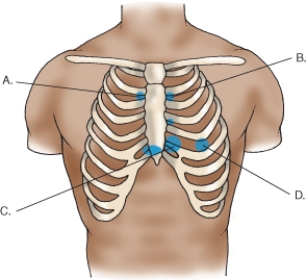
A) Location A
B) Location B
C) Location C
D) Location D
A) Location A
B) Location B
C) Location C
D) Location D
Question
Question
Question
Question
Question
Question
Question
Question

Unlock Deck
Sign up to unlock the cards in this deck!
Unlock Deck
Unlock Deck
1/27

Play

Full screen (f)
Deck 33: Assessment of the Cardiovascular System
1
A nurse assesses a client who is recovering from a myocardial infarction.The client's pulmonary artery pressure reading is 25/12 mm Hg.Which action should the nurse take first?
A) Compare the results with previous pulmonary artery pressure readings.
B) Increase the intravenous fluid rate because these readings are low.
C) Immediately notify the health care provider of the elevated pressures.
D) Document the finding in the client's chart as the only action.
A) Compare the results with previous pulmonary artery pressure readings.
B) Increase the intravenous fluid rate because these readings are low.
C) Immediately notify the health care provider of the elevated pressures.
D) Document the finding in the client's chart as the only action.
Compare the results with previous pulmonary artery pressure readings.
2
A nurse auscultated heart tones on an older adult client.Which action should the nurse take based on heart tones heard?
(Click the media button to hear the audio clip.)
A) Administer a diuretic.
B) Document the finding.
C) Decrease the IV flow rate.
D) Evaluate the client's medications.
(Click the media button to hear the audio clip.)
A) Administer a diuretic.
B) Document the finding.
C) Decrease the IV flow rate.
D) Evaluate the client's medications.
Document the finding.
3
A nurse cares for a client who is recovering from a myocardial infarction.The client states,"I will need to stop eating so much chili to keep that indigestion pain from returning." How should the nurse respond?
A) "Chili is high in fat and calories; it would be a good idea to stop eating it."
B) "The provider has prescribed an antacid for you to take every morning."
C) "What do you understand about what happened to you?"
D) "When did you start experiencing this indigestion?"
A) "Chili is high in fat and calories; it would be a good idea to stop eating it."
B) "The provider has prescribed an antacid for you to take every morning."
C) "What do you understand about what happened to you?"
D) "When did you start experiencing this indigestion?"
"What do you understand about what happened to you?"
4
An emergency room nurse obtains the health history of a client.Which statement by the client should alert the nurse to the occurrence of heart failure?
A) "I get short of breath when I climb stairs."
B) "I see halos floating around my head."
C) "I have trouble remembering things."
D) "I have lost weight over the past month."
A) "I get short of breath when I climb stairs."
B) "I see halos floating around my head."
C) "I have trouble remembering things."
D) "I have lost weight over the past month."
Unlock Deck
Unlock for access to all 27 flashcards in this deck.
Unlock Deck
k this deck
5
A nurse cares for a client who has an 80% blockage of the right coronary artery (RCA)and is scheduled for bypass surgery.Which intervention should the nurse be prepared to implement while this client waits for surgery?
A) Administration of IV furosemide (Lasix)
B) Initiation of an external pacemaker
C) Assistance with endotracheal intubation
D) Placement of central venous access
A) Administration of IV furosemide (Lasix)
B) Initiation of an external pacemaker
C) Assistance with endotracheal intubation
D) Placement of central venous access
Unlock Deck
Unlock for access to all 27 flashcards in this deck.
Unlock Deck
k this deck
6
A nurse assesses a client who is scheduled for a cardiac catheterization.Which assessment should the nurse complete prior to this procedure?
A) Client's level of anxiety
B) Ability to turn self in bed
C) Cardiac rhythm and heart rate
D) Allergies to iodine-based agents
A) Client's level of anxiety
B) Ability to turn self in bed
C) Cardiac rhythm and heart rate
D) Allergies to iodine-based agents
Unlock Deck
Unlock for access to all 27 flashcards in this deck.
Unlock Deck
k this deck
7
A nurse assesses a client who had a myocardial infarction and is hypotensive.Which additional assessment finding should the nurse expect?
A) Heart rate of 120 beats/min
B) Cool, clammy skin
C) Oxygen saturation of 90%
D) Respiratory rate of 8 breaths/min
A) Heart rate of 120 beats/min
B) Cool, clammy skin
C) Oxygen saturation of 90%
D) Respiratory rate of 8 breaths/min
Unlock Deck
Unlock for access to all 27 flashcards in this deck.
Unlock Deck
k this deck
8
A nurse assesses an older adult client who has multiple chronic diseases.The client's heart rate is 48 beats/min.Which action should the nurse take first?
A) Document the finding in the chart.
B) Initiate external pacing.
C) Assess the client's medications.
D) Administer 1 mg of atropine.
A) Document the finding in the chart.
B) Initiate external pacing.
C) Assess the client's medications.
D) Administer 1 mg of atropine.
Unlock Deck
Unlock for access to all 27 flashcards in this deck.
Unlock Deck
k this deck
9
A nurse cares for a client who has advanced cardiac disease and states,"I am having trouble sleeping at night." How should the nurse respond?
A) "I will consult the provider to prescribe a sleep study to determine the problem."
B) "You become hypoxic while sleeping; oxygen therapy via nasal cannula will help."
C) "A continuous positive airway pressure, or CPAP, breathing mask will help you breathe at night."
D) "Use pillows to elevate your head and chest while you are sleeping."
A) "I will consult the provider to prescribe a sleep study to determine the problem."
B) "You become hypoxic while sleeping; oxygen therapy via nasal cannula will help."
C) "A continuous positive airway pressure, or CPAP, breathing mask will help you breathe at night."
D) "Use pillows to elevate your head and chest while you are sleeping."
Unlock Deck
Unlock for access to all 27 flashcards in this deck.
Unlock Deck
k this deck
10
A nurse assesses a client who is recovering after a left-sided cardiac catheterization.Which assessment finding requires immediate intervention?
A) Urinary output less than intake
B) Bruising at the insertion site
C) Slurred speech and confusion
D) Discomfort in the left leg
A) Urinary output less than intake
B) Bruising at the insertion site
C) Slurred speech and confusion
D) Discomfort in the left leg
Unlock Deck
Unlock for access to all 27 flashcards in this deck.
Unlock Deck
k this deck
11
A nurse teaches a client with diabetes mellitus and a body mass index of 42 who is at high risk for coronary artery disease.Which statement related to nutrition should the nurse include in this client's teaching?
A) "The best way to lose weight is a high-protein, low-carbohydrate diet."
B) "You should balance weight loss with consuming necessary nutrients."
C) "A nutritionist will provide you with information about your new diet."
D) "If you exercise more frequently, you won't need to change your diet."
A) "The best way to lose weight is a high-protein, low-carbohydrate diet."
B) "You should balance weight loss with consuming necessary nutrients."
C) "A nutritionist will provide you with information about your new diet."
D) "If you exercise more frequently, you won't need to change your diet."
Unlock Deck
Unlock for access to all 27 flashcards in this deck.
Unlock Deck
k this deck
12
An emergency department nurse triages clients who present with chest discomfort.Which client should the nurse plan to assess first?
A) A 42-year-old female who describes her pain as a dull ache with numbness in her fingers
B) A 49-year-old male who reports moderate pain that is worse on inspiration
C) A 53-year-old female who reports substernal pain that radiates to her abdomen
D) A 58-year-old male who describes his pain as intense stabbing that spreads across his chest
A) A 42-year-old female who describes her pain as a dull ache with numbness in her fingers
B) A 49-year-old male who reports moderate pain that is worse on inspiration
C) A 53-year-old female who reports substernal pain that radiates to her abdomen
D) A 58-year-old male who describes his pain as intense stabbing that spreads across his chest
Unlock Deck
Unlock for access to all 27 flashcards in this deck.
Unlock Deck
k this deck
13
A nurse assesses clients on a medical-surgical unit.Which client should the nurse identify as having the greatest risk for cardiovascular disease?
A) An 86-year-old man with a history of asthma
B) A 32-year-old Asian-American man with colorectal cancer
C) A 45-year-old American Indian woman with diabetes mellitus
D) A 53-year-old postmenopausal woman who is on hormone therapy
A) An 86-year-old man with a history of asthma
B) A 32-year-old Asian-American man with colorectal cancer
C) A 45-year-old American Indian woman with diabetes mellitus
D) A 53-year-old postmenopausal woman who is on hormone therapy
Unlock Deck
Unlock for access to all 27 flashcards in this deck.
Unlock Deck
k this deck
14
A nurse assesses an older adult client who is experiencing a myocardial infarction.Which clinical manifestation should the nurse expect?
A) Excruciating pain on inspiration
B) Left lateral chest wall pain
C) Disorientation and confusion
D) Numbness and tingling of the arm
A) Excruciating pain on inspiration
B) Left lateral chest wall pain
C) Disorientation and confusion
D) Numbness and tingling of the arm
Unlock Deck
Unlock for access to all 27 flashcards in this deck.
Unlock Deck
k this deck
15
A nurse cares for a client who is prescribed magnetic resonance imaging (MRI)of the heart.The client's health history includes a previous myocardial infarction and pacemaker implantation.Which action should the nurse take?
A) Schedule an electrocardiogram just before the MRI.
B) Notify the health care provider before scheduling the MRI.
C) Call the physician and request a laboratory draw for cardiac enzymes.
D) Instruct the client to increase fluid intake the day before the MRI.
A) Schedule an electrocardiogram just before the MRI.
B) Notify the health care provider before scheduling the MRI.
C) Call the physician and request a laboratory draw for cardiac enzymes.
D) Instruct the client to increase fluid intake the day before the MRI.
Unlock Deck
Unlock for access to all 27 flashcards in this deck.
Unlock Deck
k this deck
16
A nurse prepares a client for coronary artery bypass graft surgery.The client states,"I am afraid I might die." How should the nurse respond?
A) "This is a routine surgery and the risk of death is very low."
B) "Would you like to speak with a chaplain prior to surgery?"
C) "Tell me more about your concerns about the surgery."
D) "What support systems do you have to assist you?"
A) "This is a routine surgery and the risk of death is very low."
B) "Would you like to speak with a chaplain prior to surgery?"
C) "Tell me more about your concerns about the surgery."
D) "What support systems do you have to assist you?"
Unlock Deck
Unlock for access to all 27 flashcards in this deck.
Unlock Deck
k this deck
17
A nurse obtains the health history of a client who is newly admitted to the medical unit.Which statement by the client should alert the nurse to the presence of edema?
A) "I wake up to go to the bathroom at night."
B) "My shoes fit tighter by the end of the day."
C) "I seem to be feeling more anxious lately."
D) "I drink at least eight glasses of water a day."
A) "I wake up to go to the bathroom at night."
B) "My shoes fit tighter by the end of the day."
C) "I seem to be feeling more anxious lately."
D) "I drink at least eight glasses of water a day."
Unlock Deck
Unlock for access to all 27 flashcards in this deck.
Unlock Deck
k this deck
18
A nurse assesses a client after administering a prescribed beta blocker.Which assessment should the nurse expect to find?
A) Blood pressure increased from 98/42 mm Hg to 132/60 mm Hg
B) Respiratory rate decreased from 25 breaths/min to 14 breaths/min
C) Oxygen saturation increased from 88% to 96%
D) Pulse decreased from 100 beats/min to 80 beats/min
A) Blood pressure increased from 98/42 mm Hg to 132/60 mm Hg
B) Respiratory rate decreased from 25 breaths/min to 14 breaths/min
C) Oxygen saturation increased from 88% to 96%
D) Pulse decreased from 100 beats/min to 80 beats/min
Unlock Deck
Unlock for access to all 27 flashcards in this deck.
Unlock Deck
k this deck
19
A nurse assesses a client who has aortic regurgitation.In which location in the illustration shown below should the nurse auscultate to best hear a cardiac murmur related to aortic regurgitation?
A) Location A
B) Location B
C) Location C
D) Location D
A) Location A
B) Location B
C) Location C
D) Location D
Unlock Deck
Unlock for access to all 27 flashcards in this deck.
Unlock Deck
k this deck
20
A nurse assesses a client 2 hours after a cardiac angiography via the left femoral artery.The nurse notes that the left pedal pulse is weak.Which action should the nurse take?
A) Elevate the leg and apply a sandbag to the entrance site.
B) Increase the flow rate of intravenous fluids.
C) Assess the color and temperature of the left leg.
D) Document the finding as "left pedal pulse of +1/4."
A) Elevate the leg and apply a sandbag to the entrance site.
B) Increase the flow rate of intravenous fluids.
C) Assess the color and temperature of the left leg.
D) Document the finding as "left pedal pulse of +1/4."
Unlock Deck
Unlock for access to all 27 flashcards in this deck.
Unlock Deck
k this deck
21
An emergency room nurse assesses a female client.Which assessment findings should alert the nurse to request a prescription for an electrocardiogram? (Select all that apply.)
A) Hypertension
B) Fatigue despite adequate rest
C) Indigestion
D) Abdominal pain
E) Shortness of breath
A) Hypertension
B) Fatigue despite adequate rest
C) Indigestion
D) Abdominal pain
E) Shortness of breath
Unlock Deck
Unlock for access to all 27 flashcards in this deck.
Unlock Deck
k this deck
22
A nurse prepares a client for a pharmacologic stress echocardiogram.Which actions should the nurse take when preparing this client for the procedure? (Select all that apply.)
A) Assist the provider to place a central venous access device.
B) Prepare for continuous blood pressure and pulse monitoring.
C) Administer the client's prescribed beta blocker.
D) Give the client nothing by mouth 3 to 6 hours before the procedure.
E) Explain to the client that dobutamine will simulate exercise for this examination.
A) Assist the provider to place a central venous access device.
B) Prepare for continuous blood pressure and pulse monitoring.
C) Administer the client's prescribed beta blocker.
D) Give the client nothing by mouth 3 to 6 hours before the procedure.
E) Explain to the client that dobutamine will simulate exercise for this examination.
Unlock Deck
Unlock for access to all 27 flashcards in this deck.
Unlock Deck
k this deck
23
A nurse cares for a client who is recovering from a right-sided heart catheterization.For which complications of this procedure should the nurse assess? (Select all that apply.)
A) Thrombophlebitis
B) Stroke
C) Pulmonary embolism
D) Myocardial infarction
E) Cardiac tamponade
A) Thrombophlebitis
B) Stroke
C) Pulmonary embolism
D) Myocardial infarction
E) Cardiac tamponade
Unlock Deck
Unlock for access to all 27 flashcards in this deck.
Unlock Deck
k this deck
24
A nurse prepares a client with acute renal insufficiency for a cardiac catheterization.The provider prescribes 0.9% normal saline to infuse at 125 mL/hr for renal protection.The nurse obtains gravity tubing with a drip rate of 15 drops/mL.At what rate (drops/min)should the nurse infuse the fluids? (Record your answer using a whole number,and rounding to the nearest drop.)_____ drops/min
Unlock Deck
Unlock for access to all 27 flashcards in this deck.
Unlock Deck
k this deck
25
A nurse reviews a client's laboratory results.Which findings should alert the nurse to the possibility of atherosclerosis? (Select all that apply.)
A) Total cholesterol: 280 mg/dL
B) High-density lipoprotein cholesterol: 50 mg/dL
C) Triglycerides: 200 mg/dL
D) Serum albumin: 4 g/dL
E) Low-density lipoprotein cholesterol: 160 mg/dL
A) Total cholesterol: 280 mg/dL
B) High-density lipoprotein cholesterol: 50 mg/dL
C) Triglycerides: 200 mg/dL
D) Serum albumin: 4 g/dL
E) Low-density lipoprotein cholesterol: 160 mg/dL
Unlock Deck
Unlock for access to all 27 flashcards in this deck.
Unlock Deck
k this deck
26
A nurse is caring for a client with a history of renal insufficiency who is scheduled for a cardiac catheterization.Which actions should the nurse take prior to the catheterization? (Select all that apply.)
A) Assess for allergies to iodine.
B) Administer intravenous fluids.
C) Assess blood urea nitrogen (BUN) and creatinine results.
D) Insert a Foley catheter.
E) Administer a prophylactic antibiotic.
A) Assess for allergies to iodine.
B) Administer intravenous fluids.
C) Assess blood urea nitrogen (BUN) and creatinine results.
D) Insert a Foley catheter.
E) Administer a prophylactic antibiotic.
Unlock Deck
Unlock for access to all 27 flashcards in this deck.
Unlock Deck
k this deck
27
A nurse assesses a client who is recovering after a coronary catheterization.Which assessment findings in the first few hours after the procedure require immediate action by the nurse? (Select all that apply.)
A) Blood pressure of 140/88 mm Hg
B) Serum potassium of 2.9 mEq/L
C) Warmth and redness at the site
D) Expanding groin hematoma
E) Rhythm changes on the cardiac monitor
A) Blood pressure of 140/88 mm Hg
B) Serum potassium of 2.9 mEq/L
C) Warmth and redness at the site
D) Expanding groin hematoma
E) Rhythm changes on the cardiac monitor
Unlock Deck
Unlock for access to all 27 flashcards in this deck.
Unlock Deck
k this deck
Unlock Deck
Unlock for access to all 27 flashcards in this deck.






