







 Chat with AI

Deck 41: Assessment of the Nervous System
Full screen (f)

Question

Question
Question
Question
Question
Question
Question
Question
Question
Question
Question
Question
Question
Question
Question
Question
Question
Question
Question
Question
Question
A nurse assesses a client and notes the client's position as indicated in the illustration below:
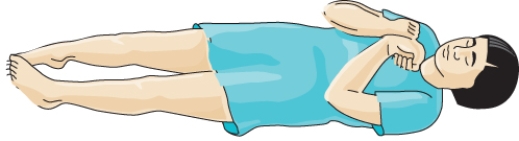
How should the nurse document this finding?
A) Decorticate posturing
B) Decerebrate posturing
C) Atypical hyperreflexia
D) Spinal cord degeneration
How should the nurse document this finding?
A) Decorticate posturing
B) Decerebrate posturing
C) Atypical hyperreflexia
D) Spinal cord degeneration
Question
Question
Question
Question
Question
A nurse assesses a client with a brain tumor.The client opens his eyes when the nurse calls his name,mumbles in response to questions,and follows simple commands.How should the nurse document this client's assessment using the Glasgow Coma Scale shown below?
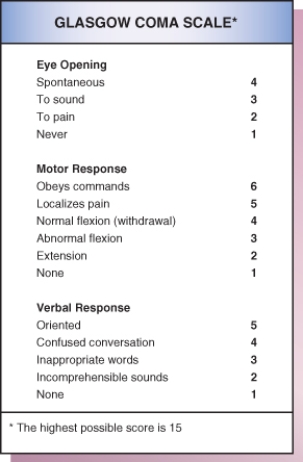
A) 8
B) 10
C) 12
D) 14
A) 8
B) 10
C) 12
D) 14
Question
Question
Question
A nurse assesses the left plantar reflexes of an adult client and notes the response shown in the photograph below:
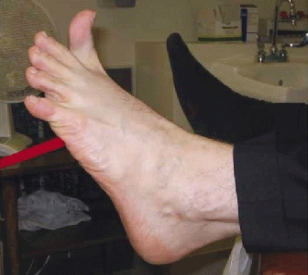
Which action should the nurse take next?
A) Contact the provider with this abnormal finding.
B) Assess bilateral legs for temperature and edema.
C) Ask the client about pain in the lower leg and calf.
D) Document the finding and continue the assessment.
Which action should the nurse take next?
A) Contact the provider with this abnormal finding.
B) Assess bilateral legs for temperature and edema.
C) Ask the client about pain in the lower leg and calf.
D) Document the finding and continue the assessment.
Question

Unlock Deck
Sign up to unlock the cards in this deck!
Unlock Deck
Unlock Deck
1/30

Play

Full screen (f)
Deck 41: Assessment of the Nervous System
1
A nurse performs an assessment of pain discrimination on an older adult client.The client correctly identifies,with eyes closed,a sharp sensation on the right hand when touched with a pin.Which action should the nurse take next?
A) Touch the pin on the same area of the left hand.
B) Contact the provider with the assessment results.
C) Ask the client about current medications.
D) Continue the assessment on the client's feet.
A) Touch the pin on the same area of the left hand.
B) Contact the provider with the assessment results.
C) Ask the client about current medications.
D) Continue the assessment on the client's feet.
Touch the pin on the same area of the left hand.
2
A nurse asks a client to take deep breaths during an electroencephalography.The client asks,"Why are you asking me to do this?" How should the nurse respond?
A) "Hyperventilation causes vascular dilation of cerebral arteries, which decreases electoral activity in the brain."
B) "Deep breathing helps you to relax and allows the electroencephalograph to obtain a better waveform."
C) "Hyperventilation causes cerebral vasoconstriction and increases the likelihood of seizure activity."
D) "Deep breathing will help you to blow off carbon dioxide and decreases intracranial pressures."
A) "Hyperventilation causes vascular dilation of cerebral arteries, which decreases electoral activity in the brain."
B) "Deep breathing helps you to relax and allows the electroencephalograph to obtain a better waveform."
C) "Hyperventilation causes cerebral vasoconstriction and increases the likelihood of seizure activity."
D) "Deep breathing will help you to blow off carbon dioxide and decreases intracranial pressures."
"Hyperventilation causes cerebral vasoconstriction and increases the likelihood of seizure activity."
3
A nurse assesses a client who demonstrates a positive Romberg's sign with eyes closed but not with eyes open.Which condition does the nurse associate with this finding?
A) Difficulty with proprioception
B) Peripheral motor disorder
C) Impaired cerebellar function
D) Positive pronator drift
A) Difficulty with proprioception
B) Peripheral motor disorder
C) Impaired cerebellar function
D) Positive pronator drift
Difficulty with proprioception
4
After teaching a client who is scheduled for magnetic resonance imaging (MRI),the nurse assesses the client's understanding.Which client statement indicates a correct understanding of the teaching?
A) "I must increase my fluids because of the dye used for the MRI."
B) "My urine will be radioactive so I should not share a bathroom."
C) "I can return to my usual activities immediately after the MRI."
D) "My gag reflex will be tested before I can eat or drink anything."
A) "I must increase my fluids because of the dye used for the MRI."
B) "My urine will be radioactive so I should not share a bathroom."
C) "I can return to my usual activities immediately after the MRI."
D) "My gag reflex will be tested before I can eat or drink anything."
Unlock Deck
Unlock for access to all 30 flashcards in this deck.
Unlock Deck
k this deck
5
A nurse delegates care to the unlicensed assistive personnel (UAP).Which statement should the nurse include when delegating care for a client with cranial nerve II impairment?
A) "Tell the client where food items are on the breakfast tray."
B) "Place the client in a high-Fowler's position for all meals."
C) "Make sure the client's food is visually appetizing."
D) "Assist the client by placing the fork in the left hand."
A) "Tell the client where food items are on the breakfast tray."
B) "Place the client in a high-Fowler's position for all meals."
C) "Make sure the client's food is visually appetizing."
D) "Assist the client by placing the fork in the left hand."
Unlock Deck
Unlock for access to all 30 flashcards in this deck.
Unlock Deck
k this deck
6
A nurse assesses a client's recent memory.Which client statement confirms that the client's remote memory is intact?
A) "A young girl wrapped in a shroud fell asleep on a bed of clouds."
B) "I was born on April 3, 1967, in Johnstown Community Hospital."
C) "Apple, chair, and pencil are the words you just stated."
D) "I ate oatmeal with wheat toast and orange juice for breakfast."
A) "A young girl wrapped in a shroud fell asleep on a bed of clouds."
B) "I was born on April 3, 1967, in Johnstown Community Hospital."
C) "Apple, chair, and pencil are the words you just stated."
D) "I ate oatmeal with wheat toast and orange juice for breakfast."
Unlock Deck
Unlock for access to all 30 flashcards in this deck.
Unlock Deck
k this deck
7
A nurse prepares to teach a client who has experienced damage to the left temporal lobe of the brain.Which action should the nurse take when providing education about newly prescribed medications to this client?
A) Help the client identify each medication by its color.
B) Provide written materials with large print size.
C) Sit on the client's right side and speak into the right ear.
D) Allow the client to use a white board to ask questions.
A) Help the client identify each medication by its color.
B) Provide written materials with large print size.
C) Sit on the client's right side and speak into the right ear.
D) Allow the client to use a white board to ask questions.
Unlock Deck
Unlock for access to all 30 flashcards in this deck.
Unlock Deck
k this deck
8
A nurse plans care for an 83-year-old client who is experiencing age-related sensory perception changes.Which intervention should the nurse include in this client's plan of care?
A) Provide a call button that requires only minimal pressure to activate.
B) Write the date on the client's white board to promote orientation.
C) Ensure that the path to the bathroom is free from equipment.
D) Encourage the client to season food to stimulate nutritional intake.
A) Provide a call button that requires only minimal pressure to activate.
B) Write the date on the client's white board to promote orientation.
C) Ensure that the path to the bathroom is free from equipment.
D) Encourage the client to season food to stimulate nutritional intake.
Unlock Deck
Unlock for access to all 30 flashcards in this deck.
Unlock Deck
k this deck
9
A nurse obtains a focused health history for a client who is scheduled for magnetic resonance imaging (MRI).Which condition should alert the nurse to contact the provider and cancel the procedure?
A) Creatine phosphokinase (CPK) of 100 IU/L
B) Atrioventricular graft
C) Blood urea nitrogen (BUN) of 50 mg/dL
D) Internal insulin pump
A) Creatine phosphokinase (CPK) of 100 IU/L
B) Atrioventricular graft
C) Blood urea nitrogen (BUN) of 50 mg/dL
D) Internal insulin pump
Unlock Deck
Unlock for access to all 30 flashcards in this deck.
Unlock Deck
k this deck
10
A nurse cares for a client who is experiencing deteriorating neurologic functions.The client states,"I am worried I will not be able to care for my young children." How should the nurse respond?
A) "Caring for your children is a priority.You may not want to ask for help, but you have to."
B) "Our community has resources that may help you with some household tasks so you have energy to care for your children."
C) "You seem distressed.Would you like to talk to a psychologist about adjusting to your changing status?"
D) "Give me more information about what worries you, so we can see if we can do something to make adjustments."
A) "Caring for your children is a priority.You may not want to ask for help, but you have to."
B) "Our community has resources that may help you with some household tasks so you have energy to care for your children."
C) "You seem distressed.Would you like to talk to a psychologist about adjusting to your changing status?"
D) "Give me more information about what worries you, so we can see if we can do something to make adjustments."
Unlock Deck
Unlock for access to all 30 flashcards in this deck.
Unlock Deck
k this deck
11
A nurse obtains a focused health history for a client who is scheduled for magnetic resonance angiography.Which priority question should the nurse ask before the test?
A) "Have you had a recent blood transfusion?"
B) "Do you have allergies to iodine or shellfish?"
C) "Are you taking any cardiac medications?"
D) "Do you currently use oral contraceptives?"
A) "Have you had a recent blood transfusion?"
B) "Do you have allergies to iodine or shellfish?"
C) "Are you taking any cardiac medications?"
D) "Do you currently use oral contraceptives?"
Unlock Deck
Unlock for access to all 30 flashcards in this deck.
Unlock Deck
k this deck
12
A nurse teaches an 80-year-old client with diminished touch sensation.Which statement should the nurse include in this client's teaching?
A) "Place soft rugs in your bathroom to decrease pain in your feet."
B) "Bathe in warm water to increase your circulation."
C) "Look at the placement of your feet when walking."
D) "Walk barefoot to decrease pressure ulcers from your shoes."
A) "Place soft rugs in your bathroom to decrease pain in your feet."
B) "Bathe in warm water to increase your circulation."
C) "Look at the placement of your feet when walking."
D) "Walk barefoot to decrease pressure ulcers from your shoes."
Unlock Deck
Unlock for access to all 30 flashcards in this deck.
Unlock Deck
k this deck
13
A nurse assesses a client who is recovering from a lumbar puncture (LP).Which complication of this procedure should alert the nurse to urgently contact the health care provider?
A) Weak pedal pulses
B) Nausea and vomiting
C) Increased thirst
D) Hives on the chest
A) Weak pedal pulses
B) Nausea and vomiting
C) Increased thirst
D) Hives on the chest
Unlock Deck
Unlock for access to all 30 flashcards in this deck.
Unlock Deck
k this deck
14
A nurse cares for a client who is recovering from a single-photon emission computed tomography (SPECT)with a radiopharmaceutical agent.Which statement should the nurse include when discussing the plan of care with this client?
A) "You may return to your previous activity level immediately."
B) "You are radioactive and must use a private bathroom."
C) "Frequent assessments of the injection site will be completed."
D) "We will be monitoring your renal functions closely."
A) "You may return to your previous activity level immediately."
B) "You are radioactive and must use a private bathroom."
C) "Frequent assessments of the injection site will be completed."
D) "We will be monitoring your renal functions closely."
Unlock Deck
Unlock for access to all 30 flashcards in this deck.
Unlock Deck
k this deck
15
A nurse teaches a client who is scheduled for a positron emission tomography scan of the brain.Which statement should the nurse include in this client's teaching?
A) "Avoid caffeine-containing substances for 12 hours before the test."
B) "Drink at least 3 liters of fluid during the first 24 hours after the test."
C) "Do not take your cardiac medication the morning of the test."
D) "Remove your dentures and any metal before the test begins."
A) "Avoid caffeine-containing substances for 12 hours before the test."
B) "Drink at least 3 liters of fluid during the first 24 hours after the test."
C) "Do not take your cardiac medication the morning of the test."
D) "Remove your dentures and any metal before the test begins."
Unlock Deck
Unlock for access to all 30 flashcards in this deck.
Unlock Deck
k this deck
16
A nurse plans care for a client who has a hypoactive response to a test of deep tendon reflexes.Which intervention should the nurse include in this client's plan of care?
A) Check bath water temperature with a thermometer.
B) Provide the client with assistance when ambulating.
C) Place elastic support hose on the client's legs.
D) Assess the client's feet for wounds each shift.
A) Check bath water temperature with a thermometer.
B) Provide the client with assistance when ambulating.
C) Place elastic support hose on the client's legs.
D) Assess the client's feet for wounds each shift.
Unlock Deck
Unlock for access to all 30 flashcards in this deck.
Unlock Deck
k this deck
17
A nurse is teaching a client with cerebellar function impairment.Which statement should the nurse include in this client's discharge teaching?
A) "Connect a light to flash when your door bell rings."
B) "Label your faucet knobs with hot and cold signs."
C) "Ask a friend to drive you to your follow-up appointments."
D) "Use a natural gas detector with an audible alarm."
A) "Connect a light to flash when your door bell rings."
B) "Label your faucet knobs with hot and cold signs."
C) "Ask a friend to drive you to your follow-up appointments."
D) "Use a natural gas detector with an audible alarm."
Unlock Deck
Unlock for access to all 30 flashcards in this deck.
Unlock Deck
k this deck
18
A nurse prepares a client for lumbar puncture (LP).Which assessment finding should alert the nurse to contact the health care provider?
A) Shingles on the client's back
B) Client is claustrophobic
C) Absence of intravenous access
D) Paroxysmal nocturnal dyspnea
A) Shingles on the client's back
B) Client is claustrophobic
C) Absence of intravenous access
D) Paroxysmal nocturnal dyspnea
Unlock Deck
Unlock for access to all 30 flashcards in this deck.
Unlock Deck
k this deck
19
A nurse is caring for a client with a history of renal insufficiency who is scheduled for a computed tomography scan of the head with contrast medium.Which priority intervention should the nurse implement?
A) Educate the client about strict bedrest after the procedure.
B) Place an indwelling urinary catheter to closely monitor output.
C) Obtain a prescription for intravenous fluids.
D) Contact the provider to cancel the procedure.
A) Educate the client about strict bedrest after the procedure.
B) Place an indwelling urinary catheter to closely monitor output.
C) Obtain a prescription for intravenous fluids.
D) Contact the provider to cancel the procedure.
Unlock Deck
Unlock for access to all 30 flashcards in this deck.
Unlock Deck
k this deck
20
A nurse assesses a client recovering from a cerebral angiography via the client's right femoral artery.Which assessment should the nurse complete?
A) Palpate bilateral lower extremity pulses.
B) Obtain orthostatic blood pressure readings.
C) Perform a funduscopic examination.
D) Assess the gag reflex prior to eating.
A) Palpate bilateral lower extremity pulses.
B) Obtain orthostatic blood pressure readings.
C) Perform a funduscopic examination.
D) Assess the gag reflex prior to eating.
Unlock Deck
Unlock for access to all 30 flashcards in this deck.
Unlock Deck
k this deck
21
A nurse assesses a client and notes the client's position as indicated in the illustration below:
How should the nurse document this finding?
A) Decorticate posturing
B) Decerebrate posturing
C) Atypical hyperreflexia
D) Spinal cord degeneration
How should the nurse document this finding?
A) Decorticate posturing
B) Decerebrate posturing
C) Atypical hyperreflexia
D) Spinal cord degeneration
Unlock Deck
Unlock for access to all 30 flashcards in this deck.
Unlock Deck
k this deck
22
A nurse assesses a client with a brain tumor.Which newly identified assessment findings should alert the nurse to urgently communicate with the health care provider? (Select all that apply.)
A) Glasgow Coma Scale score of 8
B) Decerebrate posturing
C) Reactive pupils
D) Uninhibited speech
E) Diminished cognition
A) Glasgow Coma Scale score of 8
B) Decerebrate posturing
C) Reactive pupils
D) Uninhibited speech
E) Diminished cognition
Unlock Deck
Unlock for access to all 30 flashcards in this deck.
Unlock Deck
k this deck
23
A nurse assesses an older client.Which assessment findings should the nurse identify as normal changes in the nervous system related to aging? (Select all that apply.)
A) Long-term memory loss
B) Slower processing time
C) Increased sensory perception
D) Decreased risk for infection
E) Change in sleep patterns
A) Long-term memory loss
B) Slower processing time
C) Increased sensory perception
D) Decreased risk for infection
E) Change in sleep patterns
Unlock Deck
Unlock for access to all 30 flashcards in this deck.
Unlock Deck
k this deck
24
An emergency department nurse assesses a client who was struck in the temporal lobe with a baseball.For which clinical manifestations that are related to a temporal lobe injury should the nurse assess? (Select all that apply.)
A) Memory loss
B) Personality changes
C) Difficulty with sound interpretation
D) Speech difficulties
E) Impaired taste
A) Memory loss
B) Personality changes
C) Difficulty with sound interpretation
D) Speech difficulties
E) Impaired taste
Unlock Deck
Unlock for access to all 30 flashcards in this deck.
Unlock Deck
k this deck
25
A nurse delegates care for an older adult client to the unlicensed assistive personnel (UAP).Which statements should the nurse include when delegating this client's care? (Select all that apply.)
A) "Plan to bathe the client in the evening when the client is most alert."
B) "Encourage the client to use a cane when ambulating."
C) "Assess the client for symptoms related to pain and discomfort."
D) "Remind the client to look at foot placement when walking."
E) "Schedule additional time for teaching about prescribed therapies."
A) "Plan to bathe the client in the evening when the client is most alert."
B) "Encourage the client to use a cane when ambulating."
C) "Assess the client for symptoms related to pain and discomfort."
D) "Remind the client to look at foot placement when walking."
E) "Schedule additional time for teaching about prescribed therapies."
Unlock Deck
Unlock for access to all 30 flashcards in this deck.
Unlock Deck
k this deck
26
A nurse assesses a client with a brain tumor.The client opens his eyes when the nurse calls his name,mumbles in response to questions,and follows simple commands.How should the nurse document this client's assessment using the Glasgow Coma Scale shown below?
A) 8
B) 10
C) 12
D) 14
A) 8
B) 10
C) 12
D) 14
Unlock Deck
Unlock for access to all 30 flashcards in this deck.
Unlock Deck
k this deck
27
After administering a medication that stimulates the sympathetic division of the autonomic nervous system,the nurse assesses the client.For which clinical manifestations should the nurse assess? (Select all that apply.)
A) Decreased respiratory rate
B) Increased heart rate
C) Decreased level of consciousness
D) Increased force of contraction
E) Decreased blood pressure
A) Decreased respiratory rate
B) Increased heart rate
C) Decreased level of consciousness
D) Increased force of contraction
E) Decreased blood pressure
Unlock Deck
Unlock for access to all 30 flashcards in this deck.
Unlock Deck
k this deck
28
A nurse assesses a client with an injury to the medulla.Which clinical manifestations should the nurse expect to find? (Select all that apply.)
A) Loss of smell
B) Impaired swallowing
C) Visual changes
D) Inability to shrug shoulders
E) Loss of gag reflex
A) Loss of smell
B) Impaired swallowing
C) Visual changes
D) Inability to shrug shoulders
E) Loss of gag reflex
Unlock Deck
Unlock for access to all 30 flashcards in this deck.
Unlock Deck
k this deck
29
A nurse assesses the left plantar reflexes of an adult client and notes the response shown in the photograph below:
Which action should the nurse take next?
A) Contact the provider with this abnormal finding.
B) Assess bilateral legs for temperature and edema.
C) Ask the client about pain in the lower leg and calf.
D) Document the finding and continue the assessment.
Which action should the nurse take next?
A) Contact the provider with this abnormal finding.
B) Assess bilateral legs for temperature and edema.
C) Ask the client about pain in the lower leg and calf.
D) Document the finding and continue the assessment.
Unlock Deck
Unlock for access to all 30 flashcards in this deck.
Unlock Deck
k this deck
30
A nurse is caring for a client who is prescribed a computed tomography (CT)scan with iodine-based contrast.Which actions should the nurse take to prepare the client for this procedure? (Select all that apply.)
A) Ensure that an informed consent is present.
B) Ask the client about any allergies.
C) Evaluate the client's renal function.
D) Auscultate bilateral breath sounds.
E) Assess hematocrit and hemoglobin levels.
A) Ensure that an informed consent is present.
B) Ask the client about any allergies.
C) Evaluate the client's renal function.
D) Auscultate bilateral breath sounds.
E) Assess hematocrit and hemoglobin levels.
Unlock Deck
Unlock for access to all 30 flashcards in this deck.
Unlock Deck
k this deck
Unlock Deck
Unlock for access to all 30 flashcards in this deck.






