







 Chat with AI

Deck 13: Factor Analysis and Internal Consistency Reliability Analysis
Full screen (f)

Question

Question
Question
Question
Question
Question
Question
Question
Question
Question
Question
Question
Question
Question
Question
Question
Question
Question
Question
Question
Question
Question
Question
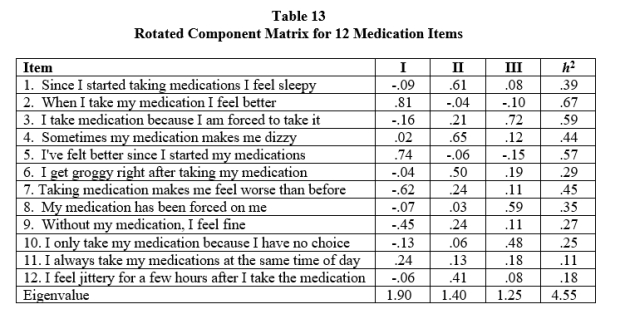
Questions pertain to the following table (Table 13), which presents results for a fictitious factor analysis of items relating to patients' use of medications.
-Refer to Table 13. What type of analysis is being reported in this table?
A) A principal axis factor analysis
B) An unweighted least-squares factor analysis
C) A PCA
D) It cannot be determined.
-Refer to Table 13. What type of analysis is being reported in this table?
A) A principal axis factor analysis
B) An unweighted least-squares factor analysis
C) A PCA
D) It cannot be determined.
Question
Questions pertain to the following table (Table 13), which presents results for a fictitious factor analysis of items relating to patients' use of medications.
-Refer to Table 13. Which method of factor rotation was used in this analysis?
A) Quartimax
B) Equimax
C) Varimax
D) It cannot be determined.
-Refer to Table 13. Which method of factor rotation was used in this analysis?
A) Quartimax
B) Equimax
C) Varimax
D) It cannot be determined.
Question
Questions pertain to the following table (Table 13), which presents results for a fictitious factor analysis of items relating to patients' use of medications.
-Refer to Table 13. Which factor might be called "Medication side effects"?
A) I
B)II
C) III
D) None of the above
-Refer to Table 13. Which factor might be called "Medication side effects"?
A) I
B)II
C) III
D) None of the above
Question
Questions pertain to the following table (Table 13), which presents results for a fictitious factor analysis of items relating to patients' use of medications.
-Refer to Table 13. Which factor might be called "Support in the use of medications"?
A) I
B) II
C) III
D) None of the above
-Refer to Table 13. Which factor might be called "Support in the use of medications"?
A) I
B) II
C) III
D) None of the above
Question
Questions pertain to the following table (Table 13), which presents results for a fictitious factor analysis of items relating to patients' use of medications.
-Refer to Table 13. Which item would be the best candidate for dropping?
A) Item 3
B) Item 5
C) Item 7
D) Item 11
-Refer to Table 13. Which item would be the best candidate for dropping?
A) Item 3
B) Item 5
C) Item 7
D) Item 11
Question
Questions pertain to the following table (Table 13), which presents results for a fictitious factor analysis of items relating to patients' use of medications.
-Refer to Table 13. How many items would most likely be used to interpret Factor I?
A) 2 items
B) 3 items
C) 4 items
D) All 12 items
-Refer to Table 13. How many items would most likely be used to interpret Factor I?
A) 2 items
B) 3 items
C) 4 items
D) All 12 items
Question
Questions pertain to the following table (Table 13), which presents results for a fictitious factor analysis of items relating to patients' use of medications.
-Refer to Table 13. How much of total variance does Factor I account for?
A) 1.9%
B) 15.8%
C) 19.0%
D) 45.5%
-Refer to Table 13. How much of total variance does Factor I account for?
A) 1.9%
B) 15.8%
C) 19.0%
D) 45.5%
Question
Questions pertain to the following table (Table 13), which presents results for a fictitious factor analysis of items relating to patients' use of medications.
-Refer to Table 13. Which of the following statements is not true?
A) The positive and negative loadings on Factor I suggest that the dataset was not really factorable.
B) The item with the most shared variance is item 2.
C) The factor with the lowest value of Cronbach's alpha would probably be Factor III.
D) The reliability of all scales would likely be improved by adding two to three similar items for each factor.
-Refer to Table 13. Which of the following statements is not true?
A) The positive and negative loadings on Factor I suggest that the dataset was not really factorable.
B) The item with the most shared variance is item 2.
C) The factor with the lowest value of Cronbach's alpha would probably be Factor III.
D) The reliability of all scales would likely be improved by adding two to three similar items for each factor.

Unlock Deck
Sign up to unlock the cards in this deck!
Unlock Deck
Unlock Deck
1/30

Play

Full screen (f)
Deck 13: Factor Analysis and Internal Consistency Reliability Analysis
1
The fundamental purpose of exploratory factor analysis is to:
A) Test hypotheses about how variables are intercorrelated
B) Test hypotheses about whether the correlation matrix is an identity matrix
C) Shed light on the underlying dimensionality of constructs within a set of measures
D) Shed light on the reliability of a set of measures
A) Test hypotheses about how variables are intercorrelated
B) Test hypotheses about whether the correlation matrix is an identity matrix
C) Shed light on the underlying dimensionality of constructs within a set of measures
D) Shed light on the reliability of a set of measures
C
2
For each original variable in the analysis, factor analysis solves for "b weights," which are called:
A) Factor scores
B) Eigenvalues
C) Communalities
D) Factor loadings
A) Factor scores
B) Eigenvalues
C) Communalities
D) Factor loadings
D
3
A factor matrix communicates information about:
A) Relationships between a set of variables and underlying factors
B) The degree of correlation among pairs of variables in a set of variables
C) The factorability of a set of variables
D) The internal consistency reliability of a set of variables as measures of a construct
A) Relationships between a set of variables and underlying factors
B) The degree of correlation among pairs of variables in a set of variables
C) The factorability of a set of variables
D) The internal consistency reliability of a set of variables as measures of a construct
A
4
The total variance in a variable can be expressed as the sum of components that include all of the following except:
A) Common factor variance
B) Error variance
C) Rotated variance
D) Variance specific to each variable
A) Common factor variance
B) Error variance
C) Rotated variance
D) Variance specific to each variable
Unlock Deck
Unlock for access to all 30 flashcards in this deck.
Unlock Deck
k this deck
5
Which of the following is not true about communalities?
A) They are sometimes referred to as h2 .
B) They can be found on the diagonal of the anti-image correlation matrix.
C) They measure the amount of shared variance between a variable and the other variables.
D) They equal the sum of squared factor loadings on a variable.
A) They are sometimes referred to as h2 .
B) They can be found on the diagonal of the anti-image correlation matrix.
C) They measure the amount of shared variance between a variable and the other variables.
D) They equal the sum of squared factor loadings on a variable.
Unlock Deck
Unlock for access to all 30 flashcards in this deck.
Unlock Deck
k this deck
6
An eigenvalue is:
A) The sum of the squared loadings of all variables on a specified factor
B) The sum of the squared loadings of a variable for all factors
C) Always equal to 1.0 after factor extraction
D) The sum of common factor variance
A) The sum of the squared loadings of all variables on a specified factor
B) The sum of the squared loadings of a variable for all factors
C) Always equal to 1.0 after factor extraction
D) The sum of common factor variance
Unlock Deck
Unlock for access to all 30 flashcards in this deck.
Unlock Deck
k this deck
7
Which of the following steps comes first in a factor analysis?
A) Factor rotation
B) Computation of factor scores
C) Factor extraction
D) Assessment of factorability
A) Factor rotation
B) Computation of factor scores
C) Factor extraction
D) Assessment of factorability
Unlock Deck
Unlock for access to all 30 flashcards in this deck.
Unlock Deck
k this deck
8
A researcher wanted to administer a set of 15 items to study participants with the intent of factor analyzing the data. Which of the following would be especially good advice?
A) The researcher should seek a sample with as little variability as possible on the 15 items.
B) The researchers should recruit a sample of at least 150 people.
C) The researcher should consider adding more items, because 15 is too low a number to be factor analyzed.
D) The researcher should do a power analysis to minimize the risk of Type II errors.
A) The researcher should seek a sample with as little variability as possible on the 15 items.
B) The researchers should recruit a sample of at least 150 people.
C) The researcher should consider adding more items, because 15 is too low a number to be factor analyzed.
D) The researcher should do a power analysis to minimize the risk of Type II errors.
Unlock Deck
Unlock for access to all 30 flashcards in this deck.
Unlock Deck
k this deck
9
In a factor analysis, Bartlett's test of sphericity tests the null hypothesis that:
A) There is only one underlying factor (i.e., the set of variables is unidimensional)
B) The minimum eigenvalue is 1.0
C) The correlation matrix is an identity matrix with all correlations = .00
D) Sampling adequacy has not been achieved
A) There is only one underlying factor (i.e., the set of variables is unidimensional)
B) The minimum eigenvalue is 1.0
C) The correlation matrix is an identity matrix with all correlations = .00
D) Sampling adequacy has not been achieved
Unlock Deck
Unlock for access to all 30 flashcards in this deck.
Unlock Deck
k this deck
10
Which of the following about the Kaiser-Meyer-Olkin test is not true?
A) It is a way to evaluate whether there are an adequate number of people in the population.
B) Values less than .50 indicate that a factor analysis should not be undertaken.
C) Negative values are not possible.
D) The test can be used to evaluate individual variables as well as a set of variables.
A) It is a way to evaluate whether there are an adequate number of people in the population.
B) Values less than .50 indicate that a factor analysis should not be undertaken.
C) Negative values are not possible.
D) The test can be used to evaluate individual variables as well as a set of variables.
Unlock Deck
Unlock for access to all 30 flashcards in this deck.
Unlock Deck
k this deck
11
Values for individuals MSAs on original variables are found in the:
A) Unrotated factor matrix
B) Rotated factor matrix
C) Anti-image correlation matrix
D) Residual correlation matrix
A) Unrotated factor matrix
B) Rotated factor matrix
C) Anti-image correlation matrix
D) Residual correlation matrix
Unlock Deck
Unlock for access to all 30 flashcards in this deck.
Unlock Deck
k this deck
12
Which of the following methods involves an analysis of total variance, not just common factor variance?
A) Alpha method factor analysis
B) Maximum likelihood factor analysis
C) Principal axis factor analysis
D) Principal components analysis
A) Alpha method factor analysis
B) Maximum likelihood factor analysis
C) Principal axis factor analysis
D) Principal components analysis
Unlock Deck
Unlock for access to all 30 flashcards in this deck.
Unlock Deck
k this deck
13
Which of the following is not a criterion for deciding how many factors to extract and rotate?
A) Minimum eigenvalue of 1.0
B) Minimum communality of 1.0
C) Minimum of 5% explained variance
D) Abrupt change in the slope of the line in a scree plot
A) Minimum eigenvalue of 1.0
B) Minimum communality of 1.0
C) Minimum of 5% explained variance
D) Abrupt change in the slope of the line in a scree plot
Unlock Deck
Unlock for access to all 30 flashcards in this deck.
Unlock Deck
k this deck
14
The purpose of factor rotation is to:
A) Increase values of the eigenvalues
B) Increase the percentage of variance accounted for
C) Make the factor structure more interpretable
D) Increase the mathematical fit between variables and factors
A) Increase values of the eigenvalues
B) Increase the percentage of variance accounted for
C) Make the factor structure more interpretable
D) Increase the mathematical fit between variables and factors
Unlock Deck
Unlock for access to all 30 flashcards in this deck.
Unlock Deck
k this deck
15
Which of the following is true?
A) Orthogonal rotation results in factors that are uncorrelated.
B) Oblique rotation yields factors that are at 90° angles to one another.
C) Advocates for oblique rotation argue that such rotations lead to greater theoretical clarity.
D) Orthogonal rotation yields a factor correlation matrix showing correlations among the factors.
A) Orthogonal rotation results in factors that are uncorrelated.
B) Oblique rotation yields factors that are at 90° angles to one another.
C) Advocates for oblique rotation argue that such rotations lead to greater theoretical clarity.
D) Orthogonal rotation yields a factor correlation matrix showing correlations among the factors.
Unlock Deck
Unlock for access to all 30 flashcards in this deck.
Unlock Deck
k this deck
16
Which of the following is not a method of orthogonal rotation?
A) Equimax
B) Promax
C) Quartimax
D) Varimax
A) Equimax
B) Promax
C) Quartimax
D) Varimax
Unlock Deck
Unlock for access to all 30 flashcards in this deck.
Unlock Deck
k this deck
17
In oblique rotation, which of the following is used to interpret factor loadings?
A) Pattern matrix
B) Unrotated factor matrix
C) Structure matrix
D) None of the above
A) Pattern matrix
B) Unrotated factor matrix
C) Structure matrix
D) None of the above
Unlock Deck
Unlock for access to all 30 flashcards in this deck.
Unlock Deck
k this deck
18
The amount of interfactor correlation that one is willing to permit is controlled by specifying a value of:
A) Alpha
B) Beta
C) Delta
D) Epsilon
A) Alpha
B) Beta
C) Delta
D) Epsilon
Unlock Deck
Unlock for access to all 30 flashcards in this deck.
Unlock Deck
k this deck
19
Which of the following is highly useful in interpreting factor analysis results?
A) Having a variable with high loadings on two factors
B) Having a potential method factor
C) Having a factor with no loadings above .30
D) Having a marker variable with a high loading on only one factor
A) Having a variable with high loadings on two factors
B) Having a potential method factor
C) Having a factor with no loadings above .30
D) Having a marker variable with a high loading on only one factor
Unlock Deck
Unlock for access to all 30 flashcards in this deck.
Unlock Deck
k this deck
20
Which of the following is not a method of developing factor scores?
A) Anderson-Rubin method
B) Bartlett method
C) Kaiser-Meyer-Olkin method
D) Regression method
A) Anderson-Rubin method
B) Bartlett method
C) Kaiser-Meyer-Olkin method
D) Regression method
Unlock Deck
Unlock for access to all 30 flashcards in this deck.
Unlock Deck
k this deck
21
Obtained scores on an instrument seldom equal true scores because of:
A) Errors of prediction
B) Errors of measurement
C) Low factorability
D) Low validity
A) Errors of prediction
B) Errors of measurement
C) Low factorability
D) Low validity
Unlock Deck
Unlock for access to all 30 flashcards in this deck.
Unlock Deck
k this deck
22
Which of the following about Cronbach's alpha is not true?
A) It is an index of the extent to which different subparts of an instrument reliably measure the critical attribute.
B) It is an estimate of how much "true score" is present in an obtained score.
C) Its values can range from .00 to 1.00.
D) The lower its value, the more reliable the instrument is.
A) It is an index of the extent to which different subparts of an instrument reliably measure the critical attribute.
B) It is an estimate of how much "true score" is present in an obtained score.
C) Its values can range from .00 to 1.00.
D) The lower its value, the more reliable the instrument is.
Unlock Deck
Unlock for access to all 30 flashcards in this deck.
Unlock Deck
k this deck
23
Questions pertain to the following table (Table 13), which presents results for a fictitious factor analysis of items relating to patients' use of medications.
-Refer to Table 13. What type of analysis is being reported in this table?
A) A principal axis factor analysis
B) An unweighted least-squares factor analysis
C) A PCA
D) It cannot be determined.
-Refer to Table 13. What type of analysis is being reported in this table?
A) A principal axis factor analysis
B) An unweighted least-squares factor analysis
C) A PCA
D) It cannot be determined.
Unlock Deck
Unlock for access to all 30 flashcards in this deck.
Unlock Deck
k this deck
24
Questions pertain to the following table (Table 13), which presents results for a fictitious factor analysis of items relating to patients' use of medications.
-Refer to Table 13. Which method of factor rotation was used in this analysis?
A) Quartimax
B) Equimax
C) Varimax
D) It cannot be determined.
-Refer to Table 13. Which method of factor rotation was used in this analysis?
A) Quartimax
B) Equimax
C) Varimax
D) It cannot be determined.
Unlock Deck
Unlock for access to all 30 flashcards in this deck.
Unlock Deck
k this deck
25
Questions pertain to the following table (Table 13), which presents results for a fictitious factor analysis of items relating to patients' use of medications.
-Refer to Table 13. Which factor might be called "Medication side effects"?
A) I
B)II
C) III
D) None of the above
-Refer to Table 13. Which factor might be called "Medication side effects"?
A) I
B)II
C) III
D) None of the above
Unlock Deck
Unlock for access to all 30 flashcards in this deck.
Unlock Deck
k this deck
26
Questions pertain to the following table (Table 13), which presents results for a fictitious factor analysis of items relating to patients' use of medications.
-Refer to Table 13. Which factor might be called "Support in the use of medications"?
A) I
B) II
C) III
D) None of the above
-Refer to Table 13. Which factor might be called "Support in the use of medications"?
A) I
B) II
C) III
D) None of the above
Unlock Deck
Unlock for access to all 30 flashcards in this deck.
Unlock Deck
k this deck
27
Questions pertain to the following table (Table 13), which presents results for a fictitious factor analysis of items relating to patients' use of medications.
-Refer to Table 13. Which item would be the best candidate for dropping?
A) Item 3
B) Item 5
C) Item 7
D) Item 11
-Refer to Table 13. Which item would be the best candidate for dropping?
A) Item 3
B) Item 5
C) Item 7
D) Item 11
Unlock Deck
Unlock for access to all 30 flashcards in this deck.
Unlock Deck
k this deck
28
Questions pertain to the following table (Table 13), which presents results for a fictitious factor analysis of items relating to patients' use of medications.
-Refer to Table 13. How many items would most likely be used to interpret Factor I?
A) 2 items
B) 3 items
C) 4 items
D) All 12 items
-Refer to Table 13. How many items would most likely be used to interpret Factor I?
A) 2 items
B) 3 items
C) 4 items
D) All 12 items
Unlock Deck
Unlock for access to all 30 flashcards in this deck.
Unlock Deck
k this deck
29
Questions pertain to the following table (Table 13), which presents results for a fictitious factor analysis of items relating to patients' use of medications.
-Refer to Table 13. How much of total variance does Factor I account for?
A) 1.9%
B) 15.8%
C) 19.0%
D) 45.5%
-Refer to Table 13. How much of total variance does Factor I account for?
A) 1.9%
B) 15.8%
C) 19.0%
D) 45.5%
Unlock Deck
Unlock for access to all 30 flashcards in this deck.
Unlock Deck
k this deck
30
Questions pertain to the following table (Table 13), which presents results for a fictitious factor analysis of items relating to patients' use of medications.
-Refer to Table 13. Which of the following statements is not true?
A) The positive and negative loadings on Factor I suggest that the dataset was not really factorable.
B) The item with the most shared variance is item 2.
C) The factor with the lowest value of Cronbach's alpha would probably be Factor III.
D) The reliability of all scales would likely be improved by adding two to three similar items for each factor.
-Refer to Table 13. Which of the following statements is not true?
A) The positive and negative loadings on Factor I suggest that the dataset was not really factorable.
B) The item with the most shared variance is item 2.
C) The factor with the lowest value of Cronbach's alpha would probably be Factor III.
D) The reliability of all scales would likely be improved by adding two to three similar items for each factor.
Unlock Deck
Unlock for access to all 30 flashcards in this deck.
Unlock Deck
k this deck
Unlock Deck
Unlock for access to all 30 flashcards in this deck.






