







 Chat with AI

Deck 8: Timing the Geologic Record
Full screen (f)

Question
Units A, B, C, D, E, and F are sedimentary rocks. Unit G is granite.
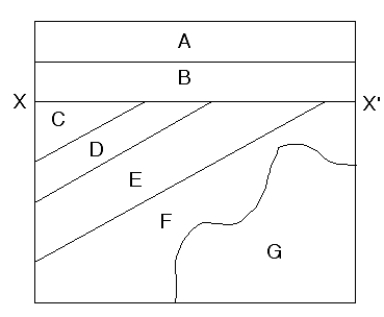
-The horizontal line labeled X-X' is a(n) ______.
A) angular unconformity
B) contour
C) cross-bed
D) fault
-The horizontal line labeled X-X' is a(n) ______.
A) angular unconformity
B) contour
C) cross-bed
D) fault

Question
Units A, B, C, D, E, and F are sedimentary rocks. Unit G is granite.
-Which of the following units is the youngest?
A) unit A
B) unit B
C) unit C
D) unit F
-Which of the following units is the youngest?
A) unit A
B) unit B
C) unit C
D) unit F
Question
Units A, B, C, D, E, and F are sedimentary rocks. Unit G is granite.
-Which of the following units is the oldest?
A) unit A
B) unit B
C) unit C
D) unit F
-Which of the following units is the oldest?
A) unit A
B) unit B
C) unit C
D) unit F
Question
Units A, B, C, D, E, and F are sedimentary rocks. Unit G is granite.
-Which of the following events happened most recently?
A) deposition of unit C
B) deposition of unit F
C) deposition of unit D
D) tilting of units C, D, E, and F
-Which of the following events happened most recently?
A) deposition of unit C
B) deposition of unit F
C) deposition of unit D
D) tilting of units C, D, E, and F
Question
Units A, B, C, D, E, and F are sedimentary rocks. Unit G is granite.
-Which of the following statements is true?
A) Deposition of unit A occurred before deposition of unit B.
B) Erosion took place prior to deposition of unit B.
C) Unit C is younger than unit A.
D) The granite is older than unit F.
-Which of the following statements is true?
A) Deposition of unit A occurred before deposition of unit B.
B) Erosion took place prior to deposition of unit B.
C) Unit C is younger than unit A.
D) The granite is older than unit F.
Question
Units A, B, C, D, and E are sedimentary rocks. The thick dark line is a fault.
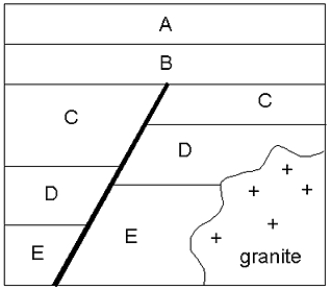
-When did faulting occur?
A) between the deposition of A and B
B) between the deposition of C and D
C) between the deposition of B and C
D) between the deposition of D and E
-When did faulting occur?
A) between the deposition of A and B
B) between the deposition of C and D
C) between the deposition of B and C
D) between the deposition of D and E
Question
Units A, B, C, D, and E are sedimentary rocks. The thick dark line is a fault.
-What is the relative timing between faulting and intrusion of the granite?
A) Faulting occurred after the intrusion of the granite.
B) Faulting occurred before the intrusion of the granite.
C) Faulting and intrusion of the granite occurred at the same time.
D) The relative timing between faulting and intrusion of the granite cannot be determined from the information provided.
-What is the relative timing between faulting and intrusion of the granite?
A) Faulting occurred after the intrusion of the granite.
B) Faulting occurred before the intrusion of the granite.
C) Faulting and intrusion of the granite occurred at the same time.
D) The relative timing between faulting and intrusion of the granite cannot be determined from the information provided.
Question
Units A, B, C, D, and E are sedimentary rocks. The thick dark line is a fault.
-Which of the following units is the oldest?
A) unit A
B) unit C
C) unit E
D) the granite
-Which of the following units is the oldest?
A) unit A
B) unit C
C) unit E
D) the granite
Question
Question
Question
Question
Question
Question
Units A, B, C, D, and F are sedimentary rocks. Unit E is an igneous rock.
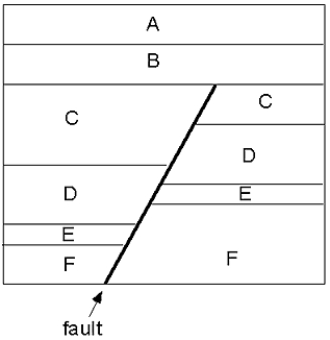
-When did the faulting occur?
A) after deposition of unit A
B) after deposition of unit C and before deposition of unit B
C) cannot be determined from the information given
-When did the faulting occur?
A) after deposition of unit A
B) after deposition of unit C and before deposition of unit B
C) cannot be determined from the information given
Question
Units A, B, C, D, and F are sedimentary rocks. Unit E is an igneous rock.
-Which of the following events happened most recently?
A) erosion of part of unit C
B) faulting
C) deposition of unit F
-Which of the following events happened most recently?
A) erosion of part of unit C
B) faulting
C) deposition of unit F
Question
Units A, B, C, D, and F are sedimentary rocks. Unit E is an igneous rock.
-Which is the oldest unit?
A) C
B) E
C) F
-Which is the oldest unit?
A) C
B) E
C) F
Question
Units A, B, C, D, and F are sedimentary rocks. Unit E is an igneous rock.
-The most likely explanation for the varying thickness of unit C on either side of the fault is that
A) more sediment was originally deposited on the left side of the fault.
B) sediment was eroded from the right side of the fault.
C) unit B is covering up part of unit C on the right side of the fault.
-The most likely explanation for the varying thickness of unit C on either side of the fault is that
A) more sediment was originally deposited on the left side of the fault.
B) sediment was eroded from the right side of the fault.
C) unit B is covering up part of unit C on the right side of the fault.
Question
Question
Question
Question
Question
Question
Question
Question
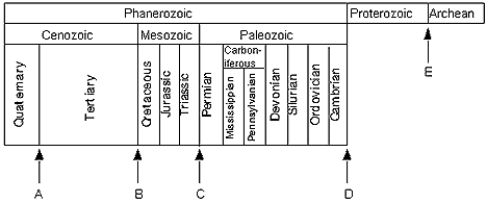
-What is the best estimate for the age of point D?
A) 65 million years
B) 250 million years
C) 145 million years
D) 542 million years
Question
-What is the best estimate for the age of point E?
A) 1.5 billion years
B) 2.5 billion years
C) 3.0 billion years
D) 4.5 billion years
Question
-When did fossils of complex organisms (such as shells) first become abundant in the geologic record?
A) at point B
B) at point C
C) at point D
D) at point E
Question
-When did dinosaurs rule the Earth?
A) between A and B
B) between C and D
C) between B and C
D) between D and E
Question
Question
Question
Question
Question
Question
Question
Question
Question
Question
Question
Question
Question
Question
Question

Unlock Deck
Sign up to unlock the cards in this deck!
Unlock Deck
Unlock Deck
1/43

Play

Full screen (f)
Deck 8: Timing the Geologic Record
1
Units A, B, C, D, E, and F are sedimentary rocks. Unit G is granite.
-The horizontal line labeled X-X' is a(n) ______.
A) angular unconformity
B) contour
C) cross-bed
D) fault
-The horizontal line labeled X-X' is a(n) ______.
A) angular unconformity
B) contour
C) cross-bed
D) fault
A
2
Units A, B, C, D, E, and F are sedimentary rocks. Unit G is granite.
-Which of the following units is the youngest?
A) unit A
B) unit B
C) unit C
D) unit F
-Which of the following units is the youngest?
A) unit A
B) unit B
C) unit C
D) unit F
A
3
Units A, B, C, D, E, and F are sedimentary rocks. Unit G is granite.
-Which of the following units is the oldest?
A) unit A
B) unit B
C) unit C
D) unit F
-Which of the following units is the oldest?
A) unit A
B) unit B
C) unit C
D) unit F
D
4
Units A, B, C, D, E, and F are sedimentary rocks. Unit G is granite.
-Which of the following events happened most recently?
A) deposition of unit C
B) deposition of unit F
C) deposition of unit D
D) tilting of units C, D, E, and F
-Which of the following events happened most recently?
A) deposition of unit C
B) deposition of unit F
C) deposition of unit D
D) tilting of units C, D, E, and F
Unlock Deck
Unlock for access to all 43 flashcards in this deck.
Unlock Deck
k this deck
5
Units A, B, C, D, E, and F are sedimentary rocks. Unit G is granite.
-Which of the following statements is true?
A) Deposition of unit A occurred before deposition of unit B.
B) Erosion took place prior to deposition of unit B.
C) Unit C is younger than unit A.
D) The granite is older than unit F.
-Which of the following statements is true?
A) Deposition of unit A occurred before deposition of unit B.
B) Erosion took place prior to deposition of unit B.
C) Unit C is younger than unit A.
D) The granite is older than unit F.
Unlock Deck
Unlock for access to all 43 flashcards in this deck.
Unlock Deck
k this deck
6
Units A, B, C, D, and E are sedimentary rocks. The thick dark line is a fault.
-When did faulting occur?
A) between the deposition of A and B
B) between the deposition of C and D
C) between the deposition of B and C
D) between the deposition of D and E
-When did faulting occur?
A) between the deposition of A and B
B) between the deposition of C and D
C) between the deposition of B and C
D) between the deposition of D and E
Unlock Deck
Unlock for access to all 43 flashcards in this deck.
Unlock Deck
k this deck
7
Units A, B, C, D, and E are sedimentary rocks. The thick dark line is a fault.
-What is the relative timing between faulting and intrusion of the granite?
A) Faulting occurred after the intrusion of the granite.
B) Faulting occurred before the intrusion of the granite.
C) Faulting and intrusion of the granite occurred at the same time.
D) The relative timing between faulting and intrusion of the granite cannot be determined from the information provided.
-What is the relative timing between faulting and intrusion of the granite?
A) Faulting occurred after the intrusion of the granite.
B) Faulting occurred before the intrusion of the granite.
C) Faulting and intrusion of the granite occurred at the same time.
D) The relative timing between faulting and intrusion of the granite cannot be determined from the information provided.
Unlock Deck
Unlock for access to all 43 flashcards in this deck.
Unlock Deck
k this deck
8
Units A, B, C, D, and E are sedimentary rocks. The thick dark line is a fault.
-Which of the following units is the oldest?
A) unit A
B) unit C
C) unit E
D) the granite
-Which of the following units is the oldest?
A) unit A
B) unit C
C) unit E
D) the granite
Unlock Deck
Unlock for access to all 43 flashcards in this deck.
Unlock Deck
k this deck
9
The founder of the principle of the faunal succession is ____________.
A) Sir James Hutton
B) Alfred Wegener
C) William Smith
D) Nicolaus Steno
A) Sir James Hutton
B) Alfred Wegener
C) William Smith
D) Nicolaus Steno
Unlock Deck
Unlock for access to all 43 flashcards in this deck.
Unlock Deck
k this deck
10
Consider three undeformed horizontal beds of sedimentary rocks. Which layer is the oldest?
A) upper layer
B) middle
C) lower
A) upper layer
B) middle
C) lower
Unlock Deck
Unlock for access to all 43 flashcards in this deck.
Unlock Deck
k this deck
11
The study of the history of ancient life based on the fossil record is called
A) paleontology.
B) anthropology.
C) biology.
A) paleontology.
B) anthropology.
C) biology.
Unlock Deck
Unlock for access to all 43 flashcards in this deck.
Unlock Deck
k this deck
12
A geologic formation is a series of rock layers that
A) can be recognized and mapped as a distinctive unit.
B) has approximately the same physical properties and the same assemblage of fossils.
C) has all these properties.
A) can be recognized and mapped as a distinctive unit.
B) has approximately the same physical properties and the same assemblage of fossils.
C) has all these properties.
Unlock Deck
Unlock for access to all 43 flashcards in this deck.
Unlock Deck
k this deck
13
A nonconformity is a
A) rock unit that is different than units above or below it.
B) gap in the geologic record bounded below by metamorphic or igneous rocks and bounded above by sedimentary rocks.
C) rock unit that does not contain fossils.
A) rock unit that is different than units above or below it.
B) gap in the geologic record bounded below by metamorphic or igneous rocks and bounded above by sedimentary rocks.
C) rock unit that does not contain fossils.
Unlock Deck
Unlock for access to all 43 flashcards in this deck.
Unlock Deck
k this deck
14
Units A, B, C, D, and F are sedimentary rocks. Unit E is an igneous rock.
-When did the faulting occur?
A) after deposition of unit A
B) after deposition of unit C and before deposition of unit B
C) cannot be determined from the information given
-When did the faulting occur?
A) after deposition of unit A
B) after deposition of unit C and before deposition of unit B
C) cannot be determined from the information given
Unlock Deck
Unlock for access to all 43 flashcards in this deck.
Unlock Deck
k this deck
15
Units A, B, C, D, and F are sedimentary rocks. Unit E is an igneous rock.
-Which of the following events happened most recently?
A) erosion of part of unit C
B) faulting
C) deposition of unit F
-Which of the following events happened most recently?
A) erosion of part of unit C
B) faulting
C) deposition of unit F
Unlock Deck
Unlock for access to all 43 flashcards in this deck.
Unlock Deck
k this deck
16
Units A, B, C, D, and F are sedimentary rocks. Unit E is an igneous rock.
-Which is the oldest unit?
A) C
B) E
C) F
-Which is the oldest unit?
A) C
B) E
C) F
Unlock Deck
Unlock for access to all 43 flashcards in this deck.
Unlock Deck
k this deck
17
Units A, B, C, D, and F are sedimentary rocks. Unit E is an igneous rock.
-The most likely explanation for the varying thickness of unit C on either side of the fault is that
A) more sediment was originally deposited on the left side of the fault.
B) sediment was eroded from the right side of the fault.
C) unit B is covering up part of unit C on the right side of the fault.
-The most likely explanation for the varying thickness of unit C on either side of the fault is that
A) more sediment was originally deposited on the left side of the fault.
B) sediment was eroded from the right side of the fault.
C) unit B is covering up part of unit C on the right side of the fault.
Unlock Deck
Unlock for access to all 43 flashcards in this deck.
Unlock Deck
k this deck
18
Which type of unconformity has sedimentary rocks both above and below the unconformity surface?
A) angular unconformity
B) disconformity
C) both an angular unconformity and a disconformity
A) angular unconformity
B) disconformity
C) both an angular unconformity and a disconformity
Unlock Deck
Unlock for access to all 43 flashcards in this deck.
Unlock Deck
k this deck
19
What is the name of the scientist whose work laid the foundation for the modern science of stratigraphy?
A) Henri Becquerel
B) Nicolaus Steno
C) Charles Darwin
A) Henri Becquerel
B) Nicolaus Steno
C) Charles Darwin
Unlock Deck
Unlock for access to all 43 flashcards in this deck.
Unlock Deck
k this deck
20
Which of the following is the smallest division of geologic time?
A) eons
B) epochs
C) eras
D) periods
A) eons
B) epochs
C) eras
D) periods
Unlock Deck
Unlock for access to all 43 flashcards in this deck.
Unlock Deck
k this deck
21
Most periods in the geologic time scale are named for
A) geographic localities and distinguishing characteristics.
B) distinctive fossils.
C) catastrophic events.
A) geographic localities and distinguishing characteristics.
B) distinctive fossils.
C) catastrophic events.
Unlock Deck
Unlock for access to all 43 flashcards in this deck.
Unlock Deck
k this deck
22
The oldest rock formation in the Grand Canyon is the
A) Bright Angel shale.
B) Tapeats sandstone.
C) Vishnu schist.
A) Bright Angel shale.
B) Tapeats sandstone.
C) Vishnu schist.
Unlock Deck
Unlock for access to all 43 flashcards in this deck.
Unlock Deck
k this deck
23
What scientific avenue of investigation gave scientists the best estimate of the absolute age of the Earth?
A) paleontological dating
B) radiometric or isotopic dating
C) carbon dating
A) paleontological dating
B) radiometric or isotopic dating
C) carbon dating
Unlock Deck
Unlock for access to all 43 flashcards in this deck.
Unlock Deck
k this deck
24
Which of the following statements about rubidium-87 radiometric dating is true?
A) The number of radioactive rubidium-87 atoms in an igneous rock is constant.
B) The number of strontium-87 daughter products in an igneous rock is constant.
C) The rate at which rubidium-87 decays to strontium-87 is constant.
A) The number of radioactive rubidium-87 atoms in an igneous rock is constant.
B) The number of strontium-87 daughter products in an igneous rock is constant.
C) The rate at which rubidium-87 decays to strontium-87 is constant.
Unlock Deck
Unlock for access to all 43 flashcards in this deck.
Unlock Deck
k this deck
25
-What is the best estimate for the age of point D?
A) 65 million years
B) 250 million years
C) 145 million years
D) 542 million years
Unlock Deck
Unlock for access to all 43 flashcards in this deck.
Unlock Deck
k this deck
26
-What is the best estimate for the age of point E?
A) 1.5 billion years
B) 2.5 billion years
C) 3.0 billion years
D) 4.5 billion years
Unlock Deck
Unlock for access to all 43 flashcards in this deck.
Unlock Deck
k this deck
27
-When did fossils of complex organisms (such as shells) first become abundant in the geologic record?
A) at point B
B) at point C
C) at point D
D) at point E
Unlock Deck
Unlock for access to all 43 flashcards in this deck.
Unlock Deck
k this deck
28
-When did dinosaurs rule the Earth?
A) between A and B
B) between C and D
C) between B and C
D) between D and E
Unlock Deck
Unlock for access to all 43 flashcards in this deck.
Unlock Deck
k this deck
29
If the Earth's history were compressed into a single calendar year, human beings would first have appeared on
A) November 30
B) December 25
C) December 31
A) November 30
B) December 25
C) December 31
Unlock Deck
Unlock for access to all 43 flashcards in this deck.
Unlock Deck
k this deck
30
In which type of rocks are fossils most commonly found?
A) igneous
B) metamorphic
C) sedimentary
A) igneous
B) metamorphic
C) sedimentary
Unlock Deck
Unlock for access to all 43 flashcards in this deck.
Unlock Deck
k this deck
31
Complete the following sentence. Two different isotopes of the same element share the same __________ but have a different _____________ from one another.
A) mass number, atomic number
B) atomic number, mass number
C) number of neutrons, number of protons
D) number of protons, number of electrons
A) mass number, atomic number
B) atomic number, mass number
C) number of neutrons, number of protons
D) number of protons, number of electrons
Unlock Deck
Unlock for access to all 43 flashcards in this deck.
Unlock Deck
k this deck
32
Which of the following materials is best suited for absolute dating using the radioactive decay of carbon-14?
A) A piece of 10 million-year-old granite
B) A piece of 10 million-year-old charcoal
C) A piece of 10 thousand-year-old granite
D) A piece of 10 thousand-year-old charcoal
A) A piece of 10 million-year-old granite
B) A piece of 10 million-year-old charcoal
C) A piece of 10 thousand-year-old granite
D) A piece of 10 thousand-year-old charcoal
Unlock Deck
Unlock for access to all 43 flashcards in this deck.
Unlock Deck
k this deck
33
The half-life of any given isotope is a function of environmental temperature and pressure.
Unlock Deck
Unlock for access to all 43 flashcards in this deck.
Unlock Deck
k this deck
34
Why was the advent of absolute dating important to the study of early Earth history?
A) Isotope half-lives are all too long to use them for dating young rocks.
B) There are few fossils in Precambrian rocks to use fossils for age control.
C) There are too few Precambrian rocks left to use fossils for age control.
D) Precambrian time is too short of an interval of geologic time to use fossils for age control.
A) Isotope half-lives are all too long to use them for dating young rocks.
B) There are few fossils in Precambrian rocks to use fossils for age control.
C) There are too few Precambrian rocks left to use fossils for age control.
D) Precambrian time is too short of an interval of geologic time to use fossils for age control.
Unlock Deck
Unlock for access to all 43 flashcards in this deck.
Unlock Deck
k this deck
35
About what percent of Earth history occurs in the Precambrian (the time before the Cambrian Period)?
A) about 1%
B) about 15%
C) about 50%
D) about 90%
A) about 1%
B) about 15%
C) about 50%
D) about 90%
Unlock Deck
Unlock for access to all 43 flashcards in this deck.
Unlock Deck
k this deck
36
Which is the earliest eon in Earth history?
A) Phanerozoic
B) Proterozoic
C) Hadean
D) Archean
A) Phanerozoic
B) Proterozoic
C) Hadean
D) Archean
Unlock Deck
Unlock for access to all 43 flashcards in this deck.
Unlock Deck
k this deck
37
During which eon of Earth history did Earth's geodynamo begin?
A) Phanerozoic
B) Proterozoic
C) Hadean
D) Archean
A) Phanerozoic
B) Proterozoic
C) Hadean
D) Archean
Unlock Deck
Unlock for access to all 43 flashcards in this deck.
Unlock Deck
k this deck
38
Earth's oldest fossils occur in sedimentary rocks that formed during which eon of geologic time?
A) Phanerozoic
B) Proterozoic
C) Hadean
D) Archean
A) Phanerozoic
B) Proterozoic
C) Hadean
D) Archean
Unlock Deck
Unlock for access to all 43 flashcards in this deck.
Unlock Deck
k this deck
39
The start of which eon of geologic time is marked by the first appearance of shelly fossils in the geologic record.
A) Phanerozoic
B) Proterozoic
C) Hadean
D) Archean
A) Phanerozoic
B) Proterozoic
C) Hadean
D) Archean
Unlock Deck
Unlock for access to all 43 flashcards in this deck.
Unlock Deck
k this deck
40
About how old is the oldest mineral grain ever dated?
A) About 800 million years old
B) About 1.5 billion years old
C) About 2.3 billion years old
D) About 4.4 billion years old
A) About 800 million years old
B) About 1.5 billion years old
C) About 2.3 billion years old
D) About 4.4 billion years old
Unlock Deck
Unlock for access to all 43 flashcards in this deck.
Unlock Deck
k this deck
41
During which eon of geologic time do fossils of organisms with cell nuclei first appear in the geologic record?
A) Phanerozoic
B) Proterozoic
C) Hadean
D) Archean
A) Phanerozoic
B) Proterozoic
C) Hadean
D) Archean
Unlock Deck
Unlock for access to all 43 flashcards in this deck.
Unlock Deck
k this deck
42
The Phanerozoic Eon is divided into three eras of approximately equal length in time.
Unlock Deck
Unlock for access to all 43 flashcards in this deck.
Unlock Deck
k this deck
43
Evidence suggests that liquid water existed on Earth more than four billion years ago.
Unlock Deck
Unlock for access to all 43 flashcards in this deck.
Unlock Deck
k this deck
Unlock Deck
Unlock for access to all 43 flashcards in this deck.






