







 Chat with AI

Deck 19: The Evolutionary History of Life
Full screen (f)

Question

Question
Question
Question
Question
Question
Question
Question
Question
Question
Question
Examine the graph below. 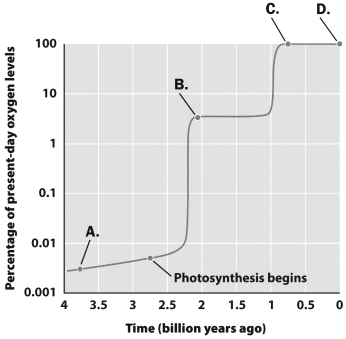
At which labeled point in this graph are the first eukaryotes thought to have evolved?
A) Point A
B) Point B
C) Point C
D) Point D
At which labeled point in this graph are the first eukaryotes thought to have evolved?
A) Point A
B) Point B
C) Point C
D) Point D
Question
Question
Question
Question
Question
Question
Question
Question
Question
Question
Question
Question
Question
Question
Question
The figure below shows the number of living families that existed on Earth during the last 540 million years. The sudden decreases in family number at 445, 360, 250, 200 and 65 million years ago represent Earth's five mass extinction events. 
Based on this data, which mass extinction had the biggest impact on the overall diversity of life on Earth?
A) 200 million years ago
B) 250 million years ago
C) 360 million years ago
D) 445 million years ago
Based on this data, which mass extinction had the biggest impact on the overall diversity of life on Earth?
A) 200 million years ago
B) 250 million years ago
C) 360 million years ago
D) 445 million years ago
Question
Question
Question
Question
Question
Question
Question
Question
Question
Question
During the time of Pangaea (left in the figure below), an ancestor of modern crocodiles inhabited the region marked by the star in this map. 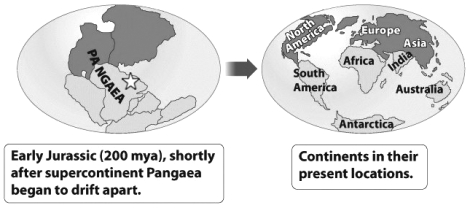
Where would you expect to find fossils of this animal today (the map on the right)?
A) Northern Hemisphere
B) on every continent
C) Africa
D) Antarctica
Where would you expect to find fossils of this animal today (the map on the right)?
A) Northern Hemisphere
B) on every continent
C) Africa
D) Antarctica
Question
Question
Question
Question
Question
Question
Question
Question
Question
Question
Question
Question
Question
Question
Question
Question
Question
Question
Question
Question
Question
Question
Question
Question
Question
Question
Question
Question
Question
Question
Question
Question
Question

Unlock Deck
Sign up to unlock the cards in this deck!
Unlock Deck
Unlock Deck
1/69

Play

Full screen (f)
Deck 19: The Evolutionary History of Life
1
The first eukaryotes evolved approximately ________ years ago.
A) 200,000
B) 200 million
C) 2 billion
D) 2 trillion
A) 200,000
B) 200 million
C) 2 billion
D) 2 trillion
C
2
Which kind of organism makes up the oldest fossil found on Earth?
A) protists
B) animals
C) bacteria
D) plants
A) protists
B) animals
C) bacteria
D) plants
C
3
The fossil record
A) is supported by DNA analysis of living organisms.
B) has not been supported by DNA analysis of living organisms.
C) contains only mineralized specimens.
D) cannot be used to document organisms that arose after the Cambrian explosion.
A) is supported by DNA analysis of living organisms.
B) has not been supported by DNA analysis of living organisms.
C) contains only mineralized specimens.
D) cannot be used to document organisms that arose after the Cambrian explosion.
A
4
The Cambrian explosion
A) caused a lack of air in Earth's atmosphere.
B) was caused by an increase in volcanic activity.
C) was volcanic in nature.
D) increased the diversity of animal life on Earth.
A) caused a lack of air in Earth's atmosphere.
B) was caused by an increase in volcanic activity.
C) was volcanic in nature.
D) increased the diversity of animal life on Earth.
Unlock Deck
Unlock for access to all 69 flashcards in this deck.
Unlock Deck
k this deck
5
Which of the following is an example of a fossil?
A) the footprint of an ancient human-like being
B) an insect preserved in hardened tree sap
C) an imprint of feathers and a skeleton in a rock
D) all of the above
A) the footprint of an ancient human-like being
B) an insect preserved in hardened tree sap
C) an imprint of feathers and a skeleton in a rock
D) all of the above
Unlock Deck
Unlock for access to all 69 flashcards in this deck.
Unlock Deck
k this deck
6
The first group of vertebrates that could complete their life cycle without returning to water were
A) amphibians.
B) reptiles.
C) mammals.
D) birds.
A) amphibians.
B) reptiles.
C) mammals.
D) birds.
Unlock Deck
Unlock for access to all 69 flashcards in this deck.
Unlock Deck
k this deck
7
Which of the following was not necessary for plants to develop in order to adapt to life on land?
A) photosynthesis
B) roots
C) waterproofing
D) transport mechanisms within stems
A) photosynthesis
B) roots
C) waterproofing
D) transport mechanisms within stems
Unlock Deck
Unlock for access to all 69 flashcards in this deck.
Unlock Deck
k this deck
8
Which of the following was not an adaptation of land plants?
A) leaves
B) waterproofing
C) photosynthesis
D) roots
A) leaves
B) waterproofing
C) photosynthesis
D) roots
Unlock Deck
Unlock for access to all 69 flashcards in this deck.
Unlock Deck
k this deck
9
Fossil anklebones from the ancestors of whales and the anklebones of hippopotamuses have the same shape, which is an adaptation for running on land. This suggests that
A) whales and ancient hippopotamuses underwent convergent evolution.
B) whales and ancient hippopotamuses evolved from a common ancestor.
C) the fossils of ancient hippopotamuses should be found in the same location and at the same depth from the Earth's surface as the fossils of ancient whales.
D) whales evolved from aquatic dinosaurs whereas hippopotamuses evolved from terrestrial dinosaurs.
A) whales and ancient hippopotamuses underwent convergent evolution.
B) whales and ancient hippopotamuses evolved from a common ancestor.
C) the fossils of ancient hippopotamuses should be found in the same location and at the same depth from the Earth's surface as the fossils of ancient whales.
D) whales evolved from aquatic dinosaurs whereas hippopotamuses evolved from terrestrial dinosaurs.
Unlock Deck
Unlock for access to all 69 flashcards in this deck.
Unlock Deck
k this deck
10
Life evolved on land long after there had been life in the oceans. Which of the following had to occur before organisms were able to live on land?
A) The Earth's land masses had to become wetter.
B) Organisms had to adapt to the harsh dry conditions faced by life on land.
C) Animals had to develop internal skeletons and efficient transport mechanisms.
D) The supercontinent Pangaea had to break up into subcontinents.
A) The Earth's land masses had to become wetter.
B) Organisms had to adapt to the harsh dry conditions faced by life on land.
C) Animals had to develop internal skeletons and efficient transport mechanisms.
D) The supercontinent Pangaea had to break up into subcontinents.
Unlock Deck
Unlock for access to all 69 flashcards in this deck.
Unlock Deck
k this deck
11
Examine the graph below.
At which labeled point in this graph are the first eukaryotes thought to have evolved?
A) Point A
B) Point B
C) Point C
D) Point D
At which labeled point in this graph are the first eukaryotes thought to have evolved?
A) Point A
B) Point B
C) Point C
D) Point D
Unlock Deck
Unlock for access to all 69 flashcards in this deck.
Unlock Deck
k this deck
12
You are looking at the side of a cliff with many clearly visible layers of rock. In the top layer you find the fossil of a mouse. In the next layer down you find the fossil of a frog. Two layers down from that you find the fossil of a beetle, and in the deepest layer the fossil of a millipede. This is evidence that
A) mice evolved before frogs.
B) frogs evolved after mice.
C) millipedes were the first among these animals to evolve.
D) the beetle evolved before millipedes.
A) mice evolved before frogs.
B) frogs evolved after mice.
C) millipedes were the first among these animals to evolve.
D) the beetle evolved before millipedes.
Unlock Deck
Unlock for access to all 69 flashcards in this deck.
Unlock Deck
k this deck
13
Which of the following represents the order in which terrestrial life evolved?
A) millipedes, green plants, amphibians, insects, reptiles
B) millipedes, insects, green plants reptiles, amphibians
C) green plants, reptiles, millipedes, insects, amphibians
D) green plants, millipedes, insects, amphibians, reptiles
A) millipedes, green plants, amphibians, insects, reptiles
B) millipedes, insects, green plants reptiles, amphibians
C) green plants, reptiles, millipedes, insects, amphibians
D) green plants, millipedes, insects, amphibians, reptiles
Unlock Deck
Unlock for access to all 69 flashcards in this deck.
Unlock Deck
k this deck
14
The appearance of eukaryotes may have been delayed until more _______ accumulated in Earth's atmosphere.
A) oxygen
B) nitrogen
C) carbon
D) sulfur
A) oxygen
B) nitrogen
C) carbon
D) sulfur
Unlock Deck
Unlock for access to all 69 flashcards in this deck.
Unlock Deck
k this deck
15
Which of the following groups of animals evolved the most recently?
A) invertebrates
B) amphibians
C) reptiles
D) mammals
A) invertebrates
B) amphibians
C) reptiles
D) mammals
Unlock Deck
Unlock for access to all 69 flashcards in this deck.
Unlock Deck
k this deck
16
The first land plants
A) were descendants of fungi that developed photosynthesis.
B) evolved from green algae that could already carry out photosynthesis.
C) were ferns and small shrubs.
D) grew from the seeds of marine plants.
A) were descendants of fungi that developed photosynthesis.
B) evolved from green algae that could already carry out photosynthesis.
C) were ferns and small shrubs.
D) grew from the seeds of marine plants.
Unlock Deck
Unlock for access to all 69 flashcards in this deck.
Unlock Deck
k this deck
17
Which of the following is not documented by the fossil record?
A) Some organisms that lived in the past are unlike living organisms we see today.
B) Some organisms that once lived on Earth have disappeared.
C) The species living today are the same as the species that lived in the distant past.
D) Over time life has evolved.
A) Some organisms that lived in the past are unlike living organisms we see today.
B) Some organisms that once lived on Earth have disappeared.
C) The species living today are the same as the species that lived in the distant past.
D) Over time life has evolved.
Unlock Deck
Unlock for access to all 69 flashcards in this deck.
Unlock Deck
k this deck
18
The first vertebrates to colonize land were
A) birds.
B) mammals.
C) amphibians.
D) reptiles.
A) birds.
B) mammals.
C) amphibians.
D) reptiles.
Unlock Deck
Unlock for access to all 69 flashcards in this deck.
Unlock Deck
k this deck
19
The oldest fossils of terrestrial animals are of
A) spiders and millipedes.
B) insects and snakes.
C) mice and bats.
D) birds and mammals.
A) spiders and millipedes.
B) insects and snakes.
C) mice and bats.
D) birds and mammals.
Unlock Deck
Unlock for access to all 69 flashcards in this deck.
Unlock Deck
k this deck
20
Which of the following statements about the fossil record is true?
A) It is useful only for plant species.
B) It is not a useful tool for understanding evolution.
C) It contains an example of every species that ever lived on Earth.
D) It supports our current understanding of evolution.
A) It is useful only for plant species.
B) It is not a useful tool for understanding evolution.
C) It contains an example of every species that ever lived on Earth.
D) It supports our current understanding of evolution.
Unlock Deck
Unlock for access to all 69 flashcards in this deck.
Unlock Deck
k this deck
21
Which of the following does not lead to adaptive radiation?
A) mass extinction
B) adaptations that allow an organism to utilize its environment in new ways
C) high levels of competition between populations
D) a low amount of gene flow between populations
A) mass extinction
B) adaptations that allow an organism to utilize its environment in new ways
C) high levels of competition between populations
D) a low amount of gene flow between populations
Unlock Deck
Unlock for access to all 69 flashcards in this deck.
Unlock Deck
k this deck
22
Continental drift has played a role in which of the following?
A) climate change
B) extinctions
C) promoting speciation
D) all of the above
A) climate change
B) extinctions
C) promoting speciation
D) all of the above
Unlock Deck
Unlock for access to all 69 flashcards in this deck.
Unlock Deck
k this deck
23
For insects, could there be a connection between being the first organism to fly and being the most diverse terrestrial organism today?
A) Probably not; terrestrial insects are only so diverse because they have been around so much longer than other animals and have, therefore, had more time to evolve.
B) Yes; the ability to fly between populations decreases gene flow resulting in rapid speciation.
C) No; only environmental changes can lead to adaptive radiation of a group as large as insects.
D) Maybe; since insects were the first in the air, they had a variety of habitats to explore without competition, which often leads to adaptive radiation.
A) Probably not; terrestrial insects are only so diverse because they have been around so much longer than other animals and have, therefore, had more time to evolve.
B) Yes; the ability to fly between populations decreases gene flow resulting in rapid speciation.
C) No; only environmental changes can lead to adaptive radiation of a group as large as insects.
D) Maybe; since insects were the first in the air, they had a variety of habitats to explore without competition, which often leads to adaptive radiation.
Unlock Deck
Unlock for access to all 69 flashcards in this deck.
Unlock Deck
k this deck
24
The most recent mass extinction, which occurred during the Cretaceous period, may have been caused by
A) extra heat from the sun.
B) the pull of the moon on Earth.
C) the dinosaurs.
D) an asteroid hitting Earth.
A) extra heat from the sun.
B) the pull of the moon on Earth.
C) the dinosaurs.
D) an asteroid hitting Earth.
Unlock Deck
Unlock for access to all 69 flashcards in this deck.
Unlock Deck
k this deck
25
Which of the following would not play a role in macroevolution?
A) mass extinctions
B) mutation in a liver cell
C) continental drift
D) climate change
A) mass extinctions
B) mutation in a liver cell
C) continental drift
D) climate change
Unlock Deck
Unlock for access to all 69 flashcards in this deck.
Unlock Deck
k this deck
26
The figure below shows the number of living families that existed on Earth during the last 540 million years. The sudden decreases in family number at 445, 360, 250, 200 and 65 million years ago represent Earth's five mass extinction events.
Based on this data, which mass extinction had the biggest impact on the overall diversity of life on Earth?
A) 200 million years ago
B) 250 million years ago
C) 360 million years ago
D) 445 million years ago
Based on this data, which mass extinction had the biggest impact on the overall diversity of life on Earth?
A) 200 million years ago
B) 250 million years ago
C) 360 million years ago
D) 445 million years ago
Unlock Deck
Unlock for access to all 69 flashcards in this deck.
Unlock Deck
k this deck
27
Why might many new species form in the aftermath of a mass extinction?
A) Gene flow among the remaining species would be increased, giving rise to many new genetic recombinations.
B) Changed environments and reduced competition would provide opportunities for new adaptations.
C) New environments would increase mutation rates.
D) Populations of remaining species would expand rapidly and reduce geographic isolation.
A) Gene flow among the remaining species would be increased, giving rise to many new genetic recombinations.
B) Changed environments and reduced competition would provide opportunities for new adaptations.
C) New environments would increase mutation rates.
D) Populations of remaining species would expand rapidly and reduce geographic isolation.
Unlock Deck
Unlock for access to all 69 flashcards in this deck.
Unlock Deck
k this deck
28
Which of the following statements is true?
A) A change in the environment generally causes a different species to become dominant.
B) A change in the environment generally has no effect on species dominance.
C) Continental drift did not cause environmental changes.
D) Environmental changes have no effect on evolution.
A) A change in the environment generally causes a different species to become dominant.
B) A change in the environment generally has no effect on species dominance.
C) Continental drift did not cause environmental changes.
D) Environmental changes have no effect on evolution.
Unlock Deck
Unlock for access to all 69 flashcards in this deck.
Unlock Deck
k this deck
29
Which of the following statements about continental drift is true?
A) It is the slow movement of the continents over time.
B) It encourages gene flow.
C) It no longer occurs.
D) It has had no effect on speciation.
A) It is the slow movement of the continents over time.
B) It encourages gene flow.
C) It no longer occurs.
D) It has had no effect on speciation.
Unlock Deck
Unlock for access to all 69 flashcards in this deck.
Unlock Deck
k this deck
30
Which of the following is not a difference between living mammals and living reptiles?
A) method of movement
B) classification as animals
C) tooth features
D) jaw structure
A) method of movement
B) classification as animals
C) tooth features
D) jaw structure
Unlock Deck
Unlock for access to all 69 flashcards in this deck.
Unlock Deck
k this deck
31
Fossils discovered in Antarctica indicate that the
A) life forms living there today have remained unchanged for millions of years.
B) life forms that live there today are different from those that lived there in the past.
C) environment there has always been too harsh to support life.
D) ice can support a wide variety of life forms.
A) life forms living there today have remained unchanged for millions of years.
B) life forms that live there today are different from those that lived there in the past.
C) environment there has always been too harsh to support life.
D) ice can support a wide variety of life forms.
Unlock Deck
Unlock for access to all 69 flashcards in this deck.
Unlock Deck
k this deck
32
Which of the following is not a key step in the evolutionary transition from reptiles to mammals?
A) the development of an opening in the bones behind the eyes
B) the development of a larger hole behind the eyes and some specialization of teeth
C) changes in the jaw hinge
D) the development of bones in the reptilian inner ear
A) the development of an opening in the bones behind the eyes
B) the development of a larger hole behind the eyes and some specialization of teeth
C) changes in the jaw hinge
D) the development of bones in the reptilian inner ear
Unlock Deck
Unlock for access to all 69 flashcards in this deck.
Unlock Deck
k this deck
33
The supercontinent Pangaea began to break up
A) before there were any dinosaurs.
B) after terrestrial organisms had evolved.
C) before the existence of land plants.
D) before photosynthesis began producing oxygen.
A) before there were any dinosaurs.
B) after terrestrial organisms had evolved.
C) before the existence of land plants.
D) before photosynthesis began producing oxygen.
Unlock Deck
Unlock for access to all 69 flashcards in this deck.
Unlock Deck
k this deck
34
The first mammals
A) were probably most active during the day.
B) were the size of modern horses and elephants.
C) had large eye sockets.
D) underwent rapid adaptive radiation during the "reign" of the dinosaurs.
A) were probably most active during the day.
B) were the size of modern horses and elephants.
C) had large eye sockets.
D) underwent rapid adaptive radiation during the "reign" of the dinosaurs.
Unlock Deck
Unlock for access to all 69 flashcards in this deck.
Unlock Deck
k this deck
35
Mass extinctions cause the loss of many species, no matter how well adapted those species were before the extinction. Why might previous adaptations not help a species survive a mass extinction?
A) The rapid environmental changes that cause mass extinctions do not leave the organisms time to adapt.
B) Ongoing continental drift allows more species to interbreed, which lowers the genetic variability available for adaptation.
C) Adaptive radiations are stronger than adaptations.
D) Well-adapted organisms will not be affected by mass extinction; these are the groups that will survive.
A) The rapid environmental changes that cause mass extinctions do not leave the organisms time to adapt.
B) Ongoing continental drift allows more species to interbreed, which lowers the genetic variability available for adaptation.
C) Adaptive radiations are stronger than adaptations.
D) Well-adapted organisms will not be affected by mass extinction; these are the groups that will survive.
Unlock Deck
Unlock for access to all 69 flashcards in this deck.
Unlock Deck
k this deck
36
During the time of Pangaea (left in the figure below), an ancestor of modern crocodiles inhabited the region marked by the star in this map.
Where would you expect to find fossils of this animal today (the map on the right)?
A) Northern Hemisphere
B) on every continent
C) Africa
D) Antarctica
Where would you expect to find fossils of this animal today (the map on the right)?
A) Northern Hemisphere
B) on every continent
C) Africa
D) Antarctica
Unlock Deck
Unlock for access to all 69 flashcards in this deck.
Unlock Deck
k this deck
37
The Cambrian explosion resulted in the evolution of more than 17, 000 species of an animal known as the trilobite. The shear number of trilobite fossils found in modern times suggests that trilobites were very abundant, perhaps the rulers of the seas. Today, no living descendants of this group exist. What happened?
A) Since trilobites evolved before the first mass extinction, its possible that any of the five mass extinctions could have wiped out the entire group.
B) In order to disappear from the planet entirely, trilobites must have undergone the process of adaptive radiation.
C) It is unlikely that trilobites could have survived the increase in atmospheric oxygen once the process of photosynthesis had evolved.
D) Being so plentiful, trilobites must have been the major food source for terrestrial dinosaurs. The extinction of the trilobite may have caused the mass extinction of dinosaurs.
A) Since trilobites evolved before the first mass extinction, its possible that any of the five mass extinctions could have wiped out the entire group.
B) In order to disappear from the planet entirely, trilobites must have undergone the process of adaptive radiation.
C) It is unlikely that trilobites could have survived the increase in atmospheric oxygen once the process of photosynthesis had evolved.
D) Being so plentiful, trilobites must have been the major food source for terrestrial dinosaurs. The extinction of the trilobite may have caused the mass extinction of dinosaurs.
Unlock Deck
Unlock for access to all 69 flashcards in this deck.
Unlock Deck
k this deck
38
One way mammal limbs differ from reptile limbs is that
A) reptiles walk in a more upright posture than mammals do.
B) mammal limbs are more vertically oriented.
C) all mammals walk on two legs.
D) reptiles have totally different limb bones than mammals have.
A) reptiles walk in a more upright posture than mammals do.
B) mammal limbs are more vertically oriented.
C) all mammals walk on two legs.
D) reptiles have totally different limb bones than mammals have.
Unlock Deck
Unlock for access to all 69 flashcards in this deck.
Unlock Deck
k this deck
39
New groups of organisms always form
A) from scratch.
B) as a result of modifications to organisms that already exist.
C) over very short periods of time as a result of adaptive radiation.
D) when climatic conditions on Earth are stable.
A) from scratch.
B) as a result of modifications to organisms that already exist.
C) over very short periods of time as a result of adaptive radiation.
D) when climatic conditions on Earth are stable.
Unlock Deck
Unlock for access to all 69 flashcards in this deck.
Unlock Deck
k this deck
40
The low number of species that live in Antarctica today is a result of
A) a worldwide mass extinction.
B) a climate change caused by continental drift.
C) an evolutionary radiation.
D) volcanic action.
A) a worldwide mass extinction.
B) a climate change caused by continental drift.
C) an evolutionary radiation.
D) volcanic action.
Unlock Deck
Unlock for access to all 69 flashcards in this deck.
Unlock Deck
k this deck
41
Members of all of Earth's different species (past and present) have been (or will be) converted into some type of fossil after their death.
Unlock Deck
Unlock for access to all 69 flashcards in this deck.
Unlock Deck
k this deck
42
Scientists use existing fossils to predict what the transitional forms between organisms might look like. Why is it so hard for scientists to find fossils of these transitional forms?
A) Scientists have no way to determine how deep in a rock to look for a transitional fossil, so they just have to dig and dig until they find the right fossil.
B) Because of continental drift, the exact location of where a transitional fossil should be found cannot be determined. Looking for a particular fossil that could be anywhere on the planet is like looking for a needle in a haystack.
C) Fossils of transitional species may have never formed due to environmental conditions or if they did form, they may have been destroyed by natural processes like erosion.
D) The transitional form of any organism is only hypothetical in nature; it never truly existed on the planet and, therefore, could never become a fossil.
A) Scientists have no way to determine how deep in a rock to look for a transitional fossil, so they just have to dig and dig until they find the right fossil.
B) Because of continental drift, the exact location of where a transitional fossil should be found cannot be determined. Looking for a particular fossil that could be anywhere on the planet is like looking for a needle in a haystack.
C) Fossils of transitional species may have never formed due to environmental conditions or if they did form, they may have been destroyed by natural processes like erosion.
D) The transitional form of any organism is only hypothetical in nature; it never truly existed on the planet and, therefore, could never become a fossil.
Unlock Deck
Unlock for access to all 69 flashcards in this deck.
Unlock Deck
k this deck
43
Oxygen was one of the original gases in abundant in Earth's atmosphere before the evolution of life.
Unlock Deck
Unlock for access to all 69 flashcards in this deck.
Unlock Deck
k this deck
44
Which of the following is not true about the Antarctic continent?
A) Dinosaurs once inhabited that land mass.
B) Microscopic organisms like protists and bacteria are found in the harsh interior of the continent.
C) There is no fossil record indicating that life existed there in the past.
D) The largest organisms found on the continent live in habitats near the ocean.
A) Dinosaurs once inhabited that land mass.
B) Microscopic organisms like protists and bacteria are found in the harsh interior of the continent.
C) There is no fossil record indicating that life existed there in the past.
D) The largest organisms found on the continent live in habitats near the ocean.
Unlock Deck
Unlock for access to all 69 flashcards in this deck.
Unlock Deck
k this deck
45
Mammals evolved from a group of reptiles known as ____________ that had mammal-like jaws and limbs positioned partially underneath their bodies.
Unlock Deck
Unlock for access to all 69 flashcards in this deck.
Unlock Deck
k this deck
46
Mammals evolved from _______ about 220 million years ago.
Unlock Deck
Unlock for access to all 69 flashcards in this deck.
Unlock Deck
k this deck
47
Mammals branched out to evolve many new species after the extinction of the _______.
Unlock Deck
Unlock for access to all 69 flashcards in this deck.
Unlock Deck
k this deck
48
Using Uranium-235, a ______________ with a half-life of 700 million years, allows scientists to determine the approximate age of a fossil.
Unlock Deck
Unlock for access to all 69 flashcards in this deck.
Unlock Deck
k this deck
49
Evidence that the Cretaceous mass extinction was created by the impact of an asteroid is the existence of a huge ______ buried under sediments off of the coast of Mexico.
Unlock Deck
Unlock for access to all 69 flashcards in this deck.
Unlock Deck
k this deck
50
The extinction of dinosaurs caused an end to the _______ between them and the mammals, thus allowing mammals to evolve to fill some ecological roles the dinosaurs had previously filled.
Unlock Deck
Unlock for access to all 69 flashcards in this deck.
Unlock Deck
k this deck
51
Descendants of _______ were among the first organisms to colonize land.
Unlock Deck
Unlock for access to all 69 flashcards in this deck.
Unlock Deck
k this deck
52
The oxygen necessary to support much of life on Earth is a waste product of an important adaptation, the process of _______.
Unlock Deck
Unlock for access to all 69 flashcards in this deck.
Unlock Deck
k this deck
53
Adaptive _______ is the diversification of groups of organisms to form new species and higher taxonomic groups. It can occur after a mass extinction or at other times.
Unlock Deck
Unlock for access to all 69 flashcards in this deck.
Unlock Deck
k this deck
54
The first single-celled organisms arose 3.5 _______ years ago.
Unlock Deck
Unlock for access to all 69 flashcards in this deck.
Unlock Deck
k this deck
55
Ninety-five percent of marine invertebrate species went extinct during the _______ mass extinction
Unlock Deck
Unlock for access to all 69 flashcards in this deck.
Unlock Deck
k this deck
56
The earliest forms of life evolved and lived in _______.
Unlock Deck
Unlock for access to all 69 flashcards in this deck.
Unlock Deck
k this deck
57
Studies of ____________ focus on understanding the origin of groups of organisms (like genera, family, etc.) rather than the changes that occur at the population level.
Unlock Deck
Unlock for access to all 69 flashcards in this deck.
Unlock Deck
k this deck
58
After the extinction of the dinosaurs the adaptive radiation of _______ set the stage for the eventual evolution of humans.
Unlock Deck
Unlock for access to all 69 flashcards in this deck.
Unlock Deck
k this deck
59
Many organisms decompose rapidly after death; some organisms had soft bodies; and some areas where organisms died have undergone massive geologic changes. For these reasons, the ______ record is incomplete.
Unlock Deck
Unlock for access to all 69 flashcards in this deck.
Unlock Deck
k this deck
60
Following each of Earth's five mass extinction the diversity of life on Earth has _______ [increased or decreased?] over time.
Unlock Deck
Unlock for access to all 69 flashcards in this deck.
Unlock Deck
k this deck
61
The same species of dinosaurs that roamed Jurassic Earth would reevolve if humans went extinct.
Unlock Deck
Unlock for access to all 69 flashcards in this deck.
Unlock Deck
k this deck
62
The diversity of life in the oceans has decreased through time.
Unlock Deck
Unlock for access to all 69 flashcards in this deck.
Unlock Deck
k this deck
63
An asteroid can cause a mass extinction by creating a cloud that blocks out the sun for months or years after impact.
Unlock Deck
Unlock for access to all 69 flashcards in this deck.
Unlock Deck
k this deck
64
Why isn't the fossil record complete?
Unlock Deck
Unlock for access to all 69 flashcards in this deck.
Unlock Deck
k this deck
65
Once a species becomes dominant on Earth, it will remain dominant until it becomes extinct.
Unlock Deck
Unlock for access to all 69 flashcards in this deck.
Unlock Deck
k this deck
66
The first single-celled prokaryotes evolved 3 billion years after the first eukaryotes.
Unlock Deck
Unlock for access to all 69 flashcards in this deck.
Unlock Deck
k this deck
67
North America and Europe are slowly but surely drifting away from one another.
Unlock Deck
Unlock for access to all 69 flashcards in this deck.
Unlock Deck
k this deck
68
Dinosaurs lived on Pangaea
Unlock Deck
Unlock for access to all 69 flashcards in this deck.
Unlock Deck
k this deck
69
The evolution of higher taxonomic groups occurs in the same way as the evolution of populations.
Unlock Deck
Unlock for access to all 69 flashcards in this deck.
Unlock Deck
k this deck
Unlock Deck
Unlock for access to all 69 flashcards in this deck.






