







 Chat with AI

Deck 39: Biodiversity and People
Full screen (f)

Question

Question
Question
Question
Question
Question
Question
Question
Question
Question
Question
Question
Question
Question
Question
Question
Question
Question
Question
Question
Question
Question
Question
Question
Question
Question
Examine the figure below, which shows a housing development. 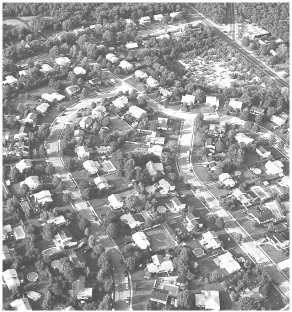
In what way(s) does this use of the land differ from the forest present prior to the construction of the development?
A) The development of roadways creates pathways that encourage the intrusion of nonresident species.
B) The extensive landscaping creates an excess of habitat and promotes overpopulation of selected species.
C) The numerous roofs and paved surfaces prevent rainwater from entering the soil.
D) all of the above
In what way(s) does this use of the land differ from the forest present prior to the construction of the development?
A) The development of roadways creates pathways that encourage the intrusion of nonresident species.
B) The extensive landscaping creates an excess of habitat and promotes overpopulation of selected species.
C) The numerous roofs and paved surfaces prevent rainwater from entering the soil.
D) all of the above
Question
Question
Question
Question
Question
In the photo below, the person is crushing aluminum cans. 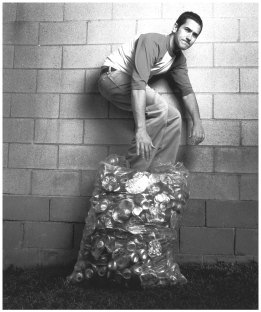
What best explains the benefit of the action depicted?
A) Toxic waste aluminum is prevented from reentering the biosphere, where it could further degrade the environment.
B) Aluminum recycling prevents environmental damage by reducing the necessity of mining aluminum ore and saves the energy needed to ship and process that ore.
C) Collecting scrap aluminum permits the continued manufacturing of the weapons necessary for the defense of this country.
D) When deposited in shallow marine habitats, aluminum cans can create artificial reef habitats that are quickly colonized by fish and shellfish.
What best explains the benefit of the action depicted?
A) Toxic waste aluminum is prevented from reentering the biosphere, where it could further degrade the environment.
B) Aluminum recycling prevents environmental damage by reducing the necessity of mining aluminum ore and saves the energy needed to ship and process that ore.
C) Collecting scrap aluminum permits the continued manufacturing of the weapons necessary for the defense of this country.
D) When deposited in shallow marine habitats, aluminum cans can create artificial reef habitats that are quickly colonized by fish and shellfish.
Question
The figure below shows various groups drawn in sizes proportional to their contribution to known biodiversity. 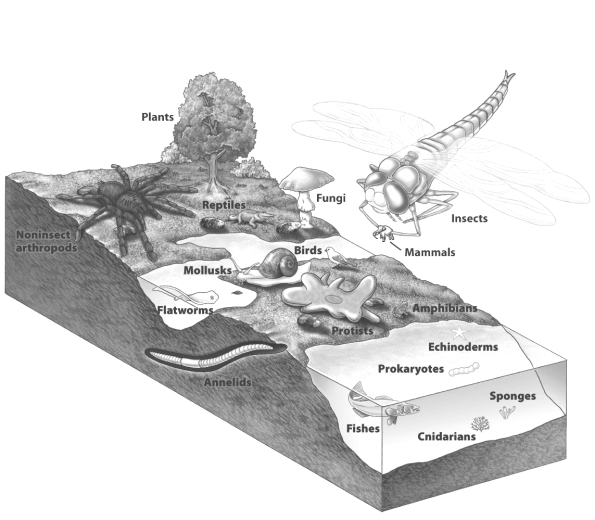
If the current extinction crisis continues, in future versions of the diagram, _______ will most likely be _______.
A) terrestrial vertebrates drawn to smaller scales
B) plants; drawn to larger scales
C) prokaryotes; drawn to smaller scales
D) birds; entirely absent
If the current extinction crisis continues, in future versions of the diagram, _______ will most likely be _______.
A) terrestrial vertebrates drawn to smaller scales
B) plants; drawn to larger scales
C) prokaryotes; drawn to smaller scales
D) birds; entirely absent
Question
Question
Question
Question
Question
Question
Question
Question
Question
Question
Question
Question
Question
Question
Question
Question
Question
Question
Question
Question
Question
Question
Question
Question
Question
Question
Question
Question
Question
Question
Question
Question
Question
Question
Question
Question
Question
Question
Question
Question

Unlock Deck
Sign up to unlock the cards in this deck!
Unlock Deck
Unlock Deck
1/72

Play

Full screen (f)
Deck 39: Biodiversity and People
1
During the past 30 years amphibians have declined at an alarming rate. Some scientists believe the decline is occurring because amphibians are
A) running out of food.
B) highly sensitive to environmental deterioration and have simply responded more quickly than other animals.
C) less highly evolved than other animals and lack the capacities to resist habitat change.
D) moving to more obscure locations to escape the impact of pollution.
A) running out of food.
B) highly sensitive to environmental deterioration and have simply responded more quickly than other animals.
C) less highly evolved than other animals and lack the capacities to resist habitat change.
D) moving to more obscure locations to escape the impact of pollution.
B
2
At least five mass extinction events have occurred during the history of life; the event that impacted the dinosaurs took place
A) 440 million years ago.
B) 350 million years ago.
C) 206 million years ago.
D) 65 million years ago.
A) 440 million years ago.
B) 350 million years ago.
C) 206 million years ago.
D) 65 million years ago.
D
3
The end of the Permian period approximately 250 million years ago coincides with a significant biological event; at that time
A) dinosaurs first evolved into mammals.
B) terrestrial plants first appeared.
C) the glacial and interglacial cycle that continues today first began.
D) 80 to 90 percent of all marine species became extinct.
A) dinosaurs first evolved into mammals.
B) terrestrial plants first appeared.
C) the glacial and interglacial cycle that continues today first began.
D) 80 to 90 percent of all marine species became extinct.
D
4
Of the species humans have catalogued, most are
A) fungi.
B) plants.
C) prokaryotes.
D) insects.
A) fungi.
B) plants.
C) prokaryotes.
D) insects.
Unlock Deck
Unlock for access to all 72 flashcards in this deck.
Unlock Deck
k this deck
5
Without places to live, Earth's biodiversity will continue to decline. In what ways does human activity contribute to habitat loss?
A) climate change
B) pollution
C) resource extraction
D) all of the above
A) climate change
B) pollution
C) resource extraction
D) all of the above
Unlock Deck
Unlock for access to all 72 flashcards in this deck.
Unlock Deck
k this deck
6
Human developments like housing, shopping centers, or highways typically
A) decrease biodiversity in the area.
B) provide a rich new habitat for new species.
C) increase biodiversity in the area.
D) have little effect on native species.
A) decrease biodiversity in the area.
B) provide a rich new habitat for new species.
C) increase biodiversity in the area.
D) have little effect on native species.
Unlock Deck
Unlock for access to all 72 flashcards in this deck.
Unlock Deck
k this deck
7
More than half of the presently identified species on Earth are
A) birds.
B) fish.
C) human.
D) insects.
A) birds.
B) fish.
C) human.
D) insects.
Unlock Deck
Unlock for access to all 72 flashcards in this deck.
Unlock Deck
k this deck
8
Attacked by chestnut blight, the American chestnut is now a rare tree in eastern forests. The disease is caused by a European fungus and illustrates the potential damage that _______ can cause.
A) an expanding human population
B) an introduced foreign species
C) climate change
D) overharvesting
A) an expanding human population
B) an introduced foreign species
C) climate change
D) overharvesting
Unlock Deck
Unlock for access to all 72 flashcards in this deck.
Unlock Deck
k this deck
9
Biologists have spent the past 200 years identifying and classifying Earth's biodiversity; at this present time
A) the exact number of species on Earth still remains unknown.
B) the annual number of newly discovered species slightly exceeds the number becoming extinct.
C) ninety percent of all species on Earth have been documented.
D) a complete count of all the species on Earth has been completed.
A) the exact number of species on Earth still remains unknown.
B) the annual number of newly discovered species slightly exceeds the number becoming extinct.
C) ninety percent of all species on Earth have been documented.
D) a complete count of all the species on Earth has been completed.
Unlock Deck
Unlock for access to all 72 flashcards in this deck.
Unlock Deck
k this deck
10
Nonhuman species are
A) relatively expendable since other species with larger populations can take the place of any that becomes extinct.
B) often essential to the health of the ecosystems that support human life.
C) rapidly expanding their natural ranges and may soon threaten human activities like agriculture.
D) competitors with humans for the resources that make life possible.
A) relatively expendable since other species with larger populations can take the place of any that becomes extinct.
B) often essential to the health of the ecosystems that support human life.
C) rapidly expanding their natural ranges and may soon threaten human activities like agriculture.
D) competitors with humans for the resources that make life possible.
Unlock Deck
Unlock for access to all 72 flashcards in this deck.
Unlock Deck
k this deck
11
The number of species of organisms on Earth is estimated to range between
A) 300 and 3,000.
B) 300,000 and 3 million.
C) 3 million and 30 million.
D) 3 billion and 30 billion.
A) 300 and 3,000.
B) 300,000 and 3 million.
C) 3 million and 30 million.
D) 3 billion and 30 billion.
Unlock Deck
Unlock for access to all 72 flashcards in this deck.
Unlock Deck
k this deck
12
Functioning ecosystems provide a variety of benefits called ecosystem services to humans; examples include
A) erosion prevention.
B) clear air and water.
C) aesthetic beauty.
D) all of the above
A) erosion prevention.
B) clear air and water.
C) aesthetic beauty.
D) all of the above
Unlock Deck
Unlock for access to all 72 flashcards in this deck.
Unlock Deck
k this deck
13
It is estimated that as many as 74 species become extinct daily; if a species has become extinct,
A) it can rebound only after the factors causing its extinction have been eliminated.
B) closely related species (same genus or family) can be expected to soon follow.
C) it is gone forever.
D) its habitat will gradually disappear, making its rebound much more difficult.
A) it can rebound only after the factors causing its extinction have been eliminated.
B) closely related species (same genus or family) can be expected to soon follow.
C) it is gone forever.
D) its habitat will gradually disappear, making its rebound much more difficult.
Unlock Deck
Unlock for access to all 72 flashcards in this deck.
Unlock Deck
k this deck
14
The behavior of _______ most closely resembles that of invasive species?
A) the xerces blue butterfly
B) humans
C) the giant ground sloth
D) the barking deer
A) the xerces blue butterfly
B) humans
C) the giant ground sloth
D) the barking deer
Unlock Deck
Unlock for access to all 72 flashcards in this deck.
Unlock Deck
k this deck
15
How many previous, well-documented mass extinctions have occurred in Earth's history?
A) one
B) three
C) five
D) nine
A) one
B) three
C) five
D) nine
Unlock Deck
Unlock for access to all 72 flashcards in this deck.
Unlock Deck
k this deck
16
The biggest threat to biodiversity is
A) habitat loss and deterioration.
B) ecosystem growth.
C) competition between nonhuman organisms.
D) predators.
A) habitat loss and deterioration.
B) ecosystem growth.
C) competition between nonhuman organisms.
D) predators.
Unlock Deck
Unlock for access to all 72 flashcards in this deck.
Unlock Deck
k this deck
17
Numerous threats to biodiversity have recently been identified, however, ______ is(are) not included among them.
A) climate change
B) tropical rainforests
C) humans
D) invasive species
A) climate change
B) tropical rainforests
C) humans
D) invasive species
Unlock Deck
Unlock for access to all 72 flashcards in this deck.
Unlock Deck
k this deck
18
Which of the following groups of organisms are arthropods?
A) fish, reptiles, birds, and mammals
B) spiders, crabs, and insects
C) turtles, frogs, and lizards
D) dogs, cats, and mice
A) fish, reptiles, birds, and mammals
B) spiders, crabs, and insects
C) turtles, frogs, and lizards
D) dogs, cats, and mice
Unlock Deck
Unlock for access to all 72 flashcards in this deck.
Unlock Deck
k this deck
19
The arrival and colonization by _______ would produce the greatest potential threat to an area's biodiversity.
A) the Nile perch
B) the brown tree snake
C) Scotch broom
D) humans
A) the Nile perch
B) the brown tree snake
C) Scotch broom
D) humans
Unlock Deck
Unlock for access to all 72 flashcards in this deck.
Unlock Deck
k this deck
20
Which of the following changes could be expected if global warming continues at its present pace?
A) Some mountain communities will relocate to higher elevations
B) Some communities will relocate to higher and cooler latitudes.
C) Some communities will become extinct.
D) All of the above can be expected.
A) Some mountain communities will relocate to higher elevations
B) Some communities will relocate to higher and cooler latitudes.
C) Some communities will become extinct.
D) All of the above can be expected.
Unlock Deck
Unlock for access to all 72 flashcards in this deck.
Unlock Deck
k this deck
21
Prairies that have high biodiversity are
A) more visually interesting but less biologically stable.
B) able to provide more significant ecosystem services than high diversity rainforests.
C) likely to have relatively few insect populations.
D) better able to recover from drought, fire, and other natural disturbances.
A) more visually interesting but less biologically stable.
B) able to provide more significant ecosystem services than high diversity rainforests.
C) likely to have relatively few insect populations.
D) better able to recover from drought, fire, and other natural disturbances.
Unlock Deck
Unlock for access to all 72 flashcards in this deck.
Unlock Deck
k this deck
22
Studies have shown that when an ecosystem's biodiversity is high,
A) the ecosystem is better able to recover from environmental disturbances.
B) disease outbreaks occur less often.
C) invasive species are less likely to become established.
D) all of the above
A) the ecosystem is better able to recover from environmental disturbances.
B) disease outbreaks occur less often.
C) invasive species are less likely to become established.
D) all of the above
Unlock Deck
Unlock for access to all 72 flashcards in this deck.
Unlock Deck
k this deck
23
Where would you expect to find the largest number of different species?
A) the San Diego Zoo
B) the Sahara desert
C) a large tree in a tropical rainforest
D) your own backyard
A) the San Diego Zoo
B) the Sahara desert
C) a large tree in a tropical rainforest
D) your own backyard
Unlock Deck
Unlock for access to all 72 flashcards in this deck.
Unlock Deck
k this deck
24
For many, stinging insects such as honeybees are a nuisance. Why might it not be a good idea simply to poison all the honeybees and save people from the temporary pain of a sting or even an allergic reaction to such insects?
A) It would be a good idea; honeybees are native to Asia and do not belong in the United States
B) The removal of honeybees would be offset by an increase in the number of other stinging species, some of which may be worse than honeybees.
C) The poisoning of honeybees would cause bears to starve as their access to honey was eliminated.
D) Removing even a single species from an ecosystem may have unforeseen and undesirable consequences.
A) It would be a good idea; honeybees are native to Asia and do not belong in the United States
B) The removal of honeybees would be offset by an increase in the number of other stinging species, some of which may be worse than honeybees.
C) The poisoning of honeybees would cause bears to starve as their access to honey was eliminated.
D) Removing even a single species from an ecosystem may have unforeseen and undesirable consequences.
Unlock Deck
Unlock for access to all 72 flashcards in this deck.
Unlock Deck
k this deck
25
Abandoned woodpecker cavities are used by many songbirds unable to create their own. The starling, an invasive species in N. America, aggressively competes for these cavities. Either a(n) _______ in woodpecker populations or a(n) _______ in the starling population has the potential to further reduce songbird populations.
A) decrease; increase
B) increase; increase
C) decrease; decrease
D) increase; decrease
A) decrease; increase
B) increase; increase
C) decrease; decrease
D) increase; decrease
Unlock Deck
Unlock for access to all 72 flashcards in this deck.
Unlock Deck
k this deck
26
Examine the figure below, which shows a housing development.
In what way(s) does this use of the land differ from the forest present prior to the construction of the development?
A) The development of roadways creates pathways that encourage the intrusion of nonresident species.
B) The extensive landscaping creates an excess of habitat and promotes overpopulation of selected species.
C) The numerous roofs and paved surfaces prevent rainwater from entering the soil.
D) all of the above
In what way(s) does this use of the land differ from the forest present prior to the construction of the development?
A) The development of roadways creates pathways that encourage the intrusion of nonresident species.
B) The extensive landscaping creates an excess of habitat and promotes overpopulation of selected species.
C) The numerous roofs and paved surfaces prevent rainwater from entering the soil.
D) all of the above
Unlock Deck
Unlock for access to all 72 flashcards in this deck.
Unlock Deck
k this deck
27
Although maintaining biodiversity faces many challenges, at this present time the most serious threat comes from
A) competition from invasive species.
B) the loss of habitat.
C) air and water pollution.
D) commercial overharvesting.
A) competition from invasive species.
B) the loss of habitat.
C) air and water pollution.
D) commercial overharvesting.
Unlock Deck
Unlock for access to all 72 flashcards in this deck.
Unlock Deck
k this deck
28
Abandoned turtle nest cavities are often used as nesting sites for species unable to dig their own cavities. If turtles are driven to extinction, which of the following is the most likely effect on these other species?
A) There will be no serious effect since other species will assume the turtle lifestyle once turtles are no longer competing for resources.
B) They would evolve nesting strategies that did not depend on turtle cavities.
C) Their populations will probably decline as reproduction becomes less successful.
D) They would evolve digging capabilities to replace those of the missing turtles.
A) There will be no serious effect since other species will assume the turtle lifestyle once turtles are no longer competing for resources.
B) They would evolve nesting strategies that did not depend on turtle cavities.
C) Their populations will probably decline as reproduction becomes less successful.
D) They would evolve digging capabilities to replace those of the missing turtles.
Unlock Deck
Unlock for access to all 72 flashcards in this deck.
Unlock Deck
k this deck
29
The earth's average temperature appears to be slowly increasing, and heralds a new era in environmental challenges for numerous species. Most evidence supports the hypothesis that climatic change is the result of
A) invasive species that disrupt ecosystem services.
B) human activities that modify the atmosphere.
C) the disappearance of key plant species that affect the water cycle.
D) excess expansion of rainforests.
A) invasive species that disrupt ecosystem services.
B) human activities that modify the atmosphere.
C) the disappearance of key plant species that affect the water cycle.
D) excess expansion of rainforests.
Unlock Deck
Unlock for access to all 72 flashcards in this deck.
Unlock Deck
k this deck
30
The canopy of the rainforest is the habitat located at the tops of the trees. One of the most amazing discoveries about canopy biodiversity was that
A) the insect biota routinely travels from tree to tree despite the potential for predation while in transit.
B) tree elevation has a bigger influence than tree species; for example, all trees taller than 200 m have similar insect communities.
C) ants comprise over 99 percent of all canopy species.
D) each tree has numerous species that appear to be unique to that tree only.
A) the insect biota routinely travels from tree to tree despite the potential for predation while in transit.
B) tree elevation has a bigger influence than tree species; for example, all trees taller than 200 m have similar insect communities.
C) ants comprise over 99 percent of all canopy species.
D) each tree has numerous species that appear to be unique to that tree only.
Unlock Deck
Unlock for access to all 72 flashcards in this deck.
Unlock Deck
k this deck
31
In the photo below, the person is crushing aluminum cans.
What best explains the benefit of the action depicted?
A) Toxic waste aluminum is prevented from reentering the biosphere, where it could further degrade the environment.
B) Aluminum recycling prevents environmental damage by reducing the necessity of mining aluminum ore and saves the energy needed to ship and process that ore.
C) Collecting scrap aluminum permits the continued manufacturing of the weapons necessary for the defense of this country.
D) When deposited in shallow marine habitats, aluminum cans can create artificial reef habitats that are quickly colonized by fish and shellfish.
What best explains the benefit of the action depicted?
A) Toxic waste aluminum is prevented from reentering the biosphere, where it could further degrade the environment.
B) Aluminum recycling prevents environmental damage by reducing the necessity of mining aluminum ore and saves the energy needed to ship and process that ore.
C) Collecting scrap aluminum permits the continued manufacturing of the weapons necessary for the defense of this country.
D) When deposited in shallow marine habitats, aluminum cans can create artificial reef habitats that are quickly colonized by fish and shellfish.
Unlock Deck
Unlock for access to all 72 flashcards in this deck.
Unlock Deck
k this deck
32
The figure below shows various groups drawn in sizes proportional to their contribution to known biodiversity.
If the current extinction crisis continues, in future versions of the diagram, _______ will most likely be _______.
A) terrestrial vertebrates drawn to smaller scales
B) plants; drawn to larger scales
C) prokaryotes; drawn to smaller scales
D) birds; entirely absent
If the current extinction crisis continues, in future versions of the diagram, _______ will most likely be _______.
A) terrestrial vertebrates drawn to smaller scales
B) plants; drawn to larger scales
C) prokaryotes; drawn to smaller scales
D) birds; entirely absent
Unlock Deck
Unlock for access to all 72 flashcards in this deck.
Unlock Deck
k this deck
33
Although humans appear to be responsible for the current extinction crisis, scientists are confident that human did not contribute to any previous extinction event because
A) humans did not exist during those time periods.
B) the human population 350 million years ago was too small to have caused any environmental problems.
C) humans lacked the modern technologies in use today that cause so much environmental damage.
D) aggressive predatory dinosaurs have been shown to be responsible for these extinctions.
A) humans did not exist during those time periods.
B) the human population 350 million years ago was too small to have caused any environmental problems.
C) humans lacked the modern technologies in use today that cause so much environmental damage.
D) aggressive predatory dinosaurs have been shown to be responsible for these extinctions.
Unlock Deck
Unlock for access to all 72 flashcards in this deck.
Unlock Deck
k this deck
34
Nonnative organisms can be serious threats to native species when they
A) retard the rate of evolution within their adopted ecosystems.
B) instigate changes in the local climate.
C) modify the community to better resemble their original environment.
D) outcompete native species for critical resources like nesting sites.
A) retard the rate of evolution within their adopted ecosystems.
B) instigate changes in the local climate.
C) modify the community to better resemble their original environment.
D) outcompete native species for critical resources like nesting sites.
Unlock Deck
Unlock for access to all 72 flashcards in this deck.
Unlock Deck
k this deck
35
Past extinctions often removed the most dominant species, so the eventual extinction of humans is not inconceivable. What action would have the highest probability of forestalling our own extinction?
A) Locate, classify, and evaluate the remaining species on Earth to identify potential replacements for those species going extinct.
B) Encourage responsible and sustainable life styles so that the earth's natural biodiversity can be maintained
C) Encourage human evolution so that people can evolve the adaptations needed to survive in the postextinction world.
D) all of the above
A) Locate, classify, and evaluate the remaining species on Earth to identify potential replacements for those species going extinct.
B) Encourage responsible and sustainable life styles so that the earth's natural biodiversity can be maintained
C) Encourage human evolution so that people can evolve the adaptations needed to survive in the postextinction world.
D) all of the above
Unlock Deck
Unlock for access to all 72 flashcards in this deck.
Unlock Deck
k this deck
36
As humans, our primary concern(s) with the present mass extinction should be that
A) this extinction is unnatural and avoidable.
B) numerous potential products will never be developed if the biological sources that provide them disappear.
C) humans populations might be seriously impacted if the ecosystems we depend on disappear.
D) all of the above
A) this extinction is unnatural and avoidable.
B) numerous potential products will never be developed if the biological sources that provide them disappear.
C) humans populations might be seriously impacted if the ecosystems we depend on disappear.
D) all of the above
Unlock Deck
Unlock for access to all 72 flashcards in this deck.
Unlock Deck
k this deck
37
How can the significance of human involvement be assessed in this current mass extinction event?
A) by using scientific methods to examine extinction patterns in locations where human activities or their impacts vary.
B) Since it is impossible to determine what caused any past extinction there is no basis to judge the significance of human activities at this present time
C) No method can reliably work because simply measuring human involvement is sufficiently disruptive to cause the observed extinctions.
D) by prohibiting all recreational hunting, fishing, hiking, and other intrusions into natural areas and observing the response.
A) by using scientific methods to examine extinction patterns in locations where human activities or their impacts vary.
B) Since it is impossible to determine what caused any past extinction there is no basis to judge the significance of human activities at this present time
C) No method can reliably work because simply measuring human involvement is sufficiently disruptive to cause the observed extinctions.
D) by prohibiting all recreational hunting, fishing, hiking, and other intrusions into natural areas and observing the response.
Unlock Deck
Unlock for access to all 72 flashcards in this deck.
Unlock Deck
k this deck
38
Anthropologists note that the arrival of humans almost always corresponds to the disappearance of large carnivorous animal species. What type of problem would the loss of these animals cause?
A) Herbivorous prey species would increase and cause environmental impacts through overabundance.
B) The loss of large carnivores would seriously reduce the availability of human food.
C) Nonnative carnivores would migrate into the area.
D) With the absence of large predators, human evolution would cease or move in a new direction.
A) Herbivorous prey species would increase and cause environmental impacts through overabundance.
B) The loss of large carnivores would seriously reduce the availability of human food.
C) Nonnative carnivores would migrate into the area.
D) With the absence of large predators, human evolution would cease or move in a new direction.
Unlock Deck
Unlock for access to all 72 flashcards in this deck.
Unlock Deck
k this deck
39
Maintaining biodiversity is critically important because when biodiversity declines,
A) ecosystem productivity, which is directly proportional to biodiversity, declines also.
B) invasive species will be able to successfully establish a presence.
C) human civilization is in jeopardy (the collapse of past civilizations was always associated with reduced biodiversity).
D) naturally occurring nutrients accumulate to the point that they become polluting.
A) ecosystem productivity, which is directly proportional to biodiversity, declines also.
B) invasive species will be able to successfully establish a presence.
C) human civilization is in jeopardy (the collapse of past civilizations was always associated with reduced biodiversity).
D) naturally occurring nutrients accumulate to the point that they become polluting.
Unlock Deck
Unlock for access to all 72 flashcards in this deck.
Unlock Deck
k this deck
40
The colonization of new areas by humans, both past and present, has several distinctive features; one of the most common is the
A) increased area available for animal habitat.
B) introduction of variable climatic cycling.
C) disappearance of large animal species.
D) increase in plant diversity that accompanies agriculture.
A) increased area available for animal habitat.
B) introduction of variable climatic cycling.
C) disappearance of large animal species.
D) increase in plant diversity that accompanies agriculture.
Unlock Deck
Unlock for access to all 72 flashcards in this deck.
Unlock Deck
k this deck
41
Although water treatment facilities exist, in most of the world humans are depend on healthy ecosystems for clean water.
Unlock Deck
Unlock for access to all 72 flashcards in this deck.
Unlock Deck
k this deck
42
Nonnative species can be accidentally or intentionally introduced into a new habitat; in most instances
A) they lack the appropriate adaptations for the habitat and quickly die.
B) they integrate with the existing community and have no effect.
C) they interbreed with existing native species and produce hybrids.
D) they compete with and eventually displace native species.
A) they lack the appropriate adaptations for the habitat and quickly die.
B) they integrate with the existing community and have no effect.
C) they interbreed with existing native species and produce hybrids.
D) they compete with and eventually displace native species.
Unlock Deck
Unlock for access to all 72 flashcards in this deck.
Unlock Deck
k this deck
43
Many yet unknown species of insects are likely to live in the nearly inaccessible branches of the ___________ of tropical rainforests.
Unlock Deck
Unlock for access to all 72 flashcards in this deck.
Unlock Deck
k this deck
44
Introduced species that aggressively compete with and displace native species are often called a(n) ____________ species.
Unlock Deck
Unlock for access to all 72 flashcards in this deck.
Unlock Deck
k this deck
45
After a mass extinction, surviving species often _______ into new groups that rapidly recolonize the planet.
Unlock Deck
Unlock for access to all 72 flashcards in this deck.
Unlock Deck
k this deck
46
Researchers have observed a direct proportional relationship between the _______ of an ecosystem (the annual growth of plant matter) and its biodiversity.
Unlock Deck
Unlock for access to all 72 flashcards in this deck.
Unlock Deck
k this deck
47
Cataclysmic events have the potential to render vast regions of the earth uninhabitable and exterminate their biota; the most recent event occurred 65 million years ago when a(n) _______struck the Earth.
Unlock Deck
Unlock for access to all 72 flashcards in this deck.
Unlock Deck
k this deck
48
Those organisms whose distinctive features are primarily microscopic are challenging to study; thus, the most poorly known kingdoms are the Fungi, the Bacteria, and the __________ .
Unlock Deck
Unlock for access to all 72 flashcards in this deck.
Unlock Deck
k this deck
49
The total number of _______ presently identified, named, and taxonomically categorized is approximately 1.5 million.
Unlock Deck
Unlock for access to all 72 flashcards in this deck.
Unlock Deck
k this deck
50
Those events during which many species become _______ are called mass extinction events.
Unlock Deck
Unlock for access to all 72 flashcards in this deck.
Unlock Deck
k this deck
51
An ecosystem is made up of _______ and the organisms that live in them.
Unlock Deck
Unlock for access to all 72 flashcards in this deck.
Unlock Deck
k this deck
52
_______ is the term used to describe the variety of the world's species of organisms.
Unlock Deck
Unlock for access to all 72 flashcards in this deck.
Unlock Deck
k this deck
53
As a byproduct of their photosynthesis, _______ produce most of the oxygen in the atmosphere.
Unlock Deck
Unlock for access to all 72 flashcards in this deck.
Unlock Deck
k this deck
54
Nonnative species are also called _________ species.
Unlock Deck
Unlock for access to all 72 flashcards in this deck.
Unlock Deck
k this deck
55
Because they are visually interesting and relatively accessible, _______ are presently the most thoroughly studied group of organisms on Earth.
Unlock Deck
Unlock for access to all 72 flashcards in this deck.
Unlock Deck
k this deck
56
_______ activity appears to have the potential to cause a decline in the diversity of life on Earth equal to those of past mass extinctions.
Unlock Deck
Unlock for access to all 72 flashcards in this deck.
Unlock Deck
k this deck
57
Many biologists believe that a mass extinction in currently in progress, but can be prevented by responsible human intervention.
Unlock Deck
Unlock for access to all 72 flashcards in this deck.
Unlock Deck
k this deck
58
Numerous reasons have been proposed for maintaining the natural biodiversity of the Earth, but not all can be judged as scientifically valid. For example, science lack the ability to evaluate
A) the relative value of different ecosystem services.
B) the ethical claims that all living things are entitled to live an unperturbed life.
C) the significance of removing one or more species from an ecosystem.
D) the impact of using antibiotics and vaccines to eradicate diseases caused by microorganisms.
A) the relative value of different ecosystem services.
B) the ethical claims that all living things are entitled to live an unperturbed life.
C) the significance of removing one or more species from an ecosystem.
D) the impact of using antibiotics and vaccines to eradicate diseases caused by microorganisms.
Unlock Deck
Unlock for access to all 72 flashcards in this deck.
Unlock Deck
k this deck
59
Characteristic types of environments or places in which different species can live are called ___________.
Unlock Deck
Unlock for access to all 72 flashcards in this deck.
Unlock Deck
k this deck
60
A current hypothesis suggests the decline in amphibian reproductive success is caused by an increased exposure to _______ light that in turn is related to global climate change.
Unlock Deck
Unlock for access to all 72 flashcards in this deck.
Unlock Deck
k this deck
61
Recycling is one human activity that can help maintain biodiversity.
Unlock Deck
Unlock for access to all 72 flashcards in this deck.
Unlock Deck
k this deck
62
Habitat loss is a serious problem in the world's rainforests, but is an insignificant issue in the world's temperate zones.
Unlock Deck
Unlock for access to all 72 flashcards in this deck.
Unlock Deck
k this deck
63
About half of the known species on Earth are insects.
Unlock Deck
Unlock for access to all 72 flashcards in this deck.
Unlock Deck
k this deck
64
Biodiversity and ecosystem stability are directly proportional to one another.
Unlock Deck
Unlock for access to all 72 flashcards in this deck.
Unlock Deck
k this deck
65
Housing developments tend to stabilize surrounding habitats by creating roadways, which channel runoff and minimize erosion.
Unlock Deck
Unlock for access to all 72 flashcards in this deck.
Unlock Deck
k this deck
66
Ocean reefs typically require millions of years to recover from mass extinctions.
Unlock Deck
Unlock for access to all 72 flashcards in this deck.
Unlock Deck
k this deck
67
Ecosystems that are not diverse tend to have a higher productivity that those with greater diversities.
Unlock Deck
Unlock for access to all 72 flashcards in this deck.
Unlock Deck
k this deck
68
During mass extinctions all existing species become extinct.
Unlock Deck
Unlock for access to all 72 flashcards in this deck.
Unlock Deck
k this deck
69
On occasion introduced species like the Chinese ring-necked pheasant have created beneficial recreational opportunities, however, in most instances their impact is detrimental.
Unlock Deck
Unlock for access to all 72 flashcards in this deck.
Unlock Deck
k this deck
70
Many prescription drugs have been derived from plants, and numerous potential drugs may never be discovered if the loss of tropical rainforest plants continues.
Unlock Deck
Unlock for access to all 72 flashcards in this deck.
Unlock Deck
k this deck
71
Although many groups continue to contain undescribed members, scientists have finally completed the classification of all fishes.
Unlock Deck
Unlock for access to all 72 flashcards in this deck.
Unlock Deck
k this deck
72
Scientists estimate that about 90 percent of the world's species have been catalogued by humans, and anticipate completing the inventory within the next decade.
Unlock Deck
Unlock for access to all 72 flashcards in this deck.
Unlock Deck
k this deck
Unlock Deck
Unlock for access to all 72 flashcards in this deck.






