







 Chat with AI

Deck 55: Debate on Free Trade
Full screen (f)

Question

Question
Question
Question
Question
Question
Question
Question
Question
Question
Question
Question
Question
Question
Question
Question
Question
Explain the comparative advantage model of trade (including the assumptions for the model) and how it is used to argue for free trade.
-Following are the production possibilities curves for the fictional nations of Bergsakeria and Solbergia showing their respective capacities for producing gizmos (G) and widgets (W). Use this information to answer the questions that follow.
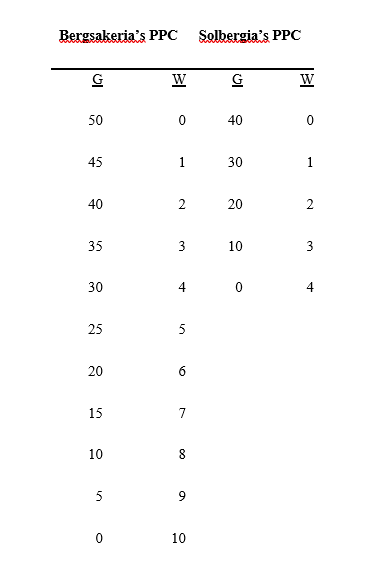
a. Which nation has an absolute advantage in producing gizmos (and widgets for that matter)? Explain.
b. Which nation has a comparative advantage in producing gizmos? How do you know?
c. Which nation has a comparative advantage in producing widgets? Explain.
-Following are the production possibilities curves for the fictional nations of Bergsakeria and Solbergia showing their respective capacities for producing gizmos (G) and widgets (W). Use this information to answer the questions that follow.
a. Which nation has an absolute advantage in producing gizmos (and widgets for that matter)? Explain.
b. Which nation has a comparative advantage in producing gizmos? How do you know?
c. Which nation has a comparative advantage in producing widgets? Explain.
Question
Question
Question
Question
Question
Question
Question
Question
Question
Question
Question
Question
Question
Question
Question
Question
Question
Question
Question

-In Table 55a, if the trading price of goods is based on labor input, what is the relative price of 1 loaf of bread in Canada?
A) 1 loaf = 1.33 pounds of cheese
B) 1 loaf = 0.75 pounds of cheese
C) 1 loaf = $4.00
D) 1 loaf = 8 pounds of cheese
Question
-In Table 55a, if the trading price of goods is based on labor input, what is the relative price of 1 loaf of bread in Mexico?
A) 1 loaf = 4 pounds of cheese
B) 1 loaf = 2 pounds of cheese
C) 1 loaf = $5.00
D) 1 loaf = 0.5 pound of cheese
Question
-In Table 55a, if the trading price of goods is based on labor input, what is the relative price of 1 pound of cheese in Canada?
A) 1 pound = 1.33 loaves of bread
B) 1 pound = 6 loaves of bread
C) 1 pound = 0.75 loaves of bread
D) 1 pound = $6.00
Question
-In Table 55a, if the trading price of goods is based on labor input, what is the relative price of 1 pound of cheese in Mexico?
A) 1 pound = 2 loaves of bread
B) 1 pound = 0.5 loaf of bread
C) 1 pound = 4 loaves of bread
D) 1 pound = $8.00
Question
-In Table 55a, which country has the comparative advantage in the production of bread?
A) Canada
B) Mexico
C) Neither country
D) Both countries
Question
-In Table 55a, which country has the comparative advantage in the production of cheese?
A) Canada
B) Mexico
C) Neither country
D) Both countries
Question
Question

-In Table 55b, assume that Canada decides to export bread to Mexico. Canada can sell 1 loaf of bread for ___________cheese at home in Canada, but it can sell 1 loaf of bread for _______ in Mexico. (Fill in the blanks)
A) 1.33 pounds of cheese, 2 pounds of cheese.
B) 4 pounds of cheese, 2 pounds of cheese.
C) ¾ pounds of cheese, ½ pounds of cheese.
D) 1 pound of cheese, 1 pound of cheese.
Question
-In Table 55b, if Mexico buys bread from Canada at the Canadian price, it will pay ___________. If Mexico buys bread from Canada at the Mexican price, it will pay________. (Fill in the blanks)
A) 1.33 pounds of cheese, 2 pounds of cheese.
B) 4 pounds of cheese, 2 pounds of cheese.
C) ¾ pounds of cheese, ½ pounds of cheese.
D) 1 pound of cheese, 1 pound of cheese.
Question
-Using Table 55b, Mexico will have the most gain from trade if
A) it can buy imported bread from Canada at the Canadian price.
B) it can buy imported bread from Canada at the Mexican price.
C) it does not buy any bread from Canada.
D) it sells bread to Canada and imports cheese.
Question
Question
Question
Question
Question
Question

Unlock Deck
Sign up to unlock the cards in this deck!
Unlock Deck
Unlock Deck
1/51

Play

Full screen (f)
Deck 55: Debate on Free Trade
1
Whats defention of terms:
-absolute advantage
-absolute advantage
producing goods and services with the fewest inputs or at the lowest cost
2
Whats defention of terms:
-comparative advantage
-comparative advantage
producing a good or service at the lowest opportunity cost
3
Whats defention of terms:
-free trade
-free trade
condition under which all goods and services must be allowed to travel freely in global trade without any barriers
4
Whats defention of terms:
-infant industry
-infant industry
Unlock Deck
Unlock for access to all 51 flashcards in this deck.
Unlock Deck
k this deck
5
Whats defention of terms:
-quota
-quota
Unlock Deck
Unlock for access to all 51 flashcards in this deck.
Unlock Deck
k this deck
6
Whats defention of terms:
-subsidy
-subsidy
Unlock Deck
Unlock for access to all 51 flashcards in this deck.
Unlock Deck
k this deck
7
Whats defention of terms:
-tariff
-tariff
Unlock Deck
Unlock for access to all 51 flashcards in this deck.
Unlock Deck
k this deck
8
Whats defention of terms:
-autarky
-autarky
Unlock Deck
Unlock for access to all 51 flashcards in this deck.
Unlock Deck
k this deck
9
Whats defention of terms:
-terms of trade
-terms of trade
Unlock Deck
Unlock for access to all 51 flashcards in this deck.
Unlock Deck
k this deck
10
Whats defention of terms:
-Heckscher-Ohlin model
-Heckscher-Ohlin model
Unlock Deck
Unlock for access to all 51 flashcards in this deck.
Unlock Deck
k this deck
11
Whats defention of terms:
-Prebisch-Singer hypothesis
-Prebisch-Singer hypothesis
Unlock Deck
Unlock for access to all 51 flashcards in this deck.
Unlock Deck
k this deck
12
Whats defention of terms:
-product cycle
-product cycle
Unlock Deck
Unlock for access to all 51 flashcards in this deck.
Unlock Deck
k this deck
13
Compare and contrast the arguments for and against free trade between countries.
-What is the difference between a tariff and a quota? Why would advocates of free trade see these policy tools as reducing consumer welfare?
-What is the difference between a tariff and a quota? Why would advocates of free trade see these policy tools as reducing consumer welfare?
Unlock Deck
Unlock for access to all 51 flashcards in this deck.
Unlock Deck
k this deck
14
Compare and contrast the arguments for and against free trade between countries.
-What would be arguments used to justify barriers to free trade, such as tariffs and ?quotas?
-What would be arguments used to justify barriers to free trade, such as tariffs and ?quotas?
Unlock Deck
Unlock for access to all 51 flashcards in this deck.
Unlock Deck
k this deck
15
Explain the comparative advantage model of trade (including the assumptions for the model) and how it is used to argue for free trade.
-Explain how comparative advantage differs from absolute advantage.
-Explain how comparative advantage differs from absolute advantage.
Unlock Deck
Unlock for access to all 51 flashcards in this deck.
Unlock Deck
k this deck
16
Explain the comparative advantage model of trade (including the assumptions for the model) and how it is used to argue for free trade.
-What are the assumptions behind the simple static theory of comparative advantage?
-What are the assumptions behind the simple static theory of comparative advantage?
Unlock Deck
Unlock for access to all 51 flashcards in this deck.
Unlock Deck
k this deck
17
Explain the comparative advantage model of trade (including the assumptions for the model) and how it is used to argue for free trade.
-Following are the production possibilities curves for the fictional nations of Bergsakeria and Solbergia showing their respective capacities for producing gizmos (G) and widgets (W). Use this information to answer the questions that follow.
a. Which nation has an absolute advantage in producing gizmos (and widgets for that matter)? Explain.
b. Which nation has a comparative advantage in producing gizmos? How do you know?
c. Which nation has a comparative advantage in producing widgets? Explain.
-Following are the production possibilities curves for the fictional nations of Bergsakeria and Solbergia showing their respective capacities for producing gizmos (G) and widgets (W). Use this information to answer the questions that follow.
a. Which nation has an absolute advantage in producing gizmos (and widgets for that matter)? Explain.
b. Which nation has a comparative advantage in producing gizmos? How do you know?
c. Which nation has a comparative advantage in producing widgets? Explain.
Unlock Deck
Unlock for access to all 51 flashcards in this deck.
Unlock Deck
k this deck
18
Cite historical and current examples of protectionism and the free trade debate.
-Why do Europe and the U.S. both want to maintain agricultural subsidies? Why do ?developing countries argue the U.S. and Europe should drop the subsidies?
-Why do Europe and the U.S. both want to maintain agricultural subsidies? Why do ?developing countries argue the U.S. and Europe should drop the subsidies?
Unlock Deck
Unlock for access to all 51 flashcards in this deck.
Unlock Deck
k this deck
19
Cite historical and current examples of protectionism and the free trade debate.
-What is the WTO? Is it effective in enforcing trade policies? Why or why not?
-What is the WTO? Is it effective in enforcing trade policies? Why or why not?
Unlock Deck
Unlock for access to all 51 flashcards in this deck.
Unlock Deck
k this deck
20
Use the comparative advantage model to explain the terms of trade
-Demonstrate using a PPF graph why both countries can be made better off by specialization and trade.
-Demonstrate using a PPF graph why both countries can be made better off by specialization and trade.
Unlock Deck
Unlock for access to all 51 flashcards in this deck.
Unlock Deck
k this deck
21
Use the comparative advantage model to explain the terms of trade
-Describe how two countries might arrive at mutually agreeable terms of trade.
-Describe how two countries might arrive at mutually agreeable terms of trade.
Unlock Deck
Unlock for access to all 51 flashcards in this deck.
Unlock Deck
k this deck
22
Explain the predicted and actual outcomes of free trade based on the comparative advantage model.
-Explain why would both countries be better off specializing and trading even if one country produces more of all goods.
-Explain why would both countries be better off specializing and trading even if one country produces more of all goods.
Unlock Deck
Unlock for access to all 51 flashcards in this deck.
Unlock Deck
k this deck
23
Explain the predicted and actual outcomes of free trade based on the comparative advantage model.
-In the real world, what might interfere with the results predicted by the model?
-In the real world, what might interfere with the results predicted by the model?
Unlock Deck
Unlock for access to all 51 flashcards in this deck.
Unlock Deck
k this deck
24
Compare and contrast alternative models of trade.
-How does the Heckscher-Ohlin model challenge the traditional model of comparative advantage? What are problems with both models?
-How does the Heckscher-Ohlin model challenge the traditional model of comparative advantage? What are problems with both models?
Unlock Deck
Unlock for access to all 51 flashcards in this deck.
Unlock Deck
k this deck
25
Compare and contrast alternative models of trade.
-How does the Prebisch-Singer hypothesis challenge the comparative advantage model of trade?
-How does the Prebisch-Singer hypothesis challenge the comparative advantage model of trade?
Unlock Deck
Unlock for access to all 51 flashcards in this deck.
Unlock Deck
k this deck
26
Discuss how alternative models seek to address weaknesses in the comparative advantage model.
-Explain the need to go beyond the analysis of static comparative advantage according to modifications of the assumptions, paying particular attention to
a. Transportation costs
b. Factor proportions
c. Human capital and knowledge
d. Distribution of benefits and costs of trade
e. Economies of scale and monopolistic competition
f. The product cycle and industrial metamorphoses
g. Anomalous terms of trade between primary and manufactured goods
-Explain the need to go beyond the analysis of static comparative advantage according to modifications of the assumptions, paying particular attention to
a. Transportation costs
b. Factor proportions
c. Human capital and knowledge
d. Distribution of benefits and costs of trade
e. Economies of scale and monopolistic competition
f. The product cycle and industrial metamorphoses
g. Anomalous terms of trade between primary and manufactured goods
Unlock Deck
Unlock for access to all 51 flashcards in this deck.
Unlock Deck
k this deck
27
Discuss how alternative models seek to address weaknesses in the comparative advantage model.
-Explain the possible policy implications for the need to develop along the lines of South Korea rather than Chile. Pay particular attention to (a) free trade versus protection, (b) industry, and (c) education and infrastructure spending.
-Explain the possible policy implications for the need to develop along the lines of South Korea rather than Chile. Pay particular attention to (a) free trade versus protection, (b) industry, and (c) education and infrastructure spending.
Unlock Deck
Unlock for access to all 51 flashcards in this deck.
Unlock Deck
k this deck
28
Discuss how alternative models seek to address weaknesses in the comparative advantage model.
-Counter to the predictions of static comparative advantage, explain why advanced nations trade mostly among themselves (along with the select new area that become part of their strategic alliances and partnerships).
-Counter to the predictions of static comparative advantage, explain why advanced nations trade mostly among themselves (along with the select new area that become part of their strategic alliances and partnerships).
Unlock Deck
Unlock for access to all 51 flashcards in this deck.
Unlock Deck
k this deck
29
Discuss how alternative models seek to address weaknesses in the comparative advantage model.
-Why might the product cycle provide an explanation for export success and then failure, while static comparative advantage fails to comprehend the evolutionary aspects of trade?
-Why might the product cycle provide an explanation for export success and then failure, while static comparative advantage fails to comprehend the evolutionary aspects of trade?
Unlock Deck
Unlock for access to all 51 flashcards in this deck.
Unlock Deck
k this deck
30
Discuss how alternative models seek to address weaknesses in the comparative advantage model.
-Why may developing nations find it advantageous to protect their new technology industries and provide infrastructure such as roads, education, and health services to stimulate human capital when they currently do not have a static comparative advantage in new technology products.
-Why may developing nations find it advantageous to protect their new technology industries and provide infrastructure such as roads, education, and health services to stimulate human capital when they currently do not have a static comparative advantage in new technology products.
Unlock Deck
Unlock for access to all 51 flashcards in this deck.
Unlock Deck
k this deck
31
Discuss how alternative models seek to address weaknesses in the comparative advantage model.
-Why have South Korea, Taiwan, and Singapore been so successful at technologically advanced processes and products when static comparative advantage indicated that they should have concentrated on low-value-added goods forty years ago? Why, on the other hand, have such apparently promising nations such as Chile and Brazil not advanced that much in development compared with these previously low-development East Asian nations?
-Why have South Korea, Taiwan, and Singapore been so successful at technologically advanced processes and products when static comparative advantage indicated that they should have concentrated on low-value-added goods forty years ago? Why, on the other hand, have such apparently promising nations such as Chile and Brazil not advanced that much in development compared with these previously low-development East Asian nations?
Unlock Deck
Unlock for access to all 51 flashcards in this deck.
Unlock Deck
k this deck
32
In the 19th century, wool imported to the United States was subject to a 25% tax. This is an example of
A) a quota
B) free trade
C) a tariff
D) comparative advantage
A) a quota
B) free trade
C) a tariff
D) comparative advantage
Unlock Deck
Unlock for access to all 51 flashcards in this deck.
Unlock Deck
k this deck
33
In the 1980s, the number of automobiles that could be imported into the U.S was limited in order to provide protection to American automobile manufacturers. This is an exmaple of
A) a quota
B) free trade
C) a tariff
D) comparative advantage
A) a quota
B) free trade
C) a tariff
D) comparative advantage
Unlock Deck
Unlock for access to all 51 flashcards in this deck.
Unlock Deck
k this deck
34
Until the early 19th century, many economists believed that international trade was a zero sum game. What is a zero sum game?
A) a game where there are no winners.
B) a game where there are no losers.
C) a game where one country can only gain if another country loses.
D) a game that does not cost anything to play.
A) a game where there are no winners.
B) a game where there are no losers.
C) a game where one country can only gain if another country loses.
D) a game that does not cost anything to play.
Unlock Deck
Unlock for access to all 51 flashcards in this deck.
Unlock Deck
k this deck
35
The classic story of comparative advantage developed by Ricardo is
A) is based on absolute advantage
B) uses the labor theory of value.
C) presents both the supply and demand side of the market for both goods.
D) demonstrates that free trade is a zero sum game.
A) is based on absolute advantage
B) uses the labor theory of value.
C) presents both the supply and demand side of the market for both goods.
D) demonstrates that free trade is a zero sum game.
Unlock Deck
Unlock for access to all 51 flashcards in this deck.
Unlock Deck
k this deck
36
-In Table 55a, if the trading price of goods is based on labor input, what is the relative price of 1 loaf of bread in Canada?
A) 1 loaf = 1.33 pounds of cheese
B) 1 loaf = 0.75 pounds of cheese
C) 1 loaf = $4.00
D) 1 loaf = 8 pounds of cheese
Unlock Deck
Unlock for access to all 51 flashcards in this deck.
Unlock Deck
k this deck
37
-In Table 55a, if the trading price of goods is based on labor input, what is the relative price of 1 loaf of bread in Mexico?
A) 1 loaf = 4 pounds of cheese
B) 1 loaf = 2 pounds of cheese
C) 1 loaf = $5.00
D) 1 loaf = 0.5 pound of cheese
Unlock Deck
Unlock for access to all 51 flashcards in this deck.
Unlock Deck
k this deck
38
-In Table 55a, if the trading price of goods is based on labor input, what is the relative price of 1 pound of cheese in Canada?
A) 1 pound = 1.33 loaves of bread
B) 1 pound = 6 loaves of bread
C) 1 pound = 0.75 loaves of bread
D) 1 pound = $6.00
Unlock Deck
Unlock for access to all 51 flashcards in this deck.
Unlock Deck
k this deck
39
-In Table 55a, if the trading price of goods is based on labor input, what is the relative price of 1 pound of cheese in Mexico?
A) 1 pound = 2 loaves of bread
B) 1 pound = 0.5 loaf of bread
C) 1 pound = 4 loaves of bread
D) 1 pound = $8.00
Unlock Deck
Unlock for access to all 51 flashcards in this deck.
Unlock Deck
k this deck
40
-In Table 55a, which country has the comparative advantage in the production of bread?
A) Canada
B) Mexico
C) Neither country
D) Both countries
Unlock Deck
Unlock for access to all 51 flashcards in this deck.
Unlock Deck
k this deck
41
-In Table 55a, which country has the comparative advantage in the production of cheese?
A) Canada
B) Mexico
C) Neither country
D) Both countries
Unlock Deck
Unlock for access to all 51 flashcards in this deck.
Unlock Deck
k this deck
42
What does the phrase, "terms of trade" refer to?
A) it refers to the agreed upon terms in a contract of sale.
B) it refers to the rate of exchange between an export good and an import good.
C) it refers to the level of tariffs imposed on an imported good.
D) it refers to the length of time between the sale and the actual delivery date.
A) it refers to the agreed upon terms in a contract of sale.
B) it refers to the rate of exchange between an export good and an import good.
C) it refers to the level of tariffs imposed on an imported good.
D) it refers to the length of time between the sale and the actual delivery date.
Unlock Deck
Unlock for access to all 51 flashcards in this deck.
Unlock Deck
k this deck
43
-In Table 55b, assume that Canada decides to export bread to Mexico. Canada can sell 1 loaf of bread for ___________cheese at home in Canada, but it can sell 1 loaf of bread for _______ in Mexico. (Fill in the blanks)
A) 1.33 pounds of cheese, 2 pounds of cheese.
B) 4 pounds of cheese, 2 pounds of cheese.
C) ¾ pounds of cheese, ½ pounds of cheese.
D) 1 pound of cheese, 1 pound of cheese.
Unlock Deck
Unlock for access to all 51 flashcards in this deck.
Unlock Deck
k this deck
44
-In Table 55b, if Mexico buys bread from Canada at the Canadian price, it will pay ___________. If Mexico buys bread from Canada at the Mexican price, it will pay________. (Fill in the blanks)
A) 1.33 pounds of cheese, 2 pounds of cheese.
B) 4 pounds of cheese, 2 pounds of cheese.
C) ¾ pounds of cheese, ½ pounds of cheese.
D) 1 pound of cheese, 1 pound of cheese.
Unlock Deck
Unlock for access to all 51 flashcards in this deck.
Unlock Deck
k this deck
45
-Using Table 55b, Mexico will have the most gain from trade if
A) it can buy imported bread from Canada at the Canadian price.
B) it can buy imported bread from Canada at the Mexican price.
C) it does not buy any bread from Canada.
D) it sells bread to Canada and imports cheese.
Unlock Deck
Unlock for access to all 51 flashcards in this deck.
Unlock Deck
k this deck
46
The assumption that a country engages in no international trade at all is called
A) aristocracy
B) autarky
C) autocracy
D) oligarchy
A) aristocracy
B) autarky
C) autocracy
D) oligarchy
Unlock Deck
Unlock for access to all 51 flashcards in this deck.
Unlock Deck
k this deck
47
The classic story of comparative advantage demonstrates that
A) everyone gains from free trade.
B) everyone loses from free trade.
C) free trade is a zero sum game.
D) free trade creates winners and losers within countries.
A) everyone gains from free trade.
B) everyone loses from free trade.
C) free trade is a zero sum game.
D) free trade creates winners and losers within countries.
Unlock Deck
Unlock for access to all 51 flashcards in this deck.
Unlock Deck
k this deck
48
The neoclassical theory of comparative advantage (the Heckscher-Ohlin model) differs from the classical theory (Ricardian model) in that
A) trade is based on absolute advantage in the production of goods.
B) trade is based on a country's endowment of resources.
C) trade is based on a country's monopoly power.
D) trade is based on a country's degree of industrialization.
A) trade is based on absolute advantage in the production of goods.
B) trade is based on a country's endowment of resources.
C) trade is based on a country's monopoly power.
D) trade is based on a country's degree of industrialization.
Unlock Deck
Unlock for access to all 51 flashcards in this deck.
Unlock Deck
k this deck
49
The criticism that both the Heckscher-Ohlin model and the Ricardian models of comparative advantage are "too static" means
A) The models are too stationary and do not take into account the cost of transporting goods.
B) Neither model incorporates capital as a factor of production.
C) Neither model recognizes that productive factors are scarce and fixed in each country.
D) Neither model recognizes that production technology is constantly changing.
A) The models are too stationary and do not take into account the cost of transporting goods.
B) Neither model incorporates capital as a factor of production.
C) Neither model recognizes that productive factors are scarce and fixed in each country.
D) Neither model recognizes that production technology is constantly changing.
Unlock Deck
Unlock for access to all 51 flashcards in this deck.
Unlock Deck
k this deck
50
In the mid 1960s, Raymond Vernon developed the idea that products go through a cycle of different phases while include
A) development, expansion, peak, maturity, and demise.
B) custom, mainstream, mass production, and demise.
C) conception, design, manufacture, service and disposal
D) recession, trough, expansion, peak.
A) development, expansion, peak, maturity, and demise.
B) custom, mainstream, mass production, and demise.
C) conception, design, manufacture, service and disposal
D) recession, trough, expansion, peak.
Unlock Deck
Unlock for access to all 51 flashcards in this deck.
Unlock Deck
k this deck
51
Assume Spain determines that it has a comparative advantage in wool and begins to export wool to Portugal. In turn, Portugal finds it has a comparative advantage in wine and begins to export wine to Spain. Who are the likely winners and losers in the short run as a result of this specialization?
A) everyone in both countries will gain from free trade.
B) the winners are producers of wool in Spain, producers of wine in Portugal, and consumers in both countries; the losers are producers of wine in Spain and producers of wool in Portugal.
C) the winners are consumers in both countries and producers in both countries; the losers are the workers in both countries.
D) the winners are producers of wool in Portugal, producers of wine in Spain, and consumers in both countries; the losers are producers of wine in Portugal and producers of wool in Spain.
A) everyone in both countries will gain from free trade.
B) the winners are producers of wool in Spain, producers of wine in Portugal, and consumers in both countries; the losers are producers of wine in Spain and producers of wool in Portugal.
C) the winners are consumers in both countries and producers in both countries; the losers are the workers in both countries.
D) the winners are producers of wool in Portugal, producers of wine in Spain, and consumers in both countries; the losers are producers of wine in Portugal and producers of wool in Spain.
Unlock Deck
Unlock for access to all 51 flashcards in this deck.
Unlock Deck
k this deck
Unlock Deck
Unlock for access to all 51 flashcards in this deck.






