







 Chat with AI

Deck 3: Orthodox International Trade Theory: Why Mainstream Economists Like Free Trade
Full screen (f)

Question

Question
Question
Question
Question
Question
Question
Question
Question
Question
Question
Question
Question
Question
Question
Question
Question
Question
Question
Question
Question
Question
Question
Question
Question
Question
Question
Suppose that the market for running shoes looks as in the figure below. Producer surplus is equal to: 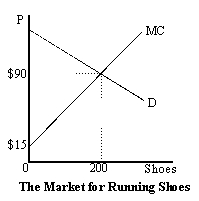
A) $15,000
B) $90
C) $7,500
D) $18,000
E) None of the above.
A) $15,000
B) $90
C) $7,500
D) $18,000
E) None of the above.
Question
Suppose that the market for baseballs looks as in the figure below. Consumer surplus is equal to: 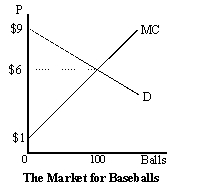
A) $150
B) $600
C) $900
D) $750
E) None of the above.
A) $150
B) $600
C) $900
D) $750
E) None of the above.
Question
Question
Question
Question
Question

Unlock Deck
Sign up to unlock the cards in this deck!
Unlock Deck
Unlock Deck
1/33

Play

Full screen (f)
Deck 3: Orthodox International Trade Theory: Why Mainstream Economists Like Free Trade
1
The production possibilities frontier is typically drawn so that it has a bowed-out shape, or concave to the origin. This shape implies that:
A) it becomes increasingly costly to expand production of one good the more of society's resources are taken from other sectors of the economy.
B) the more of a product is produced, the less costly it becomes.
C) production is characterized by decreasing costs.
D) Both b and c
E) None of the above.
A) it becomes increasingly costly to expand production of one good the more of society's resources are taken from other sectors of the economy.
B) the more of a product is produced, the less costly it becomes.
C) production is characterized by decreasing costs.
D) Both b and c
E) None of the above.
it becomes increasingly costly to expand production of one good the more of society's resources are taken from other sectors of the economy.
2
The following is a property of indifference curves:
A) they can intersect.
B) they slope downward from left to right.
C) their slope is always constant.
D) they are concave to (they bow out from) the origin.
E) None of the above.
A) they can intersect.
B) they slope downward from left to right.
C) their slope is always constant.
D) they are concave to (they bow out from) the origin.
E) None of the above.
they slope downward from left to right.
3
If an economy insists on remaining completely self-sufficient and isolated from the rest of the world and it is already producing as efficiently as possible, it can raise the welfare of its citizens only by:
A) specializing according to its comparative advantage.
B) increasing the amount of productive resources, perhaps by investing and increasing its capital stock.
C) improving its level of technology so that it can convert the same amount of inputs into a greater amount of output.
D) All of the above.
E) Both b and c
A) specializing according to its comparative advantage.
B) increasing the amount of productive resources, perhaps by investing and increasing its capital stock.
C) improving its level of technology so that it can convert the same amount of inputs into a greater amount of output.
D) All of the above.
E) Both b and c
Both b and c
4
When we assume that an economy is small and that world prices will not be affected by its engaging in international trade, we are said to be making the:
A) partial equilibrium assumption.
B) all other things equal assumption.
C) small country assumption.
D) insignificance assumption.
A) partial equilibrium assumption.
B) all other things equal assumption.
C) small country assumption.
D) insignificance assumption.
Unlock Deck
Unlock for access to all 33 flashcards in this deck.
Unlock Deck
k this deck
5
According to the general equilibrium PPF/Indifference curve model, a country's gains from international trade can be split into:
A) the gains from specialization and the gains from protection.
B) the gains from exchange and the gains from specialization.
C) the gains from exchange and the gains from growth.
D) the gains from specialization and the gains from scale.
A) the gains from specialization and the gains from protection.
B) the gains from exchange and the gains from specialization.
C) the gains from exchange and the gains from growth.
D) the gains from specialization and the gains from scale.
Unlock Deck
Unlock for access to all 33 flashcards in this deck.
Unlock Deck
k this deck
6
The economy of Tinyland is depicted using a typical production possibilities frontier, with good A on the horizontal axis and good B on the vertical axis, and the world price of good A is lower in the rest of the world relative to the price of good B than it would be in Tinyland in the absence of trade. In this case, with free trade the production point in Tinyland lies:
A) to the northwest of the no-trade production point.
B) to the southeast of the no-trade production point.
C) at the intersection of the production possibilities frontier and the vertical axis.
D) at the intersection of the production possibilities frontier and the horizontal axis.
E) at a point that is not correctly described by any of the above.
A) to the northwest of the no-trade production point.
B) to the southeast of the no-trade production point.
C) at the intersection of the production possibilities frontier and the vertical axis.
D) at the intersection of the production possibilities frontier and the horizontal axis.
E) at a point that is not correctly described by any of the above.
Unlock Deck
Unlock for access to all 33 flashcards in this deck.
Unlock Deck
k this deck
7
Exports are:
A) the cost of acquiring imports.
B) the direct benefit from international trade.
C) the only reason international trade increases national welfare.
D) the primary goal of trade policies aimed at raising national welfare.
A) the cost of acquiring imports.
B) the direct benefit from international trade.
C) the only reason international trade increases national welfare.
D) the primary goal of trade policies aimed at raising national welfare.
Unlock Deck
Unlock for access to all 33 flashcards in this deck.
Unlock Deck
k this deck
8
In the case of free trade, a small economy's:
A) production point must lie on or inside its production possibilities frontier.
B) consumption point cannot lie outside its production possibilities frontier.
C) production point can lie outside its production possibilities frontier.
D) production point must lie inside its production possibilities frontier.
E) None of the above.
A) production point must lie on or inside its production possibilities frontier.
B) consumption point cannot lie outside its production possibilities frontier.
C) production point can lie outside its production possibilities frontier.
D) production point must lie inside its production possibilities frontier.
E) None of the above.
Unlock Deck
Unlock for access to all 33 flashcards in this deck.
Unlock Deck
k this deck
9
Suppose an economy is perfectly competitive, production is subject to increasing costs, and there is completely free and costless trade. Then in equilibrium:
A) the marginal rate of substitution in the consumption is equal to the marginal rate of transformation in production.
B) the economy's production and consumption points are distinct.
C) the marginal rate of substitution in consumption is equal to the ratio of product prices.
D) All of the above.
E) None of the above.
A) the marginal rate of substitution in the consumption is equal to the marginal rate of transformation in production.
B) the economy's production and consumption points are distinct.
C) the marginal rate of substitution in consumption is equal to the ratio of product prices.
D) All of the above.
E) None of the above.
Unlock Deck
Unlock for access to all 33 flashcards in this deck.
Unlock Deck
k this deck
10
The general equilibrium model of international trade pointed out that:
A) whenever the relative prices of goods are not the same, countries can potentially enhance national welfare by engaging in international trade.
B) producers will specialize and produce more of the goods that, compared to world prices, were relatively cheap at home and fewer of the goods that were relatively expensive.
C) a country will tend to export the goods that are relatively cheap at home, compared to overseas prices, and import the goods that are relatively expensive at home.
D) All of the above.
E) None of the above.
A) whenever the relative prices of goods are not the same, countries can potentially enhance national welfare by engaging in international trade.
B) producers will specialize and produce more of the goods that, compared to world prices, were relatively cheap at home and fewer of the goods that were relatively expensive.
C) a country will tend to export the goods that are relatively cheap at home, compared to overseas prices, and import the goods that are relatively expensive at home.
D) All of the above.
E) None of the above.
Unlock Deck
Unlock for access to all 33 flashcards in this deck.
Unlock Deck
k this deck
11
The small country general equilibrium (PPF/indifference curve) model of international trade brought out a number of important points, among which is/are:
A) whenever the relative prices of goods are the same, countries can enhance national welfare by engaging in exchange, but they cannot gain from specialization.
B) producers will specialize and produce more of the goods that, compared to world prices, were relatively expensive at home and fewer of the goods that were relatively cheap.
C) a country exports goods that are relatively cheap at home, compared to overseas prices, and imports goods that are relatively expensive at home.
D) All of the above.
E) None of the above.
A) whenever the relative prices of goods are the same, countries can enhance national welfare by engaging in exchange, but they cannot gain from specialization.
B) producers will specialize and produce more of the goods that, compared to world prices, were relatively expensive at home and fewer of the goods that were relatively cheap.
C) a country exports goods that are relatively cheap at home, compared to overseas prices, and imports goods that are relatively expensive at home.
D) All of the above.
E) None of the above.
Unlock Deck
Unlock for access to all 33 flashcards in this deck.
Unlock Deck
k this deck
12
The small country general equilibrium (PPF/indifference curve model) of international trade brought out a number of important points, among which is/are:
A) after international trade is carried out to its fullest potential, all domestic prices will become lower than international prices.
B) the gains from exchange are the result of domestic consumers substituting relatively cheaper foreign products for more expensive domestic products.
C) the shift from self-sufficiency to free trade decreases the economy's real output but it lowers the prices of everything so that it seems as though real income increases.
D) All of the above.
E) None of the above.
A) after international trade is carried out to its fullest potential, all domestic prices will become lower than international prices.
B) the gains from exchange are the result of domestic consumers substituting relatively cheaper foreign products for more expensive domestic products.
C) the shift from self-sufficiency to free trade decreases the economy's real output but it lowers the prices of everything so that it seems as though real income increases.
D) All of the above.
E) None of the above.
Unlock Deck
Unlock for access to all 33 flashcards in this deck.
Unlock Deck
k this deck
13
Production possibilities frontiers vary across countries because:
A) factor endowments differ.
B) technology differs.
C) levels of international trade differ.
D) All of the above.
E) Only a and b
A) factor endowments differ.
B) technology differs.
C) levels of international trade differ.
D) All of the above.
E) Only a and b
Unlock Deck
Unlock for access to all 33 flashcards in this deck.
Unlock Deck
k this deck
14
The terms of trade (ToT) refers to:
A) the rate at which a country can exchange exports for imports in the world market.
B) the rate at which one country's money exchanges for another country's money.
C) the relative prices of goods in a country before it opens up to free trade.
D) the amount of labor used to produce exports as compared to the amount of labor that would have been used to produce the goods imported.
A) the rate at which a country can exchange exports for imports in the world market.
B) the rate at which one country's money exchanges for another country's money.
C) the relative prices of goods in a country before it opens up to free trade.
D) the amount of labor used to produce exports as compared to the amount of labor that would have been used to produce the goods imported.
Unlock Deck
Unlock for access to all 33 flashcards in this deck.
Unlock Deck
k this deck
15
The two-country general equilibrium (PPF/indifference curves) model shows that when two countries open their economies and trade freely:
A) both countries reach higher indifference curves.
B) consumers in both countries enjoy combinations of products that are simply not attainable without trade.
C) both countries specialize in producing the products in which each enjoys a comparative advantage.
D) All of the above.
E) None of the above.
A) both countries reach higher indifference curves.
B) consumers in both countries enjoy combinations of products that are simply not attainable without trade.
C) both countries specialize in producing the products in which each enjoys a comparative advantage.
D) All of the above.
E) None of the above.
Unlock Deck
Unlock for access to all 33 flashcards in this deck.
Unlock Deck
k this deck
16
The two-country general equilibrium (PPF/indifference curves) model shows that when two countries open their economies and trade freely:
A) the terms of trade will settle somewhere between the relative price ratios that prevailed in each country prior to trade.
B) one country gains welfare and the other suffers a welfare loss.
C) consumers in one country choose a new consumption combination, while consumers in the other country continue to consume exactly the same bundle of products they consumed before free trade.
D) All of the above.
E) None of the above.
A) the terms of trade will settle somewhere between the relative price ratios that prevailed in each country prior to trade.
B) one country gains welfare and the other suffers a welfare loss.
C) consumers in one country choose a new consumption combination, while consumers in the other country continue to consume exactly the same bundle of products they consumed before free trade.
D) All of the above.
E) None of the above.
Unlock Deck
Unlock for access to all 33 flashcards in this deck.
Unlock Deck
k this deck
17
According to the two-country general equilibrium (PPF/indifference curves) model, a country's comparative advantage depends on:
A) each country's opportunity costs of production.
B) each country's consumer tastes.
C) each country's resource endowment.
D) All of the above.
E) None of the above.
A) each country's opportunity costs of production.
B) each country's consumer tastes.
C) each country's resource endowment.
D) All of the above.
E) None of the above.
Unlock Deck
Unlock for access to all 33 flashcards in this deck.
Unlock Deck
k this deck
18
The Heckscher-Ohlin model generates several important conclusions about the effects of international trade:
A) international trade increases the total value of goods and services consumed.
B) to capture the gains from trade and specialization, resources must be shifted from import-competing industries to export industries.
C) consumption patterns change because exported products become more expensive and import-competing goods become less expensive.
D) estimates of the welfare gained from the shift to international trade illustrated by the movement to a higher indifference curve are very small.
E) All of the above.
A) international trade increases the total value of goods and services consumed.
B) to capture the gains from trade and specialization, resources must be shifted from import-competing industries to export industries.
C) consumption patterns change because exported products become more expensive and import-competing goods become less expensive.
D) estimates of the welfare gained from the shift to international trade illustrated by the movement to a higher indifference curve are very small.
E) All of the above.
Unlock Deck
Unlock for access to all 33 flashcards in this deck.
Unlock Deck
k this deck
19
According to the two-country general equilibrium (PPF/indifference curves) model, if both countries' production possibilities frontiers are identical, then:
A) both countries must have identical resource endowments and technology.
B) the two countries could still have different comparative advantages if their tastes differ.
C) the two countries could find that international trade is not welfare-increasing.
D) All of the above.
E) None of the above.
A) both countries must have identical resource endowments and technology.
B) the two countries could still have different comparative advantages if their tastes differ.
C) the two countries could find that international trade is not welfare-increasing.
D) All of the above.
E) None of the above.
Unlock Deck
Unlock for access to all 33 flashcards in this deck.
Unlock Deck
k this deck
20
According to the two-country general equilibrium (PPF/indifference curves) model, if both countries' tastes (indifference curves) are identical, then:
A) relative prices must be the same in both countries.
B) neither country can, under any circumstance, enjoy a comparative advantage.
C) neither country will, under any circumstance, find international trade to be welfare-increasing.
D) All of the above.
E) None of the above.
A) relative prices must be the same in both countries.
B) neither country can, under any circumstance, enjoy a comparative advantage.
C) neither country will, under any circumstance, find international trade to be welfare-increasing.
D) All of the above.
E) None of the above.
Unlock Deck
Unlock for access to all 33 flashcards in this deck.
Unlock Deck
k this deck
21
The two-country general equilibrium (PPF/indifference curves) model illustrates that:
A) there are gains from trade whenever price ratios of goods are different across countries.
B) relative prices within economies will differ only when production possibilities frontiers differ.
C) differences in production possibilities frontiers may be due to differences in tastes.
D) All of the above.
E) None of the above.
A) there are gains from trade whenever price ratios of goods are different across countries.
B) relative prices within economies will differ only when production possibilities frontiers differ.
C) differences in production possibilities frontiers may be due to differences in tastes.
D) All of the above.
E) None of the above.
Unlock Deck
Unlock for access to all 33 flashcards in this deck.
Unlock Deck
k this deck
22
The two-country PPF/indifference curves model illustrates that:
A) whenever opportunity costs differ, specialization and trade can enhance national welfare.
B) differences in factor endowments and technology cause countries' production possibilities frontiers to differ, and these differences can explain comparative advantages.
C) differences in preferences can determine comparative advantage.
D) All of the above.
E) None of the above.
A) whenever opportunity costs differ, specialization and trade can enhance national welfare.
B) differences in factor endowments and technology cause countries' production possibilities frontiers to differ, and these differences can explain comparative advantages.
C) differences in preferences can determine comparative advantage.
D) All of the above.
E) None of the above.
Unlock Deck
Unlock for access to all 33 flashcards in this deck.
Unlock Deck
k this deck
23
According to the supply and demand model of international trade, in a market for a good in which a country does enjoys a comparative advantage, free trade will lead to welfare:
A) gains for the country's producers of the good that are greater in absolute value than the losses for domestic consumers of the good.
B) gains for the country's producers of the good that are smaller in absolute value than the losses to domestic consumers of the good.
C) losses for the country's producers of the good that are larger in absolute value than the gains to domestic consumers of the good.
D) gains for the country's producers of the good that may be larger than or smaller in absolute value than the gains to domestic consumers of the good.
E) gains for producers of the good that are exactly equal to the losses to domestic consumers of the good.
A) gains for the country's producers of the good that are greater in absolute value than the losses for domestic consumers of the good.
B) gains for the country's producers of the good that are smaller in absolute value than the losses to domestic consumers of the good.
C) losses for the country's producers of the good that are larger in absolute value than the gains to domestic consumers of the good.
D) gains for the country's producers of the good that may be larger than or smaller in absolute value than the gains to domestic consumers of the good.
E) gains for producers of the good that are exactly equal to the losses to domestic consumers of the good.
Unlock Deck
Unlock for access to all 33 flashcards in this deck.
Unlock Deck
k this deck
24
According to the supply and demand model of international trade, in a market for a good in which a country does not have a comparative advantage, free trade will lead to welfare:
A) gains for the country's producers of the good that are greater in absolute value than the losses for domestic consumers of the good.
B) losses for the country's producers of the good that are smaller in absolute value than the gains to domestic consumers of the good.
C) losses for the country's producers of the good that are greater in absolute value than the gains to domestic consumers of the good.
D) gains for the country's producers of the good that may be larger than or smaller than the gains to domestic consumers of the good.
E) gains for producers of the good that are exactly equal to the losses to domestic consumers of the good.
A) gains for the country's producers of the good that are greater in absolute value than the losses for domestic consumers of the good.
B) losses for the country's producers of the good that are smaller in absolute value than the gains to domestic consumers of the good.
C) losses for the country's producers of the good that are greater in absolute value than the gains to domestic consumers of the good.
D) gains for the country's producers of the good that may be larger than or smaller than the gains to domestic consumers of the good.
E) gains for producers of the good that are exactly equal to the losses to domestic consumers of the good.
Unlock Deck
Unlock for access to all 33 flashcards in this deck.
Unlock Deck
k this deck
25
Producer surplus is:
A) the area between the supply curve and the market price.
B) the difference between total revenue and total variable costs.
C) the net welfare gain to producers from being able to produce and sell their product.
D) All of the above.
E) None of the above.
A) the area between the supply curve and the market price.
B) the difference between total revenue and total variable costs.
C) the net welfare gain to producers from being able to produce and sell their product.
D) All of the above.
E) None of the above.
Unlock Deck
Unlock for access to all 33 flashcards in this deck.
Unlock Deck
k this deck
26
Consumer surplus is:
A) the area between the demand curve and the market price.
B) the difference between welfare gained from consuming the equilibrium level of output and the total revenue paid to producers.
C) the net welfare gain to consumers from being able to buy and consume a product.
D) All of the above.
E) None of the above.
A) the area between the demand curve and the market price.
B) the difference between welfare gained from consuming the equilibrium level of output and the total revenue paid to producers.
C) the net welfare gain to consumers from being able to buy and consume a product.
D) All of the above.
E) None of the above.
Unlock Deck
Unlock for access to all 33 flashcards in this deck.
Unlock Deck
k this deck
27
Suppose that the market for running shoes looks as in the figure below. Producer surplus is equal to:
A) $15,000
B) $90
C) $7,500
D) $18,000
E) None of the above.
A) $15,000
B) $90
C) $7,500
D) $18,000
E) None of the above.
Unlock Deck
Unlock for access to all 33 flashcards in this deck.
Unlock Deck
k this deck
28
Suppose that the market for baseballs looks as in the figure below. Consumer surplus is equal to:
A) $150
B) $600
C) $900
D) $750
E) None of the above.
A) $150
B) $600
C) $900
D) $750
E) None of the above.
Unlock Deck
Unlock for access to all 33 flashcards in this deck.
Unlock Deck
k this deck
29
The case study on the market for tequila in Mexico shows that an increase in:
A) foreign demand for a product will lower the domestic price in the exporting country.
B) foreign supply for a product will lower the domestic price in the importing country.
C) foreign demand for a product will raise the domestic price in the exporting country.
D) foreign supply for a product will raise the domestic price in the importing country.
A) foreign demand for a product will lower the domestic price in the exporting country.
B) foreign supply for a product will lower the domestic price in the importing country.
C) foreign demand for a product will raise the domestic price in the exporting country.
D) foreign supply for a product will raise the domestic price in the importing country.
Unlock Deck
Unlock for access to all 33 flashcards in this deck.
Unlock Deck
k this deck
30
The case study on the market for tequila in Mexico shows that:
A) an increase in foreign demand for a product will reduce consumer surplus in the exporting country.
B) an increase in foreign supply for a product will reduce producer surplus in the importing country.
C) an increase in foreign demand for a product will raise consumer surplus in the exporting country.
D) an increase in foreign supply for a product will raise producer surplus in the importing country.
A) an increase in foreign demand for a product will reduce consumer surplus in the exporting country.
B) an increase in foreign supply for a product will reduce producer surplus in the importing country.
C) an increase in foreign demand for a product will raise consumer surplus in the exporting country.
D) an increase in foreign supply for a product will raise producer surplus in the importing country.
Unlock Deck
Unlock for access to all 33 flashcards in this deck.
Unlock Deck
k this deck
31
According to empirical studies, the gains from international trade:
A) are equal to more than 10 percent of GDP per year in all countries.
B) are not large enough to be of any concern to policy makers interested in increasing human welfare.
C) are large only in very small countries, but negative in large countries like the United States.
D) are equal to several hundred billion dollars per year throughout the world.
A) are equal to more than 10 percent of GDP per year in all countries.
B) are not large enough to be of any concern to policy makers interested in increasing human welfare.
C) are large only in very small countries, but negative in large countries like the United States.
D) are equal to several hundred billion dollars per year throughout the world.
Unlock Deck
Unlock for access to all 33 flashcards in this deck.
Unlock Deck
k this deck
32
The two-country partial equilibrium model of international trade shows that:
A) in markets where a country is an importer, consumers lose welfare when free trade is established.
B) in markets where a country is an exporter, consumers gain and competing domestic producers lose welfare when free trade is established.
C) there are net gains from trade in each individual market when free trade is established.
D) All of the above.
A) in markets where a country is an importer, consumers lose welfare when free trade is established.
B) in markets where a country is an exporter, consumers gain and competing domestic producers lose welfare when free trade is established.
C) there are net gains from trade in each individual market when free trade is established.
D) All of the above.
Unlock Deck
Unlock for access to all 33 flashcards in this deck.
Unlock Deck
k this deck
33
The two-country partial equilibrium model of international trade shows that:
A) international trade simultaneously affects consumer and producer welfare in both the importing and exporting economies.
B) in markets where a country is an exporter, consumers gain and competing domestic producers lose welfare.
C) in markets where a country is an importer, consumers lose welfare when the competition from foreign consumers forces them to pay more for the goods.
D) All of the above.
E) None of the above.
A) international trade simultaneously affects consumer and producer welfare in both the importing and exporting economies.
B) in markets where a country is an exporter, consumers gain and competing domestic producers lose welfare.
C) in markets where a country is an importer, consumers lose welfare when the competition from foreign consumers forces them to pay more for the goods.
D) All of the above.
E) None of the above.
Unlock Deck
Unlock for access to all 33 flashcards in this deck.
Unlock Deck
k this deck
Unlock Deck
Unlock for access to all 33 flashcards in this deck.






