







 Chat with AI

Deck 9: Social Dilemma Games
Full screen (f)

Question

Question
Question
Question
Question
Question
Question
Question
Question
Question
Question
Question
Question
Question
Question
Question
Question
Question
Question
Question
Question
Question
Question
Question
Question
Question
Question
Question
Question
Question
Question
Question
Question
Question
Question
Question
Question
Question
Question
"It is difficult to sustain cooperation in finitely repeated prisoner's dilemma game. Tit-for-tat strategies are key for sustaining cooperation in such situations."
(a) What does finite repetition mean?
(b) Why is it hard to sustain cooperation if the prisoner's dilemma game is repeated finitely?
(c) What does a tit-for-tat strategy imply?
Now we are going to consider an infinitely repeated version of the prisoner's dilemma game shown below.
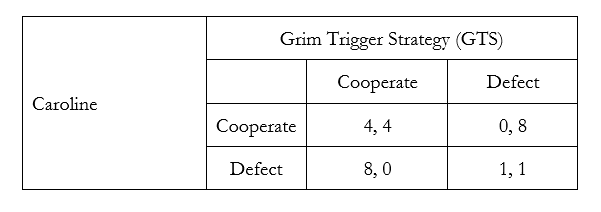
Consider Caroline who is playing against an opponent who relies on a grim-trigger strategy (GTS). This means that if you cooperate GTS will cooperate. But if you ever defect, then GTS will forever defect from the next period on.
Clearly, whether we cooperate or not in such situations is determined by how much we value future payoffs.
If Caroline and GTS keep cooperating, then Caroline keeps getting $4 each period.
If Caroline defects then she gets $8 in that period but because GTS will defect from the next period onward, the best Caroline can hope to get is $1 from the next period onward.
Remember that future payoffs are discounted by (beta*delta), where delta = 1/(1+r) i.e. delta equals {1 over (1+interest rate)}. Here, we will think of "r" as the interest rate that Caroline uses to trade-off between current and future payoffs. For the sake of simplicity assume that there is no inflation and that Caroline's beta is equal to one.
This implies the following sequence of payments for Caroline.
From cooperation: 4 + 4*(delta) + 4*(delta)^2 + 4*(delta)^3 …
From defection: 8 + 1*(delta) + 1*(delta)^2 + 1*(delta)^3…
(d) Consider two values of delta: 0.4 and 0.8. Which one of these is more likely to make Caroline choose "Cooperate" over "Defect" in period 1?
(e) What does the value of delta you identified in Part (1) imply for Caroline's implicit rate of interest? For what value or range of values of the implicit interest rate would Caroline choose to "Cooperate" in period 1?
(a) What does finite repetition mean?
(b) Why is it hard to sustain cooperation if the prisoner's dilemma game is repeated finitely?
(c) What does a tit-for-tat strategy imply?
Now we are going to consider an infinitely repeated version of the prisoner's dilemma game shown below.
Consider Caroline who is playing against an opponent who relies on a grim-trigger strategy (GTS). This means that if you cooperate GTS will cooperate. But if you ever defect, then GTS will forever defect from the next period on.
Clearly, whether we cooperate or not in such situations is determined by how much we value future payoffs.
If Caroline and GTS keep cooperating, then Caroline keeps getting $4 each period.
If Caroline defects then she gets $8 in that period but because GTS will defect from the next period onward, the best Caroline can hope to get is $1 from the next period onward.
Remember that future payoffs are discounted by (beta*delta), where delta = 1/(1+r) i.e. delta equals {1 over (1+interest rate)}. Here, we will think of "r" as the interest rate that Caroline uses to trade-off between current and future payoffs. For the sake of simplicity assume that there is no inflation and that Caroline's beta is equal to one.
This implies the following sequence of payments for Caroline.
From cooperation: 4 + 4*(delta) + 4*(delta)^2 + 4*(delta)^3 …
From defection: 8 + 1*(delta) + 1*(delta)^2 + 1*(delta)^3…
(d) Consider two values of delta: 0.4 and 0.8. Which one of these is more likely to make Caroline choose "Cooperate" over "Defect" in period 1?
(e) What does the value of delta you identified in Part (1) imply for Caroline's implicit rate of interest? For what value or range of values of the implicit interest rate would Caroline choose to "Cooperate" in period 1?
Question
Question
Question
Question
Question
Question
Question
Question
Question

Unlock Deck
Sign up to unlock the cards in this deck!
Unlock Deck
Unlock Deck
1/48

Play

Full screen (f)
Deck 9: Social Dilemma Games
1
With regards to the public goods game, the phenomenon of "conditional cooperation" refers to the finding that:
A) Participants' contributions to the public account are strongly positively correlated with their prior beliefs regarding the expected contributions of their peers.
B) Participants' contributions to the public account are strongly negatively correlated with their prior beliefs regarding the expected contributions of their peers.
C) Participants' contributions to the public account are "hump-shaped"; increasing in the expected contribution of other group members up to a point but decreasing in the expected contribution of other group members thereafter.
D) Some participants always contribute their entire endowment to the public good regardless of what others do since this is commensurate with the social optimum.
A) Participants' contributions to the public account are strongly positively correlated with their prior beliefs regarding the expected contributions of their peers.
B) Participants' contributions to the public account are strongly negatively correlated with their prior beliefs regarding the expected contributions of their peers.
C) Participants' contributions to the public account are "hump-shaped"; increasing in the expected contribution of other group members up to a point but decreasing in the expected contribution of other group members thereafter.
D) Some participants always contribute their entire endowment to the public good regardless of what others do since this is commensurate with the social optimum.
Participants' contributions to the public account are strongly positively correlated with their prior beliefs regarding the expected contributions of their peers.
2
With respect to a public goods game, the concept of "self-serving bias" among conditional co-operators refers to the fact that:
A) Conditional co-operators match others' contributions but this match is not exactly dollar-for-dollar but falls a little short.
B) The Nash equilibrium of the game is to engage in complete free riding; therefore, we expect self-serving subjects to contribute very little to the public account.
C) Conditional co-operators are willing to match others' contributions but, in general, possess pessimistic beliefs and therefore, end up contributing very little.
D) Conditional co-operators have a strong incentive to manipulate the marginal-per-capita-return in their own favour in order to increase their own payoff.
A) Conditional co-operators match others' contributions but this match is not exactly dollar-for-dollar but falls a little short.
B) The Nash equilibrium of the game is to engage in complete free riding; therefore, we expect self-serving subjects to contribute very little to the public account.
C) Conditional co-operators are willing to match others' contributions but, in general, possess pessimistic beliefs and therefore, end up contributing very little.
D) Conditional co-operators have a strong incentive to manipulate the marginal-per-capita-return in their own favour in order to increase their own payoff.
Conditional co-operators match others' contributions but this match is not exactly dollar-for-dollar but falls a little short.
3
Rabin (1993) shows that incorporating notions of fairness into a public goods game can transform this game into:
A) A stag hunt type coordination problem with two payoff-ranked Nash equilibria, one payoff dominant and the other secure.
B) A prisoner's dilemma game with a unique dominant strategy Nash equilibrium.
C) A coordination game with two equilibria, neither of which dominates the other in terms of payoff.
D) A multi-person prisoner's dilemma game with multiple Nash equilibria.
A) A stag hunt type coordination problem with two payoff-ranked Nash equilibria, one payoff dominant and the other secure.
B) A prisoner's dilemma game with a unique dominant strategy Nash equilibrium.
C) A coordination game with two equilibria, neither of which dominates the other in terms of payoff.
D) A multi-person prisoner's dilemma game with multiple Nash equilibria.
A stag hunt type coordination problem with two payoff-ranked Nash equilibria, one payoff dominant and the other secure.
4
"Punishments create a second level public good". This implies that:
A) Punishments are also a public good given that one now not only needs to cooperate and punish free-riders but may also need to punish non-punishers of free-riders.
B) Punishments are costly and therefore not easy to implement.
C) The cost benefit ratio of punishments is crucial and must be of the order of at least 1:3; i.e. it costs $1 to punish someone by $3 or more.
D) Punishments can only be successful in the very long term but not in the short-term.
?
A) Punishments are also a public good given that one now not only needs to cooperate and punish free-riders but may also need to punish non-punishers of free-riders.
B) Punishments are costly and therefore not easy to implement.
C) The cost benefit ratio of punishments is crucial and must be of the order of at least 1:3; i.e. it costs $1 to punish someone by $3 or more.
D) Punishments can only be successful in the very long term but not in the short-term.
?
Unlock Deck
Unlock for access to all 48 flashcards in this deck.
Unlock Deck
k this deck
5
_________ punishment implies punishments of _______ by co-operators while ________ punishment implies punishment of _______ by _________.
A) Social; free-riders; anti-social; co-operators; free-riders.
B) Anti-social; co-operators; social; free-riders, co-operators.
C) Social; co-operators, anti-social; free-riders; co-operators.
D) Anti-social; co-operators; social; free-riders; free-riders.
A) Social; free-riders; anti-social; co-operators; free-riders.
B) Anti-social; co-operators; social; free-riders, co-operators.
C) Social; co-operators, anti-social; free-riders; co-operators.
D) Anti-social; co-operators; social; free-riders; free-riders.
Unlock Deck
Unlock for access to all 48 flashcards in this deck.
Unlock Deck
k this deck
6
"Punishments are more effective in the longer term." This is because:
A) Over time the threat of punishment is often enough to induce cooperation without a lot of actual punishment having to be carried out.
B) Typically, the frequency and magnitude of punishment increases over time.
C) In the long run, one can combine both monetary and non-monetary sanctions.
D) In the long run, people can engage in endogenous sorting and choose who they wish to play with.
A) Over time the threat of punishment is often enough to induce cooperation without a lot of actual punishment having to be carried out.
B) Typically, the frequency and magnitude of punishment increases over time.
C) In the long run, one can combine both monetary and non-monetary sanctions.
D) In the long run, people can engage in endogenous sorting and choose who they wish to play with.
Unlock Deck
Unlock for access to all 48 flashcards in this deck.
Unlock Deck
k this deck
7
With regards to the public goods game without punishment, evidence suggests that:
A) Larger groups are not any less cooperative than smaller groups and may, at times, be even more cooperative than smaller groups for low values of MPCR.
B) It becomes more difficult to sustain cooperation as group size increases; in general, smaller groups are much more cooperative than larger groups.
C) Larger groups are more cooperative than smaller groups when the MPCR is high while smaller groups are more cooperative than larger groups when the MPCR is low.
D) Larger groups are more cooperative than smaller groups when the MPCR is low while smaller groups are more cooperative than larger groups when the MPCR is high.
A) Larger groups are not any less cooperative than smaller groups and may, at times, be even more cooperative than smaller groups for low values of MPCR.
B) It becomes more difficult to sustain cooperation as group size increases; in general, smaller groups are much more cooperative than larger groups.
C) Larger groups are more cooperative than smaller groups when the MPCR is high while smaller groups are more cooperative than larger groups when the MPCR is low.
D) Larger groups are more cooperative than smaller groups when the MPCR is low while smaller groups are more cooperative than larger groups when the MPCR is high.
Unlock Deck
Unlock for access to all 48 flashcards in this deck.
Unlock Deck
k this deck
8
Which of the following is a good description of the "strategic cooperation" hypothesis in public goods games?
A) Self-interested players mimic tit-for-tat players at the outset and then bail out over time as the final period approaches.
B) Players need time to figure out the dominant strategy in the game.
C) One way of getting conditional co-operators to cooperate more is to create optimistic beliefs.
D) Creating more optimistic beliefs makes it easier for players to coordinate to the payoff dominant equilibrium.
A) Self-interested players mimic tit-for-tat players at the outset and then bail out over time as the final period approaches.
B) Players need time to figure out the dominant strategy in the game.
C) One way of getting conditional co-operators to cooperate more is to create optimistic beliefs.
D) Creating more optimistic beliefs makes it easier for players to coordinate to the payoff dominant equilibrium.
Unlock Deck
Unlock for access to all 48 flashcards in this deck.
Unlock Deck
k this deck
9
Consider a public goods game with groups of 4. All contributions to the public account are multiplied by 1.6 and divided equally among the 4 group members. This implies that the MPCR (marginal per capita return) is:
A) 0.4.
B) 0.2.
C) 0.5.
D) 6.4.
A) 0.4.
B) 0.2.
C) 0.5.
D) 6.4.
Unlock Deck
Unlock for access to all 48 flashcards in this deck.
Unlock Deck
k this deck
10
With respect to the public goods game, in order for complete free-riding to be the Nash equilibrium outcome:
A) the MPCR must be less than 1.
B) the MPCR must be greater than 1.
C) The group size must be large (more than 4 people).
D) The group size must be small (less than 4 people).
A) the MPCR must be less than 1.
B) the MPCR must be greater than 1.
C) The group size must be large (more than 4 people).
D) The group size must be small (less than 4 people).
Unlock Deck
Unlock for access to all 48 flashcards in this deck.
Unlock Deck
k this deck
11
Suppose the MPCR for a public goods game changed from 0.75 to 0.25. Everything else held constant, which of the following will likely not happen?
A) Higher contributions to the public account.
B) Greater free-riding.
C) Lower contributions to the public account.
D) Higher contributions to the private account.
A) Higher contributions to the public account.
B) Greater free-riding.
C) Lower contributions to the public account.
D) Higher contributions to the private account.
Unlock Deck
Unlock for access to all 48 flashcards in this deck.
Unlock Deck
k this deck
12
With regards to the public goods games, which of the following will likely lead to highest efficiency?
A) It costs $1 to punish someone else by $4.
B) It costs $1 to punish someone else by $1.
C) It costs $1 to punish someone else by $2.
D) It costs $1 to punish or reward someone else by $1.
A) It costs $1 to punish someone else by $4.
B) It costs $1 to punish someone else by $1.
C) It costs $1 to punish someone else by $2.
D) It costs $1 to punish or reward someone else by $1.
Unlock Deck
Unlock for access to all 48 flashcards in this deck.
Unlock Deck
k this deck
13
With regards to the public goods game with punishments, whether efficiency is higher or not depends on whether or not:
A) earnings are higher after subtracting the costs incurred in punishing others or the costs incurred in being punished.
B) contributions to the public account are higher regardless of any punishment costs.
C) people understand that free-riding is the dominant strategy.
D) earnings are higher before subtracting the costs incurred in punishing others or the costs incurred in being punished.
A) earnings are higher after subtracting the costs incurred in punishing others or the costs incurred in being punished.
B) contributions to the public account are higher regardless of any punishment costs.
C) people understand that free-riding is the dominant strategy.
D) earnings are higher before subtracting the costs incurred in punishing others or the costs incurred in being punished.
Unlock Deck
Unlock for access to all 48 flashcards in this deck.
Unlock Deck
k this deck
14
Consider a public goods game with groups of 5. Each dollar contributed to the public account is doubled and divided equally among the 5 group members. This implies that the MPCR (marginal per capita return) is:
A) 0.4.
B) 0.2.
C) 0.5.
D) 10.
A) 0.4.
B) 0.2.
C) 0.5.
D) 10.
Unlock Deck
Unlock for access to all 48 flashcards in this deck.
Unlock Deck
k this deck
15
With respect to the public goods game, a "hump-shaped" contribution profile refers to the fact that:
A) For some people, contributions increase in the expected contribution of other group members but only up to point; thereafter, contributions decrease with an increase in the expected contribution of other group members.
B) Some people always contribute their entire token endowment to the public account regardless of what others do since this is the strategy commensurate with obtaining the social optimum.
C) Some people's contributions are positively correlated with their prior beliefs about the expected contribution of other group members.
D) Some people always free-ride no matter what the expected contribution of other group members, since free-riding is commensurate with the Nash equilibrium of this game.
A) For some people, contributions increase in the expected contribution of other group members but only up to point; thereafter, contributions decrease with an increase in the expected contribution of other group members.
B) Some people always contribute their entire token endowment to the public account regardless of what others do since this is the strategy commensurate with obtaining the social optimum.
C) Some people's contributions are positively correlated with their prior beliefs about the expected contribution of other group members.
D) Some people always free-ride no matter what the expected contribution of other group members, since free-riding is commensurate with the Nash equilibrium of this game.
Unlock Deck
Unlock for access to all 48 flashcards in this deck.
Unlock Deck
k this deck
16
With respect to a linear public goods game, the social optimum is obtained when:
A) Everyone contributes their entire token endowment to the public account.
B) Everyone behaves as a conditional co-operator.
C) Everyone free-rides.
D) Everyone behaves as a "hump-shaped" contributor.
A) Everyone contributes their entire token endowment to the public account.
B) Everyone behaves as a conditional co-operator.
C) Everyone free-rides.
D) Everyone behaves as a "hump-shaped" contributor.
Unlock Deck
Unlock for access to all 48 flashcards in this deck.
Unlock Deck
k this deck
17
Suppose the MPCR for a public goods game changed from 0.25 to 0.75. Everything else held constant, which of the following will likely not happen?
A) Higher contributions to the public account.
B) Greater free-riding.
C) Reduced free-riding.
D) Lower contributions to the private account.
A) Higher contributions to the public account.
B) Greater free-riding.
C) Reduced free-riding.
D) Lower contributions to the private account.
Unlock Deck
Unlock for access to all 48 flashcards in this deck.
Unlock Deck
k this deck
18
Suppose the MPCR for a public goods game changed from 0.25 to 0.75. Everything else held constant, which of the following will likely happen?
A) Lower contributions to the public account.
B) Greater free-riding.
C) Reduced free-riding.
D) Greater contributions to the private account.
A) Lower contributions to the public account.
B) Greater free-riding.
C) Reduced free-riding.
D) Greater contributions to the private account.
Unlock Deck
Unlock for access to all 48 flashcards in this deck.
Unlock Deck
k this deck
19
Suppose the MPCR for a public goods game changed from 0.75 to 0.25. Everything else held constant, which of the following will likely happen?
A) Lower contributions to the public account.
B) Higher contributions to the public account.
C) Reduced free-riding.
D) Lower contributions to the private account.
A) Lower contributions to the public account.
B) Higher contributions to the public account.
C) Reduced free-riding.
D) Lower contributions to the private account.
Unlock Deck
Unlock for access to all 48 flashcards in this deck.
Unlock Deck
k this deck
20
Evidence suggests that when the MPCR is _______, larger groups are as cooperative as smaller ones, while when MPCR is _________, larger groups may be _________.
A) high; low, more cooperative than smaller ones.
B) low; high; more cooperative than smaller ones.
C) high, low, less cooperative than smaller ones.
D) low; high; as cooperative as smaller ones.
A) high; low, more cooperative than smaller ones.
B) low; high; more cooperative than smaller ones.
C) high, low, less cooperative than smaller ones.
D) low; high; as cooperative as smaller ones.
Unlock Deck
Unlock for access to all 48 flashcards in this deck.
Unlock Deck
k this deck
21
___________ matching implies that the composition of groups is ______ over time; while ___________ matching implies that groups composition changes frequently, often from one round to the next.
A) Partners; fixed; strangers.
B) Strangers; fixed, partners.
C) Random; fixed; partners.
D) Strangers; fixed; random.
A) Partners; fixed; strangers.
B) Strangers; fixed, partners.
C) Random; fixed; partners.
D) Strangers; fixed; random.
Unlock Deck
Unlock for access to all 48 flashcards in this deck.
Unlock Deck
k this deck
22
"Increased free-riding and decay in contributions in the public goods game is most likely not due to people learning to play the dominant strategy over time." Which of the following provides support for this statement?
A) Contributions increase following a surprise re-start.
B) Contributions are higher for partners matching than for strangers matching.
C) Contributions are higher for strangers matching than for partners matching.
D) Free-riding is the dominant strategy in the public goods game.
A) Contributions increase following a surprise re-start.
B) Contributions are higher for partners matching than for strangers matching.
C) Contributions are higher for strangers matching than for partners matching.
D) Free-riding is the dominant strategy in the public goods game.
Unlock Deck
Unlock for access to all 48 flashcards in this deck.
Unlock Deck
k this deck
23
"Increased free-riding and decay in contributions in the public goods game is most likely not due to the hypothesis of strategic cooperation." Which of the following would provide support for this statement?
A) Contributions increase following a surprise re-start.
B) Contributions are higher for partners matching than for strangers matching.
C) Contributions are higher for strangers matching than for partners matching.
D) Free-riding is the dominant strategy in the public goods game.
A) Contributions increase following a surprise re-start.
B) Contributions are higher for partners matching than for strangers matching.
C) Contributions are higher for strangers matching than for partners matching.
D) Free-riding is the dominant strategy in the public goods game.
Unlock Deck
Unlock for access to all 48 flashcards in this deck.
Unlock Deck
k this deck
24
If the hypothesis of strategic cooperation based on the idea of self-interested players mimicking cooperative ones before bailing out as the end game approached, which of the following should we expect to see?
A) Contributions increase following a surprise re-start.
B) Contributions are higher for partners matching than for strangers matching.
C) Contributions are higher for strangers matching than for partners matching.
D) Free-riding is the dominant strategy in the public goods game.
A) Contributions increase following a surprise re-start.
B) Contributions are higher for partners matching than for strangers matching.
C) Contributions are higher for strangers matching than for partners matching.
D) Free-riding is the dominant strategy in the public goods game.
Unlock Deck
Unlock for access to all 48 flashcards in this deck.
Unlock Deck
k this deck
25
If the decay in contributions to the public account is caused by participants learning to play the dominant strategy of free-riding, which of the following would not expect to see?
A) Contributions increase following a surprise re-start.
B) Contributions are higher for partners matching than for strangers matching.
C) Contributions are higher for strangers matching than for partners matching.
D) Free-riding is the dominant strategy in the public goods game.
A) Contributions increase following a surprise re-start.
B) Contributions are higher for partners matching than for strangers matching.
C) Contributions are higher for strangers matching than for partners matching.
D) Free-riding is the dominant strategy in the public goods game.
Unlock Deck
Unlock for access to all 48 flashcards in this deck.
Unlock Deck
k this deck
26
With regards to the public goods game with punishments, higher efficiency implies:
A) Higher earnings after subtracting the costs incurred in punishing others or the costs incurred in being punished.
B) Higher contributions to the public account.
C) Higher contributions to the private account.
D) Higher earnings before subtracting the costs incurred in punishing others or the costs incurred in being punished.
A) Higher earnings after subtracting the costs incurred in punishing others or the costs incurred in being punished.
B) Higher contributions to the public account.
C) Higher contributions to the private account.
D) Higher earnings before subtracting the costs incurred in punishing others or the costs incurred in being punished.
Unlock Deck
Unlock for access to all 48 flashcards in this deck.
Unlock Deck
k this deck
27
With regards to the public goods game without punishments, higher efficiency implies:
A) Higher contributions to the public account and therefore, higher earnings.
B) Higher contributions to the private account.
C) Higher earnings without subtracting any of the costs incurred in punishing others or the costs of being punished.
D) Higher earnings after subtracting any of the costs incurred in punishing others or the costs of being punished.
A) Higher contributions to the public account and therefore, higher earnings.
B) Higher contributions to the private account.
C) Higher earnings without subtracting any of the costs incurred in punishing others or the costs of being punished.
D) Higher earnings after subtracting any of the costs incurred in punishing others or the costs of being punished.
Unlock Deck
Unlock for access to all 48 flashcards in this deck.
Unlock Deck
k this deck
28
With regards to the public goods games, which of the following will likely lead to the lowest efficiency?
A) It costs $1 to punish someone else by $1.
B) It costs $1 to punish someone else by $2.
C) It costs $1 to punish someone else by $3.
D) It costs $1 to punish someone else by $4.
A) It costs $1 to punish someone else by $1.
B) It costs $1 to punish someone else by $2.
C) It costs $1 to punish someone else by $3.
D) It costs $1 to punish someone else by $4.
Unlock Deck
Unlock for access to all 48 flashcards in this deck.
Unlock Deck
k this deck
29
_________ sorting implies that players can choose who they wish to play with while _________ sorting implies that group formation is decided by the experimenter.
A) Endogenous; exogenous.
B) Exogenous; endogenous.
C) Partners; Strangers.
D) Strangers; Partners.
A) Endogenous; exogenous.
B) Exogenous; endogenous.
C) Partners; Strangers.
D) Strangers; Partners.
Unlock Deck
Unlock for access to all 48 flashcards in this deck.
Unlock Deck
k this deck
30
Consider a public goods game with 5 players where contributions to the public account are multiplied by 4 and re-distributed equally all group members. The MPCR from the public good is:
A) 1.25.
B) 0.4.
C) 0.8.
D) 0.5.
A) 1.25.
B) 0.4.
C) 0.8.
D) 0.5.
Unlock Deck
Unlock for access to all 48 flashcards in this deck.
Unlock Deck
k this deck
31
Suppose in a public good game, the group size is held constant but the MPCR is reduced from 0.8 to 0.4. Which of the following would be true?
A) Contributions to the public account will go up.
B) The degree of free-riding will go down.
C) Contributions to the private account will go down.
D) Contributions to the private account will go up.
A) Contributions to the public account will go up.
B) The degree of free-riding will go down.
C) Contributions to the private account will go down.
D) Contributions to the private account will go up.
Unlock Deck
Unlock for access to all 48 flashcards in this deck.
Unlock Deck
k this deck
32
Suppose in a public goods games, MPCR was held constant at 0.3 but the group size increased from four to eight. Which of the following would you expect to happen?
A) Contributions to the public account will go up for both groups.
B) The degree of free-riding will go down in both groups.
C) Contributions to the public account may actually be higher with groups of eight compared to groups of four.
D) Contributions to the public account will certainly be lower with groups of eight as opposed to groups of four.
A) Contributions to the public account will go up for both groups.
B) The degree of free-riding will go down in both groups.
C) Contributions to the public account may actually be higher with groups of eight compared to groups of four.
D) Contributions to the public account will certainly be lower with groups of eight as opposed to groups of four.
Unlock Deck
Unlock for access to all 48 flashcards in this deck.
Unlock Deck
k this deck
33
It is possible to think of the public goods game as:
A) a battle-of-the-sexes game.
B) a multi-person prisoners' dilemma game.
C) a game where no player has a dominant strategy.
D) a coordination problem with multiple equilibria but these payoffs cannot be ranked in terms of their payoffs.
A) a battle-of-the-sexes game.
B) a multi-person prisoners' dilemma game.
C) a game where no player has a dominant strategy.
D) a coordination problem with multiple equilibria but these payoffs cannot be ranked in terms of their payoffs.
Unlock Deck
Unlock for access to all 48 flashcards in this deck.
Unlock Deck
k this deck
34
In the presence of reciprocal motivations among participants along the lines of Rabin (1993), it is possible to think of the public goods game as:
A) a battle-of-the-sexes game.
B) a multi-person prisoners' dilemma game.
C) a game where no player has a dominant strategy.
D) a stag-hunt game with multiple payoff-ranked equilibria.
A) a battle-of-the-sexes game.
B) a multi-person prisoners' dilemma game.
C) a game where no player has a dominant strategy.
D) a stag-hunt game with multiple payoff-ranked equilibria.
Unlock Deck
Unlock for access to all 48 flashcards in this deck.
Unlock Deck
k this deck
35
In the context of a public goods game, if a participant is purely self-interest then which of the following statements is true?
A) Regardless of this participant's beliefs about other participants actions, she should always free-ride.
B) Her contributions to the public account will be positively correlated with her beliefs about the contributions of her group members.
C) Regardless of this participant's beliefs about other participants actions, she should always contribute her entire token endowment to the public account since this will help attain the social optimum.
D) She should match the contribution of her group members up to a point but she should reduce her contributions beyond that.
A) Regardless of this participant's beliefs about other participants actions, she should always free-ride.
B) Her contributions to the public account will be positively correlated with her beliefs about the contributions of her group members.
C) Regardless of this participant's beliefs about other participants actions, she should always contribute her entire token endowment to the public account since this will help attain the social optimum.
D) She should match the contribution of her group members up to a point but she should reduce her contributions beyond that.
Unlock Deck
Unlock for access to all 48 flashcards in this deck.
Unlock Deck
k this deck
36
In the context of a public goods game, if a participant is a conditional co-operator then which of the following statements is true?
A) Regardless of this participant's beliefs about other participants actions, she should always free-ride.
B) Her contributions to the public account will be positively correlated with her beliefs about the contributions of her group members.
C) Regardless of this participant's beliefs about other participants actions, she should always contribute her entire token endowment to the public account since this will help attain the social optimum.
D) She should match the contribution of her group members up to a point but she should reduce her contributions beyond that.
A) Regardless of this participant's beliefs about other participants actions, she should always free-ride.
B) Her contributions to the public account will be positively correlated with her beliefs about the contributions of her group members.
C) Regardless of this participant's beliefs about other participants actions, she should always contribute her entire token endowment to the public account since this will help attain the social optimum.
D) She should match the contribution of her group members up to a point but she should reduce her contributions beyond that.
Unlock Deck
Unlock for access to all 48 flashcards in this deck.
Unlock Deck
k this deck
37
Consider a public goods game with 4 players where contributions to the public account are multiplied by 5 and re-distributed equally all group members. The MPCR from the public good is:
A) 1.25.
B) 0.4.
C) 0.8.
D) 0.5.
A) 1.25.
B) 0.4.
C) 0.8.
D) 0.5.
Unlock Deck
Unlock for access to all 48 flashcards in this deck.
Unlock Deck
k this deck
38
Consider a public goods game with 4 players where contributions to the public account are multiplied by 5 and re-distributed equally all group members. The MPCR from the public good is ______ and so the dominant strategy would be to contribute ________ to the public account.
A) 1.25; nothing
B) 0.8; nothing.
C) 0.8; the entire token endowment.
D) 1.25; the entire token endowment.
A) 1.25; nothing
B) 0.8; nothing.
C) 0.8; the entire token endowment.
D) 1.25; the entire token endowment.
Unlock Deck
Unlock for access to all 48 flashcards in this deck.
Unlock Deck
k this deck
39
"It is difficult to sustain cooperation in finitely repeated prisoner's dilemma game. Tit-for-tat strategies are key for sustaining cooperation in such situations."
(a) What does finite repetition mean?
(b) Why is it hard to sustain cooperation if the prisoner's dilemma game is repeated finitely?
(c) What does a tit-for-tat strategy imply?
Now we are going to consider an infinitely repeated version of the prisoner's dilemma game shown below.
Consider Caroline who is playing against an opponent who relies on a grim-trigger strategy (GTS). This means that if you cooperate GTS will cooperate. But if you ever defect, then GTS will forever defect from the next period on.
Clearly, whether we cooperate or not in such situations is determined by how much we value future payoffs.
If Caroline and GTS keep cooperating, then Caroline keeps getting $4 each period.
If Caroline defects then she gets $8 in that period but because GTS will defect from the next period onward, the best Caroline can hope to get is $1 from the next period onward.
Remember that future payoffs are discounted by (beta*delta), where delta = 1/(1+r) i.e. delta equals {1 over (1+interest rate)}. Here, we will think of "r" as the interest rate that Caroline uses to trade-off between current and future payoffs. For the sake of simplicity assume that there is no inflation and that Caroline's beta is equal to one.
This implies the following sequence of payments for Caroline.
From cooperation: 4 + 4*(delta) + 4*(delta)^2 + 4*(delta)^3 …
From defection: 8 + 1*(delta) + 1*(delta)^2 + 1*(delta)^3…
(d) Consider two values of delta: 0.4 and 0.8. Which one of these is more likely to make Caroline choose "Cooperate" over "Defect" in period 1?
(e) What does the value of delta you identified in Part (1) imply for Caroline's implicit rate of interest? For what value or range of values of the implicit interest rate would Caroline choose to "Cooperate" in period 1?
(a) What does finite repetition mean?
(b) Why is it hard to sustain cooperation if the prisoner's dilemma game is repeated finitely?
(c) What does a tit-for-tat strategy imply?
Now we are going to consider an infinitely repeated version of the prisoner's dilemma game shown below.
Consider Caroline who is playing against an opponent who relies on a grim-trigger strategy (GTS). This means that if you cooperate GTS will cooperate. But if you ever defect, then GTS will forever defect from the next period on.
Clearly, whether we cooperate or not in such situations is determined by how much we value future payoffs.
If Caroline and GTS keep cooperating, then Caroline keeps getting $4 each period.
If Caroline defects then she gets $8 in that period but because GTS will defect from the next period onward, the best Caroline can hope to get is $1 from the next period onward.
Remember that future payoffs are discounted by (beta*delta), where delta = 1/(1+r) i.e. delta equals {1 over (1+interest rate)}. Here, we will think of "r" as the interest rate that Caroline uses to trade-off between current and future payoffs. For the sake of simplicity assume that there is no inflation and that Caroline's beta is equal to one.
This implies the following sequence of payments for Caroline.
From cooperation: 4 + 4*(delta) + 4*(delta)^2 + 4*(delta)^3 …
From defection: 8 + 1*(delta) + 1*(delta)^2 + 1*(delta)^3…
(d) Consider two values of delta: 0.4 and 0.8. Which one of these is more likely to make Caroline choose "Cooperate" over "Defect" in period 1?
(e) What does the value of delta you identified in Part (1) imply for Caroline's implicit rate of interest? For what value or range of values of the implicit interest rate would Caroline choose to "Cooperate" in period 1?
Unlock Deck
Unlock for access to all 48 flashcards in this deck.
Unlock Deck
k this deck
40
Andreoni (1988) sets out to distinguish between two competing views of the phenomenon of cooperation decay in public goods games: (i) Strategic Cooperation and (ii) Learning. Clearly explain the two different theories and how Andreoni goes about designing an experimental test of the two.
Unlock Deck
Unlock for access to all 48 flashcards in this deck.
Unlock Deck
k this deck
41
The efficiency implications of costly punishments are ambiguous and depends crucially on the cost-benefit ratio. Clearly explain (a) what is meant by saying that the efficiency implication are ambiguous and (b) how the cost-benefit ratio influences this efficiency.
Unlock Deck
Unlock for access to all 48 flashcards in this deck.
Unlock Deck
k this deck
42
While punishments may not enhance efficiency in the short-run, they can do so in the long run. Clearly explain this statement. What does efficiency imply? What does it mean to say that punishments may not enhance efficiency in the short run? How and why do punishments enhance efficiency in the long run?
Unlock Deck
Unlock for access to all 48 flashcards in this deck.
Unlock Deck
k this deck
43
Clearly distinguish between what is meant by "social" punishment as opposed to "anti-social" punishment. What are the implications of "social" and "anti-social" punishments in terms of efficiency of the public good provision process?
Unlock Deck
Unlock for access to all 48 flashcards in this deck.
Unlock Deck
k this deck
44
What is the difference between a "partners" and a "strangers" protocol. Why did Andreoni (1988) introduce these two matching methods? What theory or theories was he trying to test?
Unlock Deck
Unlock for access to all 48 flashcards in this deck.
Unlock Deck
k this deck
45
The fact that contributions jump up after a surprise re-start suggests that the phenomenon of contributions decay is not caused by learning to play the dominant strategy. Clearly explain what this means. What is the dominant strategy in a linear public goods game? What does the leaning to play the dominant strategy hypothesis suggest? Why does an increase in contributions following a surprise re-start suggest that this is not about learning?
Unlock Deck
Unlock for access to all 48 flashcards in this deck.
Unlock Deck
k this deck
46
In the context of the public goods game, what is the Kreps et al. (1982) strategic cooperation hypothesis?
Unlock Deck
Unlock for access to all 48 flashcards in this deck.
Unlock Deck
k this deck
47
The phenomenon of decaying contributions in public goods games can be explained by appealing to heterogeneity of types. But heterogeneity of types is not necessary. Contributions may decay as long as there is heterogeneity of beliefs among conditional co-operators. Clearly explain (a) what is meant by "heterogeneity of types" and (b) how heterogeneity in beliefs among conditional co-operators can also lead to contributions decay.
Unlock Deck
Unlock for access to all 48 flashcards in this deck.
Unlock Deck
k this deck
48
Rabin (1993) argues that if we assume reciprocal preferences then it is possible to transform the prisoner's dilemma game into a stag-hunt game with two payoff ranked equilibria. (a) Write down the payoff matrix for a representative prisoner's dilemma game. (b) Then clearly explain how the Rabin argument works. In doing so you must (c) show a second payoff matrix to illustrate any changes in the payoffs from the first payoff matrix that you created. Clearly, explain how this second game has two payoff ranked equilibria.
Unlock Deck
Unlock for access to all 48 flashcards in this deck.
Unlock Deck
k this deck
Unlock Deck
Unlock for access to all 48 flashcards in this deck.






