







 Chat with AI

Deck 11: Conjugation, Resonance, and Dienes
Full screen (f)

Question
What is the major product of the following reaction? 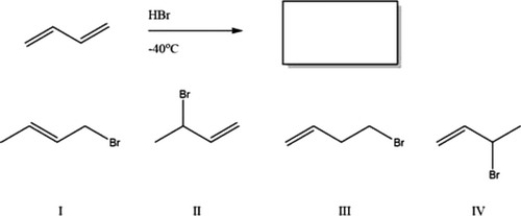
A) II
B) IV
C) I
D) III
A) II
B) IV
C) I
D) III

Question
Question
What is the major product of the following reaction? 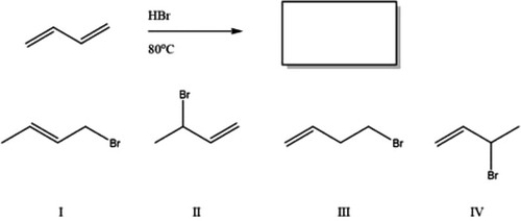
A) II
B) III
C) I
D) IV
A) II
B) III
C) I
D) IV
Question
Which of the following is (are) conjugated dienes? 
A) Only I and II
B) I, II, and III
C) Only I
D) Only II
A) Only I and II
B) I, II, and III
C) Only I
D) Only II
Question
What is the major product of the following reaction? 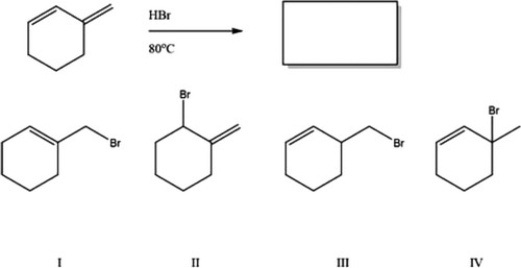
A) IV
B) I
C) III
D) II
A) IV
B) I
C) III
D) II
Question
What is the major product of the following reaction? 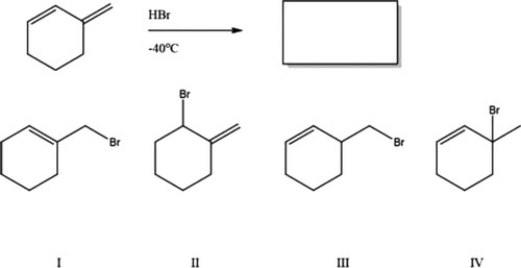
A) II
B) III
C) I
D) IV
A) II
B) III
C) I
D) IV
Question
Question
Why would the compound below not react with a dienophile in a Diels-Alder reaction? 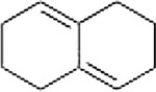
A) There are no electron withdrawing groups on the compound.
B) The compound cannot adopt thes-cis conformation.
C) The compound is not a conjugated diene.
D) There are no electron donating groups on the compound.
A) There are no electron withdrawing groups on the compound.
B) The compound cannot adopt thes-cis conformation.
C) The compound is not a conjugated diene.
D) There are no electron donating groups on the compound.
Question

Unlock Deck
Sign up to unlock the cards in this deck!
Unlock Deck
Unlock Deck
1/9

Play

Full screen (f)
Deck 11: Conjugation, Resonance, and Dienes
1
What is the major product of the following reaction?
A) II
B) IV
C) I
D) III
A) II
B) IV
C) I
D) III
II
2
Which of the following statements about the Diels-Alder reaction is true?
A) The diene can react only when it adopts thes-trans conformation.
B) The stereochemistry of the dienophile is retained in the product.
C) Electron-donating substituents in the dienophile increase the reaction rate.
D) Electron-withdrawing substituents in the diene increase reaction rate.
A) The diene can react only when it adopts thes-trans conformation.
B) The stereochemistry of the dienophile is retained in the product.
C) Electron-donating substituents in the dienophile increase the reaction rate.
D) Electron-withdrawing substituents in the diene increase reaction rate.
The stereochemistry of the dienophile is retained in the product.
3
What is the major product of the following reaction?
A) II
B) III
C) I
D) IV
A) II
B) III
C) I
D) IV
I
4
Which of the following is (are) conjugated dienes?
A) Only I and II
B) I, II, and III
C) Only I
D) Only II
A) Only I and II
B) I, II, and III
C) Only I
D) Only II
Unlock Deck
Unlock for access to all 9 flashcards in this deck.
Unlock Deck
k this deck
5
What is the major product of the following reaction?
A) IV
B) I
C) III
D) II
A) IV
B) I
C) III
D) II
Unlock Deck
Unlock for access to all 9 flashcards in this deck.
Unlock Deck
k this deck
6
What is the major product of the following reaction?
A) II
B) III
C) I
D) IV
A) II
B) III
C) I
D) IV
Unlock Deck
Unlock for access to all 9 flashcards in this deck.
Unlock Deck
k this deck
7
Which of the following isnot a feature of the Diels-Alder reaction?
A) Three ? bonds break.
B) They are initiated by peroxides.
C) They are concerted.
D) They form new six-membered rings.
A) Three ? bonds break.
B) They are initiated by peroxides.
C) They are concerted.
D) They form new six-membered rings.
Unlock Deck
Unlock for access to all 9 flashcards in this deck.
Unlock Deck
k this deck
8
Why would the compound below not react with a dienophile in a Diels-Alder reaction?
A) There are no electron withdrawing groups on the compound.
B) The compound cannot adopt thes-cis conformation.
C) The compound is not a conjugated diene.
D) There are no electron donating groups on the compound.
A) There are no electron withdrawing groups on the compound.
B) The compound cannot adopt thes-cis conformation.
C) The compound is not a conjugated diene.
D) There are no electron donating groups on the compound.
Unlock Deck
Unlock for access to all 9 flashcards in this deck.
Unlock Deck
k this deck
9
Which of the following molecules is a naturally occurring conjugated diene?
A) Acetylene
B) None of these are correct.
C) Isoprene
D) Ethylene
A) Acetylene
B) None of these are correct.
C) Isoprene
D) Ethylene
Unlock Deck
Unlock for access to all 9 flashcards in this deck.
Unlock Deck
k this deck
Unlock Deck
Unlock for access to all 9 flashcards in this deck.






