







 Chat with AI

Deck 24: Anaerobic Bacteria
Full screen (f)

Question

Question
Question
Question
Question
Question
Question
Question
Using the aerotolerance testing plates provided, which of the following organisms suggests a strict anaerobe?
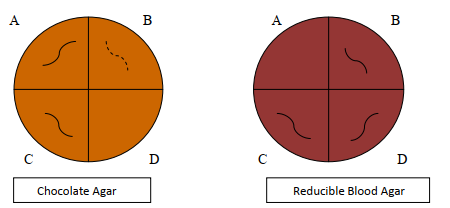
A) A
B) B
C) C
D) D
A) A
B) B
C) C
D) D
Question
Question
Question
Question
Question
Question
Question
The culture of a deep puncture wound in a farmer's leg grew pinpoint gray colonies on sheep blood and medium colonies on reducible blood agars. The Gram stain, from the sheep blood agar, is illustrated here.
 Source: CDC and Don Stalons
Given these results, you should
A) perform a catalase test.
B) examine colonies from both environments for the presence of spores.
C) perform aerotolerance testing.
D) both a and b.
Source: CDC and Don StalonsGiven these results, you should
A) perform a catalase test.
B) examine colonies from both environments for the presence of spores.
C) perform aerotolerance testing.
D) both a and b.
Question
An anaerobic, spore-forming, gram-positive rod is subbed to an egg yolk agar. Given the result provided on the EYA image provided, what organism do you suspect?
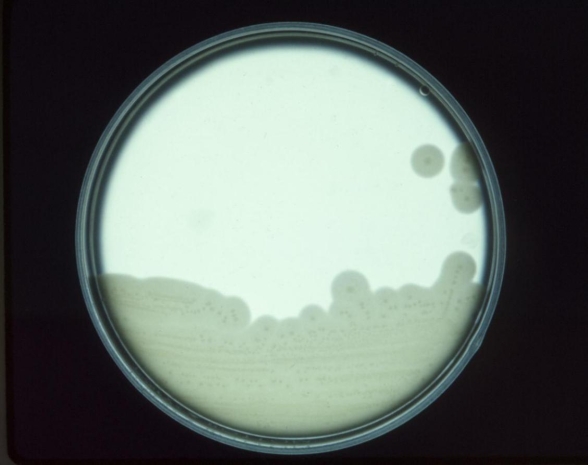 Source: CDC
A) Bifidobacterium spp.
B) Lactobacillus spp.
C) Clostridium septicum
D) C. perfringens
Source: CDCA) Bifidobacterium spp.
B) Lactobacillus spp.
C) Clostridium septicum
D) C. perfringens
Question
Question
A pelvic mass is aspirated from a 27-year-old female. The direct Gram stain of the aspirate is provided.
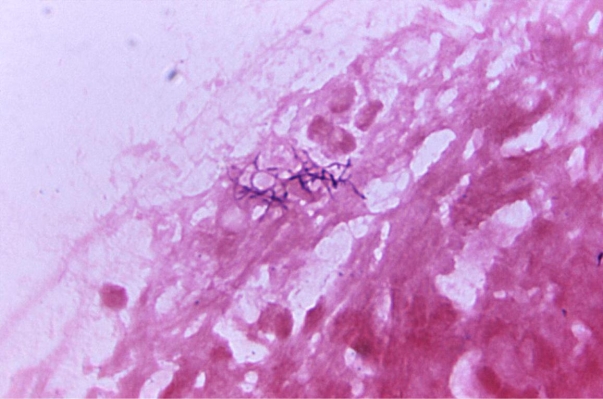 Source: CDC
The microaerotolerant organism isolated should be
A) vancomycin susceptible, catalase and indole negative, and nitrate positive.
B) vancomycin susceptible, catalase, indole, and nitrate positive.
C) vancomycin susceptible, catalase, indole, and nitrate negative.
D) vancomycin resistant, catalase, indole, and nitrate negative.
Source: CDCThe microaerotolerant organism isolated should be
A) vancomycin susceptible, catalase and indole negative, and nitrate positive.
B) vancomycin susceptible, catalase, indole, and nitrate positive.
C) vancomycin susceptible, catalase, indole, and nitrate negative.
D) vancomycin resistant, catalase, indole, and nitrate negative.
Question
Question
A 17-year-old male presents with a deep and extensive tonsillar abscess. He shares with the physician that he has recently had a sore throat. A direct Gram stain reveals the image provided here. 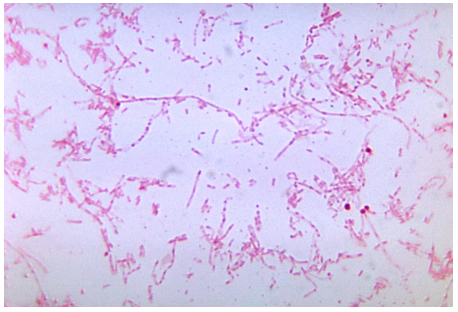 Source: CDC and Dr. V. R. Dowell, Jr.
The anaerobic organism provides the following reactions:
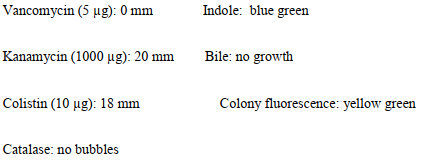 What additional test is needed to correctly identify this organism?
A) Esculin
B) Pigmentation
C) Lecithinase
D) Lipase
Source: CDC and Dr. V. R. Dowell, Jr.The anaerobic organism provides the following reactions:
What additional test is needed to correctly identify this organism?A) Esculin
B) Pigmentation
C) Lecithinase
D) Lipase
Question
Question
A 59-year-old female, with fever of unknown origin, has three sets of blood culture bottles drawn within a 24-hour period. At 24 hours incubation, one anaerobic blood
Culture bottle reveals the organism seen in the Gram stained image provided.
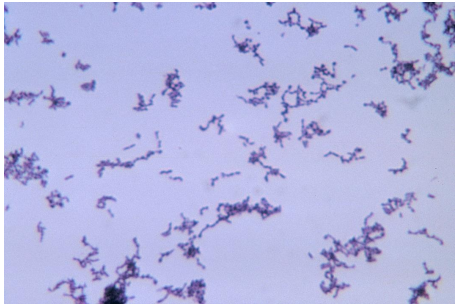 Source: CDC and Bobby Strong
The small, white, anaerobic colony that grows proves to be catalase, indole-positive, and resistant to SPS. This organism can be
1) presumptively identified as Propionibacterium acnes.
2) presumptively identified as Peptostreptococcus anaerobius.
3) considered a probable contaminant in this case.
4) considered clinically significant in this case
A) 1 and 3
B) 1 and 4
C) 2 and 3
D) 2 and 4
Culture bottle reveals the organism seen in the Gram stained image provided.
Source: CDC and Bobby StrongThe small, white, anaerobic colony that grows proves to be catalase, indole-positive, and resistant to SPS. This organism can be
1) presumptively identified as Propionibacterium acnes.
2) presumptively identified as Peptostreptococcus anaerobius.
3) considered a probable contaminant in this case.
4) considered clinically significant in this case
A) 1 and 3
B) 1 and 4
C) 2 and 3
D) 2 and 4

Unlock Deck
Sign up to unlock the cards in this deck!
Unlock Deck
Unlock Deck
1/22

Play

Full screen (f)
Deck 24: Anaerobic Bacteria
1
Which of the following body sites contains Bacteroides fragilis group, Lactobacillus spp., and Bifidobacterium spp. as part of the normal flora present?
A) Skin
B) Upper respiratory tract
C) Gastrointestinal tract
D) Genitourinary tract
A) Skin
B) Upper respiratory tract
C) Gastrointestinal tract
D) Genitourinary tract
Gastrointestinal tract
2
The presence of necrotic tissue provides anaerobes the opportunity to cause infection because
A) the dead tissue provides needed nutrients for growth.
B) the loss of blood supply allows for a lower redox potential.
C) they are able to deplete the oxygen present.
D) antibiotics cannot reach the tissue adequately.
A) the dead tissue provides needed nutrients for growth.
B) the loss of blood supply allows for a lower redox potential.
C) they are able to deplete the oxygen present.
D) antibiotics cannot reach the tissue adequately.
the loss of blood supply allows for a lower redox potential.
3
Which of the following specimen types/body sites is considered unacceptable for anaerobic culture?
A) Endometrial biospy
B) Transtracheal aspirate
C) Decubitus ulcer after debridement
D) Catheterized urine
A) Endometrial biospy
B) Transtracheal aspirate
C) Decubitus ulcer after debridement
D) Catheterized urine
Catheterized urine
4
A 63-year-old male is hospitalized with fever, cough, shortness of breath, and weight loss. He is coughing up thick, foul-smelling, purulent sputum. Talking with him revealed that he consumes about a quart of alcohol per day and smokes two packs of cigarettes per day. He admits he often passes out after one of his many drinking binges. His chest x-ray shows an extensive right upper lobe infiltrate consistent with pneumonia. His laboratory results indicate:
Sputum culture
Macroscopic: grossly purulent and foul smelling
Microscopic: gram-negative rod pattern (many pale, pleomorphic, bipolar
Staining gram-negative rods and many pale, thin, fusiform gram-negative
Rods)
Culture: light growth of normal upper respiratory flora
Transtracheal aspirate culture
Macroscopic: grossly purulent and foul smelling
Microscopic: gram-negative rod pattern (many pale, pleomorphic, bipolar
Staining gram-negative rods and many pale, thin, fusiform gram-negative rods)
Culture: results pending
What clinical feature(s) suggests this individual has anaerobic pneumonia?
A) Foul odor
B) Unique morphologies on direct Gram stain
C) Organisms grown on the sputum culture do not correlate with direct Gram stain
D) All of the above
E) B and C
Sputum culture
Macroscopic: grossly purulent and foul smelling
Microscopic: gram-negative rod pattern (many pale, pleomorphic, bipolar
Staining gram-negative rods and many pale, thin, fusiform gram-negative
Rods)
Culture: light growth of normal upper respiratory flora
Transtracheal aspirate culture
Macroscopic: grossly purulent and foul smelling
Microscopic: gram-negative rod pattern (many pale, pleomorphic, bipolar
Staining gram-negative rods and many pale, thin, fusiform gram-negative rods)
Culture: results pending
What clinical feature(s) suggests this individual has anaerobic pneumonia?
A) Foul odor
B) Unique morphologies on direct Gram stain
C) Organisms grown on the sputum culture do not correlate with direct Gram stain
D) All of the above
E) B and C
Unlock Deck
Unlock for access to all 22 flashcards in this deck.
Unlock Deck
k this deck
5
You are presenting an in-service to the nurses about the transportation of specimens for anaerobic culture. What is the most important point you want them to remember from your talk?
A) Adequate volume of specimen
B) Selection of specimens from only sterile body sites
C) Use of proper specimen transport systems
D) Swabs are acceptable but not ideal
A) Adequate volume of specimen
B) Selection of specimens from only sterile body sites
C) Use of proper specimen transport systems
D) Swabs are acceptable but not ideal
Unlock Deck
Unlock for access to all 22 flashcards in this deck.
Unlock Deck
k this deck
6
An organism that is unable to grow in ambient air, grows as tiny colonies in 5 to 10% oxygen and 10% CO2, and grows under anaerobic environment is called a
A) strict anaerobe.
B) microaerophilic organism.
C) microaerotolerant anaerobe.
D) facultative anaerobe.
A) strict anaerobe.
B) microaerophilic organism.
C) microaerotolerant anaerobe.
D) facultative anaerobe.
Unlock Deck
Unlock for access to all 22 flashcards in this deck.
Unlock Deck
k this deck
7
Which of the following statements is considered false in relation to the use of palladium catalysts?
A) Metabolic by-products, such as H2S, can render the catalysts ineffective.
B) Catalysts can be rejuvenated by heating for two hours at 165°C.
C) Catalysts must be rejuvenated after each use.
D) There is no need for the use of a methylene blue strip.
A) Metabolic by-products, such as H2S, can render the catalysts ineffective.
B) Catalysts can be rejuvenated by heating for two hours at 165°C.
C) Catalysts must be rejuvenated after each use.
D) There is no need for the use of a methylene blue strip.
Unlock Deck
Unlock for access to all 22 flashcards in this deck.
Unlock Deck
k this deck
8
Using the aerotolerance testing plates provided, which of the following organisms suggests a strict anaerobe?
A) A
B) B
C) C
D) D
A) A
B) B
C) C
D) D
Unlock Deck
Unlock for access to all 22 flashcards in this deck.
Unlock Deck
k this deck
9
Which of the following organisms requires vitamin K and hemin for growth?
A) Porphyromonas asaccharolyticus
B) Prevotella melaninogenica
C) Bacteroides thetaiotaomicron
D) Veillonella parvula
A) Porphyromonas asaccharolyticus
B) Prevotella melaninogenica
C) Bacteroides thetaiotaomicron
D) Veillonella parvula
Unlock Deck
Unlock for access to all 22 flashcards in this deck.
Unlock Deck
k this deck
10
Given the following organisms, select all that will grow on laked-kanamycin-vancomycin (LKV) agar.
1) Bacteroides vulgatus
2) Porphyromonas gingivalis
3) Fusobacterium nucleatum
4) Prevotella melaninogenica
A) 1 and 4
B) 2 and 3
C) 1, 3, and 4
D) 1, 2, 3, and 4
1) Bacteroides vulgatus
2) Porphyromonas gingivalis
3) Fusobacterium nucleatum
4) Prevotella melaninogenica
A) 1 and 4
B) 2 and 3
C) 1, 3, and 4
D) 1, 2, 3, and 4
Unlock Deck
Unlock for access to all 22 flashcards in this deck.
Unlock Deck
k this deck
11
A peritoneal fluid displays heavy growth of a facultative anaerobic gram-negative rod and moderate growth of two colony types of anaerobic gram-negative rods. Workup of these organisms should include
A) reporting as heavy growth of three morphologies of gram-negative rods.
B) identification of the facultative gram-negative rod but not the two anaerobic gram-negative rods.
C) identification of all three organisms.
D) identification of the two anaerobic gram-negative rods but not the facultative gram-negative rod.
A) reporting as heavy growth of three morphologies of gram-negative rods.
B) identification of the facultative gram-negative rod but not the two anaerobic gram-negative rods.
C) identification of all three organisms.
D) identification of the two anaerobic gram-negative rods but not the facultative gram-negative rod.
Unlock Deck
Unlock for access to all 22 flashcards in this deck.
Unlock Deck
k this deck
12
Examination of anaerobic culture plates incubated in an anaerobic jar should first be done
At
A) 24 hours
B) 48 hours
C) 72 hours
D) 5 days
At
A) 24 hours
B) 48 hours
C) 72 hours
D) 5 days
Unlock Deck
Unlock for access to all 22 flashcards in this deck.
Unlock Deck
k this deck
13
The catalase test for anaerobes is performed using a ______% solution of hydrogen peroxide due to its increased sensitivity.
A) 3
B) 10
C) 15
D) 30
A) 3
B) 10
C) 15
D) 30
Unlock Deck
Unlock for access to all 22 flashcards in this deck.
Unlock Deck
k this deck
14
Which of the following identification tests demonstrates a rainbow sheen as a positive reaction?
A) Lipase
B) Lecithinase
C) SPS
D) Bile stimulation
A) Lipase
B) Lecithinase
C) SPS
D) Bile stimulation
Unlock Deck
Unlock for access to all 22 flashcards in this deck.
Unlock Deck
k this deck
15
The culture of a deep puncture wound in a farmer's leg grew pinpoint gray colonies on sheep blood and medium colonies on reducible blood agars. The Gram stain, from the sheep blood agar, is illustrated here.
Source: CDC and Don Stalons
Given these results, you should
A) perform a catalase test.
B) examine colonies from both environments for the presence of spores.
C) perform aerotolerance testing.
D) both a and b.
Source: CDC and Don StalonsGiven these results, you should
A) perform a catalase test.
B) examine colonies from both environments for the presence of spores.
C) perform aerotolerance testing.
D) both a and b.
Unlock Deck
Unlock for access to all 22 flashcards in this deck.
Unlock Deck
k this deck
16
An anaerobic, spore-forming, gram-positive rod is subbed to an egg yolk agar. Given the result provided on the EYA image provided, what organism do you suspect?
Source: CDC
A) Bifidobacterium spp.
B) Lactobacillus spp.
C) Clostridium septicum
D) C. perfringens
Source: CDCA) Bifidobacterium spp.
B) Lactobacillus spp.
C) Clostridium septicum
D) C. perfringens
Unlock Deck
Unlock for access to all 22 flashcards in this deck.
Unlock Deck
k this deck
17
The direct Gram stain of an anaerobic wound culture reveals gram-positive cocci in clusters. The aerobic agar plates show no growth, while a small white colony grows on the reducible blood agar plate. The organism provides the following reactions:
SPS disk: 3 mm
The organism is
A) Staphylococcus spp.
B) Fingoldia magna.
C) Peptostreptococcus anaerobius.
D) Peptoniphilus asaccharolyticus.
SPS disk: 3 mm
The organism is
A) Staphylococcus spp.
B) Fingoldia magna.
C) Peptostreptococcus anaerobius.
D) Peptoniphilus asaccharolyticus.
Unlock Deck
Unlock for access to all 22 flashcards in this deck.
Unlock Deck
k this deck
18
A pelvic mass is aspirated from a 27-year-old female. The direct Gram stain of the aspirate is provided.
Source: CDC
The microaerotolerant organism isolated should be
A) vancomycin susceptible, catalase and indole negative, and nitrate positive.
B) vancomycin susceptible, catalase, indole, and nitrate positive.
C) vancomycin susceptible, catalase, indole, and nitrate negative.
D) vancomycin resistant, catalase, indole, and nitrate negative.
Source: CDCThe microaerotolerant organism isolated should be
A) vancomycin susceptible, catalase and indole negative, and nitrate positive.
B) vancomycin susceptible, catalase, indole, and nitrate positive.
C) vancomycin susceptible, catalase, indole, and nitrate negative.
D) vancomycin resistant, catalase, indole, and nitrate negative.
Unlock Deck
Unlock for access to all 22 flashcards in this deck.
Unlock Deck
k this deck
19
Bacteroides spp., Fusobacterium spp., Prevotella spp., and Porphyromonas spp. share the ability to be resistant to
A) metronidazole.
B) cefoxitin.
C) penicillin.
D) imipenem.
A) metronidazole.
B) cefoxitin.
C) penicillin.
D) imipenem.
Unlock Deck
Unlock for access to all 22 flashcards in this deck.
Unlock Deck
k this deck
20
A 17-year-old male presents with a deep and extensive tonsillar abscess. He shares with the physician that he has recently had a sore throat. A direct Gram stain reveals the image provided here. Source: CDC and Dr. V. R. Dowell, Jr.
The anaerobic organism provides the following reactions:
What additional test is needed to correctly identify this organism?
A) Esculin
B) Pigmentation
C) Lecithinase
D) Lipase
Source: CDC and Dr. V. R. Dowell, Jr.The anaerobic organism provides the following reactions:
What additional test is needed to correctly identify this organism?A) Esculin
B) Pigmentation
C) Lecithinase
D) Lipase
Unlock Deck
Unlock for access to all 22 flashcards in this deck.
Unlock Deck
k this deck
21
A 79-year-old female is hospitalized with bacterial pneumonia. After seven days of intravenous antibiotics, she develops diarrhea. The physician submits a liquid stool specimen with orders for an aerobic and anaerobic culture. Upon receipt in the microbiology laboratory, your next step is to
A) reject the specimen.
B) contact the physician for an order for an EIA test.
C) plate the specimen to CCFA agar.
D) both b and c.
A) reject the specimen.
B) contact the physician for an order for an EIA test.
C) plate the specimen to CCFA agar.
D) both b and c.
Unlock Deck
Unlock for access to all 22 flashcards in this deck.
Unlock Deck
k this deck
22
A 59-year-old female, with fever of unknown origin, has three sets of blood culture bottles drawn within a 24-hour period. At 24 hours incubation, one anaerobic blood
Culture bottle reveals the organism seen in the Gram stained image provided.
Source: CDC and Bobby Strong
The small, white, anaerobic colony that grows proves to be catalase, indole-positive, and resistant to SPS. This organism can be
1) presumptively identified as Propionibacterium acnes.
2) presumptively identified as Peptostreptococcus anaerobius.
3) considered a probable contaminant in this case.
4) considered clinically significant in this case
A) 1 and 3
B) 1 and 4
C) 2 and 3
D) 2 and 4
Culture bottle reveals the organism seen in the Gram stained image provided.
Source: CDC and Bobby StrongThe small, white, anaerobic colony that grows proves to be catalase, indole-positive, and resistant to SPS. This organism can be
1) presumptively identified as Propionibacterium acnes.
2) presumptively identified as Peptostreptococcus anaerobius.
3) considered a probable contaminant in this case.
4) considered clinically significant in this case
A) 1 and 3
B) 1 and 4
C) 2 and 3
D) 2 and 4
Unlock Deck
Unlock for access to all 22 flashcards in this deck.
Unlock Deck
k this deck
Unlock Deck
Unlock for access to all 22 flashcards in this deck.






