







 Chat with AI

Deck 22: Assessing the Older Adult
Full screen (f)

Question

Question
Question
Question
Question
Question
Question
Question
Question
Question
Question
Question
Question
Question
Question
Question
Question
Question
Question
Question
Question
Question
Question
Question
Question
Question
Question
Question
Question
Question
Question
Question
Question
Question
Question
Question
Question
Question
Question
Question
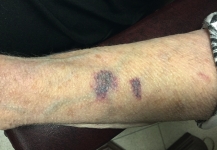 A daughter brings her elderly mother to the outpatient clinic because she has several bruises on her arm. You see the above alteration in skin. You explain to the daughter that these are not bruises but areas of ruptured fragile capillaries causing bruising of the skin. This is called ____________________ ____________________ (two words).
 Question
Question
Question

Unlock Deck
Sign up to unlock the cards in this deck!
Unlock Deck
Unlock Deck
1/43

Play

Full screen (f)
Deck 22: Assessing the Older Adult
1
The nurse is making a home visit to an elderly client. Which statement made by the client's adult daughter would cause the nurse to assess the client for skin breakdown?
A) "My mother takes a walk in the neighborhood every afternoon."
B) "My mother is able to go to the bathroom without assistance."
C) "My mother takes medication for her high blood pressure, diabetes, and a multivitamin."
D) "My mother eats three well-balanced meals a day."
A) "My mother takes a walk in the neighborhood every afternoon."
B) "My mother is able to go to the bathroom without assistance."
C) "My mother takes medication for her high blood pressure, diabetes, and a multivitamin."
D) "My mother eats three well-balanced meals a day."
"My mother takes medication for her high blood pressure, diabetes, and a multivitamin."
2
The nurse is working in a senior housing complex assessing an 85-year old-resident. Which finding would be of greatest concern to the nurse?
A) A blood pressure of 160/70 mm/Hg
B) A heart rate of 60 beats per minute
C) An echocardiogram report documenting an enlarged left ventricle
D) An irregular heartbeat of 120 beats per minute
A) A blood pressure of 160/70 mm/Hg
B) A heart rate of 60 beats per minute
C) An echocardiogram report documenting an enlarged left ventricle
D) An irregular heartbeat of 120 beats per minute
An irregular heartbeat of 120 beats per minute
3
The elderly patient who is alert and oriented tells the nurse that she is incontinent when coughing and sneezing. The nurse knows that this patient has which type of incontinence?
A) Urge incontinence
B) Stress incontinence
C) Functional incontinence
D) Overflow incontinence
A) Urge incontinence
B) Stress incontinence
C) Functional incontinence
D) Overflow incontinence
Stress incontinence
4
Which statement made by the elderly patient would concern the nurse the most?
A) "I only urinate once a day."
B) "My doctor said my body mass index (BMI) is 20."
C) "I have lost 5 pounds since I had bronchitis last month."
D) "My sense of taste is not as good as it used to be."
A) "I only urinate once a day."
B) "My doctor said my body mass index (BMI) is 20."
C) "I have lost 5 pounds since I had bronchitis last month."
D) "My sense of taste is not as good as it used to be."
Unlock Deck
Unlock for access to all 43 flashcards in this deck.
Unlock Deck
k this deck
5
What is the correct technique for assessing the carotid artery in the elderly?
A) Palpate both carotid arteries at the same time to compare carotid upstroke.
B) Auscultate for a bruit while the patient takes a deep breath.
C) Palpate each carotid artery one at a time.
D) Gently massage the carotid artery using a lateral motion.
A) Palpate both carotid arteries at the same time to compare carotid upstroke.
B) Auscultate for a bruit while the patient takes a deep breath.
C) Palpate each carotid artery one at a time.
D) Gently massage the carotid artery using a lateral motion.
Unlock Deck
Unlock for access to all 43 flashcards in this deck.
Unlock Deck
k this deck
6
How would the nurse appropriately conduct the Whispered Voice test in the elderly patient?
A) Have the patient stand in front of the nurse.
B) Stand in front of the patient and whisper two or three words.
C) Have the patient cover the ear the nurse is not assessing.
D) Conduct the Whispered Voice test to both ears at the same time.
A) Have the patient stand in front of the nurse.
B) Stand in front of the patient and whisper two or three words.
C) Have the patient cover the ear the nurse is not assessing.
D) Conduct the Whispered Voice test to both ears at the same time.
Unlock Deck
Unlock for access to all 43 flashcards in this deck.
Unlock Deck
k this deck
7
An elderly patient reports that she wakes up with "greasy eyelids" every day. What is an inflammation and infection of the eyelid called?
A) Ptosis
B) Cataract
C) Blepharitis
D) Pterygium
A) Ptosis
B) Cataract
C) Blepharitis
D) Pterygium
Unlock Deck
Unlock for access to all 43 flashcards in this deck.
Unlock Deck
k this deck
8
What is the cause of hair turning gray or white in the elderly?
A) Decreased melanin production
B) Decreased hormone production
C) Changes in hair follicle function
D) Decreased production of albumin
A) Decreased melanin production
B) Decreased hormone production
C) Changes in hair follicle function
D) Decreased production of albumin
Unlock Deck
Unlock for access to all 43 flashcards in this deck.
Unlock Deck
k this deck
9
The nurse is performing a physical assessment on an elderly patient. Which finding would be considered normal aging?
A) Increased perspiration and sweating
B) Increased accumulation of ear cerumen
C) Increased pupillary reflex
D) Auscultation of an S3 heart sound
A) Increased perspiration and sweating
B) Increased accumulation of ear cerumen
C) Increased pupillary reflex
D) Auscultation of an S3 heart sound
Unlock Deck
Unlock for access to all 43 flashcards in this deck.
Unlock Deck
k this deck
10
The elderly patient is diagnosed with gallstones and the patient asks how they developed. What is the nurse's best response?
A) "There is a decreased production of pancreatic enzymes in the elderly."
B) "Gastric acidity is reduced in the elderly."
C) "There is an increased accumulation of biliary sludge in the elderly."
D) "There is a decreased production of the intrinsic factor in the elderly."
A) "There is a decreased production of pancreatic enzymes in the elderly."
B) "Gastric acidity is reduced in the elderly."
C) "There is an increased accumulation of biliary sludge in the elderly."
D) "There is a decreased production of the intrinsic factor in the elderly."
Unlock Deck
Unlock for access to all 43 flashcards in this deck.
Unlock Deck
k this deck
11
The elderly patient reports to the nurse that he coughs a lot during and after meals. What would be most important for the nurse to ask this patient first?
A) "How much do you drink during the day?'
B) "Does the cough keep you awake at night?"
C) "Do you have difficulty swallowing?"
D) "Does it hurt when you cough?"
A) "How much do you drink during the day?'
B) "Does the cough keep you awake at night?"
C) "Do you have difficulty swallowing?"
D) "Does it hurt when you cough?"
Unlock Deck
Unlock for access to all 43 flashcards in this deck.
Unlock Deck
k this deck
12
When assessing the thyroid in the older adult, which finding would concern the nurse?
A) The lateral lobes are not palpable.
B) The lateral lobes are smooth and firm.
C) There is varying texture and firmness in the lobes.
D) The lobes are nontender.
A) The lateral lobes are not palpable.
B) The lateral lobes are smooth and firm.
C) There is varying texture and firmness in the lobes.
D) The lobes are nontender.
Unlock Deck
Unlock for access to all 43 flashcards in this deck.
Unlock Deck
k this deck
13
The daughter of an elderly patient is talking to the nurse about her parents. Which statement by the daughter would concern the nurse the most regarding risk factors for elder abuse?
A) "My parents emigrated from Italy when they were teenagers."
B) "My father takes care of my mother 24 hours a day because she has Alzheimer's disease."
C) "My parents are financially secure but are always worried about spending money."
D) "We have a nurse's aide who comes to give my mother a shower once a week."
A) "My parents emigrated from Italy when they were teenagers."
B) "My father takes care of my mother 24 hours a day because she has Alzheimer's disease."
C) "My parents are financially secure but are always worried about spending money."
D) "We have a nurse's aide who comes to give my mother a shower once a week."
Unlock Deck
Unlock for access to all 43 flashcards in this deck.
Unlock Deck
k this deck
14
When administering the Mini Nutritional Assessment (MNA) to the elderly patient, which of the following would concern the nurse the most?
A) The patient has a weight loss between 1 and 3 kg in the last 3 months.
B) The patient is ambulatory, but does not go out.
C) The patient has a body mass index (BMI) of less than 19.
D) The patient has mild dementia.
A) The patient has a weight loss between 1 and 3 kg in the last 3 months.
B) The patient is ambulatory, but does not go out.
C) The patient has a body mass index (BMI) of less than 19.
D) The patient has mild dementia.
Unlock Deck
Unlock for access to all 43 flashcards in this deck.
Unlock Deck
k this deck
15
The elderly patient's daughter is talking with the nurse. Which of the following statements made by the daughter would concern the nurse that the patient is a frail elder?
A) "My mother fell last week and I noticed some bruises on her left arm."
B) "My mother weighed the same last year at her physical examination."
C) "My mother goes to the Senior Center twice a week."
4 "My mother still cooks her own meals."
4 "My mother still cooks her own meals."
A) "My mother fell last week and I noticed some bruises on her left arm."
B) "My mother weighed the same last year at her physical examination."
C) "My mother goes to the Senior Center twice a week."
4 "My mother still cooks her own meals."
4 "My mother still cooks her own meals."
Unlock Deck
Unlock for access to all 43 flashcards in this deck.
Unlock Deck
k this deck
16
When performing a cardiac assessment, which of the following findings indicates the possibility of hypertrophy of the left ventricle?
A) An S4 heart sound
B) An S3 heart sound
C) An ejection click
D) Opening snap
A) An S4 heart sound
B) An S3 heart sound
C) An ejection click
D) Opening snap
Unlock Deck
Unlock for access to all 43 flashcards in this deck.
Unlock Deck
k this deck
17
Which abdominal assessment finding would be considered normal in the elderly frail patient?
A) Cullen's sign
B) Pulsation upon inspection
C) Hyperactive bowel sounds
D) Ascites
A) Cullen's sign
B) Pulsation upon inspection
C) Hyperactive bowel sounds
D) Ascites
Unlock Deck
Unlock for access to all 43 flashcards in this deck.
Unlock Deck
k this deck
18
A 78-year-old women lives by herself. She has no family that lives locally. Which of the following assessments would you perform to understand how she perceives her current level of functioning?
A) Tinel's test
B) Barthel's ADL index
C) CAGE questionnaire
D) AD8
A) Tinel's test
B) Barthel's ADL index
C) CAGE questionnaire
D) AD8
Unlock Deck
Unlock for access to all 43 flashcards in this deck.
Unlock Deck
k this deck
19
The nurse is assessing an 80-year-old patient in a community health outpatient clinic. The patient is reliable. She states that she is tired all the time. She states, "I am old now. I just do not like to do anything anymore and I do not care if I see my family. My kids all have their own lives and families." What would the nurse suspect in this patient?
A) Alzheimer's disease
B) Delirium
C) Depression
D) Dementia
A) Alzheimer's disease
B) Delirium
C) Depression
D) Dementia
Unlock Deck
Unlock for access to all 43 flashcards in this deck.
Unlock Deck
k this deck
20
A 78-year-old patient is complaining of chronic achy joint pain. She states, "I am so tired of living with pain." What is important to remember about pain and the elderly?
A) The older adult will report pain accurately.
B) The older adult may not be compliant in taking pain medication.
C) The older adult is willing to report pain.
D) Older adults are not able to give reliable self-reports of pain.
A) The older adult will report pain accurately.
B) The older adult may not be compliant in taking pain medication.
C) The older adult is willing to report pain.
D) Older adults are not able to give reliable self-reports of pain.
Unlock Deck
Unlock for access to all 43 flashcards in this deck.
Unlock Deck
k this deck
21
Which of the following is considered a normal aging change in the elderly patient?
A) Presence of overgrowth of the gum tissues
B) A yellow color in the hard palate
C) Decreased saliva and a dry mouth
D) A dry, red soft palate
A) Presence of overgrowth of the gum tissues
B) A yellow color in the hard palate
C) Decreased saliva and a dry mouth
D) A dry, red soft palate
Unlock Deck
Unlock for access to all 43 flashcards in this deck.
Unlock Deck
k this deck
22
The nurse is performing a physical assessment of the elderly patient. What would the nurse expect to find if the patient has cellulitis of the left lower extremity?
A) Skin that is cool to the touch
B) Loss of hair on one or both legs
C) Thick, leathery skin
D) Skin that is red and swollen
A) Skin that is cool to the touch
B) Loss of hair on one or both legs
C) Thick, leathery skin
D) Skin that is red and swollen
Unlock Deck
Unlock for access to all 43 flashcards in this deck.
Unlock Deck
k this deck
23
The nurse is performing a physical assessment of the elderly patient. For which of the following would the nurse notify the health-care provider as being abnormal?
A) Nystagmus when assessing the eyes
B) Tympany when percussing the abdomen
C) Femoral lymph nodes that are less than 1.0 cm
D) Negative Romberg test
A) Nystagmus when assessing the eyes
B) Tympany when percussing the abdomen
C) Femoral lymph nodes that are less than 1.0 cm
D) Negative Romberg test
Unlock Deck
Unlock for access to all 43 flashcards in this deck.
Unlock Deck
k this deck
24
An elderly patient with gout is being assessed by the nurse. What finding would the nurse expect to see in this patient?
A) Microtia
B) Macrotia
C) Tophi
D) Presbycusis
A) Microtia
B) Macrotia
C) Tophi
D) Presbycusis
Unlock Deck
Unlock for access to all 43 flashcards in this deck.
Unlock Deck
k this deck
25
The nurse is assessing gait and position sense in the elderly patient. Which of the following would be correct for the nurse to ask of the patient?
A) Ask the patient to walk away and then back, walking on his or her toes.
B) Ask the patient to walk heel-to-toe away and then back.
C) Ask the patient to hop on both feet.
D) Ask the patient to do a deep knee bend and assist the patient back up to standing if necessary.
A) Ask the patient to walk away and then back, walking on his or her toes.
B) Ask the patient to walk heel-to-toe away and then back.
C) Ask the patient to hop on both feet.
D) Ask the patient to do a deep knee bend and assist the patient back up to standing if necessary.
Unlock Deck
Unlock for access to all 43 flashcards in this deck.
Unlock Deck
k this deck
26
Which statement made by the elderly patient would lead the nurse to assess the patient for geriatric syndrome? Select all that apply.
A) "I wear a hearing aid."
B) "I do not have any open sores on my skin."
C) "I take a half hour nap every afternoon."
D) "I have a cup of coffee for breakfast and usually a bowl of soup or cereal for lunch and dinner."
E) "I fell in my bedroom last week."
A) "I wear a hearing aid."
B) "I do not have any open sores on my skin."
C) "I take a half hour nap every afternoon."
D) "I have a cup of coffee for breakfast and usually a bowl of soup or cereal for lunch and dinner."
E) "I fell in my bedroom last week."
Unlock Deck
Unlock for access to all 43 flashcards in this deck.
Unlock Deck
k this deck
27
When assessing the lungs of the elderly patient, which of the following procedures is correct? Select all that apply.
A) Shave the chest of a patient with excessive hair to improve the sound.
B) Instruct the patient with adventitious lung sounds to cough before reassessing.
C) Instruct the patient to breathe forcefully through the nose while auscultating lung sounds.
D) Use the bell of the stethoscope directly over the bare skin to auscultate lung sounds.
E) Auscultate for bronchial breath sounds over the larynx, trachea, and posterior nape of the neck.
A) Shave the chest of a patient with excessive hair to improve the sound.
B) Instruct the patient with adventitious lung sounds to cough before reassessing.
C) Instruct the patient to breathe forcefully through the nose while auscultating lung sounds.
D) Use the bell of the stethoscope directly over the bare skin to auscultate lung sounds.
E) Auscultate for bronchial breath sounds over the larynx, trachea, and posterior nape of the neck.
Unlock Deck
Unlock for access to all 43 flashcards in this deck.
Unlock Deck
k this deck
28
The daughter of the elderly patient is talking to the nurse. Which of the following statements made by the daughter would concern the nurse regarding an increase in the risk of falls in the elderly? Select all that apply.
A) "My mother takes an anticonvulsant for seizure control."
B) "My mother is able to get up out of the chair in one single movement."
C) "My mother is sometimes incontinent."
D) "My mother takes a benzodiazepine for her anxiety."
E) "My mother sometimes gets confused."
A) "My mother takes an anticonvulsant for seizure control."
B) "My mother is able to get up out of the chair in one single movement."
C) "My mother is sometimes incontinent."
D) "My mother takes a benzodiazepine for her anxiety."
E) "My mother sometimes gets confused."
Unlock Deck
Unlock for access to all 43 flashcards in this deck.
Unlock Deck
k this deck
29
Which of the following would be important to include in the teaching plan for the elderly patient to help reduce the risk of osteoporosis? Select all that apply.
A) Limit the amount of walking each day to reduce the stress on your joints.
B) Make sure you get enough vitamin D in your diet.
C) Medications will not affect your bones.
D) Make sure you get enough calcium in your diet.
E) Stop smoking.
A) Limit the amount of walking each day to reduce the stress on your joints.
B) Make sure you get enough vitamin D in your diet.
C) Medications will not affect your bones.
D) Make sure you get enough calcium in your diet.
E) Stop smoking.
Unlock Deck
Unlock for access to all 43 flashcards in this deck.
Unlock Deck
k this deck
30
When assessing the elderly patient, what cultural considerations are important for the nurse to know? Select all that apply.
A) Older Americans are predominantly white.
B) African Americans usually develop the onset of chronic illness earlier than whites.
C) Some cultures believe in withholding information about the older adult's diagnosis.
D) The nurse should share medical information with only the patient.
E) Demographics of the older American is expected to change dramatically in a few decades.
A) Older Americans are predominantly white.
B) African Americans usually develop the onset of chronic illness earlier than whites.
C) Some cultures believe in withholding information about the older adult's diagnosis.
D) The nurse should share medical information with only the patient.
E) Demographics of the older American is expected to change dramatically in a few decades.
Unlock Deck
Unlock for access to all 43 flashcards in this deck.
Unlock Deck
k this deck
31
When assessing the elderly female patient, which findings would the nurse document as expected as normal aging changes? Select all that apply.
A) Increased vaginal secretions
B) Increased interest in sex
C) Thin, gray pubic hair
D) Decreased breast tissue
E) Softer, smaller breast nipples
A) Increased vaginal secretions
B) Increased interest in sex
C) Thin, gray pubic hair
D) Decreased breast tissue
E) Softer, smaller breast nipples
Unlock Deck
Unlock for access to all 43 flashcards in this deck.
Unlock Deck
k this deck
32
When performing a medication assessment on the elderly patient, which of the following would concern the nurse? Select all that apply.
A) The patient takes a daily vitamin and an antihypertensive medication daily.
B) The patient has a primary care provider, an endocrinologist, a surgeon, and a rheumatologist.
C) The patient takes medications at 0800, 1000, 1200, 1600, and 1800.
D) The patient uses three different pharmacies.
E) The patient has cough syrup in the medicine cabinet that is 16 months old.
A) The patient takes a daily vitamin and an antihypertensive medication daily.
B) The patient has a primary care provider, an endocrinologist, a surgeon, and a rheumatologist.
C) The patient takes medications at 0800, 1000, 1200, 1600, and 1800.
D) The patient uses three different pharmacies.
E) The patient has cough syrup in the medicine cabinet that is 16 months old.
Unlock Deck
Unlock for access to all 43 flashcards in this deck.
Unlock Deck
k this deck
33
Which of the following statements made by the elderly patient would alert the nurse to warning signs that the patient should stop driving? Select all that apply.
A) "I got lost driving to my daughter's new house 50 miles away."
B) "I have had several traffic tickets this past year."
C) "I have pain in my neck when I turn my head."
D) "I only drive during the day."
E) "I have trouble getting out of my chair in my living room."
A) "I got lost driving to my daughter's new house 50 miles away."
B) "I have had several traffic tickets this past year."
C) "I have pain in my neck when I turn my head."
D) "I only drive during the day."
E) "I have trouble getting out of my chair in my living room."
Unlock Deck
Unlock for access to all 43 flashcards in this deck.
Unlock Deck
k this deck
34
Which of the following statements is correct regarding alcohol use/abuse in the elderly? Select all that apply.
A) More women than men abuse alcohol.
B) People who abuse alcohol generally have poor personal hygiene.
C) Those who abuse alcohol usually live alone.
D) Those who abuse alcohol tend to be married
E) Alcohol use/abuse in the elderly may be difficult to assess and/or diagnose.
A) More women than men abuse alcohol.
B) People who abuse alcohol generally have poor personal hygiene.
C) Those who abuse alcohol usually live alone.
D) Those who abuse alcohol tend to be married
E) Alcohol use/abuse in the elderly may be difficult to assess and/or diagnose.
Unlock Deck
Unlock for access to all 43 flashcards in this deck.
Unlock Deck
k this deck
35
When obtaining a health history and assessing an elderly patient in her home, which of the following would concern the nurse? Select all that apply.
A) The female patient begins talking about when her children were born.
B) The house is very cluttered with newspapers on the floor.
C) The patient's teeth are broken and missing.
D) The patient's legs have no edema.
E) The patient is speaking in a loud tone.
A) The female patient begins talking about when her children were born.
B) The house is very cluttered with newspapers on the floor.
C) The patient's teeth are broken and missing.
D) The patient's legs have no edema.
E) The patient is speaking in a loud tone.
Unlock Deck
Unlock for access to all 43 flashcards in this deck.
Unlock Deck
k this deck
36
You are performing a comprehensive health assessment on a 68-year-old female. What normal assessment findings would the nurse expect to find in this elderly patient? Select all apply.
A) Skin tenting
B) Thin, fragile skin
C) Actinic keratosis
D) Solar lentigo
E) Nevi less than 0.6 cm
A) Skin tenting
B) Thin, fragile skin
C) Actinic keratosis
D) Solar lentigo
E) Nevi less than 0.6 cm
Unlock Deck
Unlock for access to all 43 flashcards in this deck.
Unlock Deck
k this deck
37
You are a nurse working in the veterans' hospital. A 70-year-old patient reports that he has been smoking since age 20 and just has no desire to stop smoking because it is his one enjoyment in life at his age. He has a diagnosis of chronic obstructive pulmonary disease (COPD). What assessment finding(s) would the nurse expect to find in this patient? Select all that apply.
A) Clubbing of the nails
B) Inspiratory to expiratory ratio of 1:2
C) Barrel chest
D) Decreased costal angle
E) Pursed-lip breathing
A) Clubbing of the nails
B) Inspiratory to expiratory ratio of 1:2
C) Barrel chest
D) Decreased costal angle
E) Pursed-lip breathing
Unlock Deck
Unlock for access to all 43 flashcards in this deck.
Unlock Deck
k this deck
38
Which of the following would be considered an abnormal finding in the elderly patient? Select all that apply.
A) An absent palpable apical pulse in an obese older adult
B) A lift or heave upon inspection
C) Dullness when percussing the abdomen
D) 2+ radial and brachial pulse
E) Positive Romberg test
A) An absent palpable apical pulse in an obese older adult
B) A lift or heave upon inspection
C) Dullness when percussing the abdomen
D) 2+ radial and brachial pulse
E) Positive Romberg test
Unlock Deck
Unlock for access to all 43 flashcards in this deck.
Unlock Deck
k this deck
39
Under the Affordable Care Act (ACA) signed into law in 2010, which preventive services are free of charge? Select all that apply.
A) Yearly mammograms for women aged 40 and older
B) Diabetes screenings
C) Zoster vaccines
D) Prostate cancer screenings
E) Annual eye examinations
A) Yearly mammograms for women aged 40 and older
B) Diabetes screenings
C) Zoster vaccines
D) Prostate cancer screenings
E) Annual eye examinations
Unlock Deck
Unlock for access to all 43 flashcards in this deck.
Unlock Deck
k this deck
40
A daughter brings her elderly mother to the outpatient clinic because she has several bruises on her arm. You see the above alteration in skin. You explain to the daughter that these are not bruises but areas of ruptured fragile capillaries causing bruising of the skin. This is called ____________________ ____________________ (two words). Unlock Deck
Unlock for access to all 43 flashcards in this deck.
Unlock Deck
k this deck
41
A patient has fallen in the nursing home. You are going to use the PLATT mnemonic to document the fall assessment. The "L" in the PLATT mnemonic stands for ____________________ of the fall.
Unlock Deck
Unlock for access to all 43 flashcards in this deck.
Unlock Deck
k this deck
42
Identify the assessment tool: The ____________________ uses a three-item recall test to assess memory and a simple scored clock-drawing test that takes about 3 minutes to administer. The tool is used to identify early mental decline and mild cognitive decline.
Unlock Deck
Unlock for access to all 43 flashcards in this deck.
Unlock Deck
k this deck
43
You are assessing an older adult's gait and balance. Put the Get Up and Go Test in proper order (1-7). (Enter the number of each step in the proper sequence. Do not use punctuation or spaces. Example: 1234)
____1. Say "Go" to the patient and start timing the test.
____2. Give the command, "Turn around."
____3. Give the command, "Walk back to the chair."
____4. Give the command, "Stand up from the arm chair."
____5. Explain to the patient that you will be giving him or her commands to follow.
____6. Give the command, "Sit down."
____7. Give the command, "Walk in a line for 10 feet."
____1. Say "Go" to the patient and start timing the test.
____2. Give the command, "Turn around."
____3. Give the command, "Walk back to the chair."
____4. Give the command, "Stand up from the arm chair."
____5. Explain to the patient that you will be giving him or her commands to follow.
____6. Give the command, "Sit down."
____7. Give the command, "Walk in a line for 10 feet."
Unlock Deck
Unlock for access to all 43 flashcards in this deck.
Unlock Deck
k this deck
Unlock Deck
Unlock for access to all 43 flashcards in this deck.






