







 Chat with AI

Deck 11: Mendel and His Discoveries
Full screen (f)

Question

Question
Question
Question
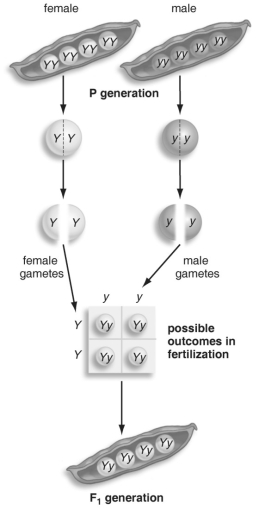 Refer to the figure above and then answer the question that follows.
-In his basic experiments, Mendel began with true-breeding parental (P) plants. What did he see when he cross-fertilized P plants that had different traits?
A) The F1 plants had new traits that were a blend of P traits.
B) All F1 plants had the trait of one or the other P plant.
C) The F1 plants had an entirely new trait, not seen in either P plant.
D) The F1 plants showed a combination of the two P traits in a 1:1 ratio.
E) The F1 plants showed a combination of the two P traits, in a 3:1 ratio.
Question
Refer to the figure above and then answer the question that follows.-Before Mendel, people had observed inheritance of dominant and recessive traits by following many generations of plants and animals. What was different about Mendel's work?
A) He used a plant that had never been cultivated before.
B) He kept careful count of his results, including mathematical analysis.
C) His results were immediately accepted and applied to other studies.
D) He followed more generations than anyone else.
E) He did both cross- and self-fertilizations.
Question
Question
Question
Question
Question
Question
Question
Question
Question
Question
Question
Question
Question
Question
Question
Question
Question
Question
Question
Question
Question
Question
Question
Question
Question
Question
Question
Question
Question
Question
Question

Unlock Deck
Sign up to unlock the cards in this deck!
Unlock Deck
Unlock Deck
1/36

Play

Full screen (f)
Deck 11: Mendel and His Discoveries
1
What is considered a "black box in biology?
A) various cellular organelles
B) any of a number of expensive automated scientific machines
C) processes in which we know only input and output
D) patented devices whose mechanisms are known only by the manufacturer
E) an old camera
A) various cellular organelles
B) any of a number of expensive automated scientific machines
C) processes in which we know only input and output
D) patented devices whose mechanisms are known only by the manufacturer
E) an old camera
processes in which we know only input and output
2
Which type of allele, or allelic combination, can be present in an individual without affecting phenotype?
A) dominant
B) heterozygous dominant
C) homozygous recessive
D) recessive
E) homozygous dominant
A) dominant
B) heterozygous dominant
C) homozygous recessive
D) recessive
E) homozygous dominant
recessive
3
Which of the following did Gregor Mendel not illustrate?
A) Identical phenotypes do not necessarily mean organisms have identical genotypes.
B) Units of inheritance come in pairs.
C) Phenotypic characteristics do not "blend" over many generations.
D) Inheritance is caused by discrete particles.
E) Units of inheritance are found on chromosomes.
A) Identical phenotypes do not necessarily mean organisms have identical genotypes.
B) Units of inheritance come in pairs.
C) Phenotypic characteristics do not "blend" over many generations.
D) Inheritance is caused by discrete particles.
E) Units of inheritance are found on chromosomes.
Units of inheritance are found on chromosomes.
4
Refer to the figure above and then answer the question that follows.-In his basic experiments, Mendel began with true-breeding parental (P) plants. What did he see when he cross-fertilized P plants that had different traits?
A) The F1 plants had new traits that were a blend of P traits.
B) All F1 plants had the trait of one or the other P plant.
C) The F1 plants had an entirely new trait, not seen in either P plant.
D) The F1 plants showed a combination of the two P traits in a 1:1 ratio.
E) The F1 plants showed a combination of the two P traits, in a 3:1 ratio.
Unlock Deck
Unlock for access to all 36 flashcards in this deck.
Unlock Deck
k this deck
5
Refer to the figure above and then answer the question that follows.-Before Mendel, people had observed inheritance of dominant and recessive traits by following many generations of plants and animals. What was different about Mendel's work?
A) He used a plant that had never been cultivated before.
B) He kept careful count of his results, including mathematical analysis.
C) His results were immediately accepted and applied to other studies.
D) He followed more generations than anyone else.
E) He did both cross- and self-fertilizations.
Unlock Deck
Unlock for access to all 36 flashcards in this deck.
Unlock Deck
k this deck
6
Crossing red flowering snapdragons with white flowering snapdragons yields seeds that grow into snapdragons with pink flowers. This suggests that:
A) red flowers are dominant.
B) white flowers are dominant.
C) pink flower are dominant.
D) incomplete dominance is occurring.
A) red flowers are dominant.
B) white flowers are dominant.
C) pink flower are dominant.
D) incomplete dominance is occurring.
Unlock Deck
Unlock for access to all 36 flashcards in this deck.
Unlock Deck
k this deck
7
Cystic fibrosis (CF) is caused by a recessive allele. A child has CF, even though neither of his parents has CF. What can you conclude about the parents?
A) One is homozygous dominant for the CF gene, and the other is heterozygous.
B) One is homozygous recessive for the CF gene, and the other is heterozygous.
C) They are both homozygous recessive for the CF gene.
D) They are both homozygous dominant for the CF gene.
E) They are both heterozygous for the CF gene.
A) One is homozygous dominant for the CF gene, and the other is heterozygous.
B) One is homozygous recessive for the CF gene, and the other is heterozygous.
C) They are both homozygous recessive for the CF gene.
D) They are both homozygous dominant for the CF gene.
E) They are both heterozygous for the CF gene.
Unlock Deck
Unlock for access to all 36 flashcards in this deck.
Unlock Deck
k this deck
8
In humans, "unattached earlobes are dominant over "attached earlobes. A woman and a man, both with unattached earlobes, have a child with attached earlobes. What is the probability their next child will have attached earlobes?
A) 3/4
B) 1/4
C) 2/4
D) 4/4
E) 0
A) 3/4
B) 1/4
C) 2/4
D) 4/4
E) 0
Unlock Deck
Unlock for access to all 36 flashcards in this deck.
Unlock Deck
k this deck
9
If an individual exhibits a recessive trait, which of the following statements can you be sure of?
A) The phenotype for this trait is different from the phenotype of the homozygous dominant genotype for this trait.
B) The genotype of this trait will be heterozygous.
C) Both parents of this individual had the same genotype for this trait.
D) Any siblings of this individual will have the same phenotype for this trait.
E) Any children this individual has will always exhibit the trait, regardless of the genotype of the other parent.
A) The phenotype for this trait is different from the phenotype of the homozygous dominant genotype for this trait.
B) The genotype of this trait will be heterozygous.
C) Both parents of this individual had the same genotype for this trait.
D) Any siblings of this individual will have the same phenotype for this trait.
E) Any children this individual has will always exhibit the trait, regardless of the genotype of the other parent.
Unlock Deck
Unlock for access to all 36 flashcards in this deck.
Unlock Deck
k this deck
10
Analyze the validity of the two statements below: Statement A: If an individual is heterozygous for a particular trait, it means that the individual carries two different alleles on a set of homologous chromosomes. Statement B: If an individual is heterozygous for a particular trait, that individual produces dominant gametes 50 percent of the time.
A) Statement A is true; Statement B is false.
B) Both statements are true.
C) Statement A is false; Statement B is true.
D) Both statements are false.
A) Statement A is true; Statement B is false.
B) Both statements are true.
C) Statement A is false; Statement B is true.
D) Both statements are false.
Unlock Deck
Unlock for access to all 36 flashcards in this deck.
Unlock Deck
k this deck
11
Alleles that are dominant are:
A) more common than recessive alleles.
B) generally more evolutionarily advantageous than recessive alleles.
C) capable of hiding or masking a recessive allele.
A) more common than recessive alleles.
B) generally more evolutionarily advantageous than recessive alleles.
C) capable of hiding or masking a recessive allele.
Unlock Deck
Unlock for access to all 36 flashcards in this deck.
Unlock Deck
k this deck
12
In the individual with genotype AaBB, what percentage of gametes will contain the A allele?
A) 75 percent
B) 25 percent
C) 100 percent
D) 10 percent
E) 50 percent
A) 75 percent
B) 25 percent
C) 100 percent
D) 10 percent
E) 50 percent
Unlock Deck
Unlock for access to all 36 flashcards in this deck.
Unlock Deck
k this deck
13
How many different types of gametes can be generated by an individual with genotype AaBB?
A) two
B) three
C) eight
D) one
E) four
A) two
B) three
C) eight
D) one
E) four
Unlock Deck
Unlock for access to all 36 flashcards in this deck.
Unlock Deck
k this deck
14
The phenotypic ratio obtained in a dihybrid cross is 8:0:4:2. The number of offspring that are dominant for trait 1 and recessive for trait 2 is:
A) zero
B) two
C) four
D) eight
A) zero
B) two
C) four
D) eight
Unlock Deck
Unlock for access to all 36 flashcards in this deck.
Unlock Deck
k this deck
15
A "trihybrid cross would:
A) follow a gene for which there are three alleles.
B) be a cross involving gametes from three different individuals.
C) follow three traits in a cross.
D) follow a gene that affects three different traits.
E) follow a trait over three generations.
A) follow a gene for which there are three alleles.
B) be a cross involving gametes from three different individuals.
C) follow three traits in a cross.
D) follow a gene that affects three different traits.
E) follow a trait over three generations.
Unlock Deck
Unlock for access to all 36 flashcards in this deck.
Unlock Deck
k this deck
16
In Mendel's pea plants, yellow seeds are dominant to green seeds. Purple flowers are dominant to white flowers. Use Y and y for the seed color alleles, and P and p for the flower color alleles. Flower color and seed color assort independently. If a YyPp plant is crossed to a Yypp plant, what is the probability that the resulting plant will have the genotype Yypp? (Hint: Determine two separate probabilities, and use the rule of multiplication.)
A) 1/2
B) 1/8
C) 1/32
D) 1/16
E) 1/4
A) 1/2
B) 1/8
C) 1/32
D) 1/16
E) 1/4
Unlock Deck
Unlock for access to all 36 flashcards in this deck.
Unlock Deck
k this deck
17
In Mendel's pea plants, yellow seeds are dominant to green seeds. Purple flowers are dominant to white flowers. Use Y and y for the seed color alleles, and P and p for the flower color alleles. Flower color and seed color assort independently. A plant of unknown genotype with yellow seeds and purple flowers is crossed to a plant with green seeds and white flowers. The offspring all have yellow seeds, but some have purple flowers and some have white flowers. What is the genotype of the yellow-seeded, purple-flowered plant?
A) YyPp
B) YYPp
C) YyPP
D) YYPP
E) Yypp
A) YyPp
B) YYPp
C) YyPP
D) YYPP
E) Yypp
Unlock Deck
Unlock for access to all 36 flashcards in this deck.
Unlock Deck
k this deck
18
In Mendel's pea plants, yellow seeds are dominant to green seeds. Purple flowers are dominant to white flowers. Use Y and y for the seed color alleles, and P and p for the flower color alleles. Flower color and seed color assort independently. A true-breeding plant with green seeds and white flowers is crossed to a plant that is heterozygous for the genes for both phenotypes. What is the probability that the cross will yield a plant with green seeds and white flowers?
A) 3/16
B) 3/32
C) 1/32
D) 1/16
E) 1/4
A) 3/16
B) 3/32
C) 1/32
D) 1/16
E) 1/4
Unlock Deck
Unlock for access to all 36 flashcards in this deck.
Unlock Deck
k this deck
19
In Mendel's pea plants, yellow seeds are dominant to green seeds. Purple flowers are dominant to white flowers. Use Y and y for the seed color alleles, and P and p for the flower color alleles. Flower color and seed color assort independently. If a plant that is heterozygous for both flower color and seed color genes is self-fertilized, what proportion of the offspring will have one of the dominant phenotypes, either the seed color or flower color, but not both?
A) 6/64
B) 6/32
C) 6/16
D) 9/32
E) 9/16
A) 6/64
B) 6/32
C) 6/16
D) 9/32
E) 9/16
Unlock Deck
Unlock for access to all 36 flashcards in this deck.
Unlock Deck
k this deck
20
In Mendel's pea plants, yellow seeds are dominant to green seeds. Purple flowers are dominant to white flowers. Use Y and y for the seed color alleles, and P and p for the flower color alleles. Flower color and seed color assort independently. What is the relationship between the Y and P?
A) They are two different genes on two different chromosomes.
B) They are two different genes on the same chromosome.
C) They are two different chromosomes in the pea plant.
D) They are the pleiotropic effects of a single gene.
E) They are incompletely dominant alleles of the same gene.
A) They are two different genes on two different chromosomes.
B) They are two different genes on the same chromosome.
C) They are two different chromosomes in the pea plant.
D) They are the pleiotropic effects of a single gene.
E) They are incompletely dominant alleles of the same gene.
Unlock Deck
Unlock for access to all 36 flashcards in this deck.
Unlock Deck
k this deck
21
If all of Mendel's monohybrid crosses had involved traits that function by incomplete dominance, would his results have supported blending inheritance?
A) It cannot be determined with the information given.
B) Yes; a cross between red and white flowers would yield all pink offspring.
C) No; half of the offspring would be red or white.
D) Yes; there is always a wide range of phenotypes in monohybrid crosses.
A) It cannot be determined with the information given.
B) Yes; a cross between red and white flowers would yield all pink offspring.
C) No; half of the offspring would be red or white.
D) Yes; there is always a wide range of phenotypes in monohybrid crosses.
Unlock Deck
Unlock for access to all 36 flashcards in this deck.
Unlock Deck
k this deck
22
A, B, and O blood type in humans is controlled by a single gene with three alleles: IA, IB and i. Imagine a fourth allele for blood type, IC. If it is codominant with IA and IB, and dominant to i, how many possible blood type phenotypes are there?
A) six
B) three
C) eight
D) nine
E) seven
A) six
B) three
C) eight
D) nine
E) seven
Unlock Deck
Unlock for access to all 36 flashcards in this deck.
Unlock Deck
k this deck
23
A, B, and O blood type in humans is controlled by a single gene with three alleles: IA, IB and i. Type O is the recessive trait. The i allele is recessive to both IA and IB. Which of the following could be possible genotypes of the parents of a person with type O blood?
A) IA IB and ii
B) both parents must be ii
C) IAi and IA IA
D) IAi and IBi
E) IA IB and IA IB
A) IA IB and ii
B) both parents must be ii
C) IAi and IA IA
D) IAi and IBi
E) IA IB and IA IB
Unlock Deck
Unlock for access to all 36 flashcards in this deck.
Unlock Deck
k this deck
24
Sickle-cell anemia is a disease whose phenotype includes not only anemia, but also damage to many different organs. All phenotypes, however, can be traced to a single gene. This is an example of :
A) multiple alleles.
B) pleiotropy.
C) codominance.
D) dominance.
E) incomplete dominance.
A) multiple alleles.
B) pleiotropy.
C) codominance.
D) dominance.
E) incomplete dominance.
Unlock Deck
Unlock for access to all 36 flashcards in this deck.
Unlock Deck
k this deck
25
The one gene, one phenotype model:
A) is well supported by available evidence.
B) is usually the relationship in inheritance.
C) is not a good model because aspects of phenotypes are often controlled by many genes.
A) is well supported by available evidence.
B) is usually the relationship in inheritance.
C) is not a good model because aspects of phenotypes are often controlled by many genes.
Unlock Deck
Unlock for access to all 36 flashcards in this deck.
Unlock Deck
k this deck
26
What are the odds of tossing a coin and having it come up heads three times in a row?
A) 1/3 1/3 1/3
B) 25 percent
C) 50 percent
D) 1/2 1/2 1/2
E) 1/2 1/3 1/4
A) 1/3 1/3 1/3
B) 25 percent
C) 50 percent
D) 1/2 1/2 1/2
E) 1/2 1/3 1/4
Unlock Deck
Unlock for access to all 36 flashcards in this deck.
Unlock Deck
k this deck
27
To determine the probability of two events occurring at the same time,
A) one probability is divided by the other.
B) the two probabilities are multiplied.
C) the individual probabilities are added, then subtracted from 1.
D) the two probabilities are added.
E) one probability is subtracted from the other.
A) one probability is divided by the other.
B) the two probabilities are multiplied.
C) the individual probabilities are added, then subtracted from 1.
D) the two probabilities are added.
E) one probability is subtracted from the other.
Unlock Deck
Unlock for access to all 36 flashcards in this deck.
Unlock Deck
k this deck
28
If one in 10 people carries the IA allele, and one in 20 people carries the IB allele, what is the probability that one person will have the IA IB genotype?
A) 1/30
B) 1/2
C) 1/200
D) 1/10
E) 2/30
A) 1/30
B) 1/2
C) 1/200
D) 1/10
E) 2/30
Unlock Deck
Unlock for access to all 36 flashcards in this deck.
Unlock Deck
k this deck
29
Match Mendel's results in column 1 with the conclusion he drew from them in column 2.
-When true-breeding P plants of different types are crossed, the offspring do not have a phenotype intermediate between the two parents.
A) There is no "blending" in inheritance.
B) Alleles come in dominant and recessive forms.
C) Genes assort independently in gamete formation.
D) Organisms have two alleles of each gene (elements), and only one is passed to offspring.
-When true-breeding P plants of different types are crossed, the offspring do not have a phenotype intermediate between the two parents.
A) There is no "blending" in inheritance.
B) Alleles come in dominant and recessive forms.
C) Genes assort independently in gamete formation.
D) Organisms have two alleles of each gene (elements), and only one is passed to offspring.
Unlock Deck
Unlock for access to all 36 flashcards in this deck.
Unlock Deck
k this deck
30
Match Mendel's results in column 1 with the conclusion he drew from them in column 2.
-When true-breeding P plants are crossed, all offspring had the trait of one of the parents.
A) There is no "blending" in inheritance.
B) Alleles come in dominant and recessive forms.
C) Genes assort independently in gamete formation.
D) Organisms have two alleles of each gene (elements), and only one is passed to offspring.
-When true-breeding P plants are crossed, all offspring had the trait of one of the parents.
A) There is no "blending" in inheritance.
B) Alleles come in dominant and recessive forms.
C) Genes assort independently in gamete formation.
D) Organisms have two alleles of each gene (elements), and only one is passed to offspring.
Unlock Deck
Unlock for access to all 36 flashcards in this deck.
Unlock Deck
k this deck
31
Match Mendel's results in column 1 with the conclusion he drew from them in column 2.
-When F2 plants, all with the heterozygous phenotype, are self-fertilized, the offspring have dominant and recessive traits in a 3:1 ratio.
A) There is no "blending" in inheritance.
B) Alleles come in dominant and recessive forms.
C) Genes assort independently in gamete formation.
D) Organisms have two alleles of each gene (elements), and only one is passed to offspring.
-When F2 plants, all with the heterozygous phenotype, are self-fertilized, the offspring have dominant and recessive traits in a 3:1 ratio.
A) There is no "blending" in inheritance.
B) Alleles come in dominant and recessive forms.
C) Genes assort independently in gamete formation.
D) Organisms have two alleles of each gene (elements), and only one is passed to offspring.
Unlock Deck
Unlock for access to all 36 flashcards in this deck.
Unlock Deck
k this deck
32
Match Mendel's results in column 1 with the conclusion he drew from them in column 2.
-When two traits are followed in a dihybrid cross, heterozygotes give offspring with all combinations of phenotypes, in a 9:3:3:1 ratio.
A) There is no "blending" in inheritance.
B) Alleles come in dominant and recessive forms.
C) Genes assort independently in gamete formation.
D) Organisms have two alleles of each gene (elements), and only one is passed to offspring.
-When two traits are followed in a dihybrid cross, heterozygotes give offspring with all combinations of phenotypes, in a 9:3:3:1 ratio.
A) There is no "blending" in inheritance.
B) Alleles come in dominant and recessive forms.
C) Genes assort independently in gamete formation.
D) Organisms have two alleles of each gene (elements), and only one is passed to offspring.
Unlock Deck
Unlock for access to all 36 flashcards in this deck.
Unlock Deck
k this deck
33
Why do you think Mendel cross-fertilized plants in the P generation, but self-fertilized in the F1 generation?
Unlock Deck
Unlock for access to all 36 flashcards in this deck.
Unlock Deck
k this deck
34
What might be the current status of genetics if Mendel had never done his experiments with garden peas?
Unlock Deck
Unlock for access to all 36 flashcards in this deck.
Unlock Deck
k this deck
35
Researchers involved in the Human Genome Project are working to determine the genetic causes of many diseases. In some cases, an allele has been identified that is associated with the particular disease, and a test for that allele can be performed. If a person tests positive for that allele, it does not always mean that they will develop the disease. Explain what else might be a factor in whether the person actually develops the disease.
Unlock Deck
Unlock for access to all 36 flashcards in this deck.
Unlock Deck
k this deck
36
Consider the following information for a dihybrid cross. The dominant allele F codes for freckles, whereas the recessive allele f codes for no freckles. The dominant allele E codes for long eyelashes, whereas the recessive allele e codes for short eyelashes. Both parents have the genotypes of ee and Ff. Indicate the following: (1) the phenotype of both parents, (2) the possible gametes that each parent can make, (3) all of the possible phenotypes for the offspring, and (4) the phenotypic ratio obtained after the Punnett square is drawn.
Unlock Deck
Unlock for access to all 36 flashcards in this deck.
Unlock Deck
k this deck
Unlock Deck
Unlock for access to all 36 flashcards in this deck.






