







 Chat with AI

Deck 39: Nursing Assessment: Gastrointestinal System
Full screen (f)

Question

Question
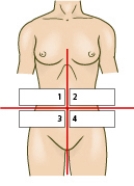
Which area of the abdomen shown in the accompanying figure will the nurse palpate to assess for splenomegaly?
A) 1
B) 2
C) 3
D) 4
A) 1
B) 2
C) 3
D) 4
Question
Question
Question
Question
Question
Question
Question
Question
Question
Question
Question
Question
Question
Question
Question
Question

Unlock Deck
Sign up to unlock the cards in this deck!
Unlock Deck
Unlock Deck
1/18

Play

Full screen (f)
Deck 39: Nursing Assessment: Gastrointestinal System
1
Which information about an 80-year-old man at the senior center is of most concern to the nurse?
A) Decreased appetite
B) Unintended weight loss
C) Difficulty chewing food
D) Complaints of indigestion
A) Decreased appetite
B) Unintended weight loss
C) Difficulty chewing food
D) Complaints of indigestion
Unintended weight loss
2
Which area of the abdomen shown in the accompanying figure will the nurse palpate to assess for splenomegaly?
A) 1
B) 2
C) 3
D) 4
A) 1
B) 2
C) 3
D) 4
2
3
The nurse is assessing an alert and independent 78-year-old woman for malnutrition risk.The most appropriate initial question is which of the following?
A) "How do you get to the store to buy your food?"
B) "Can you tell me the food that you ate yesterday?"
C) "Do you have any difficulty in preparing or eating food?"
D) "Are you taking any medications that alter your taste for food?"
A) "How do you get to the store to buy your food?"
B) "Can you tell me the food that you ate yesterday?"
C) "Do you have any difficulty in preparing or eating food?"
D) "Are you taking any medications that alter your taste for food?"
"Can you tell me the food that you ate yesterday?"
4
A patient is being scheduled for endoscopic retrograde cholangiopancreatography (ERCP)as soon as possible.Which actions from the agency policy for ERCP should the nurse take first?
A) Place the patient on NPO status.
B) Administer sedative medications.
C) Ensure the consent form is signed.
D) Teach the patient about the procedure.
A) Place the patient on NPO status.
B) Administer sedative medications.
C) Ensure the consent form is signed.
D) Teach the patient about the procedure.
Unlock Deck
Unlock for access to all 18 flashcards in this deck.
Unlock Deck
k this deck
5
A 58-year-old woman has just returned to the nursing unit after an esophagogastroduodenoscopy (EGD).Which action by unlicensed assistive personnel (UAP)requires that the registered nurse (RN)intervene?
A) Offering the patient a drink of water
B) Positioning the patient on the right side
C) Checking the vital signs every 30 minutes
D) Swabbing the patient's mouth with cold water
A) Offering the patient a drink of water
B) Positioning the patient on the right side
C) Checking the vital signs every 30 minutes
D) Swabbing the patient's mouth with cold water
Unlock Deck
Unlock for access to all 18 flashcards in this deck.
Unlock Deck
k this deck
6
When caring for a patient with a history of a total gastrectomy,the nurse will monitor for
A) constipation.
B) dehydration.
C) elevated total serum cholesterol.
D) cobalamin (vitamin B12) deficiency.
A) constipation.
B) dehydration.
C) elevated total serum cholesterol.
D) cobalamin (vitamin B12) deficiency.
Unlock Deck
Unlock for access to all 18 flashcards in this deck.
Unlock Deck
k this deck
7
A 42-year-old woman is admitted to the outpatient testing area for an ultrasound of the gallbladder.Which information obtained by the nurse indicates that the ultrasound may need to be rescheduled?
A) The patient took a laxative the previous evening.
B) The patient had a high-fat meal the previous evening.
C) The patient has a permanent gastrostomy tube in place.
D) The patient ate a low-fat bagel 4 hours ago for breakfast.
A) The patient took a laxative the previous evening.
B) The patient had a high-fat meal the previous evening.
C) The patient has a permanent gastrostomy tube in place.
D) The patient ate a low-fat bagel 4 hours ago for breakfast.
Unlock Deck
Unlock for access to all 18 flashcards in this deck.
Unlock Deck
k this deck
8
The nurse receives the following information about a 51-year-old woman who is scheduled for a colonoscopy.Which information should be communicated to the health care provider before sending the patient for the procedure?
A) The patient has a permanent pacemaker to prevent bradycardia.
B) The patient is worried about discomfort during the examination.
C) The patient has had an allergic reaction to shellfish and iodine in the past.
D) The patient refused to drink the ordered polyethylene glycol (GoLYTELY).
A) The patient has a permanent pacemaker to prevent bradycardia.
B) The patient is worried about discomfort during the examination.
C) The patient has had an allergic reaction to shellfish and iodine in the past.
D) The patient refused to drink the ordered polyethylene glycol (GoLYTELY).
Unlock Deck
Unlock for access to all 18 flashcards in this deck.
Unlock Deck
k this deck
9
A 62- year-old man reports chronic constipation.To promote bowel evacuation,the nurse will suggest that the patient attempt defecation
A) in the mid-afternoon.
B) after eating breakfast.
C) right after getting up in the morning.
D) immediately before the first daily meal.
A) in the mid-afternoon.
B) after eating breakfast.
C) right after getting up in the morning.
D) immediately before the first daily meal.
Unlock Deck
Unlock for access to all 18 flashcards in this deck.
Unlock Deck
k this deck
10
Which statement to the nurse from a patient with jaundice indicates a need for teaching?
A) "I used cough syrup several times a day last week."
B) "I take a baby aspirin every day to prevent strokes."
C) "I use acetaminophen (Tylenol) every 4 hours for back pain."
D) "I need to take an antacid for indigestion several times a week"
A) "I used cough syrup several times a day last week."
B) "I take a baby aspirin every day to prevent strokes."
C) "I use acetaminophen (Tylenol) every 4 hours for back pain."
D) "I need to take an antacid for indigestion several times a week"
Unlock Deck
Unlock for access to all 18 flashcards in this deck.
Unlock Deck
k this deck
11
In the video,the examiner is
A) percussing for liver size.
B) percussing for splenomegaly.
C) palpating for abdominal distention.
D) palpating for abdominal tenderness.
A) percussing for liver size.
B) percussing for splenomegaly.
C) palpating for abdominal distention.
D) palpating for abdominal tenderness.
Unlock Deck
Unlock for access to all 18 flashcards in this deck.
Unlock Deck
k this deck
12
A 30-year-old man is being admitted to the hospital for elective knee surgery.Which assessment finding is most important to report to the health care provider?
A) Tympany on percussion of the abdomen
B) Liver edge 3 cm below the costal margin
C) Bowel sounds of 20/minute in each quadrant
D) Aortic pulsations visible in the epigastric area
A) Tympany on percussion of the abdomen
B) Liver edge 3 cm below the costal margin
C) Bowel sounds of 20/minute in each quadrant
D) Aortic pulsations visible in the epigastric area
Unlock Deck
Unlock for access to all 18 flashcards in this deck.
Unlock Deck
k this deck
13
While interviewing a 30-year-old man,the nurse learns that the patient has a family history of familial adenomatous polyposis (FAP).The nurse will plan to assess the patient's knowledge about
A) preventing noninfectious hepatitis.
B) treating inflammatory bowel disease.
C) risk for developing colorectal cancer.
D) using antacids and proton pump inhibitors.
A) preventing noninfectious hepatitis.
B) treating inflammatory bowel disease.
C) risk for developing colorectal cancer.
D) using antacids and proton pump inhibitors.
Unlock Deck
Unlock for access to all 18 flashcards in this deck.
Unlock Deck
k this deck
14
Which finding by the nurse during abdominal auscultation indicates a need for a focused abdominal assessment?
A) Loud gurgles
B) High-pitched gurgles
C) Absent bowel sounds
D) Frequent clicking sounds
A) Loud gurgles
B) High-pitched gurgles
C) Absent bowel sounds
D) Frequent clicking sounds
Unlock Deck
Unlock for access to all 18 flashcards in this deck.
Unlock Deck
k this deck
15
To palpate the liver during a head-to-toe physical assessment,the nurse
A) places one hand on the patient's back and presses upward and inward with the other hand below the patient's right costal margin.
B) places one hand on top of the other and uses the upper fingers to apply pressure and the bottom fingers to feel for the liver edge.
C) presses slowly and firmly over the right costal margin with one hand and withdraws the fingers quickly after the liver edge is felt.
D) places one hand under the patient's lower ribs and presses the left lower rib cage forward, palpating below the costal margin with the other hand.
A) places one hand on the patient's back and presses upward and inward with the other hand below the patient's right costal margin.
B) places one hand on top of the other and uses the upper fingers to apply pressure and the bottom fingers to feel for the liver edge.
C) presses slowly and firmly over the right costal margin with one hand and withdraws the fingers quickly after the liver edge is felt.
D) places one hand under the patient's lower ribs and presses the left lower rib cage forward, palpating below the costal margin with the other hand.
Unlock Deck
Unlock for access to all 18 flashcards in this deck.
Unlock Deck
k this deck
16
A 54-year-old man has just arrived in the recovery area after an upper endoscopy.Which information collected by the nurse is most important to communicate to the health care provider?
A) The patient is very drowsy.
B) The patient reports a sore throat.
C) The oral temperature is 101.6° F.
D) The apical pulse is 104 beats/minute.
A) The patient is very drowsy.
B) The patient reports a sore throat.
C) The oral temperature is 101.6° F.
D) The apical pulse is 104 beats/minute.
Unlock Deck
Unlock for access to all 18 flashcards in this deck.
Unlock Deck
k this deck
17
After assisting with a needle biopsy of the liver at a patient's bedside,the nurse should
A) put pressure on the biopsy site using a sandbag.
B) elevate the head of the bed to facilitate breathing.
C) place the patient on the right side with the bed flat.
D) check the patient's postbiopsy coagulation studies.
A) put pressure on the biopsy site using a sandbag.
B) elevate the head of the bed to facilitate breathing.
C) place the patient on the right side with the bed flat.
D) check the patient's postbiopsy coagulation studies.
Unlock Deck
Unlock for access to all 18 flashcards in this deck.
Unlock Deck
k this deck
18
The nurse will plan to monitor a patient with an obstructed common bile duct for
A) melena.
B) steatorrhea.
C) decreased serum cholesterol levels.
D) increased serum indirect bilirubin levels.
A) melena.
B) steatorrhea.
C) decreased serum cholesterol levels.
D) increased serum indirect bilirubin levels.
Unlock Deck
Unlock for access to all 18 flashcards in this deck.
Unlock Deck
k this deck
Unlock Deck
Unlock for access to all 18 flashcards in this deck.






