







 Chat with AI

Deck 27: International Trade
Full screen (f)

Question

Question
This table shows the hypothetical effect of a redeployment of resources within the United States and the Arab countries for the production of oil and wheat.

Which of the following can be inferred from the table?
A) It costs the United States 5 billion barrels of oil for every 1 billion bushels of wheat.
B) The Arab countries have an absolute advantage in both oil and wheat.
C) It cost the Arabs 1 barrel of oil for every 0.10 bushel of wheat.
D) The United States has a comparative advantage in both oil and wheat.
E) It costs the United States 1 barrel of oil for every 1.25 bushels of wheat.
Which of the following can be inferred from the table?
A) It costs the United States 5 billion barrels of oil for every 1 billion bushels of wheat.
B) The Arab countries have an absolute advantage in both oil and wheat.
C) It cost the Arabs 1 barrel of oil for every 0.10 bushel of wheat.
D) The United States has a comparative advantage in both oil and wheat.
E) It costs the United States 1 barrel of oil for every 1.25 bushels of wheat.
Question
Question
Question
Question
Question
Question
Question
Question
Question
Question
Question
Question
Question
Question
Question
Question
Question
Question
Question
Question
Question
Question
Question
Question
Question
Question
The following questions are based on the following diagrams:
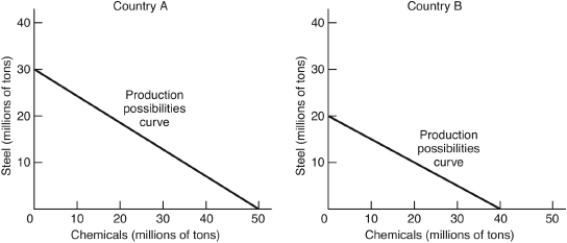
From the diagrams,it can be seen that
A) country A has a comparative advantage in both commodities.
B) country B has an absolute advantage in both commodities.
C) country B has a comparative advantage in chemicals.
D) it is more costly in terms of resources to produce steel in country A.
E) the slopes of the two curves indicate both countries will specialize in chemicals.
From the diagrams,it can be seen that
A) country A has a comparative advantage in both commodities.
B) country B has an absolute advantage in both commodities.
C) country B has a comparative advantage in chemicals.
D) it is more costly in terms of resources to produce steel in country A.
E) the slopes of the two curves indicate both countries will specialize in chemicals.
Question
Question
Question
Question
Question
Question
Question
Question
Question
Question
Question
Question
Question
Question
The following questions are based on the following graphs for men's shirts in South Korea and the United States. The exchange rate is 1,200 won equals $1.00.
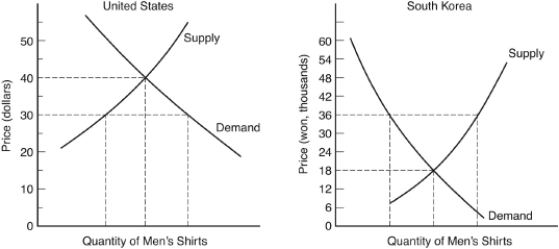
Under the market conditions shown in the graphs
A) the United States tends to export men's shirts to South Korea. The price falls in the United States but rises in South Korea.
B) the United States imports all of its men's shirts and curtails domestic production.
C) the demand curve for men's shirts in the United States and the supply curve for men's shirts in South Korea both shift to the left and prices in the two markets equalize.
D) the South Koreans introduce a tariff on imported men's shirts to keep out U.S. goods.
E) the United States tends to import men's shirts from South Korea rather than export men's shirts to it.
Under the market conditions shown in the graphs
A) the United States tends to export men's shirts to South Korea. The price falls in the United States but rises in South Korea.
B) the United States imports all of its men's shirts and curtails domestic production.
C) the demand curve for men's shirts in the United States and the supply curve for men's shirts in South Korea both shift to the left and prices in the two markets equalize.
D) the South Koreans introduce a tariff on imported men's shirts to keep out U.S. goods.
E) the United States tends to import men's shirts from South Korea rather than export men's shirts to it.
Question
Question
Question
Question
Question
The following questions are based on the following graphs for men's shirts in South Korea and the United States. The exchange rate is 1,200 won equals $1.00.
Under free trade,the price of men's shirts in South Korea tends toward ________ won.
A) 12,000
B) 24,000
C) 36,000
D) 48,000
E) 60,000
Under free trade,the price of men's shirts in South Korea tends toward ________ won.
A) 12,000
B) 24,000
C) 36,000
D) 48,000
E) 60,000
Question
Question
Question
Question
Question
Question
Question
The following questions are based on the following graphs for men's shirts in South Korea and the United States. The exchange rate is 1,200 won equals $1.00.
If the United States imposes a prohibitive tariff on men's shirts,the price of a man's shirt in the United States probably is
A) below $30.
B) $30.
C) between $30 and $40.
D) $40.
E) over $40.
If the United States imposes a prohibitive tariff on men's shirts,the price of a man's shirt in the United States probably is
A) below $30.
B) $30.
C) between $30 and $40.
D) $40.
E) over $40.
Question
Question
Question
Question
Question
The following questions are based on the following graphs for men's shirts in South Korea and the United States. The exchange rate is 1,200 won equals $1.00.
If the United States imposes a tariff on imported men's shirts,the price of a man's shirt in the United States probably is
A) below $30.
B) $30.
C) between $30 and $40.
D) $40.
E) over $40.
If the United States imposes a tariff on imported men's shirts,the price of a man's shirt in the United States probably is
A) below $30.
B) $30.
C) between $30 and $40.
D) $40.
E) over $40.
Question
Question
Question
Question
Question
Question
Question
Question
Question
Question
Question

Unlock Deck
Sign up to unlock the cards in this deck!
Unlock Deck
Unlock Deck
1/70

Play

Full screen (f)
Deck 27: International Trade
1
A husband and wife both work during the week and decide that on Saturday morning the inside of the house must be cleaned and the yard must be mowed and weeded.If it takes the husband four hours to clean the house and three hours to do the yard work,and the wife can do either in two hours
A) the husband has a comparative advantage in yard work.
B) the husband has a comparative advantage in cleaning.
C) the wife has a comparative advantage in both tasks.
D) there would be no gain from specialization since the wife is better at both tasks.
E) the husband has the comparative advantage in both tasks.
A) the husband has a comparative advantage in yard work.
B) the husband has a comparative advantage in cleaning.
C) the wife has a comparative advantage in both tasks.
D) there would be no gain from specialization since the wife is better at both tasks.
E) the husband has the comparative advantage in both tasks.
A
2
This table shows the hypothetical effect of a redeployment of resources within the United States and the Arab countries for the production of oil and wheat.
Which of the following can be inferred from the table?
A) It costs the United States 5 billion barrels of oil for every 1 billion bushels of wheat.
B) The Arab countries have an absolute advantage in both oil and wheat.
C) It cost the Arabs 1 barrel of oil for every 0.10 bushel of wheat.
D) The United States has a comparative advantage in both oil and wheat.
E) It costs the United States 1 barrel of oil for every 1.25 bushels of wheat.
Which of the following can be inferred from the table?
A) It costs the United States 5 billion barrels of oil for every 1 billion bushels of wheat.
B) The Arab countries have an absolute advantage in both oil and wheat.
C) It cost the Arabs 1 barrel of oil for every 0.10 bushel of wheat.
D) The United States has a comparative advantage in both oil and wheat.
E) It costs the United States 1 barrel of oil for every 1.25 bushels of wheat.
C
3
If a country is absolutely more efficient than any other country in producing everything,then it would
A) simply export goods and services and import money.
B) not trade with others because there would be no benefit in doing so.
C) still benefit that nation to specialize and trade those goods in which it possesses a comparative advantage.
D) make it unnecessary for other nations to produce anything for themselves.
E) represent a refutation of the concept of comparative advantage.
A) simply export goods and services and import money.
B) not trade with others because there would be no benefit in doing so.
C) still benefit that nation to specialize and trade those goods in which it possesses a comparative advantage.
D) make it unnecessary for other nations to produce anything for themselves.
E) represent a refutation of the concept of comparative advantage.
C
4
Goods and services produced in other countries and sold to U.S.residents are called
A) extracts.
B) implants.
C) exurbs.
D) imports.
E) exports.
A) extracts.
B) implants.
C) exurbs.
D) imports.
E) exports.
Unlock Deck
Unlock for access to all 70 flashcards in this deck.
Unlock Deck
k this deck
5
The advantage of trade,both for individuals and countries
A) always nets out to zero.
B) disappears when one has an absolute advantage over the other.
C) is that trade permits specialization and specialization increases output.
D) is increased when tariffs are imposed.
E) can benefit only one party in the transaction.
A) always nets out to zero.
B) disappears when one has an absolute advantage over the other.
C) is that trade permits specialization and specialization increases output.
D) is increased when tariffs are imposed.
E) can benefit only one party in the transaction.
Unlock Deck
Unlock for access to all 70 flashcards in this deck.
Unlock Deck
k this deck
6
Excluded from among the important bases for specialization is the existence of
A) perfect resource homogeneity and mobility.
B) differences in the quality of resources.
C) relative differences in the quantities of human and nonhuman resources.
D) comparative advantage.
E) differences in technology.
A) perfect resource homogeneity and mobility.
B) differences in the quality of resources.
C) relative differences in the quantities of human and nonhuman resources.
D) comparative advantage.
E) differences in technology.
Unlock Deck
Unlock for access to all 70 flashcards in this deck.
Unlock Deck
k this deck
7
The following questions are based on the following information. Country A can produce either 10,000 barrels of petroleum or 12,000 bushels of wheat with one unit of its resources. Country B can produce either 7,000 barrels of petroleum or 15,000 bushels of wheat with one unit of its resources.
From this information,country
A) A has an absolute advantage in petroleum.
B) A has an absolute advantage in wheat.
C) A has a comparative advantage in wheat.
D) B has an absolute advantage in petroleum.
E) B has a comparative advantage in petroleum.
From this information,country
A) A has an absolute advantage in petroleum.
B) A has an absolute advantage in wheat.
C) A has a comparative advantage in wheat.
D) B has an absolute advantage in petroleum.
E) B has a comparative advantage in petroleum.
Unlock Deck
Unlock for access to all 70 flashcards in this deck.
Unlock Deck
k this deck
8
In general,individuals and countries that attempt to be completely self-sufficient tend to
A) grow faster in the long run.
B) have a more equal distribution of income.
C) be assured of ongoing full employment.
D) experience a lower standard of living from the use of their resources.
E) be more productive and technically capable.
A) grow faster in the long run.
B) have a more equal distribution of income.
C) be assured of ongoing full employment.
D) experience a lower standard of living from the use of their resources.
E) be more productive and technically capable.
Unlock Deck
Unlock for access to all 70 flashcards in this deck.
Unlock Deck
k this deck
9
In which of the following situations describing the coffee-versus-computer production possibilities potential does country A have a comparative advantage in coffee? Country A: 1,000 bushels of coffee or 10 computers; country B:
A) 500 bushels of coffee or 5 computers.
B) 1,200 bushels of coffee or 12 computers.
C) 1,500 bushels of coffee or 12 computers.
D) 1,300 bushels of coffee or 15 computers.
E) 1,600 bushels of coffee or 15 computers.
A) 500 bushels of coffee or 5 computers.
B) 1,200 bushels of coffee or 12 computers.
C) 1,500 bushels of coffee or 12 computers.
D) 1,300 bushels of coffee or 15 computers.
E) 1,600 bushels of coffee or 15 computers.
Unlock Deck
Unlock for access to all 70 flashcards in this deck.
Unlock Deck
k this deck
10
If country A can produce either 1,000 bushels of wheat or 500 bushels of rice with 1 unit of resources while country B can produce 600 bushels of wheat or 400 bushels of rice with 1 unit of resources,country
A) B must give up fewer bushels of rice to get 1 unit of wheat than country A.
B) B must have an absolute advantage in wheat production.
C) A should specialize in the production of both wheat and rice because trade with B would yield no benefit.
D) A must sacrifice less wheat to produce 1 unit of rice than country B.
E) B has a comparative advantage in rice production.
A) B must give up fewer bushels of rice to get 1 unit of wheat than country A.
B) B must have an absolute advantage in wheat production.
C) A should specialize in the production of both wheat and rice because trade with B would yield no benefit.
D) A must sacrifice less wheat to produce 1 unit of rice than country B.
E) B has a comparative advantage in rice production.
Unlock Deck
Unlock for access to all 70 flashcards in this deck.
Unlock Deck
k this deck
11
If country A can produce 200 bicycles or 500 wheelbarrows with 1 unit of resources while country B can produce 150 bicycles or 400 wheelbarrows with 1 unit of resources,then with respect to the production of bicycles,country A is ________ efficient than country B.
A) 94 percent more
B) 75 percent more
C) 33 percent more
D) 25 percent more
E) relatively less
A) 94 percent more
B) 75 percent more
C) 33 percent more
D) 25 percent more
E) relatively less
Unlock Deck
Unlock for access to all 70 flashcards in this deck.
Unlock Deck
k this deck
12
Country A must have an absolute advantage over country B in the production of a good when it
A) is able to produce the good for itself.
B) imports the good from country B.
C) imports inputs to produce the good from country B.
D) decides to export the good to country B.
E) can produce a unit of the good with less resources than country B.
A) is able to produce the good for itself.
B) imports the good from country B.
C) imports inputs to produce the good from country B.
D) decides to export the good to country B.
E) can produce a unit of the good with less resources than country B.
Unlock Deck
Unlock for access to all 70 flashcards in this deck.
Unlock Deck
k this deck
13
If country A can produce either 10 automobiles or 200 computers with 1 unit of resources while country B can produce either 8 automobiles or 125 computers with 1 unit of resources,then with respect to the production of computers,country A is ________ country B.
A) relatively less efficient than
B) 28 percent more efficient than
C) 37.5 percent more efficient than
D) 60 percent more efficient than
E) 4.75 times as efficient as
A) relatively less efficient than
B) 28 percent more efficient than
C) 37.5 percent more efficient than
D) 60 percent more efficient than
E) 4.75 times as efficient as
Unlock Deck
Unlock for access to all 70 flashcards in this deck.
Unlock Deck
k this deck
14
A country that can produce a unit of some good with less resources than another country is considered with respect to the other country to possess a(n)________ advantage.
A) strategic
B) absolute
C) limited
D) bilateral
E) selective
A) strategic
B) absolute
C) limited
D) bilateral
E) selective
Unlock Deck
Unlock for access to all 70 flashcards in this deck.
Unlock Deck
k this deck
15
A husband and wife both work during the week and decide that on Saturday morning the inside of the house must be cleaned and the yard must be mowed and weeded.If it takes the husband four hours to clean the house and two hours to do the yard work,and the wife can do these tasks in two hours and one hour,respectively
A) the husband has a comparative advantage in yard work.
B) the husband has a comparative advantage in cleaning.
C) the wife has a comparative advantage in both tasks.
D) neither has a comparative advantage in either task, but the wife has an absolute advantage in both.
E) the wife should let the husband do both tasks so he can improve his time.
A) the husband has a comparative advantage in yard work.
B) the husband has a comparative advantage in cleaning.
C) the wife has a comparative advantage in both tasks.
D) neither has a comparative advantage in either task, but the wife has an absolute advantage in both.
E) the wife should let the husband do both tasks so he can improve his time.
Unlock Deck
Unlock for access to all 70 flashcards in this deck.
Unlock Deck
k this deck
16
Goods and services produced in the United States and sold to other countries are called
A) extracts.
B) implants.
C) exurbs.
D) imports.
E) exports.
A) extracts.
B) implants.
C) exurbs.
D) imports.
E) exports.
Unlock Deck
Unlock for access to all 70 flashcards in this deck.
Unlock Deck
k this deck
17
Exports from the United States are the goods and services
A) it buys from other countries.
B) that use up its holdings of foreign currencies.
C) produced here and consumed by foreigners.
D) whose dollar value is subtracted from its GDP.
E) produced here and consumed by U.S. residents.
A) it buys from other countries.
B) that use up its holdings of foreign currencies.
C) produced here and consumed by foreigners.
D) whose dollar value is subtracted from its GDP.
E) produced here and consumed by U.S. residents.
Unlock Deck
Unlock for access to all 70 flashcards in this deck.
Unlock Deck
k this deck
18
Exports from the United States
A) represent about one-half of world trade.
B) amount to about 10 percent of GDP.
C) amount to about 13 percent of GDP.
D) are primarily raw materials.
E) go mainly to third world countries.
A) represent about one-half of world trade.
B) amount to about 10 percent of GDP.
C) amount to about 13 percent of GDP.
D) are primarily raw materials.
E) go mainly to third world countries.
Unlock Deck
Unlock for access to all 70 flashcards in this deck.
Unlock Deck
k this deck
19
A country that is able to produce many goods should specialize in those products
A) in which it has a comparative advantage.
B) in which it has an absolute advantage.
C) it needs most.
D) its citizens are most willing to pay for.
E) that command the highest price on the world market.
A) in which it has a comparative advantage.
B) in which it has an absolute advantage.
C) it needs most.
D) its citizens are most willing to pay for.
E) that command the highest price on the world market.
Unlock Deck
Unlock for access to all 70 flashcards in this deck.
Unlock Deck
k this deck
20
If each country shifts one unit of resources into the production of the good in which it is relatively more efficient,world output would rise by
A) 10,000 bushels of wheat.
B) 17,000 barrels of petroleum.
C) 10,000 barrels of petroleum and 15,000 bushels of wheat.
D) 3,000 barrels of petroleum and 3,000 bushels of wheat.
E) 8,000 bushels of wheat and fall by 2,000 barrels of petroleum.
A) 10,000 bushels of wheat.
B) 17,000 barrels of petroleum.
C) 10,000 barrels of petroleum and 15,000 bushels of wheat.
D) 3,000 barrels of petroleum and 3,000 bushels of wheat.
E) 8,000 bushels of wheat and fall by 2,000 barrels of petroleum.
Unlock Deck
Unlock for access to all 70 flashcards in this deck.
Unlock Deck
k this deck
21
One of the first economists to understand and explain the notion that specialization and trade depend on comparative and NOT absolute advantage was
A) Adam Smith.
B) Edwin Mansfield.
C) John Maynard Keynes.
D) Thomas Malthus.
E) David Ricardo.
A) Adam Smith.
B) Edwin Mansfield.
C) John Maynard Keynes.
D) Thomas Malthus.
E) David Ricardo.
Unlock Deck
Unlock for access to all 70 flashcards in this deck.
Unlock Deck
k this deck
22
When free trade prevails,the
A) domestic prices of imported items rise and of exported items decline.
B) domestic prices of both imported and exported items rise.
C) domestic prices of exported items rise in the exporting country and decline in the importing country.
D) domestic prices of imported and exported items remain the same.
E) laws of supply and demand are replaced by the law of comparative advantage.
A) domestic prices of imported items rise and of exported items decline.
B) domestic prices of both imported and exported items rise.
C) domestic prices of exported items rise in the exporting country and decline in the importing country.
D) domestic prices of imported and exported items remain the same.
E) laws of supply and demand are replaced by the law of comparative advantage.
Unlock Deck
Unlock for access to all 70 flashcards in this deck.
Unlock Deck
k this deck
23
Trade between these two countries would
A) probably result in complete specialization.
B) probably result in partial specialization because the costs of producing steel and chemicals are rising.
C) be unlikely because country B is less productive than country A.
D) take place only if there are qualitative differences between each country's goods.
E) tend to enrich country A at the expense of country B.
A) probably result in complete specialization.
B) probably result in partial specialization because the costs of producing steel and chemicals are rising.
C) be unlikely because country B is less productive than country A.
D) take place only if there are qualitative differences between each country's goods.
E) tend to enrich country A at the expense of country B.
Unlock Deck
Unlock for access to all 70 flashcards in this deck.
Unlock Deck
k this deck
24
If a country maintains its level of exports to another country under free trade,even after its world price is equalized and there are no international shortages or surpluses,it must have a
A) comparative advantage in that good.
B) comparative disadvantage in that good.
C) lower domestic price for the good than would be the case if trade were not permitted.
D) higher rate of domestic consumption of the good than would be the case if trade were not permitted.
E) persistent domestic shortage of the good that necessitates a tariff on it.
A) comparative advantage in that good.
B) comparative disadvantage in that good.
C) lower domestic price for the good than would be the case if trade were not permitted.
D) higher rate of domestic consumption of the good than would be the case if trade were not permitted.
E) persistent domestic shortage of the good that necessitates a tariff on it.
Unlock Deck
Unlock for access to all 70 flashcards in this deck.
Unlock Deck
k this deck
25
If there are no barriers to trade,the current domestic price of coffee in Brazil is 8 reals per pound,the U.S.price is $4.50 per pound,and the exchange rate is 3.2 reals to the dollar
A) Brazil is not exporting coffee to the United States.
B) the United States does not want to import as much coffee from Brazil as Brazil wants to import from the United States.
C) there is a bilateral equilibrium in the U.S.-Brazilian coffee trade.
D) the U.S. price of coffee falls below $4.50 per pound and the Brazilian price rises above 8 reals per pound.
E) the United States is exporting coffee to Brazil.
A) Brazil is not exporting coffee to the United States.
B) the United States does not want to import as much coffee from Brazil as Brazil wants to import from the United States.
C) there is a bilateral equilibrium in the U.S.-Brazilian coffee trade.
D) the U.S. price of coffee falls below $4.50 per pound and the Brazilian price rises above 8 reals per pound.
E) the United States is exporting coffee to Brazil.
Unlock Deck
Unlock for access to all 70 flashcards in this deck.
Unlock Deck
k this deck
26
For trade to benefit a nation,its consumption possibilities curve must
A) lie above and to the right of its production possibilities curve.
B) equal its production possibilities curve.
C) lie below and to the left of its production possibilities curve.
D) slope upward and intersect the production possibilities curve below its midpoint.
E) be either vertical or horizontal.
A) lie above and to the right of its production possibilities curve.
B) equal its production possibilities curve.
C) lie below and to the left of its production possibilities curve.
D) slope upward and intersect the production possibilities curve below its midpoint.
E) be either vertical or horizontal.
Unlock Deck
Unlock for access to all 70 flashcards in this deck.
Unlock Deck
k this deck
27
If the United States can produce 10,000 personal computers or 20,000 TVs with 1 unit of resources and Japan can produce 12,000 personal computers and 36,000 TVs with 1 unit of resources
A) Japan has a comparative advantage in personal computers.
B) the United States has a comparative advantage in personal computers.
C) neither country has a comparative advantage, but Japan has an absolute advantage in both personal computers and TVs.
D) both countries have a comparative advantage in both commodities, so trade would not be beneficial to either.
E) both countries would produce TVs and import personal computers from somewhere else.
A) Japan has a comparative advantage in personal computers.
B) the United States has a comparative advantage in personal computers.
C) neither country has a comparative advantage, but Japan has an absolute advantage in both personal computers and TVs.
D) both countries have a comparative advantage in both commodities, so trade would not be beneficial to either.
E) both countries would produce TVs and import personal computers from somewhere else.
Unlock Deck
Unlock for access to all 70 flashcards in this deck.
Unlock Deck
k this deck
28
The following questions are based on the following diagrams:
From the diagrams,it can be seen that
A) country A has a comparative advantage in both commodities.
B) country B has an absolute advantage in both commodities.
C) country B has a comparative advantage in chemicals.
D) it is more costly in terms of resources to produce steel in country A.
E) the slopes of the two curves indicate both countries will specialize in chemicals.
From the diagrams,it can be seen that
A) country A has a comparative advantage in both commodities.
B) country B has an absolute advantage in both commodities.
C) country B has a comparative advantage in chemicals.
D) it is more costly in terms of resources to produce steel in country A.
E) the slopes of the two curves indicate both countries will specialize in chemicals.
Unlock Deck
Unlock for access to all 70 flashcards in this deck.
Unlock Deck
k this deck
29
The terms of trade reflect the
A) equation of exchange.
B) gross-net export ratio.
C) balance of trade divided by the transactions demand for money.
D) difference between the trade surplus and consumer surplus.
E) international supply and demand curves for the traded goods.
A) equation of exchange.
B) gross-net export ratio.
C) balance of trade divided by the transactions demand for money.
D) difference between the trade surplus and consumer surplus.
E) international supply and demand curves for the traded goods.
Unlock Deck
Unlock for access to all 70 flashcards in this deck.
Unlock Deck
k this deck
30
A country is said to have a comparative advantage in the production of a good when
A) it can produce more of that good with a unit of its resources than another country.
B) specialization in the production of the good and trade enables it to consume more of all goods.
C) production of the good requires a greater sacrifice of other goods than in another country.
D) it enables the country to be self-sufficient and eliminates the need for trade.
E) production of the good requires complete specialization.
A) it can produce more of that good with a unit of its resources than another country.
B) specialization in the production of the good and trade enables it to consume more of all goods.
C) production of the good requires a greater sacrifice of other goods than in another country.
D) it enables the country to be self-sufficient and eliminates the need for trade.
E) production of the good requires complete specialization.
Unlock Deck
Unlock for access to all 70 flashcards in this deck.
Unlock Deck
k this deck
31
Country A can produce either 1,000 tons of food or 800 tractors in a given month.Country B can produce either 1,500 tons of food or 1,000 tractors in the same time period.In this situation,it is clear that trade would occur if the terms of trade were
A) 1 unit of food equals 1 tractor.
B) 1 unit of food equals 0.7 tractor.
C) 0.67 unit of food equals 0.8 tractor.
D) 0.5 unit of food equals 0.5 tractor.
E) 0.1 unit of food equals 10 tractors.
A) 1 unit of food equals 1 tractor.
B) 1 unit of food equals 0.7 tractor.
C) 0.67 unit of food equals 0.8 tractor.
D) 0.5 unit of food equals 0.5 tractor.
E) 0.1 unit of food equals 10 tractors.
Unlock Deck
Unlock for access to all 70 flashcards in this deck.
Unlock Deck
k this deck
32
If the countries should trade,which chemical/steel price ratio will most likely prevail?
A) 1 ton of chemicals/0.33 ton of steel
B) 1 ton of chemicals/0.40 ton of steel
C) 1 ton of chemicals/0.50 ton of steel
D) 1 ton of chemicals/0.55 ton of steel
E) 1 ton of chemicals/1 ton of steel
A) 1 ton of chemicals/0.33 ton of steel
B) 1 ton of chemicals/0.40 ton of steel
C) 1 ton of chemicals/0.50 ton of steel
D) 1 ton of chemicals/0.55 ton of steel
E) 1 ton of chemicals/1 ton of steel
Unlock Deck
Unlock for access to all 70 flashcards in this deck.
Unlock Deck
k this deck
33
The terms of trade is the
A) amount of goods a country can consume without diminishing its supply of gold.
B) quantity of imported goods a country can obtain in exchange for a unit of domestic goods exported.
C) ratio of the increase in the domestic rate of unemployment for every 1 percent increase in imports.
D) change in the value of one currency relative to another.
E) ratio of net exports to the GDP.
A) amount of goods a country can consume without diminishing its supply of gold.
B) quantity of imported goods a country can obtain in exchange for a unit of domestic goods exported.
C) ratio of the increase in the domestic rate of unemployment for every 1 percent increase in imports.
D) change in the value of one currency relative to another.
E) ratio of net exports to the GDP.
Unlock Deck
Unlock for access to all 70 flashcards in this deck.
Unlock Deck
k this deck
34
The quantity of domestic goods that a country must give up to get a unit of imported goods is called
A) absolute advantage.
B) comparative advantage.
C) export subsidies.
D) terms of trade.
E) a quota.
A) absolute advantage.
B) comparative advantage.
C) export subsidies.
D) terms of trade.
E) a quota.
Unlock Deck
Unlock for access to all 70 flashcards in this deck.
Unlock Deck
k this deck
35
The basis for specialization and trade,both within a nation and among nations,is ________ advantage.
A) specialized
B) dominant
C) academic
D) absolute
E) comparative
A) specialized
B) dominant
C) academic
D) absolute
E) comparative
Unlock Deck
Unlock for access to all 70 flashcards in this deck.
Unlock Deck
k this deck
36
The price ratio of two internationally traded goods
A) is biased in favor of the country having an absolute advantage in the production of both goods.
B) is established by international law in favor of the less efficient country.
C) is such that only one country can benefit from trade.
D) is somewhere between the separate domestic cost ratios of the two goods.
E) fluctuates randomly and has little effect on the specialization of trade of the two goods.
A) is biased in favor of the country having an absolute advantage in the production of both goods.
B) is established by international law in favor of the less efficient country.
C) is such that only one country can benefit from trade.
D) is somewhere between the separate domestic cost ratios of the two goods.
E) fluctuates randomly and has little effect on the specialization of trade of the two goods.
Unlock Deck
Unlock for access to all 70 flashcards in this deck.
Unlock Deck
k this deck
37
Under free trade,as long as there are international differences in the price of a good,the
A) good will be exported by the country where its price is relatively high.
B) price will continue to rise in both the importing and exporting countries.
C) price will fall in the exporting country and rise in the importing country.
D) good will be imported by the country where the price is relatively high.
E) quantities being imported must be greater than the quantities being exported.
A) good will be exported by the country where its price is relatively high.
B) price will continue to rise in both the importing and exporting countries.
C) price will fall in the exporting country and rise in the importing country.
D) good will be imported by the country where the price is relatively high.
E) quantities being imported must be greater than the quantities being exported.
Unlock Deck
Unlock for access to all 70 flashcards in this deck.
Unlock Deck
k this deck
38
Under which of the following conditions will the principle of comparative advantage be most likely to produce a situation where the price of a good is equalized among all countries?
A) export subsidies
B) free trade and competition
C) quotas
D) tariffs
E) high transportation costs
A) export subsidies
B) free trade and competition
C) quotas
D) tariffs
E) high transportation costs
Unlock Deck
Unlock for access to all 70 flashcards in this deck.
Unlock Deck
k this deck
39
Maquiladoras are
A) Mexicans who illegally cross the U.S. border in search of employment.
B) programs designed to encourage Mexican investment in the United States.
C) Mexican border factories where U.S.-made components are assembled for export with reduced tariffs to the U.S. market.
D) Mexican agricultural cooperatives that produce food products for sale in the United States.
E) Mexican truck drivers who, under the North American Free Trade Agreement, are allowed to transport goods into the United States.
A) Mexicans who illegally cross the U.S. border in search of employment.
B) programs designed to encourage Mexican investment in the United States.
C) Mexican border factories where U.S.-made components are assembled for export with reduced tariffs to the U.S. market.
D) Mexican agricultural cooperatives that produce food products for sale in the United States.
E) Mexican truck drivers who, under the North American Free Trade Agreement, are allowed to transport goods into the United States.
Unlock Deck
Unlock for access to all 70 flashcards in this deck.
Unlock Deck
k this deck
40
For a country to specialize completely in one product,it must be assumed that
A) the country consumes all the production.
B) the cost of producing the product (in terms of other goods foregone) is constant.
C) the country has an absolute advantage in the production of that good.
D) sufficient technical information is available to indicate a comparative advantage in that good.
E) the country in question has a capitalistic system.
A) the country consumes all the production.
B) the cost of producing the product (in terms of other goods foregone) is constant.
C) the country has an absolute advantage in the production of that good.
D) sufficient technical information is available to indicate a comparative advantage in that good.
E) the country in question has a capitalistic system.
Unlock Deck
Unlock for access to all 70 flashcards in this deck.
Unlock Deck
k this deck
41
If the U.S.government were to impose a quota on shoes imported from Italy,the
A) price of shoes in the United States would remain the same but the quantity bought would rise.
B) United States would reduce its export of shoes.
C) price of shoes in Italy would rise.
D) total quantity of shoes purchased (both domestically produced and imported) would decline in the United States.
E) revenue raised would exceed that from a tariff (which would have had the same effect on the shoe market).
A) price of shoes in the United States would remain the same but the quantity bought would rise.
B) United States would reduce its export of shoes.
C) price of shoes in Italy would rise.
D) total quantity of shoes purchased (both domestically produced and imported) would decline in the United States.
E) revenue raised would exceed that from a tariff (which would have had the same effect on the shoe market).
Unlock Deck
Unlock for access to all 70 flashcards in this deck.
Unlock Deck
k this deck
42
The following questions are based on the following graphs for men's shirts in South Korea and the United States. The exchange rate is 1,200 won equals $1.00.
Under the market conditions shown in the graphs
A) the United States tends to export men's shirts to South Korea. The price falls in the United States but rises in South Korea.
B) the United States imports all of its men's shirts and curtails domestic production.
C) the demand curve for men's shirts in the United States and the supply curve for men's shirts in South Korea both shift to the left and prices in the two markets equalize.
D) the South Koreans introduce a tariff on imported men's shirts to keep out U.S. goods.
E) the United States tends to import men's shirts from South Korea rather than export men's shirts to it.
Under the market conditions shown in the graphs
A) the United States tends to export men's shirts to South Korea. The price falls in the United States but rises in South Korea.
B) the United States imports all of its men's shirts and curtails domestic production.
C) the demand curve for men's shirts in the United States and the supply curve for men's shirts in South Korea both shift to the left and prices in the two markets equalize.
D) the South Koreans introduce a tariff on imported men's shirts to keep out U.S. goods.
E) the United States tends to import men's shirts from South Korea rather than export men's shirts to it.
Unlock Deck
Unlock for access to all 70 flashcards in this deck.
Unlock Deck
k this deck
43
In general,tariffs,quotas,and other barriers to free trade
A) never make sense and are difficult to justify under any circumstances.
B) protect specific interests at the expense of an overall loss of consumer welfare.
C) create incentives for protected firms and industries to become more efficient and productive.
D) are necessary if a country is to have a favorable balance of trade.
E) in the short run may hurt businesses but in the long run benefit a country as a whole.
A) never make sense and are difficult to justify under any circumstances.
B) protect specific interests at the expense of an overall loss of consumer welfare.
C) create incentives for protected firms and industries to become more efficient and productive.
D) are necessary if a country is to have a favorable balance of trade.
E) in the short run may hurt businesses but in the long run benefit a country as a whole.
Unlock Deck
Unlock for access to all 70 flashcards in this deck.
Unlock Deck
k this deck
44
The windfall price increase of an imported good that results when a quota is imposed on that good accrues to
A) consumers who benefit from the lower-priced domestic substitutes.
B) no one, since only a tariff generates an explicit revenue stream.
C) firms in the industry protected by the imposition of the quota.
D) the government because it imposes the quota.
E) the importer who is successful in getting a license to import the good.
A) consumers who benefit from the lower-priced domestic substitutes.
B) no one, since only a tariff generates an explicit revenue stream.
C) firms in the industry protected by the imposition of the quota.
D) the government because it imposes the quota.
E) the importer who is successful in getting a license to import the good.
Unlock Deck
Unlock for access to all 70 flashcards in this deck.
Unlock Deck
k this deck
45
The price of domestically produced wine in the United States is $15 per liter and the price of the same wine produced in Italy is 12 euros per liter.If the exchange rate is $.96 to the euro and no tariffs or quotas affect the good
A) the United States will export wine and the U.S. price of wine will rise.
B) the United States will import wine and the U.S. price of wine will rise.
C) Italy will export wine and the Italian price of wine will rise.
D) Italy will import wine and the Italian price of wine will rise.
E) both countries will produce their own wine and no trade will occur.
A) the United States will export wine and the U.S. price of wine will rise.
B) the United States will import wine and the U.S. price of wine will rise.
C) Italy will export wine and the Italian price of wine will rise.
D) Italy will import wine and the Italian price of wine will rise.
E) both countries will produce their own wine and no trade will occur.
Unlock Deck
Unlock for access to all 70 flashcards in this deck.
Unlock Deck
k this deck
46
Which of the following is considered the most effective barrier to trade?
A) export subsidy
B) licensing requirements
C) tariff
D) quota
E) imposition of product quality standards
A) export subsidy
B) licensing requirements
C) tariff
D) quota
E) imposition of product quality standards
Unlock Deck
Unlock for access to all 70 flashcards in this deck.
Unlock Deck
k this deck
47
The following questions are based on the following graphs for men's shirts in South Korea and the United States. The exchange rate is 1,200 won equals $1.00.
Under free trade,the price of men's shirts in South Korea tends toward ________ won.
A) 12,000
B) 24,000
C) 36,000
D) 48,000
E) 60,000
Under free trade,the price of men's shirts in South Korea tends toward ________ won.
A) 12,000
B) 24,000
C) 36,000
D) 48,000
E) 60,000
Unlock Deck
Unlock for access to all 70 flashcards in this deck.
Unlock Deck
k this deck
48
Under free trade,a country's producers can tell whether they have a comparative advantage in the production of a certain commodity by
A) estimating its production possibilities curve.
B) seeing whether it is profitable to export that product.
C) seeing whether the price of that commodity is in equilibrium.
D) examining relative production costs.
E) examining absolute production costs.
A) estimating its production possibilities curve.
B) seeing whether it is profitable to export that product.
C) seeing whether the price of that commodity is in equilibrium.
D) examining relative production costs.
E) examining absolute production costs.
Unlock Deck
Unlock for access to all 70 flashcards in this deck.
Unlock Deck
k this deck
49
A quota is
A) a tariff on exports.
B) a quantitative limit on the amount of a good that may be imported.
C) the same as a nonprohibitive tariff.
D) the amount of exports a country needs to finance its imports.
E) a per unit cash rebate to an exporter.
A) a tariff on exports.
B) a quantitative limit on the amount of a good that may be imported.
C) the same as a nonprohibitive tariff.
D) the amount of exports a country needs to finance its imports.
E) a per unit cash rebate to an exporter.
Unlock Deck
Unlock for access to all 70 flashcards in this deck.
Unlock Deck
k this deck
50
For a country that uses them,the general result of tariffs and quotas is an increase in
A) the volume of trade.
B) the standard of living.
C) the level of imports.
D) domestic prices.
E) the quantities demanded.
A) the volume of trade.
B) the standard of living.
C) the level of imports.
D) domestic prices.
E) the quantities demanded.
Unlock Deck
Unlock for access to all 70 flashcards in this deck.
Unlock Deck
k this deck
51
A tariff is a(n)
A) limit on exports.
B) form of export subsidy.
C) tax on imports.
D) interest rate on foreign exchange.
E) license to import.
A) limit on exports.
B) form of export subsidy.
C) tax on imports.
D) interest rate on foreign exchange.
E) license to import.
Unlock Deck
Unlock for access to all 70 flashcards in this deck.
Unlock Deck
k this deck
52
If all tariffs were prohibitive
A) all domestic industries would prosper and therefore the general public welfare would increase.
B) the government would receive no revenue from tariffs.
C) the quantity of imports of the affected goods would increase.
D) exports would increase.
E) government revenues would increase.
A) all domestic industries would prosper and therefore the general public welfare would increase.
B) the government would receive no revenue from tariffs.
C) the quantity of imports of the affected goods would increase.
D) exports would increase.
E) government revenues would increase.
Unlock Deck
Unlock for access to all 70 flashcards in this deck.
Unlock Deck
k this deck
53
A secondary reason for a government to impose a tariff is to
A) limit its exports.
B) reduce domestic prices.
C) promote free trade.
D) eliminate shortages.
E) raise revenue.
A) limit its exports.
B) reduce domestic prices.
C) promote free trade.
D) eliminate shortages.
E) raise revenue.
Unlock Deck
Unlock for access to all 70 flashcards in this deck.
Unlock Deck
k this deck
54
The following questions are based on the following graphs for men's shirts in South Korea and the United States. The exchange rate is 1,200 won equals $1.00.
If the United States imposes a prohibitive tariff on men's shirts,the price of a man's shirt in the United States probably is
A) below $30.
B) $30.
C) between $30 and $40.
D) $40.
E) over $40.
If the United States imposes a prohibitive tariff on men's shirts,the price of a man's shirt in the United States probably is
A) below $30.
B) $30.
C) between $30 and $40.
D) $40.
E) over $40.
Unlock Deck
Unlock for access to all 70 flashcards in this deck.
Unlock Deck
k this deck
55
When foreign trade is permitted,the eventual price of a given item will reflect the level where
A) maximum resources are utilized.
B) worldwide demand cannot go higher.
C) the exporting country's demand curve is the same as its supply curve.
D) the amount one country wants to export equals the amount the other wants to import.
E) the importing country's demand equals that of the exporting country.
A) maximum resources are utilized.
B) worldwide demand cannot go higher.
C) the exporting country's demand curve is the same as its supply curve.
D) the amount one country wants to export equals the amount the other wants to import.
E) the importing country's demand equals that of the exporting country.
Unlock Deck
Unlock for access to all 70 flashcards in this deck.
Unlock Deck
k this deck
56
When a government puts a tax on an imported good that effectively stops all imports of that good,it is a(n)
A) prohibitive tariff.
B) export subsidy.
C) quota.
D) special drawing right.
E) negative import tax.
A) prohibitive tariff.
B) export subsidy.
C) quota.
D) special drawing right.
E) negative import tax.
Unlock Deck
Unlock for access to all 70 flashcards in this deck.
Unlock Deck
k this deck
57
The effect of a tariff on a good in which the domestic industry does NOT have a comparative advantage is
A) an increase in the exports of the good.
B) that the domestic industry's gain is just offset by the consuming public's loss.
C) a reduction in the nation's standard of living.
D) fewer jobs and lower wages for domestic workers in the protected industry.
E) nonexistent if the domestic industry has an absolute advantage.
A) an increase in the exports of the good.
B) that the domestic industry's gain is just offset by the consuming public's loss.
C) a reduction in the nation's standard of living.
D) fewer jobs and lower wages for domestic workers in the protected industry.
E) nonexistent if the domestic industry has an absolute advantage.
Unlock Deck
Unlock for access to all 70 flashcards in this deck.
Unlock Deck
k this deck
58
Taxes imposed on imports are called
A) depreciation.
B) special drawing rights.
C) quotas.
D) cartels.
E) tariffs.
A) depreciation.
B) special drawing rights.
C) quotas.
D) cartels.
E) tariffs.
Unlock Deck
Unlock for access to all 70 flashcards in this deck.
Unlock Deck
k this deck
59
The following questions are based on the following graphs for men's shirts in South Korea and the United States. The exchange rate is 1,200 won equals $1.00.
If the United States imposes a tariff on imported men's shirts,the price of a man's shirt in the United States probably is
A) below $30.
B) $30.
C) between $30 and $40.
D) $40.
E) over $40.
If the United States imposes a tariff on imported men's shirts,the price of a man's shirt in the United States probably is
A) below $30.
B) $30.
C) between $30 and $40.
D) $40.
E) over $40.
Unlock Deck
Unlock for access to all 70 flashcards in this deck.
Unlock Deck
k this deck
60
Cash rebates,tax exemptions,preferential financing,and insurance arrangements are all examples of
A) prohibitive tariffs.
B) voluntary quotas.
C) export subsidies.
D) terms of trade.
E) bilateral accommodations.
A) prohibitive tariffs.
B) voluntary quotas.
C) export subsidies.
D) terms of trade.
E) bilateral accommodations.
Unlock Deck
Unlock for access to all 70 flashcards in this deck.
Unlock Deck
k this deck
61
Economists generally dislike the restriction of trade because it
A) encourages inefficiency.
B) does not really save jobs in the short run despite its costs.
C) is too difficult and costly to enforce.
D) reduces a nation's industrial diversification.
E) discourages the growth of infant industries.
A) encourages inefficiency.
B) does not really save jobs in the short run despite its costs.
C) is too difficult and costly to enforce.
D) reduces a nation's industrial diversification.
E) discourages the growth of infant industries.
Unlock Deck
Unlock for access to all 70 flashcards in this deck.
Unlock Deck
k this deck
62
An argument supporting tariff or quota protection for an industry is that such protection
A) is necessary to lower domestic rates of inflation by reducing spending.
B) enables a nation to have both the goods and the money.
C) keeps foreigners from benefiting at our expense.
D) helps to equalize production costs between nations to the benefit of all countries.
E) can promote industrial diversification and prevent the nation from becoming too dependent on a few industries.
A) is necessary to lower domestic rates of inflation by reducing spending.
B) enables a nation to have both the goods and the money.
C) keeps foreigners from benefiting at our expense.
D) helps to equalize production costs between nations to the benefit of all countries.
E) can promote industrial diversification and prevent the nation from becoming too dependent on a few industries.
Unlock Deck
Unlock for access to all 70 flashcards in this deck.
Unlock Deck
k this deck
63
Evidence to date suggests that the North American Free Trade Agreement
A) produced enormous job losses in the United States as firms relocated production to Mexico.
B) was responsible for the Mexican financial crises in 1995 and 1996.
C) caused U.S. exports to Mexico to fall to record lows.
D) had a bigger positive impact on the Mexican economy than on the U.S. economy.
E) made Mexico and Canada more susceptible to damage from the 1997 Asian crisis.
A) produced enormous job losses in the United States as firms relocated production to Mexico.
B) was responsible for the Mexican financial crises in 1995 and 1996.
C) caused U.S. exports to Mexico to fall to record lows.
D) had a bigger positive impact on the Mexican economy than on the U.S. economy.
E) made Mexico and Canada more susceptible to damage from the 1997 Asian crisis.
Unlock Deck
Unlock for access to all 70 flashcards in this deck.
Unlock Deck
k this deck
64
The goal of an export subsidy is to
A) increase exports.
B) reduce domestic employment in the subsidized industry.
C) shift the demand curve for the exported good to the left.
D) raise the domestic price of goods produced abroad.
E) make it impossible for an importing country to keep out foreign goods.
A) increase exports.
B) reduce domestic employment in the subsidized industry.
C) shift the demand curve for the exported good to the left.
D) raise the domestic price of goods produced abroad.
E) make it impossible for an importing country to keep out foreign goods.
Unlock Deck
Unlock for access to all 70 flashcards in this deck.
Unlock Deck
k this deck
65
Which of the following was an important factor in boosting sales of Japanese cars during the 1970s?
A) the United States' comparative advantage in auto production
B) a shortage of U.S. cars at dealerships
C) the higher prices of Japanese cars compared to U.S. autos
D) the U.S. manufacturers' slow response to pressures to produce smaller cars
E) Japanese agreements to voluntary restrictions rather than quotas on their auto exports to the United States
A) the United States' comparative advantage in auto production
B) a shortage of U.S. cars at dealerships
C) the higher prices of Japanese cars compared to U.S. autos
D) the U.S. manufacturers' slow response to pressures to produce smaller cars
E) Japanese agreements to voluntary restrictions rather than quotas on their auto exports to the United States
Unlock Deck
Unlock for access to all 70 flashcards in this deck.
Unlock Deck
k this deck
66
Tariff protection to limit the degree to which we are dependent on foreign sources of a critical material is often justified on the grounds of
A) the infant industry argument.
B) protecting our workers from low-wage competition.
C) national defense.
D) keeping both the goods and the money from hostile nations.
E) the terms of trade argument.
A) the infant industry argument.
B) protecting our workers from low-wage competition.
C) national defense.
D) keeping both the goods and the money from hostile nations.
E) the terms of trade argument.
Unlock Deck
Unlock for access to all 70 flashcards in this deck.
Unlock Deck
k this deck
67
Which of the following best summarizes the short-term outcome of the restrictions on Japanese imported cars during the 1980s?
A) Many jobs were saved, but consumers paid for them in higher foreign and domestic auto prices.
B) Despite higher prices on both domestic and imported cars, few jobs could be saved.
C) Ultimately, additional jobs were lost, but prices were held constant for over a year.
D) The restrictions had little effect on the job market, but domestic car costs fell substantially.
E) They were ineffective in both reducing the imports of Japanese cars and saving U.S. jobs.
A) Many jobs were saved, but consumers paid for them in higher foreign and domestic auto prices.
B) Despite higher prices on both domestic and imported cars, few jobs could be saved.
C) Ultimately, additional jobs were lost, but prices were held constant for over a year.
D) The restrictions had little effect on the job market, but domestic car costs fell substantially.
E) They were ineffective in both reducing the imports of Japanese cars and saving U.S. jobs.
Unlock Deck
Unlock for access to all 70 flashcards in this deck.
Unlock Deck
k this deck
68
The Trigger Price Mechanism
A) raised tariffs on imported steel.
B) was used by U.S. steel makers as a noncollusive way to set their prices.
C) is used to establish currency prices in foreign exchange markets.
D) tied imported steel prices to U.S. unemployment rates in the steel industry.
E) used the Japanese costs of producing steel as the guide for starting dumping investigations.
A) raised tariffs on imported steel.
B) was used by U.S. steel makers as a noncollusive way to set their prices.
C) is used to establish currency prices in foreign exchange markets.
D) tied imported steel prices to U.S. unemployment rates in the steel industry.
E) used the Japanese costs of producing steel as the guide for starting dumping investigations.
Unlock Deck
Unlock for access to all 70 flashcards in this deck.
Unlock Deck
k this deck
69
Which of the following best describes the effect of the Trigger Price Mechanisms (TPM)on the U.S.steel industry?
A) The TPM virtually eradicated foreign competition.
B) It gave the U.S. industry a decided international competitive edge.
C) Although sales of imported steel continued to rise, the TPM gave the U.S. industry a chance to adjust.
D) As a result of the TPM, U.S. steel producers could no longer compete successfully against European markets.
E) It ensured that U.S. steel firms could count on a fixed share of the U.S. steel market.
A) The TPM virtually eradicated foreign competition.
B) It gave the U.S. industry a decided international competitive edge.
C) Although sales of imported steel continued to rise, the TPM gave the U.S. industry a chance to adjust.
D) As a result of the TPM, U.S. steel producers could no longer compete successfully against European markets.
E) It ensured that U.S. steel firms could count on a fixed share of the U.S. steel market.
Unlock Deck
Unlock for access to all 70 flashcards in this deck.
Unlock Deck
k this deck
70
The goals of those who offer infant industry and national defense as arguments for tariffs and quota protection might be more efficiently achieved through the use of
A) direct subsidies.
B) moral suasion.
C) wage and price controls.
D) a gold standard.
E) excess profits taxes on importers.
A) direct subsidies.
B) moral suasion.
C) wage and price controls.
D) a gold standard.
E) excess profits taxes on importers.
Unlock Deck
Unlock for access to all 70 flashcards in this deck.
Unlock Deck
k this deck
Unlock Deck
Unlock for access to all 70 flashcards in this deck.






