







 Chat with AI

Deck 5: Nontariff Trade Barriers
Full screen (f)

Question

Question
Question
Question
Question
Question
Question
Question
Question
Question
Question
Question
Question
Question
Question
Question
Question
Question
Question
Question
Question
Figure 5.1 illustrates the steel market for Mexico, assumed to be a "small" country that is unable to affect the world price. Suppose the world price of steel is given and constant at $200 per ton. Now suppose the Mexican steel industry is able to obtain trade protection.
Figure 5.1. Alternative Nontariff Trade Barriers Levied by a "Small" Country
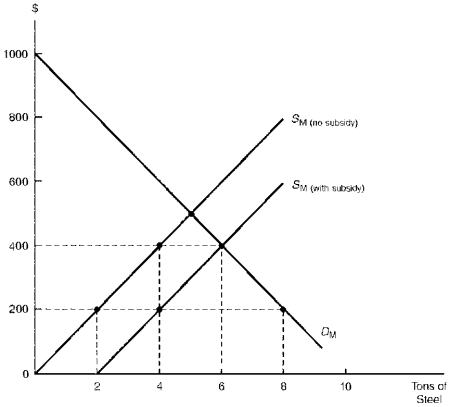
-Referring to Figure 5.1, suppose the Mexican government imposes an import quota equal to 2 tons of steel. If the Mexican government auctions import licenses to the highest foreign bidder, the welfare loss of the quota to Mexico equals:
A) $200
B) $400
C) $600
D) $800
Figure 5.1. Alternative Nontariff Trade Barriers Levied by a "Small" Country
-Referring to Figure 5.1, suppose the Mexican government imposes an import quota equal to 2 tons of steel. If the Mexican government auctions import licenses to the highest foreign bidder, the welfare loss of the quota to Mexico equals:
A) $200
B) $400
C) $600
D) $800
Question
Question
Question
Figure 5.1 illustrates the steel market for Mexico, assumed to be a "small" country that is unable to affect the world price. Suppose the world price of steel is given and constant at $200 per ton. Now suppose the Mexican steel industry is able to obtain trade protection.
Figure 5.1. Alternative Nontariff Trade Barriers Levied by a "Small" Country
Consider Figure 5.1. Suppose the Mexican government provides a subsidy of $200 per ton to its steel producers, as indicated by the supply schedule SM (with subsidy). The overall deadweight welfare loss to Mexico equals:
A) $200
B) $400
C) $600
D) $800
Figure 5.1. Alternative Nontariff Trade Barriers Levied by a "Small" Country
Consider Figure 5.1. Suppose the Mexican government provides a subsidy of $200 per ton to its steel producers, as indicated by the supply schedule SM (with subsidy). The overall deadweight welfare loss to Mexico equals:
A) $200
B) $400
C) $600
D) $800
Question
Question
Figure 5.1 illustrates the steel market for Mexico, assumed to be a "small" country that is unable to affect the world price. Suppose the world price of steel is given and constant at $200 per ton. Now suppose the Mexican steel industry is able to obtain trade protection.
Figure 5.1. Alternative Nontariff Trade Barriers Levied by a "Small" Country
Consider Figure 5.1. With free trade, Mexico's consumer surplus and producer surplus respectively equal:
A) $2000 and $1200
B) $3200 and $200
C) $3600 and $800
D) $4000 and $600
Figure 5.1. Alternative Nontariff Trade Barriers Levied by a "Small" Country
Consider Figure 5.1. With free trade, Mexico's consumer surplus and producer surplus respectively equal:
A) $2000 and $1200
B) $3200 and $200
C) $3600 and $800
D) $4000 and $600
Question
Figure 5.1 illustrates the steel market for Mexico, assumed to be a "small" country that is unable to affect the world price. Suppose the world price of steel is given and constant at $200 per ton. Now suppose the Mexican steel industry is able to obtain trade protection.
Figure 5.1. Alternative Nontariff Trade Barriers Levied by a "Small" Country
Consider Figure 5.1. Suppose instead that the Mexican government provides a subsidy of $200 per ton to its steel producers, as indicated by the supply schedule SM (with subsidy). As a result of the subsidy, the welfare loss to Mexico due to inefficient domestic production equals:
A) $200
B) $400
C) $600
D) $800
Figure 5.1. Alternative Nontariff Trade Barriers Levied by a "Small" Country
Consider Figure 5.1. Suppose instead that the Mexican government provides a subsidy of $200 per ton to its steel producers, as indicated by the supply schedule SM (with subsidy). As a result of the subsidy, the welfare loss to Mexico due to inefficient domestic production equals:
A) $200
B) $400
C) $600
D) $800
Question
Question
Question
Figure 5.1 illustrates the steel market for Mexico, assumed to be a "small" country that is unable to affect the world price. Suppose the world price of steel is given and constant at $200 per ton. Now suppose the Mexican steel industry is able to obtain trade protection.
Figure 5.1. Alternative Nontariff Trade Barriers Levied by a "Small" Country
Consider Figure 5.1. Suppose the Mexican government provides a subsidy of $200 per ton to its steel producers, as indicated by the supply schedule SM (with subsidy). The quantity of imports equals:
A) 1 ton
B) 2 tons
C) 3 tons
D) 4 tons
Figure 5.1. Alternative Nontariff Trade Barriers Levied by a "Small" Country
Consider Figure 5.1. Suppose the Mexican government provides a subsidy of $200 per ton to its steel producers, as indicated by the supply schedule SM (with subsidy). The quantity of imports equals:
A) 1 ton
B) 2 tons
C) 3 tons
D) 4 tons
Question
Question
Figure 5.1 illustrates the steel market for Mexico, assumed to be a "small" country that is unable to affect the world price. Suppose the world price of steel is given and constant at $200 per ton. Now suppose the Mexican steel industry is able to obtain trade protection.
Figure 5.1. Alternative Nontariff Trade Barriers Levied by a "Small" Country
Referring to Figure 5.1, suppose the Mexican government imposes an import quota equal to 2 tons of steel. If Mexican steel importers behave as monopoly buyers and foreign exporters behave as competitive sellers, the overall welfare loss of the quota to Mexico equals:
A) $200
B) $400
C) $600
D) $800
Figure 5.1. Alternative Nontariff Trade Barriers Levied by a "Small" Country
Referring to Figure 5.1, suppose the Mexican government imposes an import quota equal to 2 tons of steel. If Mexican steel importers behave as monopoly buyers and foreign exporters behave as competitive sellers, the overall welfare loss of the quota to Mexico equals:
A) $200
B) $400
C) $600
D) $800
Question
Figure 5.1 illustrates the steel market for Mexico, assumed to be a "small" country that is unable to affect the world price. Suppose the world price of steel is given and constant at $200 per ton. Now suppose the Mexican steel industry is able to obtain trade protection.
Figure 5.1. Alternative Nontariff Trade Barriers Levied by a "Small" Country
Consider Figure 5.1. With free trade, the quantity of steel imported by Mexico equals:
A) 2 tons
B) 4 tons
C) 6 tons
D) 8 tons
Figure 5.1. Alternative Nontariff Trade Barriers Levied by a "Small" Country
Consider Figure 5.1. With free trade, the quantity of steel imported by Mexico equals:
A) 2 tons
B) 4 tons
C) 6 tons
D) 8 tons
Question
Question
Figure 5.1 illustrates the steel market for Mexico, assumed to be a "small" country that is unable to affect the world price. Suppose the world price of steel is given and constant at $200 per ton. Now suppose the Mexican steel industry is able to obtain trade protection.
Figure 5.1. Alternative Nontariff Trade Barriers Levied by a "Small" Country
-Consider Figure 5.1. Suppose the rest of the world voluntarily agrees to reduce steel shipments to Mexico vis-a-vis an export quota equal to 2 tons. Assuming Mexican importers behave as competitive buyers while foreign exporters behave as monopoly sellers, the welfare loss of the quota to Mexico is:
A) $200
B) $400
C) $600
D) $800
Figure 5.1. Alternative Nontariff Trade Barriers Levied by a "Small" Country
-Consider Figure 5.1. Suppose the rest of the world voluntarily agrees to reduce steel shipments to Mexico vis-a-vis an export quota equal to 2 tons. Assuming Mexican importers behave as competitive buyers while foreign exporters behave as monopoly sellers, the welfare loss of the quota to Mexico is:
A) $200
B) $400
C) $600
D) $800
Question
Figure 5.1 illustrates the steel market for Mexico, assumed to be a "small" country that is unable to affect the world price. Suppose the world price of steel is given and constant at $200 per ton. Now suppose the Mexican steel industry is able to obtain trade protection.
Figure 5.1. Alternative Nontariff Trade Barriers Levied by a "Small" Country
Consider Figure 5.1. Suppose the Mexican government provides a subsidy of $200 per ton to its steel producers, as indicated by the supply schedule SM (with subsidy). The total cost of the subsidy to the Mexican government equals:
A) $200
B) $400
C) $600
D) $800
Figure 5.1. Alternative Nontariff Trade Barriers Levied by a "Small" Country
Consider Figure 5.1. Suppose the Mexican government provides a subsidy of $200 per ton to its steel producers, as indicated by the supply schedule SM (with subsidy). The total cost of the subsidy to the Mexican government equals:
A) $200
B) $400
C) $600
D) $800
Question
Figure 5.1 illustrates the steel market for Mexico, assumed to be a "small" country that is unable to affect the world price. Suppose the world price of steel is given and constant at $200 per ton. Now suppose the Mexican steel industry is able to obtain trade protection.
Figure 5.1. Alternative Nontariff Trade Barriers Levied by a "Small" Country
Referring to Figure 5.1, suppose the Mexican government imposes an import quota equal to 2 tons of steel. If foreign exporters behave as monopoly sellers, and Mexican importers behave as competitive buyers, the overall welfare loss of the quota to Mexico equals:
A) $200
B) $400
C) $600
D) $800
Figure 5.1. Alternative Nontariff Trade Barriers Levied by a "Small" Country
Referring to Figure 5.1, suppose the Mexican government imposes an import quota equal to 2 tons of steel. If foreign exporters behave as monopoly sellers, and Mexican importers behave as competitive buyers, the overall welfare loss of the quota to Mexico equals:
A) $200
B) $400
C) $600
D) $800
Question
Figure 5.1 illustrates the steel market for Mexico, assumed to be a "small" country that is unable to affect the world price. Suppose the world price of steel is given and constant at $200 per ton. Now suppose the Mexican steel industry is able to obtain trade protection.
Figure 5.1. Alternative Nontariff Trade Barriers Levied by a "Small" Country
Consider Figure 5.1. Suppose the Mexican government provides a subsidy of $200 per ton to its steel producers, as indicated by the supply schedule SM (with subsidy). As a result of the subsidy Mexican steel producers gain ____ of producer surplus.
A) $200
B) $400
C) $600
D) $800
Figure 5.1. Alternative Nontariff Trade Barriers Levied by a "Small" Country
Consider Figure 5.1. Suppose the Mexican government provides a subsidy of $200 per ton to its steel producers, as indicated by the supply schedule SM (with subsidy). As a result of the subsidy Mexican steel producers gain ____ of producer surplus.
A) $200
B) $400
C) $600
D) $800
Question
Question
Question
Figure 5.2 illustrates the revenue and cost conditions of ABC Inc. which sells calculators in Canada and France.
Figure 5.2. International Dumping
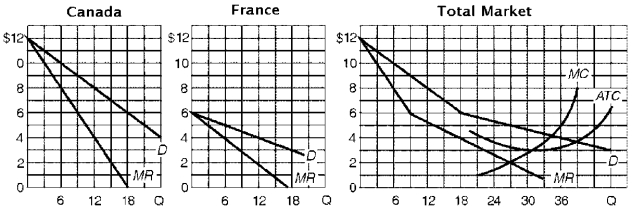
Consider Figure 5.2. With international dumping, ABC Inc. sells ____ calculators to Canadian buyers at a price of $____ and ____ calculators to French buyers at a price of $____.
A) 15, $4, 12, $7
B) 15, $7, 12, $4
C) 9, $5, 15, $6
D) 9, $6, 15, $5
Figure 5.2. International Dumping
Consider Figure 5.2. With international dumping, ABC Inc. sells ____ calculators to Canadian buyers at a price of $____ and ____ calculators to French buyers at a price of $____.
A) 15, $4, 12, $7
B) 15, $7, 12, $4
C) 9, $5, 15, $6
D) 9, $6, 15, $5
Question
Figure 5.1 illustrates the steel market for Mexico, assumed to be a "small" country that is unable to affect the world price. Suppose the world price of steel is given and constant at $200 per ton. Now suppose the Mexican steel industry is able to obtain trade protection.
Figure 5.1. Alternative Nontariff Trade Barriers Levied by a "Small" Country
Consider Figure 5.1. Suppose the rest of the world voluntarily agrees to reduce steel shipments to Mexico vis-a-vis an export quota equal to 2 tons. Assuming Mexican importers behave as monopoly buyers while foreign exporters behave as competitive sellers, the overall welfare loss of the quota to Mexico is:
A) $200
B) $400
C) $600
D) $800
Figure 5.1. Alternative Nontariff Trade Barriers Levied by a "Small" Country
Consider Figure 5.1. Suppose the rest of the world voluntarily agrees to reduce steel shipments to Mexico vis-a-vis an export quota equal to 2 tons. Assuming Mexican importers behave as monopoly buyers while foreign exporters behave as competitive sellers, the overall welfare loss of the quota to Mexico is:
A) $200
B) $400
C) $600
D) $800
Question
Figure 5.3 illustrates the apple market for Sweden, assumed to be a "small" country that is unable to affect the world price. SSweden is the domestic supply and DSweden is the domestic demand. SSweden+Quota is Sweden's supply schedule with an import quota.
Figure 5.3. Sweden's Apple Market
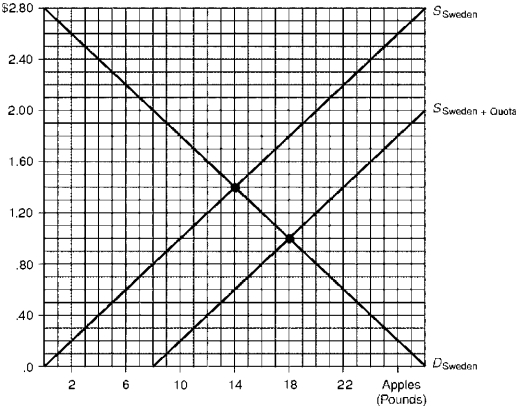
Consider Figure 5.3. The quota leads to a deadweight welfare loss for Sweden of an amount equaling:
A) $0.80
B) $1.60
C) $2.40
D) $3.20
Figure 5.3. Sweden's Apple Market
Consider Figure 5.3. The quota leads to a deadweight welfare loss for Sweden of an amount equaling:
A) $0.80
B) $1.60
C) $2.40
D) $3.20
Question
Figure 5.3 illustrates the apple market for Sweden, assumed to be a "small" country that is unable to affect the world price. SSweden is the domestic supply and DSweden is the domestic demand. SSweden+Quota is Sweden's supply schedule with an import quota.
Figure 5.3. Sweden's Apple Market
Consider Figure 5.3. If SSweden+Quota represents the supply schedule after a quota is levied, Sweden's imports will equal:
A) 6 apples
B) 8 apples
C) 10 apples
D) 12 apples
Figure 5.3. Sweden's Apple Market
Consider Figure 5.3. If SSweden+Quota represents the supply schedule after a quota is levied, Sweden's imports will equal:
A) 6 apples
B) 8 apples
C) 10 apples
D) 12 apples
Question
Figure 5.4 illustrates the calculator market for Venezuela, assumed to be a "small" country that is unable to affect the world price. SVenezuela is the domestic supply schedule and DVenezuela is the domestic demand schedule.
Figure 5.4. Venezuelan Calculator Market
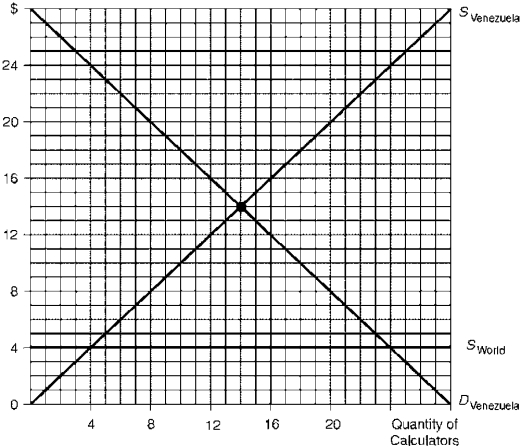
Consider Figure 5.4. The cost of the production subsidy to the Venezuelan government totals:
A) $32
B) $40
C) $48
D) $54
Figure 5.4. Venezuelan Calculator Market
Consider Figure 5.4. The cost of the production subsidy to the Venezuelan government totals:
A) $32
B) $40
C) $48
D) $54
Question
Figure 5.3 illustrates the apple market for Sweden, assumed to be a "small" country that is unable to affect the world price. SSweden is the domestic supply and DSweden is the domestic demand. SSweden+Quota is Sweden's supply schedule with an import quota.
Figure 5.3. Sweden's Apple Market
Consider Figure 5.3. As a result of the quota, Sweden's consumer surplus:
A) Increases by $6
B) Increases by $8
C) Decreases by $6
D) Decreases by $8
Figure 5.3. Sweden's Apple Market
Consider Figure 5.3. As a result of the quota, Sweden's consumer surplus:
A) Increases by $6
B) Increases by $8
C) Decreases by $6
D) Decreases by $8
Question
Figure 5.3 illustrates the apple market for Sweden, assumed to be a "small" country that is unable to affect the world price. SSweden is the domestic supply and DSweden is the domestic demand. SSweden+Quota is Sweden's supply schedule with an import quota.
Figure 5.3. Sweden's Apple Market
Consider Figure 5.3. In the absence of trade, Sweden's equilibrium price and quantity of apples would be:
A) $0.60 and 22 pounds
B) $0.60 and 14 pounds
C) $1.00 and 18 pounds
D) $1.40 and 14 pounds
Figure 5.3. Sweden's Apple Market
Consider Figure 5.3. In the absence of trade, Sweden's equilibrium price and quantity of apples would be:
A) $0.60 and 22 pounds
B) $0.60 and 14 pounds
C) $1.00 and 18 pounds
D) $1.40 and 14 pounds
Question
Figure 5.2 illustrates the revenue and cost conditions of ABC Inc. which sells calculators in Canada and France.
Figure 5.2. International Dumping
Referring to Figure 5.2, consider if ABC Inc. sells 27 calculators at a price of $5 each, realizing profits totaling $54. Of this quantity, ABC Inc. sells ____ calculators in Canada and realizes revenues totaling $____; the firm sells ____ calculators in France and realizes revenues totaling $____.
A) 15, $35, 9, $45
B) 15, $45, 9, $35
C) 21, $105, 6, $30
D) 21, $30, 6, $105
Figure 5.2. International Dumping
Referring to Figure 5.2, consider if ABC Inc. sells 27 calculators at a price of $5 each, realizing profits totaling $54. Of this quantity, ABC Inc. sells ____ calculators in Canada and realizes revenues totaling $____; the firm sells ____ calculators in France and realizes revenues totaling $____.
A) 15, $35, 9, $45
B) 15, $45, 9, $35
C) 21, $105, 6, $30
D) 21, $30, 6, $105
Question
Figure 5.3 illustrates the apple market for Sweden, assumed to be a "small" country that is unable to affect the world price. SSweden is the domestic supply and DSweden is the domestic demand. SSweden+Quota is Sweden's supply schedule with an import quota.
Figure 5.3. Sweden's Apple Market
Consider Figure 5.3. At the free-trade price of $0.60 per pound, Sweden's consumer surplus totals $____ and producer surplus totals $____.
A) $10.80, $2.40
B) $14.60, $3.90
C) $24.20, $1.80
D) $32.40, $2.30
Figure 5.3. Sweden's Apple Market
Consider Figure 5.3. At the free-trade price of $0.60 per pound, Sweden's consumer surplus totals $____ and producer surplus totals $____.
A) $10.80, $2.40
B) $14.60, $3.90
C) $24.20, $1.80
D) $32.40, $2.30
Question
Figure 5.3 illustrates the apple market for Sweden, assumed to be a "small" country that is unable to affect the world price. SSweden is the domestic supply and DSweden is the domestic demand. SSweden+Quota is Sweden's supply schedule with an import quota.
Figure 5.3. Sweden's Apple Market
Consider Figure 5.3. Suppose the rest of the world can supply apples to Sweden at a price of $0.60 per pound. With free trade, Sweden produces ____ pounds of apples and imports ____ pounds of apples.
A) 10, 8
B) 10, 18
C) 6, 22
D) 6, 16
Figure 5.3. Sweden's Apple Market
Consider Figure 5.3. Suppose the rest of the world can supply apples to Sweden at a price of $0.60 per pound. With free trade, Sweden produces ____ pounds of apples and imports ____ pounds of apples.
A) 10, 8
B) 10, 18
C) 6, 22
D) 6, 16
Question
Figure 5.3 illustrates the apple market for Sweden, assumed to be a "small" country that is unable to affect the world price. SSweden is the domestic supply and DSweden is the domestic demand. SSweden+Quota is Sweden's supply schedule with an import quota.
Figure 5.3. Sweden's Apple Market
Consider Figure 5.3. After the quota is levied, the price of apples in Sweden will equal:
A) $0.60 per pound
B) $1.00 per pound
C) $1.40 per pound
D) $1.80 per pound
Figure 5.3. Sweden's Apple Market
Consider Figure 5.3. After the quota is levied, the price of apples in Sweden will equal:
A) $0.60 per pound
B) $1.00 per pound
C) $1.40 per pound
D) $1.80 per pound
Question
Figure 5.4 illustrates the calculator market for Venezuela, assumed to be a "small" country that is unable to affect the world price. SVenezuela is the domestic supply schedule and DVenezuela is the domestic demand schedule.
Figure 5.4. Venezuelan Calculator Market
Consider Figure 5.4. Assume the Venezuelan government grants its manufacturers a production subsidy of $4 per calculator. After the subsidy is granted, Venezuelan imports total:
A) 8 calculators
B) 12 calculators
C) 16 calculators
D) 20 calculators
Figure 5.4. Venezuelan Calculator Market
Consider Figure 5.4. Assume the Venezuelan government grants its manufacturers a production subsidy of $4 per calculator. After the subsidy is granted, Venezuelan imports total:
A) 8 calculators
B) 12 calculators
C) 16 calculators
D) 20 calculators
Question
Figure 5.4 illustrates the calculator market for Venezuela, assumed to be a "small" country that is unable to affect the world price. SVenezuela is the domestic supply schedule and DVenezuela is the domestic demand schedule.
Figure 5.4. Venezuelan Calculator Market
Consider Figure 5.4. The increase in Venezuelan producer surplus under the production subsidy totals:
A) $16
B) $20
C) $24
D) $32
Figure 5.4. Venezuelan Calculator Market
Consider Figure 5.4. The increase in Venezuelan producer surplus under the production subsidy totals:
A) $16
B) $20
C) $24
D) $32
Question
Figure 5.2 illustrates the revenue and cost conditions of ABC Inc. which sells calculators in Canada and France.
Figure 5.2. International Dumping
Consider Figure 5.2. Compared with the total revenue and total profit that ABC Inc. realizes in the absence of dumping, with dumping the firm attains a:
A) Fall in revenue of $18; fall in profits of $15
B) Fall in revenue of $18, fall in profits of $18
C) Rise in revenue of $18, rise in profits of $15
D) Rise in revenue of $18, rise in profits of $18
Figure 5.2. International Dumping
Consider Figure 5.2. Compared with the total revenue and total profit that ABC Inc. realizes in the absence of dumping, with dumping the firm attains a:
A) Fall in revenue of $18; fall in profits of $15
B) Fall in revenue of $18, fall in profits of $18
C) Rise in revenue of $18, rise in profits of $15
D) Rise in revenue of $18, rise in profits of $18
Question
Figure 5.2 illustrates the revenue and cost conditions of ABC Inc. which sells calculators in Canada and France.
Figure 5.2. International Dumping
Consider Figure 5.2. In the absence of international dumping, ABC Inc. maximizes profits by selling ____ calculators at a price of $____; the firm realizes profits totaling $____.
A) 27, $5, $54
B) 27, $5, $36
C) 24, $4, $46
D) 24, $4, $28
Figure 5.2. International Dumping
Consider Figure 5.2. In the absence of international dumping, ABC Inc. maximizes profits by selling ____ calculators at a price of $____; the firm realizes profits totaling $____.
A) 27, $5, $54
B) 27, $5, $36
C) 24, $4, $46
D) 24, $4, $28
Question
Figure 5.3 illustrates the apple market for Sweden, assumed to be a "small" country that is unable to affect the world price. SSweden is the domestic supply and DSweden is the domestic demand. SSweden+Quota is Sweden's supply schedule with an import quota.
Figure 5.3. Sweden's Apple Market
Consider Figure 5.3. Assume that Swedish import companies behave as competitive buyers while foreign export companies behave as a monopoly seller. Compared to free trade, Sweden's import quota results in domestic welfare:
A) Gains totaling $3.20
B) Gains totaling $4.80
C) Losses totaling $3.20
D) Losses totaling $4.80
Figure 5.3. Sweden's Apple Market
Consider Figure 5.3. Assume that Swedish import companies behave as competitive buyers while foreign export companies behave as a monopoly seller. Compared to free trade, Sweden's import quota results in domestic welfare:
A) Gains totaling $3.20
B) Gains totaling $4.80
C) Losses totaling $3.20
D) Losses totaling $4.80
Question
Figure 5.3 illustrates the apple market for Sweden, assumed to be a "small" country that is unable to affect the world price. SSweden is the domestic supply and DSweden is the domestic demand. SSweden+Quota is Sweden's supply schedule with an import quota.
Figure 5.3. Sweden's Apple Market
Consider Figure 5.3. The quota's revenue effect equals:
A) $1.60
B) $2.40
C) $3.20
D) $4.00
Figure 5.3. Sweden's Apple Market
Consider Figure 5.3. The quota's revenue effect equals:
A) $1.60
B) $2.40
C) $3.20
D) $4.00
Question
Figure 5.4 illustrates the calculator market for Venezuela, assumed to be a "small" country that is unable to affect the world price. SVenezuela is the domestic supply schedule and DVenezuela is the domestic demand schedule.
Figure 5.4. Venezuelan Calculator Market
Consider Figure 5.4. Suppose the rest of the world supplies calculators to Venezuela at a price of $4 each. With free trade, Venezuelan imports total:
A) 8 calculators
B) 16 calculators
C) 20 calculators
D) 24 calculators
Figure 5.4. Venezuelan Calculator Market
Consider Figure 5.4. Suppose the rest of the world supplies calculators to Venezuela at a price of $4 each. With free trade, Venezuelan imports total:
A) 8 calculators
B) 16 calculators
C) 20 calculators
D) 24 calculators
Question
Figure 5.3 illustrates the apple market for Sweden, assumed to be a "small" country that is unable to affect the world price. SSweden is the domestic supply and DSweden is the domestic demand. SSweden+Quota is Sweden's supply schedule with an import quota.
Figure 5.3. Sweden's Apple Market
Consider Figure 5.3. Assume that Swedish import companies behave as a monopoly buyer while foreign export companies behave as competitive sellers. Compared to free trade, Sweden's import quota results in domestic welfare:
A) Gains totaling $1.60
B) Gains totaling $3.20
C) Losses totaling $1.60
D) Losses totaling $3.20
Figure 5.3. Sweden's Apple Market
Consider Figure 5.3. Assume that Swedish import companies behave as a monopoly buyer while foreign export companies behave as competitive sellers. Compared to free trade, Sweden's import quota results in domestic welfare:
A) Gains totaling $1.60
B) Gains totaling $3.20
C) Losses totaling $1.60
D) Losses totaling $3.20
Question
Figure 5.3 illustrates the apple market for Sweden, assumed to be a "small" country that is unable to affect the world price. SSweden is the domestic supply and DSweden is the domestic demand. SSweden+Quota is Sweden's supply schedule with an import quota.
Figure 5.3. Sweden's Apple Market
Consider Figure 5.3. If the Swedish government auctions import licenses to the highest bidder in a competitive market, it could realize revenues of up to:
A) $3.20
B) $4.00
C) $4.80
D) $5.60
Figure 5.3. Sweden's Apple Market
Consider Figure 5.3. If the Swedish government auctions import licenses to the highest bidder in a competitive market, it could realize revenues of up to:
A) $3.20
B) $4.00
C) $4.80
D) $5.60
Question
Figure 5.4 illustrates the calculator market for Venezuela, assumed to be a "small" country that is unable to affect the world price. SVenezuela is the domestic supply schedule and DVenezuela is the domestic demand schedule.
Figure 5.4. Venezuelan Calculator Market
Consider Figure 5.4. The production subsidy results in an overall welfare loss for Venezuela totaling:
A) $8
B) $12
C) $16
D) $20
Figure 5.4. Venezuelan Calculator Market
Consider Figure 5.4. The production subsidy results in an overall welfare loss for Venezuela totaling:
A) $8
B) $12
C) $16
D) $20
Question
Question
Question
Question
Question
Question
Question
Figure 5.6 Domestice Supply and demand for Wine - US
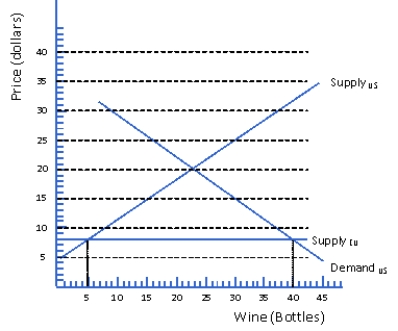
Consider Figure 5.6. In the global market for wine, the EU is willing to supply as much wine as the US demands at $8 per bottle. IF the US imposes a quota of 15 bottles of wine, how much wine will US consumers demand, how much wine will US producers produce and how much wine will be imported?
A) 30 bottles, 20 bottles, 10 bottles
B) 40 bottles, 25 bottles, 15 bottles
C) 30 bottles, 30 bottles, 0 bottles
D) 30 bottles, 15 bottles, 15 bottles
Consider Figure 5.6. In the global market for wine, the EU is willing to supply as much wine as the US demands at $8 per bottle. IF the US imposes a quota of 15 bottles of wine, how much wine will US consumers demand, how much wine will US producers produce and how much wine will be imported?
A) 30 bottles, 20 bottles, 10 bottles
B) 40 bottles, 25 bottles, 15 bottles
C) 30 bottles, 30 bottles, 0 bottles
D) 30 bottles, 15 bottles, 15 bottles
Question
Question
Question
Question
Question
Question
Question
Figure 5.6 Domestice Supply and demand for Wine - US
Consider Figure 5.6. In the global market for wine, the EU is willing to supply as much wine as the US demands at $8 per bottle. What will happen to the price of a bottle of wine in the US if a quota of 15 bottles of wine is imposed?
A) increase to $15
B) increase to $10
C) stay the same at $8
D) decrease to $5
Consider Figure 5.6. In the global market for wine, the EU is willing to supply as much wine as the US demands at $8 per bottle. What will happen to the price of a bottle of wine in the US if a quota of 15 bottles of wine is imposed?
A) increase to $15
B) increase to $10
C) stay the same at $8
D) decrease to $5
Question
Figure 5.6 Domestice Supply and demand for Wine - US
Consider Figure 5.6. In the global market for wine, the EU is willing to supply as much wine as the US demands at $8 per bottle. IF the US imposes a quota of 15 bottles of wine what will happen to consumer surplus?
A) decreases by $210
B) decreases by $245
C) stays the same
D) increases by $70
Consider Figure 5.6. In the global market for wine, the EU is willing to supply as much wine as the US demands at $8 per bottle. IF the US imposes a quota of 15 bottles of wine what will happen to consumer surplus?
A) decreases by $210
B) decreases by $245
C) stays the same
D) increases by $70
Question
Figure 5.6 Domestice Supply and demand for Wine - US
Consider Figure 5.6. In the global market for wine, the EU is willing to supply as much wine as the US demands at $8 per bottle. How much will the US produce and import in these circumstances?
A) 5 bottles, 40 bottles
B) 40 bottles, 0 bottles
C) 5 bottles, 35 bottles
D) 5 bottles, 0 bottles
Consider Figure 5.6. In the global market for wine, the EU is willing to supply as much wine as the US demands at $8 per bottle. How much will the US produce and import in these circumstances?
A) 5 bottles, 40 bottles
B) 40 bottles, 0 bottles
C) 5 bottles, 35 bottles
D) 5 bottles, 0 bottles
Question
Question
Figure 5.6 Domestice Supply and demand for Wine - US
Consider Figure 5.6. In the global market for wine, the EU is willing to supply as much wine as the US demands at $8 per bottle. If the US imposes a quota of 15 bottles of wine , how much revenue will the US government collect?
A) 0
B) $35
C) $70
D) $105
Consider Figure 5.6. In the global market for wine, the EU is willing to supply as much wine as the US demands at $8 per bottle. If the US imposes a quota of 15 bottles of wine , how much revenue will the US government collect?
A) 0
B) $35
C) $70
D) $105
Question

Unlock Deck
Sign up to unlock the cards in this deck!
Unlock Deck
Unlock Deck
1/133

Play

Full screen (f)
Deck 5: Nontariff Trade Barriers
1
The imposition of a domestic content requirement by the United States would cause consumer surplus for Americans to:
A) Rise
B) Fall
C) Remain unchanged
D) None of the above
A) Rise
B) Fall
C) Remain unchanged
D) None of the above
B
2
Assume the U.S. has a competitive advantage in producing calculators, while the rest of the world has a competitive advantage in steel. Suppose the U.S. and the rest of the world enter into an agreement to import quotas existing levels on calculators and steel. Which of the following would likely occur for the U.S.? Rising levels of:
A) Consumer surplus for American buyers of steel
B) Producer surplus for American steelmakers
C) Production in the American calculator industry
D) Producer surplus for American calculator producers
A) Consumer surplus for American buyers of steel
B) Producer surplus for American steelmakers
C) Production in the American calculator industry
D) Producer surplus for American calculator producers
Producer surplus for American steelmakers
3
Which of the following refers to a market-sharing pact negotiated by trading partners to moderate the intensity of international competition?
A) Orderly marketing agreement
B) Local content requirements
C) Import quota
D) Trigger price mechanism
A) Orderly marketing agreement
B) Local content requirements
C) Import quota
D) Trigger price mechanism
A
4
Compared to an import quota, an equivalent tariff may provide a certain amount of protection for home producers since:
A) A tariff has no deadweight loss in terms of production and consumption
B) Foreign firms may absorb the tariff by offering exports at lower prices
C) Tariffs are effective only if home demand is perfectly elastic
D) Quotas do not result in increases in the price of the imported good
A) A tariff has no deadweight loss in terms of production and consumption
B) Foreign firms may absorb the tariff by offering exports at lower prices
C) Tariffs are effective only if home demand is perfectly elastic
D) Quotas do not result in increases in the price of the imported good
Unlock Deck
Unlock for access to all 133 flashcards in this deck.
Unlock Deck
k this deck
5
If a tariff and an import quota lead to equivalent increases in the domestic price of steel, then:
A) The quota results in efficiency reductions but the tariff does not
B) The tariff results in efficiency reductions but the quota does not
C) They have identical impacts on how much is produced and consumed
D) They have identical impacts on how income is distributed
A) The quota results in efficiency reductions but the tariff does not
B) The tariff results in efficiency reductions but the quota does not
C) They have identical impacts on how much is produced and consumed
D) They have identical impacts on how income is distributed
Unlock Deck
Unlock for access to all 133 flashcards in this deck.
Unlock Deck
k this deck
6
Suppose the United States and Japan enter into a voluntary export agreement in which Japan imposes an export quota on its automakers. The share of the export quota's "revenue effect" would tend to be captured by:
A) The U.S. government
B) Japanese automakers
C) American auto consumers
D) American autoworkers
A) The U.S. government
B) Japanese automakers
C) American auto consumers
D) American autoworkers
Unlock Deck
Unlock for access to all 133 flashcards in this deck.
Unlock Deck
k this deck
7
Empirical studies show that because voluntary export quotas are typically administered by exporting countries, exporters tend to:
A) Raise their export prices, thus capturing much of the quota's revenue effect
B) Lower their export prices, thus losing much of the quota's revenue effect
C) Raise their export prices, thus selling more goods overseas
D) Lower their export prices, thus selling fewer goods overseas
A) Raise their export prices, thus capturing much of the quota's revenue effect
B) Lower their export prices, thus losing much of the quota's revenue effect
C) Raise their export prices, thus selling more goods overseas
D) Lower their export prices, thus selling fewer goods overseas
Unlock Deck
Unlock for access to all 133 flashcards in this deck.
Unlock Deck
k this deck
8
A producer successfully practicing international dumping would charge:
A) A relatively higher price in the more inelastic market
B) A relatively higher price in the more elastic market
C) The same price in all markets, regardless of their elasticities
D) Different prices in all markets, regardless of their elasticities
A) A relatively higher price in the more inelastic market
B) A relatively higher price in the more elastic market
C) The same price in all markets, regardless of their elasticities
D) Different prices in all markets, regardless of their elasticities
Unlock Deck
Unlock for access to all 133 flashcards in this deck.
Unlock Deck
k this deck
9
The practice of Canadian firms dumping their products in Sweden poses a problem for economic policymakers since dumping tends to:
A) Favor Swedish consumers over Canadian consumers
B) Favor Swedish producers over Canadian producers
C) Become widespread as firms operate at full productive capacity
D) Result in firms charging prices above the total costs of production
A) Favor Swedish consumers over Canadian consumers
B) Favor Swedish producers over Canadian producers
C) Become widespread as firms operate at full productive capacity
D) Result in firms charging prices above the total costs of production
Unlock Deck
Unlock for access to all 133 flashcards in this deck.
Unlock Deck
k this deck
10
Suppose the government grants a subsidy to domestic producers of an import-competing good. The subsidy tends to result in deadweight losses for the domestic economy in the form of the:
A) Consumption effect
B) Redistribution effect
C) Revenue effect
D) Protective effect
A) Consumption effect
B) Redistribution effect
C) Revenue effect
D) Protective effect
Unlock Deck
Unlock for access to all 133 flashcards in this deck.
Unlock Deck
k this deck
11
The United Auto Workers union attempted to win the approval of legislation that would moderate the practice of foreign sourcing on the part of American auto manufacturers. Which of the following best represents this legislation?
A) Voluntary export quotas
B) Trigger price mechanism
C) Tariff quotas
D) Local content laws
A) Voluntary export quotas
B) Trigger price mechanism
C) Tariff quotas
D) Local content laws
Unlock Deck
Unlock for access to all 133 flashcards in this deck.
Unlock Deck
k this deck
12
A firm that faces problems of falling sales and excess productive capacity might resort to international dumping if it:
A) Can charge higher prices in markets that are elastic to price changes
B) Earns revenues on foreign sales that at least cover variable costs
C) Can sell at that price where domestic and foreign demand elasticities equate
D) Is able to force foreign prices below marginal production costs
A) Can charge higher prices in markets that are elastic to price changes
B) Earns revenues on foreign sales that at least cover variable costs
C) Can sell at that price where domestic and foreign demand elasticities equate
D) Is able to force foreign prices below marginal production costs
Unlock Deck
Unlock for access to all 133 flashcards in this deck.
Unlock Deck
k this deck
13
A main factor behind the president's decision to extend relief to steel firms in the form of trigger prices was that:
A) Dumping complaints can be time consuming and expensive to implement
B) The Tokyo Round outlawed the granting of subsidies to steel firms
C) Trigger prices involve zero deadweight welfare loss for the economy
D) Orderly marketing agreements were too costly to administer
A) Dumping complaints can be time consuming and expensive to implement
B) The Tokyo Round outlawed the granting of subsidies to steel firms
C) Trigger prices involve zero deadweight welfare loss for the economy
D) Orderly marketing agreements were too costly to administer
Unlock Deck
Unlock for access to all 133 flashcards in this deck.
Unlock Deck
k this deck
14
Which trade restriction stipulates the percentage of a product's total value that must be produced domestically in order for that product to be sold domestically?
A) Import quota
B) Orderly marketing agreement
C) Local content requirement
D) Government procurement policy
A) Import quota
B) Orderly marketing agreement
C) Local content requirement
D) Government procurement policy
Unlock Deck
Unlock for access to all 133 flashcards in this deck.
Unlock Deck
k this deck
15
Concerning the restrictive impact of an import quota, assume there occurs an in the domestic demand for the import product. As long as the quota falls short of what would be imported under free market conditions, the economy's adjustment to the in demand would take the form of:
A) A decrease in domestic production of the import good
B) An increase in the amount of the good being imported
C) An increase in the domestic price of the import good
D) A decrease in domestic consumption of the import good
A) A decrease in domestic production of the import good
B) An increase in the amount of the good being imported
C) An increase in the domestic price of the import good
D) A decrease in domestic consumption of the import good
Unlock Deck
Unlock for access to all 133 flashcards in this deck.
Unlock Deck
k this deck
16
Tariffs and quotas on imports tend to involve larger sacrifices in national welfare than would occur under domestic subsidies. This is because, domestic subsidies, import tariffs and quotas:
A) Permit less efficient home production
B) Distort choices for domestic consumers
C) Result in higher tax rates for domestic residents
D) Redistribute revenue from domestic producers to consumers
A) Permit less efficient home production
B) Distort choices for domestic consumers
C) Result in higher tax rates for domestic residents
D) Redistribute revenue from domestic producers to consumers
Unlock Deck
Unlock for access to all 133 flashcards in this deck.
Unlock Deck
k this deck
17
Suppose the government grants a subsidy to its export firms that permits them to charge prices on goods sold abroad. The export revenue of these firms would if the foreign demand is:
A) Elastic in response to the price reduction
B) Inelastic in response to the price reduction
C) Unit elastic in response to the price reduction
D) None of the above
A) Elastic in response to the price reduction
B) Inelastic in response to the price reduction
C) Unit elastic in response to the price reduction
D) None of the above
Unlock Deck
Unlock for access to all 133 flashcards in this deck.
Unlock Deck
k this deck
18
If a tariff and an import quota lead to equivalent increases in the domestic price of steel, then:
A) The quota results in efficiency reductions but the tariff does not
B) The tariff results in efficiency reductions but the quota does not
C) They have different impacts on how much is produced and consumed
D) They have different impacts on how income is distributed
A) The quota results in efficiency reductions but the tariff does not
B) The tariff results in efficiency reductions but the quota does not
C) They have different impacts on how much is produced and consumed
D) They have different impacts on how income is distributed
Unlock Deck
Unlock for access to all 133 flashcards in this deck.
Unlock Deck
k this deck
19
Domestic content legislation applied to autos would tend to:
A) Support wage levels of American autoworkers
B) Lower auto prices for American autoworkers
C) Encourage American automakers to locate production overseas
D) Increase profits of American auto companies
A) Support wage levels of American autoworkers
B) Lower auto prices for American autoworkers
C) Encourage American automakers to locate production overseas
D) Increase profits of American auto companies
Unlock Deck
Unlock for access to all 133 flashcards in this deck.
Unlock Deck
k this deck
20
Because export subsidies tend to result in domestic exporters charging prices on their goods sold overseas, the home country's:
A) Export revenues will decrease
B) Export revenues will rise
C) Terms of trade will worsen
D) Terms of trade will improve
A) Export revenues will decrease
B) Export revenues will rise
C) Terms of trade will worsen
D) Terms of trade will improve
Unlock Deck
Unlock for access to all 133 flashcards in this deck.
Unlock Deck
k this deck
21
Figure 5.1 illustrates the steel market for Mexico, assumed to be a "small" country that is unable to affect the world price. Suppose the world price of steel is given and constant at $200 per ton. Now suppose the Mexican steel industry is able to obtain trade protection.
Figure 5.1. Alternative Nontariff Trade Barriers Levied by a "Small" Country
-Referring to Figure 5.1, suppose the Mexican government imposes an import quota equal to 2 tons of steel. If the Mexican government auctions import licenses to the highest foreign bidder, the welfare loss of the quota to Mexico equals:
A) $200
B) $400
C) $600
D) $800
Figure 5.1. Alternative Nontariff Trade Barriers Levied by a "Small" Country
-Referring to Figure 5.1, suppose the Mexican government imposes an import quota equal to 2 tons of steel. If the Mexican government auctions import licenses to the highest foreign bidder, the welfare loss of the quota to Mexico equals:
A) $200
B) $400
C) $600
D) $800
Unlock Deck
Unlock for access to all 133 flashcards in this deck.
Unlock Deck
k this deck
22
A specification of a maximum amount of a foreign produced good that will be allowed to enter the country over a given time period is referred to as:
A) A domestic subsidy
B) An export subsidy
C) An import quota
D) An export quota
A) A domestic subsidy
B) An export subsidy
C) An import quota
D) An export quota
Unlock Deck
Unlock for access to all 133 flashcards in this deck.
Unlock Deck
k this deck
23
Export subsidies levied by foreign governments on products in which the United States has a comparative disadvantage:
A) Lower the welfare of all Americans
B) Lead to increases in U.S. consumer surplus
C) Encourage U.S. production of competing goods
D) Encourage U.S. workers to demand higher wages
A) Lower the welfare of all Americans
B) Lead to increases in U.S. consumer surplus
C) Encourage U.S. production of competing goods
D) Encourage U.S. workers to demand higher wages
Unlock Deck
Unlock for access to all 133 flashcards in this deck.
Unlock Deck
k this deck
24
Figure 5.1 illustrates the steel market for Mexico, assumed to be a "small" country that is unable to affect the world price. Suppose the world price of steel is given and constant at $200 per ton. Now suppose the Mexican steel industry is able to obtain trade protection.
Figure 5.1. Alternative Nontariff Trade Barriers Levied by a "Small" Country
Consider Figure 5.1. Suppose the Mexican government provides a subsidy of $200 per ton to its steel producers, as indicated by the supply schedule SM (with subsidy). The overall deadweight welfare loss to Mexico equals:
A) $200
B) $400
C) $600
D) $800
Figure 5.1. Alternative Nontariff Trade Barriers Levied by a "Small" Country
Consider Figure 5.1. Suppose the Mexican government provides a subsidy of $200 per ton to its steel producers, as indicated by the supply schedule SM (with subsidy). The overall deadweight welfare loss to Mexico equals:
A) $200
B) $400
C) $600
D) $800
Unlock Deck
Unlock for access to all 133 flashcards in this deck.
Unlock Deck
k this deck
25
If import licenses are auctioned off to domestic importers in a competitive market, their scarcity value (revenue effect) accrues to:
A) Foreign corporations
B) Foreign workers
C) Domestic corporations
D) The domestic government
A) Foreign corporations
B) Foreign workers
C) Domestic corporations
D) The domestic government
Unlock Deck
Unlock for access to all 133 flashcards in this deck.
Unlock Deck
k this deck
26
Figure 5.1 illustrates the steel market for Mexico, assumed to be a "small" country that is unable to affect the world price. Suppose the world price of steel is given and constant at $200 per ton. Now suppose the Mexican steel industry is able to obtain trade protection.
Figure 5.1. Alternative Nontariff Trade Barriers Levied by a "Small" Country
Consider Figure 5.1. With free trade, Mexico's consumer surplus and producer surplus respectively equal:
A) $2000 and $1200
B) $3200 and $200
C) $3600 and $800
D) $4000 and $600
Figure 5.1. Alternative Nontariff Trade Barriers Levied by a "Small" Country
Consider Figure 5.1. With free trade, Mexico's consumer surplus and producer surplus respectively equal:
A) $2000 and $1200
B) $3200 and $200
C) $3600 and $800
D) $4000 and $600
Unlock Deck
Unlock for access to all 133 flashcards in this deck.
Unlock Deck
k this deck
27
Figure 5.1 illustrates the steel market for Mexico, assumed to be a "small" country that is unable to affect the world price. Suppose the world price of steel is given and constant at $200 per ton. Now suppose the Mexican steel industry is able to obtain trade protection.
Figure 5.1. Alternative Nontariff Trade Barriers Levied by a "Small" Country
Consider Figure 5.1. Suppose instead that the Mexican government provides a subsidy of $200 per ton to its steel producers, as indicated by the supply schedule SM (with subsidy). As a result of the subsidy, the welfare loss to Mexico due to inefficient domestic production equals:
A) $200
B) $400
C) $600
D) $800
Figure 5.1. Alternative Nontariff Trade Barriers Levied by a "Small" Country
Consider Figure 5.1. Suppose instead that the Mexican government provides a subsidy of $200 per ton to its steel producers, as indicated by the supply schedule SM (with subsidy). As a result of the subsidy, the welfare loss to Mexico due to inefficient domestic production equals:
A) $200
B) $400
C) $600
D) $800
Unlock Deck
Unlock for access to all 133 flashcards in this deck.
Unlock Deck
k this deck
28
In certain industries, Japanese employers do not lay off workers. Therefore, they sometimes have excess supplies of goods that they cannot sell on the home market without lowering prices. To hold down losses, they sell goods in overseas markets at prices well beneath those in Japan. This practice is best referred to as:
A) Orderly marketing
B) Trigger pricing
C) Domestic content pricing
D) Dumping
A) Orderly marketing
B) Trigger pricing
C) Domestic content pricing
D) Dumping
Unlock Deck
Unlock for access to all 133 flashcards in this deck.
Unlock Deck
k this deck
29
Import quotas tend to lead to all of the following except:
A) Domestic producers of the imported good being harmed
B) Domestic consumers of the imported good being harmed
C) Prices increasing in the importing country
D) Prices falling in the exporting country
A) Domestic producers of the imported good being harmed
B) Domestic consumers of the imported good being harmed
C) Prices increasing in the importing country
D) Prices falling in the exporting country
Unlock Deck
Unlock for access to all 133 flashcards in this deck.
Unlock Deck
k this deck
30
Figure 5.1 illustrates the steel market for Mexico, assumed to be a "small" country that is unable to affect the world price. Suppose the world price of steel is given and constant at $200 per ton. Now suppose the Mexican steel industry is able to obtain trade protection.
Figure 5.1. Alternative Nontariff Trade Barriers Levied by a "Small" Country
Consider Figure 5.1. Suppose the Mexican government provides a subsidy of $200 per ton to its steel producers, as indicated by the supply schedule SM (with subsidy). The quantity of imports equals:
A) 1 ton
B) 2 tons
C) 3 tons
D) 4 tons
Figure 5.1. Alternative Nontariff Trade Barriers Levied by a "Small" Country
Consider Figure 5.1. Suppose the Mexican government provides a subsidy of $200 per ton to its steel producers, as indicated by the supply schedule SM (with subsidy). The quantity of imports equals:
A) 1 ton
B) 2 tons
C) 3 tons
D) 4 tons
Unlock Deck
Unlock for access to all 133 flashcards in this deck.
Unlock Deck
k this deck
31
For years the U.S. government levied quotas on inexpensive oil imported from the Middle East. The quotas led to cost increases for U.S. consumers totaling $3 billion for oil products. An apparent justification for this policy was that:
A) U.S. oil companies and workers deserved higher incomes
B) U.S. oil was of superior quality and merited higher prices
C) One should not be too dependent on foreign suppliers of crucial resources
D) The U.S. government needed the quota revenue to balance its budget
A) U.S. oil companies and workers deserved higher incomes
B) U.S. oil was of superior quality and merited higher prices
C) One should not be too dependent on foreign suppliers of crucial resources
D) The U.S. government needed the quota revenue to balance its budget
Unlock Deck
Unlock for access to all 133 flashcards in this deck.
Unlock Deck
k this deck
32
Figure 5.1 illustrates the steel market for Mexico, assumed to be a "small" country that is unable to affect the world price. Suppose the world price of steel is given and constant at $200 per ton. Now suppose the Mexican steel industry is able to obtain trade protection.
Figure 5.1. Alternative Nontariff Trade Barriers Levied by a "Small" Country
Referring to Figure 5.1, suppose the Mexican government imposes an import quota equal to 2 tons of steel. If Mexican steel importers behave as monopoly buyers and foreign exporters behave as competitive sellers, the overall welfare loss of the quota to Mexico equals:
A) $200
B) $400
C) $600
D) $800
Figure 5.1. Alternative Nontariff Trade Barriers Levied by a "Small" Country
Referring to Figure 5.1, suppose the Mexican government imposes an import quota equal to 2 tons of steel. If Mexican steel importers behave as monopoly buyers and foreign exporters behave as competitive sellers, the overall welfare loss of the quota to Mexico equals:
A) $200
B) $400
C) $600
D) $800
Unlock Deck
Unlock for access to all 133 flashcards in this deck.
Unlock Deck
k this deck
33
Figure 5.1 illustrates the steel market for Mexico, assumed to be a "small" country that is unable to affect the world price. Suppose the world price of steel is given and constant at $200 per ton. Now suppose the Mexican steel industry is able to obtain trade protection.
Figure 5.1. Alternative Nontariff Trade Barriers Levied by a "Small" Country
Consider Figure 5.1. With free trade, the quantity of steel imported by Mexico equals:
A) 2 tons
B) 4 tons
C) 6 tons
D) 8 tons
Figure 5.1. Alternative Nontariff Trade Barriers Levied by a "Small" Country
Consider Figure 5.1. With free trade, the quantity of steel imported by Mexico equals:
A) 2 tons
B) 4 tons
C) 6 tons
D) 8 tons
Unlock Deck
Unlock for access to all 133 flashcards in this deck.
Unlock Deck
k this deck
34
To maintain that South Koreans are dumping their VCRs in the United States is to maintain that:
A) Koreans are selling VCRs in the United States below their production cost
B) Koreans are selling VCRs in the United States above their production cost
C) The cost of manufacturing VCRs in Korea is lower in Korea than in the United States since wages are lower in Korea
D) The cost of manufacturing VCRs in Korea is higher in Korea than in the United States since wages are higher in Korea
A) Koreans are selling VCRs in the United States below their production cost
B) Koreans are selling VCRs in the United States above their production cost
C) The cost of manufacturing VCRs in Korea is lower in Korea than in the United States since wages are lower in Korea
D) The cost of manufacturing VCRs in Korea is higher in Korea than in the United States since wages are higher in Korea
Unlock Deck
Unlock for access to all 133 flashcards in this deck.
Unlock Deck
k this deck
35
Figure 5.1 illustrates the steel market for Mexico, assumed to be a "small" country that is unable to affect the world price. Suppose the world price of steel is given and constant at $200 per ton. Now suppose the Mexican steel industry is able to obtain trade protection.
Figure 5.1. Alternative Nontariff Trade Barriers Levied by a "Small" Country
-Consider Figure 5.1. Suppose the rest of the world voluntarily agrees to reduce steel shipments to Mexico vis-a-vis an export quota equal to 2 tons. Assuming Mexican importers behave as competitive buyers while foreign exporters behave as monopoly sellers, the welfare loss of the quota to Mexico is:
A) $200
B) $400
C) $600
D) $800
Figure 5.1. Alternative Nontariff Trade Barriers Levied by a "Small" Country
-Consider Figure 5.1. Suppose the rest of the world voluntarily agrees to reduce steel shipments to Mexico vis-a-vis an export quota equal to 2 tons. Assuming Mexican importers behave as competitive buyers while foreign exporters behave as monopoly sellers, the welfare loss of the quota to Mexico is:
A) $200
B) $400
C) $600
D) $800
Unlock Deck
Unlock for access to all 133 flashcards in this deck.
Unlock Deck
k this deck
36
Figure 5.1 illustrates the steel market for Mexico, assumed to be a "small" country that is unable to affect the world price. Suppose the world price of steel is given and constant at $200 per ton. Now suppose the Mexican steel industry is able to obtain trade protection.
Figure 5.1. Alternative Nontariff Trade Barriers Levied by a "Small" Country
Consider Figure 5.1. Suppose the Mexican government provides a subsidy of $200 per ton to its steel producers, as indicated by the supply schedule SM (with subsidy). The total cost of the subsidy to the Mexican government equals:
A) $200
B) $400
C) $600
D) $800
Figure 5.1. Alternative Nontariff Trade Barriers Levied by a "Small" Country
Consider Figure 5.1. Suppose the Mexican government provides a subsidy of $200 per ton to its steel producers, as indicated by the supply schedule SM (with subsidy). The total cost of the subsidy to the Mexican government equals:
A) $200
B) $400
C) $600
D) $800
Unlock Deck
Unlock for access to all 133 flashcards in this deck.
Unlock Deck
k this deck
37
Figure 5.1 illustrates the steel market for Mexico, assumed to be a "small" country that is unable to affect the world price. Suppose the world price of steel is given and constant at $200 per ton. Now suppose the Mexican steel industry is able to obtain trade protection.
Figure 5.1. Alternative Nontariff Trade Barriers Levied by a "Small" Country
Referring to Figure 5.1, suppose the Mexican government imposes an import quota equal to 2 tons of steel. If foreign exporters behave as monopoly sellers, and Mexican importers behave as competitive buyers, the overall welfare loss of the quota to Mexico equals:
A) $200
B) $400
C) $600
D) $800
Figure 5.1. Alternative Nontariff Trade Barriers Levied by a "Small" Country
Referring to Figure 5.1, suppose the Mexican government imposes an import quota equal to 2 tons of steel. If foreign exporters behave as monopoly sellers, and Mexican importers behave as competitive buyers, the overall welfare loss of the quota to Mexico equals:
A) $200
B) $400
C) $600
D) $800
Unlock Deck
Unlock for access to all 133 flashcards in this deck.
Unlock Deck
k this deck
38
Figure 5.1 illustrates the steel market for Mexico, assumed to be a "small" country that is unable to affect the world price. Suppose the world price of steel is given and constant at $200 per ton. Now suppose the Mexican steel industry is able to obtain trade protection.
Figure 5.1. Alternative Nontariff Trade Barriers Levied by a "Small" Country
Consider Figure 5.1. Suppose the Mexican government provides a subsidy of $200 per ton to its steel producers, as indicated by the supply schedule SM (with subsidy). As a result of the subsidy Mexican steel producers gain ____ of producer surplus.
A) $200
B) $400
C) $600
D) $800
Figure 5.1. Alternative Nontariff Trade Barriers Levied by a "Small" Country
Consider Figure 5.1. Suppose the Mexican government provides a subsidy of $200 per ton to its steel producers, as indicated by the supply schedule SM (with subsidy). As a result of the subsidy Mexican steel producers gain ____ of producer surplus.
A) $200
B) $400
C) $600
D) $800
Unlock Deck
Unlock for access to all 133 flashcards in this deck.
Unlock Deck
k this deck
39
From the perspective of the American public as a whole, export subsidies levied by overseas governments on goods sold to the United States:
A) Help more than they hurt
B) Hurt more than they help
C) Are equivalent to an import quota
D) Are equivalent to an export quota
A) Help more than they hurt
B) Hurt more than they help
C) Are equivalent to an import quota
D) Are equivalent to an export quota
Unlock Deck
Unlock for access to all 133 flashcards in this deck.
Unlock Deck
k this deck
40
If the home country's government grants a subsidy on a domestically produced good, domestic producers tend to:
A) Capture the entire subsidy in the form of higher profits
B) Increase their level of production
C) Reduce wages paid to domestic workers
D) Consider the subsidy as an increase in production cost
A) Capture the entire subsidy in the form of higher profits
B) Increase their level of production
C) Reduce wages paid to domestic workers
D) Consider the subsidy as an increase in production cost
Unlock Deck
Unlock for access to all 133 flashcards in this deck.
Unlock Deck
k this deck
41
Figure 5.2 illustrates the revenue and cost conditions of ABC Inc. which sells calculators in Canada and France.
Figure 5.2. International Dumping
Consider Figure 5.2. With international dumping, ABC Inc. sells ____ calculators to Canadian buyers at a price of $____ and ____ calculators to French buyers at a price of $____.
A) 15, $4, 12, $7
B) 15, $7, 12, $4
C) 9, $5, 15, $6
D) 9, $6, 15, $5
Figure 5.2. International Dumping
Consider Figure 5.2. With international dumping, ABC Inc. sells ____ calculators to Canadian buyers at a price of $____ and ____ calculators to French buyers at a price of $____.
A) 15, $4, 12, $7
B) 15, $7, 12, $4
C) 9, $5, 15, $6
D) 9, $6, 15, $5
Unlock Deck
Unlock for access to all 133 flashcards in this deck.
Unlock Deck
k this deck
42
Figure 5.1 illustrates the steel market for Mexico, assumed to be a "small" country that is unable to affect the world price. Suppose the world price of steel is given and constant at $200 per ton. Now suppose the Mexican steel industry is able to obtain trade protection.
Figure 5.1. Alternative Nontariff Trade Barriers Levied by a "Small" Country
Consider Figure 5.1. Suppose the rest of the world voluntarily agrees to reduce steel shipments to Mexico vis-a-vis an export quota equal to 2 tons. Assuming Mexican importers behave as monopoly buyers while foreign exporters behave as competitive sellers, the overall welfare loss of the quota to Mexico is:
A) $200
B) $400
C) $600
D) $800
Figure 5.1. Alternative Nontariff Trade Barriers Levied by a "Small" Country
Consider Figure 5.1. Suppose the rest of the world voluntarily agrees to reduce steel shipments to Mexico vis-a-vis an export quota equal to 2 tons. Assuming Mexican importers behave as monopoly buyers while foreign exporters behave as competitive sellers, the overall welfare loss of the quota to Mexico is:
A) $200
B) $400
C) $600
D) $800
Unlock Deck
Unlock for access to all 133 flashcards in this deck.
Unlock Deck
k this deck
43
Figure 5.3 illustrates the apple market for Sweden, assumed to be a "small" country that is unable to affect the world price. SSweden is the domestic supply and DSweden is the domestic demand. SSweden+Quota is Sweden's supply schedule with an import quota.
Figure 5.3. Sweden's Apple Market
Consider Figure 5.3. The quota leads to a deadweight welfare loss for Sweden of an amount equaling:
A) $0.80
B) $1.60
C) $2.40
D) $3.20
Figure 5.3. Sweden's Apple Market
Consider Figure 5.3. The quota leads to a deadweight welfare loss for Sweden of an amount equaling:
A) $0.80
B) $1.60
C) $2.40
D) $3.20
Unlock Deck
Unlock for access to all 133 flashcards in this deck.
Unlock Deck
k this deck
44
Figure 5.3 illustrates the apple market for Sweden, assumed to be a "small" country that is unable to affect the world price. SSweden is the domestic supply and DSweden is the domestic demand. SSweden+Quota is Sweden's supply schedule with an import quota.
Figure 5.3. Sweden's Apple Market
Consider Figure 5.3. If SSweden+Quota represents the supply schedule after a quota is levied, Sweden's imports will equal:
A) 6 apples
B) 8 apples
C) 10 apples
D) 12 apples
Figure 5.3. Sweden's Apple Market
Consider Figure 5.3. If SSweden+Quota represents the supply schedule after a quota is levied, Sweden's imports will equal:
A) 6 apples
B) 8 apples
C) 10 apples
D) 12 apples
Unlock Deck
Unlock for access to all 133 flashcards in this deck.
Unlock Deck
k this deck
45
Figure 5.4 illustrates the calculator market for Venezuela, assumed to be a "small" country that is unable to affect the world price. SVenezuela is the domestic supply schedule and DVenezuela is the domestic demand schedule.
Figure 5.4. Venezuelan Calculator Market
Consider Figure 5.4. The cost of the production subsidy to the Venezuelan government totals:
A) $32
B) $40
C) $48
D) $54
Figure 5.4. Venezuelan Calculator Market
Consider Figure 5.4. The cost of the production subsidy to the Venezuelan government totals:
A) $32
B) $40
C) $48
D) $54
Unlock Deck
Unlock for access to all 133 flashcards in this deck.
Unlock Deck
k this deck
46
Figure 5.3 illustrates the apple market for Sweden, assumed to be a "small" country that is unable to affect the world price. SSweden is the domestic supply and DSweden is the domestic demand. SSweden+Quota is Sweden's supply schedule with an import quota.
Figure 5.3. Sweden's Apple Market
Consider Figure 5.3. As a result of the quota, Sweden's consumer surplus:
A) Increases by $6
B) Increases by $8
C) Decreases by $6
D) Decreases by $8
Figure 5.3. Sweden's Apple Market
Consider Figure 5.3. As a result of the quota, Sweden's consumer surplus:
A) Increases by $6
B) Increases by $8
C) Decreases by $6
D) Decreases by $8
Unlock Deck
Unlock for access to all 133 flashcards in this deck.
Unlock Deck
k this deck
47
Figure 5.3 illustrates the apple market for Sweden, assumed to be a "small" country that is unable to affect the world price. SSweden is the domestic supply and DSweden is the domestic demand. SSweden+Quota is Sweden's supply schedule with an import quota.
Figure 5.3. Sweden's Apple Market
Consider Figure 5.3. In the absence of trade, Sweden's equilibrium price and quantity of apples would be:
A) $0.60 and 22 pounds
B) $0.60 and 14 pounds
C) $1.00 and 18 pounds
D) $1.40 and 14 pounds
Figure 5.3. Sweden's Apple Market
Consider Figure 5.3. In the absence of trade, Sweden's equilibrium price and quantity of apples would be:
A) $0.60 and 22 pounds
B) $0.60 and 14 pounds
C) $1.00 and 18 pounds
D) $1.40 and 14 pounds
Unlock Deck
Unlock for access to all 133 flashcards in this deck.
Unlock Deck
k this deck
48
Figure 5.2 illustrates the revenue and cost conditions of ABC Inc. which sells calculators in Canada and France.
Figure 5.2. International Dumping
Referring to Figure 5.2, consider if ABC Inc. sells 27 calculators at a price of $5 each, realizing profits totaling $54. Of this quantity, ABC Inc. sells ____ calculators in Canada and realizes revenues totaling $____; the firm sells ____ calculators in France and realizes revenues totaling $____.
A) 15, $35, 9, $45
B) 15, $45, 9, $35
C) 21, $105, 6, $30
D) 21, $30, 6, $105
Figure 5.2. International Dumping
Referring to Figure 5.2, consider if ABC Inc. sells 27 calculators at a price of $5 each, realizing profits totaling $54. Of this quantity, ABC Inc. sells ____ calculators in Canada and realizes revenues totaling $____; the firm sells ____ calculators in France and realizes revenues totaling $____.
A) 15, $35, 9, $45
B) 15, $45, 9, $35
C) 21, $105, 6, $30
D) 21, $30, 6, $105
Unlock Deck
Unlock for access to all 133 flashcards in this deck.
Unlock Deck
k this deck
49
Figure 5.3 illustrates the apple market for Sweden, assumed to be a "small" country that is unable to affect the world price. SSweden is the domestic supply and DSweden is the domestic demand. SSweden+Quota is Sweden's supply schedule with an import quota.
Figure 5.3. Sweden's Apple Market
Consider Figure 5.3. At the free-trade price of $0.60 per pound, Sweden's consumer surplus totals $____ and producer surplus totals $____.
A) $10.80, $2.40
B) $14.60, $3.90
C) $24.20, $1.80
D) $32.40, $2.30
Figure 5.3. Sweden's Apple Market
Consider Figure 5.3. At the free-trade price of $0.60 per pound, Sweden's consumer surplus totals $____ and producer surplus totals $____.
A) $10.80, $2.40
B) $14.60, $3.90
C) $24.20, $1.80
D) $32.40, $2.30
Unlock Deck
Unlock for access to all 133 flashcards in this deck.
Unlock Deck
k this deck
50
Figure 5.3 illustrates the apple market for Sweden, assumed to be a "small" country that is unable to affect the world price. SSweden is the domestic supply and DSweden is the domestic demand. SSweden+Quota is Sweden's supply schedule with an import quota.
Figure 5.3. Sweden's Apple Market
Consider Figure 5.3. Suppose the rest of the world can supply apples to Sweden at a price of $0.60 per pound. With free trade, Sweden produces ____ pounds of apples and imports ____ pounds of apples.
A) 10, 8
B) 10, 18
C) 6, 22
D) 6, 16
Figure 5.3. Sweden's Apple Market
Consider Figure 5.3. Suppose the rest of the world can supply apples to Sweden at a price of $0.60 per pound. With free trade, Sweden produces ____ pounds of apples and imports ____ pounds of apples.
A) 10, 8
B) 10, 18
C) 6, 22
D) 6, 16
Unlock Deck
Unlock for access to all 133 flashcards in this deck.
Unlock Deck
k this deck
51
Figure 5.3 illustrates the apple market for Sweden, assumed to be a "small" country that is unable to affect the world price. SSweden is the domestic supply and DSweden is the domestic demand. SSweden+Quota is Sweden's supply schedule with an import quota.
Figure 5.3. Sweden's Apple Market
Consider Figure 5.3. After the quota is levied, the price of apples in Sweden will equal:
A) $0.60 per pound
B) $1.00 per pound
C) $1.40 per pound
D) $1.80 per pound
Figure 5.3. Sweden's Apple Market
Consider Figure 5.3. After the quota is levied, the price of apples in Sweden will equal:
A) $0.60 per pound
B) $1.00 per pound
C) $1.40 per pound
D) $1.80 per pound
Unlock Deck
Unlock for access to all 133 flashcards in this deck.
Unlock Deck
k this deck
52
Figure 5.4 illustrates the calculator market for Venezuela, assumed to be a "small" country that is unable to affect the world price. SVenezuela is the domestic supply schedule and DVenezuela is the domestic demand schedule.
Figure 5.4. Venezuelan Calculator Market
Consider Figure 5.4. Assume the Venezuelan government grants its manufacturers a production subsidy of $4 per calculator. After the subsidy is granted, Venezuelan imports total:
A) 8 calculators
B) 12 calculators
C) 16 calculators
D) 20 calculators
Figure 5.4. Venezuelan Calculator Market
Consider Figure 5.4. Assume the Venezuelan government grants its manufacturers a production subsidy of $4 per calculator. After the subsidy is granted, Venezuelan imports total:
A) 8 calculators
B) 12 calculators
C) 16 calculators
D) 20 calculators
Unlock Deck
Unlock for access to all 133 flashcards in this deck.
Unlock Deck
k this deck
53
Figure 5.4 illustrates the calculator market for Venezuela, assumed to be a "small" country that is unable to affect the world price. SVenezuela is the domestic supply schedule and DVenezuela is the domestic demand schedule.
Figure 5.4. Venezuelan Calculator Market
Consider Figure 5.4. The increase in Venezuelan producer surplus under the production subsidy totals:
A) $16
B) $20
C) $24
D) $32
Figure 5.4. Venezuelan Calculator Market
Consider Figure 5.4. The increase in Venezuelan producer surplus under the production subsidy totals:
A) $16
B) $20
C) $24
D) $32
Unlock Deck
Unlock for access to all 133 flashcards in this deck.
Unlock Deck
k this deck
54
Figure 5.2 illustrates the revenue and cost conditions of ABC Inc. which sells calculators in Canada and France.
Figure 5.2. International Dumping
Consider Figure 5.2. Compared with the total revenue and total profit that ABC Inc. realizes in the absence of dumping, with dumping the firm attains a:
A) Fall in revenue of $18; fall in profits of $15
B) Fall in revenue of $18, fall in profits of $18
C) Rise in revenue of $18, rise in profits of $15
D) Rise in revenue of $18, rise in profits of $18
Figure 5.2. International Dumping
Consider Figure 5.2. Compared with the total revenue and total profit that ABC Inc. realizes in the absence of dumping, with dumping the firm attains a:
A) Fall in revenue of $18; fall in profits of $15
B) Fall in revenue of $18, fall in profits of $18
C) Rise in revenue of $18, rise in profits of $15
D) Rise in revenue of $18, rise in profits of $18
Unlock Deck
Unlock for access to all 133 flashcards in this deck.
Unlock Deck
k this deck
55
Figure 5.2 illustrates the revenue and cost conditions of ABC Inc. which sells calculators in Canada and France.
Figure 5.2. International Dumping
Consider Figure 5.2. In the absence of international dumping, ABC Inc. maximizes profits by selling ____ calculators at a price of $____; the firm realizes profits totaling $____.
A) 27, $5, $54
B) 27, $5, $36
C) 24, $4, $46
D) 24, $4, $28
Figure 5.2. International Dumping
Consider Figure 5.2. In the absence of international dumping, ABC Inc. maximizes profits by selling ____ calculators at a price of $____; the firm realizes profits totaling $____.
A) 27, $5, $54
B) 27, $5, $36
C) 24, $4, $46
D) 24, $4, $28
Unlock Deck
Unlock for access to all 133 flashcards in this deck.
Unlock Deck
k this deck
56
Figure 5.3 illustrates the apple market for Sweden, assumed to be a "small" country that is unable to affect the world price. SSweden is the domestic supply and DSweden is the domestic demand. SSweden+Quota is Sweden's supply schedule with an import quota.
Figure 5.3. Sweden's Apple Market
Consider Figure 5.3. Assume that Swedish import companies behave as competitive buyers while foreign export companies behave as a monopoly seller. Compared to free trade, Sweden's import quota results in domestic welfare:
A) Gains totaling $3.20
B) Gains totaling $4.80
C) Losses totaling $3.20
D) Losses totaling $4.80
Figure 5.3. Sweden's Apple Market
Consider Figure 5.3. Assume that Swedish import companies behave as competitive buyers while foreign export companies behave as a monopoly seller. Compared to free trade, Sweden's import quota results in domestic welfare:
A) Gains totaling $3.20
B) Gains totaling $4.80
C) Losses totaling $3.20
D) Losses totaling $4.80
Unlock Deck
Unlock for access to all 133 flashcards in this deck.
Unlock Deck
k this deck
57
Figure 5.3 illustrates the apple market for Sweden, assumed to be a "small" country that is unable to affect the world price. SSweden is the domestic supply and DSweden is the domestic demand. SSweden+Quota is Sweden's supply schedule with an import quota.
Figure 5.3. Sweden's Apple Market
Consider Figure 5.3. The quota's revenue effect equals:
A) $1.60
B) $2.40
C) $3.20
D) $4.00
Figure 5.3. Sweden's Apple Market
Consider Figure 5.3. The quota's revenue effect equals:
A) $1.60
B) $2.40
C) $3.20
D) $4.00
Unlock Deck
Unlock for access to all 133 flashcards in this deck.
Unlock Deck
k this deck
58
Figure 5.4 illustrates the calculator market for Venezuela, assumed to be a "small" country that is unable to affect the world price. SVenezuela is the domestic supply schedule and DVenezuela is the domestic demand schedule.
Figure 5.4. Venezuelan Calculator Market
Consider Figure 5.4. Suppose the rest of the world supplies calculators to Venezuela at a price of $4 each. With free trade, Venezuelan imports total:
A) 8 calculators
B) 16 calculators
C) 20 calculators
D) 24 calculators
Figure 5.4. Venezuelan Calculator Market
Consider Figure 5.4. Suppose the rest of the world supplies calculators to Venezuela at a price of $4 each. With free trade, Venezuelan imports total:
A) 8 calculators
B) 16 calculators
C) 20 calculators
D) 24 calculators
Unlock Deck
Unlock for access to all 133 flashcards in this deck.
Unlock Deck
k this deck
59
Figure 5.3 illustrates the apple market for Sweden, assumed to be a "small" country that is unable to affect the world price. SSweden is the domestic supply and DSweden is the domestic demand. SSweden+Quota is Sweden's supply schedule with an import quota.
Figure 5.3. Sweden's Apple Market
Consider Figure 5.3. Assume that Swedish import companies behave as a monopoly buyer while foreign export companies behave as competitive sellers. Compared to free trade, Sweden's import quota results in domestic welfare:
A) Gains totaling $1.60
B) Gains totaling $3.20
C) Losses totaling $1.60
D) Losses totaling $3.20
Figure 5.3. Sweden's Apple Market
Consider Figure 5.3. Assume that Swedish import companies behave as a monopoly buyer while foreign export companies behave as competitive sellers. Compared to free trade, Sweden's import quota results in domestic welfare:
A) Gains totaling $1.60
B) Gains totaling $3.20
C) Losses totaling $1.60
D) Losses totaling $3.20
Unlock Deck
Unlock for access to all 133 flashcards in this deck.
Unlock Deck
k this deck
60
Figure 5.3 illustrates the apple market for Sweden, assumed to be a "small" country that is unable to affect the world price. SSweden is the domestic supply and DSweden is the domestic demand. SSweden+Quota is Sweden's supply schedule with an import quota.
Figure 5.3. Sweden's Apple Market
Consider Figure 5.3. If the Swedish government auctions import licenses to the highest bidder in a competitive market, it could realize revenues of up to:
A) $3.20
B) $4.00
C) $4.80
D) $5.60
Figure 5.3. Sweden's Apple Market
Consider Figure 5.3. If the Swedish government auctions import licenses to the highest bidder in a competitive market, it could realize revenues of up to:
A) $3.20
B) $4.00
C) $4.80
D) $5.60
Unlock Deck
Unlock for access to all 133 flashcards in this deck.
Unlock Deck
k this deck
61
Figure 5.4 illustrates the calculator market for Venezuela, assumed to be a "small" country that is unable to affect the world price. SVenezuela is the domestic supply schedule and DVenezuela is the domestic demand schedule.
Figure 5.4. Venezuelan Calculator Market
Consider Figure 5.4. The production subsidy results in an overall welfare loss for Venezuela totaling:
A) $8
B) $12
C) $16
D) $20
Figure 5.4. Venezuelan Calculator Market
Consider Figure 5.4. The production subsidy results in an overall welfare loss for Venezuela totaling:
A) $8
B) $12
C) $16
D) $20
Unlock Deck
Unlock for access to all 133 flashcards in this deck.
Unlock Deck
k this deck
62
An import quota is a physical restriction on the quantity of goods that may be imported during a specified time period.
Unlock Deck
Unlock for access to all 133 flashcards in this deck.
Unlock Deck
k this deck
63
Subsidies to domestic firms may lead to
A) An increase in prices
B) Higher volume of exports
C) Higher volume of imports
D) Increase in welfare of the trading partner
A) An increase in prices
B) Higher volume of exports
C) Higher volume of imports
D) Increase in welfare of the trading partner
Unlock Deck
Unlock for access to all 133 flashcards in this deck.
Unlock Deck
k this deck
64
An import quota tends to reduce the overall welfare of the importing nation by an amount equal to the protective effect, consumption effect, and the portion of the revenue effect that is captured by the domestic government.
Unlock Deck
Unlock for access to all 133 flashcards in this deck.
Unlock Deck
k this deck
65
The sugar import quotas of the U.S. government have tended to increase the market price of sugar, thus reducing the costs to the government of maintaining sugar price supports for domestic growers.
Unlock Deck
Unlock for access to all 133 flashcards in this deck.
Unlock Deck
k this deck
66
Import quotas can yield revenue for the domestic government if it auctions import licenses to the highest bidder in a competitive market.
Unlock Deck
Unlock for access to all 133 flashcards in this deck.
Unlock Deck
k this deck
67
Import tariffs and import quotas yield identical protection effects, consumption effects, redistribution effects, and revenue effects.
Unlock Deck
Unlock for access to all 133 flashcards in this deck.
Unlock Deck
k this deck
68
Figure 5.6 Domestice Supply and demand for Wine - US
Consider Figure 5.6. In the global market for wine, the EU is willing to supply as much wine as the US demands at $8 per bottle. IF the US imposes a quota of 15 bottles of wine, how much wine will US consumers demand, how much wine will US producers produce and how much wine will be imported?
A) 30 bottles, 20 bottles, 10 bottles
B) 40 bottles, 25 bottles, 15 bottles
C) 30 bottles, 30 bottles, 0 bottles
D) 30 bottles, 15 bottles, 15 bottles
Consider Figure 5.6. In the global market for wine, the EU is willing to supply as much wine as the US demands at $8 per bottle. IF the US imposes a quota of 15 bottles of wine, how much wine will US consumers demand, how much wine will US producers produce and how much wine will be imported?
A) 30 bottles, 20 bottles, 10 bottles
B) 40 bottles, 25 bottles, 15 bottles
C) 30 bottles, 30 bottles, 0 bottles
D) 30 bottles, 15 bottles, 15 bottles
Unlock Deck
Unlock for access to all 133 flashcards in this deck.
Unlock Deck
k this deck
69
In the post-World War II era, Nontariff trade barriers have decreased in importance relative to tariff barriers.
Unlock Deck
Unlock for access to all 133 flashcards in this deck.
Unlock Deck
k this deck
70
A global import quota permits a specified number of goods to be imported each year, but does not specify where the product is shipped from and who is permitted to import.
Unlock Deck
Unlock for access to all 133 flashcards in this deck.
Unlock Deck
k this deck
71
During periods of growing demand, a tariff more effectively restricts the volume of imports than an equivalent import quota.
Unlock Deck
Unlock for access to all 133 flashcards in this deck.
Unlock Deck
k this deck
72
When voluntary export limits are imposed on the world's chief exporter
A) The exports of the non-restrained suppliers may be stimulated
B) A trade diversion effect may occur
C) Both a and b
D) None of the above
A) The exports of the non-restrained suppliers may be stimulated
B) A trade diversion effect may occur
C) Both a and b
D) None of the above
Unlock Deck
Unlock for access to all 133 flashcards in this deck.
Unlock Deck
k this deck
73
Today most industrial countries protect their industries via global import quotas rather than selective import quotas.
Unlock Deck
Unlock for access to all 133 flashcards in this deck.
Unlock Deck
k this deck
74
To the extent that domestic importing companies organize as a monopoly buyer, and foreign exporting companies behave as competitive sellers, the importing companies capture the revenue effect of a quota.
Unlock Deck
Unlock for access to all 133 flashcards in this deck.
Unlock Deck
k this deck
75
Figure 5.6 Domestice Supply and demand for Wine - US
Consider Figure 5.6. In the global market for wine, the EU is willing to supply as much wine as the US demands at $8 per bottle. What will happen to the price of a bottle of wine in the US if a quota of 15 bottles of wine is imposed?
A) increase to $15
B) increase to $10
C) stay the same at $8
D) decrease to $5
Consider Figure 5.6. In the global market for wine, the EU is willing to supply as much wine as the US demands at $8 per bottle. What will happen to the price of a bottle of wine in the US if a quota of 15 bottles of wine is imposed?
A) increase to $15
B) increase to $10
C) stay the same at $8
D) decrease to $5
Unlock Deck
Unlock for access to all 133 flashcards in this deck.
Unlock Deck
k this deck
76
Figure 5.6 Domestice Supply and demand for Wine - US
Consider Figure 5.6. In the global market for wine, the EU is willing to supply as much wine as the US demands at $8 per bottle. IF the US imposes a quota of 15 bottles of wine what will happen to consumer surplus?
A) decreases by $210
B) decreases by $245
C) stays the same
D) increases by $70
Consider Figure 5.6. In the global market for wine, the EU is willing to supply as much wine as the US demands at $8 per bottle. IF the US imposes a quota of 15 bottles of wine what will happen to consumer surplus?
A) decreases by $210
B) decreases by $245
C) stays the same
D) increases by $70
Unlock Deck
Unlock for access to all 133 flashcards in this deck.
Unlock Deck
k this deck
77
Figure 5.6 Domestice Supply and demand for Wine - US
Consider Figure 5.6. In the global market for wine, the EU is willing to supply as much wine as the US demands at $8 per bottle. How much will the US produce and import in these circumstances?
A) 5 bottles, 40 bottles
B) 40 bottles, 0 bottles
C) 5 bottles, 35 bottles
D) 5 bottles, 0 bottles
Consider Figure 5.6. In the global market for wine, the EU is willing to supply as much wine as the US demands at $8 per bottle. How much will the US produce and import in these circumstances?
A) 5 bottles, 40 bottles
B) 40 bottles, 0 bottles
C) 5 bottles, 35 bottles
D) 5 bottles, 0 bottles
Unlock Deck
Unlock for access to all 133 flashcards in this deck.
Unlock Deck
k this deck
78
A voluntary export agreement
A) Typically applies only to the world's most important exporting nation(s)
B) Typically applies only to the world's least important exporting nation (s)
C) Is always more restrictive on trade than a tariff or import quota
D) All of the above
A) Typically applies only to the world's most important exporting nation(s)
B) Typically applies only to the world's least important exporting nation (s)
C) Is always more restrictive on trade than a tariff or import quota
D) All of the above
Unlock Deck
Unlock for access to all 133 flashcards in this deck.
Unlock Deck
k this deck
79
Figure 5.6 Domestice Supply and demand for Wine - US
Consider Figure 5.6. In the global market for wine, the EU is willing to supply as much wine as the US demands at $8 per bottle. If the US imposes a quota of 15 bottles of wine , how much revenue will the US government collect?
A) 0
B) $35
C) $70
D) $105
Consider Figure 5.6. In the global market for wine, the EU is willing to supply as much wine as the US demands at $8 per bottle. If the US imposes a quota of 15 bottles of wine , how much revenue will the US government collect?
A) 0
B) $35
C) $70
D) $105
Unlock Deck
Unlock for access to all 133 flashcards in this deck.
Unlock Deck
k this deck
80
Concerning international dumping, many economists argue that "fair value" should be based on
A) Average variable cost
B) Average fixed cost
C) Marginal cost
D) Total cost
A) Average variable cost
B) Average fixed cost
C) Marginal cost
D) Total cost
Unlock Deck
Unlock for access to all 133 flashcards in this deck.
Unlock Deck
k this deck
Unlock Deck
Unlock for access to all 133 flashcards in this deck.






