







 Chat with AI

Deck 33: Sensory Perception
Full screen (f)

Question

Question
Question
Figure 33.6
The Pacinian corpuscle is used in detecting ____.
A) sound
B) hard pressure
C) chemicals
D) light touch
E) chemical differences
The Pacinian corpuscle is used in detecting ____.
A) sound
B) hard pressure
C) chemicals
D) light touch
E) chemical differences
Question
Figure 33.8
The portion of the eye where photoreceptors are located is the ____.
A) lens
B) cornea
C) pupil
D) fovea
E) retina
The portion of the eye where photoreceptors are located is the ____.
A) lens
B) cornea
C) pupil
D) fovea
E) retina
Question
Figure 33.6
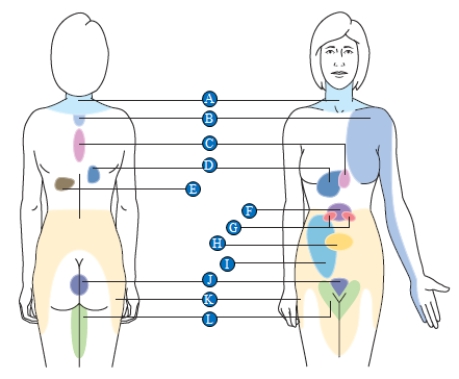
The accompanying figure shows areas of referred pain that indicate an internal organ is damaged. Which letter corresponds to heart damage?
A) A
B) B
C) C
D) D
E) E
The accompanying figure shows areas of referred pain that indicate an internal organ is damaged. Which letter corresponds to heart damage?
A) A
B) B
C) C
D) D
E) E
Question
Figure 33.6
A stretch receptor is classified as a ____.
A) chemoreceptor
B) mechanoreceptor
C) photoreceptor
D) thermoreceptor
E) nociceptor
A stretch receptor is classified as a ____.
A) chemoreceptor
B) mechanoreceptor
C) photoreceptor
D) thermoreceptor
E) nociceptor
Question
Question
Question
Question
Question
Question
Figure 33.8
Use the accompanying figure to answer the following question.
Eyes contain ____
A) chemoreceptors
B) mechanoreceptors
C) photoreceptors
D) nociceptors
E) thermoreceptors
Use the accompanying figure to answer the following question.
Eyes contain ____
A) chemoreceptors
B) mechanoreceptors
C) photoreceptors
D) nociceptors
E) thermoreceptors
Question
Question
Question
Figure 33.8
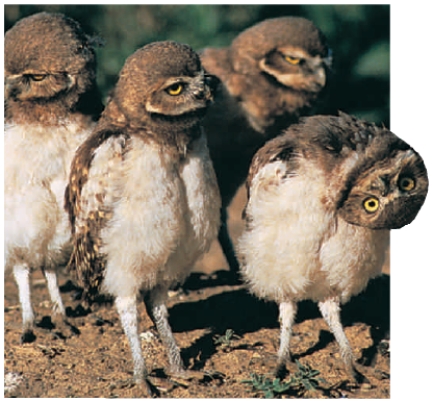
Refer to the accompanying photograph. Which statement best explains why the owl has its head almost upside down?
A) Photoreceptors are concentrated near the bottom of the eye.
B) Photoreceptors are concentrated near the top of the eye.
C) Loud music from a passing car has caused damage to the sense of balance.
D) An obstruction in its ear has caused this instinctual behavior.
E) The presence of prey above has caused this physical alert.
Refer to the accompanying photograph. Which statement best explains why the owl has its head almost upside down?
A) Photoreceptors are concentrated near the bottom of the eye.
B) Photoreceptors are concentrated near the top of the eye.
C) Loud music from a passing car has caused damage to the sense of balance.
D) An obstruction in its ear has caused this instinctual behavior.
E) The presence of prey above has caused this physical alert.
Question
Question
Question
Question
Figure 33.8
Use the accompanying figure to answer the following question.
Insects have ____.
A) simple eyes
B) ocelli
C) ciliary eyes
D) compound eyes
E) "camera" eyes
Use the accompanying figure to answer the following question.
Insects have ____.
A) simple eyes
B) ocelli
C) ciliary eyes
D) compound eyes
E) "camera" eyes
Question
Figure 33.8
Use the accompanying figure to answer the following question.
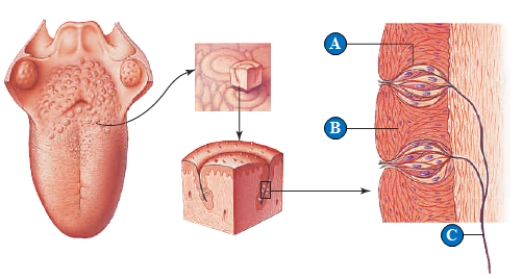
What letter indicates a taste bud?
A) A
B) B
C) C
D) A and B
E) none of these, because they are olfactory receptors
Use the accompanying figure to answer the following question.
What letter indicates a taste bud?
A) A
B) B
C) C
D) A and B
E) none of these, because they are olfactory receptors
Question
Figure 33.21 (part 2)
Use the accompanying figure to answer the following two questions.
In humans, and some other vertebrates, the organ that collects sound is called the ____.
A) auditory nerve
B) cochlea
C) eardrum
D) pinna
E) round window
Use the accompanying figure to answer the following two questions.
In humans, and some other vertebrates, the organ that collects sound is called the ____.
A) auditory nerve
B) cochlea
C) eardrum
D) pinna
E) round window
Question
Question
Question
Figure 33.21 (part 2)
Use the accompanying figure to answer the following two questions.
Equilibrium is sensed by ____.
A) chemoreceptors
B) mechanoreceptors
C) photoreceptors
D) thermoreceptors
E) nociceptors
Use the accompanying figure to answer the following two questions.
Equilibrium is sensed by ____.
A) chemoreceptors
B) mechanoreceptors
C) photoreceptors
D) thermoreceptors
E) nociceptors
Question
Question
Figure 33.14
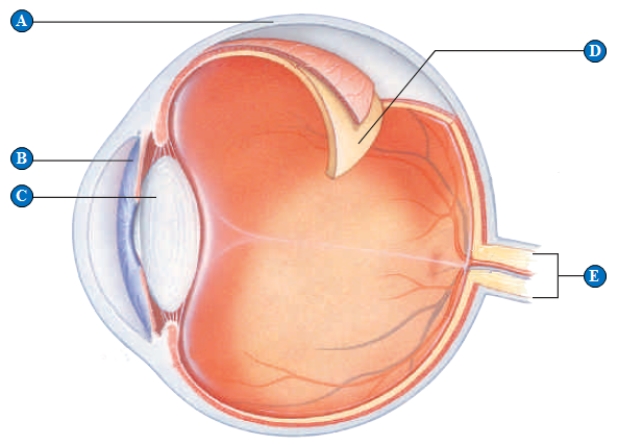
Use the accompanying figure to answer the following two questions.
The retina is indicated by the letter ____.
A) A
B) B
C) C
D) D
E) E
Use the accompanying figure to answer the following two questions.
The retina is indicated by the letter ____.
A) A
B) B
C) C
D) D
E) E
Question
Question
Figure 33.21 (part 2)
Use the accompanying figure to answer the following two questions.
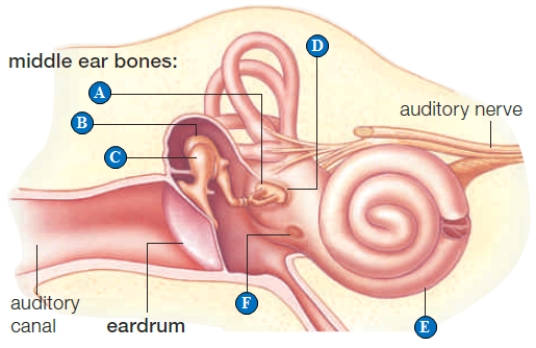
The bones that amplify sound reaching the eardrum are indicated by the letters ____.
A) A and B
B) A, B, and C
C) B and C
D) C and D
E) C, D, and F
Use the accompanying figure to answer the following two questions.
The bones that amplify sound reaching the eardrum are indicated by the letters ____.
A) A and B
B) A, B, and C
C) B and C
D) C and D
E) C, D, and F
Question
Question
Figure 33.21 (part 2)
Use the accompanying figure to answer the following two questions.
The oval window is indicated by the letter ____.
A) A
B) B
C) C
D) D
E) E
Use the accompanying figure to answer the following two questions.
The oval window is indicated by the letter ____.
A) A
B) B
C) C
D) D
E) E
Question
Question
Figure 33.14
Use the accompanying figure to answer the following two questions.
Rods and cones are located in the ____.
A) lens
B) cornea
C) pupil
D) iris
E) retina
Use the accompanying figure to answer the following two questions.
Rods and cones are located in the ____.
A) lens
B) cornea
C) pupil
D) iris
E) retina
Question
Question
Question
Figure 33.17C
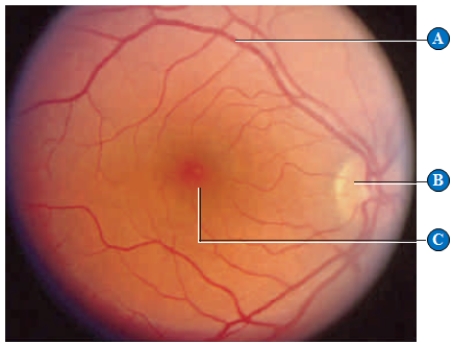
The letter "C" in the above figure represents the ____.
A) cortex
B) cornea
C) fovea
D) blood vessels
E) optic nerve
The letter "C" in the above figure represents the ____.
A) cortex
B) cornea
C) fovea
D) blood vessels
E) optic nerve
Question
Figure 33.17C
Nearsightedness is caused by a(n) _____
A) eye structure that focuses an image in front of the retina
B) eye structure that focuses an image behind the retina
C) eyeball that is too short
D) recessive trait on the Y chromosome
E) recessive trait on the X chromosome
Nearsightedness is caused by a(n) _____
A) eye structure that focuses an image in front of the retina
B) eye structure that focuses an image behind the retina
C) eyeball that is too short
D) recessive trait on the Y chromosome
E) recessive trait on the X chromosome
Question
Figure 33.17C
The color of the eye is predicated on the amount of ____ present.
A) enzyme
B) protein
C) melanin
D) salts
E) lipids
The color of the eye is predicated on the amount of ____ present.
A) enzyme
B) protein
C) melanin
D) salts
E) lipids
Question
Figure 33.14
Use the accompanying figure to answer the following two questions.
Visual accommodation involves the ability to ____.
A) change the sensitivity of the rods and cones by means of neurotransmitters
B) change the position of the retina
C) change the thickness of the lens by contracting or relaxing certain muscles
D) protect the eyeball from foreign matter
E) prevent eye strain
Use the accompanying figure to answer the following two questions.
Visual accommodation involves the ability to ____.
A) change the sensitivity of the rods and cones by means of neurotransmitters
B) change the position of the retina
C) change the thickness of the lens by contracting or relaxing certain muscles
D) protect the eyeball from foreign matter
E) prevent eye strain
Question
Question
Figure 33.14
Use the accompanying figure to answer the following two questions.
The structure that protects the eyeball is indicated by the letter ____.
A) A
B) B
C) C
D) D
E) E
Use the accompanying figure to answer the following two questions.
The structure that protects the eyeball is indicated by the letter ____.
A) A
B) B
C) C
D) D
E) E
Question
Question
Question
Question
Question
Question
Question
Question
Question
Question
Question
Question
Question
Question
Question
Question
Question
Question
Question
Question
Question
Question
Question
Question
Question
Question
Question
Question
Question
Question
Question
Question

Unlock Deck
Sign up to unlock the cards in this deck!
Unlock Deck
Unlock Deck
1/72

Play

Full screen (f)
Deck 33: Sensory Perception
1
Whales and elephants use sound to communicate with which kind of receptor?
A) photoreceptors
B) nociceptors
C) thermoreceptors
D) chemoreceptors
E) mechanoreceptors
A) photoreceptors
B) nociceptors
C) thermoreceptors
D) chemoreceptors
E) mechanoreceptors
E
2
The adjustable ring of contractile and connective tissues that controls the amount of light entering the eye is the ____.
A) lens
B) cornea
C) pupil
D) iris
E) retina
A) lens
B) cornea
C) pupil
D) iris
E) retina
D
3
Figure 33.6
The Pacinian corpuscle is used in detecting ____.
A) sound
B) hard pressure
C) chemicals
D) light touch
E) chemical differences
The Pacinian corpuscle is used in detecting ____.
A) sound
B) hard pressure
C) chemicals
D) light touch
E) chemical differences
B
4
Figure 33.8
The portion of the eye where photoreceptors are located is the ____.
A) lens
B) cornea
C) pupil
D) fovea
E) retina
The portion of the eye where photoreceptors are located is the ____.
A) lens
B) cornea
C) pupil
D) fovea
E) retina
Unlock Deck
Unlock for access to all 72 flashcards in this deck.
Unlock Deck
k this deck
5
Figure 33.6
The accompanying figure shows areas of referred pain that indicate an internal organ is damaged. Which letter corresponds to heart damage?
A) A
B) B
C) C
D) D
E) E
The accompanying figure shows areas of referred pain that indicate an internal organ is damaged. Which letter corresponds to heart damage?
A) A
B) B
C) C
D) D
E) E
Unlock Deck
Unlock for access to all 72 flashcards in this deck.
Unlock Deck
k this deck
6
Figure 33.6
A stretch receptor is classified as a ____.
A) chemoreceptor
B) mechanoreceptor
C) photoreceptor
D) thermoreceptor
E) nociceptor
A stretch receptor is classified as a ____.
A) chemoreceptor
B) mechanoreceptor
C) photoreceptor
D) thermoreceptor
E) nociceptor
Unlock Deck
Unlock for access to all 72 flashcards in this deck.
Unlock Deck
k this deck
7
The somatosensory cortex _____.
A) maps the distribution of somatic receptors on the body
B) consists of gray matter
C) involves only the spinal cord
D) responds to all signals equally
E) is not responsive to mechanoreceptors
A) maps the distribution of somatic receptors on the body
B) consists of gray matter
C) involves only the spinal cord
D) responds to all signals equally
E) is not responsive to mechanoreceptors
Unlock Deck
Unlock for access to all 72 flashcards in this deck.
Unlock Deck
k this deck
8
The processing of sensory input in animals leads to ____.
A) an adaptation
B) a sensation
C) an action
D) feeling exactly what is happening at the site
E) responding to the stimulus
A) an adaptation
B) a sensation
C) an action
D) feeling exactly what is happening at the site
E) responding to the stimulus
Unlock Deck
Unlock for access to all 72 flashcards in this deck.
Unlock Deck
k this deck
9
The pain produced in an internal organ may be perceived as occurring somewhere else. This phenomenon is called ____.
A) mixed nerve messages
B) referred pain
C) phantom pain
D) psychosomatic pain
E) hypochondria
A) mixed nerve messages
B) referred pain
C) phantom pain
D) psychosomatic pain
E) hypochondria
Unlock Deck
Unlock for access to all 72 flashcards in this deck.
Unlock Deck
k this deck
10
Sensory pathways of smell and taste ____.
A) begin with chemoreceptors
B) begin in the somatosensory cortex
C) are not involved in communication
D) are integrated with the advanced vomeronasal organ that humans possess
E) are completely separated from one another
A) begin with chemoreceptors
B) begin in the somatosensory cortex
C) are not involved in communication
D) are integrated with the advanced vomeronasal organ that humans possess
E) are completely separated from one another
Unlock Deck
Unlock for access to all 72 flashcards in this deck.
Unlock Deck
k this deck
11
When the brain assigns meaning to a sensory signal, we say that _____ has taken place.
A) sensory adaptation
B) sensory perception
C) semantic perception
D) sensory action
E) sensory activation
A) sensory adaptation
B) sensory perception
C) semantic perception
D) sensory action
E) sensory activation
Unlock Deck
Unlock for access to all 72 flashcards in this deck.
Unlock Deck
k this deck
12
Figure 33.8
Use the accompanying figure to answer the following question.
Eyes contain ____
A) chemoreceptors
B) mechanoreceptors
C) photoreceptors
D) nociceptors
E) thermoreceptors
Use the accompanying figure to answer the following question.
Eyes contain ____
A) chemoreceptors
B) mechanoreceptors
C) photoreceptors
D) nociceptors
E) thermoreceptors
Unlock Deck
Unlock for access to all 72 flashcards in this deck.
Unlock Deck
k this deck
13
A diminishing response by receptors to a constant stimulus is known as ____.
A) an action potential
B) neural transduction
C) sensory adaptation
D) referred pain
E) a sensation
A) an action potential
B) neural transduction
C) sensory adaptation
D) referred pain
E) a sensation
Unlock Deck
Unlock for access to all 72 flashcards in this deck.
Unlock Deck
k this deck
14
Which analgesic relieves pain by mimicking the action of endorphins?
A) aspirin
B) ziconotide
C) NSAIDS
D) morphine
E) acetaminophen
A) aspirin
B) ziconotide
C) NSAIDS
D) morphine
E) acetaminophen
Unlock Deck
Unlock for access to all 72 flashcards in this deck.
Unlock Deck
k this deck
15
Figure 33.8
Refer to the accompanying photograph. Which statement best explains why the owl has its head almost upside down?
A) Photoreceptors are concentrated near the bottom of the eye.
B) Photoreceptors are concentrated near the top of the eye.
C) Loud music from a passing car has caused damage to the sense of balance.
D) An obstruction in its ear has caused this instinctual behavior.
E) The presence of prey above has caused this physical alert.
Refer to the accompanying photograph. Which statement best explains why the owl has its head almost upside down?
A) Photoreceptors are concentrated near the bottom of the eye.
B) Photoreceptors are concentrated near the top of the eye.
C) Loud music from a passing car has caused damage to the sense of balance.
D) An obstruction in its ear has caused this instinctual behavior.
E) The presence of prey above has caused this physical alert.
Unlock Deck
Unlock for access to all 72 flashcards in this deck.
Unlock Deck
k this deck
16
The major function of a receptor is to _____.
A) control the autonomic functions of the body
B) stabilize the internal environment to achieve homeostasis
C) produce responses to the various stimuli the body receives
D) give organisms or cells awareness of and sensitivity to their environment
E) control the visceral functions of the body
A) control the autonomic functions of the body
B) stabilize the internal environment to achieve homeostasis
C) produce responses to the various stimuli the body receives
D) give organisms or cells awareness of and sensitivity to their environment
E) control the visceral functions of the body
Unlock Deck
Unlock for access to all 72 flashcards in this deck.
Unlock Deck
k this deck
17
The somatic senses include four of the following sensations. Which one is the exception?
A) balance
B) pain near the body surface
C) temperature
D) touch
E) pressure
A) balance
B) pain near the body surface
C) temperature
D) touch
E) pressure
Unlock Deck
Unlock for access to all 72 flashcards in this deck.
Unlock Deck
k this deck
18
Humans have ____.
A) more taste receptors than olfactory receptors
B) more olfactory receptors than taste receptors
C) a high degree of dependency on pheromones
D) approximately six types of olfactory receptors
E) an advanced vomeronasal organ
A) more taste receptors than olfactory receptors
B) more olfactory receptors than taste receptors
C) a high degree of dependency on pheromones
D) approximately six types of olfactory receptors
E) an advanced vomeronasal organ
Unlock Deck
Unlock for access to all 72 flashcards in this deck.
Unlock Deck
k this deck
19
Figure 33.8
Use the accompanying figure to answer the following question.
Insects have ____.
A) simple eyes
B) ocelli
C) ciliary eyes
D) compound eyes
E) "camera" eyes
Use the accompanying figure to answer the following question.
Insects have ____.
A) simple eyes
B) ocelli
C) ciliary eyes
D) compound eyes
E) "camera" eyes
Unlock Deck
Unlock for access to all 72 flashcards in this deck.
Unlock Deck
k this deck
20
Figure 33.8
Use the accompanying figure to answer the following question.
What letter indicates a taste bud?
A) A
B) B
C) C
D) A and B
E) none of these, because they are olfactory receptors
Use the accompanying figure to answer the following question.
What letter indicates a taste bud?
A) A
B) B
C) C
D) A and B
E) none of these, because they are olfactory receptors
Unlock Deck
Unlock for access to all 72 flashcards in this deck.
Unlock Deck
k this deck
21
Figure 33.21 (part 2)
Use the accompanying figure to answer the following two questions.
In humans, and some other vertebrates, the organ that collects sound is called the ____.
A) auditory nerve
B) cochlea
C) eardrum
D) pinna
E) round window
Use the accompanying figure to answer the following two questions.
In humans, and some other vertebrates, the organ that collects sound is called the ____.
A) auditory nerve
B) cochlea
C) eardrum
D) pinna
E) round window
Unlock Deck
Unlock for access to all 72 flashcards in this deck.
Unlock Deck
k this deck
22
When light rays converge behind the retina, it is known as ____.
A) astigmatism
B) color blindness
C) nearsightedness
D) macular degeneration
E) farsightedness
A) astigmatism
B) color blindness
C) nearsightedness
D) macular degeneration
E) farsightedness
Unlock Deck
Unlock for access to all 72 flashcards in this deck.
Unlock Deck
k this deck
23
Choose the one most appropriate answer for each.a.relays action potentials from the ear to the brain
b.contains the organ of Corti
c.separates the outer and middle ears
d.membrane-covered gateway to inner ear
e.consists of tissue containing rods and cones
f.bone in middle ear
g.defined by peak height and valley depth of sound waves
h.helps maintain balance and position; detects acceleration
i.depends on the number of wave cycles per second
j.a substance that elicits a response in members of the same species
k.regulates size of pupil and amount of incoming light
amplitude
b.contains the organ of Corti
c.separates the outer and middle ears
d.membrane-covered gateway to inner ear
e.consists of tissue containing rods and cones
f.bone in middle ear
g.defined by peak height and valley depth of sound waves
h.helps maintain balance and position; detects acceleration
i.depends on the number of wave cycles per second
j.a substance that elicits a response in members of the same species
k.regulates size of pupil and amount of incoming light
amplitude
Unlock Deck
Unlock for access to all 72 flashcards in this deck.
Unlock Deck
k this deck
24
Figure 33.21 (part 2)
Use the accompanying figure to answer the following two questions.
Equilibrium is sensed by ____.
A) chemoreceptors
B) mechanoreceptors
C) photoreceptors
D) thermoreceptors
E) nociceptors
Use the accompanying figure to answer the following two questions.
Equilibrium is sensed by ____.
A) chemoreceptors
B) mechanoreceptors
C) photoreceptors
D) thermoreceptors
E) nociceptors
Unlock Deck
Unlock for access to all 72 flashcards in this deck.
Unlock Deck
k this deck
25
Failure of the organs in the vestibular apparatus to function correctly can cause ____.
A) lack of sensation on the skin
B) loss of hearing
C) motion sickness
D) inability to smell
E) night blindness
A) lack of sensation on the skin
B) loss of hearing
C) motion sickness
D) inability to smell
E) night blindness
Unlock Deck
Unlock for access to all 72 flashcards in this deck.
Unlock Deck
k this deck
26
Figure 33.14
Use the accompanying figure to answer the following two questions.
The retina is indicated by the letter ____.
A) A
B) B
C) C
D) D
E) E
Use the accompanying figure to answer the following two questions.
The retina is indicated by the letter ____.
A) A
B) B
C) C
D) D
E) E
Unlock Deck
Unlock for access to all 72 flashcards in this deck.
Unlock Deck
k this deck
27
Choose the one most appropriate answer for each.a.relays action potentials from the ear to the brain
b.contains the organ of Corti
c.separates the outer and middle ears
d.membrane-covered gateway to inner ear
e.consists of tissue containing rods and cones
f.bone in middle ear
g.defined by peak height and valley depth of sound waves
h.helps maintain balance and position; detects acceleration
i.depends on the number of wave cycles per second
j.a substance that elicits a response in members of the same species
k.regulates size of pupil and amount of incoming light
cochlea
b.contains the organ of Corti
c.separates the outer and middle ears
d.membrane-covered gateway to inner ear
e.consists of tissue containing rods and cones
f.bone in middle ear
g.defined by peak height and valley depth of sound waves
h.helps maintain balance and position; detects acceleration
i.depends on the number of wave cycles per second
j.a substance that elicits a response in members of the same species
k.regulates size of pupil and amount of incoming light
cochlea
Unlock Deck
Unlock for access to all 72 flashcards in this deck.
Unlock Deck
k this deck
28
Figure 33.21 (part 2)
Use the accompanying figure to answer the following two questions.
The bones that amplify sound reaching the eardrum are indicated by the letters ____.
A) A and B
B) A, B, and C
C) B and C
D) C and D
E) C, D, and F
Use the accompanying figure to answer the following two questions.
The bones that amplify sound reaching the eardrum are indicated by the letters ____.
A) A and B
B) A, B, and C
C) B and C
D) C and D
E) C, D, and F
Unlock Deck
Unlock for access to all 72 flashcards in this deck.
Unlock Deck
k this deck
29
The dark middle layer of the eye that prevents the scattering of light is the ____.
A) fovea
B) retina
C) sclera
D) choroid
E) cornea
A) fovea
B) retina
C) sclera
D) choroid
E) cornea
Unlock Deck
Unlock for access to all 72 flashcards in this deck.
Unlock Deck
k this deck
30
Figure 33.21 (part 2)
Use the accompanying figure to answer the following two questions.
The oval window is indicated by the letter ____.
A) A
B) B
C) C
D) D
E) E
Use the accompanying figure to answer the following two questions.
The oval window is indicated by the letter ____.
A) A
B) B
C) C
D) D
E) E
Unlock Deck
Unlock for access to all 72 flashcards in this deck.
Unlock Deck
k this deck
31
Which statement accurately describes the properties of sound?
A) The frequency of a sound determines the loudness.
B) The amplitude of a sound determines its pitch.
C) The amplitude of a sound is the number of waves per second.
D) A soft sound has a greater amplitude than a loud sound.
E) A high note and a low note with the same amplitude are equally loud.
A) The frequency of a sound determines the loudness.
B) The amplitude of a sound determines its pitch.
C) The amplitude of a sound is the number of waves per second.
D) A soft sound has a greater amplitude than a loud sound.
E) A high note and a low note with the same amplitude are equally loud.
Unlock Deck
Unlock for access to all 72 flashcards in this deck.
Unlock Deck
k this deck
32
Figure 33.14
Use the accompanying figure to answer the following two questions.
Rods and cones are located in the ____.
A) lens
B) cornea
C) pupil
D) iris
E) retina
Use the accompanying figure to answer the following two questions.
Rods and cones are located in the ____.
A) lens
B) cornea
C) pupil
D) iris
E) retina
Unlock Deck
Unlock for access to all 72 flashcards in this deck.
Unlock Deck
k this deck
33
The utricle and saccule ____.
A) each contain an organ of dynamic equilibrium
B) detect rotation of the head
C) detect how the head is oriented relative to the ground
D) are semicircular canals
E) use the auditory nerve to send information to the brain
A) each contain an organ of dynamic equilibrium
B) detect rotation of the head
C) detect how the head is oriented relative to the ground
D) are semicircular canals
E) use the auditory nerve to send information to the brain
Unlock Deck
Unlock for access to all 72 flashcards in this deck.
Unlock Deck
k this deck
34
The organ of Corti ____.
A) is integral to balance
B) controls the sense of depth perception
C) has hair cells that fire and sends signals to the brain
D) is involved in visual acuity
E) detects light energy
A) is integral to balance
B) controls the sense of depth perception
C) has hair cells that fire and sends signals to the brain
D) is involved in visual acuity
E) detects light energy
Unlock Deck
Unlock for access to all 72 flashcards in this deck.
Unlock Deck
k this deck
35
Figure 33.17C
The letter "C" in the above figure represents the ____.
A) cortex
B) cornea
C) fovea
D) blood vessels
E) optic nerve
The letter "C" in the above figure represents the ____.
A) cortex
B) cornea
C) fovea
D) blood vessels
E) optic nerve
Unlock Deck
Unlock for access to all 72 flashcards in this deck.
Unlock Deck
k this deck
36
Figure 33.17C
Nearsightedness is caused by a(n) _____
A) eye structure that focuses an image in front of the retina
B) eye structure that focuses an image behind the retina
C) eyeball that is too short
D) recessive trait on the Y chromosome
E) recessive trait on the X chromosome
Nearsightedness is caused by a(n) _____
A) eye structure that focuses an image in front of the retina
B) eye structure that focuses an image behind the retina
C) eyeball that is too short
D) recessive trait on the Y chromosome
E) recessive trait on the X chromosome
Unlock Deck
Unlock for access to all 72 flashcards in this deck.
Unlock Deck
k this deck
37
Figure 33.17C
The color of the eye is predicated on the amount of ____ present.
A) enzyme
B) protein
C) melanin
D) salts
E) lipids
The color of the eye is predicated on the amount of ____ present.
A) enzyme
B) protein
C) melanin
D) salts
E) lipids
Unlock Deck
Unlock for access to all 72 flashcards in this deck.
Unlock Deck
k this deck
38
Figure 33.14
Use the accompanying figure to answer the following two questions.
Visual accommodation involves the ability to ____.
A) change the sensitivity of the rods and cones by means of neurotransmitters
B) change the position of the retina
C) change the thickness of the lens by contracting or relaxing certain muscles
D) protect the eyeball from foreign matter
E) prevent eye strain
Use the accompanying figure to answer the following two questions.
Visual accommodation involves the ability to ____.
A) change the sensitivity of the rods and cones by means of neurotransmitters
B) change the position of the retina
C) change the thickness of the lens by contracting or relaxing certain muscles
D) protect the eyeball from foreign matter
E) prevent eye strain
Unlock Deck
Unlock for access to all 72 flashcards in this deck.
Unlock Deck
k this deck
39
The area on the retina that has the greatest density of cone cells is called the ____.
A) fovea
B) visual ganglion
C) lateral geniculate nucleus
D) visual cortex
E) blind spot
A) fovea
B) visual ganglion
C) lateral geniculate nucleus
D) visual cortex
E) blind spot
Unlock Deck
Unlock for access to all 72 flashcards in this deck.
Unlock Deck
k this deck
40
Figure 33.14
Use the accompanying figure to answer the following two questions.
The structure that protects the eyeball is indicated by the letter ____.
A) A
B) B
C) C
D) D
E) E
Use the accompanying figure to answer the following two questions.
The structure that protects the eyeball is indicated by the letter ____.
A) A
B) B
C) C
D) D
E) E
Unlock Deck
Unlock for access to all 72 flashcards in this deck.
Unlock Deck
k this deck
41
Answer the following questions in reference to the five eye structures listed below.
a.cornea
b.lens
c.retina
d.ommatidium
e.vitreous body
This structure contains rods and cones in vertebrates.
a.cornea
b.lens
c.retina
d.ommatidium
e.vitreous body
This structure contains rods and cones in vertebrates.
Unlock Deck
Unlock for access to all 72 flashcards in this deck.
Unlock Deck
k this deck
42
Choose the one most appropriate answer for each.a.relays action potentials from the ear to the brain
b.contains the organ of Corti
c.separates the outer and middle ears
d.membrane-covered gateway to inner ear
e.consists of tissue containing rods and cones
f.bone in middle ear
g.defined by peak height and valley depth of sound waves
h.helps maintain balance and position; detects acceleration
i.depends on the number of wave cycles per second
j.a substance that elicits a response in members of the same species
k.regulates size of pupil and amount of incoming light
oval window
b.contains the organ of Corti
c.separates the outer and middle ears
d.membrane-covered gateway to inner ear
e.consists of tissue containing rods and cones
f.bone in middle ear
g.defined by peak height and valley depth of sound waves
h.helps maintain balance and position; detects acceleration
i.depends on the number of wave cycles per second
j.a substance that elicits a response in members of the same species
k.regulates size of pupil and amount of incoming light
oval window
Unlock Deck
Unlock for access to all 72 flashcards in this deck.
Unlock Deck
k this deck
43
Answer the following questions in reference to the five eye structures listed below.
a.cornea
b.lens
c.retina
d.ommatidium
e.vitreous body
This structure is found in the compound eyes of insects but not in the eyes of vertebrates.
a.cornea
b.lens
c.retina
d.ommatidium
e.vitreous body
This structure is found in the compound eyes of insects but not in the eyes of vertebrates.
Unlock Deck
Unlock for access to all 72 flashcards in this deck.
Unlock Deck
k this deck
44
Classification. Respond to the following statements in reference to the four kinds of receptors listed below.
a.chemical
b.mechanical
c.thermal
d.nociceptor
Ears detect this kind of energy.
a.chemical
b.mechanical
c.thermal
d.nociceptor
Ears detect this kind of energy.
Unlock Deck
Unlock for access to all 72 flashcards in this deck.
Unlock Deck
k this deck
45
__________ sense pain.
Unlock Deck
Unlock for access to all 72 flashcards in this deck.
Unlock Deck
k this deck
46
Choose the one most appropriate answer for each.a.relays action potentials from the ear to the brain
b.contains the organ of Corti
c.separates the outer and middle ears
d.membrane-covered gateway to inner ear
e.consists of tissue containing rods and cones
f.bone in middle ear
g.defined by peak height and valley depth of sound waves
h.helps maintain balance and position; detects acceleration
i.depends on the number of wave cycles per second
j.a substance that elicits a response in members of the same species
k.regulates size of pupil and amount of incoming light
saccule
b.contains the organ of Corti
c.separates the outer and middle ears
d.membrane-covered gateway to inner ear
e.consists of tissue containing rods and cones
f.bone in middle ear
g.defined by peak height and valley depth of sound waves
h.helps maintain balance and position; detects acceleration
i.depends on the number of wave cycles per second
j.a substance that elicits a response in members of the same species
k.regulates size of pupil and amount of incoming light
saccule
Unlock Deck
Unlock for access to all 72 flashcards in this deck.
Unlock Deck
k this deck
47
Answer the following questions in reference to the five eye structures listed below.
a.cornea
b.lens
c.retina
d.ommatidium
e.vitreous body
This structure acts to maintain the shape of the eye and to transmit light to other structures.
a.cornea
b.lens
c.retina
d.ommatidium
e.vitreous body
This structure acts to maintain the shape of the eye and to transmit light to other structures.
Unlock Deck
Unlock for access to all 72 flashcards in this deck.
Unlock Deck
k this deck
48
Classification. Respond to the following statements in reference to the four kinds of receptors listed below.
a.chemical
b.mechanical
c.thermal
d.nociceptor
The warmth you feel from a campfire is a result of detecting this kind of energy.
a.chemical
b.mechanical
c.thermal
d.nociceptor
The warmth you feel from a campfire is a result of detecting this kind of energy.
Unlock Deck
Unlock for access to all 72 flashcards in this deck.
Unlock Deck
k this deck
49
Choose the one most appropriate answer for each.a.relays action potentials from the ear to the brain
b.contains the organ of Corti
c.separates the outer and middle ears
d.membrane-covered gateway to inner ear
e.consists of tissue containing rods and cones
f.bone in middle ear
g.defined by peak height and valley depth of sound waves
h.helps maintain balance and position; detects acceleration
i.depends on the number of wave cycles per second
j.a substance that elicits a response in members of the same species
k.regulates size of pupil and amount of incoming light
hammer
b.contains the organ of Corti
c.separates the outer and middle ears
d.membrane-covered gateway to inner ear
e.consists of tissue containing rods and cones
f.bone in middle ear
g.defined by peak height and valley depth of sound waves
h.helps maintain balance and position; detects acceleration
i.depends on the number of wave cycles per second
j.a substance that elicits a response in members of the same species
k.regulates size of pupil and amount of incoming light
hammer
Unlock Deck
Unlock for access to all 72 flashcards in this deck.
Unlock Deck
k this deck
50
Classification. Respond to the following statements in reference to the four kinds of receptors listed below.
a.chemical
b.mechanical
c.thermal
d.nociceptor
Receptors on the tongue detect variations in this kind of signal.
a.chemical
b.mechanical
c.thermal
d.nociceptor
Receptors on the tongue detect variations in this kind of signal.
Unlock Deck
Unlock for access to all 72 flashcards in this deck.
Unlock Deck
k this deck
51
Choose the one most appropriate answer for each.a.relays action potentials from the ear to the brain
b.contains the organ of Corti
c.separates the outer and middle ears
d.membrane-covered gateway to inner ear
e.consists of tissue containing rods and cones
f.bone in middle ear
g.defined by peak height and valley depth of sound waves
h.helps maintain balance and position; detects acceleration
i.depends on the number of wave cycles per second
j.a substance that elicits a response in members of the same species
k.regulates size of pupil and amount of incoming light
eardrum
b.contains the organ of Corti
c.separates the outer and middle ears
d.membrane-covered gateway to inner ear
e.consists of tissue containing rods and cones
f.bone in middle ear
g.defined by peak height and valley depth of sound waves
h.helps maintain balance and position; detects acceleration
i.depends on the number of wave cycles per second
j.a substance that elicits a response in members of the same species
k.regulates size of pupil and amount of incoming light
eardrum
Unlock Deck
Unlock for access to all 72 flashcards in this deck.
Unlock Deck
k this deck
52
Answer the following questions in reference to the five eye structures listed below.
a.cornea
b.lens
c.retina
d.ommatidium
e.vitreous body
This structure forms the transparent front of the eye.
a.cornea
b.lens
c.retina
d.ommatidium
e.vitreous body
This structure forms the transparent front of the eye.
Unlock Deck
Unlock for access to all 72 flashcards in this deck.
Unlock Deck
k this deck
53
Choose the one most appropriate answer for each.a.relays action potentials from the ear to the brain
b.contains the organ of Corti
c.separates the outer and middle ears
d.membrane-covered gateway to inner ear
e.consists of tissue containing rods and cones
f.bone in middle ear
g.defined by peak height and valley depth of sound waves
h.helps maintain balance and position; detects acceleration
i.depends on the number of wave cycles per second
j.a substance that elicits a response in members of the same species
k.regulates size of pupil and amount of incoming light
pitch
b.contains the organ of Corti
c.separates the outer and middle ears
d.membrane-covered gateway to inner ear
e.consists of tissue containing rods and cones
f.bone in middle ear
g.defined by peak height and valley depth of sound waves
h.helps maintain balance and position; detects acceleration
i.depends on the number of wave cycles per second
j.a substance that elicits a response in members of the same species
k.regulates size of pupil and amount of incoming light
pitch
Unlock Deck
Unlock for access to all 72 flashcards in this deck.
Unlock Deck
k this deck
54
Choose the one most appropriate answer for each.a.relays action potentials from the ear to the brain
b.contains the organ of Corti
c.separates the outer and middle ears
d.membrane-covered gateway to inner ear
e.consists of tissue containing rods and cones
f.bone in middle ear
g.defined by peak height and valley depth of sound waves
h.helps maintain balance and position; detects acceleration
i.depends on the number of wave cycles per second
j.a substance that elicits a response in members of the same species
k.regulates size of pupil and amount of incoming light
pheromone
b.contains the organ of Corti
c.separates the outer and middle ears
d.membrane-covered gateway to inner ear
e.consists of tissue containing rods and cones
f.bone in middle ear
g.defined by peak height and valley depth of sound waves
h.helps maintain balance and position; detects acceleration
i.depends on the number of wave cycles per second
j.a substance that elicits a response in members of the same species
k.regulates size of pupil and amount of incoming light
pheromone
Unlock Deck
Unlock for access to all 72 flashcards in this deck.
Unlock Deck
k this deck
55
Choose the one most appropriate answer for each.a.relays action potentials from the ear to the brain
b.contains the organ of Corti
c.separates the outer and middle ears
d.membrane-covered gateway to inner ear
e.consists of tissue containing rods and cones
f.bone in middle ear
g.defined by peak height and valley depth of sound waves
h.helps maintain balance and position; detects acceleration
i.depends on the number of wave cycles per second
j.a substance that elicits a response in members of the same species
k.regulates size of pupil and amount of incoming light
iris
b.contains the organ of Corti
c.separates the outer and middle ears
d.membrane-covered gateway to inner ear
e.consists of tissue containing rods and cones
f.bone in middle ear
g.defined by peak height and valley depth of sound waves
h.helps maintain balance and position; detects acceleration
i.depends on the number of wave cycles per second
j.a substance that elicits a response in members of the same species
k.regulates size of pupil and amount of incoming light
iris
Unlock Deck
Unlock for access to all 72 flashcards in this deck.
Unlock Deck
k this deck
56
Classification. Respond to the following statements in reference to the four kinds of receptors listed below.
a.chemical
b.mechanical
c.thermal
d.nociceptor
Receptors that detect pain.
a.chemical
b.mechanical
c.thermal
d.nociceptor
Receptors that detect pain.
Unlock Deck
Unlock for access to all 72 flashcards in this deck.
Unlock Deck
k this deck
57
Choose the one most appropriate answer for each.a.relays action potentials from the ear to the brain
b.contains the organ of Corti
c.separates the outer and middle ears
d.membrane-covered gateway to inner ear
e.consists of tissue containing rods and cones
f.bone in middle ear
g.defined by peak height and valley depth of sound waves
h.helps maintain balance and position; detects acceleration
i.depends on the number of wave cycles per second
j.a substance that elicits a response in members of the same species
k.regulates size of pupil and amount of incoming light
auditory nerve
b.contains the organ of Corti
c.separates the outer and middle ears
d.membrane-covered gateway to inner ear
e.consists of tissue containing rods and cones
f.bone in middle ear
g.defined by peak height and valley depth of sound waves
h.helps maintain balance and position; detects acceleration
i.depends on the number of wave cycles per second
j.a substance that elicits a response in members of the same species
k.regulates size of pupil and amount of incoming light
auditory nerve
Unlock Deck
Unlock for access to all 72 flashcards in this deck.
Unlock Deck
k this deck
58
Choose the one most appropriate answer for each.a.relays action potentials from the ear to the brain
b.contains the organ of Corti
c.separates the outer and middle ears
d.membrane-covered gateway to inner ear
e.consists of tissue containing rods and cones
f.bone in middle ear
g.defined by peak height and valley depth of sound waves
h.helps maintain balance and position; detects acceleration
i.depends on the number of wave cycles per second
j.a substance that elicits a response in members of the same species
k.regulates size of pupil and amount of incoming light
retina
b.contains the organ of Corti
c.separates the outer and middle ears
d.membrane-covered gateway to inner ear
e.consists of tissue containing rods and cones
f.bone in middle ear
g.defined by peak height and valley depth of sound waves
h.helps maintain balance and position; detects acceleration
i.depends on the number of wave cycles per second
j.a substance that elicits a response in members of the same species
k.regulates size of pupil and amount of incoming light
retina
Unlock Deck
Unlock for access to all 72 flashcards in this deck.
Unlock Deck
k this deck
59
Answer the following questions in reference to the five eye structures listed below.
a.cornea
b.lens
c.retina
d.ommatidium
e.vitreous body
This structure primarily acts to focus light waves.
a.cornea
b.lens
c.retina
d.ommatidium
e.vitreous body
This structure primarily acts to focus light waves.
Unlock Deck
Unlock for access to all 72 flashcards in this deck.
Unlock Deck
k this deck
60
Answer the following questions in reference to the five eye structures listed below.
a.cornea
b.lens
c.retina
d.ommatidium
e.vitreous body
__________ respond to mechanical energy such as touch.
a.cornea
b.lens
c.retina
d.ommatidium
e.vitreous body
__________ respond to mechanical energy such as touch.
Unlock Deck
Unlock for access to all 72 flashcards in this deck.
Unlock Deck
k this deck
61
__________ sensations arise from receptors near organs in body cavities.
Unlock Deck
Unlock for access to all 72 flashcards in this deck.
Unlock Deck
k this deck
62
Insects have a(n) __________ eye, with many individual units.
Unlock Deck
Unlock for access to all 72 flashcards in this deck.
Unlock Deck
k this deck
63
People tend to crave sweet and salty foods, but dislike bitter foods. What is the evolutionary explanation for this?
Unlock Deck
Unlock for access to all 72 flashcards in this deck.
Unlock Deck
k this deck
64
What would be the danger in lacking nociceptors?
Unlock Deck
Unlock for access to all 72 flashcards in this deck.
Unlock Deck
k this deck
65
The __________ sensations arise from sensory receptors located in skin, or near muscles or joints.
Unlock Deck
Unlock for access to all 72 flashcards in this deck.
Unlock Deck
k this deck
66
Continued stimulation of a receptor may lead to a diminished response and is called __________.
Unlock Deck
Unlock for access to all 72 flashcards in this deck.
Unlock Deck
k this deck
67
The __________ is a system of fluid-filled sacs and canals in the inner ear.
Unlock Deck
Unlock for access to all 72 flashcards in this deck.
Unlock Deck
k this deck
68
The cochlea is a coiled structure with fluid-filled ducts that holds the mechanoreceptors responsible for hearing in its __________.
Unlock Deck
Unlock for access to all 72 flashcards in this deck.
Unlock Deck
k this deck
69
An individual reports to the doctor that they are experiencing pain in their left arm. What would the doctor think may be wrong?
Unlock Deck
Unlock for access to all 72 flashcards in this deck.
Unlock Deck
k this deck
70
Why is color blindness more common in males?
Unlock Deck
Unlock for access to all 72 flashcards in this deck.
Unlock Deck
k this deck
71
__________ line human nasal passages.
Unlock Deck
Unlock for access to all 72 flashcards in this deck.
Unlock Deck
k this deck
72
Light enters the eye's interior through the __________, an adjustable opening in the center of the muscular, doughnut-shaped iris.
Unlock Deck
Unlock for access to all 72 flashcards in this deck.
Unlock Deck
k this deck
Unlock Deck
Unlock for access to all 72 flashcards in this deck.






