







 Chat with AI

Deck 31: Assessment of Cardiovascular System
Full screen (f)

Question

Question
Question
Question
Question
Question
Question
Question
Question
Question
Question
Question
Question
Question
Question
Question
Question
Question
Question
Question
Question
Question
When the nurse is screening patients for possible peripheral arterial disease,indicate where the posterior tibial artery will be palpated. 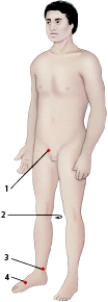
A)1
B)2
C)3
D)4
A)1
B)2
C)3
D)4
Question
Question

Unlock Deck
Sign up to unlock the cards in this deck!
Unlock Deck
Unlock Deck
1/24

Play

Full screen (f)
Deck 31: Assessment of Cardiovascular System
1
The nurse has received the laboratory results for a patient who developed chest pain 4 hours ago and may be having a myocardial infarction. The laboratory test result most helpful in indicating myocardial damage will be
A)myoglobin.
B)troponins T and I.
C)homocysteine (Hcy)
D)creatine kinase-MB (CK-MB).
A)myoglobin.
B)troponins T and I.
C)homocysteine (Hcy)
D)creatine kinase-MB (CK-MB).
troponins T and I.
2
Which information obtained by the nurse who is admitting the patient for magnetic resonance imaging (MRI)will be important to report to the health care provider before the MRI?
A)The patient has an allergy to shellfish.
B)The patient has a history of atherosclerosis.
C)The patient has a permanent cardiac pacemaker.
D)The patient took the prescribed heart medications today.
A)The patient has an allergy to shellfish.
B)The patient has a history of atherosclerosis.
C)The patient has a permanent cardiac pacemaker.
D)The patient took the prescribed heart medications today.
The patient has a permanent cardiac pacemaker.
3
When auscultating over the patient's abdominal aorta,the nurse hears a loud humming sound. The nurse documents this finding as a
A)thrill.
B)bruit.
C)murmur.
D)normal finding.
A)thrill.
B)bruit.
C)murmur.
D)normal finding.
bruit.
4
The nurse teaches the patient being evaluated for rhythm disturbances with a Holter monitor to
A)connect the recorder to a computer once daily.
B)exercise more than usual while the monitor is in place.
C)remove the electrodes when taking a shower or tub bath.
D)keep a diary of daily activities while the monitor is worn.
A)connect the recorder to a computer once daily.
B)exercise more than usual while the monitor is in place.
C)remove the electrodes when taking a shower or tub bath.
D)keep a diary of daily activities while the monitor is worn.
Unlock Deck
Unlock for access to all 24 flashcards in this deck.
Unlock Deck
k this deck
5
A 74-yr-old patient has just arrived in the emergency department. After assessment reveals a pulse deficit of 46 beats,the nurse will anticipate that the patient may require
A)emergent cardioversion.
B)a cardiac catheterization.
C)hourly blood pressure (BP) checks.
D)electrocardiographic (ECG) monitoring.
A)emergent cardioversion.
B)a cardiac catheterization.
C)hourly blood pressure (BP) checks.
D)electrocardiographic (ECG) monitoring.
Unlock Deck
Unlock for access to all 24 flashcards in this deck.
Unlock Deck
k this deck
6
The standard policy on the cardiac unit states,"Notify the health care provider for mean arterial pressure (MAP)less than 70 mm Hg." The nurse will need to call the health care provider about the
A)postoperative patient with a BP of 116/42 mm Hg.
B)newly admitted patient with a BP of 150/87 mm Hg.
C)patient with left ventricular failure who has a BP of 110/70 mm Hg.
D)patient with a myocardial infarction who has a BP of 140/86 mm Hg.
A)postoperative patient with a BP of 116/42 mm Hg.
B)newly admitted patient with a BP of 150/87 mm Hg.
C)patient with left ventricular failure who has a BP of 110/70 mm Hg.
D)patient with a myocardial infarction who has a BP of 140/86 mm Hg.
Unlock Deck
Unlock for access to all 24 flashcards in this deck.
Unlock Deck
k this deck
7
The nurse hears a murmur between the S1 and S2 heart sounds at the patient's left fifth intercostal space and midclavicular line. How will the nurse record this information?
A)Systolic murmur heard at mitral area
B)Systolic murmur heard at Erb's point
C)Diastolic murmur heard at aortic area
D)Diastolic murmur heard at the point of maximal impulse
A)Systolic murmur heard at mitral area
B)Systolic murmur heard at Erb's point
C)Diastolic murmur heard at aortic area
D)Diastolic murmur heard at the point of maximal impulse
Unlock Deck
Unlock for access to all 24 flashcards in this deck.
Unlock Deck
k this deck
8
A registered nurse (RN)is observing a student nurse who is doing a physical assessment on a patient. The RN will need to intervene immediately if the student nurse
A)presses on the skin over the tibia for 10 seconds to check for edema.
B)palpates both carotid arteries simultaneously to compare pulse quality.
C)documents a murmur heard along the right sternal border as a pulmonic murmur.
D)places the patient in the left lateral position to check for the point of maximal impulse.
A)presses on the skin over the tibia for 10 seconds to check for edema.
B)palpates both carotid arteries simultaneously to compare pulse quality.
C)documents a murmur heard along the right sternal border as a pulmonic murmur.
D)places the patient in the left lateral position to check for the point of maximal impulse.
Unlock Deck
Unlock for access to all 24 flashcards in this deck.
Unlock Deck
k this deck
9
A transesophageal echocardiogram (TEE)is ordered for a patient with possible endocarditis. Which action included in the standard TEE orders will the nurse need to accomplish first?
A)Start an IV line.
B)Start O2 per nasal cannula.
C)Place the patient on NPO status.
D)Give lorazepam (Ativan) 1 mg IV.
A)Start an IV line.
B)Start O2 per nasal cannula.
C)Place the patient on NPO status.
D)Give lorazepam (Ativan) 1 mg IV.
Unlock Deck
Unlock for access to all 24 flashcards in this deck.
Unlock Deck
k this deck
10
When admitting a patient for a cardiac catheterization and coronary angiogram,which information about the patient is most important for the nurse to communicate to the health care provider?
A)The patient's pedal pulses are +1.
B)The patient is allergic to shellfish.
C)The patient had a heart attack 1 year ago.
D)The patient has not eaten anything today.
A)The patient's pedal pulses are +1.
B)The patient is allergic to shellfish.
C)The patient had a heart attack 1 year ago.
D)The patient has not eaten anything today.
Unlock Deck
Unlock for access to all 24 flashcards in this deck.
Unlock Deck
k this deck
11
During a physical examination of an older patient,the nurse palpates the point of maximal impulse (PMI)in the sixth intercostal space lateral to the left midclavicular line. The best follow-up action for the nurse to take will be to
A)ask about risk factors for atherosclerosis.
B)determine family history of heart disease.
C)assess for symptoms of left ventricular hypertrophy.
D)auscultate carotid arteries for the presence of a bruit.
A)ask about risk factors for atherosclerosis.
B)determine family history of heart disease.
C)assess for symptoms of left ventricular hypertrophy.
D)auscultate carotid arteries for the presence of a bruit.
Unlock Deck
Unlock for access to all 24 flashcards in this deck.
Unlock Deck
k this deck
12
When assessing a newly admitted patient,the nurse notes a murmur along the left sternal border. To acquire more information about the murmur,which action will the nurse take?
A)Palpate the peripheral pulses.
B)Determine the timing of the sound.
C)Find the point of maximal impulse.
D)Compare apical and radial pulse rates.
A)Palpate the peripheral pulses.
B)Determine the timing of the sound.
C)Find the point of maximal impulse.
D)Compare apical and radial pulse rates.
Unlock Deck
Unlock for access to all 24 flashcards in this deck.
Unlock Deck
k this deck
13
To auscultate for S3 or S4 gallops in the mitral area,the nurse listens with the
A)diaphragm of the stethoscope with the patient lying flat.
B)bell of the stethoscope with the patient in the left lateral position.
C)diaphragm of the stethoscope with the patient in a supine position.
D)bell of the stethoscope with the patient sitting and leaning forward.
A)diaphragm of the stethoscope with the patient lying flat.
B)bell of the stethoscope with the patient in the left lateral position.
C)diaphragm of the stethoscope with the patient in a supine position.
D)bell of the stethoscope with the patient sitting and leaning forward.
Unlock Deck
Unlock for access to all 24 flashcards in this deck.
Unlock Deck
k this deck
14
The nurse is reviewing the 12-lead electrocardiograph (ECG)for a healthy 74-yr-old patient who is having an annual physical examination. What finding is of most concern to the nurse?
A)A right bundle-branch block.
B)The PR interval is 0.21 seconds.
C)The QRS duration is 0.13 seconds.
D)The heart rate (HR) is 41 beats/min.
A)A right bundle-branch block.
B)The PR interval is 0.21 seconds.
C)The QRS duration is 0.13 seconds.
D)The heart rate (HR) is 41 beats/min.
Unlock Deck
Unlock for access to all 24 flashcards in this deck.
Unlock Deck
k this deck
15
A patient is scheduled for a cardiac catheterization with coronary angiography. Before the test,the nurse informs the patient that
A)it will be important not to move at all during the procedure.
B)monitored anesthesia care will be provided during the procedure.
C)a flushed feeling may be noticed when the contrast dye is injected.
D)arterial pressure monitoring will be required for 24 hours after the test.
A)it will be important not to move at all during the procedure.
B)monitored anesthesia care will be provided during the procedure.
C)a flushed feeling may be noticed when the contrast dye is injected.
D)arterial pressure monitoring will be required for 24 hours after the test.
Unlock Deck
Unlock for access to all 24 flashcards in this deck.
Unlock Deck
k this deck
16
To determine the effects of therapy for a patient who is being treated for heart failure,which laboratory test result will the nurse plan to review?
A)Troponin
B)Homocysteine (Hcy)
C)Low-density lipoprotein (LDL)
D)B-type natriuretic peptide (BNP)
A)Troponin
B)Homocysteine (Hcy)
C)Low-density lipoprotein (LDL)
D)B-type natriuretic peptide (BNP)
Unlock Deck
Unlock for access to all 24 flashcards in this deck.
Unlock Deck
k this deck
17
When the nurse is monitoring a patient who is undergoing exercise (stress)testing on a treadmill,which assessment finding requires the most rapid action by the nurse?
A)Patient complaint of feeling tired
B)Sinus tachycardia at a rate of 110 beats/min
C)Inversion of T waves on the electrocardiogram
D)Blood pressure (BP) increase from 134/68 to 150/80 mm Hg
A)Patient complaint of feeling tired
B)Sinus tachycardia at a rate of 110 beats/min
C)Inversion of T waves on the electrocardiogram
D)Blood pressure (BP) increase from 134/68 to 150/80 mm Hg
Unlock Deck
Unlock for access to all 24 flashcards in this deck.
Unlock Deck
k this deck
18
While doing the hospital admission assessment for a thin older adult,the nurse observes pulsation of the abdominal aorta in the epigastric area. Which action should the nurse take next?
A)Teach the patient about aneurysms.
B)Notify the hospital rapid response team.
C)Instruct the patient to remain on bed rest.
D)Document the finding in the patient chart.
A)Teach the patient about aneurysms.
B)Notify the hospital rapid response team.
C)Instruct the patient to remain on bed rest.
D)Document the finding in the patient chart.
Unlock Deck
Unlock for access to all 24 flashcards in this deck.
Unlock Deck
k this deck
19
The nurse notes that a patient who was admitted with heart failure has jugular venous distention (JVD)when lying flat in bed. Which follow-up action should the nurse take next?
A)Obtain vital signs, including oxygen saturation.
B)Have the patient perform the Valsalva maneuver.
C)Document this JVD finding in the patient's record.
D)Observe for JVD with the patient elevated 45 degrees.
A)Obtain vital signs, including oxygen saturation.
B)Have the patient perform the Valsalva maneuver.
C)Document this JVD finding in the patient's record.
D)Observe for JVD with the patient elevated 45 degrees.
Unlock Deck
Unlock for access to all 24 flashcards in this deck.
Unlock Deck
k this deck
20
Which action will the nurse implement for a patient who arrives for a calcium-scoring CT scan?
A)Insert an IV catheter.
B)Administer oral sedative medications.
C)Teach the patient about the procedure.
D)Confirm that the patient has been fasting.
A)Insert an IV catheter.
B)Administer oral sedative medications.
C)Teach the patient about the procedure.
D)Confirm that the patient has been fasting.
Unlock Deck
Unlock for access to all 24 flashcards in this deck.
Unlock Deck
k this deck
21
While listening at the mitral area,the nurse notes abnormal heart sounds at the patient's fifth intercostal space,midclavicular line. After listening to the audio clip,describe how the nurse will document the assessment finding.
A)S3 gallop heard at the aortic area
B)Systolic murmur noted at mitral area
C)Diastolic murmur noted at tricuspid area
D)Pericardial friction rub heard at the apex
A)S3 gallop heard at the aortic area
B)Systolic murmur noted at mitral area
C)Diastolic murmur noted at tricuspid area
D)Pericardial friction rub heard at the apex
Unlock Deck
Unlock for access to all 24 flashcards in this deck.
Unlock Deck
k this deck
22
When the nurse is screening patients for possible peripheral arterial disease,indicate where the posterior tibial artery will be palpated.
A)1
B)2
C)3
D)4
A)1
B)2
C)3
D)4
Unlock Deck
Unlock for access to all 24 flashcards in this deck.
Unlock Deck
k this deck
23
The nurse is reviewing the laboratory results for newly admitted patients on the cardiovascular unit. Which laboratory result is most important to communicate as soon as possible to the health care provider?
A)High troponin I level
B)Increased triglyceride level
C)Very low homocysteine level
D)Elevated high-sensitivity C-reactive protein level
A)High troponin I level
B)Increased triglyceride level
C)Very low homocysteine level
D)Elevated high-sensitivity C-reactive protein level
Unlock Deck
Unlock for access to all 24 flashcards in this deck.
Unlock Deck
k this deck
24
The nurse and unlicensed assistive personnel (UAP)on the telemetry unit are caring for four patients. Which nursing action can be delegated to the UAP?
A)Teaching a patient about exercise electrocardiography
B)Attaching ECG monitoring electrodes after a patient bathes
C)Checking the catheter insertion site for a patient who is recovering from a coronary angiogram
D)Monitoring a patient who has just returned to the unit after a transesophageal echocardiogram
A)Teaching a patient about exercise electrocardiography
B)Attaching ECG monitoring electrodes after a patient bathes
C)Checking the catheter insertion site for a patient who is recovering from a coronary angiogram
D)Monitoring a patient who has just returned to the unit after a transesophageal echocardiogram
Unlock Deck
Unlock for access to all 24 flashcards in this deck.
Unlock Deck
k this deck
Unlock Deck
Unlock for access to all 24 flashcards in this deck.






