







 Chat with AI

Deck 59: Dementia and Delirium
Full screen (f)

Question

Question
After reviewing the health record shown in the accompanying figure for a patient who has multiple risk factors for Alzheimer's disease (AD),which topic will be most important for the nurse to discuss with the patient? 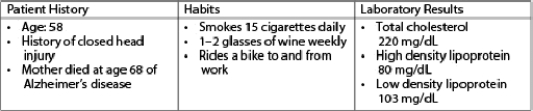
A)Tobacco use
B)Family history
C)Cholesterol level
D)Head injury history
A)Tobacco use
B)Family history
C)Cholesterol level
D)Head injury history
Question
Question
Question
Question
Question
Question
Question
Question
Question
Question
Question
Question
Question
Question
Question
Question
Question
Question
Question

Unlock Deck
Sign up to unlock the cards in this deck!
Unlock Deck
Unlock Deck
1/21

Play

Full screen (f)
Deck 59: Dementia and Delirium
1
Which action will help the nurse determine whether a new patient's confusion is caused by dementia or delirium?
A)Ask about a family history of dementia.
B)Administer the Mini-Mental Status Exam.
C)Use the Confusion Assessment Method tool.
D)Obtain a list of the patient's usual medications.
A)Ask about a family history of dementia.
B)Administer the Mini-Mental Status Exam.
C)Use the Confusion Assessment Method tool.
D)Obtain a list of the patient's usual medications.
Use the Confusion Assessment Method tool.
2
After reviewing the health record shown in the accompanying figure for a patient who has multiple risk factors for Alzheimer's disease (AD),which topic will be most important for the nurse to discuss with the patient?
A)Tobacco use
B)Family history
C)Cholesterol level
D)Head injury history
A)Tobacco use
B)Family history
C)Cholesterol level
D)Head injury history
Tobacco use
3
Which intervention will the nurse include in the plan of care for a patient with moderate dementia who had a fractured hip repair 2 days ago?
A)Provide complete personal hygiene care for the patient.
B)Remind the patient frequently about being in the hospital.
C)Reposition the patient frequently to avoid skin breakdown.
D)Place suction at the bedside to decrease the risk for aspiration.
A)Provide complete personal hygiene care for the patient.
B)Remind the patient frequently about being in the hospital.
C)Reposition the patient frequently to avoid skin breakdown.
D)Place suction at the bedside to decrease the risk for aspiration.
Remind the patient frequently about being in the hospital.
4
A patient who is hospitalized with pneumonia is disoriented and confused 3 days after admission. Which information indicates that the patient is experiencing delirium rather than dementia?
A)The patient was oriented and alert when admitted.
B)The patient's speech is fragmented and incoherent.
C)The patient is oriented to person but disoriented to place and time.
D)The patient has a history of increasing confusion over several years.
A)The patient was oriented and alert when admitted.
B)The patient's speech is fragmented and incoherent.
C)The patient is oriented to person but disoriented to place and time.
D)The patient has a history of increasing confusion over several years.
Unlock Deck
Unlock for access to all 21 flashcards in this deck.
Unlock Deck
k this deck
5
Which hospitalized patient will the nurse assign to the room closest to the nurses' station?
A)Patient with Alzheimer's disease who has long-term memory deficit
B)Patient with vascular dementia who takes medications for depression
C)Patient with new-onset confusion, restlessness, and irritability after surgery
D)Patient with dementia who has an abnormal Mini-Mental State Examination
A)Patient with Alzheimer's disease who has long-term memory deficit
B)Patient with vascular dementia who takes medications for depression
C)Patient with new-onset confusion, restlessness, and irritability after surgery
D)Patient with dementia who has an abnormal Mini-Mental State Examination
Unlock Deck
Unlock for access to all 21 flashcards in this deck.
Unlock Deck
k this deck
6
The day shift nurse at the long-term care facility learns that a patient with dementia experienced sundowning late in the afternoon on the previous two days. Which action should the nurse take?
A)Have the patient take a mid-morning nap.
B)Keep window blinds open during the day.
C)Provide hourly orientation to time and place.
D)Move the patient to a quiet room in the afternoon.
A)Have the patient take a mid-morning nap.
B)Keep window blinds open during the day.
C)Provide hourly orientation to time and place.
D)Move the patient to a quiet room in the afternoon.
Unlock Deck
Unlock for access to all 21 flashcards in this deck.
Unlock Deck
k this deck
7
The nurse is concerned about a postoperative patient's risk for injury during an episode of delirium. The most appropriate action by the nurse is to
A)secure the patient in bed using a soft chest restraint.
B)ask the health care provider to order an antipsychotic drug.
C)instruct family members to remain at the patient's bedside and prevent injury.
D)assign unlicensed assistive personnel (UAP) to stay with and reorient the patient.
A)secure the patient in bed using a soft chest restraint.
B)ask the health care provider to order an antipsychotic drug.
C)instruct family members to remain at the patient's bedside and prevent injury.
D)assign unlicensed assistive personnel (UAP) to stay with and reorient the patient.
Unlock Deck
Unlock for access to all 21 flashcards in this deck.
Unlock Deck
k this deck
8
A patient is being evaluated for Alzheimer's disease (AD). The nurse explains to the patient's adult children that
A)the most important risk factor for AD is a family history of the disorder.
B)a diagnosis of AD is made only after other causes of dementia are ruled out.
C)new drugs have been shown to reverse AD deterioration dramatically in some patients.
D)brain atrophy detected by magnetic resonance imaging (MRI) would confirm the diagnosis of AD.
A)the most important risk factor for AD is a family history of the disorder.
B)a diagnosis of AD is made only after other causes of dementia are ruled out.
C)new drugs have been shown to reverse AD deterioration dramatically in some patients.
D)brain atrophy detected by magnetic resonance imaging (MRI) would confirm the diagnosis of AD.
Unlock Deck
Unlock for access to all 21 flashcards in this deck.
Unlock Deck
k this deck
9
A 72-yr-old patient is brought to the clinic by the patient's spouse,who reports that the patient is unable to solve common problems around the house. To obtain information about the patient's current mental status,which question should the nurse ask the patient?
A)"Are you sad right now?"
B)"How is your self-image?"
C)"What did you eat for lunch?"
D)"Where were you were born?"
A)"Are you sad right now?"
B)"How is your self-image?"
C)"What did you eat for lunch?"
D)"Where were you were born?"
Unlock Deck
Unlock for access to all 21 flashcards in this deck.
Unlock Deck
k this deck
10
When administering a mental status examination to a patient with delirium,the nurse should
A)wait until the patient is well-rested.
B)administer an anxiolytic medication.
C)choose a place without distracting stimuli.
D)reorient the patient during the examination.
A)wait until the patient is well-rested.
B)administer an anxiolytic medication.
C)choose a place without distracting stimuli.
D)reorient the patient during the examination.
Unlock Deck
Unlock for access to all 21 flashcards in this deck.
Unlock Deck
k this deck
11
A patient who has severe Alzheimer's disease (AD)is being admitted to the hospital for surgery. Which intervention will the nurse include in the plan of care?
A)Encourage the patient to discuss events from the past.
B)Maintain a consistent daily routine for the patient's care.
C)Reorient the patient to the date and time every 2 to 3 hours.
D)Provide the patient with current newspapers and magazines.
A)Encourage the patient to discuss events from the past.
B)Maintain a consistent daily routine for the patient's care.
C)Reorient the patient to the date and time every 2 to 3 hours.
D)Provide the patient with current newspapers and magazines.
Unlock Deck
Unlock for access to all 21 flashcards in this deck.
Unlock Deck
k this deck
12
Which nursing action will be most effective in ensuring daily medication compliance for a patient with mild dementia?
A)Setting the medications up monthly in a medication box
B)Having the patient's family member administer the medication
C)Posting reminders to take the medications in the patient's house
D)Calling the patient weekly with a reminder to take the medication
A)Setting the medications up monthly in a medication box
B)Having the patient's family member administer the medication
C)Posting reminders to take the medications in the patient's house
D)Calling the patient weekly with a reminder to take the medication
Unlock Deck
Unlock for access to all 21 flashcards in this deck.
Unlock Deck
k this deck
13
The nurse is administering a mental status examination to a patient who has hypertension. The nurse suspects depression when the patient responds to the nurse's questions with
A)"Is that right?"
B)"I don't know."
C)"Wait, let me think about that."
D)"Who are those people over there?"
A)"Is that right?"
B)"I don't know."
C)"Wait, let me think about that."
D)"Who are those people over there?"
Unlock Deck
Unlock for access to all 21 flashcards in this deck.
Unlock Deck
k this deck
14
A patient seen in the outpatient clinic is diagnosed with mild cognitive impairment (MCI). Which action will the nurse include in the plan of care?
A)Suggest a move into an assisted living facility.
B)Schedule the patient for more frequent appointments.
C)Ask family members to supervise the patient's daily activities.
D)Discuss the preventive use of acetylcholinesterase medications.
A)Suggest a move into an assisted living facility.
B)Schedule the patient for more frequent appointments.
C)Ask family members to supervise the patient's daily activities.
D)Discuss the preventive use of acetylcholinesterase medications.
Unlock Deck
Unlock for access to all 21 flashcards in this deck.
Unlock Deck
k this deck
15
The spouse of a 67-yr-old male patient with early stage Alzheimer's disease (AD)tells the nurse,"I am exhausted from worrying all the time. I don't know what to do." Which actions are best for the nurse to take next ?
A)Suggest that a long-term care facility be considered.
B)Offer ideas for ways to distract or redirect the patient.
C)Teach the spouse about adult day care as a possible respite.
D)Suggest that the spouse consult with the physician for antianxiety drugs.
E)Ask the spouse what she knows and has considered about dementia care options.
A)Suggest that a long-term care facility be considered.
B)Offer ideas for ways to distract or redirect the patient.
C)Teach the spouse about adult day care as a possible respite.
D)Suggest that the spouse consult with the physician for antianxiety drugs.
E)Ask the spouse what she knows and has considered about dementia care options.
Unlock Deck
Unlock for access to all 21 flashcards in this deck.
Unlock Deck
k this deck
16
A patient is diagnosed with moderate dementia after multiple strokes. During assessment of the patient,the nurse would expect to find
A)excessive nighttime sleepiness.
B)difficulty eating and swallowing.
C)loss of recent and long-term memory.
D)fluctuating ability to perform simple tasks.
A)excessive nighttime sleepiness.
B)difficulty eating and swallowing.
C)loss of recent and long-term memory.
D)fluctuating ability to perform simple tasks.
Unlock Deck
Unlock for access to all 21 flashcards in this deck.
Unlock Deck
k this deck
17
The nurse's initial action for a patient with moderate dementia who develops increased restlessness and agitation should be to
A)reorient the patient to time, place, and person.
B)administer a PRN dose of lorazepam (Ativan).
C)assess for factors that might be causing discomfort.
D)assign unlicensed assistive personnel (UAP) to stay in the patient's room.
A)reorient the patient to time, place, and person.
B)administer a PRN dose of lorazepam (Ativan).
C)assess for factors that might be causing discomfort.
D)assign unlicensed assistive personnel (UAP) to stay in the patient's room.
Unlock Deck
Unlock for access to all 21 flashcards in this deck.
Unlock Deck
k this deck
18
After change-of-shift report on the Alzheimer's disease/dementia unit,which patient will the nurse assess first?
A)Patient who has not had a bowel movement for 5 days
B)Patient who has a stage II pressure ulcer on the coccyx
C)Patient who is refusing to take the prescribed medications
D)Patient who developed a new cough after eating breakfast
A)Patient who has not had a bowel movement for 5 days
B)Patient who has a stage II pressure ulcer on the coccyx
C)Patient who is refusing to take the prescribed medications
D)Patient who developed a new cough after eating breakfast
Unlock Deck
Unlock for access to all 21 flashcards in this deck.
Unlock Deck
k this deck
19
When administering the Mini-Cog exam to a patient with possible Alzheimer's disease,which action will the nurse take?
A)Check the patient's orientation to time and date.
B)Obtain a list of the patient's prescribed medications.
C)Ask the person to use a clock drawing to indicate a specific time.
D)Determine the patient's ability to recognize a common object such as a pen.
A)Check the patient's orientation to time and date.
B)Obtain a list of the patient's prescribed medications.
C)Ask the person to use a clock drawing to indicate a specific time.
D)Determine the patient's ability to recognize a common object such as a pen.
Unlock Deck
Unlock for access to all 21 flashcards in this deck.
Unlock Deck
k this deck
20
A patient with Alzheimer's disease (AD)who is being admitted to a long-term care facility has had several episodes of wandering away from home. Which action will the nurse include in the plan of care?
A)Reorient the patient several times daily.
B)Have the family bring in familiar items.
C)Place the patient in a room close to the nurses' station.
D)Ask the patient why the wandering episodes have occurred.
A)Reorient the patient several times daily.
B)Have the family bring in familiar items.
C)Place the patient in a room close to the nurses' station.
D)Ask the patient why the wandering episodes have occurred.
Unlock Deck
Unlock for access to all 21 flashcards in this deck.
Unlock Deck
k this deck
21
Which actions could the nurse delegate to a licensed practical/vocational nurse (LPN/LVN)who is part of the team caring for a patient with Alzheimer's disease ?
A)Develop a plan to minimize difficult behavior.
B)Administer the prescribed memantine (Namenda).
C)Remove potential safety hazards from the patient's environment.
D)Refer the patient and caregivers to appropriate community resources.
E)Help the patient and caregivers choose memory enhancement methods.
F)Evaluate the effectiveness of the prescribed enteral feedings on patient nutrition.
A)Develop a plan to minimize difficult behavior.
B)Administer the prescribed memantine (Namenda).
C)Remove potential safety hazards from the patient's environment.
D)Refer the patient and caregivers to appropriate community resources.
E)Help the patient and caregivers choose memory enhancement methods.
F)Evaluate the effectiveness of the prescribed enteral feedings on patient nutrition.
Unlock Deck
Unlock for access to all 21 flashcards in this deck.
Unlock Deck
k this deck
Unlock Deck
Unlock for access to all 21 flashcards in this deck.






