







 Chat with AI

Deck 5: Civil Rights
Full screen (f)

Question

Question
Question
Question
Question
Question
Question
Question
Question
Question
Question
Question
Question
Question
Question
Question
Question
Question
Question
Question
Question
Question
Question
Question
Question
Question
Question
Question
Question
Question
Question
Question
Question
Question
Question
Question
Question
Question
Question
Question
Question
Question
Question
Question
Question
Question
Question
Question
Question
Question
Question
Question
Question
Question
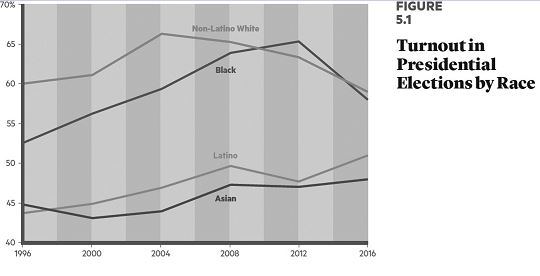
Which one of the following groups voted at the highest proportion in the 2012 presidential election?
A) Caucasian Americans
C) Latino Americans
B) African Americans
D) Asian Americans
Question
Question
Question
Question
Question
Question
Question
Question
Question
Question
Question
Question
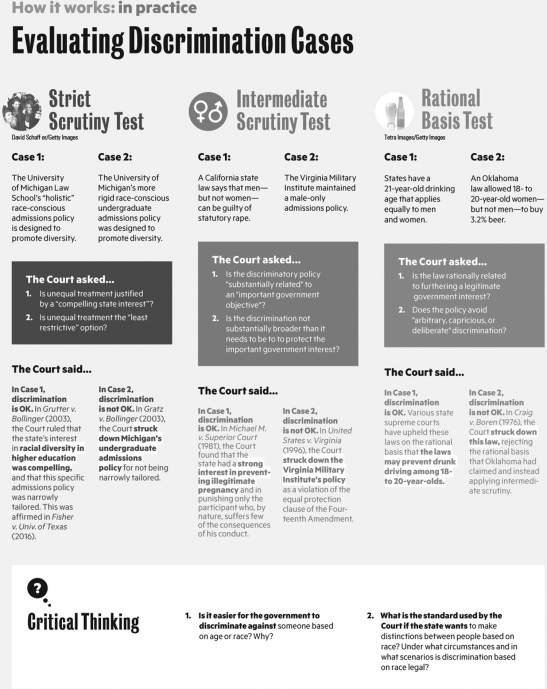
The strict scrutiny test holds that
A) discrimination is permitted if a reasonable argument could be made for such behavior.
B) discrimination is allowed when an intermediary is carrying it out.
C) discrimination is only allowed when there is a compelling state interest at stake.
D) states should be allowed to pass laws in the best interests of their citizens.
Question
Question
Question
Question
Question
Question
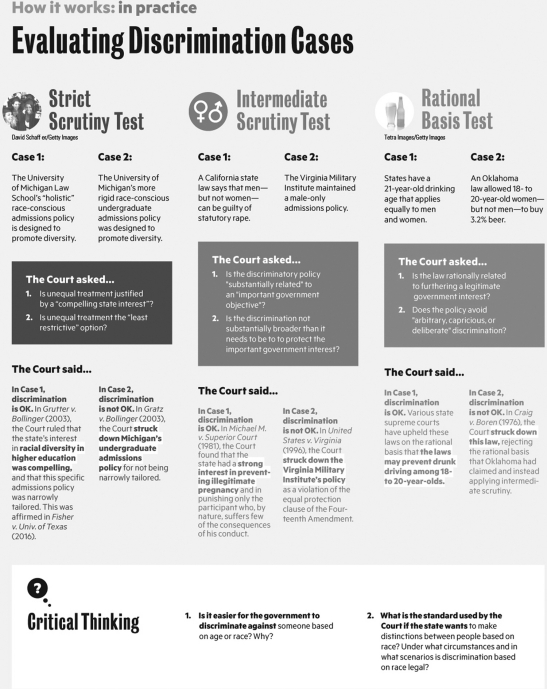
The rational basis test holds that
A) discrimination is permitted if an argument could be made for such behavior that was not racial.
B) discrimination is allowed when an important government objective is served.
C) discrimination is only allowed when there is a compelling state interest at stake.
D) no discrimination should be allowed.
Question
Question
Question
Question
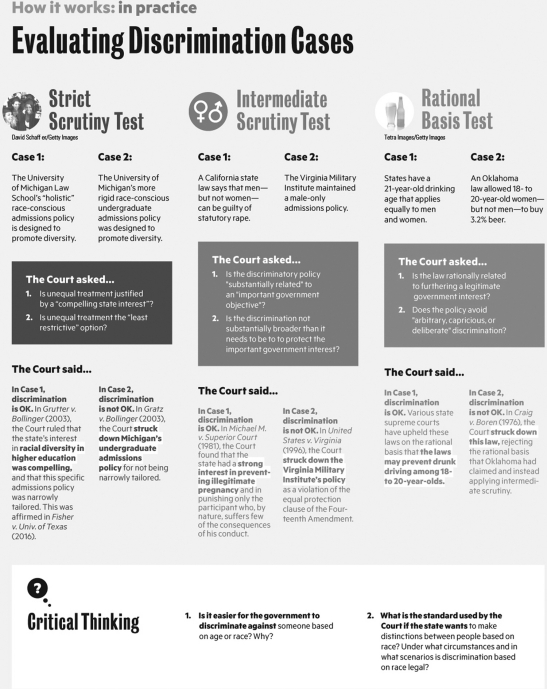
The intermediate scrutiny test holds that
A) discrimination is permitted if a reasonable argument could be made for such behavior.
B) discrimination is allowed when an important government objective is served.
C) discrimination is only allowed when an intermediary is carrying it out.
D) no discrimination should be allowed.
Question
Question
Question
Question

Unlock Deck
Sign up to unlock the cards in this deck!
Unlock Deck
Unlock Deck
1/96

Play

Full screen (f)
Deck 5: Civil Rights
1
While the standard test for the legality of unequal treatment of racial minorities and women is strict scrutiny, the test for other groups, such as homosexuals, is intermediate scrutiny.
False
2
The Supreme Court justices overturned part of the Violence Against Women Act of 1994.
True
3
Slavery began in America in 1619.
True
4
Most Americans today believe that the immigration system in the United States works fairly effectively.
Unlock Deck
Unlock for access to all 96 flashcards in this deck.
Unlock Deck
k this deck
5
The Civil War amendments banned the most important practices associated with slavery and guaranteed equal protection under the law.
Unlock Deck
Unlock for access to all 96 flashcards in this deck.
Unlock Deck
k this deck
6
The belief that women were not strong enough to compete in the business world was called protectionism.
Unlock Deck
Unlock for access to all 96 flashcards in this deck.
Unlock Deck
k this deck
7
While ________ involve limits on government action, ________ involve protection from discrimination by either government or individuals.
A) civil rights; civil liberties
C) affirmative action policies; civil liberties
B) civil rights; affirmative action policies
D) civil liberties; civil rights
A) civil rights; civil liberties
C) affirmative action policies; civil liberties
B) civil rights; affirmative action policies
D) civil liberties; civil rights
Unlock Deck
Unlock for access to all 96 flashcards in this deck.
Unlock Deck
k this deck
8
The National Association for the Advancement of Colored People (NAACP) was formed in the 1950s to help register voters in the South.
Unlock Deck
Unlock for access to all 96 flashcards in this deck.
Unlock Deck
k this deck
9
African Americans are more likely than white Americans to be convicted for the same crimes, and they tend to serve longer sentences as well.
Unlock Deck
Unlock for access to all 96 flashcards in this deck.
Unlock Deck
k this deck
10
The 1965 Voting Rights Act, which did away with literacy tests and other voter registration tests, successfully narrowed the gap between white and African-American registration rates in the South.
Unlock Deck
Unlock for access to all 96 flashcards in this deck.
Unlock Deck
k this deck
11
Slavery
A) was not part of the American economy prior to 1754.
B) was so widespread in the South that slaves made up 84 percent of the population in 1860.
C) was part of the American economy since the founding of Jamestown.
D) was almost nullified by the Missouri Compromise.
A) was not part of the American economy prior to 1754.
B) was so widespread in the South that slaves made up 84 percent of the population in 1860.
C) was part of the American economy since the founding of Jamestown.
D) was almost nullified by the Missouri Compromise.
Unlock Deck
Unlock for access to all 96 flashcards in this deck.
Unlock Deck
k this deck
12
The first African-American congressional members from the South appeared long after the civil rights movement achieved its major victories during the 1960s.
Unlock Deck
Unlock for access to all 96 flashcards in this deck.
Unlock Deck
k this deck
13
Civil rights are
A) guarantees of equal protection under the law.
B) prohibitions on government action against individuals.
C) another name for civil liberties.
D) guarantees of equality of outcomes.
A) guarantees of equal protection under the law.
B) prohibitions on government action against individuals.
C) another name for civil liberties.
D) guarantees of equality of outcomes.
Unlock Deck
Unlock for access to all 96 flashcards in this deck.
Unlock Deck
k this deck
14
Because of laws passed during the past 50 years, there are almost no differences between the objective conditions of racial minorities and whites.
Unlock Deck
Unlock for access to all 96 flashcards in this deck.
Unlock Deck
k this deck
15
The recent effort of the Supreme Court to impose "color-blind jurisprudence" has made it more difficult to demonstrate discrimination, putting a greater burden of proof on plaintiffs.
Unlock Deck
Unlock for access to all 96 flashcards in this deck.
Unlock Deck
k this deck
16
The proposed Equal Rights Amendment in the 1970s stated that equal protection cannot be denied on the basis of sex.
Unlock Deck
Unlock for access to all 96 flashcards in this deck.
Unlock Deck
k this deck
17
________ gained the right to vote in 1924, just after women.
A) African Americans
C) Japanese Americans
B) Native Americans
D) Latinos
A) African Americans
C) Japanese Americans
B) Native Americans
D) Latinos
Unlock Deck
Unlock for access to all 96 flashcards in this deck.
Unlock Deck
k this deck
18
Which one of the following is a question of civil rights rather than of civil liberties?
A) the right to attend a political rally
B) access to an abortion
C) newspaper articles publishing government information
D) accessibility to a business for a person in a wheelchair
A) the right to attend a political rally
B) access to an abortion
C) newspaper articles publishing government information
D) accessibility to a business for a person in a wheelchair
Unlock Deck
Unlock for access to all 96 flashcards in this deck.
Unlock Deck
k this deck
19
White women obtained the right to vote before African Americans did, because white women were able to pressure their husbands and fathers for the vote without fear of retribution.
Unlock Deck
Unlock for access to all 96 flashcards in this deck.
Unlock Deck
k this deck
20
Affirmative action has been strengthened over time as the Supreme Court justices have consistently found it to be constitutional.
Unlock Deck
Unlock for access to all 96 flashcards in this deck.
Unlock Deck
k this deck
21
The Stonewall Inn
A) is associated with the gay rights movement.
B) is associated with the women's movement.
C) is associated with the environmental movement.
D) is associated with the plight of Latinos in the United States.
A) is associated with the gay rights movement.
B) is associated with the women's movement.
C) is associated with the environmental movement.
D) is associated with the plight of Latinos in the United States.
Unlock Deck
Unlock for access to all 96 flashcards in this deck.
Unlock Deck
k this deck
22
The ________ Amendment gave African-American men the right to vote.
A) Thirteenth
C) Eighteenth
B) Fifteenth
D) Nineteenth
A) Thirteenth
C) Eighteenth
B) Fifteenth
D) Nineteenth
Unlock Deck
Unlock for access to all 96 flashcards in this deck.
Unlock Deck
k this deck
23
Which Supreme Court case validated the type of discrimination established by Jim Crow laws?
A) Munn v. Illinois
C) Plessy v. Ferguson
B) Bradwell v. Illinois
D) Smith v. Allwright
A) Munn v. Illinois
C) Plessy v. Ferguson
B) Bradwell v. Illinois
D) Smith v. Allwright
Unlock Deck
Unlock for access to all 96 flashcards in this deck.
Unlock Deck
k this deck
24
Despite having long-standing roots in the United States, Latinos have only recently become a political force because
A) they are a politically diverse group of voters.
B) there are not enough Latino voters to compel politicians to pay attention to this group.
C) conflict between African American and Latino politicians has led to internal rifts.
D) Latinos have only recently received the right to vote.
A) they are a politically diverse group of voters.
B) there are not enough Latino voters to compel politicians to pay attention to this group.
C) conflict between African American and Latino politicians has led to internal rifts.
D) Latinos have only recently received the right to vote.
Unlock Deck
Unlock for access to all 96 flashcards in this deck.
Unlock Deck
k this deck
25
Which one of the following is true about Native Americans in the nineteenth century?
A) The "Five Civilized Tribes" were removed from their ancestral lands.
B) The U.S. government launched a policy of assimilation.
C) Native Americans were allowed to vote in federal and state elections.
D) U.S. government officials refused to sign treaties with Native American tribes recognizing their sovereignty.
A) The "Five Civilized Tribes" were removed from their ancestral lands.
B) The U.S. government launched a policy of assimilation.
C) Native Americans were allowed to vote in federal and state elections.
D) U.S. government officials refused to sign treaties with Native American tribes recognizing their sovereignty.
Unlock Deck
Unlock for access to all 96 flashcards in this deck.
Unlock Deck
k this deck
26
The rationale justifying policies that prevented women from holding political office, filing lawsuits, and similar activities was known as ________.
A) affirmative action
C) protectionism
B) segregation
D) separate but equal
A) affirmative action
C) protectionism
B) segregation
D) separate but equal
Unlock Deck
Unlock for access to all 96 flashcards in this deck.
Unlock Deck
k this deck
27
Legal segregation of the races was justified by
A) the separate but equal doctrine.
B) the equality of opportunity doctrine.
C) Jim Crow laws.
D) the doctrine of selective incorporation.
A) the separate but equal doctrine.
B) the equality of opportunity doctrine.
C) Jim Crow laws.
D) the doctrine of selective incorporation.
Unlock Deck
Unlock for access to all 96 flashcards in this deck.
Unlock Deck
k this deck
28
The ________ Amendment abolished slavery.
A) Eleventh
C) Thirteenth
B) Twelfth
D) Fourteenth
A) Eleventh
C) Thirteenth
B) Twelfth
D) Fourteenth
Unlock Deck
Unlock for access to all 96 flashcards in this deck.
Unlock Deck
k this deck
29
Women were guaranteed the right to vote across the United States through the ________.
A) Voting Rights Act of 1965
C) Equal Rights Amendment
B) Nineteenth Amendment
D) Civil Rights Act of 1964
A) Voting Rights Act of 1965
C) Equal Rights Amendment
B) Nineteenth Amendment
D) Civil Rights Act of 1964
Unlock Deck
Unlock for access to all 96 flashcards in this deck.
Unlock Deck
k this deck
30
The white primary
A) effectively disenfranchised African-American voters in the South.
B) effectively disenfranchised African-American voters in the North.
C) was race neutral in its intent.
D) largely had no impact on elections in the South.
A) effectively disenfranchised African-American voters in the South.
B) effectively disenfranchised African-American voters in the North.
C) was race neutral in its intent.
D) largely had no impact on elections in the South.
Unlock Deck
Unlock for access to all 96 flashcards in this deck.
Unlock Deck
k this deck
31
In 1873, the Supreme Court justices
A) started affirmative action.
B) determined that women had no constitutional right to be an attorney.
C) determined that women should have the right to vote.
D) started the process of selective incorporation.
A) started affirmative action.
B) determined that women had no constitutional right to be an attorney.
C) determined that women should have the right to vote.
D) started the process of selective incorporation.
Unlock Deck
Unlock for access to all 96 flashcards in this deck.
Unlock Deck
k this deck
32
The grandfather clause allowed
A) southern whites to bypass literacy and other obstacles to voting.
B) African Americans in the South to hold public office.
C) the development of Jim Crow laws in the North.
D) the banning of segregation in the South.
A) southern whites to bypass literacy and other obstacles to voting.
B) African Americans in the South to hold public office.
C) the development of Jim Crow laws in the North.
D) the banning of segregation in the South.
Unlock Deck
Unlock for access to all 96 flashcards in this deck.
Unlock Deck
k this deck
33
At the end of Reconstruction, ________ were NOT used to disenfranchise African-Americans voters in the South.
A) age requirements
C) literacy tests
B) poll taxes
D) white primaries
A) age requirements
C) literacy tests
B) poll taxes
D) white primaries
Unlock Deck
Unlock for access to all 96 flashcards in this deck.
Unlock Deck
k this deck
34
The Missouri Compromise
A) required escaped slaves to be returned to their owners.
B) allowed each state to determine for itself whether to allow slavery.
C) banned the importation of new slaves into America.
D) ensured an overall balance between the number of free states and slave states.
A) required escaped slaves to be returned to their owners.
B) allowed each state to determine for itself whether to allow slavery.
C) banned the importation of new slaves into America.
D) ensured an overall balance between the number of free states and slave states.
Unlock Deck
Unlock for access to all 96 flashcards in this deck.
Unlock Deck
k this deck
35
The Supreme Court justices determined that slaves were property and therefore had no legal rights in ________.
A) Plessy v. Ferguson
B) University of California Regents v. Bakke
C) Dred Scott v. Sandford
D) Brown v. Board of Education
A) Plessy v. Ferguson
B) University of California Regents v. Bakke
C) Dred Scott v. Sandford
D) Brown v. Board of Education
Unlock Deck
Unlock for access to all 96 flashcards in this deck.
Unlock Deck
k this deck
36
Reconstruction
A) ended right after the Civil War.
B) lasted from 1865-1877.
C) ended in the early twentieth century.
D) ended with the passage of the Thirteenth Amendment.
A) ended right after the Civil War.
B) lasted from 1865-1877.
C) ended in the early twentieth century.
D) ended with the passage of the Thirteenth Amendment.
Unlock Deck
Unlock for access to all 96 flashcards in this deck.
Unlock Deck
k this deck
37
The Fourteenth Amendment ________.
A) outlawed slavery
B) stipulated that states could not deny freed slaves equal protection of the laws
C) gave former slaves the right to vote in federal elections
D) gave women the right to vote in federal elections
A) outlawed slavery
B) stipulated that states could not deny freed slaves equal protection of the laws
C) gave former slaves the right to vote in federal elections
D) gave women the right to vote in federal elections
Unlock Deck
Unlock for access to all 96 flashcards in this deck.
Unlock Deck
k this deck
38
What were the Jim Crow laws in the South?
A) rules that led to segregation of the races
B) informal restrictions on African-American voters enforced by intimidation
C) prohibitions against African-American participation in Democratic Party primaries
D) laws that allowed whites to avoid voting restrictions that kept African Americans disenfranchised
A) rules that led to segregation of the races
B) informal restrictions on African-American voters enforced by intimidation
C) prohibitions against African-American participation in Democratic Party primaries
D) laws that allowed whites to avoid voting restrictions that kept African Americans disenfranchised
Unlock Deck
Unlock for access to all 96 flashcards in this deck.
Unlock Deck
k this deck
39
Which one of the following events caused the southern states to secede from the Union and create the Confederacy?
A) the election of Abraham Lincoln to the presidency
B) passage of the Fugitive Slave Act
C) Missouri Compromise
D) admission of California to the United States
A) the election of Abraham Lincoln to the presidency
B) passage of the Fugitive Slave Act
C) Missouri Compromise
D) admission of California to the United States
Unlock Deck
Unlock for access to all 96 flashcards in this deck.
Unlock Deck
k this deck
40
________ ordered the integration of the U.S. armed services.
A) Harry Truman
C) Dwight Eisenhower
B) John Foster Dulles
D) Douglas MacArthur
A) Harry Truman
C) Dwight Eisenhower
B) John Foster Dulles
D) Douglas MacArthur
Unlock Deck
Unlock for access to all 96 flashcards in this deck.
Unlock Deck
k this deck
41
What is de facto segregation?
A) legal discrimination based in the law
B) discrimination based in actual conditions experienced by people
C) offering racial minorities chances to catch up to other groups
D) policies at the state level that federal officials have no right to question
A) legal discrimination based in the law
B) discrimination based in actual conditions experienced by people
C) offering racial minorities chances to catch up to other groups
D) policies at the state level that federal officials have no right to question
Unlock Deck
Unlock for access to all 96 flashcards in this deck.
Unlock Deck
k this deck
42
Why did NAACP officials decide to challenge segregation in law schools before challenging it more broadly?
A) The Supreme Court had ruled segregated law schools illegal in the 1890s.
B) No law schools admitted African Americans in the 1930s.
C) The president had asked them to begin with this policy area.
D) The NAACP leaders believed Supreme Court justices would be most familiar with law schools.
A) The Supreme Court had ruled segregated law schools illegal in the 1890s.
B) No law schools admitted African Americans in the 1930s.
C) The president had asked them to begin with this policy area.
D) The NAACP leaders believed Supreme Court justices would be most familiar with law schools.
Unlock Deck
Unlock for access to all 96 flashcards in this deck.
Unlock Deck
k this deck
43
When did the first wave of Chinese immigrants come to the United States?
A) During the 1780s when the country first began under the Constitution.
B) During the California gold rush in the 1840s.
C) During industrialization in New York City in the 1880s.
D) During the communist revolution in China in the 1940s.
A) During the 1780s when the country first began under the Constitution.
B) During the California gold rush in the 1840s.
C) During industrialization in New York City in the 1880s.
D) During the communist revolution in China in the 1940s.
Unlock Deck
Unlock for access to all 96 flashcards in this deck.
Unlock Deck
k this deck
44
Poverty
A) is distributed equally in the United States.
B) is concentrated in Caucasian America.
C) is concentrated in areas where the minority population is the highest.
D) has largely been eradicated in the United States.
A) is distributed equally in the United States.
B) is concentrated in Caucasian America.
C) is concentrated in areas where the minority population is the highest.
D) has largely been eradicated in the United States.
Unlock Deck
Unlock for access to all 96 flashcards in this deck.
Unlock Deck
k this deck
45
Which of these events initially signified a shift in tactics employed by the civil rights movement?
A) "Letter from Birmingham Jail"
B) "I Have a Dream" speech
C) sit-in at Woolworth's lunch counter
D) Civil Rights Act of 1964
A) "Letter from Birmingham Jail"
B) "I Have a Dream" speech
C) sit-in at Woolworth's lunch counter
D) Civil Rights Act of 1964
Unlock Deck
Unlock for access to all 96 flashcards in this deck.
Unlock Deck
k this deck
46
Before the 1950s, what was the principle tactic used by members of the civil rights movement to press their cause?
A) nonviolent protest
C) legal action
B) sit-ins
D) violent protests
A) nonviolent protest
C) legal action
B) sit-ins
D) violent protests
Unlock Deck
Unlock for access to all 96 flashcards in this deck.
Unlock Deck
k this deck
47
African Americans are ________ Caucasian Americans to be convicted of the same crime, and African Americans are ________ than whites to serve longer sentences once convicted.
A) more likely than; less likely
C) more likely than; more likely
B) less likely than; more likely
D) less likely than; less likely
A) more likely than; less likely
C) more likely than; more likely
B) less likely than; more likely
D) less likely than; less likely
Unlock Deck
Unlock for access to all 96 flashcards in this deck.
Unlock Deck
k this deck
48
________ began his career as a lawyer for the NAACP and later became the first African-American Supreme Court justice.
A) Martin Luther King Jr.
C) Clarence Thomas
B) Thurgood Marshall
D) Earl Warren
A) Martin Luther King Jr.
C) Clarence Thomas
B) Thurgood Marshall
D) Earl Warren
Unlock Deck
Unlock for access to all 96 flashcards in this deck.
Unlock Deck
k this deck
49
In the 1960s, the Supreme Court justices
A) struck down state laws that forbade interracial marriages.
B) upheld state laws that forbade interracial marriages.
C) declared the Voting Rights Act unconstitutional.
D) determined that Congress lacked the authority to end segregation in public places.
A) struck down state laws that forbade interracial marriages.
B) upheld state laws that forbade interracial marriages.
C) declared the Voting Rights Act unconstitutional.
D) determined that Congress lacked the authority to end segregation in public places.
Unlock Deck
Unlock for access to all 96 flashcards in this deck.
Unlock Deck
k this deck
50
What is important about Martin Luther King's "Letter from Birmingham Jail"?
A) It outlined the principles of civil disobedience.
B) It led to a large boycott of segregation in public transportation.
C) It laid the foundation for color-blind principles.
D) It was the last thing he wrote before his assassination.
A) It outlined the principles of civil disobedience.
B) It led to a large boycott of segregation in public transportation.
C) It laid the foundation for color-blind principles.
D) It was the last thing he wrote before his assassination.
Unlock Deck
Unlock for access to all 96 flashcards in this deck.
Unlock Deck
k this deck
51
Before the 1950s, schools in many parts of the country were segregated due to
A) de jure segregation.
C) unimpeachable segregation.
B) de facto segregation.
D) de rigueur segregation.
A) de jure segregation.
C) unimpeachable segregation.
B) de facto segregation.
D) de rigueur segregation.
Unlock Deck
Unlock for access to all 96 flashcards in this deck.
Unlock Deck
k this deck
52
By the 1970s, many schools remained segregated due to
A) de jure segregation.
C) unimpeachable segregation.
B) de facto segregation.
D) de rigueur segregation.
A) de jure segregation.
C) unimpeachable segregation.
B) de facto segregation.
D) de rigueur segregation.
Unlock Deck
Unlock for access to all 96 flashcards in this deck.
Unlock Deck
k this deck
53
Which one of the following statements is accurate?
A) There is no longer discrimination in voting in the United States.
B) Voter intimidation and deceptive practices still exist in the United States today.
C) Most states have new laws that expand access to voting.
D) The Supreme Court justices have upheld the Voting Rights Act in order to guarantee equal access to voting for all citizens.
A) There is no longer discrimination in voting in the United States.
B) Voter intimidation and deceptive practices still exist in the United States today.
C) Most states have new laws that expand access to voting.
D) The Supreme Court justices have upheld the Voting Rights Act in order to guarantee equal access to voting for all citizens.
Unlock Deck
Unlock for access to all 96 flashcards in this deck.
Unlock Deck
k this deck
54
Which one of the following groups voted at the highest proportion in the 2012 presidential election?
A) Caucasian Americans
C) Latino Americans
B) African Americans
D) Asian Americans
Unlock Deck
Unlock for access to all 96 flashcards in this deck.
Unlock Deck
k this deck
55
Which one of the following is true about Asian Americans?
A) Asian Americans are quite diverse in their political views.
B) Most Asian Americans come from Japan.
C) Most Asian Americans come from China.
D) Asian Americans tend to be staunch Republicans.
A) Asian Americans are quite diverse in their political views.
B) Most Asian Americans come from Japan.
C) Most Asian Americans come from China.
D) Asian Americans tend to be staunch Republicans.
Unlock Deck
Unlock for access to all 96 flashcards in this deck.
Unlock Deck
k this deck
56
What happened when the Supreme Court justices approved school busing to advance school desegregation?
A) white flight from the cities to the suburbs
B) more de facto segregation
C) the civil rights movement began organizing mass protests instead of taking legal action
D) members of Congress intervened and passed laws guaranteeing civil rights to African Americans
A) white flight from the cities to the suburbs
B) more de facto segregation
C) the civil rights movement began organizing mass protests instead of taking legal action
D) members of Congress intervened and passed laws guaranteeing civil rights to African Americans
Unlock Deck
Unlock for access to all 96 flashcards in this deck.
Unlock Deck
k this deck
57
How did the Freedom Riders advance the cause of civil rights?
A) They forced the Supreme Court to reconsider its "separate but equal" ruling.
B) They drew attention to the resistance to desegregation in the South.
C) They led to passage of a new civil rights amendment.
D) They led to passage of the Voting Rights Act.
A) They forced the Supreme Court to reconsider its "separate but equal" ruling.
B) They drew attention to the resistance to desegregation in the South.
C) They led to passage of a new civil rights amendment.
D) They led to passage of the Voting Rights Act.
Unlock Deck
Unlock for access to all 96 flashcards in this deck.
Unlock Deck
k this deck
58
The poverty rate is roughly three times as great for ________ families as for ________ families.
A) African-American; Latino
C) African-American; Caucasian
B) Caucasian; Latino
D) Asian-American; Caucasian
A) African-American; Latino
C) African-American; Caucasian
B) Caucasian; Latino
D) Asian-American; Caucasian
Unlock Deck
Unlock for access to all 96 flashcards in this deck.
Unlock Deck
k this deck
59
The ________ was the first group to advocate desegregation.
A) Democratic Party
B) Republican Party
C) Socialist Party
D) National Association for the Advancement of Colored People
A) Democratic Party
B) Republican Party
C) Socialist Party
D) National Association for the Advancement of Colored People
Unlock Deck
Unlock for access to all 96 flashcards in this deck.
Unlock Deck
k this deck
60
What is de jure segregation?
A) policies at the state level that federal officials have no right to question
B) discrimination based in actual conditions experienced by people
C) offering racial minorities chances to catch up to other groups
D) legal discrimination based in law or policy
A) policies at the state level that federal officials have no right to question
B) discrimination based in actual conditions experienced by people
C) offering racial minorities chances to catch up to other groups
D) legal discrimination based in law or policy
Unlock Deck
Unlock for access to all 96 flashcards in this deck.
Unlock Deck
k this deck
61
What is the primary constitutional issue involving affirmative action cases in college admissions?
A) free speech
C) supremacy clause
B) due process
D) equal protection
A) free speech
C) supremacy clause
B) due process
D) equal protection
Unlock Deck
Unlock for access to all 96 flashcards in this deck.
Unlock Deck
k this deck
62
Affirmative action refers to
A) efforts to fight discrimination against any group, including whites, based on the law.
B) efforts to end discrimination based on the actual conditions of people.
C) offering racial minorities chances to catch up through legal means to compensate for discrimination.
D) steps taken by the government to outlaw acts of racism and bigotry, including hate speech.
A) efforts to fight discrimination against any group, including whites, based on the law.
B) efforts to end discrimination based on the actual conditions of people.
C) offering racial minorities chances to catch up through legal means to compensate for discrimination.
D) steps taken by the government to outlaw acts of racism and bigotry, including hate speech.
Unlock Deck
Unlock for access to all 96 flashcards in this deck.
Unlock Deck
k this deck
63
The landmark decision by the Supreme Court regarding affirmative action is ________.
A) Brown v. Board of Education
B) Dred Scott v. Sandford
C) Plessy v. Ferguson
D) Regents of the University of California v. Bakke
A) Brown v. Board of Education
B) Dred Scott v. Sandford
C) Plessy v. Ferguson
D) Regents of the University of California v. Bakke
Unlock Deck
Unlock for access to all 96 flashcards in this deck.
Unlock Deck
k this deck
64
What is the substantive due process doctrine?
A) the standard for discriminating against homosexuals
B) the justification underlying the reasonable basis test
C) the Supreme Court's power to overturn laws that infringe on individual liberties
D) procedural rights guaranteed within the criminal justice system
A) the standard for discriminating against homosexuals
B) the justification underlying the reasonable basis test
C) the Supreme Court's power to overturn laws that infringe on individual liberties
D) procedural rights guaranteed within the criminal justice system
Unlock Deck
Unlock for access to all 96 flashcards in this deck.
Unlock Deck
k this deck
65
According to the Supreme Court ruling in 1971, employment tests not related to job performance are a violation of ________.
A) the commerce clause
C) the 1965 Voting Rights Act
B) the supremacy clause
D) the 1964 Civil Rights Act
A) the commerce clause
C) the 1965 Voting Rights Act
B) the supremacy clause
D) the 1964 Civil Rights Act
Unlock Deck
Unlock for access to all 96 flashcards in this deck.
Unlock Deck
k this deck
66
The strict scrutiny test holds that
A) discrimination is permitted if a reasonable argument could be made for such behavior.
B) discrimination is allowed when an intermediary is carrying it out.
C) discrimination is only allowed when there is a compelling state interest at stake.
D) states should be allowed to pass laws in the best interests of their citizens.
Unlock Deck
Unlock for access to all 96 flashcards in this deck.
Unlock Deck
k this deck
67
The largest sexual discrimination case in U.S. history was filed in 2001 against ________.
A) Walmart
C) Lockheed
B) Boeing
D) Denny's
A) Walmart
C) Lockheed
B) Boeing
D) Denny's
Unlock Deck
Unlock for access to all 96 flashcards in this deck.
Unlock Deck
k this deck
68
In what decade did the Supreme Court finally begin rejecting protectionism as a reason for treating women differently from men?
A) 1990s
C) 1930s
B) 1970s
D) 1910s
A) 1990s
C) 1930s
B) 1970s
D) 1910s
Unlock Deck
Unlock for access to all 96 flashcards in this deck.
Unlock Deck
k this deck
69
What did the 1964 Civil Rights Act achieve?
A) It barred discrimination specifically in the housing industry.
B) It banned segregation in public places.
C) It put federal election monitors in place in the South to ensure the voting rights of African Americans.
D) It outlawed slavery.
A) It barred discrimination specifically in the housing industry.
B) It banned segregation in public places.
C) It put federal election monitors in place in the South to ensure the voting rights of African Americans.
D) It outlawed slavery.
Unlock Deck
Unlock for access to all 96 flashcards in this deck.
Unlock Deck
k this deck
70
President ________ initiated the policy of affirmative action.
A) Harry Truman
C) Lyndon Johnson
B) Dwight Eisenhower
D) Bill Clinton
A) Harry Truman
C) Lyndon Johnson
B) Dwight Eisenhower
D) Bill Clinton
Unlock Deck
Unlock for access to all 96 flashcards in this deck.
Unlock Deck
k this deck
71
In Shaw v. Reno, the Supreme Court justices ruled that congressional districts drawn principally on the basis of race are unconstitutional, thus promoting the idea of ________.
A) de jure segregation
C) affirmative action
B) color-blind jurisprudence
D) the disparate impact standard
A) de jure segregation
C) affirmative action
B) color-blind jurisprudence
D) the disparate impact standard
Unlock Deck
Unlock for access to all 96 flashcards in this deck.
Unlock Deck
k this deck
72
The rational basis test holds that
A) discrimination is permitted if an argument could be made for such behavior that was not racial.
B) discrimination is allowed when an important government objective is served.
C) discrimination is only allowed when there is a compelling state interest at stake.
D) no discrimination should be allowed.
Unlock Deck
Unlock for access to all 96 flashcards in this deck.
Unlock Deck
k this deck
73
What was a result of the passage of the 1965 Voting Rights Act?
A) The percentage of women in the workplace increased.
B) The Democratic Party began winning southern states in presidential elections.
C) The gap between Caucasian and African-American voting rates narrowed.
D) The Supreme Court became more responsive to the needs of minorities.
A) The percentage of women in the workplace increased.
B) The Democratic Party began winning southern states in presidential elections.
C) The gap between Caucasian and African-American voting rates narrowed.
D) The Supreme Court became more responsive to the needs of minorities.
Unlock Deck
Unlock for access to all 96 flashcards in this deck.
Unlock Deck
k this deck
74
Which one of the following describes the disparate impact standard of discrimination?
A) when company officials provide equality of outcome, including salaries, for all employees, regardless of their role in the company
B) when company officials create policies that have negative consequences for racial minorities
C) when company officials determine that affirmative action is unlawful in their organization
D) when company officials mandate racial quotas in all aspects of hiring
A) when company officials provide equality of outcome, including salaries, for all employees, regardless of their role in the company
B) when company officials create policies that have negative consequences for racial minorities
C) when company officials determine that affirmative action is unlawful in their organization
D) when company officials mandate racial quotas in all aspects of hiring
Unlock Deck
Unlock for access to all 96 flashcards in this deck.
Unlock Deck
k this deck
75
According to the Supreme Court justices, Congress has the right to eliminate segregation in public accommodations because of ________.
A) the contract clause
C) the equal protection clause
B) the due process clause
D) the supremacy clause
A) the contract clause
C) the equal protection clause
B) the due process clause
D) the supremacy clause
Unlock Deck
Unlock for access to all 96 flashcards in this deck.
Unlock Deck
k this deck
76
The intermediate scrutiny test holds that
A) discrimination is permitted if a reasonable argument could be made for such behavior.
B) discrimination is allowed when an important government objective is served.
C) discrimination is only allowed when an intermediary is carrying it out.
D) no discrimination should be allowed.
Unlock Deck
Unlock for access to all 96 flashcards in this deck.
Unlock Deck
k this deck
77
Which president used the National Guard to enforce a court order to desegregate Central High School in Little Rock, Arkansas?
A) Franklin Roosevelt
C) Dwight Eisenhower
B) Harry Truman
D) John F. Kennedy
A) Franklin Roosevelt
C) Dwight Eisenhower
B) Harry Truman
D) John F. Kennedy
Unlock Deck
Unlock for access to all 96 flashcards in this deck.
Unlock Deck
k this deck
78
Which belief unifies the majority of today's civil rights advocates?
A) Our nation must move beyond race.
B) The goal of integration should not be supported.
C) The progress made is all that can be achieved.
D) The civil rights movement must continue to fight for equality of opportunity.
A) Our nation must move beyond race.
B) The goal of integration should not be supported.
C) The progress made is all that can be achieved.
D) The civil rights movement must continue to fight for equality of opportunity.
Unlock Deck
Unlock for access to all 96 flashcards in this deck.
Unlock Deck
k this deck
79
What does the Supreme Court's string of decisions on civil rights demonstrate about the balance of power among our national policy-making institutions?
A) The justices are increasingly interested in deferring to Congress.
B) The justices are increasingly willing to put state power before federal power.
C) The justices are increasingly interested in playing an active role in civil rights.
D) The justices are increasingly combative with the president in this area only.
A) The justices are increasingly interested in deferring to Congress.
B) The justices are increasingly willing to put state power before federal power.
C) The justices are increasingly interested in playing an active role in civil rights.
D) The justices are increasingly combative with the president in this area only.
Unlock Deck
Unlock for access to all 96 flashcards in this deck.
Unlock Deck
k this deck
80
In 2015, the Supreme Court justices
A) ruled that same-sex marriage was not a topic for federal courts to settle.
B) ruled that same-sex marriage was a topic for state legislatures to settle.
C) ruled that same-sex marriage should be available in all 50 states.
D) ruled that same-sex marriage was a topic for state judges to settle.
A) ruled that same-sex marriage was not a topic for federal courts to settle.
B) ruled that same-sex marriage was a topic for state legislatures to settle.
C) ruled that same-sex marriage should be available in all 50 states.
D) ruled that same-sex marriage was a topic for state judges to settle.
Unlock Deck
Unlock for access to all 96 flashcards in this deck.
Unlock Deck
k this deck
Unlock Deck
Unlock for access to all 96 flashcards in this deck.






