







 Chat with AI

Deck 9: Elections
Full screen (f)

Question

Question
Question
Question
Question
Question
Question
Question
Question
Question
Question
Question
Question
Question
Question
Question
Question
Question
Question
Question
Question
Question
Question
Question
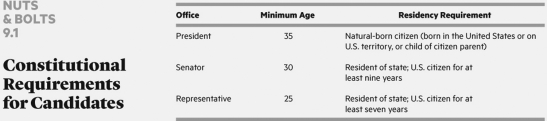
Constitutional requirements in the U.S. Constitution are least stringent for ________.
A) the presidency
C) the House of Representatives
B) the Senate
D) state governors
Question
Question
Question
Question
Question
Question
Question
Question
Question
Question
Question
Question
Question
Question
Question
Question
Question
Question
Question
Question
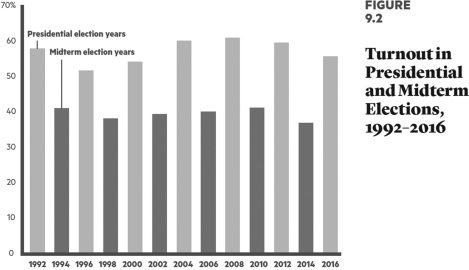
Which one of the following statements is accurate?
A) Turnout in 2016 amongst registered voters exceeded 80 percent.
B) About 38 percent of the voting age population typically votes in a presidential election.
C) About 60 percent of the voting age population typically votes in a presidential election.
D) Turnout is typically about 50 percent of registered voters in a presidential election.
Question
Question
Question
Question
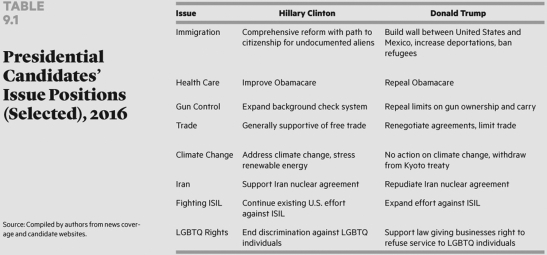
Which one of the following issues was embraced by Hillary Clinton in 2016?
A) She supported same-sex marriage.
B) She supported a voucher program for Medicare.
C) She supported a significant increase in defense spending.
D) She supported eliminating guaranteed benefits in Social Security.
Question
Question
Question
Question
Question
Question
Question
Question
Question
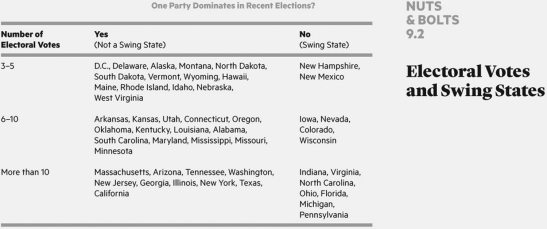
Which one of the following swing states is the most important in a presidential election?
A) Florida
C) California
B) New Hampshire
D) Colorado
Question
Question
Question
Question
Question
Question
Question
Question
Question
Question
Question
Question
Question
Question
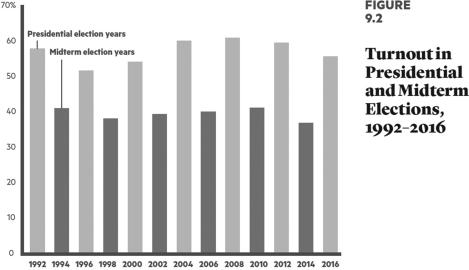
What can be concluded from the data presented in this figure?
A) About 83 percent of registered voters routinely vote in presidential elections.
B) About 59 percent of registered voters routinely vote in midterm elections.
C) Turnout was highest during this time period in 2008.
D) None of the above.
Question
Question
Question
Question
Question
Question
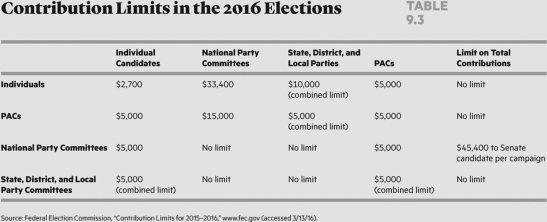
What kind of campaign funds are subject to clear limits on how much can be raised but not on how much is spent?
A) soft money
C) overall spending
B) independent expenditures
D) hard money
Question
Question
Question

Unlock Deck
Sign up to unlock the cards in this deck!
Unlock Deck
Unlock Deck
1/99

Play

Full screen (f)
Deck 9: Elections
1
The winner of the general election for president is not necessarily the person who receives the most popular votes.
True
2
Today, a 527 organization can raise unlimited soft money from individuals or corporations for voter mobilization and for issue advocacy.
True
3
Open seats are less competitive than a race where an incumbent seeks another term.
False
4
Push polls are designed to gauge public opinion.
Unlock Deck
Unlock for access to all 99 flashcards in this deck.
Unlock Deck
k this deck
5
Today, campaign donors can contribute to as many candidates and political action committees as they desire.
Unlock Deck
Unlock for access to all 99 flashcards in this deck.
Unlock Deck
k this deck
6
The process of campaigning for congressional office begins immediately after the most recent election ends.
Unlock Deck
Unlock for access to all 99 flashcards in this deck.
Unlock Deck
k this deck
7
Nearly 80 percent of congressional campaign expenditures are for television advertising.
Unlock Deck
Unlock for access to all 99 flashcards in this deck.
Unlock Deck
k this deck
8
The 2010 and 2012 elections were strikingly similar.
Unlock Deck
Unlock for access to all 99 flashcards in this deck.
Unlock Deck
k this deck
9
Retrospective evaluations make incumbents less responsive to constituent demands.
Unlock Deck
Unlock for access to all 99 flashcards in this deck.
Unlock Deck
k this deck
10
Wave elections are relatively rare.
Unlock Deck
Unlock for access to all 99 flashcards in this deck.
Unlock Deck
k this deck
11
The voting technology used for counting ballots does not influence election outcomes.
Unlock Deck
Unlock for access to all 99 flashcards in this deck.
Unlock Deck
k this deck
12
There is evidence of voter fraud in most American elections.
Unlock Deck
Unlock for access to all 99 flashcards in this deck.
Unlock Deck
k this deck
13
Decisions about how ballots are structured can affect who wins elections.
Unlock Deck
Unlock for access to all 99 flashcards in this deck.
Unlock Deck
k this deck
14
Early voting has had a clear and significant effect on the outcome of elections in recent years.
Unlock Deck
Unlock for access to all 99 flashcards in this deck.
Unlock Deck
k this deck
15
The Republican Party reserves a number of convention delegate spots for party elites, called "superdelegates."
Unlock Deck
Unlock for access to all 99 flashcards in this deck.
Unlock Deck
k this deck
16
The Democrats experienced historical losses in the House and the Senate during the 2014 elections.
Unlock Deck
Unlock for access to all 99 flashcards in this deck.
Unlock Deck
k this deck
17
Get-out-the-vote efforts are part of the ground game in campaigns.
Unlock Deck
Unlock for access to all 99 flashcards in this deck.
Unlock Deck
k this deck
18
The use of proportional allocation for convention delegates can cause the primary season to be more competitive and last longer.
Unlock Deck
Unlock for access to all 99 flashcards in this deck.
Unlock Deck
k this deck
19
Most citizens are issue voters.
Unlock Deck
Unlock for access to all 99 flashcards in this deck.
Unlock Deck
k this deck
20
In most U.S. House and Senate contests, the winner is the candidate who wins a majority of votes.
Unlock Deck
Unlock for access to all 99 flashcards in this deck.
Unlock Deck
k this deck
21
Why do election rules and their implementation matter?
A) There is no legal way to challenge the outcome of an election.
B) In close races, small changes to rules can change electoral outcomes.
C) An election must be held a second time if the rules are not followed.
D) There are different rules that must be used if voter turnout is higher than expected.
A) There is no legal way to challenge the outcome of an election.
B) In close races, small changes to rules can change electoral outcomes.
C) An election must be held a second time if the rules are not followed.
D) There are different rules that must be used if voter turnout is higher than expected.
Unlock Deck
Unlock for access to all 99 flashcards in this deck.
Unlock Deck
k this deck
22
In some democratic nations, citizens use a system of elections where if no one candidate gets more than 50 percent of the votes, everyone is eliminated except for the top two contenders. Citizens then vote again and may select either of the top two candidates. This is an example of a ________ election system.
A) plurality with run-off
C) majority with run-off
B) majority without run-off
D) proportional representation
A) plurality with run-off
C) majority with run-off
B) majority without run-off
D) proportional representation
Unlock Deck
Unlock for access to all 99 flashcards in this deck.
Unlock Deck
k this deck
23
Voters hold incumbents accountable through a ________ evaluation?
A) personal
C) retrospective
B) prospective
D) candidate
A) personal
C) retrospective
B) prospective
D) candidate
Unlock Deck
Unlock for access to all 99 flashcards in this deck.
Unlock Deck
k this deck
24
Constitutional requirements in the U.S. Constitution are least stringent for ________.
A) the presidency
C) the House of Representatives
B) the Senate
D) state governors
Unlock Deck
Unlock for access to all 99 flashcards in this deck.
Unlock Deck
k this deck
25
Analyzing the job performance of an incumbent is an exercise in ________.
A) prospective evaluation.
C) normal voting
B) retrospective evaluation
D) direct democracy
A) prospective evaluation.
C) normal voting
B) retrospective evaluation
D) direct democracy
Unlock Deck
Unlock for access to all 99 flashcards in this deck.
Unlock Deck
k this deck
26
The 2014 election was a ________ election; the 2012 election was a ________ election.
A) midterm; presidential
C) general; primary
B) general; presidential
D) presidential; midterm
A) midterm; presidential
C) general; primary
B) general; presidential
D) presidential; midterm
Unlock Deck
Unlock for access to all 99 flashcards in this deck.
Unlock Deck
k this deck
27
What will happen in 2020?
A) midterm election
B) presidential election
C) all U.S. Senate seats will be contested
D) most incumbents will likely lose
A) midterm election
B) presidential election
C) all U.S. Senate seats will be contested
D) most incumbents will likely lose
Unlock Deck
Unlock for access to all 99 flashcards in this deck.
Unlock Deck
k this deck
28
________ holds its elections entirely by mail.
A) Oregon
C) Maine
B) Alaska
D) Arizona
A) Oregon
C) Maine
B) Alaska
D) Arizona
Unlock Deck
Unlock for access to all 99 flashcards in this deck.
Unlock Deck
k this deck
29
While the ________ use(s) proportional allocation rules in all primaries and caucuses, the ________ uses a combination of proportional allocation and winner-take-all to determine convention delegates.
A) Democratic Party; Republican Party
B) Republican Party; Democratic Party
C) electoral college; state
D) Green Party; electoral college
A) Democratic Party; Republican Party
B) Republican Party; Democratic Party
C) electoral college; state
D) Green Party; electoral college
Unlock Deck
Unlock for access to all 99 flashcards in this deck.
Unlock Deck
k this deck
30
A voting system where the candidate with the most votes wins is called________.
A) proportional voting
C) semi-democratic
B) majority voting
D) plurality voting
A) proportional voting
C) semi-democratic
B) majority voting
D) plurality voting
Unlock Deck
Unlock for access to all 99 flashcards in this deck.
Unlock Deck
k this deck
31
Which one of the following most directly contributes to an incumbent president facing competition for the party's nomination during a reelection bid?
A) open primaries
C) closed primaries
B) low approval ratings
D) frontloading
A) open primaries
C) closed primaries
B) low approval ratings
D) frontloading
Unlock Deck
Unlock for access to all 99 flashcards in this deck.
Unlock Deck
k this deck
32
Which one of the following illustrates the importance of ballot design?
A) passage of the Bipartisan Campaign Reform Act
B) the butterfly ballot in Florida in 2000
C) passage of the Help America Vote Act of 2002
D) Senator Richard Lugar's primary loss in Indiana in 2012
A) passage of the Bipartisan Campaign Reform Act
B) the butterfly ballot in Florida in 2000
C) passage of the Help America Vote Act of 2002
D) Senator Richard Lugar's primary loss in Indiana in 2012
Unlock Deck
Unlock for access to all 99 flashcards in this deck.
Unlock Deck
k this deck
33
What does it mean to be a representative democracy?
A) There are multiple parties who compete for votes.
B) Some of the time people who get the most votes do not win.
C) Each vote represents the will of one, and only one, person.
D) Citizens have an indirect say on policy by voting in elections.
A) There are multiple parties who compete for votes.
B) Some of the time people who get the most votes do not win.
C) Each vote represents the will of one, and only one, person.
D) Citizens have an indirect say on policy by voting in elections.
Unlock Deck
Unlock for access to all 99 flashcards in this deck.
Unlock Deck
k this deck
34
Which one of the following restrictions on voter eligibility is true for all Americans regardless of state of residence?
A) must be 18 years or older
C) cannot be a convicted felon
B) must be mentally competent
D) cannot be in jail on Election Day
A) must be 18 years or older
C) cannot be a convicted felon
B) must be mentally competent
D) cannot be in jail on Election Day
Unlock Deck
Unlock for access to all 99 flashcards in this deck.
Unlock Deck
k this deck
35
Which one of the following is a recent trend in American general elections?
A) frontloading
C) regional elections
B) early voting
D) blanket primaries
A) frontloading
C) regional elections
B) early voting
D) blanket primaries
Unlock Deck
Unlock for access to all 99 flashcards in this deck.
Unlock Deck
k this deck
36
In 2016, ________ were the first two states holding primaries or caucuses.
A) Iowa and New Hampshire
C) Nevada and Texas
B) South Carolina and Montana
D) Maine and Vermont
A) Iowa and New Hampshire
C) Nevada and Texas
B) South Carolina and Montana
D) Maine and Vermont
Unlock Deck
Unlock for access to all 99 flashcards in this deck.
Unlock Deck
k this deck
37
________ has 55 electoral votes in presidential elections.
A) New York
C) Texas
B) Florida
D) California
A) New York
C) Texas
B) Florida
D) California
Unlock Deck
Unlock for access to all 99 flashcards in this deck.
Unlock Deck
k this deck
38
What is the second step in the election process?
A) general election
C) open primary
B) closed primary
D) semi-closed primary
A) general election
C) open primary
B) closed primary
D) semi-closed primary
Unlock Deck
Unlock for access to all 99 flashcards in this deck.
Unlock Deck
k this deck
39
How are presidential primaries different from presidential caucuses?
A) Caucuses involve voting on a specific day, whereas primaries take place over the course of a week.
B) Caucuses are secret while primaries are open to the public.
C) Primaries involve voting by ballot, whereas caucuses take place in a local meeting.
D) In caucuses anyone can participate, whereas in primaries only registered party supporters may do so.
A) Caucuses involve voting on a specific day, whereas primaries take place over the course of a week.
B) Caucuses are secret while primaries are open to the public.
C) Primaries involve voting by ballot, whereas caucuses take place in a local meeting.
D) In caucuses anyone can participate, whereas in primaries only registered party supporters may do so.
Unlock Deck
Unlock for access to all 99 flashcards in this deck.
Unlock Deck
k this deck
40
About ________ of the delegates at the Democratic Convention are superdelegates.
A) one-fifth
C) one-half
B) one-third
D) two-thirds
A) one-fifth
C) one-half
B) one-third
D) two-thirds
Unlock Deck
Unlock for access to all 99 flashcards in this deck.
Unlock Deck
k this deck
41
What happens if no presidential candidate receives a majority of the Electoral College votes?
A) Nothing; the candidate with the most votes wins.
B) The House of Representatives decides who wins, with each state getting one vote, and voting continues until someone gets a majority of the votes.
C) The current sitting vice president, in his role as the president of the Senate, chooses the next president.
D) Both the House and the Senate decide who wins with a simple majority vote.
A) Nothing; the candidate with the most votes wins.
B) The House of Representatives decides who wins, with each state getting one vote, and voting continues until someone gets a majority of the votes.
C) The current sitting vice president, in his role as the president of the Senate, chooses the next president.
D) Both the House and the Senate decide who wins with a simple majority vote.
Unlock Deck
Unlock for access to all 99 flashcards in this deck.
Unlock Deck
k this deck
42
The general election campaign typically begins ________.
A) in June
C) in September
B) in August
D) in October
A) in June
C) in September
B) in August
D) in October
Unlock Deck
Unlock for access to all 99 flashcards in this deck.
Unlock Deck
k this deck
43
How might a candidate's issue positions in the primaries differ from the general election?
A) Candidates tend to have more ideologically extreme positions during primaries.
B) Candidates try to keep their views unchanged throughout the election season.
C) Candidates do not express issue positions during primaries, since they are only competing against others of their own party.
D) Candidates tend to have more ideologically extreme positions during general elections.
A) Candidates tend to have more ideologically extreme positions during primaries.
B) Candidates try to keep their views unchanged throughout the election season.
C) Candidates do not express issue positions during primaries, since they are only competing against others of their own party.
D) Candidates tend to have more ideologically extreme positions during general elections.
Unlock Deck
Unlock for access to all 99 flashcards in this deck.
Unlock Deck
k this deck
44
Which one of the following statements is accurate?
A) Turnout in 2016 amongst registered voters exceeded 80 percent.
B) About 38 percent of the voting age population typically votes in a presidential election.
C) About 60 percent of the voting age population typically votes in a presidential election.
D) Turnout is typically about 50 percent of registered voters in a presidential election.
Unlock Deck
Unlock for access to all 99 flashcards in this deck.
Unlock Deck
k this deck
45
________ involves candidates reaching out to voters directly; ________ involves candidates contacting voters indirectly through the mass media.
A) The permanent campaign; advertising
B) Wholesale politics; retail politics
C) Name recognition; advertising
D) Retail politics; wholesale politics
A) The permanent campaign; advertising
B) Wholesale politics; retail politics
C) Name recognition; advertising
D) Retail politics; wholesale politics
Unlock Deck
Unlock for access to all 99 flashcards in this deck.
Unlock Deck
k this deck
46
What is the ground game?
A) the candidate's speechmaking ability
B) the campaign's fund-raising ability
C) the campaign's emphasis on retail politics
D) the campaign's effort to get out the vote on Election Day
A) the candidate's speechmaking ability
B) the campaign's fund-raising ability
C) the campaign's emphasis on retail politics
D) the campaign's effort to get out the vote on Election Day
Unlock Deck
Unlock for access to all 99 flashcards in this deck.
Unlock Deck
k this deck
47
Incumbents
A) are always campaigning.
B) rarely campaign outside of an election year.
C) typically get defeated for reelection.
D) are quite vulnerable in primaries.
A) are always campaigning.
B) rarely campaign outside of an election year.
C) typically get defeated for reelection.
D) are quite vulnerable in primaries.
Unlock Deck
Unlock for access to all 99 flashcards in this deck.
Unlock Deck
k this deck
48
Which one of the following issues was embraced by Hillary Clinton in 2016?
A) She supported same-sex marriage.
B) She supported a voucher program for Medicare.
C) She supported a significant increase in defense spending.
D) She supported eliminating guaranteed benefits in Social Security.
Unlock Deck
Unlock for access to all 99 flashcards in this deck.
Unlock Deck
k this deck
49
An important activity of any campaign is ________, which most directly involves ________.
A) mobilizing supporters; the ground game
B) converting opponents into supporters; the ground game
C) mobilizing supporters; name recognition
D) converting opponents into supporters; campaign platforms
A) mobilizing supporters; the ground game
B) converting opponents into supporters; the ground game
C) mobilizing supporters; name recognition
D) converting opponents into supporters; campaign platforms
Unlock Deck
Unlock for access to all 99 flashcards in this deck.
Unlock Deck
k this deck
50
The rise in the use of television advertising in campaigns is an important component of ________.
A) split ticket politics
C) mobilization
B) wholesale politics
D) retail politics
A) split ticket politics
C) mobilization
B) wholesale politics
D) retail politics
Unlock Deck
Unlock for access to all 99 flashcards in this deck.
Unlock Deck
k this deck
51
________ do not allocate all of their Electoral College votes to the winner of the state's popular vote.
A) Montana and Maine
C) Maine and Rhode Island
B) Oregon and Montana
D) Nebraska and Maine
A) Montana and Maine
C) Maine and Rhode Island
B) Oregon and Montana
D) Nebraska and Maine
Unlock Deck
Unlock for access to all 99 flashcards in this deck.
Unlock Deck
k this deck
52
The national conventions are not responsible for
A) attracting attention for the party's electoral goals.
B) developing a party platform.
C) selecting the party's presidential nominee.
D) selecting the party's congressional nominees.
A) attracting attention for the party's electoral goals.
B) developing a party platform.
C) selecting the party's presidential nominee.
D) selecting the party's congressional nominees.
Unlock Deck
Unlock for access to all 99 flashcards in this deck.
Unlock Deck
k this deck
53
Which one of the following statements is accurate?
A) Presidential campaign events usually involve a small number of citizens.
B) House and Senate candidates are more likely to engage in retail politics than presidential candidates.
C) House and Senate candidates are more likely to engage in wholesale politics than presidential candidates.
D) Voters are typically more attentive to the primary election than the general election.
A) Presidential campaign events usually involve a small number of citizens.
B) House and Senate candidates are more likely to engage in retail politics than presidential candidates.
C) House and Senate candidates are more likely to engage in wholesale politics than presidential candidates.
D) Voters are typically more attentive to the primary election than the general election.
Unlock Deck
Unlock for access to all 99 flashcards in this deck.
Unlock Deck
k this deck
54
Which one of the following is the appropriate order of events in presidential elections?
A) Super Tuesday, national conventions, Electoral College vote, general election
B) Iowa caucus, New Hampshire primary, general election, Super Tuesday
C) Electoral College vote, general election, national conventions
D) Iowa caucus, Super Tuesday, national conventions, Electoral College vote
A) Super Tuesday, national conventions, Electoral College vote, general election
B) Iowa caucus, New Hampshire primary, general election, Super Tuesday
C) Electoral College vote, general election, national conventions
D) Iowa caucus, Super Tuesday, national conventions, Electoral College vote
Unlock Deck
Unlock for access to all 99 flashcards in this deck.
Unlock Deck
k this deck
55
Which one of the following groups won the presidency but actually lost the popular vote?
A) Al Gore, Richard Nixon, Rutherford B. Hayes, and Benjamin Harrison
B) George W. Bush, John Quincy Adams, Rutherford B. Hayes, and Benjamin Harrison
C) Martin Van Buren, William Henry Harrison, Franklin Pierce, and James Garfield
D) Zachary Taylor, Millard Fillmore, James Buchanan, and Rutherford B. Hayes
A) Al Gore, Richard Nixon, Rutherford B. Hayes, and Benjamin Harrison
B) George W. Bush, John Quincy Adams, Rutherford B. Hayes, and Benjamin Harrison
C) Martin Van Buren, William Henry Harrison, Franklin Pierce, and James Garfield
D) Zachary Taylor, Millard Fillmore, James Buchanan, and Rutherford B. Hayes
Unlock Deck
Unlock for access to all 99 flashcards in this deck.
Unlock Deck
k this deck
56
Katherine is running for Congress. She spends a lot of her time attending town halls and meeting with individual voters to talk about their concerns. These are examples of ________.
A) inside strategies
C) retail politics
B) wholesale politics
D) turnout strategies
A) inside strategies
C) retail politics
B) wholesale politics
D) turnout strategies
Unlock Deck
Unlock for access to all 99 flashcards in this deck.
Unlock Deck
k this deck
57
Which one of the following swing states is the most important in a presidential election?
A) Florida
C) California
B) New Hampshire
D) Colorado
Unlock Deck
Unlock for access to all 99 flashcards in this deck.
Unlock Deck
k this deck
58
What is it called when a district has no sitting legislator running for reelection?
A) an open seat
C) a safe seat
B) a closed seat
D) a contested seat
A) an open seat
C) a safe seat
B) a closed seat
D) a contested seat
Unlock Deck
Unlock for access to all 99 flashcards in this deck.
Unlock Deck
k this deck
59
Why are swing states so important to a campaign strategy?
A) They obviously favor one party's candidate over another, which saves the favored candidate money to campaign elsewhere.
B) They provide better opportunities for fund-raising.
C) They can potentially be won by either major-party candidate.
D) They are always in the South, which is a very competitive electoral region.
A) They obviously favor one party's candidate over another, which saves the favored candidate money to campaign elsewhere.
B) They provide better opportunities for fund-raising.
C) They can potentially be won by either major-party candidate.
D) They are always in the South, which is a very competitive electoral region.
Unlock Deck
Unlock for access to all 99 flashcards in this deck.
Unlock Deck
k this deck
60
Roy and Amelia are running against each other for a seat in the Senate. Roy's campaign volunteers call voters under the guise of doing a poll and ask, "Would you be more or less likely to vote for Amelia for Senate if you knew that she took campaign funds from terrorists?" This is an example of ________.
A) the ground game
C) an attack ad
B) a push poll
D) a voting cue
A) the ground game
C) an attack ad
B) a push poll
D) a voting cue
Unlock Deck
Unlock for access to all 99 flashcards in this deck.
Unlock Deck
k this deck
61
Which one of the following describes issue voters?
A) They have a high interest in politics and are knowledgeable about candidate positions.
B) They are knowledgeable about issues but fail to vote.
C) They only vote when a particular issue is discussed during the campaign.
D) They are Independents who do not register with either major party.
A) They have a high interest in politics and are knowledgeable about candidate positions.
B) They are knowledgeable about issues but fail to vote.
C) They only vote when a particular issue is discussed during the campaign.
D) They are Independents who do not register with either major party.
Unlock Deck
Unlock for access to all 99 flashcards in this deck.
Unlock Deck
k this deck
62
Which one of the following statements is accurate?
A) Most campaign ads are positive in nature.
B) Candidates behind in the polls typically resort to attack ads against their opponent.
C) Most attack ads are factual in nature.
D) Most campaign ads today are very long compared to the past.
A) Most campaign ads are positive in nature.
B) Candidates behind in the polls typically resort to attack ads against their opponent.
C) Most attack ads are factual in nature.
D) Most campaign ads today are very long compared to the past.
Unlock Deck
Unlock for access to all 99 flashcards in this deck.
Unlock Deck
k this deck
63
A 527 organization can accept unlimited amounts of ________ but cannot use that money on behalf of a specific ________.
A) soft money; candidate
C) hard money; candidate
B) soft money; issue
D) hard money; party platform
A) soft money; candidate
C) hard money; candidate
B) soft money; issue
D) hard money; party platform
Unlock Deck
Unlock for access to all 99 flashcards in this deck.
Unlock Deck
k this deck
64
Some Americans wonder whether or not to vote because the chances of one vote being the decisive one is very small. What does this sentiment illustrate?
A) the paradox of voting
C) reasonable voting
B) a personal vote
D) split-ticket voting
A) the paradox of voting
C) reasonable voting
B) a personal vote
D) split-ticket voting
Unlock Deck
Unlock for access to all 99 flashcards in this deck.
Unlock Deck
k this deck
65
Turnout among registered voters in presidential elections is generally around ________.
A) 85 percent
C) 50 percent
B) 70 percent
D) 40 percent
A) 85 percent
C) 50 percent
B) 70 percent
D) 40 percent
Unlock Deck
Unlock for access to all 99 flashcards in this deck.
Unlock Deck
k this deck
66
What can be learned from the 2016 presidential election?
A) The candidate that raised the most money won.
B) Political victory is ensured with campaign cash.
C) Donald Trump was able to win the Republican nomination even though he spent substantially less than some of his rivals.
D) Name recognition does not matter in campaigns.
A) The candidate that raised the most money won.
B) Political victory is ensured with campaign cash.
C) Donald Trump was able to win the Republican nomination even though he spent substantially less than some of his rivals.
D) Name recognition does not matter in campaigns.
Unlock Deck
Unlock for access to all 99 flashcards in this deck.
Unlock Deck
k this deck
67
________ is in charge of administering federal election laws.
A) Congress
B) The Federal Election Commission
C) The White House chief of staff
D) The Federal Communications Commission
A) Congress
B) The Federal Election Commission
C) The White House chief of staff
D) The Federal Communications Commission
Unlock Deck
Unlock for access to all 99 flashcards in this deck.
Unlock Deck
k this deck
68
Which one of the following groups does not typically turn out in large numbers to vote?
A) whites
B) people with less than a high school education
C) middle-aged people
D) women
A) whites
B) people with less than a high school education
C) middle-aged people
D) women
Unlock Deck
Unlock for access to all 99 flashcards in this deck.
Unlock Deck
k this deck
69
What is the link between campaign donations and influence with elected officials?
A) There is a strong relationship between giving money and being able to buy votes.
B) Most campaign donations go to opposition politicians in an attempt to get them to support a cause.
C) At most, campaign donations might buy a donor access to see an elected official.
D) Elected officials often refuse to accept donations from groups with which they agree.
A) There is a strong relationship between giving money and being able to buy votes.
B) Most campaign donations go to opposition politicians in an attempt to get them to support a cause.
C) At most, campaign donations might buy a donor access to see an elected official.
D) Elected officials often refuse to accept donations from groups with which they agree.
Unlock Deck
Unlock for access to all 99 flashcards in this deck.
Unlock Deck
k this deck
70
Voters in American national elections
A) use many kinds of cues when deciding for whom to vote.
B) use only personal characteristics as a cue when deciding for whom to vote.
C) use only economic issues as a cue when deciding for whom to vote.
D) focus mostly on one issue when deciding for whom to vote.
A) use many kinds of cues when deciding for whom to vote.
B) use only personal characteristics as a cue when deciding for whom to vote.
C) use only economic issues as a cue when deciding for whom to vote.
D) focus mostly on one issue when deciding for whom to vote.
Unlock Deck
Unlock for access to all 99 flashcards in this deck.
Unlock Deck
k this deck
71
What can be concluded from the data presented in this figure?
A) About 83 percent of registered voters routinely vote in presidential elections.
B) About 59 percent of registered voters routinely vote in midterm elections.
C) Turnout was highest during this time period in 2008.
D) None of the above.
Unlock Deck
Unlock for access to all 99 flashcards in this deck.
Unlock Deck
k this deck
72
Which one of the following is a limitation on soft money?
A) Soft money cannot be used to mobilize voters.
B) Soft money cannot be used to promote a policy proposal.
C) Soft money cannot be used to promote a point of view.
D) Soft money cannot be used to elect or defeat a specific candidate.
A) Soft money cannot be used to mobilize voters.
B) Soft money cannot be used to promote a policy proposal.
C) Soft money cannot be used to promote a point of view.
D) Soft money cannot be used to elect or defeat a specific candidate.
Unlock Deck
Unlock for access to all 99 flashcards in this deck.
Unlock Deck
k this deck
73
Voter turnout in a primary in America rarely exceeds ________ percent of the voting age population.
A) 10
C) 50
B) 30
D) 66
A) 10
C) 50
B) 30
D) 66
Unlock Deck
Unlock for access to all 99 flashcards in this deck.
Unlock Deck
k this deck
74
In an effort to raise doubts about their opponents, almost all candidates use ________ as a key part of their campaign strategy.
A) hard money
C) soft money
B) opposition research
D) voting cues
A) hard money
C) soft money
B) opposition research
D) voting cues
Unlock Deck
Unlock for access to all 99 flashcards in this deck.
Unlock Deck
k this deck
75
According to political scientists, what helps make something a reasonable vote?
A) voting cues
C) coattails
B) the paradox of voting
D) a split ticket
A) voting cues
C) coattails
B) the paradox of voting
D) a split ticket
Unlock Deck
Unlock for access to all 99 flashcards in this deck.
Unlock Deck
k this deck
76
The main way that American candidates reach the electorate is through ________.
A) news media coverage
C) campaign ads
B) retail politics
D) fund-raising events
A) news media coverage
C) campaign ads
B) retail politics
D) fund-raising events
Unlock Deck
Unlock for access to all 99 flashcards in this deck.
Unlock Deck
k this deck
77
What kind of campaign funds are subject to clear limits on how much can be raised but not on how much is spent?
A) soft money
C) overall spending
B) independent expenditures
D) hard money
Unlock Deck
Unlock for access to all 99 flashcards in this deck.
Unlock Deck
k this deck
78
Which one of the following groups is most likely to run positive campaign advertisements?
A) candidates
C) political action committees
B) political parties
D) 527 groups
A) candidates
C) political action committees
B) political parties
D) 527 groups
Unlock Deck
Unlock for access to all 99 flashcards in this deck.
Unlock Deck
k this deck
79
Lyndon Johnson's "Daisy Girl" was an example of ________.
A) opposition research
C) an attack ad
B) a get out the vote effort
D) a platform
A) opposition research
C) an attack ad
B) a get out the vote effort
D) a platform
Unlock Deck
Unlock for access to all 99 flashcards in this deck.
Unlock Deck
k this deck
80
What is it called when a popular presidential candidate generates additional support for legislative candidates and helps them gain office?
A) frontloading
C) voting cues
B) coattails
D) retrospective voting
A) frontloading
C) voting cues
B) coattails
D) retrospective voting
Unlock Deck
Unlock for access to all 99 flashcards in this deck.
Unlock Deck
k this deck
Unlock Deck
Unlock for access to all 99 flashcards in this deck.






