







 Chat with AI

Deck 30: Transport and Exchange 1: Blood and Breath
Full screen (f)

Question

Question
Question
Question
Question
Question
Question
Question
Question
Question
Question
Question
Question
Question
Question
Question
Question
Question
Question
Question
Question
Question
Question
Question
Question
Question
Question
Question
Question
Question
Question
Question
Question
Question
Question
Question
Question
Question
Question
Question
Question
Question
Question
Question
Question
Question
Question
Question
Question
Question
Question
Question
Question
Question
Question
Question
Question
Question
Question
Question
Question
Question
Question
Question
Question
Question
Refer to the figure below, and then answer the following question(s).
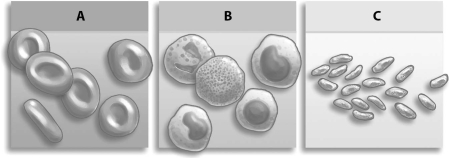
Which drawing,A,B,or C,depicts a formed element involved in gas exchange?
Which drawing,A,B,or C,depicts a formed element involved in gas exchange?
Question
Question
Question
Refer to the figure below, and then answer the following question(s).
Which drawing,A,B,or C,depicts a formed element important in clotting?
Which drawing,A,B,or C,depicts a formed element important in clotting?
Question
Refer to the figure below, and then answer the following question(s).
Which drawing,A,B,or C,depicts a formed element involved in the body's immune response?
Which drawing,A,B,or C,depicts a formed element involved in the body's immune response?
Question
Question
Question
Question
Question
Question
Match between columns
Question
Match between columns

Unlock Deck
Sign up to unlock the cards in this deck!
Unlock Deck
Unlock Deck
1/77

Play

Full screen (f)
Deck 30: Transport and Exchange 1: Blood and Breath
1
Erythrocyte is another term for:
A)plasma protein.
B)white blood cell.
C)platelet.
D)red blood cell.
A)plasma protein.
B)white blood cell.
C)platelet.
D)red blood cell.
D
2
What is the relationship of bone marrow to the cardiovascular system?
A)Bone marrow produces red blood cells.
B)Bone marrow helps keep the blood moving through the body.
C)Bone marrow produces chemicals that help carry carbon dioxide in the blood.
D)Bone marrow breaks down old blood cells.
A)Bone marrow produces red blood cells.
B)Bone marrow helps keep the blood moving through the body.
C)Bone marrow produces chemicals that help carry carbon dioxide in the blood.
D)Bone marrow breaks down old blood cells.
A
3
What happens when the diameter of an artery decreases?
A)Its semilunar valves open.
B)Its epithelial cells stretch.
C)The heart rate decreases.
D)The blood pressure decreases.
E)The blood pressure increases.
A)Its semilunar valves open.
B)Its epithelial cells stretch.
C)The heart rate decreases.
D)The blood pressure decreases.
E)The blood pressure increases.
E
4
The formed elements account for about what percentage of the total volume of blood?
A)100 percent
B)45 percent
C)75 percent
D)10 percent
A)100 percent
B)45 percent
C)75 percent
D)10 percent
Unlock Deck
Unlock for access to all 77 flashcards in this deck.
Unlock Deck
k this deck
5
Why do new red blood cells survive for only a few months?
A)The heart pumps red blood cells so often that their membranes deteriorate.
B)The oxygen that red blood cells carry damages their organelles.
C)Red blood cells do not have most organelles or a nucleus.
D)The hemoglobin that red blood cells carry is toxic.
A)The heart pumps red blood cells so often that their membranes deteriorate.
B)The oxygen that red blood cells carry damages their organelles.
C)Red blood cells do not have most organelles or a nucleus.
D)The hemoglobin that red blood cells carry is toxic.
Unlock Deck
Unlock for access to all 77 flashcards in this deck.
Unlock Deck
k this deck
6
Many people regularly donate plasma.Which of the following substances is not given when the plasma is donated?
A)electrolytes
B)antibodies
C)water
D)red blood cells
A)electrolytes
B)antibodies
C)water
D)red blood cells
Unlock Deck
Unlock for access to all 77 flashcards in this deck.
Unlock Deck
k this deck
7
Which blood component is made of fragments of cells rather than a complete cell?
A)red blood cells
B)platelets
C)white blood cells
D)plasma
A)red blood cells
B)platelets
C)white blood cells
D)plasma
Unlock Deck
Unlock for access to all 77 flashcards in this deck.
Unlock Deck
k this deck
8
Which of the following may be found in blood plasma?
A)water, proteins, nutrients, and ions
B)water, proteins, and ions
C)water and proteins
D)water
A)water, proteins, nutrients, and ions
B)water, proteins, and ions
C)water and proteins
D)water
Unlock Deck
Unlock for access to all 77 flashcards in this deck.
Unlock Deck
k this deck
9
If someone has an iron deficiency in the diet,which part of the blood would this mainly impact?
A)plasma proteins
B)red blood cells
C)platelets
D)white blood cells
A)plasma proteins
B)red blood cells
C)platelets
D)white blood cells
Unlock Deck
Unlock for access to all 77 flashcards in this deck.
Unlock Deck
k this deck
10
If a person is unable to clot blood properly,which of the following might be lacking?
A)platelets
B)red blood cells
C)white blood cells
D)ions
A)platelets
B)red blood cells
C)white blood cells
D)ions
Unlock Deck
Unlock for access to all 77 flashcards in this deck.
Unlock Deck
k this deck
11
The human cardiovascular system is comparable in some ways to a car's:
A)engine.
B)electrical system.
C)cooling system.
D)transmission system.
A)engine.
B)electrical system.
C)cooling system.
D)transmission system.
Unlock Deck
Unlock for access to all 77 flashcards in this deck.
Unlock Deck
k this deck
12
Which vessels are structurally suited for the central purpose of allowing substances to pass in and out of them through their entire lengths?
A)arterioles
B)veins
C)arteries
D)capillaries
E)semilunar valves
A)arterioles
B)veins
C)arteries
D)capillaries
E)semilunar valves
Unlock Deck
Unlock for access to all 77 flashcards in this deck.
Unlock Deck
k this deck
13
Which of the following best describes fibrinogen?
A)Fibrinogen is the connective tissue in the wall of an artery.
B)Fibrinogen is the protein portion of the hemoglobin molecule.
C)Fibrinogen is a transport lipoprotein that carries cholesterol.
D)Fibrinogen is a lipid found in platelets.
E)Fibrinogen is a plasma protein involved in clotting.
A)Fibrinogen is the connective tissue in the wall of an artery.
B)Fibrinogen is the protein portion of the hemoglobin molecule.
C)Fibrinogen is a transport lipoprotein that carries cholesterol.
D)Fibrinogen is a lipid found in platelets.
E)Fibrinogen is a plasma protein involved in clotting.
Unlock Deck
Unlock for access to all 77 flashcards in this deck.
Unlock Deck
k this deck
14
The outer layer of an artery or vein is composed of:
A)epithelium.
B)smooth muscle.
C)connective tissue.
D)cartilage.
A)epithelium.
B)smooth muscle.
C)connective tissue.
D)cartilage.
Unlock Deck
Unlock for access to all 77 flashcards in this deck.
Unlock Deck
k this deck
15
Veins always carry blood:
A)toward the heart.
B)toward the capillaries.
C)away from the lungs.
D)away from the heart.
A)toward the heart.
B)toward the capillaries.
C)away from the lungs.
D)away from the heart.
Unlock Deck
Unlock for access to all 77 flashcards in this deck.
Unlock Deck
k this deck
16
People with high blood pressure often take medication to lower blood pressure.Some of these medications might do this by:
A)increasing the blood volume.
B)relaxing the smooth muscles in the arteries.
C)opening the valves in the veins.
D)increasing the number of platelets in the blood.
A)increasing the blood volume.
B)relaxing the smooth muscles in the arteries.
C)opening the valves in the veins.
D)increasing the number of platelets in the blood.
Unlock Deck
Unlock for access to all 77 flashcards in this deck.
Unlock Deck
k this deck
17
Which of the following best describes High-Density Lipoproteins (HDLs)?
A)HDLs are transport proteins that carry lipids from tissues to the liver.
B)HDLs are transport proteins that carry lipids from the liver to tissues.
C)HDLs are large versions of the cholesterol molecule.
D)HDLs are critical components to the oxygen-carrying ability of red blood cells.
A)HDLs are transport proteins that carry lipids from tissues to the liver.
B)HDLs are transport proteins that carry lipids from the liver to tissues.
C)HDLs are large versions of the cholesterol molecule.
D)HDLs are critical components to the oxygen-carrying ability of red blood cells.
Unlock Deck
Unlock for access to all 77 flashcards in this deck.
Unlock Deck
k this deck
18
Which of the following is true of the relationship of red blood cells to the other formed elements?
A)Red blood cells make up about half of the formed elements.
B)Red blood cells make up over 99 percent of the formed elements.
C)Red blood cells are the only formed element not made in bone marrow.
D)Red blood cells are the most important formed element involved in blood clotting.
E)Red blood cells are the only formed element without a plasma membrane.
A)Red blood cells make up about half of the formed elements.
B)Red blood cells make up over 99 percent of the formed elements.
C)Red blood cells are the only formed element not made in bone marrow.
D)Red blood cells are the most important formed element involved in blood clotting.
E)Red blood cells are the only formed element without a plasma membrane.
Unlock Deck
Unlock for access to all 77 flashcards in this deck.
Unlock Deck
k this deck
19
Blood flow from the heart,to the lungs,and back to the heart is known as the:
A)pericardial circulation.
B)pulmonary circulation.
C)coronary circulation.
D)systemic circulation.
A)pericardial circulation.
B)pulmonary circulation.
C)coronary circulation.
D)systemic circulation.
Unlock Deck
Unlock for access to all 77 flashcards in this deck.
Unlock Deck
k this deck
20
Formed elements in the blood consist of all the parts below except:
A)plasma proteins.
B)white blood cells.
C)platelets.
D)red blood cells.
A)plasma proteins.
B)white blood cells.
C)platelets.
D)red blood cells.
Unlock Deck
Unlock for access to all 77 flashcards in this deck.
Unlock Deck
k this deck
21
When a doctor uses a stethoscope to listen to your heart and hears the lub-dub sound,she is actually listening to the:
A)valves in the heart closing.
B)blood surging through the arteries.
C)contraction of the cardiac muscle in the ventricles.
D)electrical signals that control heartbeat.
A)valves in the heart closing.
B)blood surging through the arteries.
C)contraction of the cardiac muscle in the ventricles.
D)electrical signals that control heartbeat.
Unlock Deck
Unlock for access to all 77 flashcards in this deck.
Unlock Deck
k this deck
22
Which chamber of the heart receives blood from the lungs?
A)left ventricle
B)right ventricle
C)left atrium
D)right atrium
A)left ventricle
B)right ventricle
C)left atrium
D)right atrium
Unlock Deck
Unlock for access to all 77 flashcards in this deck.
Unlock Deck
k this deck
23
What relationship between LDLs and HDLs is the healthiest?
A)high levels of both HDLs and LDLs
B)high levels of LDLs and low levels of HDLs
C)low levels of LDLs and high levels of HDLs
D)low levels of both HDLs and LDLs
A)high levels of both HDLs and LDLs
B)high levels of LDLs and low levels of HDLs
C)low levels of LDLs and high levels of HDLs
D)low levels of both HDLs and LDLs
Unlock Deck
Unlock for access to all 77 flashcards in this deck.
Unlock Deck
k this deck
24
A heart murmur would be associated with the malfunction of which structure?
A)aorta
B)pacemaker
C)heart muscle
D)atrioventricular valves
E)heart epithelial tissue
A)aorta
B)pacemaker
C)heart muscle
D)atrioventricular valves
E)heart epithelial tissue
Unlock Deck
Unlock for access to all 77 flashcards in this deck.
Unlock Deck
k this deck
25
Which is the best description of the function of the respiratory system?
A)delivers carbon dioxide to the blood
B)fills the lungs with air
C)facilitates gas exchange between the environment and body cells
D)delivers oxygen to the blood
A)delivers carbon dioxide to the blood
B)fills the lungs with air
C)facilitates gas exchange between the environment and body cells
D)delivers oxygen to the blood
Unlock Deck
Unlock for access to all 77 flashcards in this deck.
Unlock Deck
k this deck
26
Some of the fluid that leaks out of the capillaries is pulled back nearer to the end of the capillary bed by:
A)higher blood pressure in the capillaries.
B)suction from valves.
C)higher osmotic pressure in the capillaries.
D)low interstitial fluid pressure.
A)higher blood pressure in the capillaries.
B)suction from valves.
C)higher osmotic pressure in the capillaries.
D)low interstitial fluid pressure.
Unlock Deck
Unlock for access to all 77 flashcards in this deck.
Unlock Deck
k this deck
27
What force is most important in returning blood back to the heart in the veins?
A)contraction of the skeletal muscles in the body
B)contraction of the ventricles on the heart
C)gravity
D)osmotic pressure of proteins in the blood
A)contraction of the skeletal muscles in the body
B)contraction of the ventricles on the heart
C)gravity
D)osmotic pressure of proteins in the blood
Unlock Deck
Unlock for access to all 77 flashcards in this deck.
Unlock Deck
k this deck
28
Why is the left side of the heart stronger than the right side of the heart?
A)The left side pumps blood to the right side of the body, which has more muscle mass.
B)The left side receives more oxygen from the lungs.
C)The right side pumps only to the lungs, and the left side pumps blood around the whole body.
D)The right side pumps blood only to the brain, and the left side pumps blood around the whole body.
A)The left side pumps blood to the right side of the body, which has more muscle mass.
B)The left side receives more oxygen from the lungs.
C)The right side pumps only to the lungs, and the left side pumps blood around the whole body.
D)The right side pumps blood only to the brain, and the left side pumps blood around the whole body.
Unlock Deck
Unlock for access to all 77 flashcards in this deck.
Unlock Deck
k this deck
29
The tiny air sacs of the lungs are called:
A)bronchi.
B)trachea.
C)alveoli.
D)bronchioles.
A)bronchi.
B)trachea.
C)alveoli.
D)bronchioles.
Unlock Deck
Unlock for access to all 77 flashcards in this deck.
Unlock Deck
k this deck
30
Which factor contributes to plaque formation in coronary arteries?
A)inflammation of the lining where LDLs have attached
B)inflammation of the lining where HDLs have attached
C)protein deposits in the interior
D)fat cells clogging the interior
A)inflammation of the lining where LDLs have attached
B)inflammation of the lining where HDLs have attached
C)protein deposits in the interior
D)fat cells clogging the interior
Unlock Deck
Unlock for access to all 77 flashcards in this deck.
Unlock Deck
k this deck
31
The coronary arteries that bring blood to the heart branch off from the:
A)aorta.
B)vena cava.
C)pulmonary artery.
D)pulmonary vein.
A)aorta.
B)vena cava.
C)pulmonary artery.
D)pulmonary vein.
Unlock Deck
Unlock for access to all 77 flashcards in this deck.
Unlock Deck
k this deck
32
Which vein in the body carries oxygenated blood?
A)coronary vein
B)superior vena cava
C)inferior vena cava
D)pulmonary vein
E)Veins never carry oxygenated blood.
A)coronary vein
B)superior vena cava
C)inferior vena cava
D)pulmonary vein
E)Veins never carry oxygenated blood.
Unlock Deck
Unlock for access to all 77 flashcards in this deck.
Unlock Deck
k this deck
33
Which structure contains deoxygenated blood?
A)left atrium
B)left ventricle
C)aorta
D)pulmonary vein
E)pulmonary artery
A)left atrium
B)left ventricle
C)aorta
D)pulmonary vein
E)pulmonary artery
Unlock Deck
Unlock for access to all 77 flashcards in this deck.
Unlock Deck
k this deck
34
The combination of large numbers and small size collectively gives alveoli what characteristic that is essential to their function?
A)low air resistance
B)easy inflatability
C)low surface area
D)high surface area
A)low air resistance
B)easy inflatability
C)low surface area
D)high surface area
Unlock Deck
Unlock for access to all 77 flashcards in this deck.
Unlock Deck
k this deck
35
Which chamber of the heart is connected to the aorta?
A)right ventricle
B)left ventricle
C)right atrium
D)left atrium
A)right ventricle
B)left ventricle
C)right atrium
D)left atrium
Unlock Deck
Unlock for access to all 77 flashcards in this deck.
Unlock Deck
k this deck
36
In an area that has been "set up" for a heart attack by plaque formation,what is the most direct final trigger likely to be?
A)a sudden rise in HDL levels
B)a sudden drop in LDL levels
C)thinning of the blood
D)blood clot formation in the swollen area
E)eating a fatty meal
A)a sudden rise in HDL levels
B)a sudden drop in LDL levels
C)thinning of the blood
D)blood clot formation in the swollen area
E)eating a fatty meal
Unlock Deck
Unlock for access to all 77 flashcards in this deck.
Unlock Deck
k this deck
37
Which of the following will raise HDL and lower LDL levels?
A)exercise
B)replacing unsaturated fat in the diet with saturated fat
C)drinking more milk
D)stopping the use of anti-inflammatory medications
A)exercise
B)replacing unsaturated fat in the diet with saturated fat
C)drinking more milk
D)stopping the use of anti-inflammatory medications
Unlock Deck
Unlock for access to all 77 flashcards in this deck.
Unlock Deck
k this deck
38
The movement of air in and out of the lungs is called:
A)cellular respiration.
B)ventilation.
C)external respiration.
D)internal respiration.
A)cellular respiration.
B)ventilation.
C)external respiration.
D)internal respiration.
Unlock Deck
Unlock for access to all 77 flashcards in this deck.
Unlock Deck
k this deck
39
Which of the following usually drain blood from a capillary bed?
A)arteries
B)venules
C)veins
D)arterioles
A)arteries
B)venules
C)veins
D)arterioles
Unlock Deck
Unlock for access to all 77 flashcards in this deck.
Unlock Deck
k this deck
40
Nerve-like muscle cells that function as the heart's pacemaker are found in the:
A)left ventricle.
B)right ventricle.
C)coronary arteries.
D)atrioventricular valves.
E)sinoatrial node.
A)left ventricle.
B)right ventricle.
C)coronary arteries.
D)atrioventricular valves.
E)sinoatrial node.
Unlock Deck
Unlock for access to all 77 flashcards in this deck.
Unlock Deck
k this deck
41
Most of the oxygen in human blood is:
A)carried in the plasma membrane of red blood cells.
B)carried on albumin.
C)carried in hemoglobin.
D)dissolved in the plasma.
A)carried in the plasma membrane of red blood cells.
B)carried on albumin.
C)carried in hemoglobin.
D)dissolved in the plasma.
Unlock Deck
Unlock for access to all 77 flashcards in this deck.
Unlock Deck
k this deck
42
Inflammation is a typical part of the initial process that can result in a heart attack.
Unlock Deck
Unlock for access to all 77 flashcards in this deck.
Unlock Deck
k this deck
43
Contraction of the diaphragm causes exhalation to occur.
Unlock Deck
Unlock for access to all 77 flashcards in this deck.
Unlock Deck
k this deck
44
Capillaries are essentially water-tight vessels,so nutrients and gases diffuse in and out,but water stays put.
Unlock Deck
Unlock for access to all 77 flashcards in this deck.
Unlock Deck
k this deck
45
Because they are cell fragments,not cells,platelets are a component of plasma,not a formed element.
Unlock Deck
Unlock for access to all 77 flashcards in this deck.
Unlock Deck
k this deck
46
Some proteins are too large to leave the capillaries.
Unlock Deck
Unlock for access to all 77 flashcards in this deck.
Unlock Deck
k this deck
47
When the thoracic cavity gets smaller,the pressure inside the lungs increases.
Unlock Deck
Unlock for access to all 77 flashcards in this deck.
Unlock Deck
k this deck
48
The left ventricle pumps blood into the pulmonary artery.
Unlock Deck
Unlock for access to all 77 flashcards in this deck.
Unlock Deck
k this deck
49
Valves in veins are important features that help keep blood moving back toward the heart.
Unlock Deck
Unlock for access to all 77 flashcards in this deck.
Unlock Deck
k this deck
50
The stimuli for contraction of the heart come from within the heart rather than from the nervous system.
Unlock Deck
Unlock for access to all 77 flashcards in this deck.
Unlock Deck
k this deck
51
Ions in plasma are also known as electrolytes.
Unlock Deck
Unlock for access to all 77 flashcards in this deck.
Unlock Deck
k this deck
52
Blockage of the aorta is the most common fatal heart attack.
Unlock Deck
Unlock for access to all 77 flashcards in this deck.
Unlock Deck
k this deck
53
Water and plasma proteins make up about 99 percent of blood plasma.
Unlock Deck
Unlock for access to all 77 flashcards in this deck.
Unlock Deck
k this deck
54
Veins are smaller blood vessels than capillaries.
Unlock Deck
Unlock for access to all 77 flashcards in this deck.
Unlock Deck
k this deck
55
When the diaphragm contracts,the thoracic cavity ________,and you ________.
A)gets larger; exhale
B)gets larger; inhale
C)gets smaller; inhale
D)gets smaller; exhale
A)gets larger; exhale
B)gets larger; inhale
C)gets smaller; inhale
D)gets smaller; exhale
Unlock Deck
Unlock for access to all 77 flashcards in this deck.
Unlock Deck
k this deck
56
Arteries always carry blood that is oxygen rich.
Unlock Deck
Unlock for access to all 77 flashcards in this deck.
Unlock Deck
k this deck
57
The blood consists entirely of blood cells and water.
Unlock Deck
Unlock for access to all 77 flashcards in this deck.
Unlock Deck
k this deck
58
The trachea branches into left and right bronchioles.
Unlock Deck
Unlock for access to all 77 flashcards in this deck.
Unlock Deck
k this deck
59
Blood in the pulmonary arteries is moving toward the heart.
Unlock Deck
Unlock for access to all 77 flashcards in this deck.
Unlock Deck
k this deck
60
During gas exchange,oxygen and carbon dioxide always move:
A)down their concentration gradients.
B)into the alveoli.
C)out of the blood.
D)into the blood.
A)down their concentration gradients.
B)into the alveoli.
C)out of the blood.
D)into the blood.
Unlock Deck
Unlock for access to all 77 flashcards in this deck.
Unlock Deck
k this deck
61
Particularly with regard to gas exchange,why do we have respiratory and cardiovascular systems,but flatworms,which are only a few cells thick,don't?
Unlock Deck
Unlock for access to all 77 flashcards in this deck.
Unlock Deck
k this deck
62
The technical term for a white blood cell is ________.
Unlock Deck
Unlock for access to all 77 flashcards in this deck.
Unlock Deck
k this deck
63
Why does exchange occur only in capillaries and not in arteries or veins?
Unlock Deck
Unlock for access to all 77 flashcards in this deck.
Unlock Deck
k this deck
64
Prepare an argument for why the following statement is incorrect: The formed elements are the only important part of blood,and plasma is just the water they're carried in.
Unlock Deck
Unlock for access to all 77 flashcards in this deck.
Unlock Deck
k this deck
65
Pulmonary ventilation occurs because of pressure differences between the lungs and the external environment.
Unlock Deck
Unlock for access to all 77 flashcards in this deck.
Unlock Deck
k this deck
66
Refer to the figure below, and then answer the following question(s).
Which drawing,A,B,or C,depicts a formed element involved in gas exchange?
Which drawing,A,B,or C,depicts a formed element involved in gas exchange?
Unlock Deck
Unlock for access to all 77 flashcards in this deck.
Unlock Deck
k this deck
67
Arteries branch into smaller and smaller arteries until they become small-diameter ________ that enter the capillary bed.
Unlock Deck
Unlock for access to all 77 flashcards in this deck.
Unlock Deck
k this deck
68
What technique is used to separate blood into plasma and formed elements?
Unlock Deck
Unlock for access to all 77 flashcards in this deck.
Unlock Deck
k this deck
69
Refer to the figure below, and then answer the following question(s).
Which drawing,A,B,or C,depicts a formed element important in clotting?
Which drawing,A,B,or C,depicts a formed element important in clotting?
Unlock Deck
Unlock for access to all 77 flashcards in this deck.
Unlock Deck
k this deck
70
Refer to the figure below, and then answer the following question(s).
Which drawing,A,B,or C,depicts a formed element involved in the body's immune response?
Which drawing,A,B,or C,depicts a formed element involved in the body's immune response?
Unlock Deck
Unlock for access to all 77 flashcards in this deck.
Unlock Deck
k this deck
71
An athletic friend of yours recently had a blood test,asked for a copy of the report,and looked up numbers for his "total cholesterol," or combined LDL/HDL numbers.An online source lists his total as slightly high.He says,"My doctor's a quack! He told me my cholesterol was fine!" You press your friend for more details and come to understand that his LDL levels are within the healthy range,but his HDL levels are higher than average.What do you say to your friend to help him understand his doctor's comments?
Unlock Deck
Unlock for access to all 77 flashcards in this deck.
Unlock Deck
k this deck
72
A friend has been asked to be a bone marrow donor for her sister.She tells you that her sister has low red blood cell counts that drop more every day.Your friend doesn't understand why blood transfusion wouldn't work without having to do a bone marrow treatment.How would you explain the need for the bone marrow donation to your friend?
Unlock Deck
Unlock for access to all 77 flashcards in this deck.
Unlock Deck
k this deck
73
List the pathway a single red blood cell would follow from the superior vena cava to the lungs.
Unlock Deck
Unlock for access to all 77 flashcards in this deck.
Unlock Deck
k this deck
74
Which blood vessels carry blood away from the heart?
Unlock Deck
Unlock for access to all 77 flashcards in this deck.
Unlock Deck
k this deck
75
Discuss the effects of holding one's breath for more than a minute.
Unlock Deck
Unlock for access to all 77 flashcards in this deck.
Unlock Deck
k this deck
76
Match between columns
Unlock Deck
Unlock for access to all 77 flashcards in this deck.
Unlock Deck
k this deck
77
Match between columns
Unlock Deck
Unlock for access to all 77 flashcards in this deck.
Unlock Deck
k this deck
Unlock Deck
Unlock for access to all 77 flashcards in this deck.






