







 Chat with AI

Deck 2: The Living Units
Full screen (f)

Question

Question

Figure 2.2
Use the diagram above to answer the following questions.
Which letter indicates the DNA molecule?
A) A
B) B
C) C
D) D
E) E
Question
Figure 2.2
Use the diagram above to answer the following questions.
Which letter indicates histones?
A) A
B) B
C) C
D) D
E) E
Question
Question
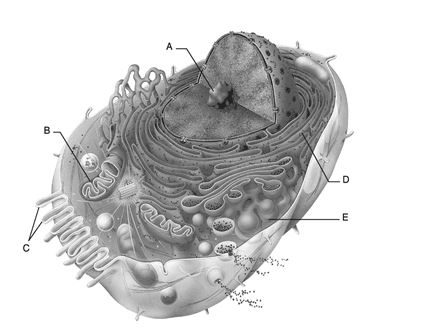
Figure 2.1
Use the diagram above to answer the following questions.
Which letter indicates the microvilli?
A) A
B) B
C) C
D) D
E) E
Question
Figure 2.1
Use the diagram above to answer the following questions.
Which letter indicates the rough endoplasmic reticulum?
A) A
B) B
C) C
D) D
E) E
Question
Question
Question
Question
Question
Figure 2.1
Use the diagram above to answer the following questions.
Which letter indicates the Golgi apparatus?
A) A
B) B
C) C
D) D
E) E
Question
Question
Figure 2.1
Use the diagram above to answer the following questions.
Which letter indicates the nucleolus?
A) A
B) B
C) C
D) D
E) E
Question
Question
Question
Figure 2.1
Use the diagram above to answer the following questions.
Which letter indicates the mitochondrion?
A) A
B) B
C) C
D) D
E) E
Question
Figure 2.2
Use the diagram above to answer the following questions.
Which letter indicates the metaphase chromosome?
A) A
B) B
C) C
D) D
E) E
Question
Figure 2.2
Use the diagram above to answer the following questions.
Which letter indicates a nucleosome?
A) A
B) B
C) C
D) D
E) E
Question
Question
Figure 2.2
Use the diagram above to answer the following questions.
Which letter indicates the chromatid?
A) A
B) B
C) C
D) D
E) E
Question
Question
Question
Question
Question
Question
Question
Question
Question
Question
Question
Question
Question
Question
Question
Question
Question
Question
Question
Question
Question
Question
Question
Question
Question
Question
Question
Question
Question
Question
Question
Question
Question
Question
Question
Question
Question
Question
Question
Question
Question
Question
Question
Question
Question
Question
Question
Question
Question
Question
Question
Question
Question
Question
Question
Question
Question
Question
Question
Question

Unlock Deck
Sign up to unlock the cards in this deck!
Unlock Deck
Unlock Deck
1/110

Play

Full screen (f)
Deck 2: The Living Units
1
This membranous organelle contains oxidase and catalase enzymes.
A) Golgi apparatus
B) lysosome
C) rough endoplasmic reticulum
D) mitochondria
E) peroxisome
A) Golgi apparatus
B) lysosome
C) rough endoplasmic reticulum
D) mitochondria
E) peroxisome
E
2
Figure 2.2
Use the diagram above to answer the following questions.
Which letter indicates the DNA molecule?
A) A
B) B
C) C
D) D
E) E
A
3
Figure 2.2
Use the diagram above to answer the following questions.
Which letter indicates histones?
A) A
B) B
C) C
D) D
E) E
B
4
This organelle detoxifies a number of toxic substances.
A) Golgi apparatus
B) lysosome
C) rough endoplasmic reticulum
D) mitochondria
E) peroxisome
A) Golgi apparatus
B) lysosome
C) rough endoplasmic reticulum
D) mitochondria
E) peroxisome
Unlock Deck
Unlock for access to all 110 flashcards in this deck.
Unlock Deck
k this deck
5
Figure 2.1
Use the diagram above to answer the following questions.
Which letter indicates the microvilli?
A) A
B) B
C) C
D) D
E) E
Unlock Deck
Unlock for access to all 110 flashcards in this deck.
Unlock Deck
k this deck
6
Figure 2.1
Use the diagram above to answer the following questions.
Which letter indicates the rough endoplasmic reticulum?
A) A
B) B
C) C
D) D
E) E
Unlock Deck
Unlock for access to all 110 flashcards in this deck.
Unlock Deck
k this deck
7
This membranous organelle is the site of protein synthesis for proteins that are secreted by the cell.
A) Golgi apparatus
B) lysosome
C) rough endoplasmic reticulum
D) mitochondria
E) peroxisome
A) Golgi apparatus
B) lysosome
C) rough endoplasmic reticulum
D) mitochondria
E) peroxisome
Unlock Deck
Unlock for access to all 110 flashcards in this deck.
Unlock Deck
k this deck
8
This organelle primarily modifies products from the rough ER, and it resembles a stack of hollow saucers, one cupped inside the next.
A) Golgi apparatus
B) lysosome
C) rough endoplasmic reticulum
D) mitochondria
E) peroxisome
A) Golgi apparatus
B) lysosome
C) rough endoplasmic reticulum
D) mitochondria
E) peroxisome
Unlock Deck
Unlock for access to all 110 flashcards in this deck.
Unlock Deck
k this deck
9
Cisternae of this organelle are continuous with the nuclear envelope.
A) Golgi apparatus
B) lysosome
C) rough endoplasmic reticulum
D) mitochondria
E) peroxisome
A) Golgi apparatus
B) lysosome
C) rough endoplasmic reticulum
D) mitochondria
E) peroxisome
Unlock Deck
Unlock for access to all 110 flashcards in this deck.
Unlock Deck
k this deck
10
This organelle is characterized by folded membranes called cristae.
A) Golgi apparatus
B) lysosome
C) rough endoplasmic reticulum
D) mitochondria
E) peroxisome
A) Golgi apparatus
B) lysosome
C) rough endoplasmic reticulum
D) mitochondria
E) peroxisome
Unlock Deck
Unlock for access to all 110 flashcards in this deck.
Unlock Deck
k this deck
11
Figure 2.1
Use the diagram above to answer the following questions.
Which letter indicates the Golgi apparatus?
A) A
B) B
C) C
D) D
E) E
Unlock Deck
Unlock for access to all 110 flashcards in this deck.
Unlock Deck
k this deck
12
This organelle is involved in production of cellular energy.
A) Golgi apparatus
B) lysosome
C) rough endoplasmic reticulum
D) mitochondria
E) peroxisome
A) Golgi apparatus
B) lysosome
C) rough endoplasmic reticulum
D) mitochondria
E) peroxisome
Unlock Deck
Unlock for access to all 110 flashcards in this deck.
Unlock Deck
k this deck
13
Figure 2.1
Use the diagram above to answer the following questions.
Which letter indicates the nucleolus?
A) A
B) B
C) C
D) D
E) E
Unlock Deck
Unlock for access to all 110 flashcards in this deck.
Unlock Deck
k this deck
14
This organelle has both a cis and a trans face.
A) Golgi apparatus
B) lysosome
C) rough endoplasmic reticulum
D) mitochondria
E) peroxisome
A) Golgi apparatus
B) lysosome
C) rough endoplasmic reticulum
D) mitochondria
E) peroxisome
Unlock Deck
Unlock for access to all 110 flashcards in this deck.
Unlock Deck
k this deck
15
These organelles are often called the "demolition crew" of the cell.
A) Golgi apparatus
B) lysosome
C) rough endoplasmic reticulum
D) mitochondria
E) peroxisome
A) Golgi apparatus
B) lysosome
C) rough endoplasmic reticulum
D) mitochondria
E) peroxisome
Unlock Deck
Unlock for access to all 110 flashcards in this deck.
Unlock Deck
k this deck
16
Figure 2.1
Use the diagram above to answer the following questions.
Which letter indicates the mitochondrion?
A) A
B) B
C) C
D) D
E) E
Unlock Deck
Unlock for access to all 110 flashcards in this deck.
Unlock Deck
k this deck
17
Figure 2.2
Use the diagram above to answer the following questions.
Which letter indicates the metaphase chromosome?
A) A
B) B
C) C
D) D
E) E
Unlock Deck
Unlock for access to all 110 flashcards in this deck.
Unlock Deck
k this deck
18
Figure 2.2
Use the diagram above to answer the following questions.
Which letter indicates a nucleosome?
A) A
B) B
C) C
D) D
E) E
Unlock Deck
Unlock for access to all 110 flashcards in this deck.
Unlock Deck
k this deck
19
When a phagocytic white blood cell ingests a foreign bacterial cell, the vesicle fuses with this organelle.
A) Golgi apparatus
B) lysosome
C) rough endoplasmic reticulum
D) mitochondria
E) peroxisome
A) Golgi apparatus
B) lysosome
C) rough endoplasmic reticulum
D) mitochondria
E) peroxisome
Unlock Deck
Unlock for access to all 110 flashcards in this deck.
Unlock Deck
k this deck
20
Figure 2.2
Use the diagram above to answer the following questions.
Which letter indicates the chromatid?
A) A
B) B
C) C
D) D
E) E
Unlock Deck
Unlock for access to all 110 flashcards in this deck.
Unlock Deck
k this deck
21
In the cell life cycle, DNA is replicated during
A) interphase G₁.
B) interphase S.
C) prophase I.
D) prophase II.
A) interphase G₁.
B) interphase S.
C) prophase I.
D) prophase II.
Unlock Deck
Unlock for access to all 110 flashcards in this deck.
Unlock Deck
k this deck
22
Hormones are secreted by
A) phagocytosis.
B) pinocytosis.
C) exocytosis.
D) osmosis.
A) phagocytosis.
B) pinocytosis.
C) exocytosis.
D) osmosis.
Unlock Deck
Unlock for access to all 110 flashcards in this deck.
Unlock Deck
k this deck
23
This organelle is primarily a sac of powerful digestive enzymes called acid hydrolases.
A) Golgi apparatus
B) lysosome
C) rough endoplasmic reticulum
D) mitochondria
E) peroxisome
A) Golgi apparatus
B) lysosome
C) rough endoplasmic reticulum
D) mitochondria
E) peroxisome
Unlock Deck
Unlock for access to all 110 flashcards in this deck.
Unlock Deck
k this deck
24
Which of the following statements about integral proteins in the plasma membrane is False?
A) Most extend all the way through the membrane.
B) Some attach to the glycocalyx.
C) They determine which molecules are transported through the membrane.
D) They are more abundant by volume than the membrane phospholipids.
A) Most extend all the way through the membrane.
B) Some attach to the glycocalyx.
C) They determine which molecules are transported through the membrane.
D) They are more abundant by volume than the membrane phospholipids.
Unlock Deck
Unlock for access to all 110 flashcards in this deck.
Unlock Deck
k this deck
25
Which type of proteins are required for exocytosis?
A) caveolin
B) coatomer proteins
C) clathrin
D) SNARE proteins
A) caveolin
B) coatomer proteins
C) clathrin
D) SNARE proteins
Unlock Deck
Unlock for access to all 110 flashcards in this deck.
Unlock Deck
k this deck
26
This organelle contains a single DNA molecule and is capable of self-replication.
A) Golgi apparatus
B) lysosome
C) rough endoplasmic reticulum
D) mitochondria
E) peroxisome
A) Golgi apparatus
B) lysosome
C) rough endoplasmic reticulum
D) mitochondria
E) peroxisome
Unlock Deck
Unlock for access to all 110 flashcards in this deck.
Unlock Deck
k this deck
27
This organelle is defective in the inherited disorder Tay-Sachs disease.
A) Golgi apparatus
B) lysosome
C) rough endoplasmic reticulum
D) mitochondria
E) peroxisome
A) Golgi apparatus
B) lysosome
C) rough endoplasmic reticulum
D) mitochondria
E) peroxisome
Unlock Deck
Unlock for access to all 110 flashcards in this deck.
Unlock Deck
k this deck
28
During anaphase, motor proteins attached to mitotic spindle fibers serve to
A) pull the chromosomes to opposite poles of the cell.
B) pull together the replicated chromosomal strands.
C) re-form the nuclear envelope.
D) form the aster.
A) pull the chromosomes to opposite poles of the cell.
B) pull together the replicated chromosomal strands.
C) re-form the nuclear envelope.
D) form the aster.
Unlock Deck
Unlock for access to all 110 flashcards in this deck.
Unlock Deck
k this deck
29
The longest arrays of microtubules that assemble from each centrosome during prophase form filaments called
A) mitotic spindle fibers.
B) kinetochores.
C) asters.
D) the nuclear envelope.
A) mitotic spindle fibers.
B) kinetochores.
C) asters.
D) the nuclear envelope.
Unlock Deck
Unlock for access to all 110 flashcards in this deck.
Unlock Deck
k this deck
30
Functions of the Golgi apparatus include all of the following except
A) synthesis of lysosomes.
B) DNA replication.
C) plasma membrane formation.
D) production of secretory granules.
A) synthesis of lysosomes.
B) DNA replication.
C) plasma membrane formation.
D) production of secretory granules.
Unlock Deck
Unlock for access to all 110 flashcards in this deck.
Unlock Deck
k this deck
31
Which type of endocytosis ingests the most specific type of molecule?
A) fluid-phase endocytosis
B) phagocytosis
C) pinocytosis
D) receptor-mediated endocytosis
A) fluid-phase endocytosis
B) phagocytosis
C) pinocytosis
D) receptor-mediated endocytosis
Unlock Deck
Unlock for access to all 110 flashcards in this deck.
Unlock Deck
k this deck
32
This organelle produces ATP molecules.
A) Golgi apparatus
B) lysosome
C) rough endoplasmic reticulum
D) mitochondria
E) peroxisome
A) Golgi apparatus
B) lysosome
C) rough endoplasmic reticulum
D) mitochondria
E) peroxisome
Unlock Deck
Unlock for access to all 110 flashcards in this deck.
Unlock Deck
k this deck
33
This organelle is numerous in liver and kidney cells.
A) Golgi apparatus
B) lysosome
C) rough endoplasmic reticulum
D) mitochondria
E) peroxisome
A) Golgi apparatus
B) lysosome
C) rough endoplasmic reticulum
D) mitochondria
E) peroxisome
Unlock Deck
Unlock for access to all 110 flashcards in this deck.
Unlock Deck
k this deck
34
Which of the following cytoskeleton elements are the largest in diameter?
A) microtubules
B) microfilaments
C) intermediate filaments
D) centrioles
A) microtubules
B) microfilaments
C) intermediate filaments
D) centrioles
Unlock Deck
Unlock for access to all 110 flashcards in this deck.
Unlock Deck
k this deck
35
In chromatin, the DNA molecule wraps around proteins called
A) nucleotides.
B) codons.
C) integral protein.
D) histones.
A) nucleotides.
B) codons.
C) integral protein.
D) histones.
Unlock Deck
Unlock for access to all 110 flashcards in this deck.
Unlock Deck
k this deck
36
Of the following, the only organelle that has a double membrane structure is the
A) centriole.
B) Golgi apparatus.
C) endoplasmic reticulum.
D) mitochondrion.
A) centriole.
B) Golgi apparatus.
C) endoplasmic reticulum.
D) mitochondrion.
Unlock Deck
Unlock for access to all 110 flashcards in this deck.
Unlock Deck
k this deck
37
Mitosis refers only to nuclear division. Separation of the entire cell following mitosis is
A) meiosis.
B) karyokinesis.
C) cytokinesis.
D) telophase.
A) meiosis.
B) karyokinesis.
C) cytokinesis.
D) telophase.
Unlock Deck
Unlock for access to all 110 flashcards in this deck.
Unlock Deck
k this deck
38
Phospholipids of the plasma membrane are arranged
A) around a central layer of cholesterol.
B) in a single layer with polar heads facing outwards.
C) as a bilayer with their nonpolar tails sandwiched between the polar heads.
D) as a bilayer with their polar heads sandwiched between the nonpolar tails.
A) around a central layer of cholesterol.
B) in a single layer with polar heads facing outwards.
C) as a bilayer with their nonpolar tails sandwiched between the polar heads.
D) as a bilayer with their polar heads sandwiched between the nonpolar tails.
Unlock Deck
Unlock for access to all 110 flashcards in this deck.
Unlock Deck
k this deck
39
Which of the following statements about the rough endoplasmic reticulum is False?
A) It consists of stacked envelopes called cisternae.
B) It makes the digestive enzymes contained in the lysosomes.
C) It stores lipids as inclusions.
D) It makes the integral proteins of the cell membrane.
A) It consists of stacked envelopes called cisternae.
B) It makes the digestive enzymes contained in the lysosomes.
C) It stores lipids as inclusions.
D) It makes the integral proteins of the cell membrane.
Unlock Deck
Unlock for access to all 110 flashcards in this deck.
Unlock Deck
k this deck
40
Which of the following is not a cytoskeleton element?
A) microtubule
B) microfilament
C) intermediate filament
D) centriole
A) microtubule
B) microfilament
C) intermediate filament
D) centriole
Unlock Deck
Unlock for access to all 110 flashcards in this deck.
Unlock Deck
k this deck
41
Which membranous organelle stores calcium and is a primary site of lipid metabolism?
A) Golgi apparatus
B) smooth endoplasmic reticulum
C) mitochondrion
D) peroxisome
A) Golgi apparatus
B) smooth endoplasmic reticulum
C) mitochondrion
D) peroxisome
Unlock Deck
Unlock for access to all 110 flashcards in this deck.
Unlock Deck
k this deck
42
The mitotic spindle forms from the
A) nucleus.
B) Golgi apparatus.
C) centrosome matrix.
D) nucleolus.
A) nucleus.
B) Golgi apparatus.
C) centrosome matrix.
D) nucleolus.
Unlock Deck
Unlock for access to all 110 flashcards in this deck.
Unlock Deck
k this deck
43
Peroxisomes
A) are the toxic waste removal system of the cell.
B) are involved in the production of ATP.
C) contain some of the code necessary for their own duplication.
D) synthesize proteins for use outside the cell.
A) are the toxic waste removal system of the cell.
B) are involved in the production of ATP.
C) contain some of the code necessary for their own duplication.
D) synthesize proteins for use outside the cell.
Unlock Deck
Unlock for access to all 110 flashcards in this deck.
Unlock Deck
k this deck
44
The endocytotic process in which small vesicles of fluid are brought into the cell is called
A) phagocytosis.
B) pinocytosis.
C) exocytosis.
D) xenocytosis.
A) phagocytosis.
B) pinocytosis.
C) exocytosis.
D) xenocytosis.
Unlock Deck
Unlock for access to all 110 flashcards in this deck.
Unlock Deck
k this deck
45
Which organelle is important in neutralizing free radicals?
A) Golgi apparatus
B) lysosome
C) mitochondrion
D) peroxisome
A) Golgi apparatus
B) lysosome
C) mitochondrion
D) peroxisome
Unlock Deck
Unlock for access to all 110 flashcards in this deck.
Unlock Deck
k this deck
46
Ribosomes may be either free within the cytoplasm or bound to a membrane system known as the
A) Golgi apparatus.
B) microtubule organizing center.
C) cytoskeleton.
D) rough endoplasmic reticulum.
A) Golgi apparatus.
B) microtubule organizing center.
C) cytoskeleton.
D) rough endoplasmic reticulum.
Unlock Deck
Unlock for access to all 110 flashcards in this deck.
Unlock Deck
k this deck
47
The double membrane structure is unique to the
A) lysosome.
B) peroxisome.
C) mitochondrion.
D) nucleolus.
A) lysosome.
B) peroxisome.
C) mitochondrion.
D) nucleolus.
Unlock Deck
Unlock for access to all 110 flashcards in this deck.
Unlock Deck
k this deck
48
The plasma membrane is important for all the following reasons except
A) it determines what substances enter and exit the cell.
B) it separates the ECF from the ICF.
C) it acts as a site for cell-to-cell interaction and recognition.
D) it is an important site for DNA transcription.
A) it determines what substances enter and exit the cell.
B) it separates the ECF from the ICF.
C) it acts as a site for cell-to-cell interaction and recognition.
D) it is an important site for DNA transcription.
Unlock Deck
Unlock for access to all 110 flashcards in this deck.
Unlock Deck
k this deck
49
Materials that are to be exocytosed by cells are enclosed in vesicles synthesized by the
A) nucleosome.
B) ribosome.
C) Golgi apparatus.
D) mitochondrion.
A) nucleosome.
B) ribosome.
C) Golgi apparatus.
D) mitochondrion.
Unlock Deck
Unlock for access to all 110 flashcards in this deck.
Unlock Deck
k this deck
50
Cell division is analogous to
A) two buildings duplicating their parts and fusing.
B) a building duplicating its blueprint and then forming a new building by splitting in two.
C) a building forming another building by random accumulation of materials.
D) a building forming another building through a loss of some of its parts.
A) two buildings duplicating their parts and fusing.
B) a building duplicating its blueprint and then forming a new building by splitting in two.
C) a building forming another building by random accumulation of materials.
D) a building forming another building through a loss of some of its parts.
Unlock Deck
Unlock for access to all 110 flashcards in this deck.
Unlock Deck
k this deck
51
Which is not part of interphase?
A) G₁
B) G₂
C) M
D) S
A) G₁
B) G₂
C) M
D) S
Unlock Deck
Unlock for access to all 110 flashcards in this deck.
Unlock Deck
k this deck
52
Dyneins and kinesins are motor proteins that ________.
A) enable a cell to send out and retract extensions called pseudopods.
B) move organelles along microtubules through the cytoplasm.
C) are molecular components of telomeres
D) resist pulling forces that are placed on cells.
A) enable a cell to send out and retract extensions called pseudopods.
B) move organelles along microtubules through the cytoplasm.
C) are molecular components of telomeres
D) resist pulling forces that are placed on cells.
Unlock Deck
Unlock for access to all 110 flashcards in this deck.
Unlock Deck
k this deck
53
Embedded in the plasma membrane of cells, cholesterol molecules act to
A) stabilize the membrane.
B) make the membrane more resistant to freezing.
C) destabilize the membrane, leading to heart attacks.
D) participate in pinocytosis.
A) stabilize the membrane.
B) make the membrane more resistant to freezing.
C) destabilize the membrane, leading to heart attacks.
D) participate in pinocytosis.
Unlock Deck
Unlock for access to all 110 flashcards in this deck.
Unlock Deck
k this deck
54
The plasma membrane is composed of all of the following except
A) glycoproteins.
B) tubulin protein.
C) cholesterol.
D) phospholipids.
A) glycoproteins.
B) tubulin protein.
C) cholesterol.
D) phospholipids.
Unlock Deck
Unlock for access to all 110 flashcards in this deck.
Unlock Deck
k this deck
55
The ________ face of the Golgi apparatus is ________ to receive spherical vesicles from the rough endoplasmic reticulum.
A) cis; convex
B) trans; concave
C) cis; flattened
D) trans; convex
A) cis; convex
B) trans; concave
C) cis; flattened
D) trans; convex
Unlock Deck
Unlock for access to all 110 flashcards in this deck.
Unlock Deck
k this deck
56
Which of the following is associated with protein synthesis?
A) mitochondria
B) ribosomes
C) chloroplasts
D) smooth endoplasmic reticulum
A) mitochondria
B) ribosomes
C) chloroplasts
D) smooth endoplasmic reticulum
Unlock Deck
Unlock for access to all 110 flashcards in this deck.
Unlock Deck
k this deck
57
Peroxisomes function to
A) synthesize and degrade hydrogen peroxide.
B) store cellular free radicals.
C) produce pigments.
D) regulate membrane permeability.
A) synthesize and degrade hydrogen peroxide.
B) store cellular free radicals.
C) produce pigments.
D) regulate membrane permeability.
Unlock Deck
Unlock for access to all 110 flashcards in this deck.
Unlock Deck
k this deck
58
Which of the following statements accurately describes the function of the nuclear envelope?
A) separation of nucleoplasm and cytoplasm
B) regulation of passage of substances into and out of the cell membrane
C) transcription of DNA
D) protein synthesis
A) separation of nucleoplasm and cytoplasm
B) regulation of passage of substances into and out of the cell membrane
C) transcription of DNA
D) protein synthesis
Unlock Deck
Unlock for access to all 110 flashcards in this deck.
Unlock Deck
k this deck
59
The stiffest elements of the cytoskeleton, analogous to the bones of the human body, are
A) microtubules.
B) microfilaments.
C) intermediate filaments.
D) the cytosol.
A) microtubules.
B) microfilaments.
C) intermediate filaments.
D) the cytosol.
Unlock Deck
Unlock for access to all 110 flashcards in this deck.
Unlock Deck
k this deck
60
Which of the following does not pass through nuclear pores?
A) chromatin
B) messenger RNA
C) proteins
D) ribosomal RNA
A) chromatin
B) messenger RNA
C) proteins
D) ribosomal RNA
Unlock Deck
Unlock for access to all 110 flashcards in this deck.
Unlock Deck
k this deck
61
The smooth ER contains its own molecules of DNA.
Unlock Deck
Unlock for access to all 110 flashcards in this deck.
Unlock Deck
k this deck
62
During what phase of mitosis does the mitotic spindle break down and disappear?
A) metaphase
B) anaphase
C) telophase
D) late prophase
A) metaphase
B) anaphase
C) telophase
D) late prophase
Unlock Deck
Unlock for access to all 110 flashcards in this deck.
Unlock Deck
k this deck
63
The nuclear envelope is continuous with the rough ER, but it differs from the rough ER in that it
A) is not associated with ribosomes.
B) has unique pores.
C) consists of two membranes separated by a space.
D) consists of tubes, like the smooth ER.
A) is not associated with ribosomes.
B) has unique pores.
C) consists of two membranes separated by a space.
D) consists of tubes, like the smooth ER.
Unlock Deck
Unlock for access to all 110 flashcards in this deck.
Unlock Deck
k this deck
64
In the process of phagocytosis, the organelles whose enzymes break down ingested foreign cells are the
A) nucleoli.
B) smooth endoplasmic reticulum.
C) peroxisomes.
D) lysosomes.
A) nucleoli.
B) smooth endoplasmic reticulum.
C) peroxisomes.
D) lysosomes.
Unlock Deck
Unlock for access to all 110 flashcards in this deck.
Unlock Deck
k this deck
65
The cell that gathers information and controls body functions is a
A) macrophage.
B) fat cell.
C) sperm cell.
D) neuron.
A) macrophage.
B) fat cell.
C) sperm cell.
D) neuron.
Unlock Deck
Unlock for access to all 110 flashcards in this deck.
Unlock Deck
k this deck
66
Which of the following is an inclusion, not an organelle?
A) lysosome
B) microtubule
C) mitochondrion
D) glycosome
A) lysosome
B) microtubule
C) mitochondrion
D) glycosome
Unlock Deck
Unlock for access to all 110 flashcards in this deck.
Unlock Deck
k this deck
67
Peroxisomes are important in detoxification of a number of toxic substances, for instance, hydrogen peroxide.
Unlock Deck
Unlock for access to all 110 flashcards in this deck.
Unlock Deck
k this deck
68
The cytoskeletal elements that form a ring to "squeeze" the two daughter cells apart during cytokinesis are
A) microtubules.
B) microfilaments.
C) intermediate filaments.
D) the microtrabecular lattice.
A) microtubules.
B) microfilaments.
C) intermediate filaments.
D) the microtrabecular lattice.
Unlock Deck
Unlock for access to all 110 flashcards in this deck.
Unlock Deck
k this deck
69
The temporary structures in the cytoplasm include all of the following except
A) pigments.
B) glycosomes.
C) lipid droplets.
D) the Golgi apparatus.
A) pigments.
B) glycosomes.
C) lipid droplets.
D) the Golgi apparatus.
Unlock Deck
Unlock for access to all 110 flashcards in this deck.
Unlock Deck
k this deck
70
The nucleolus serves as the cell's ribosome-producing machine.
Unlock Deck
Unlock for access to all 110 flashcards in this deck.
Unlock Deck
k this deck
71
During what phase of the cell cycle is the DNA duplicated?
A) metaphase
B) anaphase
C) interphase
D) prophase
A) metaphase
B) anaphase
C) interphase
D) prophase
Unlock Deck
Unlock for access to all 110 flashcards in this deck.
Unlock Deck
k this deck
72
Transcription of DNA requires the presence of
A) centrosomes.
B) extended chromatin.
C) histones.
D) nucleosomes.
A) centrosomes.
B) extended chromatin.
C) histones.
D) nucleosomes.
Unlock Deck
Unlock for access to all 110 flashcards in this deck.
Unlock Deck
k this deck
73
During mitosis, the kinetochore microtubules of the mitotic spindle
A) attach to chromatids and align them at the metaphase plate.
B) push on the chromatids.
C) anchor the centriole to the cell membrane.
D) push the two poles of the cell apart.
A) attach to chromatids and align them at the metaphase plate.
B) push on the chromatids.
C) anchor the centriole to the cell membrane.
D) push the two poles of the cell apart.
Unlock Deck
Unlock for access to all 110 flashcards in this deck.
Unlock Deck
k this deck
74
Membrane-bound organelles have the same type of membrane as the plasma membrane except
A) for the absence of a glycocalyx.
B) for the absence of cholesterol.
C) the nonpolar tails face outward.
D) they are all covered with ribosomes.
A) for the absence of a glycocalyx.
B) for the absence of cholesterol.
C) the nonpolar tails face outward.
D) they are all covered with ribosomes.
Unlock Deck
Unlock for access to all 110 flashcards in this deck.
Unlock Deck
k this deck
75
The process of cellular aging may involve all of the following except
A) accumulated damage by free radicals.
B) decreased production of lysosomes.
C) excessive metabolic rate.
D) progressive shortening of telomeres.
A) accumulated damage by free radicals.
B) decreased production of lysosomes.
C) excessive metabolic rate.
D) progressive shortening of telomeres.
Unlock Deck
Unlock for access to all 110 flashcards in this deck.
Unlock Deck
k this deck
76
The plasma membrane is
A) a single-layered membrane that surrounds the nucleus of the cell.
B) a single-layered membrane enclosing the plasma.
C) the membrane surrounding the cell.
D) a membrane composed of tiny shelves or cristae.
A) a single-layered membrane that surrounds the nucleus of the cell.
B) a single-layered membrane enclosing the plasma.
C) the membrane surrounding the cell.
D) a membrane composed of tiny shelves or cristae.
Unlock Deck
Unlock for access to all 110 flashcards in this deck.
Unlock Deck
k this deck
77
Hypercholesterolemia is an inherited disease in which the body's cells lack the protein receptors that bind to cholesterol-delivering LDLs.
Unlock Deck
Unlock for access to all 110 flashcards in this deck.
Unlock Deck
k this deck
78
Ribosomes consist of two subunits, each surrounded by a membrane.
Unlock Deck
Unlock for access to all 110 flashcards in this deck.
Unlock Deck
k this deck
79
The theory proposing that aging results from the effects of free radicals is primarily a theory of
A) wear and tear.
B) genetically programmed aging.
C) progressive disorder of immunity.
D) cross-linking of glucose.
A) wear and tear.
B) genetically programmed aging.
C) progressive disorder of immunity.
D) cross-linking of glucose.
Unlock Deck
Unlock for access to all 110 flashcards in this deck.
Unlock Deck
k this deck
80
The cytoskeletal elements that are analogous to the muscles of the body which generate pseudopodia and contractile forces in conjunction with myosin are
A) microtubules.
B) microfilaments.
C) intermediate filaments.
D) integral proteins.
A) microtubules.
B) microfilaments.
C) intermediate filaments.
D) integral proteins.
Unlock Deck
Unlock for access to all 110 flashcards in this deck.
Unlock Deck
k this deck
Unlock Deck
Unlock for access to all 110 flashcards in this deck.






