







 Chat with AI

Deck 4: Skin and Body Membranes
Full screen (f)

Question

Question
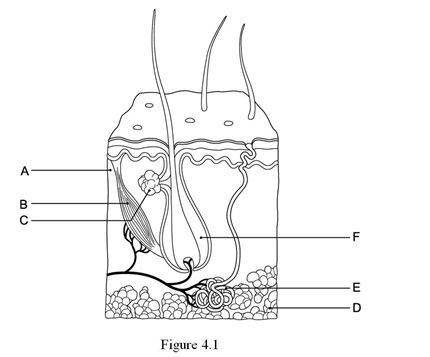
Using Figure 4.1, identify the following:
The hair follicle is indicated by ________.
A) Label A
B) Label B
C) Label C
D) Label D
E) Label E
F) Label F
Question
Using Figure 4.1, identify the following:
The gland that produces sweat is indicated by ________.
A) Label A
B) Label B
C) Label C
D) Label D
E) Label E
F) Label F
Question
Using Figure 4.1, identify the following:
The arrector pili muscle is represented by ________.
A) Label A
B) Label B
C) Label C
D) Label D
E) Label E
F) Label F
Question
Question
Using Figure 4.1, identify the following:
The layer responsible for whorled ridges on the epidermal surfaces is indicated by ________.
A) Label A
B) Label B
C) Label C
D) Label D
E) Label E
F) Label F
Question
Question
Question
Question
Using Figure 4.1, identify the following:
The hypodermis, or subcutaneous tissue, is represented by ________.
A) Label A
B) Label B
C) Label C
D) Label D
E) Label E
F) Label F
Question
Question
Question
Question
Using Figure 4.1, identify the following:
The gland that produces a mixture of oily substances and fragmented cells is indicated by ________.
A) Label A
B) Label B
C) Label C
D) Label D
E) Label E
F) Label F
Question
Question
Question
Question
Question
Question
Question
Question
Question
Question
Question
Question
Question
Question
Question
Question
Question
Question
Question
Question
Question
Question
Question
Question
Question
Question
Question
Question
Question
Question
Question
Question
Question
Question
Question
Question
Question
Question
Question
Question
Question
Question
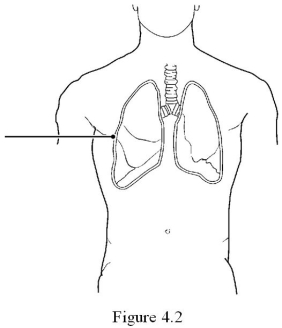
The membrane shown in Figure 4.2 is a ________.
A) cutaneous membrane
B) synovial membrane
C) pericardium, a serous membrane
D) mucous membrane
E) pleura, a serous membrane
Question
Question
Question
Question
Question
Question
Question
Question
Question
Question
Question
Question
Question
Question
Question
Question
Question
Question
Question
Question
Question
Question
Question
Question

Unlock Deck
Sign up to unlock the cards in this deck!
Unlock Deck
Unlock Deck
1/108

Play

Full screen (f)
Deck 4: Skin and Body Membranes
1
The three pigments that contribute to skin color are ________, ________, and ________.
A) collagen; elastic; keratin
B) melanin; jaundice; erythema
C) sebum; sweat; urea
D) melanin; carotene; hemoglobin
A) collagen; elastic; keratin
B) melanin; jaundice; erythema
C) sebum; sweat; urea
D) melanin; carotene; hemoglobin
D
2
Using Figure 4.1, identify the following:
The hair follicle is indicated by ________.
A) Label A
B) Label B
C) Label C
D) Label D
E) Label E
F) Label F
F
3
Using Figure 4.1, identify the following:
The gland that produces sweat is indicated by ________.
A) Label A
B) Label B
C) Label C
D) Label D
E) Label E
F) Label F
E
4
Using Figure 4.1, identify the following:
The arrector pili muscle is represented by ________.
A) Label A
B) Label B
C) Label C
D) Label D
E) Label E
F) Label F
Unlock Deck
Unlock for access to all 108 flashcards in this deck.
Unlock Deck
k this deck
5
The ________ membrane lines the fibrous capsule surrounding joints.
A) synovial
B) serous
C) mucous
D) cutaneous
A) synovial
B) serous
C) mucous
D) cutaneous
Unlock Deck
Unlock for access to all 108 flashcards in this deck.
Unlock Deck
k this deck
6
Using Figure 4.1, identify the following:
The layer responsible for whorled ridges on the epidermal surfaces is indicated by ________.
A) Label A
B) Label B
C) Label C
D) Label D
E) Label E
F) Label F
Unlock Deck
Unlock for access to all 108 flashcards in this deck.
Unlock Deck
k this deck
7
The layer of the serous membrane that covers an organ is known as the ________ layer.
A) bursa
B) visceral
C) lamina propria
D) parietal
A) bursa
B) visceral
C) lamina propria
D) parietal
Unlock Deck
Unlock for access to all 108 flashcards in this deck.
Unlock Deck
k this deck
8
The Staphylococcus infection of the skin that causes pink, water-filled, raised lesions is known as ________.
A) impetigo
B) cold sores
C) psoriasis
D) contact dermatitis
A) impetigo
B) cold sores
C) psoriasis
D) contact dermatitis
Unlock Deck
Unlock for access to all 108 flashcards in this deck.
Unlock Deck
k this deck
9
The white, cheesy-looking substance that is produced by the sebaceous glands and protects a baby's skin while it is floating in its water-filled sac inside the mother is called ________.
A) lanugo
B) vernix caseosa
C) milia
D) vellus
A) lanugo
B) vernix caseosa
C) milia
D) vellus
Unlock Deck
Unlock for access to all 108 flashcards in this deck.
Unlock Deck
k this deck
10
Using Figure 4.1, identify the following:
The hypodermis, or subcutaneous tissue, is represented by ________.
A) Label A
B) Label B
C) Label C
D) Label D
E) Label E
F) Label F
Unlock Deck
Unlock for access to all 108 flashcards in this deck.
Unlock Deck
k this deck
11
Hair color is due to a pigment known as ________.
A) hemoglobin
B) carotene
C) keratin
D) melanin
A) hemoglobin
B) carotene
C) keratin
D) melanin
Unlock Deck
Unlock for access to all 108 flashcards in this deck.
Unlock Deck
k this deck
12
"Goosebumps" are caused by contractions of the ________.
A) eccrine glands
B) synovial membranes
C) arrector pili muscles
D) apocrine glands
A) eccrine glands
B) synovial membranes
C) arrector pili muscles
D) apocrine glands
Unlock Deck
Unlock for access to all 108 flashcards in this deck.
Unlock Deck
k this deck
13
The outermost layer of the epidermis is keratinized and known as stratum ________.
A) basale
B) granulosum
C) corneum
D) spinosum
A) basale
B) granulosum
C) corneum
D) spinosum
Unlock Deck
Unlock for access to all 108 flashcards in this deck.
Unlock Deck
k this deck
14
Using Figure 4.1, identify the following:
The gland that produces a mixture of oily substances and fragmented cells is indicated by ________.
A) Label A
B) Label B
C) Label C
D) Label D
E) Label E
F) Label F
Unlock Deck
Unlock for access to all 108 flashcards in this deck.
Unlock Deck
k this deck
15
The sebaceous and sweat glands associated with the skin are classified as ________ glands because they release secretions to the skin's surface via ducts.
A) exocrine
B) endocrine
C) serous
D) mucous
A) exocrine
B) endocrine
C) serous
D) mucous
Unlock Deck
Unlock for access to all 108 flashcards in this deck.
Unlock Deck
k this deck
16
The type of burn that involves injury to the epidermis and the upper region of the dermis and is red, blistered, and painful is termed as a ________-degree burn.
A) first
B) second
C) third
D) fourth
A) first
B) second
C) third
D) fourth
Unlock Deck
Unlock for access to all 108 flashcards in this deck.
Unlock Deck
k this deck
17
The type of gland responsible for body temperature regulation is the ________ gland.
A) sebaceous
B) eccrine (sweat or sudoriferous)
C) apocrine (sweat or sudoriferous)
D) oil
A) sebaceous
B) eccrine (sweat or sudoriferous)
C) apocrine (sweat or sudoriferous)
D) oil
Unlock Deck
Unlock for access to all 108 flashcards in this deck.
Unlock Deck
k this deck
18
The part of a hair that projects from the surface of the scalp or skin is called the ________.
A) follicle
B) root
C) cuticle
D) shaft
A) follicle
B) root
C) cuticle
D) shaft
Unlock Deck
Unlock for access to all 108 flashcards in this deck.
Unlock Deck
k this deck
19
The pleura and pericardium are examples of ________ membranes that cover organs in a body cavity closed to the exterior.
A) mucous
B) serous
C) cutaneous
D) synovial
A) mucous
B) serous
C) cutaneous
D) synovial
Unlock Deck
Unlock for access to all 108 flashcards in this deck.
Unlock Deck
k this deck
20
The white crescent area located over the nail matrix is called the ________.
A) lunule
B) cuticle
C) matrix
D) bed
A) lunule
B) cuticle
C) matrix
D) bed
Unlock Deck
Unlock for access to all 108 flashcards in this deck.
Unlock Deck
k this deck
21
Where are mucous membranes found?
A) lining joint cavities
B) covering the heart
C) lining the inside of the stomach
D) covering the brain
E) lining the abdominal cavity wall
A) lining joint cavities
B) covering the heart
C) lining the inside of the stomach
D) covering the brain
E) lining the abdominal cavity wall
Unlock Deck
Unlock for access to all 108 flashcards in this deck.
Unlock Deck
k this deck
22
Jan got her microscope slides mixed up in lab as they were unlabeled. The slide with abundant adipose tissue should be labeled as the ________.
A) epidermis
B) papillary layer of the dermis
C) subcutaneous tissue
D) reticular layer of the dermis
E) stratum corneum
A) epidermis
B) papillary layer of the dermis
C) subcutaneous tissue
D) reticular layer of the dermis
E) stratum corneum
Unlock Deck
Unlock for access to all 108 flashcards in this deck.
Unlock Deck
k this deck
23
Which of the following is a vital function of the skin?
A) It converts modified epidermal cholesterol to vitamin D.
B) It aids in the transport of materials throughout the body.
C) The cells of the epidermis store glucose as glycogen for energy.
D) It absorbs vitamin C so that the skin will not be subject to diseases.
E) It aids in desiccation.
A) It converts modified epidermal cholesterol to vitamin D.
B) It aids in the transport of materials throughout the body.
C) The cells of the epidermis store glucose as glycogen for energy.
D) It absorbs vitamin C so that the skin will not be subject to diseases.
E) It aids in desiccation.
Unlock Deck
Unlock for access to all 108 flashcards in this deck.
Unlock Deck
k this deck
24
The skin and its derivatives (nails, glands, and hairs) form the ________.
A) skeletal system
B) integumentary system
C) endocrine system
D) immune system
E) lymphatic system
A) skeletal system
B) integumentary system
C) endocrine system
D) immune system
E) lymphatic system
Unlock Deck
Unlock for access to all 108 flashcards in this deck.
Unlock Deck
k this deck
25
Synovial fluid reduces friction ________.
A) in movable joints such as the knee
B) between the visceral and parietal layers of serous membranes
C) inside the lungs
D) as the heart beats
E) around the brain
A) in movable joints such as the knee
B) between the visceral and parietal layers of serous membranes
C) inside the lungs
D) as the heart beats
E) around the brain
Unlock Deck
Unlock for access to all 108 flashcards in this deck.
Unlock Deck
k this deck
26
A needle pierces through the epidermal layers of the forearm in the following order:
1) stratum basale
2) stratum corneum
3) stratum granulosum
4) stratum lucidum
5) stratum spinosum
A) 2, 3, 5, 1, 4
B) 1, 5, 3, 4, 2
C) 2, 4, 3, 5, 1
D) 1, 3, 5, 2, 4
E) 2, 3, 4, 1, 5
1) stratum basale
2) stratum corneum
3) stratum granulosum
4) stratum lucidum
5) stratum spinosum
A) 2, 3, 5, 1, 4
B) 1, 5, 3, 4, 2
C) 2, 4, 3, 5, 1
D) 1, 3, 5, 2, 4
E) 2, 3, 4, 1, 5
Unlock Deck
Unlock for access to all 108 flashcards in this deck.
Unlock Deck
k this deck
27
Which of the following letters in the ABCD rule for recognizing melanomas is incorrect?
A) A stands for asymmetry
B) B stands for border irregularity
C) C stands for color
D) D stands for diagnosis
A) A stands for asymmetry
B) B stands for border irregularity
C) C stands for color
D) D stands for diagnosis
Unlock Deck
Unlock for access to all 108 flashcards in this deck.
Unlock Deck
k this deck
28
Which of the following kills bacteria and prevents bacterial invasions of the skin?
A) sweat
B) hemoglobin
C) keratin
D) sebum
E) melanin
A) sweat
B) hemoglobin
C) keratin
D) sebum
E) melanin
Unlock Deck
Unlock for access to all 108 flashcards in this deck.
Unlock Deck
k this deck
29
The deepest layer of the serous membrane covering the outer surface of the heart is the ________.
A) parietal pericardium
B) visceral pleura
C) synovial layer
D) visceral pericardium
E) peritoneum
A) parietal pericardium
B) visceral pleura
C) synovial layer
D) visceral pericardium
E) peritoneum
Unlock Deck
Unlock for access to all 108 flashcards in this deck.
Unlock Deck
k this deck
30
The layer of the epidermis in which cells die because of their inability to get nutrients and oxygen is the clear layer called ________.
A) stratum spinosum
B) stratum granulosum
C) stratum basale
D) stratum corneum
E) stratum lucidum
A) stratum spinosum
B) stratum granulosum
C) stratum basale
D) stratum corneum
E) stratum lucidum
Unlock Deck
Unlock for access to all 108 flashcards in this deck.
Unlock Deck
k this deck
31
Which membrane is constructed of a visceral and parietal layer?
A) synovial
B) cutaneous
C) mucous
D) serous
E) peritoneum
A) synovial
B) cutaneous
C) mucous
D) serous
E) peritoneum
Unlock Deck
Unlock for access to all 108 flashcards in this deck.
Unlock Deck
k this deck
32
Although you get wet while swimming, a tough protein within the skin prevents it from soaking up moisture like a sponge. This substance is ________.
A) serous fluid
B) melanin
C) mucus
D) carotene
E) keratin
A) serous fluid
B) melanin
C) mucus
D) carotene
E) keratin
Unlock Deck
Unlock for access to all 108 flashcards in this deck.
Unlock Deck
k this deck
33
People who produce a lot of melanin have a skin tone that is ________.
A) green
B) brown
C) blue
D) pink
E) orange
A) green
B) brown
C) blue
D) pink
E) orange
Unlock Deck
Unlock for access to all 108 flashcards in this deck.
Unlock Deck
k this deck
34
The epidermis is composed of ________.
A) simple columnar epithelium
B) stratified squamous epithelium
C) adipose tissue
D) areolar tissue
E) dense fibrous connective tissue
A) simple columnar epithelium
B) stratified squamous epithelium
C) adipose tissue
D) areolar tissue
E) dense fibrous connective tissue
Unlock Deck
Unlock for access to all 108 flashcards in this deck.
Unlock Deck
k this deck
35
Which of the following homeostatic imbalances is caused by a herpes simplex infection?
A) athlete's foot
B) cold sores
C) impetigo
D) contact dermatitis
E) cyanosis
A) athlete's foot
B) cold sores
C) impetigo
D) contact dermatitis
E) cyanosis
Unlock Deck
Unlock for access to all 108 flashcards in this deck.
Unlock Deck
k this deck
36
Which of the following is a connective tissue membrane?
A) synovial membrane
B) cutaneous membrane
C) mucous membrane
D) serous membrane
E) pleural membrane
A) synovial membrane
B) cutaneous membrane
C) mucous membrane
D) serous membrane
E) pleural membrane
Unlock Deck
Unlock for access to all 108 flashcards in this deck.
Unlock Deck
k this deck
37
The "tanning" effect (darkening of the skin) that occurs when a person is exposed to the sun is due to ________.
A) melanin
B) keratin
C) oil
D) Langerhans cells
E) sweat
A) melanin
B) keratin
C) oil
D) Langerhans cells
E) sweat
Unlock Deck
Unlock for access to all 108 flashcards in this deck.
Unlock Deck
k this deck
38
The only dry membrane is the ________.
A) synovial membrane
B) cutaneous membrane
C) mucous membrane
D) serous membrane
E) basement membrane
A) synovial membrane
B) cutaneous membrane
C) mucous membrane
D) serous membrane
E) basement membrane
Unlock Deck
Unlock for access to all 108 flashcards in this deck.
Unlock Deck
k this deck
39
The two main layers of skin are ________.
A) papillary layer and reticular layer
B) stratum basale and dermis
C) epidermis and dermis
D) stratum corneum and dermis
E) epidermis and hypodermis
A) papillary layer and reticular layer
B) stratum basale and dermis
C) epidermis and dermis
D) stratum corneum and dermis
E) epidermis and hypodermis
Unlock Deck
Unlock for access to all 108 flashcards in this deck.
Unlock Deck
k this deck
40
A splinter penetrates to the deepest layer of the epidermis on your foot. This layer is the ________.
A) stratum basale
B) stratum corneum
C) stratum granulosum
D) stratum lucidum
E) stratum spinosum
A) stratum basale
B) stratum corneum
C) stratum granulosum
D) stratum lucidum
E) stratum spinosum
Unlock Deck
Unlock for access to all 108 flashcards in this deck.
Unlock Deck
k this deck
41
The secretions of the eccrine glands are ________.
A) primarily uric acid
B) mostly water, sodium chloride, and trace amounts of wastes, lactic acid, and vitamin C
C) fatty substances, proteins, antibodies, and trace amounts of minerals and vitamins
D) solely metabolic wastes
E) basic
A) primarily uric acid
B) mostly water, sodium chloride, and trace amounts of wastes, lactic acid, and vitamin C
C) fatty substances, proteins, antibodies, and trace amounts of minerals and vitamins
D) solely metabolic wastes
E) basic
Unlock Deck
Unlock for access to all 108 flashcards in this deck.
Unlock Deck
k this deck
42
When an individual is exposed to extremely low air temperatures, the capillaries of the skin will dilate so that blood will flush into skin capillary beds and heat will be dissipated.
Unlock Deck
Unlock for access to all 108 flashcards in this deck.
Unlock Deck
k this deck
43
The pinkish hue of healthy individuals with fair skin is the result of the crimson color of oxygenated hemoglobin circulating in the dermal capillaries and reflecting through the dermis.
Unlock Deck
Unlock for access to all 108 flashcards in this deck.
Unlock Deck
k this deck
44
What skin disorder is recognized using the ABCD rule?
A) squamous cell carcinoma
B) melanoma
C) psoriasis
D) basal cell carcinoma
E) impetigo
A) squamous cell carcinoma
B) melanoma
C) psoriasis
D) basal cell carcinoma
E) impetigo
Unlock Deck
Unlock for access to all 108 flashcards in this deck.
Unlock Deck
k this deck
45
Which of the following abnormal skin colors results from liver disorders?
A) cyanosis
B) pallor
C) erythema
D) jaundice
E) bruising
A) cyanosis
B) pallor
C) erythema
D) jaundice
E) bruising
Unlock Deck
Unlock for access to all 108 flashcards in this deck.
Unlock Deck
k this deck
46
A genetic switch turns on male pattern baldness in response to ________.
A) age
B) size
C) weight
D) male hormones
E) female hormones
A) age
B) size
C) weight
D) male hormones
E) female hormones
Unlock Deck
Unlock for access to all 108 flashcards in this deck.
Unlock Deck
k this deck
47
Sebum is responsible for all of the following except ________.
A) body temperature regulation
B) makes the skin oilier during adolescence
C) kills bacteria on the skin's surface
D) keeps the skin soft and moist
E) prevents hair follicles from brittleness
A) body temperature regulation
B) makes the skin oilier during adolescence
C) kills bacteria on the skin's surface
D) keeps the skin soft and moist
E) prevents hair follicles from brittleness
Unlock Deck
Unlock for access to all 108 flashcards in this deck.
Unlock Deck
k this deck
48
Serous membranes line and lubricate joint cavities such as the knee.
Unlock Deck
Unlock for access to all 108 flashcards in this deck.
Unlock Deck
k this deck
49
Hairs are found associated with the ________.
A) palms of the hands
B) axillary region
C) lips
D) nipples
E) soles of the feet
A) palms of the hands
B) axillary region
C) lips
D) nipples
E) soles of the feet
Unlock Deck
Unlock for access to all 108 flashcards in this deck.
Unlock Deck
k this deck
50
A physician estimates the volume of fluid lost in a severely burned patient by ________.
A) measuring urinary output and fluid intake
B) observing the tissues that are usually moist
C) blood analysis
D) using the "rule of nines"
E) performing enzyme studies
A) measuring urinary output and fluid intake
B) observing the tissues that are usually moist
C) blood analysis
D) using the "rule of nines"
E) performing enzyme studies
Unlock Deck
Unlock for access to all 108 flashcards in this deck.
Unlock Deck
k this deck
51
Which of the following is an indication of melanoma?
A) a symmetrical mole
B) a pigmented spot that has smooth borders
C) a spot on the skin that is smaller than the size of a pencil eraser
D) a pigmented spot that is black
E) a pigmented spot that contains areas of different colors
A) a symmetrical mole
B) a pigmented spot that has smooth borders
C) a spot on the skin that is smaller than the size of a pencil eraser
D) a pigmented spot that is black
E) a pigmented spot that contains areas of different colors
Unlock Deck
Unlock for access to all 108 flashcards in this deck.
Unlock Deck
k this deck
52
In order to warm the body up when cold ________.
A) vitamin D is synthesized
B) sudoriferous glands release sweat
C) sebaceous glands release oil
D) the arrector pili muscles contract to stand hairs upright
E) melanin is produced
A) vitamin D is synthesized
B) sudoriferous glands release sweat
C) sebaceous glands release oil
D) the arrector pili muscles contract to stand hairs upright
E) melanin is produced
Unlock Deck
Unlock for access to all 108 flashcards in this deck.
Unlock Deck
k this deck
53
Fingerprints and footprints in the epidermis are created by dermal papillae present in the ________.
A) reticular layer of the dermis
B) subcutaneous tissue
C) stratum lucidum
D) hypodermis
E) papillary layer of the dermis
A) reticular layer of the dermis
B) subcutaneous tissue
C) stratum lucidum
D) hypodermis
E) papillary layer of the dermis
Unlock Deck
Unlock for access to all 108 flashcards in this deck.
Unlock Deck
k this deck
54
Which vitamin is synthesized by the skin?
A) vitamin A
B) vitamin C
C) vitamin D
D) vitamin E
E) vitamin K
A) vitamin A
B) vitamin C
C) vitamin D
D) vitamin E
E) vitamin K
Unlock Deck
Unlock for access to all 108 flashcards in this deck.
Unlock Deck
k this deck
55
The dermis is composed mostly of dense connective tissue.
Unlock Deck
Unlock for access to all 108 flashcards in this deck.
Unlock Deck
k this deck
56
The membrane shown in Figure 4.2 is a ________.
A) cutaneous membrane
B) synovial membrane
C) pericardium, a serous membrane
D) mucous membrane
E) pleura, a serous membrane
Unlock Deck
Unlock for access to all 108 flashcards in this deck.
Unlock Deck
k this deck
57
The secretion of sweat is stimulated ________.
A) by high temperatures
B) when the air temperature drops
C) by hormones, especially male sex hormones
D) as a protective coating when one is swimming
E) both by high temperatures and by hormones, especially male hormones
A) by high temperatures
B) when the air temperature drops
C) by hormones, especially male sex hormones
D) as a protective coating when one is swimming
E) both by high temperatures and by hormones, especially male hormones
Unlock Deck
Unlock for access to all 108 flashcards in this deck.
Unlock Deck
k this deck
58
Cutaneous membranes are the only dry membranes.
Unlock Deck
Unlock for access to all 108 flashcards in this deck.
Unlock Deck
k this deck
59
Nails are composed of ________.
A) melanin
B) hemoglobin
C) keratin
D) sebum
E) carotene
A) melanin
B) hemoglobin
C) keratin
D) sebum
E) carotene
Unlock Deck
Unlock for access to all 108 flashcards in this deck.
Unlock Deck
k this deck
60
Nutrients reach the surface of the skin (epidermis) through the process of ________.
A) absorption
B) evaporation
C) filtration
D) diffusion
E) osmosis
A) absorption
B) evaporation
C) filtration
D) diffusion
E) osmosis
Unlock Deck
Unlock for access to all 108 flashcards in this deck.
Unlock Deck
k this deck
61
Match the following:
A) cancer of melanocytes
B) cancer of stratum spinosum cells
C) staphylococcus bacterial infection causing water-filled lesions, commonly around the mouth and nose
D) infection of the sebaceous gland and the formation of pimples
E) skin inflammation
F) inflammation of hair follicles and sebaceous glands
G) malignancy of the lowest epidermal layer
H) burn in which only the epidermis becomes red and swollen
I) dry, dead flakes of stratum corneum
J) virus that produces cold sores
K) full thickness burn of the skin in which the skin becomes blackened or blanched (gray-white)
Malignant melanoma
A) cancer of melanocytes
B) cancer of stratum spinosum cells
C) staphylococcus bacterial infection causing water-filled lesions, commonly around the mouth and nose
D) infection of the sebaceous gland and the formation of pimples
E) skin inflammation
F) inflammation of hair follicles and sebaceous glands
G) malignancy of the lowest epidermal layer
H) burn in which only the epidermis becomes red and swollen
I) dry, dead flakes of stratum corneum
J) virus that produces cold sores
K) full thickness burn of the skin in which the skin becomes blackened or blanched (gray-white)
Malignant melanoma
Unlock Deck
Unlock for access to all 108 flashcards in this deck.
Unlock Deck
k this deck
62
Match the following:
A) cancer of melanocytes
B) cancer of stratum spinosum cells
C) staphylococcus bacterial infection causing water-filled lesions, commonly around the mouth and nose
D) infection of the sebaceous gland and the formation of pimples
E) skin inflammation
F) inflammation of hair follicles and sebaceous glands
G) malignancy of the lowest epidermal layer
H) burn in which only the epidermis becomes red and swollen
I) dry, dead flakes of stratum corneum
J) virus that produces cold sores
K) full thickness burn of the skin in which the skin becomes blackened or blanched (gray-white)
Dermatitis
A) cancer of melanocytes
B) cancer of stratum spinosum cells
C) staphylococcus bacterial infection causing water-filled lesions, commonly around the mouth and nose
D) infection of the sebaceous gland and the formation of pimples
E) skin inflammation
F) inflammation of hair follicles and sebaceous glands
G) malignancy of the lowest epidermal layer
H) burn in which only the epidermis becomes red and swollen
I) dry, dead flakes of stratum corneum
J) virus that produces cold sores
K) full thickness burn of the skin in which the skin becomes blackened or blanched (gray-white)
Dermatitis
Unlock Deck
Unlock for access to all 108 flashcards in this deck.
Unlock Deck
k this deck
63
Sebaceous glands may be classified as eccrine or apocrine depending on their locations.
Unlock Deck
Unlock for access to all 108 flashcards in this deck.
Unlock Deck
k this deck
64
Nails and hair are composed of keratin.
Unlock Deck
Unlock for access to all 108 flashcards in this deck.
Unlock Deck
k this deck
65
The majority of the cells in the epidermis are keratinocytes.
Unlock Deck
Unlock for access to all 108 flashcards in this deck.
Unlock Deck
k this deck
66
Squamous cell carcinoma arises from cells of the stratum spinosum.
Unlock Deck
Unlock for access to all 108 flashcards in this deck.
Unlock Deck
k this deck
67
Milia is most common during old age when secretions accumulate in the sebaceous glands.
Unlock Deck
Unlock for access to all 108 flashcards in this deck.
Unlock Deck
k this deck
68
The epidermis is made up of stratified squamous epithelium.
Unlock Deck
Unlock for access to all 108 flashcards in this deck.
Unlock Deck
k this deck
69
Joe just burned his hand on a hot pot. A blister forms and the burn is painful; Joe's burn would best be described as a third-degree, or full-thickness, burn.
Unlock Deck
Unlock for access to all 108 flashcards in this deck.
Unlock Deck
k this deck
70
The reason that the nail bed appears pink is the presence of a large number of melanocytes in the underlying dermis.
Unlock Deck
Unlock for access to all 108 flashcards in this deck.
Unlock Deck
k this deck
71
Sebaceous glands release sweat to help control body temperature.
Unlock Deck
Unlock for access to all 108 flashcards in this deck.
Unlock Deck
k this deck
72
Hair is produced by the hair bulb and is composed primarily of dead keratinized cells.
Unlock Deck
Unlock for access to all 108 flashcards in this deck.
Unlock Deck
k this deck
73
Match the following:
A) cancer of melanocytes
B) cancer of stratum spinosum cells
C) staphylococcus bacterial infection causing water-filled lesions, commonly around the mouth and nose
D) infection of the sebaceous gland and the formation of pimples
E) skin inflammation
F) inflammation of hair follicles and sebaceous glands
G) malignancy of the lowest epidermal layer
H) burn in which only the epidermis becomes red and swollen
I) dry, dead flakes of stratum corneum
J) virus that produces cold sores
K) full thickness burn of the skin in which the skin becomes blackened or blanched (gray-white)
Basal cell carcinoma
A) cancer of melanocytes
B) cancer of stratum spinosum cells
C) staphylococcus bacterial infection causing water-filled lesions, commonly around the mouth and nose
D) infection of the sebaceous gland and the formation of pimples
E) skin inflammation
F) inflammation of hair follicles and sebaceous glands
G) malignancy of the lowest epidermal layer
H) burn in which only the epidermis becomes red and swollen
I) dry, dead flakes of stratum corneum
J) virus that produces cold sores
K) full thickness burn of the skin in which the skin becomes blackened or blanched (gray-white)
Basal cell carcinoma
Unlock Deck
Unlock for access to all 108 flashcards in this deck.
Unlock Deck
k this deck
74
Collagen and elastic fibers are common in the epidermis of the skin.
Unlock Deck
Unlock for access to all 108 flashcards in this deck.
Unlock Deck
k this deck
75
Match the following:
A) cancer of melanocytes
B) cancer of stratum spinosum cells
C) staphylococcus bacterial infection causing water-filled lesions, commonly around the mouth and nose
D) infection of the sebaceous gland and the formation of pimples
E) skin inflammation
F) inflammation of hair follicles and sebaceous glands
G) malignancy of the lowest epidermal layer
H) burn in which only the epidermis becomes red and swollen
I) dry, dead flakes of stratum corneum
J) virus that produces cold sores
K) full thickness burn of the skin in which the skin becomes blackened or blanched (gray-white)
Dandruff
A) cancer of melanocytes
B) cancer of stratum spinosum cells
C) staphylococcus bacterial infection causing water-filled lesions, commonly around the mouth and nose
D) infection of the sebaceous gland and the formation of pimples
E) skin inflammation
F) inflammation of hair follicles and sebaceous glands
G) malignancy of the lowest epidermal layer
H) burn in which only the epidermis becomes red and swollen
I) dry, dead flakes of stratum corneum
J) virus that produces cold sores
K) full thickness burn of the skin in which the skin becomes blackened or blanched (gray-white)
Dandruff
Unlock Deck
Unlock for access to all 108 flashcards in this deck.
Unlock Deck
k this deck
76
The pattern that produces fingerprints is produced by dermal papillae in the dermis.
Unlock Deck
Unlock for access to all 108 flashcards in this deck.
Unlock Deck
k this deck
77
Match the following:
A) cancer of melanocytes
B) cancer of stratum spinosum cells
C) staphylococcus bacterial infection causing water-filled lesions, commonly around the mouth and nose
D) infection of the sebaceous gland and the formation of pimples
E) skin inflammation
F) inflammation of hair follicles and sebaceous glands
G) malignancy of the lowest epidermal layer
H) burn in which only the epidermis becomes red and swollen
I) dry, dead flakes of stratum corneum
J) virus that produces cold sores
K) full thickness burn of the skin in which the skin becomes blackened or blanched (gray-white)
Herpes simplex
A) cancer of melanocytes
B) cancer of stratum spinosum cells
C) staphylococcus bacterial infection causing water-filled lesions, commonly around the mouth and nose
D) infection of the sebaceous gland and the formation of pimples
E) skin inflammation
F) inflammation of hair follicles and sebaceous glands
G) malignancy of the lowest epidermal layer
H) burn in which only the epidermis becomes red and swollen
I) dry, dead flakes of stratum corneum
J) virus that produces cold sores
K) full thickness burn of the skin in which the skin becomes blackened or blanched (gray-white)
Herpes simplex
Unlock Deck
Unlock for access to all 108 flashcards in this deck.
Unlock Deck
k this deck
78
The ABCD rule is used for classifying burns.
Unlock Deck
Unlock for access to all 108 flashcards in this deck.
Unlock Deck
k this deck
79
The rule of nines is used to estimate how much of the body surface is burned.
Unlock Deck
Unlock for access to all 108 flashcards in this deck.
Unlock Deck
k this deck
80
Apocrine gland secretions are normally odorless, and may be milky or yellowish in color.
Unlock Deck
Unlock for access to all 108 flashcards in this deck.
Unlock Deck
k this deck
Unlock Deck
Unlock for access to all 108 flashcards in this deck.






