







 Chat with AI

Deck 29: the Senses
Full screen (f)

Question

Question
Question
Question
Question
Question
Question
Question
Question
Question
Question
Question
Question
Question
Question
Question
Question
Question
Question
Question
Question
Question
Question
Question
Question
Question
Question
Question
Question
Question
Question
Question
Question
Question
Question
Question
Question
Question
Question
Question
Question
Question
Question
Question
Question
Question
Which part of this figure depicting an ear is the cochlea? 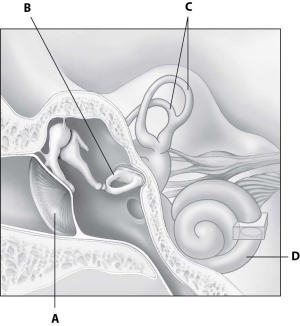
A)part A
B)part B
C)part C
D)part D
A)part A
B)part B
C)part C
D)part D
Question
Which part of this figure depicting an eye is the retina? 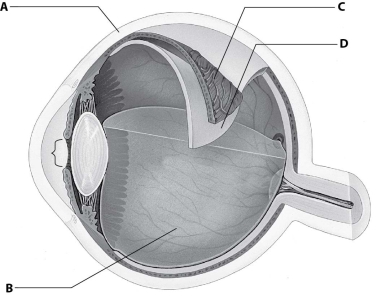
A)part A
B)part B
C)part C
D)part D
A)part A
B)part B
C)part C
D)part D
Question
Question
Question
Question
Question
Question
Question
Question
Question
Question
Question
Question
Question

Unlock Deck
Sign up to unlock the cards in this deck!
Unlock Deck
Unlock Deck
1/60

Play

Full screen (f)
Deck 29: the Senses
1
Which of the following classes of sensory receptors responds to stimuli such as touch, pressure, stretching, and sound?
A)thermoreceptors
B)mechanoreceptors
C)electromagnetic receptors
D)chemoreceptors
A)thermoreceptors
B)mechanoreceptors
C)electromagnetic receptors
D)chemoreceptors
B
2
Which type of sensory receptors becomes more sensitive when damaged tissues produce prostaglandins?
A)deep pressure receptors
B)utricle hair cells
C)pain receptors
D)temperature receptors
A)deep pressure receptors
B)utricle hair cells
C)pain receptors
D)temperature receptors
C
3
Where is the organ of Corti?
A)in the pinna
B)in the inner ear
C)in the middle canal
D)in the Eustachian tube
A)in the pinna
B)in the inner ear
C)in the middle canal
D)in the Eustachian tube
B
4
Which of the following options incorrectly pairs a class of sensory receptor with one of the stimuli it detects?
A)electromagnetic receptors-light
B)chemoreceptors-molecular structure
C)mechanoreceptors-sound
D)thermoreceptors-touch
A)electromagnetic receptors-light
B)chemoreceptors-molecular structure
C)mechanoreceptors-sound
D)thermoreceptors-touch
Unlock Deck
Unlock for access to all 60 flashcards in this deck.
Unlock Deck
k this deck
5
Which of the following lists structures involved only in the sense of hearing?
A)middle ear bones, semicircular canals, basilar membrane
B)eardrum, utricle, organ of Corti
C)oval window, cochlea, aqueous humor
D)oval window, basilar membrane, organ of Corti
A)middle ear bones, semicircular canals, basilar membrane
B)eardrum, utricle, organ of Corti
C)oval window, cochlea, aqueous humor
D)oval window, basilar membrane, organ of Corti
Unlock Deck
Unlock for access to all 60 flashcards in this deck.
Unlock Deck
k this deck
6
Which of the following correctly lists the order in which structures within the ear transfer a sound wave during hearing?
A)eardrum, hammer, anvil, stirrup, oval window, auditory canal
B)eardrum, stirrup, hammer, anvil, oval window, auditory canal
C)auditory canal, eardrum, hammer, anvil, stirrup, oval window
D)auditory canal, eardrum, stirrup, hammer, anvil, oval window
A)eardrum, hammer, anvil, stirrup, oval window, auditory canal
B)eardrum, stirrup, hammer, anvil, oval window, auditory canal
C)auditory canal, eardrum, hammer, anvil, stirrup, oval window
D)auditory canal, eardrum, stirrup, hammer, anvil, oval window
Unlock Deck
Unlock for access to all 60 flashcards in this deck.
Unlock Deck
k this deck
7
Which of the following is an example of sensory adaptation of receptors?
A)distinguishing between different colors
B)ignoring the shoes on your feet
C)thinking about what you would do with a million dollars
D)detecting sound and light simultaneously
A)distinguishing between different colors
B)ignoring the shoes on your feet
C)thinking about what you would do with a million dollars
D)detecting sound and light simultaneously
Unlock Deck
Unlock for access to all 60 flashcards in this deck.
Unlock Deck
k this deck
8
Fish that quickly and accurately sense the location of a nearby motionless fish in cloudy water are probably using
A)electromagnetic receptors.
B)photoreceptors.
C)chemoreceptors.
D)pain receptors.
A)electromagnetic receptors.
B)photoreceptors.
C)chemoreceptors.
D)pain receptors.
Unlock Deck
Unlock for access to all 60 flashcards in this deck.
Unlock Deck
k this deck
9
In stimulus detection, sensory receptor cells convert a stimulus
A)into a neurotransmitter.
B)into an enzyme.
C)into an electric signal.
D)into an astigmatism.
A)into a neurotransmitter.
B)into an enzyme.
C)into an electric signal.
D)into an astigmatism.
Unlock Deck
Unlock for access to all 60 flashcards in this deck.
Unlock Deck
k this deck
10
Which of the following statements best describes the basis of sensory adaptation?
A)A continuously stimulated sensory receptor triggers fewer action potentials, so stimuli sent to the brain decrease and awareness of the stimuli is diminished.
B)The nerve fiber synapsed with a sensory receptor gradually returns to its baseline level of firing despite continued neurotransmitter stimulation.
C)The spinal cord interneurons that receive a prolonged stimulus gradually come to ignore it.
D)The thalamic centers that receive a prolonged stimulus gradually come to ignore it.
A)A continuously stimulated sensory receptor triggers fewer action potentials, so stimuli sent to the brain decrease and awareness of the stimuli is diminished.
B)The nerve fiber synapsed with a sensory receptor gradually returns to its baseline level of firing despite continued neurotransmitter stimulation.
C)The spinal cord interneurons that receive a prolonged stimulus gradually come to ignore it.
D)The thalamic centers that receive a prolonged stimulus gradually come to ignore it.
Unlock Deck
Unlock for access to all 60 flashcards in this deck.
Unlock Deck
k this deck
11
Sensory transduction occurs in the
A)cerebral cortex.
B)thalamus.
C)spinal cord.
D)plasma membrane of sensory cells.
A)cerebral cortex.
B)thalamus.
C)spinal cord.
D)plasma membrane of sensory cells.
Unlock Deck
Unlock for access to all 60 flashcards in this deck.
Unlock Deck
k this deck
12
Receptors that transduce when the plasma membrane becomes more permeable to positive ions as it changes shape are called
A)pain receptors.
B)thermoreceptors.
C)mechanoreceptors.
D)chemoreceptors.
A)pain receptors.
B)thermoreceptors.
C)mechanoreceptors.
D)chemoreceptors.
Unlock Deck
Unlock for access to all 60 flashcards in this deck.
Unlock Deck
k this deck
13
The semicircular canals
A)are arranged in three perpendicular planes.
B)contain a thin basilar membrane.
C)are lined by long rows of hair cells along their entire length.
D)transmit vibrations from the oval window to the saccule.
A)are arranged in three perpendicular planes.
B)contain a thin basilar membrane.
C)are lined by long rows of hair cells along their entire length.
D)transmit vibrations from the oval window to the saccule.
Unlock Deck
Unlock for access to all 60 flashcards in this deck.
Unlock Deck
k this deck
14
You arrive at your office and are startled by the sounds of building construction outside your window. As you settle in to your work for the day, you forget about the construction noises. When a visitor comes to your office later that day, the first thing she comments on is how disruptive the construction noise must be to your concentration. You realize that you have not even noticed it for over an hour. This is due to
A)sensory transduction.
B)sensory adaptation.
C)resting potential.
D)action potential firing.
A)sensory transduction.
B)sensory adaptation.
C)resting potential.
D)action potential firing.
Unlock Deck
Unlock for access to all 60 flashcards in this deck.
Unlock Deck
k this deck
15
The nervous system determines the pitch of a tone by
A)the region of the basilar membrane that vibrates most vigorously at any one instant.
B)peak amplitude of basilar membrane displacement.
C)sites along the basilar membrane where vibrations are longest.
D)the frequency of oval window vibration.
A)the region of the basilar membrane that vibrates most vigorously at any one instant.
B)peak amplitude of basilar membrane displacement.
C)sites along the basilar membrane where vibrations are longest.
D)the frequency of oval window vibration.
Unlock Deck
Unlock for access to all 60 flashcards in this deck.
Unlock Deck
k this deck
16
The cochlea is
A)a coiled structure found in the inner ear.
B)part of the organ of Corti.
C)involved in the maintenance of body temperature.
D)part of the middle ear.
A)a coiled structure found in the inner ear.
B)part of the organ of Corti.
C)involved in the maintenance of body temperature.
D)part of the middle ear.
Unlock Deck
Unlock for access to all 60 flashcards in this deck.
Unlock Deck
k this deck
17
Suppose you have three water baths in front of you. The temperature of the one on the left is 22°C (cold), the one in the middle is 25°C (room temperature,)and the one on the right is 44°C (warm). At the same time, you place the index finger of your right hand into the warm water bath and the index finger of your left hand into the cold water bath, and you leave them there for 2 minutes. After 2 minutes, why would you no longer feel a difference in temperature between the two water baths?
A)The sensory receptors in your index fingers speed up the conversion of the stimulus (water)to a chemical signal.
B)The sensory receptors in your index fingers diminish the conversion of the stimulus (water)to an electrical signal.
C)The sensory receptors in your index fingers become less sensitive over time as they are stimulated repeatedly.
D)Receptor potentials in the sensory receptors in your index fingers start off weak and then become stronger.
A)The sensory receptors in your index fingers speed up the conversion of the stimulus (water)to a chemical signal.
B)The sensory receptors in your index fingers diminish the conversion of the stimulus (water)to an electrical signal.
C)The sensory receptors in your index fingers become less sensitive over time as they are stimulated repeatedly.
D)Receptor potentials in the sensory receptors in your index fingers start off weak and then become stronger.
Unlock Deck
Unlock for access to all 60 flashcards in this deck.
Unlock Deck
k this deck
18
The receptor potential is the
A)membrane potential produced when a neurotransmitter molecule binds to its receptor.
B)membrane potential produced in the receptor cell by sensory transduction.
C)electrical signal produced by an action potential.
D)membrane potential produced at a muscle cell.
A)membrane potential produced when a neurotransmitter molecule binds to its receptor.
B)membrane potential produced in the receptor cell by sensory transduction.
C)electrical signal produced by an action potential.
D)membrane potential produced at a muscle cell.
Unlock Deck
Unlock for access to all 60 flashcards in this deck.
Unlock Deck
k this deck
19
You exercised to the point that you were breathing heavily. Your heavy breathing was the result of ________ relaying information about the amount of O₂ in your blood to the medulla, which ultimately resulted in your increased rate of breathing.
A)mechanoreceptors
B)electromagnetic receptors
C)chemoreceptors
D)thermoreceptors
A)mechanoreceptors
B)electromagnetic receptors
C)chemoreceptors
D)thermoreceptors
Unlock Deck
Unlock for access to all 60 flashcards in this deck.
Unlock Deck
k this deck
20
The hair cells in the utricle detect
A)subsonic sound vibrations.
B)rotation of the head in an anteroposterior plane (a plane that cuts through you from front to back).
C)rotation of the head in a coronal plane (a plane that cuts through you from side to side).
D)the position of the head with respect to gravity.
A)subsonic sound vibrations.
B)rotation of the head in an anteroposterior plane (a plane that cuts through you from front to back).
C)rotation of the head in a coronal plane (a plane that cuts through you from side to side).
D)the position of the head with respect to gravity.
Unlock Deck
Unlock for access to all 60 flashcards in this deck.
Unlock Deck
k this deck
21
A person whose eyeball is shorter than normal suffers from
A)hyperopia.
B)myopia.
C)astigmatism.
D)presbyopia.
A)hyperopia.
B)myopia.
C)astigmatism.
D)presbyopia.
Unlock Deck
Unlock for access to all 60 flashcards in this deck.
Unlock Deck
k this deck
22
Where does the information from the light receptors undergo its first level of neural processing?
A)in the retina
B)in the optic nerve
C)in the primary visual cortex
D)in the hippocampus
A)in the retina
B)in the optic nerve
C)in the primary visual cortex
D)in the hippocampus
Unlock Deck
Unlock for access to all 60 flashcards in this deck.
Unlock Deck
k this deck
23
The olfactory receptor cells are located in the
A)forebrain.
B)semicircular canals.
C)saccule.
D)nasal cavity.
A)forebrain.
B)semicircular canals.
C)saccule.
D)nasal cavity.
Unlock Deck
Unlock for access to all 60 flashcards in this deck.
Unlock Deck
k this deck
24
If the aqueous humor circulates but does not drain properly, the likely result will be the development of
A)glaucoma.
B)myopia.
C)astigmatism.
D)hyperopia.
A)glaucoma.
B)myopia.
C)astigmatism.
D)hyperopia.
Unlock Deck
Unlock for access to all 60 flashcards in this deck.
Unlock Deck
k this deck
25
Which of the following correctly lists the order of structures through which light must pass on its way to the retina of the human eye?
A)pupil, cornea, aqueous humor, lens
B)lens, aqueous humor, pupil, cornea
C)cornea, aqueous humor, pupil, lens
D)cornea, pupil, aqueous humor, lens
A)pupil, cornea, aqueous humor, lens
B)lens, aqueous humor, pupil, cornea
C)cornea, aqueous humor, pupil, lens
D)cornea, pupil, aqueous humor, lens
Unlock Deck
Unlock for access to all 60 flashcards in this deck.
Unlock Deck
k this deck
26
Which of the following statements about the focusing of light by the eyes is true?
A)Squids and many fishes change the shape of the lens to focus light.
B)Mammals focus light when a rigid lens is moved back and forth.
C)Mammals use muscles and ligaments to change the shape of the lens to focus light.
D)Mammalian lenses thicken when focused on distant objects.
A)Squids and many fishes change the shape of the lens to focus light.
B)Mammals focus light when a rigid lens is moved back and forth.
C)Mammals use muscles and ligaments to change the shape of the lens to focus light.
D)Mammalian lenses thicken when focused on distant objects.
Unlock Deck
Unlock for access to all 60 flashcards in this deck.
Unlock Deck
k this deck
27
You are driving at night and decide to pass a slow-moving car. As you look at the car as you pass, it dawns on you that although you can see the car, you can't tell what color it is. This is due to
A)the poor ability of cones to function in low light.
B)the poor ability of rods to function in low light.
C)a reduced ability to focus in low light situations.
D)the constriction of your pupil in low light situations, which reduces color vision.
A)the poor ability of cones to function in low light.
B)the poor ability of rods to function in low light.
C)a reduced ability to focus in low light situations.
D)the constriction of your pupil in low light situations, which reduces color vision.
Unlock Deck
Unlock for access to all 60 flashcards in this deck.
Unlock Deck
k this deck
28
Which of the following statements regarding rods and cones is true?
A)Rods are more sensitive to light than cones.
B)Cones are responsible for night vision.
C)Rods are found at the greatest density at the fovea, the retina's center of focus.
D)Rods contain the visual pigment called photopsin.
A)Rods are more sensitive to light than cones.
B)Cones are responsible for night vision.
C)Rods are found at the greatest density at the fovea, the retina's center of focus.
D)Rods contain the visual pigment called photopsin.
Unlock Deck
Unlock for access to all 60 flashcards in this deck.
Unlock Deck
k this deck
29
Which of the following structures is involved in the human sense of balance?
A)the outer ear
B)the oval window
C)the utricle
D)the basilar membrane
A)the outer ear
B)the oval window
C)the utricle
D)the basilar membrane
Unlock Deck
Unlock for access to all 60 flashcards in this deck.
Unlock Deck
k this deck
30
Which of the following statements about the humors of the eye is true?
A)The vitreous humor fills the chamber behind the lens.
B)The vitreous humor circulates.
C)The aqueous humor is jellylike.
D)The humors help keep the outside of the eye moist.
A)The vitreous humor fills the chamber behind the lens.
B)The vitreous humor circulates.
C)The aqueous humor is jellylike.
D)The humors help keep the outside of the eye moist.
Unlock Deck
Unlock for access to all 60 flashcards in this deck.
Unlock Deck
k this deck
31
When farsightedness develops with age (called presbyopia), the
A)lens becomes less elastic and so gradually loses its ability to focus on nearby objects.
B)eyeball lengthens and so gradually loses its ability to focus on objects that are far away.
C)lens becomes more elastic and so gradually loses its ability to focus on nearby objects.
D)eyeball lengthens and so gradually loses its ability to focus on nearby objects.
A)lens becomes less elastic and so gradually loses its ability to focus on nearby objects.
B)eyeball lengthens and so gradually loses its ability to focus on objects that are far away.
C)lens becomes more elastic and so gradually loses its ability to focus on nearby objects.
D)eyeball lengthens and so gradually loses its ability to focus on nearby objects.
Unlock Deck
Unlock for access to all 60 flashcards in this deck.
Unlock Deck
k this deck
32
Honeybees are able to discriminate between different flowers using
A)color vision.
B)a single lens.
C)eye cups.
D)basilar membranes.
A)color vision.
B)a single lens.
C)eye cups.
D)basilar membranes.
Unlock Deck
Unlock for access to all 60 flashcards in this deck.
Unlock Deck
k this deck
33
The eyes of a planarian provide
A)a three-dimensional image, but in black and white.
B)a two-dimensional image.
C)a higher degree of resolution than human eyes.
D)information about light intensity and direction.
A)a three-dimensional image, but in black and white.
B)a two-dimensional image.
C)a higher degree of resolution than human eyes.
D)information about light intensity and direction.
Unlock Deck
Unlock for access to all 60 flashcards in this deck.
Unlock Deck
k this deck
34
A person who cannot focus on distant objects has
A)hyperopia.
B)myopia.
C)astigmatism.
D)presbyopia.
A)hyperopia.
B)myopia.
C)astigmatism.
D)presbyopia.
Unlock Deck
Unlock for access to all 60 flashcards in this deck.
Unlock Deck
k this deck
35
Which of the following components of the human eye forms the iris?
A)sclera
B)choroid
C)retina
D)pupil
A)sclera
B)choroid
C)retina
D)pupil
Unlock Deck
Unlock for access to all 60 flashcards in this deck.
Unlock Deck
k this deck
36
Which of the following statements regarding compound eyes is true?
A)Compound eyes have one light-focusing lens.
B)Compound eyes are poor motion detectors.
C)Most insect compound eyes provide excellent color vision.
D)Compound eyes can perceive only visible light.
A)Compound eyes have one light-focusing lens.
B)Compound eyes are poor motion detectors.
C)Most insect compound eyes provide excellent color vision.
D)Compound eyes can perceive only visible light.
Unlock Deck
Unlock for access to all 60 flashcards in this deck.
Unlock Deck
k this deck
37
One of the evolutionary advantages of having two eyes is that
A)two lenses provide greater magnification.
B)overlapping fields of view provide uninterrupted images.
C)there are more sensory neurons for greater action potentials.
D)the blind spot is eliminated.
A)two lenses provide greater magnification.
B)overlapping fields of view provide uninterrupted images.
C)there are more sensory neurons for greater action potentials.
D)the blind spot is eliminated.
Unlock Deck
Unlock for access to all 60 flashcards in this deck.
Unlock Deck
k this deck
38
If you are in an airplane encountering turbulence and you start feeling sick to your stomach, would closing your eyes help? Why?
A)Yes. It will calm you by allowing the sensory information from your chemoreceptors to properly readjust.
B)Yes. It will eliminate the conflict between information from your inner ears and information from your eyes.
C)No. It will intensify the feeling of falling by eliminating the sight of the cabin.
D)No. It will focus your attention on the nausea.
A)Yes. It will calm you by allowing the sensory information from your chemoreceptors to properly readjust.
B)Yes. It will eliminate the conflict between information from your inner ears and information from your eyes.
C)No. It will intensify the feeling of falling by eliminating the sight of the cabin.
D)No. It will focus your attention on the nausea.
Unlock Deck
Unlock for access to all 60 flashcards in this deck.
Unlock Deck
k this deck
39
A person who has blurred vision caused by a misshapen lens or cornea has
A)myopia.
B)astigmatism.
C)presbyopia.
D)night blindness.
A)myopia.
B)astigmatism.
C)presbyopia.
D)night blindness.
Unlock Deck
Unlock for access to all 60 flashcards in this deck.
Unlock Deck
k this deck
40
Visual information is carried from the retina to the brain via
A)the optic nerve.
B)rhodopsin.
C)photopsins.
D)the blind spot.
A)the optic nerve.
B)rhodopsin.
C)photopsins.
D)the blind spot.
Unlock Deck
Unlock for access to all 60 flashcards in this deck.
Unlock Deck
k this deck
41
"Supertasters" are individuals who
A)prefer foods that are somewhat bitter, such as vegetables.
B)typically have more food dislikes.
C)have fewer fungiform papillae on their tongue.
D)tend to eat healthier and have fewer diseases.
A)prefer foods that are somewhat bitter, such as vegetables.
B)typically have more food dislikes.
C)have fewer fungiform papillae on their tongue.
D)tend to eat healthier and have fewer diseases.
Unlock Deck
Unlock for access to all 60 flashcards in this deck.
Unlock Deck
k this deck
42
One hypothesis explaining animals' abilities to detect a magnetic field and use it to navigate is that sensory cells detect electrical fluctuations influenced by Earth's magnetic field. Which of the following pieces of evidence, if it were true, would support this hypothesis?
A)Sensory cells of an organism known to use magnetic fields to navigate show an increase in action potential firing when in the presence of electrical fluctuations.
B)Sensory cells of an organism known to use magnetic fields to navigate show a decrease in action potential firing when in the presence of electrical fluctuations.
C)Sensory cells of an organism known to use magnetic fields to navigate show a greater density of negative ions on the outside of its plasma membrane.
D)Sensory cells of an organism known to use magnetic fields to navigate produce greater amounts of enzymes sensitive to electrical fluctuations.
A)Sensory cells of an organism known to use magnetic fields to navigate show an increase in action potential firing when in the presence of electrical fluctuations.
B)Sensory cells of an organism known to use magnetic fields to navigate show a decrease in action potential firing when in the presence of electrical fluctuations.
C)Sensory cells of an organism known to use magnetic fields to navigate show a greater density of negative ions on the outside of its plasma membrane.
D)Sensory cells of an organism known to use magnetic fields to navigate produce greater amounts of enzymes sensitive to electrical fluctuations.
Unlock Deck
Unlock for access to all 60 flashcards in this deck.
Unlock Deck
k this deck
43
A molecule that is detected by our sense of smell first binds to
A)specific receptor proteins on the cilia of receptor cells located in the epithelium of the upper nasal cavity.
B)hairs that extend beyond the mucous layer and line the upper and lower nasal cavities.
C)special mechanoreceptor cells located in the epithelium of the lower nasal cavity.
D)special receptor proteins located at the surface of thermoreceptor cells lining the upper nasal cavity.
A)specific receptor proteins on the cilia of receptor cells located in the epithelium of the upper nasal cavity.
B)hairs that extend beyond the mucous layer and line the upper and lower nasal cavities.
C)special mechanoreceptor cells located in the epithelium of the lower nasal cavity.
D)special receptor proteins located at the surface of thermoreceptor cells lining the upper nasal cavity.
Unlock Deck
Unlock for access to all 60 flashcards in this deck.
Unlock Deck
k this deck
44
The pupil of the eye is similar to what part of a camera?
A)lens
B)aperture (light opener)
C)film
D)flash
A)lens
B)aperture (light opener)
C)film
D)flash
Unlock Deck
Unlock for access to all 60 flashcards in this deck.
Unlock Deck
k this deck
45
Integration of sensory stimuli occurs
A)in highly specialized receptors such as the organ of Corti.
B)in all receptors.
C)in the brain.
D)in the central and peripheral nervous systems.
A)in highly specialized receptors such as the organ of Corti.
B)in all receptors.
C)in the brain.
D)in the central and peripheral nervous systems.
Unlock Deck
Unlock for access to all 60 flashcards in this deck.
Unlock Deck
k this deck
46
Which part of this figure depicting an ear is the cochlea?
A)part A
B)part B
C)part C
D)part D
A)part A
B)part B
C)part C
D)part D
Unlock Deck
Unlock for access to all 60 flashcards in this deck.
Unlock Deck
k this deck
47
Which part of this figure depicting an eye is the retina?
A)part A
B)part B
C)part C
D)part D
A)part A
B)part B
C)part C
D)part D
Unlock Deck
Unlock for access to all 60 flashcards in this deck.
Unlock Deck
k this deck
48
The retina of the eye is similar to what part of a camera?
A)lens
B)aperture (light opener)
C)film
D)flash
A)lens
B)aperture (light opener)
C)film
D)flash
Unlock Deck
Unlock for access to all 60 flashcards in this deck.
Unlock Deck
k this deck
49
Our sense of taste results from receptors organized into taste buds
A)in the upper portions of nasal passages.
B)on the tongue.
C)that are also responsible for smell.
D)with long cilia that are constantly in motion.
A)in the upper portions of nasal passages.
B)on the tongue.
C)that are also responsible for smell.
D)with long cilia that are constantly in motion.
Unlock Deck
Unlock for access to all 60 flashcards in this deck.
Unlock Deck
k this deck
50
Vertigo is a medical term used to describe feeling dizzy, as if everything is spinning. As it can severely compromise an individual's ability to walk or stand still properly, vertigo most likely indicates a problem with the person's
A)eardrum.
B)auditory canal.
C)pinna.
D)inner ear.
A)eardrum.
B)auditory canal.
C)pinna.
D)inner ear.
Unlock Deck
Unlock for access to all 60 flashcards in this deck.
Unlock Deck
k this deck
51
After reading the paragraphs below, answer the questions that follow.
Bats and marine mammals are well-known examples of animals that produce high-frequency sound waves beyond the range of human hearing. The high-frequency waves are used for echolocation, the process of emitting high-frequency sound waves and using both the time it takes for the waves to bounce back to the caller and the direction from which the waves return to the caller to locate distant objects. Research has shown that bats can send and receive sounds as high as 100,000 Hertz (Hz).
On the other hand, several mammals, such as elephants and whales, produce extremely low-frequency sounds. Elephant calls range from 5 to 50 Hz. Low-frequency sounds have long wavelengths, which means they are less likely to be distorted or interrupted by features in the environment. In favorable weather conditions, low-frequency sound waves can be transmitted over several kilometers.
If you were observing two elephants separated by a distance of four miles, could the sensory receptors of your ear receive signals passing between them?
A)Yes. Human ears have sound reception over the same range of frequencies as elephants.
B)Yes. The organ of Corti in humans is more highly evolved than the comparable organ in elephants.
C)No. Elephants have a much wider range of high-frequency hearing.
D)No. Human ears cannot hear sounds lower than 20 Hz.
Bats and marine mammals are well-known examples of animals that produce high-frequency sound waves beyond the range of human hearing. The high-frequency waves are used for echolocation, the process of emitting high-frequency sound waves and using both the time it takes for the waves to bounce back to the caller and the direction from which the waves return to the caller to locate distant objects. Research has shown that bats can send and receive sounds as high as 100,000 Hertz (Hz).
On the other hand, several mammals, such as elephants and whales, produce extremely low-frequency sounds. Elephant calls range from 5 to 50 Hz. Low-frequency sounds have long wavelengths, which means they are less likely to be distorted or interrupted by features in the environment. In favorable weather conditions, low-frequency sound waves can be transmitted over several kilometers.
If you were observing two elephants separated by a distance of four miles, could the sensory receptors of your ear receive signals passing between them?
A)Yes. Human ears have sound reception over the same range of frequencies as elephants.
B)Yes. The organ of Corti in humans is more highly evolved than the comparable organ in elephants.
C)No. Elephants have a much wider range of high-frequency hearing.
D)No. Human ears cannot hear sounds lower than 20 Hz.
Unlock Deck
Unlock for access to all 60 flashcards in this deck.
Unlock Deck
k this deck
52
After reading the paragraph below, answer the questions that follow.
A common aspect of having a cold is nose congestion ("stuffy nose"). Air is not able to flow past your olfactory receptors, so you cannot detect smells. When eating, it is olfactory receptors, and not taste receptors, that detect the smells of your food and relate those to your brain as flavors.
Suppose you have a bag of assorted flavors of candy. You close your eyes, hold your nose, and pull out a piece of candy and eat it. Then you try to describe the candy's flavor. How accurate do you think your prediction will be?
A)very accurate, because your taste receptors can detect multiple tastes at one time
B)not very accurate, because you cannot fully experience the flavor of the candy
C)not very accurate, because the production of glutamate will be decreased
D)very accurate, because holding your nose heightens sensitivity of your taste receptors
A common aspect of having a cold is nose congestion ("stuffy nose"). Air is not able to flow past your olfactory receptors, so you cannot detect smells. When eating, it is olfactory receptors, and not taste receptors, that detect the smells of your food and relate those to your brain as flavors.
Suppose you have a bag of assorted flavors of candy. You close your eyes, hold your nose, and pull out a piece of candy and eat it. Then you try to describe the candy's flavor. How accurate do you think your prediction will be?
A)very accurate, because your taste receptors can detect multiple tastes at one time
B)not very accurate, because you cannot fully experience the flavor of the candy
C)not very accurate, because the production of glutamate will be decreased
D)very accurate, because holding your nose heightens sensitivity of your taste receptors
Unlock Deck
Unlock for access to all 60 flashcards in this deck.
Unlock Deck
k this deck
53
If you close your eyes, hold your hands over your eyes for a short time, and then uncover your eyes, your pupils will be
A)a darker color than normal.
B)smaller than normal.
C)larger than normal.
D)a lighter color than normal.
A)a darker color than normal.
B)smaller than normal.
C)larger than normal.
D)a lighter color than normal.
Unlock Deck
Unlock for access to all 60 flashcards in this deck.
Unlock Deck
k this deck
54
Individuals medically diagnosed with "dry eyes" experience feelings of dryness, itchiness, burning, and general irritation in their eyes. Dry eyes can be caused by a decreased production of tears by the tear-producing glands in the eyes. Which of the following would help alleviate dry eyes?
A)Stimulate production of aqueous humor.
B)Block the eyelid openings used to drain tears so that the limited amount of tears produced can stay longer on the eyes' surface.
C)Stimulate production of vitreous humor.
D)Avoid environments with dry climates (little moisture).
A)Stimulate production of aqueous humor.
B)Block the eyelid openings used to drain tears so that the limited amount of tears produced can stay longer on the eyes' surface.
C)Stimulate production of vitreous humor.
D)Avoid environments with dry climates (little moisture).
Unlock Deck
Unlock for access to all 60 flashcards in this deck.
Unlock Deck
k this deck
55
After reading the paragraph below, answer the questions that follow.
A common aspect of having a cold is nose congestion ("stuffy nose"). Air is not able to flow past your olfactory receptors, so you cannot detect smells. When eating, it is olfactory receptors, and not taste receptors, that detect the smells of your food and relate those to your brain as flavors.
Suppose you are trying to convince your sick child to drink some medicine that he knows does not taste good. You tell him to hold his nose while he drinks it because that will help take the bad taste away. Does your statement have any truth to it?
A)Yes. Holding your nose allows you to detect multiple tastes at one time.
B)Yes. Holding your nose increases production of glutamate.
C)Yes. Holding your nose dulls the sensitivity of taste receptors.
D)Yes. Holding your nose has the same effect as having a congested nose.
A common aspect of having a cold is nose congestion ("stuffy nose"). Air is not able to flow past your olfactory receptors, so you cannot detect smells. When eating, it is olfactory receptors, and not taste receptors, that detect the smells of your food and relate those to your brain as flavors.
Suppose you are trying to convince your sick child to drink some medicine that he knows does not taste good. You tell him to hold his nose while he drinks it because that will help take the bad taste away. Does your statement have any truth to it?
A)Yes. Holding your nose allows you to detect multiple tastes at one time.
B)Yes. Holding your nose increases production of glutamate.
C)Yes. Holding your nose dulls the sensitivity of taste receptors.
D)Yes. Holding your nose has the same effect as having a congested nose.
Unlock Deck
Unlock for access to all 60 flashcards in this deck.
Unlock Deck
k this deck
56
Mechanoreceptors (touch)are not evenly spaced on your body. What part of the body might be expected to have mechanoreceptors located closer together?
A)eyelid
B)heel of foot
C)top side of arm
D)pad of toe
A)eyelid
B)heel of foot
C)top side of arm
D)pad of toe
Unlock Deck
Unlock for access to all 60 flashcards in this deck.
Unlock Deck
k this deck
57
Mechanoreceptors (touch)are not evenly spaced on your body. What part of the body might be expected to have mechanoreceptors located farther apart?
A)lip
B)fingertip
C)underside of wrist
D)stomach
A)lip
B)fingertip
C)underside of wrist
D)stomach
Unlock Deck
Unlock for access to all 60 flashcards in this deck.
Unlock Deck
k this deck
58
Mehanoreceptors (touch)are not evenly spaced on your body. What is an advantage of having mechanoreceptors located closer together?
A)allows for less sensitivity to potentially harmful stimuli
B)allows for a greater sensitivity to changes in temperature
C)allows for a greater sensitivity to potentially harmful stimuli
D)allows for less sensitivity to changes in temperature
A)allows for less sensitivity to potentially harmful stimuli
B)allows for a greater sensitivity to changes in temperature
C)allows for a greater sensitivity to potentially harmful stimuli
D)allows for less sensitivity to changes in temperature
Unlock Deck
Unlock for access to all 60 flashcards in this deck.
Unlock Deck
k this deck
59
Mechanoreceptors (touch and pressure)are not evenly spaced on your body. What is an advantage of having mechanoreceptors located farther apart?
A)allows often used parts of the human body to feel pressure more severely than areas where mechanoreceptors are closer together
B)allows often used parts of the human body to feel pressure less severely than areas where mechanoreceptors are closer together
C)allows for greater dendrite regeneration after the body has experienced excessive pressure
D)allows for a thicker epidermis than in areas where mechanoreceptors are closer together
A)allows often used parts of the human body to feel pressure more severely than areas where mechanoreceptors are closer together
B)allows often used parts of the human body to feel pressure less severely than areas where mechanoreceptors are closer together
C)allows for greater dendrite regeneration after the body has experienced excessive pressure
D)allows for a thicker epidermis than in areas where mechanoreceptors are closer together
Unlock Deck
Unlock for access to all 60 flashcards in this deck.
Unlock Deck
k this deck
60
After reading the paragraphs below, answer the questions that follow.
Bats and marine mammals are well-known examples of animals that produce high-frequency sound waves beyond the range of human hearing. The high-frequency waves are used for echolocation, the process of emitting high-frequency sound waves and using both the time it takes for the waves to bounce back to the caller and the direction from which the waves return to the caller to locate distant objects. Research has shown that bats can send and receive sounds as high as 100,000 Hertz (Hz).
On the other hand, several mammals, such as elephants and whales, produce extremely low-frequency sounds. Elephant calls range from 5 to 50 Hz. Low-frequency sounds have long wavelengths, which means they are less likely to be distorted or interrupted by features in the environment. In favorable weather conditions, low-frequency sound waves can be transmitted over several kilometers.
What advantage does the extended hearing range of elephants provide?
A)ability to communicate with other species with extended hearing ranges
B)ability to locate obstacles in their migration routes
C)ability to communicate with other elephants long distances away
D)advance warning to take shelter when storms are coming
Bats and marine mammals are well-known examples of animals that produce high-frequency sound waves beyond the range of human hearing. The high-frequency waves are used for echolocation, the process of emitting high-frequency sound waves and using both the time it takes for the waves to bounce back to the caller and the direction from which the waves return to the caller to locate distant objects. Research has shown that bats can send and receive sounds as high as 100,000 Hertz (Hz).
On the other hand, several mammals, such as elephants and whales, produce extremely low-frequency sounds. Elephant calls range from 5 to 50 Hz. Low-frequency sounds have long wavelengths, which means they are less likely to be distorted or interrupted by features in the environment. In favorable weather conditions, low-frequency sound waves can be transmitted over several kilometers.
What advantage does the extended hearing range of elephants provide?
A)ability to communicate with other species with extended hearing ranges
B)ability to locate obstacles in their migration routes
C)ability to communicate with other elephants long distances away
D)advance warning to take shelter when storms are coming
Unlock Deck
Unlock for access to all 60 flashcards in this deck.
Unlock Deck
k this deck
Unlock Deck
Unlock for access to all 60 flashcards in this deck.






