







 Chat with AI

Deck 10: Food and Agriculture
Full screen (f)

Question
Figure 10.4.1 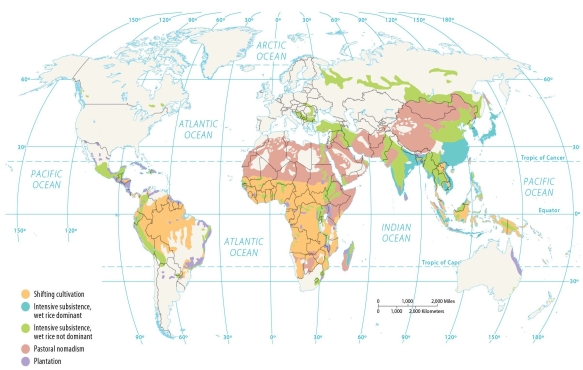
The most important distinction for dividing the world into agricultural regions is
A) whether the product is consumed on or off the farm.
B) whether crops are grown or animals are raised.
C) the location of the first agriculture.
D) the population density of the crop-producing region.
E) All of these are important distinctions.
The most important distinction for dividing the world into agricultural regions is
A) whether the product is consumed on or off the farm.
B) whether crops are grown or animals are raised.
C) the location of the first agriculture.
D) the population density of the crop-producing region.
E) All of these are important distinctions.

Question
Figure 10.3.1 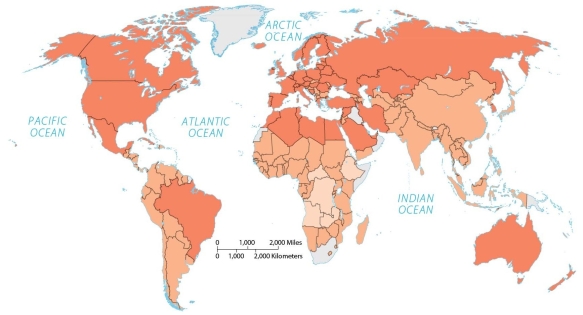
If darker shades represent higher values,this is most likely a map of
A) dietary energy consumption.
B) percent of income spent on food.
C) percent undernourished.
D) change in number undernourished.
E) per capita fish consumption.
If darker shades represent higher values,this is most likely a map of
A) dietary energy consumption.
B) percent of income spent on food.
C) percent undernourished.
D) change in number undernourished.
E) per capita fish consumption.
Question
Figure 10.3.3 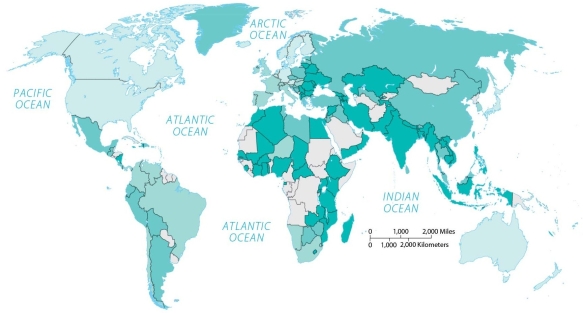
If darker shades represent higher values,this is most likely a map of
A) dietary energy consumption.
B) percent of income spent on food.
C) percent undernourished.
D) change in number undernourished.
E) per capita fish consumption.
If darker shades represent higher values,this is most likely a map of
A) dietary energy consumption.
B) percent of income spent on food.
C) percent undernourished.
D) change in number undernourished.
E) per capita fish consumption.
Question
Figure 10.5.1 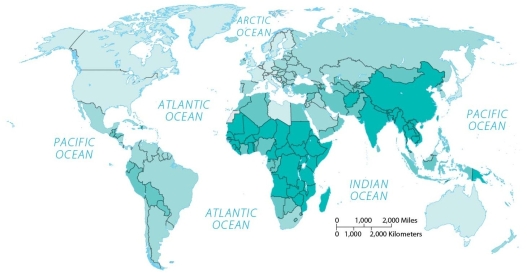
Which of the following has aided 20th century commercial farmers in MDCs?
A) transportation improvements
B) scientific advances
C) electronics
D) All of these have aided commercial farmers.
E) None of these have aided commercial farmers.
Which of the following has aided 20th century commercial farmers in MDCs?
A) transportation improvements
B) scientific advances
C) electronics
D) All of these have aided commercial farmers.
E) None of these have aided commercial farmers.
Question
Figure 10.3.4 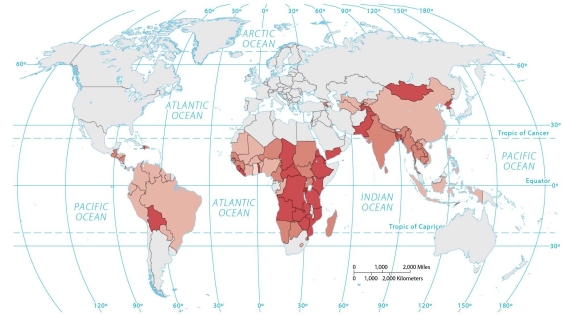
If darker shades represent higher values,this is most likely a map of
A) dietary energy consumption.
B) percent of income spent on food.
C) percent undernourished.
D) change in number undernourished.
E) per capita fish consumption.
If darker shades represent higher values,this is most likely a map of
A) dietary energy consumption.
B) percent of income spent on food.
C) percent undernourished.
D) change in number undernourished.
E) per capita fish consumption.
Question
Question
Question
Figure 10.5.2 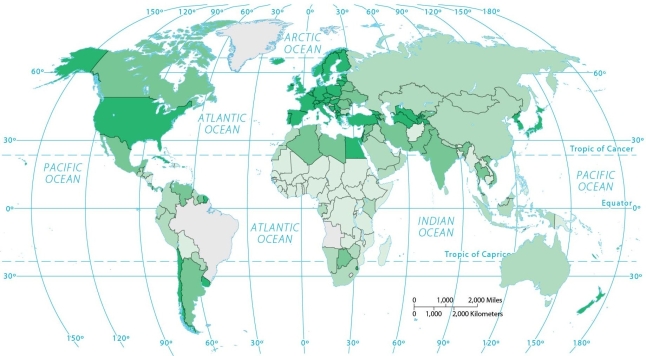
Shifting cultivation is being replaced by
A) logging.
B) cattle ranching.
C) cultivation of cash crops (commercial agriculture).
D) All of these are replacing shifting cultivation.
Shifting cultivation is being replaced by
A) logging.
B) cattle ranching.
C) cultivation of cash crops (commercial agriculture).
D) All of these are replacing shifting cultivation.
Question
Question
Question
Figure 10.5.2
If darker shades indicate higher values,this is likely a map of
A) tractors per area of farmland.
B) area of farmland per tractor.
C) farmers per total land area.
D) tractors per total land area.
E) farmers per area of farmland.
If darker shades indicate higher values,this is likely a map of
A) tractors per area of farmland.
B) area of farmland per tractor.
C) farmers per total land area.
D) tractors per total land area.
E) farmers per area of farmland.
Question
Figure 10.5.1
If darker shades indicate higher values,this is likely a map of
A) percent labor force engaged in agriculture.
B) tractors per area of farmland.
C) population density.
D) food surpluses by region.
E) economic development.
If darker shades indicate higher values,this is likely a map of
A) percent labor force engaged in agriculture.
B) tractors per area of farmland.
C) population density.
D) food surpluses by region.
E) economic development.
Question
Question
Question
Figure 10.4.1
The largest use of land near the Equator is
A) intensive subsistence, wet rice dominant agriculture.
B) intensive subsistence, wet rice not dominant agriculture.
C) pastoral nomadism.
D) plantation agriculture.
E) shifting cultivation.
The largest use of land near the Equator is
A) intensive subsistence, wet rice dominant agriculture.
B) intensive subsistence, wet rice not dominant agriculture.
C) pastoral nomadism.
D) plantation agriculture.
E) shifting cultivation.
Question
Question
Figure 10.3.4
Undernourishment is most severe in
A) south Asia.
B) east Asia.
C) Latin America.
D) sub-Saharan Africa.
E) eastern Europe.
Undernourishment is most severe in
A) south Asia.
B) east Asia.
C) Latin America.
D) sub-Saharan Africa.
E) eastern Europe.
Question
Question
Figure 10.5.2
All but which of the following are true of commercial agriculture compared to subsistence agriculture?
A) low percentage of farmers in the labor force
B) farm size
C) heavy use of machinery
D) output consumed on the farm
E) surplus production
All but which of the following are true of commercial agriculture compared to subsistence agriculture?
A) low percentage of farmers in the labor force
B) farm size
C) heavy use of machinery
D) output consumed on the farm
E) surplus production
Question
Question
Question
Figure 10.9.1 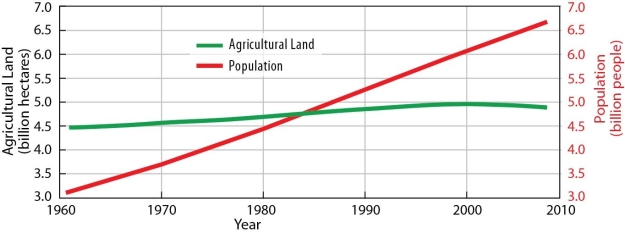
This figure helps to explain that for the last half century most increase in food production has come from
A) expanding agricultural land.
B) expanding exports.
C) discovering new foods.
D) increasing agricultural productivity.
E) increasing fish harvests.
This figure helps to explain that for the last half century most increase in food production has come from
A) expanding agricultural land.
B) expanding exports.
C) discovering new foods.
D) increasing agricultural productivity.
E) increasing fish harvests.
Question
Figure 10.6.3 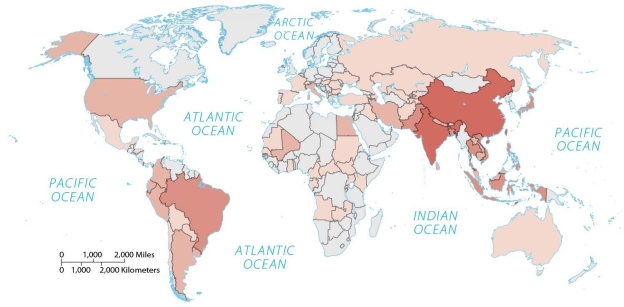
The agricultural practice most dependent on being close to consumers is
A) mixed crop and livestock farming.
B) livestock ranching.
C) commercial gardening and fruit farming.
D) grain farming.
E) dairy farming.
The agricultural practice most dependent on being close to consumers is
A) mixed crop and livestock farming.
B) livestock ranching.
C) commercial gardening and fruit farming.
D) grain farming.
E) dairy farming.
Question
Question
Figure 10.10.1: Von Thünen Model 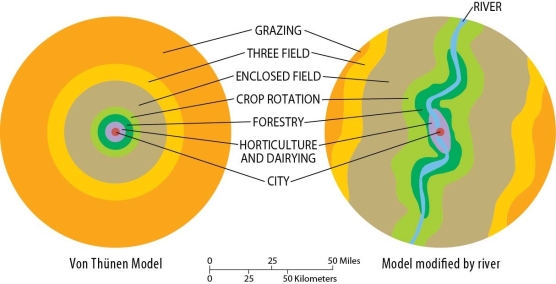
In the United States many farms are integrated into a large food production industry.This is known as
A) agribusiness.
B) commercial farming.
C) food processing.
D) mechanized farming.
E) mixed crop and livestock farming.
In the United States many farms are integrated into a large food production industry.This is known as
A) agribusiness.
B) commercial farming.
C) food processing.
D) mechanized farming.
E) mixed crop and livestock farming.
Question
Figure 10.6.3
Unlike other forms of commercial agriculture,plantations are
A) part of agribusiness.
B) owned by people in less developed countries.
C) found primarily in less developed countries.
D) situated in densely populated locations.
E) all of the above
Unlike other forms of commercial agriculture,plantations are
A) part of agribusiness.
B) owned by people in less developed countries.
C) found primarily in less developed countries.
D) situated in densely populated locations.
E) all of the above
Question
Question
Figure 10.6.3
The different areas of the world where Mediterranean agriculture predominates have similar
A) climate.
B) cultural beliefs.
C) broad expanses of flat land along sea coasts.
D) social customs.
E) levels of livestock production with the mixed crop and livestock regions.
The different areas of the world where Mediterranean agriculture predominates have similar
A) climate.
B) cultural beliefs.
C) broad expanses of flat land along sea coasts.
D) social customs.
E) levels of livestock production with the mixed crop and livestock regions.
Question
Figure 10.8.7 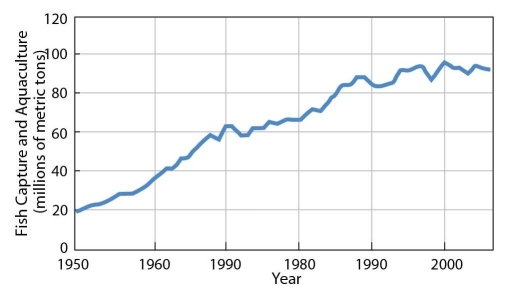
This graph indicates which of the following about the global trend in fishing?
A) Despite increased effort, the total fish harvest has barely increased in the last 20 years.
B) More and more fish are being harvested every year.
C) Fish are declining as a source of food.
D) The developing world catches more fish than the developed world.
This graph indicates which of the following about the global trend in fishing?
A) Despite increased effort, the total fish harvest has barely increased in the last 20 years.
B) More and more fish are being harvested every year.
C) Fish are declining as a source of food.
D) The developing world catches more fish than the developed world.
Question
Question
Figure 10.6.3
If darker shades mean higher values,this is most likely a map of
A) wheat production.
B) pastoral nomadism.
C) plantation agriculture.
D) rice production.
E) shifting cultivation.
If darker shades mean higher values,this is most likely a map of
A) wheat production.
B) pastoral nomadism.
C) plantation agriculture.
D) rice production.
E) shifting cultivation.
Question
Figure 10.10.1: Von Thünen Model
The effect of the river in lengthening the agricultural zones in the diagram on the right is due to
A) the availability of water for irrigation.
B) elevation changes.
C) fishing.
D) defense of the city.
E) the ease of transport by water to the market.
The effect of the river in lengthening the agricultural zones in the diagram on the right is due to
A) the availability of water for irrigation.
B) elevation changes.
C) fishing.
D) defense of the city.
E) the ease of transport by water to the market.
Question
Figure 10.6.3
While climate influences every agricultural practice,the form of agriculture most dependent on climate is
A) Mediterranean.
B) mixed crop and livestock farming.
C) dairy farming.
D) grain farming.
E) livestock ranching.
While climate influences every agricultural practice,the form of agriculture most dependent on climate is
A) Mediterranean.
B) mixed crop and livestock farming.
C) dairy farming.
D) grain farming.
E) livestock ranching.
Question
Question
Figure 10.8.6 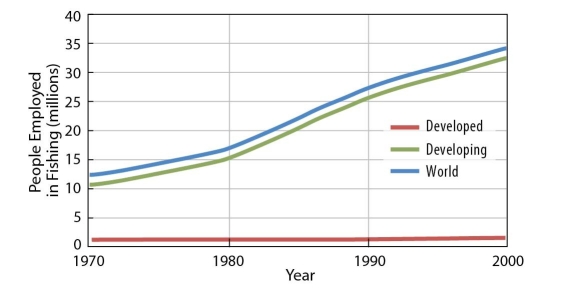
Which of the following is not a commonly proposed strategy to address issues with food supply?
A) expanding agricultural land
B) increasing agricultural productivity
C) increasing employment in fishing
D) improving food sources
E) expanding exports
Which of the following is not a commonly proposed strategy to address issues with food supply?
A) expanding agricultural land
B) increasing agricultural productivity
C) increasing employment in fishing
D) improving food sources
E) expanding exports
Question
Question
Question
Question
Question
Figure 10.8.6
Based on knowledge acquired previously in this course,this chart indicates that
A) far more people in the developing world are employed in fishing as a percentage of that population but not overall.
B) far more people in the developing world are employed in fishing both as a percentage of that population and overall.
C) far more people in the developing world are employed in fishing in numbers but not as a percentage of that population.
D) more people in the developed world are employed in fishing as a percentage of that population but not overall.
E) The answer cannot be determined from this chart.
Based on knowledge acquired previously in this course,this chart indicates that
A) far more people in the developing world are employed in fishing as a percentage of that population but not overall.
B) far more people in the developing world are employed in fishing both as a percentage of that population and overall.
C) far more people in the developing world are employed in fishing in numbers but not as a percentage of that population.
D) more people in the developed world are employed in fishing as a percentage of that population but not overall.
E) The answer cannot be determined from this chart.
Question
Question
Question
Question
Question
Figure 10.10.1: Von Thünen Model
The primary factor in von Thünen's model for choosing commercial farm products is
A) land price.
B) market location.
C) climate.
D) soil character.
E) labor cost.
The primary factor in von Thünen's model for choosing commercial farm products is
A) land price.
B) market location.
C) climate.
D) soil character.
E) labor cost.
Question
Figure 10.10.1: Von Thünen Model
________ model is used by geographers to explain the importance of proximity to the market in the choice of crops to the commercial farm.
A) Von Thünen's
B) Whittlesey's
C) Iqbel's
D) McKinley's
________ model is used by geographers to explain the importance of proximity to the market in the choice of crops to the commercial farm.
A) Von Thünen's
B) Whittlesey's
C) Iqbel's
D) McKinley's
Question
Question
Question
Question
Question
Question
Figure 10.10.1: Von Thünen Model
A principal practice of sustainable agriculture is
A) sensitive land management.
B) limited use of chemicals.
C) better integration of crops and livestock.
D) use of pesticide-resistant seed.
E) all but the use of pesticide-resistant seed are principal practices.
A principal practice of sustainable agriculture is
A) sensitive land management.
B) limited use of chemicals.
C) better integration of crops and livestock.
D) use of pesticide-resistant seed.
E) all but the use of pesticide-resistant seed are principal practices.
Question
Figure 10.10.1: Von Thünen Model
The world leader in land area devoted to organic farming is
A) Australia.
B) the United States.
C) Canada.
D) France.
E) Japan.
The world leader in land area devoted to organic farming is
A) Australia.
B) the United States.
C) Canada.
D) France.
E) Japan.
Question
Question
Question
Question
Question
Question
Question
Question
Question
Question
Question
Question
Question
Question
Question
Question
Question
Question
Question
Question
Question

Unlock Deck
Sign up to unlock the cards in this deck!
Unlock Deck
Unlock Deck
1/74

Play

Full screen (f)
Deck 10: Food and Agriculture
1
Figure 10.4.1
The most important distinction for dividing the world into agricultural regions is
A) whether the product is consumed on or off the farm.
B) whether crops are grown or animals are raised.
C) the location of the first agriculture.
D) the population density of the crop-producing region.
E) All of these are important distinctions.
The most important distinction for dividing the world into agricultural regions is
A) whether the product is consumed on or off the farm.
B) whether crops are grown or animals are raised.
C) the location of the first agriculture.
D) the population density of the crop-producing region.
E) All of these are important distinctions.
A
2
Figure 10.3.1
If darker shades represent higher values,this is most likely a map of
A) dietary energy consumption.
B) percent of income spent on food.
C) percent undernourished.
D) change in number undernourished.
E) per capita fish consumption.
If darker shades represent higher values,this is most likely a map of
A) dietary energy consumption.
B) percent of income spent on food.
C) percent undernourished.
D) change in number undernourished.
E) per capita fish consumption.
A
3
Figure 10.3.3
If darker shades represent higher values,this is most likely a map of
A) dietary energy consumption.
B) percent of income spent on food.
C) percent undernourished.
D) change in number undernourished.
E) per capita fish consumption.
If darker shades represent higher values,this is most likely a map of
A) dietary energy consumption.
B) percent of income spent on food.
C) percent undernourished.
D) change in number undernourished.
E) per capita fish consumption.
B
4
Figure 10.5.1
Which of the following has aided 20th century commercial farmers in MDCs?
A) transportation improvements
B) scientific advances
C) electronics
D) All of these have aided commercial farmers.
E) None of these have aided commercial farmers.
Which of the following has aided 20th century commercial farmers in MDCs?
A) transportation improvements
B) scientific advances
C) electronics
D) All of these have aided commercial farmers.
E) None of these have aided commercial farmers.
Unlock Deck
Unlock for access to all 74 flashcards in this deck.
Unlock Deck
k this deck
5
Figure 10.3.4
If darker shades represent higher values,this is most likely a map of
A) dietary energy consumption.
B) percent of income spent on food.
C) percent undernourished.
D) change in number undernourished.
E) per capita fish consumption.
If darker shades represent higher values,this is most likely a map of
A) dietary energy consumption.
B) percent of income spent on food.
C) percent undernourished.
D) change in number undernourished.
E) per capita fish consumption.
Unlock Deck
Unlock for access to all 74 flashcards in this deck.
Unlock Deck
k this deck
6
Hunting and gathering societies
A) include about 15 percent of the world's people.
B) are found in isolated places in the world.
C) are characterized by large concentrations of people.
D) occur nearly everywhere but are especially common in Europe.
E) are responsible for most of the environmental degradation of the planet.
A) include about 15 percent of the world's people.
B) are found in isolated places in the world.
C) are characterized by large concentrations of people.
D) occur nearly everywhere but are especially common in Europe.
E) are responsible for most of the environmental degradation of the planet.
Unlock Deck
Unlock for access to all 74 flashcards in this deck.
Unlock Deck
k this deck
7
Which statement correctly describes hunting and gathering?
A) All humans obtained their food this way before the invention of agriculture.
B) It is a form of nomadism.
C) This form of subsistence is still practiced.
D) Hunter gatherers live in small groups.
E) All of these are true.
A) All humans obtained their food this way before the invention of agriculture.
B) It is a form of nomadism.
C) This form of subsistence is still practiced.
D) Hunter gatherers live in small groups.
E) All of these are true.
Unlock Deck
Unlock for access to all 74 flashcards in this deck.
Unlock Deck
k this deck
8
Figure 10.5.2
Shifting cultivation is being replaced by
A) logging.
B) cattle ranching.
C) cultivation of cash crops (commercial agriculture).
D) All of these are replacing shifting cultivation.
Shifting cultivation is being replaced by
A) logging.
B) cattle ranching.
C) cultivation of cash crops (commercial agriculture).
D) All of these are replacing shifting cultivation.
Unlock Deck
Unlock for access to all 74 flashcards in this deck.
Unlock Deck
k this deck
9
Food consumption varies around the world because of variations in
A) level of economic development.
B) physical conditions.
C) cultural preferences.
D) all of these are responsible for variation in food consumption.
A) level of economic development.
B) physical conditions.
C) cultural preferences.
D) all of these are responsible for variation in food consumption.
Unlock Deck
Unlock for access to all 74 flashcards in this deck.
Unlock Deck
k this deck
10
Farming varies around the world because of ________ across space.
A) cultural and environmental factors
B) religious and economic factors
C) farmer personal preference and environmental factors
D) weather and climate
A) cultural and environmental factors
B) religious and economic factors
C) farmer personal preference and environmental factors
D) weather and climate
Unlock Deck
Unlock for access to all 74 flashcards in this deck.
Unlock Deck
k this deck
11
Figure 10.5.2
If darker shades indicate higher values,this is likely a map of
A) tractors per area of farmland.
B) area of farmland per tractor.
C) farmers per total land area.
D) tractors per total land area.
E) farmers per area of farmland.
If darker shades indicate higher values,this is likely a map of
A) tractors per area of farmland.
B) area of farmland per tractor.
C) farmers per total land area.
D) tractors per total land area.
E) farmers per area of farmland.
Unlock Deck
Unlock for access to all 74 flashcards in this deck.
Unlock Deck
k this deck
12
Figure 10.5.1
If darker shades indicate higher values,this is likely a map of
A) percent labor force engaged in agriculture.
B) tractors per area of farmland.
C) population density.
D) food surpluses by region.
E) economic development.
If darker shades indicate higher values,this is likely a map of
A) percent labor force engaged in agriculture.
B) tractors per area of farmland.
C) population density.
D) food surpluses by region.
E) economic development.
Unlock Deck
Unlock for access to all 74 flashcards in this deck.
Unlock Deck
k this deck
13
Residents of developed countries rely on ________ as the leading source of protein.
A) meat
B) fish
C) dairy
D) cereal
E) sugar
A) meat
B) fish
C) dairy
D) cereal
E) sugar
Unlock Deck
Unlock for access to all 74 flashcards in this deck.
Unlock Deck
k this deck
14
Hunters and gatherers probably began practicing agriculture because of
A) environmental factors.
B) cultural factors.
C) the Industrial Revolution.
D) crop hearths were discovered.
E) a combination of environmental and cultural factors.
A) environmental factors.
B) cultural factors.
C) the Industrial Revolution.
D) crop hearths were discovered.
E) a combination of environmental and cultural factors.
Unlock Deck
Unlock for access to all 74 flashcards in this deck.
Unlock Deck
k this deck
15
Figure 10.4.1
The largest use of land near the Equator is
A) intensive subsistence, wet rice dominant agriculture.
B) intensive subsistence, wet rice not dominant agriculture.
C) pastoral nomadism.
D) plantation agriculture.
E) shifting cultivation.
The largest use of land near the Equator is
A) intensive subsistence, wet rice dominant agriculture.
B) intensive subsistence, wet rice not dominant agriculture.
C) pastoral nomadism.
D) plantation agriculture.
E) shifting cultivation.
Unlock Deck
Unlock for access to all 74 flashcards in this deck.
Unlock Deck
k this deck
16
In contrast to practitioners of agriculture,hunters and gatherers
A) travel frequently.
B) domesticate animals.
C) live in large groups.
D) live near the center of world settlements.
E) cultivate plants from a variety of hearths.
A) travel frequently.
B) domesticate animals.
C) live in large groups.
D) live near the center of world settlements.
E) cultivate plants from a variety of hearths.
Unlock Deck
Unlock for access to all 74 flashcards in this deck.
Unlock Deck
k this deck
17
Figure 10.3.4
Undernourishment is most severe in
A) south Asia.
B) east Asia.
C) Latin America.
D) sub-Saharan Africa.
E) eastern Europe.
Undernourishment is most severe in
A) south Asia.
B) east Asia.
C) Latin America.
D) sub-Saharan Africa.
E) eastern Europe.
Unlock Deck
Unlock for access to all 74 flashcards in this deck.
Unlock Deck
k this deck
18
The earliest known domesticated wheat,barley,and rice crops are thought to have originated in Asia
A) 10,000 years ago.
B) 100,000 years ago.
C) 1.1 million years ago.
D) 1,000 years ago.
E) 10 million years ago.
A) 10,000 years ago.
B) 100,000 years ago.
C) 1.1 million years ago.
D) 1,000 years ago.
E) 10 million years ago.
Unlock Deck
Unlock for access to all 74 flashcards in this deck.
Unlock Deck
k this deck
19
Figure 10.5.2
All but which of the following are true of commercial agriculture compared to subsistence agriculture?
A) low percentage of farmers in the labor force
B) farm size
C) heavy use of machinery
D) output consumed on the farm
E) surplus production
All but which of the following are true of commercial agriculture compared to subsistence agriculture?
A) low percentage of farmers in the labor force
B) farm size
C) heavy use of machinery
D) output consumed on the farm
E) surplus production
Unlock Deck
Unlock for access to all 74 flashcards in this deck.
Unlock Deck
k this deck
20
An important agricultural hearth is
A) southeast Asia.
B) south and central America.
C) sub-Saharan Africa.
D) northern China.
E) All of these are important agricultural hearths.
A) southeast Asia.
B) south and central America.
C) sub-Saharan Africa.
D) northern China.
E) All of these are important agricultural hearths.
Unlock Deck
Unlock for access to all 74 flashcards in this deck.
Unlock Deck
k this deck
21
Which type of agriculture is practiced by the largest percentage of the world's people?
A) hunting and gathering
B) shifting cultivation
C) pastoral nomadism
D) intensive subsistence
E) plantation
A) hunting and gathering
B) shifting cultivation
C) pastoral nomadism
D) intensive subsistence
E) plantation
Unlock Deck
Unlock for access to all 74 flashcards in this deck.
Unlock Deck
k this deck
22
Figure 10.9.1
This figure helps to explain that for the last half century most increase in food production has come from
A) expanding agricultural land.
B) expanding exports.
C) discovering new foods.
D) increasing agricultural productivity.
E) increasing fish harvests.
This figure helps to explain that for the last half century most increase in food production has come from
A) expanding agricultural land.
B) expanding exports.
C) discovering new foods.
D) increasing agricultural productivity.
E) increasing fish harvests.
Unlock Deck
Unlock for access to all 74 flashcards in this deck.
Unlock Deck
k this deck
23
Figure 10.6.3
The agricultural practice most dependent on being close to consumers is
A) mixed crop and livestock farming.
B) livestock ranching.
C) commercial gardening and fruit farming.
D) grain farming.
E) dairy farming.
The agricultural practice most dependent on being close to consumers is
A) mixed crop and livestock farming.
B) livestock ranching.
C) commercial gardening and fruit farming.
D) grain farming.
E) dairy farming.
Unlock Deck
Unlock for access to all 74 flashcards in this deck.
Unlock Deck
k this deck
24
Which is not a form of subsistence agriculture?
A) Mediterranean
B) shifting cultivation
C) pastoral nomadism
D) intensive
E) All of these are forms of subsistence agriculture.
A) Mediterranean
B) shifting cultivation
C) pastoral nomadism
D) intensive
E) All of these are forms of subsistence agriculture.
Unlock Deck
Unlock for access to all 74 flashcards in this deck.
Unlock Deck
k this deck
25
Figure 10.10.1: Von Thünen Model
In the United States many farms are integrated into a large food production industry.This is known as
A) agribusiness.
B) commercial farming.
C) food processing.
D) mechanized farming.
E) mixed crop and livestock farming.
In the United States many farms are integrated into a large food production industry.This is known as
A) agribusiness.
B) commercial farming.
C) food processing.
D) mechanized farming.
E) mixed crop and livestock farming.
Unlock Deck
Unlock for access to all 74 flashcards in this deck.
Unlock Deck
k this deck
26
Figure 10.6.3
Unlike other forms of commercial agriculture,plantations are
A) part of agribusiness.
B) owned by people in less developed countries.
C) found primarily in less developed countries.
D) situated in densely populated locations.
E) all of the above
Unlike other forms of commercial agriculture,plantations are
A) part of agribusiness.
B) owned by people in less developed countries.
C) found primarily in less developed countries.
D) situated in densely populated locations.
E) all of the above
Unlock Deck
Unlock for access to all 74 flashcards in this deck.
Unlock Deck
k this deck
27
Which of the following is a typical practice in growing rice in Asia?
A) preparing fields with a plow drawn by oxen
B) flooding the plowed field with water
C) growing seedlings in a nursery
D) transplanting seedlings into the flooded field
E) all of the above
A) preparing fields with a plow drawn by oxen
B) flooding the plowed field with water
C) growing seedlings in a nursery
D) transplanting seedlings into the flooded field
E) all of the above
Unlock Deck
Unlock for access to all 74 flashcards in this deck.
Unlock Deck
k this deck
28
Figure 10.6.3
The different areas of the world where Mediterranean agriculture predominates have similar
A) climate.
B) cultural beliefs.
C) broad expanses of flat land along sea coasts.
D) social customs.
E) levels of livestock production with the mixed crop and livestock regions.
The different areas of the world where Mediterranean agriculture predominates have similar
A) climate.
B) cultural beliefs.
C) broad expanses of flat land along sea coasts.
D) social customs.
E) levels of livestock production with the mixed crop and livestock regions.
Unlock Deck
Unlock for access to all 74 flashcards in this deck.
Unlock Deck
k this deck
29
Figure 10.8.7
This graph indicates which of the following about the global trend in fishing?
A) Despite increased effort, the total fish harvest has barely increased in the last 20 years.
B) More and more fish are being harvested every year.
C) Fish are declining as a source of food.
D) The developing world catches more fish than the developed world.
This graph indicates which of the following about the global trend in fishing?
A) Despite increased effort, the total fish harvest has barely increased in the last 20 years.
B) More and more fish are being harvested every year.
C) Fish are declining as a source of food.
D) The developing world catches more fish than the developed world.
Unlock Deck
Unlock for access to all 74 flashcards in this deck.
Unlock Deck
k this deck
30
Which type of agriculture is found primarily in less developed countries?
A) Mediterranean
B) plantation
C) truck farming
D) commercial gardening
E) None of these is found in LDCs;they are all commercial agriculture.
A) Mediterranean
B) plantation
C) truck farming
D) commercial gardening
E) None of these is found in LDCs;they are all commercial agriculture.
Unlock Deck
Unlock for access to all 74 flashcards in this deck.
Unlock Deck
k this deck
31
Figure 10.6.3
If darker shades mean higher values,this is most likely a map of
A) wheat production.
B) pastoral nomadism.
C) plantation agriculture.
D) rice production.
E) shifting cultivation.
If darker shades mean higher values,this is most likely a map of
A) wheat production.
B) pastoral nomadism.
C) plantation agriculture.
D) rice production.
E) shifting cultivation.
Unlock Deck
Unlock for access to all 74 flashcards in this deck.
Unlock Deck
k this deck
32
Figure 10.10.1: Von Thünen Model
The effect of the river in lengthening the agricultural zones in the diagram on the right is due to
A) the availability of water for irrigation.
B) elevation changes.
C) fishing.
D) defense of the city.
E) the ease of transport by water to the market.
The effect of the river in lengthening the agricultural zones in the diagram on the right is due to
A) the availability of water for irrigation.
B) elevation changes.
C) fishing.
D) defense of the city.
E) the ease of transport by water to the market.
Unlock Deck
Unlock for access to all 74 flashcards in this deck.
Unlock Deck
k this deck
33
Figure 10.6.3
While climate influences every agricultural practice,the form of agriculture most dependent on climate is
A) Mediterranean.
B) mixed crop and livestock farming.
C) dairy farming.
D) grain farming.
E) livestock ranching.
While climate influences every agricultural practice,the form of agriculture most dependent on climate is
A) Mediterranean.
B) mixed crop and livestock farming.
C) dairy farming.
D) grain farming.
E) livestock ranching.
Unlock Deck
Unlock for access to all 74 flashcards in this deck.
Unlock Deck
k this deck
34
The largest proportion of farmers in Asia practice
A) hunting and gathering.
B) intensive subsistence.
C) pastoral nomadism.
D) shifting cultivation.
E) plantation agriculture.
A) hunting and gathering.
B) intensive subsistence.
C) pastoral nomadism.
D) shifting cultivation.
E) plantation agriculture.
Unlock Deck
Unlock for access to all 74 flashcards in this deck.
Unlock Deck
k this deck
35
Figure 10.8.6
Which of the following is not a commonly proposed strategy to address issues with food supply?
A) expanding agricultural land
B) increasing agricultural productivity
C) increasing employment in fishing
D) improving food sources
E) expanding exports
Which of the following is not a commonly proposed strategy to address issues with food supply?
A) expanding agricultural land
B) increasing agricultural productivity
C) increasing employment in fishing
D) improving food sources
E) expanding exports
Unlock Deck
Unlock for access to all 74 flashcards in this deck.
Unlock Deck
k this deck
36
Pastoral nomads
A) are expanding their territory in North Africa and the Middle East.
B) occupy only their own territory, moving with the seasons to find forage and water.
C) occupy different territory each year to find forage and water.
D) consume mostly meat, rather than grain.
E) prefer sheep to goats because sheep require less water and will forage on virtually any vegetation.
A) are expanding their territory in North Africa and the Middle East.
B) occupy only their own territory, moving with the seasons to find forage and water.
C) occupy different territory each year to find forage and water.
D) consume mostly meat, rather than grain.
E) prefer sheep to goats because sheep require less water and will forage on virtually any vegetation.
Unlock Deck
Unlock for access to all 74 flashcards in this deck.
Unlock Deck
k this deck
37
Shifting cultivation is most commonly found in which climate region?
A) humid low-latitude
B) dry
C) warm mid-latitude
D) cold mid-latitude
E) undifferentiated Highlands.
A) humid low-latitude
B) dry
C) warm mid-latitude
D) cold mid-latitude
E) undifferentiated Highlands.
Unlock Deck
Unlock for access to all 74 flashcards in this deck.
Unlock Deck
k this deck
38
Only about 15 million people are nomads,but they sparsely occupy
A) 20 percent of the earth's land area.
B) 10 percent of the earth's land area.
C) most of the tropical regions of the earth.
D) most of the islands of the south Pacific.
E) 50 percent of the undifferentiated highlands.
A) 20 percent of the earth's land area.
B) 10 percent of the earth's land area.
C) most of the tropical regions of the earth.
D) most of the islands of the south Pacific.
E) 50 percent of the undifferentiated highlands.
Unlock Deck
Unlock for access to all 74 flashcards in this deck.
Unlock Deck
k this deck
39
Which of the following is not an important plantation crop?
A) tobacco
B) sugarcane
C) rice
D) coffee
E) rubber
A) tobacco
B) sugarcane
C) rice
D) coffee
E) rubber
Unlock Deck
Unlock for access to all 74 flashcards in this deck.
Unlock Deck
k this deck
40
Figure 10.8.6
Based on knowledge acquired previously in this course,this chart indicates that
A) far more people in the developing world are employed in fishing as a percentage of that population but not overall.
B) far more people in the developing world are employed in fishing both as a percentage of that population and overall.
C) far more people in the developing world are employed in fishing in numbers but not as a percentage of that population.
D) more people in the developed world are employed in fishing as a percentage of that population but not overall.
E) The answer cannot be determined from this chart.
Based on knowledge acquired previously in this course,this chart indicates that
A) far more people in the developing world are employed in fishing as a percentage of that population but not overall.
B) far more people in the developing world are employed in fishing both as a percentage of that population and overall.
C) far more people in the developing world are employed in fishing in numbers but not as a percentage of that population.
D) more people in the developed world are employed in fishing as a percentage of that population but not overall.
E) The answer cannot be determined from this chart.
Unlock Deck
Unlock for access to all 74 flashcards in this deck.
Unlock Deck
k this deck
41
Subsistence agriculture is designed mainly to generate products for sale off the farm.
Unlock Deck
Unlock for access to all 74 flashcards in this deck.
Unlock Deck
k this deck
42
Ranching is practiced in the dry lands of both more developed and less developed countries.
Unlock Deck
Unlock for access to all 74 flashcards in this deck.
Unlock Deck
k this deck
43
The number of undernourished is decreasing in every world region.
Unlock Deck
Unlock for access to all 74 flashcards in this deck.
Unlock Deck
k this deck
44
Although plantation agriculture is found in developing countries,it is not a form of subsistence agriculture.
Unlock Deck
Unlock for access to all 74 flashcards in this deck.
Unlock Deck
k this deck
45
Figure 10.10.1: Von Thünen Model
The primary factor in von Thünen's model for choosing commercial farm products is
A) land price.
B) market location.
C) climate.
D) soil character.
E) labor cost.
The primary factor in von Thünen's model for choosing commercial farm products is
A) land price.
B) market location.
C) climate.
D) soil character.
E) labor cost.
Unlock Deck
Unlock for access to all 74 flashcards in this deck.
Unlock Deck
k this deck
46
Figure 10.10.1: Von Thünen Model
________ model is used by geographers to explain the importance of proximity to the market in the choice of crops to the commercial farm.
A) Von Thünen's
B) Whittlesey's
C) Iqbel's
D) McKinley's
________ model is used by geographers to explain the importance of proximity to the market in the choice of crops to the commercial farm.
A) Von Thünen's
B) Whittlesey's
C) Iqbel's
D) McKinley's
Unlock Deck
Unlock for access to all 74 flashcards in this deck.
Unlock Deck
k this deck
47
Crops grown in the mixed crop and livestock region are used primarily to feed animals.
Unlock Deck
Unlock for access to all 74 flashcards in this deck.
Unlock Deck
k this deck
48
Most commercial farms in the United States are owned by large corporations rather than individual families.
Unlock Deck
Unlock for access to all 74 flashcards in this deck.
Unlock Deck
k this deck
49
Developing countries are responsible for a small percentage of the world's milk production.
Unlock Deck
Unlock for access to all 74 flashcards in this deck.
Unlock Deck
k this deck
50
In places where subsistence agriculture is practiced,a high percentage of the labor force works on farms.
Unlock Deck
Unlock for access to all 74 flashcards in this deck.
Unlock Deck
k this deck
51
The green revolution has allowed agricultural production to increase at a rate equal to population growth.
Unlock Deck
Unlock for access to all 74 flashcards in this deck.
Unlock Deck
k this deck
52
Figure 10.10.1: Von Thünen Model
A principal practice of sustainable agriculture is
A) sensitive land management.
B) limited use of chemicals.
C) better integration of crops and livestock.
D) use of pesticide-resistant seed.
E) all but the use of pesticide-resistant seed are principal practices.
A principal practice of sustainable agriculture is
A) sensitive land management.
B) limited use of chemicals.
C) better integration of crops and livestock.
D) use of pesticide-resistant seed.
E) all but the use of pesticide-resistant seed are principal practices.
Unlock Deck
Unlock for access to all 74 flashcards in this deck.
Unlock Deck
k this deck
53
Figure 10.10.1: Von Thünen Model
The world leader in land area devoted to organic farming is
A) Australia.
B) the United States.
C) Canada.
D) France.
E) Japan.
The world leader in land area devoted to organic farming is
A) Australia.
B) the United States.
C) Canada.
D) France.
E) Japan.
Unlock Deck
Unlock for access to all 74 flashcards in this deck.
Unlock Deck
k this deck
54
Mediterranean farming is so named because it is practiced only on land bordering the Mediterranean Sea.
Unlock Deck
Unlock for access to all 74 flashcards in this deck.
Unlock Deck
k this deck
55
Humans have only started to tap the potential food resource of the Earth's fish.
Unlock Deck
Unlock for access to all 74 flashcards in this deck.
Unlock Deck
k this deck
56
There is consensus among scientists that hunters/gatherers converted to agriculture because of the domestication of animals roughly 12,000 years ago.
Unlock Deck
Unlock for access to all 74 flashcards in this deck.
Unlock Deck
k this deck
57
Subsistence agriculture generally makes use of larger farms since the food goes to feed those on the farm.
Unlock Deck
Unlock for access to all 74 flashcards in this deck.
Unlock Deck
k this deck
58
Hunting and gathering is still practiced by some societies today.
Unlock Deck
Unlock for access to all 74 flashcards in this deck.
Unlock Deck
k this deck
59
Residents of developed countries rely mostly on cereals and legumes as a source of protein.
Unlock Deck
Unlock for access to all 74 flashcards in this deck.
Unlock Deck
k this deck
60
Hunting and gathering is still practiced by isolated groups in Africa,Australia,and South America.
Unlock Deck
Unlock for access to all 74 flashcards in this deck.
Unlock Deck
k this deck
61
Why does the consumption of food vary around the world? Use geographic concepts to explain your answer.
Unlock Deck
Unlock for access to all 74 flashcards in this deck.
Unlock Deck
k this deck
62
Compare the distinctive types of agriculture found in the dry lands of more and less developed regions.
Unlock Deck
Unlock for access to all 74 flashcards in this deck.
Unlock Deck
k this deck
63
Prior to the invention of agriculture,how did most people obtain their food?
Unlock Deck
Unlock for access to all 74 flashcards in this deck.
Unlock Deck
k this deck
64
How does commercial agriculture differ from subsistence agriculture? Describe several ways.
Unlock Deck
Unlock for access to all 74 flashcards in this deck.
Unlock Deck
k this deck
65
How is plantation agriculture different from other forms of commercial agriculture?
Unlock Deck
Unlock for access to all 74 flashcards in this deck.
Unlock Deck
k this deck
66
List the four strategies to address food shortages and identify a limitation of each.
Unlock Deck
Unlock for access to all 74 flashcards in this deck.
Unlock Deck
k this deck
67
What is the distinctive type of agriculture practiced in the population concentrations of East and South Asia?
Unlock Deck
Unlock for access to all 74 flashcards in this deck.
Unlock Deck
k this deck
68
Given that the world's fisheries are fully exploited or overfished,explain why fish remains a relatively small part of the human diet.
Unlock Deck
Unlock for access to all 74 flashcards in this deck.
Unlock Deck
k this deck
69
Explain the sustainable agriculture principals and complex management issues of integrated crop and livestock farming.
Unlock Deck
Unlock for access to all 74 flashcards in this deck.
Unlock Deck
k this deck
70
The U.S.government attempts to help farmers because there is a problem of excess production.
Unlock Deck
Unlock for access to all 74 flashcards in this deck.
Unlock Deck
k this deck
71
What is the relationship between agricultural practices and physical geography? Explain.
Unlock Deck
Unlock for access to all 74 flashcards in this deck.
Unlock Deck
k this deck
72
What is the distinctive type of agriculture practiced in the dry lands of less developed countries?
Unlock Deck
Unlock for access to all 74 flashcards in this deck.
Unlock Deck
k this deck
73
In shifting cultivation,how do farmers clear their fields for planting?
Unlock Deck
Unlock for access to all 74 flashcards in this deck.
Unlock Deck
k this deck
74
Sustainable agricultural practices limit the use of herbicides.
Unlock Deck
Unlock for access to all 74 flashcards in this deck.
Unlock Deck
k this deck
Unlock Deck
Unlock for access to all 74 flashcards in this deck.






