







 Chat with AI

Deck 6: Religion
Full screen (f)

Question

Question
Question
Question
Question
Question
Question
Question
Question
Question
Question
Question
Question
Question
Question
Question
Question
Question
Question
Question
Question
Question
Question
Question
Question
Question
Question
Question
Question
Question
Question
Question
Question
Question
Question
Question
Question
Question
Question
Question
Question
Figure 6.8.3 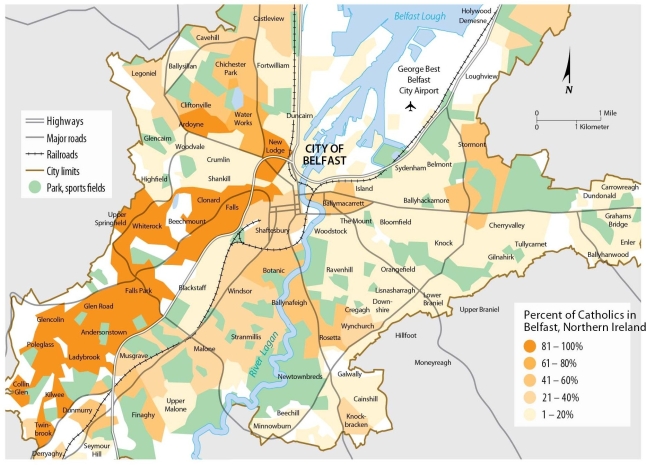
The goal of the majority of people living in Northern Ireland is to
A) remain part of the United Kingdom.
B) migrate to the Republic of Ireland.
C) become part of the Republic of Ireland.
D) join the Irish Republican Army.
E) establish an independent republic.
The goal of the majority of people living in Northern Ireland is to
A) remain part of the United Kingdom.
B) migrate to the Republic of Ireland.
C) become part of the Republic of Ireland.
D) join the Irish Republican Army.
E) establish an independent republic.
Question
Question
Figure 6.8.3
This map demonstrates
A) Catholics are clustered in eastern Belfast.
B) Catholics are clustered in western Belfast.
C) Catholics are clustered in Northern Ireland.
D) Protestants are clustered in western Belfast.
E) people are well dispersed by religious adherence.
This map demonstrates
A) Catholics are clustered in eastern Belfast.
B) Catholics are clustered in western Belfast.
C) Catholics are clustered in Northern Ireland.
D) Protestants are clustered in western Belfast.
E) people are well dispersed by religious adherence.
Question
Question
Question
Question
Question
Question
Figure 6.8.3
Palestinians include all but which of the following groups?
A) residents of refugee camps surrounding Israel
B) residents of territories occupied by Israel
C) citizens of other states calling themselves Palestinians
D) Jewish citizens of Israel
E) Muslim citizens of Israel
Palestinians include all but which of the following groups?
A) residents of refugee camps surrounding Israel
B) residents of territories occupied by Israel
C) citizens of other states calling themselves Palestinians
D) Jewish citizens of Israel
E) Muslim citizens of Israel
Question
Question
Question
Question
Question
Figure 6.8.3
The United Nations partition plan dividing Palestine placed Jerusalem under
A) a British Mandate.
B) Palestinian administration.
C) Israeli administration.
D) divided administration.
E) United Nations administration.
The United Nations partition plan dividing Palestine placed Jerusalem under
A) a British Mandate.
B) Palestinian administration.
C) Israeli administration.
D) divided administration.
E) United Nations administration.
Question
Question
Question
Figure 6.8.3
Protestants in Ireland are
A) dispersed throughout the island.
B) recent immigrants from Great Britain.
C) highly clustered in one part of the island.
D) highly integrated with the Roman Catholic population.
E) Both A and B are correct.
Protestants in Ireland are
A) dispersed throughout the island.
B) recent immigrants from Great Britain.
C) highly clustered in one part of the island.
D) highly integrated with the Roman Catholic population.
E) Both A and B are correct.
Question
Question
Figure 6.8.3
The territory of Israel has generally ________ since its formation in 1947.
A) grown
B) shrunk
C) remained constant
D) grown, with the exception of the Sinai Peninsula,
E) shrunk, with the exception of the Gaza Strip,
The territory of Israel has generally ________ since its formation in 1947.
A) grown
B) shrunk
C) remained constant
D) grown, with the exception of the Sinai Peninsula,
E) shrunk, with the exception of the Gaza Strip,
Question
Question
Question
Question
Question
Question
Question
Question
Question
Question
Question
Question
Question
Question
Question
Question
Question
Question
Question
Question
Question

Unlock Deck
Sign up to unlock the cards in this deck!
Unlock Deck
Unlock Deck
1/95

Play

Full screen (f)
Deck 6: Religion
1
Eastern Orthodoxy is an example of a Christian
A) branch.
B) denomination.
C) religion.
D) sect.
E) family.
A) branch.
B) denomination.
C) religion.
D) sect.
E) family.
A
2
Lutheranism is an example of a Christian
A) branch.
B) denomination.
C) religion.
D) sect.
E) family.
A) branch.
B) denomination.
C) religion.
D) sect.
E) family.
B
3
A universalizing religion
A) is based on the physical characteristics of a particular location on Earth.
B) appeals to people living in a wide variety of locations.
C) is rarely transmitted through missionaries.
D) has celebrations based on seasonal changes.
E) is less likely to be used as a reason for violence than ethnic religions.
A) is based on the physical characteristics of a particular location on Earth.
B) appeals to people living in a wide variety of locations.
C) is rarely transmitted through missionaries.
D) has celebrations based on seasonal changes.
E) is less likely to be used as a reason for violence than ethnic religions.
B
4
An ethnic religion is
A) based on only one language.
B) appealing mostly to one group of people in one place.
C) based on belief in one particular spiritual leader.
D) younger than a universalizing religion.
A) based on only one language.
B) appealing mostly to one group of people in one place.
C) based on belief in one particular spiritual leader.
D) younger than a universalizing religion.
Unlock Deck
Unlock for access to all 95 flashcards in this deck.
Unlock Deck
k this deck
5
A relatively small group that has broken away from an established church is a
A) branch.
B) denomination.
C) sect.
D) dialect.
E) family.
A) branch.
B) denomination.
C) sect.
D) dialect.
E) family.
Unlock Deck
Unlock for access to all 95 flashcards in this deck.
Unlock Deck
k this deck
6
Which is a branch of Christianity?
A) Druze
B) Eastern Orthodox
C) Shiite
D) Theravadist
E) Judaism
A) Druze
B) Eastern Orthodox
C) Shiite
D) Theravadist
E) Judaism
Unlock Deck
Unlock for access to all 95 flashcards in this deck.
Unlock Deck
k this deck
7
The largest branch of Islam in Iran is
A) Druze.
B) Eastern Orthodoxy.
C) Sikh.
D) Sunni.
E) Shiite.
A) Druze.
B) Eastern Orthodoxy.
C) Sikh.
D) Sunni.
E) Shiite.
Unlock Deck
Unlock for access to all 95 flashcards in this deck.
Unlock Deck
k this deck
8
Of the following religious branches,which one has a single living authority who speaks for the entire branch?
A) Eastern Orthodoxy
B) Theravada Buddhism
C) Shaktism
D) Roman Catholicism
E) Protestantism
A) Eastern Orthodoxy
B) Theravada Buddhism
C) Shaktism
D) Roman Catholicism
E) Protestantism
Unlock Deck
Unlock for access to all 95 flashcards in this deck.
Unlock Deck
k this deck
9
For many people on Earth,religion serves as a source of
A) key values and beliefs.
B) ethnic identification.
C) material culture.
D) literary tradition.
E) popular culture.
A) key values and beliefs.
B) ethnic identification.
C) material culture.
D) literary tradition.
E) popular culture.
Unlock Deck
Unlock for access to all 95 flashcards in this deck.
Unlock Deck
k this deck
10
Almost 90 percent of people in the Western Hemisphere claim adherence to
A) Christianity.
B) Roman Catholicism.
C) Protestantism.
D) Eastern Orthodoxy.
E) atheism.
A) Christianity.
B) Roman Catholicism.
C) Protestantism.
D) Eastern Orthodoxy.
E) atheism.
Unlock Deck
Unlock for access to all 95 flashcards in this deck.
Unlock Deck
k this deck
11
Which characteristic distinguishes religion in Latin America from North America?
A) having a Roman Catholic majority
B) having a Protestant majority
C) location relative to the Equator
D) Ethnic religions make up the majority in one but not the other.
A) having a Roman Catholic majority
B) having a Protestant majority
C) location relative to the Equator
D) Ethnic religions make up the majority in one but not the other.
Unlock Deck
Unlock for access to all 95 flashcards in this deck.
Unlock Deck
k this deck
12
Religion is a particularly good example of the tension between globalization and local diversity because
A) migrants leave their religion behind when they migrate to a new area.
B) many people follow more than one religion.
C) all religions are in competition to convert as many people as possible.
D) religion represents core cultural values and beliefs that may conflict with others.
A) migrants leave their religion behind when they migrate to a new area.
B) many people follow more than one religion.
C) all religions are in competition to convert as many people as possible.
D) religion represents core cultural values and beliefs that may conflict with others.
Unlock Deck
Unlock for access to all 95 flashcards in this deck.
Unlock Deck
k this deck
13
The predominant religion in Latin America is
A) Islam.
B) Catholicism.
C) Protestantism.
D) Animism.
E) Eastern Orthodoxy.
A) Islam.
B) Catholicism.
C) Protestantism.
D) Animism.
E) Eastern Orthodoxy.
Unlock Deck
Unlock for access to all 95 flashcards in this deck.
Unlock Deck
k this deck
14
The world's largest ethnic religion is
A) Confucianism.
B) Daoism.
C) Hinduism.
D) Shintoism.
E) Islam.
A) Confucianism.
B) Daoism.
C) Hinduism.
D) Shintoism.
E) Islam.
Unlock Deck
Unlock for access to all 95 flashcards in this deck.
Unlock Deck
k this deck
15
Mahayanists,in contrast to Theravadists,emphasize Buddha's
A) life of self-help.
B) compassion.
C) renouncing of worldly goods.
D) wisdom.
E) practice of meditation.
A) life of self-help.
B) compassion.
C) renouncing of worldly goods.
D) wisdom.
E) practice of meditation.
Unlock Deck
Unlock for access to all 95 flashcards in this deck.
Unlock Deck
k this deck
16
Which of the following is not a universalizing religion?
A) Buddhism
B) Sikhism
C) Islam
D) Judaism
E) Christianity
A) Buddhism
B) Sikhism
C) Islam
D) Judaism
E) Christianity
Unlock Deck
Unlock for access to all 95 flashcards in this deck.
Unlock Deck
k this deck
17
Muslims are clustered in
A) sub-Saharan Africa.
B) South America
C) eastern Europe.
D) eastern Asia.
E) north Africa and southwest Asia.
A) sub-Saharan Africa.
B) South America
C) eastern Europe.
D) eastern Asia.
E) north Africa and southwest Asia.
Unlock Deck
Unlock for access to all 95 flashcards in this deck.
Unlock Deck
k this deck
18
What is the holiest book in Hinduism?
A) the Bible
B) the Old Testament
C) the Quran
D) the Amrit
E) none of these answers are correct.
A) the Bible
B) the Old Testament
C) the Quran
D) the Amrit
E) none of these answers are correct.
Unlock Deck
Unlock for access to all 95 flashcards in this deck.
Unlock Deck
k this deck
19
The world's largest universalizing religion is
A) Buddhism.
B) Christianity.
C) Hinduism.
D) Islam.
E) Shintoism.
A) Buddhism.
B) Christianity.
C) Hinduism.
D) Islam.
E) Shintoism.
Unlock Deck
Unlock for access to all 95 flashcards in this deck.
Unlock Deck
k this deck
20
Buddhism's 400 million adherents are
A) dispersed around the world.
B) mostly in India and the west coast of North America.
C) concentrated in China and Southeast Asia.
D) distributed in an narrow band from Nepal through North Africa.
E) not divided into any branches.
A) dispersed around the world.
B) mostly in India and the west coast of North America.
C) concentrated in China and Southeast Asia.
D) distributed in an narrow band from Nepal through North Africa.
E) not divided into any branches.
Unlock Deck
Unlock for access to all 95 flashcards in this deck.
Unlock Deck
k this deck
21
Universalizing religions mostly have in common
A) origins with individual men or prophets.
B) unknown or unclear origins.
C) belief in multiple deities.
D) holy sites in Jerusalem.
E) roots in agricultural practices.
A) origins with individual men or prophets.
B) unknown or unclear origins.
C) belief in multiple deities.
D) holy sites in Jerusalem.
E) roots in agricultural practices.
Unlock Deck
Unlock for access to all 95 flashcards in this deck.
Unlock Deck
k this deck
22
Ethnic religions generally have in common
A) some historical person who founded the religion.
B) unknown or unclear origins.
C) multiple deities.
D) a lack of any holy books.
E) precise places of origin.
A) some historical person who founded the religion.
B) unknown or unclear origins.
C) multiple deities.
D) a lack of any holy books.
E) precise places of origin.
Unlock Deck
Unlock for access to all 95 flashcards in this deck.
Unlock Deck
k this deck
23
Adherents of which religion controlled much of present-day Spain from the 8th century until 1492,but not since then?
A) Buddhism
B) Christianity
C) Hinduism
D) Islam
E) Druze
A) Buddhism
B) Christianity
C) Hinduism
D) Islam
E) Druze
Unlock Deck
Unlock for access to all 95 flashcards in this deck.
Unlock Deck
k this deck
24
A mosque differs from a church because a mosque
A) is not a sanctified place.
B) is not a place of worship.
C) displays a variety of architectural styles.
D) contains relics of the founder.
E) is decorated with scenes from the life of the founder.
A) is not a sanctified place.
B) is not a place of worship.
C) displays a variety of architectural styles.
D) contains relics of the founder.
E) is decorated with scenes from the life of the founder.
Unlock Deck
Unlock for access to all 95 flashcards in this deck.
Unlock Deck
k this deck
25
The division of Islam into branches resulted from a disagreement
A) over interpretation of the Quran.
B) between northern and southern geographic regions.
C) between Muslims and Christians.
D) between the Shah of Iran and Saddam Hussein.
E) over which of Mohammed's relatives should succeed him.
A) over interpretation of the Quran.
B) between northern and southern geographic regions.
C) between Muslims and Christians.
D) between the Shah of Iran and Saddam Hussein.
E) over which of Mohammed's relatives should succeed him.
Unlock Deck
Unlock for access to all 95 flashcards in this deck.
Unlock Deck
k this deck
26
Roman Catholics are clustered in the U.S.southwest primarily because of migration of
A) Roman Catholics from Latin America.
B) Roman Catholics from the northeast United States.
C) Roman Catholics from Ireland.
D) Protestants to the north.
E) Protestants to the east.
A) Roman Catholics from Latin America.
B) Roman Catholics from the northeast United States.
C) Roman Catholics from Ireland.
D) Protestants to the north.
E) Protestants to the east.
Unlock Deck
Unlock for access to all 95 flashcards in this deck.
Unlock Deck
k this deck
27
Which of the following is not considered a Christian church?
A) Bahá'í
B) Coptic
C) Armenian
D) Maronite
E) Latter-Day Saints
A) Bahá'í
B) Coptic
C) Armenian
D) Maronite
E) Latter-Day Saints
Unlock Deck
Unlock for access to all 95 flashcards in this deck.
Unlock Deck
k this deck
28
Confucianism and Daoism share a belief in
A) silent meditation.
B) the balance of yin and yang.
C) correct behavior.
D) multiple gods.
E) the agricultural calendar.
A) silent meditation.
B) the balance of yin and yang.
C) correct behavior.
D) multiple gods.
E) the agricultural calendar.
Unlock Deck
Unlock for access to all 95 flashcards in this deck.
Unlock Deck
k this deck
29
Baptists are clustered in the ________ United States.
A) northeastern
B) southeastern
C) southwestern
D) upper midwestern
E) Baptists are not spatially clustered.
A) northeastern
B) southeastern
C) southwestern
D) upper midwestern
E) Baptists are not spatially clustered.
Unlock Deck
Unlock for access to all 95 flashcards in this deck.
Unlock Deck
k this deck
30
Which of the following is currently the most important religion in the homeland of the man who founded it?
A) Bahá'í
B) Christianity
C) Hinduism
D) Islam
E) Shintoism
A) Bahá'í
B) Christianity
C) Hinduism
D) Islam
E) Shintoism
Unlock Deck
Unlock for access to all 95 flashcards in this deck.
Unlock Deck
k this deck
31
A large and fundamental division within a religion is a
A) branch.
B) denomination.
C) sect.
D) dialect.
E) family.
A) branch.
B) denomination.
C) sect.
D) dialect.
E) family.
Unlock Deck
Unlock for access to all 95 flashcards in this deck.
Unlock Deck
k this deck
32
The single holiest site in Islam is
A) Madinah
B) Jerusalem
C) Makkah
D) Amritsar
E) the al-Ka'ba
A) Madinah
B) Jerusalem
C) Makkah
D) Amritsar
E) the al-Ka'ba
Unlock Deck
Unlock for access to all 95 flashcards in this deck.
Unlock Deck
k this deck
33
Christianity diffused contagiously through
A) the travels of missionaries.
B) the conversion of Emperor Constantine.
C) daily contact between believers and nonbelievers.
D) diffusion through India to Indonesia.
E) merchants traveling to China in the first century.
A) the travels of missionaries.
B) the conversion of Emperor Constantine.
C) daily contact between believers and nonbelievers.
D) diffusion through India to Indonesia.
E) merchants traveling to China in the first century.
Unlock Deck
Unlock for access to all 95 flashcards in this deck.
Unlock Deck
k this deck
34
Adherents to the Bahá'í faith have built Houses of Worship on every populated continent
A) to demonstrate the global extent of the religion.
B) because of a religious taboo on crossing oceans.
C) to memorialize the missionary travels of its prophet.
D) to symbolize the five pillars of its faith.
E) all with entrances facing east.
A) to demonstrate the global extent of the religion.
B) because of a religious taboo on crossing oceans.
C) to memorialize the missionary travels of its prophet.
D) to symbolize the five pillars of its faith.
E) all with entrances facing east.
Unlock Deck
Unlock for access to all 95 flashcards in this deck.
Unlock Deck
k this deck
35
Lutherans are clustered in the ________ United States.
A) northeastern
B) southern
C) southwestern
D) upper midwestern
E) northwestern
A) northeastern
B) southern
C) southwestern
D) upper midwestern
E) northwestern
Unlock Deck
Unlock for access to all 95 flashcards in this deck.
Unlock Deck
k this deck
36
Christianity diffused hierarchically through
A) the travels of missionaries.
B) the conversion of Emperor Constantine.
C) daily contact between believers and nonbelievers.
D) diffusion through India to Indonesia.
E) merchants traveling to China in the first century.
A) the travels of missionaries.
B) the conversion of Emperor Constantine.
C) daily contact between believers and nonbelievers.
D) diffusion through India to Indonesia.
E) merchants traveling to China in the first century.
Unlock Deck
Unlock for access to all 95 flashcards in this deck.
Unlock Deck
k this deck
37
Which Christian denomination is known for an ornate,Byzantine style of church?
A) Jehovah's Witness
B) Protestant
C) Catholic
D) Eastern Orthodox
E) Latter Day Saints
A) Jehovah's Witness
B) Protestant
C) Catholic
D) Eastern Orthodox
E) Latter Day Saints
Unlock Deck
Unlock for access to all 95 flashcards in this deck.
Unlock Deck
k this deck
38
Unlike other universalizing religions,Buddhism
A) remained concentrated in one region of the world.
B) was not begun by an individual founder.
C) was founded in China.
D) worships more than one god.
E) diffused primarily by colonization.
A) remained concentrated in one region of the world.
B) was not begun by an individual founder.
C) was founded in China.
D) worships more than one god.
E) diffused primarily by colonization.
Unlock Deck
Unlock for access to all 95 flashcards in this deck.
Unlock Deck
k this deck
39
The agricultural calendar is relatively unimportant to which type of religions?
A) animist
B) ethnic
C) pagan
D) universalizing
E) all of the above
A) animist
B) ethnic
C) pagan
D) universalizing
E) all of the above
Unlock Deck
Unlock for access to all 95 flashcards in this deck.
Unlock Deck
k this deck
40
Christianity first diffused from its hearth through
A) contagious diffusion.
B) hierarchical diffusion.
C) relocation diffusion.
D) expansion diffusion.
E) all of the above
A) contagious diffusion.
B) hierarchical diffusion.
C) relocation diffusion.
D) expansion diffusion.
E) all of the above
Unlock Deck
Unlock for access to all 95 flashcards in this deck.
Unlock Deck
k this deck
41
Figure 6.8.3
The goal of the majority of people living in Northern Ireland is to
A) remain part of the United Kingdom.
B) migrate to the Republic of Ireland.
C) become part of the Republic of Ireland.
D) join the Irish Republican Army.
E) establish an independent republic.
The goal of the majority of people living in Northern Ireland is to
A) remain part of the United Kingdom.
B) migrate to the Republic of Ireland.
C) become part of the Republic of Ireland.
D) join the Irish Republican Army.
E) establish an independent republic.
Unlock Deck
Unlock for access to all 95 flashcards in this deck.
Unlock Deck
k this deck
42
The conflict in Northern Ireland is geographically represented by
A) spatial segregation of religious groups in the capital.
B) the physical landscape creating a division from southern Ireland.
C) long barriers and police checkpoints.
D) street signs in two languages, depending on the dominance of each language.
E) the creation of a demilitarized zone along the border.
A) spatial segregation of religious groups in the capital.
B) the physical landscape creating a division from southern Ireland.
C) long barriers and police checkpoints.
D) street signs in two languages, depending on the dominance of each language.
E) the creation of a demilitarized zone along the border.
Unlock Deck
Unlock for access to all 95 flashcards in this deck.
Unlock Deck
k this deck
43
Figure 6.8.3
This map demonstrates
A) Catholics are clustered in eastern Belfast.
B) Catholics are clustered in western Belfast.
C) Catholics are clustered in Northern Ireland.
D) Protestants are clustered in western Belfast.
E) people are well dispersed by religious adherence.
This map demonstrates
A) Catholics are clustered in eastern Belfast.
B) Catholics are clustered in western Belfast.
C) Catholics are clustered in Northern Ireland.
D) Protestants are clustered in western Belfast.
E) people are well dispersed by religious adherence.
Unlock Deck
Unlock for access to all 95 flashcards in this deck.
Unlock Deck
k this deck
44
The Jewish calendar
A) does not have a leap year.
B) has nineteen months.
C) is completely out of sync with the seasons.
D) is based on the lunar cycle.
E) features holidays based on the life and death of Jesus.
A) does not have a leap year.
B) has nineteen months.
C) is completely out of sync with the seasons.
D) is based on the lunar cycle.
E) features holidays based on the life and death of Jesus.
Unlock Deck
Unlock for access to all 95 flashcards in this deck.
Unlock Deck
k this deck
45
Much of the conflict in Northern Ireland today is an indirect result of
A) the physical geography of the island creating a division.
B) Irish Catholics migrating northward into the territory.
C) the Norman invasion of 1066.
D) migration from southern Europe and north Africa.
E) the English colonization of Ireland.
A) the physical geography of the island creating a division.
B) Irish Catholics migrating northward into the territory.
C) the Norman invasion of 1066.
D) migration from southern Europe and north Africa.
E) the English colonization of Ireland.
Unlock Deck
Unlock for access to all 95 flashcards in this deck.
Unlock Deck
k this deck
46
Which is not an ethnic Asian religion?
A) Buddhism
B) Confucianism
C) Shintoism
D) Daoism
E) Hinduism
A) Buddhism
B) Confucianism
C) Shintoism
D) Daoism
E) Hinduism
Unlock Deck
Unlock for access to all 95 flashcards in this deck.
Unlock Deck
k this deck
47
Beliefs concerning the origin of the universe are
A) animism.
B) cosmogony.
C) monotheism.
D) astronomy.
E) polytheism.
A) animism.
B) cosmogony.
C) monotheism.
D) astronomy.
E) polytheism.
Unlock Deck
Unlock for access to all 95 flashcards in this deck.
Unlock Deck
k this deck
48
Animists believe that
A) people should complete God's creation of the Earth.
B) inanimate objects and natural events have spirits.
C) people should make complete use of the Earth's resources.
D) natural disasters are preventable.
E) enlightenment can be achieved by all people.
A) people should complete God's creation of the Earth.
B) inanimate objects and natural events have spirits.
C) people should make complete use of the Earth's resources.
D) natural disasters are preventable.
E) enlightenment can be achieved by all people.
Unlock Deck
Unlock for access to all 95 flashcards in this deck.
Unlock Deck
k this deck
49
Figure 6.8.3
Palestinians include all but which of the following groups?
A) residents of refugee camps surrounding Israel
B) residents of territories occupied by Israel
C) citizens of other states calling themselves Palestinians
D) Jewish citizens of Israel
E) Muslim citizens of Israel
Palestinians include all but which of the following groups?
A) residents of refugee camps surrounding Israel
B) residents of territories occupied by Israel
C) citizens of other states calling themselves Palestinians
D) Jewish citizens of Israel
E) Muslim citizens of Israel
Unlock Deck
Unlock for access to all 95 flashcards in this deck.
Unlock Deck
k this deck
50
The situation in Northern Ireland is the result of
A) counties in Northern Ireland voting to remain in the United Kingdom.
B) Catholic protest against discrimination by Protestants.
C) British colonial control which contributed to poor economic conditions.
D) violence committed by extreme partisans on both sides.
E) All of the reasons given have contributed to the situation.
A) counties in Northern Ireland voting to remain in the United Kingdom.
B) Catholic protest against discrimination by Protestants.
C) British colonial control which contributed to poor economic conditions.
D) violence committed by extreme partisans on both sides.
E) All of the reasons given have contributed to the situation.
Unlock Deck
Unlock for access to all 95 flashcards in this deck.
Unlock Deck
k this deck
51
The Western Wall
A) is a holy site to Jews.
B) is the remains of an ancient temple.
C) is beneath an important Muslim mosque.
D) was once closed to Jews for all but one day each year.
E) All of these choices are correct.
A) is a holy site to Jews.
B) is the remains of an ancient temple.
C) is beneath an important Muslim mosque.
D) was once closed to Jews for all but one day each year.
E) All of these choices are correct.
Unlock Deck
Unlock for access to all 95 flashcards in this deck.
Unlock Deck
k this deck
52
Hindus generally prefer
A) burial near a temple of their choice.
B) burial in a natural setting such as a field or forest.
C) cremation rather than burial.
D) burial with their heads facing north.
E) burial at sea.
A) burial near a temple of their choice.
B) burial in a natural setting such as a field or forest.
C) cremation rather than burial.
D) burial with their heads facing north.
E) burial at sea.
Unlock Deck
Unlock for access to all 95 flashcards in this deck.
Unlock Deck
k this deck
53
The belief in the existence of only one god is
A) animism.
B) cosmogony.
C) monotheism.
D) polytheism.
E) pagan.
A) animism.
B) cosmogony.
C) monotheism.
D) polytheism.
E) pagan.
Unlock Deck
Unlock for access to all 95 flashcards in this deck.
Unlock Deck
k this deck
54
Figure 6.8.3
The United Nations partition plan dividing Palestine placed Jerusalem under
A) a British Mandate.
B) Palestinian administration.
C) Israeli administration.
D) divided administration.
E) United Nations administration.
The United Nations partition plan dividing Palestine placed Jerusalem under
A) a British Mandate.
B) Palestinian administration.
C) Israeli administration.
D) divided administration.
E) United Nations administration.
Unlock Deck
Unlock for access to all 95 flashcards in this deck.
Unlock Deck
k this deck
55
Cremation is more important than burial in which religion?
A) Buddhism
B) Christianity
C) Hinduism
D) Islam
E) Judaism
A) Buddhism
B) Christianity
C) Hinduism
D) Islam
E) Judaism
Unlock Deck
Unlock for access to all 95 flashcards in this deck.
Unlock Deck
k this deck
56
Especially important in Daoism is to
A) perform public service.
B) reflect on the mystical and magical aspects of life.
C) respect forces of nature as divine.
D) believe in one all-powerful God.
E) read the holy texts daily.
A) perform public service.
B) reflect on the mystical and magical aspects of life.
C) respect forces of nature as divine.
D) believe in one all-powerful God.
E) read the holy texts daily.
Unlock Deck
Unlock for access to all 95 flashcards in this deck.
Unlock Deck
k this deck
57
Figure 6.8.3
Protestants in Ireland are
A) dispersed throughout the island.
B) recent immigrants from Great Britain.
C) highly clustered in one part of the island.
D) highly integrated with the Roman Catholic population.
E) Both A and B are correct.
Protestants in Ireland are
A) dispersed throughout the island.
B) recent immigrants from Great Britain.
C) highly clustered in one part of the island.
D) highly integrated with the Roman Catholic population.
E) Both A and B are correct.
Unlock Deck
Unlock for access to all 95 flashcards in this deck.
Unlock Deck
k this deck
58
Judaism is classified as an ethnic rather than a universalizing religion,primarily because
A) its main holidays relate to events in the life of its founder, Abraham.
B) it uses a lunar calendar.
C) its rituals derive from the agricultural cycle in Israel.
D) it commemorates the Exodus from Egypt.
E) the holy text is the foundation of the religion.
A) its main holidays relate to events in the life of its founder, Abraham.
B) it uses a lunar calendar.
C) its rituals derive from the agricultural cycle in Israel.
D) it commemorates the Exodus from Egypt.
E) the holy text is the foundation of the religion.
Unlock Deck
Unlock for access to all 95 flashcards in this deck.
Unlock Deck
k this deck
59
Figure 6.8.3
The territory of Israel has generally ________ since its formation in 1947.
A) grown
B) shrunk
C) remained constant
D) grown, with the exception of the Sinai Peninsula,
E) shrunk, with the exception of the Gaza Strip,
The territory of Israel has generally ________ since its formation in 1947.
A) grown
B) shrunk
C) remained constant
D) grown, with the exception of the Sinai Peninsula,
E) shrunk, with the exception of the Gaza Strip,
Unlock Deck
Unlock for access to all 95 flashcards in this deck.
Unlock Deck
k this deck
60
Israel has controlled all of Jerusalem since
A) partition of Palestine by the United Nations in 1947.
B) the withdrawal of British rule in 1948.
C) the Arab-Israeli armistice of 1949.
D) the Six-Day War in 1967.
E) the Egyptian and Israeli peace treaty of 1979.
A) partition of Palestine by the United Nations in 1947.
B) the withdrawal of British rule in 1948.
C) the Arab-Israeli armistice of 1949.
D) the Six-Day War in 1967.
E) the Egyptian and Israeli peace treaty of 1979.
Unlock Deck
Unlock for access to all 95 flashcards in this deck.
Unlock Deck
k this deck
61
The barrier between Israel and the West Bank
A) has been ruled as illegal by both Israeli and international courts.
B) is welcomed by both sides.
C) represents the natural landscape feature of the Jordan River.
D) follows the previous border between Israel and Jordan
E) is more than one thousand miles long.
A) has been ruled as illegal by both Israeli and international courts.
B) is welcomed by both sides.
C) represents the natural landscape feature of the Jordan River.
D) follows the previous border between Israel and Jordan
E) is more than one thousand miles long.
Unlock Deck
Unlock for access to all 95 flashcards in this deck.
Unlock Deck
k this deck
62
Roman Catholicism is prevalent in eastern Europe,including Romania.
Unlock Deck
Unlock for access to all 95 flashcards in this deck.
Unlock Deck
k this deck
63
Individual ethnic religions generally have more concentrated geographic distributions than universalizing religions.
Unlock Deck
Unlock for access to all 95 flashcards in this deck.
Unlock Deck
k this deck
64
Holy sites in Buddhism are associated with important events in Buddha's life.
Unlock Deck
Unlock for access to all 95 flashcards in this deck.
Unlock Deck
k this deck
65
Catholics in the United States are concentrated in the northeast and southwest.
Unlock Deck
Unlock for access to all 95 flashcards in this deck.
Unlock Deck
k this deck
66
Hinduism was founded by Siddhartha Gautama in the sixth century B.C.
Unlock Deck
Unlock for access to all 95 flashcards in this deck.
Unlock Deck
k this deck
67
Mahayana is one of the largest branches of Buddhism.
Unlock Deck
Unlock for access to all 95 flashcards in this deck.
Unlock Deck
k this deck
68
Like churches,mosques are consecrated as holy places.
Unlock Deck
Unlock for access to all 95 flashcards in this deck.
Unlock Deck
k this deck
69
Christianity has the most widespread geographic distribution of any religion.
Unlock Deck
Unlock for access to all 95 flashcards in this deck.
Unlock Deck
k this deck
70
Sikhism is an ethnic religion of India.
Unlock Deck
Unlock for access to all 95 flashcards in this deck.
Unlock Deck
k this deck
71
The largest concentration of Eastern Orthodox Christians is in Eastern Europe.
Unlock Deck
Unlock for access to all 95 flashcards in this deck.
Unlock Deck
k this deck
72
Animist beliefs do not allow for a single supreme god.
Unlock Deck
Unlock for access to all 95 flashcards in this deck.
Unlock Deck
k this deck
73
Buddhism is the most important religion in India.
Unlock Deck
Unlock for access to all 95 flashcards in this deck.
Unlock Deck
k this deck
74
Natural landscape features are the holiest places in Islam.
Unlock Deck
Unlock for access to all 95 flashcards in this deck.
Unlock Deck
k this deck
75
Jerusalem's geography represents a particularly difficult religious conflict to resolve because
A) sacred sites to Jews and Muslims are literally built one on top the other.
B) the population of Jerusalem is majority Christian but surrounded by majority Jewish and Muslim populations on either side.
C) the Israeli government has separated the most sacred sites with a massive concrete wall.
D) Israel captured the Sinai peninsula from Egypt.
E) Jews and Muslims have never co-existed peacefully.
A) sacred sites to Jews and Muslims are literally built one on top the other.
B) the population of Jerusalem is majority Christian but surrounded by majority Jewish and Muslim populations on either side.
C) the Israeli government has separated the most sacred sites with a massive concrete wall.
D) Israel captured the Sinai peninsula from Egypt.
E) Jews and Muslims have never co-existed peacefully.
Unlock Deck
Unlock for access to all 95 flashcards in this deck.
Unlock Deck
k this deck
76
Religion is a source of core values and beliefs.
Unlock Deck
Unlock for access to all 95 flashcards in this deck.
Unlock Deck
k this deck
77
Bahá'í is a universalizing religion.
Unlock Deck
Unlock for access to all 95 flashcards in this deck.
Unlock Deck
k this deck
78
Lutherans in the United States are concentrated in the southeast.
Unlock Deck
Unlock for access to all 95 flashcards in this deck.
Unlock Deck
k this deck
79
Buddhism diffused along trade routes into eastern Asia,including China.
Unlock Deck
Unlock for access to all 95 flashcards in this deck.
Unlock Deck
k this deck
80
Pilgrimages play a significant role in ethnic religions but not in universalizing religions.
Unlock Deck
Unlock for access to all 95 flashcards in this deck.
Unlock Deck
k this deck
Unlock Deck
Unlock for access to all 95 flashcards in this deck.






