







 Chat with AI

Deck 35: Assessment of the Cardiovascular System
Full screen (f)

Question

Question
Question
Question
Question
Question
Question
Question
Question
Question
Question
Question
Question
Question
Question
Question
Question
Question
Question
Question
Question
Question
Question
Question
Question
Question
Question
Question
The nurse is auscultating cardiac tones.Where should the nurse listen to best hear a cardiac murmur related to aortic regurgitation? 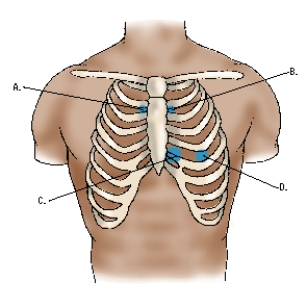
A) Location A
B) Location B
C) Location C
D) Location D
A) Location A
B) Location B
C) Location C
D) Location D
Question
Question
Question
Question

Unlock Deck
Sign up to unlock the cards in this deck!
Unlock Deck
Unlock Deck
1/32

Play

Full screen (f)
Deck 35: Assessment of the Cardiovascular System
1
When obtaining a client's vital signs,the nurse assesses a blood pressure of 134/88 mm Hg.What is the nurse's best intervention?
A) Call the health care provider and report the finding.
B) Reassess the client's blood pressure at the next yearly physical.
C) Administer an additional antihypertensive medication to the client.
D) Teach the client lifestyle modifications to decrease blood pressure.
A) Call the health care provider and report the finding.
B) Reassess the client's blood pressure at the next yearly physical.
C) Administer an additional antihypertensive medication to the client.
D) Teach the client lifestyle modifications to decrease blood pressure.
Teach the client lifestyle modifications to decrease blood pressure.
2
A client is newly diagnosed with a heart murmur and asks the nurse to explain what this means.What is the nurse's best response?
A) "It is a rushing sound that blood makes moving through narrow places."
B) "It's the sound of the heart muscle stretching in an area of weakness."
C) "It's a term doctors use to describe the efficiency of blood circulation."
D) "It is the sound the heart makes when it is has an increased workload."
A) "It is a rushing sound that blood makes moving through narrow places."
B) "It's the sound of the heart muscle stretching in an area of weakness."
C) "It's a term doctors use to describe the efficiency of blood circulation."
D) "It is the sound the heart makes when it is has an increased workload."
"It is a rushing sound that blood makes moving through narrow places."
3
The nurse is assessing clients at a community health center.Which client does the nurse determine is at high risk for cardiovascular disease?
A) Older adult man with a history of asthma
B) Asian-American man with colorectal cancer
C) American Indian woman with diabetes mellitus
D) Postmenopausal woman on hormone therapy
A) Older adult man with a history of asthma
B) Asian-American man with colorectal cancer
C) American Indian woman with diabetes mellitus
D) Postmenopausal woman on hormone therapy
American Indian woman with diabetes mellitus
4
The nurse is assessing clients at a clinic.Which activity takes priority?
A) Teaching smoking cessation to a middle-aged woman who smokes
B) Planning an exercise regimen with a woman with a sedentary lifestyle
C) Teaching an older man who is moderately obese to keep a food diary
D) Assessing a man with familial coronary artery disease for specific risk factors
A) Teaching smoking cessation to a middle-aged woman who smokes
B) Planning an exercise regimen with a woman with a sedentary lifestyle
C) Teaching an older man who is moderately obese to keep a food diary
D) Assessing a man with familial coronary artery disease for specific risk factors
Unlock Deck
Unlock for access to all 32 flashcards in this deck.
Unlock Deck
k this deck
5
The nurse is caring for a client who has had a recent myocardial infarction involving the left ventricle.Which assessment finding is expected?
A) Faint S1 and S2 sounds
B) Decreased cardiac output
C) Increased blood pressure
D) Absent peripheral pulses
A) Faint S1 and S2 sounds
B) Decreased cardiac output
C) Increased blood pressure
D) Absent peripheral pulses
Unlock Deck
Unlock for access to all 32 flashcards in this deck.
Unlock Deck
k this deck
6
The nurse is recovering a client after a left-sided cardiac catheterization.What assessment finding requires immediate intervention?
A) Urinary output less than intake
B) Bruising at the insertion site
C) Slurred speech and confusion
D) Discomfort in the left leg
A) Urinary output less than intake
B) Bruising at the insertion site
C) Slurred speech and confusion
D) Discomfort in the left leg
Unlock Deck
Unlock for access to all 32 flashcards in this deck.
Unlock Deck
k this deck
7
A client consistently reports feeling dizzy and lightheaded when moving from a supine position to a sitting position.What nursing assessment takes priority at this time?
A) Pulse oximetry
B) Blood pressure
C) Respiratory rate
D) Neurologic evaluation
A) Pulse oximetry
B) Blood pressure
C) Respiratory rate
D) Neurologic evaluation
Unlock Deck
Unlock for access to all 32 flashcards in this deck.
Unlock Deck
k this deck
8
The nurse is caring for a client with coronary artery disease.What assessment finding does the nurse expect if the client's mean arterial blood pressure decreases below 60 mm Hg?
A) Increased cardiac output
B) Hypertension
C) Chest pain
D) Decreased heart rate
A) Increased cardiac output
B) Hypertension
C) Chest pain
D) Decreased heart rate
Unlock Deck
Unlock for access to all 32 flashcards in this deck.
Unlock Deck
k this deck
9
The nurse is preparing a client for a cardiac catheterization.What assessment is a priority before the procedure?
A) Client's level of anxiety
B) Ability to turn self in bed
C) Cardiac rhythm and heart rate
D) Allergies to iodine and shellfish
A) Client's level of anxiety
B) Ability to turn self in bed
C) Cardiac rhythm and heart rate
D) Allergies to iodine and shellfish
Unlock Deck
Unlock for access to all 32 flashcards in this deck.
Unlock Deck
k this deck
10
A client has returned from a cardiac angiography via the left femoral artery.Two hours after the procedure,the nurse notes that the left pedal pulse is weak.What is the nurse's best action?
A) Elevate the leg and apply a sandbag to the entrance site.
B) Increase the flow rate of intravenous fluids.
C) Assess the color and temperature of the left leg.
D) Document the finding as left pedal pulse of +1/4.
A) Elevate the leg and apply a sandbag to the entrance site.
B) Increase the flow rate of intravenous fluids.
C) Assess the color and temperature of the left leg.
D) Document the finding as left pedal pulse of +1/4.
Unlock Deck
Unlock for access to all 32 flashcards in this deck.
Unlock Deck
k this deck
11
The client is scheduled for a resting electrocardiography.Which statement by the client indicates a good understanding of the preprocedure teaching?
A) "I cannot eat or drink before the electrocardiography."
B) "I must lie as still as possible during the procedure."
C) "I am likely to feel warmth as the dye enters the heart."
D) "I will increase my fluid intake on the day of the procedure."
A) "I cannot eat or drink before the electrocardiography."
B) "I must lie as still as possible during the procedure."
C) "I am likely to feel warmth as the dye enters the heart."
D) "I will increase my fluid intake on the day of the procedure."
Unlock Deck
Unlock for access to all 32 flashcards in this deck.
Unlock Deck
k this deck
12
The nurse is assessing a client following a myocardial infarction.The client is hypotensive.What additional assessment finding does the nurse expect?
A) Heart rate of 120 beats/min
B) Cool, clammy skin
C) Oxygen saturation of 90%
D) Respiratory rate of 8 breaths/min
A) Heart rate of 120 beats/min
B) Cool, clammy skin
C) Oxygen saturation of 90%
D) Respiratory rate of 8 breaths/min
Unlock Deck
Unlock for access to all 32 flashcards in this deck.
Unlock Deck
k this deck
13
The nurse is assessing an older adult client who is experiencing a myocardial infarction.What clinical manifestation does the nurse expect in this client?
A) Excruciating pain on inspiration
B) Left lateral chest wall pain
C) Disorientation and confusion
D) Numbness and tingling of the arm
A) Excruciating pain on inspiration
B) Left lateral chest wall pain
C) Disorientation and confusion
D) Numbness and tingling of the arm
Unlock Deck
Unlock for access to all 32 flashcards in this deck.
Unlock Deck
k this deck
14
The nurse administers a beta blocker to a client after a myocardial infarction.What assessment finding does the nurse expect?
A) Blood pressure increase of 10%
B) Increasing respiratory rate
C) Increased cardiac output
D) Pulse decrease from 100 to 80 beats/min
A) Blood pressure increase of 10%
B) Increasing respiratory rate
C) Increased cardiac output
D) Pulse decrease from 100 to 80 beats/min
Unlock Deck
Unlock for access to all 32 flashcards in this deck.
Unlock Deck
k this deck
15
The nurse is performing a focused cardiac assessment.What assessment finding should be reported to the health care provider?
A) Bruit heard on the side of the neck
B) Bounding peripheral pulses
C) Pulse rate of 90 beats/min
D) Blood pressure of 140/90 mm Hg
A) Bruit heard on the side of the neck
B) Bounding peripheral pulses
C) Pulse rate of 90 beats/min
D) Blood pressure of 140/90 mm Hg
Unlock Deck
Unlock for access to all 32 flashcards in this deck.
Unlock Deck
k this deck
16
The nurse is obtaining a client's health history.Which illness alerts the nurse to the possibility of abnormal heart valves?
A) Tuberculosis
B) Recurrent viral pneumonia
C) Rheumatic fever
D) Asthma
A) Tuberculosis
B) Recurrent viral pneumonia
C) Rheumatic fever
D) Asthma
Unlock Deck
Unlock for access to all 32 flashcards in this deck.
Unlock Deck
k this deck
17
A nurse is performing an admission assessment on an older adult client with multiple chronic diseases.The nurse assesses the heart rate to be 48 beats/min.What does the nurse do first?
A) Document the finding in the chart.
B) Evaluate for a pulse deficit.
C) Assess the client's medications.
D) Administer 1 mg of atropine.
A) Document the finding in the chart.
B) Evaluate for a pulse deficit.
C) Assess the client's medications.
D) Administer 1 mg of atropine.
Unlock Deck
Unlock for access to all 32 flashcards in this deck.
Unlock Deck
k this deck
18
The nurse is assessing a client in the emergency department.Which client statement alerts the nurse to the occurrence of heart failure?
A) "I get short of breath when I climb stairs."
B) "I see halos floating around my head."
C) "I have trouble remembering things."
D) "I have lost weight over the past month."
A) "I get short of breath when I climb stairs."
B) "I see halos floating around my head."
C) "I have trouble remembering things."
D) "I have lost weight over the past month."
Unlock Deck
Unlock for access to all 32 flashcards in this deck.
Unlock Deck
k this deck
19
The nurse is assessing a client newly admitted to the medical unit.Which statement made by the client alerts the nurse to the presence of edema?
A) "I wake up to go to the bathroom at night."
B) "My shoes fit tighter by the end of the day."
C) "I seem to be feeling more anxious lately."
D) "I drink at least eight glasses of water a day."
A) "I wake up to go to the bathroom at night."
B) "My shoes fit tighter by the end of the day."
C) "I seem to be feeling more anxious lately."
D) "I drink at least eight glasses of water a day."
Unlock Deck
Unlock for access to all 32 flashcards in this deck.
Unlock Deck
k this deck
20
The nurse is monitoring a client undergoing an exercise electrocardiography (stress test).Which assessment finding necessitates that the test be stopped?
A) Heart rate increases to 140 beats/min
B) Blood pressure of 100/80 mm Hg
C) Respiratory rate exceeds 36 breaths/min
D) Significant ST-segment depression
A) Heart rate increases to 140 beats/min
B) Blood pressure of 100/80 mm Hg
C) Respiratory rate exceeds 36 breaths/min
D) Significant ST-segment depression
Unlock Deck
Unlock for access to all 32 flashcards in this deck.
Unlock Deck
k this deck
21
A client is recovering after a coronary catheterization.What assessment findings in the first few hours after the procedure require immediate action by the nurse?
A) Blood pressure of 140/88 mm Hg
B) Serum potassium of 2.9 mEq/L
C) Warmth and redness at the site
D) Expanding groin hematoma
E) Rhythm changes on the cardiac monitor
A) Blood pressure of 140/88 mm Hg
B) Serum potassium of 2.9 mEq/L
C) Warmth and redness at the site
D) Expanding groin hematoma
E) Rhythm changes on the cardiac monitor
Unlock Deck
Unlock for access to all 32 flashcards in this deck.
Unlock Deck
k this deck
22
A client with a history of renal insufficiency is scheduled for a cardiac catheterization.What does the nurse expect to do for this client before the catheterization?
A) Insert a Foley catheter.
B) Administer IV fluids.
C) Assess for allergies to iodine.
D) Assess laboratory results.
E) Assess and mark pulses.
F) Insert a central venous catheter.
G) Have the client sign the consent.
A) Insert a Foley catheter.
B) Administer IV fluids.
C) Assess for allergies to iodine.
D) Assess laboratory results.
E) Assess and mark pulses.
F) Insert a central venous catheter.
G) Have the client sign the consent.
Unlock Deck
Unlock for access to all 32 flashcards in this deck.
Unlock Deck
k this deck
23
The nurse is preparing to measure a client's pulmonary artery wedge pressure (PAWP).In what position will the nurse place the client for the most accurate results?
A) Supine, with the head elevated to 45 degrees
B) Supine, with the head elevated to 30 degrees
C) Reverse Trendelenburg position at 15 degrees
D) Supine, with the head of the bed flat
A) Supine, with the head elevated to 45 degrees
B) Supine, with the head elevated to 30 degrees
C) Reverse Trendelenburg position at 15 degrees
D) Supine, with the head of the bed flat
Unlock Deck
Unlock for access to all 32 flashcards in this deck.
Unlock Deck
k this deck
24
The nurse is auscultating heart tones on an older client and hears the following sound.What is the nurse's best action? (Click the media button to hear the audio clip.)
A) Administer a diuretic.
B) Document the finding.
C) Decrease the IV flow rate.
D) Evaluate the medications.
A) Administer a diuretic.
B) Document the finding.
C) Decrease the IV flow rate.
D) Evaluate the medications.
Unlock Deck
Unlock for access to all 32 flashcards in this deck.
Unlock Deck
k this deck
25
A female client is admitted to the emergency department.Which symptoms cause the nurse to order an electrocardiogram?
A) Hypertension
B) Fatigue despite adequate rest
C) Indigestion
D) Abdominal fullness
E) Shortness of breath
F) Feeling of choking
G) Abdominal pain
A) Hypertension
B) Fatigue despite adequate rest
C) Indigestion
D) Abdominal fullness
E) Shortness of breath
F) Feeling of choking
G) Abdominal pain
Unlock Deck
Unlock for access to all 32 flashcards in this deck.
Unlock Deck
k this deck
26
The nurse is caring for a client who is scheduled for magnetic resonance imaging (MRI)of the heart.The client's history includes a previous myocardial infarction and pacemaker implantation.Which action by the nurse is most appropriate?
A) Schedule an electrocardiogram just before the MRI.
B) Notify the health care provider before scheduling the MRI.
C) Call the physician and request a laboratory draw for cardiac enzymes.
D) Instruct the client to increase fluid intake the day before the MRI.
A) Schedule an electrocardiogram just before the MRI.
B) Notify the health care provider before scheduling the MRI.
C) Call the physician and request a laboratory draw for cardiac enzymes.
D) Instruct the client to increase fluid intake the day before the MRI.
Unlock Deck
Unlock for access to all 32 flashcards in this deck.
Unlock Deck
k this deck
27
The nurse is caring for a client with pericarditis.What assessment finding correlates with this disorder?
A) Pericardial friction rub
B) Systolic murmur
C) Ventricular gallop
D) Paradoxical splitting
A) Pericardial friction rub
B) Systolic murmur
C) Ventricular gallop
D) Paradoxical splitting
Unlock Deck
Unlock for access to all 32 flashcards in this deck.
Unlock Deck
k this deck
28
The nurse is auscultating cardiac tones.Where should the nurse listen to best hear a cardiac murmur related to aortic regurgitation?
A) Location A
B) Location B
C) Location C
D) Location D
A) Location A
B) Location B
C) Location C
D) Location D
Unlock Deck
Unlock for access to all 32 flashcards in this deck.
Unlock Deck
k this deck
29
When reviewing a client's laboratory results,which findings alert the nurse to the possibility of atherosclerosis?
A) Total cholesterol of 280 mg/dL
B) High-density cholesterol of 50 mg/dL
C) Triglycerides of 200 mg/dL
D) Serum albumin of 4 g/dL
E) Low-density cholesterol of 160 mg/dL
A) Total cholesterol of 280 mg/dL
B) High-density cholesterol of 50 mg/dL
C) Triglycerides of 200 mg/dL
D) Serum albumin of 4 g/dL
E) Low-density cholesterol of 160 mg/dL
Unlock Deck
Unlock for access to all 32 flashcards in this deck.
Unlock Deck
k this deck
30
The nurse obtains a pulmonary artery pressure reading of 25/12 mm Hg in a client recovering from a myocardial infarction.What is the nurse's first intervention?
A) Compare the results with previous readings.
B) Increase the IV fluid rate because these readings are low.
C) Immediately notify the physician of the elevated pressures.
D) Document the finding and continue to monitor.
A) Compare the results with previous readings.
B) Increase the IV fluid rate because these readings are low.
C) Immediately notify the physician of the elevated pressures.
D) Document the finding and continue to monitor.
Unlock Deck
Unlock for access to all 32 flashcards in this deck.
Unlock Deck
k this deck
31
The nurse is caring for a client with an 80% blockage of the right coronary artery (RCA).While waiting for bypass surgery,what is essential for the nurse to have available?
A) Furosemide (Lasix)
B) External pacemaker
C) Lidocaine
D) Central venous access
A) Furosemide (Lasix)
B) External pacemaker
C) Lidocaine
D) Central venous access
Unlock Deck
Unlock for access to all 32 flashcards in this deck.
Unlock Deck
k this deck
32
A client who is scheduled for an echocardiography today asks why this test is being performed.What is the nurse's best response?
A) "This procedure is a noninvasive way to assess the structure of the heart."
B) "This procedure assesses for abnormal electrical impulses within the heart."
C) "This procedure will evaluate the oxygen saturation in your blood."
D) "This procedure assesses for blockages within the coronary arteries."
A) "This procedure is a noninvasive way to assess the structure of the heart."
B) "This procedure assesses for abnormal electrical impulses within the heart."
C) "This procedure will evaluate the oxygen saturation in your blood."
D) "This procedure assesses for blockages within the coronary arteries."
Unlock Deck
Unlock for access to all 32 flashcards in this deck.
Unlock Deck
k this deck
Unlock Deck
Unlock for access to all 32 flashcards in this deck.






