







 Chat with AI

Deck 36: Care of Patients With Dysrhythmias
Full screen (f)

Question

Question
Question
Question
Question
Question
Question
Question
Question
Question
Question
Question
Question
Question
Question
Question
Question
Question
Question
Question
Question
Question
The nurse is assessing a client's ECG.What is the nurse's interpretation of the following ECG strip? 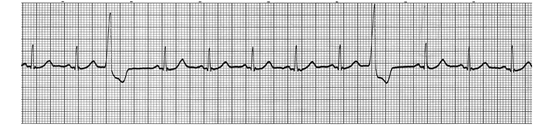
A) Sinus rhythm with premature ventricular contractions (PVCs)
B) Ventricular tachycardia
C) Ventricular fibrillation
D) Sinus rhythm with premature atrial contractions (PACs)
A) Sinus rhythm with premature ventricular contractions (PVCs)
B) Ventricular tachycardia
C) Ventricular fibrillation
D) Sinus rhythm with premature atrial contractions (PACs)
Question
A nurse assesses the following electrocardiography (ECG)strip from a client's telemetry monitor.What does the nurse chart as the client's ventricular heart rate? 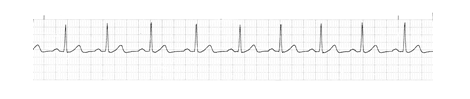
A) 40 beats/min
B) 80 beats/min
C) 120 beats/min
D) 160 beats/min
A) 40 beats/min
B) 80 beats/min
C) 120 beats/min
D) 160 beats/min
Question
Question
Question
Question
Question
Question
Question
Question
Question
The nurse notes the following rhythm on a client's telemetry monitor.How does the nurse interpret these findings? 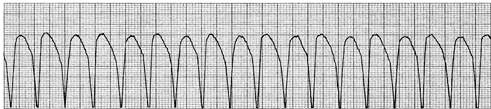
A) Ventricular tachycardia
B) Second-degree heart block
C) Supraventricular tachycardia
D) Premature ventricular contractions
A) Ventricular tachycardia
B) Second-degree heart block
C) Supraventricular tachycardia
D) Premature ventricular contractions
Question
The nurse is alerted to a client's telemetry monitor.After assessing the following ECG,what is the nurse's priority intervention? 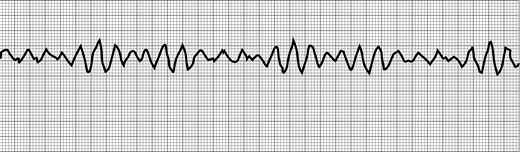
A) Start a large-bore IV.
B) Administer atropine.
C) Prepare for intubation.
D) Perform defibrillation.
A) Start a large-bore IV.
B) Administer atropine.
C) Prepare for intubation.
D) Perform defibrillation.
Question
Question
Question
Question
A nurse assesses the following ECG strip from a client's telemetry monitor.What does the nurse do next? 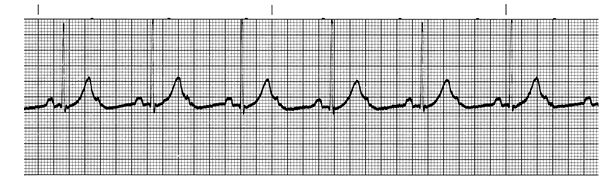
A) Measure hourly urine output.
B) Assess the client's vital signs.
C) Administer 0.5 mg atropine IV.
D) Prepare for external pacing.
A) Measure hourly urine output.
B) Assess the client's vital signs.
C) Administer 0.5 mg atropine IV.
D) Prepare for external pacing.

Unlock Deck
Sign up to unlock the cards in this deck!
Unlock Deck
Unlock Deck
1/37

Play

Full screen (f)
Deck 36: Care of Patients With Dysrhythmias
1
A client's electrocardiograph (ECG)tracing shows a run of sustained ventricular tachycardia.What is the nurse's first action?
A) Assess airway, breathing, and level of consciousness.
B) Administer an amiodarone bolus followed by a drip.
C) Cardiovert the client with a biphasic defibrillator.
D) Begin cardiopulmonary resuscitation (CPR).
A) Assess airway, breathing, and level of consciousness.
B) Administer an amiodarone bolus followed by a drip.
C) Cardiovert the client with a biphasic defibrillator.
D) Begin cardiopulmonary resuscitation (CPR).
Assess airway, breathing, and level of consciousness.
2
When analyzing a client's electrocardiograph (ECG)tracing,the nurse observes that not all QRS complexes are preceded by a P wave.What is the nurse's interpretation of this observation?
A) The client has hyperkalemia causing irregular QRS complexes.
B) Ventricular tachycardia is overriding the normal atrial rhythm.
C) The client's chest leads are not making sufficient contact with the skin.
D) Ventricular and atrial depolarizations are initiated from different sites.
A) The client has hyperkalemia causing irregular QRS complexes.
B) Ventricular tachycardia is overriding the normal atrial rhythm.
C) The client's chest leads are not making sufficient contact with the skin.
D) Ventricular and atrial depolarizations are initiated from different sites.
Ventricular and atrial depolarizations are initiated from different sites.
3
The nurse is caring for a client with atrial fibrillation.What manifestation most alerts the nurse to the possibility of a serious complication from this condition?
A) Sinus tachycardia
B) Speech alterations
C) Fatigue
D) Dyspnea with activity
A) Sinus tachycardia
B) Speech alterations
C) Fatigue
D) Dyspnea with activity
Speech alterations
4
The nurse is caring for a client on a cardiac monitor.The monitor shows a rapid rhythm with a "saw tooth" configuration.What physical assessment findings does the nurse expect?
A) Presence of a split S1 and wheezing
B) Anorexia and gastric distress
C) Shortness of breath and anxiety
D) Hypertension and mental status changes
A) Presence of a split S1 and wheezing
B) Anorexia and gastric distress
C) Shortness of breath and anxiety
D) Hypertension and mental status changes
Unlock Deck
Unlock for access to all 37 flashcards in this deck.
Unlock Deck
k this deck
5
The nurse has administered adenosine (Adenocard).What is the expected therapeutic response?
A) Increased intraocular pressure
B) A brief tonic-clonic seizure
C) A short period of asystole
D) Hypertensive crisis
A) Increased intraocular pressure
B) A brief tonic-clonic seizure
C) A short period of asystole
D) Hypertensive crisis
Unlock Deck
Unlock for access to all 37 flashcards in this deck.
Unlock Deck
k this deck
6
A client with myocardial ischemia is having frequent early,wide ventricular complexes seen on the cardiac monitor.Which medication does the nurse administer?
A) Lanoxin (Digoxin)
B) Amiodarone (Cordarone)
C) Dobutamine (Dobutamine)
D) Atropine sulfate (Atropisol)
A) Lanoxin (Digoxin)
B) Amiodarone (Cordarone)
C) Dobutamine (Dobutamine)
D) Atropine sulfate (Atropisol)
Unlock Deck
Unlock for access to all 37 flashcards in this deck.
Unlock Deck
k this deck
7
The nurse is assessing clients at a community clinic.Which client does the nurse assess most carefully for atrial fibrillation?
A) Middle-aged client who takes an aspirin daily
B) Client who is dismissed after coronary artery bypass surgery
C) Older adult client after a carotid endarterectomy
D) Client with chronic obstructive pulmonary disease
A) Middle-aged client who takes an aspirin daily
B) Client who is dismissed after coronary artery bypass surgery
C) Older adult client after a carotid endarterectomy
D) Client with chronic obstructive pulmonary disease
Unlock Deck
Unlock for access to all 37 flashcards in this deck.
Unlock Deck
k this deck
8
A nurse notes that the PR interval on a client's electrocardiograph (ECG)tracing is 0.14 second.What action does the nurse take?
A) Assess serum cardiac enzymes.
B) Administer 1 mg epinephrine IV.
C) Administer oxygen via nasal cannula.
D) Document the finding in the client's chart.
A) Assess serum cardiac enzymes.
B) Administer 1 mg epinephrine IV.
C) Administer oxygen via nasal cannula.
D) Document the finding in the client's chart.
Unlock Deck
Unlock for access to all 37 flashcards in this deck.
Unlock Deck
k this deck
9
The client's heart rate increases slightly during inspiration and decreases slightly during expiration.What action does the nurse take?
A) Evaluate for a respirator disorder.
B) Assess the client for chest pain.
C) Document the finding in the chart.
D) Administer antidysrhythmic drugs.
A) Evaluate for a respirator disorder.
B) Assess the client for chest pain.
C) Document the finding in the chart.
D) Administer antidysrhythmic drugs.
Unlock Deck
Unlock for access to all 37 flashcards in this deck.
Unlock Deck
k this deck
10
A client's cardiac status is being observed by telemetry monitoring.The nurse observes a P wave that changes shape in lead II.What conclusion does the nurse make about the P wave?
A) It originates from an ectopic focus.
B) The P wave was replaced by U waves.
C) It is from the sinoatrial (SA) node.
D) Multiple P waves are present.
A) It originates from an ectopic focus.
B) The P wave was replaced by U waves.
C) It is from the sinoatrial (SA) node.
D) Multiple P waves are present.
Unlock Deck
Unlock for access to all 37 flashcards in this deck.
Unlock Deck
k this deck
11
A client experiences occasional premature atrial contractions (PACs)accompanied by palpitations that resolve spontaneously without treatment.What instruction does the nurse include in the client's teaching plan?
A) "Minimize or abstain from caffeine."
B) "Lie on your side until the attack subsides."
C) "Use your oxygen when you experience PACs."
D) "Take quinidine (Cardioquin) daily to prevent PACs."
A) "Minimize or abstain from caffeine."
B) "Lie on your side until the attack subsides."
C) "Use your oxygen when you experience PACs."
D) "Take quinidine (Cardioquin) daily to prevent PACs."
Unlock Deck
Unlock for access to all 37 flashcards in this deck.
Unlock Deck
k this deck
12
The nurse is assessing the client's electrocardiography (ECG).What does the P wave on the ECG tracing represent?
A) Contraction of the atria
B) Contraction of the ventricles
C) Depolarization of the atria
D) Depolarization of the ventricles
A) Contraction of the atria
B) Contraction of the ventricles
C) Depolarization of the atria
D) Depolarization of the ventricles
Unlock Deck
Unlock for access to all 37 flashcards in this deck.
Unlock Deck
k this deck
13
A client with unstable ventricular tachycardia is receiving amiodarone by intravenous infusion.The nurse notes that the client's heart rate has decreased from 68 to 50 beats/min.The client is asymptomatic.What is the nurse's priority intervention?
A) Stop the infusion and flush the IV.
B) Slow the amiodarone infusion rate.
C) Administer a precordial thump.
D) Place the client in a side-lying position.
A) Stop the infusion and flush the IV.
B) Slow the amiodarone infusion rate.
C) Administer a precordial thump.
D) Place the client in a side-lying position.
Unlock Deck
Unlock for access to all 37 flashcards in this deck.
Unlock Deck
k this deck
14
The nurse identifies a client's rhythm to be a sustained supraventricular tachycardia.What medication does the nurse administer?
A) Atropine (Atropine)
B) Epinephrine (Adrenalin)
C) Lidocaine (Xylocaine)
D) Diltiazem (Cardizem)
A) Atropine (Atropine)
B) Epinephrine (Adrenalin)
C) Lidocaine (Xylocaine)
D) Diltiazem (Cardizem)
Unlock Deck
Unlock for access to all 37 flashcards in this deck.
Unlock Deck
k this deck
15
A client has a heart rate averaging 56 beats/min with no adverse symptoms.What activity modifications does the nurse suggest to avoid further slowing of the heart rate?
A) "Make certain that your bath water is warm (100° F)."
B) "Avoid bearing down or straining while having a bowel movement."
C) "Avoid strenuous exercise, such as running, during the late afternoon."
D) "Limit your intake of caffeinated drinks to no more than 2 cups per day."
A) "Make certain that your bath water is warm (100° F)."
B) "Avoid bearing down or straining while having a bowel movement."
C) "Avoid strenuous exercise, such as running, during the late afternoon."
D) "Limit your intake of caffeinated drinks to no more than 2 cups per day."
Unlock Deck
Unlock for access to all 37 flashcards in this deck.
Unlock Deck
k this deck
16
A client is experiencing sinus bradycardia with hypotension and dizziness.What medication does the nurse administer?
A) Atropine (Atropine)
B) Digoxin (Lanoxin)
C) Lidocaine (Xylocaine)
D) Metoprolol (Lopressor)
A) Atropine (Atropine)
B) Digoxin (Lanoxin)
C) Lidocaine (Xylocaine)
D) Metoprolol (Lopressor)
Unlock Deck
Unlock for access to all 37 flashcards in this deck.
Unlock Deck
k this deck
17
A client with tachycardia is experiencing clinical manifestations.Which manifestation requires immediate intervention by the nurse?
A) Mid-sternal chest pain
B) Increased urine output
C) Mild orthostatic hypotension
D) P wave touching the T wave
A) Mid-sternal chest pain
B) Increased urine output
C) Mild orthostatic hypotension
D) P wave touching the T wave
Unlock Deck
Unlock for access to all 37 flashcards in this deck.
Unlock Deck
k this deck
18
The nurse is caring for a client admitted for myocardial infarction.The client's monitor shows frequent premature ventricular contractions (PVCs).What dysrhythmia does the nurse remain alert for?
A) Sinus tachycardia
B) Rapid atrial flutter
C) Ventricular tachycardia
D) Atrioventricular junctional rhythm
A) Sinus tachycardia
B) Rapid atrial flutter
C) Ventricular tachycardia
D) Atrioventricular junctional rhythm
Unlock Deck
Unlock for access to all 37 flashcards in this deck.
Unlock Deck
k this deck
19
The nurse is caring for a client with chronic atrial fibrillation.Which drug does the nurse expect to administer to prevent a common complication of this condition?
A) Sotalol (Betapace)
B) Warfarin (Coumadin)
C) Atropine (Atropine)
D) Lidocaine (Xylocaine)
A) Sotalol (Betapace)
B) Warfarin (Coumadin)
C) Atropine (Atropine)
D) Lidocaine (Xylocaine)
Unlock Deck
Unlock for access to all 37 flashcards in this deck.
Unlock Deck
k this deck
20
The nurse observes a prominent U wave on the client's electrocardiograph (ECG)tracing.What is the most appropriate action for the nurse to take?
A) Document the finding as a normal variant.
B) Review the client's daily electrolyte results.
C) Move the crash cart closer to the client's room.
D) Call for an immediate electrocardiogram.
A) Document the finding as a normal variant.
B) Review the client's daily electrolyte results.
C) Move the crash cart closer to the client's room.
D) Call for an immediate electrocardiogram.
Unlock Deck
Unlock for access to all 37 flashcards in this deck.
Unlock Deck
k this deck
21
The physician is about to perform carotid sinus massage on a client with supraventricular tachycardia.What equipment is most important for the nurse to have ready?
A) Emesis basin
B) Magnesium sulfate
C) Resuscitation cart
D) Padded tongue blade
A) Emesis basin
B) Magnesium sulfate
C) Resuscitation cart
D) Padded tongue blade
Unlock Deck
Unlock for access to all 37 flashcards in this deck.
Unlock Deck
k this deck
22
The nurse is assessing a client's ECG.What is the nurse's interpretation of the following ECG strip?
A) Sinus rhythm with premature ventricular contractions (PVCs)
B) Ventricular tachycardia
C) Ventricular fibrillation
D) Sinus rhythm with premature atrial contractions (PACs)
A) Sinus rhythm with premature ventricular contractions (PVCs)
B) Ventricular tachycardia
C) Ventricular fibrillation
D) Sinus rhythm with premature atrial contractions (PACs)
Unlock Deck
Unlock for access to all 37 flashcards in this deck.
Unlock Deck
k this deck
23
A nurse assesses the following electrocardiography (ECG)strip from a client's telemetry monitor.What does the nurse chart as the client's ventricular heart rate?
A) 40 beats/min
B) 80 beats/min
C) 120 beats/min
D) 160 beats/min
A) 40 beats/min
B) 80 beats/min
C) 120 beats/min
D) 160 beats/min
Unlock Deck
Unlock for access to all 37 flashcards in this deck.
Unlock Deck
k this deck
24
A client with third-degree heart block is admitted to the telemetry unit.The nurse observes wide QRS complexes on the monitor with a heart rate of 35 beats/min.What priority assessment does the nurse perform?
A) Pulmonary auscultation
B) Pulse strength and amplitude
C) Level of consciousness
D) Mobility and gait stability
A) Pulmonary auscultation
B) Pulse strength and amplitude
C) Level of consciousness
D) Mobility and gait stability
Unlock Deck
Unlock for access to all 37 flashcards in this deck.
Unlock Deck
k this deck
25
The nurse is caring for a client with a temporary pacemaker.The client's bedside monitor shows a spike followed by a QRS complex.What is the nurse's best action?
A) Remove the pacemaker; it is not needed.
B) Decrease the threshold of the pacemaker.
C) Document the finding in the client's chart.
D) Set the pacemaker to the synchronous mode.
A) Remove the pacemaker; it is not needed.
B) Decrease the threshold of the pacemaker.
C) Document the finding in the client's chart.
D) Set the pacemaker to the synchronous mode.
Unlock Deck
Unlock for access to all 37 flashcards in this deck.
Unlock Deck
k this deck
26
The nurse is caring for a client with a complete heart block (third-degree atrioventricular [AV] block).What is the nurse's priority intervention?
A) Perform a cardioversion.
B) Assist with carotid massage.
C) Begin external pacing.
D) Administer adenosine (Adenocard) IV.
A) Perform a cardioversion.
B) Assist with carotid massage.
C) Begin external pacing.
D) Administer adenosine (Adenocard) IV.
Unlock Deck
Unlock for access to all 37 flashcards in this deck.
Unlock Deck
k this deck
27
A client with ischemic heart disease has an electrocardiograph (ECG)tracing that shows a PR interval of 0.24 second.What is the nurse's best action?
A) Document the finding in the chart.
B) Measure blood pressure.
C) Notify the health care provider.
D) Administer oxygen.
A) Document the finding in the chart.
B) Measure blood pressure.
C) Notify the health care provider.
D) Administer oxygen.
Unlock Deck
Unlock for access to all 37 flashcards in this deck.
Unlock Deck
k this deck
28
A client was admitted for a permanent pacemaker insertion.What priority instruction does the nurse include in the client's discharge teaching?
A) "Do not submerge your pacemaker, take only showers."
B) "Report pulse rates lower than your pacemaker setting."
C) "If you feel weak, apply pressure over your generator."
D) "Have your pacemaker turned off before having an MRI."
A) "Do not submerge your pacemaker, take only showers."
B) "Report pulse rates lower than your pacemaker setting."
C) "If you feel weak, apply pressure over your generator."
D) "Have your pacemaker turned off before having an MRI."
Unlock Deck
Unlock for access to all 37 flashcards in this deck.
Unlock Deck
k this deck
29
A client has a consistently regular heart rate of 128 beats/min.Which related physiologic alterations does the nurse assess for?
A) Decrease in cardiac output
B) Increase in cardiac output
C) Increase in blood pressure
D) Decrease in blood pressure
E) Increase in urine output
A) Decrease in cardiac output
B) Increase in cardiac output
C) Increase in blood pressure
D) Decrease in blood pressure
E) Increase in urine output
Unlock Deck
Unlock for access to all 37 flashcards in this deck.
Unlock Deck
k this deck
30
The nurse is recovering a client after insertion of an implantable cardioverter-defibrillator (ICD).What complication must the nurse intervene for immediately?
A) 2/4 bilateral peripheral edema
B) Heart rate of 56 beats/min
C) Temperature of 96° F (35.5° C)
D) Muffled heart sounds
A) 2/4 bilateral peripheral edema
B) Heart rate of 56 beats/min
C) Temperature of 96° F (35.5° C)
D) Muffled heart sounds
Unlock Deck
Unlock for access to all 37 flashcards in this deck.
Unlock Deck
k this deck
31
A client has an epicardial pacemaker.The nurse observes the presence of a pacing spike but no QRS complex on the client's electrocardiograph (ECG)tracing.How does the nurse interpret this event?
A) Loss of capture
B) Ventricular fibrillation
C) Failure to sense
D) A normal tracing
A) Loss of capture
B) Ventricular fibrillation
C) Failure to sense
D) A normal tracing
Unlock Deck
Unlock for access to all 37 flashcards in this deck.
Unlock Deck
k this deck
32
The nurse notes the following rhythm on a client's telemetry monitor.How does the nurse interpret these findings?
A) Ventricular tachycardia
B) Second-degree heart block
C) Supraventricular tachycardia
D) Premature ventricular contractions
A) Ventricular tachycardia
B) Second-degree heart block
C) Supraventricular tachycardia
D) Premature ventricular contractions
Unlock Deck
Unlock for access to all 37 flashcards in this deck.
Unlock Deck
k this deck
33
The nurse is alerted to a client's telemetry monitor.After assessing the following ECG,what is the nurse's priority intervention?
A) Start a large-bore IV.
B) Administer atropine.
C) Prepare for intubation.
D) Perform defibrillation.
A) Start a large-bore IV.
B) Administer atropine.
C) Prepare for intubation.
D) Perform defibrillation.
Unlock Deck
Unlock for access to all 37 flashcards in this deck.
Unlock Deck
k this deck
34
The nurse is assisting with resuscitation of a client.What priority intervention does the nurse perform before defibrillating a client?
A) Make sure the defibrillator is set to the synchronous mode.
B) Deliver a precordial thump to the upper portion of the sternum.
C) Test the equipment by delivering a smaller shock at 100 J.
D) Ensure that all personnel are clear of contact with the client and the bed.
A) Make sure the defibrillator is set to the synchronous mode.
B) Deliver a precordial thump to the upper portion of the sternum.
C) Test the equipment by delivering a smaller shock at 100 J.
D) Ensure that all personnel are clear of contact with the client and the bed.
Unlock Deck
Unlock for access to all 37 flashcards in this deck.
Unlock Deck
k this deck
35
A client with ventricular tachycardia (VT)is unresponsive and has no pulse.The nurse calls for assistance and a defibrillator.What is the nurse's priority intervention while waiting for the defibrillator to arrive?
A) Perform a pericardial thump.
B) Initiate cardiopulmonary resuscitation.
C) Start an 18-gauge IV in the antecubital.
D) Ask the client's family about code status.
A) Perform a pericardial thump.
B) Initiate cardiopulmonary resuscitation.
C) Start an 18-gauge IV in the antecubital.
D) Ask the client's family about code status.
Unlock Deck
Unlock for access to all 37 flashcards in this deck.
Unlock Deck
k this deck
36
The nurse is providing discharge instructions for a client with an implantable cardioverter-defibrillator (ICD).What statement by the client indicates a good understanding of the instructions?
A) "I should wear a snug-fitting shirt over the ICD."
B) "I will avoid sources of strong electromagnetic fields."
C) "I can't perform activities that increase my heart rate."
D) "Now I can discontinue my antidysrhythmic medication."
A) "I should wear a snug-fitting shirt over the ICD."
B) "I will avoid sources of strong electromagnetic fields."
C) "I can't perform activities that increase my heart rate."
D) "Now I can discontinue my antidysrhythmic medication."
Unlock Deck
Unlock for access to all 37 flashcards in this deck.
Unlock Deck
k this deck
37
A nurse assesses the following ECG strip from a client's telemetry monitor.What does the nurse do next?
A) Measure hourly urine output.
B) Assess the client's vital signs.
C) Administer 0.5 mg atropine IV.
D) Prepare for external pacing.
A) Measure hourly urine output.
B) Assess the client's vital signs.
C) Administer 0.5 mg atropine IV.
D) Prepare for external pacing.
Unlock Deck
Unlock for access to all 37 flashcards in this deck.
Unlock Deck
k this deck
Unlock Deck
Unlock for access to all 37 flashcards in this deck.






