







 Chat with AI

Deck 43: Assessment of the Nervous System
Full screen (f)

Question

Question
Question
Question
Question
Question
Question
Question
Question
Question
Question
Question
Question
Question
Question
Question
Question
Question
Question
Question
Question
Question
Question
Question
Question
Question
Question
Question
On assessment of the left plantar reflexes of an adult client,the nurse notes the response shown in the photograph below.What action does the nurse take after assessing this new finding? 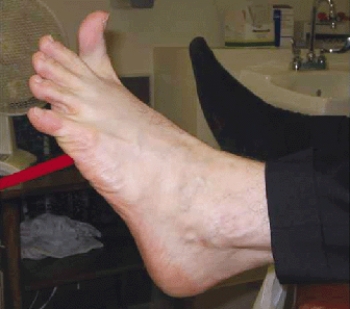
A) Relay this abnormal finding to other members of the health care team.
B) Anticipate the need for cerebral angiography to determine the cause.
C) Examine the family history for a potential genetic disorder.
D) Document the finding and continue the assessment.
A) Relay this abnormal finding to other members of the health care team.
B) Anticipate the need for cerebral angiography to determine the cause.
C) Examine the family history for a potential genetic disorder.
D) Document the finding and continue the assessment.

Unlock Deck
Sign up to unlock the cards in this deck!
Unlock Deck
Unlock Deck
1/28

Play

Full screen (f)
Deck 43: Assessment of the Nervous System
1
The nurse is caring for a client post-cerebral angiography via the client's right femoral artery.Which intervention does the nurse implement?
A) Check the right lower extremity pulses.
B) Measure orthostatic blood pressure.
C) Perform a funduscopic examination.
D) Assess the client's gag reflex.
A) Check the right lower extremity pulses.
B) Measure orthostatic blood pressure.
C) Perform a funduscopic examination.
D) Assess the client's gag reflex.
Check the right lower extremity pulses.
2
The nurse is assessing the deep tendon reflexes of a client with long-standing diabetes mellitus.Which clinical manifestation does the nurse expect to see?
A) Bilateral hypoactive reflexes
B) Bilateral hyperactive reflexes
C) Asymmetric reflex response
D) Bilateral ankle clonus
A) Bilateral hypoactive reflexes
B) Bilateral hyperactive reflexes
C) Asymmetric reflex response
D) Bilateral ankle clonus
Bilateral hypoactive reflexes
3
During a neurologic examination,a client demonstrates a positive Romberg's sign with eyes closed,but not with eyes open.Which condition does the nurse associate with this finding?
A) Difficulty with proprioception
B) Peripheral motor disorder
C) Impaired cerebellar function
D) Positive pronator drift
A) Difficulty with proprioception
B) Peripheral motor disorder
C) Impaired cerebellar function
D) Positive pronator drift
Difficulty with proprioception
4
The nurse is caring for a client who had a computed tomography (CT)scan of the head with contrast medium.Which priority intervention does the nurse implement?
A) Maintain bedrest with the head of the bed elevated less than 30 degrees.
B) Apply a pressure dressing to the site of injection.
C) Increase fluid intake after the procedure.
D) Maintain sedation for 8 hours postprocedure.
A) Maintain bedrest with the head of the bed elevated less than 30 degrees.
B) Apply a pressure dressing to the site of injection.
C) Increase fluid intake after the procedure.
D) Maintain sedation for 8 hours postprocedure.
Unlock Deck
Unlock for access to all 28 flashcards in this deck.
Unlock Deck
k this deck
5
A client is scheduled for a single-photon emission computed tomography test.Which condition in the client's history causes the nurse to contact the provider before the test takes place?
A) Peptic ulcers
B) Smoking history
C) Liver failure
D) Currently breast feeding
A) Peptic ulcers
B) Smoking history
C) Liver failure
D) Currently breast feeding
Unlock Deck
Unlock for access to all 28 flashcards in this deck.
Unlock Deck
k this deck
6
The nurse assesses a client who has trauma to the cerebrum.Which clinical manifestation does the nurse expect to observe?
A) Poor coordination
B) Memory loss
C) Hyperthermia
D) Slurred speech
A) Poor coordination
B) Memory loss
C) Hyperthermia
D) Slurred speech
Unlock Deck
Unlock for access to all 28 flashcards in this deck.
Unlock Deck
k this deck
7
Which priority instruction or precaution does the nurse teach a client who is scheduled for a positron emission tomography scan of the brain?
A) "Avoid caffeine-containing substances for 12 hours before the test."
B) "Drink at least 3 liters of fluid during the 24 hours after the test."
C) "Do not take your cardiac medication on the morning of the test."
D) "Remove your dentures and any metal before the test begins."
A) "Avoid caffeine-containing substances for 12 hours before the test."
B) "Drink at least 3 liters of fluid during the 24 hours after the test."
C) "Do not take your cardiac medication on the morning of the test."
D) "Remove your dentures and any metal before the test begins."
Unlock Deck
Unlock for access to all 28 flashcards in this deck.
Unlock Deck
k this deck
8
The nurse is discharging an 80-year-old client with diminished touch sensation.Which instruction does the nurse provide to promote client safety?
A) "Walk barefoot only in your home."
B) "Bathe in warm water to increase your circulation."
C) "Look at the placement of your feet when walking."
D) "Put throw rugs at the foot of your bed for cushioning."
A) "Walk barefoot only in your home."
B) "Bathe in warm water to increase your circulation."
C) "Look at the placement of your feet when walking."
D) "Put throw rugs at the foot of your bed for cushioning."
Unlock Deck
Unlock for access to all 28 flashcards in this deck.
Unlock Deck
k this deck
9
The nurse is evaluating a client's physical assessment with the medical history and treatment plan.The nurse notes that the client's right pupil appears dilated,with a sluggish pupillary response to light.Which disorder and related treatment does this physical finding correlate with?
A) Coronary artery disease and beta blockers
B) Diabetes mellitus and oral glycemic reducing agents
C) Glaucoma and intraocular pressure-reducing eyedrops
D) Myopia and corrective laser surgery
A) Coronary artery disease and beta blockers
B) Diabetes mellitus and oral glycemic reducing agents
C) Glaucoma and intraocular pressure-reducing eyedrops
D) Myopia and corrective laser surgery
Unlock Deck
Unlock for access to all 28 flashcards in this deck.
Unlock Deck
k this deck
10
The nurse is preparing a client for magnetic resonance angiography.Which question is a priority at this time?
A) "Have you had a recent blood transfusion?"
B) "Do you have allergies to iodine or shellfish?"
C) "Do you have a history of urinary tract infections?"
D) "Do you currently use oral contraceptives?"
A) "Have you had a recent blood transfusion?"
B) "Do you have allergies to iodine or shellfish?"
C) "Do you have a history of urinary tract infections?"
D) "Do you currently use oral contraceptives?"
Unlock Deck
Unlock for access to all 28 flashcards in this deck.
Unlock Deck
k this deck
11
During a neurologic assessment of a client,the nurse notes that the client's arms,wrists,and fingers have become flexed,and internal rotation and plantar flexion of the legs are evident.How does the nurse document these findings?
A) Decorticate posturing
B) Decerebrate posturing
C) Atypical hyperreflexia
D) Spinal cord degeneration
A) Decorticate posturing
B) Decerebrate posturing
C) Atypical hyperreflexia
D) Spinal cord degeneration
Unlock Deck
Unlock for access to all 28 flashcards in this deck.
Unlock Deck
k this deck
12
A female client with deteriorating neurologic function states,"I am worried I will not be able to care for my young children." How does the nurse respond?
A) "Caring for your children is a priority. You may not want to ask for help, but you have to."
B) "Our community has resources that may help you with some household tasks so you have energy to care for your children."
C) "You seem distressed. Would you like to talk to a psychologist about adjusting to your changing status?"
D) "Give me more information about what worries you, so we can see if we can do something to make adjustments."
A) "Caring for your children is a priority. You may not want to ask for help, but you have to."
B) "Our community has resources that may help you with some household tasks so you have energy to care for your children."
C) "You seem distressed. Would you like to talk to a psychologist about adjusting to your changing status?"
D) "Give me more information about what worries you, so we can see if we can do something to make adjustments."
Unlock Deck
Unlock for access to all 28 flashcards in this deck.
Unlock Deck
k this deck
13
Before electroencephalography,a client asks,"Why will I be asked to take deep breaths during the procedure?" How does the nurse respond?
A) "Hyperventilation causes cerebral vasodilatation and increases the likelihood of seizure activity."
B) "Hyperventilation causes cerebral vasoconstriction and increases the likelihood of seizure activity."
C) "Deep breathing will keep you relaxed and will lower the seizure threshold."
D) "Deep breathing will make you hypoxemic, which lowers the seizure threshold."
A) "Hyperventilation causes cerebral vasodilatation and increases the likelihood of seizure activity."
B) "Hyperventilation causes cerebral vasoconstriction and increases the likelihood of seizure activity."
C) "Deep breathing will keep you relaxed and will lower the seizure threshold."
D) "Deep breathing will make you hypoxemic, which lowers the seizure threshold."
Unlock Deck
Unlock for access to all 28 flashcards in this deck.
Unlock Deck
k this deck
14
The nurse is obtaining the health history of a client scheduled for magnetic resonance imaging (MRI).Which condition requires the nurse to cancel the MRI?
A) Amputated leg
B) Internal insulin pump
C) Intrauterine device
D) Atrioventricular (AV) graft
A) Amputated leg
B) Internal insulin pump
C) Intrauterine device
D) Atrioventricular (AV) graft
Unlock Deck
Unlock for access to all 28 flashcards in this deck.
Unlock Deck
k this deck
15
The nurse is planning care for an 83-year-old client with age-related changes to his sensory perception.Which nursing action does the nurse implement to ensure the client's safety?
A) Provide a call button that requires only minimal pressure to activate.
B) Use a clock and a calendar to orient and minimize onset of dementia.
C) Ensure that the path to the bathroom is free from equipment.
D) Admit the client to the room closest to the nursing station.
A) Provide a call button that requires only minimal pressure to activate.
B) Use a clock and a calendar to orient and minimize onset of dementia.
C) Ensure that the path to the bathroom is free from equipment.
D) Admit the client to the room closest to the nursing station.
Unlock Deck
Unlock for access to all 28 flashcards in this deck.
Unlock Deck
k this deck
16
The nurse is assessing a client with a frontal lobe brain injury.Which clinical manifestation does the nurse expect to see?
A) Inability to interpret taste sensations
B) Inability to interpret sound
C) Impaired judgment
D) Impaired learning
A) Inability to interpret taste sensations
B) Inability to interpret sound
C) Impaired judgment
D) Impaired learning
Unlock Deck
Unlock for access to all 28 flashcards in this deck.
Unlock Deck
k this deck
17
After performing a physical assessment on a 75-year-old client,the nurse notes that the client has a hypoactive response to a test of deep tendon reflexes.Which intervention does the nurse include in this client's plan of care?
A) Assist the client with ambulation.
B) Elevate the client's lower extremities.
C) Apply elastic support hose.
D) Massage the client's legs.
A) Assist the client with ambulation.
B) Elevate the client's lower extremities.
C) Apply elastic support hose.
D) Massage the client's legs.
Unlock Deck
Unlock for access to all 28 flashcards in this deck.
Unlock Deck
k this deck
18
The nurse is assessing a client's remote memory.Which statement by the client confirms that remote memory is intact?
A) "Mary had a little lamb whose fleece was white as snow."
B) "I was born on April 3, 1967, in Johnstown Community Hospital."
C) "Apple, chair, and pencil are the words you just stated."
D) "My sister brought me to the clinic for this appointment."
A) "Mary had a little lamb whose fleece was white as snow."
B) "I was born on April 3, 1967, in Johnstown Community Hospital."
C) "Apple, chair, and pencil are the words you just stated."
D) "My sister brought me to the clinic for this appointment."
Unlock Deck
Unlock for access to all 28 flashcards in this deck.
Unlock Deck
k this deck
19
The nurse is planning to provide discharge teaching related to cardiac medications to a client who has experienced damage to the left temporal lobe of the brain.What does the nurse do to assist the client to understand the content of the instruction?
A) Use a larger print size for written materials.
B) Ensure that the client is wearing glasses.
C) Point out the color of the medication.
D) Sit on the client's right side.
A) Use a larger print size for written materials.
B) Ensure that the client is wearing glasses.
C) Point out the color of the medication.
D) Sit on the client's right side.
Unlock Deck
Unlock for access to all 28 flashcards in this deck.
Unlock Deck
k this deck
20
A client admitted the previous day for a suspected neurologic disorder becomes increasingly lethargic.Which is the best nursing action?
A) Promote a quiet atmosphere for sleep and rest to treat the client's sleep deprivation.
B) Explain to the family that this is a normal age-related decline in mental processing.
C) Consult a psychiatrist to treat the client's hospital-acquired depression.
D) Complete a full neurologic assessment and notify the neurologist.
A) Promote a quiet atmosphere for sleep and rest to treat the client's sleep deprivation.
B) Explain to the family that this is a normal age-related decline in mental processing.
C) Consult a psychiatrist to treat the client's hospital-acquired depression.
D) Complete a full neurologic assessment and notify the neurologist.
Unlock Deck
Unlock for access to all 28 flashcards in this deck.
Unlock Deck
k this deck
21
The nurse is assessing a client scheduled for a lumbar puncture.Which clinical manifestation assessed by the nurse complicates the lumbar puncture procedure?
A) Normal intracranial pressures
B) Allergy to iodine or shellfish
C) Restlessness and agitation
D) Eating lunch less than 2 hours ago
A) Normal intracranial pressures
B) Allergy to iodine or shellfish
C) Restlessness and agitation
D) Eating lunch less than 2 hours ago
Unlock Deck
Unlock for access to all 28 flashcards in this deck.
Unlock Deck
k this deck
22
While assessing pain discrimination,a client correctly identifies,with eyes closed,a sharp sensation on the right hand when touched with a pin.How does the nurse then proceed with the examination?
A) Touch the pin on the same area of the left hand.
B) Touch the pin on the right forearm.
C) Touch the pin on the right upper arm.
D) Touch the right hand with a drop of cold water.
A) Touch the pin on the same area of the left hand.
B) Touch the pin on the right forearm.
C) Touch the pin on the right upper arm.
D) Touch the right hand with a drop of cold water.
Unlock Deck
Unlock for access to all 28 flashcards in this deck.
Unlock Deck
k this deck
23
The nurse is assessing a client with a temporal lobe injury.Which clinical manifestations correlate with this injury?
A) Memory loss
B) Personality changes
C) Loss of temperature regulation
D) Difficulty with sound interpretation
E) Speech difficulties
F) Impaired taste
A) Memory loss
B) Personality changes
C) Loss of temperature regulation
D) Difficulty with sound interpretation
E) Speech difficulties
F) Impaired taste
Unlock Deck
Unlock for access to all 28 flashcards in this deck.
Unlock Deck
k this deck
24
The nurse is administering a medication to a client that stimulates the sympathetic division of the autonomic nervous system.Which clinical manifestations does the nurse monitor for?
A) Decreased heart rate
B) Increased heart rate
C) Decreased force of contraction
D) Increased force of contraction
E) Decreased respirations
A) Decreased heart rate
B) Increased heart rate
C) Decreased force of contraction
D) Increased force of contraction
E) Decreased respirations
Unlock Deck
Unlock for access to all 28 flashcards in this deck.
Unlock Deck
k this deck
25
Immediately after a lumbar puncture,the client begins to vomit and an IV is started with normal saline (0.9% NS).The provider orders a 200-mL bolus over 15 minutes.Using an infusion pump that delivers mL/hr,the rate at which the nurse sets the pump is _____ mL.
Unlock Deck
Unlock for access to all 28 flashcards in this deck.
Unlock Deck
k this deck
26
The nurse is teaching a client before magnetic resonance imaging (MRI).Which statement indicates that the client understands the content of the education?
A) "I need to stay away from heavy metals for the next 48 hours."
B) "My urine will be radioactive for the next 48 hours."
C) "I must increase my fluids because of the dye used for the MRI."
D) "I can return to my usual activities immediately after the MRI."
A) "I need to stay away from heavy metals for the next 48 hours."
B) "My urine will be radioactive for the next 48 hours."
C) "I must increase my fluids because of the dye used for the MRI."
D) "I can return to my usual activities immediately after the MRI."
Unlock Deck
Unlock for access to all 28 flashcards in this deck.
Unlock Deck
k this deck
27
In a client with an injury to the medulla,the nurse monitors for which clinical manifestations secondary to damage of cranial nerves that emerge from the medulla?
A) Loss of smell
B) Impaired swallowing
C) Blink reflex
D) Visual changes
E) Inability to shrug shoulders
F) Loss of gag reflex
A) Loss of smell
B) Impaired swallowing
C) Blink reflex
D) Visual changes
E) Inability to shrug shoulders
F) Loss of gag reflex
Unlock Deck
Unlock for access to all 28 flashcards in this deck.
Unlock Deck
k this deck
28
On assessment of the left plantar reflexes of an adult client,the nurse notes the response shown in the photograph below.What action does the nurse take after assessing this new finding?
A) Relay this abnormal finding to other members of the health care team.
B) Anticipate the need for cerebral angiography to determine the cause.
C) Examine the family history for a potential genetic disorder.
D) Document the finding and continue the assessment.
A) Relay this abnormal finding to other members of the health care team.
B) Anticipate the need for cerebral angiography to determine the cause.
C) Examine the family history for a potential genetic disorder.
D) Document the finding and continue the assessment.
Unlock Deck
Unlock for access to all 28 flashcards in this deck.
Unlock Deck
k this deck
Unlock Deck
Unlock for access to all 28 flashcards in this deck.






