







 Chat with AI

Deck 12: Marine Life and the Marine Environment
Full screen (f)

Question

Question
Question
Question
Question
Question
Question
Question
Question
Question
Question
Question
Question
Question
Question
Question
Question
Question
Question
Question
Question
Question
Question
Refer to the figure below to answer the following question(s)..
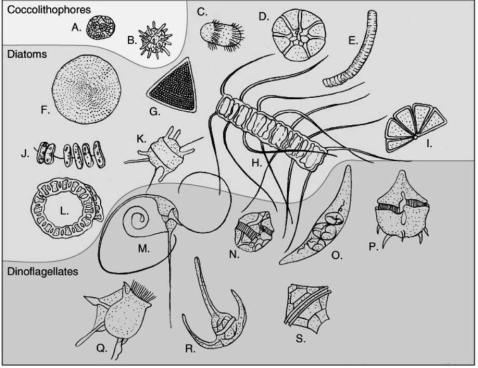
These planktonic organisms often have needle-like structures that:
A) are used as a defense mechanism.
B) are used as paddles to catch ocean currents.
C) increase density.
D) prevent sinking.
E) serve as a "skeleton" to support the diatom.
These planktonic organisms often have needle-like structures that:
A) are used as a defense mechanism.
B) are used as paddles to catch ocean currents.
C) increase density.
D) prevent sinking.
E) serve as a "skeleton" to support the diatom.
Question
Question
Question
Question
Question
Question
Question
Question
Question
Question
Question
Question
Question
With respect to their marine environment, these organisms can be referred to as:
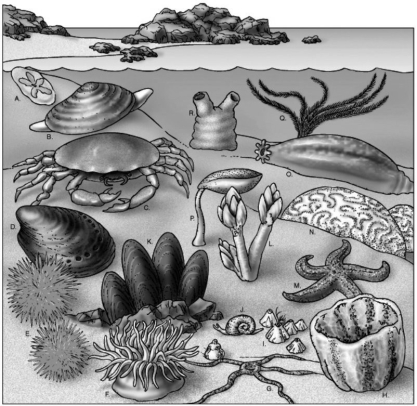
A) benthos.
B) heterotrophs.
C) nekton.
D) plankton.
E) predators.
A) benthos.
B) heterotrophs.
C) nekton.
D) plankton.
E) predators.
Question
Question
Question
Question
Question
Question
Question
Question
Question
Question
Question
Question
Question
Question
Question
Question
Question
Question
Question
Question
Question
Question
Question
Question
Question
Question
Question
Question
Question
Question
Question
Question
Question
Question
Question
Question
Question
Match between columns
Premises:
abyssopelagic
abyssopelagic
abyssopelagic
abyssopelagic
littoral
littoral
littoral
littoral
subtidal
subtidal
subtidal
subtidal
abyssal
abyssal
abyssal
abyssal
Responses:
benthic
pelagic
neritic
benthic, neritic
benthic
pelagic
neritic
benthic, neritic
benthic
pelagic
neritic
benthic, neritic
benthic
pelagic
neritic
benthic, neritic
benthic
pelagic
neritic
benthic, neritic
benthic
pelagic
neritic
benthic, neritic
benthic
pelagic
neritic
benthic, neritic
benthic
pelagic
neritic
benthic, neritic
Question
Match between columns

Unlock Deck
Sign up to unlock the cards in this deck!
Unlock Deck
Unlock Deck
1/74

Play

Full screen (f)
Deck 12: Marine Life and the Marine Environment
1
The depth of the nutrient maximum is found at the base of the mesopelagic zone.
True
2
A euryhaline organism would be poorly adapted to living in coastal environments.
False
3
Meroplankton are organisms that spend the larval phase of their life cycle associated with the ocean bottom (benthos) and the adult phase of the life cycle as plankton.
False
4
The majority of marine species are pelagic.
Unlock Deck
Unlock for access to all 74 flashcards in this deck.
Unlock Deck
k this deck
5
The depth of the oxygen minimum is found in the bathypelagic zone.
Unlock Deck
Unlock for access to all 74 flashcards in this deck.
Unlock Deck
k this deck
6
Streamlining in fish means that the minimum amount of energy is expended to swim.
Unlock Deck
Unlock for access to all 74 flashcards in this deck.
Unlock Deck
k this deck
7
One reason that polar climates support a high biomass is that cold water can hold more dissolved oxygen.
Unlock Deck
Unlock for access to all 74 flashcards in this deck.
Unlock Deck
k this deck
8
The hadal zone is associated with deep-ocean trenches.
Unlock Deck
Unlock for access to all 74 flashcards in this deck.
Unlock Deck
k this deck
9
Osmosis occurs when salt ions diffuse through a membrane with a lower ion concentration.
Unlock Deck
Unlock for access to all 74 flashcards in this deck.
Unlock Deck
k this deck
10
The deep scattering layer is produced by masses of migrating phytoplankton.
Unlock Deck
Unlock for access to all 74 flashcards in this deck.
Unlock Deck
k this deck
11
The science of classification is termed taxonomy.
Unlock Deck
Unlock for access to all 74 flashcards in this deck.
Unlock Deck
k this deck
12
The neritic province is associated with the continental shelf.
Unlock Deck
Unlock for access to all 74 flashcards in this deck.
Unlock Deck
k this deck
13
The euphotic zone is contained entirely in the epipelagic zone.
Unlock Deck
Unlock for access to all 74 flashcards in this deck.
Unlock Deck
k this deck
14
Epifauna live deep within benthic sediments.
Unlock Deck
Unlock for access to all 74 flashcards in this deck.
Unlock Deck
k this deck
15
Cold, high viscosity water benefits floating organisms.
Unlock Deck
Unlock for access to all 74 flashcards in this deck.
Unlock Deck
k this deck
16
One example of infauna are coquina clams that burrow into the beach sand as soon as they are washed ashore by the waves.
Unlock Deck
Unlock for access to all 74 flashcards in this deck.
Unlock Deck
k this deck
17
Phytoplankton are small in size as a result of predation pressure.
Unlock Deck
Unlock for access to all 74 flashcards in this deck.
Unlock Deck
k this deck
18
Stenothermal organisms are likely to be found in deep open ocean water.
Unlock Deck
Unlock for access to all 74 flashcards in this deck.
Unlock Deck
k this deck
19
Plankton which are 2.0 to 0.2 μm in size are called:
A) nanoplankton.
B) net plankton.
C) picoplankton.
D) phytoplankton.
E) zooplankton.
A) nanoplankton.
B) net plankton.
C) picoplankton.
D) phytoplankton.
E) zooplankton.
Unlock Deck
Unlock for access to all 74 flashcards in this deck.
Unlock Deck
k this deck
20
When compared to their warmer water counterparts, cold water plankton often:
A) are larger in size.
B) are smaller in size.
C) exhibit countershading.
D) have more spines and ornamentation on the cell wall.
E) reproduce asexually only.
A) are larger in size.
B) are smaller in size.
C) exhibit countershading.
D) have more spines and ornamentation on the cell wall.
E) reproduce asexually only.
Unlock Deck
Unlock for access to all 74 flashcards in this deck.
Unlock Deck
k this deck
21
All of the following are adaptive solutions employed by marine organisms to prevent sinking except:
A) building a flotation mechanism such as a gas bladder.
B) decreasing density.
C) decreasing cellular fat content.
D) increasing drag in the water.
E) increasing the surface area to volume ratio.
A) building a flotation mechanism such as a gas bladder.
B) decreasing density.
C) decreasing cellular fat content.
D) increasing drag in the water.
E) increasing the surface area to volume ratio.
Unlock Deck
Unlock for access to all 74 flashcards in this deck.
Unlock Deck
k this deck
22
Species diversity and total biomass are greater in warm water marine environments in comparison to cold water marine environments.
Unlock Deck
Unlock for access to all 74 flashcards in this deck.
Unlock Deck
k this deck
23
Refer to the figure below to answer the following question(s)..
These planktonic organisms often have needle-like structures that:
A) are used as a defense mechanism.
B) are used as paddles to catch ocean currents.
C) increase density.
D) prevent sinking.
E) serve as a "skeleton" to support the diatom.
These planktonic organisms often have needle-like structures that:
A) are used as a defense mechanism.
B) are used as paddles to catch ocean currents.
C) increase density.
D) prevent sinking.
E) serve as a "skeleton" to support the diatom.
Unlock Deck
Unlock for access to all 74 flashcards in this deck.
Unlock Deck
k this deck
24
Tropical marine organisms grow more slowly, live longer, and are smaller in general than their cold-water counterparts.
Unlock Deck
Unlock for access to all 74 flashcards in this deck.
Unlock Deck
k this deck
25
A small size is advantageous for marine organisms because it:
A) increases the ability to absorb nutrients.
B) increases the ability of wastes to diffuse out of the organism.
C) increases the surface area to volume ratio that in turn decreases density.
D) All of the above statements are advantageous to marine organisms.
E) None of the above statements are advantageous to marine organisms.
A) increases the ability to absorb nutrients.
B) increases the ability of wastes to diffuse out of the organism.
C) increases the surface area to volume ratio that in turn decreases density.
D) All of the above statements are advantageous to marine organisms.
E) None of the above statements are advantageous to marine organisms.
Unlock Deck
Unlock for access to all 74 flashcards in this deck.
Unlock Deck
k this deck
26
The portion of the ocean in which these organisms are most likely to be found is the:
A) benthic zone.
B) estuary.
C) intertidal zone.
D) pelagic zone.
E) sediment layer.
A) benthic zone.
B) estuary.
C) intertidal zone.
D) pelagic zone.
E) sediment layer.
Unlock Deck
Unlock for access to all 74 flashcards in this deck.
Unlock Deck
k this deck
27
An example of an organism that might be part of the epifauna is a(n):
A) bull kelp.
B) feather duster worm.
C) sea star.
D) shark.
E) tuna.
A) bull kelp.
B) feather duster worm.
C) sea star.
D) shark.
E) tuna.
Unlock Deck
Unlock for access to all 74 flashcards in this deck.
Unlock Deck
k this deck
28
Which of the following statements shows the correct hierarchical ordering of taxonomic levels in terms of increasing specificity?
A) class, family, genus, kingdom, order, phylum, species
B) genus, species order, family, kingdom, phylum, class
C) kingdom, phylum, class, order, family, genus, species
D) order, family, genus, species, kingdom, phylum, class
E) phylum, class, order, kingdom, family, genus, species
A) class, family, genus, kingdom, order, phylum, species
B) genus, species order, family, kingdom, phylum, class
C) kingdom, phylum, class, order, family, genus, species
D) order, family, genus, species, kingdom, phylum, class
E) phylum, class, order, kingdom, family, genus, species
Unlock Deck
Unlock for access to all 74 flashcards in this deck.
Unlock Deck
k this deck
29
The majority of marine species are associated with the pelagic environment.
Unlock Deck
Unlock for access to all 74 flashcards in this deck.
Unlock Deck
k this deck
30
Which of the following associations is incorrect?
A) Kingdom Animalia - dolphins
B) Kingdom Fungi - mushrooms
C) Kingdom Monera - bacteria in hydrothermal vents
D) Kingdom Plantae - macroalgae
E) Kingdom Protista - phytoplankton
A) Kingdom Animalia - dolphins
B) Kingdom Fungi - mushrooms
C) Kingdom Monera - bacteria in hydrothermal vents
D) Kingdom Plantae - macroalgae
E) Kingdom Protista - phytoplankton
Unlock Deck
Unlock for access to all 74 flashcards in this deck.
Unlock Deck
k this deck
31
High latitude ocean water tends to support large planktonic communities because:
A) fewer predators that feed on plankton.
B) longer summer day length.
C) of higher dissolved gas concentrations.
D) there is abundant light.
E) there are abundant nutrients.
A) fewer predators that feed on plankton.
B) longer summer day length.
C) of higher dissolved gas concentrations.
D) there is abundant light.
E) there are abundant nutrients.
Unlock Deck
Unlock for access to all 74 flashcards in this deck.
Unlock Deck
k this deck
32
Which of the following word pairs correctly link a descriptor with the way in which the organism lives in the ocean?
A) benthos - drift
B) benthos - swim
C) nekton - bottom-dwelling
D) nekton - swim
E) plankton - bottom-dwelling
A) benthos - drift
B) benthos - swim
C) nekton - bottom-dwelling
D) nekton - swim
E) plankton - bottom-dwelling
Unlock Deck
Unlock for access to all 74 flashcards in this deck.
Unlock Deck
k this deck
33
Nekton are restricted to particular ocean areas by:
A) availability of food.
B) differences in water pressure with depth.
C) changes in salinity.
D) temperature variations with latitude and depth.
E) All of the above conditions may restrict the distribution of nekton.
A) availability of food.
B) differences in water pressure with depth.
C) changes in salinity.
D) temperature variations with latitude and depth.
E) All of the above conditions may restrict the distribution of nekton.
Unlock Deck
Unlock for access to all 74 flashcards in this deck.
Unlock Deck
k this deck
34
Planktonic organisms that spend part of their life in planktonic form, and the rest of their life as either benthos or nekton are called:
A) bacterioplankton.
B) holoplankton.
C) macroplankton.
D) meroplankton.
E) zooplankton.
A) bacterioplankton.
B) holoplankton.
C) macroplankton.
D) meroplankton.
E) zooplankton.
Unlock Deck
Unlock for access to all 74 flashcards in this deck.
Unlock Deck
k this deck
35
Euryhaline organisms:
A) are less common than stenohaline organisms.
B) can survive wide salinity fluctuations.
C) require less oxygen for survival.
D) tolerate a narrow range of salinities.
E) tolerate small temperature changes.
A) are less common than stenohaline organisms.
B) can survive wide salinity fluctuations.
C) require less oxygen for survival.
D) tolerate a narrow range of salinities.
E) tolerate small temperature changes.
Unlock Deck
Unlock for access to all 74 flashcards in this deck.
Unlock Deck
k this deck
36
With respect to their marine environment, these organisms can be referred to as:
A) benthos.
B) heterotrophs.
C) nekton.
D) plankton.
E) predators.
A) benthos.
B) heterotrophs.
C) nekton.
D) plankton.
E) predators.
Unlock Deck
Unlock for access to all 74 flashcards in this deck.
Unlock Deck
k this deck
37
Multicellular organisms that are comprised of eukaryotic, heterotrophic cells with cell walls would most likely belong to the kingdom:
A) Animalia.
B) Fungi.
C) Monera.
D) Plantae.
E) Protista.
A) Animalia.
B) Fungi.
C) Monera.
D) Plantae.
E) Protista.
Unlock Deck
Unlock for access to all 74 flashcards in this deck.
Unlock Deck
k this deck
38
Which of the following statements concerning bacteria is not true?
A) Bacteria can be found living in extreme environments (heat, salinity, cold, etc.).
B) Bacteria have a cell membrane and a cell wall.
C) Bacteria lack membrane-bound organelles and a distinct nucleus surrounded by a nuclear membrane.
D) Bacteria reproduce asexually only.
E) Bacteria were the first type of cells to evolve on earth.
A) Bacteria can be found living in extreme environments (heat, salinity, cold, etc.).
B) Bacteria have a cell membrane and a cell wall.
C) Bacteria lack membrane-bound organelles and a distinct nucleus surrounded by a nuclear membrane.
D) Bacteria reproduce asexually only.
E) Bacteria were the first type of cells to evolve on earth.
Unlock Deck
Unlock for access to all 74 flashcards in this deck.
Unlock Deck
k this deck
39
The photic zone is confined to the:
A) abyssopelagic zone.
B) bathypelagic zone.
C) epipelagic zone.
D) mesopelagic zone.
E) neritic province.
A) abyssopelagic zone.
B) bathypelagic zone.
C) epipelagic zone.
D) mesopelagic zone.
E) neritic province.
Unlock Deck
Unlock for access to all 74 flashcards in this deck.
Unlock Deck
k this deck
40
The color pattern in which marine organisms are light on the bottom and dark on the top of their bodies camouflaging them against the water-air interface is:
A) countershading.
B) cryptic coloration.
C) defensive coloration.
D) disruptive coloration.
E) warning coloration.
A) countershading.
B) cryptic coloration.
C) defensive coloration.
D) disruptive coloration.
E) warning coloration.
Unlock Deck
Unlock for access to all 74 flashcards in this deck.
Unlock Deck
k this deck
41
The majority of marine invertebrates are:
A) adapted to life in the pelagic zone.
B) estuarine.
C) found only in benthic environments.
D) hypertonic with respect to their environment.
E) isotonic with respect to their environment.
A) adapted to life in the pelagic zone.
B) estuarine.
C) found only in benthic environments.
D) hypertonic with respect to their environment.
E) isotonic with respect to their environment.
Unlock Deck
Unlock for access to all 74 flashcards in this deck.
Unlock Deck
k this deck
42
When an organism has the same salt and water concentration as its environment, it is said to be:
A) euryhaline.
B) hypertonic.
C) hypotonic.
D) isotonic.
E) stenohaline.
A) euryhaline.
B) hypertonic.
C) hypotonic.
D) isotonic.
E) stenohaline.
Unlock Deck
Unlock for access to all 74 flashcards in this deck.
Unlock Deck
k this deck
43
Most marine species are found in a(n):
A) bathypelagic environment.
B) benthic environment.
C) mesopelagic environment.
D) oceanic environment.
E) pelagic environment.
A) bathypelagic environment.
B) benthic environment.
C) mesopelagic environment.
D) oceanic environment.
E) pelagic environment.
Unlock Deck
Unlock for access to all 74 flashcards in this deck.
Unlock Deck
k this deck
44
Neritic marine environments would be found:
A) associated with continental shelves.
B) at mid-ocean ridges.
C) deep in the ocean basin.
D) in subduction zones.
E) within a deep-sea trench.
A) associated with continental shelves.
B) at mid-ocean ridges.
C) deep in the ocean basin.
D) in subduction zones.
E) within a deep-sea trench.
Unlock Deck
Unlock for access to all 74 flashcards in this deck.
Unlock Deck
k this deck
45
The movement of a substance in solution from an area of higher concentration to an area of lower concentration across a selectively permeable membrane is:
A) active transport.
B) Brownian movement.
C) diffusion.
D) osmosis.
E) passive transport.
A) active transport.
B) Brownian movement.
C) diffusion.
D) osmosis.
E) passive transport.
Unlock Deck
Unlock for access to all 74 flashcards in this deck.
Unlock Deck
k this deck
46
Organisms with small, expandable bodies, extremely large mouths, and efficient teeth are likely to be found in the:
A) bathypelagic zone.
B) epipelagic zone.
C) mesopelagic zone.
D) neritic province.
E) photic zone.
A) bathypelagic zone.
B) epipelagic zone.
C) mesopelagic zone.
D) neritic province.
E) photic zone.
Unlock Deck
Unlock for access to all 74 flashcards in this deck.
Unlock Deck
k this deck
47
Organisms of the mesopelagic zone are characterized by:
A) bioluminescence.
B) large, sensitive eyes.
C) no eyes.
D) A and B are correct.
E) A and C are correct.
A) bioluminescence.
B) large, sensitive eyes.
C) no eyes.
D) A and B are correct.
E) A and C are correct.
Unlock Deck
Unlock for access to all 74 flashcards in this deck.
Unlock Deck
k this deck
48
Compared to freshwater fishes, marine fishes:
A) drink seawater and produce a large volume of urine.
B) do not drink seawater in an effort to conserve as much water as possible.
C) produce a large volume of dilute urine in an effort to rid their bodies of excess water.
D) tend to gain water by osmosis since their internal salt concentration is higher than that of seawater.
E) tend to lose water by osmosis since their internal salt concentration is lower than that of seawater.
A) drink seawater and produce a large volume of urine.
B) do not drink seawater in an effort to conserve as much water as possible.
C) produce a large volume of dilute urine in an effort to rid their bodies of excess water.
D) tend to gain water by osmosis since their internal salt concentration is higher than that of seawater.
E) tend to lose water by osmosis since their internal salt concentration is lower than that of seawater.
Unlock Deck
Unlock for access to all 74 flashcards in this deck.
Unlock Deck
k this deck
49
Osmotic pressure increases as the:
A) difference in salinity decreases.
B) difference in salinity increases.
C) difference in temperature increases.
D) salinity increases.
E) temperature increases.
A) difference in salinity decreases.
B) difference in salinity increases.
C) difference in temperature increases.
D) salinity increases.
E) temperature increases.
Unlock Deck
Unlock for access to all 74 flashcards in this deck.
Unlock Deck
k this deck
50
Neritic environments are influenced by:
A) seasonal salinity variations.
B) seasonal temperature fluctuations.
C) tidal movements.
D) wave energy.
E) All of the above factors influence neritic environments.
A) seasonal salinity variations.
B) seasonal temperature fluctuations.
C) tidal movements.
D) wave energy.
E) All of the above factors influence neritic environments.
Unlock Deck
Unlock for access to all 74 flashcards in this deck.
Unlock Deck
k this deck
51
Coastal waters that are highly productive tend to be:
A) brown in color.
B) colorless.
C) deep blue in color.
D) green in color.
E) light blue in color.
A) brown in color.
B) colorless.
C) deep blue in color.
D) green in color.
E) light blue in color.
Unlock Deck
Unlock for access to all 74 flashcards in this deck.
Unlock Deck
k this deck
52
A common body shape that streamlines an organism in the marine environment is a flattened body that:
A) has a wide, blunt end.
B) tapers at the anterior end.
C) tapers at the dorsal surface.
D) tapers at the posterior end.
E) tapers at the ventral surface.
A) has a wide, blunt end.
B) tapers at the anterior end.
C) tapers at the dorsal surface.
D) tapers at the posterior end.
E) tapers at the ventral surface.
Unlock Deck
Unlock for access to all 74 flashcards in this deck.
Unlock Deck
k this deck
53
The sublittoral (subtidal) zone is the area:
A) above the highest tide.
B) below the intertidal zone on the continental shelf.
C) between the highest high tide and the lowest low tide.
D) beyond the continental shelf.
E) where demersal and pelagic organisms are found.
A) above the highest tide.
B) below the intertidal zone on the continental shelf.
C) between the highest high tide and the lowest low tide.
D) beyond the continental shelf.
E) where demersal and pelagic organisms are found.
Unlock Deck
Unlock for access to all 74 flashcards in this deck.
Unlock Deck
k this deck
54
The seasonal temperature range in the deep ocean is usually:
A) between -2°and 32°C.
B) between 0° and 15°C.
C) between 2° and 8°C.
D) between 8° and 25°C.
E) negligible.
A) between -2°and 32°C.
B) between 0° and 15°C.
C) between 2° and 8°C.
D) between 8° and 25°C.
E) negligible.
Unlock Deck
Unlock for access to all 74 flashcards in this deck.
Unlock Deck
k this deck
55
Zonation of benthic organisms includes all of the following except the:
A) abyssal zone.
B) bathyl zone.
C) hadal zone.
D) neritic zone.
E) subtidal zone.
A) abyssal zone.
B) bathyl zone.
C) hadal zone.
D) neritic zone.
E) subtidal zone.
Unlock Deck
Unlock for access to all 74 flashcards in this deck.
Unlock Deck
k this deck
56
Which marine environment exhibits the greatest species diversity?
A) bathypelagic zone
B) epipelagic zone
C) hadal zone
D) littoral zone
E) neritic province
A) bathypelagic zone
B) epipelagic zone
C) hadal zone
D) littoral zone
E) neritic province
Unlock Deck
Unlock for access to all 74 flashcards in this deck.
Unlock Deck
k this deck
57
Organisms that cannot withstand large changes in temperature are referred to as:
A) eurythermal.
B) euryhaline.
C) estuarine.
D) isothermal.
E) stenothermal.
A) eurythermal.
B) euryhaline.
C) estuarine.
D) isothermal.
E) stenothermal.
Unlock Deck
Unlock for access to all 74 flashcards in this deck.
Unlock Deck
k this deck
58
An organism that tolerates a wide range of salinities is referred to as:
A) euryhaline.
B) hypertonic.
C) hypotonic.
D) isotonic.
E) stenohaline.
A) euryhaline.
B) hypertonic.
C) hypotonic.
D) isotonic.
E) stenohaline.
Unlock Deck
Unlock for access to all 74 flashcards in this deck.
Unlock Deck
k this deck
59
Explain why the majority of marine organisms are benthic.
Unlock Deck
Unlock for access to all 74 flashcards in this deck.
Unlock Deck
k this deck
60
Discuss osmotic balance in freshwater and saltwater fishes.
Unlock Deck
Unlock for access to all 74 flashcards in this deck.
Unlock Deck
k this deck
61
Compare and contrast warm and cold water marine species in terms of life span, body size, and relative abundance.
Unlock Deck
Unlock for access to all 74 flashcards in this deck.
Unlock Deck
k this deck
62
Examine the five words and/or phrases and determine the relationship among the majority of words/phrases. Choose the one option that does not fit the pattern.
A)Animalia
B)Archae
C)Fungi
D Plantae
E)Protoctista
A)Animalia
B)Archae
C)Fungi
D Plantae
E)Protoctista
Unlock Deck
Unlock for access to all 74 flashcards in this deck.
Unlock Deck
k this deck
63
Distinguish between plankton, nekton, and benthos and give an example of each.
Unlock Deck
Unlock for access to all 74 flashcards in this deck.
Unlock Deck
k this deck
64
Define the terms hypotonic, hypertonic, and isotonic and discuss their relationship to osmotic pressure.
Unlock Deck
Unlock for access to all 74 flashcards in this deck.
Unlock Deck
k this deck
65
Discuss the modern taxonomic classification of living organisms and include in your answer the distinction between a Domain and a Kingdom.
Unlock Deck
Unlock for access to all 74 flashcards in this deck.
Unlock Deck
k this deck
66
Discuss why marine phytoplankton are generally smaller and more ornate than their freshwater counterparts.
Unlock Deck
Unlock for access to all 74 flashcards in this deck.
Unlock Deck
k this deck
67
Examine the five words and/or phrases and determine the relationship among the majority of words/phrases. Choose the one option that does not fit the pattern.
A)littoral
B)sublittoral
C)subneritic
D)suboceanic
E)supralittoral
A)littoral
B)sublittoral
C)subneritic
D)suboceanic
E)supralittoral
Unlock Deck
Unlock for access to all 74 flashcards in this deck.
Unlock Deck
k this deck
68
Examine the five words and/or phrases and determine the relationship among the majority of words/phrases. Choose the one option that does not fit the pattern.
A)holoplankton
B)macroplankton
C)meroplankton
D)nektoplankton
E)picoplankton
A)holoplankton
B)macroplankton
C)meroplankton
D)nektoplankton
E)picoplankton
Unlock Deck
Unlock for access to all 74 flashcards in this deck.
Unlock Deck
k this deck
69
Draw and label a cross-section of the marine environment and include the following biozones: the neritic province (supralittoral, littoral, sublittoral, bathyal, abyssal, and hadal zones) and the oceanic province (epipelagic, mesopelagic, bathypelagic, and abyssopelagic zones).
Unlock Deck
Unlock for access to all 74 flashcards in this deck.
Unlock Deck
k this deck
70
Compare and contrast the ways marine organisms are classified including: by mode of nutrition, location in the marine environment where they live, and size.
Unlock Deck
Unlock for access to all 74 flashcards in this deck.
Unlock Deck
k this deck
71
Examine the five words and/or phrases and determine the relationship among the majority of words/phrases. Choose the one option that does not fit the pattern.
A)abyssopelagic
B)bathypelagic
C)benthopelagic
D)epipelagic
E)mesopelagic
A)abyssopelagic
B)bathypelagic
C)benthopelagic
D)epipelagic
E)mesopelagic
Unlock Deck
Unlock for access to all 74 flashcards in this deck.
Unlock Deck
k this deck
72
Examine the five words and/or phrases and determine the relationship among the majority of words/phrases. Choose the one option that does not fit the pattern.
A)kelp
B)krill
C)jellyfish
D)Sargassum
E)zooplankton
A)kelp
B)krill
C)jellyfish
D)Sargassum
E)zooplankton
Unlock Deck
Unlock for access to all 74 flashcards in this deck.
Unlock Deck
k this deck
73
Match between columns
Premises:
abyssopelagic
abyssopelagic
abyssopelagic
abyssopelagic
littoral
littoral
littoral
littoral
subtidal
subtidal
subtidal
subtidal
abyssal
abyssal
abyssal
abyssal
Responses:
benthic
pelagic
neritic
benthic, neritic
benthic
pelagic
neritic
benthic, neritic
benthic
pelagic
neritic
benthic, neritic
benthic
pelagic
neritic
benthic, neritic
benthic
pelagic
neritic
benthic, neritic
benthic
pelagic
neritic
benthic, neritic
benthic
pelagic
neritic
benthic, neritic
benthic
pelagic
neritic
benthic, neritic
Unlock Deck
Unlock for access to all 74 flashcards in this deck.
Unlock Deck
k this deck
74
Match between columns
Unlock Deck
Unlock for access to all 74 flashcards in this deck.
Unlock Deck
k this deck
Unlock Deck
Unlock for access to all 74 flashcards in this deck.






