







 Chat with AI

Deck 6: Production Costs
Full screen (f)

Question

Question
Question
Question
Question
Question
Question
Question
Question
Question
Question
Question
Question
Question
Question
Question
Question
Question
Question
Question
Question
Question
Question
Question
Question
Question
Question
Question
Question
Question
Question
Question
Question
Question
Question
Question
Question
Question
Question
Question
Question
Question
Question
Question
Question
Question
Question
Question
Question
Question
Question
Question
Question
Question
Question
Question
Question
Question
Question
Question
Question
Exhibit 6-2 Cost schedule for pizza production
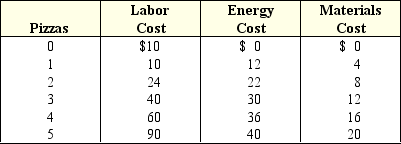
Exhibit 6-2 shows the labor,energy,and materials cost of making various quantities of pizzas.The table shows that the labor cost of making pizzas will:
A) increase at a decreasing rate.
B) decrease at a decreasing rate.
C) decrease at an increasing rate.
D) increase at an increasing rate.
E) increase at a constant rate.
Exhibit 6-2 shows the labor,energy,and materials cost of making various quantities of pizzas.The table shows that the labor cost of making pizzas will:
A) increase at a decreasing rate.
B) decrease at a decreasing rate.
C) decrease at an increasing rate.
D) increase at an increasing rate.
E) increase at a constant rate.
Question
Question
Exhibit 6-2 Cost schedule for pizza production
Exhibit 6-2 shows the labor,energy,and materials cost of making various quantities of pizzas.The table shows that the energy cost of making pizzas will:
A) increase at a decreasing rate.
B) decrease at a decreasing rate.
C) decrease at an increasing rate.
D) increase at an increasing rate.
E) increase at a constant rate.
Exhibit 6-2 shows the labor,energy,and materials cost of making various quantities of pizzas.The table shows that the energy cost of making pizzas will:
A) increase at a decreasing rate.
B) decrease at a decreasing rate.
C) decrease at an increasing rate.
D) increase at an increasing rate.
E) increase at a constant rate.
Question
Question
Question
Question
Exhibit 6-1 Production of pizza data
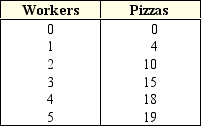
Exhibit 6-1 shows the change in the production of pizzas as more workers are hired.The marginal product of the second employee equals:
A) 4.
B) 10.
C) 14.
D) 6.
E) 15.
Exhibit 6-1 shows the change in the production of pizzas as more workers are hired.The marginal product of the second employee equals:
A) 4.
B) 10.
C) 14.
D) 6.
E) 15.
Question
Question
Question
Question
Exhibit 6-1 Production of pizza data
Exhibit 6-1 shows the change in the short run production of pizzas as more workers are hired.The table shows marginal product increasing between the 0 to 2 hired workers.A possible reason for this increased marginal product is:
A) increased wages.
B) increases in plant size.
C) decreases in fixed cost.
D) increased division of labor as additional workers are hired.
E) increased product price.
Exhibit 6-1 shows the change in the short run production of pizzas as more workers are hired.The table shows marginal product increasing between the 0 to 2 hired workers.A possible reason for this increased marginal product is:
A) increased wages.
B) increases in plant size.
C) decreases in fixed cost.
D) increased division of labor as additional workers are hired.
E) increased product price.
Question
Question
Question
Question
Exhibit 6-1 Production of pizza data
Exhibit 6-1 shows the change in the production of pizzas as more workers are hired.The marginal product of the fifth employee equals:
A) 4.
B) 18.
C) 19.
D) 3.
E) 1.
Exhibit 6-1 shows the change in the production of pizzas as more workers are hired.The marginal product of the fifth employee equals:
A) 4.
B) 18.
C) 19.
D) 3.
E) 1.
Question
Exhibit 6-2 Cost schedule for pizza production
Exhibit 6-2 shows the labor,energy,and materials cost of making various quantities of pizzas.The table shows that the materials cost of making pizzas will:
A) increase at a decreasing rate.
B) decrease at a decreasing rate.
C) decrease at an increasing rate.
D) increase at an increasing rate.
E) increase at a constant rate.
Exhibit 6-2 shows the labor,energy,and materials cost of making various quantities of pizzas.The table shows that the materials cost of making pizzas will:
A) increase at a decreasing rate.
B) decrease at a decreasing rate.
C) decrease at an increasing rate.
D) increase at an increasing rate.
E) increase at a constant rate.
Question
Exhibit 6-1 Production of pizza data
Exhibit 6-1 shows the change in the production of pizzas as more workers are hired.The total output of pizzas after hiring 4 workers is:
A) 4.
B) 15.
C) 18.
D) 3.
E) 1.
Exhibit 6-1 shows the change in the production of pizzas as more workers are hired.The total output of pizzas after hiring 4 workers is:
A) 4.
B) 15.
C) 18.
D) 3.
E) 1.
Question
Question
Exhibit 6-1 Production of pizza data
Exhibit 6-1 shows the change in the short-run production of pizzas as more workers are hired.The table shows the marginal product of the labor input is decreasing with the hiring of the third worker.A possible reason for this diminishing marginal product is:
A) decreased wages.
B) increases in plant size.
C) decreases in fixed cost.
D) increased division of labor as additional workers are hired.
E) decreases in labor productivity.
Exhibit 6-1 shows the change in the short-run production of pizzas as more workers are hired.The table shows the marginal product of the labor input is decreasing with the hiring of the third worker.A possible reason for this diminishing marginal product is:
A) decreased wages.
B) increases in plant size.
C) decreases in fixed cost.
D) increased division of labor as additional workers are hired.
E) decreases in labor productivity.
Question
Exhibit 6-1 Production of pizza data
Exhibit 6-1 shows the change in the production of pizzas as more workers are hired.The marginal product of the labor input begins to fall with the employment of the ____ worker.
A) first
B) second
C) third
D) fourth
E) fifth
Exhibit 6-1 shows the change in the production of pizzas as more workers are hired.The marginal product of the labor input begins to fall with the employment of the ____ worker.
A) first
B) second
C) third
D) fourth
E) fifth

Unlock Deck
Sign up to unlock the cards in this deck!
Unlock Deck
Unlock Deck
1/249

Play

Full screen (f)
Deck 6: Production Costs
1
Unlike implicit costs,explicit costs:
A) reflect opportunity costs.
B) include the value of the owner's time.
C) are not included in the accounting statement of the firm.
D) are actual cash payments.
E) do not change with the output rate of the firm.
A) reflect opportunity costs.
B) include the value of the owner's time.
C) are not included in the accounting statement of the firm.
D) are actual cash payments.
E) do not change with the output rate of the firm.
D
2
Which of the following is not an explicit cost?
A) Salaries.
B) Sales taxes.
C) Utilities, such as gas and electricity.
D) Insurance.
E) The firm owner's time.
A) Salaries.
B) Sales taxes.
C) Utilities, such as gas and electricity.
D) Insurance.
E) The firm owner's time.
E
3
Explicit costs would include
A) rent.
B) the interest loss of the business owner on money withdrawn from his/her saving account and invested in the business.
C) the loss of rent on a building the business owner owns and uses in his/her business.
D) the opportunity costs of the business owner's time.
E) the use of tools owned by the business owner and dedicated to the business.
A) rent.
B) the interest loss of the business owner on money withdrawn from his/her saving account and invested in the business.
C) the loss of rent on a building the business owner owns and uses in his/her business.
D) the opportunity costs of the business owner's time.
E) the use of tools owned by the business owner and dedicated to the business.
A
4
Payments to nonowners of a firm are called:
A) implicit costs.
B) accounting costs.
C) explicit costs.
D) economic costs.
A) implicit costs.
B) accounting costs.
C) explicit costs.
D) economic costs.
Unlock Deck
Unlock for access to all 249 flashcards in this deck.
Unlock Deck
k this deck
5
Sam quits his job as an airline pilot and opens his own pilot training school.He was earning $40,000 as a pilot.He withdraws $10,000 from his savings where he was earning 6 percent interest and uses the money in his new business.He uses a building he owns as a hanger and could rent it out for $5,000 per year.He rents a computer for $1,200,buys office supplies for $500,rents an airplane for $6,000,pays $1,300 for fuel and maintenance,and hires one worker for $30,000.Sam's total revenue from pilot training classes this year equaled $90,400.Sam's explicit costs this year equals:
A) $84,400.
B) $39,000.
C) $55,000.
D) $45,600.
E) $40,000.
A) $84,400.
B) $39,000.
C) $55,000.
D) $45,600.
E) $40,000.
Unlock Deck
Unlock for access to all 249 flashcards in this deck.
Unlock Deck
k this deck
6
Paul's Plumbing is a small business that employs 12 people.Which of the following is the best example of an implicit cost incurred by this firm?
A) The tax payments on property owned by the firm.
B) The wages paid to the 12 employees.
C) The half of the payroll taxes on the wages of the 12 employees paid by the employers, but not the half paid by the employees.
D) The accounting services provided free of charge to the firm by Paul's wife, who is an accountant.
A) The tax payments on property owned by the firm.
B) The wages paid to the 12 employees.
C) The half of the payroll taxes on the wages of the 12 employees paid by the employers, but not the half paid by the employees.
D) The accounting services provided free of charge to the firm by Paul's wife, who is an accountant.
Unlock Deck
Unlock for access to all 249 flashcards in this deck.
Unlock Deck
k this deck
7
The amount of money that could have been made by renting a piece of land to be used for building an office building instead of using the land for employee parking is a(n):
A) implicit cost.
B) accounting cost.
C) explicit cost.
D) pure economic cost.
A) implicit cost.
B) accounting cost.
C) explicit cost.
D) pure economic cost.
Unlock Deck
Unlock for access to all 249 flashcards in this deck.
Unlock Deck
k this deck
8
Which of the following are implicit costs for a typical firm?
A) Insurance costs.
B) Electricity costs.
C) Opportunity costs of capital owned and used by the firm.
D) Cost of labor hired by the firm.
E) The cost of raw materials.
A) Insurance costs.
B) Electricity costs.
C) Opportunity costs of capital owned and used by the firm.
D) Cost of labor hired by the firm.
E) The cost of raw materials.
Unlock Deck
Unlock for access to all 249 flashcards in this deck.
Unlock Deck
k this deck
9
The opportunity costs associated with the use of resources owned by a firm are:
A) externalities.
B) implicit costs.
C) explicit costs.
D) sunk costs.
A) externalities.
B) implicit costs.
C) explicit costs.
D) sunk costs.
Unlock Deck
Unlock for access to all 249 flashcards in this deck.
Unlock Deck
k this deck
10
Which of the following is an explicit cost?
A) The opportunity cost of an owner/entrepreneur's time invested in the firm.
B) The opportunity cost of the money the business owner/entrepreneur has invested in the firm.
C) The wages paid to workers.
D) None of the above.
A) The opportunity cost of an owner/entrepreneur's time invested in the firm.
B) The opportunity cost of the money the business owner/entrepreneur has invested in the firm.
C) The wages paid to workers.
D) None of the above.
Unlock Deck
Unlock for access to all 249 flashcards in this deck.
Unlock Deck
k this deck
11
Implicit costs are:
A) the opportunity costs of using resources owned by the entrepreneur in his/her own business.
B) payments the business owner must make on borrowed funds.
C) costs which vary as the level of output varies.
D) those payments the business owner makes in cash.
E) the payments the business owner makes for public relations, such as donations to charity.
A) the opportunity costs of using resources owned by the entrepreneur in his/her own business.
B) payments the business owner must make on borrowed funds.
C) costs which vary as the level of output varies.
D) those payments the business owner makes in cash.
E) the payments the business owner makes for public relations, such as donations to charity.
Unlock Deck
Unlock for access to all 249 flashcards in this deck.
Unlock Deck
k this deck
12
Sam quits his job as an airline pilot and opens his own pilot training school.He was earning $40,000 as a pilot.He withdraws $10,000 from his savings where he was earning 6 percent interest and uses the money in his new business.He uses a building he owns as a hanger and could rent it out for $5,000 per year.He rents a computer for $1,200,buys office supplies for $500,rents an airplane for $6,000,pays $1,300 for fuel and maintenance,and hires one worker for $30,000.Sam's total revenue from pilot training classes equaled $90,400.Sam's implicit costs for this year are equal to:
A) $84,400.
B) $39,000.
C) $55,000.
D) $45,600.
E) $40,000.
A) $84,400.
B) $39,000.
C) $55,000.
D) $45,600.
E) $40,000.
Unlock Deck
Unlock for access to all 249 flashcards in this deck.
Unlock Deck
k this deck
13
A young chef is considering opening his own sushi bar.To do so,he would have to quit his current job,which pays $20,000 a year,and take over a store building that he owns and currently rents to his brother for $6,000 a year.His expenses at the sushi bar would be $50,000 for food and $2,000 for gas and electricity.What are his explicit costs?
A) $26,000.
B) $66,000.
C) $78,000.
D) $52,000.
E) $72,000.
A) $26,000.
B) $66,000.
C) $78,000.
D) $52,000.
E) $72,000.
Unlock Deck
Unlock for access to all 249 flashcards in this deck.
Unlock Deck
k this deck
14
A firm's opportunity cost of using resources provided by the firm's owners is called:
A) sunk costs.
B) fixed costs.
C) explicit costs.
D) implicit costs.
E) entrepreneurial costs.
A) sunk costs.
B) fixed costs.
C) explicit costs.
D) implicit costs.
E) entrepreneurial costs.
Unlock Deck
Unlock for access to all 249 flashcards in this deck.
Unlock Deck
k this deck
15
A young chef is considering opening his own sushi bar.To do so,he would have to quit his current job,which pays $20,000 a year,and take over a store building that he owns and currently rents to his brother for $6,000 a year.His expenses at the sushi bar would be $50,000,for food and $2,000 for gas and electricity.What are his implicit costs?
A) $26,000.
B) $66,000.
C) $78,000.
D) $52,000.
E) $72,000.
A) $26,000.
B) $66,000.
C) $78,000.
D) $52,000.
E) $72,000.
Unlock Deck
Unlock for access to all 249 flashcards in this deck.
Unlock Deck
k this deck
16
Which of the following is an implicit cost of going to college?
A) Tuition.
B) Books.
C) Lost income.
D) Future income.
E) Room and board.
A) Tuition.
B) Books.
C) Lost income.
D) Future income.
E) Room and board.
Unlock Deck
Unlock for access to all 249 flashcards in this deck.
Unlock Deck
k this deck
17
Implicit costs are best thought of as:
A) variable costs.
B) marginal costs.
C) accounting costs.
D) opportunity costs.
E) sunk costs.
A) variable costs.
B) marginal costs.
C) accounting costs.
D) opportunity costs.
E) sunk costs.
Unlock Deck
Unlock for access to all 249 flashcards in this deck.
Unlock Deck
k this deck
18
Cash payments to a steel mill for steel used in production would be an example of:
A) sunk costs.
B) fixed costs.
C) explicit costs.
D) implicit costs.
E) entrepreneurial costs.
A) sunk costs.
B) fixed costs.
C) explicit costs.
D) implicit costs.
E) entrepreneurial costs.
Unlock Deck
Unlock for access to all 249 flashcards in this deck.
Unlock Deck
k this deck
19
Two friends,Diane and Sam,own and run a bar.Diane tends bar on Monday,Wednesday,and Friday and receives a wage in addition to tips.Sam tends bar on Tuesday,Thursday,and Saturday and receives only tips.Which of the following represents an implicit cost of operating the bar?
A) Diane's wage.
B) Sam's time.
C) Diane's tips.
D) Sam's tips.
E) Both Diane's and Sam's tips.
A) Diane's wage.
B) Sam's time.
C) Diane's tips.
D) Sam's tips.
E) Both Diane's and Sam's tips.
Unlock Deck
Unlock for access to all 249 flashcards in this deck.
Unlock Deck
k this deck
20
Which of the following would be considered an implicit cost?
A) Health insurance of employees paid for by the firm
B) The water bill of the firm
C) The salaries paid to the managers of the firm
D) Foregone rent on assets owned by the firm
A) Health insurance of employees paid for by the firm
B) The water bill of the firm
C) The salaries paid to the managers of the firm
D) Foregone rent on assets owned by the firm
Unlock Deck
Unlock for access to all 249 flashcards in this deck.
Unlock Deck
k this deck
21
An economist left her $100,000-a-year teaching position to work full-time in her own consulting business.In the first year,she had total revenue of $200,000 and business expenses of $100,000.She made a(n):
A) economic profit.
B) economic loss.
C) implicit profit.
D) accounting loss but not an economic loss.
E) zero economic profit.
A) economic profit.
B) economic loss.
C) implicit profit.
D) accounting loss but not an economic loss.
E) zero economic profit.
Unlock Deck
Unlock for access to all 249 flashcards in this deck.
Unlock Deck
k this deck
22
Economists say that a firm has a normal profit when:
A) it earns a return of at least 10 percent.
B) its accounting profit is positive.
C) it can pay all its variable costs.
D) its economic profit is zero.
A) it earns a return of at least 10 percent.
B) its accounting profit is positive.
C) it can pay all its variable costs.
D) its economic profit is zero.
Unlock Deck
Unlock for access to all 249 flashcards in this deck.
Unlock Deck
k this deck
23
Economic profit equals accounting profit minus:
A) explicit costs.
B) implicit costs.
C) fixed costs.
D) variable costs.
A) explicit costs.
B) implicit costs.
C) fixed costs.
D) variable costs.
Unlock Deck
Unlock for access to all 249 flashcards in this deck.
Unlock Deck
k this deck
24
The difference between a firm's total revenues and total costs when all explicit and implicit costs are included is the firm's:
A) economic profit.
B) accounting profit.
C) opportunity cost of capital.
D) long-run average total cost.
A) economic profit.
B) accounting profit.
C) opportunity cost of capital.
D) long-run average total cost.
Unlock Deck
Unlock for access to all 249 flashcards in this deck.
Unlock Deck
k this deck
25
The sum of the explicit and implicit costs incurred in the production process is called
A) fixed cost.
B) sunk cost.
C) marginal cost.
D) total cost.
A) fixed cost.
B) sunk cost.
C) marginal cost.
D) total cost.
Unlock Deck
Unlock for access to all 249 flashcards in this deck.
Unlock Deck
k this deck
26
Economic profit is:
A) always less than zero.
B) never less than accounting profit.
C) less than accounting profit if implicit costs are zero.
D) less than accounting profit if implicit costs are greater than zero.
A) always less than zero.
B) never less than accounting profit.
C) less than accounting profit if implicit costs are zero.
D) less than accounting profit if implicit costs are greater than zero.
Unlock Deck
Unlock for access to all 249 flashcards in this deck.
Unlock Deck
k this deck
27
When total revenue minus total cost is equal to zero,the firm is:
A) earning above-average economic profit.
B) earning a normal profit.
C) losing too much money to stay in business.
D) earning abnormally low profits.
A) earning above-average economic profit.
B) earning a normal profit.
C) losing too much money to stay in business.
D) earning abnormally low profits.
Unlock Deck
Unlock for access to all 249 flashcards in this deck.
Unlock Deck
k this deck
28
An economist left his $100,000-a-year teaching position to work full-time in his own consulting business.In the first year,he had total revenue of $200,000 and business expenses of $150,000.She made a(n):
A) implicit profit.
B) economic loss.
C) economic profit.
D) accounting loss but not an economic loss.
E) zero economic profit.
A) implicit profit.
B) economic loss.
C) economic profit.
D) accounting loss but not an economic loss.
E) zero economic profit.
Unlock Deck
Unlock for access to all 249 flashcards in this deck.
Unlock Deck
k this deck
29
Normal profit is defined as a(n):
A) foregone percent rate of return.
B) opportunity profit.
C) implicit profit.
D) minimum necessary to keep a firm in operation.
A) foregone percent rate of return.
B) opportunity profit.
C) implicit profit.
D) minimum necessary to keep a firm in operation.
Unlock Deck
Unlock for access to all 249 flashcards in this deck.
Unlock Deck
k this deck
30
If a firm has total revenue of $200 million,explicit costs of $190 million,and implicit costs of $30 million,its economic profit is:
A) $200 million.
B) $70 million.
C) $10 million.
D) -$10 million.
E) -$20 million.
A) $200 million.
B) $70 million.
C) $10 million.
D) -$10 million.
E) -$20 million.
Unlock Deck
Unlock for access to all 249 flashcards in this deck.
Unlock Deck
k this deck
31
Suppose that a small business takes in monthly revenue of $100,000.Labor,rental,energy,and other purchased input costs are $70,000.The owner/entrepreneur could earn $5,000 per month in another job,and the owner/entrepreneur could get a return of $5,000 each month if she sold her business and invested the net proceeds in a financial asset,such as a treasury bond.Which of the following correctly describes her monthly economic profit?
A) $100,000.
B) $90,000.
C) $70,000.
D) $30,000.
E) $20,000.
A) $100,000.
B) $90,000.
C) $70,000.
D) $30,000.
E) $20,000.
Unlock Deck
Unlock for access to all 249 flashcards in this deck.
Unlock Deck
k this deck
32
Economic profit is:
A) total revenues minus variable costs.
B) total revenues minus private costs.
C) total revenues minus explicit costs.
D) total revenues minus total costs.
A) total revenues minus variable costs.
B) total revenues minus private costs.
C) total revenues minus explicit costs.
D) total revenues minus total costs.
Unlock Deck
Unlock for access to all 249 flashcards in this deck.
Unlock Deck
k this deck
33
A firm has $200 million in total revenue and explicit costs of $190 million.Suppose its owners have invested $100 million in the company at an opportunity cost of 10 percent interest rate per year.The firm's economic profit is:
A) $400 million.
B) $100 million.
C) $80 million.
D) zero.
A) $400 million.
B) $100 million.
C) $80 million.
D) zero.
Unlock Deck
Unlock for access to all 249 flashcards in this deck.
Unlock Deck
k this deck
34
Which of the following is most likely to be true of economic and accounting profits?
A) Economic profits are less than accounting profits.
B) Accounting profits are less than economic profits.
C) Economic profits plus accounting profits equal zero.
D) Accounting profits minus economic profits equal zero.
A) Economic profits are less than accounting profits.
B) Accounting profits are less than economic profits.
C) Economic profits plus accounting profits equal zero.
D) Accounting profits minus economic profits equal zero.
Unlock Deck
Unlock for access to all 249 flashcards in this deck.
Unlock Deck
k this deck
35
Variable inputs are defined as any resource that:
A) varies with the size of the firm's plant.
B) cannot be changed as output changes.
C) can be changed as output changes.
D) can be increased or decreased hourly.
A) varies with the size of the firm's plant.
B) cannot be changed as output changes.
C) can be changed as output changes.
D) can be increased or decreased hourly.
Unlock Deck
Unlock for access to all 249 flashcards in this deck.
Unlock Deck
k this deck
36
Normal profit is a term for:
A) explicit profit.
B) the minimum profit to keep a firm in operation.
C) the accounting profit forgone.
D) pure economic profit.
A) explicit profit.
B) the minimum profit to keep a firm in operation.
C) the accounting profit forgone.
D) pure economic profit.
Unlock Deck
Unlock for access to all 249 flashcards in this deck.
Unlock Deck
k this deck
37
A firm has $200 million in total revenue and explicit costs of $190 million.If its owners have invested $100 million in the company at an opportunity cost of 10 percent interest per year,the firm's accounting profit is:
A) $400 million.
B) $100 million.
C) $80 million.
D) $10 million.
E) zero.
A) $400 million.
B) $100 million.
C) $80 million.
D) $10 million.
E) zero.
Unlock Deck
Unlock for access to all 249 flashcards in this deck.
Unlock Deck
k this deck
38
Which of the following represents the key difference between the short run and the long run?
A) In the long run, the firm makes commitments to a certain type of production technology which are represented as fixed costs in the long run. For example, they have signed a lease on a particular production facility. These fixed costs do not exist in the short run.
B) In the short run, the firm makes commitments to a certain type of production technology, which are represented as fixed costs in the short run. For example, they have signed a lease on a particular production facility. These fixed costs do not exist in the long run.
C) The short run refers to less than two years and the long run in over two years.
D) None of the above are correct.
A) In the long run, the firm makes commitments to a certain type of production technology which are represented as fixed costs in the long run. For example, they have signed a lease on a particular production facility. These fixed costs do not exist in the short run.
B) In the short run, the firm makes commitments to a certain type of production technology, which are represented as fixed costs in the short run. For example, they have signed a lease on a particular production facility. These fixed costs do not exist in the long run.
C) The short run refers to less than two years and the long run in over two years.
D) None of the above are correct.
Unlock Deck
Unlock for access to all 249 flashcards in this deck.
Unlock Deck
k this deck
39
Which of the following is an example of a fixed input?
A) The acreage of a farmer's land.
B) Machinery.
C) The size of a firm's plant.
D) All of the above.
A) The acreage of a farmer's land.
B) Machinery.
C) The size of a firm's plant.
D) All of the above.
Unlock Deck
Unlock for access to all 249 flashcards in this deck.
Unlock Deck
k this deck
40
Suppose a firm has total revenue of $200 million,explicit costs of $190 million,and implicit costs of $20 million.This firm's accounting profit is:
A) $80 million.
B) $70 million.
C) $10 million.
D) -$10 million.
A) $80 million.
B) $70 million.
C) $10 million.
D) -$10 million.
Unlock Deck
Unlock for access to all 249 flashcards in this deck.
Unlock Deck
k this deck
41
The long run is a period of time:
A) that is too short to change the size of a firm's plant.
B) that is long enough to permit changes in all the firm's inputs, both fixed and variable.
C) in which production occurs beyond one year.
D) in which production occurs beyond five years.
A) that is too short to change the size of a firm's plant.
B) that is long enough to permit changes in all the firm's inputs, both fixed and variable.
C) in which production occurs beyond one year.
D) in which production occurs beyond five years.
Unlock Deck
Unlock for access to all 249 flashcards in this deck.
Unlock Deck
k this deck
42
The long run is a planning period:
A) during which the firm can vary all inputs including its plant size.
B) less than six months.
C) less than one year.
D) less than five years.
A) during which the firm can vary all inputs including its plant size.
B) less than six months.
C) less than one year.
D) less than five years.
Unlock Deck
Unlock for access to all 249 flashcards in this deck.
Unlock Deck
k this deck
43
Which of the following statements is true?
A) Economic profit equals accounting profit minus implicit costs.
B) The short run is any period of time in which there is at least one fixed input.
C) A fixed input is any resource for which the quantity cannot change during the period under consideration.
D) In the long run there are no fixed costs.
E) All of the above.
A) Economic profit equals accounting profit minus implicit costs.
B) The short run is any period of time in which there is at least one fixed input.
C) A fixed input is any resource for which the quantity cannot change during the period under consideration.
D) In the long run there are no fixed costs.
E) All of the above.
Unlock Deck
Unlock for access to all 249 flashcards in this deck.
Unlock Deck
k this deck
44
Which of the following factors of production is not variable in the long run?
A) the size of the firm's plant.
B) property taxes on the assets of the firm.
C) highly trained labor.
D) All factors of production are variable in the long run.
A) the size of the firm's plant.
B) property taxes on the assets of the firm.
C) highly trained labor.
D) All factors of production are variable in the long run.
Unlock Deck
Unlock for access to all 249 flashcards in this deck.
Unlock Deck
k this deck
45
If the units of variable input in a production process are 1,2,3,4,and 5,and the corresponding total outputs are 30,34,37,39,and 40,respectively.The marginal product of the fourth unit is:
A) 2.
B) 1.
C) 37.
D) 39.
A) 2.
B) 1.
C) 37.
D) 39.
Unlock Deck
Unlock for access to all 249 flashcards in this deck.
Unlock Deck
k this deck
46
If two workers can produce 22 units of output,and the addition of a third worker increases output to 30 units,the marginal product of the third worker is
A) 8 units.
B) 10 units.
C) 22 units.
D) 30 units.
A) 8 units.
B) 10 units.
C) 22 units.
D) 30 units.
Unlock Deck
Unlock for access to all 249 flashcards in this deck.
Unlock Deck
k this deck
47
The short run is a period of time:
A) in which a firm uses at least one fixed input.
B) that is long enough to permit changes in the firm's plant size.
C) in which production occurs within one year.
D) in which production occurs within six months.
A) in which a firm uses at least one fixed input.
B) that is long enough to permit changes in the firm's plant size.
C) in which production occurs within one year.
D) in which production occurs within six months.
Unlock Deck
Unlock for access to all 249 flashcards in this deck.
Unlock Deck
k this deck
48
During the course of a week,McDonald's has enough time to hire or layoff workers,but it does not have enough time to expand its kitchen or add an additional seating area.In this situation,McDonald's:
A) has no fixed costs.
B) is in the short run.
C) suffers an economic loss.
D) earns a large profit.
A) has no fixed costs.
B) is in the short run.
C) suffers an economic loss.
D) earns a large profit.
Unlock Deck
Unlock for access to all 249 flashcards in this deck.
Unlock Deck
k this deck
49
A farm is able to produce 10,000 bushels of peanuts per season on 10 acres.Assume it adds one more acre and is able to produce 12,000 bushels per season.The marginal product of the additional acre of land for this farm is:
A) 10,000 bushels per acre per year.
B) 1,200 bushels per acre per year.
C) 2,000 bushels per acre per year.
D) 12,000 bushels per acre per year.
A) 10,000 bushels per acre per year.
B) 1,200 bushels per acre per year.
C) 2,000 bushels per acre per year.
D) 12,000 bushels per acre per year.
Unlock Deck
Unlock for access to all 249 flashcards in this deck.
Unlock Deck
k this deck
50
In the long run,total fixed cost:
A) falls.
B) rises.
C) is constant.
D) does not exist.
A) falls.
B) rises.
C) is constant.
D) does not exist.
Unlock Deck
Unlock for access to all 249 flashcards in this deck.
Unlock Deck
k this deck
51
The increase in total output that results from a unit increase in one unit of a variable input is equal to the input's:
A) total product.
B) marginal product.
C) average product.
D) marginal cost.
A) total product.
B) marginal product.
C) average product.
D) marginal cost.
Unlock Deck
Unlock for access to all 249 flashcards in this deck.
Unlock Deck
k this deck
52
A farm can produce 10,000 bushels of wheat per year with 5 workers and 13,000 bushels with 6 workers.The marginal product of the sixth worker for this farm is:
A) 10,000 bushels.
B) 3,000 bushels.
C) 500 bushels.
D) 23,000 bushels.
A) 10,000 bushels.
B) 3,000 bushels.
C) 500 bushels.
D) 23,000 bushels.
Unlock Deck
Unlock for access to all 249 flashcards in this deck.
Unlock Deck
k this deck
53
During the short-run period of the production process,a firm will be:
A) unable to vary any of its factors of production.
B) able to vary some of its factors of production.
C) able to vary all of its factors of production.
D) able to vary the size of its plant.
A) unable to vary any of its factors of production.
B) able to vary some of its factors of production.
C) able to vary all of its factors of production.
D) able to vary the size of its plant.
Unlock Deck
Unlock for access to all 249 flashcards in this deck.
Unlock Deck
k this deck
54
A farm is able to produce 5,000 bushels of peaches per season on 100 acres.Assume it adds one more acre and is able to produce 6,000 bushels per season.The marginal product of the additional acre of land for this farm is:
A) 6,000 bushels per acre per year.
B) 5,000 bushels per acre per year.
C) 1,000 bushels per acre per year.
D) 11,000 bushels per acre per year.
A) 6,000 bushels per acre per year.
B) 5,000 bushels per acre per year.
C) 1,000 bushels per acre per year.
D) 11,000 bushels per acre per year.
Unlock Deck
Unlock for access to all 249 flashcards in this deck.
Unlock Deck
k this deck
55
A farm is able to produce 9,000 pints of strawberries per season on 10 acres.It adds one more acre and is able to produce 12,000 pints per season.The marginal product of land for this farm is:
A) 900 pints per acre per year.
B) 1,000 pints per acre per year.
C) 3,000 pints per acre per year.
D) 12,000 pints per acre per year.
A) 900 pints per acre per year.
B) 1,000 pints per acre per year.
C) 3,000 pints per acre per year.
D) 12,000 pints per acre per year.
Unlock Deck
Unlock for access to all 249 flashcards in this deck.
Unlock Deck
k this deck
56
During the short run,a firm has enough time to adjust:
A) its technology.
B) its fixed inputs.
C) its variable inputs.
D) all of its inputs-both fixed and variable.
A) its technology.
B) its fixed inputs.
C) its variable inputs.
D) all of its inputs-both fixed and variable.
Unlock Deck
Unlock for access to all 249 flashcards in this deck.
Unlock Deck
k this deck
57
The short run is a time period such that:
A) the existing firms in the market do not have sufficient time to change the amounts of any of the inputs that they employ.
B) the existing firms in the market do not have sufficient time to either increase or decrease their current rate of output.
C) the existing firms in the market do not have sufficient time to increase the size of their existing plant or build a new factory.
D) new firms may build plants and enter the industry.
A) the existing firms in the market do not have sufficient time to change the amounts of any of the inputs that they employ.
B) the existing firms in the market do not have sufficient time to either increase or decrease their current rate of output.
C) the existing firms in the market do not have sufficient time to increase the size of their existing plant or build a new factory.
D) new firms may build plants and enter the industry.
Unlock Deck
Unlock for access to all 249 flashcards in this deck.
Unlock Deck
k this deck
58
Which of the following best describes a production function?
A) The relationship between consumer preferences and market demand.
B) The relationship between the quantity of labor employed and total cost.
C) The relationship between the maximum amounts of output a firm can produce and various quantities of inputs.
D) The relationship between price and quantity supplied by sellers in a market.
A) The relationship between consumer preferences and market demand.
B) The relationship between the quantity of labor employed and total cost.
C) The relationship between the maximum amounts of output a firm can produce and various quantities of inputs.
D) The relationship between price and quantity supplied by sellers in a market.
Unlock Deck
Unlock for access to all 249 flashcards in this deck.
Unlock Deck
k this deck
59
The long run is a period of:
A) at least one year.
B) sufficient length to allow a firm to expand output by hiring additional workers.
C) sufficient length to allow a firm to alter its plant size and capacity and all other factors of production.
D) sufficient length to allow a firm to transform economic losses into economic profits by hiring better workers.
A) at least one year.
B) sufficient length to allow a firm to expand output by hiring additional workers.
C) sufficient length to allow a firm to alter its plant size and capacity and all other factors of production.
D) sufficient length to allow a firm to transform economic losses into economic profits by hiring better workers.
Unlock Deck
Unlock for access to all 249 flashcards in this deck.
Unlock Deck
k this deck
60
A firm can produce 450 gallons of milk per day with 4 workers and 500 gallons per day with 5 workers.The marginal product of the fifth worker expressed in gallons per worker per day,is:
A) 35.
B) 50.
C) 70.
D) 350.
A) 35.
B) 50.
C) 70.
D) 350.
Unlock Deck
Unlock for access to all 249 flashcards in this deck.
Unlock Deck
k this deck
61
Exhibit 6-2 Cost schedule for pizza production
Exhibit 6-2 shows the labor,energy,and materials cost of making various quantities of pizzas.The table shows that the labor cost of making pizzas will:
A) increase at a decreasing rate.
B) decrease at a decreasing rate.
C) decrease at an increasing rate.
D) increase at an increasing rate.
E) increase at a constant rate.
Exhibit 6-2 shows the labor,energy,and materials cost of making various quantities of pizzas.The table shows that the labor cost of making pizzas will:
A) increase at a decreasing rate.
B) decrease at a decreasing rate.
C) decrease at an increasing rate.
D) increase at an increasing rate.
E) increase at a constant rate.
Unlock Deck
Unlock for access to all 249 flashcards in this deck.
Unlock Deck
k this deck
62
Marginal product measures the change in:
A) total cost brought about by changing production by one unit.
B) product price brought about by changing production by one unit.
C) a firm's revenue brought about by changing production by one unit.
D) the firm's output brought about by employing one additional unit of input.
E) the firm's profit brought about by employing one more input.
A) total cost brought about by changing production by one unit.
B) product price brought about by changing production by one unit.
C) a firm's revenue brought about by changing production by one unit.
D) the firm's output brought about by employing one additional unit of input.
E) the firm's profit brought about by employing one more input.
Unlock Deck
Unlock for access to all 249 flashcards in this deck.
Unlock Deck
k this deck
63
Exhibit 6-2 Cost schedule for pizza production
Exhibit 6-2 shows the labor,energy,and materials cost of making various quantities of pizzas.The table shows that the energy cost of making pizzas will:
A) increase at a decreasing rate.
B) decrease at a decreasing rate.
C) decrease at an increasing rate.
D) increase at an increasing rate.
E) increase at a constant rate.
Exhibit 6-2 shows the labor,energy,and materials cost of making various quantities of pizzas.The table shows that the energy cost of making pizzas will:
A) increase at a decreasing rate.
B) decrease at a decreasing rate.
C) decrease at an increasing rate.
D) increase at an increasing rate.
E) increase at a constant rate.
Unlock Deck
Unlock for access to all 249 flashcards in this deck.
Unlock Deck
k this deck
64
As a fishing firm hires its first,second,and third workers,it could find that marginal product actually rises.The reason for this is:
A) diminishing returns have set in.
B) the division of labor creates greater productivity.
C) the firm has hired another boat.
D) all tasks are shared by all workers.
E) less qualified workers are becoming available.
A) diminishing returns have set in.
B) the division of labor creates greater productivity.
C) the firm has hired another boat.
D) all tasks are shared by all workers.
E) less qualified workers are becoming available.
Unlock Deck
Unlock for access to all 249 flashcards in this deck.
Unlock Deck
k this deck
65
In order for the law of diminishing returns to be present,we must have:
A) at least one factor of production to be fixed.
B) output decreasing as more laborers are hired.
C) the price of labor increasing as more workers are hired.
D) simultaneous changes in labor and capital.
E) double the output when labor input is doubled.
A) at least one factor of production to be fixed.
B) output decreasing as more laborers are hired.
C) the price of labor increasing as more workers are hired.
D) simultaneous changes in labor and capital.
E) double the output when labor input is doubled.
Unlock Deck
Unlock for access to all 249 flashcards in this deck.
Unlock Deck
k this deck
66
Suppose when a car wash has 2 washing stations and 5 workers and is able to wash 100 cars per day.When it adds a third station,but no more workers,it is able to wash 150 cars per day.The marginal product of the third washing station appears is:
A) 100 cars per day.
B) 150 cars per day.
C) 5 cars per day.
D) 50 cars per day.
A) 100 cars per day.
B) 150 cars per day.
C) 5 cars per day.
D) 50 cars per day.
Unlock Deck
Unlock for access to all 249 flashcards in this deck.
Unlock Deck
k this deck
67
Exhibit 6-1 Production of pizza data
Exhibit 6-1 shows the change in the production of pizzas as more workers are hired.The marginal product of the second employee equals:
A) 4.
B) 10.
C) 14.
D) 6.
E) 15.
Exhibit 6-1 shows the change in the production of pizzas as more workers are hired.The marginal product of the second employee equals:
A) 4.
B) 10.
C) 14.
D) 6.
E) 15.
Unlock Deck
Unlock for access to all 249 flashcards in this deck.
Unlock Deck
k this deck
68
Bill lives in Montana and likes to grow zucchini.He applies fertilizer to his crops twice during the growing season and notices that the second layer of fertilizer increases his crop,but not as much as the first layer.What economic concept best explains this observation?
A) The law of diminishing marginal utility.
B) The law of diminishing returns.
C) Return equalization principle.
D) The principal-agent problem.
A) The law of diminishing marginal utility.
B) The law of diminishing returns.
C) Return equalization principle.
D) The principal-agent problem.
Unlock Deck
Unlock for access to all 249 flashcards in this deck.
Unlock Deck
k this deck
69
When a total output curve is falling,its corresponding marginal product curve is:
A) vertical.
B) horizontal.
C) rising.
D) falling.
A) vertical.
B) horizontal.
C) rising.
D) falling.
Unlock Deck
Unlock for access to all 249 flashcards in this deck.
Unlock Deck
k this deck
70
In the short run,a firm will eventually experience rising per-unit costs because of:
A) economies of scale.
B) diseconomies of scale.
C) the law of supply.
D) the law of diminishing returns.
A) economies of scale.
B) diseconomies of scale.
C) the law of supply.
D) the law of diminishing returns.
Unlock Deck
Unlock for access to all 249 flashcards in this deck.
Unlock Deck
k this deck
71
Exhibit 6-1 Production of pizza data
Exhibit 6-1 shows the change in the short run production of pizzas as more workers are hired.The table shows marginal product increasing between the 0 to 2 hired workers.A possible reason for this increased marginal product is:
A) increased wages.
B) increases in plant size.
C) decreases in fixed cost.
D) increased division of labor as additional workers are hired.
E) increased product price.
Exhibit 6-1 shows the change in the short run production of pizzas as more workers are hired.The table shows marginal product increasing between the 0 to 2 hired workers.A possible reason for this increased marginal product is:
A) increased wages.
B) increases in plant size.
C) decreases in fixed cost.
D) increased division of labor as additional workers are hired.
E) increased product price.
Unlock Deck
Unlock for access to all 249 flashcards in this deck.
Unlock Deck
k this deck
72
Which of the following best describes the law of diminishing returns?
A) The principle that beyond some point the marginal product decreases as additional units of a variable factor (ex: labor) are added to a fixed factor (ex: a restaurant kitchen).
B) The concept that as a person consumes more and more of a good, such as pizza slices, that the marginal utility from each additional slice will decline.
C) The empirical fact that the profitability of firms declines in the long run due to increasing competition.
D) None of the above.
A) The principle that beyond some point the marginal product decreases as additional units of a variable factor (ex: labor) are added to a fixed factor (ex: a restaurant kitchen).
B) The concept that as a person consumes more and more of a good, such as pizza slices, that the marginal utility from each additional slice will decline.
C) The empirical fact that the profitability of firms declines in the long run due to increasing competition.
D) None of the above.
Unlock Deck
Unlock for access to all 249 flashcards in this deck.
Unlock Deck
k this deck
73
Which of the following is an implication of the law of diminishing returns?
A) Total output will decline as more workers are hired.
B) In the long run, average total cost will eventually decline as output is expanded.
C) In the short run, expansion of output will eventually lead to increases in marginal cost and average total cost.
D) A doubling of all inputs will lead to more than a doubling of output.
A) Total output will decline as more workers are hired.
B) In the long run, average total cost will eventually decline as output is expanded.
C) In the short run, expansion of output will eventually lead to increases in marginal cost and average total cost.
D) A doubling of all inputs will lead to more than a doubling of output.
Unlock Deck
Unlock for access to all 249 flashcards in this deck.
Unlock Deck
k this deck
74
Applying a price of labor to the law of diminishing returns generates:
A) the law of increasing costs.
B) less output as more labor is hired.
C) differences in the quality of labor.
D) a negatively-sloped labor supply curve.
E) specialization and the division of labor.
A) the law of increasing costs.
B) less output as more labor is hired.
C) differences in the quality of labor.
D) a negatively-sloped labor supply curve.
E) specialization and the division of labor.
Unlock Deck
Unlock for access to all 249 flashcards in this deck.
Unlock Deck
k this deck
75
Exhibit 6-1 Production of pizza data
Exhibit 6-1 shows the change in the production of pizzas as more workers are hired.The marginal product of the fifth employee equals:
A) 4.
B) 18.
C) 19.
D) 3.
E) 1.
Exhibit 6-1 shows the change in the production of pizzas as more workers are hired.The marginal product of the fifth employee equals:
A) 4.
B) 18.
C) 19.
D) 3.
E) 1.
Unlock Deck
Unlock for access to all 249 flashcards in this deck.
Unlock Deck
k this deck
76
Exhibit 6-2 Cost schedule for pizza production
Exhibit 6-2 shows the labor,energy,and materials cost of making various quantities of pizzas.The table shows that the materials cost of making pizzas will:
A) increase at a decreasing rate.
B) decrease at a decreasing rate.
C) decrease at an increasing rate.
D) increase at an increasing rate.
E) increase at a constant rate.
Exhibit 6-2 shows the labor,energy,and materials cost of making various quantities of pizzas.The table shows that the materials cost of making pizzas will:
A) increase at a decreasing rate.
B) decrease at a decreasing rate.
C) decrease at an increasing rate.
D) increase at an increasing rate.
E) increase at a constant rate.
Unlock Deck
Unlock for access to all 249 flashcards in this deck.
Unlock Deck
k this deck
77
Exhibit 6-1 Production of pizza data
Exhibit 6-1 shows the change in the production of pizzas as more workers are hired.The total output of pizzas after hiring 4 workers is:
A) 4.
B) 15.
C) 18.
D) 3.
E) 1.
Exhibit 6-1 shows the change in the production of pizzas as more workers are hired.The total output of pizzas after hiring 4 workers is:
A) 4.
B) 15.
C) 18.
D) 3.
E) 1.
Unlock Deck
Unlock for access to all 249 flashcards in this deck.
Unlock Deck
k this deck
78
The law of diminishing marginal returns implies that,in the short run:
A) output must fall beyond a certain point.
B) price must fall beyond a certain point.
C) the marginal product of the variable input must eventually decrease.
D) wages of workers must eventually increase.
E) total cost must fall beyond a certain point.
A) output must fall beyond a certain point.
B) price must fall beyond a certain point.
C) the marginal product of the variable input must eventually decrease.
D) wages of workers must eventually increase.
E) total cost must fall beyond a certain point.
Unlock Deck
Unlock for access to all 249 flashcards in this deck.
Unlock Deck
k this deck
79
Exhibit 6-1 Production of pizza data
Exhibit 6-1 shows the change in the short-run production of pizzas as more workers are hired.The table shows the marginal product of the labor input is decreasing with the hiring of the third worker.A possible reason for this diminishing marginal product is:
A) decreased wages.
B) increases in plant size.
C) decreases in fixed cost.
D) increased division of labor as additional workers are hired.
E) decreases in labor productivity.
Exhibit 6-1 shows the change in the short-run production of pizzas as more workers are hired.The table shows the marginal product of the labor input is decreasing with the hiring of the third worker.A possible reason for this diminishing marginal product is:
A) decreased wages.
B) increases in plant size.
C) decreases in fixed cost.
D) increased division of labor as additional workers are hired.
E) decreases in labor productivity.
Unlock Deck
Unlock for access to all 249 flashcards in this deck.
Unlock Deck
k this deck
80
Exhibit 6-1 Production of pizza data
Exhibit 6-1 shows the change in the production of pizzas as more workers are hired.The marginal product of the labor input begins to fall with the employment of the ____ worker.
A) first
B) second
C) third
D) fourth
E) fifth
Exhibit 6-1 shows the change in the production of pizzas as more workers are hired.The marginal product of the labor input begins to fall with the employment of the ____ worker.
A) first
B) second
C) third
D) fourth
E) fifth
Unlock Deck
Unlock for access to all 249 flashcards in this deck.
Unlock Deck
k this deck
Unlock Deck
Unlock for access to all 249 flashcards in this deck.






