







 Chat with AI

Deck 26: Epidemiology: Tracking Infectious Diseases
Full screen (f)

Question
This map shows the incidence of Lyme disease in the United States in 2012.Based on the map shown,which of the following statements is true?
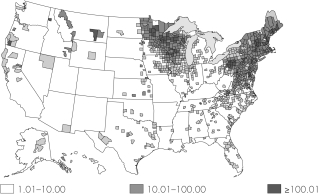
A) Lyme disease exhibits geographical clusters in the Northeast.
B) A decrease in Lyme disease vaccinations led to an increase in Lyme disease incidence in 2012.
C) Lyme disease is maintained in a reservoir that is restricted to the Northeast.
D) The number of Lyme disease cases has been steadily increasing since the 1970s.
A) Lyme disease exhibits geographical clusters in the Northeast.
B) A decrease in Lyme disease vaccinations led to an increase in Lyme disease incidence in 2012.
C) Lyme disease is maintained in a reservoir that is restricted to the Northeast.
D) The number of Lyme disease cases has been steadily increasing since the 1970s.

Question
Question
Question
Question
Question
Question
Which of the following is a factor that could explain the pattern of pertussis incidence shown?
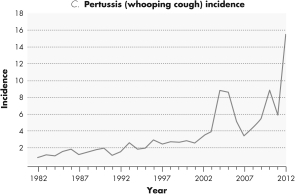
A) There was an increased rate of vaccination beginning in 2002.
B) There was an improved laboratory detection of pertussis.
C) A more effective vaccine was introduced in 2012.
D) Fewer infants were vaccinated between 1982 and 1987.
A) There was an increased rate of vaccination beginning in 2002.
B) There was an improved laboratory detection of pertussis.
C) A more effective vaccine was introduced in 2012.
D) Fewer infants were vaccinated between 1982 and 1987.
Question
Question
In the figure shown,the lower part of the line on the graph represents a low,steady number of disease cases,which is indicative of a(n)
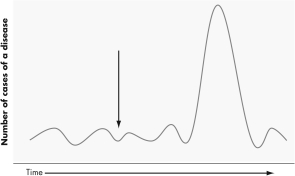
A) epidemic.
B) pandemic.
C) outbreak.
D) endemic disease.
A) epidemic.
B) pandemic.
C) outbreak.
D) endemic disease.
Question
Question
Question
This map shows the incidence of syphilis in the United States in 2012.Based on the map shown,which of the following statements is true?
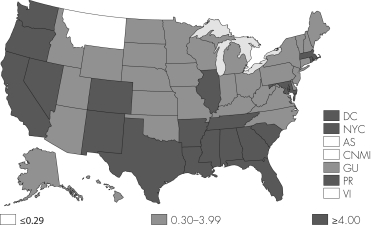
A) Efforts to prevent syphilis in the southern states failed to prevent an increase in the number of new cases in 2012.
B) No individuals in Montana were infected with syphilis in 2012.
C) The number of new cases of syphilis was higher in Texas than it was in North Dakota in 2012.
D) The total number of active cases of syphilis in 2012 was highest in the southern states.
A) Efforts to prevent syphilis in the southern states failed to prevent an increase in the number of new cases in 2012.
B) No individuals in Montana were infected with syphilis in 2012.
C) The number of new cases of syphilis was higher in Texas than it was in North Dakota in 2012.
D) The total number of active cases of syphilis in 2012 was highest in the southern states.
Question
Question
Question
Question
Question
Question
Question
The figure shown represents
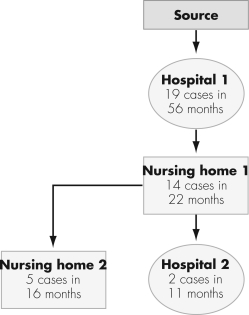
A) "daisy chain" movement of an infectious organism.
B) an endemic organism colonizing a new area.
C) a pandemic infection.
D) syndromic surveillance of an index patient.
A) "daisy chain" movement of an infectious organism.
B) an endemic organism colonizing a new area.
C) a pandemic infection.
D) syndromic surveillance of an index patient.
Question
Question
Question
Question
Question
Question
The figure shown indicates the spread of a highly infectious disease.The largest circle,labeled "1," indicates
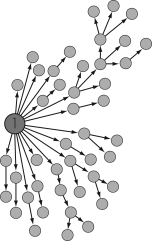
A) the index case.
B) a "super spreader."
C) the beginning of a "daisy chain."
D) an infectious carrier.
A) the index case.
B) a "super spreader."
C) the beginning of a "daisy chain."
D) an infectious carrier.
Question
Question
Question
Question
Question
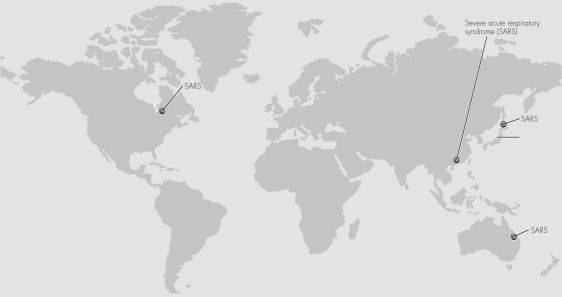
This figure shows locations of severe acute respiratory syndrome (SARS)outbreaks.Which of the following is the best explanation for the pattern of outbreaks?
A) A new coronavirus appeared simultaneously in each of the locations when spontaneous mutations occurred.
B) An index case patient spread a virus to other individuals who traveled rapidly around the globe.
C) A previously undiagnosed virus was reported as SARS in all locations simultaneously.
D) Climate change allowed mosquitoes carrying a virus to move into all of the locations.
A) A new coronavirus appeared simultaneously in each of the locations when spontaneous mutations occurred.
B) An index case patient spread a virus to other individuals who traveled rapidly around the globe.
C) A previously undiagnosed virus was reported as SARS in all locations simultaneously.
D) Climate change allowed mosquitoes carrying a virus to move into all of the locations.
Question
Question
Question
Question
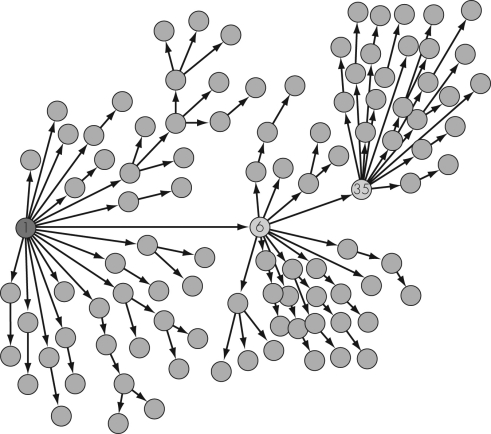
The figure shown indicates the spread of a highly infectious disease.The numbered circle,labeled "35," indicates
A) the index case.
B) a "super spreader."
C) the beginning of a "daisy chain."
D) a noninfectious carrier.
A) the index case.
B) a "super spreader."
C) the beginning of a "daisy chain."
D) a noninfectious carrier.
Question
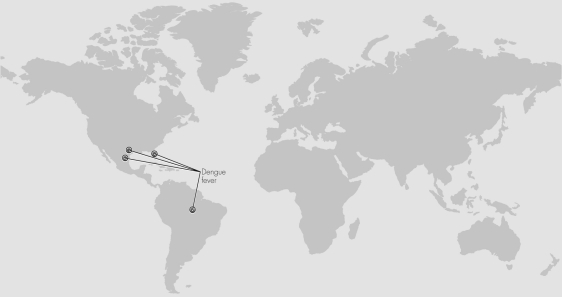
This figure shows locations where cases of Dengue fever are increasing.Dengue fever is caused by a virus transmitted by Aedes genus mosquitoes.Warmer temperatures and increased precipitation both influence populations of Aedes mosquitoes.Which of the following statements represents the best prediction for future outbreaks of Dengue fever?
A) Aedes mosquitoes and Dengue fever will become extinct as both temperature and precipitation decrease in tropical regions.
B) Dengue fever outbreaks will remain restricted to a few locations because mosquitoes are unable to expand their range.
C) Humans will become immune to Dengue fever as more individuals are exposed to the virus.
D) Climate change will lead to Dengue fever outbreaks in once-temperate areas north and south of the sites of current outbreaks.
A) Aedes mosquitoes and Dengue fever will become extinct as both temperature and precipitation decrease in tropical regions.
B) Dengue fever outbreaks will remain restricted to a few locations because mosquitoes are unable to expand their range.
C) Humans will become immune to Dengue fever as more individuals are exposed to the virus.
D) Climate change will lead to Dengue fever outbreaks in once-temperate areas north and south of the sites of current outbreaks.
Question
Question
Question
Question
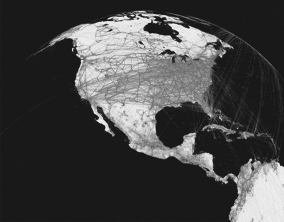
This figure shows the pattern of short-range and long-range transportation connections.Which of the following accurately describes the connection between these patterns and infectious diseases?
A) Areas with more connections tend to experience fewer disease outbreaks because people are exposed to more microbes.
B) Blood-borne pathogens tend to follow transportation routes, but respiratory infections do not.
C) The rapid introduction of pathogens from one area to another strongly correlates with modern travel routes.
D) Patterns of modern transportation routes strongly correlate with social inequality and host susceptibility.
A) Areas with more connections tend to experience fewer disease outbreaks because people are exposed to more microbes.
B) Blood-borne pathogens tend to follow transportation routes, but respiratory infections do not.
C) The rapid introduction of pathogens from one area to another strongly correlates with modern travel routes.
D) Patterns of modern transportation routes strongly correlate with social inequality and host susceptibility.
Question
Question
Question
Question
Question
Question
Question
Question
Question
Question
Question
Question
Question
Question
Question
Question
Question
Question
Question
Question
Question
Question

Unlock Deck
Sign up to unlock the cards in this deck!
Unlock Deck
Unlock Deck
1/61

Play

Full screen (f)
Deck 26: Epidemiology: Tracking Infectious Diseases
1
This map shows the incidence of Lyme disease in the United States in 2012.Based on the map shown,which of the following statements is true?
A) Lyme disease exhibits geographical clusters in the Northeast.
B) A decrease in Lyme disease vaccinations led to an increase in Lyme disease incidence in 2012.
C) Lyme disease is maintained in a reservoir that is restricted to the Northeast.
D) The number of Lyme disease cases has been steadily increasing since the 1970s.
A) Lyme disease exhibits geographical clusters in the Northeast.
B) A decrease in Lyme disease vaccinations led to an increase in Lyme disease incidence in 2012.
C) Lyme disease is maintained in a reservoir that is restricted to the Northeast.
D) The number of Lyme disease cases has been steadily increasing since the 1970s.
A
2
An individual case of diphtheria,a notifiable infectious disease,in a patient in Florida is confirmed by laboratory testing.This patient's physician would be required to
A) send a letter to the WHO in Geneva, Switzerland.
B) contact the CDC in Atlanta, Georgia.
C) treat the patient regardless of health insurance status.
D) quarantine the patient for eight weeks.
A) send a letter to the WHO in Geneva, Switzerland.
B) contact the CDC in Atlanta, Georgia.
C) treat the patient regardless of health insurance status.
D) quarantine the patient for eight weeks.
B
3
A man infected with a viral respiratory infection sneezes and releases tiny droplets containing viral particles.Two minutes later,a woman breathes in some of these tiny droplets and becomes infected by the same viral infection.The movement of this virus from one individual to another is best described as the
A) etiologic agent.
B) reservoir.
C) mode of transmission.
D) host.
A) etiologic agent.
B) reservoir.
C) mode of transmission.
D) host.
C
4
Which of the following is NOT an example of aseptic technique?
A) use of antiseptic on skin prior to insertion of an IV line
B) use of latex gloves during the insertion of an indwelling catheter
C) disinfection of doorknobs and other inert surfaces
D) use of trash can liners in all patient rooms
A) use of antiseptic on skin prior to insertion of an IV line
B) use of latex gloves during the insertion of an indwelling catheter
C) disinfection of doorknobs and other inert surfaces
D) use of trash can liners in all patient rooms
Unlock Deck
Unlock for access to all 61 flashcards in this deck.
Unlock Deck
k this deck
5
Which of the following does NOT involve testing a hypothesis?
A) descriptive epidemiology
B) analytical epidemiology
C) experimental study
D) cohort study
A) descriptive epidemiology
B) analytical epidemiology
C) experimental study
D) cohort study
Unlock Deck
Unlock for access to all 61 flashcards in this deck.
Unlock Deck
k this deck
6
Charlotte touches a doorknob after an individual with MRSA touched the doorknob.Immediately after touching the knob,Charlotte scratches her leg and transmits some MRSA cells into a small wound.The doorknob is functioning as a(n)
A) etiologic agent.
B) reservoir.
C) mode of transmission.
D) host.
A) etiologic agent.
B) reservoir.
C) mode of transmission.
D) host.
Unlock Deck
Unlock for access to all 61 flashcards in this deck.
Unlock Deck
k this deck
7
Which of the following is a factor that could explain the pattern of pertussis incidence shown?
A) There was an increased rate of vaccination beginning in 2002.
B) There was an improved laboratory detection of pertussis.
C) A more effective vaccine was introduced in 2012.
D) Fewer infants were vaccinated between 1982 and 1987.
A) There was an increased rate of vaccination beginning in 2002.
B) There was an improved laboratory detection of pertussis.
C) A more effective vaccine was introduced in 2012.
D) Fewer infants were vaccinated between 1982 and 1987.
Unlock Deck
Unlock for access to all 61 flashcards in this deck.
Unlock Deck
k this deck
8
Which of the following lists correctly identifies nosocomial infections from most common to least common?
A) urinary tract, pneumonia, septicemia
B) pneumonia, urinary tract, surgical wounds
C) septicemia, surgical wounds, diarrhea
D) diarrhea, urinary tract, pneumonia
A) urinary tract, pneumonia, septicemia
B) pneumonia, urinary tract, surgical wounds
C) septicemia, surgical wounds, diarrhea
D) diarrhea, urinary tract, pneumonia
Unlock Deck
Unlock for access to all 61 flashcards in this deck.
Unlock Deck
k this deck
9
In the figure shown,the lower part of the line on the graph represents a low,steady number of disease cases,which is indicative of a(n)
A) epidemic.
B) pandemic.
C) outbreak.
D) endemic disease.
A) epidemic.
B) pandemic.
C) outbreak.
D) endemic disease.
Unlock Deck
Unlock for access to all 61 flashcards in this deck.
Unlock Deck
k this deck
10
Although sporadic outbreaks of measles occur in the United States,the disease is considered nonendemic.What differentiates measles from endemic diseases,such as chickenpox?
A) Endemic diseases exhibit higher numbers of cases than a sporadic outbreak.
B) Diseases that are not endemic lack a reservoir in the area.
C) Endemic diseases do not exhibit sporadic outbreaks.
D) Diseases that are not endemic remain in reservoirs without infecting humans.
A) Endemic diseases exhibit higher numbers of cases than a sporadic outbreak.
B) Diseases that are not endemic lack a reservoir in the area.
C) Endemic diseases do not exhibit sporadic outbreaks.
D) Diseases that are not endemic remain in reservoirs without infecting humans.
Unlock Deck
Unlock for access to all 61 flashcards in this deck.
Unlock Deck
k this deck
11
Psittacosis is a zoonotic disease contracted by humans during contact with bacteria found in bird droppings.Human-to-human transmission is rare.Reducing contact with bird droppings will break the chain of infection by
A) reducing the virulence of the bacteria responsible for causing the disease.
B) affecting the bacteria's portal of entry into the human body.
C) reducing the number of organisms acting as reservoirs for the bacteria.
D) reducing the transmission of bacteria from the reservoir to humans.
A) reducing the virulence of the bacteria responsible for causing the disease.
B) affecting the bacteria's portal of entry into the human body.
C) reducing the number of organisms acting as reservoirs for the bacteria.
D) reducing the transmission of bacteria from the reservoir to humans.
Unlock Deck
Unlock for access to all 61 flashcards in this deck.
Unlock Deck
k this deck
12
This map shows the incidence of syphilis in the United States in 2012.Based on the map shown,which of the following statements is true?
A) Efforts to prevent syphilis in the southern states failed to prevent an increase in the number of new cases in 2012.
B) No individuals in Montana were infected with syphilis in 2012.
C) The number of new cases of syphilis was higher in Texas than it was in North Dakota in 2012.
D) The total number of active cases of syphilis in 2012 was highest in the southern states.
A) Efforts to prevent syphilis in the southern states failed to prevent an increase in the number of new cases in 2012.
B) No individuals in Montana were infected with syphilis in 2012.
C) The number of new cases of syphilis was higher in Texas than it was in North Dakota in 2012.
D) The total number of active cases of syphilis in 2012 was highest in the southern states.
Unlock Deck
Unlock for access to all 61 flashcards in this deck.
Unlock Deck
k this deck
13
Six patients with indwelling catheters develop urinary tract infections caused by Escherichia coli.The isolates from all six patients are identical.Which of the following steps should be used to identify the source of infection?
A) Test for antibiotic resistance in the Escherichia coli isolated from each patient.
B) Ensure that all health care providers wear gloves during care of infected patients.
C) Begin using air filters in the rooms of all infected patients.
D) Question hospital staff to determine whether infection control measures are being maintained.
A) Test for antibiotic resistance in the Escherichia coli isolated from each patient.
B) Ensure that all health care providers wear gloves during care of infected patients.
C) Begin using air filters in the rooms of all infected patients.
D) Question hospital staff to determine whether infection control measures are being maintained.
Unlock Deck
Unlock for access to all 61 flashcards in this deck.
Unlock Deck
k this deck
14
A nurse working in a large hospital harbors MRSA as part of the normal microbiota in his nose.He is most likely the source of a MRSA outbreak if
A) infected patients have all had been cared for by this nurse and the isolates are identical.
B) the patients are all elderly and the isolates of MRSA are not genetically identical.
C) all of the infected patients were seen by the same physician and half of the patients were cared for by this nurse.
D) all of the infected patients are on the same floor of the hospital and all have a history of heart problems.
A) infected patients have all had been cared for by this nurse and the isolates are identical.
B) the patients are all elderly and the isolates of MRSA are not genetically identical.
C) all of the infected patients were seen by the same physician and half of the patients were cared for by this nurse.
D) all of the infected patients are on the same floor of the hospital and all have a history of heart problems.
Unlock Deck
Unlock for access to all 61 flashcards in this deck.
Unlock Deck
k this deck
15
Which of the following statements is a description of the prevalence of chlamydia?
A) There are 57 active cases of chlamydia on a university campus.
B) There were 57 new cases of chlamydia on a university campus last week.
C) There were 123 new cases of chlamydia on a university campus last year.
D) Young women on a university campus are twice as likely as young men to develop chlamydia.
A) There are 57 active cases of chlamydia on a university campus.
B) There were 57 new cases of chlamydia on a university campus last week.
C) There were 123 new cases of chlamydia on a university campus last year.
D) Young women on a university campus are twice as likely as young men to develop chlamydia.
Unlock Deck
Unlock for access to all 61 flashcards in this deck.
Unlock Deck
k this deck
16
Which of the following statements describes one of the three steps of surveillance used for infectious diseases?
A) Patients with infectious diseases are required to be seen by a physician at the CDC.
B) Physicians are required to submit all patient records electronically to the CDC for review.
C) Patient charts are reviewed by an infection control practitioner when an infectious disease is suspected.
D) Incidence data is collected in all cases of bacterial infections within the United States.
A) Patients with infectious diseases are required to be seen by a physician at the CDC.
B) Physicians are required to submit all patient records electronically to the CDC for review.
C) Patient charts are reviewed by an infection control practitioner when an infectious disease is suspected.
D) Incidence data is collected in all cases of bacterial infections within the United States.
Unlock Deck
Unlock for access to all 61 flashcards in this deck.
Unlock Deck
k this deck
17
Which of the following would indicate efforts to control a disease are working?
A) The disease becomes endemic.
B) The disease prevalence increases.
C) The disease incidence decreases.
D) Outbreaks of the disease only occur every other year.
A) The disease becomes endemic.
B) The disease prevalence increases.
C) The disease incidence decreases.
D) Outbreaks of the disease only occur every other year.
Unlock Deck
Unlock for access to all 61 flashcards in this deck.
Unlock Deck
k this deck
18
An investigator is collecting data identifying the time of year and locations of measles outbreaks within the United States over a ten-year period from 2000 to 2010.This investigator is most likely involved in
A) descriptive epidemiology.
B) cohort studies.
C) analytical epidemiology.
D) experimental studies.
A) descriptive epidemiology.
B) cohort studies.
C) analytical epidemiology.
D) experimental studies.
Unlock Deck
Unlock for access to all 61 flashcards in this deck.
Unlock Deck
k this deck
19
The figure shown represents
A) "daisy chain" movement of an infectious organism.
B) an endemic organism colonizing a new area.
C) a pandemic infection.
D) syndromic surveillance of an index patient.
A) "daisy chain" movement of an infectious organism.
B) an endemic organism colonizing a new area.
C) a pandemic infection.
D) syndromic surveillance of an index patient.
Unlock Deck
Unlock for access to all 61 flashcards in this deck.
Unlock Deck
k this deck
20
Mary,an elderly woman with an indwelling catheter,is admitted to a local hospital for treatment of pneumonia.Three days after her admission,Mary's husband receives a call from the hospital.He is informed that Mary has a nosocomial infection.Which of the following statements is true?
A) The nosocomial infection referred to is pneumonia.
B) Mary has most likely developed a urinary tract infection.
C) Of all hospital patients, 25-30% develop nosocomial infections.
D) Mary's nosocomial infection could have been prevented with improved ventilation.
A) The nosocomial infection referred to is pneumonia.
B) Mary has most likely developed a urinary tract infection.
C) Of all hospital patients, 25-30% develop nosocomial infections.
D) Mary's nosocomial infection could have been prevented with improved ventilation.
Unlock Deck
Unlock for access to all 61 flashcards in this deck.
Unlock Deck
k this deck
21
Which of the following scenarios would help meet the goal of the One Health Initiative?
A) vaccinating poultry against avian influenza to prevent influenza from being transmitted to humans
B) taking steps to reduce carbon dioxide emissions to reduce the effects of climate change
C) providing sanitation after flooding events to prevent gastrointestinal infections in humans
D) increasing compliance during antibiotic treatment of tuberculosis patients to prevent emergence of drug-resistant strains of tuberculosis
A) vaccinating poultry against avian influenza to prevent influenza from being transmitted to humans
B) taking steps to reduce carbon dioxide emissions to reduce the effects of climate change
C) providing sanitation after flooding events to prevent gastrointestinal infections in humans
D) increasing compliance during antibiotic treatment of tuberculosis patients to prevent emergence of drug-resistant strains of tuberculosis
Unlock Deck
Unlock for access to all 61 flashcards in this deck.
Unlock Deck
k this deck
22
Which of the following is NOT an example of a bioweapon?
A) distributing anthrax spores in mailed letters
B) giving susceptible individuals blankets used by smallpox patients
C) failing to monitor animal health in towns where humans live in close contact with animals
D) catapulting bodies of plague victims over castle walls
A) distributing anthrax spores in mailed letters
B) giving susceptible individuals blankets used by smallpox patients
C) failing to monitor animal health in towns where humans live in close contact with animals
D) catapulting bodies of plague victims over castle walls
Unlock Deck
Unlock for access to all 61 flashcards in this deck.
Unlock Deck
k this deck
23
Which of the following is likely to occur as a result of climate change?
A) Insect vectors will migrate from tropical regions to once-temperate regions.
B) Gastrointestinal infections will decrease in tropical regions.
C) Microbes currently found in temperate regions will move to tropical regions.
D) Extreme weather will decrease and diseases will become less seasonal.
A) Insect vectors will migrate from tropical regions to once-temperate regions.
B) Gastrointestinal infections will decrease in tropical regions.
C) Microbes currently found in temperate regions will move to tropical regions.
D) Extreme weather will decrease and diseases will become less seasonal.
Unlock Deck
Unlock for access to all 61 flashcards in this deck.
Unlock Deck
k this deck
24
An infection with similar signs and symptoms appears in 24 prison inmates.There is evidence of bacterial etiology,but no laboratory has successfully isolated a bacterial agent in pure culture.Which of the following pieces of evidence would indicate a single bacterial species is causing the disease?
A) DNA sequence analysis reveals an organism genetically similar to a known bacterium.
B) the presence of eukaryotic DNA within biopsy tissues from all individuals
C) high fevers and night sweats in all affected individuals
D) 16S ribosomal RNA amplified in 50% of biopsy tissue samples
A) DNA sequence analysis reveals an organism genetically similar to a known bacterium.
B) the presence of eukaryotic DNA within biopsy tissues from all individuals
C) high fevers and night sweats in all affected individuals
D) 16S ribosomal RNA amplified in 50% of biopsy tissue samples
Unlock Deck
Unlock for access to all 61 flashcards in this deck.
Unlock Deck
k this deck
25
The figure shown indicates the spread of a highly infectious disease.The largest circle,labeled "1," indicates
A) the index case.
B) a "super spreader."
C) the beginning of a "daisy chain."
D) an infectious carrier.
A) the index case.
B) a "super spreader."
C) the beginning of a "daisy chain."
D) an infectious carrier.
Unlock Deck
Unlock for access to all 61 flashcards in this deck.
Unlock Deck
k this deck
26
How has the AIDS pandemic influenced reemerging diseases?
A) AIDS has increased the number of immunocompromised individuals who are susceptible to diseases that were previously declining in developed countries.
B) AIDS has led to an increase in the number of disease vectors throughout the world.
C) AIDS has increased the prevalence of protozoal and parasitic infections that were declining in underdeveloped countries.
D) AIDS has caused evolution to occur in diseases that were close to being eradicated in all countries.
A) AIDS has increased the number of immunocompromised individuals who are susceptible to diseases that were previously declining in developed countries.
B) AIDS has led to an increase in the number of disease vectors throughout the world.
C) AIDS has increased the prevalence of protozoal and parasitic infections that were declining in underdeveloped countries.
D) AIDS has caused evolution to occur in diseases that were close to being eradicated in all countries.
Unlock Deck
Unlock for access to all 61 flashcards in this deck.
Unlock Deck
k this deck
27
Fifteen individuals within one province in China are diagnosed with SARS.Epidemiologists will most likely
A) quarantine the entire province immediately.
B) contact the CDC in the United States to see if any cases were reported in the United States.
C) wait to see if more cases of SARS are reported.
D) try to identify the index case.
A) quarantine the entire province immediately.
B) contact the CDC in the United States to see if any cases were reported in the United States.
C) wait to see if more cases of SARS are reported.
D) try to identify the index case.
Unlock Deck
Unlock for access to all 61 flashcards in this deck.
Unlock Deck
k this deck
28
How does vaccinating wild rodents or poultry influence human health?
A) Vaccinating wild rodents or poultry has no effect on human health.
B) Vaccinating wild rodents or poultry reduces transmission of zoonotic diseases to humans.
C) Vaccinating wild rodents or poultry reduces the migration of microbes into temperate regions.
D) Vaccinating wild rodents or poultry increases the emergence of drug-resistant bacteria.
A) Vaccinating wild rodents or poultry has no effect on human health.
B) Vaccinating wild rodents or poultry reduces transmission of zoonotic diseases to humans.
C) Vaccinating wild rodents or poultry reduces the migration of microbes into temperate regions.
D) Vaccinating wild rodents or poultry increases the emergence of drug-resistant bacteria.
Unlock Deck
Unlock for access to all 61 flashcards in this deck.
Unlock Deck
k this deck
29
Amplifying 16S ribosomal RNA from biopsy tissues would be useful in identifying the presence of a
A) bacterium.
B) specific virus.
C) multicellular parasite.
D) unicellular parasite.
A) bacterium.
B) specific virus.
C) multicellular parasite.
D) unicellular parasite.
Unlock Deck
Unlock for access to all 61 flashcards in this deck.
Unlock Deck
k this deck
30
This figure shows locations of severe acute respiratory syndrome (SARS)outbreaks.Which of the following is the best explanation for the pattern of outbreaks?
A) A new coronavirus appeared simultaneously in each of the locations when spontaneous mutations occurred.
B) An index case patient spread a virus to other individuals who traveled rapidly around the globe.
C) A previously undiagnosed virus was reported as SARS in all locations simultaneously.
D) Climate change allowed mosquitoes carrying a virus to move into all of the locations.
A) A new coronavirus appeared simultaneously in each of the locations when spontaneous mutations occurred.
B) An index case patient spread a virus to other individuals who traveled rapidly around the globe.
C) A previously undiagnosed virus was reported as SARS in all locations simultaneously.
D) Climate change allowed mosquitoes carrying a virus to move into all of the locations.
Unlock Deck
Unlock for access to all 61 flashcards in this deck.
Unlock Deck
k this deck
31
During the spring and summer of 2014 an online epidemiological search indicated an increase in U.S.searches for signs and symptoms associated with Ebola,a disease previously found in West Africa.What was the most likely cause of this trend?
A) Many individuals in the United States were infected with Ebola.
B) Media reports of Ebola in other countries led to online searches in the United States.
C) Individuals infected with Ebola fled to the United States.
D) An Ebola epidemic occurred within the United States.
A) Many individuals in the United States were infected with Ebola.
B) Media reports of Ebola in other countries led to online searches in the United States.
C) Individuals infected with Ebola fled to the United States.
D) An Ebola epidemic occurred within the United States.
Unlock Deck
Unlock for access to all 61 flashcards in this deck.
Unlock Deck
k this deck
32
If humans continue to develop rapid transportation systems into more parts of the world,we should expect to see
A) pandemics tracing the path of the transportation systems.
B) an increase in detection of blood-borne pathogens.
C) a decrease in human encroachment into tropical rain forests.
D) an increase in the spread of transmissible spongiform encephalopathies.
A) pandemics tracing the path of the transportation systems.
B) an increase in detection of blood-borne pathogens.
C) a decrease in human encroachment into tropical rain forests.
D) an increase in the spread of transmissible spongiform encephalopathies.
Unlock Deck
Unlock for access to all 61 flashcards in this deck.
Unlock Deck
k this deck
33
Which of the following statements applies to a select agent?
A) A select agent is chosen by a bio-warfare committee to decimate a population.
B) A select agent is a highly contagious, infectious agent with a high mortality rate.
C) A select agent has been designed by humans to resemble biological molecules.
D) A select agent is a new genetic strain of diseases eradicated in the wild.
A) A select agent is chosen by a bio-warfare committee to decimate a population.
B) A select agent is a highly contagious, infectious agent with a high mortality rate.
C) A select agent has been designed by humans to resemble biological molecules.
D) A select agent is a new genetic strain of diseases eradicated in the wild.
Unlock Deck
Unlock for access to all 61 flashcards in this deck.
Unlock Deck
k this deck
34
The figure shown indicates the spread of a highly infectious disease.The numbered circle,labeled "35," indicates
A) the index case.
B) a "super spreader."
C) the beginning of a "daisy chain."
D) a noninfectious carrier.
A) the index case.
B) a "super spreader."
C) the beginning of a "daisy chain."
D) a noninfectious carrier.
Unlock Deck
Unlock for access to all 61 flashcards in this deck.
Unlock Deck
k this deck
35
This figure shows locations where cases of Dengue fever are increasing.Dengue fever is caused by a virus transmitted by Aedes genus mosquitoes.Warmer temperatures and increased precipitation both influence populations of Aedes mosquitoes.Which of the following statements represents the best prediction for future outbreaks of Dengue fever?
A) Aedes mosquitoes and Dengue fever will become extinct as both temperature and precipitation decrease in tropical regions.
B) Dengue fever outbreaks will remain restricted to a few locations because mosquitoes are unable to expand their range.
C) Humans will become immune to Dengue fever as more individuals are exposed to the virus.
D) Climate change will lead to Dengue fever outbreaks in once-temperate areas north and south of the sites of current outbreaks.
A) Aedes mosquitoes and Dengue fever will become extinct as both temperature and precipitation decrease in tropical regions.
B) Dengue fever outbreaks will remain restricted to a few locations because mosquitoes are unable to expand their range.
C) Humans will become immune to Dengue fever as more individuals are exposed to the virus.
D) Climate change will lead to Dengue fever outbreaks in once-temperate areas north and south of the sites of current outbreaks.
Unlock Deck
Unlock for access to all 61 flashcards in this deck.
Unlock Deck
k this deck
36
Which of the following agencies would be the first to receive information about a reportable disease in the United States?
A) the WHO
B) the CDC
C) a state health agency
D) the FDA
A) the WHO
B) the CDC
C) a state health agency
D) the FDA
Unlock Deck
Unlock for access to all 61 flashcards in this deck.
Unlock Deck
k this deck
37
Which of the following bioweapons would be used with the intent of terrorizing people rather than inflicting death on large numbers of individuals?
A) a virus that is easily transmitted between people and to which most individuals in a population are susceptible
B) a virus with a low infectious dose and high mortality that is easily dispersed through the air
C) a virus that is not easily transmitted between people and has a high infectious dose
D) a virus that is easily dispersed from one infected person to many within a day and has a high mortality rate
A) a virus that is easily transmitted between people and to which most individuals in a population are susceptible
B) a virus with a low infectious dose and high mortality that is easily dispersed through the air
C) a virus that is not easily transmitted between people and has a high infectious dose
D) a virus that is easily dispersed from one infected person to many within a day and has a high mortality rate
Unlock Deck
Unlock for access to all 61 flashcards in this deck.
Unlock Deck
k this deck
38
What features would allow a virus to be used effectively as a bioweapon?
A) a high infectious dose
B) transmission via an insect vector
C) person-to-person transmission
D) quick pathogen detection systems
A) a high infectious dose
B) transmission via an insect vector
C) person-to-person transmission
D) quick pathogen detection systems
Unlock Deck
Unlock for access to all 61 flashcards in this deck.
Unlock Deck
k this deck
39
This figure shows the pattern of short-range and long-range transportation connections.Which of the following accurately describes the connection between these patterns and infectious diseases?
A) Areas with more connections tend to experience fewer disease outbreaks because people are exposed to more microbes.
B) Blood-borne pathogens tend to follow transportation routes, but respiratory infections do not.
C) The rapid introduction of pathogens from one area to another strongly correlates with modern travel routes.
D) Patterns of modern transportation routes strongly correlate with social inequality and host susceptibility.
A) Areas with more connections tend to experience fewer disease outbreaks because people are exposed to more microbes.
B) Blood-borne pathogens tend to follow transportation routes, but respiratory infections do not.
C) The rapid introduction of pathogens from one area to another strongly correlates with modern travel routes.
D) Patterns of modern transportation routes strongly correlate with social inequality and host susceptibility.
Unlock Deck
Unlock for access to all 61 flashcards in this deck.
Unlock Deck
k this deck
40
In developed countries,healthy individuals are typically able to handle occasional infections with some disease agents,but immunocompromised individuals are affected by these agents.The agents that can cause disease in immunocompromised individuals but that are often repelled by healthy individuals are
A) parasites such as ascariasis.
B) viruses such as hantavirus.
C) bacteria such as Streptococcus pyogenes.
D) antibiotic-resistant bacteria such as MRSA.
A) parasites such as ascariasis.
B) viruses such as hantavirus.
C) bacteria such as Streptococcus pyogenes.
D) antibiotic-resistant bacteria such as MRSA.
Unlock Deck
Unlock for access to all 61 flashcards in this deck.
Unlock Deck
k this deck
41
The etiologic agent of a microbe,the agent's reservoir,the mode of transmission,and its host make up what is known as the ______.
Unlock Deck
Unlock for access to all 61 flashcards in this deck.
Unlock Deck
k this deck
42
List the characteristics that would make a bioweapon effective in terms of bio-warfare or inflicting as many casualties as possible.
Unlock Deck
Unlock for access to all 61 flashcards in this deck.
Unlock Deck
k this deck
43
CASE HISTORY
Stephanie was a bright seven-year-old girl who came to her rural Manitoba hospital for a tonsillectomy.She was a little scared,but her mother was with her and she liked the surgeon,Dr.Ryan,and his funny Winnie-the-Pooh ties.Sometimes she would even grab his tie while Dr.Ryan was examining her.However,she did not much like the IV catheter Dr.Ryan had to insert in her arm.It hurt a little,but she was brave and did not cry much.The surgery went well and Stephanie was recovering in her hospital room a few hours later.However,that night the nurse noted her temperature had risen to 102°F.By the next day,Stephanie's heart was racing and her breathing was labored.She was rushed to the pediatric intensive care unit and empiric antibiotic therapy was initiated.Despite this treatment,her blood pressure began to fall.Stephanie was diagnosed with postsurgical septic shock.To everyone's horror,Stephanie died two days later of MRSA sepsis.The organism recovered from her blood was a MRSA strain identical to one causing a wound infection in a 57-year-old man two floors down.
Discuss at least three key measures implemented in health care settings that are designed to prevent transmission of infectious diseases in health care environments,and offer a scenario that reveals how a breach in these procedures could have led to Stephanie's tragic death.
Stephanie was a bright seven-year-old girl who came to her rural Manitoba hospital for a tonsillectomy.She was a little scared,but her mother was with her and she liked the surgeon,Dr.Ryan,and his funny Winnie-the-Pooh ties.Sometimes she would even grab his tie while Dr.Ryan was examining her.However,she did not much like the IV catheter Dr.Ryan had to insert in her arm.It hurt a little,but she was brave and did not cry much.The surgery went well and Stephanie was recovering in her hospital room a few hours later.However,that night the nurse noted her temperature had risen to 102°F.By the next day,Stephanie's heart was racing and her breathing was labored.She was rushed to the pediatric intensive care unit and empiric antibiotic therapy was initiated.Despite this treatment,her blood pressure began to fall.Stephanie was diagnosed with postsurgical septic shock.To everyone's horror,Stephanie died two days later of MRSA sepsis.The organism recovered from her blood was a MRSA strain identical to one causing a wound infection in a 57-year-old man two floors down.
Discuss at least three key measures implemented in health care settings that are designed to prevent transmission of infectious diseases in health care environments,and offer a scenario that reveals how a breach in these procedures could have led to Stephanie's tragic death.
Unlock Deck
Unlock for access to all 61 flashcards in this deck.
Unlock Deck
k this deck
44
Anyone with a computer and Internet access can use Google Trends to investigate the search frequency for diseases such as influenza.What are two reasons that explain why online searches for an infectious disease will crudely track actual cases of the disease?
Unlock Deck
Unlock for access to all 61 flashcards in this deck.
Unlock Deck
k this deck
45
Describe how the AIDS pandemic has influenced reemerging diseases in developed countries.
Unlock Deck
Unlock for access to all 61 flashcards in this deck.
Unlock Deck
k this deck
46
One potential bioweapon is a virus that has been eradicated from natural populations;only two WHO-sanctioned laboratories still maintain vials of this virus.This virus is ____.
Unlock Deck
Unlock for access to all 61 flashcards in this deck.
Unlock Deck
k this deck
47
An epidemiologist collects information about the person,place,and time of infection by the varicella zoster virus.After collecting this information,she forms a hypothesis about the possible risk factors involved and uses an observational study to test her hypothesis.This type of epidemiology is _____.
Unlock Deck
Unlock for access to all 61 flashcards in this deck.
Unlock Deck
k this deck
48
What type of disease is reported by syndromic surveillance,and how does this type of surveillance fit into tracking global outbreaks of disease?
Unlock Deck
Unlock for access to all 61 flashcards in this deck.
Unlock Deck
k this deck
49
An infectious agent with a high mortality rate that is highly contagious and lacks a vaccine and effective treatment is known as a ______.
Unlock Deck
Unlock for access to all 61 flashcards in this deck.
Unlock Deck
k this deck
50
Koch's postulates require that an organism suspected as the causative agent of a disease be grown in pure culture.In some cases scientists have not successfully cultured an organism but have used molecular techniques to identify the cause of a new disease.Describe the molecular techniques that may be used to identify a previously uncultured bacterium and indicate that the identified organism is the causative agent.
Unlock Deck
Unlock for access to all 61 flashcards in this deck.
Unlock Deck
k this deck
51
Describe two ways in which climate change can influence when and where diseases occur.
Unlock Deck
Unlock for access to all 61 flashcards in this deck.
Unlock Deck
k this deck
52
A nurse stops by a new patient's room and observes a sign outside the door indicating that a disposable mask and gown should be worn in addition to latex gloves when caring for this patient.What are the two broad categories of patients that would require this extra step,and who is this gear designed to protect in each category?
Unlock Deck
Unlock for access to all 61 flashcards in this deck.
Unlock Deck
k this deck
53
Describe two ways in which technology has contributed to the emergence of pathogens and the spread of infectious diseases.
Unlock Deck
Unlock for access to all 61 flashcards in this deck.
Unlock Deck
k this deck
54
A disease transmitted from animals to humans is called a _______ disease.
Unlock Deck
Unlock for access to all 61 flashcards in this deck.
Unlock Deck
k this deck
55
You turn on a television and catch the end of an interview with a young patient who developed a life-threatening MRSA infection after a routine surgery to remove his appendix.What is the term for this type of surgical wound infection,and how common are these infections?
Unlock Deck
Unlock for access to all 61 flashcards in this deck.
Unlock Deck
k this deck
56
An elderly man is admitted to a hospital after he experiences a heart attack.Four days after his admission he is diagnosed with pneumonia caused by Pseudomonas.Three other patients in the same hospital at the same time also develop pneumonia caused by Pseudomonas.List at least four key questions an infectious disease epidemiologist would want answered as the source of these infections is investigated.
Unlock Deck
Unlock for access to all 61 flashcards in this deck.
Unlock Deck
k this deck
57
Explain the relationship between the terms endemic,epidemic,and pandemic.
Unlock Deck
Unlock for access to all 61 flashcards in this deck.
Unlock Deck
k this deck
58
CASE HISTORY
In 2003,a 48-year-old man was hospitalized in Dutchess County,New York,with a 101°F (38.4°C)fever,headache,and body aches.He also had difficulty breathing.He had just returned from a business trip to China.Health care workers were stumped for a diagnosis.Serological tests,PCR analysis,and fluorescent antibody stains failed to reveal a cause.Was this something new?
The disease in the case history was determined to be a new agent,SARS.One week later a 27-year-old local patient with no history of travel presents with similar symptoms at a hospital in Florida.How should hospital personnel respond?
A) Proceed initially with serological tests, PCR and antibody stains as they did in the case of the original infection.
B) Immediately offer the treatment for SARS.
C) Utilize whole genome sequencing to determine the nature of the pathogen.
D) Prescribe a broad spectrum antibiotic.
In 2003,a 48-year-old man was hospitalized in Dutchess County,New York,with a 101°F (38.4°C)fever,headache,and body aches.He also had difficulty breathing.He had just returned from a business trip to China.Health care workers were stumped for a diagnosis.Serological tests,PCR analysis,and fluorescent antibody stains failed to reveal a cause.Was this something new?
The disease in the case history was determined to be a new agent,SARS.One week later a 27-year-old local patient with no history of travel presents with similar symptoms at a hospital in Florida.How should hospital personnel respond?
A) Proceed initially with serological tests, PCR and antibody stains as they did in the case of the original infection.
B) Immediately offer the treatment for SARS.
C) Utilize whole genome sequencing to determine the nature of the pathogen.
D) Prescribe a broad spectrum antibiotic.
Unlock Deck
Unlock for access to all 61 flashcards in this deck.
Unlock Deck
k this deck
59
Explain why it is important to recognize "patient zero" during an epidemic of a disease such as severe acute respiratory syndrome (SARS).
Unlock Deck
Unlock for access to all 61 flashcards in this deck.
Unlock Deck
k this deck
60
A young man infected with multi-drug resistant (MDR)tuberculosis is attempting to immigrate into the United States from his war-torn homeland.A mandatory chest X-ray does not show any lung tubercles that are indicative of tuberculosis,and an acid-fast stain also fails to detect his early infection.Describe an approach that is able to detect an early tuberculosis infection.
Unlock Deck
Unlock for access to all 61 flashcards in this deck.
Unlock Deck
k this deck
61
CASE HISTORY
Stephanie was a bright seven-year-old girl who came to her rural Manitoba hospital for a tonsillectomy.She was a little scared,but her mother was with her and she liked the surgeon,Dr.Ryan,and his funny Winnie-the-Pooh ties.Sometimes she would even grab his tie while Dr.Ryan was examining her.However,she did not much like the IV catheter Dr.Ryan had to insert in her arm.It hurt a little,but she was brave and did not cry much.The surgery went well and Stephanie was recovering in her hospital room a few hours later.However,that night the nurse noted her temperature had risen to 102°F.By the next day,Stephanie's heart was racing and her breathing was labored.She was rushed to the pediatric intensive care unit and empiric antibiotic therapy was initiated.Despite this treatment,her blood pressure began to fall.Stephanie was diagnosed with postsurgical septic shock.To everyone's horror,Stephanie died two days later of MRSA sepsis.The organism recovered from her blood was a MRSA strain identical to one causing a wound infection in a 57-year-old man two floors down.
Explain the process by which hospital staff may have been able to identify Stephanie's infection as nosocomial and identify the same isolate from other patients.
Stephanie was a bright seven-year-old girl who came to her rural Manitoba hospital for a tonsillectomy.She was a little scared,but her mother was with her and she liked the surgeon,Dr.Ryan,and his funny Winnie-the-Pooh ties.Sometimes she would even grab his tie while Dr.Ryan was examining her.However,she did not much like the IV catheter Dr.Ryan had to insert in her arm.It hurt a little,but she was brave and did not cry much.The surgery went well and Stephanie was recovering in her hospital room a few hours later.However,that night the nurse noted her temperature had risen to 102°F.By the next day,Stephanie's heart was racing and her breathing was labored.She was rushed to the pediatric intensive care unit and empiric antibiotic therapy was initiated.Despite this treatment,her blood pressure began to fall.Stephanie was diagnosed with postsurgical septic shock.To everyone's horror,Stephanie died two days later of MRSA sepsis.The organism recovered from her blood was a MRSA strain identical to one causing a wound infection in a 57-year-old man two floors down.
Explain the process by which hospital staff may have been able to identify Stephanie's infection as nosocomial and identify the same isolate from other patients.
Unlock Deck
Unlock for access to all 61 flashcards in this deck.
Unlock Deck
k this deck
Unlock Deck
Unlock for access to all 61 flashcards in this deck.






