







 Chat with AI

Deck 8: Cancer and Human Health
Full screen (f)

Question
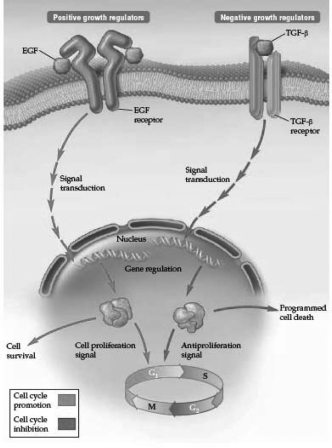
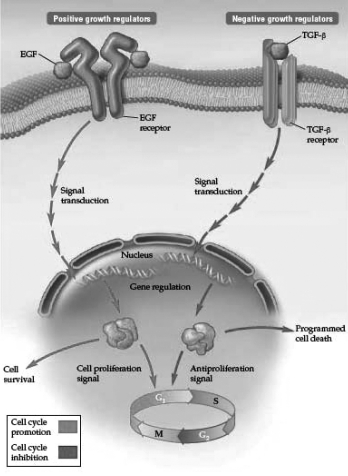
As indicated in the following diagram,the transforming growth factor beta (TGF- )is an example of a
A) proto-oncogene.
B) oncogene.
C) growth factor.
D) tumor suppressor.
A) proto-oncogene.
B) oncogene.
C) growth factor.
D) tumor suppressor.

Question
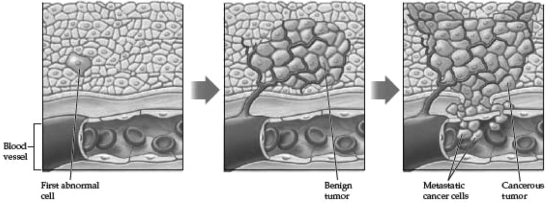
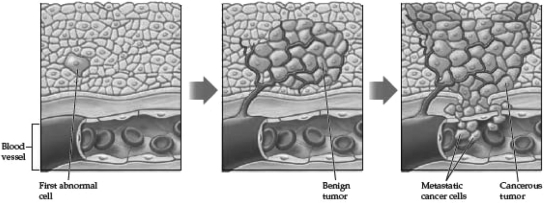
Examine the following diagram.Which is most likely to have occurred in panel 2,depicting tumor formation?
A) loss of adhesion dependence
B) initiation of angiogenesis
C) mutation of a proto-oncogene into an oncogene
D) metastasis
A) loss of adhesion dependence
B) initiation of angiogenesis
C) mutation of a proto-oncogene into an oncogene
D) metastasis
Question
Question
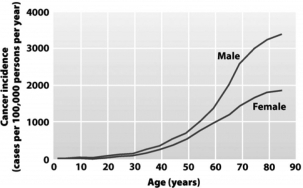
Examine the following graph.This graph shows that the
A) rate of cancer diagnosis increases for both genders with increasing age.
B) mortality rate for cancer increases more rapidly in older men than in older women.
C) probability of acquiring cancer for both genders becomes greater than 50 percent after age 80.
D) majority of individuals living to age 80 or beyond will be diagnosed with cancer.
A) rate of cancer diagnosis increases for both genders with increasing age.
B) mortality rate for cancer increases more rapidly in older men than in older women.
C) probability of acquiring cancer for both genders becomes greater than 50 percent after age 80.
D) majority of individuals living to age 80 or beyond will be diagnosed with cancer.
Question
Question
Question
Question
Question
Question
Question
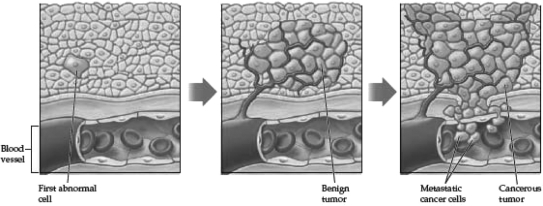
Examine the following diagram.Which is most likely to have occurred in panel 3,depicting invasion?
A) loss of adhesion dependence
B) initiation of angiogenesis
C) mutation of a proto-oncogene into an oncogene
D) activation of tumor suppressor genes
A) loss of adhesion dependence
B) initiation of angiogenesis
C) mutation of a proto-oncogene into an oncogene
D) activation of tumor suppressor genes
Question
Question
Question
Question
Question
Question
Question
Examine the following diagram.Which is most likely to have occurred in panel 1,depicting proliferation?
A) loss of adhesion dependence
B) initiation of angiogenesis
C) mutation of a proto-oncogene into an oncogene
D) metastasis
A) loss of adhesion dependence
B) initiation of angiogenesis
C) mutation of a proto-oncogene into an oncogene
D) metastasis
Question
Question
Question
Question
Question
Question
Question
Question
Question
Question
Question
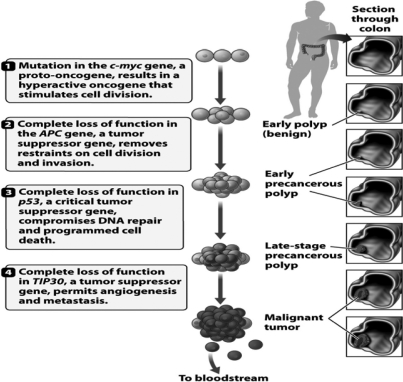
As indicated in the following diagram,in many human colon tumors,true malignancy is the result of
A) the loss of the TIP30 tumor suppressor gene.
B) the loss of the p53 tumor suppressor gene.
C) the loss of the APC tumor suppressor gene.
D) a mutation in the c-myc gene.
A) the loss of the TIP30 tumor suppressor gene.
B) the loss of the p53 tumor suppressor gene.
C) the loss of the APC tumor suppressor gene.
D) a mutation in the c-myc gene.
Question
Question
Question
Question
Question
Question
Question
Question
Question
Question
Question
Question
Question
Question
Question
Question
Question
Question
Examine the following diagram.What will most likely happen if an antibody blocks the EGF receptor such that EGF can no longer bind to it?
A) The cell will start to divide more rapidly.
B) The cell will stop dividing and possibly die.
C) More proto-oncogene protein products will be made.
D) Less tumor suppressor protein products will be made.o
A) The cell will start to divide more rapidly.
B) The cell will stop dividing and possibly die.
C) More proto-oncogene protein products will be made.
D) Less tumor suppressor protein products will be made.o
Question
Question
Question
Question
Question
Question
Question
Question
Question
Question
Question
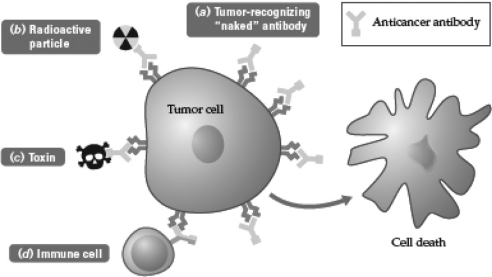
Examine the following diagram.The Y-shaped anticancer antibodies in the diagram do not cause cell death in healthy cells because healthy cells do not
A) have telomeres.
B) have the genes that cause cell death.
C) require nutrients from blood.
D) have the target proteins on their surface.
A) have telomeres.
B) have the genes that cause cell death.
C) require nutrients from blood.
D) have the target proteins on their surface.
Question
Question
Question
Question
Question
Question
Question
Question
Question
Question
Question
Question
Question
Question
Question
Question
Question
Question
Question
Question
Question
Question

Unlock Deck
Sign up to unlock the cards in this deck!
Unlock Deck
Unlock Deck
1/86

Play

Full screen (f)
Deck 8: Cancer and Human Health
1
As indicated in the following diagram,the transforming growth factor beta (TGF- )is an example of a
A) proto-oncogene.
B) oncogene.
C) growth factor.
D) tumor suppressor.
A) proto-oncogene.
B) oncogene.
C) growth factor.
D) tumor suppressor.
tumor suppressor.
2
Examine the following diagram.Which is most likely to have occurred in panel 2,depicting tumor formation?
A) loss of adhesion dependence
B) initiation of angiogenesis
C) mutation of a proto-oncogene into an oncogene
D) metastasis
A) loss of adhesion dependence
B) initiation of angiogenesis
C) mutation of a proto-oncogene into an oncogene
D) metastasis
B
3
As an individual ages,cancer risk increases over the course of a life because
A) telomerase enzyme accumulates.
B) inherited mutations accumulate.
C) somatic mutations accumulate.
D) growth factors accumulate.
A) telomerase enzyme accumulates.
B) inherited mutations accumulate.
C) somatic mutations accumulate.
D) growth factors accumulate.
C
4
Examine the following graph.This graph shows that the
A) rate of cancer diagnosis increases for both genders with increasing age.
B) mortality rate for cancer increases more rapidly in older men than in older women.
C) probability of acquiring cancer for both genders becomes greater than 50 percent after age 80.
D) majority of individuals living to age 80 or beyond will be diagnosed with cancer.
A) rate of cancer diagnosis increases for both genders with increasing age.
B) mortality rate for cancer increases more rapidly in older men than in older women.
C) probability of acquiring cancer for both genders becomes greater than 50 percent after age 80.
D) majority of individuals living to age 80 or beyond will be diagnosed with cancer.
Unlock Deck
Unlock for access to all 86 flashcards in this deck.
Unlock Deck
k this deck
5
Rapid cell proliferation can result from
A) contact inhibition.
B) a cell ignoring a negative growth regulator.
C) a mutation inhibiting the action of a positive growth regulator.
D) the surgical removal of a benign polyp.
A) contact inhibition.
B) a cell ignoring a negative growth regulator.
C) a mutation inhibiting the action of a positive growth regulator.
D) the surgical removal of a benign polyp.
Unlock Deck
Unlock for access to all 86 flashcards in this deck.
Unlock Deck
k this deck
6
A woman who has already had children develops skin cancer from overexposure to the sun.Is it likely that her children have inherited this cancer from her?
A) No,because somatic mutations are not passed on to the next generation.
B) No,because any cancer that develops after a person is an adult cannot have a genetic component.
C) Yes,because almost all cancers are caused by inherited mutations.
D) Yes,because the woman's children have exactly the same genes as their mother.
A) No,because somatic mutations are not passed on to the next generation.
B) No,because any cancer that develops after a person is an adult cannot have a genetic component.
C) Yes,because almost all cancers are caused by inherited mutations.
D) Yes,because the woman's children have exactly the same genes as their mother.
Unlock Deck
Unlock for access to all 86 flashcards in this deck.
Unlock Deck
k this deck
7
A tumor that has gained the ability to spread throughout the body,generally with life-threatening consequences,is known as a ________ tumor.
A) benign
B) polyp
C) malignant
D) growth-promoting
A) benign
B) polyp
C) malignant
D) growth-promoting
Unlock Deck
Unlock for access to all 86 flashcards in this deck.
Unlock Deck
k this deck
8
Normal cellular genes that can be mutated into cancer-causing genes are known as
A) oncogenes.
B) growth factors.
C) proto-oncogenes.
D) viral proteins.
A) oncogenes.
B) growth factors.
C) proto-oncogenes.
D) viral proteins.
Unlock Deck
Unlock for access to all 86 flashcards in this deck.
Unlock Deck
k this deck
9
For cancer to form in the presence of a tumor suppressor gene,which of the following is necessary?
A) Both copies of the tumor suppressor gene must be inactivated.
B) The tumor suppressor gene must be activated.
C) One copy of the tumor suppressor gene must be inactivated.
D) The tumor suppressor gene is not involved in cancer formation.
A) Both copies of the tumor suppressor gene must be inactivated.
B) The tumor suppressor gene must be activated.
C) One copy of the tumor suppressor gene must be inactivated.
D) The tumor suppressor gene is not involved in cancer formation.
Unlock Deck
Unlock for access to all 86 flashcards in this deck.
Unlock Deck
k this deck
10
Which of the following is NOT true of cell division?
A) A cell has no control over how often it divides.
B) Negative growth regulators are used to halt cell division.
C) Positive growth regulators stimulate cell division.
D) Uncontrolled cell division can cause cancer.
A) A cell has no control over how often it divides.
B) Negative growth regulators are used to halt cell division.
C) Positive growth regulators stimulate cell division.
D) Uncontrolled cell division can cause cancer.
Unlock Deck
Unlock for access to all 86 flashcards in this deck.
Unlock Deck
k this deck
11
Examine the following diagram.Which is most likely to have occurred in panel 3,depicting invasion?
A) loss of adhesion dependence
B) initiation of angiogenesis
C) mutation of a proto-oncogene into an oncogene
D) activation of tumor suppressor genes
A) loss of adhesion dependence
B) initiation of angiogenesis
C) mutation of a proto-oncogene into an oncogene
D) activation of tumor suppressor genes
Unlock Deck
Unlock for access to all 86 flashcards in this deck.
Unlock Deck
k this deck
12
When cells are stimulated to divide,then
A) proto-oncogenes are inactivated.
B) tumor suppressors are activated.
C) tumor suppressors are inactivated.
D) oncogenes become proto-oncogenes.
A) proto-oncogenes are inactivated.
B) tumor suppressors are activated.
C) tumor suppressors are inactivated.
D) oncogenes become proto-oncogenes.
Unlock Deck
Unlock for access to all 86 flashcards in this deck.
Unlock Deck
k this deck
13
A tumor suppressor is a(n)
A) negative growth regulator.
B) oncogene.
C) positive growth regulator.
D) sarcoma virus.
A) negative growth regulator.
B) oncogene.
C) positive growth regulator.
D) sarcoma virus.
Unlock Deck
Unlock for access to all 86 flashcards in this deck.
Unlock Deck
k this deck
14
Normal cell division requires ________ proto-oncogenes and ________ tumor suppressor genes.
A) inactivated;activated
B) inactivated;inactivated
C) activated;activated
D) activated;inactivated
A) inactivated;activated
B) inactivated;inactivated
C) activated;activated
D) activated;inactivated
Unlock Deck
Unlock for access to all 86 flashcards in this deck.
Unlock Deck
k this deck
15
When a mutant receptor protein no longer requires a positive growth factor to activate it,the result is
A) reduction in cell division.
B) extra binding sites.
C) uncontrolled cell division.
D) lack of protein products.
A) reduction in cell division.
B) extra binding sites.
C) uncontrolled cell division.
D) lack of protein products.
Unlock Deck
Unlock for access to all 86 flashcards in this deck.
Unlock Deck
k this deck
16
If exposure to sunlight causes a mutation in a single proto-oncogene in a diploid cell so that it becomes hyperactive,then
A) the remaining unmutated proto-oncogene copy will prevent the cell from becoming cancerous.
B) tumor suppressors will destroy the proteins made from the mutated gene.
C) the cell might produce a protein that pushes it into rapid cell division.
D) the mutated gene will be inactivated by telomerase.
A) the remaining unmutated proto-oncogene copy will prevent the cell from becoming cancerous.
B) tumor suppressors will destroy the proteins made from the mutated gene.
C) the cell might produce a protein that pushes it into rapid cell division.
D) the mutated gene will be inactivated by telomerase.
Unlock Deck
Unlock for access to all 86 flashcards in this deck.
Unlock Deck
k this deck
17
The fact that the human genome contains proto-oncogenes means that
A) there is nothing we can do to reduce our chance of developing cancer.
B) our genomes are constantly producing cancerous cells.
C) the disruption of certain cellular controls can lead to cancer.
D) we will all develop cancer during our lifetimes.
A) there is nothing we can do to reduce our chance of developing cancer.
B) our genomes are constantly producing cancerous cells.
C) the disruption of certain cellular controls can lead to cancer.
D) we will all develop cancer during our lifetimes.
Unlock Deck
Unlock for access to all 86 flashcards in this deck.
Unlock Deck
k this deck
18
Examine the following diagram.Which is most likely to have occurred in panel 1,depicting proliferation?
A) loss of adhesion dependence
B) initiation of angiogenesis
C) mutation of a proto-oncogene into an oncogene
D) metastasis
A) loss of adhesion dependence
B) initiation of angiogenesis
C) mutation of a proto-oncogene into an oncogene
D) metastasis
Unlock Deck
Unlock for access to all 86 flashcards in this deck.
Unlock Deck
k this deck
19
Tumor suppressor proteins ________ cell division.
A) activate
B) inhibit
C) catalyze
D) have no effect on
A) activate
B) inhibit
C) catalyze
D) have no effect on
Unlock Deck
Unlock for access to all 86 flashcards in this deck.
Unlock Deck
k this deck
20
Which of the following is NOT true of cancer?
A) Cancer involves cell proliferation.
B) Cancer can be caused by viruses.
C) Cancer results from a balanced production of positive and negative growth regulators.
D) Cancer involves the loss of a cell's ability to control cell division.
A) Cancer involves cell proliferation.
B) Cancer can be caused by viruses.
C) Cancer results from a balanced production of positive and negative growth regulators.
D) Cancer involves the loss of a cell's ability to control cell division.
Unlock Deck
Unlock for access to all 86 flashcards in this deck.
Unlock Deck
k this deck
21
The cells in many late-stage precancerous polyps in the human colon usually contain
A) normal tumor suppressor genes and at least one oncogene.
B) one inactive and one active copy of a tumor suppressor gene and normal proto-oncogenes.
C) two inactive copies of a tumor suppressor gene and two proto-oncogenes.
D) two inactive copies of a tumor suppressor gene and one oncogene.
A) normal tumor suppressor genes and at least one oncogene.
B) one inactive and one active copy of a tumor suppressor gene and normal proto-oncogenes.
C) two inactive copies of a tumor suppressor gene and two proto-oncogenes.
D) two inactive copies of a tumor suppressor gene and one oncogene.
Unlock Deck
Unlock for access to all 86 flashcards in this deck.
Unlock Deck
k this deck
22
If a cell's p53 genes are inactivated,the cell
A) loses control over cell division.
B) no longer makes proto-oncogenes.
C) stops dividing.
D) activates tumor suppressors.
A) loses control over cell division.
B) no longer makes proto-oncogenes.
C) stops dividing.
D) activates tumor suppressors.
Unlock Deck
Unlock for access to all 86 flashcards in this deck.
Unlock Deck
k this deck
23
Which of the following is NOT likely to cause a cell to become cancerous?
A) mutation
B) meiosis
C) chemical pollutants
D) cigarette smoke
A) mutation
B) meiosis
C) chemical pollutants
D) cigarette smoke
Unlock Deck
Unlock for access to all 86 flashcards in this deck.
Unlock Deck
k this deck
24
For a virus to reproduce,it must insert its DNA into the host cell's genome,sometimes leading to activation of host cell genes.Which of the following host cell genes,when activated,would most likely result in cancer?
A) proto-oncogene
B) tumor suppressor gene
C) p53 gene
D) DNA repair gene
A) proto-oncogene
B) tumor suppressor gene
C) p53 gene
D) DNA repair gene
Unlock Deck
Unlock for access to all 86 flashcards in this deck.
Unlock Deck
k this deck
25
A protein is identified that starts a signal cascade leading to the activation of a gene that promotes cell division.This protein is coded for by a
A) tumor suppressor gene.
B) oncogene.
C) proto-oncogene.
D) carcinogen.
A) tumor suppressor gene.
B) oncogene.
C) proto-oncogene.
D) carcinogen.
Unlock Deck
Unlock for access to all 86 flashcards in this deck.
Unlock Deck
k this deck
26
Which of the following statements about the p53 protein is FALSE?
A) It halts cell division when necessary,allowing the cell to repair damaged DNA.
B) It causes cells with heavily damaged,unrepairable DNA to undergo cell death.
C) It works with telomerase to extend the ends of the chromosomes.
D) It is critical to the regulation of the cell cycle.
A) It halts cell division when necessary,allowing the cell to repair damaged DNA.
B) It causes cells with heavily damaged,unrepairable DNA to undergo cell death.
C) It works with telomerase to extend the ends of the chromosomes.
D) It is critical to the regulation of the cell cycle.
Unlock Deck
Unlock for access to all 86 flashcards in this deck.
Unlock Deck
k this deck
27
What is the most likely explanation for why colon cancer frequently metastasizes to the liver?
A) Blood flows from the colon to the liver.
B) Blood flows from the liver to the colon.
C) There is no blood flow between these two organs.
D) Water moves from the colon into the blood.
A) Blood flows from the colon to the liver.
B) Blood flows from the liver to the colon.
C) There is no blood flow between these two organs.
D) Water moves from the colon into the blood.
Unlock Deck
Unlock for access to all 86 flashcards in this deck.
Unlock Deck
k this deck
28
Proto-oncogenes,which produce many of the proteins used in a signal cascade,are found
A) only in Golgi bodies.
B) only on the cell's surface.
C) only in the cell's nucleus.
D) throughout the cell.
A) only in Golgi bodies.
B) only on the cell's surface.
C) only in the cell's nucleus.
D) throughout the cell.
Unlock Deck
Unlock for access to all 86 flashcards in this deck.
Unlock Deck
k this deck
29
As indicated in the following diagram,in many human colon tumors,true malignancy is the result of
A) the loss of the TIP30 tumor suppressor gene.
B) the loss of the p53 tumor suppressor gene.
C) the loss of the APC tumor suppressor gene.
D) a mutation in the c-myc gene.
A) the loss of the TIP30 tumor suppressor gene.
B) the loss of the p53 tumor suppressor gene.
C) the loss of the APC tumor suppressor gene.
D) a mutation in the c-myc gene.
Unlock Deck
Unlock for access to all 86 flashcards in this deck.
Unlock Deck
k this deck
30
AIDS patients are more susceptible to infections than healthy people.Therefore,AIDS patients are more likely than healthy people to develop some cancers caused by
A) inherited defects.
B) viruses.
C) a family history of cancer.
D) obesity.
A) inherited defects.
B) viruses.
C) a family history of cancer.
D) obesity.
Unlock Deck
Unlock for access to all 86 flashcards in this deck.
Unlock Deck
k this deck
31
Growth factors,which often participate in signal cascades,are typically active
A) in Golgi bodies.
B) on the cell's surface.
C) in the cell's nucleus.
D) throughout the cell.
A) in Golgi bodies.
B) on the cell's surface.
C) in the cell's nucleus.
D) throughout the cell.
Unlock Deck
Unlock for access to all 86 flashcards in this deck.
Unlock Deck
k this deck
32
The best reason for males to receive the Gardasil vaccine,which protects against human papillomavirus (HPV)infections,is to prevent
A) stomach cancer in males.
B) males from transmitting the sexually transmitted disease to other people.
C) cancers caused by inherited mutations in males.
D) liver cancer in males.
A) stomach cancer in males.
B) males from transmitting the sexually transmitted disease to other people.
C) cancers caused by inherited mutations in males.
D) liver cancer in males.
Unlock Deck
Unlock for access to all 86 flashcards in this deck.
Unlock Deck
k this deck
33
Immunotherapy has less side effects than chemotherapy because immunotherapy
A) kills all rapidly dividing cells.
B) specifically targets the cancer cells.
C) kills viruses.
D) blocks the effects of carcinogens.
A) kills all rapidly dividing cells.
B) specifically targets the cancer cells.
C) kills viruses.
D) blocks the effects of carcinogens.
Unlock Deck
Unlock for access to all 86 flashcards in this deck.
Unlock Deck
k this deck
34
In colon cancer,the complete loss of function of the p53 gene requires
A) a single mutation.
B) at least two mutations.
C) at least three mutations.
D) more than four mutations.
A) a single mutation.
B) at least two mutations.
C) at least three mutations.
D) more than four mutations.
Unlock Deck
Unlock for access to all 86 flashcards in this deck.
Unlock Deck
k this deck
35
Chemotherapy frequently causes nausea because the cells that line the digestive system
A) have receptors similar to those found on tumor cells.
B) divide rapidly like tumor cells.
C) have more proto-oncogenes than other cell types.
D) produce more antibodies than other cell types.
A) have receptors similar to those found on tumor cells.
B) divide rapidly like tumor cells.
C) have more proto-oncogenes than other cell types.
D) produce more antibodies than other cell types.
Unlock Deck
Unlock for access to all 86 flashcards in this deck.
Unlock Deck
k this deck
36
Which of the following kinds of molecules are NOT likely to be produced by a proto-oncogene?
A) receptor proteins
B) positive growth factors
C) signaling proteins
D) ribosomal proteins
A) receptor proteins
B) positive growth factors
C) signaling proteins
D) ribosomal proteins
Unlock Deck
Unlock for access to all 86 flashcards in this deck.
Unlock Deck
k this deck
37
A physical,chemical,or biological agent that causes cancer is called a(n)
A) virus.
B) carcinogen.
C) oncogene.
D) regulatory protein.
A) virus.
B) carcinogen.
C) oncogene.
D) regulatory protein.
Unlock Deck
Unlock for access to all 86 flashcards in this deck.
Unlock Deck
k this deck
38
Cancer in humans is caused
A) only by environmental factors.
B) only by genetic factors.
C) by neither environmental nor genetic factors.
D) by both environmental and genetic factors.
A) only by environmental factors.
B) only by genetic factors.
C) by neither environmental nor genetic factors.
D) by both environmental and genetic factors.
Unlock Deck
Unlock for access to all 86 flashcards in this deck.
Unlock Deck
k this deck
39
Even though all people are exposed to potential carcinogens on a daily basis,we do not all develop cancer.Why?
A) The carcinogens are too weak to cause mutations in our DNA.
B) Human cells are resistant to carcinogens until we are approximately 50 years old.
C) DNA repair mechanisms are able to correct some of the mutations that occur.
D) Oncogenes protect cells from most carcinogen exposures.
A) The carcinogens are too weak to cause mutations in our DNA.
B) Human cells are resistant to carcinogens until we are approximately 50 years old.
C) DNA repair mechanisms are able to correct some of the mutations that occur.
D) Oncogenes protect cells from most carcinogen exposures.
Unlock Deck
Unlock for access to all 86 flashcards in this deck.
Unlock Deck
k this deck
40
A pesticide was found to cause cancer in laboratory mice.Which of the following would be the most reasonable hypothesis to pursue?
A) The pesticide mutates one copy of an oncogene to a proto-oncogene.
B) The pesticide mutates both copies of an oncogene to proto-oncogenes.
C) The pesticide mutates one copy of an oncogene to a proto-oncogene and one copy of a tumor suppressor gene to an inactive form.
D) The pesticide mutates both copies of a tumor suppressor gene to inactive forms.
A) The pesticide mutates one copy of an oncogene to a proto-oncogene.
B) The pesticide mutates both copies of an oncogene to proto-oncogenes.
C) The pesticide mutates one copy of an oncogene to a proto-oncogene and one copy of a tumor suppressor gene to an inactive form.
D) The pesticide mutates both copies of a tumor suppressor gene to inactive forms.
Unlock Deck
Unlock for access to all 86 flashcards in this deck.
Unlock Deck
k this deck
41
A disease that starts with a single cell that loses its ability to control cell division is ________.
Unlock Deck
Unlock for access to all 86 flashcards in this deck.
Unlock Deck
k this deck
42
For proper cell division to occur,the activity of proto-oncogenes must be balanced by the activity of ________ genes.
Unlock Deck
Unlock for access to all 86 flashcards in this deck.
Unlock Deck
k this deck
43
Cancers that spread throughout the body with life-threatening consequences are called ________.
Unlock Deck
Unlock for access to all 86 flashcards in this deck.
Unlock Deck
k this deck
44
Both BRCA1 and BRCA2 are tumor suppressor genes that repair damaged DNA.How do mutations in these genes predispose women for breast cancer?
A) They allow future mutations to remain uncorrected.
B) They cause the chromosome telomeres to extend.
C) They lead to the construction of carcinogen receptors that pull harmful chemicals into the cell and accelerate the mutation process.
D) They make the cell susceptible to viral infections.
A) They allow future mutations to remain uncorrected.
B) They cause the chromosome telomeres to extend.
C) They lead to the construction of carcinogen receptors that pull harmful chemicals into the cell and accelerate the mutation process.
D) They make the cell susceptible to viral infections.
Unlock Deck
Unlock for access to all 86 flashcards in this deck.
Unlock Deck
k this deck
45
The p53 protein is a ________ because it halts the cell cycle and allows the cell to repair DNA damage.
Unlock Deck
Unlock for access to all 86 flashcards in this deck.
Unlock Deck
k this deck
46
Mutations cause changes in ________ produced by a gene.
Unlock Deck
Unlock for access to all 86 flashcards in this deck.
Unlock Deck
k this deck
47
Examine the following diagram.What will most likely happen if an antibody blocks the EGF receptor such that EGF can no longer bind to it?
A) The cell will start to divide more rapidly.
B) The cell will stop dividing and possibly die.
C) More proto-oncogene protein products will be made.
D) Less tumor suppressor protein products will be made.o
A) The cell will start to divide more rapidly.
B) The cell will stop dividing and possibly die.
C) More proto-oncogene protein products will be made.
D) Less tumor suppressor protein products will be made.o
Unlock Deck
Unlock for access to all 86 flashcards in this deck.
Unlock Deck
k this deck
48
Cancer cells can ________,or spread,to other organs where they can form new tumors.
Unlock Deck
Unlock for access to all 86 flashcards in this deck.
Unlock Deck
k this deck
49
Tamoxifen is a drug that prevents the positive growth regulator estrogen from binding the estrogen receptor on the surface of breast cancer cells.The most likely result of this is a(n)________ in production of proteins that cause ________.
A) increase;programmed cell death
B) decrease;programmed cell death
C) increase;cell proliferation
D) decrease;cell proliferation
A) increase;programmed cell death
B) decrease;programmed cell death
C) increase;cell proliferation
D) decrease;cell proliferation
Unlock Deck
Unlock for access to all 86 flashcards in this deck.
Unlock Deck
k this deck
50
Breast cancer that is not inherited is caused by ________ mutations.
Unlock Deck
Unlock for access to all 86 flashcards in this deck.
Unlock Deck
k this deck
51
Mutations that cause an inherited risk for cancer occur in the ________ cells.
Unlock Deck
Unlock for access to all 86 flashcards in this deck.
Unlock Deck
k this deck
52
Grilling meat appears to be associated with an avoidable exposure to carcinogens that form when
A) the growth hormones used by the livestock industry react at high temperature with meat proteins.
B) the antibiotics routinely used by the livestock industry degrade at high temperature.
C) certain amino acids and fats react at high temperature to form HCAs and PAHs.
D) combustion products from the charcoal,natural gas,or propane mutate the DNA in the cooked food.
A) the growth hormones used by the livestock industry react at high temperature with meat proteins.
B) the antibiotics routinely used by the livestock industry degrade at high temperature.
C) certain amino acids and fats react at high temperature to form HCAs and PAHs.
D) combustion products from the charcoal,natural gas,or propane mutate the DNA in the cooked food.
Unlock Deck
Unlock for access to all 86 flashcards in this deck.
Unlock Deck
k this deck
53
A tumor cell has lost ________ when it breaks off from the primary tumor.
Unlock Deck
Unlock for access to all 86 flashcards in this deck.
Unlock Deck
k this deck
54
HeLa cells display a variety of abnormalities.Which is most associated with their ability to divide repeatedly?
A) The cell line shows evidence of having been infected with HPV (human papillomavirus).
B) HeLa cells express the telomerase gene and are able to reconstruct the ends of their chromosomes after each round of cell division.
C) The cell line is quadraploid (having four sets of chromosomes)rather than diploid (having two sets of chromosomes)like all normal somatic cells.
D) The HeLa cell line was exposed to cosmic radiation prior to developing its unusual reproductive capabilities.
A) The cell line shows evidence of having been infected with HPV (human papillomavirus).
B) HeLa cells express the telomerase gene and are able to reconstruct the ends of their chromosomes after each round of cell division.
C) The cell line is quadraploid (having four sets of chromosomes)rather than diploid (having two sets of chromosomes)like all normal somatic cells.
D) The HeLa cell line was exposed to cosmic radiation prior to developing its unusual reproductive capabilities.
Unlock Deck
Unlock for access to all 86 flashcards in this deck.
Unlock Deck
k this deck
55
A harmless proliferation of cells in a human colon would be called a(n)________ polyp.
Unlock Deck
Unlock for access to all 86 flashcards in this deck.
Unlock Deck
k this deck
56
A 20-year-old female is 5 feet 2 inches in height.She weighs 112 pounds despite getting very little physical exercise.She works at a desk 10 hours a day and sleeps 8 hours a night.From this description,her biggest risk of cancer is due to her
A) lack of exercise.
B) short stature.
C) age.
D) work/sleep schedule.
A) lack of exercise.
B) short stature.
C) age.
D) work/sleep schedule.
Unlock Deck
Unlock for access to all 86 flashcards in this deck.
Unlock Deck
k this deck
57
Scientists develop an antibody that binds to telomerase and prevents it from repairing telomeres.This antibody would be useful in treating cancer cells because it would
A) activate tumor suppressor genes.
B) activate proto-oncogenes.
C) give the cell immortality.
D) decrease the amount of times the cell could divide.o
A) activate tumor suppressor genes.
B) activate proto-oncogenes.
C) give the cell immortality.
D) decrease the amount of times the cell could divide.o
Unlock Deck
Unlock for access to all 86 flashcards in this deck.
Unlock Deck
k this deck
58
Examine the following diagram.The Y-shaped anticancer antibodies in the diagram do not cause cell death in healthy cells because healthy cells do not
A) have telomeres.
B) have the genes that cause cell death.
C) require nutrients from blood.
D) have the target proteins on their surface.
A) have telomeres.
B) have the genes that cause cell death.
C) require nutrients from blood.
D) have the target proteins on their surface.
Unlock Deck
Unlock for access to all 86 flashcards in this deck.
Unlock Deck
k this deck
59
Under normal conditions,growth factors activate ________ and inactivate ________ genes.
Unlock Deck
Unlock for access to all 86 flashcards in this deck.
Unlock Deck
k this deck
60
Genes that increase the rate of cell division are ________ growth regulators.
Unlock Deck
Unlock for access to all 86 flashcards in this deck.
Unlock Deck
k this deck
61
The binding of a growth factor to a receptor protein on the surface of a cell results in signal transduction that affects gene expression in the cell.
Unlock Deck
Unlock for access to all 86 flashcards in this deck.
Unlock Deck
k this deck
62
Malignant colon cancer cells enter the bloodstream and move to the liver where they form ________ tumors.
Unlock Deck
Unlock for access to all 86 flashcards in this deck.
Unlock Deck
k this deck
63
Immune molecules that can specifically target proteins on cancer cells are called ________.
Unlock Deck
Unlock for access to all 86 flashcards in this deck.
Unlock Deck
k this deck
64
To be healthy,an organism must stop all cell division activities.
Unlock Deck
Unlock for access to all 86 flashcards in this deck.
Unlock Deck
k this deck
65
A mutation that changes a gene,but not the protein product of that gene,will NOT cause cancer.
Unlock Deck
Unlock for access to all 86 flashcards in this deck.
Unlock Deck
k this deck
66
Tumor suppressors cause programmed cell death.
Unlock Deck
Unlock for access to all 86 flashcards in this deck.
Unlock Deck
k this deck
67
The p53 gene is activated by positive growth regulators.
Unlock Deck
Unlock for access to all 86 flashcards in this deck.
Unlock Deck
k this deck
68
The capacity of stem cells,germ line cells,and HeLa cells to divide repeatedly suggests that they share one or more common features,the most important of which is probably the ability to synthesize ________ and repair their chromosomes after each round of cell division.
Unlock Deck
Unlock for access to all 86 flashcards in this deck.
Unlock Deck
k this deck
69
One or two mutations are often the cause of cancer.
Unlock Deck
Unlock for access to all 86 flashcards in this deck.
Unlock Deck
k this deck
70
If a normally dividing cell gains anchorage dependence,it will cause a secondary tumor.
Unlock Deck
Unlock for access to all 86 flashcards in this deck.
Unlock Deck
k this deck
71
Mutations cause only a few types of cancer.
Unlock Deck
Unlock for access to all 86 flashcards in this deck.
Unlock Deck
k this deck
72
A cure for cancer would stop all cell division in an organism.
Unlock Deck
Unlock for access to all 86 flashcards in this deck.
Unlock Deck
k this deck
73
A gene that repairs double-stranded DNA breaks is a proto-oncogene.
Unlock Deck
Unlock for access to all 86 flashcards in this deck.
Unlock Deck
k this deck
74
A physical,chemical,or biological agent that causes cancer is a ________.
Unlock Deck
Unlock for access to all 86 flashcards in this deck.
Unlock Deck
k this deck
75
All viruses cause cancer.
Unlock Deck
Unlock for access to all 86 flashcards in this deck.
Unlock Deck
k this deck
76
The chance of developing cervical cancer is reduced by ________ against the human papillomavirus.
Unlock Deck
Unlock for access to all 86 flashcards in this deck.
Unlock Deck
k this deck
77
A benign polyp in the colon always progresses to malignant colon cancer.
Unlock Deck
Unlock for access to all 86 flashcards in this deck.
Unlock Deck
k this deck
78
The p53 gene is nonfunctional in most colon cancers.
Unlock Deck
Unlock for access to all 86 flashcards in this deck.
Unlock Deck
k this deck
79
A benign growth is noncancerous.
Unlock Deck
Unlock for access to all 86 flashcards in this deck.
Unlock Deck
k this deck
80
Cancer-causing chemicals increase the risk of cancer by promoting ________ in the DNA,causing changes in the DNA base sequences.
Unlock Deck
Unlock for access to all 86 flashcards in this deck.
Unlock Deck
k this deck
Unlock Deck
Unlock for access to all 86 flashcards in this deck.






