







 Chat with AI

Deck 31: New Frontiers: Politics and Social Change in the 1960s
Full screen (f)

Question

Question
Question
Question
Question
Question
Question
Question
Question
Question
Question
Question
Question
Question
Question
Question
Question
Question
Question
Question
Question
Question
Question
Question
Question
Question
Question
Question
Question
Question
Question
Question
Question
Question
Question
Question
Question
Question
Question
Question
Question
Question
Question
Question
Question
Question
Question
Question
Question
Question
Question
Question
Question
Question
Question
Question
Question
Question
Question
Question
Question
Match between columns
Question
Question
Question
Question
Question
Question
Question
Question
Question
Question
Question
Question
Question
Question
Question
Question
Question
MATCHING
Match each description with the item below.
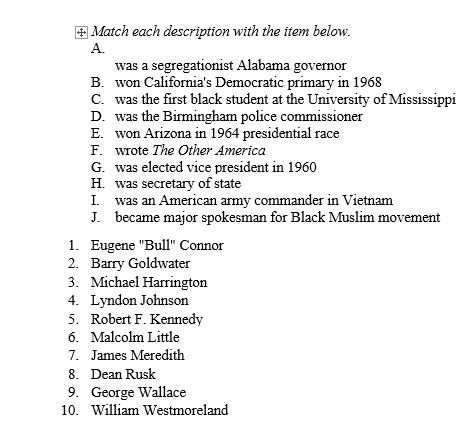
Match each description with the item below.

Unlock Deck
Sign up to unlock the cards in this deck!
Unlock Deck
Unlock Deck
1/78

Play

Full screen (f)
Deck 31: New Frontiers: Politics and Social Change in the 1960s
1
The Tet offensive marked a turning point in public support for the war in Vietnam.
True
2
President Johnson was not as adept at handling Congress as President Kennedy had been.
False
3
Richard Nixon:
A) had limited political experience when he ran for president in 1960
B) had a reputation for hard-line anticommunism and rough campaign tactics
C) like John F. Kennedy, came from a wealthy family
D) did not have the intellectual depth to be president
E) was politically damaged by his service as vice president due to Eisenhower's unpopularity when his presidency ended
A) had limited political experience when he ran for president in 1960
B) had a reputation for hard-line anticommunism and rough campaign tactics
C) like John F. Kennedy, came from a wealthy family
D) did not have the intellectual depth to be president
E) was politically damaged by his service as vice president due to Eisenhower's unpopularity when his presidency ended
had a reputation for hard-line anticommunism and rough campaign tactics
4
Barry Goldwater said, "extremism in the defense of liberty is no vice."
Unlock Deck
Unlock for access to all 78 flashcards in this deck.
Unlock Deck
k this deck
5
Johnson's Great Society programs helped reduce the number of people living in poverty.
Unlock Deck
Unlock for access to all 78 flashcards in this deck.
Unlock Deck
k this deck
6
Nikita Khrushchev was Soviet premier while Kennedy was president.
Unlock Deck
Unlock for access to all 78 flashcards in this deck.
Unlock Deck
k this deck
7
The Viet Cong were the rebel army in South Vietnam.
Unlock Deck
Unlock for access to all 78 flashcards in this deck.
Unlock Deck
k this deck
8
John F. Kennedy was careful to conceal from the public during the 1960 campaign his:
A) Roman Catholicism
B) wife
C) family wealth
D) war record
E) personal health
A) Roman Catholicism
B) wife
C) family wealth
D) war record
E) personal health
Unlock Deck
Unlock for access to all 78 flashcards in this deck.
Unlock Deck
k this deck
9
From the beginning of his presidency, Kennedy vigorously supported black civil rights.
Unlock Deck
Unlock for access to all 78 flashcards in this deck.
Unlock Deck
k this deck
10
Had Kennedy lived, he would certainly have removed U.S. troops from Vietnam.
Unlock Deck
Unlock for access to all 78 flashcards in this deck.
Unlock Deck
k this deck
11
The Black Panthers organization was formed in 1961.
Unlock Deck
Unlock for access to all 78 flashcards in this deck.
Unlock Deck
k this deck
12
Lyndon Johnson's domestic program was called the Great Society.
Unlock Deck
Unlock for access to all 78 flashcards in this deck.
Unlock Deck
k this deck
13
Jack Ruby was charged with assassinating President John
F. Kennedy, but doubts about his guilt linger.
F. Kennedy, but doubts about his guilt linger.
Unlock Deck
Unlock for access to all 78 flashcards in this deck.
Unlock Deck
k this deck
14
Hubert Humphrey was Lyndon Johnson's running mate in the presidential race of 1964.
Unlock Deck
Unlock for access to all 78 flashcards in this deck.
Unlock Deck
k this deck
15
In the 1960 presidential race, John F. Kennedy:
A) appeared nervous and unknowledgeable in a televised debate
B) promised to use the White House to promote religion
C) promised to get the country "moving again"
D) promised to provide health care to all Americans
E) opposed civil rights
A) appeared nervous and unknowledgeable in a televised debate
B) promised to use the White House to promote religion
C) promised to get the country "moving again"
D) promised to provide health care to all Americans
E) opposed civil rights
Unlock Deck
Unlock for access to all 78 flashcards in this deck.
Unlock Deck
k this deck
16
By 1966, Martin Luther King Jr. had become a leading spokesman for "black power."
Unlock Deck
Unlock for access to all 78 flashcards in this deck.
Unlock Deck
k this deck
17
The person most persuasive in getting President Kennedy to endorse civil rights would have been:
A) his vice president, Lyndon Johnson
B) his brother, Robert
C) his wife, Jackie
D) FBI director J. Edgar Hoover
E) Chief Justice Earl Warren
A) his vice president, Lyndon Johnson
B) his brother, Robert
C) his wife, Jackie
D) FBI director J. Edgar Hoover
E) Chief Justice Earl Warren
Unlock Deck
Unlock for access to all 78 flashcards in this deck.
Unlock Deck
k this deck
18
Volunteers in Service to America was a group of Republican young people who campaigned for Nixon and other conservative candidates in 1960.
Unlock Deck
Unlock for access to all 78 flashcards in this deck.
Unlock Deck
k this deck
19
Congress narrowly defeated President Johnson's request in 1964 for authorization to "take all necessary measures" to prevent further aggression in Vietnam.
Unlock Deck
Unlock for access to all 78 flashcards in this deck.
Unlock Deck
k this deck
20
By the time of the 1960 presidential race, Kennedy had far more experience in national politics than did Richard Nixon.
Unlock Deck
Unlock for access to all 78 flashcards in this deck.
Unlock Deck
k this deck
21
The protest tactic initiated by black students in Greensboro, North Carolina, was:
A) the sit-in
B) the occupation of campus administration buildings
C) the March on Washington
D) street theater
E) the freedom ride
A) the sit-in
B) the occupation of campus administration buildings
C) the March on Washington
D) street theater
E) the freedom ride
Unlock Deck
Unlock for access to all 78 flashcards in this deck.
Unlock Deck
k this deck
22
The Cuban missile crisis:
A) led to a U.S.-backed invasion of Cuba
B) showed Kennedy's tendency to back down in a tense confrontation
C) ended the cold war
D) brought the United States and the Soviet Union close to nuclear war
E) saw the United States destroy some missile sites with surgical air strikes
A) led to a U.S.-backed invasion of Cuba
B) showed Kennedy's tendency to back down in a tense confrontation
C) ended the cold war
D) brought the United States and the Soviet Union close to nuclear war
E) saw the United States destroy some missile sites with surgical air strikes
Unlock Deck
Unlock for access to all 78 flashcards in this deck.
Unlock Deck
k this deck
23
In its controversial Miranda v. Arizona decision, the Warren Court:
A) required that an accused person be informed of certain basic rights
B) made abortion legal
C) banned prayer in public schools
D) protected job rights for homosexuals
E) gave police more power to search without a warrant
A) required that an accused person be informed of certain basic rights
B) made abortion legal
C) banned prayer in public schools
D) protected job rights for homosexuals
E) gave police more power to search without a warrant
Unlock Deck
Unlock for access to all 78 flashcards in this deck.
Unlock Deck
k this deck
24
Student civil rights activists in the South would likely experience all of the following EXCEPT:
A) mass arrests
B) mob violence
C) extreme verbal abuse
D) Kennedy's public encouragement
E) growing public admiration
A) mass arrests
B) mob violence
C) extreme verbal abuse
D) Kennedy's public encouragement
E) growing public admiration
Unlock Deck
Unlock for access to all 78 flashcards in this deck.
Unlock Deck
k this deck
25
When Alabama governor George Wallace was ordered by federal marshals to stand aside from the doorway at the University of Alabama so that black students could enter, Wallace:
A) provoked a riot
B) stood aside
C) got himself arrested
D) unleashed a torrent of racist language
E) refused to budge
A) provoked a riot
B) stood aside
C) got himself arrested
D) unleashed a torrent of racist language
E) refused to budge
Unlock Deck
Unlock for access to all 78 flashcards in this deck.
Unlock Deck
k this deck
26
The result of the 1960 election:
A) was likely determined by African American votes in a few southern states
B) was a popular vote landslide victory for Kennedy
C) saw Democrats regain control of the South
D) was determined when Kennedy swept the West Coast
E) was challenged in the courts by the Republicans
A) was likely determined by African American votes in a few southern states
B) was a popular vote landslide victory for Kennedy
C) saw Democrats regain control of the South
D) was determined when Kennedy swept the West Coast
E) was challenged in the courts by the Republicans
Unlock Deck
Unlock for access to all 78 flashcards in this deck.
Unlock Deck
k this deck
27
The major purpose of the Soviet missiles placed in Cuba was to:
A) deter another American-supported invasion of Cuba
B) show hard-liners in the Soviet military that Khrushchev was sufficiently tough
C) launch an attack upon the United States
D) make Castro more dependent upon the Soviets
E) get Kennedy to let the Soviets have West Berlin
A) deter another American-supported invasion of Cuba
B) show hard-liners in the Soviet military that Khrushchev was sufficiently tough
C) launch an attack upon the United States
D) make Castro more dependent upon the Soviets
E) get Kennedy to let the Soviets have West Berlin
Unlock Deck
Unlock for access to all 78 flashcards in this deck.
Unlock Deck
k this deck
28
In South Vietnam in the early 1960s:
A) Diem's land reforms were undercutting the Communists
B) Kennedy was increasing the number of American military advisers
C) American troops were regularly involved in combat
D) the Viet Cong captured several major cities
E) the French had returned to assist the South Vietnamese
A) Diem's land reforms were undercutting the Communists
B) Kennedy was increasing the number of American military advisers
C) American troops were regularly involved in combat
D) the Viet Cong captured several major cities
E) the French had returned to assist the South Vietnamese
Unlock Deck
Unlock for access to all 78 flashcards in this deck.
Unlock Deck
k this deck
29
The Cuban missile crisis led to all of the following EXCEPT:
A) the removal of the Soviet missiles from Cuba
B) the installation of a "hot line" between Moscow and Washington
C) the removal of American missiles from Turkey
D) an easing of cold war tensions
E) a U.S.-Soviet agreement to scrap nuclear weapons
A) the removal of the Soviet missiles from Cuba
B) the installation of a "hot line" between Moscow and Washington
C) the removal of American missiles from Turkey
D) an easing of cold war tensions
E) a U.S.-Soviet agreement to scrap nuclear weapons
Unlock Deck
Unlock for access to all 78 flashcards in this deck.
Unlock Deck
k this deck
30
Violence erupted in 1962 when James Meredith attempted to integrate:
A) the University of Alabama
B) Louisiana State University
C) Georgia Tech
D) the University of Mississippi
E) Texas A&M
A) the University of Alabama
B) Louisiana State University
C) Georgia Tech
D) the University of Mississippi
E) Texas A&M
Unlock Deck
Unlock for access to all 78 flashcards in this deck.
Unlock Deck
k this deck
31
Tensions escalated in Southeast Asia by 1961 with increasing Communist influence in:
A) Hong Kong
B) Burma
C) Cambodia
D) Thailand
E) Laos
A) Hong Kong
B) Burma
C) Cambodia
D) Thailand
E) Laos
Unlock Deck
Unlock for access to all 78 flashcards in this deck.
Unlock Deck
k this deck
32
In 1961, Khrushchev escalated tensions over Berlin by:
A) imposing another Soviet blockade of West Berlin
B) sending spy planes over West Germany
C) putting nuclear missiles in East Berlin
D) erecting the Berlin Wall
E) walking out of a summit conference in Vienna
A) imposing another Soviet blockade of West Berlin
B) sending spy planes over West Germany
C) putting nuclear missiles in East Berlin
D) erecting the Berlin Wall
E) walking out of a summit conference in Vienna
Unlock Deck
Unlock for access to all 78 flashcards in this deck.
Unlock Deck
k this deck
33
The Bay of Pigs invasion:
A) was Kennedy's original idea
B) was thoroughly bungled by the CIA
C) proved Kennedy's competence in foreign policy
D) weakened the Castro regime
E) inspired the United States and the Soviet Union to improve relations
A) was Kennedy's original idea
B) was thoroughly bungled by the CIA
C) proved Kennedy's competence in foreign policy
D) weakened the Castro regime
E) inspired the United States and the Soviet Union to improve relations
Unlock Deck
Unlock for access to all 78 flashcards in this deck.
Unlock Deck
k this deck
34
All of the following are true of the Kennedy assassination EXCEPT:
A) the primary suspect was Lee Harvey Oswald
B) Jack Ruby shot and killed the suspected assassin
C) the Warren Commission concluded there may have been multiple gunmen
D) it occurred in Dallas on November 22, 1963
E) so many of the related events were watched on television
A) the primary suspect was Lee Harvey Oswald
B) Jack Ruby shot and killed the suspected assassin
C) the Warren Commission concluded there may have been multiple gunmen
D) it occurred in Dallas on November 22, 1963
E) so many of the related events were watched on television
Unlock Deck
Unlock for access to all 78 flashcards in this deck.
Unlock Deck
k this deck
35
President Kennedy's cabinet was dominated by:
A) men from the most radical wing of the Democratic party
B) old-school politicians from the Truman administration
C) men with new ideas and fresh thinking
D) his fraternity buddies from Harvard
E) Catholics and racial minorities
A) men from the most radical wing of the Democratic party
B) old-school politicians from the Truman administration
C) men with new ideas and fresh thinking
D) his fraternity buddies from Harvard
E) Catholics and racial minorities
Unlock Deck
Unlock for access to all 78 flashcards in this deck.
Unlock Deck
k this deck
36
Kennedy's inauguration is best remembered for:
A) the flatness of his delivery
B) the record cold in Washington that day
C) the large and friendly crowd
D) the list of promises in his speech
E) his elegant and inspiring rhetoric
A) the flatness of his delivery
B) the record cold in Washington that day
C) the large and friendly crowd
D) the list of promises in his speech
E) his elegant and inspiring rhetoric
Unlock Deck
Unlock for access to all 78 flashcards in this deck.
Unlock Deck
k this deck
37
Early in his presidency, Kennedy accomplished all of the following EXCEPT:
A) support for space exploration
B) the creation of the Peace Corps
C) the Trade Expansion Act of 1962
D) the passage of a large tax cut
E) increases in Social Security benefits and the minimum wage
A) support for space exploration
B) the creation of the Peace Corps
C) the Trade Expansion Act of 1962
D) the passage of a large tax cut
E) increases in Social Security benefits and the minimum wage
Unlock Deck
Unlock for access to all 78 flashcards in this deck.
Unlock Deck
k this deck
38
The city that described itself as "too busy to hate" was:
A) Atlanta
B) New Orleans
C) Memphis
D) Charlotte
E) Houston
A) Atlanta
B) New Orleans
C) Memphis
D) Charlotte
E) Houston
Unlock Deck
Unlock for access to all 78 flashcards in this deck.
Unlock Deck
k this deck
39
In his Letter from Birmingham City Jail, Martin Luther King:
A) expressed his admiration of activists Ross Barnett and Bull Connor
B) announced that he was abandoning nonviolent tactics
C) expressed anger at being locked up
D) declared his willingness to break unjust laws
E) explained why he hated racist whites
A) expressed his admiration of activists Ross Barnett and Bull Connor
B) announced that he was abandoning nonviolent tactics
C) expressed anger at being locked up
D) declared his willingness to break unjust laws
E) explained why he hated racist whites
Unlock Deck
Unlock for access to all 78 flashcards in this deck.
Unlock Deck
k this deck
40
The strongest and most visible opposition to Diem's government was led by:
A) Buddhists
B) Socialists
C) Muslims
D) American diplomats
E) French-speaking Vietnamese elites
A) Buddhists
B) Socialists
C) Muslims
D) American diplomats
E) French-speaking Vietnamese elites
Unlock Deck
Unlock for access to all 78 flashcards in this deck.
Unlock Deck
k this deck
41
By 1966, black leaders like Stokely Carmichael and H. Rap Brown were proponents of what they termed:
A) passive nonviolence
B) black communism
C) massive integration
D) black capitalism
E) black power
A) passive nonviolence
B) black communism
C) massive integration
D) black capitalism
E) black power
Unlock Deck
Unlock for access to all 78 flashcards in this deck.
Unlock Deck
k this deck
42
In the 1964 campaign, Republican nominee Barry Goldwater:
A) promised to manage New Deal programs more effectively than Democrats had
B) said he would use diplomacy to settle the conflict in Vietnam
C) offered a sharply conservative alternative to Johnson's policies
D) endorsed Johnson's achievements on civil rights
E) represented Eisenhower-style "moderate Republicanism"
A) promised to manage New Deal programs more effectively than Democrats had
B) said he would use diplomacy to settle the conflict in Vietnam
C) offered a sharply conservative alternative to Johnson's policies
D) endorsed Johnson's achievements on civil rights
E) represented Eisenhower-style "moderate Republicanism"
Unlock Deck
Unlock for access to all 78 flashcards in this deck.
Unlock Deck
k this deck
43
By the mid-1960s, Martin Luther King had decided to:
A) emphasize the need for economic uplift for the black urban poor
B) adopt much of the rhetoric and tactics of the militant blacks
C) retire so that younger leaders could move to the forefront
D) focus on his opposition to the war in Vietnam
E) declare that the fight for black equality was largely won
A) emphasize the need for economic uplift for the black urban poor
B) adopt much of the rhetoric and tactics of the militant blacks
C) retire so that younger leaders could move to the forefront
D) focus on his opposition to the war in Vietnam
E) declare that the fight for black equality was largely won
Unlock Deck
Unlock for access to all 78 flashcards in this deck.
Unlock Deck
k this deck
44
Kennedy's successor as president, Lyndon Johnson:
A) had a humble and modest character
B) was a fairly typical southern conservative
C) may have been involved in the assassination
D) like Kennedy, had been born into wealth and privilege
E) genuinely cared about the disadvantaged in society
A) had a humble and modest character
B) was a fairly typical southern conservative
C) may have been involved in the assassination
D) like Kennedy, had been born into wealth and privilege
E) genuinely cared about the disadvantaged in society
Unlock Deck
Unlock for access to all 78 flashcards in this deck.
Unlock Deck
k this deck
45
Malcolm X:
A) said blacks should be proud of their African heritage
B) was killed by a white racist during a speech in Harlem
C) headed the Black Panthers
D) supported the nonviolent tactics of Martin Luther King Jr.
E) was a militant black Christian
A) said blacks should be proud of their African heritage
B) was killed by a white racist during a speech in Harlem
C) headed the Black Panthers
D) supported the nonviolent tactics of Martin Luther King Jr.
E) was a militant black Christian
Unlock Deck
Unlock for access to all 78 flashcards in this deck.
Unlock Deck
k this deck
46
Johnson's Medicare program provided medical benefits to:
A) the unemployed
B) all Americans
C) those over age sixty-five
D) single mothers and their children
E) the handicapped
A) the unemployed
B) all Americans
C) those over age sixty-five
D) single mothers and their children
E) the handicapped
Unlock Deck
Unlock for access to all 78 flashcards in this deck.
Unlock Deck
k this deck
47
The Tonkin Gulf resolution:
A) was in response to a Viet Cong attack upon an American military base
B) deeply divided Congress
C) was used by Johnson as a substitute for a declaration of war
D) authorized American naval aggression off the coast of North Vietnam
E) led Johnson to de-escalate the Vietnam War
A) was in response to a Viet Cong attack upon an American military base
B) deeply divided Congress
C) was used by Johnson as a substitute for a declaration of war
D) authorized American naval aggression off the coast of North Vietnam
E) led Johnson to de-escalate the Vietnam War
Unlock Deck
Unlock for access to all 78 flashcards in this deck.
Unlock Deck
k this deck
48
Beginning with Watts, the major race riots of 1965 and 1966:
A) occurred largely outside the South
B) started when white mobs attacked blacks
C) resulted from blacks being denied the vote
D) were led by the Black Panthers
E) proved the increasing irrelevance of Martin Luther King
A) occurred largely outside the South
B) started when white mobs attacked blacks
C) resulted from blacks being denied the vote
D) were led by the Black Panthers
E) proved the increasing irrelevance of Martin Luther King
Unlock Deck
Unlock for access to all 78 flashcards in this deck.
Unlock Deck
k this deck
49
The Equal Employment Opportunities Commission was created by the:
A) Housing and Urban Development Act of 1965
B) Redevelopment Act of 1961
C) Civil Rights Act of 1964
D) Immigration and Nationality Services Act of 1965
E) Trade Expansion Act of 1962
A) Housing and Urban Development Act of 1965
B) Redevelopment Act of 1961
C) Civil Rights Act of 1964
D) Immigration and Nationality Services Act of 1965
E) Trade Expansion Act of 1962
Unlock Deck
Unlock for access to all 78 flashcards in this deck.
Unlock Deck
k this deck
50
Michael Harrington's book, The Other America, influenced President Johnson to declare war on:
A) racism
B) teen pregnancy
C) illegal aliens
D) poverty
E) drugs
A) racism
B) teen pregnancy
C) illegal aliens
D) poverty
E) drugs
Unlock Deck
Unlock for access to all 78 flashcards in this deck.
Unlock Deck
k this deck
51
President Johnson labeled his overall program of domestic reform the:
A) True Deal
B) New Frontier
C) New Beginning
D) Great Society
E) New America
A) True Deal
B) New Frontier
C) New Beginning
D) Great Society
E) New America
Unlock Deck
Unlock for access to all 78 flashcards in this deck.
Unlock Deck
k this deck
52
In retrospect, Johnson's war on poverty:
A) practically eliminated poverty
B) generated middle-class resentment that benefited the Republicans
C) kept the United States from devoting sufficient funds to the war in Vietnam
D) had practically no effect on poverty levels
E) proved that government was incapable of improving society
A) practically eliminated poverty
B) generated middle-class resentment that benefited the Republicans
C) kept the United States from devoting sufficient funds to the war in Vietnam
D) had practically no effect on poverty levels
E) proved that government was incapable of improving society
Unlock Deck
Unlock for access to all 78 flashcards in this deck.
Unlock Deck
k this deck
53
Changes in immigration law in 1965:
A) favored immigration from Europe as compared to other parts of the world
B) removed quotas based upon national origin
C) removed annual limits on how many could enter the United States
D) decreased foreign immigration
E) were designed to increase American access to cheap labor
A) favored immigration from Europe as compared to other parts of the world
B) removed quotas based upon national origin
C) removed annual limits on how many could enter the United States
D) decreased foreign immigration
E) were designed to increase American access to cheap labor
Unlock Deck
Unlock for access to all 78 flashcards in this deck.
Unlock Deck
k this deck
54
The purpose of Kennedy's proposed tax cut was to:
A) reduce the size of the federal government
B) help the economy by stimulating consumer spending
C) give rich Americans even more money
D) reduce the government's budgetary surplus
E) win Republican support for civil rights legislation
A) reduce the size of the federal government
B) help the economy by stimulating consumer spending
C) give rich Americans even more money
D) reduce the government's budgetary surplus
E) win Republican support for civil rights legislation
Unlock Deck
Unlock for access to all 78 flashcards in this deck.
Unlock Deck
k this deck
55
The legislation passed by Congress at Johnson's urging in 1965 included all of the following EXCEPT:
A) Medicare
B) funds for urban renewal and public housing
C) anti-poverty aid to Appalachia
D) government guarantee of full employment
E) massive federal aid to education
A) Medicare
B) funds for urban renewal and public housing
C) anti-poverty aid to Appalachia
D) government guarantee of full employment
E) massive federal aid to education
Unlock Deck
Unlock for access to all 78 flashcards in this deck.
Unlock Deck
k this deck
56
The Civil Rights Act of 1964:
A) outlawed segregation in public facilities
B) strengthened the Democratic party in the South
C) was reluctantly supported by Johnson
D) passed Congress with minimal opposition
E) ended racism in the United States
A) outlawed segregation in public facilities
B) strengthened the Democratic party in the South
C) was reluctantly supported by Johnson
D) passed Congress with minimal opposition
E) ended racism in the United States
Unlock Deck
Unlock for access to all 78 flashcards in this deck.
Unlock Deck
k this deck
57
President Johnson's first priority on the domestic front was to:
A) balance the federal budget
B) give more power to the states
C) get Kennedy's legislative program through Congress
D) redistribute wealth and income
E) reduce the bloated power of the executive branch of government
A) balance the federal budget
B) give more power to the states
C) get Kennedy's legislative program through Congress
D) redistribute wealth and income
E) reduce the bloated power of the executive branch of government
Unlock Deck
Unlock for access to all 78 flashcards in this deck.
Unlock Deck
k this deck
58
One of Johnson's major goals in Vietnam was to:
A) kill as many Vietnamese as possible
B) keep the Soviets and Chinese from attacking elsewhere in Asia
C) use nuclear weapons to end the war as quickly as possible
D) use the war to unite the country at home
E) avoid losing it to communism
A) kill as many Vietnamese as possible
B) keep the Soviets and Chinese from attacking elsewhere in Asia
C) use nuclear weapons to end the war as quickly as possible
D) use the war to unite the country at home
E) avoid losing it to communism
Unlock Deck
Unlock for access to all 78 flashcards in this deck.
Unlock Deck
k this deck
59
In the 1964 election:
A) Republicans continued to make gains in the Deep South
B) Republicans made gains in both houses of Congress
C) voters approved Johnson's pledge to escalate the war in Vietnam
D) Goldwater lost but did better than expected
E) voters expressed their desire for even more radical domestic reform
A) Republicans continued to make gains in the Deep South
B) Republicans made gains in both houses of Congress
C) voters approved Johnson's pledge to escalate the war in Vietnam
D) Goldwater lost but did better than expected
E) voters expressed their desire for even more radical domestic reform
Unlock Deck
Unlock for access to all 78 flashcards in this deck.
Unlock Deck
k this deck
60
The Voting Rights Act of 1965:
A) was passed by Congress over Johnson's opposition
B) ended black protest movements
C) dramatically expanded black votes in the South
D) made the South more strongly Democratic
E) was successfully resisted in the Deep South
A) was passed by Congress over Johnson's opposition
B) ended black protest movements
C) dramatically expanded black votes in the South
D) made the South more strongly Democratic
E) was successfully resisted in the Deep South
Unlock Deck
Unlock for access to all 78 flashcards in this deck.
Unlock Deck
k this deck
61
Match between columns
Unlock Deck
Unlock for access to all 78 flashcards in this deck.
Unlock Deck
k this deck
62
What were the main domestic achievements of the New Frontier and the Great Society? Which accomplished more? Why?
Unlock Deck
Unlock for access to all 78 flashcards in this deck.
Unlock Deck
k this deck
63
The year 1968 has been called the most turbulent year of the 1960s. Explain why some people believe this.
Unlock Deck
Unlock for access to all 78 flashcards in this deck.
Unlock Deck
k this deck
64
On June 5, 1968, Sirhan Sirhan shot and killed:
A) Martin Luther King
B) Malcolm X
C) George Wallace
D) Robert Kennedy
E) Eugene McCarthy
A) Martin Luther King
B) Malcolm X
C) George Wallace
D) Robert Kennedy
E) Eugene McCarthy
Unlock Deck
Unlock for access to all 78 flashcards in this deck.
Unlock Deck
k this deck
65
Compare the philosophies and styles of Martin Luther King Jr. and the leaders of the black power movement.
Unlock Deck
Unlock for access to all 78 flashcards in this deck.
Unlock Deck
k this deck
66
All of the following became critical of Johnson's Vietnam policy EXCEPT:
A) Senator Robert Kennedy
B) General William Westmoreland
C) Senator J. William Fulbright
D) Senator Eugene McCarthy
E) George Kennan
A) Senator Robert Kennedy
B) General William Westmoreland
C) Senator J. William Fulbright
D) Senator Eugene McCarthy
E) George Kennan
Unlock Deck
Unlock for access to all 78 flashcards in this deck.
Unlock Deck
k this deck
67
Discuss, in detail, Martin Luther King Jr.'s "militant nonviolence." How did this philosophy inspire others to challenge segregation in the South?
Unlock Deck
Unlock for access to all 78 flashcards in this deck.
Unlock Deck
k this deck
68
The Tet offensive of early 1968:
A) was the American attempt to destroy the Ho Chi Minh Trail
B) was a major victory for the Viet Cong
C) resulted in Saigon's fall to the Communists
D) inspired Johnson to dramatically raise troop levels in Vietnam
E) dramatically affected public support for Johnson's war policy
A) was the American attempt to destroy the Ho Chi Minh Trail
B) was a major victory for the Viet Cong
C) resulted in Saigon's fall to the Communists
D) inspired Johnson to dramatically raise troop levels in Vietnam
E) dramatically affected public support for Johnson's war policy
Unlock Deck
Unlock for access to all 78 flashcards in this deck.
Unlock Deck
k this deck
69
"American military intervention in Vietnam was . . . a logical culmination of the assumptions widely shared by the foreign-policy establishment and leaders of both political parties since the early days of the cold war." Explain this statement.
Unlock Deck
Unlock for access to all 78 flashcards in this deck.
Unlock Deck
k this deck
70
All of the following are true of the 1968 presidential election EXCEPT:
A) Richard Nixon won a very close popular vote victory
B) George Wallace appealed to social conservatives, even outside the South
C) Nixon made a remarkable comeback from earlier political defeats
D) Wallace made one of the strongest third-party showings in history
E) Hubert Humphrey lost because he refused to alter Johnson's Vietnam policies
A) Richard Nixon won a very close popular vote victory
B) George Wallace appealed to social conservatives, even outside the South
C) Nixon made a remarkable comeback from earlier political defeats
D) Wallace made one of the strongest third-party showings in history
E) Hubert Humphrey lost because he refused to alter Johnson's Vietnam policies
Unlock Deck
Unlock for access to all 78 flashcards in this deck.
Unlock Deck
k this deck
71
In early 1968, increasing opposition to the war within his own party:
A) only increased Johnson's determination to win in Vietnam
B) ultimately forced Johnson out of the presidential race
C) led to Johnson's clear defeat in the New Hampshire primary
D) caused Johnson to end the war on poverty
E) caused most Americans to rally around Johnson
A) only increased Johnson's determination to win in Vietnam
B) ultimately forced Johnson out of the presidential race
C) led to Johnson's clear defeat in the New Hampshire primary
D) caused Johnson to end the war on poverty
E) caused most Americans to rally around Johnson
Unlock Deck
Unlock for access to all 78 flashcards in this deck.
Unlock Deck
k this deck
72
Describe the major trends in the cold war in the 1960s.
Unlock Deck
Unlock for access to all 78 flashcards in this deck.
Unlock Deck
k this deck
73
The 1968 Democratic National Convention in Chicago:
A) boosted the candidacy of Hubert Humphrey
B) showed the patience of Mayor Daley and the Chicago police
C) resulted in massive rioting in the streets
D) was dull and uninspiring
E) successfully appealed to the values of "middle America"
A) boosted the candidacy of Hubert Humphrey
B) showed the patience of Mayor Daley and the Chicago police
C) resulted in massive rioting in the streets
D) was dull and uninspiring
E) successfully appealed to the values of "middle America"
Unlock Deck
Unlock for access to all 78 flashcards in this deck.
Unlock Deck
k this deck
74
Trace the early foreign-policy setbacks during the Kennedy administration.
Unlock Deck
Unlock for access to all 78 flashcards in this deck.
Unlock Deck
k this deck
75
Describe the candidates, issues, and results of the presidential elections of 1960, 1964, and 1968.
Unlock Deck
Unlock for access to all 78 flashcards in this deck.
Unlock Deck
k this deck
76
Discuss the rise of Malcolm X and his influence on the black power movement in America.
Unlock Deck
Unlock for access to all 78 flashcards in this deck.
Unlock Deck
k this deck
77
Describe the Warren Court's impact on American domestic life in the 1960s.
Unlock Deck
Unlock for access to all 78 flashcards in this deck.
Unlock Deck
k this deck
77
MATCHING
Match each description with the item below.
Match each description with the item below.
Unlock Deck
Unlock for access to all 78 flashcards in this deck.
Unlock Deck
k this deck
Unlock Deck
Unlock for access to all 78 flashcards in this deck.






