







 Chat with AI

Deck 8: Quantities in Chemical Reactions
Full screen (f)

Question

Question
Question
Question
Question
Question
Question
Question
Question
Question
Question
Question
Question
Question
Question
Question
Question
Question
Question
Question
Question
Question
Question
Question
Question
Question
Question
Question
Question
Question
Question
Question
Question
Question
Question
Question
Question
Question
Question
Question
Question
Question
Question
Question
Diatomic O2 can react with the element magnesium to form magnesium oxide (MgO).The balanced chemical equation is:

If 4 moles of magnesium totally reacted with more than enough O2,how many moles of MgO would be expected to form?
A)1 mole
B)2 moles
C)4 moles
D)8 moles
E)not enough information
If 4 moles of magnesium totally reacted with more than enough O2,how many moles of MgO would be expected to form?
A)1 mole
B)2 moles
C)4 moles
D)8 moles
E)not enough information
Question
Question
Question
Question
Question
Question
Question
Diatomic N2 can react with diatomic H2 to form ammonia (NH3).The balanced chemical equation is:

If 6 moles of H2 totally reacted with more than enough N2,how many moles of ammonia would be expected to form?
A)2 moles
B)3 moles
C)4 moles
D)6 moles
E)not enough information
If 6 moles of H2 totally reacted with more than enough N2,how many moles of ammonia would be expected to form?
A)2 moles
B)3 moles
C)4 moles
D)6 moles
E)not enough information
Question
Question
Question
Question
Question
Question
Question
Given the balanced equation CH4 + 2 O2 → CO2 + 2 H2O,which of the following is NOT a correct conversion factor?
A)2 mole H2O = 18.02 g
B)1 mole O2 = 32.00 g
C)1 mole CH4 2 mole H2O
D)2 mole O2 1 mole CO2
E)none of the above
A)2 mole H2O = 18.02 g
B)1 mole O2 = 32.00 g
C)1 mole CH4
2 mole H2OD)2 mole O2
1 mole CO2E)none of the above
Question
Question
Question
Question
Question
Question
Question
Question
A balanced chemical equation used to prepare ammonium carbonate,(NH4)2CO3 ,is: 
Which choice of reactant quantities shown below would result in the greatest amount of ammonium carbonate being formed?
A)React 2 moles NH3 ,1 mole CO2 ,and 1 mole H2O
B)React 2 moles NH3 ,8 moles CO2 ,and 8 moles H2O
C)React 4 moles NH3 ,1 mole CO2 ,and 2 moles H2O
D)React 4 moles NH3 ,2 moles CO2 ,and 2 moles H2O
E)none of the above
Which choice of reactant quantities shown below would result in the greatest amount of ammonium carbonate being formed?
A)React 2 moles NH3 ,1 mole CO2 ,and 1 mole H2O
B)React 2 moles NH3 ,8 moles CO2 ,and 8 moles H2O
C)React 4 moles NH3 ,1 mole CO2 ,and 2 moles H2O
D)React 4 moles NH3 ,2 moles CO2 ,and 2 moles H2O
E)none of the above
Question
Question
Question
Question
Question
Question
Question
Which of the following statements is false?
A)The limiting reactant is completely consumed in a chemical reaction.
B)The theoretical yield is the amount of product that can be made based on the amount of limiting reagent.
C)The actual yield is the amount of product actually produced by a chemical reaction.
D)The percent yield =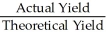 × 100%.
E)All of the above are true statements.
A)The limiting reactant is completely consumed in a chemical reaction.
B)The theoretical yield is the amount of product that can be made based on the amount of limiting reagent.
C)The actual yield is the amount of product actually produced by a chemical reaction.
D)The percent yield =
× 100%.E)All of the above are true statements.
Question
Question
Question
Question
Question
Question
Question

Unlock Deck
Sign up to unlock the cards in this deck!
Unlock Deck
Unlock Deck
1/115

Play

Full screen (f)
Deck 8: Quantities in Chemical Reactions
1
The primary greenhouse gas is carbon dioxide.
True
2
Given the reaction: 2 Na(s)+ Cl2(g)→ 2 NaCl(s)
The conversion factor for chlorine gas to sodium metal is: 2 mol Cl ≡ 2 mol Na
The conversion factor for chlorine gas to sodium metal is: 2 mol Cl ≡ 2 mol Na
False
3
Given the recipe: 2 cups flour + 1 egg + 3 oz blueberries → 4 muffins.
You can make 1 dozen muffins from 3 eggs.
You can make 1 dozen muffins from 3 eggs.
True
4
The percent yield is calculated by dividing the actual yield by the theoretical yield times 100.
Unlock Deck
Unlock for access to all 115 flashcards in this deck.
Unlock Deck
k this deck
5
The limiting reactant is the product that is completely consumed in a chemical reaction.
Unlock Deck
Unlock for access to all 115 flashcards in this deck.
Unlock Deck
k this deck
6
Before determining conversion factors,it is necessary to make sure the equation is properly balanced.
Unlock Deck
Unlock for access to all 115 flashcards in this deck.
Unlock Deck
k this deck
7
One of the advantages of burning fossil fuels is that it produces O2 for humans to breathe.
Unlock Deck
Unlock for access to all 115 flashcards in this deck.
Unlock Deck
k this deck
8
Stoichiometry is a chemist's version of following a recipe.
Unlock Deck
Unlock for access to all 115 flashcards in this deck.
Unlock Deck
k this deck
9
If it takes 2 cups of milk and 1 cup of cocoa mix to make three servings of hot chocolate,and you only have 1 cup of each,then you cannot make any hot chocolate.
Unlock Deck
Unlock for access to all 115 flashcards in this deck.
Unlock Deck
k this deck
10
Global warming is due to the greenhouse gases preventing heat from Earth escaping into space.
Unlock Deck
Unlock for access to all 115 flashcards in this deck.
Unlock Deck
k this deck
11
Given the reaction: 2 Na(s)+ Cl2(g)→ 2 NaCl(s)
The conversion factor for chlorine gas to sodium chloride is: 1 mol Cl2 ≡ 2 mol NaCl
The conversion factor for chlorine gas to sodium chloride is: 1 mol Cl2 ≡ 2 mol NaCl
Unlock Deck
Unlock for access to all 115 flashcards in this deck.
Unlock Deck
k this deck
12
The theoretical yield is the amount of each reactant needed in order to make the maximum amount of product.
Unlock Deck
Unlock for access to all 115 flashcards in this deck.
Unlock Deck
k this deck
13
The limiting reactant is the reactant that produces the maximum amount of product.
Unlock Deck
Unlock for access to all 115 flashcards in this deck.
Unlock Deck
k this deck
14
The primary source for the rising carbon dioxide levels is respiration of the Earth's growing population.
Unlock Deck
Unlock for access to all 115 flashcards in this deck.
Unlock Deck
k this deck
15
The conversion factor between mass and moles for a compound is the molar mass.
Unlock Deck
Unlock for access to all 115 flashcards in this deck.
Unlock Deck
k this deck
16
The actual yield is the amount of product actually produced by a chemical reaction.
Unlock Deck
Unlock for access to all 115 flashcards in this deck.
Unlock Deck
k this deck
17
Greenhouse gases affect the temperature of the earth by blocking sunlight from reaching earth.
Unlock Deck
Unlock for access to all 115 flashcards in this deck.
Unlock Deck
k this deck
18
Given the chemical equation: 2 Ca + O2 → 2 CaO,
if 2 moles of CaO are formed in this reaction,then 2 moles of O2 must have reacted.
if 2 moles of CaO are formed in this reaction,then 2 moles of O2 must have reacted.
Unlock Deck
Unlock for access to all 115 flashcards in this deck.
Unlock Deck
k this deck
19
The conversion factor for moles of carbon dioxide to mass of carbon dioxide is:
1 mole CO2 ≡ 44.01 g.
1 mole CO2 ≡ 44.01 g.
Unlock Deck
Unlock for access to all 115 flashcards in this deck.
Unlock Deck
k this deck
20
Given the recipe: 2 cups flour + 1 egg + 3 oz blueberries → 4 muffins.
You can make 9 muffins from 3.5 cups of flour.
You can make 9 muffins from 3.5 cups of flour.
Unlock Deck
Unlock for access to all 115 flashcards in this deck.
Unlock Deck
k this deck
21
Given the recipe: 2 cups flour + 1 egg + 3 oz blueberries → 4 muffins
If you have 5 cups of flour,3 eggs and plenty of blueberries,the limiting reactant is the eggs.
If you have 5 cups of flour,3 eggs and plenty of blueberries,the limiting reactant is the eggs.
Unlock Deck
Unlock for access to all 115 flashcards in this deck.
Unlock Deck
k this deck
22
The percent yield can never be greater than 100%.
Unlock Deck
Unlock for access to all 115 flashcards in this deck.
Unlock Deck
k this deck
23
Given the following generic equation,2 A + 3B → A2B3 △H rxn = +444 kJ,if you completely reacted 1 mole of compound A,the amount of heat absorbed would be 222 kJ.
Unlock Deck
Unlock for access to all 115 flashcards in this deck.
Unlock Deck
k this deck
24
If the theoretical yield of a reaction is 144 grams and the actual yield of the reaction is 72 grams,the percent yield of the reaction is 200%.
Unlock Deck
Unlock for access to all 115 flashcards in this deck.
Unlock Deck
k this deck
25
Given the recipe: 2 cups flour + 1 egg + 3 oz blueberries → 4 muffins
If you have 9 cups of flour,4 eggs and plenty of blueberries,the theoretical yield of muffins is 16.
If you have 9 cups of flour,4 eggs and plenty of blueberries,the theoretical yield of muffins is 16.
Unlock Deck
Unlock for access to all 115 flashcards in this deck.
Unlock Deck
k this deck
26
The limiting reactant determines what the actual yield is.
Unlock Deck
Unlock for access to all 115 flashcards in this deck.
Unlock Deck
k this deck
27
For the following reaction you have 8 grams of hydrogen and 2 grams of oxygen.
2H2 + O2 → 2H2O
The limiting reagent is the oxygen.
2H2 + O2 → 2H2O
The limiting reagent is the oxygen.
Unlock Deck
Unlock for access to all 115 flashcards in this deck.
Unlock Deck
k this deck
28
The limiting reactant is not necessarily the reactant with the least mass.
Unlock Deck
Unlock for access to all 115 flashcards in this deck.
Unlock Deck
k this deck
29
For the following reaction you have 8 grams of hydrogen and 2 grams of oxygen.
2H2 + O2 → 2H2O
The theoretical yield of the reaction is 4 grams of water.
2H2 + O2 → 2H2O
The theoretical yield of the reaction is 4 grams of water.
Unlock Deck
Unlock for access to all 115 flashcards in this deck.
Unlock Deck
k this deck
30
The average global temperature depends on all factors EXCEPT what?
A)the amount of incoming sunlight
B)the amount of outgoing heat lost to space
C)the amount of greenhouse gases
D)the angle of the earth's surface in relation to the incoming sunlight
E)All of the above are factors.
A)the amount of incoming sunlight
B)the amount of outgoing heat lost to space
C)the amount of greenhouse gases
D)the angle of the earth's surface in relation to the incoming sunlight
E)All of the above are factors.
Unlock Deck
Unlock for access to all 115 flashcards in this deck.
Unlock Deck
k this deck
31
Which of the below statements about global warming is FALSE?
A)Some greenhouses gases are needed to keep the proper temperature balance.
B)Greenhouse gases prevent heat from leaving the earth.
C)Greenhouse gases allow sunlight to reach and heat the earth.
D)If the level of greenhouse gases increases,the temperature will decrease.
E)none of the above
A)Some greenhouses gases are needed to keep the proper temperature balance.
B)Greenhouse gases prevent heat from leaving the earth.
C)Greenhouse gases allow sunlight to reach and heat the earth.
D)If the level of greenhouse gases increases,the temperature will decrease.
E)none of the above
Unlock Deck
Unlock for access to all 115 flashcards in this deck.
Unlock Deck
k this deck
32
Since heat must be supplied to melt ice,the melting of ice is an endothermic process and so has a positive enthalpy value.
Unlock Deck
Unlock for access to all 115 flashcards in this deck.
Unlock Deck
k this deck
33
The actual yield is the same as the theoretical yield if the reaction goes to completion and there is no loss of product.
Unlock Deck
Unlock for access to all 115 flashcards in this deck.
Unlock Deck
k this deck
34
An exothermic reaction has a negative enthalpy of reaction.
Unlock Deck
Unlock for access to all 115 flashcards in this deck.
Unlock Deck
k this deck
35
The primary cause of increasing greenhouse gases is:
A)the burning of vast amounts of rain forests.
B)the production of CO2 by respiration.
C)the increased use of natural gas,petroleum and coal.
D)the release of CO2 by decreasing solubility in the ocean.
E)none of the above
A)the burning of vast amounts of rain forests.
B)the production of CO2 by respiration.
C)the increased use of natural gas,petroleum and coal.
D)the release of CO2 by decreasing solubility in the ocean.
E)none of the above
Unlock Deck
Unlock for access to all 115 flashcards in this deck.
Unlock Deck
k this deck
36
When viewing a chemical equation,the limiting reactant can never be a chemical on the product side of the equation.
Unlock Deck
Unlock for access to all 115 flashcards in this deck.
Unlock Deck
k this deck
37
Which of the following is TRUE?
A)Stoichiometry shows the numerical relationship between chemical quantities in a balanced chemical equation.
B)Stoichiometry allows prediction of the amounts of products that form in a chemical reaction based on the amounts of reactants.
C)Stoichiometry allows prediction of how much of the reactants are necessary to form a given amount of product.
D)All of the above are true.
E)None of the above are true.
A)Stoichiometry shows the numerical relationship between chemical quantities in a balanced chemical equation.
B)Stoichiometry allows prediction of the amounts of products that form in a chemical reaction based on the amounts of reactants.
C)Stoichiometry allows prediction of how much of the reactants are necessary to form a given amount of product.
D)All of the above are true.
E)None of the above are true.
Unlock Deck
Unlock for access to all 115 flashcards in this deck.
Unlock Deck
k this deck
38
For the following reaction you have 8 grams of hydrogen and 2 grams of oxygen.
2H2 + O2 → 2H2O
The excess reactant is the oxygen.
2H2 + O2 → 2H2O
The excess reactant is the oxygen.
Unlock Deck
Unlock for access to all 115 flashcards in this deck.
Unlock Deck
k this deck
39
Thermal energy flows into the reaction and out of the surroundings in an endothermic reaction.
Unlock Deck
Unlock for access to all 115 flashcards in this deck.
Unlock Deck
k this deck
40
The enthalpy of reaction,△H rxn,is the amount of thermal energy that flows when a reaction occurs at constant temperature.
Unlock Deck
Unlock for access to all 115 flashcards in this deck.
Unlock Deck
k this deck
41
How many waffles can be made from 1 dozen eggs,assuming you have enough of all other ingredients?
Given: 2 cups flour + 3 eggs + 1 tbs oil → 4 waffles
A)48
B)12
C)4
D)16
E)not enough information
Given: 2 cups flour + 3 eggs + 1 tbs oil → 4 waffles
A)48
B)12
C)4
D)16
E)not enough information
Unlock Deck
Unlock for access to all 115 flashcards in this deck.
Unlock Deck
k this deck
42
Suppose two chemical reactions are linked together in a way that the O2 produced in the first reaction goes on to react completely with Mg to form MgO in the second reaction. Reaction one:
2 KClO3 → 3 O2 + 2 KCl
Reaction two: 2 Mg + O2 → 2 MgO
If you start with 4 moles of KClO3,how many moles of MgO could eventually form?
A)2 moles
B)4 moles
C)6 moles
D)12 moles
E)none of the above
2 KClO3 → 3 O2 + 2 KCl
Reaction two: 2 Mg + O2 → 2 MgO
If you start with 4 moles of KClO3,how many moles of MgO could eventually form?
A)2 moles
B)4 moles
C)6 moles
D)12 moles
E)none of the above
Unlock Deck
Unlock for access to all 115 flashcards in this deck.
Unlock Deck
k this deck
43
How many grams of water are made from the reaction of 16.0 grams of oxygen gas?
Given the reaction: 2H2 + O2 → 2H2O
A)18
B)9
C)36
D)16
E)not enough information
Given the reaction: 2H2 + O2 → 2H2O
A)18
B)9
C)36
D)16
E)not enough information
Unlock Deck
Unlock for access to all 115 flashcards in this deck.
Unlock Deck
k this deck
44
Diatomic O2 can react with the element magnesium to form magnesium oxide (MgO).The balanced chemical equation is:
If 4 moles of magnesium totally reacted with more than enough O2,how many moles of MgO would be expected to form?
A)1 mole
B)2 moles
C)4 moles
D)8 moles
E)not enough information
If 4 moles of magnesium totally reacted with more than enough O2,how many moles of MgO would be expected to form?
A)1 mole
B)2 moles
C)4 moles
D)8 moles
E)not enough information
Unlock Deck
Unlock for access to all 115 flashcards in this deck.
Unlock Deck
k this deck
45
Given that 4 NH3 + 5 O2 → 4 NO + 6 H2O,when 4.50 mol of H2O are formed,the amount of NO formed is:
A)1.50 mol.
B)3.00 mol.
C)4.50 mol.
D)6.75 mol.
E)none of the above
A)1.50 mol.
B)3.00 mol.
C)4.50 mol.
D)6.75 mol.
E)none of the above
Unlock Deck
Unlock for access to all 115 flashcards in this deck.
Unlock Deck
k this deck
46
How many grams of sodium metal are needed to make 29.3 grams of sodium chloride? Given the reaction:
2Na + Cl2 → 2NaCl
A)46.0
B)5.75
C)23.0
D)11.5
E)not enough information
2Na + Cl2 → 2NaCl
A)46.0
B)5.75
C)23.0
D)11.5
E)not enough information
Unlock Deck
Unlock for access to all 115 flashcards in this deck.
Unlock Deck
k this deck
47
How many moles of water are made from complete reaction of 2.2 moles of oxygen gas with hydrogen gas?
Given the reaction:
2H2 + O2 → 2H2O
A)4.4
B)1.1
C)2.2
D)3.3
E)not enough information
Given the reaction:
2H2 + O2 → 2H2O
A)4.4
B)1.1
C)2.2
D)3.3
E)not enough information
Unlock Deck
Unlock for access to all 115 flashcards in this deck.
Unlock Deck
k this deck
48
How many moles of aluminum are needed to make 9 moles of molecular hydrogen? Given the reaction:
2 Al + 6 HCl → 2 AlCl3 + 3H2
A)2 moles
B)3 moles
C)4 moles
D)6 moles
E)none of the above
2 Al + 6 HCl → 2 AlCl3 + 3H2
A)2 moles
B)3 moles
C)4 moles
D)6 moles
E)none of the above
Unlock Deck
Unlock for access to all 115 flashcards in this deck.
Unlock Deck
k this deck
49
How many moles of chlorine gas are needed to make 0.6 moles of sodium chloride? Given the reaction:
2Na + Cl2 → 2NaCl
A)0.6
B)0.3
C)1.2
D)3.6
E)not enough information
2Na + Cl2 → 2NaCl
A)0.6
B)0.3
C)1.2
D)3.6
E)not enough information
Unlock Deck
Unlock for access to all 115 flashcards in this deck.
Unlock Deck
k this deck
50
How many grams of chlorine gas are needed to make 117 grams of sodium chloride?
Given the reaction:
2Na + Cl2 → 2NaCl
A)71.0
B)142
C)35.5
D)48.2
E)not enough information
Given the reaction:
2Na + Cl2 → 2NaCl
A)71.0
B)142
C)35.5
D)48.2
E)not enough information
Unlock Deck
Unlock for access to all 115 flashcards in this deck.
Unlock Deck
k this deck
51
Diatomic N2 can react with diatomic H2 to form ammonia (NH3).The balanced chemical equation is:
If 6 moles of H2 totally reacted with more than enough N2,how many moles of ammonia would be expected to form?
A)2 moles
B)3 moles
C)4 moles
D)6 moles
E)not enough information
If 6 moles of H2 totally reacted with more than enough N2,how many moles of ammonia would be expected to form?
A)2 moles
B)3 moles
C)4 moles
D)6 moles
E)not enough information
Unlock Deck
Unlock for access to all 115 flashcards in this deck.
Unlock Deck
k this deck
52
How many grams of water are made from the reaction of 4.0 grams of hydrogen gas?
Given the reaction: 2H2 + O2 → 2H2O
A)18
B)72
C)36
D)4.5
E)not enough information
Given the reaction: 2H2 + O2 → 2H2O
A)18
B)72
C)36
D)4.5
E)not enough information
Unlock Deck
Unlock for access to all 115 flashcards in this deck.
Unlock Deck
k this deck
53
How many eggs are needed to make 1 dozen waffles,assuming you have enough of all other ingredients?
Given: 2 cups flour + 3 eggs + 1 tbs oil → 4 waffles
A)48
B)9
C)12
D)16
E)not enough information
Given: 2 cups flour + 3 eggs + 1 tbs oil → 4 waffles
A)48
B)9
C)12
D)16
E)not enough information
Unlock Deck
Unlock for access to all 115 flashcards in this deck.
Unlock Deck
k this deck
54
Given that 4 NH3 + 5 O2 → 4 NO + 6 H2O,if 3.00 mol NH3 were made to react with excess of oxygen gas,the amount of H2O formed would be:
A)2.00 mol.
B)3.00 mol.
C)4.50 mol.
D)6.00 mol.
E)none of the above
A)2.00 mol.
B)3.00 mol.
C)4.50 mol.
D)6.00 mol.
E)none of the above
Unlock Deck
Unlock for access to all 115 flashcards in this deck.
Unlock Deck
k this deck
55
How many moles of sodium metal are needed to make 3.6 moles of sodium chloride? Given the reaction:
2Na + Cl2 → 2NaCl
A)0.9
B)7.2
C)1.8
D)3.6
E)not enough information
2Na + Cl2 → 2NaCl
A)0.9
B)7.2
C)1.8
D)3.6
E)not enough information
Unlock Deck
Unlock for access to all 115 flashcards in this deck.
Unlock Deck
k this deck
56
Many metals react with halogens to give metal halides.For example, 2 Al (s)+ 3 Cl2(g)→ 2 AlCl3 (s)
If you begin with 13.5 g of aluminum:
A)you will need 23.6 g Cl2 for complete reaction and will produce 66.7 g of AlCl3.
B)you will need 53.2 g Cl2 for complete reaction and will produce 66.7 g of AlCl3.
C)you will need 26.6 g Cl2 for complete reaction and will produce 49.0 g of AlCl3.
D)you will need 11.8 g Cl2 for complete reaction and will produce 49.0 g of AlCl3.
E)none of the above
If you begin with 13.5 g of aluminum:
A)you will need 23.6 g Cl2 for complete reaction and will produce 66.7 g of AlCl3.
B)you will need 53.2 g Cl2 for complete reaction and will produce 66.7 g of AlCl3.
C)you will need 26.6 g Cl2 for complete reaction and will produce 49.0 g of AlCl3.
D)you will need 11.8 g Cl2 for complete reaction and will produce 49.0 g of AlCl3.
E)none of the above
Unlock Deck
Unlock for access to all 115 flashcards in this deck.
Unlock Deck
k this deck
57
How many moles of water are made from complete reaction of 1.4 moles of hydrogen gas? Given the reaction:
2H2 + O2 → 2H2O
A)2.8
B)0.7
C)1.4
D)2.1
E)not enough information
2H2 + O2 → 2H2O
A)2.8
B)0.7
C)1.4
D)2.1
E)not enough information
Unlock Deck
Unlock for access to all 115 flashcards in this deck.
Unlock Deck
k this deck
58
Given the balanced equation CH4 + 2 O2 → CO2 + 2 H2O,which of the following is NOT a correct conversion factor?
A)2 mole H2O = 18.02 g
B)1 mole O2 = 32.00 g
C)1 mole CH4 2 mole H2O
D)2 mole O2 1 mole CO2
E)none of the above
A)2 mole H2O = 18.02 g
B)1 mole O2 = 32.00 g
C)1 mole CH4
2 mole H2OD)2 mole O2
1 mole CO2E)none of the above
Unlock Deck
Unlock for access to all 115 flashcards in this deck.
Unlock Deck
k this deck
59
Iron metal reacts with oxygen to produce iron(III)oxide.If you have 12.0 moles of iron for complete reaction,you need:
A)9.0 moles of O2 and produce 3.0 moles of Fe2O3.
B)12.0 moles of O2 and produce 24.0 moles of Fe2O3.
C)9.0 moles of O2 and produce 6.0 moles of Fe2O3.
D)4.5 moles of O2 and produce 3.0 moles of Fe2O3.
E)none of the above
A)9.0 moles of O2 and produce 3.0 moles of Fe2O3.
B)12.0 moles of O2 and produce 24.0 moles of Fe2O3.
C)9.0 moles of O2 and produce 6.0 moles of Fe2O3.
D)4.5 moles of O2 and produce 3.0 moles of Fe2O3.
E)none of the above
Unlock Deck
Unlock for access to all 115 flashcards in this deck.
Unlock Deck
k this deck
60
How many moles of H2 can be made from complete reaction of 3.0 moles of Al? Given:
2 Al + 6 HCl → 2 AlCl3 + 3 H2
A)3 moles
B)3.0 moles
C)4.5 moles
D)9.0 moles
E)none of the above
2 Al + 6 HCl → 2 AlCl3 + 3 H2
A)3 moles
B)3.0 moles
C)4.5 moles
D)9.0 moles
E)none of the above
Unlock Deck
Unlock for access to all 115 flashcards in this deck.
Unlock Deck
k this deck
61
Given the balanced equation CO2 + Si → SiO2 + C,if you were to react 1 mole of CO2 with 1 mole of Si,which statement is TRUE?
A)The CO2 is the limiting reactant.
B)The Si is the limiting reactant.
C)The SiO2 is the limiting reactant.
D)You have equal stoichiometric amounts of reactants.
E)none of the above
A)The CO2 is the limiting reactant.
B)The Si is the limiting reactant.
C)The SiO2 is the limiting reactant.
D)You have equal stoichiometric amounts of reactants.
E)none of the above
Unlock Deck
Unlock for access to all 115 flashcards in this deck.
Unlock Deck
k this deck
62
Which ingredient is the limiting reactant if you have 6 cups of flour,9 eggs and 2 tbs of oil? Given: 2 cups flour + 3 eggs + 1 tbs oil → 4 waffles
A)flour
B)eggs
C)oil
D)waffles
E)not enough information
A)flour
B)eggs
C)oil
D)waffles
E)not enough information
Unlock Deck
Unlock for access to all 115 flashcards in this deck.
Unlock Deck
k this deck
63
Which ingredient is the limiting reactant if you have 5 cups of flour,9 eggs and 3 tbs of oil? Given: 2 cups flour + 3 eggs + 1 tbs oil → 4 waffles
A)flour
B)eggs
C)oil
D)waffles
E)not enough information
A)flour
B)eggs
C)oil
D)waffles
E)not enough information
Unlock Deck
Unlock for access to all 115 flashcards in this deck.
Unlock Deck
k this deck
64
How many grams of NO2 are theoretically produced if we start with 1.20 moles of S and 9.90 moles of HNO3?
Reaction: S + 6HNO3 → H2SO4 + 6NO2 + 2H2O
A)7.20
B)331
C)455
D)786
E)not enough information
Reaction: S + 6HNO3 → H2SO4 + 6NO2 + 2H2O
A)7.20
B)331
C)455
D)786
E)not enough information
Unlock Deck
Unlock for access to all 115 flashcards in this deck.
Unlock Deck
k this deck
65
What is the theoretical yield of a reaction if 25.0 grams of product were actually produced from a reaction that has a 88% yield?
A)28.4
B)22.0
C)3.52
D)352
E)none of the above
A)28.4
B)22.0
C)3.52
D)352
E)none of the above
Unlock Deck
Unlock for access to all 115 flashcards in this deck.
Unlock Deck
k this deck
66
A balanced chemical equation used to prepare ammonium carbonate,(NH4)2CO3 ,is:
Which choice of reactant quantities shown below would result in the greatest amount of ammonium carbonate being formed?
A)React 2 moles NH3 ,1 mole CO2 ,and 1 mole H2O
B)React 2 moles NH3 ,8 moles CO2 ,and 8 moles H2O
C)React 4 moles NH3 ,1 mole CO2 ,and 2 moles H2O
D)React 4 moles NH3 ,2 moles CO2 ,and 2 moles H2O
E)none of the above
Which choice of reactant quantities shown below would result in the greatest amount of ammonium carbonate being formed?
A)React 2 moles NH3 ,1 mole CO2 ,and 1 mole H2O
B)React 2 moles NH3 ,8 moles CO2 ,and 8 moles H2O
C)React 4 moles NH3 ,1 mole CO2 ,and 2 moles H2O
D)React 4 moles NH3 ,2 moles CO2 ,and 2 moles H2O
E)none of the above
Unlock Deck
Unlock for access to all 115 flashcards in this deck.
Unlock Deck
k this deck
67
What is the limiting reactant for the following reaction given we have 3.4 moles of Ca(NO3)2 and 2.4 moles of Li3PO4?
Reaction: 3Ca(NO3)2 + 2Li3PO4 → 6LiNO3 + Ca3(PO4)2
A)Ca(NO3)2
B)Li3PO4
C)LiNO3
D)Ca3(PO4)2
E)not enough information
Reaction: 3Ca(NO3)2 + 2Li3PO4 → 6LiNO3 + Ca3(PO4)2
A)Ca(NO3)2
B)Li3PO4
C)LiNO3
D)Ca3(PO4)2
E)not enough information
Unlock Deck
Unlock for access to all 115 flashcards in this deck.
Unlock Deck
k this deck
68
What is the excess reactant for the following reaction given we have 3.4 moles of Ca(NO3)2 and 2.4 moles of Li3PO4?
Reaction: 3Ca(NO3)2 + 2Li3PO4 → 6LiNO3 + Ca3(PO4)2
A)Ca(NO3)2
B)Li3PO4
C)LiNO3
D)Ca3(PO4)2
E)not enough information
Reaction: 3Ca(NO3)2 + 2Li3PO4 → 6LiNO3 + Ca3(PO4)2
A)Ca(NO3)2
B)Li3PO4
C)LiNO3
D)Ca3(PO4)2
E)not enough information
Unlock Deck
Unlock for access to all 115 flashcards in this deck.
Unlock Deck
k this deck
69
What is the theoretical yield of waffles if you have 6 cups of flour,9 eggs and 2 tbs of oil? Given: 2 cups flour + 3 eggs + 1 tbs oil → 4 waffles
A)10
B)12
C)8
D)4
E)not enough information
A)10
B)12
C)8
D)4
E)not enough information
Unlock Deck
Unlock for access to all 115 flashcards in this deck.
Unlock Deck
k this deck
70
What is the theoretical yield of waffles if you have 5 cups of flour,9 eggs and 3 tbs of oil? Given: 2 cups flour + 3 eggs + 1 tbs oil → 4 waffles
A)10
B)12
C)6
D)4
E)not enough information
A)10
B)12
C)6
D)4
E)not enough information
Unlock Deck
Unlock for access to all 115 flashcards in this deck.
Unlock Deck
k this deck
71
A tricycle factory uses the following items to produce one tricycle: 3 tires,1 frame,and 2 pedals. If the factory has available 270 tires,90 frames,and 170 pedals,which item would limit the amount of complete tricycles that can be assembled?
A)tires
B)frames
C)pedals
D)both tires and frames are limiting
E)not enough information
A)tires
B)frames
C)pedals
D)both tires and frames are limiting
E)not enough information
Unlock Deck
Unlock for access to all 115 flashcards in this deck.
Unlock Deck
k this deck
72
Determine the theoretical yield of C when 3 units of A and 10 units of B are reacted in the following generic chemical equation: 2A + 5B → 4C.
A)3
B)4
C)6
D)8
E)none of the above
A)3
B)4
C)6
D)8
E)none of the above
Unlock Deck
Unlock for access to all 115 flashcards in this deck.
Unlock Deck
k this deck
73
Which of the following statements is false?
A)The limiting reactant is completely consumed in a chemical reaction.
B)The theoretical yield is the amount of product that can be made based on the amount of limiting reagent.
C)The actual yield is the amount of product actually produced by a chemical reaction.
D)The percent yield = × 100%.
E)All of the above are true statements.
A)The limiting reactant is completely consumed in a chemical reaction.
B)The theoretical yield is the amount of product that can be made based on the amount of limiting reagent.
C)The actual yield is the amount of product actually produced by a chemical reaction.
D)The percent yield =
× 100%.E)All of the above are true statements.
Unlock Deck
Unlock for access to all 115 flashcards in this deck.
Unlock Deck
k this deck
74
Consider the following generic chemical equation: 2A + 5B → C + 3D If you react 4 units of A with 10 units of B,which statement is TRUE?
A)Substance A will be the limiting reactant.
B)Substance B will be the limiting reactant.
C)There is just enough of A and B so that everything reacts completely.
D)Substance C cannot be formed from this reaction.
E)none of the above
A)Substance A will be the limiting reactant.
B)Substance B will be the limiting reactant.
C)There is just enough of A and B so that everything reacts completely.
D)Substance C cannot be formed from this reaction.
E)none of the above
Unlock Deck
Unlock for access to all 115 flashcards in this deck.
Unlock Deck
k this deck
75
If the theoretical yield of a reaction is 42.0 grams of product and the percent yield is 75%.How many grams were actually produced?
A)5400
B)56
C)32
D)1.8
E)none of the above
A)5400
B)56
C)32
D)1.8
E)none of the above
Unlock Deck
Unlock for access to all 115 flashcards in this deck.
Unlock Deck
k this deck
76
Consider the following generic chemical equation: 2W + 3X → 3Y + Z When 5 units of W and 6 units of X are allowed to react,the limiting reactant would be:
A)W
B)X
C)Y
D)Z
E)There is no limiting reactant in this situation.
A)W
B)X
C)Y
D)Z
E)There is no limiting reactant in this situation.
Unlock Deck
Unlock for access to all 115 flashcards in this deck.
Unlock Deck
k this deck
77
The theoretical yield of a reaction is 75.0 grams of product and the actual yield is 42.0g.What is the percent yield?
A)75.0
B)56.0
C)31.5
D)178
E)none of the above
A)75.0
B)56.0
C)31.5
D)178
E)none of the above
Unlock Deck
Unlock for access to all 115 flashcards in this deck.
Unlock Deck
k this deck
78
A chemist wishes to perform the following reaction: N2 + 3 H2 → 2 NH3 If only 14.0 g of N2 is available,what is the minimum amount,in grams,of H2 needed to completely react with this quantity of N2?
A)1.01 g
B)1.51 g
C)3.03 g
D)6.06 g
E)none of the above
A)1.01 g
B)1.51 g
C)3.03 g
D)6.06 g
E)none of the above
Unlock Deck
Unlock for access to all 115 flashcards in this deck.
Unlock Deck
k this deck
79
How many grams of calcium phosphate are theoretically produced if we start with 3.40 moles of Ca(NO3)2 and 2.40 moles of Li3PO4?
Reaction: 3Ca(NO3)2 + 2Li3PO4 → 6LiNO3 + Ca3(PO4)2
A)310
B)248
C)1054
D)351
E)not enough information
Reaction: 3Ca(NO3)2 + 2Li3PO4 → 6LiNO3 + Ca3(PO4)2
A)310
B)248
C)1054
D)351
E)not enough information
Unlock Deck
Unlock for access to all 115 flashcards in this deck.
Unlock Deck
k this deck
80
How many moles of lithium nitrate are theoretically produced if we start with 3.4 moles of Ca(NO3)2 and 2.4 moles of Li3PO4?
Reaction: 3Ca(NO3)2 + 2Li3PO4 → 6LiNO3 + Ca3(PO4)2
A)7.2
B)6.8
C)1.2
D)1.1
E)not enough information
Reaction: 3Ca(NO3)2 + 2Li3PO4 → 6LiNO3 + Ca3(PO4)2
A)7.2
B)6.8
C)1.2
D)1.1
E)not enough information
Unlock Deck
Unlock for access to all 115 flashcards in this deck.
Unlock Deck
k this deck
Unlock Deck
Unlock for access to all 115 flashcards in this deck.






