







 Chat with AI

Deck 13: A House Divided, 1840-1861
Full screen (f)

Question

Question
Question
Question
Question
Question
Slave Catcher Poster (1851)
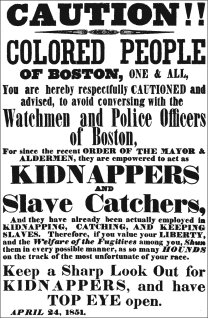
Why did tensions remain after the Compromise of 1850?
A) The Supreme Court ruled the compromise unconstitutional.
B) Fighting over slavery had begun to spread into new territories.
C) The South took great liberties in the enforcement of the fugitive slave law.
D) The slavery issue had not been adequately resolved by the compromise.
Why did tensions remain after the Compromise of 1850?
A) The Supreme Court ruled the compromise unconstitutional.
B) Fighting over slavery had begun to spread into new territories.
C) The South took great liberties in the enforcement of the fugitive slave law.
D) The slavery issue had not been adequately resolved by the compromise.
Question
Map: The Compromise of 1850
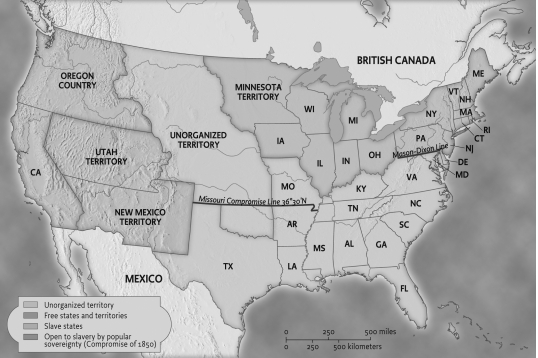
Which of the following was a significant cause of the political boundaries depicted in the map?
A) The outbreak of the Civil War led to the drawing of new boundaries.
B) Congress became involved in disputes to encourage settlers to move west.
C) The Mexican Cession led to heated controversies over whether to allow slavery there.
D) The Supreme Court intervened in boundary disputes in order to settle them.
Which of the following was a significant cause of the political boundaries depicted in the map?
A) The outbreak of the Civil War led to the drawing of new boundaries.
B) Congress became involved in disputes to encourage settlers to move west.
C) The Mexican Cession led to heated controversies over whether to allow slavery there.
D) The Supreme Court intervened in boundary disputes in order to settle them.
Question
Question
Question
Map: The Compromise of 1850
The compromise depicted in the map was supported by which of the following groups?
A) those who wished to remain isolationist
B) northerners who wanted to preserve the union
C) those who wished to abolish slavery
D) southerners who wanted to protect their interests
The compromise depicted in the map was supported by which of the following groups?
A) those who wished to remain isolationist
B) northerners who wanted to preserve the union
C) those who wished to abolish slavery
D) southerners who wanted to protect their interests
Question
Question
Question
Slave Catcher Poster (1851)
Debates around issues like those depicted in the poster
A) were responsible for the end of the Second Party System.
B) greatly increased the national debt.
C) made it impossible for industry to develop in the United States.
D) prevented women from advocating for their own rights and suffrage.
Debates around issues like those depicted in the poster
A) were responsible for the end of the Second Party System.
B) greatly increased the national debt.
C) made it impossible for industry to develop in the United States.
D) prevented women from advocating for their own rights and suffrage.
Question
Slave Catcher Poster (1851)
The existence of this poster provides evidence that
A) southerners were not abiding by the terms of the new Fugitive Slave Act.
B) abolitionists' concerns that the new Fugitive Slave Act would allow slave catchers to spread into the North were justified.
C) the Democratic Party was now clearly a proslavery party.
D) the Supreme Court had sided with the proslavery argument.
The existence of this poster provides evidence that
A) southerners were not abiding by the terms of the new Fugitive Slave Act.
B) abolitionists' concerns that the new Fugitive Slave Act would allow slave catchers to spread into the North were justified.
C) the Democratic Party was now clearly a proslavery party.
D) the Supreme Court had sided with the proslavery argument.
Question
Question
Question
Slave Catcher Poster (1851)
The failure of the new fugitive slave law to resolve the issue of slavery
A) was exacerbated by the Supreme Court's controversial decision that slaves were property.
B) paved the way for a solution based on popular sovereignty.
C) was eventually the catalyst for secession by the South.
D) was successfully addressed by the concept of popular sovereignty.
The failure of the new fugitive slave law to resolve the issue of slavery
A) was exacerbated by the Supreme Court's controversial decision that slaves were property.
B) paved the way for a solution based on popular sovereignty.
C) was eventually the catalyst for secession by the South.
D) was successfully addressed by the concept of popular sovereignty.
Question
Map: The Compromise of 1850
Which of the following was an important outcome of the compromise depicted in the map?
A) Instead of reducing conflict, it created more of it.
B) Southerners seceded from the Union.
C) Northerners began to make more concessions to the South.
D) No further compromise was needed.
Which of the following was an important outcome of the compromise depicted in the map?
A) Instead of reducing conflict, it created more of it.
B) Southerners seceded from the Union.
C) Northerners began to make more concessions to the South.
D) No further compromise was needed.
Question
Question
Question
Question
Question
Question
Question
Question
Question
Question
Question
Question
Question
Question
Question
Question
Question
Question
Question
Question
Question
Question
Question
Question
Question
Question
Question
Question
Question
Question
Question
Question
Question
Question
Question
Question
Question
Question
Question
Question
Question
Question
Question
Question
Question
Question
Question
Question
Question
Question
Question
Question
Question
Question
Question
Question
Question
Question
Question
Question
Question
Question

Unlock Deck
Sign up to unlock the cards in this deck!
Unlock Deck
Unlock Deck
1/87

Play

Full screen (f)
Deck 13: A House Divided, 1840-1861
1
Why did slavery become more central to American politics in the 1840s?
A) The Methodist Church, the nation's largest denomination, called on all its members to free their slaves.
B) Territorial expansion raised the question of whether new lands should be free or slave.
C) Members of the abolitionist Republican Party, formed in 1844, insisted on debating slavery.
D) President John Tyler's antislavery policies caused a major proslavery backlash led by John C. Calhoun.
A) The Methodist Church, the nation's largest denomination, called on all its members to free their slaves.
B) Territorial expansion raised the question of whether new lands should be free or slave.
C) Members of the abolitionist Republican Party, formed in 1844, insisted on debating slavery.
D) President John Tyler's antislavery policies caused a major proslavery backlash led by John C. Calhoun.
Territorial expansion raised the question of whether new lands should be free or slave.
2
A Pioneer Woman's Westward Journey (1849)
Catherine Haun
Our caravan had a good many women and children and although we were probably longer on the journey owing to their presence-they exerted a good influence, as the men did not take such risks with Indians and thereby avoided conflict; were more alert about the care of the teams and seldom had accidents; more attention was paid to cleanliness and sanitation and, lastly but not of less importance, the meals were more regular and better cooked thus preventing much sickness and their was less waste of food. . . .
During the entire trip the Indians were a source of anxiety, we being never sure of their friendship. Secret dread and alert watchfulness seemed always necessary for after we left the prairies they were more treacherous and numerous. . . .
We had not traveled many miles in the Black Hills . . . before we realized that our loads would have to be lightened as the animals were not able to draw the heavily laden wagons over the slippery steep roads. We were obliged to sacrifice most of our merchandise that was intended for our stock in trade in California and left it by the wayside; burying the barrels of alcohol least the Indians should drink it and frenzied thereby might follow and attack us. . . .
During and after the Civil War, movements of people like the ones described in this passage were
A) opposed by industrialists.
B) undertaken primarily by freedmen.
C) accessible only to people from the North.
D) incentivized by the federal government.
Catherine Haun
Our caravan had a good many women and children and although we were probably longer on the journey owing to their presence-they exerted a good influence, as the men did not take such risks with Indians and thereby avoided conflict; were more alert about the care of the teams and seldom had accidents; more attention was paid to cleanliness and sanitation and, lastly but not of less importance, the meals were more regular and better cooked thus preventing much sickness and their was less waste of food. . . .
During the entire trip the Indians were a source of anxiety, we being never sure of their friendship. Secret dread and alert watchfulness seemed always necessary for after we left the prairies they were more treacherous and numerous. . . .
We had not traveled many miles in the Black Hills . . . before we realized that our loads would have to be lightened as the animals were not able to draw the heavily laden wagons over the slippery steep roads. We were obliged to sacrifice most of our merchandise that was intended for our stock in trade in California and left it by the wayside; burying the barrels of alcohol least the Indians should drink it and frenzied thereby might follow and attack us. . . .
During and after the Civil War, movements of people like the ones described in this passage were
A) opposed by industrialists.
B) undertaken primarily by freedmen.
C) accessible only to people from the North.
D) incentivized by the federal government.
incentivized by the federal government.
3
South Carolina’s Ordinance of Secession (1860)
We affirm that these ends for which this Government was instituted have been defeated, and the Government itself has been made destructive of them by the action of the non-slaveholding States. Those States have assumed the right of deciding upon the propriety of our domestic institutions; and have denied the rights of property established in fifteen of the States and recognized by the Constitution . . .
For twenty-five years this agitation has been steadily increasing. . . . A geographical line has been drawn across the Union, and all the States north of that line have united in the election of a man to the high office of President of the United States, whose opinions and purposes are hostile to slavery . . .
The guaranties of the Constitution will then no longer exist; the equal rights of the States will be lost. The slaveholding States will no longer have the power of self-government, or self-protection, and the Federal Government will have become their enemy.
Adopted December 24, 1860
The concerns raised in this passage by the leaders of South Carolina
A) were shared by many people in the North and West as well.
B) were ignored by the incoming Lincoln administration.
C) had been debated by politicians for several decades, resulting in a series of compromises.
D) had been dismissed as insignificant following the demise of the Whig Party.
We affirm that these ends for which this Government was instituted have been defeated, and the Government itself has been made destructive of them by the action of the non-slaveholding States. Those States have assumed the right of deciding upon the propriety of our domestic institutions; and have denied the rights of property established in fifteen of the States and recognized by the Constitution . . .
For twenty-five years this agitation has been steadily increasing. . . . A geographical line has been drawn across the Union, and all the States north of that line have united in the election of a man to the high office of President of the United States, whose opinions and purposes are hostile to slavery . . .
The guaranties of the Constitution will then no longer exist; the equal rights of the States will be lost. The slaveholding States will no longer have the power of self-government, or self-protection, and the Federal Government will have become their enemy.
Adopted December 24, 1860
The concerns raised in this passage by the leaders of South Carolina
A) were shared by many people in the North and West as well.
B) were ignored by the incoming Lincoln administration.
C) had been debated by politicians for several decades, resulting in a series of compromises.
D) had been dismissed as insignificant following the demise of the Whig Party.
had been debated by politicians for several decades, resulting in a series of compromises.
4
In 1821, the opening of the Santa Fe Trail between Santa Fe and ________ led to a reorientation of New Mexico's commerce from the rest of Mexico to the United States.
A) Houston, Texas,
B) Independence, Missouri,
C) New Orleans, Louisiana,
D) Omaha, Nebraska,
A) Houston, Texas,
B) Independence, Missouri,
C) New Orleans, Louisiana,
D) Omaha, Nebraska,
Unlock Deck
Unlock for access to all 87 flashcards in this deck.
Unlock Deck
k this deck
5
South Carolina's Ordinance of Secession (1860)
We affirm that these ends for which this Government was instituted have been defeated, and the Government itself has been made destructive of them by the action of the non-slaveholding States. Those States have assumed the right of deciding upon the propriety of our domestic institutions; and have denied the rights of property established in fifteen of the States and recognized by the Constitution . . .
For twenty-five years this agitation has been steadily increasing. . . . A geographical line has been drawn across the Union, and all the States north of that line have united in the election of a man to the high office of President of the United States, whose opinions and purposes are hostile to slavery . . .
The guaranties of the Constitution will then no longer exist; the equal rights of the States will be lost. The slaveholding States will no longer have the power of self-government, or self-protection, and the Federal Government will have become their enemy.
Adopted December 24, 1860
South Carolina's decision to secede from the Union
A) was reminiscent of the colonists' protests against taxation without representation.
B) was based on the unresolved constitutional issues surrounding states' rights.
C) demanded a restructuring of the existing governmental system.
D) was made possible by the failure of the Compromises of 1820 and 1850.
We affirm that these ends for which this Government was instituted have been defeated, and the Government itself has been made destructive of them by the action of the non-slaveholding States. Those States have assumed the right of deciding upon the propriety of our domestic institutions; and have denied the rights of property established in fifteen of the States and recognized by the Constitution . . .
For twenty-five years this agitation has been steadily increasing. . . . A geographical line has been drawn across the Union, and all the States north of that line have united in the election of a man to the high office of President of the United States, whose opinions and purposes are hostile to slavery . . .
The guaranties of the Constitution will then no longer exist; the equal rights of the States will be lost. The slaveholding States will no longer have the power of self-government, or self-protection, and the Federal Government will have become their enemy.
Adopted December 24, 1860
South Carolina's decision to secede from the Union
A) was reminiscent of the colonists' protests against taxation without representation.
B) was based on the unresolved constitutional issues surrounding states' rights.
C) demanded a restructuring of the existing governmental system.
D) was made possible by the failure of the Compromises of 1820 and 1850.
Unlock Deck
Unlock for access to all 87 flashcards in this deck.
Unlock Deck
k this deck
6
Slave Catcher Poster (1851)
Why did tensions remain after the Compromise of 1850?
A) The Supreme Court ruled the compromise unconstitutional.
B) Fighting over slavery had begun to spread into new territories.
C) The South took great liberties in the enforcement of the fugitive slave law.
D) The slavery issue had not been adequately resolved by the compromise.
Why did tensions remain after the Compromise of 1850?
A) The Supreme Court ruled the compromise unconstitutional.
B) Fighting over slavery had begun to spread into new territories.
C) The South took great liberties in the enforcement of the fugitive slave law.
D) The slavery issue had not been adequately resolved by the compromise.
Unlock Deck
Unlock for access to all 87 flashcards in this deck.
Unlock Deck
k this deck
7
Map: The Compromise of 1850
Which of the following was a significant cause of the political boundaries depicted in the map?
A) The outbreak of the Civil War led to the drawing of new boundaries.
B) Congress became involved in disputes to encourage settlers to move west.
C) The Mexican Cession led to heated controversies over whether to allow slavery there.
D) The Supreme Court intervened in boundary disputes in order to settle them.
Which of the following was a significant cause of the political boundaries depicted in the map?
A) The outbreak of the Civil War led to the drawing of new boundaries.
B) Congress became involved in disputes to encourage settlers to move west.
C) The Mexican Cession led to heated controversies over whether to allow slavery there.
D) The Supreme Court intervened in boundary disputes in order to settle them.
Unlock Deck
Unlock for access to all 87 flashcards in this deck.
Unlock Deck
k this deck
8
A Pioneer Woman's Westward Journey (1849)
Catherine Haun
Our caravan had a good many women and children and although we were probably longer on the journey owing to their presence-they exerted a good influence, as the men did not take such risks with Indians and thereby avoided conflict; were more alert about the care of the teams and seldom had accidents; more attention was paid to cleanliness and sanitation and, lastly but not of less importance, the meals were more regular and better cooked thus preventing much sickness and their was less waste of food. . . .
During the entire trip the Indians were a source of anxiety, we being never sure of their friendship. Secret dread and alert watchfulness seemed always necessary for after we left the prairies they were more treacherous and numerous. . . .
We had not traveled many miles in the Black Hills . . . before we realized that our loads would have to be lightened as the animals were not able to draw the heavily laden wagons over the slippery steep roads. We were obliged to sacrifice most of our merchandise that was intended for our stock in trade in California and left it by the wayside; burying the barrels of alcohol least the Indians should drink it and frenzied thereby might follow and attack us. . . .
On long journeys of migration to unsettled lands, the presence of many women and children
A) meant faster journeys.
B) provided safeguards against Indians.
C) ensured music and storytelling.
D) was unusual.
Catherine Haun
Our caravan had a good many women and children and although we were probably longer on the journey owing to their presence-they exerted a good influence, as the men did not take such risks with Indians and thereby avoided conflict; were more alert about the care of the teams and seldom had accidents; more attention was paid to cleanliness and sanitation and, lastly but not of less importance, the meals were more regular and better cooked thus preventing much sickness and their was less waste of food. . . .
During the entire trip the Indians were a source of anxiety, we being never sure of their friendship. Secret dread and alert watchfulness seemed always necessary for after we left the prairies they were more treacherous and numerous. . . .
We had not traveled many miles in the Black Hills . . . before we realized that our loads would have to be lightened as the animals were not able to draw the heavily laden wagons over the slippery steep roads. We were obliged to sacrifice most of our merchandise that was intended for our stock in trade in California and left it by the wayside; burying the barrels of alcohol least the Indians should drink it and frenzied thereby might follow and attack us. . . .
On long journeys of migration to unsettled lands, the presence of many women and children
A) meant faster journeys.
B) provided safeguards against Indians.
C) ensured music and storytelling.
D) was unusual.
Unlock Deck
Unlock for access to all 87 flashcards in this deck.
Unlock Deck
k this deck
9
South Carolina's Ordinance of Secession (1860)
We affirm that these ends for which this Government was instituted have been defeated, and the Government itself has been made destructive of them by the action of the non-slaveholding States. Those States have assumed the right of deciding upon the propriety of our domestic institutions; and have denied the rights of property established in fifteen of the States and recognized by the Constitution . . .
For twenty-five years this agitation has been steadily increasing. . . . A geographical line has been drawn across the Union, and all the States north of that line have united in the election of a man to the high office of President of the United States, whose opinions and purposes are hostile to slavery . . .
The guaranties of the Constitution will then no longer exist; the equal rights of the States will be lost. The slaveholding States will no longer have the power of self-government, or self-protection, and the Federal Government will have become their enemy.
Adopted December 24, 1860
The Republican Party's platform in the 1860 election
A) sought compromise on most of the issues that concerned the South.
B) was comprised solely of the economic interests of northern manufacturers.
C) proposed to amend several aspects of the Constitution.
D) took a firm position against many key issues valued by the South.
We affirm that these ends for which this Government was instituted have been defeated, and the Government itself has been made destructive of them by the action of the non-slaveholding States. Those States have assumed the right of deciding upon the propriety of our domestic institutions; and have denied the rights of property established in fifteen of the States and recognized by the Constitution . . .
For twenty-five years this agitation has been steadily increasing. . . . A geographical line has been drawn across the Union, and all the States north of that line have united in the election of a man to the high office of President of the United States, whose opinions and purposes are hostile to slavery . . .
The guaranties of the Constitution will then no longer exist; the equal rights of the States will be lost. The slaveholding States will no longer have the power of self-government, or self-protection, and the Federal Government will have become their enemy.
Adopted December 24, 1860
The Republican Party's platform in the 1860 election
A) sought compromise on most of the issues that concerned the South.
B) was comprised solely of the economic interests of northern manufacturers.
C) proposed to amend several aspects of the Constitution.
D) took a firm position against many key issues valued by the South.
Unlock Deck
Unlock for access to all 87 flashcards in this deck.
Unlock Deck
k this deck
10
Map: The Compromise of 1850
The compromise depicted in the map was supported by which of the following groups?
A) those who wished to remain isolationist
B) northerners who wanted to preserve the union
C) those who wished to abolish slavery
D) southerners who wanted to protect their interests
The compromise depicted in the map was supported by which of the following groups?
A) those who wished to remain isolationist
B) northerners who wanted to preserve the union
C) those who wished to abolish slavery
D) southerners who wanted to protect their interests
Unlock Deck
Unlock for access to all 87 flashcards in this deck.
Unlock Deck
k this deck
11
The term "Californios" referred in the 1830s and 1840s to ________ in California.
A) Mexican cattle ranchers
B) the Indian inhabitants
C) U.S.-born immigrants
D) any individual
A) Mexican cattle ranchers
B) the Indian inhabitants
C) U.S.-born immigrants
D) any individual
Unlock Deck
Unlock for access to all 87 flashcards in this deck.
Unlock Deck
k this deck
12
Presidents Andrew Jackson and Martin Van Buren rejected adding Texas to the United States because:
A) the Texas Republic's congress opposed joining the United States, preferring to stay independent.
B) the Mexican army's resounding victory at the Alamo made them fearful of antagonizing a powerful government.
C) the population of Texas was too small to justify it.
D) the presence of slaves there would reignite the issue of slavery, and they preferred to avoid it.
A) the Texas Republic's congress opposed joining the United States, preferring to stay independent.
B) the Mexican army's resounding victory at the Alamo made them fearful of antagonizing a powerful government.
C) the population of Texas was too small to justify it.
D) the presence of slaves there would reignite the issue of slavery, and they preferred to avoid it.
Unlock Deck
Unlock for access to all 87 flashcards in this deck.
Unlock Deck
k this deck
13
Slave Catcher Poster (1851)
Debates around issues like those depicted in the poster
A) were responsible for the end of the Second Party System.
B) greatly increased the national debt.
C) made it impossible for industry to develop in the United States.
D) prevented women from advocating for their own rights and suffrage.
Debates around issues like those depicted in the poster
A) were responsible for the end of the Second Party System.
B) greatly increased the national debt.
C) made it impossible for industry to develop in the United States.
D) prevented women from advocating for their own rights and suffrage.
Unlock Deck
Unlock for access to all 87 flashcards in this deck.
Unlock Deck
k this deck
14
Slave Catcher Poster (1851)
The existence of this poster provides evidence that
A) southerners were not abiding by the terms of the new Fugitive Slave Act.
B) abolitionists' concerns that the new Fugitive Slave Act would allow slave catchers to spread into the North were justified.
C) the Democratic Party was now clearly a proslavery party.
D) the Supreme Court had sided with the proslavery argument.
The existence of this poster provides evidence that
A) southerners were not abiding by the terms of the new Fugitive Slave Act.
B) abolitionists' concerns that the new Fugitive Slave Act would allow slave catchers to spread into the North were justified.
C) the Democratic Party was now clearly a proslavery party.
D) the Supreme Court had sided with the proslavery argument.
Unlock Deck
Unlock for access to all 87 flashcards in this deck.
Unlock Deck
k this deck
15
Why did Mississippi politician Jefferson Davis object in the 1850s to the original design of the Statue of Freedom that now adorns the U.S. Capitol dome?
A) He disliked the fact that the sculptor was a former slave who had won acclaim for his talent, thus suggesting that blacks were as gifted as whites.
B) The use of a soldier as the key figure made the nation appear too militaristic.
C) It portrayed "Freedom" as a nude woman, which he saw as inappropriate.
D) Its use of an ancient Roman liberty cap on "Freedom" raised a touchy matter about slaves' longing for freedom.
A) He disliked the fact that the sculptor was a former slave who had won acclaim for his talent, thus suggesting that blacks were as gifted as whites.
B) The use of a soldier as the key figure made the nation appear too militaristic.
C) It portrayed "Freedom" as a nude woman, which he saw as inappropriate.
D) Its use of an ancient Roman liberty cap on "Freedom" raised a touchy matter about slaves' longing for freedom.
Unlock Deck
Unlock for access to all 87 flashcards in this deck.
Unlock Deck
k this deck
16
When Mexico won its independence from Spain in 1821:
A) it was much smaller in area than the United States at the time.
B) California became a major American trading partner within half a decade.
C) its Indian population was relatively large compared to its non-Indian population.
D) its leaders founded new missions in California to assure continued Catholic power.
A) it was much smaller in area than the United States at the time.
B) California became a major American trading partner within half a decade.
C) its Indian population was relatively large compared to its non-Indian population.
D) its leaders founded new missions in California to assure continued Catholic power.
Unlock Deck
Unlock for access to all 87 flashcards in this deck.
Unlock Deck
k this deck
17
Slave Catcher Poster (1851)
The failure of the new fugitive slave law to resolve the issue of slavery
A) was exacerbated by the Supreme Court's controversial decision that slaves were property.
B) paved the way for a solution based on popular sovereignty.
C) was eventually the catalyst for secession by the South.
D) was successfully addressed by the concept of popular sovereignty.
The failure of the new fugitive slave law to resolve the issue of slavery
A) was exacerbated by the Supreme Court's controversial decision that slaves were property.
B) paved the way for a solution based on popular sovereignty.
C) was eventually the catalyst for secession by the South.
D) was successfully addressed by the concept of popular sovereignty.
Unlock Deck
Unlock for access to all 87 flashcards in this deck.
Unlock Deck
k this deck
18
Map: The Compromise of 1850
Which of the following was an important outcome of the compromise depicted in the map?
A) Instead of reducing conflict, it created more of it.
B) Southerners seceded from the Union.
C) Northerners began to make more concessions to the South.
D) No further compromise was needed.
Which of the following was an important outcome of the compromise depicted in the map?
A) Instead of reducing conflict, it created more of it.
B) Southerners seceded from the Union.
C) Northerners began to make more concessions to the South.
D) No further compromise was needed.
Unlock Deck
Unlock for access to all 87 flashcards in this deck.
Unlock Deck
k this deck
19
American settlement in Texas in the 1820s and 1830s:
A) took place without approval from the Mexican government.
B) did not exceed the Mexican population there until the United States annexed Texas in 1845.
C) led Stephen Austin to demand more autonomy from Mexican officials.
D) included no slaves, because Mexico had banned slavery in its territory.
A) took place without approval from the Mexican government.
B) did not exceed the Mexican population there until the United States annexed Texas in 1845.
C) led Stephen Austin to demand more autonomy from Mexican officials.
D) included no slaves, because Mexico had banned slavery in its territory.
Unlock Deck
Unlock for access to all 87 flashcards in this deck.
Unlock Deck
k this deck
20
A Pioneer Woman's Westward Journey (1849)
Catherine Haun
Our caravan had a good many women and children and although we were probably longer on the journey owing to their presence-they exerted a good influence, as the men did not take such risks with Indians and thereby avoided conflict; were more alert about the care of the teams and seldom had accidents; more attention was paid to cleanliness and sanitation and, lastly but not of less importance, the meals were more regular and better cooked thus preventing much sickness and their was less waste of food. . . .
During the entire trip the Indians were a source of anxiety, we being never sure of their friendship. Secret dread and alert watchfulness seemed always necessary for after we left the prairies they were more treacherous and numerous. . . .
We had not traveled many miles in the Black Hills . . . before we realized that our loads would have to be lightened as the animals were not able to draw the heavily laden wagons over the slippery steep roads. We were obliged to sacrifice most of our merchandise that was intended for our stock in trade in California and left it by the wayside; burying the barrels of alcohol least the Indians should drink it and frenzied thereby might follow and attack us. . . .
Compared with white settlers' views of Indians in the Old Northwest after the Revolution, Haun's ideas about Indians
A) were similar in wanting to push Indians off their land.
B) viewed the Indians more as equally with whites.
C) were more antagonistic toward the Indians.
D) saw the Indians only as potential converts rather than trading partners.
Catherine Haun
Our caravan had a good many women and children and although we were probably longer on the journey owing to their presence-they exerted a good influence, as the men did not take such risks with Indians and thereby avoided conflict; were more alert about the care of the teams and seldom had accidents; more attention was paid to cleanliness and sanitation and, lastly but not of less importance, the meals were more regular and better cooked thus preventing much sickness and their was less waste of food. . . .
During the entire trip the Indians were a source of anxiety, we being never sure of their friendship. Secret dread and alert watchfulness seemed always necessary for after we left the prairies they were more treacherous and numerous. . . .
We had not traveled many miles in the Black Hills . . . before we realized that our loads would have to be lightened as the animals were not able to draw the heavily laden wagons over the slippery steep roads. We were obliged to sacrifice most of our merchandise that was intended for our stock in trade in California and left it by the wayside; burying the barrels of alcohol least the Indians should drink it and frenzied thereby might follow and attack us. . . .
Compared with white settlers' views of Indians in the Old Northwest after the Revolution, Haun's ideas about Indians
A) were similar in wanting to push Indians off their land.
B) viewed the Indians more as equally with whites.
C) were more antagonistic toward the Indians.
D) saw the Indians only as potential converts rather than trading partners.
Unlock Deck
Unlock for access to all 87 flashcards in this deck.
Unlock Deck
k this deck
21
After gaining its independence, what resulted in the new independent nation of Texas?
A) Anglos encouraged Tejanos to keep their Mexican customs.
B) Anglos welcomed Juan Seguín, Tejano supporter of Texas independence, as mayor of San Antonio.
C) The Catholic Church lost power in Texas.
D) All Tejanos refused to send their children to English-speaking schools.
A) Anglos encouraged Tejanos to keep their Mexican customs.
B) Anglos welcomed Juan Seguín, Tejano supporter of Texas independence, as mayor of San Antonio.
C) The Catholic Church lost power in Texas.
D) All Tejanos refused to send their children to English-speaking schools.
Unlock Deck
Unlock for access to all 87 flashcards in this deck.
Unlock Deck
k this deck
22
The California gold rush:
A) actually had only a small impact on California's population because its rich farmlands already attracted thousands of new settlers each year.
B) attracted almost equal numbers of men and women.
C) resulted in laws that discriminated against "foreign miners."
D) made considerable wealth for average miners because gold mining demanded no real investment of capital.
A) actually had only a small impact on California's population because its rich farmlands already attracted thousands of new settlers each year.
B) attracted almost equal numbers of men and women.
C) resulted in laws that discriminated against "foreign miners."
D) made considerable wealth for average miners because gold mining demanded no real investment of capital.
Unlock Deck
Unlock for access to all 87 flashcards in this deck.
Unlock Deck
k this deck
23
Which of the following statements related to ethnicity was true in California in the 1850s?
A) Thousands of Indian children were declared orphans and treated as slaves.
B) The state recognized more than 15,000 African-Americans as slaves of whites who had moved there.
C) Men of all backgrounds, except those from China, were allowed to vote and serve on juries.
D) Indian communities prospered by renting land and selling supplies to gold miners.
A) Thousands of Indian children were declared orphans and treated as slaves.
B) The state recognized more than 15,000 African-Americans as slaves of whites who had moved there.
C) Men of all backgrounds, except those from China, were allowed to vote and serve on juries.
D) Indian communities prospered by renting land and selling supplies to gold miners.
Unlock Deck
Unlock for access to all 87 flashcards in this deck.
Unlock Deck
k this deck
24
As he entered the White House, which of James K. Polk's goals led to war?
A) Reducing the tariff.
B) Settling the slavery dispute.
C) Obtaining Oregon.
D) Bringing California into the Union.
A) Reducing the tariff.
B) Settling the slavery dispute.
C) Obtaining Oregon.
D) Bringing California into the Union.
Unlock Deck
Unlock for access to all 87 flashcards in this deck.
Unlock Deck
k this deck
25
"Fifty-four forty or fight" referred to demands for American control of:
A) Texas.
B) Oregon.
C) California.
D) Mexico.
A) Texas.
B) Oregon.
C) California.
D) Mexico.
Unlock Deck
Unlock for access to all 87 flashcards in this deck.
Unlock Deck
k this deck
26
Who wrote On Civil Disobedience as a response to the U.S. war with Mexico?
A) Abraham Lincoln.
B) Ralph Waldo Emerson.
C) Henry David Thoreau.
D) David Wilmot.
A) Abraham Lincoln.
B) Ralph Waldo Emerson.
C) Henry David Thoreau.
D) David Wilmot.
Unlock Deck
Unlock for access to all 87 flashcards in this deck.
Unlock Deck
k this deck
27
In the first half of the nineteenth century, the United States gained the most territory through:
A) purchasing territory from Russia.
B) a treaty with Great Britain.
C) purchasing territory from France.
D) wars with Mexico.
A) purchasing territory from Russia.
B) a treaty with Great Britain.
C) purchasing territory from France.
D) wars with Mexico.
Unlock Deck
Unlock for access to all 87 flashcards in this deck.
Unlock Deck
k this deck
28
When Democrats demanded the "reannexation" of Texas in 1844, they:
A) implied that Texas had once been part of the United States through the Louisiana Purchase.
B) were consciously appealing to northern Whigs.
C) were seeking to take the slavery issue out of the presidential campaign.
D) neglected to say anything about the status of Oregon.
A) implied that Texas had once been part of the United States through the Louisiana Purchase.
B) were consciously appealing to northern Whigs.
C) were seeking to take the slavery issue out of the presidential campaign.
D) neglected to say anything about the status of Oregon.
Unlock Deck
Unlock for access to all 87 flashcards in this deck.
Unlock Deck
k this deck
29
One aspect of the Treaty of Guadalupe Hidalgo of 1848 provided for what?
A) The transfer of Montana to the United States.
B) Payment of $15 million to the Mexican citizenry in the United States and Indians but not the Mexican government.
C) Mexicans to still govern themselves in Texas and New Mexico.
D) Protection of large Mexican landowners in California.
A) The transfer of Montana to the United States.
B) Payment of $15 million to the Mexican citizenry in the United States and Indians but not the Mexican government.
C) Mexicans to still govern themselves in Texas and New Mexico.
D) Protection of large Mexican landowners in California.
Unlock Deck
Unlock for access to all 87 flashcards in this deck.
Unlock Deck
k this deck
30
When "Fifty-four forty or fight" did not result in gaining all of the Pacific Northwest, who most likely would have been the angriest?
A) Southern Democrats.
B) Northern Democrats.
C) Liberty Party members.
D) Northern Whigs.
A) Southern Democrats.
B) Northern Democrats.
C) Liberty Party members.
D) Northern Whigs.
Unlock Deck
Unlock for access to all 87 flashcards in this deck.
Unlock Deck
k this deck
31
For the South in the 1830s, making the Texas territory part of the United States could potentially be most beneficial in what way?
A) Several slave states could be created out of Texas.
B) The United States would gain valuable oil reserves.
C) There would be no trading with Mexico.
D) Texas was mostly dry, so there was little potential in farming.
A) Several slave states could be created out of Texas.
B) The United States would gain valuable oil reserves.
C) There would be no trading with Mexico.
D) Texas was mostly dry, so there was little potential in farming.
Unlock Deck
Unlock for access to all 87 flashcards in this deck.
Unlock Deck
k this deck
32
Who questioned President Polk's right to declare war by introducing a resolution to Congress requesting that the president specify the precise spot where blood had first been shed?
A) Daniel Webster.
B) John C. Calhoun.
C) Stephen Douglas.
D) Abraham Lincoln.
A) Daniel Webster.
B) John C. Calhoun.
C) Stephen Douglas.
D) Abraham Lincoln.
Unlock Deck
Unlock for access to all 87 flashcards in this deck.
Unlock Deck
k this deck
33
How did the territory acquired from the Mexican War promote Thomas Jefferson's earlier idea of an Empire of Liberty?
A) More land meant more business opportunities.
B) Only people classified as whites gained full rights.
C) Desert farming would attract many American settlers.
D) The national government would have full sovereignty.
A) More land meant more business opportunities.
B) Only people classified as whites gained full rights.
C) Desert farming would attract many American settlers.
D) The national government would have full sovereignty.
Unlock Deck
Unlock for access to all 87 flashcards in this deck.
Unlock Deck
k this deck
34
Analyze the role that manifest destiny played in the California gold rush. What was the result?
A) It led to a diverse group of people migrating to California.
B) It was God's will for California to have gold.
C) The California legislature created a foreign miners' tax.
D) The Native American population grew due to the amount of gold.
A) It led to a diverse group of people migrating to California.
B) It was God's will for California to have gold.
C) The California legislature created a foreign miners' tax.
D) The Native American population grew due to the amount of gold.
Unlock Deck
Unlock for access to all 87 flashcards in this deck.
Unlock Deck
k this deck
35
According to John L. O'Sullivan's Democratic Review, what was the key to the history of nations and the rise and fall of empires?
A) Race.
B) Democracy.
C) Economic freedom.
D) Slavery.
A) Race.
B) Democracy.
C) Economic freedom.
D) Slavery.
Unlock Deck
Unlock for access to all 87 flashcards in this deck.
Unlock Deck
k this deck
36
What happened under the constitution of independent Texas?
A) Slavery was banned.
B) People of color had had more freedoms and rights when Mexico previously controlled Texas.
C) Rights and privileges for free blacks expanded.
D) The government would respect Comanche territory.
A) Slavery was banned.
B) People of color had had more freedoms and rights when Mexico previously controlled Texas.
C) Rights and privileges for free blacks expanded.
D) The government would respect Comanche territory.
Unlock Deck
Unlock for access to all 87 flashcards in this deck.
Unlock Deck
k this deck
37
During the Mexican War:
A) Mexican troops occupied much of Texas after winning at the Alamo.
B) the bulk of the fighting occurred in California.
C) for the first time, U.S. troops occupied a foreign capital.
D) an American revolt in California led briefly to a monarchy.
A) Mexican troops occupied much of Texas after winning at the Alamo.
B) the bulk of the fighting occurred in California.
C) for the first time, U.S. troops occupied a foreign capital.
D) an American revolt in California led briefly to a monarchy.
Unlock Deck
Unlock for access to all 87 flashcards in this deck.
Unlock Deck
k this deck
38
Until the 1870s, who in essence controlled the territory between the Nueces River and the Rio Grande?
A) Apaches.
B) Comanches.
C) Mexico.
D) Spain.
A) Apaches.
B) Comanches.
C) Mexico.
D) Spain.
Unlock Deck
Unlock for access to all 87 flashcards in this deck.
Unlock Deck
k this deck
39
The California gold rush turned ________ into perhaps the world's most diverse city.
A) San Francisco
B) Los Angeles
C) Malibu
D) Sacramento
A) San Francisco
B) Los Angeles
C) Malibu
D) Sacramento
Unlock Deck
Unlock for access to all 87 flashcards in this deck.
Unlock Deck
k this deck
40
Which two political figures agreed to keep the issue of annexing Texas out of the 1844 presidential campaign if possible?
A) John Tyler and John C. Calhoun.
B) Henry Clay and Daniel Webster.
C) Henry Clay and Martin Van Buren.
D) Henry Clay and James Polk.
A) John Tyler and John C. Calhoun.
B) Henry Clay and Daniel Webster.
C) Henry Clay and Martin Van Buren.
D) Henry Clay and James Polk.
Unlock Deck
Unlock for access to all 87 flashcards in this deck.
Unlock Deck
k this deck
41
Why was the extension of slavery significant politically?
A) It determined whether slavery should end everywhere immediately.
B) Both the North and South wanted to control the Senate.
C) It led to the United States gaining more territory in the Caribbean.
D) It gave the abolitionists control of northern politics.
A) It determined whether slavery should end everywhere immediately.
B) Both the North and South wanted to control the Senate.
C) It led to the United States gaining more territory in the Caribbean.
D) It gave the abolitionists control of northern politics.
Unlock Deck
Unlock for access to all 87 flashcards in this deck.
Unlock Deck
k this deck
42
What occurred in 1848 in Europe?
A) There were revolutions against monarchies.
B) The unification of Germany occurred.
C) Italian kingdoms reunified.
D) Napoleon escaped, created an army, and attacked England.
A) There were revolutions against monarchies.
B) The unification of Germany occurred.
C) Italian kingdoms reunified.
D) Napoleon escaped, created an army, and attacked England.
Unlock Deck
Unlock for access to all 87 flashcards in this deck.
Unlock Deck
k this deck
43
What was ironic about the Fugitive Slave Act?
A) Only ten slaves were returned to the South.
B) Abolitionists endorsed this federal legislation.
C) Ex-slaves who gained their freedom before 1850 resented the law.
D) The South promoted states' rights, but with this law agreed to strong federal action.
A) Only ten slaves were returned to the South.
B) Abolitionists endorsed this federal legislation.
C) Ex-slaves who gained their freedom before 1850 resented the law.
D) The South promoted states' rights, but with this law agreed to strong federal action.
Unlock Deck
Unlock for access to all 87 flashcards in this deck.
Unlock Deck
k this deck
44
The opponents of the Compromise of 1850:
A) included key Whig leaders Henry Clay and Daniel Webster.
B) received a boost from President Zachary Taylor.
C) were surprised when John C. Calhoun spoke in favor of the Compromise.
D) argued that California must become a free state, which the Compromise did not allow.
A) included key Whig leaders Henry Clay and Daniel Webster.
B) received a boost from President Zachary Taylor.
C) were surprised when John C. Calhoun spoke in favor of the Compromise.
D) argued that California must become a free state, which the Compromise did not allow.
Unlock Deck
Unlock for access to all 87 flashcards in this deck.
Unlock Deck
k this deck
45
What was a key provision of the Compromise of 1850?
A) California would enter the Union as a slave state.
B) Slavery would be abolished in Washington, D.C.
C) The Oregon Territory would be created.
D) The New Mexico and Utah Territories would use popular sovereignty to decide about slavery.
A) California would enter the Union as a slave state.
B) Slavery would be abolished in Washington, D.C.
C) The Oregon Territory would be created.
D) The New Mexico and Utah Territories would use popular sovereignty to decide about slavery.
Unlock Deck
Unlock for access to all 87 flashcards in this deck.
Unlock Deck
k this deck
46
Winning the Mexican War did what in regard to trade for the United States?
A) Mexico refused to trade with the United States.
B) Native Americans blocked ports in southern California.
C) Gaining valuable trade ports tripled trade with China by 1860.
D) The United States now had to consider going to war with Great Britain for control of the Pacific Coast.
A) Mexico refused to trade with the United States.
B) Native Americans blocked ports in southern California.
C) Gaining valuable trade ports tripled trade with China by 1860.
D) The United States now had to consider going to war with Great Britain for control of the Pacific Coast.
Unlock Deck
Unlock for access to all 87 flashcards in this deck.
Unlock Deck
k this deck
47
The Free Soil Party:
A) demonstrated that antislavery sentiment had spread far beyond abolitionist ranks.
B) cost Henry Clay the presidency by siphoning off votes from him in New York.
C) was powerful enough to convince James Polk not to seek reelection.
D) strongly opposed the Wilmot Proviso but agreed to let it pass as part of a compromise.
A) demonstrated that antislavery sentiment had spread far beyond abolitionist ranks.
B) cost Henry Clay the presidency by siphoning off votes from him in New York.
C) was powerful enough to convince James Polk not to seek reelection.
D) strongly opposed the Wilmot Proviso but agreed to let it pass as part of a compromise.
Unlock Deck
Unlock for access to all 87 flashcards in this deck.
Unlock Deck
k this deck
48
The Wilmot Proviso, admission of California into the Union, and the Missouri Compromise focused on what?
A) The slaves should be freed immediately.
B) Popular sovereignty needed to be used.
C) The extension of slavery was a volatile issue.
D) A slave should be counted as three-fifths of a person.
A) The slaves should be freed immediately.
B) Popular sovereignty needed to be used.
C) The extension of slavery was a volatile issue.
D) A slave should be counted as three-fifths of a person.
Unlock Deck
Unlock for access to all 87 flashcards in this deck.
Unlock Deck
k this deck
49
The controversy over the arrest of Anthony Burns in 1854 shows:
A) the problematic nature of the Dred Scott decision.
B) that abolitionists were definitely declining in influence.
C) the unpopularity of the Fugitive Slave Act in parts of the North.
D) the popularity of the Whig Party in the South.
A) the problematic nature of the Dred Scott decision.
B) that abolitionists were definitely declining in influence.
C) the unpopularity of the Fugitive Slave Act in parts of the North.
D) the popularity of the Whig Party in the South.
Unlock Deck
Unlock for access to all 87 flashcards in this deck.
Unlock Deck
k this deck
50
From 1848 to 1860, most of the railroad construction was in which region?
A) Northeast.
B) Southeast.
C) Southwest.
D) Midwest.
A) Northeast.
B) Southeast.
C) Southwest.
D) Midwest.
Unlock Deck
Unlock for access to all 87 flashcards in this deck.
Unlock Deck
k this deck
51
What attracted voters to the Know-Nothing Party?
A) Its denunciation of Roman Catholic immigrants.
B) Its move to annex Cuba for the expansion of American slavery.
C) Its call for immediate emancipation of all slaves.
D) Its opposition to the Dred Scott decision.
A) Its denunciation of Roman Catholic immigrants.
B) Its move to annex Cuba for the expansion of American slavery.
C) Its call for immediate emancipation of all slaves.
D) Its opposition to the Dred Scott decision.
Unlock Deck
Unlock for access to all 87 flashcards in this deck.
Unlock Deck
k this deck
52
The opening of Japan to United States trade led to what?
A) Japan created its own minstrel shows.
B) Other nations wanted to carve up Japanese territory.
C) Japan became a modernized military power.
D) The United States became much less interested in China.
A) Japan created its own minstrel shows.
B) Other nations wanted to carve up Japanese territory.
C) Japan became a modernized military power.
D) The United States became much less interested in China.
Unlock Deck
Unlock for access to all 87 flashcards in this deck.
Unlock Deck
k this deck
53
The Fugitive Slave Act of 1850:
A) won the grudging support of Ralph Waldo Emerson as a necessary compromise.
B) gave new powers to federal officers to override local law enforcement.
C) was declared unconstitutional in the Dred Scott case.
D) angered southerners by weakening an earlier law on fugitive slaves.
A) won the grudging support of Ralph Waldo Emerson as a necessary compromise.
B) gave new powers to federal officers to override local law enforcement.
C) was declared unconstitutional in the Dred Scott case.
D) angered southerners by weakening an earlier law on fugitive slaves.
Unlock Deck
Unlock for access to all 87 flashcards in this deck.
Unlock Deck
k this deck
54
In 1846, Congressman David Wilmot proposed to:
A) prohibit slavery from all territory acquired from Mexico.
B) allow voters to decide the status of slavery in new territories.
C) divide the Oregon Country between Great Britain and the United States.
D) annex Cuba to avoid southern secession.
A) prohibit slavery from all territory acquired from Mexico.
B) allow voters to decide the status of slavery in new territories.
C) divide the Oregon Country between Great Britain and the United States.
D) annex Cuba to avoid southern secession.
Unlock Deck
Unlock for access to all 87 flashcards in this deck.
Unlock Deck
k this deck
55
Which of the following is an example of the political impact of the Kansas-Nebraska Act?
A) A strong, united Whig Party won the White House in the next presidential election.
B) Nearly half of northern Democrats joined the patriotic American Party.
C) The Whig Party collapsed, and many disgruntled northerners joined the new Republican Party.
D) Stephen Douglas and Abraham Lincoln decided to become running mates for the presidential election of 1856.
A) A strong, united Whig Party won the White House in the next presidential election.
B) Nearly half of northern Democrats joined the patriotic American Party.
C) The Whig Party collapsed, and many disgruntled northerners joined the new Republican Party.
D) Stephen Douglas and Abraham Lincoln decided to become running mates for the presidential election of 1856.
Unlock Deck
Unlock for access to all 87 flashcards in this deck.
Unlock Deck
k this deck
56
Stephen Douglas's motivation for introducing the Kansas-Nebraska Act was to:
A) boost efforts to build a transcontinental railroad.
B) spread slavery.
C) win the position of speaker of the House of Representatives.
D) pacify southerners who strongly supported the idea of popular sovereignty.
A) boost efforts to build a transcontinental railroad.
B) spread slavery.
C) win the position of speaker of the House of Representatives.
D) pacify southerners who strongly supported the idea of popular sovereignty.
Unlock Deck
Unlock for access to all 87 flashcards in this deck.
Unlock Deck
k this deck
57
What became a key component of the Underground Railroad in the 1850s?
A) Abolitionists finally agreed to participate in hiding and moving slaves to freedom.
B) Slave catchers also employed the Underground Railroad to return slaves to the South.
C) The Erie Canal became the primary means to get slaves to freedom in Canada.
D) Trains were used more frequently to take slaves to Canada and freedom.
A) Abolitionists finally agreed to participate in hiding and moving slaves to freedom.
B) Slave catchers also employed the Underground Railroad to return slaves to the South.
C) The Erie Canal became the primary means to get slaves to freedom in Canada.
D) Trains were used more frequently to take slaves to Canada and freedom.
Unlock Deck
Unlock for access to all 87 flashcards in this deck.
Unlock Deck
k this deck
58
With the Gadsden Purchase, whose territory increased in size?
A) Canada.
B) Arizona.
C) California.
D) Texas.
A) Canada.
B) Arizona.
C) California.
D) Texas.
Unlock Deck
Unlock for access to all 87 flashcards in this deck.
Unlock Deck
k this deck
59
Which American naval officer negotiated a treaty that opened two Japanese ports to U.S. ships in 1854?
A) Oliver H. Perry.
B) Matthew Perry.
C) Alfred Mahan.
D) Chester Nimitz.
A) Oliver H. Perry.
B) Matthew Perry.
C) Alfred Mahan.
D) Chester Nimitz.
Unlock Deck
Unlock for access to all 87 flashcards in this deck.
Unlock Deck
k this deck
60
In 1854, the Know-Nothings won all the congressional races as well as the governorship in:
A) Louisiana.
B) South Carolina.
C) Ohio.
D) Massachusetts.
A) Louisiana.
B) South Carolina.
C) Ohio.
D) Massachusetts.
Unlock Deck
Unlock for access to all 87 flashcards in this deck.
Unlock Deck
k this deck
61
In the Lincoln-Douglas debates, what view did Stephen Douglas take?
A) If each state, slave or free, worried only about its own status, then there should be harmony.
B) Douglas believed that the national government should have the final say on whether a state was slave or free.
C) If slavery could be extended to the Pacific, then manifest destiny could be achieved.
D) Douglas stated slavery was wrong but should not be abolished.
A) If each state, slave or free, worried only about its own status, then there should be harmony.
B) Douglas believed that the national government should have the final say on whether a state was slave or free.
C) If slavery could be extended to the Pacific, then manifest destiny could be achieved.
D) Douglas stated slavery was wrong but should not be abolished.
Unlock Deck
Unlock for access to all 87 flashcards in this deck.
Unlock Deck
k this deck
62
The Democratic Party split in 1860 over the question of whether to:
A) renominate President James Buchanan for a second term.
B) protect slavery in the territories or allow popular sovereignty in them.
C) impeach Chief Justice Roger Taney for the Dred Scott decision.
D) endorse the acquisition of Cuba by the United States, thus increasing slave territory.
A) renominate President James Buchanan for a second term.
B) protect slavery in the territories or allow popular sovereignty in them.
C) impeach Chief Justice Roger Taney for the Dred Scott decision.
D) endorse the acquisition of Cuba by the United States, thus increasing slave territory.
Unlock Deck
Unlock for access to all 87 flashcards in this deck.
Unlock Deck
k this deck
63
In the 1850s, which action would be in line with Abraham Lincoln's views on race?
A) Blacks and whites live harmoniously in the same town.
B) An African-American man trains as an artisan and then starts his own business.
C) An African-American man wants the right to vote in Illinois.
D) African-Americans and whites are equals in the court system.
A) Blacks and whites live harmoniously in the same town.
B) An African-American man trains as an artisan and then starts his own business.
C) An African-American man wants the right to vote in Illinois.
D) African-Americans and whites are equals in the court system.
Unlock Deck
Unlock for access to all 87 flashcards in this deck.
Unlock Deck
k this deck
64
The famous Lincoln-Douglas debates took place during the campaign for:
A) U.S. senator from Illinois in 1858.
B) U.S. president in 1860.
C) governor of Illinois in 1858.
D) a congressional seat from Illinois in 1856.
A) U.S. senator from Illinois in 1858.
B) U.S. president in 1860.
C) governor of Illinois in 1858.
D) a congressional seat from Illinois in 1856.
Unlock Deck
Unlock for access to all 87 flashcards in this deck.
Unlock Deck
k this deck
65
During his debate with Abraham Lincoln in Freeport, Illinois, Stephen Douglas:
A) called for the free soil principle to determine the status of slavery in the West.
B) denounced popular sovereignty as a fraud.
C) praised the temperance movement and other key social reforms.
D) insisted that popular sovereignty was compatible with the Dred Scott decision.
A) called for the free soil principle to determine the status of slavery in the West.
B) denounced popular sovereignty as a fraud.
C) praised the temperance movement and other key social reforms.
D) insisted that popular sovereignty was compatible with the Dred Scott decision.
Unlock Deck
Unlock for access to all 87 flashcards in this deck.
Unlock Deck
k this deck
66
On matters related to citizenship, the U.S. Supreme Court declared in Dred Scott that:
A) free African-Americans could vote.
B) anyone that a state considered to be a citizen was a U.S. citizen.
C) freeborn blacks were U.S. citizens, but those born into slavery and later freed could not be citizens.
D) only white persons could be U.S. citizens.
A) free African-Americans could vote.
B) anyone that a state considered to be a citizen was a U.S. citizen.
C) freeborn blacks were U.S. citizens, but those born into slavery and later freed could not be citizens.
D) only white persons could be U.S. citizens.
Unlock Deck
Unlock for access to all 87 flashcards in this deck.
Unlock Deck
k this deck
67
Why were the Know-Nothings unable to curb the political influence of Irish immigrants?
A) The pope interceded on behalf of Catholics in America.
B) Southern slaveholders protected the rights of immigrants.
C) Voting rights were being determined by race.
D) After arriving in the United States, most of the Irish converted to Protestant faiths.
A) The pope interceded on behalf of Catholics in America.
B) Southern slaveholders protected the rights of immigrants.
C) Voting rights were being determined by race.
D) After arriving in the United States, most of the Irish converted to Protestant faiths.
Unlock Deck
Unlock for access to all 87 flashcards in this deck.
Unlock Deck
k this deck
68
In the 1850s, Tennessee-born William Walker became famous for:
A) creating a utopian community in northern California.
B) his proslavery novels that heightened sectionalism.
C) breeding the "Tennessee Walker," a horse prominent in westward expansion.
D) seeking to establish himself as ruler of a slaveholding Nicaragua.
A) creating a utopian community in northern California.
B) his proslavery novels that heightened sectionalism.
C) breeding the "Tennessee Walker," a horse prominent in westward expansion.
D) seeking to establish himself as ruler of a slaveholding Nicaragua.
Unlock Deck
Unlock for access to all 87 flashcards in this deck.
Unlock Deck
k this deck
69
The Republican presidential candidate in 1856 was:
A) John Breckinridge.
B) Abraham Lincoln.
C) Charles Sumner.
D) John Frémont.
A) John Breckinridge.
B) Abraham Lincoln.
C) Charles Sumner.
D) John Frémont.
Unlock Deck
Unlock for access to all 87 flashcards in this deck.
Unlock Deck
k this deck
70
The Lecompton Constitution was the:
A) antislavery constitution adopted in Nebraska.
B) proslavery constitution proposed for Kansas.
C) pro-secession constitution of North Carolina.
D) Missouri constitution preferred by Abraham Lincoln.
A) antislavery constitution adopted in Nebraska.
B) proslavery constitution proposed for Kansas.
C) pro-secession constitution of North Carolina.
D) Missouri constitution preferred by Abraham Lincoln.
Unlock Deck
Unlock for access to all 87 flashcards in this deck.
Unlock Deck
k this deck
71
In the late 1850s, a white slaveholder living in Mississippi most likely voted for candidates from which political party?
A) Free Soil.
B) Democratic.
C) American.
D) Whig.
A) Free Soil.
B) Democratic.
C) American.
D) Whig.
Unlock Deck
Unlock for access to all 87 flashcards in this deck.
Unlock Deck
k this deck
72
The Republican free labor ideology:
A) convinced northerners that Catholic immigrants posed a more significant threat than the southern slave power.
B) led to the argument by Abraham Lincoln and William Seward that free labor and slave labor were essentially incompatible.
C) owed its origins to Abraham Lincoln's reemergence in the wake of the Kansas-Nebraska Act.
D) accepted southerners' point that slavery protected their liberty, but explained that the economic benefits of free labor would outweigh the damage abolition would do to southern liberty.
A) convinced northerners that Catholic immigrants posed a more significant threat than the southern slave power.
B) led to the argument by Abraham Lincoln and William Seward that free labor and slave labor were essentially incompatible.
C) owed its origins to Abraham Lincoln's reemergence in the wake of the Kansas-Nebraska Act.
D) accepted southerners' point that slavery protected their liberty, but explained that the economic benefits of free labor would outweigh the damage abolition would do to southern liberty.
Unlock Deck
Unlock for access to all 87 flashcards in this deck.
Unlock Deck
k this deck
73
Who was responsible for the 1856 Pottawatomie Creek Massacre in Kansas and led the raid on the federal arsenal at Harpers Ferry, Virginia, in 1859?
A) Frederick Douglass.
B) Joseph Lane.
C) John Brown.
D) Henry Ward Beecher.
A) Frederick Douglass.
B) Joseph Lane.
C) John Brown.
D) Henry Ward Beecher.
Unlock Deck
Unlock for access to all 87 flashcards in this deck.
Unlock Deck
k this deck
74
The Dred Scott decision of the U.S. Supreme Court:
A) declared that Congress could not ban slavery from territories.
B) endorsed the free soil policy of the Republicans.
C) backed the idea of popular sovereignty.
D) freed Dred and Harriet Scott.
A) declared that Congress could not ban slavery from territories.
B) endorsed the free soil policy of the Republicans.
C) backed the idea of popular sovereignty.
D) freed Dred and Harriet Scott.
Unlock Deck
Unlock for access to all 87 flashcards in this deck.
Unlock Deck
k this deck
75
What distinguished John Brown from other abolitionists such as William Lloyd Garrison and Frederick Douglass?
A) Brown only used religion.
B) Brown wanted to send ex-slaves abroad.
C) Brown emphasized violence in freeing slaves.
D) Brown wanted slaves to be freed immediately.
A) Brown only used religion.
B) Brown wanted to send ex-slaves abroad.
C) Brown emphasized violence in freeing slaves.
D) Brown wanted slaves to be freed immediately.
Unlock Deck
Unlock for access to all 87 flashcards in this deck.
Unlock Deck
k this deck
76
The Republican Party founded in the 1850s strongly endorsed the same policy about slavery in the territories that ________ had begun advocating in 1846.
A) David Wilmot
B) Stephen Douglas
C) John C. Calhoun
D) Roger Taney
A) David Wilmot
B) Stephen Douglas
C) John C. Calhoun
D) Roger Taney
Unlock Deck
Unlock for access to all 87 flashcards in this deck.
Unlock Deck
k this deck
77
The caning of Charles Sumner by Preston Brooks:
A) showed the extreme violence of which northern abolitionists were capable.
B) actually helped the new Republican Party.
C) was denounced by most southerners as barbaric.
D) occurred because Sumner praised the attack on Lawrence, Kansas.
A) showed the extreme violence of which northern abolitionists were capable.
B) actually helped the new Republican Party.
C) was denounced by most southerners as barbaric.
D) occurred because Sumner praised the attack on Lawrence, Kansas.
Unlock Deck
Unlock for access to all 87 flashcards in this deck.
Unlock Deck
k this deck
78
Which event sparked Abraham Lincoln's reentry into politics?
A) Compromise of 1850.
B) Kansas-Nebraska Act.
C) Dred Scott decision.
D) Raid on Harpers Ferry.
A) Compromise of 1850.
B) Kansas-Nebraska Act.
C) Dred Scott decision.
D) Raid on Harpers Ferry.
Unlock Deck
Unlock for access to all 87 flashcards in this deck.
Unlock Deck
k this deck
79
Which 1854 document called for the United States to seize Cuba?
A) The Monroe Doctrine.
B) The Ostend Manifesto.
C) The Wilmot Proviso.
D) The Webster-Ashburton Treaty.
A) The Monroe Doctrine.
B) The Ostend Manifesto.
C) The Wilmot Proviso.
D) The Webster-Ashburton Treaty.
Unlock Deck
Unlock for access to all 87 flashcards in this deck.
Unlock Deck
k this deck
80
What key component of the 1860 Republican platform had never before been part of a major party's platform?
A) There should be no national banking system.
B) Slavery should be abolished in the Upper South.
C) Slavery should not be extended into new states and territories.
D) Federal money should be used to improve and extend transportation.
A) There should be no national banking system.
B) Slavery should be abolished in the Upper South.
C) Slavery should not be extended into new states and territories.
D) Federal money should be used to improve and extend transportation.
Unlock Deck
Unlock for access to all 87 flashcards in this deck.
Unlock Deck
k this deck
Unlock Deck
Unlock for access to all 87 flashcards in this deck.






