







 Chat with AI

Deck 14: Labor Market Discrimination
Full screen (f)

Question

Question
Question
Question
Question
Question
Question
Question
Question
Question
Question
Question
Question
Question
Question
Question
Question
Question
Question
Question
Question
An implication of the crowding model of segregation is that:
A)labor must be efficiently allocated since all workers are employed
B)the value of national output is unaffected by the segregation
C)men's and women's wages would both rise if segregation were reduced
D)the value of national output is reduced by the segregation
Question 41 refers to the following labor market data showing the distribution of males and females within the three occupations (labeled A,B,and C)of a hypothetical economy.

A)labor must be efficiently allocated since all workers are employed
B)the value of national output is unaffected by the segregation
C)men's and women's wages would both rise if segregation were reduced
D)the value of national output is reduced by the segregation
Question 41 refers to the following labor market data showing the distribution of males and females within the three occupations (labeled A,B,and C)of a hypothetical economy.
Question
Question
Question
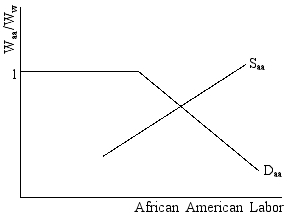
The horizontal portion of the demand curve will be extended by an increase in the:
A)number of firms that discriminate
B)number of firms that do not discriminate
C)productivity of white workers
D)supply of African American workers
Question
Question
Question
A decrease in the supply of African American workers will:
A)extend the horizontal portion of the demand curve,raising the relative wage of African Americans
B)lower the relative wage of African Americans
C)eliminate the wage differential between whites and African Americans if the resulting supply curve intersects the horizontal portion of the demand curve
D)embolden more employers to discriminate,reducing the horizontal portion of the demand curve,and lowering the relative wage of African Americans
Question
Question
Question
Question
Question
Question
Question
Question
The demand curve in the diagram eventually slopes downward because:
A)as the African American-white wage ratio falls,more firms find it "too costly" to indulge their tastes for discrimination
B)as the African American-white wage ratio rises,more firms find it "too costly" to indulge their tastes for discrimination
C)as the African American-white wage ratio falls,firms will raise their discrimination coefficients
D)as the African American-white wage ratio falls,firms will reduce their discrimination coefficients
Question
Question
Question
Question
Question
Question
Question
Question
Question
Question
Question
Question
Question
Question
Question
Question
Question
Question
Question
Question
Question
Question
Question
Question
Question

Unlock Deck
Sign up to unlock the cards in this deck!
Unlock Deck
Unlock Deck
1/60

Play

Full screen (f)
Deck 14: Labor Market Discrimination
1
Which of the following occupations was less than 60% female in 2011?
A)Physicians and surgeons
B)Cashiers
C)Elementary and middle school teachers
D)Waiters and waitresses
A)Physicians and surgeons
B)Cashiers
C)Elementary and middle school teachers
D)Waiters and waitresses
A
2
Evidence on the occupational distribution suggests that:
A)women are disproportionately represented in lower-paying occupations,but African Americans are not
B)African Americans are disproportionately represented in lower-paying occupations,but women are not
C)neither women nor African Americans are disproportionately represented in lower-paying occupations
D)both women and African Americans are disproportionately represented in lower-paying occupations
A)women are disproportionately represented in lower-paying occupations,but African Americans are not
B)African Americans are disproportionately represented in lower-paying occupations,but women are not
C)neither women nor African Americans are disproportionately represented in lower-paying occupations
D)both women and African Americans are disproportionately represented in lower-paying occupations
D
3
Discrimination that results in the payment of a lower wage rate to a female relative to an equally productive male is termed:
A)wage discrimination
B)employment discrimination
C)occupational discrimination
D)human capital discrimination
A)wage discrimination
B)employment discrimination
C)occupational discrimination
D)human capital discrimination
A
4
The African American-white hourly wage ratio is currently about:
A)59%
B)67%
C)74%
D)80%
A)59%
B)67%
C)74%
D)80%
Unlock Deck
Unlock for access to all 60 flashcards in this deck.
Unlock Deck
k this deck
5
Which one of the following is an example of premarket discrimination:
A)wage discrimination
B)employment discrimination
C)occupational discrimination
D)human capital discrimination
A)wage discrimination
B)employment discrimination
C)occupational discrimination
D)human capital discrimination
Unlock Deck
Unlock for access to all 60 flashcards in this deck.
Unlock Deck
k this deck
6
High school completion rates are:
A)lower for both females and African Americans
B)lower for females,but about the same for African Americans and whites
C)lower for African Americans,but about the same for males and females
D)about the same for males and females,African Americans and whites
A)lower for both females and African Americans
B)lower for females,but about the same for African Americans and whites
C)lower for African Americans,but about the same for males and females
D)about the same for males and females,African Americans and whites
Unlock Deck
Unlock for access to all 60 flashcards in this deck.
Unlock Deck
k this deck
7
In 2011 the occupational distribution was:
A)uneven by gender and by race
B)uneven by race but not by gender
C)uneven by gender but not by race
D)even by gender and by race
A)uneven by gender and by race
B)uneven by race but not by gender
C)uneven by gender but not by race
D)even by gender and by race
Unlock Deck
Unlock for access to all 60 flashcards in this deck.
Unlock Deck
k this deck
8
In 2011 the ratio of African American to white hourly wages was approximately:
A)45%-55%
B)60%-70%
C)75%-85%
D)90%-100%
A)45%-55%
B)60%-70%
C)75%-85%
D)90%-100%
Unlock Deck
Unlock for access to all 60 flashcards in this deck.
Unlock Deck
k this deck
9
Discrimination that segregates qualified women into lower paying jobs is called:
A)wage discrimination
B)employment discrimination
C)occupational discrimination
D)human capital discrimination
A)wage discrimination
B)employment discrimination
C)occupational discrimination
D)human capital discrimination
Unlock Deck
Unlock for access to all 60 flashcards in this deck.
Unlock Deck
k this deck
10
Data on unemployment rates consistently show that the unemployment rate of:
A)females of all races exceeds that of males of all races
B)African Americans of both sexes exceeds that of whites of both sexes
C)white females exceeds that of white males,but African American males exceeds that of African American females
D)African American females exceeds that of African American males,but white males exceeds that of white females
A)females of all races exceeds that of males of all races
B)African Americans of both sexes exceeds that of whites of both sexes
C)white females exceeds that of white males,but African American males exceeds that of African American females
D)African American females exceeds that of African American males,but white males exceeds that of white females
Unlock Deck
Unlock for access to all 60 flashcards in this deck.
Unlock Deck
k this deck
11
Comparing the experiences of African Americans and women,evidence suggests that African Americans are more likely to be subject to:
A)occupational discrimination,while women are more likely to be subject to wage discrimination
B)employment discrimination,while women are more likely to be subject to human capital discrimination
C)wage discrimination,while women are more likely to be subject to employment discrimination
D)employment discrimination,while women are more likely to be subject to occupational discrimination
A)occupational discrimination,while women are more likely to be subject to wage discrimination
B)employment discrimination,while women are more likely to be subject to human capital discrimination
C)wage discrimination,while women are more likely to be subject to employment discrimination
D)employment discrimination,while women are more likely to be subject to occupational discrimination
Unlock Deck
Unlock for access to all 60 flashcards in this deck.
Unlock Deck
k this deck
12
In 2010,average earnings at each educational level indicated that:
A)white men earned more than African American men and African American men earned more than both African American and white women
B)white men and white women earned more than African American men
C)white men earned more than white women,but African American men earned less than African American women
D)white men earned more than African American men and African American men earned approximately the same as white women
A)white men earned more than African American men and African American men earned more than both African American and white women
B)white men and white women earned more than African American men
C)white men earned more than white women,but African American men earned less than African American women
D)white men earned more than African American men and African American men earned approximately the same as white women
Unlock Deck
Unlock for access to all 60 flashcards in this deck.
Unlock Deck
k this deck
13
Which of the following exemplifies occupational discrimination?
A)97% of all secretaries are women
B)women secretaries make,on average,40% of their boss' pay while male secretaries average 50% of their boss' pay
C)women secretaries average 12 years of education and obtain little on-the-job training; male secretaries average 12.5 years of education and usually qualify for advanced training programs
D)the unemployment rate for women secretaries is typically 2% higher than that for male secretaries
A)97% of all secretaries are women
B)women secretaries make,on average,40% of their boss' pay while male secretaries average 50% of their boss' pay
C)women secretaries average 12 years of education and obtain little on-the-job training; male secretaries average 12.5 years of education and usually qualify for advanced training programs
D)the unemployment rate for women secretaries is typically 2% higher than that for male secretaries
Unlock Deck
Unlock for access to all 60 flashcards in this deck.
Unlock Deck
k this deck
14
The largest increase in the female-male earning ratio occurred:
A)in the 1960s
B)in the 1970s
C)in the 1980s through the mid-1990s
D)none of the above: there has been no change in the female-male earning ratio for the past 40 years
A)in the 1960s
B)in the 1970s
C)in the 1980s through the mid-1990s
D)none of the above: there has been no change in the female-male earning ratio for the past 40 years
Unlock Deck
Unlock for access to all 60 flashcards in this deck.
Unlock Deck
k this deck
15
Discrimination in the form of access barriers to productivity-increasing opportunities is termed:
A)wage discrimination
B)employment discrimination
C)occupational discrimination
D)human capital discrimination
A)wage discrimination
B)employment discrimination
C)occupational discrimination
D)human capital discrimination
Unlock Deck
Unlock for access to all 60 flashcards in this deck.
Unlock Deck
k this deck
16
If an African American woman is paid a lower wage than a similarly qualified and experienced white man performing the same job at the same firm,then this is an example of:
A)wage discrimination
B)employment discrimination
C)occupational discrimination
D)human capital discrimination
A)wage discrimination
B)employment discrimination
C)occupational discrimination
D)human capital discrimination
Unlock Deck
Unlock for access to all 60 flashcards in this deck.
Unlock Deck
k this deck
17
Which one of the following is a true statement?
A)Female unemployment rates are approximately twice that of males,while the unemployment rates of African Americans and whites are quite similar
B)African American unemployment rates are approximately twice that of whites,while the unemployment rates of men and women are quite similar
C)African American unemployment rates are approximately twice that of whites and female unemployment rates are approximately twice that of males
D)The unemployment rates of African Americans and whites are quite similar,as are the unemployment rates of males and females
A)Female unemployment rates are approximately twice that of males,while the unemployment rates of African Americans and whites are quite similar
B)African American unemployment rates are approximately twice that of whites,while the unemployment rates of men and women are quite similar
C)African American unemployment rates are approximately twice that of whites and female unemployment rates are approximately twice that of males
D)The unemployment rates of African Americans and whites are quite similar,as are the unemployment rates of males and females
Unlock Deck
Unlock for access to all 60 flashcards in this deck.
Unlock Deck
k this deck
18
In 2011 the ratio of female to male hourly wages was approximately:
A)45%-55%
B)60%-70%
C)75%-85%
D)90%-100%
A)45%-55%
B)60%-70%
C)75%-85%
D)90%-100%
Unlock Deck
Unlock for access to all 60 flashcards in this deck.
Unlock Deck
k this deck
19
The ratio of female to male hourly wages:
A)has risen steadily from 1979 to the present
B)dropped steadily from 1979 to the present
C)rose substantially from 1979 to the mid 1990s but has increased only slightly since then
D)rose steadily from 1979 to 1986,but has remained relatively constant since then
A)has risen steadily from 1979 to the present
B)dropped steadily from 1979 to the present
C)rose substantially from 1979 to the mid 1990s but has increased only slightly since then
D)rose steadily from 1979 to 1986,but has remained relatively constant since then
Unlock Deck
Unlock for access to all 60 flashcards in this deck.
Unlock Deck
k this deck
20
The ratio of African American to white hourly wages:
A)rose steadily from 1979 to the present
B)dropped steadily from 1979 to the present
C)was relatively constant from 1979 to 1985,but has increased steadily since then
D)has changed little in the past three decades
A)rose steadily from 1979 to the present
B)dropped steadily from 1979 to the present
C)was relatively constant from 1979 to 1985,but has increased steadily since then
D)has changed little in the past three decades
Unlock Deck
Unlock for access to all 60 flashcards in this deck.
Unlock Deck
k this deck
21
An implication of the crowding model of segregation is that:
A)labor must be efficiently allocated since all workers are employed
B)the value of national output is unaffected by the segregation
C)men's and women's wages would both rise if segregation were reduced
D)the value of national output is reduced by the segregation
Question 41 refers to the following labor market data showing the distribution of males and females within the three occupations (labeled A,B,and C)of a hypothetical economy.
A)labor must be efficiently allocated since all workers are employed
B)the value of national output is unaffected by the segregation
C)men's and women's wages would both rise if segregation were reduced
D)the value of national output is reduced by the segregation
Question 41 refers to the following labor market data showing the distribution of males and females within the three occupations (labeled A,B,and C)of a hypothetical economy.
Unlock Deck
Unlock for access to all 60 flashcards in this deck.
Unlock Deck
k this deck
22
According to the "demand and supply" interpretation of Becker's model,which one of the following will tend to reduce the male-female wage gap?
A)An increase in the supply of female labor
B)An increase in the discrimination coefficients of some employers
C)An increase in the number of nondiscriminating firms
D)An overall increase in the demand for labor
A)An increase in the supply of female labor
B)An increase in the discrimination coefficients of some employers
C)An increase in the number of nondiscriminating firms
D)An overall increase in the demand for labor
Unlock Deck
Unlock for access to all 60 flashcards in this deck.
Unlock Deck
k this deck
23
Consider Becker's "taste-for-discrimination" model.All else equal,the increase in female labor supply over the past 40 years should have resulted in:
A)reduced employment opportunities for women
B)a lower relative wage for women
C)a higher relative wage for women
D)increased efficiency in the labor market
A)reduced employment opportunities for women
B)a lower relative wage for women
C)a higher relative wage for women
D)increased efficiency in the labor market
Unlock Deck
Unlock for access to all 60 flashcards in this deck.
Unlock Deck
k this deck
24
The horizontal portion of the demand curve will be extended by an increase in the:
A)number of firms that discriminate
B)number of firms that do not discriminate
C)productivity of white workers
D)supply of African American workers
Unlock Deck
Unlock for access to all 60 flashcards in this deck.
Unlock Deck
k this deck
25
The statistical discrimination model and Becker's "taste-for-discrimination" model:
A)are alike in that both predict discriminating firms will have higher profits
B)are alike in that both predict discriminating firms will have lower profits
C)differ in that the former results in potentially increased profits; firms with a taste for discrimination will have lower profits
D)differ in that the former results in lower profits; firms with a taste for discrimination will have higher profits
A)are alike in that both predict discriminating firms will have higher profits
B)are alike in that both predict discriminating firms will have lower profits
C)differ in that the former results in potentially increased profits; firms with a taste for discrimination will have lower profits
D)differ in that the former results in lower profits; firms with a taste for discrimination will have higher profits
Unlock Deck
Unlock for access to all 60 flashcards in this deck.
Unlock Deck
k this deck
26
Assume that all workers are equally productive,but that male wages are $14 and female wages are $10.An employer who employs only male workers has a discrimination coefficient of:
A)at most 0.4
B)at least $4
C)at most $4
D)at least 10/14
A)at most 0.4
B)at least $4
C)at most $4
D)at least 10/14
Unlock Deck
Unlock for access to all 60 flashcards in this deck.
Unlock Deck
k this deck
27
A decrease in the supply of African American workers will:
A)extend the horizontal portion of the demand curve,raising the relative wage of African Americans
B)lower the relative wage of African Americans
C)eliminate the wage differential between whites and African Americans if the resulting supply curve intersects the horizontal portion of the demand curve
D)embolden more employers to discriminate,reducing the horizontal portion of the demand curve,and lowering the relative wage of African Americans
Unlock Deck
Unlock for access to all 60 flashcards in this deck.
Unlock Deck
k this deck
28
Statistical discrimination is:
A)the use of some observable characteristic by employers as a screening device in the hiring process
B)comparing the marginal productivities of job applicants to determine who is most suitable for the job
C)not based on accumulated factual evidence about different groups
D)malicious treatment aimed at persons with observable demographic characteristics
A)the use of some observable characteristic by employers as a screening device in the hiring process
B)comparing the marginal productivities of job applicants to determine who is most suitable for the job
C)not based on accumulated factual evidence about different groups
D)malicious treatment aimed at persons with observable demographic characteristics
Unlock Deck
Unlock for access to all 60 flashcards in this deck.
Unlock Deck
k this deck
29
According to the theory of statistical discrimination:
A)the process of competition should put discriminating employers at a competitive disadvantage
B)the discrimination coefficient is a measure of prejudice in the labor market
C)there will be discriminatory wage differentials because a firm with market power distinguishes between different groups with different elasticities of labor supply
D)a person is judged on the basis of the average characteristics of her or his demographic group
A)the process of competition should put discriminating employers at a competitive disadvantage
B)the discrimination coefficient is a measure of prejudice in the labor market
C)there will be discriminatory wage differentials because a firm with market power distinguishes between different groups with different elasticities of labor supply
D)a person is judged on the basis of the average characteristics of her or his demographic group
Unlock Deck
Unlock for access to all 60 flashcards in this deck.
Unlock Deck
k this deck
30
An employer whose discrimination coefficient approaches infinity:
A)refuses to hire any women or minorities regardless of the wage differential
B)does not discriminate against women or minorities
C)discriminates against women but not minorities
D)discriminates in favor of women and minorities
A)refuses to hire any women or minorities regardless of the wage differential
B)does not discriminate against women or minorities
C)discriminates against women but not minorities
D)discriminates in favor of women and minorities
Unlock Deck
Unlock for access to all 60 flashcards in this deck.
Unlock Deck
k this deck
31
Assume that all workers are equally productive,but the white wage is $14 and the African American wage is $10.An employer who employs only African American workers has a discrimination coefficient of:
A)0
B)at least $4
C)at most $4
D)at least 10/14
A)0
B)at least $4
C)at most $4
D)at least 10/14
Unlock Deck
Unlock for access to all 60 flashcards in this deck.
Unlock Deck
k this deck
32
An employer whose discrimination coefficient is zero:
A)refuses to hire any women or minorities regardless of the wage differential
B)does not discriminate for or against women or minorities
C)discriminates against women and minorities
D)discriminates in favor of women and minorities
A)refuses to hire any women or minorities regardless of the wage differential
B)does not discriminate for or against women or minorities
C)discriminates against women and minorities
D)discriminates in favor of women and minorities
Unlock Deck
Unlock for access to all 60 flashcards in this deck.
Unlock Deck
k this deck
33
One implication of Becker's "taste-for-discrimination" model is that:
A)firms that discriminate will have lower costs than non-discriminating firms
B)the existence of competitive market forces will cause discrimination to diminish and eventually disappear
C)an increase in the supply of African American workers will cause the equilibrium African American-white wage ratio to rise
D)non-discriminating firms will be put at a competitive disadvantage because they employ victims of discrimination
A)firms that discriminate will have lower costs than non-discriminating firms
B)the existence of competitive market forces will cause discrimination to diminish and eventually disappear
C)an increase in the supply of African American workers will cause the equilibrium African American-white wage ratio to rise
D)non-discriminating firms will be put at a competitive disadvantage because they employ victims of discrimination
Unlock Deck
Unlock for access to all 60 flashcards in this deck.
Unlock Deck
k this deck
34
Assuming competitive labor markets,occupational segregation by sex:
A)increases the profits of firms that discriminate
B)is beneficial from society's standpoint,because the gains to male employees outweigh the losses to female employees
C)results in an inefficient allocation of labor and diminished output
D)cannot persist,as employers will find it in their best interest to hire only female employees
A)increases the profits of firms that discriminate
B)is beneficial from society's standpoint,because the gains to male employees outweigh the losses to female employees
C)results in an inefficient allocation of labor and diminished output
D)cannot persist,as employers will find it in their best interest to hire only female employees
Unlock Deck
Unlock for access to all 60 flashcards in this deck.
Unlock Deck
k this deck
35
The demand curve in the diagram eventually slopes downward because:
A)as the African American-white wage ratio falls,more firms find it "too costly" to indulge their tastes for discrimination
B)as the African American-white wage ratio rises,more firms find it "too costly" to indulge their tastes for discrimination
C)as the African American-white wage ratio falls,firms will raise their discrimination coefficients
D)as the African American-white wage ratio falls,firms will reduce their discrimination coefficients
Unlock Deck
Unlock for access to all 60 flashcards in this deck.
Unlock Deck
k this deck
36
The inefficiencies of occupational segregation by gender arise because:
A)women are paid less than their values of marginal product
B)men are paid less than their values of marginal product
C)both women and men are paid less than their values of marginal product
D)women's values of marginal product are less than men's,even though they are equally productive
A)women are paid less than their values of marginal product
B)men are paid less than their values of marginal product
C)both women and men are paid less than their values of marginal product
D)women's values of marginal product are less than men's,even though they are equally productive
Unlock Deck
Unlock for access to all 60 flashcards in this deck.
Unlock Deck
k this deck
37
According to Becker's "taste-for-discrimination" model:
A)a person is judged on the basis of the average characteristics of her or his demographic group
B)the process of competition will cause discrimination-based wage differentials to persist over long periods of time
C)there will be discrimination-based wage differentials because a firm with market power distinguishes between different groups with different elasticities of labor supply
D)the process of competition should put discriminating employers at a competitive disadvantage
A)a person is judged on the basis of the average characteristics of her or his demographic group
B)the process of competition will cause discrimination-based wage differentials to persist over long periods of time
C)there will be discrimination-based wage differentials because a firm with market power distinguishes between different groups with different elasticities of labor supply
D)the process of competition should put discriminating employers at a competitive disadvantage
Unlock Deck
Unlock for access to all 60 flashcards in this deck.
Unlock Deck
k this deck
38
Occupational segregation creates:
A)a redistribution of a larger national output
B)a redistribution of a smaller national output
C)a larger national output but no redistribution
D)a smaller national output but no redistribution
A)a redistribution of a larger national output
B)a redistribution of a smaller national output
C)a larger national output but no redistribution
D)a smaller national output but no redistribution
Unlock Deck
Unlock for access to all 60 flashcards in this deck.
Unlock Deck
k this deck
39
In Becker's "taste-for-discrimination" model,an employer who is prejudiced against African Americans:
A)refuses to hire African Americans regardless of the wage differential
B)may have an integrated work force if the wage differential is less than his discrimination coefficient
C)will hire only African Americans if the wage differential exceeds his discrimination coefficient
D)will hire only whites if the white wage is equal to his discrimination coefficient
A)refuses to hire African Americans regardless of the wage differential
B)may have an integrated work force if the wage differential is less than his discrimination coefficient
C)will hire only African Americans if the wage differential exceeds his discrimination coefficient
D)will hire only whites if the white wage is equal to his discrimination coefficient
Unlock Deck
Unlock for access to all 60 flashcards in this deck.
Unlock Deck
k this deck
40
An employer who is willing to pay a wage premium to avoid employing persons from some particular group is engaging in:
A)a taste for discrimination
B)occupational segregation
C)statistical discrimination
D)human capital discrimination
A)a taste for discrimination
B)occupational segregation
C)statistical discrimination
D)human capital discrimination
Unlock Deck
Unlock for access to all 60 flashcards in this deck.
Unlock Deck
k this deck
41
(World of Work 14-6)Following the change to "blind" orchestra auditions in the 1970 and 1980s:
A)the proportion of females in major orchestras increased substantially
B)orchestra sizes increased substantially to accommodate additional females and African Americans
C)the quality of major orchestras declined substantially
D)all of the above
A)the proportion of females in major orchestras increased substantially
B)orchestra sizes increased substantially to accommodate additional females and African Americans
C)the quality of major orchestras declined substantially
D)all of the above
Unlock Deck
Unlock for access to all 60 flashcards in this deck.
Unlock Deck
k this deck
42
Which of the following required firms holding federal contracts to establish "affirmative action" programs?
A)Equal Pay Act of 1963
B)Civil Rights Act of 1964
C)A 1968 Executive Order
D)Landrum-Griffin Act of 1959
A)Equal Pay Act of 1963
B)Civil Rights Act of 1964
C)A 1968 Executive Order
D)Landrum-Griffin Act of 1959
Unlock Deck
Unlock for access to all 60 flashcards in this deck.
Unlock Deck
k this deck
43
Which of the following required equal treatment for all persons in hiring,firing,promotion and compensation decisions without regard to race,color,religion,sex,or nationality?
A)Equal Pay Act of 1963
B)Civil Rights Act of 1964
C)A 1968 Executive Order
D)Landrum-Griffin Act of 1959
A)Equal Pay Act of 1963
B)Civil Rights Act of 1964
C)A 1968 Executive Order
D)Landrum-Griffin Act of 1959
Unlock Deck
Unlock for access to all 60 flashcards in this deck.
Unlock Deck
k this deck
44
Studies by Blau and Kahn report that productivity differences "explain" approximately:
A)two-thirds of the wage difference for women and nine-tenths for African Americans
B)half of the wage difference for both women and African Americans
C)one-third of the wage difference for women and one-tenth for African Americans
D)one-quarter of the wage difference for women and half for African Americans
A)two-thirds of the wage difference for women and nine-tenths for African Americans
B)half of the wage difference for both women and African Americans
C)one-third of the wage difference for women and one-tenth for African Americans
D)one-quarter of the wage difference for women and half for African Americans
Unlock Deck
Unlock for access to all 60 flashcards in this deck.
Unlock Deck
k this deck
45
Which one of the following non-discriminatory factors may account for lower observed wages for women compared to men?
A)Women have stronger preferences for job safety
B)"Full-time" females actually work more hours than "full-time" males
C)Men expect to change jobs more often than women
D)Men have higher levels of "general" training,while women's training is more "specific"
A)Women have stronger preferences for job safety
B)"Full-time" females actually work more hours than "full-time" males
C)Men expect to change jobs more often than women
D)Men have higher levels of "general" training,while women's training is more "specific"
Unlock Deck
Unlock for access to all 60 flashcards in this deck.
Unlock Deck
k this deck
46
Critics of the "rational choice" view contend that:
A)differences in earnings may be the result of freely-made schooling and occupational choices
B)differences in schooling and occupational choices are caused by discrimination
C)wage differentials may be due to nondiscriminatory factors
D)sexual harassment and discrimination do not affect occupational choices
A)differences in earnings may be the result of freely-made schooling and occupational choices
B)differences in schooling and occupational choices are caused by discrimination
C)wage differentials may be due to nondiscriminatory factors
D)sexual harassment and discrimination do not affect occupational choices
Unlock Deck
Unlock for access to all 60 flashcards in this deck.
Unlock Deck
k this deck
47
Empirical estimates of the extent of discrimination may be downwardly biased if:
A)certain variables which have a positive effect on productivity are omitted from the study
B)certain variables which have a negative effect on productivity are omitted from the study
C)many of the control variables (such as education or occupation)reflect personal choices
D)all of the above
A)certain variables which have a positive effect on productivity are omitted from the study
B)certain variables which have a negative effect on productivity are omitted from the study
C)many of the control variables (such as education or occupation)reflect personal choices
D)all of the above
Unlock Deck
Unlock for access to all 60 flashcards in this deck.
Unlock Deck
k this deck
48
(World of Work 14-1)Francine Blau and Lawrence Kahn have reported that the gender pay gap is larger in the United States than in countries such as Sweden,Belgium and Australia because:
A)American women tend to have less education than women in other countries
B)The U.S.has not been as committed to equal pay for women as other countries
C)There is a relatively small gap in pay between low- and high-skilled workers in the U.S.and women are disproportionately represented in lower-skilled jobs
D)There is a relatively large gap in pay between low- and high-skilled workers in the U.S.and women are disproportionately represented in low-skilled jobs
A)American women tend to have less education than women in other countries
B)The U.S.has not been as committed to equal pay for women as other countries
C)There is a relatively small gap in pay between low- and high-skilled workers in the U.S.and women are disproportionately represented in lower-skilled jobs
D)There is a relatively large gap in pay between low- and high-skilled workers in the U.S.and women are disproportionately represented in low-skilled jobs
Unlock Deck
Unlock for access to all 60 flashcards in this deck.
Unlock Deck
k this deck
49
Question refers to the following labor market data showing the distribution of males and females within the three occupations (labeled A, B, and C) of a hypothetical economy.
-The index of segregation for this economy is:
A).20
B).30
C).40
D).70
-The index of segregation for this economy is:
A).20
B).30
C).40
D).70
Unlock Deck
Unlock for access to all 60 flashcards in this deck.
Unlock Deck
k this deck
50
According to empirical estimates,approximately what proportion of the observed female-male earnings gap and African American-white earnings gap can be explained by nondiscriminatory factors?
A)none
B)no more than half
C)more than half
D)virtually all
A)none
B)no more than half
C)more than half
D)virtually all
Unlock Deck
Unlock for access to all 60 flashcards in this deck.
Unlock Deck
k this deck
51
Data comparing income by gender and race:
A)provide proof of discrimination when differentials are observed
B)provide proof of no discrimination when average salaries are equal
C)must be interpreted with caution because efficiency loss may be the cause of observed differentials
D)must be interpreted with caution because nondiscriminatory factors may explain all or part of observed differentials
A)provide proof of discrimination when differentials are observed
B)provide proof of no discrimination when average salaries are equal
C)must be interpreted with caution because efficiency loss may be the cause of observed differentials
D)must be interpreted with caution because nondiscriminatory factors may explain all or part of observed differentials
Unlock Deck
Unlock for access to all 60 flashcards in this deck.
Unlock Deck
k this deck
52
Empirical estimates of the extent of discrimination may be upwardly biased if:
A)certain variables which have a positive effect on productivity are omitted from the study
B)certain variables which have a negative effect on productivity are omitted from the study
C)many variables (such as education or occupation)reflect discriminatory decisions
D)all of the above
A)certain variables which have a positive effect on productivity are omitted from the study
B)certain variables which have a negative effect on productivity are omitted from the study
C)many variables (such as education or occupation)reflect discriminatory decisions
D)all of the above
Unlock Deck
Unlock for access to all 60 flashcards in this deck.
Unlock Deck
k this deck
53
(World of Work 14-5)The overall index of occupational segregation _____ from 1980 to the present; at the same time,the presence of women in selected professions such as dentistry,law,medicine and the clergy _____.
A)decreased; increased
B)decreased; decreased
C)increased; increased
D)increased; decreased
A)decreased; increased
B)decreased; decreased
C)increased; increased
D)increased; decreased
Unlock Deck
Unlock for access to all 60 flashcards in this deck.
Unlock Deck
k this deck
54
The Equal Pay Act of 1963 was of little help to many women because:
A)it did not address occupational segregation
B)male employers ignored the act because it provided no enforcement power
C)the act addressed only racial discrimination,not discrimination based on gender
D)it was declared unconstitutional and later replaced by the Civil Rights Act
A)it did not address occupational segregation
B)male employers ignored the act because it provided no enforcement power
C)the act addressed only racial discrimination,not discrimination based on gender
D)it was declared unconstitutional and later replaced by the Civil Rights Act
Unlock Deck
Unlock for access to all 60 flashcards in this deck.
Unlock Deck
k this deck
55
The index of occupational segregation by sex:
A)has fallen steadily since 1973
B)fell between 1958 and 1973 but has leveled off since then
C)has increased steadily since 1973
D)increased between 1958 and 1973 but has leveled off since then
A)has fallen steadily since 1973
B)fell between 1958 and 1973 but has leveled off since then
C)has increased steadily since 1973
D)increased between 1958 and 1973 but has leveled off since then
Unlock Deck
Unlock for access to all 60 flashcards in this deck.
Unlock Deck
k this deck
56
Empirical evidence indicates that affirmative action programs in the 1970s improved employment opportunities for:
A)minorities but not women
B)women but not minorities
C)both minorities and women
D)neither minorities nor women
A)minorities but not women
B)women but not minorities
C)both minorities and women
D)neither minorities nor women
Unlock Deck
Unlock for access to all 60 flashcards in this deck.
Unlock Deck
k this deck
57
Question refers to the following labor market data showing the distribution of males and females within the three occupations (labeled A, B, and C) of a hypothetical economy.
-The index of segregation for this economy is:
A).20
B).30
C).40
D).70
-The index of segregation for this economy is:
A).20
B).30
C).40
D).70
Unlock Deck
Unlock for access to all 60 flashcards in this deck.
Unlock Deck
k this deck
58
(World of Work 14-4)Empirical studies of the effect of competition on discrimination have shown all of the following except:
A)increased international trade lowered the wage gap in less-competitive industries
B)bank deregulation narrowed the gap between men's and women's wages
C)among plants with high levels of market power,a greater proportion of women employees raises firm profits
D)among plants in highly competitive industries,a greater proportion of women employees raises firm profits
A)increased international trade lowered the wage gap in less-competitive industries
B)bank deregulation narrowed the gap between men's and women's wages
C)among plants with high levels of market power,a greater proportion of women employees raises firm profits
D)among plants in highly competitive industries,a greater proportion of women employees raises firm profits
Unlock Deck
Unlock for access to all 60 flashcards in this deck.
Unlock Deck
k this deck
59
(World of Work 14-2)In their study of beauty and earnings,Hamermesh and Biddle report that:
A)attractive people enter into occupations where appearance is productive,but also earn more than plain people in jobs where beauty does not affect productivity
B)attractive people enter into occupations where appearance is productive,but earn no more than plain people in jobs where beauty does not affect productivity
C)less attractive people compensate for lower individual earnings by marrying persons with higher than average earnings
D)beauty appears to have no impact on a person's earnings
A)attractive people enter into occupations where appearance is productive,but also earn more than plain people in jobs where beauty does not affect productivity
B)attractive people enter into occupations where appearance is productive,but earn no more than plain people in jobs where beauty does not affect productivity
C)less attractive people compensate for lower individual earnings by marrying persons with higher than average earnings
D)beauty appears to have no impact on a person's earnings
Unlock Deck
Unlock for access to all 60 flashcards in this deck.
Unlock Deck
k this deck
60
At firms obligated to undertake affirmative action,female and minority shares of employment:
A)grew consistently from 1975 to the present
B)grew from 1975 to 1980,but have not changed appreciably since then
C)did not change appreciably from 1965 to 1975,but have grown consistently since then
D)did not change from 1965 to the present
A)grew consistently from 1975 to the present
B)grew from 1975 to 1980,but have not changed appreciably since then
C)did not change appreciably from 1965 to 1975,but have grown consistently since then
D)did not change from 1965 to the present
Unlock Deck
Unlock for access to all 60 flashcards in this deck.
Unlock Deck
k this deck
Unlock Deck
Unlock for access to all 60 flashcards in this deck.






