







 Chat with AI

Deck 25: The Sixties, 1960-1968
Full screen (f)

Question
Women's Liberation March, New York (August 26, 1970)
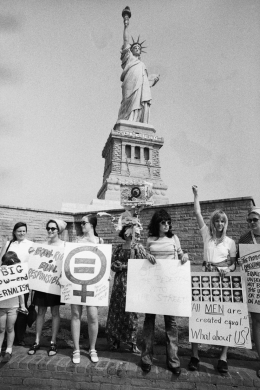
The main goal of the activists in the image was
A) the right to run for public office.
B) gay and lesbian rights.
C) equal pay.
D) freedom from an oppressive social structure.
The main goal of the activists in the image was
A) the right to run for public office.
B) gay and lesbian rights.
C) equal pay.
D) freedom from an oppressive social structure.

Question
Question
Question
Question
Question
Question
Question
Question
Women's Liberation March, New York (August 26, 1970)
Which of the following most inspired the actions of the women shown in the photograph?
A) the desire for reproductive rights
B) the African-American civil rights movement
C) increasingly discriminatory government policies
D) the desire to limit the role of government
Which of the following most inspired the actions of the women shown in the photograph?
A) the desire for reproductive rights
B) the African-American civil rights movement
C) increasingly discriminatory government policies
D) the desire to limit the role of government
Question
Question
Question
Question
Question
Women's Liberation March, New York (August 26, 1970)
The activities depicted in the image best reflect which of the following trends of the 1960s and 1970s?
A) Conservatives challenging liberal laws and court decisions
B) a decline in the trust in government as a result of war and corruption
C) the emergence of grassroots movements focused on social justice
D) the persistence of poverty as a national problem despite overall affluence
The activities depicted in the image best reflect which of the following trends of the 1960s and 1970s?
A) Conservatives challenging liberal laws and court decisions
B) a decline in the trust in government as a result of war and corruption
C) the emergence of grassroots movements focused on social justice
D) the persistence of poverty as a national problem despite overall affluence
Question
Question
Question
Women's Liberation March, New York (August 26, 1970)
The women in this protest would have most likely agreed with which of the following groups?
A) New Left liberals of the 1960s
B) the Religious Right
C) New Deal Democrats
D) Lincoln's Republican Party
The women in this protest would have most likely agreed with which of the following groups?
A) New Left liberals of the 1960s
B) the Religious Right
C) New Deal Democrats
D) Lincoln's Republican Party
Question
Question
Question
Question
Question
Question
Question
Question
Question
Question
Question
Question
Question
Question
Question
Question
Question
Question
Question
Question
Question
Question
Question
Question
Question
Question
Question
Question
Question
Question
Question
Question
Question
Question
Question
Question
Question
Question
Question
Question
Question
Question
Question
Question
Question
Question
Question
Question
Question
Question
Question
Question
Question
Question
Question
Question

Unlock Deck
Sign up to unlock the cards in this deck!
Unlock Deck
Unlock Deck
1/73

Play

Full screen (f)
Deck 25: The Sixties, 1960-1968
1
Women's Liberation March, New York (August 26, 1970)
The main goal of the activists in the image was
A) the right to run for public office.
B) gay and lesbian rights.
C) equal pay.
D) freedom from an oppressive social structure.
The main goal of the activists in the image was
A) the right to run for public office.
B) gay and lesbian rights.
C) equal pay.
D) freedom from an oppressive social structure.
freedom from an oppressive social structure.
2
In addition to sit-ins, other forms of direct action:
A) were limited to marches and demonstrations.
B) included "wade-ins," where black activists attempted to integrate southern beaches.
C) attracted national attention, especially the 1961 "Freedom Rides," where integrated groups rode interstate buses into the Deep South and were violently attacked along the way.
D) B and C
A) were limited to marches and demonstrations.
B) included "wade-ins," where black activists attempted to integrate southern beaches.
C) attracted national attention, especially the 1961 "Freedom Rides," where integrated groups rode interstate buses into the Deep South and were violently attacked along the way.
D) B and C
B and C
3
César Chavez
We are men and women who have suffered and endured much, and not only because of our abject poverty but because we have been kept poor. The colors of our skins, the languages of our cultural and native origins, the lack of formal education, the exclusion from the democratic process, the numbers of our slain in recent wars-all these burdens generation after generation have sought to demoralize us, to break our human spirit. But God knows that we are not beasts of burden, agricultural implements, or rented slaves; we are men. . . .
We advocate militant nonviolence as our means for social revolution and to achieve justice for our people, but we are not blind or deaf to the desperate and moody winds of human frustration, impatience and rage that blow among us. . . . We hate the agribusiness system that seeks to keep us enslaved, and we shall overcome and change it not by retaliation or bloodshed but by a determined nonviolent struggle carried on by those masses of farm workers who intended to be free and human.
Which earlier group of immigrants was sometimes compared with slaves (as Chavez does here)?
A) Scotch-Irish immigrants of the 1740s
B) Irish immigrants of the antebellum period
C) Slavs in the late nineteenth century
D) Jews during the 1940s
We are men and women who have suffered and endured much, and not only because of our abject poverty but because we have been kept poor. The colors of our skins, the languages of our cultural and native origins, the lack of formal education, the exclusion from the democratic process, the numbers of our slain in recent wars-all these burdens generation after generation have sought to demoralize us, to break our human spirit. But God knows that we are not beasts of burden, agricultural implements, or rented slaves; we are men. . . .
We advocate militant nonviolence as our means for social revolution and to achieve justice for our people, but we are not blind or deaf to the desperate and moody winds of human frustration, impatience and rage that blow among us. . . . We hate the agribusiness system that seeks to keep us enslaved, and we shall overcome and change it not by retaliation or bloodshed but by a determined nonviolent struggle carried on by those masses of farm workers who intended to be free and human.
Which earlier group of immigrants was sometimes compared with slaves (as Chavez does here)?
A) Scotch-Irish immigrants of the 1740s
B) Irish immigrants of the antebellum period
C) Slavs in the late nineteenth century
D) Jews during the 1940s
Irish immigrants of the antebellum period
4
How could Birmingham police chief Eugene Connor have undermined Martin Luther King Jr.'s strategy in Birmingham in May 1963?
A) He could have arrested more of the protesters.
B) He could have requested the National Guard from the governor of Alabama.
C) He could have requested federal assistance from President John F. Kennedy.
D) He could have allowed the protesters to march unimpeded.
A) He could have arrested more of the protesters.
B) He could have requested the National Guard from the governor of Alabama.
C) He could have requested federal assistance from President John F. Kennedy.
D) He could have allowed the protesters to march unimpeded.
Unlock Deck
Unlock for access to all 73 flashcards in this deck.
Unlock Deck
k this deck
5
The Freedom Rides of 1961 traveled through which of the following states?
A) Texas and Missouri.
B) Maryland and Massachusetts.
C) Florida and South Carolina.
D) Alabama and Mississippi.
A) Texas and Missouri.
B) Maryland and Massachusetts.
C) Florida and South Carolina.
D) Alabama and Mississippi.
Unlock Deck
Unlock for access to all 73 flashcards in this deck.
Unlock Deck
k this deck
6
The 1960 sit-in at Greensboro, North Carolina:
A) sparked similar successful demonstrations throughout the South.
B) did not end with integration of the Woolworth's lunch counter.
C) encountered a harsh reaction from Greensboro's police force, which jailed the four ringleaders.
D) was staged in one of the most notoriously racist cities of the South, where angry residents remained deeply committed to the racial divide.
A) sparked similar successful demonstrations throughout the South.
B) did not end with integration of the Woolworth's lunch counter.
C) encountered a harsh reaction from Greensboro's police force, which jailed the four ringleaders.
D) was staged in one of the most notoriously racist cities of the South, where angry residents remained deeply committed to the racial divide.
Unlock Deck
Unlock for access to all 73 flashcards in this deck.
Unlock Deck
k this deck
7
To combat communism, one of John Kennedy's first acts was to:
A) call for a summit meeting between the two superpowers.
B) increase military spending on ballistic missiles.
C) suggest a ban on nuclear weapons.
D) establish the Peace Corps.
A) call for a summit meeting between the two superpowers.
B) increase military spending on ballistic missiles.
C) suggest a ban on nuclear weapons.
D) establish the Peace Corps.
Unlock Deck
Unlock for access to all 73 flashcards in this deck.
Unlock Deck
k this deck
8
Commencement Address at Howard University (1965)
Lyndon Johnson
But freedom is not enough. . . . It is not enough just to open the gates of opportunity. All our citizens must have the ability to walk through those gates.
This is the next and the more profound stage of the battle for civil rights. We seek not just freedom but opportunity. We seek not just legal equality but human ability, not just equality as a right and a theory but equality as a fact and equality as a result. For the task is to give 20 million Negroes the same chance as every other American to learn and grow, to work and share in society, to develop their abilities-physical, mental and spiritual, and to pursue their individual happiness.
To this end equal opportunity is essential but not enough, not enough. Men and women of all races are born with the same range of abilities. But ability is not just the product of birth. Ability is stretched or stunted by the family that you live with, and the neighborhood you live in-by the school you go to and the poverty or the richness of your surroundings. It is the product of a hundred unseen forces playing upon the little infant, the child, and finally the man.
What was one significant criticism of Johnson's ideas on civil rights?
A) The Supreme Court would not support ending segregation.
B) Johnson's approach would increase the power of the federal government too much.
C) Winning the war in Vietnam was more important than working on race relations.
D) High-minded ideas were not relevant to baby boomers.
Lyndon Johnson
But freedom is not enough. . . . It is not enough just to open the gates of opportunity. All our citizens must have the ability to walk through those gates.
This is the next and the more profound stage of the battle for civil rights. We seek not just freedom but opportunity. We seek not just legal equality but human ability, not just equality as a right and a theory but equality as a fact and equality as a result. For the task is to give 20 million Negroes the same chance as every other American to learn and grow, to work and share in society, to develop their abilities-physical, mental and spiritual, and to pursue their individual happiness.
To this end equal opportunity is essential but not enough, not enough. Men and women of all races are born with the same range of abilities. But ability is not just the product of birth. Ability is stretched or stunted by the family that you live with, and the neighborhood you live in-by the school you go to and the poverty or the richness of your surroundings. It is the product of a hundred unseen forces playing upon the little infant, the child, and finally the man.
What was one significant criticism of Johnson's ideas on civil rights?
A) The Supreme Court would not support ending segregation.
B) Johnson's approach would increase the power of the federal government too much.
C) Winning the war in Vietnam was more important than working on race relations.
D) High-minded ideas were not relevant to baby boomers.
Unlock Deck
Unlock for access to all 73 flashcards in this deck.
Unlock Deck
k this deck
9
Women's Liberation March, New York (August 26, 1970)
Which of the following most inspired the actions of the women shown in the photograph?
A) the desire for reproductive rights
B) the African-American civil rights movement
C) increasingly discriminatory government policies
D) the desire to limit the role of government
Which of the following most inspired the actions of the women shown in the photograph?
A) the desire for reproductive rights
B) the African-American civil rights movement
C) increasingly discriminatory government policies
D) the desire to limit the role of government
Unlock Deck
Unlock for access to all 73 flashcards in this deck.
Unlock Deck
k this deck
10
What did President John F. Kennedy have in common with his predecessor Dwight D. Eisenhower?
A) Both came from the conservative wing of the Democratic Party.
B) Both had been high-ranking officers during the U.S. invasion of France in World War II.
C) Both preferred the challenges of domestic policy rather than foreign affairs.
D) Both tended to view the entire world through the lens of the Cold War.
A) Both came from the conservative wing of the Democratic Party.
B) Both had been high-ranking officers during the U.S. invasion of France in World War II.
C) Both preferred the challenges of domestic policy rather than foreign affairs.
D) Both tended to view the entire world through the lens of the Cold War.
Unlock Deck
Unlock for access to all 73 flashcards in this deck.
Unlock Deck
k this deck
11
During the Bay of Pigs invasion:
A) the CIA failed in its mission.
B) Eisenhower suspended trade with Cuba.
C) the CIA restored Fulgencio Batista to power.
D) a popular uprising of anti-Castro Cubans toppled Castro's regime.
A) the CIA failed in its mission.
B) Eisenhower suspended trade with Cuba.
C) the CIA restored Fulgencio Batista to power.
D) a popular uprising of anti-Castro Cubans toppled Castro's regime.
Unlock Deck
Unlock for access to all 73 flashcards in this deck.
Unlock Deck
k this deck
12
The 1963 March on Washington:
A) included various female speakers.
B) included speeches with militant language.
C) was a high point in black and white cooperation.
D) focused solely on a languishing civil rights bill.
A) included various female speakers.
B) included speeches with militant language.
C) was a high point in black and white cooperation.
D) focused solely on a languishing civil rights bill.
Unlock Deck
Unlock for access to all 73 flashcards in this deck.
Unlock Deck
k this deck
13
Why did the African-American civil rights protesters that marched in June 1963 in more than 186 cities NOT try more deliberately to avoid arrest?
A) They had tried to avoid any encounter with the police as best they could.
B) Too many police officers had infiltrated the civil rights movement.
C) Most of the protesters came from privileged backgrounds and knew that they would get off easy.
D) The very point of the protests was to illustrate the punitive nature of southern Jim Crow justice.
A) They had tried to avoid any encounter with the police as best they could.
B) Too many police officers had infiltrated the civil rights movement.
C) Most of the protesters came from privileged backgrounds and knew that they would get off easy.
D) The very point of the protests was to illustrate the punitive nature of southern Jim Crow justice.
Unlock Deck
Unlock for access to all 73 flashcards in this deck.
Unlock Deck
k this deck
14
Women's Liberation March, New York (August 26, 1970)
The activities depicted in the image best reflect which of the following trends of the 1960s and 1970s?
A) Conservatives challenging liberal laws and court decisions
B) a decline in the trust in government as a result of war and corruption
C) the emergence of grassroots movements focused on social justice
D) the persistence of poverty as a national problem despite overall affluence
The activities depicted in the image best reflect which of the following trends of the 1960s and 1970s?
A) Conservatives challenging liberal laws and court decisions
B) a decline in the trust in government as a result of war and corruption
C) the emergence of grassroots movements focused on social justice
D) the persistence of poverty as a national problem despite overall affluence
Unlock Deck
Unlock for access to all 73 flashcards in this deck.
Unlock Deck
k this deck
15
César Chavez
We are men and women who have suffered and endured much, and not only because of our abject poverty but because we have been kept poor. The colors of our skins, the languages of our cultural and native origins, the lack of formal education, the exclusion from the democratic process, the numbers of our slain in recent wars-all these burdens generation after generation have sought to demoralize us, to break our human spirit. But God knows that we are not beasts of burden, agricultural implements, or rented slaves; we are men. . . .
We advocate militant nonviolence as our means for social revolution and to achieve justice for our people, but we are not blind or deaf to the desperate and moody winds of human frustration, impatience and rage that blow among us. . . . We hate the agribusiness system that seeks to keep us enslaved, and we shall overcome and change it not by retaliation or bloodshed but by a determined nonviolent struggle carried on by those masses of farm workers who intended to be free and human.
Cesar Chavez and other leaders of migrant farm workers were inspired by the ideas of the
A) New Deal.
B) Populist Party.
C) black civil rights movement.
D) gay rights movement.
We are men and women who have suffered and endured much, and not only because of our abject poverty but because we have been kept poor. The colors of our skins, the languages of our cultural and native origins, the lack of formal education, the exclusion from the democratic process, the numbers of our slain in recent wars-all these burdens generation after generation have sought to demoralize us, to break our human spirit. But God knows that we are not beasts of burden, agricultural implements, or rented slaves; we are men. . . .
We advocate militant nonviolence as our means for social revolution and to achieve justice for our people, but we are not blind or deaf to the desperate and moody winds of human frustration, impatience and rage that blow among us. . . . We hate the agribusiness system that seeks to keep us enslaved, and we shall overcome and change it not by retaliation or bloodshed but by a determined nonviolent struggle carried on by those masses of farm workers who intended to be free and human.
Cesar Chavez and other leaders of migrant farm workers were inspired by the ideas of the
A) New Deal.
B) Populist Party.
C) black civil rights movement.
D) gay rights movement.
Unlock Deck
Unlock for access to all 73 flashcards in this deck.
Unlock Deck
k this deck
16
César Chavez
We are men and women who have suffered and endured much, and not only because of our abject poverty but because we have been kept poor. The colors of our skins, the languages of our cultural and native origins, the lack of formal education, the exclusion from the democratic process, the numbers of our slain in recent wars-all these burdens generation after generation have sought to demoralize us, to break our human spirit. But God knows that we are not beasts of burden, agricultural implements, or rented slaves; we are men. . . .
We advocate militant nonviolence as our means for social revolution and to achieve justice for our people, but we are not blind or deaf to the desperate and moody winds of human frustration, impatience and rage that blow among us. . . . We hate the agribusiness system that seeks to keep us enslaved, and we shall overcome and change it not by retaliation or bloodshed but by a determined nonviolent struggle carried on by those masses of farm workers who intended to be free and human.
Chavez's letter reflects Chicano support for
A) the rights of migrant workers and immigrants.
B) an increasingly homogeneous mass culture.
C) a smaller role for the federal government.
D) militant strategies to press for reform and equality.
We are men and women who have suffered and endured much, and not only because of our abject poverty but because we have been kept poor. The colors of our skins, the languages of our cultural and native origins, the lack of formal education, the exclusion from the democratic process, the numbers of our slain in recent wars-all these burdens generation after generation have sought to demoralize us, to break our human spirit. But God knows that we are not beasts of burden, agricultural implements, or rented slaves; we are men. . . .
We advocate militant nonviolence as our means for social revolution and to achieve justice for our people, but we are not blind or deaf to the desperate and moody winds of human frustration, impatience and rage that blow among us. . . . We hate the agribusiness system that seeks to keep us enslaved, and we shall overcome and change it not by retaliation or bloodshed but by a determined nonviolent struggle carried on by those masses of farm workers who intended to be free and human.
Chavez's letter reflects Chicano support for
A) the rights of migrant workers and immigrants.
B) an increasingly homogeneous mass culture.
C) a smaller role for the federal government.
D) militant strategies to press for reform and equality.
Unlock Deck
Unlock for access to all 73 flashcards in this deck.
Unlock Deck
k this deck
17
Women's Liberation March, New York (August 26, 1970)
The women in this protest would have most likely agreed with which of the following groups?
A) New Left liberals of the 1960s
B) the Religious Right
C) New Deal Democrats
D) Lincoln's Republican Party
The women in this protest would have most likely agreed with which of the following groups?
A) New Left liberals of the 1960s
B) the Religious Right
C) New Deal Democrats
D) Lincoln's Republican Party
Unlock Deck
Unlock for access to all 73 flashcards in this deck.
Unlock Deck
k this deck
18
The Berlin Wall:
A) was built with the cooperation of West Germany and her western allies, who sought to improve relations with the Soviet Union.
B) was torn down in 1989 by a group of Soviet protestors.
C) was erected in 1961 by the Soviets to stem the rising tide of emigration from East Berlin to West Berlin.
D) became an unlikely symbol of hope that one day the Cold War would end.
A) was built with the cooperation of West Germany and her western allies, who sought to improve relations with the Soviet Union.
B) was torn down in 1989 by a group of Soviet protestors.
C) was erected in 1961 by the Soviets to stem the rising tide of emigration from East Berlin to West Berlin.
D) became an unlikely symbol of hope that one day the Cold War would end.
Unlock Deck
Unlock for access to all 73 flashcards in this deck.
Unlock Deck
k this deck
19
Commencement Address at Howard University (1965)
Lyndon Johnson
But freedom is not enough. . . . It is not enough just to open the gates of opportunity. All our citizens must have the ability to walk through those gates.
This is the next and the more profound stage of the battle for civil rights. We seek not just freedom but opportunity. We seek not just legal equality but human ability, not just equality as a right and a theory but equality as a fact and equality as a result. For the task is to give 20 million Negroes the same chance as every other American to learn and grow, to work and share in society, to develop their abilities-physical, mental and spiritual, and to pursue their individual happiness.
To this end equal opportunity is essential but not enough, not enough. Men and women of all races are born with the same range of abilities. But ability is not just the product of birth. Ability is stretched or stunted by the family that you live with, and the neighborhood you live in-by the school you go to and the poverty or the richness of your surroundings. It is the product of a hundred unseen forces playing upon the little infant, the child, and finally the man.
Ideas like those espoused by Johnson
A) were realized through Supreme Court decisions of the 1960s and 1970s.
B) were supported widely across the entire political spectrum.
C) failed to produce any legislation on equality.
D) were opposed primarily by immigrants.
Lyndon Johnson
But freedom is not enough. . . . It is not enough just to open the gates of opportunity. All our citizens must have the ability to walk through those gates.
This is the next and the more profound stage of the battle for civil rights. We seek not just freedom but opportunity. We seek not just legal equality but human ability, not just equality as a right and a theory but equality as a fact and equality as a result. For the task is to give 20 million Negroes the same chance as every other American to learn and grow, to work and share in society, to develop their abilities-physical, mental and spiritual, and to pursue their individual happiness.
To this end equal opportunity is essential but not enough, not enough. Men and women of all races are born with the same range of abilities. But ability is not just the product of birth. Ability is stretched or stunted by the family that you live with, and the neighborhood you live in-by the school you go to and the poverty or the richness of your surroundings. It is the product of a hundred unseen forces playing upon the little infant, the child, and finally the man.
Ideas like those espoused by Johnson
A) were realized through Supreme Court decisions of the 1960s and 1970s.
B) were supported widely across the entire political spectrum.
C) failed to produce any legislation on equality.
D) were opposed primarily by immigrants.
Unlock Deck
Unlock for access to all 73 flashcards in this deck.
Unlock Deck
k this deck
20
Commencement Address at Howard University (1965)
Lyndon Johnson
But freedom is not enough. . . . It is not enough just to open the gates of opportunity. All our citizens must have the ability to walk through those gates.
This is the next and the more profound stage of the battle for civil rights. We seek not just freedom but opportunity. We seek not just legal equality but human ability, not just equality as a right and a theory but equality as a fact and equality as a result. For the task is to give 20 million Negroes the same chance as every other American to learn and grow, to work and share in society, to develop their abilities-physical, mental and spiritual, and to pursue their individual happiness.
To this end equal opportunity is essential but not enough, not enough. Men and women of all races are born with the same range of abilities. But ability is not just the product of birth. Ability is stretched or stunted by the family that you live with, and the neighborhood you live in-by the school you go to and the poverty or the richness of your surroundings. It is the product of a hundred unseen forces playing upon the little infant, the child, and finally the man.
Johnson's Great Society efforts to end racial discrimination
A) succeeded in eradicating poverty in America.
B) failed to inspire Latinos, Native Americans, or Asian Americans.
C) did not appeal to people living in the West.
D) energized a new conservative movement.
Lyndon Johnson
But freedom is not enough. . . . It is not enough just to open the gates of opportunity. All our citizens must have the ability to walk through those gates.
This is the next and the more profound stage of the battle for civil rights. We seek not just freedom but opportunity. We seek not just legal equality but human ability, not just equality as a right and a theory but equality as a fact and equality as a result. For the task is to give 20 million Negroes the same chance as every other American to learn and grow, to work and share in society, to develop their abilities-physical, mental and spiritual, and to pursue their individual happiness.
To this end equal opportunity is essential but not enough, not enough. Men and women of all races are born with the same range of abilities. But ability is not just the product of birth. Ability is stretched or stunted by the family that you live with, and the neighborhood you live in-by the school you go to and the poverty or the richness of your surroundings. It is the product of a hundred unseen forces playing upon the little infant, the child, and finally the man.
Johnson's Great Society efforts to end racial discrimination
A) succeeded in eradicating poverty in America.
B) failed to inspire Latinos, Native Americans, or Asian Americans.
C) did not appeal to people living in the West.
D) energized a new conservative movement.
Unlock Deck
Unlock for access to all 73 flashcards in this deck.
Unlock Deck
k this deck
21
Why did the Mississippi Freedom Democratic Party (MFDP) emerge at the Democratic Party convention in Atlantic City in 1964?
A) The MFDP had won local elections in Mississippi.
B) The MFDP was the white supremacist delegation sent to New Jersey by white Mississippians.
C) The MFDP had received a personal invitation from the family of the deceased President John F. Kennedy.
D) The MFDP challenged the state's Democratic Party's claim that it represented Mississippi fairly.
A) The MFDP had won local elections in Mississippi.
B) The MFDP was the white supremacist delegation sent to New Jersey by white Mississippians.
C) The MFDP had received a personal invitation from the family of the deceased President John F. Kennedy.
D) The MFDP challenged the state's Democratic Party's claim that it represented Mississippi fairly.
Unlock Deck
Unlock for access to all 73 flashcards in this deck.
Unlock Deck
k this deck
22
Which of the following statements is NOT accurate about the 1965 Voting Rights Act?
A) It was partly the result of the Selma to Montgomery civil rights march where participants were brutally assaulted by police.
B) It upheld the right of county officials to oversee black voter registration in cases where provided for by local statute.
C) It empowered federal officials to oversee voter registration.
D) It was strongly endorsed by President Johnson.
A) It was partly the result of the Selma to Montgomery civil rights march where participants were brutally assaulted by police.
B) It upheld the right of county officials to oversee black voter registration in cases where provided for by local statute.
C) It empowered federal officials to oversee voter registration.
D) It was strongly endorsed by President Johnson.
Unlock Deck
Unlock for access to all 73 flashcards in this deck.
Unlock Deck
k this deck
23
What was the purpose of Freedom Summer?
A) To bring national attention to the growing strength of Klan members in Mississippi.
B) To register new black voters across the state of Mississippi.
C) To address the failure of the Civil Rights Act to include a provision on voting rights in the South.
D) B and C
A) To bring national attention to the growing strength of Klan members in Mississippi.
B) To register new black voters across the state of Mississippi.
C) To address the failure of the Civil Rights Act to include a provision on voting rights in the South.
D) B and C
Unlock Deck
Unlock for access to all 73 flashcards in this deck.
Unlock Deck
k this deck
24
During Freedom Summer:
A) very few white college students participated.
B) only black activists participated in the voter registration campaign.
C) signers of the Southern Manifesto launched a campaign against integration.
D) a coalition of civil rights groups launched a voter registration drive in Mississippi.
A) very few white college students participated.
B) only black activists participated in the voter registration campaign.
C) signers of the Southern Manifesto launched a campaign against integration.
D) a coalition of civil rights groups launched a voter registration drive in Mississippi.
Unlock Deck
Unlock for access to all 73 flashcards in this deck.
Unlock Deck
k this deck
25
The Civil Rights Act:
A) prohibited racial discrimination in places of public accommodation, but not private accommodation.
B) was seen by Lyndon Johnson as "a fitting memorial" to John F. Kennedy, after his assassination.
C) did not include a ban on discrimination on the basis of "sex" until the original bill was amended two years later.
D) prohibited racial discrimination in places of employment only.
A) prohibited racial discrimination in places of public accommodation, but not private accommodation.
B) was seen by Lyndon Johnson as "a fitting memorial" to John F. Kennedy, after his assassination.
C) did not include a ban on discrimination on the basis of "sex" until the original bill was amended two years later.
D) prohibited racial discrimination in places of employment only.
Unlock Deck
Unlock for access to all 73 flashcards in this deck.
Unlock Deck
k this deck
26
Why did John F. Kennedy consider civil rights a moral crisis for the nation?
A) He saw how racial tensions divided his own family.
B) He had personally witnessed the hardships of Jim Crow growing up.
C) He did not think racial equality in the United States possible without reparations for slavery.
D) He found racial discrimination incompatible with the United States' claim for leadership of the free world.
A) He saw how racial tensions divided his own family.
B) He had personally witnessed the hardships of Jim Crow growing up.
C) He did not think racial equality in the United States possible without reparations for slavery.
D) He found racial discrimination incompatible with the United States' claim for leadership of the free world.
Unlock Deck
Unlock for access to all 73 flashcards in this deck.
Unlock Deck
k this deck
27
The Hart-Cellar Act of 1965 did all of the following EXCEPT it:
A) no longer restricted southern and eastern Europeans.
B) limited the amount of immigrants from the Western Hemisphere to 120,000.
C) was forced through Congress in response to increasing numbers of Vietnamese refugees.
D) provided special provisions for communist country refugees.
A) no longer restricted southern and eastern Europeans.
B) limited the amount of immigrants from the Western Hemisphere to 120,000.
C) was forced through Congress in response to increasing numbers of Vietnamese refugees.
D) provided special provisions for communist country refugees.
Unlock Deck
Unlock for access to all 73 flashcards in this deck.
Unlock Deck
k this deck
28
Which of the following was NOT true of the Cuban Missile Crisis?
A) The crisis was part of a dispute between the United States and the Soviet Union after a U.S. Navy vessel carrying nuclear warheads was intercepted off the coast of Turkey.
B) The crisis erupted after U.S. spy planes discovered Soviet nuclear missiles in Cuba.
C) The standoff brought the United States to the brink of nuclear war with the Soviet Union.
D) Kennedy was appalled by military leaders who had discussed "winning" a nuclear war, prompting him to sign an aboveground nuclear test-ban treaty with the Soviets the following year.
A) The crisis was part of a dispute between the United States and the Soviet Union after a U.S. Navy vessel carrying nuclear warheads was intercepted off the coast of Turkey.
B) The crisis erupted after U.S. spy planes discovered Soviet nuclear missiles in Cuba.
C) The standoff brought the United States to the brink of nuclear war with the Soviet Union.
D) Kennedy was appalled by military leaders who had discussed "winning" a nuclear war, prompting him to sign an aboveground nuclear test-ban treaty with the Soviets the following year.
Unlock Deck
Unlock for access to all 73 flashcards in this deck.
Unlock Deck
k this deck
29
What set President Lyndon Baines Johnson apart from his predecessor, John F. Kennedy?
A) He was willing to focus on Cold War issues the way Kennedy did not.
B) He was free from the legacy of political compromise in Congress that had weakened Kennedy's reputation.
C) He had the charm and affability that the often-aloof Kennedy could not muster.
D) He knew the meaning of poverty and racial injustice from his own life experiences.
A) He was willing to focus on Cold War issues the way Kennedy did not.
B) He was free from the legacy of political compromise in Congress that had weakened Kennedy's reputation.
C) He had the charm and affability that the often-aloof Kennedy could not muster.
D) He knew the meaning of poverty and racial injustice from his own life experiences.
Unlock Deck
Unlock for access to all 73 flashcards in this deck.
Unlock Deck
k this deck
30
Which of the following organizations does NOT belong in this group?
A) SNCC.
B) YAF.
C) CORE.
D) SDS.
A) SNCC.
B) YAF.
C) CORE.
D) SDS.
Unlock Deck
Unlock for access to all 73 flashcards in this deck.
Unlock Deck
k this deck
31
Barry Goldwater's 1964 campaign emphasized:
A) increased taxes to balance the budget.
B) an immediate pullout from Vietnam.
C) a reduction in governmental regulations.
D) racial equality in the United States.
A) increased taxes to balance the budget.
B) an immediate pullout from Vietnam.
C) a reduction in governmental regulations.
D) racial equality in the United States.
Unlock Deck
Unlock for access to all 73 flashcards in this deck.
Unlock Deck
k this deck
32
What event forced John F. Kennedy to take meaningful action in support of the civil rights movement?
A) Selma-to-Birmingham March.
B) March on Washington rally.
C) King's demonstrations in Birmingham.
D) Greensboro sit-ins.
A) Selma-to-Birmingham March.
B) March on Washington rally.
C) King's demonstrations in Birmingham.
D) Greensboro sit-ins.
Unlock Deck
Unlock for access to all 73 flashcards in this deck.
Unlock Deck
k this deck
33
Which of the following statements best describes the legacy of the War on Poverty?
A) Its overwhelming success suggested that restoring Americans' economic security was ultimately more important than securing their civil rights.
B) It cemented Lyndon Johnson's reputation as one of the most popular presidents in American history.
C) It transformed the condition of life in poor urban neighborhoods.
D) It helped significantly reduce America's incidence of poverty.
A) Its overwhelming success suggested that restoring Americans' economic security was ultimately more important than securing their civil rights.
B) It cemented Lyndon Johnson's reputation as one of the most popular presidents in American history.
C) It transformed the condition of life in poor urban neighborhoods.
D) It helped significantly reduce America's incidence of poverty.
Unlock Deck
Unlock for access to all 73 flashcards in this deck.
Unlock Deck
k this deck
34
Regarding civil rights during his presidency, John F. Kennedy:
A) immediately addressed the demands of black activists.
B) remained completely uninvolved.
C) was reluctant to address the movement's demands until 1963.
D) instructed his brother Robert Kennedy to immediately enforce desegregation in the South.
A) immediately addressed the demands of black activists.
B) remained completely uninvolved.
C) was reluctant to address the movement's demands until 1963.
D) instructed his brother Robert Kennedy to immediately enforce desegregation in the South.
Unlock Deck
Unlock for access to all 73 flashcards in this deck.
Unlock Deck
k this deck
35
Barry Goldwater's conservative movement:
A) marked a departure from the radical conservatism of William Buckley.
B) did not find traction among midwestern and eastern transplants to southern California.
C) was strongly embraced by the Young Americans for Freedom.
D) essentially ended with his landslide defeat in the 1964 presidential election.
A) marked a departure from the radical conservatism of William Buckley.
B) did not find traction among midwestern and eastern transplants to southern California.
C) was strongly embraced by the Young Americans for Freedom.
D) essentially ended with his landslide defeat in the 1964 presidential election.
Unlock Deck
Unlock for access to all 73 flashcards in this deck.
Unlock Deck
k this deck
36
The War on Poverty:
A) was first proposed by Richard Nixon as a means to gain support of congressional Democrats during Eisenhower's second term.
B) was not a part of Johnson's Great Society agenda.
C) concentrated on equipping the poor with skills and rebuilding their spirit and motivation.
D) guaranteed an annual income for most Americans.
A) was first proposed by Richard Nixon as a means to gain support of congressional Democrats during Eisenhower's second term.
B) was not a part of Johnson's Great Society agenda.
C) concentrated on equipping the poor with skills and rebuilding their spirit and motivation.
D) guaranteed an annual income for most Americans.
Unlock Deck
Unlock for access to all 73 flashcards in this deck.
Unlock Deck
k this deck
37
What did the defeat of Republican presidential candidate Barry Goldwater show?
A) The success of the civil rights movement had made conventional Republicans unelectable.
B) The success of the New Deal state had made libertarianism unattractive to Americans.
C) The changing demographic image of the United States had made older presidential candidates unappealing.
D) The civil rights movement had redrawn the political map and opened the South to the Republican Party.
A) The success of the civil rights movement had made conventional Republicans unelectable.
B) The success of the New Deal state had made libertarianism unattractive to Americans.
C) The changing demographic image of the United States had made older presidential candidates unappealing.
D) The civil rights movement had redrawn the political map and opened the South to the Republican Party.
Unlock Deck
Unlock for access to all 73 flashcards in this deck.
Unlock Deck
k this deck
38
On what grounds could foreign nationals apply for immigrant status in the United States after 1965?
A) The color of their skin.
B) Their proficiency in English.
C) Their anticommunist credentials.
D) Their family ties to U.S. citizens or other immigrants.
A) The color of their skin.
B) Their proficiency in English.
C) Their anticommunist credentials.
D) Their family ties to U.S. citizens or other immigrants.
Unlock Deck
Unlock for access to all 73 flashcards in this deck.
Unlock Deck
k this deck
39
The Great Society:
A) included new health care, education, and urban development initiatives with the use of federal funds.
B) established the Department of Housing and Urban Development, and the Department of Transportation.
C) actually reduced federal power, as most of its programs were administered at the local level.
D) A and B
A) included new health care, education, and urban development initiatives with the use of federal funds.
B) established the Department of Housing and Urban Development, and the Department of Transportation.
C) actually reduced federal power, as most of its programs were administered at the local level.
D) A and B
Unlock Deck
Unlock for access to all 73 flashcards in this deck.
Unlock Deck
k this deck
40
Republican Barry Goldwater viewed as a threat to freedom:
A) the New Deal welfare state.
B) the nuclear weapons buildup.
C) the military-industrial complex.
D) the proliferation of private charities.
A) the New Deal welfare state.
B) the nuclear weapons buildup.
C) the military-industrial complex.
D) the proliferation of private charities.
Unlock Deck
Unlock for access to all 73 flashcards in this deck.
Unlock Deck
k this deck
41
Why are the riots in American cities during the 1960s best understood as battles?
A) The Department of Defense deployed regular army units to suppress these uprisings.
B) African-American rioters often had received military training in Cuba and Venezuela.
C) Urban blacks saw the predominantly white police force as an occupying army.
D) Rioters frequently employed weapons otherwise only used in military combat operations.
A) The Department of Defense deployed regular army units to suppress these uprisings.
B) African-American rioters often had received military training in Cuba and Venezuela.
C) Urban blacks saw the predominantly white police force as an occupying army.
D) Rioters frequently employed weapons otherwise only used in military combat operations.
Unlock Deck
Unlock for access to all 73 flashcards in this deck.
Unlock Deck
k this deck
42
The gay liberation movement:
A) was banned in several states.
B) attracted many straight women.
C) initially excluded women.
D) was inspired by the civil rights movement.
A) was banned in several states.
B) attracted many straight women.
C) initially excluded women.
D) was inspired by the civil rights movement.
Unlock Deck
Unlock for access to all 73 flashcards in this deck.
Unlock Deck
k this deck
43
Why was liberation theology so popular in Latin America in the 1960s?
A) The Second Vatican Council had sanctioned birth control.
B) Reform in the Catholic Church had inspired social justice activists.
C) Kennedy's Alliance for Progress was bearing fruit.
D) The Cuban Missile Crisis had shattered the region's complacency.
A) The Second Vatican Council had sanctioned birth control.
B) Reform in the Catholic Church had inspired social justice activists.
C) Kennedy's Alliance for Progress was bearing fruit.
D) The Cuban Missile Crisis had shattered the region's complacency.
Unlock Deck
Unlock for access to all 73 flashcards in this deck.
Unlock Deck
k this deck
44
What did students of the New Left movement think was missing in American liberalism in the 1960s?
A) The willingness to address poverty.
B) The reluctance of companies to recognize unions.
C) The commitment to legislate on behalf of Social Security.
D) The practice of true participatory democracy.
A) The willingness to address poverty.
B) The reluctance of companies to recognize unions.
C) The commitment to legislate on behalf of Social Security.
D) The practice of true participatory democracy.
Unlock Deck
Unlock for access to all 73 flashcards in this deck.
Unlock Deck
k this deck
45
The anti-war movement:
A) attracted only draft-age males.
B) was of little interest to civil-rights activists.
C) never built a mass constituency.
D) challenged the foundations of Cold War thinking.
A) attracted only draft-age males.
B) was of little interest to civil-rights activists.
C) never built a mass constituency.
D) challenged the foundations of Cold War thinking.
Unlock Deck
Unlock for access to all 73 flashcards in this deck.
Unlock Deck
k this deck
46
All of the following were part of Martin Luther King Jr.'s Chicago Freedom Movement platform EXCEPT:
A) the integration of public housing.
B) equal access to mortgages.
C) an end to discrimination by employers and unions.
D) voter registration of black citizens.
A) the integration of public housing.
B) equal access to mortgages.
C) an end to discrimination by employers and unions.
D) voter registration of black citizens.
Unlock Deck
Unlock for access to all 73 flashcards in this deck.
Unlock Deck
k this deck
47
Why did the United States continue to support South Vietnamese leader Ngo Dinh Diem's corrupt and weak regime?
A) Diem had the support of his people, which pointed to an eventual South Vietnamese victory over the communists.
B) By 1963, Diem's forces had regained much of the Vietnamese countryside from the outnumbered Viet Cong.
C) Presidents Kennedy and Johnson feared losing Vietnam to communism.
D) U.S. officials were caught by surprise when a military coup led to Diem's death.
A) Diem had the support of his people, which pointed to an eventual South Vietnamese victory over the communists.
B) By 1963, Diem's forces had regained much of the Vietnamese countryside from the outnumbered Viet Cong.
C) Presidents Kennedy and Johnson feared losing Vietnam to communism.
D) U.S. officials were caught by surprise when a military coup led to Diem's death.
Unlock Deck
Unlock for access to all 73 flashcards in this deck.
Unlock Deck
k this deck
48
The Gulf of Tonkin resolution:
A) was a nonbinding measure that passed both the House and Senate, calling for peace negotiations between North and South Vietnam.
B) was opposed by the majority of lawmakers in Congress.
C) authorized a ground invasion of U.S. troops into North Vietnam.
D) authorized the president to take "all necessary measures to repel armed attack" in Vietnam.
A) was a nonbinding measure that passed both the House and Senate, calling for peace negotiations between North and South Vietnam.
B) was opposed by the majority of lawmakers in Congress.
C) authorized a ground invasion of U.S. troops into North Vietnam.
D) authorized the president to take "all necessary measures to repel armed attack" in Vietnam.
Unlock Deck
Unlock for access to all 73 flashcards in this deck.
Unlock Deck
k this deck
49
What opened Malcolm X up to the possibility of interracial cooperation in the United States?
A) The interracial harmony he witnessed among Muslims in Saudi Arabia.
B) The tragedy of Martin Luther King Jr.'s assassination.
C) The goodwill displayed by white college students of the New Left movement.
D) The progressive legislation pushed by President Lyndon B. Johnson.
A) The interracial harmony he witnessed among Muslims in Saudi Arabia.
B) The tragedy of Martin Luther King Jr.'s assassination.
C) The goodwill displayed by white college students of the New Left movement.
D) The progressive legislation pushed by President Lyndon B. Johnson.
Unlock Deck
Unlock for access to all 73 flashcards in this deck.
Unlock Deck
k this deck
50
Black Power emerged as a response to all of the following factors EXCEPT:
A) frustrations over the federal government's failure to stop violence against civil rights workers.
B) white workers' attempts to determine the civil rights movement's strategy.
C) the civil rights movement's failure to have any impact on the economic problems of black ghettos.
D) the passage of the Civil Rights Act.
A) frustrations over the federal government's failure to stop violence against civil rights workers.
B) white workers' attempts to determine the civil rights movement's strategy.
C) the civil rights movement's failure to have any impact on the economic problems of black ghettos.
D) the passage of the Civil Rights Act.
Unlock Deck
Unlock for access to all 73 flashcards in this deck.
Unlock Deck
k this deck
51
The free speech movement:
A) failed in its efforts to establish free speech on college campuses.
B) began in Berkeley to protest a campus ban on political groups convening and distributing literature at a central meeting place.
C) began in Los Angeles to protest a campus ban on political literature.
D) began in Port Huron to protest a campus ban on political literature.
A) failed in its efforts to establish free speech on college campuses.
B) began in Berkeley to protest a campus ban on political groups convening and distributing literature at a central meeting place.
C) began in Los Angeles to protest a campus ban on political literature.
D) began in Port Huron to protest a campus ban on political literature.
Unlock Deck
Unlock for access to all 73 flashcards in this deck.
Unlock Deck
k this deck
52
How did the women's liberation movement inspire a major expansion of the idea of freedom?
A) The women's movement included members of the middle class as well as the working class.
B) The women's movement included men and women.
C) The women's movement included African-Americans, Mexican-Americans, and Anglo-Americans.
D) The women's movement brought considerations of power and justice inside the family.
A) The women's movement included members of the middle class as well as the working class.
B) The women's movement included men and women.
C) The women's movement included African-Americans, Mexican-Americans, and Anglo-Americans.
D) The women's movement brought considerations of power and justice inside the family.
Unlock Deck
Unlock for access to all 73 flashcards in this deck.
Unlock Deck
k this deck
53
Women's liberation:
A) was a single-issue movement that argued for equal pay for equal work.
B) was a movement born of other movements where female activists had experienced discriminatory treatment from their male counterparts.
C) remained a tiny fringe movement because of its radical tactics, including "consciousness-raising" sessions and a takeover of the 1968 Miss America pageant.
D) B and C
A) was a single-issue movement that argued for equal pay for equal work.
B) was a movement born of other movements where female activists had experienced discriminatory treatment from their male counterparts.
C) remained a tiny fringe movement because of its radical tactics, including "consciousness-raising" sessions and a takeover of the 1968 Miss America pageant.
D) B and C
Unlock Deck
Unlock for access to all 73 flashcards in this deck.
Unlock Deck
k this deck
54
The New Left:
A) was made up mostly of black college students.
B) focused its activism on economic justice.
C) called for a democracy of citizen participation.
D) was made up of children of the Old Left.
A) was made up mostly of black college students.
B) focused its activism on economic justice.
C) called for a democracy of citizen participation.
D) was made up of children of the Old Left.
Unlock Deck
Unlock for access to all 73 flashcards in this deck.
Unlock Deck
k this deck
55
By 1968, the number of U.S. troops in Vietnam:
A) was less than in 1965.
B) was decreasing as the peace process accelerated.
C) exceeded half a million as the war became more brutal.
D) was reduced, as President Johnson considered running for another term.
A) was less than in 1965.
B) was decreasing as the peace process accelerated.
C) exceeded half a million as the war became more brutal.
D) was reduced, as President Johnson considered running for another term.
Unlock Deck
Unlock for access to all 73 flashcards in this deck.
Unlock Deck
k this deck
56
The National Organization for Women (NOW) campaigned for all of the following EXCEPT:
A) an end to the Equal Employment Opportunity Commission.
B) equal job opportunities for women.
C) equal educational opportunities.
D) equal opportunities in politics.
A) an end to the Equal Employment Opportunity Commission.
B) equal job opportunities for women.
C) equal educational opportunities.
D) equal opportunities in politics.
Unlock Deck
Unlock for access to all 73 flashcards in this deck.
Unlock Deck
k this deck
57
The Black Panther Party:
A) repudiated the notion of "black power" and worked for reconciliation between the divided factions of SNCC and CORE.
B) became a target of the FBI and California police.
C) provided education and health care to urban residents.
D) B and C
A) repudiated the notion of "black power" and worked for reconciliation between the divided factions of SNCC and CORE.
B) became a target of the FBI and California police.
C) provided education and health care to urban residents.
D) B and C
Unlock Deck
Unlock for access to all 73 flashcards in this deck.
Unlock Deck
k this deck
58
In what ways did the counterculture represent the fulfillment of the consumer marketplace?
A) The counterculture extended the concept of individual choice into every realm of life.
B) The counterculture made mass consumption more affordable for college students.
C) The counterculture revived the concept of free competition and innovation.
D) The counterculture extended the privilege of consumption and leisure to the young.
A) The counterculture extended the concept of individual choice into every realm of life.
B) The counterculture made mass consumption more affordable for college students.
C) The counterculture revived the concept of free competition and innovation.
D) The counterculture extended the privilege of consumption and leisure to the young.
Unlock Deck
Unlock for access to all 73 flashcards in this deck.
Unlock Deck
k this deck
59
Malcolm X:
A) supported integration efforts.
B) worked with the Southern Christian Leadership Conference.
C) insisted that blacks have economic and political autonomy.
D) felt that the Black Power movement went too far.
A) supported integration efforts.
B) worked with the Southern Christian Leadership Conference.
C) insisted that blacks have economic and political autonomy.
D) felt that the Black Power movement went too far.
Unlock Deck
Unlock for access to all 73 flashcards in this deck.
Unlock Deck
k this deck
60
In The Feminine Mystique, Betty Friedan:
A) focused on the plight of working-class women.
B) emphasized the role of child-rearing for women.
C) focused on the discontents of middle-class women.
D) focused on the particular plight of black women.
A) focused on the plight of working-class women.
B) emphasized the role of child-rearing for women.
C) focused on the discontents of middle-class women.
D) focused on the particular plight of black women.
Unlock Deck
Unlock for access to all 73 flashcards in this deck.
Unlock Deck
k this deck
61
Chicano farm workers found a powerful advocate in:
A) the bracero program.
B) Cesar Chavez.
C) Mario Savio.
D) Carlos Bulosan.
A) the bracero program.
B) Cesar Chavez.
C) Mario Savio.
D) Carlos Bulosan.
Unlock Deck
Unlock for access to all 73 flashcards in this deck.
Unlock Deck
k this deck
62
On April 4, 1968, Martin Luther King Jr. was assassinated:
A) while in Memphis, supporting a garbage workers' strike.
B) as he launched the Poor People's Campaign in Dallas.
C) and while the nation mourned his death, there was no violence.
D) and congressional support for the Open Housing Act declined.
A) while in Memphis, supporting a garbage workers' strike.
B) as he launched the Poor People's Campaign in Dallas.
C) and while the nation mourned his death, there was no violence.
D) and congressional support for the Open Housing Act declined.
Unlock Deck
Unlock for access to all 73 flashcards in this deck.
Unlock Deck
k this deck
63
In the 1960s, Latino rights in particular were the focus of the:
A) Student Nonviolent Coordinating Committee.
B) United Farm Workers.
C) Mattachine Society.
D) Redstockings.
A) Student Nonviolent Coordinating Committee.
B) United Farm Workers.
C) Mattachine Society.
D) Redstockings.
Unlock Deck
Unlock for access to all 73 flashcards in this deck.
Unlock Deck
k this deck
64
Rachel Carson's Silent Spring inspired the ________ movement.
A) environmental
B) feminist
C) gay liberation
D) conservative
A) environmental
B) feminist
C) gay liberation
D) conservative
Unlock Deck
Unlock for access to all 73 flashcards in this deck.
Unlock Deck
k this deck
65
Evaluate the extent to which the civil rights movement in the United States contributed to maintaining continuity as well as fostering change in the lives of African-Americans during the period 1954-1980.
Unlock Deck
Unlock for access to all 73 flashcards in this deck.
Unlock Deck
k this deck
66
Compare and contrast the diplomatic, economic, and military initiatives between 1945 and 1980 in TWO of the following regions: East Asia, Southeast Asia, Africa, the Middle East, and Latin America.
Unlock Deck
Unlock for access to all 73 flashcards in this deck.
Unlock Deck
k this deck
67
The Roe v. Wade Supreme Court decision:
A) created a woman's constitutional right to an abortion.
B) was the least controversial piece of the rights revolution.
C) provoked little opposition.
D) declared school prayer was unconstitutional.
A) created a woman's constitutional right to an abortion.
B) was the least controversial piece of the rights revolution.
C) provoked little opposition.
D) declared school prayer was unconstitutional.
Unlock Deck
Unlock for access to all 73 flashcards in this deck.
Unlock Deck
k this deck
68
The American Indian Movement:
A) was in opposition to the Red Power movement.
B) demanded the end of the tribal system.
C) demanded greater tribal self-government.
D) urged all Indians to leave their reservations.
A) was in opposition to the Red Power movement.
B) demanded the end of the tribal system.
C) demanded greater tribal self-government.
D) urged all Indians to leave their reservations.
Unlock Deck
Unlock for access to all 73 flashcards in this deck.
Unlock Deck
k this deck
69
After the Stonewall riot:
A) gay men and lesbians divided into two separate political movements.
B) the gay liberation movement came to an end.
C) prejudice against lesbians ended.
D) a militant gay liberation movement was born.
A) gay men and lesbians divided into two separate political movements.
B) the gay liberation movement came to an end.
C) prejudice against lesbians ended.
D) a militant gay liberation movement was born.
Unlock Deck
Unlock for access to all 73 flashcards in this deck.
Unlock Deck
k this deck
70
The Warren Court:
A) was a conservative court with the one exception of Brown v. Board of Education.
B) seemed to accept the feminist view of the family as a collection of sovereign individuals rather than a unit with a single male head.
C) began a trend to halt the liberal view that had begun in the late 1950s that government had an obligation to provide for the welfare of the citizens.
D) condemned Lyndon Johnson for abuses of power taken during the Vietnam War.
A) was a conservative court with the one exception of Brown v. Board of Education.
B) seemed to accept the feminist view of the family as a collection of sovereign individuals rather than a unit with a single male head.
C) began a trend to halt the liberal view that had begun in the late 1950s that government had an obligation to provide for the welfare of the citizens.
D) condemned Lyndon Johnson for abuses of power taken during the Vietnam War.
Unlock Deck
Unlock for access to all 73 flashcards in this deck.
Unlock Deck
k this deck
71
Compare and contrast the liberal efforts to expand the role of government in the 1960s with the New Deal's efforts to expand the role of government in the 1930s.
Unlock Deck
Unlock for access to all 73 flashcards in this deck.
Unlock Deck
k this deck
72
In 1966, the Supreme Court ruled in Miranda v. Arizona that:
A) suspects could not refuse to cooperate with police.
B) local elections could be monitored by federal officials.
C) states must permit interracial marriage.
D) those in police custody had certain rights.
A) suspects could not refuse to cooperate with police.
B) local elections could be monitored by federal officials.
C) states must permit interracial marriage.
D) those in police custody had certain rights.
Unlock Deck
Unlock for access to all 73 flashcards in this deck.
Unlock Deck
k this deck
73
In 1967, the Supreme Court ruled in Loving v. Virginia that:
A) suspects could refuse to cooperate with police.
B) local elections could be monitored by federal officials.
C) state laws prohibiting interracial marriage were unconstitutional.
D) those in police custody had certain rights.
A) suspects could refuse to cooperate with police.
B) local elections could be monitored by federal officials.
C) state laws prohibiting interracial marriage were unconstitutional.
D) those in police custody had certain rights.
Unlock Deck
Unlock for access to all 73 flashcards in this deck.
Unlock Deck
k this deck
Unlock Deck
Unlock for access to all 73 flashcards in this deck.






