







 Chat with AI

Deck 24: An Affluent Society, 1953-1960
Full screen (f)

Question

Question
Question
Question
Question
Question
Question
Question
Question
Question
Question
Question
Levittown
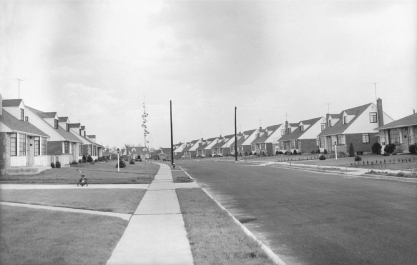
The conformity that suburbs represented was
A) challenged by artists, intellectuals, and rebellious youth.
B) found only in the "Sun Belt."
C) opposed by liberal and left-leaning politicians.
D) generally good for the environment.
The conformity that suburbs represented was
A) challenged by artists, intellectuals, and rebellious youth.
B) found only in the "Sun Belt."
C) opposed by liberal and left-leaning politicians.
D) generally good for the environment.
Question
Question
Question
Question
Levittown
Communities like Levittown exemplified
A) homogeneous mass culture.
B) liberalization of racial policies.
C) the embrace of immigrants.
D) the shift away from consumer spending.
Communities like Levittown exemplified
A) homogeneous mass culture.
B) liberalization of racial policies.
C) the embrace of immigrants.
D) the shift away from consumer spending.
Question
Levittown
The demographic changes that resulted in the development of housing projects like the one in the image could be described as
A) the great migration.
B) westward migration.
C) suburbanization.
D) immigration.
The demographic changes that resulted in the development of housing projects like the one in the image could be described as
A) the great migration.
B) westward migration.
C) suburbanization.
D) immigration.
Question
Question
Question
Question
Question
Question
Question
Question
Question
Question
Question
Question
Question
Question
Question
Question
Question
Question
Question
Question
Question
Question
Question
Question
Question
Question
Question
Question
Question
Question
Question
Question
Question
Question
Question
Question
Question
Question
Question
Question
Question
Question
Question
Question
Question
Question
Question
Question
Question
Question
Question
Question
Question
Question

Unlock Deck
Sign up to unlock the cards in this deck!
Unlock Deck
Unlock Deck
1/71

Play

Full screen (f)
Deck 24: An Affluent Society, 1953-1960
1
How did 1950s consumerism differ from previous eras?
A) Advertising shaped patterns of consumption based on "desires" rather than "needs."
B) Americans became accustomed to buying goods with credit cards.
C) The wide availability of goods such as Levis, dishwashers, and refrigerators symbolized the superiority of American culture to communist culture.
D) B and C
A) Advertising shaped patterns of consumption based on "desires" rather than "needs."
B) Americans became accustomed to buying goods with credit cards.
C) The wide availability of goods such as Levis, dishwashers, and refrigerators symbolized the superiority of American culture to communist culture.
D) B and C
B and C
2
What about the golden age of capitalism between 1946 and 1960 was most beneficial for Americans?
A) The American GNP more than doubled.
B) The United States maintained a trade surplus.
C) Prices remained stable.
D) Most monetary gains reached ordinary citizens through rising wages.
A) The American GNP more than doubled.
B) The United States maintained a trade surplus.
C) Prices remained stable.
D) Most monetary gains reached ordinary citizens through rising wages.
Most monetary gains reached ordinary citizens through rising wages.
3
Between 1946 and 1960, the American gross national product:
A) more than doubled, and wages increased.
B) declined as wages stagnated.
C) stayed about the same.
D) returned to prewar levels.
A) more than doubled, and wages increased.
B) declined as wages stagnated.
C) stayed about the same.
D) returned to prewar levels.
more than doubled, and wages increased.
4
Which of the following is NOT true about the growth of the postwar West?
A) Unlike in previous migrations, people flowed into the region from all parts of the country.
B) Washington and Oregon eclipsed California's population due to unprecedented employment opportunities in the defense industry.
C) Most western growth took place in urban rather than rural areas.
D) Oil production led to explosive population growth in Dallas and Houston.
A) Unlike in previous migrations, people flowed into the region from all parts of the country.
B) Washington and Oregon eclipsed California's population due to unprecedented employment opportunities in the defense industry.
C) Most western growth took place in urban rather than rural areas.
D) Oil production led to explosive population growth in Dallas and Houston.
Unlock Deck
Unlock for access to all 71 flashcards in this deck.
Unlock Deck
k this deck
5
Massive Retaliation (1954)
John Foster Dulles
We want, for ourselves and the other free nations, a maximum deterrent at a bearable cost. . . . Local defense will always be important. But there is no local defense whichalone will contain the mighty land power of the Communist world. Local defenses must be reinforced by the further deterrent of massive retaliatory power. A potential aggressor mustknow that he cannot always prescribe battle conditions that suit him. . . .
The way to deter aggression is for the free community to be willing and able to respond vigorously at places and with means of its own choosing. . . .
If we can deter such aggression as would mean general war, and that is our confident resolve, then we can let time and fundamentals work for us.
Under Eisenhower and Dulles, the United States developed a nuclear strategy for defense based on
A) building more conventional and nuclear weapons.
B) ensuring that Western Hemisphere nations would fight with the United States.
C) signing arms reduction treaties.
D) launching frequent preemptive military strikes.
John Foster Dulles
We want, for ourselves and the other free nations, a maximum deterrent at a bearable cost. . . . Local defense will always be important. But there is no local defense whichalone will contain the mighty land power of the Communist world. Local defenses must be reinforced by the further deterrent of massive retaliatory power. A potential aggressor mustknow that he cannot always prescribe battle conditions that suit him. . . .
The way to deter aggression is for the free community to be willing and able to respond vigorously at places and with means of its own choosing. . . .
If we can deter such aggression as would mean general war, and that is our confident resolve, then we can let time and fundamentals work for us.
Under Eisenhower and Dulles, the United States developed a nuclear strategy for defense based on
A) building more conventional and nuclear weapons.
B) ensuring that Western Hemisphere nations would fight with the United States.
C) signing arms reduction treaties.
D) launching frequent preemptive military strikes.
Unlock Deck
Unlock for access to all 71 flashcards in this deck.
Unlock Deck
k this deck
6
Massive Retaliation (1954)
John Foster Dulles
We want, for ourselves and the other free nations, a maximum deterrent at a bearable cost. . . . Local defense will always be important. But there is no local defense whichalone will contain the mighty land power of the Communist world. Local defenses must be reinforced by the further deterrent of massive retaliatory power. A potential aggressor mustknow that he cannot always prescribe battle conditions that suit him. . . .
The way to deter aggression is for the free community to be willing and able to respond vigorously at places and with means of its own choosing. . . .
If we can deter such aggression as would mean general war, and that is our confident resolve, then we can let time and fundamentals work for us.
Dulles's statement reflects which broadly embraced assumption of Americans in the 1950s?
A) Eastern European nations could defend themselves if they were funded by the United States.
B) The United States should not be concerned about the costs of maintaining a strong military.
C) If the expansion of the Soviet Union could be limited, communism would ultimately collapse.
D) Americans should form local militias to defend their communities from communism.
John Foster Dulles
We want, for ourselves and the other free nations, a maximum deterrent at a bearable cost. . . . Local defense will always be important. But there is no local defense whichalone will contain the mighty land power of the Communist world. Local defenses must be reinforced by the further deterrent of massive retaliatory power. A potential aggressor mustknow that he cannot always prescribe battle conditions that suit him. . . .
The way to deter aggression is for the free community to be willing and able to respond vigorously at places and with means of its own choosing. . . .
If we can deter such aggression as would mean general war, and that is our confident resolve, then we can let time and fundamentals work for us.
Dulles's statement reflects which broadly embraced assumption of Americans in the 1950s?
A) Eastern European nations could defend themselves if they were funded by the United States.
B) The United States should not be concerned about the costs of maintaining a strong military.
C) If the expansion of the Soviet Union could be limited, communism would ultimately collapse.
D) Americans should form local militias to defend their communities from communism.
Unlock Deck
Unlock for access to all 71 flashcards in this deck.
Unlock Deck
k this deck
7
Dwight D. Eisenhower
In that city, under the leadership of demagogic extremists, disorderly mobs have deliberately prevented the carrying out of proper orders from a federal court . . . obviously for the purpose of again preventing the carrying out of the court's order relating to the admission of Negro children to that school. . . .
Citizens are keenly aware of the tremendous disservice that has been done to the people of Arkansas in the eyes of the nation, and that has been done to the nation in the eyes of the world.
At a time when we face grave situations abroad because of the hatred that communism bears toward a system of government based on human rights, it would be difficult to exaggerate the harm that is being done to the prestige and influence, and indeed to the safety, of our nation and the world.
Our enemies are gloating over this incident and using it everywhere to misrepresent our whole nation.
Federal government actions like those at Little Rock High School
A) sought to fulfill the promises of Reconstruction.
B) failed to have much impact on social customs in the United States.
C) elevated the reputation of the South across the nation.
D) benefited immigrants as much as they did blacks.
In that city, under the leadership of demagogic extremists, disorderly mobs have deliberately prevented the carrying out of proper orders from a federal court . . . obviously for the purpose of again preventing the carrying out of the court's order relating to the admission of Negro children to that school. . . .
Citizens are keenly aware of the tremendous disservice that has been done to the people of Arkansas in the eyes of the nation, and that has been done to the nation in the eyes of the world.
At a time when we face grave situations abroad because of the hatred that communism bears toward a system of government based on human rights, it would be difficult to exaggerate the harm that is being done to the prestige and influence, and indeed to the safety, of our nation and the world.
Our enemies are gloating over this incident and using it everywhere to misrepresent our whole nation.
Federal government actions like those at Little Rock High School
A) sought to fulfill the promises of Reconstruction.
B) failed to have much impact on social customs in the United States.
C) elevated the reputation of the South across the nation.
D) benefited immigrants as much as they did blacks.
Unlock Deck
Unlock for access to all 71 flashcards in this deck.
Unlock Deck
k this deck
8
William Levitt, with the help of the GI Bill, gave many Americans the opportunity to:
A) get an education.
B) buy a home.
C) buy a gray flannel suit.
D) buy a car.
A) get an education.
B) buy a home.
C) buy a gray flannel suit.
D) buy a car.
Unlock Deck
Unlock for access to all 71 flashcards in this deck.
Unlock Deck
k this deck
9
How did Los Angeles epitomize the new emphasis on the car in 1950s America?
A) Filmmakers in Hollywood released hundreds of movies in the new "road picture" genre, featuring sleek cars racing down Los Angeles highways.
B) The city's centralized design enabled people to carpool to suburban transit centers and then take public transportation.
C) People drove to and from work on a web of highways and shopped at malls only accessible by driving.
D) Bucking the western trend, Los Angeles actually maintained its extensive system of trains, trolleys, and buses well into the 1970s.
A) Filmmakers in Hollywood released hundreds of movies in the new "road picture" genre, featuring sleek cars racing down Los Angeles highways.
B) The city's centralized design enabled people to carpool to suburban transit centers and then take public transportation.
C) People drove to and from work on a web of highways and shopped at malls only accessible by driving.
D) Bucking the western trend, Los Angeles actually maintained its extensive system of trains, trolleys, and buses well into the 1970s.
Unlock Deck
Unlock for access to all 71 flashcards in this deck.
Unlock Deck
k this deck
10
Which statement about industry is FALSE?
A) The West did not benefit from the industries that sprang up from the Cold War.
B) By the mid-1950s, white-collar workers outnumbered blue-collar factory and manual laborers.
C) The unions' success in raising wages inspired employers to mechanize more and more elements of manufacturing in order to reduce labor costs.
D) Since the 1950s, the American economy has shifted away from manufacturing.
A) The West did not benefit from the industries that sprang up from the Cold War.
B) By the mid-1950s, white-collar workers outnumbered blue-collar factory and manual laborers.
C) The unions' success in raising wages inspired employers to mechanize more and more elements of manufacturing in order to reduce labor costs.
D) Since the 1950s, the American economy has shifted away from manufacturing.
Unlock Deck
Unlock for access to all 71 flashcards in this deck.
Unlock Deck
k this deck
11
During the 1950s:
A) the federal government bypassed the South as a location for new military bases and shipyards.
B) the Cold War stimulated western manufacturing in defense industries such as guided missiles.
C) more efficient machinery and fertilization techniques helped the shift toward larger farms with fewer people working on them, particularly in the West.
D) B and C
A) the federal government bypassed the South as a location for new military bases and shipyards.
B) the Cold War stimulated western manufacturing in defense industries such as guided missiles.
C) more efficient machinery and fertilization techniques helped the shift toward larger farms with fewer people working on them, particularly in the West.
D) B and C
Unlock Deck
Unlock for access to all 71 flashcards in this deck.
Unlock Deck
k this deck
12
Levittown
The conformity that suburbs represented was
A) challenged by artists, intellectuals, and rebellious youth.
B) found only in the "Sun Belt."
C) opposed by liberal and left-leaning politicians.
D) generally good for the environment.
The conformity that suburbs represented was
A) challenged by artists, intellectuals, and rebellious youth.
B) found only in the "Sun Belt."
C) opposed by liberal and left-leaning politicians.
D) generally good for the environment.
Unlock Deck
Unlock for access to all 71 flashcards in this deck.
Unlock Deck
k this deck
13
Dwight D. Eisenhower
In that city, under the leadership of demagogic extremists, disorderly mobs have deliberately prevented the carrying out of proper orders from a federal court . . . obviously for the purpose of again preventing the carrying out of the court's order relating to the admission of Negro children to that school. . . .
Citizens are keenly aware of the tremendous disservice that has been done to the people of Arkansas in the eyes of the nation, and that has been done to the nation in the eyes of the world.
At a time when we face grave situations abroad because of the hatred that communism bears toward a system of government based on human rights, it would be difficult to exaggerate the harm that is being done to the prestige and influence, and indeed to the safety, of our nation and the world.
Our enemies are gloating over this incident and using it everywhere to misrepresent our whole nation.
What did Eisenhower fear?
A) The war efforts in Korea and Vietnam would suffer due to racial conflict at home.
B) Expanding the power of the federal government to enforce an end to segregation would help the communists.
C) Arkansas might secede from the nation.
D) The Soviets and other communists abroad would use racial conflict in the United States to demean America and what it stood for.
In that city, under the leadership of demagogic extremists, disorderly mobs have deliberately prevented the carrying out of proper orders from a federal court . . . obviously for the purpose of again preventing the carrying out of the court's order relating to the admission of Negro children to that school. . . .
Citizens are keenly aware of the tremendous disservice that has been done to the people of Arkansas in the eyes of the nation, and that has been done to the nation in the eyes of the world.
At a time when we face grave situations abroad because of the hatred that communism bears toward a system of government based on human rights, it would be difficult to exaggerate the harm that is being done to the prestige and influence, and indeed to the safety, of our nation and the world.
Our enemies are gloating over this incident and using it everywhere to misrepresent our whole nation.
What did Eisenhower fear?
A) The war efforts in Korea and Vietnam would suffer due to racial conflict at home.
B) Expanding the power of the federal government to enforce an end to segregation would help the communists.
C) Arkansas might secede from the nation.
D) The Soviets and other communists abroad would use racial conflict in the United States to demean America and what it stood for.
Unlock Deck
Unlock for access to all 71 flashcards in this deck.
Unlock Deck
k this deck
14
Dwight D. Eisenhower
In that city, under the leadership of demagogic extremists, disorderly mobs have deliberately prevented the carrying out of proper orders from a federal court . . . obviously for the purpose of again preventing the carrying out of the court's order relating to the admission of Negro children to that school. . . .
Citizens are keenly aware of the tremendous disservice that has been done to the people of Arkansas in the eyes of the nation, and that has been done to the nation in the eyes of the world.
At a time when we face grave situations abroad because of the hatred that communism bears toward a system of government based on human rights, it would be difficult to exaggerate the harm that is being done to the prestige and influence, and indeed to the safety, of our nation and the world.
Our enemies are gloating over this incident and using it everywhere to misrepresent our whole nation.
Eisenhower's connection of domestic and foreign policy best reflects ideas associated with
A) laissez-faire economics.
B) Keynesian economics.
C) containment.
D) realpolitik.
In that city, under the leadership of demagogic extremists, disorderly mobs have deliberately prevented the carrying out of proper orders from a federal court . . . obviously for the purpose of again preventing the carrying out of the court's order relating to the admission of Negro children to that school. . . .
Citizens are keenly aware of the tremendous disservice that has been done to the people of Arkansas in the eyes of the nation, and that has been done to the nation in the eyes of the world.
At a time when we face grave situations abroad because of the hatred that communism bears toward a system of government based on human rights, it would be difficult to exaggerate the harm that is being done to the prestige and influence, and indeed to the safety, of our nation and the world.
Our enemies are gloating over this incident and using it everywhere to misrepresent our whole nation.
Eisenhower's connection of domestic and foreign policy best reflects ideas associated with
A) laissez-faire economics.
B) Keynesian economics.
C) containment.
D) realpolitik.
Unlock Deck
Unlock for access to all 71 flashcards in this deck.
Unlock Deck
k this deck
15
Dwight D. Eisenhower
In that city, under the leadership of demagogic extremists, disorderly mobs have deliberately prevented the carrying out of proper orders from a federal court . . . obviously for the purpose of again preventing the carrying out of the court's order relating to the admission of Negro children to that school. . . .
Citizens are keenly aware of the tremendous disservice that has been done to the people of Arkansas in the eyes of the nation, and that has been done to the nation in the eyes of the world.
At a time when we face grave situations abroad because of the hatred that communism bears toward a system of government based on human rights, it would be difficult to exaggerate the harm that is being done to the prestige and influence, and indeed to the safety, of our nation and the world.
Our enemies are gloating over this incident and using it everywhere to misrepresent our whole nation.
The "mob" referred to by Eisenhower represents
A) legal challenges made to compulsory education laws.
B) white resistance to efforts at desegregation.
C) violence associated with student-led antiwar protests.
D) communist efforts to destabilize American life.
In that city, under the leadership of demagogic extremists, disorderly mobs have deliberately prevented the carrying out of proper orders from a federal court . . . obviously for the purpose of again preventing the carrying out of the court's order relating to the admission of Negro children to that school. . . .
Citizens are keenly aware of the tremendous disservice that has been done to the people of Arkansas in the eyes of the nation, and that has been done to the nation in the eyes of the world.
At a time when we face grave situations abroad because of the hatred that communism bears toward a system of government based on human rights, it would be difficult to exaggerate the harm that is being done to the prestige and influence, and indeed to the safety, of our nation and the world.
Our enemies are gloating over this incident and using it everywhere to misrepresent our whole nation.
The "mob" referred to by Eisenhower represents
A) legal challenges made to compulsory education laws.
B) white resistance to efforts at desegregation.
C) violence associated with student-led antiwar protests.
D) communist efforts to destabilize American life.
Unlock Deck
Unlock for access to all 71 flashcards in this deck.
Unlock Deck
k this deck
16
Levittown
Communities like Levittown exemplified
A) homogeneous mass culture.
B) liberalization of racial policies.
C) the embrace of immigrants.
D) the shift away from consumer spending.
Communities like Levittown exemplified
A) homogeneous mass culture.
B) liberalization of racial policies.
C) the embrace of immigrants.
D) the shift away from consumer spending.
Unlock Deck
Unlock for access to all 71 flashcards in this deck.
Unlock Deck
k this deck
17
Levittown
The demographic changes that resulted in the development of housing projects like the one in the image could be described as
A) the great migration.
B) westward migration.
C) suburbanization.
D) immigration.
The demographic changes that resulted in the development of housing projects like the one in the image could be described as
A) the great migration.
B) westward migration.
C) suburbanization.
D) immigration.
Unlock Deck
Unlock for access to all 71 flashcards in this deck.
Unlock Deck
k this deck
18
Massive Retaliation (1954)
John Foster Dulles
We want, for ourselves and the other free nations, a maximum deterrent at a bearable cost. . . . Local defense will always be important. But there is no local defense whichalone will contain the mighty land power of the Communist world. Local defenses must be reinforced by the further deterrent of massive retaliatory power. A potential aggressor mustknow that he cannot always prescribe battle conditions that suit him. . . .
The way to deter aggression is for the free community to be willing and able to respond vigorously at places and with means of its own choosing. . . .
If we can deter such aggression as would mean general war, and that is our confident resolve, then we can let time and fundamentals work for us.
The position of the United States in the world after World War II was
A) quite similar to that of the United States in the nineteenth century.
B) a direct result of territorial expansion after World War I.
C) focused mostly on the obligations of the Roosevelt Corollary.
D) more globally engaged militarily and economically.
John Foster Dulles
We want, for ourselves and the other free nations, a maximum deterrent at a bearable cost. . . . Local defense will always be important. But there is no local defense whichalone will contain the mighty land power of the Communist world. Local defenses must be reinforced by the further deterrent of massive retaliatory power. A potential aggressor mustknow that he cannot always prescribe battle conditions that suit him. . . .
The way to deter aggression is for the free community to be willing and able to respond vigorously at places and with means of its own choosing. . . .
If we can deter such aggression as would mean general war, and that is our confident resolve, then we can let time and fundamentals work for us.
The position of the United States in the world after World War II was
A) quite similar to that of the United States in the nineteenth century.
B) a direct result of territorial expansion after World War I.
C) focused mostly on the obligations of the Roosevelt Corollary.
D) more globally engaged militarily and economically.
Unlock Deck
Unlock for access to all 71 flashcards in this deck.
Unlock Deck
k this deck
19
The shopping mall was the inevitable result of what institution?
A) The suburb.
B) Free-trade agreements.
C) Fast-food restaurants.
D) The college.
A) The suburb.
B) Free-trade agreements.
C) Fast-food restaurants.
D) The college.
Unlock Deck
Unlock for access to all 71 flashcards in this deck.
Unlock Deck
k this deck
20
What was one result of the development of suburbs?
A) construction of shopping malls
B) integration of public schools
C) creation of rock and roll
D) passage of the GI Bill
A) construction of shopping malls
B) integration of public schools
C) creation of rock and roll
D) passage of the GI Bill
Unlock Deck
Unlock for access to all 71 flashcards in this deck.
Unlock Deck
k this deck
21
New conservatives trusted government to:
A) regulate the economy.
B) regulate personal behavior.
C) protect civil liberties and the toleration of differences.
D) provide a comprehensive welfare system.
A) regulate the economy.
B) regulate personal behavior.
C) protect civil liberties and the toleration of differences.
D) provide a comprehensive welfare system.
Unlock Deck
Unlock for access to all 71 flashcards in this deck.
Unlock Deck
k this deck
22
Why were American suburbs of the 1950s so heavily segregated?
A) African-Americans preferred to live in the inner cities.
B) Neighborhoods formed around churches, and as long as churches were segregated, suburbs would remain so as well.
C) All states had laws in place mandating the segregation of residential districts.
D) Residents, brokers, and realtors dealt in contracts and mortgages that barred the sale to non-white residents.
A) African-Americans preferred to live in the inner cities.
B) Neighborhoods formed around churches, and as long as churches were segregated, suburbs would remain so as well.
C) All states had laws in place mandating the segregation of residential districts.
D) Residents, brokers, and realtors dealt in contracts and mortgages that barred the sale to non-white residents.
Unlock Deck
Unlock for access to all 71 flashcards in this deck.
Unlock Deck
k this deck
23
How did American companies contribute to the influx of Puerto Rican migrants by the hundreds of thousands beginning in the 1950s?
A) They were looking for cheaper labor to replace expensive union contracts.
B) They recruited Puerto Ricans primarily for construction jobs in Florida and in the fishing industry.
C) The end of the bracero program in 1954 prompted American agro-business to look for new cheap labor in Puerto Rico.
D) The increasing control of land by U.S. sugar companies on the island pushed small tobacco and coffee farmers off the land and into a search for jobs on the mainland.
A) They were looking for cheaper labor to replace expensive union contracts.
B) They recruited Puerto Ricans primarily for construction jobs in Florida and in the fishing industry.
C) The end of the bracero program in 1954 prompted American agro-business to look for new cheap labor in Puerto Rico.
D) The increasing control of land by U.S. sugar companies on the island pushed small tobacco and coffee farmers off the land and into a search for jobs on the mainland.
Unlock Deck
Unlock for access to all 71 flashcards in this deck.
Unlock Deck
k this deck
24
In the 1952 presidential campaign, Richard Nixon's Checkers speech:
A) reflected the growing importance of board games in American life.
B) reflected the growing importance of television in American life.
C) reflected the growing importance of pets in American life.
D) was not well received, and the Republicans lost the election.
A) reflected the growing importance of board games in American life.
B) reflected the growing importance of television in American life.
C) reflected the growing importance of pets in American life.
D) was not well received, and the Republicans lost the election.
Unlock Deck
Unlock for access to all 71 flashcards in this deck.
Unlock Deck
k this deck
25
During the 1950s, Americans:
A) tended to marry later in life than did previous generations.
B) experienced a declining birth rate.
C) stressed the importance of a college education, especially for women.
D) on average married younger and had more children than previous generations.
A) tended to marry later in life than did previous generations.
B) experienced a declining birth rate.
C) stressed the importance of a college education, especially for women.
D) on average married younger and had more children than previous generations.
Unlock Deck
Unlock for access to all 71 flashcards in this deck.
Unlock Deck
k this deck
26
Dwight D. Eisenhower was elected president in 1952 in part because he:
A) pledged to use nuclear weapons in the Korean War.
B) promised to dismantle the New Deal.
C) supported civil rights.
D) manifested a public image of fatherly warmth.
A) pledged to use nuclear weapons in the Korean War.
B) promised to dismantle the New Deal.
C) supported civil rights.
D) manifested a public image of fatherly warmth.
Unlock Deck
Unlock for access to all 71 flashcards in this deck.
Unlock Deck
k this deck
27
To libertarian conservatives, freedom meant:
A) first and foremost a moral condition.
B) individual autonomy, limited government, and unregulated capitalism.
C) using government as a vehicle for social reform, ensuring an equal distribution of wealth.
D) what it did in the late eighteenth century-the right to own property and to vote.
A) first and foremost a moral condition.
B) individual autonomy, limited government, and unregulated capitalism.
C) using government as a vehicle for social reform, ensuring an equal distribution of wealth.
D) what it did in the late eighteenth century-the right to own property and to vote.
Unlock Deck
Unlock for access to all 71 flashcards in this deck.
Unlock Deck
k this deck
28
What made the Army-McCarthy Hearings unusual for American television programming of the 1950s?
A) It appeared in color.
B) It was the first live broadcast.
C) It was the first broadcast via satellite.
D) It was deeply political and controversial.
A) It appeared in color.
B) It was the first live broadcast.
C) It was the first broadcast via satellite.
D) It was deeply political and controversial.
Unlock Deck
Unlock for access to all 71 flashcards in this deck.
Unlock Deck
k this deck
29
After World War II, most working women:
A) remained in the industrial jobs they held during the war.
B) did not work outside the home.
C) were concentrated in low-paying, nonunion jobs.
D) earned the same wages as men.
A) remained in the industrial jobs they held during the war.
B) did not work outside the home.
C) were concentrated in low-paying, nonunion jobs.
D) earned the same wages as men.
Unlock Deck
Unlock for access to all 71 flashcards in this deck.
Unlock Deck
k this deck
30
What gave conservatives of the 1950s their political unity?
A) The massive corporate sponsorships they secured through private fund-raising.
B) The unifying political ideology of Friedrich von Hayek.
C) The common enemies of the Soviet Union and the federal government.
D) Their shared religious fundamentals of Protestant Christianity.
A) The massive corporate sponsorships they secured through private fund-raising.
B) The unifying political ideology of Friedrich von Hayek.
C) The common enemies of the Soviet Union and the federal government.
D) Their shared religious fundamentals of Protestant Christianity.
Unlock Deck
Unlock for access to all 71 flashcards in this deck.
Unlock Deck
k this deck
31
After World War II, the automobile:
A) declined in use, and the Midwest suffered economically.
B) became a status symbol only for the wealthy.
C) remained a luxury, not a necessity of life.
D) altered the American landscape.
A) declined in use, and the Midwest suffered economically.
B) became a status symbol only for the wealthy.
C) remained a luxury, not a necessity of life.
D) altered the American landscape.
Unlock Deck
Unlock for access to all 71 flashcards in this deck.
Unlock Deck
k this deck
32
The new conservatives:
A) spoke the language of personal autonomy.
B) emphasized tradition, community, and moral commitment.
C) supported a more centralized federal government.
D) were also known as libertarians.
A) spoke the language of personal autonomy.
B) emphasized tradition, community, and moral commitment.
C) supported a more centralized federal government.
D) were also known as libertarians.
Unlock Deck
Unlock for access to all 71 flashcards in this deck.
Unlock Deck
k this deck
33
As suggested by some commentators, how did big business enable individual freedom in the 1950s?
A) Big business successfully lobbied for higher tariffs on consumer goods, which increased profits and drove American wages up.
B) With large-scale production of goods came the freedom for individuals to choose among many items.
C) Corporations in the 1950s offered a range of benefits to employees that freed them from economic uncertainty.
D) The repeal of New Deal regulatory controls on investment banking allowed individual Americans to put their money into the stock market without restriction.
A) Big business successfully lobbied for higher tariffs on consumer goods, which increased profits and drove American wages up.
B) With large-scale production of goods came the freedom for individuals to choose among many items.
C) Corporations in the 1950s offered a range of benefits to employees that freed them from economic uncertainty.
D) The repeal of New Deal regulatory controls on investment banking allowed individual Americans to put their money into the stock market without restriction.
Unlock Deck
Unlock for access to all 71 flashcards in this deck.
Unlock Deck
k this deck
34
The Housing Act of 1949:
A) set a high income ceiling for eligibility.
B) reinforced the concentration of poverty in non-white urban neighborhoods.
C) ended the concentration of poverty in non-white urban neighborhoods.
D) allowed growing numbers of blacks to move to the suburbs.
A) set a high income ceiling for eligibility.
B) reinforced the concentration of poverty in non-white urban neighborhoods.
C) ended the concentration of poverty in non-white urban neighborhoods.
D) allowed growing numbers of blacks to move to the suburbs.
Unlock Deck
Unlock for access to all 71 flashcards in this deck.
Unlock Deck
k this deck
35
During the 1950s, television:
A) effectively spread images of working-class life to a growing number of Americans.
B) tried to replace newspapers as the most common source of information but failed.
C) became the nation's least favorite form of leisure activity.
D) became an effective advertising medium.
A) effectively spread images of working-class life to a growing number of Americans.
B) tried to replace newspapers as the most common source of information but failed.
C) became the nation's least favorite form of leisure activity.
D) became an effective advertising medium.
Unlock Deck
Unlock for access to all 71 flashcards in this deck.
Unlock Deck
k this deck
36
All of the following spurred the growth of the suburban middle class EXCEPT:
A) federal tax subsidies.
B) mortgage guarantees for home purchases.
C) trains and streetcars.
D) federal highway construction.
A) federal tax subsidies.
B) mortgage guarantees for home purchases.
C) trains and streetcars.
D) federal highway construction.
Unlock Deck
Unlock for access to all 71 flashcards in this deck.
Unlock Deck
k this deck
37
During the Cold War, religious differences:
A) were absorbed within the notion of a common Judeo-Christian heritage.
B) were heightened by the growth of the suburbs.
C) were not a factor, as church and synagogue membership declined.
D) were intensified through the institution of school prayer.
A) were absorbed within the notion of a common Judeo-Christian heritage.
B) were heightened by the growth of the suburbs.
C) were not a factor, as church and synagogue membership declined.
D) were intensified through the institution of school prayer.
Unlock Deck
Unlock for access to all 71 flashcards in this deck.
Unlock Deck
k this deck
38
Why did auto manufacturers and oil companies vault to the top ranks of corporate America in 1950s?
A) Profits in both industries rose steeply, due to the vast majority of auto manufacturing and oil refinery jobs being shipped overseas.
B) Lucrative government defense contracts continued, due to a postwar need for military trucks and jeeps.
C) The consumer demand for the automobile boomed in this decade.
D) Most members of Congress had business backgrounds.
A) Profits in both industries rose steeply, due to the vast majority of auto manufacturing and oil refinery jobs being shipped overseas.
B) Lucrative government defense contracts continued, due to a postwar need for military trucks and jeeps.
C) The consumer demand for the automobile boomed in this decade.
D) Most members of Congress had business backgrounds.
Unlock Deck
Unlock for access to all 71 flashcards in this deck.
Unlock Deck
k this deck
39
During the postwar suburban boom, African-Americans:
A) experienced little, if any, discrimination, especially in the North.
B) were encouraged to move into communities like Levittown, New York.
C) were discriminated against only in the South.
D) were often unable to receive financing for housing.
A) experienced little, if any, discrimination, especially in the North.
B) were encouraged to move into communities like Levittown, New York.
C) were discriminated against only in the South.
D) were often unable to receive financing for housing.
Unlock Deck
Unlock for access to all 71 flashcards in this deck.
Unlock Deck
k this deck
40
Between 1950 and 1970, suburbanization:
A) eased racial tensions in American cities.
B) encouraged a revitalization of American cities.
C) hardened racial divisions in American life.
D) encouraged Puerto Rican immigration.
A) eased racial tensions in American cities.
B) encouraged a revitalization of American cities.
C) hardened racial divisions in American life.
D) encouraged Puerto Rican immigration.
Unlock Deck
Unlock for access to all 71 flashcards in this deck.
Unlock Deck
k this deck
41
Why did the Soviet Union strongly support the national independence movements in the new Third World?
A) Soviets were desperately trying to expand their share in foreign export markets.
B) They hoped to convince new nations to ally themselves with the eastern bloc against European and American imperialists.
C) Soviets feared the obvious appeal an alliance with former colonial rulers had for these new nations.
D) The Soviet Union had made the right to self-determination a principle for all nations around the world.
A) Soviets were desperately trying to expand their share in foreign export markets.
B) They hoped to convince new nations to ally themselves with the eastern bloc against European and American imperialists.
C) Soviets feared the obvious appeal an alliance with former colonial rulers had for these new nations.
D) The Soviet Union had made the right to self-determination a principle for all nations around the world.
Unlock Deck
Unlock for access to all 71 flashcards in this deck.
Unlock Deck
k this deck
42
Why did the Eisenhower administration embrace the doctrine of "massive retaliation"?
A) The doctrine provided Eisenhower with the necessary flexibility to fight communism in Central America and Southeast Asia.
B) The doctrine prevented not only large but small military conflicts as well.
C) The constant threat of mutually assured destruction under the doctrine made for more cautious diplomacy.
D) The doctrine reduced national anxiety over the threat of nuclear annihilation.
A) The doctrine provided Eisenhower with the necessary flexibility to fight communism in Central America and Southeast Asia.
B) The doctrine prevented not only large but small military conflicts as well.
C) The constant threat of mutually assured destruction under the doctrine made for more cautious diplomacy.
D) The doctrine reduced national anxiety over the threat of nuclear annihilation.
Unlock Deck
Unlock for access to all 71 flashcards in this deck.
Unlock Deck
k this deck
43
Which statement best describes the thesis of David Riesman's book The Lonely Crowd?
A) White America had alienated black Americans from mainstream society.
B) Americans were conformists and lacked the inner resources to lead truly independent lives.
C) Women were unhappy with the role of wife and mother and longed for acceptance in higher education and other intellectual pursuits.
D) After World War II, Europe was left behind economically and politically with the emergence of the United States and Soviet Union as superpowers.
A) White America had alienated black Americans from mainstream society.
B) Americans were conformists and lacked the inner resources to lead truly independent lives.
C) Women were unhappy with the role of wife and mother and longed for acceptance in higher education and other intellectual pursuits.
D) After World War II, Europe was left behind economically and politically with the emergence of the United States and Soviet Union as superpowers.
Unlock Deck
Unlock for access to all 71 flashcards in this deck.
Unlock Deck
k this deck
44
Why did the editors of Life magazine fear that American freedom might be in danger from not being used enough?
A) American voter participation had fallen dramatically since World War II.
B) Americans remained reluctant to travel and see the world.
C) Americans failed to enjoy the blessings of their private lives.
D) Americans seemed to have largely withdrawn from open dissent in the public sphere.
A) American voter participation had fallen dramatically since World War II.
B) Americans remained reluctant to travel and see the world.
C) Americans failed to enjoy the blessings of their private lives.
D) Americans seemed to have largely withdrawn from open dissent in the public sphere.
Unlock Deck
Unlock for access to all 71 flashcards in this deck.
Unlock Deck
k this deck
45
Labor and employers agreed to a new "social contract" that included all of the following provisions EXCEPT:
A) employers required the National Association of Manufacturers to accept the right of workers to organize unions.
B) unions left decisions regarding capital investment in management's hands.
C) unions left decisions regarding plant location in management's hands.
D) employers granted wage increases.
A) employers required the National Association of Manufacturers to accept the right of workers to organize unions.
B) unions left decisions regarding capital investment in management's hands.
C) unions left decisions regarding plant location in management's hands.
D) employers granted wage increases.
Unlock Deck
Unlock for access to all 71 flashcards in this deck.
Unlock Deck
k this deck
46
Eisenhower's intervention in Vietnam partly consisted of:
A) urging Ngo Dinh Diem not to hold elections.
B) hosting the 1954 Geneva Accords.
C) the United States paying four-fifths of the cost of the war between the French and Ho Chi Minh's nationalist forces.
D) A and C
A) urging Ngo Dinh Diem not to hold elections.
B) hosting the 1954 Geneva Accords.
C) the United States paying four-fifths of the cost of the war between the French and Ho Chi Minh's nationalist forces.
D) A and C
Unlock Deck
Unlock for access to all 71 flashcards in this deck.
Unlock Deck
k this deck
47
Ngo Dinh Diem:
A) had allied with Ho Chi Minh in the struggle against Japanese occupation of Indochina during World War II.
B) was backed by the United States in his decision to ignore the Geneva Accords' plan for elections in Vietnam.
C) agreed to hold elections in South Vietnam in 1956.
D) refused American aid intended to bolster his regime.
A) had allied with Ho Chi Minh in the struggle against Japanese occupation of Indochina during World War II.
B) was backed by the United States in his decision to ignore the Geneva Accords' plan for elections in Vietnam.
C) agreed to hold elections in South Vietnam in 1956.
D) refused American aid intended to bolster his regime.
Unlock Deck
Unlock for access to all 71 flashcards in this deck.
Unlock Deck
k this deck
48
During the 1950s, American teenagers:
A) declined in number within the general population.
B) increased in number and were often perceived to be alienated.
C) were not viewed as a distinct population group.
D) voted in significant numbers.
A) declined in number within the general population.
B) increased in number and were often perceived to be alienated.
C) were not viewed as a distinct population group.
D) voted in significant numbers.
Unlock Deck
Unlock for access to all 71 flashcards in this deck.
Unlock Deck
k this deck
49
Most likely why did the U.S. Supreme Court not order the immediate implementation of its ruling in Brown v. Board of Education in 1954?
A) The Court did not have authority to declare segregation instantly unconstitutional.
B) The plaintiffs in the case themselves had asked for a gradual desegregation of schools.
C) Some justices on the Court feared the outbreak of widespread violence with such a bold ruling.
D) The Court wanted to give the defendants in the case the chance to appeal.
A) The Court did not have authority to declare segregation instantly unconstitutional.
B) The plaintiffs in the case themselves had asked for a gradual desegregation of schools.
C) Some justices on the Court feared the outbreak of widespread violence with such a bold ruling.
D) The Court wanted to give the defendants in the case the chance to appeal.
Unlock Deck
Unlock for access to all 71 flashcards in this deck.
Unlock Deck
k this deck
50
Secretary of State John Foster Dulles's policy of massive retaliation:
A) was part of the effort to rely more on conventional forces.
B) eased tensions between the United States and the Soviet Union.
C) declared that any Soviet attack would be countered by a nuclear attack.
D) applied only to communist China.
A) was part of the effort to rely more on conventional forces.
B) eased tensions between the United States and the Soviet Union.
C) declared that any Soviet attack would be countered by a nuclear attack.
D) applied only to communist China.
Unlock Deck
Unlock for access to all 71 flashcards in this deck.
Unlock Deck
k this deck
51
Which of the following did NOT challenge the mass conformity of the 1950s?
A) On the Road.
B) Desperate materialism.
C) Immediate pleasure enhanced by drugs.
D) Beat poet Allen Ginsberg.
A) On the Road.
B) Desperate materialism.
C) Immediate pleasure enhanced by drugs.
D) Beat poet Allen Ginsberg.
Unlock Deck
Unlock for access to all 71 flashcards in this deck.
Unlock Deck
k this deck
52
Dwight D. Eisenhower appointed which kind of individuals to his cabinet?
A) The "best and brightest," young intellectuals in their fields.
B) Former government men who had lots of combined political experience.
C) Wealthy businessmen to run the government like an efficient business.
D) A balanced mixture of Republicans and Democrats, since his party did not control Congress.
A) The "best and brightest," young intellectuals in their fields.
B) Former government men who had lots of combined political experience.
C) Wealthy businessmen to run the government like an efficient business.
D) A balanced mixture of Republicans and Democrats, since his party did not control Congress.
Unlock Deck
Unlock for access to all 71 flashcards in this deck.
Unlock Deck
k this deck
53
What made Elvis such a popular celebrity?
A) He sang songs no one had ever heard before.
B) He was one of the most gifted vocal performers of his generation.
C) He brought the rhythms and sexually provocative movements of black musicians to white audiences.
D) He sang openly about civil rights and equality.
A) He sang songs no one had ever heard before.
B) He was one of the most gifted vocal performers of his generation.
C) He brought the rhythms and sexually provocative movements of black musicians to white audiences.
D) He sang openly about civil rights and equality.
Unlock Deck
Unlock for access to all 71 flashcards in this deck.
Unlock Deck
k this deck
54
Which of the following assessments of the civil rights movement is most accurate?
A) The movement invigorated white Americans just like black Americans.
B) The movement grew popular at a time when whites had largely given up on the practice of segregation.
C) Although well-intentioned, the civil rights movement slowed down progress toward equality.
D) The movement came as a great surprise and was predicted only by a few.
A) The movement invigorated white Americans just like black Americans.
B) The movement grew popular at a time when whites had largely given up on the practice of segregation.
C) Although well-intentioned, the civil rights movement slowed down progress toward equality.
D) The movement came as a great surprise and was predicted only by a few.
Unlock Deck
Unlock for access to all 71 flashcards in this deck.
Unlock Deck
k this deck
55
Why did President Eisenhower use the CIA to overthrow the government of Iran in the early 1950s?
A) He did not believe Iran was ready for a democratically elected leader after centuries of monarchical rule.
B) Iran had refused to enter peace talks with the United States and the Soviet Union in 1950.
C) Israel had protested Iran's friendly relationship with Egypt.
D) The government had attempted to nationalize British-owned oil fields.
A) He did not believe Iran was ready for a democratically elected leader after centuries of monarchical rule.
B) Iran had refused to enter peace talks with the United States and the Soviet Union in 1950.
C) Israel had protested Iran's friendly relationship with Egypt.
D) The government had attempted to nationalize British-owned oil fields.
Unlock Deck
Unlock for access to all 71 flashcards in this deck.
Unlock Deck
k this deck
56
How did President Dwight D. Eisenhower surpass the New Deal in government involvement in the economy?
A) He established the Veterans Administration health care system.
B) He presided over the construction of 41,000 miles of interstate highways.
C) He established the most generous agricultural subsidy programs in the nation's history.
D) He signed Medicaid and Medicare into law.
A) He established the Veterans Administration health care system.
B) He presided over the construction of 41,000 miles of interstate highways.
C) He established the most generous agricultural subsidy programs in the nation's history.
D) He signed Medicaid and Medicare into law.
Unlock Deck
Unlock for access to all 71 flashcards in this deck.
Unlock Deck
k this deck
57
The "Third World":
A) encompassed an enormous range of territory, including several tiny western European nations.
B) included many nations newly created out of former European colonies.
C) was an invented term describing developing nations not aligned with either the Soviet Union or United States.
D) B and C
A) encompassed an enormous range of territory, including several tiny western European nations.
B) included many nations newly created out of former European colonies.
C) was an invented term describing developing nations not aligned with either the Soviet Union or United States.
D) B and C
Unlock Deck
Unlock for access to all 71 flashcards in this deck.
Unlock Deck
k this deck
58
The "social contract":
A) describes the new style of cooperation between labor and management that emerged in the 1950s and 1960s.
B) was of great benefit to union and the majority of nonunion workers alike.
C) did not include wage increases or health insurance.
D) was accepted by the National Association of Manufacturers as a compromise measure to ease labor disputes eroding industry profits.
A) describes the new style of cooperation between labor and management that emerged in the 1950s and 1960s.
B) was of great benefit to union and the majority of nonunion workers alike.
C) did not include wage increases or health insurance.
D) was accepted by the National Association of Manufacturers as a compromise measure to ease labor disputes eroding industry profits.
Unlock Deck
Unlock for access to all 71 flashcards in this deck.
Unlock Deck
k this deck
59
During the Eisenhower administration, U.S.-Soviet relations:
A) were made worse with the introduction of the policy of massive retaliation.
B) improved somewhat after the end of the Korean War and the death of Stalin.
C) stayed about the same as those experienced during the Truman years.
D) worsened considerably after the death of Stalin.
A) were made worse with the introduction of the policy of massive retaliation.
B) improved somewhat after the end of the Korean War and the death of Stalin.
C) stayed about the same as those experienced during the Truman years.
D) worsened considerably after the death of Stalin.
Unlock Deck
Unlock for access to all 71 flashcards in this deck.
Unlock Deck
k this deck
60
Guatemalan leader Jacobo Arbenz Guzmán:
A) sought to reduce foreign corporations' control over his country's economy.
B) was ousted by the KGB and replaced with a Soviet-friendly dictator.
C) was a friend and close ally of Soviet premier Josef Stalin before his death.
D) appealed to President Eisenhower for military support to defeat a growing communist insurgency in Guatemala.
A) sought to reduce foreign corporations' control over his country's economy.
B) was ousted by the KGB and replaced with a Soviet-friendly dictator.
C) was a friend and close ally of Soviet premier Josef Stalin before his death.
D) appealed to President Eisenhower for military support to defeat a growing communist insurgency in Guatemala.
Unlock Deck
Unlock for access to all 71 flashcards in this deck.
Unlock Deck
k this deck
61
The Southern Manifesto:
A) rejected massive resistance.
B) argued that southern states should not fly the Confederate flag over state capitol buildings.
C) repudiated the Supreme Court decision in Brown v. Board of Education.
D) argued that the Brown v. Board of Education decision reinforced southern customs and traditions.
A) rejected massive resistance.
B) argued that southern states should not fly the Confederate flag over state capitol buildings.
C) repudiated the Supreme Court decision in Brown v. Board of Education.
D) argued that the Brown v. Board of Education decision reinforced southern customs and traditions.
Unlock Deck
Unlock for access to all 71 flashcards in this deck.
Unlock Deck
k this deck
62
Which event did President John F. Kennedy blame on the failures of the Eisenhower administration?
A) The French defeat in Vietnam.
B) The failed coup in Guatemala.
C) The construction of the Berlin Wall.
D) The launch of the Soviet satellite Sputnik.
A) The French defeat in Vietnam.
B) The failed coup in Guatemala.
C) The construction of the Berlin Wall.
D) The launch of the Soviet satellite Sputnik.
Unlock Deck
Unlock for access to all 71 flashcards in this deck.
Unlock Deck
k this deck
63
In his 1961 farewell address, President Eisenhower warned Americans about:
A) the military-industrial complex.
B) the rise of organized crime.
C) the increase in juvenile delinquency.
D) environmental hazards.
A) the military-industrial complex.
B) the rise of organized crime.
C) the increase in juvenile delinquency.
D) environmental hazards.
Unlock Deck
Unlock for access to all 71 flashcards in this deck.
Unlock Deck
k this deck
64
Governor Orval Faubus responded to the court-ordered desegregation of Central High School:
A) by urging President Eisenhower to send in federal troops.
B) with defiance, refusing to comply and allowing violence to break out.
C) by offering his resignation to the people of Arkansas in protest.
D) by immediately closing Central High School, much like Virginia's governor had done to public schools in Virginia rather than integrate them.
A) by urging President Eisenhower to send in federal troops.
B) with defiance, refusing to comply and allowing violence to break out.
C) by offering his resignation to the people of Arkansas in protest.
D) by immediately closing Central High School, much like Virginia's governor had done to public schools in Virginia rather than integrate them.
Unlock Deck
Unlock for access to all 71 flashcards in this deck.
Unlock Deck
k this deck
65
The 1960 presidential debate between John F. Kennedy and Richard Nixon:
A) was broadcast only on the radio.
B) allowed Nixon to demonstrate his best qualities, thus winning the debate.
C) showed Kennedy to be an ineffective speaker, and thus he lost.
D) highlighted the impact of television on political campaigns.
A) was broadcast only on the radio.
B) allowed Nixon to demonstrate his best qualities, thus winning the debate.
C) showed Kennedy to be an ineffective speaker, and thus he lost.
D) highlighted the impact of television on political campaigns.
Unlock Deck
Unlock for access to all 71 flashcards in this deck.
Unlock Deck
k this deck
66
The Montgomery Bus Boycott:
A) was sparked when Rosa Parks was arrested for refusing to give up her seat to a white man.
B) did not succeed in desegregating the public buses.
C) propelled Thurgood Marshall into the national spotlight as a leader in the civil rights movement.
D) marked the end of the civil rights movement.
A) was sparked when Rosa Parks was arrested for refusing to give up her seat to a white man.
B) did not succeed in desegregating the public buses.
C) propelled Thurgood Marshall into the national spotlight as a leader in the civil rights movement.
D) marked the end of the civil rights movement.
Unlock Deck
Unlock for access to all 71 flashcards in this deck.
Unlock Deck
k this deck
67
What inspiration did Martin Luther King Jr. gain from Mahatma Gandhi?
A) The concept of black nationalism.
B) The principles of Zen pacifism.
C) The notion of subversive obedience.
D) The idea of peaceful civil disobedience.
A) The concept of black nationalism.
B) The principles of Zen pacifism.
C) The notion of subversive obedience.
D) The idea of peaceful civil disobedience.
Unlock Deck
Unlock for access to all 71 flashcards in this deck.
Unlock Deck
k this deck
68
Describe the factors that contributed to the migration of many Americans in the middle class to the suburbs and to the South and western parts (the Sun Belt) of the United States during the 1950s.
Unlock Deck
Unlock for access to all 71 flashcards in this deck.
Unlock Deck
k this deck
69
Evaluate the extent to which the election of Richard Nixon in 1968 marked a turning point in American politics, analyzing what changed and what stayed the same before and after Nixon became the president of the United States.
Unlock Deck
Unlock for access to all 71 flashcards in this deck.
Unlock Deck
k this deck
70
America's image abroad during the Cold War:
A) did not appear to suffer in Asian or African nations, who relied on the United States for military and economic aid.
B) proved to be an unreliable propaganda weapon for the Soviet Union.
C) could be a source of embarrassment for American diplomats seeking to win the loyalty of people in the non-white world.
D) was not of major concern to most leaders, given America's status as an economic superpower.
A) did not appear to suffer in Asian or African nations, who relied on the United States for military and economic aid.
B) proved to be an unreliable propaganda weapon for the Soviet Union.
C) could be a source of embarrassment for American diplomats seeking to win the loyalty of people in the non-white world.
D) was not of major concern to most leaders, given America's status as an economic superpower.
Unlock Deck
Unlock for access to all 71 flashcards in this deck.
Unlock Deck
k this deck
71
Which statement best describes how the white South reacted to the Brown v. Board of Education decision?
A) In opposition to integration, white southerners often burned down schools.
B) While the general public was outraged, southern congressional politicians supported the Supreme Court's decisions.
C) Southerners worked closely with the NAACP, cooperating when they could to integrate schools.
D) Some states closed the public schools rather than integrate, and offered white children the choice to opt out of integrated schools.
A) In opposition to integration, white southerners often burned down schools.
B) While the general public was outraged, southern congressional politicians supported the Supreme Court's decisions.
C) Southerners worked closely with the NAACP, cooperating when they could to integrate schools.
D) Some states closed the public schools rather than integrate, and offered white children the choice to opt out of integrated schools.
Unlock Deck
Unlock for access to all 71 flashcards in this deck.
Unlock Deck
k this deck
Unlock Deck
Unlock for access to all 71 flashcards in this deck.






