







 Chat with AI

Deck 14: Chemical Kinetics
Full screen (f)

Question

Question
Question
Question
Question
Question
Question
Question
Question
Question
Question
Question
Question
Question
Question
Which one of the following graphs shows the correct relationship between concentration and time for a reaction that is second order in [A]?
A)![<strong>Which one of the following graphs shows the correct relationship between concentration and time for a reaction that is second order in [A]?</strong> A) B) C) D) E) <div style=padding-top: 35px>](https://d2lvgg3v3hfg70.cloudfront.net/TB1822/11ea7ce9_fb19_fd91_b46a_79e39a54a289_TB1822_11.jpg)
B)![<strong>Which one of the following graphs shows the correct relationship between concentration and time for a reaction that is second order in [A]?</strong> A) B) C) D) E) <div style=padding-top: 35px>](https://d2lvgg3v3hfg70.cloudfront.net/TB1822/11ea7ce9_fb19_fd92_b46a_13c536fbc77f_TB1822_11.jpg)
C)![<strong>Which one of the following graphs shows the correct relationship between concentration and time for a reaction that is second order in [A]?</strong> A) B) C) D) E) <div style=padding-top: 35px>](https://d2lvgg3v3hfg70.cloudfront.net/TB1822/11ea7ce9_fb19_fd93_b46a_8f19e04c9023_TB1822_11.jpg)
D)![<strong>Which one of the following graphs shows the correct relationship between concentration and time for a reaction that is second order in [A]?</strong> A) B) C) D) E) <div style=padding-top: 35px>](https://d2lvgg3v3hfg70.cloudfront.net/TB1822/11ea7ce9_fb1a_24a4_b46a_1b4371d29255_TB1822_11.jpg)
E)![<strong>Which one of the following graphs shows the correct relationship between concentration and time for a reaction that is second order in [A]?</strong> A) B) C) D) E) <div style=padding-top: 35px>](https://d2lvgg3v3hfg70.cloudfront.net/TB1822/11ea7ce9_fb1a_24a5_b46a_ebe8d35420d6_TB1822_11.jpg)
A)
B)
C)
D)
E)
Question
Question
Question
Question
Question
Which one of the following is not a valid expression for the rate of the reaction below? 4NH3 + 7O2 → 4NO2 + 6H2O
A)
B)
C)
D)
E)All of the above are valid expressions of the reaction rate.
A)
B)
C)
D)
E)All of the above are valid expressions of the reaction rate.
Question
Question
Question
Question
Question
The reaction A (aq)→ B (aq)is first order in [A]. A solution is prepared with [A] = 1.22 M. The following data are obtained as the reaction proceeds: ![<strong>The reaction A (aq)→ B (aq)is first order in [A]. A solution is prepared with [A] = 1.22 M. The following data are obtained as the reaction proceeds: The rate constant for this reaction is __________ s<sup>-</sup><sup>1</sup>.</strong> A)0.23 B)1.0 C)0.17 D)0.12 E)-0.12 <div style=padding-top: 35px>](https://d2lvgg3v3hfg70.cloudfront.net/TB1822/11ea7ce9_fb1a_99d6_b46a_d137b3084653_TB1822_00.jpg) The rate constant for this reaction is __________ s-1.
The rate constant for this reaction is __________ s-1.
A)0.23
B)1.0
C)0.17
D)0.12
E)-0.12
The rate constant for this reaction is __________ s-1.A)0.23
B)1.0
C)0.17
D)0.12
E)-0.12
Question
Question
Question
Question
Question
Question
At elevated temperatures, methylisonitrile (CH3NC)isomerizes to acetonitrile (CH3CN): CH3NC (g)→ CH3CN (g)
The dependence of the rate constant on temperature is studied and the graph below is prepared from the results.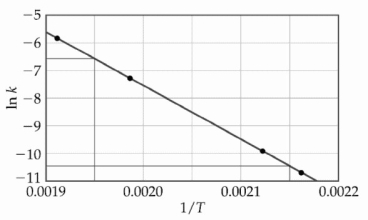 The energy of activation of this reaction is __________ kJ/mol.
A)160
B)1.6 × 10⁵
C)4.4 × 10⁻⁷
D)4.4 × 10⁻⁴
E)1.9 × 10⁴
The dependence of the rate constant on temperature is studied and the graph below is prepared from the results.
The energy of activation of this reaction is __________ kJ/mol.A)160
B)1.6 × 10⁵
C)4.4 × 10⁻⁷
D)4.4 × 10⁻⁴
E)1.9 × 10⁴
Question
Question
At elevated temperatures, methylisonitrile (CH3NC)isomerizes to acetonitrile (CH3CN): CH3NC (g)→ CH3CN (g)
The reaction is first order in methylisonitrile. The attached graph shows data for the reaction obtained at 198.9°C.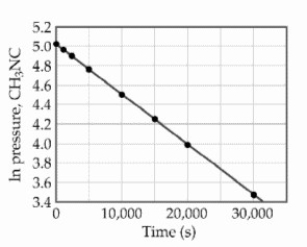 The rate constant for the reaction is __________ s-1.
A)-1.9 × 10⁴
B)+1.9 × 10⁴
C)-5.2 × 10⁻⁵
D)+5.2 × 10⁻⁵
E)+6.2
The reaction is first order in methylisonitrile. The attached graph shows data for the reaction obtained at 198.9°C.
The rate constant for the reaction is __________ s-1.A)-1.9 × 10⁴
B)+1.9 × 10⁴
C)-5.2 × 10⁻⁵
D)+5.2 × 10⁻⁵
E)+6.2
Question
Question
Which energy difference in the energy profile below corresponds to the activation energy for the forward reaction? 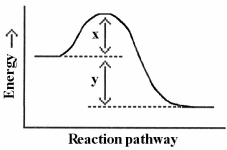
A)x
B)y
C)x + y
D)x - y
E)y - x
A)x
B)y
C)x + y
D)x - y
E)y - x
Question
The decomposition of N2O5 in solution in carbon tetrachloride proceeds via the reaction 2N2O5 (soln)→ 4NO2 (soln)+ O2 (soln)
The reaction is first order and has a rate constant of 4.82 × 10⁻³ s-1 at 64°C. The rate law for the reaction is rate = __________.
A)k[N2O5]2
B)![<strong>The decomposition of N<sub>2</sub>O<sub>5</sub> in solution in carbon tetrachloride proceeds via the reaction 2N<sub>2</sub>O<sub>5 </sub>(soln)→ 4NO<sub>2 </sub>(soln)+ O<sub>2 </sub>(soln) The reaction is first order and has a rate constant of 4.82 × 10<sup>-3</sup> s<sup>-1</sup> at 64°C. The rate law for the reaction is rate = __________.</strong> A)k[N<sub>2</sub>O<sub>5</sub>]<sup>2</sup> B) C)k[N<sub>2</sub>O<sub>5</sub>] D) E)2k[N<sub>2</sub>O<sub>5</sub>] <div style=padding-top: 35px>](https://d2lvgg3v3hfg70.cloudfront.net/TB1822/11ea7ce9_fb1a_e7f8_b46a_0f3fc9ed249a_TB1822_11.jpg)
C)k[N2O5]
D)![<strong>The decomposition of N<sub>2</sub>O<sub>5</sub> in solution in carbon tetrachloride proceeds via the reaction 2N<sub>2</sub>O<sub>5 </sub>(soln)→ 4NO<sub>2 </sub>(soln)+ O<sub>2 </sub>(soln) The reaction is first order and has a rate constant of 4.82 × 10<sup>-3</sup> s<sup>-1</sup> at 64°C. The rate law for the reaction is rate = __________.</strong> A)k[N<sub>2</sub>O<sub>5</sub>]<sup>2</sup> B) C)k[N<sub>2</sub>O<sub>5</sub>] D) E)2k[N<sub>2</sub>O<sub>5</sub>] <div style=padding-top: 35px>](https://d2lvgg3v3hfg70.cloudfront.net/TB1822/11ea7ce9_fb1a_e7f9_b46a_01159b79a4e7_TB1822_11.jpg)
E)2k[N2O5]
The reaction is first order and has a rate constant of 4.82 × 10⁻³ s-1 at 64°C. The rate law for the reaction is rate = __________.
A)k[N2O5]2
B)
C)k[N2O5]
D)
E)2k[N2O5]
Question
Question
Question
Question
Question
Question
Question
Question
Question
Question
Question
Question
Question
Question
Question
Question
Question
Question
Question
Question
Question
A possible mechanism for the overall reaction Br2 (g)+ 2NO (g)→ 2NOBr (g)
Is
NO (g)+ Br2 (g)![<strong>A possible mechanism for the overall reaction Br<sub>2</sub> (g)+ 2NO (g)→ 2NOBr (g) Is NO (g)+ Br<sub>2</sub> (g) NOBr<sub>2</sub> (g)(fast) NOBr<sub>2</sub> (g)+ NO (g) 2NOBr (slow) The rate law for formation of NOBr based on this mechanism is rate = __________.</strong> A)k<sub>1</sub>[NO]1/2 B)k<sub>1</sub>[Br<sub>2</sub>]1/2 C)(k<sub>2</sub>k<sub>1</sub>/k<sup>-1</sup>)[NO]<sup>2</sup>[Br<sub>2</sub>] D)(k<sub>1</sub>/k<sup>-1</sup>)<sup>2</sup>[NO]<sup>2</sup> E)(k<sub>2</sub>k<sub>1</sub>/k<sup>-1</sup>)[NO]<sup>2</sup>[Br<sub>2</sub>]<sup>2</sup> <div style=padding-top: 35px>](https://d2lvgg3v3hfg70.cloudfront.net/TB1822/11ea7ce9_fb1b_ab4c_b46a_17c0e2000001_TB1822_11.jpg) NOBr2 (g)(fast)
NOBr2 (g)(fast)
NOBr2 (g)+ NO (g)![<strong>A possible mechanism for the overall reaction Br<sub>2</sub> (g)+ 2NO (g)→ 2NOBr (g) Is NO (g)+ Br<sub>2</sub> (g) NOBr<sub>2</sub> (g)(fast) NOBr<sub>2</sub> (g)+ NO (g) 2NOBr (slow) The rate law for formation of NOBr based on this mechanism is rate = __________.</strong> A)k<sub>1</sub>[NO]1/2 B)k<sub>1</sub>[Br<sub>2</sub>]1/2 C)(k<sub>2</sub>k<sub>1</sub>/k<sup>-1</sup>)[NO]<sup>2</sup>[Br<sub>2</sub>] D)(k<sub>1</sub>/k<sup>-1</sup>)<sup>2</sup>[NO]<sup>2</sup> E)(k<sub>2</sub>k<sub>1</sub>/k<sup>-1</sup>)[NO]<sup>2</sup>[Br<sub>2</sub>]<sup>2</sup> <div style=padding-top: 35px>](https://d2lvgg3v3hfg70.cloudfront.net/TB1822/11ea7ce9_fb1b_d25d_b46a_a95f75214c0e_TB1822_11.jpg) 2NOBr (slow)
2NOBr (slow)
The rate law for formation of NOBr based on this mechanism is rate = __________.
A)k1[NO]1/2
B)k1[Br2]1/2
C)(k2k1/k-1)[NO]2[Br2]
D)(k1/k-1)2[NO]2
E)(k2k1/k-1)[NO]2[Br2]2
Is
NO (g)+ Br2 (g)
NOBr2 (g)(fast)NOBr2 (g)+ NO (g)
2NOBr (slow)The rate law for formation of NOBr based on this mechanism is rate = __________.
A)k1[NO]1/2
B)k1[Br2]1/2
C)(k2k1/k-1)[NO]2[Br2]
D)(k1/k-1)2[NO]2
E)(k2k1/k-1)[NO]2[Br2]2
Question
Question
Question
Question
Question
Question
Question
Question
Question
Question
Question
Question
Question
Question
Question
Question
Question
Question
Question
Question
Question
Question
Question

Unlock Deck
Sign up to unlock the cards in this deck!
Unlock Deck
Unlock Deck
1/130

Play

Full screen (f)
Deck 14: Chemical Kinetics
1
Under constant conditions, the half-life of a first-order reaction __________.
A)is the time necessary for the reactant concentration to drop to half its original value
B)is constant
C)can be calculated from the reaction rate constant
D)does not depend on the initial reactant concentration
E)All of the above are correct.
A)is the time necessary for the reactant concentration to drop to half its original value
B)is constant
C)can be calculated from the reaction rate constant
D)does not depend on the initial reactant concentration
E)All of the above are correct.
All of the above are correct.
2
Nitrogen dioxide decomposes to nitric oxide and oxygen via the reaction: 2NO2 → 2NO + O2
In a particular experiment at 300 °C, [NO2] drops from 0.0100 to 0.00650 M in 100 s. The rate of disappearance of NO2 for this period is __________ M/s.
A)0.35
B)3.5 × 10⁻³
C)3.5 × 10⁻⁵
D)7.0 × 10⁻³
E)1.8 × 10⁻³
In a particular experiment at 300 °C, [NO2] drops from 0.0100 to 0.00650 M in 100 s. The rate of disappearance of NO2 for this period is __________ M/s.
A)0.35
B)3.5 × 10⁻³
C)3.5 × 10⁻⁵
D)7.0 × 10⁻³
E)1.8 × 10⁻³
3.5 × 10⁻⁵
3
What is the order of the reaction with respect to ClO2?
A)1
B)0
C)2
D)3
E)4
A)1
B)0
C)2
D)3
E)4
2
4
Of the following, all are valid units for a reaction rate except __________.
A)mol/L
B)M/s
C)mol/hr
D)g/s
E)mol/L-hr
A)mol/L
B)M/s
C)mol/hr
D)g/s
E)mol/L-hr
Unlock Deck
Unlock for access to all 130 flashcards in this deck.
Unlock Deck
k this deck
5
The reaction CH3-N≡C → CH3-C≡N
Is a first-order reaction. At 230.3 °C, k = 6.29 × 10⁻⁴s-1. If [CH3-NC] is 1.00 × 10⁻³ initially, [CH3-NC] is __________ after 1.000 × 10³ s.
A)5.33 × 10⁻⁴
B)2.34 × 10⁻⁴
C)1.88 × 10⁻³
D)4.27 × 10⁻³
E)1.00 × 10⁻⁶
Is a first-order reaction. At 230.3 °C, k = 6.29 × 10⁻⁴s-1. If [CH3-NC] is 1.00 × 10⁻³ initially, [CH3-NC] is __________ after 1.000 × 10³ s.
A)5.33 × 10⁻⁴
B)2.34 × 10⁻⁴
C)1.88 × 10⁻³
D)4.27 × 10⁻³
E)1.00 × 10⁻⁶
Unlock Deck
Unlock for access to all 130 flashcards in this deck.
Unlock Deck
k this deck
6
A compound decomposes by a first-order process. If 17.0% of the compound decomposes in 60.0 minutes, the half-life of the compound is __________.
A)141 minutes
B)181 minutes
C)198 minutes
D)223 minutes
E)325 minutes
A)141 minutes
B)181 minutes
C)198 minutes
D)223 minutes
E)325 minutes
Unlock Deck
Unlock for access to all 130 flashcards in this deck.
Unlock Deck
k this deck
7
The rate law of a reaction is rate = k[D][X]. The units of the rate constant are __________.
A)mol L-1s-1
B)L mol-1s-1
C)mol2 L-2s-1
D)mol L-1s-2
E)L2 mol -2s-1
A)mol L-1s-1
B)L mol-1s-1
C)mol2 L-2s-1
D)mol L-1s-2
E)L2 mol -2s-1
Unlock Deck
Unlock for access to all 130 flashcards in this deck.
Unlock Deck
k this deck
8
What is the order of the reaction with respect to OH-?
A)0
B)1
C)2
D)3
E)4
A)0
B)1
C)2
D)3
E)4
Unlock Deck
Unlock for access to all 130 flashcards in this deck.
Unlock Deck
k this deck
9
The rate law for this reaction is rate = __________.
A)k[A][B]
B)k[P]
C)k[A]2[B]
D)k[A]2[B]2
E)k[A]2
A)k[A][B]
B)k[P]
C)k[A]2[B]
D)k[A]2[B]2
E)k[A]2
Unlock Deck
Unlock for access to all 130 flashcards in this deck.
Unlock Deck
k this deck
10
The rate law for a reaction is rate = k [A][B]2
Which one of the following statements is false?
A)The reaction is first order in A.
B)The reaction is second order in B.
C)The reaction is second order overall.
D)k is the reaction rate constant
E)If [B] is doubled, the reaction rate will increase by a factor of 4.
Which one of the following statements is false?
A)The reaction is first order in A.
B)The reaction is second order in B.
C)The reaction is second order overall.
D)k is the reaction rate constant
E)If [B] is doubled, the reaction rate will increase by a factor of 4.
Unlock Deck
Unlock for access to all 130 flashcards in this deck.
Unlock Deck
k this deck
11
What is the magnitude of the rate constant for the reaction?
A)1.15 × 10⁴
B)4.6
C)230
D)115
E)713
A)1.15 × 10⁴
B)4.6
C)230
D)115
E)713
Unlock Deck
Unlock for access to all 130 flashcards in this deck.
Unlock Deck
k this deck
12
Of the units below, __________ are appropriate for a first-order reaction rate constant.
A)M s-1
B)s-1
C)mol/L
D)M-1 s-1
E)L mol-1 s-1
A)M s-1
B)s-1
C)mol/L
D)M-1 s-1
E)L mol-1 s-1
Unlock Deck
Unlock for access to all 130 flashcards in this deck.
Unlock Deck
k this deck
13
The reaction 2NO2 → 2NO + O2
Follows second-order kinetics. At 300°C, [NO2] drops from 0.0100 M to 0.00650 M in 100.0 s. The rate constant for the reaction is __________ M-1s-1.
A)0.096
B)0.65
C)0.81
D)1.2
E)0.54
Follows second-order kinetics. At 300°C, [NO2] drops from 0.0100 M to 0.00650 M in 100.0 s. The rate constant for the reaction is __________ M-1s-1.
A)0.096
B)0.65
C)0.81
D)1.2
E)0.54
Unlock Deck
Unlock for access to all 130 flashcards in this deck.
Unlock Deck
k this deck
14
At elevated temperatures, dinitrogen pentoxide decomposes to nitrogen dioxide and oxygen: 2N2O5(g)→ 4NO2 (g)+ O2 (g)
When the rate of formation of O2 is 2.2 × 10⁻⁴ M/s, the rate of decomposition of N2O5 is __________ M/s.
A)1.1 × 10⁻⁴
B)2.2 × 10⁻⁴
C)2.8 × 10⁻⁴
D)4.4 × 10⁻⁴
E)5.5 × 10⁻⁴
When the rate of formation of O2 is 2.2 × 10⁻⁴ M/s, the rate of decomposition of N2O5 is __________ M/s.
A)1.1 × 10⁻⁴
B)2.2 × 10⁻⁴
C)2.8 × 10⁻⁴
D)4.4 × 10⁻⁴
E)5.5 × 10⁻⁴
Unlock Deck
Unlock for access to all 130 flashcards in this deck.
Unlock Deck
k this deck
15
Which one of the following graphs shows the correct relationship between concentration and time for a reaction that is second order in [A]?
A)
B)
C)
D)
E)
A)
B)
C)
D)
E)
Unlock Deck
Unlock for access to all 130 flashcards in this deck.
Unlock Deck
k this deck
16
The magnitude of the rate constant is __________.
A)38.0
B)0.278
C)13.2
D)42.0
E)2.21
A)38.0
B)0.278
C)13.2
D)42.0
E)2.21
Unlock Deck
Unlock for access to all 130 flashcards in this deck.
Unlock Deck
k this deck
17
What is the overall order of the reaction?
A)4
B)0
C)1
D)2
E)3
A)4
B)0
C)1
D)2
E)3
Unlock Deck
Unlock for access to all 130 flashcards in this deck.
Unlock Deck
k this deck
18
A compound decomposes by a first-order process. If 25.0% of the compound decomposes in 60.0 minutes, the half-life of the compound is __________.
A)65 minutes
B)120 minutes
C)145 minutes
D)180 minutes
E)198 minutes
A)65 minutes
B)120 minutes
C)145 minutes
D)180 minutes
E)198 minutes
Unlock Deck
Unlock for access to all 130 flashcards in this deck.
Unlock Deck
k this deck
19
A burning splint will burn more vigorously in pure oxygen than in air because
A)oxygen is a reactant in combustion and concentration of oxygen is higher in pure oxygen than is in air.
B)oxygen is a catalyst for combustion.
C)oxygen is a product of combustion.
D)nitrogen is a product of combustion and the system reaches equilibrium at a lower temperature.
E)nitrogen is a reactant in combustion and its low concentration in pure oxygen catalyzes the combustion.
A)oxygen is a reactant in combustion and concentration of oxygen is higher in pure oxygen than is in air.
B)oxygen is a catalyst for combustion.
C)oxygen is a product of combustion.
D)nitrogen is a product of combustion and the system reaches equilibrium at a lower temperature.
E)nitrogen is a reactant in combustion and its low concentration in pure oxygen catalyzes the combustion.
Unlock Deck
Unlock for access to all 130 flashcards in this deck.
Unlock Deck
k this deck
20
Which one of the following is not a valid expression for the rate of the reaction below? 4NH3 + 7O2 → 4NO2 + 6H2O
A)
B)
C)
D)
E)All of the above are valid expressions of the reaction rate.
A)
B)
C)
D)
E)All of the above are valid expressions of the reaction rate.
Unlock Deck
Unlock for access to all 130 flashcards in this deck.
Unlock Deck
k this deck
21
The following reaction is second order in [A] and the rate constant is 0.039 M-1s-1: A → B
The concentration of A was 0.30 M at 23 s. The initial concentration of A was __________ M.
A)2.4
B)0.27
C)0.41
D)3.7
E)1.2 × 10⁻²
The concentration of A was 0.30 M at 23 s. The initial concentration of A was __________ M.
A)2.4
B)0.27
C)0.41
D)3.7
E)1.2 × 10⁻²
Unlock Deck
Unlock for access to all 130 flashcards in this deck.
Unlock Deck
k this deck
22
The rate constant for this reaction is __________ s-1.
A)0.013
B)0.030
C)0.14
D)3.0
E)3.1 × 10⁻³
A)0.013
B)0.030
C)0.14
D)3.0
E)3.1 × 10⁻³
Unlock Deck
Unlock for access to all 130 flashcards in this deck.
Unlock Deck
k this deck
23
The rate constant for this reaction is __________ s-1.
A)6.9 × 10⁻²
B)3.0 × 10⁻²
C)14
D)0.46
E)4.0 × 10²
A)6.9 × 10⁻²
B)3.0 × 10⁻²
C)14
D)0.46
E)4.0 × 10²
Unlock Deck
Unlock for access to all 130 flashcards in this deck.
Unlock Deck
k this deck
24
The rate constant of a first-order process that has a half-life of 3.50 min is __________ s-1.
A)0.693
B)1.65 × 10⁻²
C)1.98
D).198
E)3.30 × 10⁻³
A)0.693
B)1.65 × 10⁻²
C)1.98
D).198
E)3.30 × 10⁻³
Unlock Deck
Unlock for access to all 130 flashcards in this deck.
Unlock Deck
k this deck
25
The reaction A (aq)→ B (aq)is first order in [A]. A solution is prepared with [A] = 1.22 M. The following data are obtained as the reaction proceeds: The rate constant for this reaction is __________ s-1.
A)0.23
B)1.0
C)0.17
D)0.12
E)-0.12
The rate constant for this reaction is __________ s-1.A)0.23
B)1.0
C)0.17
D)0.12
E)-0.12
Unlock Deck
Unlock for access to all 130 flashcards in this deck.
Unlock Deck
k this deck
26
In general, as temperature goes up, reaction rate __________.
A)goes up if the reaction is exothermic
B)goes up if the reaction is endothermic
C)goes up regardless of whether the reaction is exothermic or endothermic
D)stays the same regardless of whether the reaction is exothermic or endothermic
E)stays the same if the reaction is first order
A)goes up if the reaction is exothermic
B)goes up if the reaction is endothermic
C)goes up regardless of whether the reaction is exothermic or endothermic
D)stays the same regardless of whether the reaction is exothermic or endothermic
E)stays the same if the reaction is first order
Unlock Deck
Unlock for access to all 130 flashcards in this deck.
Unlock Deck
k this deck
27
One difference between first- and second-order reactions is that __________.
A)the half-life of a first-order reaction does not depend on [A]0; the half-life of a second-order reaction does depend on [A]0
B)the rate of both first-order and second-order reactions do not depend on reactant concentrations
C)the rate of a first-order reaction depends on reactant concentrations; the rate of a second-order reaction does not depend on reactant concentrations
D)a first-order reaction can be catalyzed; a second-order reaction cannot be catalyzed
E)None of the above are true.
A)the half-life of a first-order reaction does not depend on [A]0; the half-life of a second-order reaction does depend on [A]0
B)the rate of both first-order and second-order reactions do not depend on reactant concentrations
C)the rate of a first-order reaction depends on reactant concentrations; the rate of a second-order reaction does not depend on reactant concentrations
D)a first-order reaction can be catalyzed; a second-order reaction cannot be catalyzed
E)None of the above are true.
Unlock Deck
Unlock for access to all 130 flashcards in this deck.
Unlock Deck
k this deck
28
The rate of a reaction depends on __________.
A)collision frequency
B)collision energy
C)collision orientation
D)all of the above
E)none of the above
A)collision frequency
B)collision energy
C)collision orientation
D)all of the above
E)none of the above
Unlock Deck
Unlock for access to all 130 flashcards in this deck.
Unlock Deck
k this deck
29
In the energy profile of a reaction, the species that exists at the maximum on the curve is called the __________.
A)product
B)activated complex
C)activation energy
D)enthalpy of reaction
E)atomic state
A)product
B)activated complex
C)activation energy
D)enthalpy of reaction
E)atomic state
Unlock Deck
Unlock for access to all 130 flashcards in this deck.
Unlock Deck
k this deck
30
The following reaction is second order in [A] and the rate constant is 0.025 M-1s-1: A → B
The concentration of A was 0.65 M at 33 s. The initial concentration of A was __________ M.
A)2.4
B)0.27
C)0.24
D)1.4
E)1.2 × 10⁻²
The concentration of A was 0.65 M at 33 s. The initial concentration of A was __________ M.
A)2.4
B)0.27
C)0.24
D)1.4
E)1.2 × 10⁻²
Unlock Deck
Unlock for access to all 130 flashcards in this deck.
Unlock Deck
k this deck
31
At elevated temperatures, methylisonitrile (CH3NC)isomerizes to acetonitrile (CH3CN): CH3NC (g)→ CH3CN (g)
The dependence of the rate constant on temperature is studied and the graph below is prepared from the results. The energy of activation of this reaction is __________ kJ/mol.
A)160
B)1.6 × 10⁵
C)4.4 × 10⁻⁷
D)4.4 × 10⁻⁴
E)1.9 × 10⁴
The dependence of the rate constant on temperature is studied and the graph below is prepared from the results.
The energy of activation of this reaction is __________ kJ/mol.A)160
B)1.6 × 10⁵
C)4.4 × 10⁻⁷
D)4.4 × 10⁻⁴
E)1.9 × 10⁴
Unlock Deck
Unlock for access to all 130 flashcards in this deck.
Unlock Deck
k this deck
32
As the temperature of a reaction is increased, the rate of the reaction increases because the __________.
A)reactant molecules collide less frequently
B)reactant molecules collide more frequently and with greater energy per collision
C)activation energy is lowered
D)reactant molecules collide less frequently and with greater energy per collision
E)reactant molecules collide more frequently with less energy per collision
A)reactant molecules collide less frequently
B)reactant molecules collide more frequently and with greater energy per collision
C)activation energy is lowered
D)reactant molecules collide less frequently and with greater energy per collision
E)reactant molecules collide more frequently with less energy per collision
Unlock Deck
Unlock for access to all 130 flashcards in this deck.
Unlock Deck
k this deck
33
At elevated temperatures, methylisonitrile (CH3NC)isomerizes to acetonitrile (CH3CN): CH3NC (g)→ CH3CN (g)
The reaction is first order in methylisonitrile. The attached graph shows data for the reaction obtained at 198.9°C. The rate constant for the reaction is __________ s-1.
A)-1.9 × 10⁴
B)+1.9 × 10⁴
C)-5.2 × 10⁻⁵
D)+5.2 × 10⁻⁵
E)+6.2
The reaction is first order in methylisonitrile. The attached graph shows data for the reaction obtained at 198.9°C.
The rate constant for the reaction is __________ s-1.A)-1.9 × 10⁴
B)+1.9 × 10⁴
C)-5.2 × 10⁻⁵
D)+5.2 × 10⁻⁵
E)+6.2
Unlock Deck
Unlock for access to all 130 flashcards in this deck.
Unlock Deck
k this deck
34
In general, as temperature goes down, reaction rate __________.
A)goes down if the reaction is exothermic
B)goes down if the reaction is endothermic
C)stays the same regardless of whether the reaction is exothermic or endothermic
D)goes down regardless of whether the reaction is exothermic or endothermic
E)none of the above
A)goes down if the reaction is exothermic
B)goes down if the reaction is endothermic
C)stays the same regardless of whether the reaction is exothermic or endothermic
D)goes down regardless of whether the reaction is exothermic or endothermic
E)none of the above
Unlock Deck
Unlock for access to all 130 flashcards in this deck.
Unlock Deck
k this deck
35
Which energy difference in the energy profile below corresponds to the activation energy for the forward reaction?
A)x
B)y
C)x + y
D)x - y
E)y - x
A)x
B)y
C)x + y
D)x - y
E)y - x
Unlock Deck
Unlock for access to all 130 flashcards in this deck.
Unlock Deck
k this deck
36
The decomposition of N2O5 in solution in carbon tetrachloride proceeds via the reaction 2N2O5 (soln)→ 4NO2 (soln)+ O2 (soln)
The reaction is first order and has a rate constant of 4.82 × 10⁻³ s-1 at 64°C. The rate law for the reaction is rate = __________.
A)k[N2O5]2
B)
C)k[N2O5]
D)
E)2k[N2O5]
The reaction is first order and has a rate constant of 4.82 × 10⁻³ s-1 at 64°C. The rate law for the reaction is rate = __________.
A)k[N2O5]2
B)
C)k[N2O5]
D)
E)2k[N2O5]
Unlock Deck
Unlock for access to all 130 flashcards in this deck.
Unlock Deck
k this deck
37
In the Arrhenius equation, k = Ae-Ea/RT
__________ is the frequency factor.
A)k
B)A
C)e
D)Ea
E)R
__________ is the frequency factor.
A)k
B)A
C)e
D)Ea
E)R
Unlock Deck
Unlock for access to all 130 flashcards in this deck.
Unlock Deck
k this deck
38
The rate constant of a first-order process that has a half-life of 225 s is __________ s-1.
A)0.693
B)3.08 × 10⁻³
C)1.25
D)12.5
E)4.44 × 10⁻³
A)0.693
B)3.08 × 10⁻³
C)1.25
D)12.5
E)4.44 × 10⁻³
Unlock Deck
Unlock for access to all 130 flashcards in this deck.
Unlock Deck
k this deck
39
The concentration of A is __________ M after 40.0 s.
A)1.3 × 10⁻²
B)1.2
C)0.17
D)3.5 × 10⁻⁴
E)0.025
A)1.3 × 10⁻²
B)1.2
C)0.17
D)3.5 × 10⁻⁴
E)0.025
Unlock Deck
Unlock for access to all 130 flashcards in this deck.
Unlock Deck
k this deck
40
The half-life of this reaction is __________ s.
A)0.97
B)7.1
C)5.0
D)3.0
E)0.14
A)0.97
B)7.1
C)5.0
D)3.0
E)0.14
Unlock Deck
Unlock for access to all 130 flashcards in this deck.
Unlock Deck
k this deck
41
Of the following, __________ will lower the activation energy for a reaction.
A)increasing the concentrations of reactants
B)raising the temperature of the reaction
C)adding a catalyst for the reaction
D)removing products as the reaction proceeds
E)increasing the pressure
A)increasing the concentrations of reactants
B)raising the temperature of the reaction
C)adding a catalyst for the reaction
D)removing products as the reaction proceeds
E)increasing the pressure
Unlock Deck
Unlock for access to all 130 flashcards in this deck.
Unlock Deck
k this deck
42
The average rate of disappearance of A between 20 s and 40 s is __________ mol/s.
A)8.5 × 10⁻⁴
B)1.7 × 10⁻³
C)590
D)7.1 × 10⁻³
E)1.4 × 10⁻³
A)8.5 × 10⁻⁴
B)1.7 × 10⁻³
C)590
D)7.1 × 10⁻³
E)1.4 × 10⁻³
Unlock Deck
Unlock for access to all 130 flashcards in this deck.
Unlock Deck
k this deck
43
The mechanism for formation of the product X is: A + B → C + D (slow)
B + D → X (fast)
The intermediate reactant in the reaction is __________.
A)A
B)B
C)C
D)D
E)X
B + D → X (fast)
The intermediate reactant in the reaction is __________.
A)A
B)B
C)C
D)D
E)X
Unlock Deck
Unlock for access to all 130 flashcards in this deck.
Unlock Deck
k this deck
44
The average rate of disappearance of A between 10 s and 20 s is __________ mol/s.
A)2.2 × 10⁻³
B)1.1 × 10⁻³
C)4.4 × 10⁻³
D)454
E)9.90 × 10⁻³
A)2.2 × 10⁻³
B)1.1 × 10⁻³
C)4.4 × 10⁻³
D)454
E)9.90 × 10⁻³
Unlock Deck
Unlock for access to all 130 flashcards in this deck.
Unlock Deck
k this deck
45
Which of the following is true?
A)If we know that a reaction is an elementary reaction, then we know its rate law.
B)The rate-determining step of a reaction is the rate of the fastest elementary step of its mechanism.
C)Since intermediate compounds can be formed, the chemical equations for the elementary reactions in a multistep mechanism do not always have to add to give the chemical equation of the overall process.
D)In a reaction mechanism, an intermediate is identical to an activated complex.
E)All of the above statements are true.
A)If we know that a reaction is an elementary reaction, then we know its rate law.
B)The rate-determining step of a reaction is the rate of the fastest elementary step of its mechanism.
C)Since intermediate compounds can be formed, the chemical equations for the elementary reactions in a multistep mechanism do not always have to add to give the chemical equation of the overall process.
D)In a reaction mechanism, an intermediate is identical to an activated complex.
E)All of the above statements are true.
Unlock Deck
Unlock for access to all 130 flashcards in this deck.
Unlock Deck
k this deck
46
The active site of nitrogenase is a cofactor that contains two transition metals. These transition metals are __________.
A)Cr and Mg
B)Mn and V
C)Os and Ir
D)Fe and Zn
E)Fe and Mo
A)Cr and Mg
B)Mn and V
C)Os and Ir
D)Fe and Zn
E)Fe and Mo
Unlock Deck
Unlock for access to all 130 flashcards in this deck.
Unlock Deck
k this deck
47
For the elementary reaction NO3 + CO → NO2 + CO2
The molecularity of the reaction is __________, and the rate law is rate = __________.
A)2, k[NO3][CO]
B)4, k[NO3][CO][NO2][CO2]
C)2, k[NO2][CO2]
D)2, k[NO3][CO]/[NO2][CO2]
E)4, k[NO2][CO2]/[NO3][CO]
The molecularity of the reaction is __________, and the rate law is rate = __________.
A)2, k[NO3][CO]
B)4, k[NO3][CO][NO2][CO2]
C)2, k[NO2][CO2]
D)2, k[NO3][CO]/[NO2][CO2]
E)4, k[NO2][CO2]/[NO3][CO]
Unlock Deck
Unlock for access to all 130 flashcards in this deck.
Unlock Deck
k this deck
48
The average rate disappearance of A between 20 s and 30 s is __________ mol/s.
A)5.0 × 10⁻⁴
B)1.6 × 10⁻²
C)1.5 × 10⁻³
D)670
E)0.15
A)5.0 × 10⁻⁴
B)1.6 × 10⁻²
C)1.5 × 10⁻³
D)670
E)0.15
Unlock Deck
Unlock for access to all 130 flashcards in this deck.
Unlock Deck
k this deck
49
The rate law of the overall reaction A + B → C
Is rate = k[A]2. Which of the following will not increase the rate of the reaction?
A)increasing the concentration of reactant A
B)increasing the concentration of reactant B
C)increasing the temperature of the reaction
D)adding a catalyst for the reaction
E)All of these will increase the rate.
Is rate = k[A]2. Which of the following will not increase the rate of the reaction?
A)increasing the concentration of reactant A
B)increasing the concentration of reactant B
C)increasing the temperature of the reaction
D)adding a catalyst for the reaction
E)All of these will increase the rate.
Unlock Deck
Unlock for access to all 130 flashcards in this deck.
Unlock Deck
k this deck
50
How many moles of B are present at 10 s?
A)0.011
B)0.220
C)0.110
D)0.014
E)1.4 × 10⁻³
A)0.011
B)0.220
C)0.110
D)0.014
E)1.4 × 10⁻³
Unlock Deck
Unlock for access to all 130 flashcards in this deck.
Unlock Deck
k this deck
51
Which substance in the reaction below either appears or disappears the fastest? 4NH3 + 7O2 → 4NO2 + 6H2O
A)NH3
B)O2
C)NO2
D)H2O
E)The rates of appearance/disappearance are the same for all of these.
A)NH3
B)O2
C)NO2
D)H2O
E)The rates of appearance/disappearance are the same for all of these.
Unlock Deck
Unlock for access to all 130 flashcards in this deck.
Unlock Deck
k this deck
52
__________ are used in automotive catalytic converters.
A)Heterogeneous catalysts
B)Homogeneous catalysts
C)Enzymes
D)Noble gases
E)Nonmetal oxides
A)Heterogeneous catalysts
B)Homogeneous catalysts
C)Enzymes
D)Noble gases
E)Nonmetal oxides
Unlock Deck
Unlock for access to all 130 flashcards in this deck.
Unlock Deck
k this deck
53
The primary source of the specificity of enzymes is __________.
A)their polarity, which matches that of their specific substrate
B)their delocalized electron cloud
C)their bonded transition metal, which is specific to the target substrate
D)their locations within the cell
E)their shape, which relates to the lock-and-key model
A)their polarity, which matches that of their specific substrate
B)their delocalized electron cloud
C)their bonded transition metal, which is specific to the target substrate
D)their locations within the cell
E)their shape, which relates to the lock-and-key model
Unlock Deck
Unlock for access to all 130 flashcards in this deck.
Unlock Deck
k this deck
54
The average rate of appearance of B between 20 s and 30 s is __________ mol/s.
A)+1.5 × 10⁻³
B)+5.0 × 10⁻⁴
C)-1.5 × 10⁻³
D)+7.3 × 10⁻³
E)-7.3 × 10⁻³
A)+1.5 × 10⁻³
B)+5.0 × 10⁻⁴
C)-1.5 × 10⁻³
D)+7.3 × 10⁻³
E)-7.3 × 10⁻³
Unlock Deck
Unlock for access to all 130 flashcards in this deck.
Unlock Deck
k this deck
55
A catalyst can increase the rate of a reaction __________.
A)by changing the value of the frequency factor (A)
B)by increasing the overall activation energy (Ea)of the reaction
C)by lowering the activation energy of the reverse reaction
D)by providing an alternative pathway with a lower activation energy
E)All of these are ways that a catalyst might act to increase the rate of reaction.
A)by changing the value of the frequency factor (A)
B)by increasing the overall activation energy (Ea)of the reaction
C)by lowering the activation energy of the reverse reaction
D)by providing an alternative pathway with a lower activation energy
E)All of these are ways that a catalyst might act to increase the rate of reaction.
Unlock Deck
Unlock for access to all 130 flashcards in this deck.
Unlock Deck
k this deck
56
The enzyme nitrogenase converts __________ into __________.
A)ammonia, urea
B)CO and unburned hydrocarbons, H2O and CO2
C)nitrogen, ammonia
D)nitrogen oxides, N2 and O2
E)nitroglycerine, nitric acid, and glycerine
A)ammonia, urea
B)CO and unburned hydrocarbons, H2O and CO2
C)nitrogen, ammonia
D)nitrogen oxides, N2 and O2
E)nitroglycerine, nitric acid, and glycerine
Unlock Deck
Unlock for access to all 130 flashcards in this deck.
Unlock Deck
k this deck
57
A possible mechanism for the overall reaction Br2 (g)+ 2NO (g)→ 2NOBr (g)
Is
NO (g)+ Br2 (g) NOBr2 (g)(fast)
NOBr2 (g)+ NO (g) 2NOBr (slow)
The rate law for formation of NOBr based on this mechanism is rate = __________.
A)k1[NO]1/2
B)k1[Br2]1/2
C)(k2k1/k-1)[NO]2[Br2]
D)(k1/k-1)2[NO]2
E)(k2k1/k-1)[NO]2[Br2]2
Is
NO (g)+ Br2 (g)
NOBr2 (g)(fast)NOBr2 (g)+ NO (g)
2NOBr (slow)The rate law for formation of NOBr based on this mechanism is rate = __________.
A)k1[NO]1/2
B)k1[Br2]1/2
C)(k2k1/k-1)[NO]2[Br2]
D)(k1/k-1)2[NO]2
E)(k2k1/k-1)[NO]2[Br2]2
Unlock Deck
Unlock for access to all 130 flashcards in this deck.
Unlock Deck
k this deck
58
Nitrogen fixation is a difficult process because __________.
A)there is so little nitrogen in the atmosphere
B)nitrogen exists in the atmosphere primarily as its oxides which are very unreactive
C)nitrogen is very unreactive, largely due to its triple bond
D)of the extreme toxicity of nitrogen
E)of the high polarity of nitrogen molecules preventing them from dissolving in biological fluids, such as those inside cells
A)there is so little nitrogen in the atmosphere
B)nitrogen exists in the atmosphere primarily as its oxides which are very unreactive
C)nitrogen is very unreactive, largely due to its triple bond
D)of the extreme toxicity of nitrogen
E)of the high polarity of nitrogen molecules preventing them from dissolving in biological fluids, such as those inside cells
Unlock Deck
Unlock for access to all 130 flashcards in this deck.
Unlock Deck
k this deck
59
Consider the following reaction: 3A → 2B
The average rate of appearance of B is given by Δ[B]/Δt. Comparing the rate of appearance of B and the rate of disappearance of A, we get Δ[B]/Δt = __________ × (-Δ[A]/Δt).
A)-2/3
B)+2/3
C)-3/2
D)+1
E)+3/2
The average rate of appearance of B is given by Δ[B]/Δt. Comparing the rate of appearance of B and the rate of disappearance of A, we get Δ[B]/Δt = __________ × (-Δ[A]/Δt).
A)-2/3
B)+2/3
C)-3/2
D)+1
E)+3/2
Unlock Deck
Unlock for access to all 130 flashcards in this deck.
Unlock Deck
k this deck
60
Consider the following reaction: A → 2C
The average rate of appearance of C is given by Δ[C]/Δt. Comparing the rate of appearance of C and the rate of disappearance of A, we get Δ[C]/Δt = __________ × (-Δ[A]/Δt).
A)+2
B)-1
C)+1
D)+1/2
E)-1/2
The average rate of appearance of C is given by Δ[C]/Δt. Comparing the rate of appearance of C and the rate of disappearance of A, we get Δ[C]/Δt = __________ × (-Δ[A]/Δt).
A)+2
B)-1
C)+1
D)+1/2
E)-1/2
Unlock Deck
Unlock for access to all 130 flashcards in this deck.
Unlock Deck
k this deck
61
The concentration of S2O82- remaining at 800 s is __________ M.
A)0.046
B)0.076
C)4.00 × 10⁻³
D)0.015
E)0.041
A)0.046
B)0.076
C)4.00 × 10⁻³
D)0.015
E)0.041
Unlock Deck
Unlock for access to all 130 flashcards in this deck.
Unlock Deck
k this deck
62
The concentration of S2O82- remaining at 400 s is __________ M.
A)+0.015
B)+0.035
C)-0.007
D)+0.045
E)+0.057
A)+0.015
B)+0.035
C)-0.007
D)+0.045
E)+0.057
Unlock Deck
Unlock for access to all 130 flashcards in this deck.
Unlock Deck
k this deck
63
The average rate of disappearance of I- between 400.0 s and 800.0 s is __________ M/s.
A)2.8 × 10⁻⁵
B)1.4 × 10⁻⁵
C)5.8 × 10⁻⁵
D)3.6 × 10⁴
E)2.6 × 10⁻⁴
A)2.8 × 10⁻⁵
B)1.4 × 10⁻⁵
C)5.8 × 10⁻⁵
D)3.6 × 10⁴
E)2.6 × 10⁻⁴
Unlock Deck
Unlock for access to all 130 flashcards in this deck.
Unlock Deck
k this deck
64
At elevated temperatures, dinitrogen pentoxide decomposes to nitrogen dioxide and oxygen: 2N2O5(g)→ 4NO2 (g)+ O2 (g)
When the rate of formation of NO2 is 5.5 × 10⁻⁴ M/s, the rate of decomposition of N2O5 is ________ M/s.
A)2.2 × 10⁻³
B)1.4 × 10⁻⁴
C)10.1 × 10⁻⁴
D)2.8 × 10⁻⁴
E)5.5 × 10⁻⁴
When the rate of formation of NO2 is 5.5 × 10⁻⁴ M/s, the rate of decomposition of N2O5 is ________ M/s.
A)2.2 × 10⁻³
B)1.4 × 10⁻⁴
C)10.1 × 10⁻⁴
D)2.8 × 10⁻⁴
E)5.5 × 10⁻⁴
Unlock Deck
Unlock for access to all 130 flashcards in this deck.
Unlock Deck
k this deck
65
A reaction was found to be second order in carbon monoxide concentration. The rate of the reaction __________ if the [CO] is doubled, with everything else kept the same.
A)doubles
B)remains unchanged
C)triples
D)increases by a factor of 4
E)is reduced by a factor of 2
A)doubles
B)remains unchanged
C)triples
D)increases by a factor of 4
E)is reduced by a factor of 2
Unlock Deck
Unlock for access to all 130 flashcards in this deck.
Unlock Deck
k this deck
66
The overall order of a reaction is 2. The units of the rate constant for the reaction are __________.
A)M/s
B)M-1s-1
C)1/s
D)1/M
E)s/M2
A)M/s
B)M-1s-1
C)1/s
D)1/M
E)s/M2
Unlock Deck
Unlock for access to all 130 flashcards in this deck.
Unlock Deck
k this deck
67
A reaction was found to be third order in A. Increasing the concentration of A by a factor of 3 will cause the reaction rate to __________.
A)remain constant
B)increase by a factor of 27
C)increase by a factor of 9
D)triple
E)decrease by a factor of the cube root of 3
A)remain constant
B)increase by a factor of 27
C)increase by a factor of 9
D)triple
E)decrease by a factor of the cube root of 3
Unlock Deck
Unlock for access to all 130 flashcards in this deck.
Unlock Deck
k this deck
68
How many moles of B are present at 30 s?
A)2.4 × 10⁻³
B)0.15
C)0.073
D)1.7 × 10⁻³
E)0.051
A)2.4 × 10⁻³
B)0.15
C)0.073
D)1.7 × 10⁻³
E)0.051
Unlock Deck
Unlock for access to all 130 flashcards in this deck.
Unlock Deck
k this deck
69
If the rate law for the reaction 2A + 3B → products
Is second order in A and first order in B, then the rate law is rate = __________.
A)k[A][B]
B)k[A]2[B]3
C)k[A][B]2
D)k[A]2[B]
E)k[A]2[B]2
Is second order in A and first order in B, then the rate law is rate = __________.
A)k[A][B]
B)k[A]2[B]3
C)k[A][B]2
D)k[A]2[B]
E)k[A]2[B]2
Unlock Deck
Unlock for access to all 130 flashcards in this deck.
Unlock Deck
k this deck
70
A reaction was found to be zero order in A. Increasing the concentration of A by a factor of 3 will cause the reaction rate to __________.
A)remain constant
B)increase by a factor of 27
C)increase by a factor of 9
D)triple
E)decrease by a factor of the cube root of 3
A)remain constant
B)increase by a factor of 27
C)increase by a factor of 9
D)triple
E)decrease by a factor of the cube root of 3
Unlock Deck
Unlock for access to all 130 flashcards in this deck.
Unlock Deck
k this deck
71
The average rate of disappearance of I- between 1200.0 s and 1600.0 s is __________ M/s.
A)1.8 × 10⁻⁵
B)1.2 × 10⁻⁵
C)2.0 × 10⁻⁵
D)5.0 × 10⁴
E)1.6 × 10⁻⁴
A)1.8 × 10⁻⁵
B)1.2 × 10⁻⁵
C)2.0 × 10⁻⁵
D)5.0 × 10⁴
E)1.6 × 10⁻⁴
Unlock Deck
Unlock for access to all 130 flashcards in this deck.
Unlock Deck
k this deck
72
The kinetics of the reaction below were studied and it was determined that the reaction rate increased by a factor of 9 when the concentration of B was tripled. The reaction is __________ order in B. A + B → P
A)zero
B)first
C)second
D)third
E)one-half
A)zero
B)first
C)second
D)third
E)one-half
Unlock Deck
Unlock for access to all 130 flashcards in this deck.
Unlock Deck
k this deck
73
The average rate of disappearance of I- in the initial 400.0 s is __________ M/s.
A)6.00
B)3.8 × 10⁻⁵
C)1.4 × 10⁻⁴
D)2.7 × 10⁴
E)3.2 × 10⁻⁴
A)6.00
B)3.8 × 10⁻⁵
C)1.4 × 10⁻⁴
D)2.7 × 10⁴
E)3.2 × 10⁻⁴
Unlock Deck
Unlock for access to all 130 flashcards in this deck.
Unlock Deck
k this deck
74
The order of the reaction in B is __________.
A)1
B)2
C)3
D)4
E)0
A)1
B)2
C)3
D)4
E)0
Unlock Deck
Unlock for access to all 130 flashcards in this deck.
Unlock Deck
k this deck
75
The concentration of S2O82- remaining at 1600 s is __________ M.
A)0.036
B)0.014
C)0.043
D)0.064
E)0.029
A)0.036
B)0.014
C)0.043
D)0.064
E)0.029
Unlock Deck
Unlock for access to all 130 flashcards in this deck.
Unlock Deck
k this deck
76
If the rate law for the reaction 2A + 3B → products
Is first order in A and second order in B, then the rate law is rate = __________.
A)k[A][B]
B)k[A]2[B]3
C)k[A][B]2
D)k[A]2[B]
E)k[A]2[B]2
Is first order in A and second order in B, then the rate law is rate = __________.
A)k[A][B]
B)k[A]2[B]3
C)k[A][B]2
D)k[A]2[B]
E)k[A]2[B]2
Unlock Deck
Unlock for access to all 130 flashcards in this deck.
Unlock Deck
k this deck
77
The kinetics of the reaction below were studied and it was determined that the reaction rate did not change when the concentration of B was tripled. The reaction is __________ order in B. A + B → P
A)zero
B)first
C)second
D)third
E)one-half
A)zero
B)first
C)second
D)third
E)one-half
Unlock Deck
Unlock for access to all 130 flashcards in this deck.
Unlock Deck
k this deck
78
At elevated temperatures, methylisonitrile (CH3NC)isomerizes to acetonitrile (CH3CN): CH3NC (g)→ CH3CN (g)
At the start of the experiment, there are 0.200 mol of reactant (CH3NC)and 0 mol of product (CH3CN)in the reaction vessel. After 25 min of reaction, 0.108 mol of reactant (CH3NC)remain. The average rate of decomposition of methyl isonitrile, CH3NC, in this 25 min period is __________ mol/min.
A)3.7 × 10⁻³
B)0.092
C)2.3
D)4.3 × 10⁻³
E)0.54
At the start of the experiment, there are 0.200 mol of reactant (CH3NC)and 0 mol of product (CH3CN)in the reaction vessel. After 25 min of reaction, 0.108 mol of reactant (CH3NC)remain. The average rate of decomposition of methyl isonitrile, CH3NC, in this 25 min period is __________ mol/min.
A)3.7 × 10⁻³
B)0.092
C)2.3
D)4.3 × 10⁻³
E)0.54
Unlock Deck
Unlock for access to all 130 flashcards in this deck.
Unlock Deck
k this deck
79
The overall order of a reaction is 1. The units of the rate constant for the reaction are __________.
A)M/s
B)M-1s-1
C)1/s
D)1/M
E)s/M2
A)M/s
B)M-1s-1
C)1/s
D)1/M
E)s/M2
Unlock Deck
Unlock for access to all 130 flashcards in this deck.
Unlock Deck
k this deck
80
The order of the reaction in A is __________.
A)1
B)2
C)3
D)4
E)0
A)1
B)2
C)3
D)4
E)0
Unlock Deck
Unlock for access to all 130 flashcards in this deck.
Unlock Deck
k this deck
Unlock Deck
Unlock for access to all 130 flashcards in this deck.






