







 Chat with AI

Deck 11: Chemical Equilibria
Full screen (f)

Question

Question
Question
For the equilibrium N2O4(g)  2NO2(g),plot,on the same graph,the forward and reverse reaction rates as a function of time.If possible,mark on the graph where equilibrium is reached.
2NO2(g),plot,on the same graph,the forward and reverse reaction rates as a function of time.If possible,mark on the graph where equilibrium is reached. Question
Question
What is the relation between K and Kc for the reaction H2(g)+ I2(g)  2HI(g)
A)K = Kc
B)K = RTKc
C)Kc = (RT)2K
D)K = (RT)2Kc
E)Kc = RTK
2HI(g)A)K = Kc
B)K = RTKc
C)Kc = (RT)2K
D)K = (RT)2Kc
E)Kc = RTK
Question
For the equilibrium CaCO3(s)  CaO(s)+ CO2(g),(a)represents the composition at equilibrium at a certain temperature.In (b),a small amount of Ca*CO3(s)has been added (Ca*CO3(s)represents Ca14CO3(s)or labeled calcium carbonate).Draw the composition in (c)at equilibrium and explain your drawing.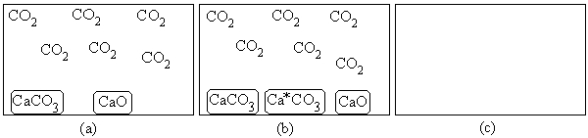
CaO(s)+ CO2(g),(a)represents the composition at equilibrium at a certain temperature.In (b),a small amount of Ca*CO3(s)has been added (Ca*CO3(s)represents Ca14CO3(s)or labeled calcium carbonate).Draw the composition in (c)at equilibrium and explain your drawing. Question
If Gro = 27.1 kJ∙mol-1 at 25 C for the dissociation of acetic acid in aqueous solution,what is K for the reaction
CH3COO-(aq)+ H3O+(aq) CH3COOH(aq)+ H2O(l)
CH3COO-(aq)+ H3O+(aq)
CH3COOH(aq)+ H2O(l) Question
Question
Question
Consider the following reaction at a certain temperature:
Ni(s)+ 4CO(g) Ni(CO)4(g)
Calculate K for this reaction if,at equilibrium,the partial pressures of CO(g)and Ni(CO)4(g)are 1.25 and 6.65 atm over 1.00 kg of nickel.
Ni(s)+ 4CO(g)
Ni(CO)4(g)Calculate K for this reaction if,at equilibrium,the partial pressures of CO(g)and Ni(CO)4(g)are 1.25 and 6.65 atm over 1.00 kg of nickel.
Question
Consider the reaction NO(g)+  O2(g) NO2(g)
If H = -56.52 kJ and S = -72.60 J.K - 1 at 298 K,what is the equilibrium constant for the reaction at 298 K?
A)1.31 * 106
B)7.63 *10-7
C)660
D)1.22 * 1014
E)8.08*109
O2(g) NO2(g)If H = -56.52 kJ and S = -72.60 J.K - 1 at 298 K,what is the equilibrium constant for the reaction at 298 K?
A)1.31 * 106
B)7.63 *10-7
C)660
D)1.22 * 1014
E)8.08*109
Question
If G = 27.1 kJ at 25 C for the reaction CH3COOH(aq)+ H2O(l)  CH3COO-(aq)+ H3O+(aq)
What is Ka for this reaction at 298 K?
A)1.15 *10-11
B)5.63 * 104
C)1.78 *10-5
D)1.01
E)9.89 *10-1
CH3COO-(aq)+ H3O+(aq)What is Ka for this reaction at 298 K?
A)1.15 *10-11
B)5.63 * 104
C)1.78 *10-5
D)1.01
E)9.89 *10-1
Question
The equilibrium constant for the reaction
HNO2(aq)+ H2O(l)![The equilibrium constant for the reaction HNO<sub>2</sub>(aq)+ H<sub>2</sub>O(l) NO<sub>2</sub>+(aq)+ H<sub>3</sub>O<sup>+</sup>(aq) is 4.3*10 sup>-</sup> <sup>4</sup> at 25 \degree C.Will nitrous acid spontaneously dissociate when [HNO<sub>2</sub>(aq)] = [NO<sub>2</sub>+(aq)] = [H<sub>3</sub>O<sup>+</sup>(aq)] = 1.0 M? Show your calculations.<div style=padding-top: 35px>](https://d2lvgg3v3hfg70.cloudfront.net/TB1039/11ea7e73_3880_914a_9a0a_87de293e6750_TB1039_11.jpg) NO2+(aq)+ H3O+(aq)
NO2+(aq)+ H3O+(aq)
is 4.3*10 sup>- 4 at 25 C.Will nitrous acid spontaneously dissociate when
[HNO2(aq)] = [NO2+(aq)] = [H3O+(aq)] = 1.0 M? Show your calculations.
HNO2(aq)+ H2O(l)
NO2+(aq)+ H3O+(aq)is 4.3*10 sup>- 4 at 25 C.Will nitrous acid spontaneously dissociate when
[HNO2(aq)] = [NO2+(aq)] = [H3O+(aq)] = 1.0 M? Show your calculations.
Question
Calculate the value of K at 700 K for the reaction H2(g)+ I2(g)  2HI(g)
Given that Kc = 54 at the same temperature.
A)3100
B)2.2
C)54
D)9.3
E)1300
2HI(g)Given that Kc = 54 at the same temperature.
A)3100
B)2.2
C)54
D)9.3
E)1300
Question
The equilibrium constant expression for the reaction
CuSO4(s)![The equilibrium constant expression for the reaction CuSO<sub>4</sub>(s) CuO(s)+ SO<sub>3</sub>(g) is K = [CuO(s)][SO<sub>3</sub>(g)]/[CuSO<sub>4</sub>(s)].True or false?<div style=padding-top: 35px>](https://d2lvgg3v3hfg70.cloudfront.net/TB1039/11ea7e73_387f_a6e5_9a0a_a9776b4f0248_TB1039_11.jpg) CuO(s)+ SO3(g)
CuO(s)+ SO3(g)
is K = [CuO(s)][SO3(g)]/[CuSO4(s)].True or false?
CuSO4(s)
CuO(s)+ SO3(g)is K = [CuO(s)][SO3(g)]/[CuSO4(s)].True or false?
Question
Question
The equilibrium constant for the reaction
HNO2(aq)+ H2O(l)![The equilibrium constant for the reaction HNO<sub>2</sub>(aq)+ H<sub>2</sub>O(l) NO<sub>2</sub>-(aq)+ H<sub>3</sub>O<sup>+</sup>(aq) is 4.3 *10 <sup>-</sup> <sup>4</sup> at 25 \degree C.Will nitrous acid spontaneously dissociate when [HNO<sub>2</sub>(aq)] = 1.0 M and [NO<sub>2</sub>-(aq)] = [H<sub>3</sub>O<sup>+</sup>(aq)] = 1.0 *10 <sup>-</sup> <sup>5</sup> M? Show your calculations.<div style=padding-top: 35px>](https://d2lvgg3v3hfg70.cloudfront.net/TB1039/11ea7e73_3880_914b_9a0a_fbeca88395d7_TB1039_11.jpg) NO2-(aq)+ H3O+(aq)
NO2-(aq)+ H3O+(aq)
is 4.3 *10 - 4 at 25 C.Will nitrous acid spontaneously dissociate when
[HNO2(aq)] = 1.0 M and [NO2-(aq)] = [H3O+(aq)] = 1.0 *10 - 5 M?
Show your calculations.
HNO2(aq)+ H2O(l)
NO2-(aq)+ H3O+(aq)is 4.3 *10 - 4 at 25 C.Will nitrous acid spontaneously dissociate when
[HNO2(aq)] = 1.0 M and [NO2-(aq)] = [H3O+(aq)] = 1.0 *10 - 5 M?
Show your calculations.
Question
Question
Question
Calculate the equilibrium constant for the following reaction at 25 C 2TiCl3(s)+ 2HCl(g)  2TiCl4(g)+ H2(g)
Given G = +46.6 kJ.
A)3.8 *10-98
B)1.5 *10-19
C)6.7 *10-9
D)6.6 * 1018
E)1.5 * 108
2TiCl4(g)+ H2(g)Given G = +46.6 kJ.
A)3.8 *10-98
B)1.5 *10-19
C)6.7 *10-9
D)6.6 * 1018
E)1.5 * 108
Question
Given: P4(s)+ 6Cl2(g)b 4PCl3(l)
K
Calculate the equilibrium constant for the following reaction.
2PCl3(l) 3Cl2(g)+
  P4(s)
P4(s)
A)(-K1/2 )
B)1/K1/2
C)1/K2
D)1/K
E)K1/2
K
Calculate the equilibrium constant for the following reaction.
2PCl3(l)
3Cl2(g)+ P4(s)A)(-K1/2 )
B)1/K1/2
C)1/K2
D)1/K
E)K1/2
Question
Question
Given: C(s)+ CO2(g)  2CO(g) At equilibrium at a certain temperature,the partial pressures of CO(g)and CO2(g)are 1.22 atm and 0.780 atm,respectively.Calculate the value of K for this reaction.
A)3.13
B)2.00
C)1.91
D)1.56
E)0.640
2CO(g) At equilibrium at a certain temperature,the partial pressures of CO(g)and CO2(g)are 1.22 atm and 0.780 atm,respectively.Calculate the value of K for this reaction.A)3.13
B)2.00
C)1.91
D)1.56
E)0.640
Question
Given: 2SO2(g)+ O2(g)  2SO3(g) At equilibrium at a certain temperature,the concentrations of SO3(g),SO2(g),and O2(g)are 0.12 M,0.86 M,and 0.33 M,respectively.Calculate the value of Kc for this reaction.
A)1.31
B)0.42
C)0.014
D)0.059
E)0.87
2SO3(g) At equilibrium at a certain temperature,the concentrations of SO3(g),SO2(g),and O2(g)are 0.12 M,0.86 M,and 0.33 M,respectively.Calculate the value of Kc for this reaction.A)1.31
B)0.42
C)0.014
D)0.059
E)0.87
Question
The equilibrium constant,K,for the reaction 2HgO(s)  2Hg(l)+ O2(g)
Is 1.2 *10-30.Calculate K for the reaction
1/2O2(g)+ Hg(l) HgO(s).
A)(-1.1 * 10-15 )
B)8.3 *1029
C)4.2 *1029
D)9.1 *1014
E)1.1 *10-15
2Hg(l)+ O2(g)Is 1.2 *10-30.Calculate K for the reaction
1/2O2(g)+ Hg(l)
HgO(s).A)(-1.1 * 10-15 )
B)8.3 *1029
C)4.2 *1029
D)9.1 *1014
E)1.1 *10-15
Question
What is the relationship between K and Kc for the reaction below? N2(g)+ 3H2(g)  2NH3(g)
A)K = (RT)6Kc
B)Kc = (RT)-2K
C)Kc = (RT)2K
D)K = (RT)-2Kc
E)K = (RT)2Kc
2NH3(g)A)K = (RT)6Kc
B)Kc = (RT)-2K
C)Kc = (RT)2K
D)K = (RT)-2Kc
E)K = (RT)2Kc
Question
At 700 K,K = 54 for the reaction H2(g)+ I2(g)  2HI(g)
Calculate Kc at 700 K for this reaction.
A)3.2 *10-4
B)0.94
C)7.7 *10-4
D)0.45
E)54
2HI(g)Calculate Kc at 700 K for this reaction.
A)3.2 *10-4
B)0.94
C)7.7 *10-4
D)0.45
E)54
Question
Given: SO2(g)  O2(g)+ S(s)
Kc = 2.5 *10-53
SO3(g)
 O2(g)+ SO2(g)
Kc = 4.0 *10-13
Calculate Kc for the reaction
2S(s)+ 3O2(g) 2SO3(g)
A)1.6 *10103
B)1.6 *1080
C)1.0 * 10130
D)1.6 * 1040
E)1.0 *1065
O2(g)+ S(s)Kc = 2.5 *10-53
SO3(g)
O2(g)+ SO2(g)Kc = 4.0 *10-13
Calculate Kc for the reaction
2S(s)+ 3O2(g)
2SO3(g)A)1.6 *10103
B)1.6 *1080
C)1.0 * 10130
D)1.6 * 1040
E)1.0 *1065
Question
Given: 4NH3(g)+ 5O2(g)  4NO(g)+ 6H2O(g)
K
Calculate the equilibrium constant for the following reaction.
2NO(g)+ 3H2O(g) 2NH3(g)+
  O2(g)
O2(g)
A)(-0.5K)
B)(-2K)
C)K-1/2
D)(-K)
E)K-1
4NO(g)+ 6H2O(g)K
Calculate the equilibrium constant for the following reaction.
2NO(g)+ 3H2O(g)
2NH3(g)+ O2(g)A)(-0.5K)
B)(-2K)
C)K-1/2
D)(-K)
E)K-1
Question
Given: 2SO2(g)+ O2(g)  2SO3(g) At equilibrium at a certain temperature,the concentrations of SO3(g),SO2(g),and O2(g)are 0.24 M,0.82 M,and 0.33 M,respectively.Calculate the value of Kc for this reaction.
A)0.89
B)0.21
C)0.79
D)0.26
E)1.04
2SO3(g) At equilibrium at a certain temperature,the concentrations of SO3(g),SO2(g),and O2(g)are 0.24 M,0.82 M,and 0.33 M,respectively.Calculate the value of Kc for this reaction.A)0.89
B)0.21
C)0.79
D)0.26
E)1.04
Question
Question
Given: 4NH3(g)+ 5O2(g)  4NO(g)+ 6H2O(g)
K
Calculate the equilibrium constant for the following reaction.
2NH3(g)+ O2(g)
O2(g)  2NO(g)+ 3H2O(g)
A)K
B)K-1
C)2K
D)0.5K
E)K1/2
4NO(g)+ 6H2O(g)K
Calculate the equilibrium constant for the following reaction.
2NH3(g)+
O2(g) 2NO(g)+ 3H2O(g)A)K
B)K-1
C)2K
D)0.5K
E)K1/2
Question
At 25 C,K = 6.9 *105 for the reaction N2(g)+ 3H2(g)  2NH3(g)
Calculate Kc at 25 C for this reaction.
A)2.8* 104
B)6.8 * 105
C)1.1 *103
D)1.7 * 107
E)4.1 * 108
2NH3(g)Calculate Kc at 25 C for this reaction.
A)2.8* 104
B)6.8 * 105
C)1.1 *103
D)1.7 * 107
E)4.1 * 108
Question
At 600 C,the equilibrium constant for the reaction 2HgO(s)  2Hg(l)+ O2(g)
Is 2.8.Calculate the equilibrium constant for the reaction 1/2O2(g)+ Hg(l)
  HgO(s)
A)(-1.7)
B)1.1
C)0.60
D)0.36
E)1.7
2Hg(l)+ O2(g)Is 2.8.Calculate the equilibrium constant for the reaction
1/2O2(g)+ Hg(l) HgO(s)A)(-1.7)
B)1.1
C)0.60
D)0.36
E)1.7
Question
Question
Given: C(s)+ CO2(g)  2CO(g) At equilibrium at a certain temperature,the partial pressures of CO(g)and CO2(g)are 1.44 atm and 0.820 atm,respectively.Calculate the value of K for this reaction.
A)2.53
B)10.1
C)1.76
D)3.08
E)3.51
2CO(g) At equilibrium at a certain temperature,the partial pressures of CO(g)and CO2(g)are 1.44 atm and 0.820 atm,respectively.Calculate the value of K for this reaction.A)2.53
B)10.1
C)1.76
D)3.08
E)3.51
Question
At 25 C,Kc = 4.1 *108 for the reaction N2(g)+ 3H2(g)  2NH3(g)
Calculate K at 25 C for this reaction.
A)9.7*107
B)6.9 * 105
C)4.1* 108
D)1.7 *109
E)2.5 *1011
2NH3(g)Calculate K at 25 C for this reaction.
A)9.7*107
B)6.9 * 105
C)4.1* 108
D)1.7 *109
E)2.5 *1011
Question
What is the relationship between K and Kc for the reaction below? NH4(NH2CO2)(s)  2NH3(g)+ CO2(g)
A)Kc = (RT)2K
B)K = RTKc
C)K = (RT)2Kc
D)K = (RT)3Kc
E)Kc = (RT)3K
2NH3(g)+ CO2(g)A)Kc = (RT)2K
B)K = RTKc
C)K = (RT)2Kc
D)K = (RT)3Kc
E)Kc = (RT)3K
Question
At 600 C,Kc = 2.8 for the reaction 2HgO(s)  2Hg(l)+ O2(g)
Calculate K at 600 C for this reaction.
A)6800
B)200
C)1.4 *104
D)2.8
E)138
2Hg(l)+ O2(g)Calculate K at 600 C for this reaction.
A)6800
B)200
C)1.4 *104
D)2.8
E)138
Question
What is the relationship between K and Kc for the reaction below? 2HgO(s)  2Hg(l)+ O2(g)
A)Kc = (RT)2K
B)K = Kc
C)Kc = RTK
D)K = RTKc
E)K = (RT)2Kc
2Hg(l)+ O2(g)A)Kc = (RT)2K
B)K = Kc
C)Kc = RTK
D)K = RTKc
E)K = (RT)2Kc
Question
Question
For the reaction NH3(g)+ H2S(g)  NH4HS(s)
Kc = 9.7 at 900 K.If the initial concentrations of NH3(g)and H2S(g)are 2.0 M,what is the equilibrium concentration of NH3(g)?
A)1.9 M
B)1.7 M
C)0.20 M
D)0.10 M
E)0.32 M
NH4HS(s)Kc = 9.7 at 900 K.If the initial concentrations of NH3(g)and H2S(g)are 2.0 M,what is the equilibrium concentration of NH3(g)?
A)1.9 M
B)1.7 M
C)0.20 M
D)0.10 M
E)0.32 M
Question
A mixture consisting of 0.250 M N2(g)and 0.500 M H2(g)reaches equilibrium according to the equation below: N2(g)3H2(g)  2NH3(g)
At equilibrium,the concentration of ammonia is 0.150 M.Calculate the concentration of H2(g)at equilibrium.
A)0.0750 M
B)0.350 M
C)0.425 M
D)0.275 M
E)0.150 M
2NH3(g)At equilibrium,the concentration of ammonia is 0.150 M.Calculate the concentration of H2(g)at equilibrium.
A)0.0750 M
B)0.350 M
C)0.425 M
D)0.275 M
E)0.150 M
Question
A mixture consisting of 0.250 M N2(g)and 0.500 M H2(g)reaches equilibrium according to the equation below: N2(g)3H2(g)  2NH3(g)
At equilibrium,the concentration of ammonia is 0.150 M.Calculate the concentration of N2(g)at equilibrium.
A)0.150 M
B)0.100 M
C)0.0750 M
D)0.0500 M
E)0.175 M
2NH3(g)At equilibrium,the concentration of ammonia is 0.150 M.Calculate the concentration of N2(g)at equilibrium.
A)0.150 M
B)0.100 M
C)0.0750 M
D)0.0500 M
E)0.175 M
Question
Consider the reaction PCl5(g)  PCl3(g)+ Cl2(g)
At a certain temperature,if the initial concentration of PCl5(g)is 3.0 M,at equilibrium the concentration of Cl2(g)is 0.80 M.Calculate the value of Kc at this temperature.
A)0.21
B)0.29
C)0.64
D)3.4
E)0.46
PCl3(g)+ Cl2(g)At a certain temperature,if the initial concentration of PCl5(g)is 3.0 M,at equilibrium the concentration of Cl2(g)is 0.80 M.Calculate the value of Kc at this temperature.
A)0.21
B)0.29
C)0.64
D)3.4
E)0.46
Question
Consider the following reaction at a certain temperature: PCl5(g) ![<strong>Consider the following reaction at a certain temperature: PCl<sub>5</sub>(g) PCl<sub>3</sub>(g)+ Cl<sub>2</sub>(g) K<sub>c</sub> = 0.100 At equilibrium,[PCl<sub>5</sub>] = 2.00 M and [PCl<sub>3</sub>] = [Cl<sub>2</sub>] = 1.00 M.If suddenly 1.00 M PCl<sub>5</sub>(g),PCl<sub>3</sub>(g),and Cl<sub>2</sub>(g)is added,what is the equilibrium concentration of PCl<sub>5</sub>(g)?</strong> A)0.65 M B)4.35 M C)1.35 M D)essentially zero E)2.35 M <div style=padding-top: 35px>](https://d2lvgg3v3hfg70.cloudfront.net/TB1039/11ea7e73_3884_6208_9a0a_9784518c27f1_TB1039_11.jpg) PCl3(g)+ Cl2(g)
PCl3(g)+ Cl2(g)
Kc = 0.100
At equilibrium,[PCl5] = 2.00 M and [PCl3] = [Cl2] = 1.00 M.If suddenly 1.00 M PCl5(g),PCl3(g),and Cl2(g)is added,what is the equilibrium concentration of PCl5(g)?
A)0.65 M
B)4.35 M
C)1.35 M
D)essentially zero
E)2.35 M
PCl3(g)+ Cl2(g)Kc = 0.100
At equilibrium,[PCl5] = 2.00 M and [PCl3] = [Cl2] = 1.00 M.If suddenly 1.00 M PCl5(g),PCl3(g),and Cl2(g)is added,what is the equilibrium concentration of PCl5(g)?
A)0.65 M
B)4.35 M
C)1.35 M
D)essentially zero
E)2.35 M
Question
Consider the reaction
N2(g)3H2(g) 2NH3(g)
If the initial concentrations of nitrogen and hydrogen are each 1.0 M,and X is the equilibrium concentration of ammonia,what is the correct equilibrium expression?
N2(g)3H2(g)
2NH3(g)If the initial concentrations of nitrogen and hydrogen are each 1.0 M,and X is the equilibrium concentration of ammonia,what is the correct equilibrium expression?
Question
Consider the following reaction: Ni(CO)4(g)  Ni(s)+ 4CO(g)
If the initial concentration of Ni(CO)4(g)is 1.0 M,and x is the equilibrium concentration of CO(g),what is the correct equilibrium relation?
A)Kc = X4/(1.0 - 4X)
B)Kc = X/(1.0 - X/4)
C)Kc = X4/(1.0 -X/4)
D)Kc = X5/(1.0-X/4)
E)Kc = 4X/(1.0 - 4X)
Ni(s)+ 4CO(g)If the initial concentration of Ni(CO)4(g)is 1.0 M,and x is the equilibrium concentration of CO(g),what is the correct equilibrium relation?
A)Kc = X4/(1.0 - 4X)
B)Kc = X/(1.0 - X/4)
C)Kc = X4/(1.0 -X/4)
D)Kc = X5/(1.0-X/4)
E)Kc = 4X/(1.0 - 4X)
Question
For the reaction 2CaSO4(s)  2CaO(s)+ 2SO2(g)+ O2(g)
K = 0.032 at 700 K.What is the total pressure starting from pure CaSO4(s)?
A)0.22 bar
B)0.011 bar
C)0.60 bar
D)0.20 bar
E)0.40 bar
2CaO(s)+ 2SO2(g)+ O2(g)K = 0.032 at 700 K.What is the total pressure starting from pure CaSO4(s)?
A)0.22 bar
B)0.011 bar
C)0.60 bar
D)0.20 bar
E)0.40 bar
Question
Consider the reaction
Na+(g)+ Cl - (g) NaCl(s)
If the temperature is lowered,the products/reactants are favored.
Na+(g)+ Cl - (g)
NaCl(s)If the temperature is lowered,the products/reactants are favored.
Question
For the reaction NH3(g)+ H2S(g)  NH4HS(s)
Kc = 9.7 at 900 K.If the initial concentrations of NH3(g)and H2S(g)are 2.0 M,what is the equilibrium concentration of H2S(g)?
A)1.9 M
B)0.20 M
C)1.7 M
D)0.10 M
E)0.32 M
NH4HS(s)Kc = 9.7 at 900 K.If the initial concentrations of NH3(g)and H2S(g)are 2.0 M,what is the equilibrium concentration of H2S(g)?
A)1.9 M
B)0.20 M
C)1.7 M
D)0.10 M
E)0.32 M
Question
Consider the following reaction at a certain temperature: PCl5(g) ![<strong>Consider the following reaction at a certain temperature: PCl<sub>5</sub>(g) PCl<sub>3</sub>(g)+ Cl<sub>2</sub>(g) K<sub>c</sub> = 0.100 At equilibrium,[PCl<sub>5</sub>] = 2.00 M and [PCl<sub>3</sub>] = [Cl<sub>2</sub>] = 1.00 M.If suddenly 1.00 M PCl<sub>5</sub>(g),PCl<sub>3</sub>(g),and Cl<sub>2</sub>(g)is added,what is the equilibrium concentration of Cl<sub>2</sub>(g)?</strong> A)3.0 M B)essentially zero C)0.65 M D)2.75 M E)3.35 M <div style=padding-top: 35px>](https://d2lvgg3v3hfg70.cloudfront.net/TB1039/11ea7e73_3884_3af7_9a0a_e56725cc0394_TB1039_11.jpg) PCl3(g)+ Cl2(g)
PCl3(g)+ Cl2(g)
Kc = 0.100
At equilibrium,[PCl5] = 2.00 M and [PCl3] = [Cl2] = 1.00 M.If suddenly 1.00 M PCl5(g),PCl3(g),and Cl2(g)is added,what is the equilibrium concentration of Cl2(g)?
A)3.0 M
B)essentially zero
C)0.65 M
D)2.75 M
E)3.35 M
PCl3(g)+ Cl2(g)Kc = 0.100
At equilibrium,[PCl5] = 2.00 M and [PCl3] = [Cl2] = 1.00 M.If suddenly 1.00 M PCl5(g),PCl3(g),and Cl2(g)is added,what is the equilibrium concentration of Cl2(g)?
A)3.0 M
B)essentially zero
C)0.65 M
D)2.75 M
E)3.35 M
Question
The equilibrium constant,Kc,for the reaction 2NOCl(g) ![<strong>The equilibrium constant,K<sub>c</sub>,for the reaction 2NOCl(g) 2NO(g)+ Cl<sub>2</sub>(g) Is 0.51 at a certain temperature.A mixture of NOCl,NO,and Cl<sub>2</sub> with concentrations 1.3,1.2,and 0.60 M,respectively,was introduced into a container at this temperature.Which of the following is true?</strong> A)Cl<sub>2</sub>(g)is produced until equilibrium is reached. B)[NOCl] = [NO] = [Cl<sub>2</sub>] at equilibrium. C)NOCl(g)is produced until equilibrium is reached. D)[Cl<sub>2</sub>] = 0.30 M at equilibrium. E)No apparent reaction takes place. <div style=padding-top: 35px>](https://d2lvgg3v3hfg70.cloudfront.net/TB1039/11ea7e73_3883_779d_9a0a_17d787990bc6_TB1039_11.jpg) 2NO(g)+ Cl2(g)
2NO(g)+ Cl2(g)
Is 0.51 at a certain temperature.A mixture of NOCl,NO,and Cl2 with concentrations 1.3,1.2,and 0.60 M,respectively,was introduced into a container at this temperature.Which of the following is true?
A)Cl2(g)is produced until equilibrium is reached.
B)[NOCl] = [NO] = [Cl2] at equilibrium.
C)NOCl(g)is produced until equilibrium is reached.
D)[Cl2] = 0.30 M at equilibrium.
E)No apparent reaction takes place.
2NO(g)+ Cl2(g)Is 0.51 at a certain temperature.A mixture of NOCl,NO,and Cl2 with concentrations 1.3,1.2,and 0.60 M,respectively,was introduced into a container at this temperature.Which of the following is true?
A)Cl2(g)is produced until equilibrium is reached.
B)[NOCl] = [NO] = [Cl2] at equilibrium.
C)NOCl(g)is produced until equilibrium is reached.
D)[Cl2] = 0.30 M at equilibrium.
E)No apparent reaction takes place.
Question
Consider the following reaction at a certain temperature: PCl5(g) ![<strong>Consider the following reaction at a certain temperature: PCl<sub>5</sub>(g) PCl<sub>3</sub>(g)+ Cl<sub>2</sub>(g) K<sub>c</sub> = 0.100 At equilibrium,[PCl<sub>5</sub>] = 2.00 M and [PCl<sub>3</sub>] = [Cl<sub>2</sub>] = 1.00 M.If suddenly 1.00 M PCl<sub>3</sub>(g)and Cl<sub>2</sub>(g)is added,what is the equilibrium concentration of PCl<sub>5</sub>(g)?</strong> A)essentially 4.00 M B)0.58 M C)2.58 M D)3.42 M E)1.42 M <div style=padding-top: 35px>](https://d2lvgg3v3hfg70.cloudfront.net/TB1039/11ea7e73_3884_6209_9a0a_b7752cbdf917_TB1039_11.jpg) PCl3(g)+ Cl2(g)
PCl3(g)+ Cl2(g)
Kc = 0.100
At equilibrium,[PCl5] = 2.00 M and [PCl3] = [Cl2] = 1.00 M.If suddenly 1.00 M PCl3(g)and Cl2(g)is added,what is the equilibrium concentration of PCl5(g)?
A)essentially 4.00 M
B)0.58 M
C)2.58 M
D)3.42 M
E)1.42 M
PCl3(g)+ Cl2(g)Kc = 0.100
At equilibrium,[PCl5] = 2.00 M and [PCl3] = [Cl2] = 1.00 M.If suddenly 1.00 M PCl3(g)and Cl2(g)is added,what is the equilibrium concentration of PCl5(g)?
A)essentially 4.00 M
B)0.58 M
C)2.58 M
D)3.42 M
E)1.42 M
Question
Question
Consider the reaction PCl5(g)  PCl3(g)+ Cl2(g)
At a certain temperature,if the initial concentration of PCl5(g)is 2.0 M,at equilibrium the concentration of Cl2(g)is 0.30 M.Calculate the value of Kc at this temperature.
A)0.064
B)0.053
C)0.090
D)19
E)0.045
PCl3(g)+ Cl2(g)At a certain temperature,if the initial concentration of PCl5(g)is 2.0 M,at equilibrium the concentration of Cl2(g)is 0.30 M.Calculate the value of Kc at this temperature.
A)0.064
B)0.053
C)0.090
D)19
E)0.045
Question
The equilibrium constant,Kc,for the reaction 2SO2(g)+ O2(g) ![<strong>The equilibrium constant,K<sub>c</sub>,for the reaction 2SO<sub>2</sub>(g)+ O<sub>2</sub>(g) 2SO<sub>3</sub>(g) Is 11.7 at 1100 K.A mixture of SO<sub>2</sub>,O<sub>2</sub>,and SO<sub>3</sub>,each with a concentration of 0.015 M,was introduced into a container at 1100 K.Which of the following is true?</strong> A)SO<sub>2</sub>(g)and O<sub>2</sub>(g)will be formed until equilibrium is reached. B)[SO<sub>3</sub>] = 0.045 M at equilibrium. C)[SO<sub>3</sub>] = 0.015 M at equilibrium. D)SO<sub>3</sub>(g)will be formed until equilibrium is reached. E)[SO<sub>3</sub>] = [SO<sub>2</sub>] = [O<sub>2</sub>] at equilibrium. <div style=padding-top: 35px>](https://d2lvgg3v3hfg70.cloudfront.net/TB1039/11ea7e73_3883_508c_9a0a_55f10e78a543_TB1039_11.jpg) 2SO3(g)
2SO3(g)
Is 11.7 at 1100 K.A mixture of SO2,O2,and SO3,each with a concentration of 0.015 M,was introduced into a container at 1100 K.Which of the following is true?
A)SO2(g)and O2(g)will be formed until equilibrium is reached.
B)[SO3] = 0.045 M at equilibrium.
C)[SO3] = 0.015 M at equilibrium.
D)SO3(g)will be formed until equilibrium is reached.
E)[SO3] = [SO2] = [O2] at equilibrium.
2SO3(g)Is 11.7 at 1100 K.A mixture of SO2,O2,and SO3,each with a concentration of 0.015 M,was introduced into a container at 1100 K.Which of the following is true?
A)SO2(g)and O2(g)will be formed until equilibrium is reached.
B)[SO3] = 0.045 M at equilibrium.
C)[SO3] = 0.015 M at equilibrium.
D)SO3(g)will be formed until equilibrium is reached.
E)[SO3] = [SO2] = [O2] at equilibrium.
Question
The effect of a volume decrease on the reaction C(s)+ H2O(g)  CO(g)+ H2(g)
Is
A)that K decreases.
B)more CO(g)and H2(g)are produced.
C)no change.
D)more H2O(g)is produced.
E)that K increases.
CO(g)+ H2(g)Is
A)that K decreases.
B)more CO(g)and H2(g)are produced.
C)no change.
D)more H2O(g)is produced.
E)that K increases.
Question
Write the equilibrium constant for 2NaBr(aq)+ Pb(ClO4)2(aq) ![<strong>Write the equilibrium constant for 2NaBr(aq)+ Pb(ClO<sub>4</sub>)<sub>2</sub>(aq) PbBr<sub>2</sub>(s)+ 2NaClO<sub>4</sub>(aq).</strong> A)K = [Pb<sup>2+</sup>][Br <sup>-</sup> ]<sup>2 </sup> B)K = 1/([Pb<sup>2+</sup>][Br<sup>-</sup>]<sup>2</sup>) C)K = [NaClO<sub>4</sub>]<sup>2</sup>/([NaBr]<sup>2</sup>[Pb(ClO<sub>4</sub>)<sub>2</sub>] D)K = [PbBr<sub>2</sub>]/([Pb<sup>2+</sup>][Br<sup>-</sup>]<sup>2</sup>) E)K = 1/([Pb(ClO<sub>4</sub>)<sub>2</sub>][NaBr]<sup>2</sup>) <div style=padding-top: 35px>](https://d2lvgg3v3hfg70.cloudfront.net/TB1039/11ea7e73_3883_508b_9a0a_fbd8e9b2367d_TB1039_11.jpg) PbBr2(s)+ 2NaClO4(aq).
PbBr2(s)+ 2NaClO4(aq).
A)K = [Pb2+][Br - ]2
B)K = 1/([Pb2+][Br-]2)
C)K = [NaClO4]2/([NaBr]2[Pb(ClO4)2]
D)K = [PbBr2]/([Pb2+][Br-]2)
E)K = 1/([Pb(ClO4)2][NaBr]2)
PbBr2(s)+ 2NaClO4(aq).A)K = [Pb2+][Br - ]2
B)K = 1/([Pb2+][Br-]2)
C)K = [NaClO4]2/([NaBr]2[Pb(ClO4)2]
D)K = [PbBr2]/([Pb2+][Br-]2)
E)K = 1/([Pb(ClO4)2][NaBr]2)
Question
Consider the reaction 3Fe(s)+ 4H2O(g)  4H2(g)+ Fe3O4(s)
If the volume of the container is reduced,
A)the equilibrium constant increases.
B)more H2(g)is produced.
C)no change occurs.
D)more H2O(g)is produced.
E)more Fe(s)is produced.
4H2(g)+ Fe3O4(s)If the volume of the container is reduced,
A)the equilibrium constant increases.
B)more H2(g)is produced.
C)no change occurs.
D)more H2O(g)is produced.
E)more Fe(s)is produced.
Question
Consider the reaction 4NH3(g)+ 3O2(g)  2N2(g)+ 6H2O(g),K = 1080 at a certain temperature.
Initially,all reactants and products have concentrations equal to 12 M.At equilibrium,the approximate concentration of oxygen is
A)6 M.
B)0 M.
C)3 M.
D)12 M.
E)18 M.
2N2(g)+ 6H2O(g),K = 1080 at a certain temperature.Initially,all reactants and products have concentrations equal to 12 M.At equilibrium,the approximate concentration of oxygen is
A)6 M.
B)0 M.
C)3 M.
D)12 M.
E)18 M.
Question
For the reaction 2NOCl(g) ![For the reaction 2NOCl(g) 2NO(g)+ Cl<sub>2</sub>(g),K = 98 at a certain temperature.If the equilibrium concentrations in a 1 L container are [NOCl(g)] = 1.0 M,[NO(g)] = 3.5 M and [Cl<sub>2</sub>(g)] = 8.0 M,and 2.0 mol of each gas is added,in which direction does the reaction shift?<div style=padding-top: 35px>](https://d2lvgg3v3hfg70.cloudfront.net/TB1039/11ea7e73_3885_e8b7_9a0a_d58e789805c9_TB1039_11.jpg) 2NO(g)+ Cl2(g),K = 98 at a certain temperature.If the equilibrium concentrations in a 1 L container are [NOCl(g)] = 1.0 M,[NO(g)] = 3.5 M and [Cl2(g)] = 8.0 M,and 2.0 mol of each gas is added,in which direction does the reaction shift?
2NO(g)+ Cl2(g),K = 98 at a certain temperature.If the equilibrium concentrations in a 1 L container are [NOCl(g)] = 1.0 M,[NO(g)] = 3.5 M and [Cl2(g)] = 8.0 M,and 2.0 mol of each gas is added,in which direction does the reaction shift?
2NO(g)+ Cl2(g),K = 98 at a certain temperature.If the equilibrium concentrations in a 1 L container are [NOCl(g)] = 1.0 M,[NO(g)] = 3.5 M and [Cl2(g)] = 8.0 M,and 2.0 mol of each gas is added,in which direction does the reaction shift? Question
The vapor pressure of acetic acid at 25 C is 16 Torr Gr for the reaction CH3COOH(l)  CH3COOH(g)
At 25 C is
A)0
B)+9.57 kJ·mol-1
C)(-9.57 kJ·mol-1)
D)+1.85 kJ·mol-1
CH3COOH(g)At 25 C is
A)0
B)+9.57 kJ·mol-1
C)(-9.57 kJ·mol-1)
D)+1.85 kJ·mol-1
Question
Question
Consider the reaction Ni(s)+ 4CO(g)  Ni(CO)4(g)
At 30 C and PCO = 1 atm,Ni reacts with CO(g)to form Ni(CO)4(g).At 200 C,Ni(CO)4(g)decomposes to Ni(s)and CO(g).This means
A)adding an inert gas like argon favors the forward reaction.
B)the activation energy for the forward reaction is greater than for the reverse reaction.
C)the forward reaction is endothermic.
D)K at 30 C is greater than K at 200 C.
E)a decrease in pressure favors the forward reaction.
Ni(CO)4(g)At 30 C and PCO = 1 atm,Ni reacts with CO(g)to form Ni(CO)4(g).At 200 C,Ni(CO)4(g)decomposes to Ni(s)and CO(g).This means
A)adding an inert gas like argon favors the forward reaction.
B)the activation energy for the forward reaction is greater than for the reverse reaction.
C)the forward reaction is endothermic.
D)K at 30 C is greater than K at 200 C.
E)a decrease in pressure favors the forward reaction.
Question
Consider the reaction below:
F2(g) 2F(g)
2F(g)
(a)Compressing the reaction mixture results in a change in Q.True or false?
(b)Heating the reaction mixture causes the reaction to shift to the left.True or false?
(c)At 1000 K,the equilibrium constant for the reaction is about 10 - 4.If the reaction is perturbed such that Q = 1,the reaction must shift to the left.True or false?
F2(g)
2F(g)(a)Compressing the reaction mixture results in a change in Q.True or false?
(b)Heating the reaction mixture causes the reaction to shift to the left.True or false?
(c)At 1000 K,the equilibrium constant for the reaction is about 10 - 4.If the reaction is perturbed such that Q = 1,the reaction must shift to the left.True or false?
Question
If the equilibrium constant for the reaction Ni(s)+ 4CO(g)  Ni(CO)4(g)is 2.72 at a certain temperature,what is the equilibrium constant for the following reaction at the same temperature?
Ni(CO)4(g) Ni(s)+ 4CO(g)
Ni(CO)4(g)is 2.72 at a certain temperature,what is the equilibrium constant for the following reaction at the same temperature?Ni(CO)4(g)
Ni(s)+ 4CO(g) Question
Consider the reaction
4NH3(g)+ 7O2(g)![Consider the reaction 4NH<sub>3</sub>(g)+ 7O<sub>2</sub>(g) 2N<sub>2</sub>O<sub>4</sub>(g)+ 6H<sub>2</sub>O(g) If,initially,[NH<sub>3</sub>(g)] = [O<sub>2</sub>(g)] = 3.60 M,at equilibrium,[N<sub>2</sub>O<sub>4</sub>(g)] = 0.60 M.Calculate the equilibrium concentrations of all other species.<div style=padding-top: 35px>](https://d2lvgg3v3hfg70.cloudfront.net/TB1039/11ea7e73_3885_7383_9a0a_733f4f9744a4_TB1039_11.jpg) 2N2O4(g)+ 6H2O(g)
2N2O4(g)+ 6H2O(g)
If,initially,[NH3(g)] = [O2(g)] = 3.60 M,at equilibrium,[N2O4(g)] = 0.60 M.Calculate the equilibrium concentrations of all other species.
4NH3(g)+ 7O2(g)
2N2O4(g)+ 6H2O(g)If,initially,[NH3(g)] = [O2(g)] = 3.60 M,at equilibrium,[N2O4(g)] = 0.60 M.Calculate the equilibrium concentrations of all other species.
Question
Consider the following
N2O4(g) 2NO2(g)
The equilibrium constant for this reaction will decrease with an increase in temperature.True or false?
N2O4(g)
2NO2(g)The equilibrium constant for this reaction will decrease with an increase in temperature.True or false?
Question
For the reaction N2O4(g)  2NO2(g)
Which of the following disturbances will cause an increase in NO2(g)concentration?
A)a decrease in temperature
B)need to know H for the reaction to predict
C)removal of some N2O4(g)
D)an increase in pressure
E)an increase in temperature
2NO2(g)Which of the following disturbances will cause an increase in NO2(g)concentration?
A)a decrease in temperature
B)need to know H for the reaction to predict
C)removal of some N2O4(g)
D)an increase in pressure
E)an increase in temperature
Question
Consider the reaction 2HI(g)  H2(g)+ I2(g)
At 298 K,Kc = 1.3 *10-3,whereas at 783 K,Kc = 2.2 *10-2.Which of the following is true?
A)The reaction is exothermic.
B)The reaction is endothermic.
C)At 298 K, K = 3.2 *10-2.
D)At 298 K, the reaction is likely to be spontaneous.
E)At 783 K, more HI(g)is produced.
H2(g)+ I2(g)At 298 K,Kc = 1.3 *10-3,whereas at 783 K,Kc = 2.2 *10-2.Which of the following is true?
A)The reaction is exothermic.
B)The reaction is endothermic.
C)At 298 K, K = 3.2 *10-2.
D)At 298 K, the reaction is likely to be spontaneous.
E)At 783 K, more HI(g)is produced.
Question
Question
Question
Question
For the reaction 2NOCl(g) ![For the reaction 2NOCl(g) 2NO(g)+ Cl<sub>2</sub>(g),if,initially,[NOCl(g)] = 2.8 M,at equilibrium [NO(g)] = 1.2 M.Calculate the equilibrium concentration of NOCl(g).<div style=padding-top: 35px>](https://d2lvgg3v3hfg70.cloudfront.net/TB1039/11ea7e73_3885_c1a6_9a0a_1f04146ca4e0_TB1039_11.jpg) 2NO(g)+ Cl2(g),if,initially,[NOCl(g)] = 2.8 M,at equilibrium [NO(g)] = 1.2 M.Calculate the equilibrium concentration of NOCl(g).
2NO(g)+ Cl2(g),if,initially,[NOCl(g)] = 2.8 M,at equilibrium [NO(g)] = 1.2 M.Calculate the equilibrium concentration of NOCl(g).
2NO(g)+ Cl2(g),if,initially,[NOCl(g)] = 2.8 M,at equilibrium [NO(g)] = 1.2 M.Calculate the equilibrium concentration of NOCl(g). Question
Consider the reaction CO(g)+ 2H2(g)  CH3OH(g)
At room temperature,K is approximately 2*104,but at a higher temperature K is substantially smaller.Which of the following is true?
A)The reaction is endothermic.
B)The value of Kc for this reaction is smaller at all temperatures.
C)At the higher temperature, more CH3OH(g)is produced.
D)The reaction is exothermic.
E)The reaction becomes spontaneous at higher temperatures.
CH3OH(g)At room temperature,K is approximately 2*104,but at a higher temperature K is substantially smaller.Which of the following is true?
A)The reaction is endothermic.
B)The value of Kc for this reaction is smaller at all temperatures.
C)At the higher temperature, more CH3OH(g)is produced.
D)The reaction is exothermic.
E)The reaction becomes spontaneous at higher temperatures.
Question
Consider the reaction 4NH3(g)+ 3O2(g)  2N2(g)+ 6H2O(g),K = 1080 at a certain temperature.
Initially,all reactants and products have concentrations equal to 12 M.At equilibrium,the approximate concentration of ammonia is
A)6 M.
B)3 M.
C)12 M.
D)18 M.
E)0 M.
2N2(g)+ 6H2O(g),K = 1080 at a certain temperature.Initially,all reactants and products have concentrations equal to 12 M.At equilibrium,the approximate concentration of ammonia is
A)6 M.
B)3 M.
C)12 M.
D)18 M.
E)0 M.
Question
Question
Question

Unlock Deck
Sign up to unlock the cards in this deck!
Unlock Deck
Unlock Deck
1/93

Play

Full screen (f)
Deck 11: Chemical Equilibria
1
Consider the reaction CuSO4(s) CuO(s)+ SO3(g)
If G = -14.6 kJ at 950 C for this reaction,what is G for an SO3(g)pressure of 20 bar at this temperature.
A)15.9 kJ
B)45.1 kJ
C)(-14.6 kJ)
D)30.5 kJ
E)(-45.1 kJ)
If G = -14.6 kJ at 950 C for this reaction,what is G for an SO3(g)pressure of 20 bar at this temperature.
A)15.9 kJ
B)45.1 kJ
C)(-14.6 kJ)
D)30.5 kJ
E)(-45.1 kJ)
15.9 kJ
2
Calculate G at 298 K for the reaction C2H5OH(l) C2H5OH(g,0.0400 bar)
Given G = 6.2 kJ at 298 K.
A)14 kJ
B)2.7 kJ
C)(-14 kJ)
D)(-1.8 kJ)
E)1.8 kJ
Given G = 6.2 kJ at 298 K.
A)14 kJ
B)2.7 kJ
C)(-14 kJ)
D)(-1.8 kJ)
E)1.8 kJ
(-1.8 kJ)
3
For the equilibrium N2O4(g) 2NO2(g),plot,on the same graph,the forward and reverse reaction rates as a function of time.If possible,mark on the graph where equilibrium is reached.
2NO2(g),plot,on the same graph,the forward and reverse reaction rates as a function of time.If possible,mark on the graph where equilibrium is reached.Eventually the rate of the forward reaction equals the rate of the reverse reaction-this is equilibrium.
4
Consider the reaction 2CuBr2(s) 2CuBr(s)+ Br2(g)
If the equilibrium vapor pressure of Br2(g)is 1.43 * 10-5 Torr at 298 K,what is G at this temperature when Br2(g)is produced at a pressure of 7.50 * 10-8 Torr.
A)(-5.65 kJ)
B)13.0 kJ
C)5.65 kJ
D)(-3.42 kJ)
E)(-13.0 kJ)
If the equilibrium vapor pressure of Br2(g)is 1.43 * 10-5 Torr at 298 K,what is G at this temperature when Br2(g)is produced at a pressure of 7.50 * 10-8 Torr.
A)(-5.65 kJ)
B)13.0 kJ
C)5.65 kJ
D)(-3.42 kJ)
E)(-13.0 kJ)
Unlock Deck
Unlock for access to all 93 flashcards in this deck.
Unlock Deck
k this deck
5
What is the relation between K and Kc for the reaction H2(g)+ I2(g) 2HI(g)
A)K = Kc
B)K = RTKc
C)Kc = (RT)2K
D)K = (RT)2Kc
E)Kc = RTK
2HI(g)A)K = Kc
B)K = RTKc
C)Kc = (RT)2K
D)K = (RT)2Kc
E)Kc = RTK
Unlock Deck
Unlock for access to all 93 flashcards in this deck.
Unlock Deck
k this deck
6
For the equilibrium CaCO3(s) CaO(s)+ CO2(g),(a)represents the composition at equilibrium at a certain temperature.In (b),a small amount of Ca*CO3(s)has been added (Ca*CO3(s)represents Ca14CO3(s)or labeled calcium carbonate).Draw the composition in (c)at equilibrium and explain your drawing.
CaO(s)+ CO2(g),(a)represents the composition at equilibrium at a certain temperature.In (b),a small amount of Ca*CO3(s)has been added (Ca*CO3(s)represents Ca14CO3(s)or labeled calcium carbonate).Draw the composition in (c)at equilibrium and explain your drawing. Unlock Deck
Unlock for access to all 93 flashcards in this deck.
Unlock Deck
k this deck
7
If Gro = 27.1 kJ∙mol-1 at 25 C for the dissociation of acetic acid in aqueous solution,what is K for the reaction
CH3COO-(aq)+ H3O+(aq) CH3COOH(aq)+ H2O(l)
CH3COO-(aq)+ H3O+(aq)
CH3COOH(aq)+ H2O(l) Unlock Deck
Unlock for access to all 93 flashcards in this deck.
Unlock Deck
k this deck
8
If a 1-L flask containing D2(g),N2(g),and ND3(g)at equilibrium at 300 K and a 1-L flask of H2(g),N2(g),and NH3(g)at equilibrium at 300 K are mixed,analysis of the reaction mixture shows that HD(g),NHD2(g),and NH2D(g)are also present.What conclusion(s)can be drawn?
Unlock Deck
Unlock for access to all 93 flashcards in this deck.
Unlock Deck
k this deck
9
Consider the reaction CuSO4(s) CuO(s)+ SO3(g)
If G = -14.6 kJ at 950 C for this reaction,what is G for an SO3(g)pressure of 50 bar at this temperature?
A)2.68 kJ
B)25.2 kJ
C)54.4 kJ
D)16.3 kJ
E)(-54.4 kJ)
If G = -14.6 kJ at 950 C for this reaction,what is G for an SO3(g)pressure of 50 bar at this temperature?
A)2.68 kJ
B)25.2 kJ
C)54.4 kJ
D)16.3 kJ
E)(-54.4 kJ)
Unlock Deck
Unlock for access to all 93 flashcards in this deck.
Unlock Deck
k this deck
10
Consider the following reaction at a certain temperature:
Ni(s)+ 4CO(g) Ni(CO)4(g)
Calculate K for this reaction if,at equilibrium,the partial pressures of CO(g)and Ni(CO)4(g)are 1.25 and 6.65 atm over 1.00 kg of nickel.
Ni(s)+ 4CO(g)
Ni(CO)4(g)Calculate K for this reaction if,at equilibrium,the partial pressures of CO(g)and Ni(CO)4(g)are 1.25 and 6.65 atm over 1.00 kg of nickel.
Unlock Deck
Unlock for access to all 93 flashcards in this deck.
Unlock Deck
k this deck
11
Consider the reaction NO(g)+ O2(g) NO2(g)
If H = -56.52 kJ and S = -72.60 J.K - 1 at 298 K,what is the equilibrium constant for the reaction at 298 K?
A)1.31 * 106
B)7.63 *10-7
C)660
D)1.22 * 1014
E)8.08*109
O2(g) NO2(g)If H = -56.52 kJ and S = -72.60 J.K - 1 at 298 K,what is the equilibrium constant for the reaction at 298 K?
A)1.31 * 106
B)7.63 *10-7
C)660
D)1.22 * 1014
E)8.08*109
Unlock Deck
Unlock for access to all 93 flashcards in this deck.
Unlock Deck
k this deck
12
If G = 27.1 kJ at 25 C for the reaction CH3COOH(aq)+ H2O(l) CH3COO-(aq)+ H3O+(aq)
What is Ka for this reaction at 298 K?
A)1.15 *10-11
B)5.63 * 104
C)1.78 *10-5
D)1.01
E)9.89 *10-1
CH3COO-(aq)+ H3O+(aq)What is Ka for this reaction at 298 K?
A)1.15 *10-11
B)5.63 * 104
C)1.78 *10-5
D)1.01
E)9.89 *10-1
Unlock Deck
Unlock for access to all 93 flashcards in this deck.
Unlock Deck
k this deck
13
The equilibrium constant for the reaction
HNO2(aq)+ H2O(l) NO2+(aq)+ H3O+(aq)
is 4.3*10 sup>- 4 at 25 C.Will nitrous acid spontaneously dissociate when
[HNO2(aq)] = [NO2+(aq)] = [H3O+(aq)] = 1.0 M? Show your calculations.
HNO2(aq)+ H2O(l)
NO2+(aq)+ H3O+(aq)is 4.3*10 sup>- 4 at 25 C.Will nitrous acid spontaneously dissociate when
[HNO2(aq)] = [NO2+(aq)] = [H3O+(aq)] = 1.0 M? Show your calculations.
Unlock Deck
Unlock for access to all 93 flashcards in this deck.
Unlock Deck
k this deck
14
Calculate the value of K at 700 K for the reaction H2(g)+ I2(g) 2HI(g)
Given that Kc = 54 at the same temperature.
A)3100
B)2.2
C)54
D)9.3
E)1300
2HI(g)Given that Kc = 54 at the same temperature.
A)3100
B)2.2
C)54
D)9.3
E)1300
Unlock Deck
Unlock for access to all 93 flashcards in this deck.
Unlock Deck
k this deck
15
The equilibrium constant expression for the reaction
CuSO4(s) CuO(s)+ SO3(g)
is K = [CuO(s)][SO3(g)]/[CuSO4(s)].True or false?
CuSO4(s)
CuO(s)+ SO3(g)is K = [CuO(s)][SO3(g)]/[CuSO4(s)].True or false?
Unlock Deck
Unlock for access to all 93 flashcards in this deck.
Unlock Deck
k this deck
16
Calculate G at 298 K for the reaction C2H5OH(l) C2H5OH(g,0.0263 bar)
Given G = 6.2 kJ at 298 K.
A)6.2 kJ
B)15 kJ
C)2.8 kJ
D)(-2.8 kJ)
E)(-15 kJ)
Given G = 6.2 kJ at 298 K.
A)6.2 kJ
B)15 kJ
C)2.8 kJ
D)(-2.8 kJ)
E)(-15 kJ)
Unlock Deck
Unlock for access to all 93 flashcards in this deck.
Unlock Deck
k this deck
17
The equilibrium constant for the reaction
HNO2(aq)+ H2O(l) NO2-(aq)+ H3O+(aq)
is 4.3 *10 - 4 at 25 C.Will nitrous acid spontaneously dissociate when
[HNO2(aq)] = 1.0 M and [NO2-(aq)] = [H3O+(aq)] = 1.0 *10 - 5 M?
Show your calculations.
HNO2(aq)+ H2O(l)
NO2-(aq)+ H3O+(aq)is 4.3 *10 - 4 at 25 C.Will nitrous acid spontaneously dissociate when
[HNO2(aq)] = 1.0 M and [NO2-(aq)] = [H3O+(aq)] = 1.0 *10 - 5 M?
Show your calculations.
Unlock Deck
Unlock for access to all 93 flashcards in this deck.
Unlock Deck
k this deck
18
Consider the reaction 2Fe2O3(s)+ 3C(s) 4Fe(s)+ 3CO2(g), H = 462 kJ, S = 558 J.K - 1
Calculate the equilibrium constant for this reaction at 525 C.
A)3.04 *10 - 3
B)8.07 *10 - 2
C)5.20* 10 - 7
D)1.9*106
E)2.18 *10 - 2
Calculate the equilibrium constant for this reaction at 525 C.
A)3.04 *10 - 3
B)8.07 *10 - 2
C)5.20* 10 - 7
D)1.9*106
E)2.18 *10 - 2
Unlock Deck
Unlock for access to all 93 flashcards in this deck.
Unlock Deck
k this deck
19
Consider the reaction 2CuBr2(s) 2CuBr(s)+ Br2(g)
If the equilibrium vapor pressure of Br2(g)is 1.43 *10 - 5 Torr at 298 K,what is G at this temperature when Br2(g)is produced at a pressure of 7.50 * 10-7 Torr?
A)(-7.31 kJ)
B)7.31 kJ
C)39.9 kJ
D)(-3.17 kJ)
E)(-4.15 kJ)
If the equilibrium vapor pressure of Br2(g)is 1.43 *10 - 5 Torr at 298 K,what is G at this temperature when Br2(g)is produced at a pressure of 7.50 * 10-7 Torr?
A)(-7.31 kJ)
B)7.31 kJ
C)39.9 kJ
D)(-3.17 kJ)
E)(-4.15 kJ)
Unlock Deck
Unlock for access to all 93 flashcards in this deck.
Unlock Deck
k this deck
20
Calculate the equilibrium constant for the following reaction at 25 C 2TiCl3(s)+ 2HCl(g) 2TiCl4(g)+ H2(g)
Given G = +46.6 kJ.
A)3.8 *10-98
B)1.5 *10-19
C)6.7 *10-9
D)6.6 * 1018
E)1.5 * 108
2TiCl4(g)+ H2(g)Given G = +46.6 kJ.
A)3.8 *10-98
B)1.5 *10-19
C)6.7 *10-9
D)6.6 * 1018
E)1.5 * 108
Unlock Deck
Unlock for access to all 93 flashcards in this deck.
Unlock Deck
k this deck
21
Given: P4(s)+ 6Cl2(g)b 4PCl3(l)
K
Calculate the equilibrium constant for the following reaction.
2PCl3(l) 3Cl2(g)+ P4(s)
A)(-K1/2 )
B)1/K1/2
C)1/K2
D)1/K
E)K1/2
K
Calculate the equilibrium constant for the following reaction.
2PCl3(l)
3Cl2(g)+ P4(s)A)(-K1/2 )
B)1/K1/2
C)1/K2
D)1/K
E)K1/2
Unlock Deck
Unlock for access to all 93 flashcards in this deck.
Unlock Deck
k this deck
22
The value of K for a given reaction is a constant and does not have units.True or false?
Unlock Deck
Unlock for access to all 93 flashcards in this deck.
Unlock Deck
k this deck
23
Given: C(s)+ CO2(g) 2CO(g) At equilibrium at a certain temperature,the partial pressures of CO(g)and CO2(g)are 1.22 atm and 0.780 atm,respectively.Calculate the value of K for this reaction.
A)3.13
B)2.00
C)1.91
D)1.56
E)0.640
2CO(g) At equilibrium at a certain temperature,the partial pressures of CO(g)and CO2(g)are 1.22 atm and 0.780 atm,respectively.Calculate the value of K for this reaction.A)3.13
B)2.00
C)1.91
D)1.56
E)0.640
Unlock Deck
Unlock for access to all 93 flashcards in this deck.
Unlock Deck
k this deck
24
Given: 2SO2(g)+ O2(g) 2SO3(g) At equilibrium at a certain temperature,the concentrations of SO3(g),SO2(g),and O2(g)are 0.12 M,0.86 M,and 0.33 M,respectively.Calculate the value of Kc for this reaction.
A)1.31
B)0.42
C)0.014
D)0.059
E)0.87
2SO3(g) At equilibrium at a certain temperature,the concentrations of SO3(g),SO2(g),and O2(g)are 0.12 M,0.86 M,and 0.33 M,respectively.Calculate the value of Kc for this reaction.A)1.31
B)0.42
C)0.014
D)0.059
E)0.87
Unlock Deck
Unlock for access to all 93 flashcards in this deck.
Unlock Deck
k this deck
25
The equilibrium constant,K,for the reaction 2HgO(s) 2Hg(l)+ O2(g)
Is 1.2 *10-30.Calculate K for the reaction
1/2O2(g)+ Hg(l) HgO(s).
A)(-1.1 * 10-15 )
B)8.3 *1029
C)4.2 *1029
D)9.1 *1014
E)1.1 *10-15
2Hg(l)+ O2(g)Is 1.2 *10-30.Calculate K for the reaction
1/2O2(g)+ Hg(l)
HgO(s).A)(-1.1 * 10-15 )
B)8.3 *1029
C)4.2 *1029
D)9.1 *1014
E)1.1 *10-15
Unlock Deck
Unlock for access to all 93 flashcards in this deck.
Unlock Deck
k this deck
26
What is the relationship between K and Kc for the reaction below? N2(g)+ 3H2(g) 2NH3(g)
A)K = (RT)6Kc
B)Kc = (RT)-2K
C)Kc = (RT)2K
D)K = (RT)-2Kc
E)K = (RT)2Kc
2NH3(g)A)K = (RT)6Kc
B)Kc = (RT)-2K
C)Kc = (RT)2K
D)K = (RT)-2Kc
E)K = (RT)2Kc
Unlock Deck
Unlock for access to all 93 flashcards in this deck.
Unlock Deck
k this deck
27
At 700 K,K = 54 for the reaction H2(g)+ I2(g) 2HI(g)
Calculate Kc at 700 K for this reaction.
A)3.2 *10-4
B)0.94
C)7.7 *10-4
D)0.45
E)54
2HI(g)Calculate Kc at 700 K for this reaction.
A)3.2 *10-4
B)0.94
C)7.7 *10-4
D)0.45
E)54
Unlock Deck
Unlock for access to all 93 flashcards in this deck.
Unlock Deck
k this deck
28
Given: SO2(g) O2(g)+ S(s)
Kc = 2.5 *10-53
SO3(g) O2(g)+ SO2(g)
Kc = 4.0 *10-13
Calculate Kc for the reaction
2S(s)+ 3O2(g) 2SO3(g)
A)1.6 *10103
B)1.6 *1080
C)1.0 * 10130
D)1.6 * 1040
E)1.0 *1065
O2(g)+ S(s)Kc = 2.5 *10-53
SO3(g)
O2(g)+ SO2(g)Kc = 4.0 *10-13
Calculate Kc for the reaction
2S(s)+ 3O2(g)
2SO3(g)A)1.6 *10103
B)1.6 *1080
C)1.0 * 10130
D)1.6 * 1040
E)1.0 *1065
Unlock Deck
Unlock for access to all 93 flashcards in this deck.
Unlock Deck
k this deck
29
Given: 4NH3(g)+ 5O2(g) 4NO(g)+ 6H2O(g)
K
Calculate the equilibrium constant for the following reaction.
2NO(g)+ 3H2O(g) 2NH3(g)+ O2(g)
A)(-0.5K)
B)(-2K)
C)K-1/2
D)(-K)
E)K-1
4NO(g)+ 6H2O(g)K
Calculate the equilibrium constant for the following reaction.
2NO(g)+ 3H2O(g)
2NH3(g)+ O2(g)A)(-0.5K)
B)(-2K)
C)K-1/2
D)(-K)
E)K-1
Unlock Deck
Unlock for access to all 93 flashcards in this deck.
Unlock Deck
k this deck
30
Given: 2SO2(g)+ O2(g) 2SO3(g) At equilibrium at a certain temperature,the concentrations of SO3(g),SO2(g),and O2(g)are 0.24 M,0.82 M,and 0.33 M,respectively.Calculate the value of Kc for this reaction.
A)0.89
B)0.21
C)0.79
D)0.26
E)1.04
2SO3(g) At equilibrium at a certain temperature,the concentrations of SO3(g),SO2(g),and O2(g)are 0.24 M,0.82 M,and 0.33 M,respectively.Calculate the value of Kc for this reaction.A)0.89
B)0.21
C)0.79
D)0.26
E)1.04
Unlock Deck
Unlock for access to all 93 flashcards in this deck.
Unlock Deck
k this deck
31
At 25 C,Kc = 1.58 *10-8 for the reaction NH4(NH2CO2)(s)b 2NH3(g)+ CO2(g)
Calculate K at 25 C for this reaction.
A)3.87 *10-7
B)2.31 *10-4
C)9.45 *10-5
D)5.69 *10-3
E)1.36 *10-7
Calculate K at 25 C for this reaction.
A)3.87 *10-7
B)2.31 *10-4
C)9.45 *10-5
D)5.69 *10-3
E)1.36 *10-7
Unlock Deck
Unlock for access to all 93 flashcards in this deck.
Unlock Deck
k this deck
32
Given: 4NH3(g)+ 5O2(g) 4NO(g)+ 6H2O(g)
K
Calculate the equilibrium constant for the following reaction.
2NH3(g)+ O2(g) 2NO(g)+ 3H2O(g)
A)K
B)K-1
C)2K
D)0.5K
E)K1/2
4NO(g)+ 6H2O(g)K
Calculate the equilibrium constant for the following reaction.
2NH3(g)+
O2(g) 2NO(g)+ 3H2O(g)A)K
B)K-1
C)2K
D)0.5K
E)K1/2
Unlock Deck
Unlock for access to all 93 flashcards in this deck.
Unlock Deck
k this deck
33
At 25 C,K = 6.9 *105 for the reaction N2(g)+ 3H2(g) 2NH3(g)
Calculate Kc at 25 C for this reaction.
A)2.8* 104
B)6.8 * 105
C)1.1 *103
D)1.7 * 107
E)4.1 * 108
2NH3(g)Calculate Kc at 25 C for this reaction.
A)2.8* 104
B)6.8 * 105
C)1.1 *103
D)1.7 * 107
E)4.1 * 108
Unlock Deck
Unlock for access to all 93 flashcards in this deck.
Unlock Deck
k this deck
34
At 600 C,the equilibrium constant for the reaction 2HgO(s) 2Hg(l)+ O2(g)
Is 2.8.Calculate the equilibrium constant for the reaction 1/2O2(g)+ Hg(l) HgO(s)
A)(-1.7)
B)1.1
C)0.60
D)0.36
E)1.7
2Hg(l)+ O2(g)Is 2.8.Calculate the equilibrium constant for the reaction
1/2O2(g)+ Hg(l) HgO(s)A)(-1.7)
B)1.1
C)0.60
D)0.36
E)1.7
Unlock Deck
Unlock for access to all 93 flashcards in this deck.
Unlock Deck
k this deck
35
The reaction free energy Gr = G°r - RTln(K).True or false?
Unlock Deck
Unlock for access to all 93 flashcards in this deck.
Unlock Deck
k this deck
36
Given: C(s)+ CO2(g) 2CO(g) At equilibrium at a certain temperature,the partial pressures of CO(g)and CO2(g)are 1.44 atm and 0.820 atm,respectively.Calculate the value of K for this reaction.
A)2.53
B)10.1
C)1.76
D)3.08
E)3.51
2CO(g) At equilibrium at a certain temperature,the partial pressures of CO(g)and CO2(g)are 1.44 atm and 0.820 atm,respectively.Calculate the value of K for this reaction.A)2.53
B)10.1
C)1.76
D)3.08
E)3.51
Unlock Deck
Unlock for access to all 93 flashcards in this deck.
Unlock Deck
k this deck
37
At 25 C,Kc = 4.1 *108 for the reaction N2(g)+ 3H2(g) 2NH3(g)
Calculate K at 25 C for this reaction.
A)9.7*107
B)6.9 * 105
C)4.1* 108
D)1.7 *109
E)2.5 *1011
2NH3(g)Calculate K at 25 C for this reaction.
A)9.7*107
B)6.9 * 105
C)4.1* 108
D)1.7 *109
E)2.5 *1011
Unlock Deck
Unlock for access to all 93 flashcards in this deck.
Unlock Deck
k this deck
38
What is the relationship between K and Kc for the reaction below? NH4(NH2CO2)(s) 2NH3(g)+ CO2(g)
A)Kc = (RT)2K
B)K = RTKc
C)K = (RT)2Kc
D)K = (RT)3Kc
E)Kc = (RT)3K
2NH3(g)+ CO2(g)A)Kc = (RT)2K
B)K = RTKc
C)K = (RT)2Kc
D)K = (RT)3Kc
E)Kc = (RT)3K
Unlock Deck
Unlock for access to all 93 flashcards in this deck.
Unlock Deck
k this deck
39
At 600 C,Kc = 2.8 for the reaction 2HgO(s) 2Hg(l)+ O2(g)
Calculate K at 600 C for this reaction.
A)6800
B)200
C)1.4 *104
D)2.8
E)138
2Hg(l)+ O2(g)Calculate K at 600 C for this reaction.
A)6800
B)200
C)1.4 *104
D)2.8
E)138
Unlock Deck
Unlock for access to all 93 flashcards in this deck.
Unlock Deck
k this deck
40
What is the relationship between K and Kc for the reaction below? 2HgO(s) 2Hg(l)+ O2(g)
A)Kc = (RT)2K
B)K = Kc
C)Kc = RTK
D)K = RTKc
E)K = (RT)2Kc
2Hg(l)+ O2(g)A)Kc = (RT)2K
B)K = Kc
C)Kc = RTK
D)K = RTKc
E)K = (RT)2Kc
Unlock Deck
Unlock for access to all 93 flashcards in this deck.
Unlock Deck
k this deck
41
Which of the following statements is true?
A)When the value of Q is large, the equilibrium lies on the product side of the equilibrium reaction.
B)When the value of K is large, the equilibrium lies on the reactant side of the equilibrium reaction.
C)A small value of K means that the equilibrium concentrations of the reactants are small compared to the equilibrium concentrations of the products.
D)A large value of K means that the equilibrium concentrations of products are large compared to the equilibrium concentrations of the reactants.
E)When the value of K is small, the equilibrium lies on the product side of the equilibrium reaction.
A)When the value of Q is large, the equilibrium lies on the product side of the equilibrium reaction.
B)When the value of K is large, the equilibrium lies on the reactant side of the equilibrium reaction.
C)A small value of K means that the equilibrium concentrations of the reactants are small compared to the equilibrium concentrations of the products.
D)A large value of K means that the equilibrium concentrations of products are large compared to the equilibrium concentrations of the reactants.
E)When the value of K is small, the equilibrium lies on the product side of the equilibrium reaction.
Unlock Deck
Unlock for access to all 93 flashcards in this deck.
Unlock Deck
k this deck
42
For the reaction NH3(g)+ H2S(g) NH4HS(s)
Kc = 9.7 at 900 K.If the initial concentrations of NH3(g)and H2S(g)are 2.0 M,what is the equilibrium concentration of NH3(g)?
A)1.9 M
B)1.7 M
C)0.20 M
D)0.10 M
E)0.32 M
NH4HS(s)Kc = 9.7 at 900 K.If the initial concentrations of NH3(g)and H2S(g)are 2.0 M,what is the equilibrium concentration of NH3(g)?
A)1.9 M
B)1.7 M
C)0.20 M
D)0.10 M
E)0.32 M
Unlock Deck
Unlock for access to all 93 flashcards in this deck.
Unlock Deck
k this deck
43
A mixture consisting of 0.250 M N2(g)and 0.500 M H2(g)reaches equilibrium according to the equation below: N2(g)3H2(g) 2NH3(g)
At equilibrium,the concentration of ammonia is 0.150 M.Calculate the concentration of H2(g)at equilibrium.
A)0.0750 M
B)0.350 M
C)0.425 M
D)0.275 M
E)0.150 M
2NH3(g)At equilibrium,the concentration of ammonia is 0.150 M.Calculate the concentration of H2(g)at equilibrium.
A)0.0750 M
B)0.350 M
C)0.425 M
D)0.275 M
E)0.150 M
Unlock Deck
Unlock for access to all 93 flashcards in this deck.
Unlock Deck
k this deck
44
A mixture consisting of 0.250 M N2(g)and 0.500 M H2(g)reaches equilibrium according to the equation below: N2(g)3H2(g) 2NH3(g)
At equilibrium,the concentration of ammonia is 0.150 M.Calculate the concentration of N2(g)at equilibrium.
A)0.150 M
B)0.100 M
C)0.0750 M
D)0.0500 M
E)0.175 M
2NH3(g)At equilibrium,the concentration of ammonia is 0.150 M.Calculate the concentration of N2(g)at equilibrium.
A)0.150 M
B)0.100 M
C)0.0750 M
D)0.0500 M
E)0.175 M
Unlock Deck
Unlock for access to all 93 flashcards in this deck.
Unlock Deck
k this deck
45
Consider the reaction PCl5(g) PCl3(g)+ Cl2(g)
At a certain temperature,if the initial concentration of PCl5(g)is 3.0 M,at equilibrium the concentration of Cl2(g)is 0.80 M.Calculate the value of Kc at this temperature.
A)0.21
B)0.29
C)0.64
D)3.4
E)0.46
PCl3(g)+ Cl2(g)At a certain temperature,if the initial concentration of PCl5(g)is 3.0 M,at equilibrium the concentration of Cl2(g)is 0.80 M.Calculate the value of Kc at this temperature.
A)0.21
B)0.29
C)0.64
D)3.4
E)0.46
Unlock Deck
Unlock for access to all 93 flashcards in this deck.
Unlock Deck
k this deck
46
Consider the following reaction at a certain temperature: PCl5(g) PCl3(g)+ Cl2(g)
Kc = 0.100
At equilibrium,[PCl5] = 2.00 M and [PCl3] = [Cl2] = 1.00 M.If suddenly 1.00 M PCl5(g),PCl3(g),and Cl2(g)is added,what is the equilibrium concentration of PCl5(g)?
A)0.65 M
B)4.35 M
C)1.35 M
D)essentially zero
E)2.35 M
PCl3(g)+ Cl2(g)Kc = 0.100
At equilibrium,[PCl5] = 2.00 M and [PCl3] = [Cl2] = 1.00 M.If suddenly 1.00 M PCl5(g),PCl3(g),and Cl2(g)is added,what is the equilibrium concentration of PCl5(g)?
A)0.65 M
B)4.35 M
C)1.35 M
D)essentially zero
E)2.35 M
Unlock Deck
Unlock for access to all 93 flashcards in this deck.
Unlock Deck
k this deck
47
Consider the reaction
N2(g)3H2(g) 2NH3(g)
If the initial concentrations of nitrogen and hydrogen are each 1.0 M,and X is the equilibrium concentration of ammonia,what is the correct equilibrium expression?
N2(g)3H2(g)
2NH3(g)If the initial concentrations of nitrogen and hydrogen are each 1.0 M,and X is the equilibrium concentration of ammonia,what is the correct equilibrium expression?
Unlock Deck
Unlock for access to all 93 flashcards in this deck.
Unlock Deck
k this deck
48
Consider the following reaction: Ni(CO)4(g) Ni(s)+ 4CO(g)
If the initial concentration of Ni(CO)4(g)is 1.0 M,and x is the equilibrium concentration of CO(g),what is the correct equilibrium relation?
A)Kc = X4/(1.0 - 4X)
B)Kc = X/(1.0 - X/4)
C)Kc = X4/(1.0 -X/4)
D)Kc = X5/(1.0-X/4)
E)Kc = 4X/(1.0 - 4X)
Ni(s)+ 4CO(g)If the initial concentration of Ni(CO)4(g)is 1.0 M,and x is the equilibrium concentration of CO(g),what is the correct equilibrium relation?
A)Kc = X4/(1.0 - 4X)
B)Kc = X/(1.0 - X/4)
C)Kc = X4/(1.0 -X/4)
D)Kc = X5/(1.0-X/4)
E)Kc = 4X/(1.0 - 4X)
Unlock Deck
Unlock for access to all 93 flashcards in this deck.
Unlock Deck
k this deck
49
For the reaction 2CaSO4(s) 2CaO(s)+ 2SO2(g)+ O2(g)
K = 0.032 at 700 K.What is the total pressure starting from pure CaSO4(s)?
A)0.22 bar
B)0.011 bar
C)0.60 bar
D)0.20 bar
E)0.40 bar
2CaO(s)+ 2SO2(g)+ O2(g)K = 0.032 at 700 K.What is the total pressure starting from pure CaSO4(s)?
A)0.22 bar
B)0.011 bar
C)0.60 bar
D)0.20 bar
E)0.40 bar
Unlock Deck
Unlock for access to all 93 flashcards in this deck.
Unlock Deck
k this deck
50
Consider the reaction
Na+(g)+ Cl - (g) NaCl(s)
If the temperature is lowered,the products/reactants are favored.
Na+(g)+ Cl - (g)
NaCl(s)If the temperature is lowered,the products/reactants are favored.
Unlock Deck
Unlock for access to all 93 flashcards in this deck.
Unlock Deck
k this deck
51
For the reaction NH3(g)+ H2S(g) NH4HS(s)
Kc = 9.7 at 900 K.If the initial concentrations of NH3(g)and H2S(g)are 2.0 M,what is the equilibrium concentration of H2S(g)?
A)1.9 M
B)0.20 M
C)1.7 M
D)0.10 M
E)0.32 M
NH4HS(s)Kc = 9.7 at 900 K.If the initial concentrations of NH3(g)and H2S(g)are 2.0 M,what is the equilibrium concentration of H2S(g)?
A)1.9 M
B)0.20 M
C)1.7 M
D)0.10 M
E)0.32 M
Unlock Deck
Unlock for access to all 93 flashcards in this deck.
Unlock Deck
k this deck
52
Consider the following reaction at a certain temperature: PCl5(g) PCl3(g)+ Cl2(g)
Kc = 0.100
At equilibrium,[PCl5] = 2.00 M and [PCl3] = [Cl2] = 1.00 M.If suddenly 1.00 M PCl5(g),PCl3(g),and Cl2(g)is added,what is the equilibrium concentration of Cl2(g)?
A)3.0 M
B)essentially zero
C)0.65 M
D)2.75 M
E)3.35 M
PCl3(g)+ Cl2(g)Kc = 0.100
At equilibrium,[PCl5] = 2.00 M and [PCl3] = [Cl2] = 1.00 M.If suddenly 1.00 M PCl5(g),PCl3(g),and Cl2(g)is added,what is the equilibrium concentration of Cl2(g)?
A)3.0 M
B)essentially zero
C)0.65 M
D)2.75 M
E)3.35 M
Unlock Deck
Unlock for access to all 93 flashcards in this deck.
Unlock Deck
k this deck
53
The equilibrium constant,Kc,for the reaction 2NOCl(g) 2NO(g)+ Cl2(g)
Is 0.51 at a certain temperature.A mixture of NOCl,NO,and Cl2 with concentrations 1.3,1.2,and 0.60 M,respectively,was introduced into a container at this temperature.Which of the following is true?
A)Cl2(g)is produced until equilibrium is reached.
B)[NOCl] = [NO] = [Cl2] at equilibrium.
C)NOCl(g)is produced until equilibrium is reached.
D)[Cl2] = 0.30 M at equilibrium.
E)No apparent reaction takes place.
2NO(g)+ Cl2(g)Is 0.51 at a certain temperature.A mixture of NOCl,NO,and Cl2 with concentrations 1.3,1.2,and 0.60 M,respectively,was introduced into a container at this temperature.Which of the following is true?
A)Cl2(g)is produced until equilibrium is reached.
B)[NOCl] = [NO] = [Cl2] at equilibrium.
C)NOCl(g)is produced until equilibrium is reached.
D)[Cl2] = 0.30 M at equilibrium.
E)No apparent reaction takes place.
Unlock Deck
Unlock for access to all 93 flashcards in this deck.
Unlock Deck
k this deck
54
Consider the following reaction at a certain temperature: PCl5(g) PCl3(g)+ Cl2(g)
Kc = 0.100
At equilibrium,[PCl5] = 2.00 M and [PCl3] = [Cl2] = 1.00 M.If suddenly 1.00 M PCl3(g)and Cl2(g)is added,what is the equilibrium concentration of PCl5(g)?
A)essentially 4.00 M
B)0.58 M
C)2.58 M
D)3.42 M
E)1.42 M
PCl3(g)+ Cl2(g)Kc = 0.100
At equilibrium,[PCl5] = 2.00 M and [PCl3] = [Cl2] = 1.00 M.If suddenly 1.00 M PCl3(g)and Cl2(g)is added,what is the equilibrium concentration of PCl5(g)?
A)essentially 4.00 M
B)0.58 M
C)2.58 M
D)3.42 M
E)1.42 M
Unlock Deck
Unlock for access to all 93 flashcards in this deck.
Unlock Deck
k this deck
55
At equilibrium,Q = K and G°r = 0.
Unlock Deck
Unlock for access to all 93 flashcards in this deck.
Unlock Deck
k this deck
56
Consider the reaction PCl5(g) PCl3(g)+ Cl2(g)
At a certain temperature,if the initial concentration of PCl5(g)is 2.0 M,at equilibrium the concentration of Cl2(g)is 0.30 M.Calculate the value of Kc at this temperature.
A)0.064
B)0.053
C)0.090
D)19
E)0.045
PCl3(g)+ Cl2(g)At a certain temperature,if the initial concentration of PCl5(g)is 2.0 M,at equilibrium the concentration of Cl2(g)is 0.30 M.Calculate the value of Kc at this temperature.
A)0.064
B)0.053
C)0.090
D)19
E)0.045
Unlock Deck
Unlock for access to all 93 flashcards in this deck.
Unlock Deck
k this deck
57
The equilibrium constant,Kc,for the reaction 2SO2(g)+ O2(g) 2SO3(g)
Is 11.7 at 1100 K.A mixture of SO2,O2,and SO3,each with a concentration of 0.015 M,was introduced into a container at 1100 K.Which of the following is true?
A)SO2(g)and O2(g)will be formed until equilibrium is reached.
B)[SO3] = 0.045 M at equilibrium.
C)[SO3] = 0.015 M at equilibrium.
D)SO3(g)will be formed until equilibrium is reached.
E)[SO3] = [SO2] = [O2] at equilibrium.
2SO3(g)Is 11.7 at 1100 K.A mixture of SO2,O2,and SO3,each with a concentration of 0.015 M,was introduced into a container at 1100 K.Which of the following is true?
A)SO2(g)and O2(g)will be formed until equilibrium is reached.
B)[SO3] = 0.045 M at equilibrium.
C)[SO3] = 0.015 M at equilibrium.
D)SO3(g)will be formed until equilibrium is reached.
E)[SO3] = [SO2] = [O2] at equilibrium.
Unlock Deck
Unlock for access to all 93 flashcards in this deck.
Unlock Deck
k this deck
58
The effect of a volume decrease on the reaction C(s)+ H2O(g) CO(g)+ H2(g)
Is
A)that K decreases.
B)more CO(g)and H2(g)are produced.
C)no change.
D)more H2O(g)is produced.
E)that K increases.
CO(g)+ H2(g)Is
A)that K decreases.
B)more CO(g)and H2(g)are produced.
C)no change.
D)more H2O(g)is produced.
E)that K increases.
Unlock Deck
Unlock for access to all 93 flashcards in this deck.
Unlock Deck
k this deck
59
Write the equilibrium constant for 2NaBr(aq)+ Pb(ClO4)2(aq) PbBr2(s)+ 2NaClO4(aq).
A)K = [Pb2+][Br - ]2
B)K = 1/([Pb2+][Br-]2)
C)K = [NaClO4]2/([NaBr]2[Pb(ClO4)2]
D)K = [PbBr2]/([Pb2+][Br-]2)
E)K = 1/([Pb(ClO4)2][NaBr]2)
PbBr2(s)+ 2NaClO4(aq).A)K = [Pb2+][Br - ]2
B)K = 1/([Pb2+][Br-]2)
C)K = [NaClO4]2/([NaBr]2[Pb(ClO4)2]
D)K = [PbBr2]/([Pb2+][Br-]2)
E)K = 1/([Pb(ClO4)2][NaBr]2)
Unlock Deck
Unlock for access to all 93 flashcards in this deck.
Unlock Deck
k this deck
60
Consider the reaction 3Fe(s)+ 4H2O(g) 4H2(g)+ Fe3O4(s)
If the volume of the container is reduced,
A)the equilibrium constant increases.
B)more H2(g)is produced.
C)no change occurs.
D)more H2O(g)is produced.
E)more Fe(s)is produced.
4H2(g)+ Fe3O4(s)If the volume of the container is reduced,
A)the equilibrium constant increases.
B)more H2(g)is produced.
C)no change occurs.
D)more H2O(g)is produced.
E)more Fe(s)is produced.
Unlock Deck
Unlock for access to all 93 flashcards in this deck.
Unlock Deck
k this deck
61
Consider the reaction 4NH3(g)+ 3O2(g) 2N2(g)+ 6H2O(g),K = 1080 at a certain temperature.
Initially,all reactants and products have concentrations equal to 12 M.At equilibrium,the approximate concentration of oxygen is
A)6 M.
B)0 M.
C)3 M.
D)12 M.
E)18 M.
2N2(g)+ 6H2O(g),K = 1080 at a certain temperature.Initially,all reactants and products have concentrations equal to 12 M.At equilibrium,the approximate concentration of oxygen is
A)6 M.
B)0 M.
C)3 M.
D)12 M.
E)18 M.
Unlock Deck
Unlock for access to all 93 flashcards in this deck.
Unlock Deck
k this deck
62
For the reaction 2NOCl(g) 2NO(g)+ Cl2(g),K = 98 at a certain temperature.If the equilibrium concentrations in a 1 L container are [NOCl(g)] = 1.0 M,[NO(g)] = 3.5 M and [Cl2(g)] = 8.0 M,and 2.0 mol of each gas is added,in which direction does the reaction shift?
2NO(g)+ Cl2(g),K = 98 at a certain temperature.If the equilibrium concentrations in a 1 L container are [NOCl(g)] = 1.0 M,[NO(g)] = 3.5 M and [Cl2(g)] = 8.0 M,and 2.0 mol of each gas is added,in which direction does the reaction shift? Unlock Deck
Unlock for access to all 93 flashcards in this deck.
Unlock Deck
k this deck
63
The vapor pressure of acetic acid at 25 C is 16 Torr Gr for the reaction CH3COOH(l) CH3COOH(g)
At 25 C is
A)0
B)+9.57 kJ·mol-1
C)(-9.57 kJ·mol-1)
D)+1.85 kJ·mol-1
CH3COOH(g)At 25 C is
A)0
B)+9.57 kJ·mol-1
C)(-9.57 kJ·mol-1)
D)+1.85 kJ·mol-1
Unlock Deck
Unlock for access to all 93 flashcards in this deck.
Unlock Deck
k this deck
64
For any reaction at equilibrium, G < 0.True or false?
Unlock Deck
Unlock for access to all 93 flashcards in this deck.
Unlock Deck
k this deck
65
Consider the reaction Ni(s)+ 4CO(g) Ni(CO)4(g)
At 30 C and PCO = 1 atm,Ni reacts with CO(g)to form Ni(CO)4(g).At 200 C,Ni(CO)4(g)decomposes to Ni(s)and CO(g).This means
A)adding an inert gas like argon favors the forward reaction.
B)the activation energy for the forward reaction is greater than for the reverse reaction.
C)the forward reaction is endothermic.
D)K at 30 C is greater than K at 200 C.
E)a decrease in pressure favors the forward reaction.
Ni(CO)4(g)At 30 C and PCO = 1 atm,Ni reacts with CO(g)to form Ni(CO)4(g).At 200 C,Ni(CO)4(g)decomposes to Ni(s)and CO(g).This means
A)adding an inert gas like argon favors the forward reaction.
B)the activation energy for the forward reaction is greater than for the reverse reaction.
C)the forward reaction is endothermic.
D)K at 30 C is greater than K at 200 C.
E)a decrease in pressure favors the forward reaction.
Unlock Deck
Unlock for access to all 93 flashcards in this deck.
Unlock Deck
k this deck
66
Consider the reaction below:
F2(g) 2F(g)
(a)Compressing the reaction mixture results in a change in Q.True or false?
(b)Heating the reaction mixture causes the reaction to shift to the left.True or false?
(c)At 1000 K,the equilibrium constant for the reaction is about 10 - 4.If the reaction is perturbed such that Q = 1,the reaction must shift to the left.True or false?
F2(g)
2F(g)(a)Compressing the reaction mixture results in a change in Q.True or false?
(b)Heating the reaction mixture causes the reaction to shift to the left.True or false?
(c)At 1000 K,the equilibrium constant for the reaction is about 10 - 4.If the reaction is perturbed such that Q = 1,the reaction must shift to the left.True or false?
Unlock Deck
Unlock for access to all 93 flashcards in this deck.
Unlock Deck
k this deck
67
If the equilibrium constant for the reaction Ni(s)+ 4CO(g) Ni(CO)4(g)is 2.72 at a certain temperature,what is the equilibrium constant for the following reaction at the same temperature?
Ni(CO)4(g) Ni(s)+ 4CO(g)
Ni(CO)4(g)is 2.72 at a certain temperature,what is the equilibrium constant for the following reaction at the same temperature?Ni(CO)4(g)
Ni(s)+ 4CO(g) Unlock Deck
Unlock for access to all 93 flashcards in this deck.
Unlock Deck
k this deck
68
Consider the reaction
4NH3(g)+ 7O2(g) 2N2O4(g)+ 6H2O(g)
If,initially,[NH3(g)] = [O2(g)] = 3.60 M,at equilibrium,[N2O4(g)] = 0.60 M.Calculate the equilibrium concentrations of all other species.
4NH3(g)+ 7O2(g)
2N2O4(g)+ 6H2O(g)If,initially,[NH3(g)] = [O2(g)] = 3.60 M,at equilibrium,[N2O4(g)] = 0.60 M.Calculate the equilibrium concentrations of all other species.
Unlock Deck
Unlock for access to all 93 flashcards in this deck.
Unlock Deck
k this deck
69
Consider the following
N2O4(g) 2NO2(g)
The equilibrium constant for this reaction will decrease with an increase in temperature.True or false?
N2O4(g)
2NO2(g)The equilibrium constant for this reaction will decrease with an increase in temperature.True or false?
Unlock Deck
Unlock for access to all 93 flashcards in this deck.
Unlock Deck
k this deck
70
For the reaction N2O4(g) 2NO2(g)
Which of the following disturbances will cause an increase in NO2(g)concentration?
A)a decrease in temperature
B)need to know H for the reaction to predict
C)removal of some N2O4(g)
D)an increase in pressure
E)an increase in temperature
2NO2(g)Which of the following disturbances will cause an increase in NO2(g)concentration?
A)a decrease in temperature
B)need to know H for the reaction to predict
C)removal of some N2O4(g)
D)an increase in pressure
E)an increase in temperature
Unlock Deck
Unlock for access to all 93 flashcards in this deck.
Unlock Deck
k this deck
71
Consider the reaction 2HI(g) H2(g)+ I2(g)
At 298 K,Kc = 1.3 *10-3,whereas at 783 K,Kc = 2.2 *10-2.Which of the following is true?
A)The reaction is exothermic.
B)The reaction is endothermic.
C)At 298 K, K = 3.2 *10-2.
D)At 298 K, the reaction is likely to be spontaneous.
E)At 783 K, more HI(g)is produced.
H2(g)+ I2(g)At 298 K,Kc = 1.3 *10-3,whereas at 783 K,Kc = 2.2 *10-2.Which of the following is true?
A)The reaction is exothermic.
B)The reaction is endothermic.
C)At 298 K, K = 3.2 *10-2.
D)At 298 K, the reaction is likely to be spontaneous.
E)At 783 K, more HI(g)is produced.
Unlock Deck
Unlock for access to all 93 flashcards in this deck.
Unlock Deck
k this deck
72
From a plot of Gibbs free energy versus progress of reaction,the sign of Gr at any point along the curve is given by the slope of the curve.True or false?
Unlock Deck
Unlock for access to all 93 flashcards in this deck.
Unlock Deck
k this deck
73
For the decomposition of ammonia to nitrogen and hydrogen,the equilibrium constant is 1.47*10-6 at 298 K.Calculate the temperature at which K = 1.00.For this reaction, H = 92.38 kJ.mol - 1.
A)193 K
B)353 K
C)466 K
D)492 K
E)219 K
A)193 K
B)353 K
C)466 K
D)492 K
E)219 K
Unlock Deck
Unlock for access to all 93 flashcards in this deck.
Unlock Deck
k this deck
74
For a pure solid or liquid,the molar free energy always has its standard value.True or false?
Unlock Deck
Unlock for access to all 93 flashcards in this deck.
Unlock Deck
k this deck
75
For the reaction 2NOCl(g) 2NO(g)+ Cl2(g),if,initially,[NOCl(g)] = 2.8 M,at equilibrium [NO(g)] = 1.2 M.Calculate the equilibrium concentration of NOCl(g).
2NO(g)+ Cl2(g),if,initially,[NOCl(g)] = 2.8 M,at equilibrium [NO(g)] = 1.2 M.Calculate the equilibrium concentration of NOCl(g). Unlock Deck
Unlock for access to all 93 flashcards in this deck.
Unlock Deck
k this deck
76
Consider the reaction CO(g)+ 2H2(g) CH3OH(g)
At room temperature,K is approximately 2*104,but at a higher temperature K is substantially smaller.Which of the following is true?
A)The reaction is endothermic.
B)The value of Kc for this reaction is smaller at all temperatures.
C)At the higher temperature, more CH3OH(g)is produced.
D)The reaction is exothermic.
E)The reaction becomes spontaneous at higher temperatures.
CH3OH(g)At room temperature,K is approximately 2*104,but at a higher temperature K is substantially smaller.Which of the following is true?
A)The reaction is endothermic.
B)The value of Kc for this reaction is smaller at all temperatures.
C)At the higher temperature, more CH3OH(g)is produced.
D)The reaction is exothermic.
E)The reaction becomes spontaneous at higher temperatures.
Unlock Deck
Unlock for access to all 93 flashcards in this deck.
Unlock Deck
k this deck
77
Consider the reaction 4NH3(g)+ 3O2(g) 2N2(g)+ 6H2O(g),K = 1080 at a certain temperature.
Initially,all reactants and products have concentrations equal to 12 M.At equilibrium,the approximate concentration of ammonia is
A)6 M.
B)3 M.
C)12 M.
D)18 M.
E)0 M.
2N2(g)+ 6H2O(g),K = 1080 at a certain temperature.Initially,all reactants and products have concentrations equal to 12 M.At equilibrium,the approximate concentration of ammonia is
A)6 M.
B)3 M.
C)12 M.
D)18 M.
E)0 M.
Unlock Deck
Unlock for access to all 93 flashcards in this deck.
Unlock Deck
k this deck
78
If a reaction mixture that is not at equilibrium contains more products than reactants, G > 0 for the forward reaction.True or false?
Unlock Deck
Unlock for access to all 93 flashcards in this deck.
Unlock Deck
k this deck
79
The equilibrium constant K for the dissociation of N2O4(g)to NO2(g)is 1700 at 500 K.Predict its value at 300 K.For this reaction, H is 56.8 kJ.mol - 1.
A)1.32*10-6
B)1.11*10-4
C)15.5
D)0.188
E)1.54* 107
A)1.32*10-6
B)1.11*10-4
C)15.5
D)0.188
E)1.54* 107
Unlock Deck
Unlock for access to all 93 flashcards in this deck.
Unlock Deck
k this deck
80
For the decomposition of ammonia to nitrogen and hydrogen,the equilibrium constant is 1.47 *10 - 6 at 298 K.Calculate the temperature at which K = 0.0100.For this reaction, H = 92.38 kJ.mol - 1.
A)241 K
B)332 K
C)59 K
D)390 K
E)117 K
A)241 K
B)332 K
C)59 K
D)390 K
E)117 K
Unlock Deck
Unlock for access to all 93 flashcards in this deck.
Unlock Deck
k this deck
Unlock Deck
Unlock for access to all 93 flashcards in this deck.






