







 Chat with AI

Deck 6: Potential Energy and Energy Conservation
Full screen (f)

Question

Question
A block of mass 1.40 kg is attached to a spring and sits on a frictionless table which is a height h=4.0 m above the floor.The spring is compressed by d=0.11 m initially.If the spring constant is k = 600 N/m,what is the speed of the block when it leaves the spring? 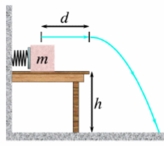
A)1.2 m/s
B)2.3 m/s
C)3.4 m/s
D)4.7 m/s
E)5.1 m/s
A)1.2 m/s
B)2.3 m/s
C)3.4 m/s
D)4.7 m/s
E)5.1 m/s
Question
Question
Question
Question
Question
Question
Question
A particle of mass m moving in the x-y plane is confined by a two-dimensional potential.The net force on the mass is  .What is the potential?
A)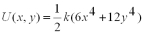
B)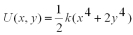
C)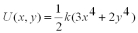
D)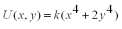
.What is the potential?A)
B)
C)
D)
Question
Question
Question
Question
Question
Question
Question
Question
Question
Question
Question
Question
Question
Question
Question
Question
In figure,the 2-kg mass has an initial velocity of 1 m/s down the ramp when it is 4 m up from the tip of a spring along a 30-degree ramp.The coefficient of kinetic friction between the ramp and the mass is 0.2.The spring at the bottom of the ramp is 200 cm long and has a spring constant of 100 N/m.What is the maximum compression the spring will have when the mass collides with it? 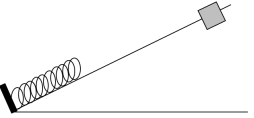
A)0.80 m
B)0.16 m
C)0.24 m
D)1.17 m
E)0.59 m
A)0.80 m
B)0.16 m
C)0.24 m
D)1.17 m
E)0.59 m
Question
The turning points for a 0.25-kg object in a potential of  are 0.50 m .What is the maximum kinetic energy of the object in this potential?
A)5.0 J
B)3.4 J
C)2.7 J
D)2.3 J
are 0.50 m .What is the maximum kinetic energy of the object in this potential?A)5.0 J
B)3.4 J
C)2.7 J
D)2.3 J
Question
Question
Question
Question
In figure,the 2-kg mass has an initial velocity of 1 m/s down the ramp when it is 3 m up from the tip of a spring along a 30-degree ramp.The coefficient of kinetic friction between the ramp and the mass is 0.2.The spring at the bottom of the ramp is 200 cm long.The maximum compression the spring when the mass collides with it is 0.5 m.What is the spring constant of the spring? 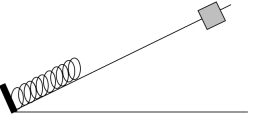
A)160 N/m
B)1.17 m
C)140 N/m
D)180 N/m
E)200 N/m
A)160 N/m
B)1.17 m
C)140 N/m
D)180 N/m
E)200 N/m
Question
Question
Question
Question
Question
Question
Find the turning points for a 0.25-kg object in a potential of  if its maximum kinetic energy is 5.0 J.
A) 0.51 m
B) 0.56 m
C) 0.75 m
D) 4.5 m
if its maximum kinetic energy is 5.0 J.A) 0.51 m
B) 0.56 m
C) 0.75 m
D) 4.5 m
Question
Find the magnitude of the force acting on a 3.0-kg mass located at x=2.0 m inside a potential of  (assume all units in MKS).
A)10 N
B)12 N
C)28 N
D)83 N
(assume all units in MKS).A)10 N
B)12 N
C)28 N
D)83 N
Question
Question
The turning points for a 0.25-kg object in a potential of  are 0.50 m .What is the maximum potential energy of this object?
A)2.7 J
B)5.0 J
C)2.3 J
D)3.4 J
are 0.50 m .What is the maximum potential energy of this object?A)2.7 J
B)5.0 J
C)2.3 J
D)3.4 J
Question
Question
Question
Question
Question
Question
A 30.0-kg child slides down a long slide in a play- ground.She starts from rest at a height h1 of 22.00 m.When she is partway down the slide,at a height h2 of 13.00 m,she is moving at a speed of 9.10 m/s.Calculate the mechanical energy lost due to friction (as heat,etc.).(in J) 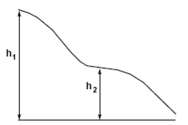
A)1.41 * 103
B)1.87 * 103
C)2.49 * 103
D)3.31 * 103
E)4.40 * 103
A)1.41 * 103
B)1.87 * 103
C)2.49 * 103
D)3.31 * 103
E)4.40 * 103
Question
Question
An object is attached to a string that is 2.00 m long as shown below.The object is pulled back such that the string makes an angle of 30.0 with respect to the vertical.The object is held still then released.What is the speed of the object at its lowest point? 
A)2.29 m/s
B)3.59 m/s
C)5.67 m/s
D)7.94 m/s
E)9.87 m/s
A)2.29 m/s
B)3.59 m/s
C)5.67 m/s
D)7.94 m/s
E)9.87 m/s
Question
Question
Question
Question
Question
Question
Question
Question
Question
Question
Question
Question
Question
Question
Question
Question
Question
Question
Question
A ball with mass m is thrown off a building of height h above the ground with a speed vo at an angle  above the horizontal as shown.The angle
  is greater than 0 and less than 90˚.Neglect friction for this problem.Which one of the following statements is true?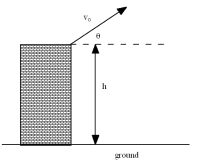
A)The speed at which the ball strikes the ground depends on .
.
B)The speed at which ball strikes the ground does not depend on the height of the building.
C)The speed at which the ball strikes the ground depends on vo.
D)The distance the ball strikes the ground from the building does not depend on .
.
E)The speed at which the ball strikes the ground depends on the mass of the ball.
above the horizontal as shown.The angle is greater than 0 and less than 90˚.Neglect friction for this problem.Which one of the following statements is true? A)The speed at which the ball strikes the ground depends on
.B)The speed at which ball strikes the ground does not depend on the height of the building.
C)The speed at which the ball strikes the ground depends on vo.
D)The distance the ball strikes the ground from the building does not depend on
.E)The speed at which the ball strikes the ground depends on the mass of the ball.
Question
Question
I push an object along a horizontal surface a distance d with a force F at an angle  .If the velocity is constant at a value v,then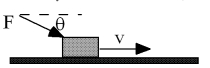
A)there is no net work done.
B)the net work done is Fdcos .
.
C)the net work done is Fdsin .
.
D)you cannot calculate the net work.
E)the net work done is Fv.
.If the velocity is constant at a value v,then A)there is no net work done.
B)the net work done is Fdcos
.C)the net work done is Fdsin
.D)you cannot calculate the net work.
E)the net work done is Fv.
Question
Question
Question
A block of mass M is sliding with velocity v along a horizontal surface with coefficient of friction  .How much heat produced in bringing the block to rest?
A)1/2 Mv2
B) Mv
Mv
C)1/2 Mv2
Mv2
D) v
v
E)zero
.How much heat produced in bringing the block to rest?A)1/2 Mv2
B)
MvC)1/2
Mv2D)
vE)zero
Question
A skier starts up a slope with a speed of 20.0 m/s.The slope makes an angle of 25.0 with respect to the horizontal.The coefficient of kinetic friction between her skis and the snow is 0.0300.How far in meters does the skier travel before she stops? 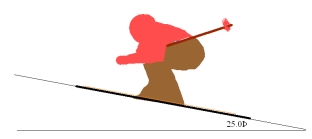
A)45.3
B)66.2
C)76.3
D)88.9
E)109
A)45.3
B)66.2
C)76.3
D)88.9
E)109
Question
An object is sliding on a horizontal surface.The coefficient of kinetic friction between the object and the surface is 0.250.If the object has an initial velocity of 45.0 m/s,how far will the object travel before it stops? 
A)134 m
B)213 m
C)334 m
D)413 m
E)506 m
A)134 m
B)213 m
C)334 m
D)413 m
E)506 m
Question
An object heads towards a hill sliding without friction.If its initial velocity is 23 m/s,and its mass 111 kg how far up the hill h in m does it go? 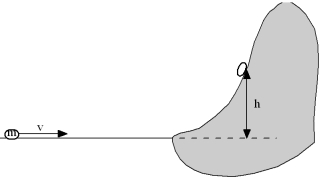
A)123.
B)47.
C)0.345
D)27.
E)35.
A)123.
B)47.
C)0.345
D)27.
E)35.
Question
Question
Question
Question
Question

Unlock Deck
Sign up to unlock the cards in this deck!
Unlock Deck
Unlock Deck
1/79

Play

Full screen (f)
Deck 6: Potential Energy and Energy Conservation
1
An arrow of mass 0.100 kg is launched directly upward with a bow of spring constant 1962 N/m.If the bow was stretched 10.0 cm and then released,how high above the bow did the arrow go before coming to rest temporarily?
A)10.0 m
B)20.0 m
C)100 m
D)200 m
A)10.0 m
B)20.0 m
C)100 m
D)200 m
10.0 m
2
A block of mass 1.40 kg is attached to a spring and sits on a frictionless table which is a height h=4.0 m above the floor.The spring is compressed by d=0.11 m initially.If the spring constant is k = 600 N/m,what is the speed of the block when it leaves the spring?
A)1.2 m/s
B)2.3 m/s
C)3.4 m/s
D)4.7 m/s
E)5.1 m/s
A)1.2 m/s
B)2.3 m/s
C)3.4 m/s
D)4.7 m/s
E)5.1 m/s
2.3 m/s
3
Calculate the gravitational potential energy relative to the ground of a 35.0-kg rock is 1.75 m above the ground.
A)690 J
B)656 J
C)601 J
D)343 J
E)61.3 J
A)690 J
B)656 J
C)601 J
D)343 J
E)61.3 J
601 J
4
A 1210-kg car travels 1.20 km up an incline at constant velocity.The incline is 15 measured with respect to the horizontal.The change in the car's potential energy is
A)3.68 MJ.
B)3.68 KJ.
C)1.92 MJ.
D)1.92 KJ.
E)4.37 J.
A)3.68 MJ.
B)3.68 KJ.
C)1.92 MJ.
D)1.92 KJ.
E)4.37 J.
Unlock Deck
Unlock for access to all 79 flashcards in this deck.
Unlock Deck
k this deck
5
The potential energy of an object as a function of position is U(x)= x3 - 12x + 8,where U is measured in joules and x is measured in meters.Where is the object be located if it is in an unstable equilibrium?
A)x= +2.0 m
B)x = -2.0 m
C)x = 0 m
D)x = -2.3 m
E)x = +2.3 m
A)x= +2.0 m
B)x = -2.0 m
C)x = 0 m
D)x = -2.3 m
E)x = +2.3 m
Unlock Deck
Unlock for access to all 79 flashcards in this deck.
Unlock Deck
k this deck
6
A 1210-kg car travels up an incline at constant velocity.The incline is 15 measured with respect to the horizontal.The change in the car's potential energy is 1.92 MJ.What is the length of the incline?
A)0.55 km
B)0.34 km
C)0.48 km
D)0.75 km
E)0.62 km
A)0.55 km
B)0.34 km
C)0.48 km
D)0.75 km
E)0.62 km
Unlock Deck
Unlock for access to all 79 flashcards in this deck.
Unlock Deck
k this deck
7
The potential energy of an object as a function of position is U(x)= x2 - x - 6,where U is measured in joules and x is measured in meters.Where is the object be located if it is in a stable equilibrium?
A)x = -2 m
B)x = 0 m
C)x = 0.5 m
D)x = 3 m
A)x = -2 m
B)x = 0 m
C)x = 0.5 m
D)x = 3 m
Unlock Deck
Unlock for access to all 79 flashcards in this deck.
Unlock Deck
k this deck
8
The gravitational potential energy of a 35.0-kg rock is 690.0 J relative to the ground.The rock is at a height ______ above the ground.
A)1.27 m
B)1.75 m
C)2.01 m
D)2.87 m
E)3.56 m
A)1.27 m
B)1.75 m
C)2.01 m
D)2.87 m
E)3.56 m
Unlock Deck
Unlock for access to all 79 flashcards in this deck.
Unlock Deck
k this deck
9
A particle of mass m moving in the x-y plane is confined by a two-dimensional potential.The net force on the mass is .What is the potential?
A)
B)
C)
D)
.What is the potential?A)
B)
C)
D)
Unlock Deck
Unlock for access to all 79 flashcards in this deck.
Unlock Deck
k this deck
10
An 80-kg fireman slides down a 3-meter pole by applying a frictional force against the pole using his hands.If he slides from rest and he land on the ground with a speed of 6.00 m/s,the frictional force his hands applied against the pole was
A)423 N.
B)581 N.
C)735 N.
D)305 N.
E)912 N.
A)423 N.
B)581 N.
C)735 N.
D)305 N.
E)912 N.
Unlock Deck
Unlock for access to all 79 flashcards in this deck.
Unlock Deck
k this deck
11
A 30.0-kg crate is pushed across a rough floor by a horizontal force of 100 N.The coefficient of kinetic friction between the crate and the floor is 0.100.If a total of 80.5 J of work is done on the crate,how far was it moved along the floor?
A)0.840 m
B)1.14 m
C)1.64 m
D)2.04 m
E)2.44 m
A)0.840 m
B)1.14 m
C)1.64 m
D)2.04 m
E)2.44 m
Unlock Deck
Unlock for access to all 79 flashcards in this deck.
Unlock Deck
k this deck
12
You are on a sled at the top of a 30.0-m tall toboggan run.Provided you can ignore friction forces between the sled and the track,when you reach the bottom of the toboggan you have a speed of
A)12.3 m/s.
B)11.7 m/s.
C)24.3 m/s.
D)28.0 m/s.
E)32.1 m/s.
A)12.3 m/s.
B)11.7 m/s.
C)24.3 m/s.
D)28.0 m/s.
E)32.1 m/s.
Unlock Deck
Unlock for access to all 79 flashcards in this deck.
Unlock Deck
k this deck
13
A stone is thrown up in the air and it reaches a maximum height of 10.0 m.What is the initial speed of the stone?
A)10.0 m/s
B)12.0 m/s
C)14.0 m/s
D)19.0 m/s
E)20.0 m/s
A)10.0 m/s
B)12.0 m/s
C)14.0 m/s
D)19.0 m/s
E)20.0 m/s
Unlock Deck
Unlock for access to all 79 flashcards in this deck.
Unlock Deck
k this deck
14
An Olympic weight lifter lifts a 186 kg weight from the floor to a height of 2.10 m.The change in the potential energy of the weight is
A)-3832 J.
B)1825 J.
C)-1825 J.
D)3832 J.
E)2456 J.
A)-3832 J.
B)1825 J.
C)-1825 J.
D)3832 J.
E)2456 J.
Unlock Deck
Unlock for access to all 79 flashcards in this deck.
Unlock Deck
k this deck
15
The potential energy of an object as a function of position is U(x)= x3 + 8,where U is measured in joules and x is measured in meters.Where is the object be located if it is in a metastable equilibrium?
A)x = 0 m
B)x = +1.3 m
C)x = -1.3 m
D)x= +2.0 m
E)x = -2.0 m
A)x = 0 m
B)x = +1.3 m
C)x = -1.3 m
D)x= +2.0 m
E)x = -2.0 m
Unlock Deck
Unlock for access to all 79 flashcards in this deck.
Unlock Deck
k this deck
16
A loaded wheelbarrow with a total mass of 70 kg is moved from the bottom to the top of a 2.5-m tall hill.The change in the potential energy of the loaded wheelbarrow is
A)687 J.
B)1717 J.
C)-687 J.
D)-1717 J.
E)0 J.
A)687 J.
B)1717 J.
C)-687 J.
D)-1717 J.
E)0 J.
Unlock Deck
Unlock for access to all 79 flashcards in this deck.
Unlock Deck
k this deck
17
A slingshot is used to launch a 5.00-gram rock.The effective spring constant of the slingshot is 200 N/m.By what distance must the slingshot be stretched in order to launch the rock at 20.0 m/s?
A)5.00 cm
B)7.07 cm
C)10.0 cm
D)14.1 cm
A)5.00 cm
B)7.07 cm
C)10.0 cm
D)14.1 cm
Unlock Deck
Unlock for access to all 79 flashcards in this deck.
Unlock Deck
k this deck
18
A projectile of mass 2.00 kg is launched from the ground with a speed 10.0 m/s at an angle 20.0 above the horizontal.Assume that air drag is negligible.What is the kinetic energy of the projectile 0.500 seconds after it is launched?
A)50.5 J
B)60.5 J
C)70.5 J
D)80.5 J
E)90.5 J
A)50.5 J
B)60.5 J
C)70.5 J
D)80.5 J
E)90.5 J
Unlock Deck
Unlock for access to all 79 flashcards in this deck.
Unlock Deck
k this deck
19
441 J of work is required to slide a 15-kg ice block up a frictionless slope that is 20 m long.The incline of the slope with respect to horizontal is
A)8.62 .
B)4.71 .
C)3.22 .
D)5.83 .
E)9.71 .
A)8.62 .
B)4.71 .
C)3.22 .
D)5.83 .
E)9.71 .
Unlock Deck
Unlock for access to all 79 flashcards in this deck.
Unlock Deck
k this deck
20
The mechanical energy of an object is always equal to
A)the work done on the object.
B)the change in the object's kinetic energy.
C)the sum of the object's kinetic and potential energies.
D)All are correct.
A)the work done on the object.
B)the change in the object's kinetic energy.
C)the sum of the object's kinetic and potential energies.
D)All are correct.
Unlock Deck
Unlock for access to all 79 flashcards in this deck.
Unlock Deck
k this deck
21
Block A is dropped from a height of 2 m.A second identical block B slides frictionlessly down a ramp of height 2 m inclined at 30 .A third identical block C slides down a frictionless ramp of height 2 m inclined at 45 .Which block is travelling fastest at the bottom of the ramp?
A)block A
B)block B
C)block C
D)They all travel at the same speed.
A)block A
B)block B
C)block C
D)They all travel at the same speed.
Unlock Deck
Unlock for access to all 79 flashcards in this deck.
Unlock Deck
k this deck
22
A 3-kg block slides down a smooth incline of length 2 m inclined at 30 and hits a level,horizontal rough patch,coming to a stop in 1 m.What is the coefficient of friction between the block and the rough patch?
A)0.25
B)0.5
C)0.33
D)1.0
E)0.75
A)0.25
B)0.5
C)0.33
D)1.0
E)0.75
Unlock Deck
Unlock for access to all 79 flashcards in this deck.
Unlock Deck
k this deck
23
The potential energy of a 10-kg mass is given by -3.98 * 1015 r-1 (potential energy decreases as r approaches zero).The force on this mass when it is located at r=6.38 * 106 m is
A)638 N towards r=0.
B)638 N away from r=0.
C)62.4 * 108 N towards r=0.
D)97.8 N away from r=0.
E)97.8 N towards r=0.
A)638 N towards r=0.
B)638 N away from r=0.
C)62.4 * 108 N towards r=0.
D)97.8 N away from r=0.
E)97.8 N towards r=0.
Unlock Deck
Unlock for access to all 79 flashcards in this deck.
Unlock Deck
k this deck
24
Find the gravitational potential energy of a 1.88-m tall person whose weight is 670 N when he is standing on a high dive platform 3.00 m above the water (take the surface of the water as zero potential).
A)2640 J
B)3270 J
C)25,900 J
D)32,000 J
A)2640 J
B)3270 J
C)25,900 J
D)32,000 J
Unlock Deck
Unlock for access to all 79 flashcards in this deck.
Unlock Deck
k this deck
25
In figure,the 2-kg mass has an initial velocity of 1 m/s down the ramp when it is 4 m up from the tip of a spring along a 30-degree ramp.The coefficient of kinetic friction between the ramp and the mass is 0.2.The spring at the bottom of the ramp is 200 cm long and has a spring constant of 100 N/m.What is the maximum compression the spring will have when the mass collides with it?
A)0.80 m
B)0.16 m
C)0.24 m
D)1.17 m
E)0.59 m
A)0.80 m
B)0.16 m
C)0.24 m
D)1.17 m
E)0.59 m
Unlock Deck
Unlock for access to all 79 flashcards in this deck.
Unlock Deck
k this deck
26
The turning points for a 0.25-kg object in a potential of are 0.50 m .What is the maximum kinetic energy of the object in this potential?
A)5.0 J
B)3.4 J
C)2.7 J
D)2.3 J
are 0.50 m .What is the maximum kinetic energy of the object in this potential?A)5.0 J
B)3.4 J
C)2.7 J
D)2.3 J
Unlock Deck
Unlock for access to all 79 flashcards in this deck.
Unlock Deck
k this deck
27
A spring,with k = 2500 N/m,is fixed vertically to the floor.A 10.0-kg box is pressed down on the spring such that the total compression of the spring is 0.5 m.When the box is released,what is the maximum speed the box reaches?
A)8.49 m/s
B)7.25 m/s
C)6.54 m/s
D)5.13 m/s
E)4.08 m/s
A)8.49 m/s
B)7.25 m/s
C)6.54 m/s
D)5.13 m/s
E)4.08 m/s
Unlock Deck
Unlock for access to all 79 flashcards in this deck.
Unlock Deck
k this deck
28
A 5-kg block of ice travels with a speed of 12 m/s when it hits a 25 incline plane.How far does it travel frictionlessly up the plane?
A)12.3 m
B)7.3 m
C)5.6 m
D)13.7 m
E)17.4 m
A)12.3 m
B)7.3 m
C)5.6 m
D)13.7 m
E)17.4 m
Unlock Deck
Unlock for access to all 79 flashcards in this deck.
Unlock Deck
k this deck
29
A mortar launches a 8.50-kg fireworks shell straight up with an initial speed of 62.6 m/s.How high does the shell go?
A)50.0 m
B)100 m
C)200 m
D)300 m
E)400 m
A)50.0 m
B)100 m
C)200 m
D)300 m
E)400 m
Unlock Deck
Unlock for access to all 79 flashcards in this deck.
Unlock Deck
k this deck
30
In figure,the 2-kg mass has an initial velocity of 1 m/s down the ramp when it is 3 m up from the tip of a spring along a 30-degree ramp.The coefficient of kinetic friction between the ramp and the mass is 0.2.The spring at the bottom of the ramp is 200 cm long.The maximum compression the spring when the mass collides with it is 0.5 m.What is the spring constant of the spring?
A)160 N/m
B)1.17 m
C)140 N/m
D)180 N/m
E)200 N/m
A)160 N/m
B)1.17 m
C)140 N/m
D)180 N/m
E)200 N/m
Unlock Deck
Unlock for access to all 79 flashcards in this deck.
Unlock Deck
k this deck
31
A 60-kg man needs to climb a flight of stairs 25 m high at a constant speed.The energy he requires is
A)1500 J.
B)9800 J.
C)11249 J.
D)14715 J.
A)1500 J.
B)9800 J.
C)11249 J.
D)14715 J.
Unlock Deck
Unlock for access to all 79 flashcards in this deck.
Unlock Deck
k this deck
32
A block (m=12 kg)is moving at a speed of 7.0 m/s on a level surface.A force of 25 N is applied in the direction that it is moving but it comes to a stop in a distance 625 cm.Find the coefficient of friction.
A)0.22 N
B)0.22
C)0.40
D)0.61
E)0.86
A)0.22 N
B)0.22
C)0.40
D)0.61
E)0.86
Unlock Deck
Unlock for access to all 79 flashcards in this deck.
Unlock Deck
k this deck
33
Find the PE of a 25-kg object 1.67 m above the surface of the National Mall in Washington,DC.Take the surface of Tiananmen Square to be zero potential.Possibly useful information Beijing elevation: 43 m above sea level.
National Mall elevation: 10 m above sea level
Radius of the Earth: 6.38 * 106 m.
Assume that DC and Beijing are directly opposite each other for this problem.
A)-8100 J
B)-7700 J
C)410 J
D)3.1 * 109 J
National Mall elevation: 10 m above sea level
Radius of the Earth: 6.38 * 106 m.
Assume that DC and Beijing are directly opposite each other for this problem.
A)-8100 J
B)-7700 J
C)410 J
D)3.1 * 109 J
Unlock Deck
Unlock for access to all 79 flashcards in this deck.
Unlock Deck
k this deck
34
541 J of work is required to slide a 20-kg ice block up a frictionless slope.The incline of the slope with respect to horizontal is 9.71 .What is the length of the slope?
A)23 m
B)2.8 m
C)16 m
D)12 m
E)20 m
A)23 m
B)2.8 m
C)16 m
D)12 m
E)20 m
Unlock Deck
Unlock for access to all 79 flashcards in this deck.
Unlock Deck
k this deck
35
A 2-kg mass is dropped 2.0 m above a spring with a spring constant 40.0 N/m.How much does the spring compress? Use g=10 m/s2.
A)1.4 m
B)2.0 m
C)1.0 m
D)1.5 m
E)2.5 m
A)1.4 m
B)2.0 m
C)1.0 m
D)1.5 m
E)2.5 m
Unlock Deck
Unlock for access to all 79 flashcards in this deck.
Unlock Deck
k this deck
36
Find the turning points for a 0.25-kg object in a potential of if its maximum kinetic energy is 5.0 J.
A) 0.51 m
B) 0.56 m
C) 0.75 m
D) 4.5 m
if its maximum kinetic energy is 5.0 J.A) 0.51 m
B) 0.56 m
C) 0.75 m
D) 4.5 m
Unlock Deck
Unlock for access to all 79 flashcards in this deck.
Unlock Deck
k this deck
37
Find the magnitude of the force acting on a 3.0-kg mass located at x=2.0 m inside a potential of (assume all units in MKS).
A)10 N
B)12 N
C)28 N
D)83 N
(assume all units in MKS).A)10 N
B)12 N
C)28 N
D)83 N
Unlock Deck
Unlock for access to all 79 flashcards in this deck.
Unlock Deck
k this deck
38
Which of the following are necessary for a point of stable equilibrium?
A)a local minimum in potential energy
B)kinetic energy equal to zero
C)potential energy equal to zero
D)All are correct.
E)A and C only are correct.
A)a local minimum in potential energy
B)kinetic energy equal to zero
C)potential energy equal to zero
D)All are correct.
E)A and C only are correct.
Unlock Deck
Unlock for access to all 79 flashcards in this deck.
Unlock Deck
k this deck
39
The turning points for a 0.25-kg object in a potential of are 0.50 m .What is the maximum potential energy of this object?
A)2.7 J
B)5.0 J
C)2.3 J
D)3.4 J
are 0.50 m .What is the maximum potential energy of this object?A)2.7 J
B)5.0 J
C)2.3 J
D)3.4 J
Unlock Deck
Unlock for access to all 79 flashcards in this deck.
Unlock Deck
k this deck
40
A steel ball of mass 0.5 kg is fired vertically up from the edge of a building 20 m high with an initial speed of 10 m/s.When it falls back on the ground at the base of the building,it gets buried in sand to a depth of 0.2 m.Determine: the average resistance force that sand exerts on the ball.
A)1040 N
B)25 N
C)620 N
D)126 N
E)87 N
A)1040 N
B)25 N
C)620 N
D)126 N
E)87 N
Unlock Deck
Unlock for access to all 79 flashcards in this deck.
Unlock Deck
k this deck
41
A person standing on top of a 40-m high cliff throws a rock with a mass of 0.25 kg off the cliff.The rock leaves the person's hand with a speed of 14 m/s and makes an angle of 60 degrees above the horizontal.What is the kinetic of the rock when it reaches the top of its path?
A)6.1 J
B)0 J
C)25 J
D)49 J
E)18 J
A)6.1 J
B)0 J
C)25 J
D)49 J
E)18 J
Unlock Deck
Unlock for access to all 79 flashcards in this deck.
Unlock Deck
k this deck
42
A 1.0-kg object 2.0 m above the floor has a gravitational potential energy of 3.0 J.How much gravitational potential energy does the object have when it is 4.0 m above the floor?
A)6.0 J
B)10 J
C)20 J
D)23 J
E)39 J
A)6.0 J
B)10 J
C)20 J
D)23 J
E)39 J
Unlock Deck
Unlock for access to all 79 flashcards in this deck.
Unlock Deck
k this deck
43
A tennis ball of mass 70 g is thrown vertically upward at 25 m/s.It rises to a height of 21 m.The work done by the resistive forces is
A)-18.1 J.
B)-7.5 J.
C)-6.2 J.
D)-3.5 J.
A)-18.1 J.
B)-7.5 J.
C)-6.2 J.
D)-3.5 J.
Unlock Deck
Unlock for access to all 79 flashcards in this deck.
Unlock Deck
k this deck
44
Find the magnitude of the force at the position x = 2.0 m and y = 3.0 m associated with the potential energy function U = (7.0 J)+ (5.0 J/m)x + (4.0 J/m)y.
A)6.4 N
B)11.1 N
C)9.0 N
D)16.0 N
E)7.8 N
A)6.4 N
B)11.1 N
C)9.0 N
D)16.0 N
E)7.8 N
Unlock Deck
Unlock for access to all 79 flashcards in this deck.
Unlock Deck
k this deck
45
A 30.0-kg child slides down a long slide in a play- ground.She starts from rest at a height h1 of 22.00 m.When she is partway down the slide,at a height h2 of 13.00 m,she is moving at a speed of 9.10 m/s.Calculate the mechanical energy lost due to friction (as heat,etc.).(in J)
A)1.41 * 103
B)1.87 * 103
C)2.49 * 103
D)3.31 * 103
E)4.40 * 103
A)1.41 * 103
B)1.87 * 103
C)2.49 * 103
D)3.31 * 103
E)4.40 * 103
Unlock Deck
Unlock for access to all 79 flashcards in this deck.
Unlock Deck
k this deck
46
A body fired vertically up reaches a maximum height of 120 m.The location at which the kinetic energy is 75% of the potential energy is
A)69 m.
B)75 m.
C)90 m.
D)98 m.
A)69 m.
B)75 m.
C)90 m.
D)98 m.
Unlock Deck
Unlock for access to all 79 flashcards in this deck.
Unlock Deck
k this deck
47
An object is attached to a string that is 2.00 m long as shown below.The object is pulled back such that the string makes an angle of 30.0 with respect to the vertical.The object is held still then released.What is the speed of the object at its lowest point?
A)2.29 m/s
B)3.59 m/s
C)5.67 m/s
D)7.94 m/s
E)9.87 m/s
A)2.29 m/s
B)3.59 m/s
C)5.67 m/s
D)7.94 m/s
E)9.87 m/s
Unlock Deck
Unlock for access to all 79 flashcards in this deck.
Unlock Deck
k this deck
48
A 25-kg child starts from rest at the top of a slide inclined at 27 relative to the horizontal.The slide is 6.0 m long.The coefficient of the kinetic friction of the slide is 0.25.When reaching the bottom of the slide,the child's speed is:
A)5.2 m/s
B)4.0 m/s
C)7.3 m/s
D)6.5 m/s
A)5.2 m/s
B)4.0 m/s
C)7.3 m/s
D)6.5 m/s
Unlock Deck
Unlock for access to all 79 flashcards in this deck.
Unlock Deck
k this deck
49
A frustrated student drops his physics book of 2-kg out of the window that is 100 m from the ground.The kinetic energy of the book at 25 m from the ground is
A)5000 J.
B)1472 J.
C)490 J.
D)250 J.
A)5000 J.
B)1472 J.
C)490 J.
D)250 J.
Unlock Deck
Unlock for access to all 79 flashcards in this deck.
Unlock Deck
k this deck
50
Find the x-component of the force at the position x = 2.0 m and y = 3.0 m associated with the potential energy function U = (7.0 J)+ (5.0 J/m)x + (4.0 J/m)y.
A)+10 N
B)-5.0 N
C)+29 N
D)-2.0 N
E)-9.0 N
A)+10 N
B)-5.0 N
C)+29 N
D)-2.0 N
E)-9.0 N
Unlock Deck
Unlock for access to all 79 flashcards in this deck.
Unlock Deck
k this deck
51
A person standing on top of a 40-m high cliff throws a rock with a mass of 0.25 kg off the cliff.The rock leaves the person's hand with a speed of 11 m/s and makes an angle of 75 degrees above the horizontal.What is the speed of the rock when it hits the ground at the bottom of the cliff?
A)26 m/s
B)28 m/s
C)30 m/s
D)49 m/s
E)52 m/s
A)26 m/s
B)28 m/s
C)30 m/s
D)49 m/s
E)52 m/s
Unlock Deck
Unlock for access to all 79 flashcards in this deck.
Unlock Deck
k this deck
52
A 25-kg child starts from rest and attains a speed of 4 m/s at the bottom of a 27 slide of length 6 m.The coefficient of the kinetic friction of the slide is
A)0.08.
B)0.19.
C)0.22.
D)0.36.
A)0.08.
B)0.19.
C)0.22.
D)0.36.
Unlock Deck
Unlock for access to all 79 flashcards in this deck.
Unlock Deck
k this deck
53
Find the y-component of the force at the position x = 2.0 m and y = 3.0 m associated with the potential energy function U = (7.0 J)+ (5.0 J/m)x + (4.0 J/m)y.
A)-5.0 N
B)-2.0 N
C)-9.0 N
D)-4.0 N
E)+29 N
A)-5.0 N
B)-2.0 N
C)-9.0 N
D)-4.0 N
E)+29 N
Unlock Deck
Unlock for access to all 79 flashcards in this deck.
Unlock Deck
k this deck
54
How much mechanical energy is lost to friction if a 22-kg box slides 7.0 m down a rough inclined plane at a constant speed of 11 m/s? The inclined plane makes an angle of 33 degrees with respect to the horizontal.
A)820 J
B)920 J
C)1300 J
D)1500 J
E)1700 J
A)820 J
B)920 J
C)1300 J
D)1500 J
E)1700 J
Unlock Deck
Unlock for access to all 79 flashcards in this deck.
Unlock Deck
k this deck
55
A 5.0-kg pumpkin is dropped from the top of the RCA Building in New York City.If it falls through a distance of 380 m,and splats on the sidewalk with a speed of 52.0 m/s,what is the work done by air resistance during its fall?
A)12 kJ
B)-12 kJ
C)19 kJ
D)-19 kJ
A)12 kJ
B)-12 kJ
C)19 kJ
D)-19 kJ
Unlock Deck
Unlock for access to all 79 flashcards in this deck.
Unlock Deck
k this deck
56
A pendulum of length 0.471 m,with a bob of mass 0.593 kg is moved out to an angle and released from rest.The speed of the bob at the bottom of the pendulum oscillation is 1.20 m/s.What is the angle from which the pendulum is released? (in degrees)
A)32.4
B)37.9
C)44.4
D)51.9
E)60.7
A)32.4
B)37.9
C)44.4
D)51.9
E)60.7
Unlock Deck
Unlock for access to all 79 flashcards in this deck.
Unlock Deck
k this deck
57
A child slides down a slippery slide (neglect friction)of length 3.0 m and angle of inclination 32 above the horizontal.How fast is she going when she leaves the end of the slide?
A)3.9 m/s
B)5.0 m/s
C)5.6 m/s
D)7.1 m/s
A)3.9 m/s
B)5.0 m/s
C)5.6 m/s
D)7.1 m/s
Unlock Deck
Unlock for access to all 79 flashcards in this deck.
Unlock Deck
k this deck
58
When Neil Armstrong climbed down to the surface of the Moon via the 3.5-m tall ladder of the Lunar Lander,his potential energy changed by 1260 J.If his mass was 79 kg,what was the mass of his suit? The acceleration due to gravity on the moon is 1.62 m/s2.
A)140 kg
B)36 kg
C)280 kg
D)42 kg
A)140 kg
B)36 kg
C)280 kg
D)42 kg
Unlock Deck
Unlock for access to all 79 flashcards in this deck.
Unlock Deck
k this deck
59
A person standing on top of a 40-m high cliff throws a rock with a mass of 0.25 kg off the cliff.The rock leaves the person's hand with a speed of 11 m/s and makes an angle of 75 degrees above the horizontal.What is the kinetic of the rock when it hits the ground at the bottom of the cliff?
A)98.0 J
B)300 J
C)113 J
D)55 J
E)84.5 J
A)98.0 J
B)300 J
C)113 J
D)55 J
E)84.5 J
Unlock Deck
Unlock for access to all 79 flashcards in this deck.
Unlock Deck
k this deck
60
An ideal spring with a spring constant of 3000 N/m is attached at the bottom of a rough inclined plane that makes an angle of 37 degrees with the horizontal.The spring is compressed a distance of 80 cm and then a 12-kg box is placed on the spring.The coefficient of kinetic friction between the box and the inclined plane is 0.2.If the box is released from rest and is not attached to the spring,how fast will the box be traveling after sliding 4 m up the incline (3.2 m beyond the uncompressed length of the spring)?
A)6.9 m/s
B)9.5 m/s
C)11 m/s
D)13 m/s
E)14 m/s
A)6.9 m/s
B)9.5 m/s
C)11 m/s
D)13 m/s
E)14 m/s
Unlock Deck
Unlock for access to all 79 flashcards in this deck.
Unlock Deck
k this deck
61
A spring is fixed vertically to the floor.A 10.0-kg box is then pressed down such that the spring is compressed 0.5 m beyond its equilibrium length.The box is then released and it travels vertically upward to a maximum height of 2.40 m above its release point.Assuming the work done against drag (air resistance)is 120 J,what is the spring constant of the spring?
A)2500 N/m
B)3750 N/m
C)1880 N/m
D)3600 N/m
E)2840 N/m
A)2500 N/m
B)3750 N/m
C)1880 N/m
D)3600 N/m
E)2840 N/m
Unlock Deck
Unlock for access to all 79 flashcards in this deck.
Unlock Deck
k this deck
62
A 20.0-kg object starts from rest and slides down an inclined plane.The change in its elevation is 2.50 m and its final speed is 5.00 m/sec.How much energy did the object lose due to friction as it slid down the plane?
A)491 J
B)245 J
C)250 J
D)241 J
A)491 J
B)245 J
C)250 J
D)241 J
Unlock Deck
Unlock for access to all 79 flashcards in this deck.
Unlock Deck
k this deck
63
A spring,with k = 2500N/m,is fixed vertically to the floor.A 10.0-kg box is then pressed down such that the spring is compressed 0.5 m beyond its equilibrium length.The box is then released and the box travels vertically upward reaching a maximum height of 2.24 m above its release point.What is the work done by the resistive forces (drag/air resistance)?
A)0 J
B)-171 J
C)-93 J
D)-49 J
E)-60 J
A)0 J
B)-171 J
C)-93 J
D)-49 J
E)-60 J
Unlock Deck
Unlock for access to all 79 flashcards in this deck.
Unlock Deck
k this deck
64
A 500-g book is resting on top of a shelf 1 m above the floor.The book is 10 cm from the edge of the shelf.Accidentally the book is pushed off the shelf with a force of 25 N and falls to the floor following a parabolic trajectory coming to rest a horizontal distance of 20 cm from the edge of the shelf.If the coefficient of kinetic friction between the book and the shelf is 0.3,how much net work is done on the book?
A)4.9 J
B)0
C)-4.9 J
D)7.4 J
E)-7.4 J
A)4.9 J
B)0
C)-4.9 J
D)7.4 J
E)-7.4 J
Unlock Deck
Unlock for access to all 79 flashcards in this deck.
Unlock Deck
k this deck
65
Four balls are thrown off the top of a building 27 m high.All balls are thrown with identical speeds,but at different angles.Ball 1 is thrown straight upward.Ball 2 is thrown straight downward.Ball 3 is thrown at an angle of +45 relative to the horizontal.And Ball 4 is thrown at an angle of -45 relative to the horizontal.Which ball has the highest speed when it hits the ground?
A)ball 1
B)ball 2
C)ball 3
D)ball 4
E)All hit with the same speed.
A)ball 1
B)ball 2
C)ball 3
D)ball 4
E)All hit with the same speed.
Unlock Deck
Unlock for access to all 79 flashcards in this deck.
Unlock Deck
k this deck
66
A ball with mass m is thrown off a building of height h above the ground with a speed vo at an angle above the horizontal as shown.The angle is greater than 0 and less than 90˚.Neglect friction for this problem.Which one of the following statements is true?
A)The speed at which the ball strikes the ground depends on .
B)The speed at which ball strikes the ground does not depend on the height of the building.
C)The speed at which the ball strikes the ground depends on vo.
D)The distance the ball strikes the ground from the building does not depend on .
E)The speed at which the ball strikes the ground depends on the mass of the ball.
above the horizontal as shown.The angle is greater than 0 and less than 90˚.Neglect friction for this problem.Which one of the following statements is true? A)The speed at which the ball strikes the ground depends on
.B)The speed at which ball strikes the ground does not depend on the height of the building.
C)The speed at which the ball strikes the ground depends on vo.
D)The distance the ball strikes the ground from the building does not depend on
.E)The speed at which the ball strikes the ground depends on the mass of the ball.
Unlock Deck
Unlock for access to all 79 flashcards in this deck.
Unlock Deck
k this deck
67
On a snowy day your car which is moving at 20 km/h skids 15 m with locked brakes.When moving at 120 km/h with locked brakes,your car would skid
A)540 m
B)90 m
C)320 m
D)129 m
A)540 m
B)90 m
C)320 m
D)129 m
Unlock Deck
Unlock for access to all 79 flashcards in this deck.
Unlock Deck
k this deck
68
I push an object along a horizontal surface a distance d with a force F at an angle .If the velocity is constant at a value v,then
A)there is no net work done.
B)the net work done is Fdcos .
C)the net work done is Fdsin .
D)you cannot calculate the net work.
E)the net work done is Fv.
.If the velocity is constant at a value v,then A)there is no net work done.
B)the net work done is Fdcos
.C)the net work done is Fdsin
.D)you cannot calculate the net work.
E)the net work done is Fv.
Unlock Deck
Unlock for access to all 79 flashcards in this deck.
Unlock Deck
k this deck
69
A cannon is shot downward from a 195-m high cliff at an angle of 34 with respect to the horizontal.The initial speed is 40.0 m/s.What is its speed when it hits the ground in m/s?
A)41.
B)48.3
C)59.2
D)73.7
E)98.1
A)41.
B)48.3
C)59.2
D)73.7
E)98.1
Unlock Deck
Unlock for access to all 79 flashcards in this deck.
Unlock Deck
k this deck
70
A 5.0-kg block slides a distance of 4.0 m down a rough inclined plane.The inclined plane makes an angle = 30 with respect to the horizontal.If the block had an initial velocity of 2.0 m/s down the inclined plane and a final velocity of 6.0 m/s down the inclined plane,how much energy was lost by the block due to the work done by friction?
A)88 J
B)28 J
C)80 J
D)8.0 J
E)18 J
A)88 J
B)28 J
C)80 J
D)8.0 J
E)18 J
Unlock Deck
Unlock for access to all 79 flashcards in this deck.
Unlock Deck
k this deck
71
A block of mass M is sliding with velocity v along a horizontal surface with coefficient of friction .How much heat produced in bringing the block to rest?
A)1/2 Mv2
B) Mv
C)1/2 Mv2
D) v
E)zero
.How much heat produced in bringing the block to rest?A)1/2 Mv2
B)
MvC)1/2
Mv2D)
vE)zero
Unlock Deck
Unlock for access to all 79 flashcards in this deck.
Unlock Deck
k this deck
72
A skier starts up a slope with a speed of 20.0 m/s.The slope makes an angle of 25.0 with respect to the horizontal.The coefficient of kinetic friction between her skis and the snow is 0.0300.How far in meters does the skier travel before she stops?
A)45.3
B)66.2
C)76.3
D)88.9
E)109
A)45.3
B)66.2
C)76.3
D)88.9
E)109
Unlock Deck
Unlock for access to all 79 flashcards in this deck.
Unlock Deck
k this deck
73
An object is sliding on a horizontal surface.The coefficient of kinetic friction between the object and the surface is 0.250.If the object has an initial velocity of 45.0 m/s,how far will the object travel before it stops?
A)134 m
B)213 m
C)334 m
D)413 m
E)506 m
A)134 m
B)213 m
C)334 m
D)413 m
E)506 m
Unlock Deck
Unlock for access to all 79 flashcards in this deck.
Unlock Deck
k this deck
74
An object heads towards a hill sliding without friction.If its initial velocity is 23 m/s,and its mass 111 kg how far up the hill h in m does it go?
A)123.
B)47.
C)0.345
D)27.
E)35.
A)123.
B)47.
C)0.345
D)27.
E)35.
Unlock Deck
Unlock for access to all 79 flashcards in this deck.
Unlock Deck
k this deck
75
A spring,with k = 2500N/m,is fixed vertically to the floor.A 10.0-kg box is then pressed down such that the spring is compressed 0.5 m beyond its equilibrium length.The box is then released.Assuming the work done against drag (air resistance)is 60 J,how high will the box travel above its release position?
A)2.58 m
B)2.01 m
C)1.57 m
D)0.50 m
E)1.23 m
A)2.58 m
B)2.01 m
C)1.57 m
D)0.50 m
E)1.23 m
Unlock Deck
Unlock for access to all 79 flashcards in this deck.
Unlock Deck
k this deck
76
Four balls are thrown off the top of a building 27 m high.All balls are thrown with identical speeds,but at different angles.Ball 1 is thrown straight upward.Ball 2 is thrown +30 relative to the horizontal.Ball 3 is thrown at an angle of +45 relative to the horizontal.And Ball 4 is thrown at an angle of -45 relative to the horizontal.Which ball has the greatest kinetic energy at the top of their respective paths?
A)ball 1
B)ball 2
C)ball 3
D)ball 4
E)All have the same kinetic energy
A)ball 1
B)ball 2
C)ball 3
D)ball 4
E)All have the same kinetic energy
Unlock Deck
Unlock for access to all 79 flashcards in this deck.
Unlock Deck
k this deck
77
A sled of mass 10 kg starts out at an initial speed of 5 m/s on a horizontal surface.The coefficient of kinetic friction with the snow is 0.05.Use energy considerations to determine how far it goes before it comes to a stop (within 5% accuracy).
A)25 m
B)50 m
C)320 m
D)640 m
E)1280 m
A)25 m
B)50 m
C)320 m
D)640 m
E)1280 m
Unlock Deck
Unlock for access to all 79 flashcards in this deck.
Unlock Deck
k this deck
78
Four balls are thrown off the top of a building 27 m high.All balls are thrown with identical speeds,but at different angles.Ball 1 is thrown straight upward.Ball 2 is thrown straight downward.Ball 3 is thrown at an angle of +45 relative to the horizontal.And Ball 4 is thrown at an angle of -45 relative to the horizontal.Which ball has the greatest kinetic energy when it hits the ground?
A)ball 1
B)ball 2
C)ball 3
D)ball 4
E)All have the same kinetic energy
A)ball 1
B)ball 2
C)ball 3
D)ball 4
E)All have the same kinetic energy
Unlock Deck
Unlock for access to all 79 flashcards in this deck.
Unlock Deck
k this deck
79
A 200 N force pushes a 50-kg oak table a distance of 2.0 m across an oak floor.Friction resists this motion with a force of 157 N.The work done by the friction is
A)-128 J
B)-86 J
C)-400 J
D)-314 J
E)-714 J
A)-128 J
B)-86 J
C)-400 J
D)-314 J
E)-714 J
Unlock Deck
Unlock for access to all 79 flashcards in this deck.
Unlock Deck
k this deck
Unlock Deck
Unlock for access to all 79 flashcards in this deck.






