







 Chat with AI

Deck 38: Nursing Management Dysrhythmias
Full screen (f)

Question

Question
Question
Question
Question
Question
Question
Question
Question
Question
Question
Question
Question
Question
Question
Question
Question
Question
Question
Question
Question
The nurse is caring for a client who has been experiencing dizziness and shortness of breath for several days. During cardiac monitoring in the emergency department (ED), the nurse obtains the following electrocardiographictracing. 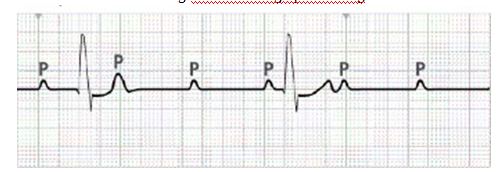
Which of the following cardiac rhythms should the nurse identify?
A)Sinus rhythm with premature ventricular contractions (PVCs)
B)Junctional escape rhythm
C)Third-degree atrioventricular (AV) block
D)Sinus rhythm with premature atrial contractions (PACs)
Which of the following cardiac rhythms should the nurse identify?
A)Sinus rhythm with premature ventricular contractions (PVCs)
B)Junctional escape rhythm
C)Third-degree atrioventricular (AV) block
D)Sinus rhythm with premature atrial contractions (PACs)
Question
Question
Question
Question
Question
Question

Unlock Deck
Sign up to unlock the cards in this deck!
Unlock Deck
Unlock Deck
1/27

Play

Full screen (f)
Deck 38: Nursing Management Dysrhythmias
1
The nurse is caring for a client who has a normal cardiac rhythm and a heart rate of 72 beats/minute, except that the P-R interval is 0.24 seconds. Which of the following actions should the nurse implement?
A)Notify the client's health care provider immediately.
B)Administer atropine per agency bradycardia protocol.
C)Prepare the client for temporary pacemaker insertion.
D)Document the finding and continue to monitor the client.
A)Notify the client's health care provider immediately.
B)Administer atropine per agency bradycardia protocol.
C)Prepare the client for temporary pacemaker insertion.
D)Document the finding and continue to monitor the client.
Document the finding and continue to monitor the client.
2
Which of the following laboratory results for a client whose cardiac monitor shows multifocal premature ventricular contractions (PVCs) is most important for the nurse to communicate to the health care provider?
A)Blood glucose 12.8 mmol/L
B)Serum chloride 90 mmol/L
C)Serum sodium 133 mmol/L
D)Serum potassium 2.8 mmol/L
A)Blood glucose 12.8 mmol/L
B)Serum chloride 90 mmol/L
C)Serum sodium 133 mmol/L
D)Serum potassium 2.8 mmol/L
Serum potassium 2.8 mmol/L
3
The nurse is caring for a young adult client who had a mandatory electrocardiogram (ECG) before participating on a college swim team and is found to have sinus bradycardia, rate 52. BP is 114/54 mm Hg, and the student denies any health problems. Which of thefollowing actions by the nurse is best?
A)Allow the student to participate on the swim team.
B)Refer the student to a cardiologist for further assessment.
C)Obtain more detailed information about the student's health history.
D)Tell the student to stop swimming immediately if any dyspnea occurs.
A)Allow the student to participate on the swim team.
B)Refer the student to a cardiologist for further assessment.
C)Obtain more detailed information about the student's health history.
D)Tell the student to stop swimming immediately if any dyspnea occurs.
Allow the student to participate on the swim team.
4
The nurse is interpreting an ECG strip to determine whether there is a delay in impulse conduction through the atria. Which of the following components of an ECG strip should the nurse measure?
A)P wave
B)P-R interval
C)Q-T interval
D)QRS complex
A)P wave
B)P-R interval
C)Q-T interval
D)QRS complex
Unlock Deck
Unlock for access to all 27 flashcards in this deck.
Unlock Deck
k this deck
5
The nurse is caring for a client whose cardiac monitor shows sinus rhythm, rate 60-70. The P-R interval is 0.18 seconds at 1:00 A.M., 0.20 seconds at 2:30 P.M., and 0.23 seconds at 4:00 P.M. Which of the following actions should the nurse take at this time?
A)Prepare for possible temporary pacemaker insertion.
B)Administer atropine sulphate 1 mg IV per agency protocol.
C)Document the client's rhythm and assess the client's response to the rhythm.
D)Call the health care provider before giving the prescribed metoprolol.
A)Prepare for possible temporary pacemaker insertion.
B)Administer atropine sulphate 1 mg IV per agency protocol.
C)Document the client's rhythm and assess the client's response to the rhythm.
D)Call the health care provider before giving the prescribed metoprolol.
Unlock Deck
Unlock for access to all 27 flashcards in this deck.
Unlock Deck
k this deck
6
Aclient has a junctional escape rhythm on the monitor. The nurse will expect the client to have a heart rate of how many beats/minute?
A)20-30
B) 40-60
C)70-80
D) 90-100
A)20-30
B) 40-60
C)70-80
D) 90-100
Unlock Deck
Unlock for access to all 27 flashcards in this deck.
Unlock Deck
k this deck
7
The nurse is caring for a client with dilated cardiomyopathy who has an atrial fibrillation that has been unresponsive to drug therapy for several days. Which of the following actions should the nurse anticipate?
A)Electrical cardioversion
B)IV adenosine
C)Anticoagulant therapy with warfarin
D)Insertion of an implantable cardioverter-defibrillator
A)Electrical cardioversion
B)IV adenosine
C)Anticoagulant therapy with warfarin
D)Insertion of an implantable cardioverter-defibrillator
Unlock Deck
Unlock for access to all 27 flashcards in this deck.
Unlock Deck
k this deck
8
The nurse notes that a client's cardiac monitor shows that every other beat is earlier than expected, has no P wave, and has a QRS complex with a wide and bizarre shape. How should the nurse document the rhythm?
A)Ventricular couplets
B)Ventricular bigeminy
C)Ventricular R-on-T phenomenon
D)Ventricular multifocal contractions
A)Ventricular couplets
B)Ventricular bigeminy
C)Ventricular R-on-T phenomenon
D)Ventricular multifocal contractions
Unlock Deck
Unlock for access to all 27 flashcards in this deck.
Unlock Deck
k this deck
9
The nurse is caring for a client who was admitted with a myocardial infarction and experiences a 50-second episode of ventricular tachycardia, then converts to sinus rhythm with a heart rate of 98 beats/minute. Which of the following actions should the nurse take next?
A)Notify the health care provider.
B)Perform synchronized cardioversion.
C)Administer the PRN IV lidocaine.
D)Document the rhythm and monitor the client.
A)Notify the health care provider.
B)Perform synchronized cardioversion.
C)Administer the PRN IV lidocaine.
D)Document the rhythm and monitor the client.
Unlock Deck
Unlock for access to all 27 flashcards in this deck.
Unlock Deck
k this deck
10
The nurse needs to estimate quickly the heart rate for a client with a regular heart rhythm. Which of the following methods is best to use?
A)Print a 1-minute electrocardiogram (ECG) strip and count the number of QRS complexes.
B)Count the number of large squares in the R-R interval and divide by 300.
C)Use the 3-second markers to count the number of QRS complexes in 6 seconds and multiply by 10.
D)Calculate the number of small squares between one QRS complex and the next and divide into 1 500.
A)Print a 1-minute electrocardiogram (ECG) strip and count the number of QRS complexes.
B)Count the number of large squares in the R-R interval and divide by 300.
C)Use the 3-second markers to count the number of QRS complexes in 6 seconds and multiply by 10.
D)Calculate the number of small squares between one QRS complex and the next and divide into 1 500.
Unlock Deck
Unlock for access to all 27 flashcards in this deck.
Unlock Deck
k this deck
11
The nurse is caring for a client whose cardiac monitor has a pattern of undulations of varying contours and amplitude with no measurable ECG pattern. The client is unconscious and pulseless. Which of the following actions should the nurse take first?
A)Defibrillate at 200 J.
B)Give O2 per bag-valve-mask.
C)Give epinephrine (Adrenalin) IV.
D)Prepare for endotracheal intubation.
A)Defibrillate at 200 J.
B)Give O2 per bag-valve-mask.
C)Give epinephrine (Adrenalin) IV.
D)Prepare for endotracheal intubation.
Unlock Deck
Unlock for access to all 27 flashcards in this deck.
Unlock Deck
k this deck
12
The nurse obtains a monitor strip on a client who has had a myocardial infarction and makes the following analysis: P wave not apparent, ventricular rate 162, R-R interval regular, P-R interval not measurable, and QRS complex wide and distorted, QRS duration 0.18 second. Which of the following cardiac rhythms should the nurse interpret from these findings?
A)Atrial fibrillation
B)Sinus tachycardia
C)Ventricular fibrillation
D)Ventricular tachycardia
A)Atrial fibrillation
B)Sinus tachycardia
C)Ventricular fibrillation
D)Ventricular tachycardia
Unlock Deck
Unlock for access to all 27 flashcards in this deck.
Unlock Deck
k this deck
13
The nurse is caring for a client who has a ST segment change that indicates an acute inferior wall myocardial infarction. Which of the following leads is best for monitoring the client?
A)I
B)II
C)V6
D)MCL1
A)I
B)II
C)V6
D)MCL1
Unlock Deck
Unlock for access to all 27 flashcards in this deck.
Unlock Deck
k this deck
14
When analyzing the waveforms of a client's electrocardiogram (ECG), the nurse will need to investigate further upon assessing which of the following findings?
A)T wave of 0.16 second
B)P-R interval of 0.18 second
C)Q-T interval of 0.34 second
D)QRS interval of 0.14 second
A)T wave of 0.16 second
B)P-R interval of 0.18 second
C)Q-T interval of 0.34 second
D)QRS interval of 0.14 second
Unlock Deck
Unlock for access to all 27 flashcards in this deck.
Unlock Deck
k this deck
15
Which of the following information will the nurse include when teaching a client who is scheduled to have a permanent pacemaker inserted for treatment of chronic atrial fibrillation with slow ventricular response?
A)The pacemaker prevents or minimizes ventricular irritability.
B)The pacemaker paces the atria at rates up to 500 impulses/minute.
C)The pacemaker discharges if ventricular fibrillation and cardiac arrest occur.
D)The pacemaker stimulates a heartbeat if the client's heart rate drops too low.
A)The pacemaker prevents or minimizes ventricular irritability.
B)The pacemaker paces the atria at rates up to 500 impulses/minute.
C)The pacemaker discharges if ventricular fibrillation and cardiac arrest occur.
D)The pacemaker stimulates a heartbeat if the client's heart rate drops too low.
Unlock Deck
Unlock for access to all 27 flashcards in this deck.
Unlock Deck
k this deck
16
The nurse is caring for a client who develops sinus bradycardia at a rate of 32 beats/minute, has a BP of 80/36 mm Hg, and symptoms of feeling faint. Which of the following actions should the nurse take?
A)Continue to monitor the rhythm and BP.
B)Apply the transcutaneous pacemaker (TCP).
C)Have the client perform the Valsalva manoeuvre.
D)Give the scheduled dose of diltiazem.
A)Continue to monitor the rhythm and BP.
B)Apply the transcutaneous pacemaker (TCP).
C)Have the client perform the Valsalva manoeuvre.
D)Give the scheduled dose of diltiazem.
Unlock Deck
Unlock for access to all 27 flashcards in this deck.
Unlock Deck
k this deck
17
Which of the following actions should the nurse take when preparing for cardioversion of a client with supraventricular tachycardia who is alert and has a blood pressure of 110/66 mm Hg?
A)Turn the synchronizer switch to the "off" position.
B)Perform cardiopulmonary resuscitation (CPR) until the paddles are in correct position.
C)Set the defibrillator/cardioverter energy to 300 J.
D)Administer a sedative before cardioversion is implemented.
A)Turn the synchronizer switch to the "off" position.
B)Perform cardiopulmonary resuscitation (CPR) until the paddles are in correct position.
C)Set the defibrillator/cardioverter energy to 300 J.
D)Administer a sedative before cardioversion is implemented.
Unlock Deck
Unlock for access to all 27 flashcards in this deck.
Unlock Deck
k this deck
18
Which of the following actions by a new nurse who is caring for a client who has just had an implantable cardioverter-defibrillator (ICD) inserted indicates a need for more education about care of clients with ICDs?
A)The nurse assists the client to do active range-of-motion exercises for all extremities.
B)The nurse assists the client to fill out the application for obtaining a Medic Alert ID and bracelet.
C)The nurse gives atenolol to the client without consulting first with the health care provider.
D)The nurse teaches the client that sexual activity usually can be resumed once the surgical incision is healed.
A)The nurse assists the client to do active range-of-motion exercises for all extremities.
B)The nurse assists the client to fill out the application for obtaining a Medic Alert ID and bracelet.
C)The nurse gives atenolol to the client without consulting first with the health care provider.
D)The nurse teaches the client that sexual activity usually can be resumed once the surgical incision is healed.
Unlock Deck
Unlock for access to all 27 flashcards in this deck.
Unlock Deck
k this deck
19
The nurse is providing instruction to a client on the management of a new implantable cardioverter-defibrillator (ICD). Which of the following client statements indicate that the teaching has been effective?
A)"It will be 6 weeks before I can take a bath or return to my usual activities."
B)"I will notify the airlines when I make a reservation that I have a pacemaker."
C)"I won't lift the arm on the pacemaker side up very high until I see the doctor."
D)"I must avoid cooking with a microwave oven or being near a microwave in use."
A)"It will be 6 weeks before I can take a bath or return to my usual activities."
B)"I will notify the airlines when I make a reservation that I have a pacemaker."
C)"I won't lift the arm on the pacemaker side up very high until I see the doctor."
D)"I must avoid cooking with a microwave oven or being near a microwave in use."
Unlock Deck
Unlock for access to all 27 flashcards in this deck.
Unlock Deck
k this deck
20
The nurse administers IV atropine to a client with symptomatic type 1, second-degree atrioventricular (AV) block. Which of the following findings indicate that the medication has been effective?
A)Increase in the client's heart rate
B)Decrease in premature contractions
C)Increase in peripheral pulse volume
D)Decrease in ventricular ectopic beats
A)Increase in the client's heart rate
B)Decrease in premature contractions
C)Increase in peripheral pulse volume
D)Decrease in ventricular ectopic beats
Unlock Deck
Unlock for access to all 27 flashcards in this deck.
Unlock Deck
k this deck
21
The nurse is caring for a client who has been experiencing dizziness and shortness of breath for several days. During cardiac monitoring in the emergency department (ED), the nurse obtains the following electrocardiographictracing.
Which of the following cardiac rhythms should the nurse identify?
A)Sinus rhythm with premature ventricular contractions (PVCs)
B)Junctional escape rhythm
C)Third-degree atrioventricular (AV) block
D)Sinus rhythm with premature atrial contractions (PACs)
Which of the following cardiac rhythms should the nurse identify?
A)Sinus rhythm with premature ventricular contractions (PVCs)
B)Junctional escape rhythm
C)Third-degree atrioventricular (AV) block
D)Sinus rhythm with premature atrial contractions (PACs)
Unlock Deck
Unlock for access to all 27 flashcards in this deck.
Unlock Deck
k this deck
22
A young adult client arrives at the student health centre at the end of the quarter complaining that, "My heart is skipping beats." An electrocardiogram (ECG) shows occasional premature ventricular contractions (PVCs). What of the following actions shouldthenurse take first?
A)Have the client transported to the hospital emergency department (ED).
B)Administer O2 at 2-3 L/minute using nasal prongs.
C)Ask the client about any history of coronary artery disease.
D)Question the client about current stress level and coffee use.
A)Have the client transported to the hospital emergency department (ED).
B)Administer O2 at 2-3 L/minute using nasal prongs.
C)Ask the client about any history of coronary artery disease.
D)Question the client about current stress level and coffee use.
Unlock Deck
Unlock for access to all 27 flashcards in this deck.
Unlock Deck
k this deck
23
The nurse is caring for a client who requires defibrillation. In which order will the nurse accomplish the following steps?
A)Turn the defibrillator on.
B)Deliver the electrical charge.
C)Select the appropriate energy level.
D)Place the paddles on the client's chest.
E)Check the location of other personnel and call out "all clear."
A)Turn the defibrillator on.
B)Deliver the electrical charge.
C)Select the appropriate energy level.
D)Place the paddles on the client's chest.
E)Check the location of other personnel and call out "all clear."
Unlock Deck
Unlock for access to all 27 flashcards in this deck.
Unlock Deck
k this deck
24
The nurse is caring for a client whose cardiac monitor shows sinus tachycardia, rate 102, and is apneic with no pulses are palpable by the nurse. Which of the following actions should the nurse do first?
A)Start CPR.
B)Defibrillate.
C)Administer atropine per hospital protocol.
D)Give 100% oxygen per nonrebreather mask.
A)Start CPR.
B)Defibrillate.
C)Administer atropine per hospital protocol.
D)Give 100% oxygen per nonrebreather mask.
Unlock Deck
Unlock for access to all 27 flashcards in this deck.
Unlock Deck
k this deck
25
The nurse has received change-of-shift report about the following clients on the telemetry unit. Which of the following clients should the nurse see first?
A)A client with atrial fibrillation, rate 88, who has a new order for warfarin
B)A client with type 1 second-degree atrioventricular (AV) block, rate 60, who is dizzy when ambulating
C)A client who is in a sinus rhythm, rate 98, after having electrical cardioversion 2 hours ago
D)A client whose implantable cardioverter-defibrillator (ICD) fired three times today who has a dose of amiodaronedue
A)A client with atrial fibrillation, rate 88, who has a new order for warfarin
B)A client with type 1 second-degree atrioventricular (AV) block, rate 60, who is dizzy when ambulating
C)A client who is in a sinus rhythm, rate 98, after having electrical cardioversion 2 hours ago
D)A client whose implantable cardioverter-defibrillator (ICD) fired three times today who has a dose of amiodaronedue
Unlock Deck
Unlock for access to all 27 flashcards in this deck.
Unlock Deck
k this deck
26
The nurse is analyzing an electrocardiographic rhythm strip of a client with a regular cardiac rhythm and finds there are 25 small blocks from one R wave to the next. The nurse calculates the client's heart rate as beats per minute.
Unlock Deck
Unlock for access to all 27 flashcards in this deck.
Unlock Deck
k this deck
27
The nurse is caring for a client who is on the telemetry unit and develops atrial flutter, rate 150, with associated dyspnea and diaphoresis. Which of the following actions that are included in the hospital dysrhythmia protocol should the nurse take first?
A)Obtain a 12-lead electrocardiogram (ECG).
B)Give O2 via nasal cannula at 3-4 L/minute.
C)Take the client's blood pressure and respiratory rate.
D)Notify the health care provider of the change in rhythm.
A)Obtain a 12-lead electrocardiogram (ECG).
B)Give O2 via nasal cannula at 3-4 L/minute.
C)Take the client's blood pressure and respiratory rate.
D)Notify the health care provider of the change in rhythm.
Unlock Deck
Unlock for access to all 27 flashcards in this deck.
Unlock Deck
k this deck
Unlock Deck
Unlock for access to all 27 flashcards in this deck.






