







 Chat with AI

Deck 12: Nutrition Through the Life Span: Later Adulthood
Full screen (f)

Question

Question
Question
Question
Question
Question
Question
Question
Question
Question
Question
Question
Question
Question
Question
Question
Question
Question
Question
Question
Question
Question
Question
Question
Question
Question
Question
Question
Question
Question
Question
Question
Question
Question
Question
Question
Question
Question
Question
Question
Question
Question
Question
Question
Question
Question
Question
Question
Question
Question
Question
Question
Question
Question
Question
Question
Question
Matching
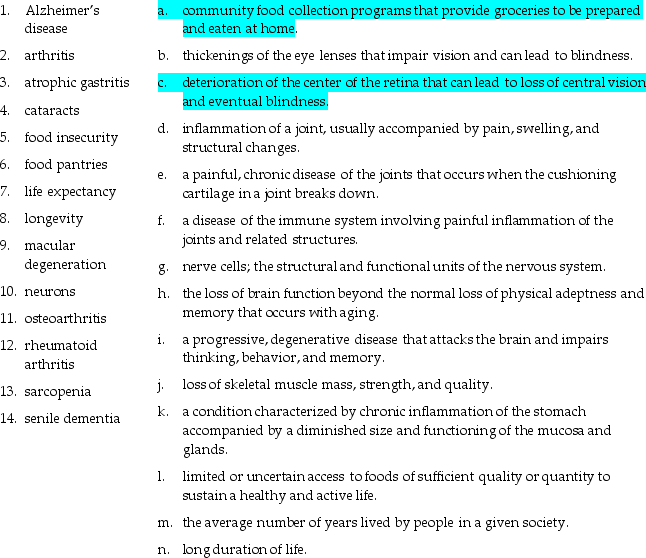
Question
Question
Question
Question
Question
Question
Question
Question
Question
Question

Unlock Deck
Sign up to unlock the cards in this deck!
Unlock Deck
Unlock Deck
1/67

Play

Full screen (f)
Deck 12: Nutrition Through the Life Span: Later Adulthood
1
Zinc intake is commonly low in older adults.
True
2
Moderate energy restriction results in all of the following changes except:
A)reduced body weight.
B)reduced body fat.
C)reduced blood pressure.
D)reduced insulin sensitivity.
A)reduced body weight.
B)reduced body fat.
C)reduced blood pressure.
D)reduced insulin sensitivity.
D
3
Iron-deficiency anemia is more common in older adults than in young people.
False
4
Which statement is false?
A)Aging is an inevitable, natural process.
B)Aging is programmed into the genes at conception.
C)Aging can be slowed by a healthy lifestyle.
D)Aging can be slowed with the use of appropriate supplements.
A)Aging is an inevitable, natural process.
B)Aging is programmed into the genes at conception.
C)Aging can be slowed by a healthy lifestyle.
D)Aging can be slowed with the use of appropriate supplements.
Unlock Deck
Unlock for access to all 67 flashcards in this deck.
Unlock Deck
k this deck
5
The fastest growing age group in the U.S.population is people over:
A)50.
B)65.
C)75.
D)85.
A)50.
B)65.
C)75.
D)85.
Unlock Deck
Unlock for access to all 67 flashcards in this deck.
Unlock Deck
k this deck
6
The known connection between osteoarthritis and nutrition is related to:
A)milk.
B)fish oil.
C)overweight.
D)sugar.
A)milk.
B)fish oil.
C)overweight.
D)sugar.
Unlock Deck
Unlock for access to all 67 flashcards in this deck.
Unlock Deck
k this deck
7
Research supports the notion that an overload of minerals in the body causes Alzheimer's disease.
Unlock Deck
Unlock for access to all 67 flashcards in this deck.
Unlock Deck
k this deck
8
Which of the following health behaviors is the strongest predictor of continued mobility in the later years?
A)not smoking
B)low to moderate alcohol consumption
C)maintenance of moderate body weight
D)frequent physical activity
A)not smoking
B)low to moderate alcohol consumption
C)maintenance of moderate body weight
D)frequent physical activity
Unlock Deck
Unlock for access to all 67 flashcards in this deck.
Unlock Deck
k this deck
9
Vision problems in older adults may be due to dietary factors such as:
A)underweight.
B)low intake of vitamins D and E.
C)overweight.
D)low intake of vitamins C and E.
A)underweight.
B)low intake of vitamins D and E.
C)overweight.
D)low intake of vitamins C and E.
Unlock Deck
Unlock for access to all 67 flashcards in this deck.
Unlock Deck
k this deck
10
The elderly are more likely to have medical conditions or to take medications that may compromise folate status.
Unlock Deck
Unlock for access to all 67 flashcards in this deck.
Unlock Deck
k this deck
11
As people grow older, the use of medicines becomes commonplace, thus increasing the potential for diet-medication interactions.
Unlock Deck
Unlock for access to all 67 flashcards in this deck.
Unlock Deck
k this deck
12
Being physically active can reduce your physiological age, in part because:
A)it reduces appetite and kcal intake.
B)it promotes muscle atrophy.
C)it increases blood flow to the brain.
D)it reduces energy expenditure.
A)it reduces appetite and kcal intake.
B)it promotes muscle atrophy.
C)it increases blood flow to the brain.
D)it reduces energy expenditure.
Unlock Deck
Unlock for access to all 67 flashcards in this deck.
Unlock Deck
k this deck
13
The protein needs of older adults appear to be about the same as those of younger people.
Unlock Deck
Unlock for access to all 67 flashcards in this deck.
Unlock Deck
k this deck
14
Older adults spend more money per person on foods to eat at home than other age groups.
Unlock Deck
Unlock for access to all 67 flashcards in this deck.
Unlock Deck
k this deck
15
All of the following seem to be related to the development of Alzheimer's disease except:
A)genetic factors.
B)obesity.
C)low levels of homocysteine.
D)free-radical damage.
A)genetic factors.
B)obesity.
C)low levels of homocysteine.
D)free-radical damage.
Unlock Deck
Unlock for access to all 67 flashcards in this deck.
Unlock Deck
k this deck
16
Studies suggest that a diet providing ample carotenoids, vitamin C, and vitamin E may help to prevent the early onset of cataracts.
Unlock Deck
Unlock for access to all 67 flashcards in this deck.
Unlock Deck
k this deck
17
Increasing evidence suggests that overweight and obesity in middle age are associated with Alzheimer's disease.
Unlock Deck
Unlock for access to all 67 flashcards in this deck.
Unlock Deck
k this deck
18
The benefits of physical activity in older adults include all of the following except:
A)increased blood flow to the brain.
B)decreased risk of falling.
C)improved balance.
D)decreased muscle mass.
A)increased blood flow to the brain.
B)decreased risk of falling.
C)improved balance.
D)decreased muscle mass.
Unlock Deck
Unlock for access to all 67 flashcards in this deck.
Unlock Deck
k this deck
19
Life expectancy in the U.S.is _____ years.
A)68
B)72
C)75
D)78
A)68
B)72
C)75
D)78
Unlock Deck
Unlock for access to all 67 flashcards in this deck.
Unlock Deck
k this deck
20
Rheumatoid arthritis may respond to a dietary intervention involving a diet:
A)low in saturated fat and high in omega-3 fatty acids.
B)high in vitamins A, C, and E.
C)restricted in kcalories.
D)low in carbohydrates.
A)low in saturated fat and high in omega-3 fatty acids.
B)high in vitamins A, C, and E.
C)restricted in kcalories.
D)low in carbohydrates.
Unlock Deck
Unlock for access to all 67 flashcards in this deck.
Unlock Deck
k this deck
21
Which of the following sources of protein are most appropriate for older adults?
A)milk and cheese
B)legumes and fish
C)whole grains and legumes
D)nonfat milk and peanut butter
A)milk and cheese
B)legumes and fish
C)whole grains and legumes
D)nonfat milk and peanut butter
Unlock Deck
Unlock for access to all 67 flashcards in this deck.
Unlock Deck
k this deck
22
The estimated energy requirements for adults decrease steadily after age:
A)19.
B)30.
C)40.
D)51.
A)19.
B)30.
C)40.
D)51.
Unlock Deck
Unlock for access to all 67 flashcards in this deck.
Unlock Deck
k this deck
23
Protein is especially important for older adults to:
A)increase muscle mass.
B)rebuild aging bones.
C)support a healthy immune system.
D)prevent macular degeneration.
A)increase muscle mass.
B)rebuild aging bones.
C)support a healthy immune system.
D)prevent macular degeneration.
Unlock Deck
Unlock for access to all 67 flashcards in this deck.
Unlock Deck
k this deck
24
Severe fat restriction among older adults may lead to:
A)nutrient deficiencies.
B)weight gain.
C)greater risk of cancer.
D)dehydration.
A)nutrient deficiencies.
B)weight gain.
C)greater risk of cancer.
D)dehydration.
Unlock Deck
Unlock for access to all 67 flashcards in this deck.
Unlock Deck
k this deck
25
The most important nutrition concern for the person with Alzheimer's disease is:
A)being allowed to choose his own foods.
B)a strict eating schedule.
C)maintaining appropriate body weight.
D)a regimen of dietary supplements.
A)being allowed to choose his own foods.
B)a strict eating schedule.
C)maintaining appropriate body weight.
D)a regimen of dietary supplements.
Unlock Deck
Unlock for access to all 67 flashcards in this deck.
Unlock Deck
k this deck
26
An adequate calcium intake throughout life helps protect against:
A)cancer.
B)osteoporosis.
C)diabetes.
D)cardiovascular disease.
A)cancer.
B)osteoporosis.
C)diabetes.
D)cardiovascular disease.
Unlock Deck
Unlock for access to all 67 flashcards in this deck.
Unlock Deck
k this deck
27
The best choice for older adults with small energy allowances is to:
A)take vitamin-mineral supplements.
B)select nutrient-dense foods.
C)consume less food.
D)moderate alcohol consumption.
A)take vitamin-mineral supplements.
B)select nutrient-dense foods.
C)consume less food.
D)moderate alcohol consumption.
Unlock Deck
Unlock for access to all 67 flashcards in this deck.
Unlock Deck
k this deck
28
The older adult's intake of fiber-rich fruits and vegetables may be limited due to all of the following except:
A)chewing problems.
B)transportation problems.
C)limited cooking facilities.
D)bladder control problems.
A)chewing problems.
B)transportation problems.
C)limited cooking facilities.
D)bladder control problems.
Unlock Deck
Unlock for access to all 67 flashcards in this deck.
Unlock Deck
k this deck
29
An estimated _____% of adults 51 years and older lose the ability to absorb vitamin B12.
A)5 to 10
B)10 to 30
C)15 to 35
D)20 to 35
A)5 to 10
B)10 to 30
C)15 to 35
D)20 to 35
Unlock Deck
Unlock for access to all 67 flashcards in this deck.
Unlock Deck
k this deck
30
Dehydrated older adults are more susceptible to all of the following except:
A)disorientation.
B)emphysema.
C)urinary tract infections.
D)pressure ulcers.
A)disorientation.
B)emphysema.
C)urinary tract infections.
D)pressure ulcers.
Unlock Deck
Unlock for access to all 67 flashcards in this deck.
Unlock Deck
k this deck
31
Sarcopenia refers to:
A)loss of muscle mass.
B)a vitamin deficiency.
C)bone loss.
D)malnutrition associated with aging.
A)loss of muscle mass.
B)a vitamin deficiency.
C)bone loss.
D)malnutrition associated with aging.
Unlock Deck
Unlock for access to all 67 flashcards in this deck.
Unlock Deck
k this deck
32
Energy needs decline with advancing age due to all of the following reasons except:
A)sarcopenia can be significant in later years.
B)basal metabolic rate declines as people age.
C)older people usually reduce their physical activity.
D)older people are better able to absorb energy from foods.
A)sarcopenia can be significant in later years.
B)basal metabolic rate declines as people age.
C)older people usually reduce their physical activity.
D)older people are better able to absorb energy from foods.
Unlock Deck
Unlock for access to all 67 flashcards in this deck.
Unlock Deck
k this deck
33
Older adults are predisposed to fluid imbalances due to all of the following reasons except:
A)they do not pay attention to their thirst.
B)they may find it difficult to obtain water.
C)their thirst sensation is reduced.
D)their total body water increases as they age.
A)they do not pay attention to their thirst.
B)they may find it difficult to obtain water.
C)their thirst sensation is reduced.
D)their total body water increases as they age.
Unlock Deck
Unlock for access to all 67 flashcards in this deck.
Unlock Deck
k this deck
34
All of the following factors increase an older person's risk of iron deficiency except:
A)antacid use.
B)reduced stomach acid secretion.
C)limited intake of milk.
D)chronic blood loss due to disease or medicines.
A)antacid use.
B)reduced stomach acid secretion.
C)limited intake of milk.
D)chronic blood loss due to disease or medicines.
Unlock Deck
Unlock for access to all 67 flashcards in this deck.
Unlock Deck
k this deck
35
Many older people consume less than the recommended amount of all these nutrients except:
A)vitamin A.
B)vitamin D.
C)folate.
D)zinc.
A)vitamin A.
B)vitamin D.
C)folate.
D)zinc.
Unlock Deck
Unlock for access to all 67 flashcards in this deck.
Unlock Deck
k this deck
36
Physical changes of aging that affect nutrition include all of the following except:
A)swallowing disorders.
B)sluggish intestinal motility.
C)diminished vision.
D)increased sense of smell.
A)swallowing disorders.
B)sluggish intestinal motility.
C)diminished vision.
D)increased sense of smell.
Unlock Deck
Unlock for access to all 67 flashcards in this deck.
Unlock Deck
k this deck
37
Fat intakes should be moderate in the diets of most older adults because:
A)cutting fat helps alleviate constipation.
B)cutting fat helps retard the development of atherosclerosis.
C)cutting fat helps reduce the risk of osteoporosis.
D)cutting fat helps increase lean body mass.
A)cutting fat helps alleviate constipation.
B)cutting fat helps retard the development of atherosclerosis.
C)cutting fat helps reduce the risk of osteoporosis.
D)cutting fat helps increase lean body mass.
Unlock Deck
Unlock for access to all 67 flashcards in this deck.
Unlock Deck
k this deck
38
Your grandfather is having trouble with his short-term memory.You suggest that he may be experiencing symptoms of a deficiency of:
A)aluminum.
B)vitamin D.
C)DHA.
D)protein.
A)aluminum.
B)vitamin D.
C)DHA.
D)protein.
Unlock Deck
Unlock for access to all 67 flashcards in this deck.
Unlock Deck
k this deck
39
One nutrient that is underconsumed by many elderly people is:
A)vitamin A.
B)protein.
C)vitamin D.
D)vitamin C.
A)vitamin A.
B)protein.
C)vitamin D.
D)vitamin C.
Unlock Deck
Unlock for access to all 67 flashcards in this deck.
Unlock Deck
k this deck
40
Older adults face a greater risk of vitamin D deficiency than young people due to:
A)low consumption of meat.
B)low intake of vegetables.
C)limited exposure to sunlight.
D)low intake of fiber.
A)low consumption of meat.
B)low intake of vegetables.
C)limited exposure to sunlight.
D)low intake of fiber.
Unlock Deck
Unlock for access to all 67 flashcards in this deck.
Unlock Deck
k this deck
41
Few older adults consume the recommend amount of _____ due to complaints about stomach discomfort.
A)meat
B)fruit
C)milk
D)bread
A)meat
B)fruit
C)milk
D)bread
Unlock Deck
Unlock for access to all 67 flashcards in this deck.
Unlock Deck
k this deck
42
The DRI committee recommends that adults aged 51 years and older obtain 2.4 micrograms of vitamin B12 daily and that vitamin B12-fortified foods (such as fortified cereals) or supplements be used to meet much of the DRI recommended intake.Mrs.Wylie should be placed on a vitamin B12 supplement because:
A)she has neurologic symptoms consistent with vitamin B12 deficiency.
B)she has a history of antacid use.
C)of her age.
D)all of the above
A)she has neurologic symptoms consistent with vitamin B12 deficiency.
B)she has a history of antacid use.
C)of her age.
D)all of the above
Unlock Deck
Unlock for access to all 67 flashcards in this deck.
Unlock Deck
k this deck
43
An older adult complains about the expense of cooking for one.You suggest:
A)purchasing large bags of frozen vegetables.
B)purchasing large bags of shredded cheese.
C)purchasing eggs in large quantities.
D)stocking up on fresh produce when in season.
A)purchasing large bags of frozen vegetables.
B)purchasing large bags of shredded cheese.
C)purchasing eggs in large quantities.
D)stocking up on fresh produce when in season.
Unlock Deck
Unlock for access to all 67 flashcards in this deck.
Unlock Deck
k this deck
44
Which of the following groups of older adults is most likely to be poorly nourished?
A)those living with their children in federally-funded housing
B)those with the least education
C)those who have recently experienced lifestyle changes
D)men who live alone
A)those living with their children in federally-funded housing
B)those with the least education
C)those who have recently experienced lifestyle changes
D)men who live alone
Unlock Deck
Unlock for access to all 67 flashcards in this deck.
Unlock Deck
k this deck
45
The most common drug that can affect nutrition in older people is:
A)alcohol.
B)laxatives.
C)antacids.
D)aspirin.
A)alcohol.
B)laxatives.
C)antacids.
D)aspirin.
Unlock Deck
Unlock for access to all 67 flashcards in this deck.
Unlock Deck
k this deck
46
The largest federal food assistance program is:
A)WIC.
B)SNAP.
C)WHO.
D)USDA.
A)WIC.
B)SNAP.
C)WHO.
D)USDA.
Unlock Deck
Unlock for access to all 67 flashcards in this deck.
Unlock Deck
k this deck
47
The RDA for calcium for adults >70 is:
A)800 mg/day.
B)1000 mg/day.
C)1200 mg/day.
D)1500 mg/day.
A)800 mg/day.
B)1000 mg/day.
C)1200 mg/day.
D)1500 mg/day.
Unlock Deck
Unlock for access to all 67 flashcards in this deck.
Unlock Deck
k this deck
48
Which of the following relationships has not been established by nutrition research?
A)Ample intakes of fruits and vegetables may prevent cancer development.
B)Appropriate energy intake helps prevent obesity, diabetes, and cardiovascular diseases.
C)A low insoluble fiber intake prevents colon cancer.
D)An adequate intake of potassium helps prevent hypertension.
A)Ample intakes of fruits and vegetables may prevent cancer development.
B)Appropriate energy intake helps prevent obesity, diabetes, and cardiovascular diseases.
C)A low insoluble fiber intake prevents colon cancer.
D)An adequate intake of potassium helps prevent hypertension.
Unlock Deck
Unlock for access to all 67 flashcards in this deck.
Unlock Deck
k this deck
49
The doctor addresses the importance of hydration with Mrs.Wylie.Dehydration can cause all the following except:
A)compromised mental status.
B)altered effects of medications.
C)increased susceptibility to urinary tract infections.
D)increased susceptibility to atrophic gastritis.
A)compromised mental status.
B)altered effects of medications.
C)increased susceptibility to urinary tract infections.
D)increased susceptibility to atrophic gastritis.
Unlock Deck
Unlock for access to all 67 flashcards in this deck.
Unlock Deck
k this deck
50
Given only the information provided, how many DETERMINE risk factors for malnutrition does Mrs.Wylie have? (DETERMINE = disease; eating poorly; tooth loss or oral pain; economic hardship; reduced social contact; multiple medications; involuntary weight loss or gain; needs assistance with self-care; elderly person older than 80 years.)
A)3
B)4
C)5
D)6
A)3
B)4
C)5
D)6
Unlock Deck
Unlock for access to all 67 flashcards in this deck.
Unlock Deck
k this deck
51
The following statement by Mrs.Wylie indicates she will take measures to maintain hydration status:
A)"I will try to drink more often throughout the day."
B)"I will try to drink a measured amount of water, juice, or milk each day."
C)"I will have my hydration status monitored at each medical appointment."
D)"I will drink water, juice, or milk each time I am thirsty."
A)"I will try to drink more often throughout the day."
B)"I will try to drink a measured amount of water, juice, or milk each day."
C)"I will have my hydration status monitored at each medical appointment."
D)"I will drink water, juice, or milk each time I am thirsty."
Unlock Deck
Unlock for access to all 67 flashcards in this deck.
Unlock Deck
k this deck
52
Which food assistance program would most likely improve the intake of fruits and vegetables among low-income older adults?
A)OAA Nutrition Program
B)Supplemental Nutrition Assistance Program
C)Meals on Wheals
D)Senior Farmers Market Nutrition Program
A)OAA Nutrition Program
B)Supplemental Nutrition Assistance Program
C)Meals on Wheals
D)Senior Farmers Market Nutrition Program
Unlock Deck
Unlock for access to all 67 flashcards in this deck.
Unlock Deck
k this deck
53
The primary cause of hunger in developed countries is:
A)poverty.
B)war.
C)mental illness.
D)politics.
A)poverty.
B)war.
C)mental illness.
D)politics.
Unlock Deck
Unlock for access to all 67 flashcards in this deck.
Unlock Deck
k this deck
54
Which of the following is not a common risk factor for malnutrition in older adults?
A)disease
B)eating disorders
C)economic hardship
D)reduced social contact
E)multiple medications
A)disease
B)eating disorders
C)economic hardship
D)reduced social contact
E)multiple medications
Unlock Deck
Unlock for access to all 67 flashcards in this deck.
Unlock Deck
k this deck
55
Older adults at risk nutritionally, such as Mrs.Wylie, should have their diets assessed at medical appointments for:
A)total energy and protein.
B)calcium, iron, and zinc.
C)vitamin B6, vitamin B12, folate, and vitamin D.
D)all of the above
A)total energy and protein.
B)calcium, iron, and zinc.
C)vitamin B6, vitamin B12, folate, and vitamin D.
D)all of the above
Unlock Deck
Unlock for access to all 67 flashcards in this deck.
Unlock Deck
k this deck
56
Major factors that contribute to food insecurity include all of the following except:
A)alcohol abuse.
B)lack of knowledge about food assistance programs.
C)physical and mental disabilities.
D)lack of insurance.
A)alcohol abuse.
B)lack of knowledge about food assistance programs.
C)physical and mental disabilities.
D)lack of insurance.
Unlock Deck
Unlock for access to all 67 flashcards in this deck.
Unlock Deck
k this deck
57
Matching
Unlock Deck
Unlock for access to all 67 flashcards in this deck.
Unlock Deck
k this deck
58
Iron status in women generally improves:
A)after menopause.
B)with daily exercise.
C)as muscle mass decreases.
D)during perimenopause.
A)after menopause.
B)with daily exercise.
C)as muscle mass decreases.
D)during perimenopause.
Unlock Deck
Unlock for access to all 67 flashcards in this deck.
Unlock Deck
k this deck
59
A food recovery program might involve all of the following except:
A)taking leftover food from a fundraiser to a local shelter.
B)picking berries in an already harvested field.
C)the delivery of day-old bread to a soup kitchen.
D)collecting unused WIC vouchers.
Use the following case study to answer questions 46-50.
Mrs)Wylie is a 78-year-old Caucasian woman who lives alone in a small, one-story home she and her husband purchased several ago before he died.She lives on social security income and her deceased husband's corporate pension, and is financially secure.Though she is in relatively good health, she has been having increasing difficulty walking for the past several years, which has been attributed to peripheral vascular disease.She complains of weakness and pain in her legs, and a loss of feeling in her fingers and feet.She also suffers from occasional constipation.She is happiest just doing her activities of daily living, such as preparing breakfast, lunch, and a late-afternoon snack, then relaxing in her living room until it is time for bed.She has a good relationship with her adult children, who have been discussing with her the possibility of hiring a visiting nurse as her mobility declines.Her children takes turns visiting on Sundays, when they help with her shopping, laundry, and other tasks, but none live close enough to visit daily, and Mrs.Wylie sometimes goes a week without seeing another person.Lately, Mrs.Wylie has been cutting back on drinking water (or any beverages) to save trips to the bathroom.When mild dehydration was noted at a recent visit to the doctor, Mrs.Wylie told her doctor she would try to drink more often, but she is rarely thirsty.She takes seven different prescription and/or over-the-counter medications daily, including a proton pump inhibitor drug for long-standing GERD, and a calcium with vitamin D supplement.
A)taking leftover food from a fundraiser to a local shelter.
B)picking berries in an already harvested field.
C)the delivery of day-old bread to a soup kitchen.
D)collecting unused WIC vouchers.
Use the following case study to answer questions 46-50.
Mrs)Wylie is a 78-year-old Caucasian woman who lives alone in a small, one-story home she and her husband purchased several ago before he died.She lives on social security income and her deceased husband's corporate pension, and is financially secure.Though she is in relatively good health, she has been having increasing difficulty walking for the past several years, which has been attributed to peripheral vascular disease.She complains of weakness and pain in her legs, and a loss of feeling in her fingers and feet.She also suffers from occasional constipation.She is happiest just doing her activities of daily living, such as preparing breakfast, lunch, and a late-afternoon snack, then relaxing in her living room until it is time for bed.She has a good relationship with her adult children, who have been discussing with her the possibility of hiring a visiting nurse as her mobility declines.Her children takes turns visiting on Sundays, when they help with her shopping, laundry, and other tasks, but none live close enough to visit daily, and Mrs.Wylie sometimes goes a week without seeing another person.Lately, Mrs.Wylie has been cutting back on drinking water (or any beverages) to save trips to the bathroom.When mild dehydration was noted at a recent visit to the doctor, Mrs.Wylie told her doctor she would try to drink more often, but she is rarely thirsty.She takes seven different prescription and/or over-the-counter medications daily, including a proton pump inhibitor drug for long-standing GERD, and a calcium with vitamin D supplement.
Unlock Deck
Unlock for access to all 67 flashcards in this deck.
Unlock Deck
k this deck
60
Characteristics of foods preferred by many older adults include all of the following except:
A)easy-to-open packaging.
B)single-serving packages.
C)inclusion of new recipes.
D)labels that are easy to read.
A)easy-to-open packaging.
B)single-serving packages.
C)inclusion of new recipes.
D)labels that are easy to read.
Unlock Deck
Unlock for access to all 67 flashcards in this deck.
Unlock Deck
k this deck
61
Describe factors in many older people's lives that increase the likelihood of iron deficiency.
Unlock Deck
Unlock for access to all 67 flashcards in this deck.
Unlock Deck
k this deck
62
Why are some elderly people at risk of developing vitamin D deficiency?
Unlock Deck
Unlock for access to all 67 flashcards in this deck.
Unlock Deck
k this deck
63
Why is dehydration a risk for older adults?
Unlock Deck
Unlock for access to all 67 flashcards in this deck.
Unlock Deck
k this deck
64
Discuss ways that older adults can stretch their food dollars.
Unlock Deck
Unlock for access to all 67 flashcards in this deck.
Unlock Deck
k this deck
65
Describe possible relationships between cataracts and nutrition.
Unlock Deck
Unlock for access to all 67 flashcards in this deck.
Unlock Deck
k this deck
66
Discuss the possible roles of nutrition in the prevention of Alzheimer's disease.
Unlock Deck
Unlock for access to all 67 flashcards in this deck.
Unlock Deck
k this deck
67
Describe why energy needs decline with advancing age.
Unlock Deck
Unlock for access to all 67 flashcards in this deck.
Unlock Deck
k this deck
Unlock Deck
Unlock for access to all 67 flashcards in this deck.






