







 Chat with AI

Deck 18: marine Ecosystems Ocean Acidification: the Other Co2 Problem
Full screen (f)

Question

Question
Question
Question
Question
Question
Question
Question
Question
Refer to the graph depicting ocean acidification over time in Infographic 1.Which of the following statements is TRUE of the graph? 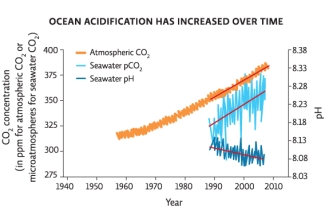
A)As the atmospheric concentration of CO2 increases,the amount of CO2 absorbed by the oceans (pCO2)also increases.
B)As the atmospheric concentration of CO2 increases,the amount of CO2 absorbed by the oceans (pCO2)decreases.
C)As the atmospheric concentration of CO2 increases,the seawater pH increases.
D)As the amount of CO2 absorbed by the oceans (pCO2)decreases,the seawater pH increases.
E)None of these answers is correct.
A)As the atmospheric concentration of CO2 increases,the amount of CO2 absorbed by the oceans (pCO2)also increases.
B)As the atmospheric concentration of CO2 increases,the amount of CO2 absorbed by the oceans (pCO2)decreases.
C)As the atmospheric concentration of CO2 increases,the seawater pH increases.
D)As the amount of CO2 absorbed by the oceans (pCO2)decreases,the seawater pH increases.
E)None of these answers is correct.
Question
Question
Question
What is the pH trend in the seawater represented in the chart shown in Infographic 1? 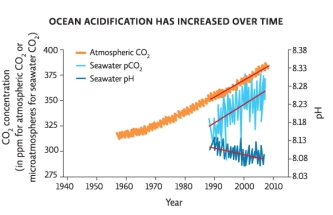
A)The pH trend is not significant.
B)The pH is becoming more acidic.
C)The pH is becoming more basic.
D)There is no trend in the pH.
E)More information is needed to answer the question.
A)The pH trend is not significant.
B)The pH is becoming more acidic.
C)The pH is becoming more basic.
D)There is no trend in the pH.
E)More information is needed to answer the question.
Question
Question
Question
Examine the pH scale below.Which of the following statements is correct? 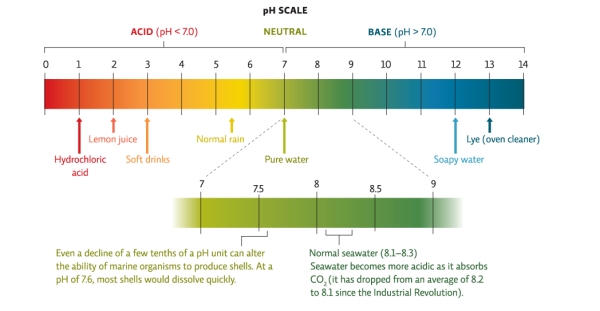
A)Rainwater is more basic than pure water.
B)Soapy water is more acidic than rainwater.
C)Seawater is more acidic than pure water.
D)Lemon juice is the most acidic substance on the scale.
E)Soft drinks are more acidic than pure water.
A)Rainwater is more basic than pure water.
B)Soapy water is more acidic than rainwater.
C)Seawater is more acidic than pure water.
D)Lemon juice is the most acidic substance on the scale.
E)Soft drinks are more acidic than pure water.
Question
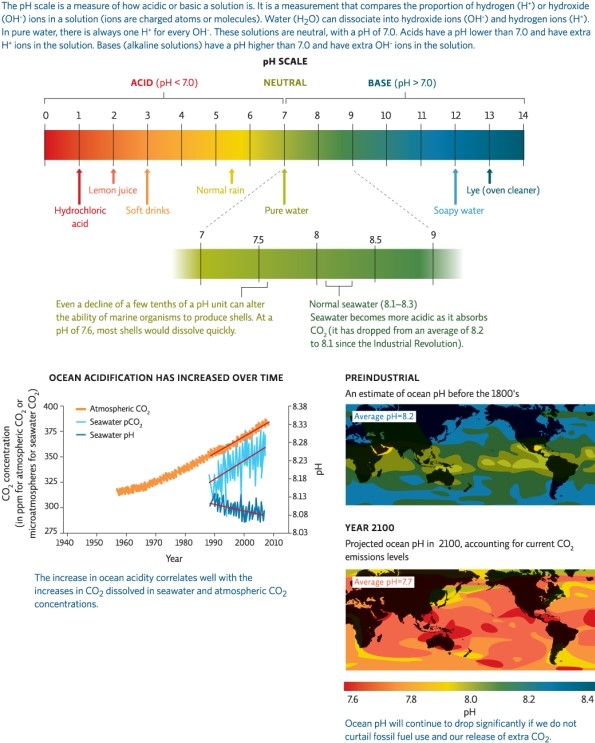
Refer to Infographic 1.Carbon dioxide emissions have reduced the ocean's pH by about 0.1.Why is this acidification of the ocean a problem?
Question
Refer to Infographic 3.Which ocean zone has the highest rate of photosynthesis? 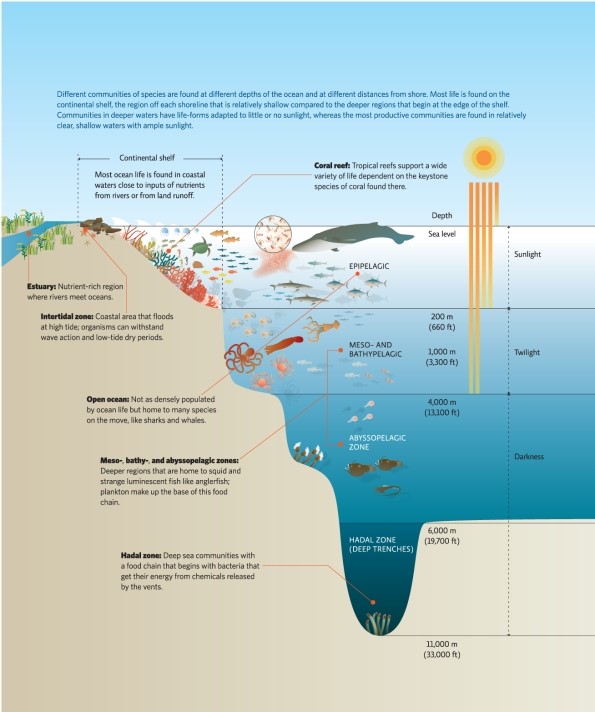
A)abyssal
B)hadal
C)bathypelagic
D)epipelagic
E)meso
A)abyssal
B)hadal
C)bathypelagic
D)epipelagic
E)meso
Question
Question
Question
Question
Question
Question
Question
Question
Question
Question
Question
Question
Question
Question
Question
Question
Question
Question
Question
Question
Question
Question
Question
Question
Question
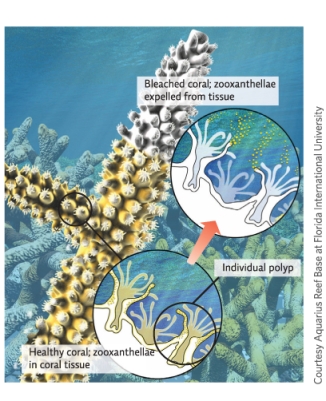
Refer to Infographic 5.What does the white area on this coral indicate? Discuss the possible causes and the ecological impact of this phenomenon.
Question
Refer to the graph in Infographic 4.The graph shows the level of each of the four major threats that coral reefs currently face.Which are the correct labels for the graph? 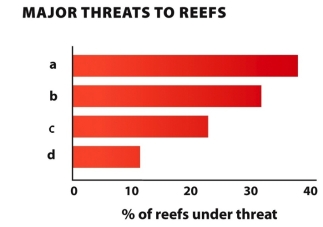
A)a = overfishing; b = marine-based pollution; c = coastal development; d = inland pollution
B)a = inland pollution; b = marine-based pollution; c = overfishing; d = coastal development
C)a = coastal development; b = inland pollution; c = marine-based pollution; d = overfishing
D)a = overfishing; b = coastal development; c = inland population; d = marine-based pollution
E)a = marine-based pollution; b = coastal development; c = inland pollution; d = overfishing
A)a = overfishing; b = marine-based pollution; c = coastal development; d = inland pollution
B)a = inland pollution; b = marine-based pollution; c = overfishing; d = coastal development
C)a = coastal development; b = inland pollution; c = marine-based pollution; d = overfishing
D)a = overfishing; b = coastal development; c = inland population; d = marine-based pollution
E)a = marine-based pollution; b = coastal development; c = inland pollution; d = overfishing
Question
Question
Question
Question
Question
Question
Question
Question
Question
Question
Question
Question
Question
Question
Question
Question
Question
Question
Question
Question
Question
Question
Question
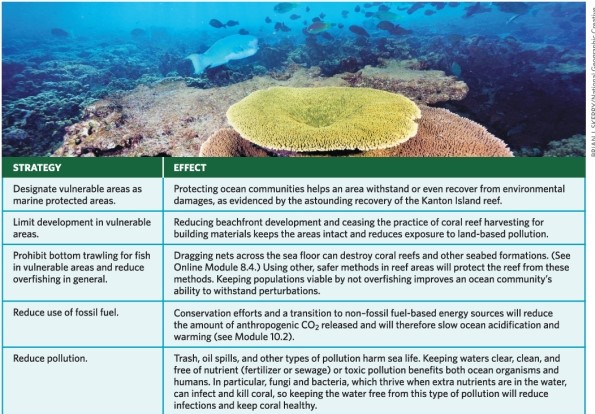
Refer to Infographic 7.Describe ways that you can reduce threats to ocean ecosystems through your personal actions.
Question
Question
Match each term in the left-hand column to the statement that it best exemplifies.

Question
Science Literacy Refer to the graphs below to answer the following questions. Below are data from a study (described in Module 6.3)conducted by Michael Lesser,Marc Slattery,and colleagues.The rate of photosynthesis (Graph A)and the amount of carbohydrate present (Graph B),an indication of photosynthetic production of sugars,were determined in sponges exposed to current temperature and pH (control)or to one of three test groups: the expected pH in 2100 (test group 1),the expected temperature in 2100 (test group 2),or both (test group 3). (Note: Significant difference between groups is denoted by a different letter above the bars; if two groups share the same letter,they are not statistically different.) 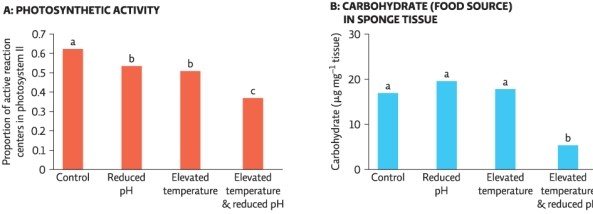
Which groups in Graph A are not statistically different from each other?
A)the control group and the reduced pH group
B)the reduced pH group and the elevated temperature group
C)the elevated temperature group and the elevated temperature combined with reduced pH group
Which groups in Graph A are not statistically different from each other?
A)the control group and the reduced pH group
B)the reduced pH group and the elevated temperature group
C)the elevated temperature group and the elevated temperature combined with reduced pH group
Question
Question
Question
Question
Science Literacy Refer to the graphs below to answer the following questions. Below are data from a study (described in Module 6.3)conducted by Michael Lesser,Marc Slattery,and colleagues.The rate of photosynthesis (Graph A)and the amount of carbohydrate present (Graph B),an indication of photosynthetic production of sugars,were determined in sponges exposed to current temperature and pH (control)or to one of three test groups: the expected pH in 2100 (test group 1),the expected temperature in 2100 (test group 2),or both (test group 3). (Note: Significant difference between groups is denoted by a different letter above the bars; if two groups share the same letter,they are not statistically different.)
What was the dependent variable(s)for the rate of photosynthesis experiment?
A)reduced pH
B)elevated temperature
C)elevated pH
D)both reduced pH and elevated temperature
What was the dependent variable(s)for the rate of photosynthesis experiment?
A)reduced pH
B)elevated temperature
C)elevated pH
D)both reduced pH and elevated temperature
Question
Science Literacy Refer to the graphs below to answer the following questions. Below are data from a study (described in Module 6.3)conducted by Michael Lesser,Marc Slattery,and colleagues.The rate of photosynthesis (Graph A)and the amount of carbohydrate present (Graph B),an indication of photosynthetic production of sugars,were determined in sponges exposed to current temperature and pH (control)or to one of three test groups: the expected pH in 2100 (test group 1),the expected temperature in 2100 (test group 2),or both (test group 3). (Note: Significant difference between groups is denoted by a different letter above the bars; if two groups share the same letter,they are not statistically different.)
Which of the following hypothesis is supported by Graphs A and B?
A)Reduced pH in oceans has the greatest effect on barrel sponge photosynthesis and carbohydrates.
B)Elevated temperatures in oceans have the greatest effect on barrel sponge photosynthesis and carbohydrates.
C)Reduced pH and elevated temperatures in oceans have the greatest effect on barrel sponge photosynthesis and carbohydrates.
Which of the following hypothesis is supported by Graphs A and B?
A)Reduced pH in oceans has the greatest effect on barrel sponge photosynthesis and carbohydrates.
B)Elevated temperatures in oceans have the greatest effect on barrel sponge photosynthesis and carbohydrates.
C)Reduced pH and elevated temperatures in oceans have the greatest effect on barrel sponge photosynthesis and carbohydrates.
Question
Question
Science Literacy Refer to the graphs below to answer the following questions. Below are data from a study (described in Module 6.3)conducted by Michael Lesser,Marc Slattery,and colleagues.The rate of photosynthesis (Graph A)and the amount of carbohydrate present (Graph B),an indication of photosynthetic production of sugars,were determined in sponges exposed to current temperature and pH (control)or to one of three test groups: the expected pH in 2100 (test group 1),the expected temperature in 2100 (test group 2),or both (test group 3). (Note: Significant difference between groups is denoted by a different letter above the bars; if two groups share the same letter,they are not statistically different.)
What would the control conditions be for this experiment?
A)reduced pH
B)normal temperature and pH
C)elevated temperatures
D)both reduced pH and elevated temperatures
What would the control conditions be for this experiment?
A)reduced pH
B)normal temperature and pH
C)elevated temperatures
D)both reduced pH and elevated temperatures

Unlock Deck
Sign up to unlock the cards in this deck!
Unlock Deck
Unlock Deck
1/76

Play

Full screen (f)
Deck 18: marine Ecosystems Ocean Acidification: the Other Co2 Problem
1
The most well-documented effect of ocean acidification is on _________.
A)marine mammals
B)saltwater fish
C)marine calcifiers
D)seaweeds
E)sharks
A)marine mammals
B)saltwater fish
C)marine calcifiers
D)seaweeds
E)sharks
marine calcifiers
2
Which factor in the ocean is key in determining environmental conditions?
A)space
B)depth
C)predators
D)pressure
E)biota
A)space
B)depth
C)predators
D)pressure
E)biota
depth
3
The deepest zone in the ocean is the ____________.
A)abyssal
B)hadal
C)bathypelagic
D)epipelagic
E)meso
A)abyssal
B)hadal
C)bathypelagic
D)epipelagic
E)meso
hadal
4
What is the major cause of ocean acidification?
A)the increase in atmospheric carbon dioxide levels caused by human activity
B)pollution
C)overfishing
D)naturally occurring pH changes in the ocean
E)invasive species
A)the increase in atmospheric carbon dioxide levels caused by human activity
B)pollution
C)overfishing
D)naturally occurring pH changes in the ocean
E)invasive species
Unlock Deck
Unlock for access to all 76 flashcards in this deck.
Unlock Deck
k this deck
5
Nutrient-rich areas where shallow rivers meet the ocean are known as ______.
A)intertidal zones
B)estuaries
C)coral reefs
D)abyssal zones
E)open ocean
A)intertidal zones
B)estuaries
C)coral reefs
D)abyssal zones
E)open ocean
Unlock Deck
Unlock for access to all 76 flashcards in this deck.
Unlock Deck
k this deck
6
Organisms use calcium and carbonate to make shells.What is the correct chemical formula for calcium carbonate?
A)Ca+2
B)CO32-
C)CO2
D)CaCO3
E)Ca2CO3
A)Ca+2
B)CO32-
C)CO2
D)CaCO3
E)Ca2CO3
Unlock Deck
Unlock for access to all 76 flashcards in this deck.
Unlock Deck
k this deck
7
What do organisms use to make shells?
A)Ca+2
B)H2O
C)H+
D)CO2
E)CaCO3
A)Ca+2
B)H2O
C)H+
D)CO2
E)CaCO3
Unlock Deck
Unlock for access to all 76 flashcards in this deck.
Unlock Deck
k this deck
8
What is ocean acidification? How are humans contributing to ocean acidification?
Unlock Deck
Unlock for access to all 76 flashcards in this deck.
Unlock Deck
k this deck
9
Refer to the graph depicting ocean acidification over time in Infographic 1.Which of the following statements is TRUE of the graph?
A)As the atmospheric concentration of CO2 increases,the amount of CO2 absorbed by the oceans (pCO2)also increases.
B)As the atmospheric concentration of CO2 increases,the amount of CO2 absorbed by the oceans (pCO2)decreases.
C)As the atmospheric concentration of CO2 increases,the seawater pH increases.
D)As the amount of CO2 absorbed by the oceans (pCO2)decreases,the seawater pH increases.
E)None of these answers is correct.
A)As the atmospheric concentration of CO2 increases,the amount of CO2 absorbed by the oceans (pCO2)also increases.
B)As the atmospheric concentration of CO2 increases,the amount of CO2 absorbed by the oceans (pCO2)decreases.
C)As the atmospheric concentration of CO2 increases,the seawater pH increases.
D)As the amount of CO2 absorbed by the oceans (pCO2)decreases,the seawater pH increases.
E)None of these answers is correct.
Unlock Deck
Unlock for access to all 76 flashcards in this deck.
Unlock Deck
k this deck
10
What allows CO2 to mix quickly into the top 100 feet of water from the atmosphere?
A)wind
B)waves
C)currents
D)both waves and currents
E)wind,waves,and currents
A)wind
B)waves
C)currents
D)both waves and currents
E)wind,waves,and currents
Unlock Deck
Unlock for access to all 76 flashcards in this deck.
Unlock Deck
k this deck
11
A pH drop of 0.1 corresponds to a ____ increase in ocean water acidity.
A)10%
B)20%
C)30%
D)40%
E)50%
A)10%
B)20%
C)30%
D)40%
E)50%
Unlock Deck
Unlock for access to all 76 flashcards in this deck.
Unlock Deck
k this deck
12
What is the pH trend in the seawater represented in the chart shown in Infographic 1?
A)The pH trend is not significant.
B)The pH is becoming more acidic.
C)The pH is becoming more basic.
D)There is no trend in the pH.
E)More information is needed to answer the question.
A)The pH trend is not significant.
B)The pH is becoming more acidic.
C)The pH is becoming more basic.
D)There is no trend in the pH.
E)More information is needed to answer the question.
Unlock Deck
Unlock for access to all 76 flashcards in this deck.
Unlock Deck
k this deck
13
Scientists estimate _______ of all CO2 released by humans is being absorbed by the world's oceans.
A)25%
B)30%
C)35%
D)40%
E)55%
A)25%
B)30%
C)35%
D)40%
E)55%
Unlock Deck
Unlock for access to all 76 flashcards in this deck.
Unlock Deck
k this deck
14
When a solution becomes acidic,it contains a greater amount of which of the following?
A)H2O
B)OH-
C)CH4
D)H+
E)O2
A)H2O
B)OH-
C)CH4
D)H+
E)O2
Unlock Deck
Unlock for access to all 76 flashcards in this deck.
Unlock Deck
k this deck
15
Examine the pH scale below.Which of the following statements is correct?
A)Rainwater is more basic than pure water.
B)Soapy water is more acidic than rainwater.
C)Seawater is more acidic than pure water.
D)Lemon juice is the most acidic substance on the scale.
E)Soft drinks are more acidic than pure water.
A)Rainwater is more basic than pure water.
B)Soapy water is more acidic than rainwater.
C)Seawater is more acidic than pure water.
D)Lemon juice is the most acidic substance on the scale.
E)Soft drinks are more acidic than pure water.
Unlock Deck
Unlock for access to all 76 flashcards in this deck.
Unlock Deck
k this deck
16
Refer to Infographic 1.Carbon dioxide emissions have reduced the ocean's pH by about 0.1.Why is this acidification of the ocean a problem?
Unlock Deck
Unlock for access to all 76 flashcards in this deck.
Unlock Deck
k this deck
17
Refer to Infographic 3.Which ocean zone has the highest rate of photosynthesis?
A)abyssal
B)hadal
C)bathypelagic
D)epipelagic
E)meso
A)abyssal
B)hadal
C)bathypelagic
D)epipelagic
E)meso
Unlock Deck
Unlock for access to all 76 flashcards in this deck.
Unlock Deck
k this deck
18
The lowering of the pH of the oceans is known as ___________.
A)salting
B)reduction
C)alkalinity
D)acidification
E)chloride shifting
A)salting
B)reduction
C)alkalinity
D)acidification
E)chloride shifting
Unlock Deck
Unlock for access to all 76 flashcards in this deck.
Unlock Deck
k this deck
19
If present trends continue,the ocean's surface waters will be ______ more acidic by 2100 than they were in 1800.
A)75%
B)100%
C)125%
D)150%
E)200%
A)75%
B)100%
C)125%
D)150%
E)200%
Unlock Deck
Unlock for access to all 76 flashcards in this deck.
Unlock Deck
k this deck
20
What effect do acidic ocean waters have on shells made of calcium carbonate?
A)They cause increased dissolution (dissolving)of calcium carbonate shells.
B)They cause decreased dissolution (dissolving)of calcium carbonate shells.
C)There is no effect on shells made of calcium carbonate.
D)They cause shells to grow at faster rates.
E)They cause shells to overly calcify.
A)They cause increased dissolution (dissolving)of calcium carbonate shells.
B)They cause decreased dissolution (dissolving)of calcium carbonate shells.
C)There is no effect on shells made of calcium carbonate.
D)They cause shells to grow at faster rates.
E)They cause shells to overly calcify.
Unlock Deck
Unlock for access to all 76 flashcards in this deck.
Unlock Deck
k this deck
21
NOAA estimates that ______ of coral reefs worldwide are threatened by either human activity or environmental changes.
A)10%
B)25%
C)50%
D)75%
E)90%
A)10%
B)25%
C)50%
D)75%
E)90%
Unlock Deck
Unlock for access to all 76 flashcards in this deck.
Unlock Deck
k this deck
22
What benefit do corals get from their mutualistic relationship with zooxanthellae?
A)give coral their color
B)provide coral with food via sugars they make during photosynthesis
C)provide coral with a place to attach to the ocean floor
D)All of these answer choices are correct.
E)both give coral their color and provide coral with food via sugars they make during photosynthesis
A)give coral their color
B)provide coral with food via sugars they make during photosynthesis
C)provide coral with a place to attach to the ocean floor
D)All of these answer choices are correct.
E)both give coral their color and provide coral with food via sugars they make during photosynthesis
Unlock Deck
Unlock for access to all 76 flashcards in this deck.
Unlock Deck
k this deck
23
Which of the following is TRUE of the environments that coral reefs are found in?
A)Colder water is trapped on top of warmer water,creating stratification.
B)There is intensive mixing of deep water and surface water.
C)The waters are saturated with nitrogen and iron.
D)They are nutrient poor.
E)They are typically deep waters.
A)Colder water is trapped on top of warmer water,creating stratification.
B)There is intensive mixing of deep water and surface water.
C)The waters are saturated with nitrogen and iron.
D)They are nutrient poor.
E)They are typically deep waters.
Unlock Deck
Unlock for access to all 76 flashcards in this deck.
Unlock Deck
k this deck
24
Coral bleaching is _________.
A)when the sun bleaches the pigment of the coral and turns it white
B)when a chemical spill causes the coral to die and the skeleton,which is white,to show through
C)when coral expel the zooxanthellae from their cells in response to stress
D)when coral turns white due to lowering water temperatures
E)when another organism colonizes the coral and turns it white
A)when the sun bleaches the pigment of the coral and turns it white
B)when a chemical spill causes the coral to die and the skeleton,which is white,to show through
C)when coral expel the zooxanthellae from their cells in response to stress
D)when coral turns white due to lowering water temperatures
E)when another organism colonizes the coral and turns it white
Unlock Deck
Unlock for access to all 76 flashcards in this deck.
Unlock Deck
k this deck
25
What benefit do zooxanthellae get from their mutualistic relationship with corals?
A)oxygen
B)sugars from photosynthesis
C)color
D)carbon dioxide
E)lower pH
A)oxygen
B)sugars from photosynthesis
C)color
D)carbon dioxide
E)lower pH
Unlock Deck
Unlock for access to all 76 flashcards in this deck.
Unlock Deck
k this deck
26
Lower pH affects which coral developmental stage/process?
A)fertilization
B)larval development
C)settlement
D)fertilization,larval development,and settlement
E)both fertilization and settlement
A)fertilization
B)larval development
C)settlement
D)fertilization,larval development,and settlement
E)both fertilization and settlement
Unlock Deck
Unlock for access to all 76 flashcards in this deck.
Unlock Deck
k this deck
27
The majority of coral reefs on Earth are found between ______ and _______ of the equator.
A)10 N; 10 S
B)30 N; 30 S
C)50 N; 50 S
D)10 W; 10 E
E)30 W; 30 S
A)10 N; 10 S
B)30 N; 30 S
C)50 N; 50 S
D)10 W; 10 E
E)30 W; 30 S
Unlock Deck
Unlock for access to all 76 flashcards in this deck.
Unlock Deck
k this deck
28
Marc Slattery conducted several experiments using both natural and simulated coral reefs.When reef species (sponges)were subjected to higher temperatures and lower pH,most likely the conditions that will exist in the future ocean environment,Slattery found that the reef species had slower growth rates and reduced reproduction.What was the cause of these results?
A)The higher temperature directly affected the growth rate of the sponge.
B)The higher temperature and lower pH reduced the sponges' symbiotic partners' ability to conduct photosynthesis.
C)The lower pH prevented the sponge prodigy from attaching to a solid surface.
D)The higher temperature and lower pH interfered with the sponges' reproductive cycle.
E)The higher temperature and lower pH increased the sponges' symbiotic partners' ability to photosynthesize,and they were therefore able to survive on their own.
A)The higher temperature directly affected the growth rate of the sponge.
B)The higher temperature and lower pH reduced the sponges' symbiotic partners' ability to conduct photosynthesis.
C)The lower pH prevented the sponge prodigy from attaching to a solid surface.
D)The higher temperature and lower pH interfered with the sponges' reproductive cycle.
E)The higher temperature and lower pH increased the sponges' symbiotic partners' ability to photosynthesize,and they were therefore able to survive on their own.
Unlock Deck
Unlock for access to all 76 flashcards in this deck.
Unlock Deck
k this deck
29
Why is proximity to land an important factor in determining the abundance of an ocean region? Provide an example to support your reasoning.
Unlock Deck
Unlock for access to all 76 flashcards in this deck.
Unlock Deck
k this deck
30
Where would you find the highest concentration of coral reefs?
A)freshwater lakes
B)freshwater streams
C)temperate marine areas
D)tropical marine areas
E)terrestrial areas
A)freshwater lakes
B)freshwater streams
C)temperate marine areas
D)tropical marine areas
E)terrestrial areas
Unlock Deck
Unlock for access to all 76 flashcards in this deck.
Unlock Deck
k this deck
31
Coral is a type of marine _________.
A)plant
B)fungi
C)bacterium
D)animal
E)protozoan
A)plant
B)fungi
C)bacterium
D)animal
E)protozoan
Unlock Deck
Unlock for access to all 76 flashcards in this deck.
Unlock Deck
k this deck
32
Which statement about coral reefs is FALSE?
A)Overfishing is a major cause of coral reef destruction.
B)Coral reefs serve as a source of current and potential medicines.
C)Coral reefs help protect shorelines from storms.
D)Coastal development does not affect coral reefs because they develop far away from the shore.
E)Most coral reefs are found between 30 degrees north latitude and 30 degrees south latitude.
A)Overfishing is a major cause of coral reef destruction.
B)Coral reefs serve as a source of current and potential medicines.
C)Coral reefs help protect shorelines from storms.
D)Coastal development does not affect coral reefs because they develop far away from the shore.
E)Most coral reefs are found between 30 degrees north latitude and 30 degrees south latitude.
Unlock Deck
Unlock for access to all 76 flashcards in this deck.
Unlock Deck
k this deck
33
What event can lead to coral bleaching?
A)pollution
B)acidification
C)high temperatures
D)salinity changes
E)All of these answer choices are correct.
A)pollution
B)acidification
C)high temperatures
D)salinity changes
E)All of these answer choices are correct.
Unlock Deck
Unlock for access to all 76 flashcards in this deck.
Unlock Deck
k this deck
34
You would expect to find barnacles,starfish,and mussels in which ocean zone?
A)abyssal
B)hadal
C)bathypelagic
D)intertidal
A)abyssal
B)hadal
C)bathypelagic
D)intertidal
Unlock Deck
Unlock for access to all 76 flashcards in this deck.
Unlock Deck
k this deck
35
Why do corals need a mutualistic relationship with other species,like zooxanthellae?
A)Corals typically live in nutrient-poor regions.
B)Corals grow on top of one another
C)Corals live in cold water.
D)Corals live so deep that the sunlight cannot reach them.
E)Corals live in oxygen-poor water.
A)Corals typically live in nutrient-poor regions.
B)Corals grow on top of one another
C)Corals live in cold water.
D)Corals live so deep that the sunlight cannot reach them.
E)Corals live in oxygen-poor water.
Unlock Deck
Unlock for access to all 76 flashcards in this deck.
Unlock Deck
k this deck
36
The skeleton of coral is mostly composed of ________.
A)nitrogen
B)aluminum
C)calcium carbonate
D)silicon
E)iron
A)nitrogen
B)aluminum
C)calcium carbonate
D)silicon
E)iron
Unlock Deck
Unlock for access to all 76 flashcards in this deck.
Unlock Deck
k this deck
37
It is estimated that ______ of all ocean species spend some portion of their life in a coral reef.
A)10%
B)25%
C)50%
D)75%
E)90%
A)10%
B)25%
C)50%
D)75%
E)90%
Unlock Deck
Unlock for access to all 76 flashcards in this deck.
Unlock Deck
k this deck
38
Why is depth such an important factor in determining the abundance of life in a given region of the ocean? Provide an example to support your reasoning.
Unlock Deck
Unlock for access to all 76 flashcards in this deck.
Unlock Deck
k this deck
39
Coral reefs are complex ecosystems with numerous interspecies interactions.Which of the following interactions is an example of commensalism?
A)clown fish and sea anemone
B)remora fish and manta ray
C)corals and zooxanthellae
D)sharks and tuna
E)octopus and crab
A)clown fish and sea anemone
B)remora fish and manta ray
C)corals and zooxanthellae
D)sharks and tuna
E)octopus and crab
Unlock Deck
Unlock for access to all 76 flashcards in this deck.
Unlock Deck
k this deck
40
All of the following are major threats to reefs EXCEPT _________.
A)overfishing
B)coastal development
C)inland pollution
D)marine-based pollution
E)aquarium collection
A)overfishing
B)coastal development
C)inland pollution
D)marine-based pollution
E)aquarium collection
Unlock Deck
Unlock for access to all 76 flashcards in this deck.
Unlock Deck
k this deck
41
Which of the following changes will have the GREATEST global effect on coral reefs despite their particular geographic location in the oceans?
A)increased water temperatures from anthropogenic CO2 emissions
B)increased salinity from desalination of ocean water for human use
C)increased oxygen concentrations from algal blooms due to nutrient pollution
D)increased predation of native coral reef fish by non-native lionfish
E)increased sediment pollution from clear-cut inland forests that smother reefs
A)increased water temperatures from anthropogenic CO2 emissions
B)increased salinity from desalination of ocean water for human use
C)increased oxygen concentrations from algal blooms due to nutrient pollution
D)increased predation of native coral reef fish by non-native lionfish
E)increased sediment pollution from clear-cut inland forests that smother reefs
Unlock Deck
Unlock for access to all 76 flashcards in this deck.
Unlock Deck
k this deck
42
Refer to Infographic 5.What does the white area on this coral indicate? Discuss the possible causes and the ecological impact of this phenomenon.
Unlock Deck
Unlock for access to all 76 flashcards in this deck.
Unlock Deck
k this deck
43
Refer to the graph in Infographic 4.The graph shows the level of each of the four major threats that coral reefs currently face.Which are the correct labels for the graph?
A)a = overfishing; b = marine-based pollution; c = coastal development; d = inland pollution
B)a = inland pollution; b = marine-based pollution; c = overfishing; d = coastal development
C)a = coastal development; b = inland pollution; c = marine-based pollution; d = overfishing
D)a = overfishing; b = coastal development; c = inland population; d = marine-based pollution
E)a = marine-based pollution; b = coastal development; c = inland pollution; d = overfishing
A)a = overfishing; b = marine-based pollution; c = coastal development; d = inland pollution
B)a = inland pollution; b = marine-based pollution; c = overfishing; d = coastal development
C)a = coastal development; b = inland pollution; c = marine-based pollution; d = overfishing
D)a = overfishing; b = coastal development; c = inland population; d = marine-based pollution
E)a = marine-based pollution; b = coastal development; c = inland pollution; d = overfishing
Unlock Deck
Unlock for access to all 76 flashcards in this deck.
Unlock Deck
k this deck
44
Fishing pressures (overexploitation)have eliminated ______ of top trophic-level predators in the oceans.
A)15%
B)30%
C)55%
D)75%
E)90%
A)15%
B)30%
C)55%
D)75%
E)90%
Unlock Deck
Unlock for access to all 76 flashcards in this deck.
Unlock Deck
k this deck
45
Match the human activity to its correct consequence for marine ecosystems.
A)drilling for oil - coral bleaching
B)using fertilizer - ocean acidification
C)fishing with dynamite - algal blooms
D)releasing ballast water from ships - introduction of invasive species
A)drilling for oil - coral bleaching
B)using fertilizer - ocean acidification
C)fishing with dynamite - algal blooms
D)releasing ballast water from ships - introduction of invasive species
Unlock Deck
Unlock for access to all 76 flashcards in this deck.
Unlock Deck
k this deck
46
The greatest threat to coral reefs worldwide is ___________.
A)marine-based pollution
B)inland pollution
C)coastal development
D)overfishing
A)marine-based pollution
B)inland pollution
C)coastal development
D)overfishing
Unlock Deck
Unlock for access to all 76 flashcards in this deck.
Unlock Deck
k this deck
47
What are invasive species? Discuss the possible causes and the ecological impact of this threat to ocean ecosystems using the lionfish as an example.
Unlock Deck
Unlock for access to all 76 flashcards in this deck.
Unlock Deck
k this deck
48
You have been given the task of monitoring the health of a coral reef.Over the years,you have documented a decrease in the biodiversity of life in the reef.What could be some of the reasons why the reef is suffering?
Unlock Deck
Unlock for access to all 76 flashcards in this deck.
Unlock Deck
k this deck
49
Threats from fishing pressure include _________.
A)sediment pollution
B)plastic bag debris
C)oil spills
D)damage from dynamite
E)All of these answer choices are correct.
A)sediment pollution
B)plastic bag debris
C)oil spills
D)damage from dynamite
E)All of these answer choices are correct.
Unlock Deck
Unlock for access to all 76 flashcards in this deck.
Unlock Deck
k this deck
50
The ocean is so vast it is difficult to imagine that human activities could harm it.However,the evidence of human impact is unmistakable.Discuss the nature of marine ecosystem destruction from pollution and overfishing.
Unlock Deck
Unlock for access to all 76 flashcards in this deck.
Unlock Deck
k this deck
51
What are the causes of algal blooms,and how do algal blooms affect coral reefs?
Unlock Deck
Unlock for access to all 76 flashcards in this deck.
Unlock Deck
k this deck
52
Describe the complex relationship that coral have with zooxanthellae ("zooks").
Unlock Deck
Unlock for access to all 76 flashcards in this deck.
Unlock Deck
k this deck
53
All of the following actions would threaten the ocean's ability to provide ecosystem goods and services EXCEPT ___________.
A)dumping motor oil down storm drains
B)fishing using bottom trawlers
C)spilling gasoline while fueling your lawn mower
D)soil erosion from construction sites
E)installing solar panels
A)dumping motor oil down storm drains
B)fishing using bottom trawlers
C)spilling gasoline while fueling your lawn mower
D)soil erosion from construction sites
E)installing solar panels
Unlock Deck
Unlock for access to all 76 flashcards in this deck.
Unlock Deck
k this deck
54
Why do ecologists consider coral reefs a keystone species?
Unlock Deck
Unlock for access to all 76 flashcards in this deck.
Unlock Deck
k this deck
55
Coral reefs are limited to shallow water,and there is a concern that rising sea levels will affect the reefs.This is because ______________.
A)they require the lower salinity found in shallow waters
B)there are more nutrients found in shallow water
C)their symbiotic zooxanthellae require light to survive
D)they require coastal upwellings of CO2 in order to survive
E)it is too difficult for them to build reefs in deeper water
A)they require the lower salinity found in shallow waters
B)there are more nutrients found in shallow water
C)their symbiotic zooxanthellae require light to survive
D)they require coastal upwellings of CO2 in order to survive
E)it is too difficult for them to build reefs in deeper water
Unlock Deck
Unlock for access to all 76 flashcards in this deck.
Unlock Deck
k this deck
56
In 2006,commercial fishing was prohibited in the marine protected area of the South Pacific coral reefs of the Republic of Kirbati's Kanton Island.What was the effect of this?
A)Fishermen lost their jobs and went bankrupt.
B)The fish in the reef died off anyway.
C)The reef began to recover from a bleaching event.
D)The corals were stressed further and more of them died.
E)Algae began growing on the corals and took over the area.
A)Fishermen lost their jobs and went bankrupt.
B)The fish in the reef died off anyway.
C)The reef began to recover from a bleaching event.
D)The corals were stressed further and more of them died.
E)Algae began growing on the corals and took over the area.
Unlock Deck
Unlock for access to all 76 flashcards in this deck.
Unlock Deck
k this deck
57
In some areas of Florida,divers who remove non-native lionfish from coral reefs are eligible for a $10,000 prize.This is because lionfish ___________.
A)produce a chemical in great demand in the pharmaceutical industry
B)exclusively eat grouper,a fish considered a delicacy in fine dining
C)aggressively kill native fish outright or outcompete them when foraging
D)populations are dwindling in some parts of their range,and this is a way to repopulate them in those regions
E)are in high demand by aquarium enthusiasts
A)produce a chemical in great demand in the pharmaceutical industry
B)exclusively eat grouper,a fish considered a delicacy in fine dining
C)aggressively kill native fish outright or outcompete them when foraging
D)populations are dwindling in some parts of their range,and this is a way to repopulate them in those regions
E)are in high demand by aquarium enthusiasts
Unlock Deck
Unlock for access to all 76 flashcards in this deck.
Unlock Deck
k this deck
58
Choose the strategy that is correctly matched with how it reduces the threat to marine ecosystems.
A)reducing beachfront development - reduces overfishing
B)designating marine-protected areas - enables recovery from coral-bleaching events
C)transitioning to non-fossil fuel energy sources - reduces algal blooms
D)prohibiting bottom trawling - prevents introduction of invasive species
E)banning release of ballast water from ships - reduces ocean acidification
A)reducing beachfront development - reduces overfishing
B)designating marine-protected areas - enables recovery from coral-bleaching events
C)transitioning to non-fossil fuel energy sources - reduces algal blooms
D)prohibiting bottom trawling - prevents introduction of invasive species
E)banning release of ballast water from ships - reduces ocean acidification
Unlock Deck
Unlock for access to all 76 flashcards in this deck.
Unlock Deck
k this deck
59
Which of the following is NOT a source of human impact on marine ecosystems?
A)fishing practices such as bottom trawling
B)resort development in coastal areas
C)agricultural use of chemical fertilizers and pesticides
D)offshore oil drilling
E)All of the above are examples of human impact on marine ecosystems.
A)fishing practices such as bottom trawling
B)resort development in coastal areas
C)agricultural use of chemical fertilizers and pesticides
D)offshore oil drilling
E)All of the above are examples of human impact on marine ecosystems.
Unlock Deck
Unlock for access to all 76 flashcards in this deck.
Unlock Deck
k this deck
60
More than ______ of today's oceans contain at least one invasive species.
A)20%
B)40%
C)50%
D)60%
E)80%
A)20%
B)40%
C)50%
D)60%
E)80%
Unlock Deck
Unlock for access to all 76 flashcards in this deck.
Unlock Deck
k this deck
61
Which of the following is NOT a major threat to ocean ecosystems?
A)overfishing
B)plate tectonics
C)pollution
D)rising sea levels
E)invasive species
A)overfishing
B)plate tectonics
C)pollution
D)rising sea levels
E)invasive species
Unlock Deck
Unlock for access to all 76 flashcards in this deck.
Unlock Deck
k this deck
62
The majority of coral reefs that have been destroyed are found near less-developed countries.What are some of the reasons why these coral reefs have been more damaged compared with reefs found near countries that are more developed?
Unlock Deck
Unlock for access to all 76 flashcards in this deck.
Unlock Deck
k this deck
63
How can we reduce threats to ocean ecosystems? Discuss three strategies to improve oceans and coasts,and explain the potential positive effects.
Unlock Deck
Unlock for access to all 76 flashcards in this deck.
Unlock Deck
k this deck
64
You explain the main threat to reefs worldwide is _________.
A)overfishing
B)coastal development
C)inland pollution
D)marine-based pollution
A)overfishing
B)coastal development
C)inland pollution
D)marine-based pollution
Unlock Deck
Unlock for access to all 76 flashcards in this deck.
Unlock Deck
k this deck
65
Which strategy is INCORRECTLY matched with its effect on ocean ecosystems?
A)prohibiting bottom-trawling in vulnerable areas - reduces exposure to land-based pollution
B)reducing the use of fossil fuel - reduces the amount of anthropogenic carbon dioxide released and slows ocean acidification
C)reducing pollution - reduces infections and keeps coral healthy
D)designating MPAs - protects ocean communities to help them recover from environmental damage
E)prohibiting bottom-trawling in vulnerable areas - protects reefs from destructive practices
A)prohibiting bottom-trawling in vulnerable areas - reduces exposure to land-based pollution
B)reducing the use of fossil fuel - reduces the amount of anthropogenic carbon dioxide released and slows ocean acidification
C)reducing pollution - reduces infections and keeps coral healthy
D)designating MPAs - protects ocean communities to help them recover from environmental damage
E)prohibiting bottom-trawling in vulnerable areas - protects reefs from destructive practices
Unlock Deck
Unlock for access to all 76 flashcards in this deck.
Unlock Deck
k this deck
66
Refer to Infographic 7.Describe ways that you can reduce threats to ocean ecosystems through your personal actions.
Unlock Deck
Unlock for access to all 76 flashcards in this deck.
Unlock Deck
k this deck
67
Which of the following statements is/are TRUE regarding reducing threats to marine ecosystems?
A)Evidence shows that MPAs do not improve marine ecosystems,as it is impossible to keep community connections intact and because ocean ecosystems are generally not resilient.
B)A transition to energy sources not based on fossil fuels will reduce the amount of anthropogenic CO2 released and slow ocean acidification and warming.
C)Given that sea levels are likely rising,it is less critical to reduce nutrient (fertilizer or sewage)or toxic pollution,as the larger volume of water will dilute the pollutants.
D)Overfishing is not the problem,but rather the problem lies in the fishing techniques.So,we can continue to fish at current levels and still improve ocean ecosystems if we just change how we fish.
E)All of these statements are true regarding reducing threats to marine ecosystems.
A)Evidence shows that MPAs do not improve marine ecosystems,as it is impossible to keep community connections intact and because ocean ecosystems are generally not resilient.
B)A transition to energy sources not based on fossil fuels will reduce the amount of anthropogenic CO2 released and slow ocean acidification and warming.
C)Given that sea levels are likely rising,it is less critical to reduce nutrient (fertilizer or sewage)or toxic pollution,as the larger volume of water will dilute the pollutants.
D)Overfishing is not the problem,but rather the problem lies in the fishing techniques.So,we can continue to fish at current levels and still improve ocean ecosystems if we just change how we fish.
E)All of these statements are true regarding reducing threats to marine ecosystems.
Unlock Deck
Unlock for access to all 76 flashcards in this deck.
Unlock Deck
k this deck
68
Match each term in the left-hand column to the statement that it best exemplifies.
Unlock Deck
Unlock for access to all 76 flashcards in this deck.
Unlock Deck
k this deck
69
Science Literacy Refer to the graphs below to answer the following questions. Below are data from a study (described in Module 6.3)conducted by Michael Lesser,Marc Slattery,and colleagues.The rate of photosynthesis (Graph A)and the amount of carbohydrate present (Graph B),an indication of photosynthetic production of sugars,were determined in sponges exposed to current temperature and pH (control)or to one of three test groups: the expected pH in 2100 (test group 1),the expected temperature in 2100 (test group 2),or both (test group 3). (Note: Significant difference between groups is denoted by a different letter above the bars; if two groups share the same letter,they are not statistically different.)
Which groups in Graph A are not statistically different from each other?
A)the control group and the reduced pH group
B)the reduced pH group and the elevated temperature group
C)the elevated temperature group and the elevated temperature combined with reduced pH group
Which groups in Graph A are not statistically different from each other?
A)the control group and the reduced pH group
B)the reduced pH group and the elevated temperature group
C)the elevated temperature group and the elevated temperature combined with reduced pH group
Unlock Deck
Unlock for access to all 76 flashcards in this deck.
Unlock Deck
k this deck
70
A young woman asks what the danger is of using cyanide spray to stun fish for aquarium collection.You tell her that _________.
A)it can kill fish and coral other than the fish intended for collection
B)it will affect only the fish that are being captured,so there is not much harm to the reef
C)it can cause coral bleaching
A)it can kill fish and coral other than the fish intended for collection
B)it will affect only the fish that are being captured,so there is not much harm to the reef
C)it can cause coral bleaching
Unlock Deck
Unlock for access to all 76 flashcards in this deck.
Unlock Deck
k this deck
71
What are MPAs?
A)fishing areas for commercial fishermen
B)places where fishing and other human activities are restricted or completely prohibited
C)delicate intertidal communities
D)areas that are overrun with invasive species
E)places near shorelines that have been extremely polluted by sediment
A)fishing areas for commercial fishermen
B)places where fishing and other human activities are restricted or completely prohibited
C)delicate intertidal communities
D)areas that are overrun with invasive species
E)places near shorelines that have been extremely polluted by sediment
Unlock Deck
Unlock for access to all 76 flashcards in this deck.
Unlock Deck
k this deck
72
An older man asks you,"What are the benefits of coral reefs?" You tell him that _________.
A)reefs attract food and provide habitat for other species
B)they contain high biodiversity
C)25% of all ocean species spend at least some part of their lives in a coral reef
D)You tell him all of the above are benefits to coral reefs.
A)reefs attract food and provide habitat for other species
B)they contain high biodiversity
C)25% of all ocean species spend at least some part of their lives in a coral reef
D)You tell him all of the above are benefits to coral reefs.
Unlock Deck
Unlock for access to all 76 flashcards in this deck.
Unlock Deck
k this deck
73
Science Literacy Refer to the graphs below to answer the following questions. Below are data from a study (described in Module 6.3)conducted by Michael Lesser,Marc Slattery,and colleagues.The rate of photosynthesis (Graph A)and the amount of carbohydrate present (Graph B),an indication of photosynthetic production of sugars,were determined in sponges exposed to current temperature and pH (control)or to one of three test groups: the expected pH in 2100 (test group 1),the expected temperature in 2100 (test group 2),or both (test group 3). (Note: Significant difference between groups is denoted by a different letter above the bars; if two groups share the same letter,they are not statistically different.)
What was the dependent variable(s)for the rate of photosynthesis experiment?
A)reduced pH
B)elevated temperature
C)elevated pH
D)both reduced pH and elevated temperature
What was the dependent variable(s)for the rate of photosynthesis experiment?
A)reduced pH
B)elevated temperature
C)elevated pH
D)both reduced pH and elevated temperature
Unlock Deck
Unlock for access to all 76 flashcards in this deck.
Unlock Deck
k this deck
74
Science Literacy Refer to the graphs below to answer the following questions. Below are data from a study (described in Module 6.3)conducted by Michael Lesser,Marc Slattery,and colleagues.The rate of photosynthesis (Graph A)and the amount of carbohydrate present (Graph B),an indication of photosynthetic production of sugars,were determined in sponges exposed to current temperature and pH (control)or to one of three test groups: the expected pH in 2100 (test group 1),the expected temperature in 2100 (test group 2),or both (test group 3). (Note: Significant difference between groups is denoted by a different letter above the bars; if two groups share the same letter,they are not statistically different.)
Which of the following hypothesis is supported by Graphs A and B?
A)Reduced pH in oceans has the greatest effect on barrel sponge photosynthesis and carbohydrates.
B)Elevated temperatures in oceans have the greatest effect on barrel sponge photosynthesis and carbohydrates.
C)Reduced pH and elevated temperatures in oceans have the greatest effect on barrel sponge photosynthesis and carbohydrates.
Which of the following hypothesis is supported by Graphs A and B?
A)Reduced pH in oceans has the greatest effect on barrel sponge photosynthesis and carbohydrates.
B)Elevated temperatures in oceans have the greatest effect on barrel sponge photosynthesis and carbohydrates.
C)Reduced pH and elevated temperatures in oceans have the greatest effect on barrel sponge photosynthesis and carbohydrates.
Unlock Deck
Unlock for access to all 76 flashcards in this deck.
Unlock Deck
k this deck
75
At a Save Our Reefs meeting,people are asking you what effect the development of new hotels would have on the beach and the reef.You tell them that _________.
A)the hotels would increase tourism,and more people would be a benefit for the beach and coral reefs,since they would be able to capture fish for the aquarium trade and fish in the reef
B)the development company could harvest the coral reef for building material and expose it to more land-based pollution
C)even if the development harms the reef,the beach and the town will be safe,since corals don't contribute much to the ocean ecosystems
A)the hotels would increase tourism,and more people would be a benefit for the beach and coral reefs,since they would be able to capture fish for the aquarium trade and fish in the reef
B)the development company could harvest the coral reef for building material and expose it to more land-based pollution
C)even if the development harms the reef,the beach and the town will be safe,since corals don't contribute much to the ocean ecosystems
Unlock Deck
Unlock for access to all 76 flashcards in this deck.
Unlock Deck
k this deck
76
Science Literacy Refer to the graphs below to answer the following questions. Below are data from a study (described in Module 6.3)conducted by Michael Lesser,Marc Slattery,and colleagues.The rate of photosynthesis (Graph A)and the amount of carbohydrate present (Graph B),an indication of photosynthetic production of sugars,were determined in sponges exposed to current temperature and pH (control)or to one of three test groups: the expected pH in 2100 (test group 1),the expected temperature in 2100 (test group 2),or both (test group 3). (Note: Significant difference between groups is denoted by a different letter above the bars; if two groups share the same letter,they are not statistically different.)
What would the control conditions be for this experiment?
A)reduced pH
B)normal temperature and pH
C)elevated temperatures
D)both reduced pH and elevated temperatures
What would the control conditions be for this experiment?
A)reduced pH
B)normal temperature and pH
C)elevated temperatures
D)both reduced pH and elevated temperatures
Unlock Deck
Unlock for access to all 76 flashcards in this deck.
Unlock Deck
k this deck
Unlock Deck
Unlock for access to all 76 flashcards in this deck.






