







 Chat with AI

Deck 55: Cardiopulmonary Rehabilitation
Full screen (f)

Question

Question
Question
Question
Question
Question
Question
Question
Question
Question
Question
Question
Question
Question
Question
Question
Question
Question
Question
Question
Question
Question
Question
Question
Question
Question
Question
Question
Question
Question
Question
Question
Question
Question
Question
Which of the following patients with irreversible airway obstruction are the best candidates for pulmonary rehabilitation? 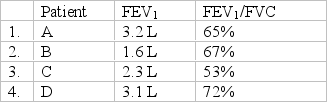
A) 2 and 4 only
B) 1, 2, and 3 only
C) 2 and 3 only
D) 1, 2, 3, and 4
A) 2 and 4 only
B) 1, 2, and 3 only
C) 2 and 3 only
D) 1, 2, 3, and 4
Question
Question
Question
Question
Question
Question
Question
Question
Question
Question
Question
Question
Question
Question
Question
Question
Question
Question
Question
Question
Question
Question
Question
Question
Question
Question
Question
Question

Unlock Deck
Sign up to unlock the cards in this deck!
Unlock Deck
Unlock Deck
1/63

Play

Full screen (f)
Deck 55: Cardiopulmonary Rehabilitation
1
A cardiopulmonary exercise evaluation is conducted on a patient before participation in pulmonary rehabilitation for what purposes?
1) To quantify the patient's baseline exercise capacity
2) To develop an exercise prescription (including target heart rate)
3) To determine how much desaturation occurs with exercise
A)2 and 3 only
B)1, 2, and 3
C)1 and 2 only
D)1 and 3 only
1) To quantify the patient's baseline exercise capacity
2) To develop an exercise prescription (including target heart rate)
3) To determine how much desaturation occurs with exercise
A)2 and 3 only
B)1, 2, and 3
C)1 and 2 only
D)1 and 3 only
B
2
Which of the following occur when the ventilatory threshold is exceeded during exercise?
1) Metabolism becomes anaerobic.
2) Energy production increases.
3) Fatigue increases.
A)1 and 2 only
B)2 and 3 only
C)1 and 3 only
D)1, 2, and 3
1) Metabolism becomes anaerobic.
2) Energy production increases.
3) Fatigue increases.
A)1 and 2 only
B)2 and 3 only
C)1 and 3 only
D)1, 2, and 3
C
3
Common goals shared by most pulmonary rehabilitation programs include which of the following?
1) Improvement in physical activity levels
2) Control of respiratory infections
3) Reduction in medical costs and hospitalizations
4) Family education, counseling, and support
A)1, 2, and 3 only
B)2 and 4 only
C)1, 2, 3, and 4
D)3 and 4 only
1) Improvement in physical activity levels
2) Control of respiratory infections
3) Reduction in medical costs and hospitalizations
4) Family education, counseling, and support
A)1, 2, and 3 only
B)2 and 4 only
C)1, 2, 3, and 4
D)3 and 4 only
C
3
Patients with chronic cardiopulmonary disorders all share an inability to do what?
A) Understand the disease process.
B) Regain functional use of atrophied muscles.
C) Improve tolerance for physical activity.
D) Cope effectively with their disease process.
A) Understand the disease process.
B) Regain functional use of atrophied muscles.
C) Improve tolerance for physical activity.
D) Cope effectively with their disease process.
D
Explanation: Although differences in diagnoses can have an impact on treatment outcomes and survival, patients with chronic pulmonary disorders have much in common. All have difficulty coping with the physiologic limitations of their diseases.
Explanation: Although differences in diagnoses can have an impact on treatment outcomes and survival, patients with chronic pulmonary disorders have much in common. All have difficulty coping with the physiologic limitations of their diseases.
4
Which of the following are reasonable expectations for a pulmonary rehabilitation program?
1) Reduction in hospitalizations
2) Improvement in ambulation
3) Reversal of the disease process
4) Control of respiratory infections
A)1 and 3 only
B)1, 2, and 3 only
C)3 and 4 only
D)1, 2, and 4 only
1) Reduction in hospitalizations
2) Improvement in ambulation
3) Reversal of the disease process
4) Control of respiratory infections
A)1 and 3 only
B)1, 2, and 3 only
C)3 and 4 only
D)1, 2, and 4 only
Unlock Deck
Unlock for access to all 63 flashcards in this deck.
Unlock Deck
k this deck
5
A patient is being considered for participation in a pulmonary rehabilitation program. Which of the following pulmonary function tests would you recommend be performed as a component of the preliminary evaluation?
1) Lung volumes, including functional residual capacity (FRC)
2) Diffusing capacity (DLCO)
3) Pre- and post-bronchodilator flows
4) Lung and thoracic compliance
A)2 and 4 only
B)1, 2, and 3 only
C)1, 2, 3, and 4
D)1, 2, and 4 only
1) Lung volumes, including functional residual capacity (FRC)
2) Diffusing capacity (DLCO)
3) Pre- and post-bronchodilator flows
4) Lung and thoracic compliance
A)2 and 4 only
B)1, 2, and 3 only
C)1, 2, 3, and 4
D)1, 2, and 4 only
Unlock Deck
Unlock for access to all 63 flashcards in this deck.
Unlock Deck
k this deck
6
Attrition in pulmonary rehabilitation programs is most associated with which of the following?
A) Success of the physical reconditioning component
B) Degree to which patients' psychosocial needs are met
C) Scope and depth of the group educational activities
D) Availability of adequate and reliable exercise equipment
A) Success of the physical reconditioning component
B) Degree to which patients' psychosocial needs are met
C) Scope and depth of the group educational activities
D) Availability of adequate and reliable exercise equipment
Unlock Deck
Unlock for access to all 63 flashcards in this deck.
Unlock Deck
k this deck
7
What is the first step in evaluating patients for participation in a pulmonary rehabilitation program?
A) Complete blood gas analysis
B) Complete patient history
C) Cardiopulmonary stress test
D) Pulmonary function testing
A) Complete blood gas analysis
B) Complete patient history
C) Cardiopulmonary stress test
D) Pulmonary function testing
Unlock Deck
Unlock for access to all 63 flashcards in this deck.
Unlock Deck
k this deck
8
Specific patient objectives for a pulmonary rehabilitation program could include which of the following?
1) Proper use of medications, O2, and breathing equipment
2) Reconditioning of both skeletal and respiratory muscles
3) Adherence to proper hygiene and good nutrition
4) Improvement in the results of pulmonary function tests
A)1 and 3 only
B)1, 2, and 3 only
C)3 and 4 only
D)2, 3, and 4 only
1) Proper use of medications, O2, and breathing equipment
2) Reconditioning of both skeletal and respiratory muscles
3) Adherence to proper hygiene and good nutrition
4) Improvement in the results of pulmonary function tests
A)1 and 3 only
B)1, 2, and 3 only
C)3 and 4 only
D)2, 3, and 4 only
Unlock Deck
Unlock for access to all 63 flashcards in this deck.
Unlock Deck
k this deck
9
A patient is being considered for participation in a pulmonary rehabilitation program. Which of the following test regimens would you recommend in order to ascertain the patient's cardiopulmonary status?
1) Cardiopulmonary exercise evaluation
2) Pulmonary function testing
3) Cardiac catheterization
A)2 and 3 only
B)1 and 2 only
C)1, 2, and 3
D)1 and 3 only
1) Cardiopulmonary exercise evaluation
2) Pulmonary function testing
3) Cardiac catheterization
A)2 and 3 only
B)1 and 2 only
C)1, 2, and 3
D)1 and 3 only
Unlock Deck
Unlock for access to all 63 flashcards in this deck.
Unlock Deck
k this deck
10
Knowledge from the social sciences is used in pulmonary rehabilitation programming for mainly what purpose?
1) To determine the impact of the disability on the patient or family
2) To quantify the extent of physiological impairment due to disease
3) To establish ways to improve the patient's quality-of-life
A)1 and 2 only
B)2 and 3 only
C)1 and 3 only
D)1, 2, and 3
1) To determine the impact of the disability on the patient or family
2) To quantify the extent of physiological impairment due to disease
3) To establish ways to improve the patient's quality-of-life
A)1 and 2 only
B)2 and 3 only
C)1 and 3 only
D)1, 2, and 3
Unlock Deck
Unlock for access to all 63 flashcards in this deck.
Unlock Deck
k this deck
11
What are the overall goals of rehabilitation?
1) To reverse the course or progression of the disease process
2) To minimize the disability's impact on the individual or family
3) To maximize the functional ability of the individual
A)1 and 2 only
B)2 and 3 only
C)1 and 3 only
D)1, 2, and 3
1) To reverse the course or progression of the disease process
2) To minimize the disability's impact on the individual or family
3) To maximize the functional ability of the individual
A)1 and 2 only
B)2 and 3 only
C)1 and 3 only
D)1, 2, and 3
Unlock Deck
Unlock for access to all 63 flashcards in this deck.
Unlock Deck
k this deck
12
To physically recondition a patient and increase exercise tolerance, which of the following must be accomplished?
1) The body's overall O2 utilization must be improved.
2) The patient's essential muscle groups must be strengthened.
3) The cardiovascular response to exercise must be enhanced.
A)2 and 3 only
B)1 and 2 only
C)1, 2, and 3
D)1 and 3 only
1) The body's overall O2 utilization must be improved.
2) The patient's essential muscle groups must be strengthened.
3) The cardiovascular response to exercise must be enhanced.
A)2 and 3 only
B)1 and 2 only
C)1, 2, and 3
D)1 and 3 only
Unlock Deck
Unlock for access to all 63 flashcards in this deck.
Unlock Deck
k this deck
13
The principal objectives of pulmonary rehabilitation include which of the following?
1) To control and alleviate the symptoms
2) To restore functional capabilities as much as possible
3) To improve quality-of-life
A)1 and 2 only
B)2 and 3 only
C)1 and 3 only
D)1, 2, and 3
1) To control and alleviate the symptoms
2) To restore functional capabilities as much as possible
3) To improve quality-of-life
A)1 and 2 only
B)2 and 3 only
C)1 and 3 only
D)1, 2, and 3
Unlock Deck
Unlock for access to all 63 flashcards in this deck.
Unlock Deck
k this deck
14
During exercise, the point at which increased levels of lactic acid production result in an increased VCO2 and VE is referred to as what?
A) Respiratory quotient (RQ)
B) Ventilatory threshold
C) Crossover point
D) Exercise limit
A) Respiratory quotient (RQ)
B) Ventilatory threshold
C) Crossover point
D) Exercise limit
Unlock Deck
Unlock for access to all 63 flashcards in this deck.
Unlock Deck
k this deck
15
What is the term used to describe the restoration of individuals to the fullest possible medical, mental, emotional, social, and vocational potential?
A) Disease prevention
B) Rehabilitation
C) Intensive care
D) Homecare
A) Disease prevention
B) Rehabilitation
C) Intensive care
D) Homecare
Unlock Deck
Unlock for access to all 63 flashcards in this deck.
Unlock Deck
k this deck
16
In which of the following ways does the body respond to increased levels of physical activity?
1) Decreased cardiac output
2) Increased minute ventilation
3) Neuroendocrine stimulation
A)3 only
B)1 and 2 only
C)1 and 3 only
D)1, 2, and 3
1) Decreased cardiac output
2) Increased minute ventilation
3) Neuroendocrine stimulation
A)3 only
B)1 and 2 only
C)1 and 3 only
D)1, 2, and 3
Unlock Deck
Unlock for access to all 63 flashcards in this deck.
Unlock Deck
k this deck
17
Which of the following would you not expect to observe after a chronic obstructive pulmonary disease (COPD) patient completes a sound pulmonary rehabilitation program?
A) Reduced pulse rate during exercise
B) Decreased breathing rates during exercise
C) Reduction in CO2 production during exercise
D) Permanent increase in forced expiratory volume in 1 sec (FEV1) and forced expiratory flow (FEF25% to 75%)
A) Reduced pulse rate during exercise
B) Decreased breathing rates during exercise
C) Reduction in CO2 production during exercise
D) Permanent increase in forced expiratory volume in 1 sec (FEV1) and forced expiratory flow (FEF25% to 75%)
Unlock Deck
Unlock for access to all 63 flashcards in this deck.
Unlock Deck
k this deck
18
Which of the following elements should be considered in most pulmonary rehabilitation programs?
1) Individual needs
2) Patient's education
3) Patient's personality
4) Patient's aptitudes
A)1, 2, and 3 only
B)2 and 4 only
C)1, 2, 3, and 4
D)3 and 4 only
1) Individual needs
2) Patient's education
3) Patient's personality
4) Patient's aptitudes
A)1, 2, and 3 only
B)2 and 4 only
C)1, 2, 3, and 4
D)3 and 4 only
Unlock Deck
Unlock for access to all 63 flashcards in this deck.
Unlock Deck
k this deck
19
Knowledge from the clinical sciences is used in pulmonary rehabilitation programming for mainly what purpose?
1) To quantify the extent of physiological impairment
2) To establish ways to improve the quality-of-life
3) To set expectations for reasonable outcomes
A)1 and 2 only
B)2 and 3 only
C)1 and 3 only
D)1, 2, and 3
1) To quantify the extent of physiological impairment
2) To establish ways to improve the quality-of-life
3) To set expectations for reasonable outcomes
A)1 and 2 only
B)2 and 3 only
C)1 and 3 only
D)1, 2, and 3
Unlock Deck
Unlock for access to all 63 flashcards in this deck.
Unlock Deck
k this deck
20
In preparing an outpatient for a cardiopulmonary stress test to be conducted the next day, which of the following instructions would you provide?
1) The patient should fast for at least 8 hr before testing.
2) The patient should wear loose-fitting clothing and sneakers.
3) The patient should stop all medications at once.
4) The patient should review the drugs with the physician.
A)1, 2, and 3 only
B)2 and 4 only
C)1, 2, 3, and 4
D)1, 2, and 4 only
1) The patient should fast for at least 8 hr before testing.
2) The patient should wear loose-fitting clothing and sneakers.
3) The patient should stop all medications at once.
4) The patient should review the drugs with the physician.
A)1, 2, and 3 only
B)2 and 4 only
C)1, 2, 3, and 4
D)1, 2, and 4 only
Unlock Deck
Unlock for access to all 63 flashcards in this deck.
Unlock Deck
k this deck
21
Absolute contraindications for conducting a cardiopulmonary exercise evaluation include which of the following?
1) Diastolic blood pressure greater than 110 mm Hg
2) Serious cardiac arrhythmias
3) Unstable angina
4) Recent myocardial infarction
A)1 and 3 only
B)1, 2, and 3 only
C)3 and 4 only
D)2, 3, and 4 only
1) Diastolic blood pressure greater than 110 mm Hg
2) Serious cardiac arrhythmias
3) Unstable angina
4) Recent myocardial infarction
A)1 and 3 only
B)1, 2, and 3 only
C)3 and 4 only
D)2, 3, and 4 only
Unlock Deck
Unlock for access to all 63 flashcards in this deck.
Unlock Deck
k this deck
22
To increase the likelihood that positive patient results are lasting, what must pulmonary rehabilitation programs provide?
A) Vocational and social counseling
B) Staff training in rehabilitation methods
C) Financial support for re-hospitalization
D) Periodic follow-up and reinforcement
A) Vocational and social counseling
B) Staff training in rehabilitation methods
C) Financial support for re-hospitalization
D) Periodic follow-up and reinforcement
Unlock Deck
Unlock for access to all 63 flashcards in this deck.
Unlock Deck
k this deck
23
Which of the following pulmonary function tests are most useful in determining whether a patient with restrictive lung disease should be considered for pulmonary rehabilitation?
1) DLCO
2) Total lung capacity (TLC)
3) FEV1/FVC
A)1 and 2 only
B)2 and 3 only
C)1 and 3 only
D)1, 2, and 3
1) DLCO
2) Total lung capacity (TLC)
3) FEV1/FVC
A)1 and 2 only
B)2 and 3 only
C)1 and 3 only
D)1, 2, and 3
Unlock Deck
Unlock for access to all 63 flashcards in this deck.
Unlock Deck
k this deck
24
Which of the following exercises are useful for reconditioning the lower extremities of patients undergoing pulmonary rehabilitation?
1) Walking on a flat surface for a specified period of time
2) Walking on a treadmill for a specified distance or time
3) Pedaling a stationary bicycle for a specified distance
A)2 and 3 only
B)1 and 2 only
C)1, 2, and 3
D)1 and 3 only
1) Walking on a flat surface for a specified period of time
2) Walking on a treadmill for a specified distance or time
3) Pedaling a stationary bicycle for a specified distance
A)2 and 3 only
B)1 and 2 only
C)1, 2, and 3
D)1 and 3 only
Unlock Deck
Unlock for access to all 63 flashcards in this deck.
Unlock Deck
k this deck
25
Which of the following exercises are useful for reconditioning the upper extremities of patients undergoing pulmonary rehabilitation?
1) Using a rowing machine
2) Using an arm ergometer
3) Pedaling a stationary bicycle
4) Using free hand weights
A)1, 2, 3, and 4
B)1 and 3 only
C)1, 2, and 4 only
D)2 and 4 only
1) Using a rowing machine
2) Using an arm ergometer
3) Pedaling a stationary bicycle
4) Using free hand weights
A)1, 2, 3, and 4
B)1 and 3 only
C)1, 2, and 4 only
D)2 and 4 only
Unlock Deck
Unlock for access to all 63 flashcards in this deck.
Unlock Deck
k this deck
26
Which of the following measures during cardiopulmonary exercise evaluation are most useful in differentiating between exercise intolerance of cardiac versus ventilatory origin?
1) Maximum heart rate
2) O2max
3) PaCO2
4) PaO2
A)2 and 4 only
B)1, 2, and 3 only
C)3 and 4 only
D)2, 3, and 4 only
1) Maximum heart rate
2) O2max
3) PaCO2
4) PaO2
A)2 and 4 only
B)1, 2, and 3 only
C)3 and 4 only
D)2, 3, and 4 only
Unlock Deck
Unlock for access to all 63 flashcards in this deck.
Unlock Deck
k this deck
27
A patient in your pulmonary rehabilitation program has an orthopedic disability that precludes her from walking or using a stationary bicycle. Which of the following activities would you recommend to help recondition the lower extremities?
A) Use of a rowing machine
B) Calisthenic exercises
C) Aquatic exercises
D) Use of a treadmill
A) Use of a rowing machine
B) Calisthenic exercises
C) Aquatic exercises
D) Use of a treadmill
Unlock Deck
Unlock for access to all 63 flashcards in this deck.
Unlock Deck
k this deck
28
Under which of the following conditions would you recommend ending a cardiopulmonary exercise evaluation?
1) Electrocardiogram indicating sinus tachycardia
2) 10% fall from baseline oxyhemoglobin (HbO2) saturation
3) Fall in systolic blood pressure of more than 20 mm Hg
4) Request from the patient to terminate the test
A)2, 3, and 4 only
B)1, 2, and 3 only
C)1, 2, 3, and 4
D)1, 2, and 4 only
1) Electrocardiogram indicating sinus tachycardia
2) 10% fall from baseline oxyhemoglobin (HbO2) saturation
3) Fall in systolic blood pressure of more than 20 mm Hg
4) Request from the patient to terminate the test
A)2, 3, and 4 only
B)1, 2, and 3 only
C)1, 2, 3, and 4
D)1, 2, and 4 only
Unlock Deck
Unlock for access to all 63 flashcards in this deck.
Unlock Deck
k this deck
29
For which of the following patients would you recommend an open-ended format for a pulmonary rehabilitation program?
1) Those with scheduling difficulties
2) Those who require individual attention
3) Those who are self-directed
A)2 and 3 only
B)1 and 2 only
C)1, 2, and 3
D)1 and 3 only
1) Those with scheduling difficulties
2) Those who require individual attention
3) Those who are self-directed
A)2 and 3 only
B)1 and 2 only
C)1, 2, and 3
D)1 and 3 only
Unlock Deck
Unlock for access to all 63 flashcards in this deck.
Unlock Deck
k this deck
30
What are some relative contraindications for cardiopulmonary exercise testing?
1) Severe pulmonary hypertension or cor pulmonale
2) Known electrolyte disturbances (e.g., hypokalemia)
3) SaO2 or SpO2 less than 85% breathing room air
4) Untreated or unstable asthma
A)2 and 4 only
B)1, 2, and 3 only
C)1, 2, 3, and 4
D)1, 2, and 4 only
1) Severe pulmonary hypertension or cor pulmonale
2) Known electrolyte disturbances (e.g., hypokalemia)
3) SaO2 or SpO2 less than 85% breathing room air
4) Untreated or unstable asthma
A)2 and 4 only
B)1, 2, and 3 only
C)1, 2, 3, and 4
D)1, 2, and 4 only
Unlock Deck
Unlock for access to all 63 flashcards in this deck.
Unlock Deck
k this deck
31
Which of the following should be monitored during a cardiopulmonary exercise evaluation?
1) Respiratory rate
2) HbO2 saturation
3) ECG and blood pressure
4) FEV1 and FVC
A)1 and 3 only
B)1, 2, and 3 only
C)3 and 4 only
D)2, 3, and 4 only
1) Respiratory rate
2) HbO2 saturation
3) ECG and blood pressure
4) FEV1 and FVC
A)1 and 3 only
B)1, 2, and 3 only
C)3 and 4 only
D)2, 3, and 4 only
Unlock Deck
Unlock for access to all 63 flashcards in this deck.
Unlock Deck
k this deck
32
Below what level of the predicted FEV1/FVC are patients with irreversible airway obstruction considered good candidates for pulmonary rehabilitation?
A) 75%
B) 80%
C) 60%
D) 70%
A) 75%
B) 80%
C) 60%
D) 70%
Unlock Deck
Unlock for access to all 63 flashcards in this deck.
Unlock Deck
k this deck
33
To maximize patient safety during cardiopulmonary stress testing, which of the following precautions would you recommend?
1) Immediate availability of a crash cart
2) Staff training in emergency life support
3) Presence of a physician throughout testing
4) Patient physical exam or ECG before testing
A)1, 2, and 3 only
B)1, 2, 3, and 4
C)1 and 3 only
D)3 and 4 only
1) Immediate availability of a crash cart
2) Staff training in emergency life support
3) Presence of a physician throughout testing
4) Patient physical exam or ECG before testing
A)1, 2, and 3 only
B)1, 2, 3, and 4
C)1 and 3 only
D)3 and 4 only
Unlock Deck
Unlock for access to all 63 flashcards in this deck.
Unlock Deck
k this deck
34
Which of the following patients with irreversible airway obstruction are the best candidates for pulmonary rehabilitation?
A) 2 and 4 only
B) 1, 2, and 3 only
C) 2 and 3 only
D) 1, 2, 3, and 4
A) 2 and 4 only
B) 1, 2, and 3 only
C) 2 and 3 only
D) 1, 2, 3, and 4
Unlock Deck
Unlock for access to all 63 flashcards in this deck.
Unlock Deck
k this deck
35
The physical reconditioning component of a pulmonary rehabilitation program usually includes which of the following?
1) Aerobic exercises for the extremities
2) Timed walking exercise
3) Ventilatory muscle training
A)1, 2, and 3
B)2 and 3 only
C)1 and 3 only
D)3 only
1) Aerobic exercises for the extremities
2) Timed walking exercise
3) Ventilatory muscle training
A)1, 2, and 3
B)2 and 3 only
C)1 and 3 only
D)3 only
Unlock Deck
Unlock for access to all 63 flashcards in this deck.
Unlock Deck
k this deck
36
Which of the following patients are good candidates for pulmonary rehabilitation?
1) Unstable cardiovascular patients who require monitoring
2) Patients with exercise limitations due to severe dyspnea
3) Patients with malignant neoplasms involving the lungs
A)2 only
B)2 and 3 only
C)1 and 3 only
D)1, 2, and 3
1) Unstable cardiovascular patients who require monitoring
2) Patients with exercise limitations due to severe dyspnea
3) Patients with malignant neoplasms involving the lungs
A)2 only
B)2 and 3 only
C)1 and 3 only
D)1, 2, and 3
Unlock Deck
Unlock for access to all 63 flashcards in this deck.
Unlock Deck
k this deck
37
While you are assisting in a treadmill cardiopulmonary stress test procedure, the patient complains to you of severe shortness of breath and some chest pain. Which of the following actions would you recommend at this time?
A) Increase the O2 flow rate.
B) Decrease the treadmill speed.
C) Decrease the treadmill incline.
D) Terminate the procedure at once.
A) Increase the O2 flow rate.
B) Decrease the treadmill speed.
C) Decrease the treadmill incline.
D) Terminate the procedure at once.
Unlock Deck
Unlock for access to all 63 flashcards in this deck.
Unlock Deck
k this deck
38
The O2max at termination of exercise (as a percentage of the predicted) for five patients appears below. Which of these patients is the best candidate for pulmonary rehabilitation?
A) 65%
B) 80%
C) 90%
D) 95%
A) 65%
B) 80%
C) 90%
D) 95%
Unlock Deck
Unlock for access to all 63 flashcards in this deck.
Unlock Deck
k this deck
39
Which of the following educational topics covered in a typical pulmonary rehabilitation program are most suitable for presentation by a respiratory care practitioner?
1) Methods of relaxation and stress management
2) Recreation and vocational counseling
3) Diaphragmatic and pursed-lip breathing techniques
4) Respiratory structure, function, and disease
A)2 and 4 only
B)1, 2, and 3 only
C)3 and 4 only
D)1, 2, 3, and 4
1) Methods of relaxation and stress management
2) Recreation and vocational counseling
3) Diaphragmatic and pursed-lip breathing techniques
4) Respiratory structure, function, and disease
A)2 and 4 only
B)1, 2, and 3 only
C)3 and 4 only
D)1, 2, 3, and 4
Unlock Deck
Unlock for access to all 63 flashcards in this deck.
Unlock Deck
k this deck
40
Which of the following health professionals would be best for conducting a pulmonary rehabilitation session on methods of relaxation and stress management?
A) Clinical psychologist
B) Physical therapist
C) Respiratory therapist
D) Pulmonary physician
A) Clinical psychologist
B) Physical therapist
C) Respiratory therapist
D) Pulmonary physician
Unlock Deck
Unlock for access to all 63 flashcards in this deck.
Unlock Deck
k this deck
41
During inspiratory resistive exercises, the desired load should be about what percentage of the maximum inspiratory pressure?
A) 15%
B) 25%
C) 30%
D) 20%
A) 15%
B) 25%
C) 30%
D) 20%
Unlock Deck
Unlock for access to all 63 flashcards in this deck.
Unlock Deck
k this deck
42
Which of the following outcome measures is considered a major predictor for improvement in a COPD patient's health-related quality-of-life?
A) Frequent attendance in a maintenance program
B) Repeated admission to a rehabilitation program
C) Frequent medical evaluations
D) Antibiotic therapy
A) Frequent attendance in a maintenance program
B) Repeated admission to a rehabilitation program
C) Frequent medical evaluations
D) Antibiotic therapy
Unlock Deck
Unlock for access to all 63 flashcards in this deck.
Unlock Deck
k this deck
43
Which of the following are legitimate ways to obtain reimbursement from third-party payers for pulmonary rehabilitation programs?
1) Charge sessions as physical therapy exercises for COPD patients
2) Charge sessions as office visits with therapeutic exercises
3) Charge sessions as physician office visits-intermediate
A)2 and 3 only
B)1 and 2 only
C)1, 2, and 3
D)1 and 3 only
1) Charge sessions as physical therapy exercises for COPD patients
2) Charge sessions as office visits with therapeutic exercises
3) Charge sessions as physician office visits-intermediate
A)2 and 3 only
B)1 and 2 only
C)1, 2, and 3
D)1 and 3 only
Unlock Deck
Unlock for access to all 63 flashcards in this deck.
Unlock Deck
k this deck
44
Which of the following health professionals would be best for conducting a pulmonary rehabilitation session on recreation and vocational counseling?
A) Physical therapist
B) Respiratory therapist
C) Clinical psychologist
D) Occupational therapist
A) Physical therapist
B) Respiratory therapist
C) Clinical psychologist
D) Occupational therapist
Unlock Deck
Unlock for access to all 63 flashcards in this deck.
Unlock Deck
k this deck
45
What is the ideal class size for pulmonary rehabilitation programs?
A) 5 to 15
B) 10 to 20
C) 20 to 30
D) 3 to 10
A) 5 to 15
B) 10 to 20
C) 20 to 30
D) 3 to 10
Unlock Deck
Unlock for access to all 63 flashcards in this deck.
Unlock Deck
k this deck
46
A small-group discussion format for pulmonary rehabilitation educational sessions is recommended in order to foster which of the following?
1) Group interaction
2) Peer support
3) Group identity
A)1 and 2 only
B)2 and 3 only
C)1 and 3 only
D)1, 2, and 3
1) Group interaction
2) Peer support
3) Group identity
A)1 and 2 only
B)2 and 3 only
C)1 and 3 only
D)1, 2, and 3
Unlock Deck
Unlock for access to all 63 flashcards in this deck.
Unlock Deck
k this deck
47
Which of the following is/are true about the flow-resistor breathing exerciser?
1) Exhaled gas flows unimpeded out a one-way valve.
2) Resistance is created by a variable-size orifice.
3) Imposed load varies with the rate of flow.
A)2 and 3 only
B)1, 2, and 3
C)1 and 2 only
D)2 only
1) Exhaled gas flows unimpeded out a one-way valve.
2) Resistance is created by a variable-size orifice.
3) Imposed load varies with the rate of flow.
A)2 and 3 only
B)1, 2, and 3
C)1 and 2 only
D)2 only
Unlock Deck
Unlock for access to all 63 flashcards in this deck.
Unlock Deck
k this deck
48
Appropriate topical areas to be covered in a rehabilitation education session on nutrition include which of the following?
1) Elements of a good diet
2) Proper eating habits
3) Foods to avoid
4) Daily menu planning
A)1, 2, and 3 only
B)2 and 4 only
C)1, 2, 3, and 4
D)3 and 4 only
1) Elements of a good diet
2) Proper eating habits
3) Foods to avoid
4) Daily menu planning
A)1, 2, and 3 only
B)2 and 4 only
C)1, 2, 3, and 4
D)3 and 4 only
Unlock Deck
Unlock for access to all 63 flashcards in this deck.
Unlock Deck
k this deck
49
Minimum equipment requirements for the physical reconditioning component of a pulmonary rehabilitation program include which of the following?
1) Inspiratory resistive breathing devices
2) Rowing machines or upper extremity ergometers
3) Pulse oximeters (for pulse rate/SaO2)
4) Stationary bicycles
A)1, 2, and 3 only
B)2 and 4 only
C)1, 2, 3, and 4
D)3 and 4 only
1) Inspiratory resistive breathing devices
2) Rowing machines or upper extremity ergometers
3) Pulse oximeters (for pulse rate/SaO2)
4) Stationary bicycles
A)1, 2, and 3 only
B)2 and 4 only
C)1, 2, 3, and 4
D)3 and 4 only
Unlock Deck
Unlock for access to all 63 flashcards in this deck.
Unlock Deck
k this deck
50
By following the reimbursement guidelines for a comprehensive outpatient rehabilitative facility (CORF), Medicare will reimburse up to what percentage of the allowable charge for a rehabilitation program?
A) 60%
B) 80%
C) 20%
D) 40%
A) 60%
B) 80%
C) 20%
D) 40%
Unlock Deck
Unlock for access to all 63 flashcards in this deck.
Unlock Deck
k this deck
51
Which of the following topics should be covered in a rehabilitation education session on respiratory homecare?
1) Self-administration of therapy
2) Care of home equipment (e.g., cleaning)
3) Safe use of home care equipment
A)1 and 2 only
B)2 and 3 only
C)1 and 3 only
D)1, 2, and 3
1) Self-administration of therapy
2) Care of home equipment (e.g., cleaning)
3) Safe use of home care equipment
A)1 and 2 only
B)2 and 3 only
C)1 and 3 only
D)1, 2, and 3
Unlock Deck
Unlock for access to all 63 flashcards in this deck.
Unlock Deck
k this deck
52
A small pulmonary rehabilitation program class size has which of the following beneficial effects?
1) It facilitates group interaction.
2) It allows for more individualized attention.
3) It helps to sustain participant motivation.
4) It reduces the likelihood of attrition.
A)2 and 4 only
B)1, 2, and 3 only
C)3 and 4 only
D)1, 2, 3, and 4
1) It facilitates group interaction.
2) It allows for more individualized attention.
3) It helps to sustain participant motivation.
4) It reduces the likelihood of attrition.
A)2 and 4 only
B)1, 2, and 3 only
C)3 and 4 only
D)1, 2, 3, and 4
Unlock Deck
Unlock for access to all 63 flashcards in this deck.
Unlock Deck
k this deck
53
Reconditioning the inspiratory muscles of patients undergoing pulmonary rehabilitation is accomplished through which of the following methods?
A) Walking aerobically for a specified time
B) Using a rowing machine for a specified time
C) Pedaling a stationary bicycle for a specified distance
D) Performing inspiratory resistive breathing exercises
A) Walking aerobically for a specified time
B) Using a rowing machine for a specified time
C) Pedaling a stationary bicycle for a specified distance
D) Performing inspiratory resistive breathing exercises
Unlock Deck
Unlock for access to all 63 flashcards in this deck.
Unlock Deck
k this deck
54
Which of the following are factors affecting the cost of a pulmonary rehabilitation program?
1) Space and utility expenses
2) Equipment and supplies
3) Patient health insurance
4) Program promotion costs
A)1 and 3 only
B)1, 2, and 3 only
C)3 and 4 only
D)1, 2, and 4 only
1) Space and utility expenses
2) Equipment and supplies
3) Patient health insurance
4) Program promotion costs
A)1 and 3 only
B)1, 2, and 3 only
C)3 and 4 only
D)1, 2, and 4 only
Unlock Deck
Unlock for access to all 63 flashcards in this deck.
Unlock Deck
k this deck
55
Common cardiovascular hazards of physical reconditioning for patients with chronic lung disease include which of the following?
1) Cardiac arrhythmias
2) Systemic hypotension
3) Muscle contractures
A)1 and 2 only
B)2 and 3 only
C)1 and 3 only
D)1, 2, and 3
1) Cardiac arrhythmias
2) Systemic hypotension
3) Muscle contractures
A)1 and 2 only
B)2 and 3 only
C)1 and 3 only
D)1, 2, and 3
Unlock Deck
Unlock for access to all 63 flashcards in this deck.
Unlock Deck
k this deck
56
To deal with incidents of hypoxemia, dyspnea, or airway hyperreactivity during physical reconditioning activities, which of the following should be available in the rehabilitation area?
1) Intubation tray
2) Bronchodilator agents
3) Emergency oxygen
A)1 and 2 only
B)2 and 3 only
C)1 and 3 only
D)1, 2, and 3
1) Intubation tray
2) Bronchodilator agents
3) Emergency oxygen
A)1 and 2 only
B)2 and 3 only
C)1 and 3 only
D)1, 2, and 3
Unlock Deck
Unlock for access to all 63 flashcards in this deck.
Unlock Deck
k this deck
57
For which of the following procedures pulmonary rehabilitation has become recognized as a prerequisite?
A) Thoracotomy
B) Lung volume reduction surgery
C) Lung transplantation
D) Heart transplantation
A) Thoracotomy
B) Lung volume reduction surgery
C) Lung transplantation
D) Heart transplantation
Unlock Deck
Unlock for access to all 63 flashcards in this deck.
Unlock Deck
k this deck
58
What government programs can serve as a source for reimbursement for pulmonary rehabilitation?
1) Prospective payment system (PPS)
2) Comprehensive outpatient rehabilitative facility (CORF)
3) Veterans Administration benefits
4) Civilian Health and Medical Programs of the Uniformed Services (CHAMPUS)
A)1, 2, and 3 only
B)2 and 4 only
C)1, 2, 3, and 4
D)2, 3, and 4 only
1) Prospective payment system (PPS)
2) Comprehensive outpatient rehabilitative facility (CORF)
3) Veterans Administration benefits
4) Civilian Health and Medical Programs of the Uniformed Services (CHAMPUS)
A)1, 2, and 3 only
B)2 and 4 only
C)1, 2, 3, and 4
D)2, 3, and 4 only
Unlock Deck
Unlock for access to all 63 flashcards in this deck.
Unlock Deck
k this deck
59
Where are most cardiac rehabilitation programs conducted?
A) Private practice offices
B) Clinics
C) Hospital facilities
D) Homes
A) Private practice offices
B) Clinics
C) Hospital facilities
D) Homes
Unlock Deck
Unlock for access to all 63 flashcards in this deck.
Unlock Deck
k this deck
61
What is the level of involvement of the respiratory therapist in cardiac rehabilitation?
A) Same as in the pulmonary rehabilitation
B) Greater than in pulmonary rehabilitation
C) Significantly less than in pulmonary rehabilitation
D) Respiratory therapist does not participate in cardiac rehabilitation
A) Same as in the pulmonary rehabilitation
B) Greater than in pulmonary rehabilitation
C) Significantly less than in pulmonary rehabilitation
D) Respiratory therapist does not participate in cardiac rehabilitation
Unlock Deck
Unlock for access to all 63 flashcards in this deck.
Unlock Deck
k this deck
62
Which of the following clinicians are commonly involved in the cardiac rehabilitation programs?
1) Nurse specialist
2) Cardiologist
3) Dietitian
A)1 and 2 only
B)2 and 3 only
C)1 and 3 only
D)1, 2, and 3
1) Nurse specialist
2) Cardiologist
3) Dietitian
A)1 and 2 only
B)2 and 3 only
C)1 and 3 only
D)1, 2, and 3
Unlock Deck
Unlock for access to all 63 flashcards in this deck.
Unlock Deck
k this deck
64
Which of the following are differences between cardiac and pulmonary rehabilitation?
1) Cardiac patients are typically younger.
2) Most cardiac patients are not able to walk for 1 hr.
3) Reimbursement is easier to obtain with cardiac rehabilitation.
4) Breathing exercises are not essential to cardiac patients.
A)1 and 2 only
B)2 and 3 only
C)1, 3, and 4 only
D)1, 2, and 3 only
1) Cardiac patients are typically younger.
2) Most cardiac patients are not able to walk for 1 hr.
3) Reimbursement is easier to obtain with cardiac rehabilitation.
4) Breathing exercises are not essential to cardiac patients.
A)1 and 2 only
B)2 and 3 only
C)1, 3, and 4 only
D)1, 2, and 3 only
Unlock Deck
Unlock for access to all 63 flashcards in this deck.
Unlock Deck
k this deck
Unlock Deck
Unlock for access to all 63 flashcards in this deck.






