







 Chat with AI

Deck 18: Labor Markets
Full screen (f)

Question

Question
Question
Figure: Cleaners' Wages 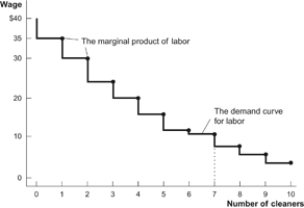 Refer to the figure. How many workers will this firm hire at a wage of $29?
A) 0
B) 1
C) 2
D) 3
Refer to the figure. How many workers will this firm hire at a wage of $29?A) 0
B) 1
C) 2
D) 3
Question
Question
Question
Question
Question
Question
Question
Table: Stone Masons
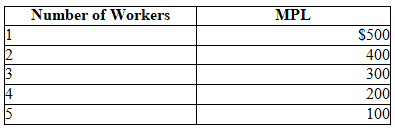
A construction company builds stone fireplaces. The market wage for a stonemason is $350 per day. The table depicts the marginal product of labor (MPL) per day for a given number of stonemasons. To maximize profits, this company should hire ______ stonemasons.
A) 2
B) 3
C) 4
D) 5
A construction company builds stone fireplaces. The market wage for a stonemason is $350 per day. The table depicts the marginal product of labor (MPL) per day for a given number of stonemasons. To maximize profits, this company should hire ______ stonemasons.
A) 2
B) 3
C) 4
D) 5
Question
Question
Question
Question
Question
Question
Question
Question
Question
Question
Question
Question
Figure: Marginal Product of Labor 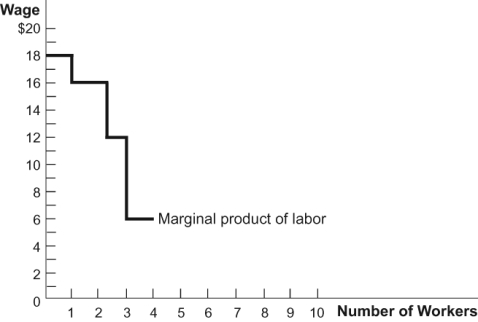 The firm in this figure will hire ______ worker(s) at a wage of $10 and 2 workers at a wage of _______.
A) 4; $18
B) 3; $15
C) 1; $6
D) 3; $17
The firm in this figure will hire ______ worker(s) at a wage of $10 and 2 workers at a wage of _______.A) 4; $18
B) 3; $15
C) 1; $6
D) 3; $17
Question
Question
Question
Question
Question
Question
Question
Question
Table: Mr. B's Restaurant
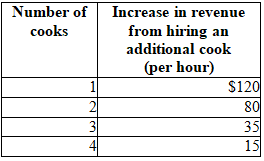
The second column in this table shows the firm's ______. At a wage of $28 an hour, Mr. B should hire ______ cooks.
A) marginal disutility of work; 4
B) marginal product of labor; 3
C) marginal disutility of work; 2
D) marginal cost of labor; 3
The second column in this table shows the firm's ______. At a wage of $28 an hour, Mr. B should hire ______ cooks.
A) marginal disutility of work; 4
B) marginal product of labor; 3
C) marginal disutility of work; 2
D) marginal cost of labor; 3
Question
Question
Question
Question
Question
Question
Question
Question
Question
Question
Question
Question
Question
Question
Question
Question
Figure: Market for Plumbers 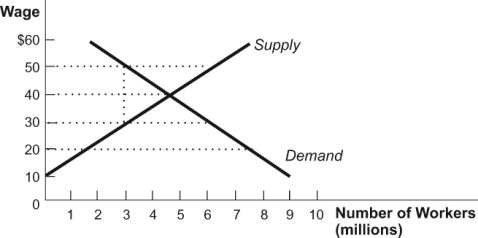 If the market in this figure is in equilibrium, the hourly wage paid to plumbers is ______ and the marginal product of a plumber is ______.
A) $40; $20
B) $30; $50
C) $40; $40
D) $20; $30
If the market in this figure is in equilibrium, the hourly wage paid to plumbers is ______ and the marginal product of a plumber is ______.A) $40; $20
B) $30; $50
C) $40; $40
D) $20; $30
Question
Question
Question
Question
Question
Question
Question
Question
Question
Question
Question
Question
Question
Question
Question
Question
Question
Question
Question
Question
Question
Question
Question
Question
Question
Question
Question
Question
Question
Question
Question
Question
Question
Question

Unlock Deck
Sign up to unlock the cards in this deck!
Unlock Deck
Unlock Deck
1/262

Play

Full screen (f)
Deck 18: Labor Markets
1
A firm is willing to hire a worker when the marginal product of labor is:
A) greater than the wage.
B) less than the wage.
C) equal to or less than the wage.
D) efficient.
A) greater than the wage.
B) less than the wage.
C) equal to or less than the wage.
D) efficient.
greater than the wage.
2
We often think of technology and labor as substitutes for each other, but technology can lead to the hiring of more labor if it:
A) decreases the average total cost of production.
B) decreases the compensating differential.
C) increases the marginal product of labor.
D) increases the opportunity cost of labor.
A) decreases the average total cost of production.
B) decreases the compensating differential.
C) increases the marginal product of labor.
D) increases the opportunity cost of labor.
increases the marginal product of labor.
3
Figure: Cleaners' Wages Refer to the figure. How many workers will this firm hire at a wage of $29?
A) 0
B) 1
C) 2
D) 3
Refer to the figure. How many workers will this firm hire at a wage of $29?A) 0
B) 1
C) 2
D) 3
2
4
To maximize profit, a firm will hire workers when the ________ in revenue from hiring an additional worker ________ the worker's wage.
A) decrease; is less than or equal to
B) decrease; is greater than
C) increase; is greater than
D) increase; is less than or equal to
A) decrease; is less than or equal to
B) decrease; is greater than
C) increase; is greater than
D) increase; is less than or equal to
Unlock Deck
Unlock for access to all 262 flashcards in this deck.
Unlock Deck
k this deck
5
As the wage for janitors falls, firms will demand:
A) more janitors.
B) fewer janitors.
C) a constant number of janitors.
D) no janitors.
A) more janitors.
B) fewer janitors.
C) a constant number of janitors.
D) no janitors.
Unlock Deck
Unlock for access to all 262 flashcards in this deck.
Unlock Deck
k this deck
6
When wages decrease, firms will hire more workers who will be:
A) assigned to the most important tasks.
B) assigned to the least important tasks.
C) least likely to be laid off.
D) paid wages that are higher than market wages.
A) assigned to the most important tasks.
B) assigned to the least important tasks.
C) least likely to be laid off.
D) paid wages that are higher than market wages.
Unlock Deck
Unlock for access to all 262 flashcards in this deck.
Unlock Deck
k this deck
7
The three-cylinder mill revolutionized sugar production around the year 1500, allowing sugar cane to be crushed rapidly using animal power (before then, the cane had to be ground by hand with a mortar-and-pestle). It took only three slaves to operate the machine, a small fraction of what it took to do the same job by hand. What happened to the price of slaves for sugar production?
A) It increased, because the marginal product of labor increased.
B) It decreased, because you needed fewer slaves to crush your sugar cane.
C) It stayed the same, because the factor from (a) balances out the factor from (b).
D) It decreased, because the marginal product of labor increased. .
A) It increased, because the marginal product of labor increased.
B) It decreased, because you needed fewer slaves to crush your sugar cane.
C) It stayed the same, because the factor from (a) balances out the factor from (b).
D) It decreased, because the marginal product of labor increased. .
Unlock Deck
Unlock for access to all 262 flashcards in this deck.
Unlock Deck
k this deck
8
A firm will hire workers as long as the marginal product of labor is:
A) greater than the wage.
B) equal to the wage.
C) less than the wage.
D) either greater than or less than the wage.
A) greater than the wage.
B) equal to the wage.
C) less than the wage.
D) either greater than or less than the wage.
Unlock Deck
Unlock for access to all 262 flashcards in this deck.
Unlock Deck
k this deck
9
The marginal product of labor is:
A) the additional output produced by an extra worker.
B) the increase in costs borne by the firm when one extra worker is hired.
C) always greater than the wage earned by one additional worker.
D) the increase in firm revenue when an additional worker is employed.
A) the additional output produced by an extra worker.
B) the increase in costs borne by the firm when one extra worker is hired.
C) always greater than the wage earned by one additional worker.
D) the increase in firm revenue when an additional worker is employed.
Unlock Deck
Unlock for access to all 262 flashcards in this deck.
Unlock Deck
k this deck
10
Table: Stone Masons
A construction company builds stone fireplaces. The market wage for a stonemason is $350 per day. The table depicts the marginal product of labor (MPL) per day for a given number of stonemasons. To maximize profits, this company should hire ______ stonemasons.
A) 2
B) 3
C) 4
D) 5
A construction company builds stone fireplaces. The market wage for a stonemason is $350 per day. The table depicts the marginal product of labor (MPL) per day for a given number of stonemasons. To maximize profits, this company should hire ______ stonemasons.
A) 2
B) 3
C) 4
D) 5
Unlock Deck
Unlock for access to all 262 flashcards in this deck.
Unlock Deck
k this deck
11
Marián Hossa was paid $7.4 million by the Detroit Red Wings for the 2008-2009 season. We can conclude that:
A) Marián Hossa was overpaid.
B) the Red Wings expected Marián Hossa to increase the team's revenue by at least $7.4 million.
C) the marginal product of labor of Marián Hossa must be less than $7.4 million.
D) the marginal product of labor of Marián Hossa is 0.90 times the marginal cost.
A) Marián Hossa was overpaid.
B) the Red Wings expected Marián Hossa to increase the team's revenue by at least $7.4 million.
C) the marginal product of labor of Marián Hossa must be less than $7.4 million.
D) the marginal product of labor of Marián Hossa is 0.90 times the marginal cost.
Unlock Deck
Unlock for access to all 262 flashcards in this deck.
Unlock Deck
k this deck
12
A firm will continue to hire workers as long as:
A) the marginal product of labor is greater than the wage.
B) the marginal product of labor is less than the wage.
C) the value of labor exceeds the firm's production costs.
D) the value of labor exceeds the firm's fixed costs of labor.
A) the marginal product of labor is greater than the wage.
B) the marginal product of labor is less than the wage.
C) the value of labor exceeds the firm's production costs.
D) the value of labor exceeds the firm's fixed costs of labor.
Unlock Deck
Unlock for access to all 262 flashcards in this deck.
Unlock Deck
k this deck
13
The marginal product of labor is:
A) the revenue created by a firm's entire workforce.
B) the revenue created by the average worker.
C) the increase in a firm's revenues created by hiring an additional laborer.
D) the decrease in a firm's revenues created by hiring an additional laborer.
A) the revenue created by a firm's entire workforce.
B) the revenue created by the average worker.
C) the increase in a firm's revenues created by hiring an additional laborer.
D) the decrease in a firm's revenues created by hiring an additional laborer.
Unlock Deck
Unlock for access to all 262 flashcards in this deck.
Unlock Deck
k this deck
14
Which of the following statements is(are) TRUE?
I. The demand for labor is downward sloping.
II. The marginal product of labor declines as a firm hires more labor.
III. The marginal product of labor is the demand curve for labor.
A) I only
B) I and II only
C) III only
D) I, II, and III
I. The demand for labor is downward sloping.
II. The marginal product of labor declines as a firm hires more labor.
III. The marginal product of labor is the demand curve for labor.
A) I only
B) I and II only
C) III only
D) I, II, and III
Unlock Deck
Unlock for access to all 262 flashcards in this deck.
Unlock Deck
k this deck
15
If we know the marginal product of labor for every unit of labor, we can derive:
A) the demand curve for labor.
B) the supply curve for labor.
C) the equilibrium wage.
D) the equilibrium quantity of workers.
A) the demand curve for labor.
B) the supply curve for labor.
C) the equilibrium wage.
D) the equilibrium quantity of workers.
Unlock Deck
Unlock for access to all 262 flashcards in this deck.
Unlock Deck
k this deck
16
The market demand curve for labor is based on the:
A) hiring preferences of firms.
B) elasticity of supply of labor.
C) elasticity of demand for labor.
D) marginal product of labor.
A) hiring preferences of firms.
B) elasticity of supply of labor.
C) elasticity of demand for labor.
D) marginal product of labor.
Unlock Deck
Unlock for access to all 262 flashcards in this deck.
Unlock Deck
k this deck
17
As more workers are hired, the marginal product of labor typically:
A) increases.
B) decreases.
C) remains the same.
D) oscillates more rapidly.
A) increases.
B) decreases.
C) remains the same.
D) oscillates more rapidly.
Unlock Deck
Unlock for access to all 262 flashcards in this deck.
Unlock Deck
k this deck
18
The increase in a firm's revenues created by hiring an additional worker is called:
A) marginal revenue.
B) marginal revenue of labor.
C) marginal product.
D) marginal product of labor.
A) marginal revenue.
B) marginal revenue of labor.
C) marginal product.
D) marginal product of labor.
Unlock Deck
Unlock for access to all 262 flashcards in this deck.
Unlock Deck
k this deck
19
Firms will hire additional workers as long as:
A) the marginal revenue of that worker is greater than the worker's wage.
B) the total revenue is greater than the total cost.
C) the marginal cost of that worker is greater than the marginal revenue.
D) the marginal revenue of that worker is equal to the marginal product of labor.
A) the marginal revenue of that worker is greater than the worker's wage.
B) the total revenue is greater than the total cost.
C) the marginal cost of that worker is greater than the marginal revenue.
D) the marginal revenue of that worker is equal to the marginal product of labor.
Unlock Deck
Unlock for access to all 262 flashcards in this deck.
Unlock Deck
k this deck
20
A firm will hire a worker as long as:
A) the marginal product of labor is greater than or equal to the wage earned by the worker.
B) the wage earned is greater than the marginal product of labor.
C) the worker is not unionized.
D) the worker does not demand OSHA safety regulations.
A) the marginal product of labor is greater than or equal to the wage earned by the worker.
B) the wage earned is greater than the marginal product of labor.
C) the worker is not unionized.
D) the worker does not demand OSHA safety regulations.
Unlock Deck
Unlock for access to all 262 flashcards in this deck.
Unlock Deck
k this deck
21
If the marginal product of labor is constant in labor, then a firm-level labor demand curve is:
A) positively sloped.
B) negatively sloped.
C) flat
D) varied.
A) positively sloped.
B) negatively sloped.
C) flat
D) varied.
Unlock Deck
Unlock for access to all 262 flashcards in this deck.
Unlock Deck
k this deck
22
Figure: Marginal Product of Labor The firm in this figure will hire ______ worker(s) at a wage of $10 and 2 workers at a wage of _______.
A) 4; $18
B) 3; $15
C) 1; $6
D) 3; $17
The firm in this figure will hire ______ worker(s) at a wage of $10 and 2 workers at a wage of _______.A) 4; $18
B) 3; $15
C) 1; $6
D) 3; $17
Unlock Deck
Unlock for access to all 262 flashcards in this deck.
Unlock Deck
k this deck
23
If the marginal product of labor is decreasing in labor, then a market labor demand curve is:
A) positively sloped.
B) negatively sloped.
C) flat.
D) varied.
A) positively sloped.
B) negatively sloped.
C) flat.
D) varied.
Unlock Deck
Unlock for access to all 262 flashcards in this deck.
Unlock Deck
k this deck
24
Clark starts a coffee shop and begins hiring employees. The first employee's marginal product of labor (MPL) is $128 an hour and the MPL for each employee beyond the first adds half of the previous employee's ($64 for the second, $32 for the third, etc.). If the market wage for employees is $7 an hour, how many employees should Clark hire?
A) 4
B) 5
C) 6
D) 7
A) 4
B) 5
C) 6
D) 7
Unlock Deck
Unlock for access to all 262 flashcards in this deck.
Unlock Deck
k this deck
25
An individual's labor supply curve:
A) may be backward bending if the wage is high enough.
B) is always upward sloping.
C) is typically vertical.
D) is identical to the market labor supply curve.
A) may be backward bending if the wage is high enough.
B) is always upward sloping.
C) is typically vertical.
D) is identical to the market labor supply curve.
Unlock Deck
Unlock for access to all 262 flashcards in this deck.
Unlock Deck
k this deck
26
When labor demand increases, the wage is expected to:
A) increase.
B) decrease.
C) remain the same.
D) change in the same direction.
A) increase.
B) decrease.
C) remain the same.
D) change in the same direction.
Unlock Deck
Unlock for access to all 262 flashcards in this deck.
Unlock Deck
k this deck
27
A firm will hire a worker whenever that worker's marginal product of labor is:
A) greater than the marginal product of labor for the next best worker.
B) less than the marginal product of labor for the next best worker.
C) greater than the worker's wage.
D) less than the worker's wage.
A) greater than the marginal product of labor for the next best worker.
B) less than the marginal product of labor for the next best worker.
C) greater than the worker's wage.
D) less than the worker's wage.
Unlock Deck
Unlock for access to all 262 flashcards in this deck.
Unlock Deck
k this deck
28
The individual supply curve for labor:
A) slopes up.
B) slopes down.
C) is flat.
D) starts sloping up and then bends back as wages rise.
A) slopes up.
B) slopes down.
C) is flat.
D) starts sloping up and then bends back as wages rise.
Unlock Deck
Unlock for access to all 262 flashcards in this deck.
Unlock Deck
k this deck
29
If the marginal product of labor is constant in labor, then a market labor demand curve is:
A) positively sloped.
B) negatively sloped.
C) flat.
D) varied.
A) positively sloped.
B) negatively sloped.
C) flat.
D) varied.
Unlock Deck
Unlock for access to all 262 flashcards in this deck.
Unlock Deck
k this deck
30
Table: Mr. B's Restaurant
The second column in this table shows the firm's ______. At a wage of $28 an hour, Mr. B should hire ______ cooks.
A) marginal disutility of work; 4
B) marginal product of labor; 3
C) marginal disutility of work; 2
D) marginal cost of labor; 3
The second column in this table shows the firm's ______. At a wage of $28 an hour, Mr. B should hire ______ cooks.
A) marginal disutility of work; 4
B) marginal product of labor; 3
C) marginal disutility of work; 2
D) marginal cost of labor; 3
Unlock Deck
Unlock for access to all 262 flashcards in this deck.
Unlock Deck
k this deck
31
Which of the following best explains why assembly-line workers in the United States earn significantly more than assembly-line workers in Mexico?
I. The supply of low-skilled laborers, such as those that work on assembly lines, is higher in Mexico.
II. The demand for assembly-line workers is higher in the United States.
III. Assembly-line workers are more productive in the United States.
A) I and II only
B) II and III only
C) I and III only
D) I, II, and III
I. The supply of low-skilled laborers, such as those that work on assembly lines, is higher in Mexico.
II. The demand for assembly-line workers is higher in the United States.
III. Assembly-line workers are more productive in the United States.
A) I and II only
B) II and III only
C) I and III only
D) I, II, and III
Unlock Deck
Unlock for access to all 262 flashcards in this deck.
Unlock Deck
k this deck
32
The general rule of hiring workers is to hire:
A) workers if their marginal product of labor is less than or equal to the wage.
B) workers if they contribute more to the firms' revenues than the firm's costs.
C) educated workers before noneducated workers.
D) the most productive workers, regardless of the wage.
A) workers if their marginal product of labor is less than or equal to the wage.
B) workers if they contribute more to the firms' revenues than the firm's costs.
C) educated workers before noneducated workers.
D) the most productive workers, regardless of the wage.
Unlock Deck
Unlock for access to all 262 flashcards in this deck.
Unlock Deck
k this deck
33
Before the shipping container, cargo had to be removed from a ship piece by piece, a very time-consuming process requiring a lot of dockworkers to accomplish. The shipping container allows a single dockworker to accomplish what it took several workers to do by moving many pieces of cargo all at once. The West Coast Dockworkers' Union was concerned about the change and demanded compensation from an association of shipping companies resulting in the Mechanization and Modernization Agreement of 1961. But, if automation increased wages, which of the following best explains why the workers resisted change?
A) The shipping container would make their job more pleasant, resulting in smaller wages.
B) They were unionized.
C) The machines would require additional labor market issues to operate.
D) The least productive members were concerned about automation.
A) The shipping container would make their job more pleasant, resulting in smaller wages.
B) They were unionized.
C) The machines would require additional labor market issues to operate.
D) The least productive members were concerned about automation.
Unlock Deck
Unlock for access to all 262 flashcards in this deck.
Unlock Deck
k this deck
34
Marginal product of labor typically ______ as more labor is hired.
A) increases
B) remains the same
C) declines
D) sometimes increases, sometimes remains the same, and sometimes declines
A) increases
B) remains the same
C) declines
D) sometimes increases, sometimes remains the same, and sometimes declines
Unlock Deck
Unlock for access to all 262 flashcards in this deck.
Unlock Deck
k this deck
35
The ______ is derived from a marginal product of labor function.
A) supply of labor
B) demand for labor
C) minimum wage
D) salary cap
A) supply of labor
B) demand for labor
C) minimum wage
D) salary cap
Unlock Deck
Unlock for access to all 262 flashcards in this deck.
Unlock Deck
k this deck
36
If higher wages give the incentive for some workers to work fewer hours:
A) the quantity of labor supplied in the market will fall.
B) the quantity of labor supplied in the market will still rise as new workers enter the market.
C) the MPL will fall.
D) the demand for workers will rise.
A) the quantity of labor supplied in the market will fall.
B) the quantity of labor supplied in the market will still rise as new workers enter the market.
C) the MPL will fall.
D) the demand for workers will rise.
Unlock Deck
Unlock for access to all 262 flashcards in this deck.
Unlock Deck
k this deck
37
When labor demand decreases, the wage is expected to:
A) increase.
B) decrease.
C) remain the same.
D) change in an indeterminate direction.
A) increase.
B) decrease.
C) remain the same.
D) change in an indeterminate direction.
Unlock Deck
Unlock for access to all 262 flashcards in this deck.
Unlock Deck
k this deck
38
Suppose that a public accounting firm plans to hire some accountants for tax season. What will happen to the marginal product of labor as the firm hires more and more accountants?
A) The marginal product of labor will increase because preparing tax returns requires high levels of education and experience.
B) The marginal product of labor will increase because completing and filing tax returns requires team production techniques.
C) The marginal product of labor will decline because each subsequent accountant that is hired will be assigned to work on less important (i.e., less lucrative) tax returns.
D) The marginal product of labor will not change because the practice of accounting is quite standardized, forcing all accountants to follow the uniform procedures set forth in federal tax law.
A) The marginal product of labor will increase because preparing tax returns requires high levels of education and experience.
B) The marginal product of labor will increase because completing and filing tax returns requires team production techniques.
C) The marginal product of labor will decline because each subsequent accountant that is hired will be assigned to work on less important (i.e., less lucrative) tax returns.
D) The marginal product of labor will not change because the practice of accounting is quite standardized, forcing all accountants to follow the uniform procedures set forth in federal tax law.
Unlock Deck
Unlock for access to all 262 flashcards in this deck.
Unlock Deck
k this deck
39
The marginal product of labor curve is the same as the:
A) marginal cost curve for labor.
B) wage curve for labor.
C) labor supply curve.
D) labor demand curve.
A) marginal cost curve for labor.
B) wage curve for labor.
C) labor supply curve.
D) labor demand curve.
Unlock Deck
Unlock for access to all 262 flashcards in this deck.
Unlock Deck
k this deck
40
If the marginal product of labor is decreasing in labor, then a firm-level labor demand curve is:
A) positively sloped.
B) negatively sloped.
C) flat.
D) varied.
A) positively sloped.
B) negatively sloped.
C) flat.
D) varied.
Unlock Deck
Unlock for access to all 262 flashcards in this deck.
Unlock Deck
k this deck
41
If Bob's wages ______ and he works ______ hours, his labor supply curve slopes downward.
A) increase; fewer
B) increase; more
C) decrease; fewer
D) increase by 10%; 10% more
A) increase; fewer
B) increase; more
C) decrease; fewer
D) increase by 10%; 10% more
Unlock Deck
Unlock for access to all 262 flashcards in this deck.
Unlock Deck
k this deck
42
The market wage of computer programmers is determined by:
A) the demand for labor.
B) an upward sloping supply curve of labor and a downward sloping demand curve for labor.
C) a downward sloping demand and supply curve of labor.
D) the marginal product of labor and demand curve for labor.
A) the demand for labor.
B) an upward sloping supply curve of labor and a downward sloping demand curve for labor.
C) a downward sloping demand and supply curve of labor.
D) the marginal product of labor and demand curve for labor.
Unlock Deck
Unlock for access to all 262 flashcards in this deck.
Unlock Deck
k this deck
43
It is possible for an individual to have a downward-sloping labor supply curve if:
A) the wage increases enough that a worker may decide to work less and enjoy the income.
B) higher wages increase the return to effort, leading to increased hours of work.
C) all other supply curves slope upward.
D) the standard work-week is 40 hours.
A) the wage increases enough that a worker may decide to work less and enjoy the income.
B) higher wages increase the return to effort, leading to increased hours of work.
C) all other supply curves slope upward.
D) the standard work-week is 40 hours.
Unlock Deck
Unlock for access to all 262 flashcards in this deck.
Unlock Deck
k this deck
44
Which of the following is TRUE?
I. The market supply curve for labor can be upward sloping or downward sloping.
II. As wages increase, the market labor supply curve slopes upward because some people are willing to work more hours.
III. As wages increase in the health care industry, the market labor supply curve slopes upward because some workers from other industries decide to get jobs in health care.
A) I only
B) II only
C) I, II, and III
D) II and III only
I. The market supply curve for labor can be upward sloping or downward sloping.
II. As wages increase, the market labor supply curve slopes upward because some people are willing to work more hours.
III. As wages increase in the health care industry, the market labor supply curve slopes upward because some workers from other industries decide to get jobs in health care.
A) I only
B) II only
C) I, II, and III
D) II and III only
Unlock Deck
Unlock for access to all 262 flashcards in this deck.
Unlock Deck
k this deck
45
The normal shape of the labor market supply curve is:
A) perfectly inelastic.
B) positively sloped.
C) backward bending.
D) unknown.
A) perfectly inelastic.
B) positively sloped.
C) backward bending.
D) unknown.
Unlock Deck
Unlock for access to all 262 flashcards in this deck.
Unlock Deck
k this deck
46
Figure: Market for Plumbers If the market in this figure is in equilibrium, the hourly wage paid to plumbers is ______ and the marginal product of a plumber is ______.
A) $40; $20
B) $30; $50
C) $40; $40
D) $20; $30
If the market in this figure is in equilibrium, the hourly wage paid to plumbers is ______ and the marginal product of a plumber is ______.A) $40; $20
B) $30; $50
C) $40; $40
D) $20; $30
Unlock Deck
Unlock for access to all 262 flashcards in this deck.
Unlock Deck
k this deck
47
When labor supply decreases, the wage is expected to:
A) increase.
B) decrease.
C) remain the same.
D) change in an indeterminate direction.
A) increase.
B) decrease.
C) remain the same.
D) change in an indeterminate direction.
Unlock Deck
Unlock for access to all 262 flashcards in this deck.
Unlock Deck
k this deck
48
When labor supply increases, the wage is expected to:
A) increase.
B) decrease.
C) remain the same.
D) change in an indeterminate direction.
A) increase.
B) decrease.
C) remain the same.
D) change in an indeterminate direction.
Unlock Deck
Unlock for access to all 262 flashcards in this deck.
Unlock Deck
k this deck
49
Why might an individual's labor supply curve bend backwards?
A) As wages rise above a threshold level, the individual will decide to work harder.
B) As wages rise above a threshold level, the individual may opt for more leisure time.
C) As wages rise above a threshold level, firms limit the amount of hours that a worker can work.
D) When wages rise, firms hire fewer workers.
A) As wages rise above a threshold level, the individual will decide to work harder.
B) As wages rise above a threshold level, the individual may opt for more leisure time.
C) As wages rise above a threshold level, firms limit the amount of hours that a worker can work.
D) When wages rise, firms hire fewer workers.
Unlock Deck
Unlock for access to all 262 flashcards in this deck.
Unlock Deck
k this deck
50
The market supply curve for labor:
A) slopes up.
B) slopes down.
C) is flat.
D) starts sloping up but may then bend back as wages rise.
A) slopes up.
B) slopes down.
C) is flat.
D) starts sloping up but may then bend back as wages rise.
Unlock Deck
Unlock for access to all 262 flashcards in this deck.
Unlock Deck
k this deck
51
The market wage for workers is:
I. equal to the marginal product of labor.
II. determined by the intersection of the firm's demand curve for labor and the individual's supply curve for labor.
III. always greater than the minimum wage.
A) I only
B) I and II only
C) II and III only
D) I, II, and III
I. equal to the marginal product of labor.
II. determined by the intersection of the firm's demand curve for labor and the individual's supply curve for labor.
III. always greater than the minimum wage.
A) I only
B) I and II only
C) II and III only
D) I, II, and III
Unlock Deck
Unlock for access to all 262 flashcards in this deck.
Unlock Deck
k this deck
52
A high demand for labor in one industry will:
A) decrease the number of hours worked in that industry.
B) cause a shortage of workers.
C) attract workers from another industry.
D) cause a surplus of workers.
A) decrease the number of hours worked in that industry.
B) cause a shortage of workers.
C) attract workers from another industry.
D) cause a surplus of workers.
Unlock Deck
Unlock for access to all 262 flashcards in this deck.
Unlock Deck
k this deck
53
An individual's labor supply curve:
A) is always upward sloping.
B) is always perfectly inelastic.
C) can be either positively or negatively sloped, or perfectly inelastic.
D) is negatively sloped.
A) is always upward sloping.
B) is always perfectly inelastic.
C) can be either positively or negatively sloped, or perfectly inelastic.
D) is negatively sloped.
Unlock Deck
Unlock for access to all 262 flashcards in this deck.
Unlock Deck
k this deck
54
Which of the following statements is TRUE?
A) The market supply of labor is always upward sloping, but an individual's labor supply may not be upward sloping throughout its entire range.
B) An individual's supply of labor is always upward sloping, but the market supply of labor may not be upward sloping throughout its entire range.
C) Both the market supply of labor and the individual's labor supply will both be upward sloping.
D) Both the market supply of labor and the individual's labor supply may not be upward sloping across their entire range.
A) The market supply of labor is always upward sloping, but an individual's labor supply may not be upward sloping throughout its entire range.
B) An individual's supply of labor is always upward sloping, but the market supply of labor may not be upward sloping throughout its entire range.
C) Both the market supply of labor and the individual's labor supply will both be upward sloping.
D) Both the market supply of labor and the individual's labor supply may not be upward sloping across their entire range.
Unlock Deck
Unlock for access to all 262 flashcards in this deck.
Unlock Deck
k this deck
55
A market labor supply curve:
A) is always positively sloped.
B) is always negatively sloped.
C) is always vertical.
D) can be positively sloped, vertical, or negatively sloped at different ranges.
A) is always positively sloped.
B) is always negatively sloped.
C) is always vertical.
D) can be positively sloped, vertical, or negatively sloped at different ranges.
Unlock Deck
Unlock for access to all 262 flashcards in this deck.
Unlock Deck
k this deck
56
In general, wages are determined:
A) by the skills of the worker, regardless of the country he or she works in.
B) by the skills of the worker and the productivity of the entire economy.
C) based on the average wage for all individuals in a particular country.
D) based on the average marginal product of labor of workers in similar countries.
A) by the skills of the worker, regardless of the country he or she works in.
B) by the skills of the worker and the productivity of the entire economy.
C) based on the average wage for all individuals in a particular country.
D) based on the average marginal product of labor of workers in similar countries.
Unlock Deck
Unlock for access to all 262 flashcards in this deck.
Unlock Deck
k this deck
57
The market supply of labor is upward sloping because:
A) an individual might work less when his wage increases.
B) higher wages would attract more workers into the industry.
C) an additional worker hired tends to be more productive.
D) higher wages would attract fewer workers into the industry.
A) an individual might work less when his wage increases.
B) higher wages would attract more workers into the industry.
C) an additional worker hired tends to be more productive.
D) higher wages would attract fewer workers into the industry.
Unlock Deck
Unlock for access to all 262 flashcards in this deck.
Unlock Deck
k this deck
58
If the market wage for electrical engineers in the United States is $50 per hour, then we know that the marginal product of electrical engineers is:
A) exactly $50 an hour.
B) approximately $50 an hour.
C) less than $50 an hour.
D) at least $50 an hour.
A) exactly $50 an hour.
B) approximately $50 an hour.
C) less than $50 an hour.
D) at least $50 an hour.
Unlock Deck
Unlock for access to all 262 flashcards in this deck.
Unlock Deck
k this deck
59
A single person's supply curve for labor slopes down when:
A) the person starts taking part of their income as leisure.
B) labor market issues increases beyond physical capital.
C) the marginal product of labor exceeds the wage.
D) the demand curve for labor starts sloping up.
A) the person starts taking part of their income as leisure.
B) labor market issues increases beyond physical capital.
C) the marginal product of labor exceeds the wage.
D) the demand curve for labor starts sloping up.
Unlock Deck
Unlock for access to all 262 flashcards in this deck.
Unlock Deck
k this deck
60
An individual labor supply curve:
A) is always positively sloped.
B) is always negatively sloped.
C) is always vertical.
D) can be positively sloped, vertical, or negatively sloped at different ranges.
A) is always positively sloped.
B) is always negatively sloped.
C) is always vertical.
D) can be positively sloped, vertical, or negatively sloped at different ranges.
Unlock Deck
Unlock for access to all 262 flashcards in this deck.
Unlock Deck
k this deck
61
Which of the following is NOT a possible cause of the increasing return to college education since the 1980s?
A) The ability to work with computers has made an education more valuable than in times past.
B) The flow of new people into the ranks of the college-educated has been limited.
C) The cost of college education has been skyrocketing.
D) More people are obtaining a college degree, thus increasing the wages of workers with a college degree.
A) The ability to work with computers has made an education more valuable than in times past.
B) The flow of new people into the ranks of the college-educated has been limited.
C) The cost of college education has been skyrocketing.
D) More people are obtaining a college degree, thus increasing the wages of workers with a college degree.
Unlock Deck
Unlock for access to all 262 flashcards in this deck.
Unlock Deck
k this deck
62
The wages of office cleaners in the United States are ________ than the wages of office cleaners in India because ________.
A) lower; few Americans want jobs as office cleaners generating a lower supply of office cleaners in the United States
B) lower; Indians work more hours
C) greater; American offices are more productive, hence more valuable to keep clean
D) greater; more Indian cleaners are in a union
A) lower; few Americans want jobs as office cleaners generating a lower supply of office cleaners in the United States
B) lower; Indians work more hours
C) greater; American offices are more productive, hence more valuable to keep clean
D) greater; more Indian cleaners are in a union
Unlock Deck
Unlock for access to all 262 flashcards in this deck.
Unlock Deck
k this deck
63
Compared with a similar job that requires little human capital labor market issues, a job that requires a large amount of human capital labor market issues will likely pay:
A) a lower wage rate.
B) a higher wage rate.
C) the same wage rate.
D) twice the wage rate.
A) a lower wage rate.
B) a higher wage rate.
C) the same wage rate.
D) twice the wage rate.
Unlock Deck
Unlock for access to all 262 flashcards in this deck.
Unlock Deck
k this deck
64
Economic theory suggests that college graduates receive higher wages than those with only a high school education because:
A) college graduates tend to unionize.
B) the supply of high school graduates is relatively small compared with the supply of college graduates.
C) college graduates must be paid higher wages to help them pay off their college expenses.
D) college graduates are more productive.
A) college graduates tend to unionize.
B) the supply of high school graduates is relatively small compared with the supply of college graduates.
C) college graduates must be paid higher wages to help them pay off their college expenses.
D) college graduates are more productive.
Unlock Deck
Unlock for access to all 262 flashcards in this deck.
Unlock Deck
k this deck
65
Workers in many foreign countries such as India are paid much less for work that is very similar to the work done by workers in the United States. One reason for this is that:
A) India is a more productive economy.
B) workers in the United States are greedy.
C) India is a less productive economy.
D) workers in India are less materialistic.
A) India is a more productive economy.
B) workers in the United States are greedy.
C) India is a less productive economy.
D) workers in India are less materialistic.
Unlock Deck
Unlock for access to all 262 flashcards in this deck.
Unlock Deck
k this deck
66
If all people had the same preferences and productivity, then the currently highest paying jobs would be the most:
A) easily learned.
B) prestigious.
C) convenient.
D) undesirable.
A) easily learned.
B) prestigious.
C) convenient.
D) undesirable.
Unlock Deck
Unlock for access to all 262 flashcards in this deck.
Unlock Deck
k this deck
67
Which of the following statements is TRUE?
A) Because employers care so much about maximizing profits, they are likely to discriminate against minority workers.
B) All else equal, there is no trade-off between risk of job injury and wages.
C) The falling returns to human capital labor market issues investment for women are because of employer discrimination.
D) The rising returns to human capital labor market issues may be attributable to the growing importance of advanced technology.
A) Because employers care so much about maximizing profits, they are likely to discriminate against minority workers.
B) All else equal, there is no trade-off between risk of job injury and wages.
C) The falling returns to human capital labor market issues investment for women are because of employer discrimination.
D) The rising returns to human capital labor market issues may be attributable to the growing importance of advanced technology.
Unlock Deck
Unlock for access to all 262 flashcards in this deck.
Unlock Deck
k this deck
68
Why do similar jobs have similar compensation packages?
I. The law of demand and supply will ensure that the salaries will be similar over time.
II. Wages and "fun" adjust between jobs until compensation packages are similar.
III. Because exactly the same skills are being applied.
A) I only
B) I and II only
C) II and III only
D) I, II, and III
I. The law of demand and supply will ensure that the salaries will be similar over time.
II. Wages and "fun" adjust between jobs until compensation packages are similar.
III. Because exactly the same skills are being applied.
A) I only
B) I and II only
C) II and III only
D) I, II, and III
Unlock Deck
Unlock for access to all 262 flashcards in this deck.
Unlock Deck
k this deck
69
Which of the following does not represent a human capital labor market issues?
A) skills gained while working on the job
B) a college education
C) a government retraining program
D) all jobs have the same danger level
A) skills gained while working on the job
B) a college education
C) a government retraining program
D) all jobs have the same danger level
Unlock Deck
Unlock for access to all 262 flashcards in this deck.
Unlock Deck
k this deck
70
A college education in the United States:
A) has been shown to earn a wage premium.
B) is not counted as human capital market issues.
C) does not lead to any difference in wages as compared with a high school education.
D) does not command the same high wages as it did in the past.
A) has been shown to earn a wage premium.
B) is not counted as human capital market issues.
C) does not lead to any difference in wages as compared with a high school education.
D) does not command the same high wages as it did in the past.
Unlock Deck
Unlock for access to all 262 flashcards in this deck.
Unlock Deck
k this deck
71
Which of the following is most likely to improve the productivity of workers?
A) federal legislation mandating benefits
B) an increase in unionization
C) an increase in the minimum wage
D) investment in human capital labor market issues
A) federal legislation mandating benefits
B) an increase in unionization
C) an increase in the minimum wage
D) investment in human capital labor market issues
Unlock Deck
Unlock for access to all 262 flashcards in this deck.
Unlock Deck
k this deck
72
Which of the following statements is FALSE?
A) The returns to college education have been increasing over time.
B) College graduates earn about twice that of high school graduates.
C) There is almost no return to getting more education beyond a bachelor's degree.
D) Grade school deficiencies may limit the number of people entering college, increasing the returns to education.
A) The returns to college education have been increasing over time.
B) College graduates earn about twice that of high school graduates.
C) There is almost no return to getting more education beyond a bachelor's degree.
D) Grade school deficiencies may limit the number of people entering college, increasing the returns to education.
Unlock Deck
Unlock for access to all 262 flashcards in this deck.
Unlock Deck
k this deck
73
Human capital labor market issues:
A) refers to workers who do highly repetitive work, which requires little thought and creativity.
B) include the equipment, tools, and computers that make workers more productive.
C) include the skills, knowledge, and experience that people obtain.
D) refers to a worker in a capital intensive industry.
A) refers to workers who do highly repetitive work, which requires little thought and creativity.
B) include the equipment, tools, and computers that make workers more productive.
C) include the skills, knowledge, and experience that people obtain.
D) refers to a worker in a capital intensive industry.
Unlock Deck
Unlock for access to all 262 flashcards in this deck.
Unlock Deck
k this deck
74
Workers earn higher wages:
I. when the demand for labor rises in an industry.
II. the greater the amount of human capital market issues they possess.
III. the more dangerous the job they perform.
A) II only
B) III only
C) II and III only
D) I, II, and III
I. when the demand for labor rises in an industry.
II. the greater the amount of human capital market issues they possess.
III. the more dangerous the job they perform.
A) II only
B) III only
C) II and III only
D) I, II, and III
Unlock Deck
Unlock for access to all 262 flashcards in this deck.
Unlock Deck
k this deck
75
Truck drivers who drive on the ice roads in Alaska and Canada (like those on Ice Road Truckers) earn:
A) the same hourly wages as most other professions.
B) a college wage premium.
C) a compensating wage differential.
D) the same wage as all other truck drivers in North America.
A) the same hourly wages as most other professions.
B) a college wage premium.
C) a compensating wage differential.
D) the same wage as all other truck drivers in North America.
Unlock Deck
Unlock for access to all 262 flashcards in this deck.
Unlock Deck
k this deck
76
Wages for low-skilled positions are typically higher in developed countries than wages for identical positions in less-developed countries. Which of the following explains why this is the case?
I. There is a greater supply of low-skilled labor in less-developed countries.
II. There is a greater demand for low-skilled labor in developed countries.
III. There is a greater demand for low-skilled labor in less-developed countries.
A) I only
B) I and II only
C) I and III only
D) II only
I. There is a greater supply of low-skilled labor in less-developed countries.
II. There is a greater demand for low-skilled labor in developed countries.
III. There is a greater demand for low-skilled labor in less-developed countries.
A) I only
B) I and II only
C) I and III only
D) II only
Unlock Deck
Unlock for access to all 262 flashcards in this deck.
Unlock Deck
k this deck
77
Fishermen who go deep-sea crab fishing (like those on The Deadliest Catch) earn:
A) the same hourly wages as most other professions.
B) a compensating wage differential.
C) a college wage premium.
D) the same wage as all other local fishermen.
A) the same hourly wages as most other professions.
B) a compensating wage differential.
C) a college wage premium.
D) the same wage as all other local fishermen.
Unlock Deck
Unlock for access to all 262 flashcards in this deck.
Unlock Deck
k this deck
78
What is NOT a reason why are jobs safer today than they were some decades ago?
A) Workers are wealthier and less willing to take on risk.
B) The laws enforced by OSHA (Occupational Safety and Health Administration) have made jobs safer.
C) Market competition has ensured that firms have installed safety procedures.
D) Jobs are not safer than they were decades ago.
A) Workers are wealthier and less willing to take on risk.
B) The laws enforced by OSHA (Occupational Safety and Health Administration) have made jobs safer.
C) Market competition has ensured that firms have installed safety procedures.
D) Jobs are not safer than they were decades ago.
Unlock Deck
Unlock for access to all 262 flashcards in this deck.
Unlock Deck
k this deck
79
One reason office cleaners in India earn less than office cleaners in the United States NOT because:
A) American office cleaners work harder than Indian office cleaners.
B) American office cleaners possess higher education levels than Indian office cleaners do.
C) the American economy is more productive than the Indian economy.
D) the Indian economy is more productive than the U.S. economy.
A) American office cleaners work harder than Indian office cleaners.
B) American office cleaners possess higher education levels than Indian office cleaners do.
C) the American economy is more productive than the Indian economy.
D) the Indian economy is more productive than the U.S. economy.
Unlock Deck
Unlock for access to all 262 flashcards in this deck.
Unlock Deck
k this deck
80
Some workers have lower wages than others because:
A) they have more human capital labor market issues.
B) they have more access to physical capital.
C) they work harder than others.
D) there are variations in the difficulty of the work.
A) they have more human capital labor market issues.
B) they have more access to physical capital.
C) they work harder than others.
D) there are variations in the difficulty of the work.
Unlock Deck
Unlock for access to all 262 flashcards in this deck.
Unlock Deck
k this deck
Unlock Deck
Unlock for access to all 262 flashcards in this deck.






