







 Chat with AI

Deck 7: Aintercompany Profits in Depreciable Assets
Full screen (f)

Question

Question
Question
Question
The following information pertains to questions
King Corp.owns 80% of Kong Corp and uses the cost method to account for its investment,which it acquired on January 1,2009.The Financial Statements of King Corp and Kong Corp for the Year ended December 31,2009 are shown below: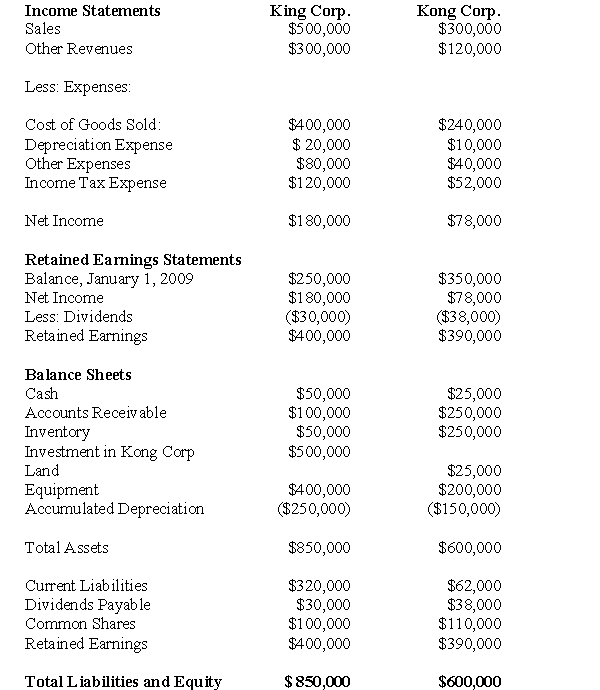 Other Information:
King sold a tract of Land to Kong at a profit of $10,000 during 2009.This land is still the property of Kong Corp.
On January 1,2009,Kong sold equipment to King at a price that was $20,000 higher than its book value.The equipment had a remaining useful life of 4 years from that date.
On January 1,2009 King's inventories contained items purchased from Kong for $10,000.This entire inventory was sold to outsiders during the year.Also during 2009,King sold Inventory to Kong for $50,000.Half this inventory is still in Kong's warehouse at year end.All sales are priced at a 25% mark-up above cost,regardless of whether the sales are internal or external.
Kong's Retained Earnings on the date of acquisition amounted to $250,000.There have been no changes to the company's common shares account.
Kong's book values did not differ materially from its fair values on the date of acquisition with the following exceptions:
▫ Inventory had a Fair value that was $20,000 higher than its book value.This inventory was sold to outsiders during 2009.
▫ A Patent (which had not previously been accounted for)was identified on the acquisition date with an estimated fair value of $15,000.The patent had an estimated useful life of 3 years.
▫ There was a goodwill impairment loss of $4,000 during 2009.
▫ Both companies are subject to an effective tax rate of 40%.
▫ Both companies use straight line amortization.
-What amount of sales revenue would appear on King's Consolidated Income Statement for the year ended December 31,2009?
A)$750,000
B)$790,000
C)$800,000
D)$810,000
King Corp.owns 80% of Kong Corp and uses the cost method to account for its investment,which it acquired on January 1,2009.The Financial Statements of King Corp and Kong Corp for the Year ended December 31,2009 are shown below:
Other Information:King sold a tract of Land to Kong at a profit of $10,000 during 2009.This land is still the property of Kong Corp.
On January 1,2009,Kong sold equipment to King at a price that was $20,000 higher than its book value.The equipment had a remaining useful life of 4 years from that date.
On January 1,2009 King's inventories contained items purchased from Kong for $10,000.This entire inventory was sold to outsiders during the year.Also during 2009,King sold Inventory to Kong for $50,000.Half this inventory is still in Kong's warehouse at year end.All sales are priced at a 25% mark-up above cost,regardless of whether the sales are internal or external.
Kong's Retained Earnings on the date of acquisition amounted to $250,000.There have been no changes to the company's common shares account.
Kong's book values did not differ materially from its fair values on the date of acquisition with the following exceptions:
▫ Inventory had a Fair value that was $20,000 higher than its book value.This inventory was sold to outsiders during 2009.
▫ A Patent (which had not previously been accounted for)was identified on the acquisition date with an estimated fair value of $15,000.The patent had an estimated useful life of 3 years.
▫ There was a goodwill impairment loss of $4,000 during 2009.
▫ Both companies are subject to an effective tax rate of 40%.
▫ Both companies use straight line amortization.
-What amount of sales revenue would appear on King's Consolidated Income Statement for the year ended December 31,2009?
A)$750,000
B)$790,000
C)$800,000
D)$810,000
Question
Question
Question
Question
Question
The following information pertains to questions
King Corp.owns 80% of Kong Corp and uses the cost method to account for its investment,which it acquired on January 1,2009.The Financial Statements of King Corp and Kong Corp for the Year ended December 31,2009 are shown below: Other Information:
King sold a tract of Land to Kong at a profit of $10,000 during 2009.This land is still the property of Kong Corp.
On January 1,2009,Kong sold equipment to King at a price that was $20,000 higher than its book value.The equipment had a remaining useful life of 4 years from that date.
On January 1,2009 King's inventories contained items purchased from Kong for $10,000.This entire inventory was sold to outsiders during the year.Also during 2009,King sold Inventory to Kong for $50,000.Half this inventory is still in Kong's warehouse at year end.All sales are priced at a 25% mark-up above cost,regardless of whether the sales are internal or external.
Kong's Retained Earnings on the date of acquisition amounted to $250,000.There have been no changes to the company's common shares account.
Kong's book values did not differ materially from its fair values on the date of acquisition with the following exceptions:
▫ Inventory had a Fair value that was $20,000 higher than its book value.This inventory was sold to outsiders during 2009.
▫ A Patent (which had not previously been accounted for)was identified on the acquisition date with an estimated fair value of $15,000.The patent had an estimated useful life of 3 years.
▫ There was a goodwill impairment loss of $4,000 during 2009.
▫ Both companies are subject to an effective tax rate of 40%.
▫ Both companies use straight line amortization.
-The amount of goodwill appearing on King's December 31,2009 Consolidated Statement of Financial Position would be:
A)Nil
B)$126,000
C)$240,000
D)$224,000
King Corp.owns 80% of Kong Corp and uses the cost method to account for its investment,which it acquired on January 1,2009.The Financial Statements of King Corp and Kong Corp for the Year ended December 31,2009 are shown below:
Other Information:King sold a tract of Land to Kong at a profit of $10,000 during 2009.This land is still the property of Kong Corp.
On January 1,2009,Kong sold equipment to King at a price that was $20,000 higher than its book value.The equipment had a remaining useful life of 4 years from that date.
On January 1,2009 King's inventories contained items purchased from Kong for $10,000.This entire inventory was sold to outsiders during the year.Also during 2009,King sold Inventory to Kong for $50,000.Half this inventory is still in Kong's warehouse at year end.All sales are priced at a 25% mark-up above cost,regardless of whether the sales are internal or external.
Kong's Retained Earnings on the date of acquisition amounted to $250,000.There have been no changes to the company's common shares account.
Kong's book values did not differ materially from its fair values on the date of acquisition with the following exceptions:
▫ Inventory had a Fair value that was $20,000 higher than its book value.This inventory was sold to outsiders during 2009.
▫ A Patent (which had not previously been accounted for)was identified on the acquisition date with an estimated fair value of $15,000.The patent had an estimated useful life of 3 years.
▫ There was a goodwill impairment loss of $4,000 during 2009.
▫ Both companies are subject to an effective tax rate of 40%.
▫ Both companies use straight line amortization.
-The amount of goodwill appearing on King's December 31,2009 Consolidated Statement of Financial Position would be:
A)Nil
B)$126,000
C)$240,000
D)$224,000
Question
Question
Question
Question
The following information pertains to questions
King Corp.owns 80% of Kong Corp and uses the cost method to account for its investment,which it acquired on January 1,2009.The Financial Statements of King Corp and Kong Corp for the Year ended December 31,2009 are shown below: Other Information:
King sold a tract of Land to Kong at a profit of $10,000 during 2009.This land is still the property of Kong Corp.
On January 1,2009,Kong sold equipment to King at a price that was $20,000 higher than its book value.The equipment had a remaining useful life of 4 years from that date.
On January 1,2009 King's inventories contained items purchased from Kong for $10,000.This entire inventory was sold to outsiders during the year.Also during 2009,King sold Inventory to Kong for $50,000.Half this inventory is still in Kong's warehouse at year end.All sales are priced at a 25% mark-up above cost,regardless of whether the sales are internal or external.
Kong's Retained Earnings on the date of acquisition amounted to $250,000.There have been no changes to the company's common shares account.
Kong's book values did not differ materially from its fair values on the date of acquisition with the following exceptions:
▫ Inventory had a Fair value that was $20,000 higher than its book value.This inventory was sold to outsiders during 2009.
▫ A Patent (which had not previously been accounted for)was identified on the acquisition date with an estimated fair value of $15,000.The patent had an estimated useful life of 3 years.
▫ There was a goodwill impairment loss of $4,000 during 2009.
▫ Both companies are subject to an effective tax rate of 40%.
▫ Both companies use straight line amortization.
-The amount of goodwill arising from this business combination is:
A)Nil.
B)$130,000
C)$72,000
D)$220,000
King Corp.owns 80% of Kong Corp and uses the cost method to account for its investment,which it acquired on January 1,2009.The Financial Statements of King Corp and Kong Corp for the Year ended December 31,2009 are shown below:
Other Information:King sold a tract of Land to Kong at a profit of $10,000 during 2009.This land is still the property of Kong Corp.
On January 1,2009,Kong sold equipment to King at a price that was $20,000 higher than its book value.The equipment had a remaining useful life of 4 years from that date.
On January 1,2009 King's inventories contained items purchased from Kong for $10,000.This entire inventory was sold to outsiders during the year.Also during 2009,King sold Inventory to Kong for $50,000.Half this inventory is still in Kong's warehouse at year end.All sales are priced at a 25% mark-up above cost,regardless of whether the sales are internal or external.
Kong's Retained Earnings on the date of acquisition amounted to $250,000.There have been no changes to the company's common shares account.
Kong's book values did not differ materially from its fair values on the date of acquisition with the following exceptions:
▫ Inventory had a Fair value that was $20,000 higher than its book value.This inventory was sold to outsiders during 2009.
▫ A Patent (which had not previously been accounted for)was identified on the acquisition date with an estimated fair value of $15,000.The patent had an estimated useful life of 3 years.
▫ There was a goodwill impairment loss of $4,000 during 2009.
▫ Both companies are subject to an effective tax rate of 40%.
▫ Both companies use straight line amortization.
-The amount of goodwill arising from this business combination is:
A)Nil.
B)$130,000
C)$72,000
D)$220,000
Question
Question
Question
Question
Question
Question
The following information pertains to questions
King Corp.owns 80% of Kong Corp and uses the cost method to account for its investment,which it acquired on January 1,2009.The Financial Statements of King Corp and Kong Corp for the Year ended December 31,2009 are shown below: Other Information:
King sold a tract of Land to Kong at a profit of $10,000 during 2009.This land is still the property of Kong Corp.
On January 1,2009,Kong sold equipment to King at a price that was $20,000 higher than its book value.The equipment had a remaining useful life of 4 years from that date.
On January 1,2009 King's inventories contained items purchased from Kong for $10,000.This entire inventory was sold to outsiders during the year.Also during 2009,King sold Inventory to Kong for $50,000.Half this inventory is still in Kong's warehouse at year end.All sales are priced at a 25% mark-up above cost,regardless of whether the sales are internal or external.
Kong's Retained Earnings on the date of acquisition amounted to $250,000.There have been no changes to the company's common shares account.
Kong's book values did not differ materially from its fair values on the date of acquisition with the following exceptions:
▫ Inventory had a Fair value that was $20,000 higher than its book value.This inventory was sold to outsiders during 2009.
▫ A Patent (which had not previously been accounted for)was identified on the acquisition date with an estimated fair value of $15,000.The patent had an estimated useful life of 3 years.
▫ There was a goodwill impairment loss of $4,000 during 2009.
▫ Both companies are subject to an effective tax rate of 40%.
▫ Both companies use straight line amortization.
-What would be the journal entry to record the dividends received by King Corp during the year?
A)Cash $30,000 Investment in Kong $30,000
B)Cash $30,400 Investment in Kong $30,400
C)Cash $30,400 Dividend Revenue $30,400
D)No entry.
King Corp.owns 80% of Kong Corp and uses the cost method to account for its investment,which it acquired on January 1,2009.The Financial Statements of King Corp and Kong Corp for the Year ended December 31,2009 are shown below:
Other Information:King sold a tract of Land to Kong at a profit of $10,000 during 2009.This land is still the property of Kong Corp.
On January 1,2009,Kong sold equipment to King at a price that was $20,000 higher than its book value.The equipment had a remaining useful life of 4 years from that date.
On January 1,2009 King's inventories contained items purchased from Kong for $10,000.This entire inventory was sold to outsiders during the year.Also during 2009,King sold Inventory to Kong for $50,000.Half this inventory is still in Kong's warehouse at year end.All sales are priced at a 25% mark-up above cost,regardless of whether the sales are internal or external.
Kong's Retained Earnings on the date of acquisition amounted to $250,000.There have been no changes to the company's common shares account.
Kong's book values did not differ materially from its fair values on the date of acquisition with the following exceptions:
▫ Inventory had a Fair value that was $20,000 higher than its book value.This inventory was sold to outsiders during 2009.
▫ A Patent (which had not previously been accounted for)was identified on the acquisition date with an estimated fair value of $15,000.The patent had an estimated useful life of 3 years.
▫ There was a goodwill impairment loss of $4,000 during 2009.
▫ Both companies are subject to an effective tax rate of 40%.
▫ Both companies use straight line amortization.
-What would be the journal entry to record the dividends received by King Corp during the year?
A)Cash $30,000 Investment in Kong $30,000
B)Cash $30,400 Investment in Kong $30,400
C)Cash $30,400 Dividend Revenue $30,400
D)No entry.
Question
Question
The following information pertains to questions
King Corp.owns 80% of Kong Corp and uses the cost method to account for its investment,which it acquired on January 1,2009.The Financial Statements of King Corp and Kong Corp for the Year ended December 31,2009 are shown below: Other Information:
King sold a tract of Land to Kong at a profit of $10,000 during 2009.This land is still the property of Kong Corp.
On January 1,2009,Kong sold equipment to King at a price that was $20,000 higher than its book value.The equipment had a remaining useful life of 4 years from that date.
On January 1,2009 King's inventories contained items purchased from Kong for $10,000.This entire inventory was sold to outsiders during the year.Also during 2009,King sold Inventory to Kong for $50,000.Half this inventory is still in Kong's warehouse at year end.All sales are priced at a 25% mark-up above cost,regardless of whether the sales are internal or external.
Kong's Retained Earnings on the date of acquisition amounted to $250,000.There have been no changes to the company's common shares account.
Kong's book values did not differ materially from its fair values on the date of acquisition with the following exceptions:
▫ Inventory had a Fair value that was $20,000 higher than its book value.This inventory was sold to outsiders during 2009.
▫ A Patent (which had not previously been accounted for)was identified on the acquisition date with an estimated fair value of $15,000.The patent had an estimated useful life of 3 years.
▫ There was a goodwill impairment loss of $4,000 during 2009.
▫ Both companies are subject to an effective tax rate of 40%.
▫ Both companies use straight line amortization.
-Ignoring taxes,what is the total amount of pre-tax profit from intercompany inventory sales that was realized during 2009?
A)$10,000
B)$2,000
C)$5,000
D)$7,000
King Corp.owns 80% of Kong Corp and uses the cost method to account for its investment,which it acquired on January 1,2009.The Financial Statements of King Corp and Kong Corp for the Year ended December 31,2009 are shown below:
Other Information:King sold a tract of Land to Kong at a profit of $10,000 during 2009.This land is still the property of Kong Corp.
On January 1,2009,Kong sold equipment to King at a price that was $20,000 higher than its book value.The equipment had a remaining useful life of 4 years from that date.
On January 1,2009 King's inventories contained items purchased from Kong for $10,000.This entire inventory was sold to outsiders during the year.Also during 2009,King sold Inventory to Kong for $50,000.Half this inventory is still in Kong's warehouse at year end.All sales are priced at a 25% mark-up above cost,regardless of whether the sales are internal or external.
Kong's Retained Earnings on the date of acquisition amounted to $250,000.There have been no changes to the company's common shares account.
Kong's book values did not differ materially from its fair values on the date of acquisition with the following exceptions:
▫ Inventory had a Fair value that was $20,000 higher than its book value.This inventory was sold to outsiders during 2009.
▫ A Patent (which had not previously been accounted for)was identified on the acquisition date with an estimated fair value of $15,000.The patent had an estimated useful life of 3 years.
▫ There was a goodwill impairment loss of $4,000 during 2009.
▫ Both companies are subject to an effective tax rate of 40%.
▫ Both companies use straight line amortization.
-Ignoring taxes,what is the total amount of pre-tax profit from intercompany inventory sales that was realized during 2009?
A)$10,000
B)$2,000
C)$5,000
D)$7,000
Question
The following information pertains to questions
Ting Corp.owns 75% of Won Corp and uses the Cost Method to account for its Investment,which it acquired on January 1,2010 The Financial Statements of Ting Corp and Won Corp for the Year ended December 31,2010 are shown below: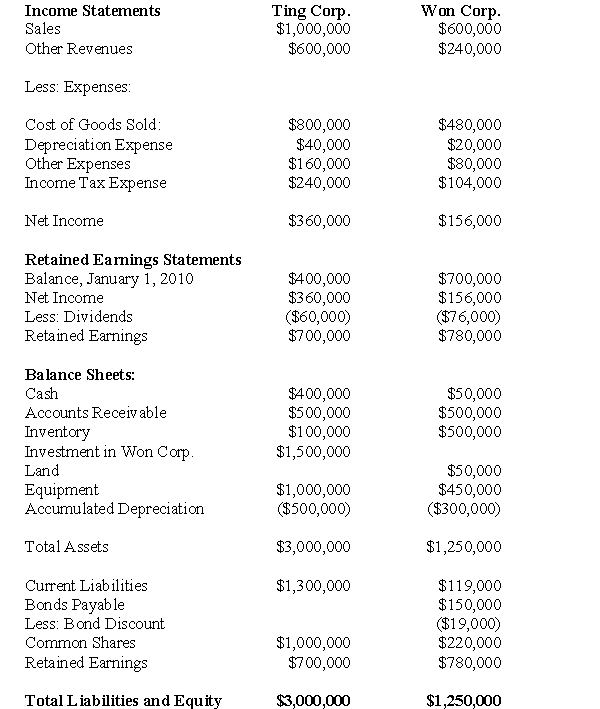 Other Information:
Won sold a tract of land to Ting at a profit of $20,000 during 2010.This land is still the property of Ting Corp.
On January 1,2010,Won sold equipment to Ting at a price that was $20,000 lower than its book value.The equipment had a remaining useful life of 5 years from that date.
On January 1,2010,Won's inventories contained items purchased from Ting for $120,000.This entire inventory was sold to outsiders during the year.Also during 2010,Won sold inventory to Ting for $30,000.Half this inventory is still in Ting's warehouse at year end.All sales are priced at a 20% mark-up above cost,regardless of whether the sales are internal or external.
Won's Retained Earnings on the date of acquisition amounted to $400,000.There have been no changes to the company's common shares account.
Won's book values did not differ materially from its fair values on the date of acquisition with the following exceptions:
▫ Inventory had a fair value that was $50,000 higher than its book value
▫ A patent (which had not previously been accounted for)was identified on the acquisition date with an estimated fair value of $20,000.The patent had an estimated useful life of 5 years.
▫ There was a goodwill impairment loss of $10,000 during 2010
▫ Both companies are subject to an effective tax rate of 40%.
▫ Both companies use straight line amortization exclusively.
▫ On January 1,2010,Ting acquired half of Won's bonds for $60,000
▫ The bonds carry a coupon rate of 10% and mature on January 1,2030.The initial bond issue took place on January 1,2010.The total discount on the issue date of the bonds was $20,000.
▫ Gains and losses from intercompany bondholdings are to be allocated to the two companies when consolidated statements are prepared.
-What would be the carrying value of the bonds payable appearing on Ting's December 31,2010 Consolidated Statement of Financial Position?
A)$130,000
B)$65,000
C)$64,500
D)$65,500
Ting Corp.owns 75% of Won Corp and uses the Cost Method to account for its Investment,which it acquired on January 1,2010 The Financial Statements of Ting Corp and Won Corp for the Year ended December 31,2010 are shown below:
Other Information:Won sold a tract of land to Ting at a profit of $20,000 during 2010.This land is still the property of Ting Corp.
On January 1,2010,Won sold equipment to Ting at a price that was $20,000 lower than its book value.The equipment had a remaining useful life of 5 years from that date.
On January 1,2010,Won's inventories contained items purchased from Ting for $120,000.This entire inventory was sold to outsiders during the year.Also during 2010,Won sold inventory to Ting for $30,000.Half this inventory is still in Ting's warehouse at year end.All sales are priced at a 20% mark-up above cost,regardless of whether the sales are internal or external.
Won's Retained Earnings on the date of acquisition amounted to $400,000.There have been no changes to the company's common shares account.
Won's book values did not differ materially from its fair values on the date of acquisition with the following exceptions:
▫ Inventory had a fair value that was $50,000 higher than its book value
▫ A patent (which had not previously been accounted for)was identified on the acquisition date with an estimated fair value of $20,000.The patent had an estimated useful life of 5 years.
▫ There was a goodwill impairment loss of $10,000 during 2010
▫ Both companies are subject to an effective tax rate of 40%.
▫ Both companies use straight line amortization exclusively.
▫ On January 1,2010,Ting acquired half of Won's bonds for $60,000
▫ The bonds carry a coupon rate of 10% and mature on January 1,2030.The initial bond issue took place on January 1,2010.The total discount on the issue date of the bonds was $20,000.
▫ Gains and losses from intercompany bondholdings are to be allocated to the two companies when consolidated statements are prepared.
-What would be the carrying value of the bonds payable appearing on Ting's December 31,2010 Consolidated Statement of Financial Position?
A)$130,000
B)$65,000
C)$64,500
D)$65,500
Question
The following information pertains to questions
King Corp.owns 80% of Kong Corp and uses the cost method to account for its investment,which it acquired on January 1,2009.The Financial Statements of King Corp and Kong Corp for the Year ended December 31,2009 are shown below: Other Information:
King sold a tract of Land to Kong at a profit of $10,000 during 2009.This land is still the property of Kong Corp.
On January 1,2009,Kong sold equipment to King at a price that was $20,000 higher than its book value.The equipment had a remaining useful life of 4 years from that date.
On January 1,2009 King's inventories contained items purchased from Kong for $10,000.This entire inventory was sold to outsiders during the year.Also during 2009,King sold Inventory to Kong for $50,000.Half this inventory is still in Kong's warehouse at year end.All sales are priced at a 25% mark-up above cost,regardless of whether the sales are internal or external.
Kong's Retained Earnings on the date of acquisition amounted to $250,000.There have been no changes to the company's common shares account.
Kong's book values did not differ materially from its fair values on the date of acquisition with the following exceptions:
▫ Inventory had a Fair value that was $20,000 higher than its book value.This inventory was sold to outsiders during 2009.
▫ A Patent (which had not previously been accounted for)was identified on the acquisition date with an estimated fair value of $15,000.The patent had an estimated useful life of 3 years.
▫ There was a goodwill impairment loss of $4,000 during 2009.
▫ Both companies are subject to an effective tax rate of 40%.
▫ Both companies use straight line amortization.
-What would be the non-controlling interest amount appearing on King's Consolidated Income Statement for 2009?
A)$78,000
B)$11,600
C)$12,000
D)$10,000
King Corp.owns 80% of Kong Corp and uses the cost method to account for its investment,which it acquired on January 1,2009.The Financial Statements of King Corp and Kong Corp for the Year ended December 31,2009 are shown below:
Other Information:King sold a tract of Land to Kong at a profit of $10,000 during 2009.This land is still the property of Kong Corp.
On January 1,2009,Kong sold equipment to King at a price that was $20,000 higher than its book value.The equipment had a remaining useful life of 4 years from that date.
On January 1,2009 King's inventories contained items purchased from Kong for $10,000.This entire inventory was sold to outsiders during the year.Also during 2009,King sold Inventory to Kong for $50,000.Half this inventory is still in Kong's warehouse at year end.All sales are priced at a 25% mark-up above cost,regardless of whether the sales are internal or external.
Kong's Retained Earnings on the date of acquisition amounted to $250,000.There have been no changes to the company's common shares account.
Kong's book values did not differ materially from its fair values on the date of acquisition with the following exceptions:
▫ Inventory had a Fair value that was $20,000 higher than its book value.This inventory was sold to outsiders during 2009.
▫ A Patent (which had not previously been accounted for)was identified on the acquisition date with an estimated fair value of $15,000.The patent had an estimated useful life of 3 years.
▫ There was a goodwill impairment loss of $4,000 during 2009.
▫ Both companies are subject to an effective tax rate of 40%.
▫ Both companies use straight line amortization.
-What would be the non-controlling interest amount appearing on King's Consolidated Income Statement for 2009?
A)$78,000
B)$11,600
C)$12,000
D)$10,000
Question
The following information pertains to questions
Ting Corp.owns 75% of Won Corp and uses the Cost Method to account for its Investment,which it acquired on January 1,2010 The Financial Statements of Ting Corp and Won Corp for the Year ended December 31,2010 are shown below: Other Information:
Won sold a tract of land to Ting at a profit of $20,000 during 2010.This land is still the property of Ting Corp.
On January 1,2010,Won sold equipment to Ting at a price that was $20,000 lower than its book value.The equipment had a remaining useful life of 5 years from that date.
On January 1,2010,Won's inventories contained items purchased from Ting for $120,000.This entire inventory was sold to outsiders during the year.Also during 2010,Won sold inventory to Ting for $30,000.Half this inventory is still in Ting's warehouse at year end.All sales are priced at a 20% mark-up above cost,regardless of whether the sales are internal or external.
Won's Retained Earnings on the date of acquisition amounted to $400,000.There have been no changes to the company's common shares account.
Won's book values did not differ materially from its fair values on the date of acquisition with the following exceptions:
▫ Inventory had a fair value that was $50,000 higher than its book value
▫ A patent (which had not previously been accounted for)was identified on the acquisition date with an estimated fair value of $20,000.The patent had an estimated useful life of 5 years.
▫ There was a goodwill impairment loss of $10,000 during 2010
▫ Both companies are subject to an effective tax rate of 40%.
▫ Both companies use straight line amortization exclusively.
▫ On January 1,2010,Ting acquired half of Won's bonds for $60,000
▫ The bonds carry a coupon rate of 10% and mature on January 1,2030.The initial bond issue took place on January 1,2010.The total discount on the issue date of the bonds was $20,000.
▫ Gains and losses from intercompany bondholdings are to be allocated to the two companies when consolidated statements are prepared.
-What amount of sales revenue would appear on Ting's Consolidated Income Statement for the year ended December 31,2010?
A)$1,600,000
B)$1,480,000
C)$1,450,000
D)$1,570,000
Ting Corp.owns 75% of Won Corp and uses the Cost Method to account for its Investment,which it acquired on January 1,2010 The Financial Statements of Ting Corp and Won Corp for the Year ended December 31,2010 are shown below:
Other Information:Won sold a tract of land to Ting at a profit of $20,000 during 2010.This land is still the property of Ting Corp.
On January 1,2010,Won sold equipment to Ting at a price that was $20,000 lower than its book value.The equipment had a remaining useful life of 5 years from that date.
On January 1,2010,Won's inventories contained items purchased from Ting for $120,000.This entire inventory was sold to outsiders during the year.Also during 2010,Won sold inventory to Ting for $30,000.Half this inventory is still in Ting's warehouse at year end.All sales are priced at a 20% mark-up above cost,regardless of whether the sales are internal or external.
Won's Retained Earnings on the date of acquisition amounted to $400,000.There have been no changes to the company's common shares account.
Won's book values did not differ materially from its fair values on the date of acquisition with the following exceptions:
▫ Inventory had a fair value that was $50,000 higher than its book value
▫ A patent (which had not previously been accounted for)was identified on the acquisition date with an estimated fair value of $20,000.The patent had an estimated useful life of 5 years.
▫ There was a goodwill impairment loss of $10,000 during 2010
▫ Both companies are subject to an effective tax rate of 40%.
▫ Both companies use straight line amortization exclusively.
▫ On January 1,2010,Ting acquired half of Won's bonds for $60,000
▫ The bonds carry a coupon rate of 10% and mature on January 1,2030.The initial bond issue took place on January 1,2010.The total discount on the issue date of the bonds was $20,000.
▫ Gains and losses from intercompany bondholdings are to be allocated to the two companies when consolidated statements are prepared.
-What amount of sales revenue would appear on Ting's Consolidated Income Statement for the year ended December 31,2010?
A)$1,600,000
B)$1,480,000
C)$1,450,000
D)$1,570,000
Question
The following information pertains to questions
King Corp.owns 80% of Kong Corp and uses the cost method to account for its investment,which it acquired on January 1,2009.The Financial Statements of King Corp and Kong Corp for the Year ended December 31,2009 are shown below: Other Information:
King sold a tract of Land to Kong at a profit of $10,000 during 2009.This land is still the property of Kong Corp.
On January 1,2009,Kong sold equipment to King at a price that was $20,000 higher than its book value.The equipment had a remaining useful life of 4 years from that date.
On January 1,2009 King's inventories contained items purchased from Kong for $10,000.This entire inventory was sold to outsiders during the year.Also during 2009,King sold Inventory to Kong for $50,000.Half this inventory is still in Kong's warehouse at year end.All sales are priced at a 25% mark-up above cost,regardless of whether the sales are internal or external.
Kong's Retained Earnings on the date of acquisition amounted to $250,000.There have been no changes to the company's common shares account.
Kong's book values did not differ materially from its fair values on the date of acquisition with the following exceptions:
▫ Inventory had a Fair value that was $20,000 higher than its book value.This inventory was sold to outsiders during 2009.
▫ A Patent (which had not previously been accounted for)was identified on the acquisition date with an estimated fair value of $15,000.The patent had an estimated useful life of 3 years.
▫ There was a goodwill impairment loss of $4,000 during 2009.
▫ Both companies are subject to an effective tax rate of 40%.
▫ Both companies use straight line amortization.
-What would be the amount appearing for accumulated depreciation - equipment on King's 2009 Consolidated Statement of Financial Position?
A)$390,000
B)$400,000
C)$395,000
D)$391,000
King Corp.owns 80% of Kong Corp and uses the cost method to account for its investment,which it acquired on January 1,2009.The Financial Statements of King Corp and Kong Corp for the Year ended December 31,2009 are shown below:
Other Information:King sold a tract of Land to Kong at a profit of $10,000 during 2009.This land is still the property of Kong Corp.
On January 1,2009,Kong sold equipment to King at a price that was $20,000 higher than its book value.The equipment had a remaining useful life of 4 years from that date.
On January 1,2009 King's inventories contained items purchased from Kong for $10,000.This entire inventory was sold to outsiders during the year.Also during 2009,King sold Inventory to Kong for $50,000.Half this inventory is still in Kong's warehouse at year end.All sales are priced at a 25% mark-up above cost,regardless of whether the sales are internal or external.
Kong's Retained Earnings on the date of acquisition amounted to $250,000.There have been no changes to the company's common shares account.
Kong's book values did not differ materially from its fair values on the date of acquisition with the following exceptions:
▫ Inventory had a Fair value that was $20,000 higher than its book value.This inventory was sold to outsiders during 2009.
▫ A Patent (which had not previously been accounted for)was identified on the acquisition date with an estimated fair value of $15,000.The patent had an estimated useful life of 3 years.
▫ There was a goodwill impairment loss of $4,000 during 2009.
▫ Both companies are subject to an effective tax rate of 40%.
▫ Both companies use straight line amortization.
-What would be the amount appearing for accumulated depreciation - equipment on King's 2009 Consolidated Statement of Financial Position?
A)$390,000
B)$400,000
C)$395,000
D)$391,000
Question
The following information pertains to questions
King Corp.owns 80% of Kong Corp and uses the cost method to account for its investment,which it acquired on January 1,2009.The Financial Statements of King Corp and Kong Corp for the Year ended December 31,2009 are shown below: Other Information:
King sold a tract of Land to Kong at a profit of $10,000 during 2009.This land is still the property of Kong Corp.
On January 1,2009,Kong sold equipment to King at a price that was $20,000 higher than its book value.The equipment had a remaining useful life of 4 years from that date.
On January 1,2009 King's inventories contained items purchased from Kong for $10,000.This entire inventory was sold to outsiders during the year.Also during 2009,King sold Inventory to Kong for $50,000.Half this inventory is still in Kong's warehouse at year end.All sales are priced at a 25% mark-up above cost,regardless of whether the sales are internal or external.
Kong's Retained Earnings on the date of acquisition amounted to $250,000.There have been no changes to the company's common shares account.
Kong's book values did not differ materially from its fair values on the date of acquisition with the following exceptions:
▫ Inventory had a Fair value that was $20,000 higher than its book value.This inventory was sold to outsiders during 2009.
▫ A Patent (which had not previously been accounted for)was identified on the acquisition date with an estimated fair value of $15,000.The patent had an estimated useful life of 3 years.
▫ There was a goodwill impairment loss of $4,000 during 2009.
▫ Both companies are subject to an effective tax rate of 40%.
▫ Both companies use straight line amortization.
-Ignoring income taxes and any minority interest effects,what is the amount of unrealized profit remaining from the intercompany sale of equipment at December 31,2009?
A)Nil
B)$15,000
C)$20,000
D)$10,000
King Corp.owns 80% of Kong Corp and uses the cost method to account for its investment,which it acquired on January 1,2009.The Financial Statements of King Corp and Kong Corp for the Year ended December 31,2009 are shown below:
Other Information:King sold a tract of Land to Kong at a profit of $10,000 during 2009.This land is still the property of Kong Corp.
On January 1,2009,Kong sold equipment to King at a price that was $20,000 higher than its book value.The equipment had a remaining useful life of 4 years from that date.
On January 1,2009 King's inventories contained items purchased from Kong for $10,000.This entire inventory was sold to outsiders during the year.Also during 2009,King sold Inventory to Kong for $50,000.Half this inventory is still in Kong's warehouse at year end.All sales are priced at a 25% mark-up above cost,regardless of whether the sales are internal or external.
Kong's Retained Earnings on the date of acquisition amounted to $250,000.There have been no changes to the company's common shares account.
Kong's book values did not differ materially from its fair values on the date of acquisition with the following exceptions:
▫ Inventory had a Fair value that was $20,000 higher than its book value.This inventory was sold to outsiders during 2009.
▫ A Patent (which had not previously been accounted for)was identified on the acquisition date with an estimated fair value of $15,000.The patent had an estimated useful life of 3 years.
▫ There was a goodwill impairment loss of $4,000 during 2009.
▫ Both companies are subject to an effective tax rate of 40%.
▫ Both companies use straight line amortization.
-Ignoring income taxes and any minority interest effects,what is the amount of unrealized profit remaining from the intercompany sale of equipment at December 31,2009?
A)Nil
B)$15,000
C)$20,000
D)$10,000
Question
The following information pertains to questions
Ting Corp.owns 75% of Won Corp and uses the Cost Method to account for its Investment,which it acquired on January 1,2010 The Financial Statements of Ting Corp and Won Corp for the Year ended December 31,2010 are shown below: Other Information:
Won sold a tract of land to Ting at a profit of $20,000 during 2010.This land is still the property of Ting Corp.
On January 1,2010,Won sold equipment to Ting at a price that was $20,000 lower than its book value.The equipment had a remaining useful life of 5 years from that date.
On January 1,2010,Won's inventories contained items purchased from Ting for $120,000.This entire inventory was sold to outsiders during the year.Also during 2010,Won sold inventory to Ting for $30,000.Half this inventory is still in Ting's warehouse at year end.All sales are priced at a 20% mark-up above cost,regardless of whether the sales are internal or external.
Won's Retained Earnings on the date of acquisition amounted to $400,000.There have been no changes to the company's common shares account.
Won's book values did not differ materially from its fair values on the date of acquisition with the following exceptions:
▫ Inventory had a fair value that was $50,000 higher than its book value
▫ A patent (which had not previously been accounted for)was identified on the acquisition date with an estimated fair value of $20,000.The patent had an estimated useful life of 5 years.
▫ There was a goodwill impairment loss of $10,000 during 2010
▫ Both companies are subject to an effective tax rate of 40%.
▫ Both companies use straight line amortization exclusively.
▫ On January 1,2010,Ting acquired half of Won's bonds for $60,000
▫ The bonds carry a coupon rate of 10% and mature on January 1,2030.The initial bond issue took place on January 1,2010.The total discount on the issue date of the bonds was $20,000.
▫ Gains and losses from intercompany bondholdings are to be allocated to the two companies when consolidated statements are prepared.
-What effect would the intercompany bond sale have on Ting?
A)Ting would record a loss $5,000.
B)Ting would record a gain of $15,000.
C)Ting would record a loss of $4,000.
D)Ting would record a gain of $14,000.
Ting Corp.owns 75% of Won Corp and uses the Cost Method to account for its Investment,which it acquired on January 1,2010 The Financial Statements of Ting Corp and Won Corp for the Year ended December 31,2010 are shown below:
Other Information:Won sold a tract of land to Ting at a profit of $20,000 during 2010.This land is still the property of Ting Corp.
On January 1,2010,Won sold equipment to Ting at a price that was $20,000 lower than its book value.The equipment had a remaining useful life of 5 years from that date.
On January 1,2010,Won's inventories contained items purchased from Ting for $120,000.This entire inventory was sold to outsiders during the year.Also during 2010,Won sold inventory to Ting for $30,000.Half this inventory is still in Ting's warehouse at year end.All sales are priced at a 20% mark-up above cost,regardless of whether the sales are internal or external.
Won's Retained Earnings on the date of acquisition amounted to $400,000.There have been no changes to the company's common shares account.
Won's book values did not differ materially from its fair values on the date of acquisition with the following exceptions:
▫ Inventory had a fair value that was $50,000 higher than its book value
▫ A patent (which had not previously been accounted for)was identified on the acquisition date with an estimated fair value of $20,000.The patent had an estimated useful life of 5 years.
▫ There was a goodwill impairment loss of $10,000 during 2010
▫ Both companies are subject to an effective tax rate of 40%.
▫ Both companies use straight line amortization exclusively.
▫ On January 1,2010,Ting acquired half of Won's bonds for $60,000
▫ The bonds carry a coupon rate of 10% and mature on January 1,2030.The initial bond issue took place on January 1,2010.The total discount on the issue date of the bonds was $20,000.
▫ Gains and losses from intercompany bondholdings are to be allocated to the two companies when consolidated statements are prepared.
-What effect would the intercompany bond sale have on Ting?
A)Ting would record a loss $5,000.
B)Ting would record a gain of $15,000.
C)Ting would record a loss of $4,000.
D)Ting would record a gain of $14,000.
Question
The following information pertains to questions
Ting Corp.owns 75% of Won Corp and uses the Cost Method to account for its Investment,which it acquired on January 1,2010 The Financial Statements of Ting Corp and Won Corp for the Year ended December 31,2010 are shown below: Other Information:
Won sold a tract of land to Ting at a profit of $20,000 during 2010.This land is still the property of Ting Corp.
On January 1,2010,Won sold equipment to Ting at a price that was $20,000 lower than its book value.The equipment had a remaining useful life of 5 years from that date.
On January 1,2010,Won's inventories contained items purchased from Ting for $120,000.This entire inventory was sold to outsiders during the year.Also during 2010,Won sold inventory to Ting for $30,000.Half this inventory is still in Ting's warehouse at year end.All sales are priced at a 20% mark-up above cost,regardless of whether the sales are internal or external.
Won's Retained Earnings on the date of acquisition amounted to $400,000.There have been no changes to the company's common shares account.
Won's book values did not differ materially from its fair values on the date of acquisition with the following exceptions:
▫ Inventory had a fair value that was $50,000 higher than its book value
▫ A patent (which had not previously been accounted for)was identified on the acquisition date with an estimated fair value of $20,000.The patent had an estimated useful life of 5 years.
▫ There was a goodwill impairment loss of $10,000 during 2010
▫ Both companies are subject to an effective tax rate of 40%.
▫ Both companies use straight line amortization exclusively.
▫ On January 1,2010,Ting acquired half of Won's bonds for $60,000
▫ The bonds carry a coupon rate of 10% and mature on January 1,2030.The initial bond issue took place on January 1,2010.The total discount on the issue date of the bonds was $20,000.
▫ Gains and losses from intercompany bondholdings are to be allocated to the two companies when consolidated statements are prepared.
-What effect would the intercompany bond sale have on Won?
A)Won would record a loss $10,000
B)Won would record a gain of $10,000
C)Won would record a loss of $14,000
D)Won would record a gain of $4,000
Ting Corp.owns 75% of Won Corp and uses the Cost Method to account for its Investment,which it acquired on January 1,2010 The Financial Statements of Ting Corp and Won Corp for the Year ended December 31,2010 are shown below:
Other Information:Won sold a tract of land to Ting at a profit of $20,000 during 2010.This land is still the property of Ting Corp.
On January 1,2010,Won sold equipment to Ting at a price that was $20,000 lower than its book value.The equipment had a remaining useful life of 5 years from that date.
On January 1,2010,Won's inventories contained items purchased from Ting for $120,000.This entire inventory was sold to outsiders during the year.Also during 2010,Won sold inventory to Ting for $30,000.Half this inventory is still in Ting's warehouse at year end.All sales are priced at a 20% mark-up above cost,regardless of whether the sales are internal or external.
Won's Retained Earnings on the date of acquisition amounted to $400,000.There have been no changes to the company's common shares account.
Won's book values did not differ materially from its fair values on the date of acquisition with the following exceptions:
▫ Inventory had a fair value that was $50,000 higher than its book value
▫ A patent (which had not previously been accounted for)was identified on the acquisition date with an estimated fair value of $20,000.The patent had an estimated useful life of 5 years.
▫ There was a goodwill impairment loss of $10,000 during 2010
▫ Both companies are subject to an effective tax rate of 40%.
▫ Both companies use straight line amortization exclusively.
▫ On January 1,2010,Ting acquired half of Won's bonds for $60,000
▫ The bonds carry a coupon rate of 10% and mature on January 1,2030.The initial bond issue took place on January 1,2010.The total discount on the issue date of the bonds was $20,000.
▫ Gains and losses from intercompany bondholdings are to be allocated to the two companies when consolidated statements are prepared.
-What effect would the intercompany bond sale have on Won?
A)Won would record a loss $10,000
B)Won would record a gain of $10,000
C)Won would record a loss of $14,000
D)Won would record a gain of $4,000
Question
The following information pertains to questions
Ting Corp.owns 75% of Won Corp and uses the Cost Method to account for its Investment,which it acquired on January 1,2010 The Financial Statements of Ting Corp and Won Corp for the Year ended December 31,2010 are shown below: Other Information:
Won sold a tract of land to Ting at a profit of $20,000 during 2010.This land is still the property of Ting Corp.
On January 1,2010,Won sold equipment to Ting at a price that was $20,000 lower than its book value.The equipment had a remaining useful life of 5 years from that date.
On January 1,2010,Won's inventories contained items purchased from Ting for $120,000.This entire inventory was sold to outsiders during the year.Also during 2010,Won sold inventory to Ting for $30,000.Half this inventory is still in Ting's warehouse at year end.All sales are priced at a 20% mark-up above cost,regardless of whether the sales are internal or external.
Won's Retained Earnings on the date of acquisition amounted to $400,000.There have been no changes to the company's common shares account.
Won's book values did not differ materially from its fair values on the date of acquisition with the following exceptions:
▫ Inventory had a fair value that was $50,000 higher than its book value
▫ A patent (which had not previously been accounted for)was identified on the acquisition date with an estimated fair value of $20,000.The patent had an estimated useful life of 5 years.
▫ There was a goodwill impairment loss of $10,000 during 2010
▫ Both companies are subject to an effective tax rate of 40%.
▫ Both companies use straight line amortization exclusively.
▫ On January 1,2010,Ting acquired half of Won's bonds for $60,000
▫ The bonds carry a coupon rate of 10% and mature on January 1,2030.The initial bond issue took place on January 1,2010.The total discount on the issue date of the bonds was $20,000.
▫ Gains and losses from intercompany bondholdings are to be allocated to the two companies when consolidated statements are prepared.
-What would be the amount of other revenue appearing on Ting's Consolidated Income Statement for the Year ended December 31,2010?
A)$840,000
B)$820,000
C)$815,000
D)$779,300
Ting Corp.owns 75% of Won Corp and uses the Cost Method to account for its Investment,which it acquired on January 1,2010 The Financial Statements of Ting Corp and Won Corp for the Year ended December 31,2010 are shown below:
Other Information:Won sold a tract of land to Ting at a profit of $20,000 during 2010.This land is still the property of Ting Corp.
On January 1,2010,Won sold equipment to Ting at a price that was $20,000 lower than its book value.The equipment had a remaining useful life of 5 years from that date.
On January 1,2010,Won's inventories contained items purchased from Ting for $120,000.This entire inventory was sold to outsiders during the year.Also during 2010,Won sold inventory to Ting for $30,000.Half this inventory is still in Ting's warehouse at year end.All sales are priced at a 20% mark-up above cost,regardless of whether the sales are internal or external.
Won's Retained Earnings on the date of acquisition amounted to $400,000.There have been no changes to the company's common shares account.
Won's book values did not differ materially from its fair values on the date of acquisition with the following exceptions:
▫ Inventory had a fair value that was $50,000 higher than its book value
▫ A patent (which had not previously been accounted for)was identified on the acquisition date with an estimated fair value of $20,000.The patent had an estimated useful life of 5 years.
▫ There was a goodwill impairment loss of $10,000 during 2010
▫ Both companies are subject to an effective tax rate of 40%.
▫ Both companies use straight line amortization exclusively.
▫ On January 1,2010,Ting acquired half of Won's bonds for $60,000
▫ The bonds carry a coupon rate of 10% and mature on January 1,2030.The initial bond issue took place on January 1,2010.The total discount on the issue date of the bonds was $20,000.
▫ Gains and losses from intercompany bondholdings are to be allocated to the two companies when consolidated statements are prepared.
-What would be the amount of other revenue appearing on Ting's Consolidated Income Statement for the Year ended December 31,2010?
A)$840,000
B)$820,000
C)$815,000
D)$779,300
Question
The following information pertains to questions
Ting Corp.owns 75% of Won Corp and uses the Cost Method to account for its Investment,which it acquired on January 1,2010 The Financial Statements of Ting Corp and Won Corp for the Year ended December 31,2010 are shown below: Other Information:
Won sold a tract of land to Ting at a profit of $20,000 during 2010.This land is still the property of Ting Corp.
On January 1,2010,Won sold equipment to Ting at a price that was $20,000 lower than its book value.The equipment had a remaining useful life of 5 years from that date.
On January 1,2010,Won's inventories contained items purchased from Ting for $120,000.This entire inventory was sold to outsiders during the year.Also during 2010,Won sold inventory to Ting for $30,000.Half this inventory is still in Ting's warehouse at year end.All sales are priced at a 20% mark-up above cost,regardless of whether the sales are internal or external.
Won's Retained Earnings on the date of acquisition amounted to $400,000.There have been no changes to the company's common shares account.
Won's book values did not differ materially from its fair values on the date of acquisition with the following exceptions:
▫ Inventory had a fair value that was $50,000 higher than its book value
▫ A patent (which had not previously been accounted for)was identified on the acquisition date with an estimated fair value of $20,000.The patent had an estimated useful life of 5 years.
▫ There was a goodwill impairment loss of $10,000 during 2010
▫ Both companies are subject to an effective tax rate of 40%.
▫ Both companies use straight line amortization exclusively.
▫ On January 1,2010,Ting acquired half of Won's bonds for $60,000
▫ The bonds carry a coupon rate of 10% and mature on January 1,2030.The initial bond issue took place on January 1,2010.The total discount on the issue date of the bonds was $20,000.
▫ Gains and losses from intercompany bondholdings are to be allocated to the two companies when consolidated statements are prepared.
-The amount of goodwill arising from this business combination is
A)$530,000
B)$500,000
C)$1,310,000
D)$300,000
Ting Corp.owns 75% of Won Corp and uses the Cost Method to account for its Investment,which it acquired on January 1,2010 The Financial Statements of Ting Corp and Won Corp for the Year ended December 31,2010 are shown below:
Other Information:Won sold a tract of land to Ting at a profit of $20,000 during 2010.This land is still the property of Ting Corp.
On January 1,2010,Won sold equipment to Ting at a price that was $20,000 lower than its book value.The equipment had a remaining useful life of 5 years from that date.
On January 1,2010,Won's inventories contained items purchased from Ting for $120,000.This entire inventory was sold to outsiders during the year.Also during 2010,Won sold inventory to Ting for $30,000.Half this inventory is still in Ting's warehouse at year end.All sales are priced at a 20% mark-up above cost,regardless of whether the sales are internal or external.
Won's Retained Earnings on the date of acquisition amounted to $400,000.There have been no changes to the company's common shares account.
Won's book values did not differ materially from its fair values on the date of acquisition with the following exceptions:
▫ Inventory had a fair value that was $50,000 higher than its book value
▫ A patent (which had not previously been accounted for)was identified on the acquisition date with an estimated fair value of $20,000.The patent had an estimated useful life of 5 years.
▫ There was a goodwill impairment loss of $10,000 during 2010
▫ Both companies are subject to an effective tax rate of 40%.
▫ Both companies use straight line amortization exclusively.
▫ On January 1,2010,Ting acquired half of Won's bonds for $60,000
▫ The bonds carry a coupon rate of 10% and mature on January 1,2030.The initial bond issue took place on January 1,2010.The total discount on the issue date of the bonds was $20,000.
▫ Gains and losses from intercompany bondholdings are to be allocated to the two companies when consolidated statements are prepared.
-The amount of goodwill arising from this business combination is
A)$530,000
B)$500,000
C)$1,310,000
D)$300,000
Question
The following information pertains to questions
King Corp.owns 80% of Kong Corp and uses the cost method to account for its investment,which it acquired on January 1,2009.The Financial Statements of King Corp and Kong Corp for the Year ended December 31,2009 are shown below: Other Information:
King sold a tract of Land to Kong at a profit of $10,000 during 2009.This land is still the property of Kong Corp.
On January 1,2009,Kong sold equipment to King at a price that was $20,000 higher than its book value.The equipment had a remaining useful life of 4 years from that date.
On January 1,2009 King's inventories contained items purchased from Kong for $10,000.This entire inventory was sold to outsiders during the year.Also during 2009,King sold Inventory to Kong for $50,000.Half this inventory is still in Kong's warehouse at year end.All sales are priced at a 25% mark-up above cost,regardless of whether the sales are internal or external.
Kong's Retained Earnings on the date of acquisition amounted to $250,000.There have been no changes to the company's common shares account.
Kong's book values did not differ materially from its fair values on the date of acquisition with the following exceptions:
▫ Inventory had a Fair value that was $20,000 higher than its book value.This inventory was sold to outsiders during 2009.
▫ A Patent (which had not previously been accounted for)was identified on the acquisition date with an estimated fair value of $15,000.The patent had an estimated useful life of 3 years.
▫ There was a goodwill impairment loss of $4,000 during 2009.
▫ Both companies are subject to an effective tax rate of 40%.
▫ Both companies use straight line amortization.
-Ignoring income taxes and any minority interest effects,what is the amount of profit realized during 2009 from the intercompany sale of equipment?
A)Nil
B)$5,000
C)$8,000
D)$4,000
King Corp.owns 80% of Kong Corp and uses the cost method to account for its investment,which it acquired on January 1,2009.The Financial Statements of King Corp and Kong Corp for the Year ended December 31,2009 are shown below:
Other Information:King sold a tract of Land to Kong at a profit of $10,000 during 2009.This land is still the property of Kong Corp.
On January 1,2009,Kong sold equipment to King at a price that was $20,000 higher than its book value.The equipment had a remaining useful life of 4 years from that date.
On January 1,2009 King's inventories contained items purchased from Kong for $10,000.This entire inventory was sold to outsiders during the year.Also during 2009,King sold Inventory to Kong for $50,000.Half this inventory is still in Kong's warehouse at year end.All sales are priced at a 25% mark-up above cost,regardless of whether the sales are internal or external.
Kong's Retained Earnings on the date of acquisition amounted to $250,000.There have been no changes to the company's common shares account.
Kong's book values did not differ materially from its fair values on the date of acquisition with the following exceptions:
▫ Inventory had a Fair value that was $20,000 higher than its book value.This inventory was sold to outsiders during 2009.
▫ A Patent (which had not previously been accounted for)was identified on the acquisition date with an estimated fair value of $15,000.The patent had an estimated useful life of 3 years.
▫ There was a goodwill impairment loss of $4,000 during 2009.
▫ Both companies are subject to an effective tax rate of 40%.
▫ Both companies use straight line amortization.
-Ignoring income taxes and any minority interest effects,what is the amount of profit realized during 2009 from the intercompany sale of equipment?
A)Nil
B)$5,000
C)$8,000
D)$4,000
Question
The following information pertains to questions
King Corp.owns 80% of Kong Corp and uses the cost method to account for its investment,which it acquired on January 1,2009.The Financial Statements of King Corp and Kong Corp for the Year ended December 31,2009 are shown below: Other Information:
King sold a tract of Land to Kong at a profit of $10,000 during 2009.This land is still the property of Kong Corp.
On January 1,2009,Kong sold equipment to King at a price that was $20,000 higher than its book value.The equipment had a remaining useful life of 4 years from that date.
On January 1,2009 King's inventories contained items purchased from Kong for $10,000.This entire inventory was sold to outsiders during the year.Also during 2009,King sold Inventory to Kong for $50,000.Half this inventory is still in Kong's warehouse at year end.All sales are priced at a 25% mark-up above cost,regardless of whether the sales are internal or external.
Kong's Retained Earnings on the date of acquisition amounted to $250,000.There have been no changes to the company's common shares account.
Kong's book values did not differ materially from its fair values on the date of acquisition with the following exceptions:
▫ Inventory had a Fair value that was $20,000 higher than its book value.This inventory was sold to outsiders during 2009.
▫ A Patent (which had not previously been accounted for)was identified on the acquisition date with an estimated fair value of $15,000.The patent had an estimated useful life of 3 years.
▫ There was a goodwill impairment loss of $4,000 during 2009.
▫ Both companies are subject to an effective tax rate of 40%.
▫ Both companies use straight line amortization.
-What would be the amount of consolidated patents appearing on King's Consolidated Statement of Financial Position as at December 31,2009?
A)10,000
B)$15,000
C)$8,000
D)$12,000
King Corp.owns 80% of Kong Corp and uses the cost method to account for its investment,which it acquired on January 1,2009.The Financial Statements of King Corp and Kong Corp for the Year ended December 31,2009 are shown below:
Other Information:King sold a tract of Land to Kong at a profit of $10,000 during 2009.This land is still the property of Kong Corp.
On January 1,2009,Kong sold equipment to King at a price that was $20,000 higher than its book value.The equipment had a remaining useful life of 4 years from that date.
On January 1,2009 King's inventories contained items purchased from Kong for $10,000.This entire inventory was sold to outsiders during the year.Also during 2009,King sold Inventory to Kong for $50,000.Half this inventory is still in Kong's warehouse at year end.All sales are priced at a 25% mark-up above cost,regardless of whether the sales are internal or external.
Kong's Retained Earnings on the date of acquisition amounted to $250,000.There have been no changes to the company's common shares account.
Kong's book values did not differ materially from its fair values on the date of acquisition with the following exceptions:
▫ Inventory had a Fair value that was $20,000 higher than its book value.This inventory was sold to outsiders during 2009.
▫ A Patent (which had not previously been accounted for)was identified on the acquisition date with an estimated fair value of $15,000.The patent had an estimated useful life of 3 years.
▫ There was a goodwill impairment loss of $4,000 during 2009.
▫ Both companies are subject to an effective tax rate of 40%.
▫ Both companies use straight line amortization.
-What would be the amount of consolidated patents appearing on King's Consolidated Statement of Financial Position as at December 31,2009?
A)10,000
B)$15,000
C)$8,000
D)$12,000
Question
The following information pertains to questions
King Corp.owns 80% of Kong Corp and uses the cost method to account for its investment,which it acquired on January 1,2009.The Financial Statements of King Corp and Kong Corp for the Year ended December 31,2009 are shown below: Other Information:
King sold a tract of Land to Kong at a profit of $10,000 during 2009.This land is still the property of Kong Corp.
On January 1,2009,Kong sold equipment to King at a price that was $20,000 higher than its book value.The equipment had a remaining useful life of 4 years from that date.
On January 1,2009 King's inventories contained items purchased from Kong for $10,000.This entire inventory was sold to outsiders during the year.Also during 2009,King sold Inventory to Kong for $50,000.Half this inventory is still in Kong's warehouse at year end.All sales are priced at a 25% mark-up above cost,regardless of whether the sales are internal or external.
Kong's Retained Earnings on the date of acquisition amounted to $250,000.There have been no changes to the company's common shares account.
Kong's book values did not differ materially from its fair values on the date of acquisition with the following exceptions:
▫ Inventory had a Fair value that was $20,000 higher than its book value.This inventory was sold to outsiders during 2009.
▫ A Patent (which had not previously been accounted for)was identified on the acquisition date with an estimated fair value of $15,000.The patent had an estimated useful life of 3 years.
▫ There was a goodwill impairment loss of $4,000 during 2009.
▫ Both companies are subject to an effective tax rate of 40%.
▫ Both companies use straight line amortization.
-What is the amount of unamortized acquisition differential on December 31,2009?
A)$10,000
B)$5,000
C)$8,000
D)$4,000
King Corp.owns 80% of Kong Corp and uses the cost method to account for its investment,which it acquired on January 1,2009.The Financial Statements of King Corp and Kong Corp for the Year ended December 31,2009 are shown below:
Other Information:King sold a tract of Land to Kong at a profit of $10,000 during 2009.This land is still the property of Kong Corp.
On January 1,2009,Kong sold equipment to King at a price that was $20,000 higher than its book value.The equipment had a remaining useful life of 4 years from that date.
On January 1,2009 King's inventories contained items purchased from Kong for $10,000.This entire inventory was sold to outsiders during the year.Also during 2009,King sold Inventory to Kong for $50,000.Half this inventory is still in Kong's warehouse at year end.All sales are priced at a 25% mark-up above cost,regardless of whether the sales are internal or external.
Kong's Retained Earnings on the date of acquisition amounted to $250,000.There have been no changes to the company's common shares account.
Kong's book values did not differ materially from its fair values on the date of acquisition with the following exceptions:
▫ Inventory had a Fair value that was $20,000 higher than its book value.This inventory was sold to outsiders during 2009.
▫ A Patent (which had not previously been accounted for)was identified on the acquisition date with an estimated fair value of $15,000.The patent had an estimated useful life of 3 years.
▫ There was a goodwill impairment loss of $4,000 during 2009.
▫ Both companies are subject to an effective tax rate of 40%.
▫ Both companies use straight line amortization.
-What is the amount of unamortized acquisition differential on December 31,2009?
A)$10,000
B)$5,000
C)$8,000
D)$4,000
Question
The following information pertains to questions
King Corp.owns 80% of Kong Corp and uses the cost method to account for its investment,which it acquired on January 1,2009.The Financial Statements of King Corp and Kong Corp for the Year ended December 31,2009 are shown below: Other Information:
King sold a tract of Land to Kong at a profit of $10,000 during 2009.This land is still the property of Kong Corp.
On January 1,2009,Kong sold equipment to King at a price that was $20,000 higher than its book value.The equipment had a remaining useful life of 4 years from that date.
On January 1,2009 King's inventories contained items purchased from Kong for $10,000.This entire inventory was sold to outsiders during the year.Also during 2009,King sold Inventory to Kong for $50,000.Half this inventory is still in Kong's warehouse at year end.All sales are priced at a 25% mark-up above cost,regardless of whether the sales are internal or external.
Kong's Retained Earnings on the date of acquisition amounted to $250,000.There have been no changes to the company's common shares account.
Kong's book values did not differ materially from its fair values on the date of acquisition with the following exceptions:
▫ Inventory had a Fair value that was $20,000 higher than its book value.This inventory was sold to outsiders during 2009.
▫ A Patent (which had not previously been accounted for)was identified on the acquisition date with an estimated fair value of $15,000.The patent had an estimated useful life of 3 years.
▫ There was a goodwill impairment loss of $4,000 during 2009.
▫ Both companies are subject to an effective tax rate of 40%.
▫ Both companies use straight line amortization.
-Ignoring taxes,what is the total amount of unrealized profits in inventory at the start of 2010?
A)Nil.
B)$10,000
C)$8,000
D)$2,000
King Corp.owns 80% of Kong Corp and uses the cost method to account for its investment,which it acquired on January 1,2009.The Financial Statements of King Corp and Kong Corp for the Year ended December 31,2009 are shown below:
Other Information:King sold a tract of Land to Kong at a profit of $10,000 during 2009.This land is still the property of Kong Corp.
On January 1,2009,Kong sold equipment to King at a price that was $20,000 higher than its book value.The equipment had a remaining useful life of 4 years from that date.
On January 1,2009 King's inventories contained items purchased from Kong for $10,000.This entire inventory was sold to outsiders during the year.Also during 2009,King sold Inventory to Kong for $50,000.Half this inventory is still in Kong's warehouse at year end.All sales are priced at a 25% mark-up above cost,regardless of whether the sales are internal or external.
Kong's Retained Earnings on the date of acquisition amounted to $250,000.There have been no changes to the company's common shares account.
Kong's book values did not differ materially from its fair values on the date of acquisition with the following exceptions:
▫ Inventory had a Fair value that was $20,000 higher than its book value.This inventory was sold to outsiders during 2009.
▫ A Patent (which had not previously been accounted for)was identified on the acquisition date with an estimated fair value of $15,000.The patent had an estimated useful life of 3 years.
▫ There was a goodwill impairment loss of $4,000 during 2009.
▫ Both companies are subject to an effective tax rate of 40%.
▫ Both companies use straight line amortization.
-Ignoring taxes,what is the total amount of unrealized profits in inventory at the start of 2010?
A)Nil.
B)$10,000
C)$8,000
D)$2,000
Question
The following information pertains to questions
Ting Corp.owns 75% of Won Corp and uses the Cost Method to account for its Investment,which it acquired on January 1,2010 The Financial Statements of Ting Corp and Won Corp for the Year ended December 31,2010 are shown below: Other Information:
Won sold a tract of land to Ting at a profit of $20,000 during 2010.This land is still the property of Ting Corp.
On January 1,2010,Won sold equipment to Ting at a price that was $20,000 lower than its book value.The equipment had a remaining useful life of 5 years from that date.
On January 1,2010,Won's inventories contained items purchased from Ting for $120,000.This entire inventory was sold to outsiders during the year.Also during 2010,Won sold inventory to Ting for $30,000.Half this inventory is still in Ting's warehouse at year end.All sales are priced at a 20% mark-up above cost,regardless of whether the sales are internal or external.
Won's Retained Earnings on the date of acquisition amounted to $400,000.There have been no changes to the company's common shares account.
Won's book values did not differ materially from its fair values on the date of acquisition with the following exceptions:
▫ Inventory had a fair value that was $50,000 higher than its book value
▫ A patent (which had not previously been accounted for)was identified on the acquisition date with an estimated fair value of $20,000.The patent had an estimated useful life of 5 years.
▫ There was a goodwill impairment loss of $10,000 during 2010
▫ Both companies are subject to an effective tax rate of 40%.
▫ Both companies use straight line amortization exclusively.
▫ On January 1,2010,Ting acquired half of Won's bonds for $60,000
▫ The bonds carry a coupon rate of 10% and mature on January 1,2030.The initial bond issue took place on January 1,2010.The total discount on the issue date of the bonds was $20,000.
▫ Gains and losses from intercompany bondholdings are to be allocated to the two companies when consolidated statements are prepared.
-What effect would the intercompany bond sale have on Ting's December 31,2010 Consolidated Income Statement?
A)Ting would record a gain of $5,000.
B)Ting would record a gain of $10,000.
C)Ting would record a loss of $15,000.
D)Ting would record a loss of $5,000.
Ting Corp.owns 75% of Won Corp and uses the Cost Method to account for its Investment,which it acquired on January 1,2010 The Financial Statements of Ting Corp and Won Corp for the Year ended December 31,2010 are shown below:
Other Information:Won sold a tract of land to Ting at a profit of $20,000 during 2010.This land is still the property of Ting Corp.
On January 1,2010,Won sold equipment to Ting at a price that was $20,000 lower than its book value.The equipment had a remaining useful life of 5 years from that date.
On January 1,2010,Won's inventories contained items purchased from Ting for $120,000.This entire inventory was sold to outsiders during the year.Also during 2010,Won sold inventory to Ting for $30,000.Half this inventory is still in Ting's warehouse at year end.All sales are priced at a 20% mark-up above cost,regardless of whether the sales are internal or external.
Won's Retained Earnings on the date of acquisition amounted to $400,000.There have been no changes to the company's common shares account.
Won's book values did not differ materially from its fair values on the date of acquisition with the following exceptions:
▫ Inventory had a fair value that was $50,000 higher than its book value
▫ A patent (which had not previously been accounted for)was identified on the acquisition date with an estimated fair value of $20,000.The patent had an estimated useful life of 5 years.
▫ There was a goodwill impairment loss of $10,000 during 2010
▫ Both companies are subject to an effective tax rate of 40%.
▫ Both companies use straight line amortization exclusively.
▫ On January 1,2010,Ting acquired half of Won's bonds for $60,000
▫ The bonds carry a coupon rate of 10% and mature on January 1,2030.The initial bond issue took place on January 1,2010.The total discount on the issue date of the bonds was $20,000.
▫ Gains and losses from intercompany bondholdings are to be allocated to the two companies when consolidated statements are prepared.
-What effect would the intercompany bond sale have on Ting's December 31,2010 Consolidated Income Statement?
A)Ting would record a gain of $5,000.
B)Ting would record a gain of $10,000.
C)Ting would record a loss of $15,000.
D)Ting would record a loss of $5,000.
Question
The following information pertains to questions
King Corp.owns 80% of Kong Corp and uses the cost method to account for its investment,which it acquired on January 1,2009.The Financial Statements of King Corp and Kong Corp for the Year ended December 31,2009 are shown below: Other Information:
King sold a tract of Land to Kong at a profit of $10,000 during 2009.This land is still the property of Kong Corp.
On January 1,2009,Kong sold equipment to King at a price that was $20,000 higher than its book value.The equipment had a remaining useful life of 4 years from that date.
On January 1,2009 King's inventories contained items purchased from Kong for $10,000.This entire inventory was sold to outsiders during the year.Also during 2009,King sold Inventory to Kong for $50,000.Half this inventory is still in Kong's warehouse at year end.All sales are priced at a 25% mark-up above cost,regardless of whether the sales are internal or external.
Kong's Retained Earnings on the date of acquisition amounted to $250,000.There have been no changes to the company's common shares account.
Kong's book values did not differ materially from its fair values on the date of acquisition with the following exceptions:
▫ Inventory had a Fair value that was $20,000 higher than its book value.This inventory was sold to outsiders during 2009.
▫ A Patent (which had not previously been accounted for)was identified on the acquisition date with an estimated fair value of $15,000.The patent had an estimated useful life of 3 years.
▫ There was a goodwill impairment loss of $4,000 during 2009.
▫ Both companies are subject to an effective tax rate of 40%.
▫ Both companies use straight line amortization.
-What would be the amount appearing on the December 31,2009 Consolidated Statement of Financial Position for cost of goods sold?
A)$640,000
B)$645,000
C)$635,000
D)$240,000
King Corp.owns 80% of Kong Corp and uses the cost method to account for its investment,which it acquired on January 1,2009.The Financial Statements of King Corp and Kong Corp for the Year ended December 31,2009 are shown below:
Other Information:King sold a tract of Land to Kong at a profit of $10,000 during 2009.This land is still the property of Kong Corp.
On January 1,2009,Kong sold equipment to King at a price that was $20,000 higher than its book value.The equipment had a remaining useful life of 4 years from that date.
On January 1,2009 King's inventories contained items purchased from Kong for $10,000.This entire inventory was sold to outsiders during the year.Also during 2009,King sold Inventory to Kong for $50,000.Half this inventory is still in Kong's warehouse at year end.All sales are priced at a 25% mark-up above cost,regardless of whether the sales are internal or external.
Kong's Retained Earnings on the date of acquisition amounted to $250,000.There have been no changes to the company's common shares account.
Kong's book values did not differ materially from its fair values on the date of acquisition with the following exceptions:
▫ Inventory had a Fair value that was $20,000 higher than its book value.This inventory was sold to outsiders during 2009.
▫ A Patent (which had not previously been accounted for)was identified on the acquisition date with an estimated fair value of $15,000.The patent had an estimated useful life of 3 years.
▫ There was a goodwill impairment loss of $4,000 during 2009.
▫ Both companies are subject to an effective tax rate of 40%.
▫ Both companies use straight line amortization.
-What would be the amount appearing on the December 31,2009 Consolidated Statement of Financial Position for cost of goods sold?
A)$640,000
B)$645,000
C)$635,000
D)$240,000
Question
The following information pertains to questions
King Corp.owns 80% of Kong Corp and uses the cost method to account for its investment,which it acquired on January 1,2009.The Financial Statements of King Corp and Kong Corp for the Year ended December 31,2009 are shown below: Other Information:
King sold a tract of Land to Kong at a profit of $10,000 during 2009.This land is still the property of Kong Corp.
On January 1,2009,Kong sold equipment to King at a price that was $20,000 higher than its book value.The equipment had a remaining useful life of 4 years from that date.
On January 1,2009 King's inventories contained items purchased from Kong for $10,000.This entire inventory was sold to outsiders during the year.Also during 2009,King sold Inventory to Kong for $50,000.Half this inventory is still in Kong's warehouse at year end.All sales are priced at a 25% mark-up above cost,regardless of whether the sales are internal or external.
Kong's Retained Earnings on the date of acquisition amounted to $250,000.There have been no changes to the company's common shares account.
Kong's book values did not differ materially from its fair values on the date of acquisition with the following exceptions:
▫ Inventory had a Fair value that was $20,000 higher than its book value.This inventory was sold to outsiders during 2009.
▫ A Patent (which had not previously been accounted for)was identified on the acquisition date with an estimated fair value of $15,000.The patent had an estimated useful life of 3 years.
▫ There was a goodwill impairment loss of $4,000 during 2009.
▫ Both companies are subject to an effective tax rate of 40%.
▫ Both companies use straight line amortization.
-What would be the amount appearing on the December 31,2009 Consolidated Statement of Financial Position for inventories?
A)$300,000
B)$295,000
C)$296,000
D)$305,000
King Corp.owns 80% of Kong Corp and uses the cost method to account for its investment,which it acquired on January 1,2009.The Financial Statements of King Corp and Kong Corp for the Year ended December 31,2009 are shown below:
Other Information:King sold a tract of Land to Kong at a profit of $10,000 during 2009.This land is still the property of Kong Corp.
On January 1,2009,Kong sold equipment to King at a price that was $20,000 higher than its book value.The equipment had a remaining useful life of 4 years from that date.
On January 1,2009 King's inventories contained items purchased from Kong for $10,000.This entire inventory was sold to outsiders during the year.Also during 2009,King sold Inventory to Kong for $50,000.Half this inventory is still in Kong's warehouse at year end.All sales are priced at a 25% mark-up above cost,regardless of whether the sales are internal or external.
Kong's Retained Earnings on the date of acquisition amounted to $250,000.There have been no changes to the company's common shares account.
Kong's book values did not differ materially from its fair values on the date of acquisition with the following exceptions:
▫ Inventory had a Fair value that was $20,000 higher than its book value.This inventory was sold to outsiders during 2009.
▫ A Patent (which had not previously been accounted for)was identified on the acquisition date with an estimated fair value of $15,000.The patent had an estimated useful life of 3 years.
▫ There was a goodwill impairment loss of $4,000 during 2009.
▫ Both companies are subject to an effective tax rate of 40%.
▫ Both companies use straight line amortization.
-What would be the amount appearing on the December 31,2009 Consolidated Statement of Financial Position for inventories?
A)$300,000
B)$295,000
C)$296,000
D)$305,000
Question
The following information pertains to questions
King Corp.owns 80% of Kong Corp and uses the cost method to account for its investment,which it acquired on January 1,2009.The Financial Statements of King Corp and Kong Corp for the Year ended December 31,2009 are shown below: Other Information:
King sold a tract of Land to Kong at a profit of $10,000 during 2009.This land is still the property of Kong Corp.
On January 1,2009,Kong sold equipment to King at a price that was $20,000 higher than its book value.The equipment had a remaining useful life of 4 years from that date.
On January 1,2009 King's inventories contained items purchased from Kong for $10,000.This entire inventory was sold to outsiders during the year.Also during 2009,King sold Inventory to Kong for $50,000.Half this inventory is still in Kong's warehouse at year end.All sales are priced at a 25% mark-up above cost,regardless of whether the sales are internal or external.
Kong's Retained Earnings on the date of acquisition amounted to $250,000.There have been no changes to the company's common shares account.
Kong's book values did not differ materially from its fair values on the date of acquisition with the following exceptions:
▫ Inventory had a Fair value that was $20,000 higher than its book value.This inventory was sold to outsiders during 2009.
▫ A Patent (which had not previously been accounted for)was identified on the acquisition date with an estimated fair value of $15,000.The patent had an estimated useful life of 3 years.
▫ There was a goodwill impairment loss of $4,000 during 2009.
▫ Both companies are subject to an effective tax rate of 40%.
▫ Both companies use straight line amortization.
-What would be the amount appearing on the December 31,2009 Consolidated Statement of Financial Position for land?
A)$25,000
B)$17,000
C)$15,000
D)$21,000
King Corp.owns 80% of Kong Corp and uses the cost method to account for its investment,which it acquired on January 1,2009.The Financial Statements of King Corp and Kong Corp for the Year ended December 31,2009 are shown below:
Other Information:King sold a tract of Land to Kong at a profit of $10,000 during 2009.This land is still the property of Kong Corp.
On January 1,2009,Kong sold equipment to King at a price that was $20,000 higher than its book value.The equipment had a remaining useful life of 4 years from that date.
On January 1,2009 King's inventories contained items purchased from Kong for $10,000.This entire inventory was sold to outsiders during the year.Also during 2009,King sold Inventory to Kong for $50,000.Half this inventory is still in Kong's warehouse at year end.All sales are priced at a 25% mark-up above cost,regardless of whether the sales are internal or external.
Kong's Retained Earnings on the date of acquisition amounted to $250,000.There have been no changes to the company's common shares account.
Kong's book values did not differ materially from its fair values on the date of acquisition with the following exceptions:
▫ Inventory had a Fair value that was $20,000 higher than its book value.This inventory was sold to outsiders during 2009.
▫ A Patent (which had not previously been accounted for)was identified on the acquisition date with an estimated fair value of $15,000.The patent had an estimated useful life of 3 years.
▫ There was a goodwill impairment loss of $4,000 during 2009.
▫ Both companies are subject to an effective tax rate of 40%.
▫ Both companies use straight line amortization.
-What would be the amount appearing on the December 31,2009 Consolidated Statement of Financial Position for land?
A)$25,000
B)$17,000
C)$15,000
D)$21,000
Question
The following information pertains to questions
King Corp.owns 80% of Kong Corp and uses the cost method to account for its investment,which it acquired on January 1,2009.The Financial Statements of King Corp and Kong Corp for the Year ended December 31,2009 are shown below: Other Information:
King sold a tract of Land to Kong at a profit of $10,000 during 2009.This land is still the property of Kong Corp.
On January 1,2009,Kong sold equipment to King at a price that was $20,000 higher than its book value.The equipment had a remaining useful life of 4 years from that date.
On January 1,2009 King's inventories contained items purchased from Kong for $10,000.This entire inventory was sold to outsiders during the year.Also during 2009,King sold Inventory to Kong for $50,000.Half this inventory is still in Kong's warehouse at year end.All sales are priced at a 25% mark-up above cost,regardless of whether the sales are internal or external.
Kong's Retained Earnings on the date of acquisition amounted to $250,000.There have been no changes to the company's common shares account.
Kong's book values did not differ materially from its fair values on the date of acquisition with the following exceptions:
▫ Inventory had a Fair value that was $20,000 higher than its book value.This inventory was sold to outsiders during 2009.
▫ A Patent (which had not previously been accounted for)was identified on the acquisition date with an estimated fair value of $15,000.The patent had an estimated useful life of 3 years.
▫ There was a goodwill impairment loss of $4,000 during 2009.
▫ Both companies are subject to an effective tax rate of 40%.
▫ Both companies use straight line amortization.
-What would be the non-controlling Interest amount appearing on King's Consolidated Statement of Financial Position at the START of 2009?
A)$100,000
B)$101,800
C)$125,000
D)$185,000
King Corp.owns 80% of Kong Corp and uses the cost method to account for its investment,which it acquired on January 1,2009.The Financial Statements of King Corp and Kong Corp for the Year ended December 31,2009 are shown below:
Other Information:King sold a tract of Land to Kong at a profit of $10,000 during 2009.This land is still the property of Kong Corp.
On January 1,2009,Kong sold equipment to King at a price that was $20,000 higher than its book value.The equipment had a remaining useful life of 4 years from that date.
On January 1,2009 King's inventories contained items purchased from Kong for $10,000.This entire inventory was sold to outsiders during the year.Also during 2009,King sold Inventory to Kong for $50,000.Half this inventory is still in Kong's warehouse at year end.All sales are priced at a 25% mark-up above cost,regardless of whether the sales are internal or external.
Kong's Retained Earnings on the date of acquisition amounted to $250,000.There have been no changes to the company's common shares account.
Kong's book values did not differ materially from its fair values on the date of acquisition with the following exceptions:
▫ Inventory had a Fair value that was $20,000 higher than its book value.This inventory was sold to outsiders during 2009.
▫ A Patent (which had not previously been accounted for)was identified on the acquisition date with an estimated fair value of $15,000.The patent had an estimated useful life of 3 years.
▫ There was a goodwill impairment loss of $4,000 during 2009.
▫ Both companies are subject to an effective tax rate of 40%.
▫ Both companies use straight line amortization.
-What would be the non-controlling Interest amount appearing on King's Consolidated Statement of Financial Position at the START of 2009?
A)$100,000
B)$101,800
C)$125,000
D)$185,000
Question
The following information pertains to questions
King Corp.owns 80% of Kong Corp and uses the cost method to account for its investment,which it acquired on January 1,2009.The Financial Statements of King Corp and Kong Corp for the Year ended December 31,2009 are shown below: Other Information:
King sold a tract of Land to Kong at a profit of $10,000 during 2009.This land is still the property of Kong Corp.
On January 1,2009,Kong sold equipment to King at a price that was $20,000 higher than its book value.The equipment had a remaining useful life of 4 years from that date.
On January 1,2009 King's inventories contained items purchased from Kong for $10,000.This entire inventory was sold to outsiders during the year.Also during 2009,King sold Inventory to Kong for $50,000.Half this inventory is still in Kong's warehouse at year end.All sales are priced at a 25% mark-up above cost,regardless of whether the sales are internal or external.
Kong's Retained Earnings on the date of acquisition amounted to $250,000.There have been no changes to the company's common shares account.
Kong's book values did not differ materially from its fair values on the date of acquisition with the following exceptions:
▫ Inventory had a Fair value that was $20,000 higher than its book value.This inventory was sold to outsiders during 2009.
▫ A Patent (which had not previously been accounted for)was identified on the acquisition date with an estimated fair value of $15,000.The patent had an estimated useful life of 3 years.
▫ There was a goodwill impairment loss of $4,000 during 2009.
▫ Both companies are subject to an effective tax rate of 40%.
▫ Both companies use straight line amortization.
-What would be the amount appearing on the December 31,2009 Consolidated Statement of Financial Position for future income taxes?
A)Nil
B)$12,000
C)$10,000
D)$20,000
King Corp.owns 80% of Kong Corp and uses the cost method to account for its investment,which it acquired on January 1,2009.The Financial Statements of King Corp and Kong Corp for the Year ended December 31,2009 are shown below:
Other Information:King sold a tract of Land to Kong at a profit of $10,000 during 2009.This land is still the property of Kong Corp.
On January 1,2009,Kong sold equipment to King at a price that was $20,000 higher than its book value.The equipment had a remaining useful life of 4 years from that date.
On January 1,2009 King's inventories contained items purchased from Kong for $10,000.This entire inventory was sold to outsiders during the year.Also during 2009,King sold Inventory to Kong for $50,000.Half this inventory is still in Kong's warehouse at year end.All sales are priced at a 25% mark-up above cost,regardless of whether the sales are internal or external.
Kong's Retained Earnings on the date of acquisition amounted to $250,000.There have been no changes to the company's common shares account.
Kong's book values did not differ materially from its fair values on the date of acquisition with the following exceptions:
▫ Inventory had a Fair value that was $20,000 higher than its book value.This inventory was sold to outsiders during 2009.
▫ A Patent (which had not previously been accounted for)was identified on the acquisition date with an estimated fair value of $15,000.The patent had an estimated useful life of 3 years.
▫ There was a goodwill impairment loss of $4,000 during 2009.
▫ Both companies are subject to an effective tax rate of 40%.
▫ Both companies use straight line amortization.
-What would be the amount appearing on the December 31,2009 Consolidated Statement of Financial Position for future income taxes?
A)Nil
B)$12,000
C)$10,000
D)$20,000
Question
inclusively.Assume that the Entity Method applies (regardless of the dates used in the problems).
The Financial Statements of Plax Inc.and Slate Corp for the Year ended December 31,2009 are shown below: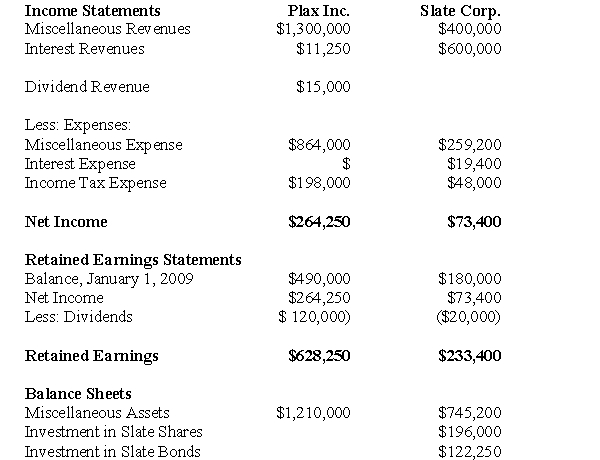
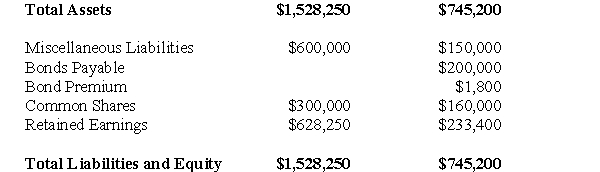 Other Information:
Plax acquired 75% of Slate on January 1,2005 for $196,000,when Slate's retained earnings was $80,000 and the acquisition differential was attributable entirely to goodwill.There were impairment losses to the goodwill of $6,400 and $1,600 in 2000 and 2003 respectively.
Plax uses the cost method to account for its investment.
Slate has 10% par value bonds outstanding in the amount of $200,000 which mature on December 31,2012.The bonds were issued at a premium.On January 1,2009 the unamortized premium amounted to $2,400 Slate uses the straight line method to amortize the premium.
On January 1,2009,Plax acquired $120,000 face value of Slate's bonds for $123,000 Plax also uses the straight line method to amortize any bond premium or discount.
Both companies are subject to a 40% Tax rate.
Gains and losses from intercompany bond holdings are to be allocated to the two companies when Consolidated Financial Statements are prepared.
-Prepare a detailed calculation of consolidated retained earnings as at January 1,2009.Do not prepare a Statement of Retained Earnings for this requirement.
The Financial Statements of Plax Inc.and Slate Corp for the Year ended December 31,2009 are shown below:
Other Information:Plax acquired 75% of Slate on January 1,2005 for $196,000,when Slate's retained earnings was $80,000 and the acquisition differential was attributable entirely to goodwill.There were impairment losses to the goodwill of $6,400 and $1,600 in 2000 and 2003 respectively.
Plax uses the cost method to account for its investment.
Slate has 10% par value bonds outstanding in the amount of $200,000 which mature on December 31,2012.The bonds were issued at a premium.On January 1,2009 the unamortized premium amounted to $2,400 Slate uses the straight line method to amortize the premium.
On January 1,2009,Plax acquired $120,000 face value of Slate's bonds for $123,000 Plax also uses the straight line method to amortize any bond premium or discount.
Both companies are subject to a 40% Tax rate.
Gains and losses from intercompany bond holdings are to be allocated to the two companies when Consolidated Financial Statements are prepared.
-Prepare a detailed calculation of consolidated retained earnings as at January 1,2009.Do not prepare a Statement of Retained Earnings for this requirement.
Question
Question
The following information pertains to questions
Ting Corp.owns 75% of Won Corp and uses the Cost Method to account for its Investment,which it acquired on January 1,2010 The Financial Statements of Ting Corp and Won Corp for the Year ended December 31,2010 are shown below: Other Information:
Won sold a tract of land to Ting at a profit of $20,000 during 2010.This land is still the property of Ting Corp.
On January 1,2010,Won sold equipment to Ting at a price that was $20,000 lower than its book value.The equipment had a remaining useful life of 5 years from that date.
On January 1,2010,Won's inventories contained items purchased from Ting for $120,000.This entire inventory was sold to outsiders during the year.Also during 2010,Won sold inventory to Ting for $30,000.Half this inventory is still in Ting's warehouse at year end.All sales are priced at a 20% mark-up above cost,regardless of whether the sales are internal or external.
Won's Retained Earnings on the date of acquisition amounted to $400,000.There have been no changes to the company's common shares account.
Won's book values did not differ materially from its fair values on the date of acquisition with the following exceptions:
▫ Inventory had a fair value that was $50,000 higher than its book value
▫ A patent (which had not previously been accounted for)was identified on the acquisition date with an estimated fair value of $20,000.The patent had an estimated useful life of 5 years.
▫ There was a goodwill impairment loss of $10,000 during 2010
▫ Both companies are subject to an effective tax rate of 40%.
▫ Both companies use straight line amortization exclusively.
▫ On January 1,2010,Ting acquired half of Won's bonds for $60,000
▫ The bonds carry a coupon rate of 10% and mature on January 1,2030.The initial bond issue took place on January 1,2010.The total discount on the issue date of the bonds was $20,000.
▫ Gains and losses from intercompany bondholdings are to be allocated to the two companies when consolidated statements are prepared.
-Ignoring income taxes,what is the amount of unrealized profit/(loss)remaining from the intercompany sale of equipment at December 31,2010?
A)$(16,000)
B)$12,500
C)$16,000
D)$12,000
Ting Corp.owns 75% of Won Corp and uses the Cost Method to account for its Investment,which it acquired on January 1,2010 The Financial Statements of Ting Corp and Won Corp for the Year ended December 31,2010 are shown below:
Other Information:Won sold a tract of land to Ting at a profit of $20,000 during 2010.This land is still the property of Ting Corp.
On January 1,2010,Won sold equipment to Ting at a price that was $20,000 lower than its book value.The equipment had a remaining useful life of 5 years from that date.
On January 1,2010,Won's inventories contained items purchased from Ting for $120,000.This entire inventory was sold to outsiders during the year.Also during 2010,Won sold inventory to Ting for $30,000.Half this inventory is still in Ting's warehouse at year end.All sales are priced at a 20% mark-up above cost,regardless of whether the sales are internal or external.
Won's Retained Earnings on the date of acquisition amounted to $400,000.There have been no changes to the company's common shares account.
Won's book values did not differ materially from its fair values on the date of acquisition with the following exceptions:
▫ Inventory had a fair value that was $50,000 higher than its book value
▫ A patent (which had not previously been accounted for)was identified on the acquisition date with an estimated fair value of $20,000.The patent had an estimated useful life of 5 years.
▫ There was a goodwill impairment loss of $10,000 during 2010
▫ Both companies are subject to an effective tax rate of 40%.
▫ Both companies use straight line amortization exclusively.
▫ On January 1,2010,Ting acquired half of Won's bonds for $60,000
▫ The bonds carry a coupon rate of 10% and mature on January 1,2030.The initial bond issue took place on January 1,2010.The total discount on the issue date of the bonds was $20,000.
▫ Gains and losses from intercompany bondholdings are to be allocated to the two companies when consolidated statements are prepared.
-Ignoring income taxes,what is the amount of unrealized profit/(loss)remaining from the intercompany sale of equipment at December 31,2010?
A)$(16,000)
B)$12,500
C)$16,000
D)$12,000
Question
inclusively.Assume that the Entity Method applies (regardless of the dates used in the problems).
The Financial Statements of Plax Inc.and Slate Corp for the Year ended December 31,2009 are shown below: Other Information:
Plax acquired 75% of Slate on January 1,2005 for $196,000,when Slate's retained earnings was $80,000 and the acquisition differential was attributable entirely to goodwill.There were impairment losses to the goodwill of $6,400 and $1,600 in 2000 and 2003 respectively.
Plax uses the cost method to account for its investment.
Slate has 10% par value bonds outstanding in the amount of $200,000 which mature on December 31,2012.The bonds were issued at a premium.On January 1,2009 the unamortized premium amounted to $2,400 Slate uses the straight line method to amortize the premium.
On January 1,2009,Plax acquired $120,000 face value of Slate's bonds for $123,000 Plax also uses the straight line method to amortize any bond premium or discount.
Both companies are subject to a 40% Tax rate.
Gains and losses from intercompany bond holdings are to be allocated to the two companies when Consolidated Financial Statements are prepared.
-Prepare Plax's Consolidated Income Statement for the year ended December 31,2009.
The Financial Statements of Plax Inc.and Slate Corp for the Year ended December 31,2009 are shown below:
Other Information:Plax acquired 75% of Slate on January 1,2005 for $196,000,when Slate's retained earnings was $80,000 and the acquisition differential was attributable entirely to goodwill.There were impairment losses to the goodwill of $6,400 and $1,600 in 2000 and 2003 respectively.
Plax uses the cost method to account for its investment.
Slate has 10% par value bonds outstanding in the amount of $200,000 which mature on December 31,2012.The bonds were issued at a premium.On January 1,2009 the unamortized premium amounted to $2,400 Slate uses the straight line method to amortize the premium.
On January 1,2009,Plax acquired $120,000 face value of Slate's bonds for $123,000 Plax also uses the straight line method to amortize any bond premium or discount.
Both companies are subject to a 40% Tax rate.
Gains and losses from intercompany bond holdings are to be allocated to the two companies when Consolidated Financial Statements are prepared.
-Prepare Plax's Consolidated Income Statement for the year ended December 31,2009.
Question
The following information pertains to questions
Ting Corp.owns 75% of Won Corp and uses the Cost Method to account for its Investment,which it acquired on January 1,2010 The Financial Statements of Ting Corp and Won Corp for the Year ended December 31,2010 are shown below: Other Information:
Won sold a tract of land to Ting at a profit of $20,000 during 2010.This land is still the property of Ting Corp.
On January 1,2010,Won sold equipment to Ting at a price that was $20,000 lower than its book value.The equipment had a remaining useful life of 5 years from that date.
On January 1,2010,Won's inventories contained items purchased from Ting for $120,000.This entire inventory was sold to outsiders during the year.Also during 2010,Won sold inventory to Ting for $30,000.Half this inventory is still in Ting's warehouse at year end.All sales are priced at a 20% mark-up above cost,regardless of whether the sales are internal or external.
Won's Retained Earnings on the date of acquisition amounted to $400,000.There have been no changes to the company's common shares account.
Won's book values did not differ materially from its fair values on the date of acquisition with the following exceptions:
▫ Inventory had a fair value that was $50,000 higher than its book value
▫ A patent (which had not previously been accounted for)was identified on the acquisition date with an estimated fair value of $20,000.The patent had an estimated useful life of 5 years.
▫ There was a goodwill impairment loss of $10,000 during 2010
▫ Both companies are subject to an effective tax rate of 40%.
▫ Both companies use straight line amortization exclusively.
▫ On January 1,2010,Ting acquired half of Won's bonds for $60,000
▫ The bonds carry a coupon rate of 10% and mature on January 1,2030.The initial bond issue took place on January 1,2010.The total discount on the issue date of the bonds was $20,000.
▫ Gains and losses from intercompany bondholdings are to be allocated to the two companies when consolidated statements are prepared.
-Ignoring income taxes,what is the amount of profit/(loss)realized during 2010 from the intercompany sale of equipment?
A)($4,000)
B)$20,000
C)$2,800
D)$4,000
Ting Corp.owns 75% of Won Corp and uses the Cost Method to account for its Investment,which it acquired on January 1,2010 The Financial Statements of Ting Corp and Won Corp for the Year ended December 31,2010 are shown below:
Other Information:Won sold a tract of land to Ting at a profit of $20,000 during 2010.This land is still the property of Ting Corp.
On January 1,2010,Won sold equipment to Ting at a price that was $20,000 lower than its book value.The equipment had a remaining useful life of 5 years from that date.
On January 1,2010,Won's inventories contained items purchased from Ting for $120,000.This entire inventory was sold to outsiders during the year.Also during 2010,Won sold inventory to Ting for $30,000.Half this inventory is still in Ting's warehouse at year end.All sales are priced at a 20% mark-up above cost,regardless of whether the sales are internal or external.
Won's Retained Earnings on the date of acquisition amounted to $400,000.There have been no changes to the company's common shares account.
Won's book values did not differ materially from its fair values on the date of acquisition with the following exceptions:
▫ Inventory had a fair value that was $50,000 higher than its book value
▫ A patent (which had not previously been accounted for)was identified on the acquisition date with an estimated fair value of $20,000.The patent had an estimated useful life of 5 years.
▫ There was a goodwill impairment loss of $10,000 during 2010
▫ Both companies are subject to an effective tax rate of 40%.
▫ Both companies use straight line amortization exclusively.
▫ On January 1,2010,Ting acquired half of Won's bonds for $60,000
▫ The bonds carry a coupon rate of 10% and mature on January 1,2030.The initial bond issue took place on January 1,2010.The total discount on the issue date of the bonds was $20,000.
▫ Gains and losses from intercompany bondholdings are to be allocated to the two companies when consolidated statements are prepared.
-Ignoring income taxes,what is the amount of profit/(loss)realized during 2010 from the intercompany sale of equipment?
A)($4,000)
B)$20,000
C)$2,800
D)$4,000
Question
The following information pertains to questions
Ting Corp.owns 75% of Won Corp and uses the Cost Method to account for its Investment,which it acquired on January 1,2010 The Financial Statements of Ting Corp and Won Corp for the Year ended December 31,2010 are shown below: Other Information:
Won sold a tract of land to Ting at a profit of $20,000 during 2010.This land is still the property of Ting Corp.
On January 1,2010,Won sold equipment to Ting at a price that was $20,000 lower than its book value.The equipment had a remaining useful life of 5 years from that date.
On January 1,2010,Won's inventories contained items purchased from Ting for $120,000.This entire inventory was sold to outsiders during the year.Also during 2010,Won sold inventory to Ting for $30,000.Half this inventory is still in Ting's warehouse at year end.All sales are priced at a 20% mark-up above cost,regardless of whether the sales are internal or external.
Won's Retained Earnings on the date of acquisition amounted to $400,000.There have been no changes to the company's common shares account.
Won's book values did not differ materially from its fair values on the date of acquisition with the following exceptions:
▫ Inventory had a fair value that was $50,000 higher than its book value
▫ A patent (which had not previously been accounted for)was identified on the acquisition date with an estimated fair value of $20,000.The patent had an estimated useful life of 5 years.
▫ There was a goodwill impairment loss of $10,000 during 2010
▫ Both companies are subject to an effective tax rate of 40%.
▫ Both companies use straight line amortization exclusively.
▫ On January 1,2010,Ting acquired half of Won's bonds for $60,000
▫ The bonds carry a coupon rate of 10% and mature on January 1,2030.The initial bond issue took place on January 1,2010.The total discount on the issue date of the bonds was $20,000.
▫ Gains and losses from intercompany bondholdings are to be allocated to the two companies when consolidated statements are prepared.
-What would be the amount of consolidated patents appearing on Ting's Consolidated Statement of Financial Position as at December 31,2010?
A)$14,000
B)$16,000
C)$18,000
D)$15,000
Ting Corp.owns 75% of Won Corp and uses the Cost Method to account for its Investment,which it acquired on January 1,2010 The Financial Statements of Ting Corp and Won Corp for the Year ended December 31,2010 are shown below:
Other Information:Won sold a tract of land to Ting at a profit of $20,000 during 2010.This land is still the property of Ting Corp.
On January 1,2010,Won sold equipment to Ting at a price that was $20,000 lower than its book value.The equipment had a remaining useful life of 5 years from that date.
On January 1,2010,Won's inventories contained items purchased from Ting for $120,000.This entire inventory was sold to outsiders during the year.Also during 2010,Won sold inventory to Ting for $30,000.Half this inventory is still in Ting's warehouse at year end.All sales are priced at a 20% mark-up above cost,regardless of whether the sales are internal or external.
Won's Retained Earnings on the date of acquisition amounted to $400,000.There have been no changes to the company's common shares account.
Won's book values did not differ materially from its fair values on the date of acquisition with the following exceptions:
▫ Inventory had a fair value that was $50,000 higher than its book value
▫ A patent (which had not previously been accounted for)was identified on the acquisition date with an estimated fair value of $20,000.The patent had an estimated useful life of 5 years.
▫ There was a goodwill impairment loss of $10,000 during 2010
▫ Both companies are subject to an effective tax rate of 40%.
▫ Both companies use straight line amortization exclusively.
▫ On January 1,2010,Ting acquired half of Won's bonds for $60,000
▫ The bonds carry a coupon rate of 10% and mature on January 1,2030.The initial bond issue took place on January 1,2010.The total discount on the issue date of the bonds was $20,000.
▫ Gains and losses from intercompany bondholdings are to be allocated to the two companies when consolidated statements are prepared.
-What would be the amount of consolidated patents appearing on Ting's Consolidated Statement of Financial Position as at December 31,2010?
A)$14,000
B)$16,000
C)$18,000
D)$15,000
Question
inclusively.Assume that the Entity Method applies (regardless of the dates used in the problems).
The Financial Statements of Plax Inc.and Slate Corp for the Year ended December 31,2009 are shown below: Other Information:
Plax acquired 75% of Slate on January 1,2005 for $196,000,when Slate's retained earnings was $80,000 and the acquisition differential was attributable entirely to goodwill.There were impairment losses to the goodwill of $6,400 and $1,600 in 2000 and 2003 respectively.
Plax uses the cost method to account for its investment.
Slate has 10% par value bonds outstanding in the amount of $200,000 which mature on December 31,2012.The bonds were issued at a premium.On January 1,2009 the unamortized premium amounted to $2,400 Slate uses the straight line method to amortize the premium.
On January 1,2009,Plax acquired $120,000 face value of Slate's bonds for $123,000 Plax also uses the straight line method to amortize any bond premium or discount.
Both companies are subject to a 40% Tax rate.
Gains and losses from intercompany bond holdings are to be allocated to the two companies when Consolidated Financial Statements are prepared.
-Prepare a summary of intercompany interest revenues and expenses.
The Financial Statements of Plax Inc.and Slate Corp for the Year ended December 31,2009 are shown below:
Other Information:Plax acquired 75% of Slate on January 1,2005 for $196,000,when Slate's retained earnings was $80,000 and the acquisition differential was attributable entirely to goodwill.There were impairment losses to the goodwill of $6,400 and $1,600 in 2000 and 2003 respectively.
Plax uses the cost method to account for its investment.
Slate has 10% par value bonds outstanding in the amount of $200,000 which mature on December 31,2012.The bonds were issued at a premium.On January 1,2009 the unamortized premium amounted to $2,400 Slate uses the straight line method to amortize the premium.
On January 1,2009,Plax acquired $120,000 face value of Slate's bonds for $123,000 Plax also uses the straight line method to amortize any bond premium or discount.
Both companies are subject to a 40% Tax rate.
Gains and losses from intercompany bond holdings are to be allocated to the two companies when Consolidated Financial Statements are prepared.
-Prepare a summary of intercompany interest revenues and expenses.
Question
The following information pertains to questions
Ting Corp.owns 75% of Won Corp and uses the Cost Method to account for its Investment,which it acquired on January 1,2010 The Financial Statements of Ting Corp and Won Corp for the Year ended December 31,2010 are shown below: Other Information:
Won sold a tract of land to Ting at a profit of $20,000 during 2010.This land is still the property of Ting Corp.
On January 1,2010,Won sold equipment to Ting at a price that was $20,000 lower than its book value.The equipment had a remaining useful life of 5 years from that date.
On January 1,2010,Won's inventories contained items purchased from Ting for $120,000.This entire inventory was sold to outsiders during the year.Also during 2010,Won sold inventory to Ting for $30,000.Half this inventory is still in Ting's warehouse at year end.All sales are priced at a 20% mark-up above cost,regardless of whether the sales are internal or external.
Won's Retained Earnings on the date of acquisition amounted to $400,000.There have been no changes to the company's common shares account.
Won's book values did not differ materially from its fair values on the date of acquisition with the following exceptions:
▫ Inventory had a fair value that was $50,000 higher than its book value
▫ A patent (which had not previously been accounted for)was identified on the acquisition date with an estimated fair value of $20,000.The patent had an estimated useful life of 5 years.
▫ There was a goodwill impairment loss of $10,000 during 2010
▫ Both companies are subject to an effective tax rate of 40%.
▫ Both companies use straight line amortization exclusively.
▫ On January 1,2010,Ting acquired half of Won's bonds for $60,000
▫ The bonds carry a coupon rate of 10% and mature on January 1,2030.The initial bond issue took place on January 1,2010.The total discount on the issue date of the bonds was $20,000.
▫ Gains and losses from intercompany bondholdings are to be allocated to the two companies when consolidated statements are prepared.
-Ignoring taxes,what is the total amount of unrealized profits in inventory at the start of 2010?
A)$20,000
B)$5,000
C)$3,000
D)$2,500
Ting Corp.owns 75% of Won Corp and uses the Cost Method to account for its Investment,which it acquired on January 1,2010 The Financial Statements of Ting Corp and Won Corp for the Year ended December 31,2010 are shown below:
Other Information:Won sold a tract of land to Ting at a profit of $20,000 during 2010.This land is still the property of Ting Corp.
On January 1,2010,Won sold equipment to Ting at a price that was $20,000 lower than its book value.The equipment had a remaining useful life of 5 years from that date.
On January 1,2010,Won's inventories contained items purchased from Ting for $120,000.This entire inventory was sold to outsiders during the year.Also during 2010,Won sold inventory to Ting for $30,000.Half this inventory is still in Ting's warehouse at year end.All sales are priced at a 20% mark-up above cost,regardless of whether the sales are internal or external.
Won's Retained Earnings on the date of acquisition amounted to $400,000.There have been no changes to the company's common shares account.
Won's book values did not differ materially from its fair values on the date of acquisition with the following exceptions:
▫ Inventory had a fair value that was $50,000 higher than its book value
▫ A patent (which had not previously been accounted for)was identified on the acquisition date with an estimated fair value of $20,000.The patent had an estimated useful life of 5 years.
▫ There was a goodwill impairment loss of $10,000 during 2010
▫ Both companies are subject to an effective tax rate of 40%.
▫ Both companies use straight line amortization exclusively.
▫ On January 1,2010,Ting acquired half of Won's bonds for $60,000
▫ The bonds carry a coupon rate of 10% and mature on January 1,2030.The initial bond issue took place on January 1,2010.The total discount on the issue date of the bonds was $20,000.
▫ Gains and losses from intercompany bondholdings are to be allocated to the two companies when consolidated statements are prepared.
-Ignoring taxes,what is the total amount of unrealized profits in inventory at the start of 2010?
A)$20,000
B)$5,000
C)$3,000
D)$2,500
Question
inclusively.Assume that the Entity Method applies (regardless of the dates used in the problems).
The Financial Statements of Plax Inc.and Slate Corp for the Year ended December 31,2009 are shown below: Other Information:
Plax acquired 75% of Slate on January 1,2005 for $196,000,when Slate's retained earnings was $80,000 and the acquisition differential was attributable entirely to goodwill.There were impairment losses to the goodwill of $6,400 and $1,600 in 2000 and 2003 respectively.
Plax uses the cost method to account for its investment.
Slate has 10% par value bonds outstanding in the amount of $200,000 which mature on December 31,2012.The bonds were issued at a premium.On January 1,2009 the unamortized premium amounted to $2,400 Slate uses the straight line method to amortize the premium.
On January 1,2009,Plax acquired $120,000 face value of Slate's bonds for $123,000 Plax also uses the straight line method to amortize any bond premium or discount.
Both companies are subject to a 40% Tax rate.
Gains and losses from intercompany bond holdings are to be allocated to the two companies when Consolidated Financial Statements are prepared.
-Prepare a Statement of Consolidated Retained Earnings for the year ended December 31,2003 for Plax Inc.
The Financial Statements of Plax Inc.and Slate Corp for the Year ended December 31,2009 are shown below:
Other Information:Plax acquired 75% of Slate on January 1,2005 for $196,000,when Slate's retained earnings was $80,000 and the acquisition differential was attributable entirely to goodwill.There were impairment losses to the goodwill of $6,400 and $1,600 in 2000 and 2003 respectively.
Plax uses the cost method to account for its investment.
Slate has 10% par value bonds outstanding in the amount of $200,000 which mature on December 31,2012.The bonds were issued at a premium.On January 1,2009 the unamortized premium amounted to $2,400 Slate uses the straight line method to amortize the premium.
On January 1,2009,Plax acquired $120,000 face value of Slate's bonds for $123,000 Plax also uses the straight line method to amortize any bond premium or discount.
Both companies are subject to a 40% Tax rate.
Gains and losses from intercompany bond holdings are to be allocated to the two companies when Consolidated Financial Statements are prepared.
-Prepare a Statement of Consolidated Retained Earnings for the year ended December 31,2003 for Plax Inc.
Question
The following information pertains to questions
Ting Corp.owns 75% of Won Corp and uses the Cost Method to account for its Investment,which it acquired on January 1,2010 The Financial Statements of Ting Corp and Won Corp for the Year ended December 31,2010 are shown below: Other Information:
Won sold a tract of land to Ting at a profit of $20,000 during 2010.This land is still the property of Ting Corp.
On January 1,2010,Won sold equipment to Ting at a price that was $20,000 lower than its book value.The equipment had a remaining useful life of 5 years from that date.
On January 1,2010,Won's inventories contained items purchased from Ting for $120,000.This entire inventory was sold to outsiders during the year.Also during 2010,Won sold inventory to Ting for $30,000.Half this inventory is still in Ting's warehouse at year end.All sales are priced at a 20% mark-up above cost,regardless of whether the sales are internal or external.
Won's Retained Earnings on the date of acquisition amounted to $400,000.There have been no changes to the company's common shares account.
Won's book values did not differ materially from its fair values on the date of acquisition with the following exceptions:
▫ Inventory had a fair value that was $50,000 higher than its book value
▫ A patent (which had not previously been accounted for)was identified on the acquisition date with an estimated fair value of $20,000.The patent had an estimated useful life of 5 years.
▫ There was a goodwill impairment loss of $10,000 during 2010
▫ Both companies are subject to an effective tax rate of 40%.
▫ Both companies use straight line amortization exclusively.
▫ On January 1,2010,Ting acquired half of Won's bonds for $60,000
▫ The bonds carry a coupon rate of 10% and mature on January 1,2030.The initial bond issue took place on January 1,2010.The total discount on the issue date of the bonds was $20,000.
▫ Gains and losses from intercompany bondholdings are to be allocated to the two companies when consolidated statements are prepared.
-What is the amount of unamortized acquisition differential on December 31,2010?
A)$26,000
B)$16,000
C)$8,000
D)$4,000
Ting Corp.owns 75% of Won Corp and uses the Cost Method to account for its Investment,which it acquired on January 1,2010 The Financial Statements of Ting Corp and Won Corp for the Year ended December 31,2010 are shown below:
Other Information:Won sold a tract of land to Ting at a profit of $20,000 during 2010.This land is still the property of Ting Corp.
On January 1,2010,Won sold equipment to Ting at a price that was $20,000 lower than its book value.The equipment had a remaining useful life of 5 years from that date.
On January 1,2010,Won's inventories contained items purchased from Ting for $120,000.This entire inventory was sold to outsiders during the year.Also during 2010,Won sold inventory to Ting for $30,000.Half this inventory is still in Ting's warehouse at year end.All sales are priced at a 20% mark-up above cost,regardless of whether the sales are internal or external.
Won's Retained Earnings on the date of acquisition amounted to $400,000.There have been no changes to the company's common shares account.
Won's book values did not differ materially from its fair values on the date of acquisition with the following exceptions:
▫ Inventory had a fair value that was $50,000 higher than its book value
▫ A patent (which had not previously been accounted for)was identified on the acquisition date with an estimated fair value of $20,000.The patent had an estimated useful life of 5 years.
▫ There was a goodwill impairment loss of $10,000 during 2010
▫ Both companies are subject to an effective tax rate of 40%.
▫ Both companies use straight line amortization exclusively.
▫ On January 1,2010,Ting acquired half of Won's bonds for $60,000
▫ The bonds carry a coupon rate of 10% and mature on January 1,2030.The initial bond issue took place on January 1,2010.The total discount on the issue date of the bonds was $20,000.
▫ Gains and losses from intercompany bondholdings are to be allocated to the two companies when consolidated statements are prepared.
-What is the amount of unamortized acquisition differential on December 31,2010?
A)$26,000
B)$16,000
C)$8,000
D)$4,000
Question
inclusively.Assume that the Entity Method applies (regardless of the dates used in the problems).
The Financial Statements of Plax Inc.and Slate Corp for the Year ended December 31,2009 are shown below: Other Information:
Plax acquired 75% of Slate on January 1,2005 for $196,000,when Slate's retained earnings was $80,000 and the acquisition differential was attributable entirely to goodwill.There were impairment losses to the goodwill of $6,400 and $1,600 in 2000 and 2003 respectively.
Plax uses the cost method to account for its investment.
Slate has 10% par value bonds outstanding in the amount of $200,000 which mature on December 31,2012.The bonds were issued at a premium.On January 1,2009 the unamortized premium amounted to $2,400 Slate uses the straight line method to amortize the premium.
On January 1,2009,Plax acquired $120,000 face value of Slate's bonds for $123,000 Plax also uses the straight line method to amortize any bond premium or discount.
Both companies are subject to a 40% Tax rate.
Gains and losses from intercompany bond holdings are to be allocated to the two companies when Consolidated Financial Statements are prepared.
-Prepare a detailed calculation of Consolidated Net Income.Do not prepare an income statement for this requirement.
The Financial Statements of Plax Inc.and Slate Corp for the Year ended December 31,2009 are shown below:
Other Information:Plax acquired 75% of Slate on January 1,2005 for $196,000,when Slate's retained earnings was $80,000 and the acquisition differential was attributable entirely to goodwill.There were impairment losses to the goodwill of $6,400 and $1,600 in 2000 and 2003 respectively.
Plax uses the cost method to account for its investment.
Slate has 10% par value bonds outstanding in the amount of $200,000 which mature on December 31,2012.The bonds were issued at a premium.On January 1,2009 the unamortized premium amounted to $2,400 Slate uses the straight line method to amortize the premium.
On January 1,2009,Plax acquired $120,000 face value of Slate's bonds for $123,000 Plax also uses the straight line method to amortize any bond premium or discount.
Both companies are subject to a 40% Tax rate.
Gains and losses from intercompany bond holdings are to be allocated to the two companies when Consolidated Financial Statements are prepared.
-Prepare a detailed calculation of Consolidated Net Income.Do not prepare an income statement for this requirement.
Question
inclusively.Assume that the Entity Method applies (regardless of the dates used in the problems).
The Financial Statements of Plax Inc.and Slate Corp for the Year ended December 31,2009 are shown below: Other Information:
Plax acquired 75% of Slate on January 1,2005 for $196,000,when Slate's retained earnings was $80,000 and the acquisition differential was attributable entirely to goodwill.There were impairment losses to the goodwill of $6,400 and $1,600 in 2000 and 2003 respectively.
Plax uses the cost method to account for its investment.
Slate has 10% par value bonds outstanding in the amount of $200,000 which mature on December 31,2012.The bonds were issued at a premium.On January 1,2009 the unamortized premium amounted to $2,400 Slate uses the straight line method to amortize the premium.
On January 1,2009,Plax acquired $120,000 face value of Slate's bonds for $123,000 Plax also uses the straight line method to amortize any bond premium or discount.
Both companies are subject to a 40% Tax rate.
Gains and losses from intercompany bond holdings are to be allocated to the two companies when Consolidated Financial Statements are prepared.
-Prepare a summary of intercompany bond transactions.Be sure to show the gain or loss for each company as well as the effect on the consolidated entity.
The Financial Statements of Plax Inc.and Slate Corp for the Year ended December 31,2009 are shown below:
Other Information:Plax acquired 75% of Slate on January 1,2005 for $196,000,when Slate's retained earnings was $80,000 and the acquisition differential was attributable entirely to goodwill.There were impairment losses to the goodwill of $6,400 and $1,600 in 2000 and 2003 respectively.
Plax uses the cost method to account for its investment.
Slate has 10% par value bonds outstanding in the amount of $200,000 which mature on December 31,2012.The bonds were issued at a premium.On January 1,2009 the unamortized premium amounted to $2,400 Slate uses the straight line method to amortize the premium.
On January 1,2009,Plax acquired $120,000 face value of Slate's bonds for $123,000 Plax also uses the straight line method to amortize any bond premium or discount.
Both companies are subject to a 40% Tax rate.
Gains and losses from intercompany bond holdings are to be allocated to the two companies when Consolidated Financial Statements are prepared.
-Prepare a summary of intercompany bond transactions.Be sure to show the gain or loss for each company as well as the effect on the consolidated entity.
Question
Question
Question
inclusively.Assume that the Entity Method applies (regardless of the dates used in the problems).
The Financial Statements of Plax Inc.and Slate Corp for the Year ended December 31,2009 are shown below: Other Information:
Plax acquired 75% of Slate on January 1,2005 for $196,000,when Slate's retained earnings was $80,000 and the acquisition differential was attributable entirely to goodwill.There were impairment losses to the goodwill of $6,400 and $1,600 in 2000 and 2003 respectively.
Plax uses the cost method to account for its investment.
Slate has 10% par value bonds outstanding in the amount of $200,000 which mature on December 31,2012.The bonds were issued at a premium.On January 1,2009 the unamortized premium amounted to $2,400 Slate uses the straight line method to amortize the premium.
On January 1,2009,Plax acquired $120,000 face value of Slate's bonds for $123,000 Plax also uses the straight line method to amortize any bond premium or discount.
Both companies are subject to a 40% Tax rate.
Gains and losses from intercompany bond holdings are to be allocated to the two companies when Consolidated Financial Statements are prepared.
-Calculate the goodwill as at December 31,2009.
The Financial Statements of Plax Inc.and Slate Corp for the Year ended December 31,2009 are shown below:
Other Information:Plax acquired 75% of Slate on January 1,2005 for $196,000,when Slate's retained earnings was $80,000 and the acquisition differential was attributable entirely to goodwill.There were impairment losses to the goodwill of $6,400 and $1,600 in 2000 and 2003 respectively.
Plax uses the cost method to account for its investment.
Slate has 10% par value bonds outstanding in the amount of $200,000 which mature on December 31,2012.The bonds were issued at a premium.On January 1,2009 the unamortized premium amounted to $2,400 Slate uses the straight line method to amortize the premium.
On January 1,2009,Plax acquired $120,000 face value of Slate's bonds for $123,000 Plax also uses the straight line method to amortize any bond premium or discount.
Both companies are subject to a 40% Tax rate.
Gains and losses from intercompany bond holdings are to be allocated to the two companies when Consolidated Financial Statements are prepared.
-Calculate the goodwill as at December 31,2009.
Question
inclusively.Assume that the Entity Method applies (regardless of the dates used in the problems).
The Financial Statements of Plax Inc.and Slate Corp for the Year ended December 31,2009 are shown below: Other Information:
Plax acquired 75% of Slate on January 1,2005 for $196,000,when Slate's retained earnings was $80,000 and the acquisition differential was attributable entirely to goodwill.There were impairment losses to the goodwill of $6,400 and $1,600 in 2000 and 2003 respectively.
Plax uses the cost method to account for its investment.
Slate has 10% par value bonds outstanding in the amount of $200,000 which mature on December 31,2012.The bonds were issued at a premium.On January 1,2009 the unamortized premium amounted to $2,400 Slate uses the straight line method to amortize the premium.
On January 1,2009,Plax acquired $120,000 face value of Slate's bonds for $123,000 Plax also uses the straight line method to amortize any bond premium or discount.
Both companies are subject to a 40% Tax rate.
Gains and losses from intercompany bond holdings are to be allocated to the two companies when Consolidated Financial Statements are prepared.
-Prepare a Statement of Non-Controlling Interest for the year ended December 31,2009 for Plax Inc.
The Financial Statements of Plax Inc.and Slate Corp for the Year ended December 31,2009 are shown below:
Other Information:Plax acquired 75% of Slate on January 1,2005 for $196,000,when Slate's retained earnings was $80,000 and the acquisition differential was attributable entirely to goodwill.There were impairment losses to the goodwill of $6,400 and $1,600 in 2000 and 2003 respectively.
Plax uses the cost method to account for its investment.
Slate has 10% par value bonds outstanding in the amount of $200,000 which mature on December 31,2012.The bonds were issued at a premium.On January 1,2009 the unamortized premium amounted to $2,400 Slate uses the straight line method to amortize the premium.
On January 1,2009,Plax acquired $120,000 face value of Slate's bonds for $123,000 Plax also uses the straight line method to amortize any bond premium or discount.
Both companies are subject to a 40% Tax rate.
Gains and losses from intercompany bond holdings are to be allocated to the two companies when Consolidated Financial Statements are prepared.
-Prepare a Statement of Non-Controlling Interest for the year ended December 31,2009 for Plax Inc.
Question
The following information pertains to questions
Ting Corp.owns 75% of Won Corp and uses the Cost Method to account for its Investment,which it acquired on January 1,2010 The Financial Statements of Ting Corp and Won Corp for the Year ended December 31,2010 are shown below: Other Information:
Won sold a tract of land to Ting at a profit of $20,000 during 2010.This land is still the property of Ting Corp.
On January 1,2010,Won sold equipment to Ting at a price that was $20,000 lower than its book value.The equipment had a remaining useful life of 5 years from that date.
On January 1,2010,Won's inventories contained items purchased from Ting for $120,000.This entire inventory was sold to outsiders during the year.Also during 2010,Won sold inventory to Ting for $30,000.Half this inventory is still in Ting's warehouse at year end.All sales are priced at a 20% mark-up above cost,regardless of whether the sales are internal or external.
Won's Retained Earnings on the date of acquisition amounted to $400,000.There have been no changes to the company's common shares account.
Won's book values did not differ materially from its fair values on the date of acquisition with the following exceptions:
▫ Inventory had a fair value that was $50,000 higher than its book value
▫ A patent (which had not previously been accounted for)was identified on the acquisition date with an estimated fair value of $20,000.The patent had an estimated useful life of 5 years.
▫ There was a goodwill impairment loss of $10,000 during 2010
▫ Both companies are subject to an effective tax rate of 40%.
▫ Both companies use straight line amortization exclusively.
▫ On January 1,2010,Ting acquired half of Won's bonds for $60,000
▫ The bonds carry a coupon rate of 10% and mature on January 1,2030.The initial bond issue took place on January 1,2010.The total discount on the issue date of the bonds was $20,000.
▫ Gains and losses from intercompany bondholdings are to be allocated to the two companies when consolidated statements are prepared.
-Compute the goodwill on the acquisition date.
Ting Corp.owns 75% of Won Corp and uses the Cost Method to account for its Investment,which it acquired on January 1,2010 The Financial Statements of Ting Corp and Won Corp for the Year ended December 31,2010 are shown below:
Other Information:Won sold a tract of land to Ting at a profit of $20,000 during 2010.This land is still the property of Ting Corp.
On January 1,2010,Won sold equipment to Ting at a price that was $20,000 lower than its book value.The equipment had a remaining useful life of 5 years from that date.
On January 1,2010,Won's inventories contained items purchased from Ting for $120,000.This entire inventory was sold to outsiders during the year.Also during 2010,Won sold inventory to Ting for $30,000.Half this inventory is still in Ting's warehouse at year end.All sales are priced at a 20% mark-up above cost,regardless of whether the sales are internal or external.
Won's Retained Earnings on the date of acquisition amounted to $400,000.There have been no changes to the company's common shares account.
Won's book values did not differ materially from its fair values on the date of acquisition with the following exceptions:
▫ Inventory had a fair value that was $50,000 higher than its book value
▫ A patent (which had not previously been accounted for)was identified on the acquisition date with an estimated fair value of $20,000.The patent had an estimated useful life of 5 years.
▫ There was a goodwill impairment loss of $10,000 during 2010
▫ Both companies are subject to an effective tax rate of 40%.
▫ Both companies use straight line amortization exclusively.
▫ On January 1,2010,Ting acquired half of Won's bonds for $60,000
▫ The bonds carry a coupon rate of 10% and mature on January 1,2030.The initial bond issue took place on January 1,2010.The total discount on the issue date of the bonds was $20,000.
▫ Gains and losses from intercompany bondholdings are to be allocated to the two companies when consolidated statements are prepared.
-Compute the goodwill on the acquisition date.
Question
The following information pertains to questions
Ting Corp.owns 75% of Won Corp and uses the Cost Method to account for its Investment,which it acquired on January 1,2010 The Financial Statements of Ting Corp and Won Corp for the Year ended December 31,2010 are shown below: Other Information:
Won sold a tract of land to Ting at a profit of $20,000 during 2010.This land is still the property of Ting Corp.
On January 1,2010,Won sold equipment to Ting at a price that was $20,000 lower than its book value.The equipment had a remaining useful life of 5 years from that date.
On January 1,2010,Won's inventories contained items purchased from Ting for $120,000.This entire inventory was sold to outsiders during the year.Also during 2010,Won sold inventory to Ting for $30,000.Half this inventory is still in Ting's warehouse at year end.All sales are priced at a 20% mark-up above cost,regardless of whether the sales are internal or external.
Won's Retained Earnings on the date of acquisition amounted to $400,000.There have been no changes to the company's common shares account.
Won's book values did not differ materially from its fair values on the date of acquisition with the following exceptions:
▫ Inventory had a fair value that was $50,000 higher than its book value
▫ A patent (which had not previously been accounted for)was identified on the acquisition date with an estimated fair value of $20,000.The patent had an estimated useful life of 5 years.
▫ There was a goodwill impairment loss of $10,000 during 2010
▫ Both companies are subject to an effective tax rate of 40%.
▫ Both companies use straight line amortization exclusively.
▫ On January 1,2010,Ting acquired half of Won's bonds for $60,000
▫ The bonds carry a coupon rate of 10% and mature on January 1,2030.The initial bond issue took place on January 1,2010.The total discount on the issue date of the bonds was $20,000.
▫ Gains and losses from intercompany bondholdings are to be allocated to the two companies when consolidated statements are prepared.
-What would be the amount appearing on the December 31,2010 Consolidated Statement of Financial Position for future income taxes?
A)$600
B)$900
C)$1,200
D)$1,600
Ting Corp.owns 75% of Won Corp and uses the Cost Method to account for its Investment,which it acquired on January 1,2010 The Financial Statements of Ting Corp and Won Corp for the Year ended December 31,2010 are shown below:
Other Information:Won sold a tract of land to Ting at a profit of $20,000 during 2010.This land is still the property of Ting Corp.
On January 1,2010,Won sold equipment to Ting at a price that was $20,000 lower than its book value.The equipment had a remaining useful life of 5 years from that date.
On January 1,2010,Won's inventories contained items purchased from Ting for $120,000.This entire inventory was sold to outsiders during the year.Also during 2010,Won sold inventory to Ting for $30,000.Half this inventory is still in Ting's warehouse at year end.All sales are priced at a 20% mark-up above cost,regardless of whether the sales are internal or external.
Won's Retained Earnings on the date of acquisition amounted to $400,000.There have been no changes to the company's common shares account.
Won's book values did not differ materially from its fair values on the date of acquisition with the following exceptions:
▫ Inventory had a fair value that was $50,000 higher than its book value
▫ A patent (which had not previously been accounted for)was identified on the acquisition date with an estimated fair value of $20,000.The patent had an estimated useful life of 5 years.
▫ There was a goodwill impairment loss of $10,000 during 2010
▫ Both companies are subject to an effective tax rate of 40%.
▫ Both companies use straight line amortization exclusively.
▫ On January 1,2010,Ting acquired half of Won's bonds for $60,000
▫ The bonds carry a coupon rate of 10% and mature on January 1,2030.The initial bond issue took place on January 1,2010.The total discount on the issue date of the bonds was $20,000.
▫ Gains and losses from intercompany bondholdings are to be allocated to the two companies when consolidated statements are prepared.
-What would be the amount appearing on the December 31,2010 Consolidated Statement of Financial Position for future income taxes?
A)$600
B)$900
C)$1,200
D)$1,600
Question
The following information pertains to questions
Ting Corp.owns 75% of Won Corp and uses the Cost Method to account for its Investment,which it acquired on January 1,2010 The Financial Statements of Ting Corp and Won Corp for the Year ended December 31,2010 are shown below: Other Information:
Won sold a tract of land to Ting at a profit of $20,000 during 2010.This land is still the property of Ting Corp.
On January 1,2010,Won sold equipment to Ting at a price that was $20,000 lower than its book value.The equipment had a remaining useful life of 5 years from that date.
On January 1,2010,Won's inventories contained items purchased from Ting for $120,000.This entire inventory was sold to outsiders during the year.Also during 2010,Won sold inventory to Ting for $30,000.Half this inventory is still in Ting's warehouse at year end.All sales are priced at a 20% mark-up above cost,regardless of whether the sales are internal or external.
Won's Retained Earnings on the date of acquisition amounted to $400,000.There have been no changes to the company's common shares account.
Won's book values did not differ materially from its fair values on the date of acquisition with the following exceptions:
▫ Inventory had a fair value that was $50,000 higher than its book value
▫ A patent (which had not previously been accounted for)was identified on the acquisition date with an estimated fair value of $20,000.The patent had an estimated useful life of 5 years.
▫ There was a goodwill impairment loss of $10,000 during 2010
▫ Both companies are subject to an effective tax rate of 40%.
▫ Both companies use straight line amortization exclusively.
▫ On January 1,2010,Ting acquired half of Won's bonds for $60,000
▫ The bonds carry a coupon rate of 10% and mature on January 1,2030.The initial bond issue took place on January 1,2010.The total discount on the issue date of the bonds was $20,000.
▫ Gains and losses from intercompany bondholdings are to be allocated to the two companies when consolidated statements are prepared.
-What would be the non-controlling interest amount appearing on Ting's Consolidated Statement of Financial Position on January 1st,2010?
A)$450,000
B)$500,000
C)$375,000
D)$298,300
Ting Corp.owns 75% of Won Corp and uses the Cost Method to account for its Investment,which it acquired on January 1,2010 The Financial Statements of Ting Corp and Won Corp for the Year ended December 31,2010 are shown below:
Other Information:Won sold a tract of land to Ting at a profit of $20,000 during 2010.This land is still the property of Ting Corp.
On January 1,2010,Won sold equipment to Ting at a price that was $20,000 lower than its book value.The equipment had a remaining useful life of 5 years from that date.
On January 1,2010,Won's inventories contained items purchased from Ting for $120,000.This entire inventory was sold to outsiders during the year.Also during 2010,Won sold inventory to Ting for $30,000.Half this inventory is still in Ting's warehouse at year end.All sales are priced at a 20% mark-up above cost,regardless of whether the sales are internal or external.
Won's Retained Earnings on the date of acquisition amounted to $400,000.There have been no changes to the company's common shares account.
Won's book values did not differ materially from its fair values on the date of acquisition with the following exceptions:
▫ Inventory had a fair value that was $50,000 higher than its book value
▫ A patent (which had not previously been accounted for)was identified on the acquisition date with an estimated fair value of $20,000.The patent had an estimated useful life of 5 years.
▫ There was a goodwill impairment loss of $10,000 during 2010
▫ Both companies are subject to an effective tax rate of 40%.
▫ Both companies use straight line amortization exclusively.
▫ On January 1,2010,Ting acquired half of Won's bonds for $60,000
▫ The bonds carry a coupon rate of 10% and mature on January 1,2030.The initial bond issue took place on January 1,2010.The total discount on the issue date of the bonds was $20,000.
▫ Gains and losses from intercompany bondholdings are to be allocated to the two companies when consolidated statements are prepared.
-What would be the non-controlling interest amount appearing on Ting's Consolidated Statement of Financial Position on January 1st,2010?
A)$450,000
B)$500,000
C)$375,000
D)$298,300
Question
The following information pertains to questions
Ting Corp.owns 75% of Won Corp and uses the Cost Method to account for its Investment,which it acquired on January 1,2010 The Financial Statements of Ting Corp and Won Corp for the Year ended December 31,2010 are shown below: Other Information:
Won sold a tract of land to Ting at a profit of $20,000 during 2010.This land is still the property of Ting Corp.
On January 1,2010,Won sold equipment to Ting at a price that was $20,000 lower than its book value.The equipment had a remaining useful life of 5 years from that date.
On January 1,2010,Won's inventories contained items purchased from Ting for $120,000.This entire inventory was sold to outsiders during the year.Also during 2010,Won sold inventory to Ting for $30,000.Half this inventory is still in Ting's warehouse at year end.All sales are priced at a 20% mark-up above cost,regardless of whether the sales are internal or external.
Won's Retained Earnings on the date of acquisition amounted to $400,000.There have been no changes to the company's common shares account.
Won's book values did not differ materially from its fair values on the date of acquisition with the following exceptions:
▫ Inventory had a fair value that was $50,000 higher than its book value
▫ A patent (which had not previously been accounted for)was identified on the acquisition date with an estimated fair value of $20,000.The patent had an estimated useful life of 5 years.
▫ There was a goodwill impairment loss of $10,000 during 2010
▫ Both companies are subject to an effective tax rate of 40%.
▫ Both companies use straight line amortization exclusively.
▫ On January 1,2010,Ting acquired half of Won's bonds for $60,000
▫ The bonds carry a coupon rate of 10% and mature on January 1,2030.The initial bond issue took place on January 1,2010.The total discount on the issue date of the bonds was $20,000.
▫ Gains and losses from intercompany bondholdings are to be allocated to the two companies when consolidated statements are prepared.
-Ignoring taxes,what is the total amount of pre-tax profit from intercompany inventory sales that was realized during 2010?
A)$23,000
B)$20,200
C)$22,500
D)$6,000
Ting Corp.owns 75% of Won Corp and uses the Cost Method to account for its Investment,which it acquired on January 1,2010 The Financial Statements of Ting Corp and Won Corp for the Year ended December 31,2010 are shown below:
Other Information:Won sold a tract of land to Ting at a profit of $20,000 during 2010.This land is still the property of Ting Corp.
On January 1,2010,Won sold equipment to Ting at a price that was $20,000 lower than its book value.The equipment had a remaining useful life of 5 years from that date.
On January 1,2010,Won's inventories contained items purchased from Ting for $120,000.This entire inventory was sold to outsiders during the year.Also during 2010,Won sold inventory to Ting for $30,000.Half this inventory is still in Ting's warehouse at year end.All sales are priced at a 20% mark-up above cost,regardless of whether the sales are internal or external.
Won's Retained Earnings on the date of acquisition amounted to $400,000.There have been no changes to the company's common shares account.
Won's book values did not differ materially from its fair values on the date of acquisition with the following exceptions:
▫ Inventory had a fair value that was $50,000 higher than its book value
▫ A patent (which had not previously been accounted for)was identified on the acquisition date with an estimated fair value of $20,000.The patent had an estimated useful life of 5 years.
▫ There was a goodwill impairment loss of $10,000 during 2010
▫ Both companies are subject to an effective tax rate of 40%.
▫ Both companies use straight line amortization exclusively.
▫ On January 1,2010,Ting acquired half of Won's bonds for $60,000
▫ The bonds carry a coupon rate of 10% and mature on January 1,2030.The initial bond issue took place on January 1,2010.The total discount on the issue date of the bonds was $20,000.
▫ Gains and losses from intercompany bondholdings are to be allocated to the two companies when consolidated statements are prepared.
-Ignoring taxes,what is the total amount of pre-tax profit from intercompany inventory sales that was realized during 2010?
A)$23,000
B)$20,200
C)$22,500
D)$6,000
Question
inclusively.Assume that the Entity Method applies (regardless of the dates used in the problems).
The Financial Statements of Plax Inc.and Slate Corp for the Year ended December 31,2009 are shown below: Other Information:
Plax acquired 75% of Slate on January 1,2005 for $196,000,when Slate's retained earnings was $80,000 and the acquisition differential was attributable entirely to goodwill.There were impairment losses to the goodwill of $6,400 and $1,600 in 2000 and 2003 respectively.
Plax uses the cost method to account for its investment.
Slate has 10% par value bonds outstanding in the amount of $200,000 which mature on December 31,2012.The bonds were issued at a premium.On January 1,2009 the unamortized premium amounted to $2,400 Slate uses the straight line method to amortize the premium.
On January 1,2009,Plax acquired $120,000 face value of Slate's bonds for $123,000 Plax also uses the straight line method to amortize any bond premium or discount.
Both companies are subject to a 40% Tax rate.
Gains and losses from intercompany bond holdings are to be allocated to the two companies when Consolidated Financial Statements are prepared.
-Assuming that Plax uses the equity method,prepare a computation showing the balance in Plax's investment in Slate account on December 31,2009.
The Financial Statements of Plax Inc.and Slate Corp for the Year ended December 31,2009 are shown below:
Other Information:Plax acquired 75% of Slate on January 1,2005 for $196,000,when Slate's retained earnings was $80,000 and the acquisition differential was attributable entirely to goodwill.There were impairment losses to the goodwill of $6,400 and $1,600 in 2000 and 2003 respectively.
Plax uses the cost method to account for its investment.
Slate has 10% par value bonds outstanding in the amount of $200,000 which mature on December 31,2012.The bonds were issued at a premium.On January 1,2009 the unamortized premium amounted to $2,400 Slate uses the straight line method to amortize the premium.
On January 1,2009,Plax acquired $120,000 face value of Slate's bonds for $123,000 Plax also uses the straight line method to amortize any bond premium or discount.
Both companies are subject to a 40% Tax rate.
Gains and losses from intercompany bond holdings are to be allocated to the two companies when Consolidated Financial Statements are prepared.
-Assuming that Plax uses the equity method,prepare a computation showing the balance in Plax's investment in Slate account on December 31,2009.
Question
inclusively.Assume that the Entity Method applies (regardless of the dates used in the problems).
The Financial Statements of Plax Inc.and Slate Corp for the Year ended December 31,2009 are shown below: Other Information:
Plax acquired 75% of Slate on January 1,2005 for $196,000,when Slate's retained earnings was $80,000 and the acquisition differential was attributable entirely to goodwill.There were impairment losses to the goodwill of $6,400 and $1,600 in 2000 and 2003 respectively.
Plax uses the cost method to account for its investment.
Slate has 10% par value bonds outstanding in the amount of $200,000 which mature on December 31,2012.The bonds were issued at a premium.On January 1,2009 the unamortized premium amounted to $2,400 Slate uses the straight line method to amortize the premium.
On January 1,2009,Plax acquired $120,000 face value of Slate's bonds for $123,000 Plax also uses the straight line method to amortize any bond premium or discount.
Both companies are subject to a 40% Tax rate.
Gains and losses from intercompany bond holdings are to be allocated to the two companies when Consolidated Financial Statements are prepared.
-Prepare Plax's Consolidated Statement of Financial Position as at December 31,2009.
The Financial Statements of Plax Inc.and Slate Corp for the Year ended December 31,2009 are shown below:
Other Information:Plax acquired 75% of Slate on January 1,2005 for $196,000,when Slate's retained earnings was $80,000 and the acquisition differential was attributable entirely to goodwill.There were impairment losses to the goodwill of $6,400 and $1,600 in 2000 and 2003 respectively.
Plax uses the cost method to account for its investment.
Slate has 10% par value bonds outstanding in the amount of $200,000 which mature on December 31,2012.The bonds were issued at a premium.On January 1,2009 the unamortized premium amounted to $2,400 Slate uses the straight line method to amortize the premium.
On January 1,2009,Plax acquired $120,000 face value of Slate's bonds for $123,000 Plax also uses the straight line method to amortize any bond premium or discount.
Both companies are subject to a 40% Tax rate.
Gains and losses from intercompany bond holdings are to be allocated to the two companies when Consolidated Financial Statements are prepared.
-Prepare Plax's Consolidated Statement of Financial Position as at December 31,2009.

Unlock Deck
Sign up to unlock the cards in this deck!
Unlock Deck
Unlock Deck
1/62

Play

Full screen (f)
Deck 7: Aintercompany Profits in Depreciable Assets
1
The following information pertains to questions
Duff Inc.owns 75% of Paddy Corp.and uses the Equity Method to account for its investment.Paddy purchased $120,000 worth of Duff's 12% par value bonds on January 1,2001 for $100,000,when Duff's bond liability consisted of $240,000 par of 12% Bonds maturing on January 1,2011.There was an unamortized bond discount of $20,000 attached to the bonds on that date.Interest payment dates are June 30 and December 31 each year.Straight line amortization is used.Both companies have a December 31 year end.Intercompany bond gains and losses are to be allocated to each company.During 2001,Paddy earned a net income of $80,000 and paid dividends of $20,000
What amount would be shown on Duff's 2001 Consolidated Statement of Financial Position under bonds payable?
A)$220,000
B)$112,000
C)$110,000
D)$111,000
Duff Inc.owns 75% of Paddy Corp.and uses the Equity Method to account for its investment.Paddy purchased $120,000 worth of Duff's 12% par value bonds on January 1,2001 for $100,000,when Duff's bond liability consisted of $240,000 par of 12% Bonds maturing on January 1,2011.There was an unamortized bond discount of $20,000 attached to the bonds on that date.Interest payment dates are June 30 and December 31 each year.Straight line amortization is used.Both companies have a December 31 year end.Intercompany bond gains and losses are to be allocated to each company.During 2001,Paddy earned a net income of $80,000 and paid dividends of $20,000
What amount would be shown on Duff's 2001 Consolidated Statement of Financial Position under bonds payable?
A)$220,000
B)$112,000
C)$110,000
D)$111,000
D
2
How much Intercompany profit was realized on Rin's 2009 sale of assets to Stempy during 2010?
A)Nil.
B)$10,000
C)$1,000
D)$2,000
A)Nil.
B)$10,000
C)$1,000
D)$2,000
C
3
The following information pertains to question
Jay Inc owns 80% of Tesla Inc and uses the cost method to account for its investment.The 2010 income statements of both companies are shown below.
Jay Tesla
Gross Profit $100,000 $50,000
Miscellaneous Expenses $30,000 $20,000
Depreciation Expense $20,000 $15,000
Income Tax Expense $20,000 $ 6,000
Net Income $30,000 $9,000
On January 1,2010,Tesla sold equipment to Jay at a profit of $3,000 Jay had been depreciating this equipment over a 20 year period.Both companies are subject to an effective tax rate of 40%.
The amount of non-controlling interest in earnings appearing on Jay's 2010 Consolidated Income Statement would be:
A)Nil.
B)$1,800
C)$1,830
D)$1,818
Jay Inc owns 80% of Tesla Inc and uses the cost method to account for its investment.The 2010 income statements of both companies are shown below.
Jay Tesla
Gross Profit $100,000 $50,000
Miscellaneous Expenses $30,000 $20,000
Depreciation Expense $20,000 $15,000
Income Tax Expense $20,000 $ 6,000
Net Income $30,000 $9,000
On January 1,2010,Tesla sold equipment to Jay at a profit of $3,000 Jay had been depreciating this equipment over a 20 year period.Both companies are subject to an effective tax rate of 40%.
The amount of non-controlling interest in earnings appearing on Jay's 2010 Consolidated Income Statement would be:
A)Nil.
B)$1,800
C)$1,830
D)$1,818
D
4
The following information pertains to questions
King Corp.owns 80% of Kong Corp and uses the cost method to account for its investment,which it acquired on January 1,2009.The Financial Statements of King Corp and Kong Corp for the Year ended December 31,2009 are shown below: Other Information:
King sold a tract of Land to Kong at a profit of $10,000 during 2009.This land is still the property of Kong Corp.
On January 1,2009,Kong sold equipment to King at a price that was $20,000 higher than its book value.The equipment had a remaining useful life of 4 years from that date.
On January 1,2009 King's inventories contained items purchased from Kong for $10,000.This entire inventory was sold to outsiders during the year.Also during 2009,King sold Inventory to Kong for $50,000.Half this inventory is still in Kong's warehouse at year end.All sales are priced at a 25% mark-up above cost,regardless of whether the sales are internal or external.
Kong's Retained Earnings on the date of acquisition amounted to $250,000.There have been no changes to the company's common shares account.
Kong's book values did not differ materially from its fair values on the date of acquisition with the following exceptions:
▫ Inventory had a Fair value that was $20,000 higher than its book value.This inventory was sold to outsiders during 2009.
▫ A Patent (which had not previously been accounted for)was identified on the acquisition date with an estimated fair value of $15,000.The patent had an estimated useful life of 3 years.
▫ There was a goodwill impairment loss of $4,000 during 2009.
▫ Both companies are subject to an effective tax rate of 40%.
▫ Both companies use straight line amortization.
-What amount of sales revenue would appear on King's Consolidated Income Statement for the year ended December 31,2009?
A)$750,000
B)$790,000
C)$800,000
D)$810,000
King Corp.owns 80% of Kong Corp and uses the cost method to account for its investment,which it acquired on January 1,2009.The Financial Statements of King Corp and Kong Corp for the Year ended December 31,2009 are shown below:
Other Information:King sold a tract of Land to Kong at a profit of $10,000 during 2009.This land is still the property of Kong Corp.
On January 1,2009,Kong sold equipment to King at a price that was $20,000 higher than its book value.The equipment had a remaining useful life of 4 years from that date.
On January 1,2009 King's inventories contained items purchased from Kong for $10,000.This entire inventory was sold to outsiders during the year.Also during 2009,King sold Inventory to Kong for $50,000.Half this inventory is still in Kong's warehouse at year end.All sales are priced at a 25% mark-up above cost,regardless of whether the sales are internal or external.
Kong's Retained Earnings on the date of acquisition amounted to $250,000.There have been no changes to the company's common shares account.
Kong's book values did not differ materially from its fair values on the date of acquisition with the following exceptions:
▫ Inventory had a Fair value that was $20,000 higher than its book value.This inventory was sold to outsiders during 2009.
▫ A Patent (which had not previously been accounted for)was identified on the acquisition date with an estimated fair value of $15,000.The patent had an estimated useful life of 3 years.
▫ There was a goodwill impairment loss of $4,000 during 2009.
▫ Both companies are subject to an effective tax rate of 40%.
▫ Both companies use straight line amortization.
-What amount of sales revenue would appear on King's Consolidated Income Statement for the year ended December 31,2009?
A)$750,000
B)$790,000
C)$800,000
D)$810,000
Unlock Deck
Unlock for access to all 62 flashcards in this deck.
Unlock Deck
k this deck
5
What is the balance the Investment in Stempy account at the end of 2010?
A)$350,000
B)$300,000
C)$469,000
D)$444,960
A)$350,000
B)$300,000
C)$469,000
D)$444,960
Unlock Deck
Unlock for access to all 62 flashcards in this deck.
Unlock Deck
k this deck
6
The following information pertains to question
Jay Inc owns 80% of Tesla Inc and uses the cost method to account for its investment.The 2010 income statements of both companies are shown below.
Jay Tesla
Gross Profit $100,000 $50,000
Miscellaneous Expenses $30,000 $20,000
Depreciation Expense $20,000 $15,000
Income Tax Expense $20,000 $ 6,000
Net Income $30,000 $9,000
On January 1,2010,Tesla sold equipment to Jay at a profit of $3,000 Jay had been depreciating this equipment over a 20 year period.Both companies are subject to an effective tax rate of 40%.
The amount of gross profit appearing on Jay's 2010 Consolidated Income Statement would be:
A)$150,000
B)$153,000
C)$147,000 d.$147,600
Jay Inc owns 80% of Tesla Inc and uses the cost method to account for its investment.The 2010 income statements of both companies are shown below.
Jay Tesla
Gross Profit $100,000 $50,000
Miscellaneous Expenses $30,000 $20,000
Depreciation Expense $20,000 $15,000
Income Tax Expense $20,000 $ 6,000
Net Income $30,000 $9,000
On January 1,2010,Tesla sold equipment to Jay at a profit of $3,000 Jay had been depreciating this equipment over a 20 year period.Both companies are subject to an effective tax rate of 40%.
The amount of gross profit appearing on Jay's 2010 Consolidated Income Statement would be:
A)$150,000
B)$153,000
C)$147,000 d.$147,600
Unlock Deck
Unlock for access to all 62 flashcards in this deck.
Unlock Deck
k this deck
7
The following information pertains to question
Jay Inc owns 80% of Tesla Inc and uses the cost method to account for its investment.The 2010 income statements of both companies are shown below.
Jay Tesla
Gross Profit $100,000 $50,000
Miscellaneous Expenses $30,000 $20,000
Depreciation Expense $20,000 $15,000
Income Tax Expense $20,000 $ 6,000
Net Income $30,000 $9,000
On January 1,2010,Tesla sold equipment to Jay at a profit of $3,000 Jay had been depreciating this equipment over a 20 year period.Both companies are subject to an effective tax rate of 40%.
The amount of depreciation expense appearing on Jay's 2010 Consolidated Income Statement would be:
A)$15,000
B)$35,000
C)$34,850
D)$34,880
Jay Inc owns 80% of Tesla Inc and uses the cost method to account for its investment.The 2010 income statements of both companies are shown below.
Jay Tesla
Gross Profit $100,000 $50,000
Miscellaneous Expenses $30,000 $20,000
Depreciation Expense $20,000 $15,000
Income Tax Expense $20,000 $ 6,000
Net Income $30,000 $9,000
On January 1,2010,Tesla sold equipment to Jay at a profit of $3,000 Jay had been depreciating this equipment over a 20 year period.Both companies are subject to an effective tax rate of 40%.
The amount of depreciation expense appearing on Jay's 2010 Consolidated Income Statement would be:
A)$15,000
B)$35,000
C)$34,850
D)$34,880
Unlock Deck
Unlock for access to all 62 flashcards in this deck.
Unlock Deck
k this deck
8
How much Intercompany profit was realized on Stempy's 2010 sale of assets to Rin during 2009?
A)Nil.
B)$10,000
C)$1,000
D)$2,000
A)Nil.
B)$10,000
C)$1,000
D)$2,000
Unlock Deck
Unlock for access to all 62 flashcards in this deck.
Unlock Deck
k this deck
9
The following information pertains to questions
King Corp.owns 80% of Kong Corp and uses the cost method to account for its investment,which it acquired on January 1,2009.The Financial Statements of King Corp and Kong Corp for the Year ended December 31,2009 are shown below: Other Information:
King sold a tract of Land to Kong at a profit of $10,000 during 2009.This land is still the property of Kong Corp.
On January 1,2009,Kong sold equipment to King at a price that was $20,000 higher than its book value.The equipment had a remaining useful life of 4 years from that date.
On January 1,2009 King's inventories contained items purchased from Kong for $10,000.This entire inventory was sold to outsiders during the year.Also during 2009,King sold Inventory to Kong for $50,000.Half this inventory is still in Kong's warehouse at year end.All sales are priced at a 25% mark-up above cost,regardless of whether the sales are internal or external.
Kong's Retained Earnings on the date of acquisition amounted to $250,000.There have been no changes to the company's common shares account.
Kong's book values did not differ materially from its fair values on the date of acquisition with the following exceptions:
▫ Inventory had a Fair value that was $20,000 higher than its book value.This inventory was sold to outsiders during 2009.
▫ A Patent (which had not previously been accounted for)was identified on the acquisition date with an estimated fair value of $15,000.The patent had an estimated useful life of 3 years.
▫ There was a goodwill impairment loss of $4,000 during 2009.
▫ Both companies are subject to an effective tax rate of 40%.
▫ Both companies use straight line amortization.
-The amount of goodwill appearing on King's December 31,2009 Consolidated Statement of Financial Position would be:
A)Nil
B)$126,000
C)$240,000
D)$224,000
King Corp.owns 80% of Kong Corp and uses the cost method to account for its investment,which it acquired on January 1,2009.The Financial Statements of King Corp and Kong Corp for the Year ended December 31,2009 are shown below:
Other Information:King sold a tract of Land to Kong at a profit of $10,000 during 2009.This land is still the property of Kong Corp.
On January 1,2009,Kong sold equipment to King at a price that was $20,000 higher than its book value.The equipment had a remaining useful life of 4 years from that date.
On January 1,2009 King's inventories contained items purchased from Kong for $10,000.This entire inventory was sold to outsiders during the year.Also during 2009,King sold Inventory to Kong for $50,000.Half this inventory is still in Kong's warehouse at year end.All sales are priced at a 25% mark-up above cost,regardless of whether the sales are internal or external.
Kong's Retained Earnings on the date of acquisition amounted to $250,000.There have been no changes to the company's common shares account.
Kong's book values did not differ materially from its fair values on the date of acquisition with the following exceptions:
▫ Inventory had a Fair value that was $20,000 higher than its book value.This inventory was sold to outsiders during 2009.
▫ A Patent (which had not previously been accounted for)was identified on the acquisition date with an estimated fair value of $15,000.The patent had an estimated useful life of 3 years.
▫ There was a goodwill impairment loss of $4,000 during 2009.
▫ Both companies are subject to an effective tax rate of 40%.
▫ Both companies use straight line amortization.
-The amount of goodwill appearing on King's December 31,2009 Consolidated Statement of Financial Position would be:
A)Nil
B)$126,000
C)$240,000
D)$224,000
Unlock Deck
Unlock for access to all 62 flashcards in this deck.
Unlock Deck
k this deck
10
What is the total amount of Unrealized Profit remaining at the end of 2010?
A)$30,000
B)$26,000
C)$27,000
D)Nil.
A)$30,000
B)$26,000
C)$27,000
D)Nil.
Unlock Deck
Unlock for access to all 62 flashcards in this deck.
Unlock Deck
k this deck
11
The following information pertains to questions
Duff Inc.owns 75% of Paddy Corp.and uses the Equity Method to account for its investment.Paddy purchased $120,000 worth of Duff's 12% par value bonds on January 1,2001 for $100,000,when Duff's bond liability consisted of $240,000 par of 12% Bonds maturing on January 1,2011.There was an unamortized bond discount of $20,000 attached to the bonds on that date.Interest payment dates are June 30 and December 31 each year.Straight line amortization is used.Both companies have a December 31 year end.Intercompany bond gains and losses are to be allocated to each company.During 2001,Paddy earned a net income of $80,000 and paid dividends of $20,000
What amount of interest expense (if any)would have to be eliminated as a result of the intercompany sale of the bonds?
A)None.
B)$14,400
C)$12,000
D)$12,200
Duff Inc.owns 75% of Paddy Corp.and uses the Equity Method to account for its investment.Paddy purchased $120,000 worth of Duff's 12% par value bonds on January 1,2001 for $100,000,when Duff's bond liability consisted of $240,000 par of 12% Bonds maturing on January 1,2011.There was an unamortized bond discount of $20,000 attached to the bonds on that date.Interest payment dates are June 30 and December 31 each year.Straight line amortization is used.Both companies have a December 31 year end.Intercompany bond gains and losses are to be allocated to each company.During 2001,Paddy earned a net income of $80,000 and paid dividends of $20,000
What amount of interest expense (if any)would have to be eliminated as a result of the intercompany sale of the bonds?
A)None.
B)$14,400
C)$12,000
D)$12,200
Unlock Deck
Unlock for access to all 62 flashcards in this deck.
Unlock Deck
k this deck
12
The following information pertains to questions
Duff Inc.owns 75% of Paddy Corp.and uses the Equity Method to account for its investment.Paddy purchased $120,000 worth of Duff's 12% par value bonds on January 1,2001 for $100,000,when Duff's bond liability consisted of $240,000 par of 12% Bonds maturing on January 1,2011.There was an unamortized bond discount of $20,000 attached to the bonds on that date.Interest payment dates are June 30 and December 31 each year.Straight line amortization is used.Both companies have a December 31 year end.Intercompany bond gains and losses are to be allocated to each company.During 2001,Paddy earned a net income of $80,000 and paid dividends of $20,000
What was the pre-tax gain or loss to Paddy Inc.on the intercompany sale of the bonds?
A)Nil.
B)$20,000 loss.
C)$20,000 gain.
D)$40,000 loss.
Duff Inc.owns 75% of Paddy Corp.and uses the Equity Method to account for its investment.Paddy purchased $120,000 worth of Duff's 12% par value bonds on January 1,2001 for $100,000,when Duff's bond liability consisted of $240,000 par of 12% Bonds maturing on January 1,2011.There was an unamortized bond discount of $20,000 attached to the bonds on that date.Interest payment dates are June 30 and December 31 each year.Straight line amortization is used.Both companies have a December 31 year end.Intercompany bond gains and losses are to be allocated to each company.During 2001,Paddy earned a net income of $80,000 and paid dividends of $20,000
What was the pre-tax gain or loss to Paddy Inc.on the intercompany sale of the bonds?
A)Nil.
B)$20,000 loss.
C)$20,000 gain.
D)$40,000 loss.
Unlock Deck
Unlock for access to all 62 flashcards in this deck.
Unlock Deck
k this deck
13
The following information pertains to questions
King Corp.owns 80% of Kong Corp and uses the cost method to account for its investment,which it acquired on January 1,2009.The Financial Statements of King Corp and Kong Corp for the Year ended December 31,2009 are shown below: Other Information:
King sold a tract of Land to Kong at a profit of $10,000 during 2009.This land is still the property of Kong Corp.
On January 1,2009,Kong sold equipment to King at a price that was $20,000 higher than its book value.The equipment had a remaining useful life of 4 years from that date.
On January 1,2009 King's inventories contained items purchased from Kong for $10,000.This entire inventory was sold to outsiders during the year.Also during 2009,King sold Inventory to Kong for $50,000.Half this inventory is still in Kong's warehouse at year end.All sales are priced at a 25% mark-up above cost,regardless of whether the sales are internal or external.
Kong's Retained Earnings on the date of acquisition amounted to $250,000.There have been no changes to the company's common shares account.
Kong's book values did not differ materially from its fair values on the date of acquisition with the following exceptions:
▫ Inventory had a Fair value that was $20,000 higher than its book value.This inventory was sold to outsiders during 2009.
▫ A Patent (which had not previously been accounted for)was identified on the acquisition date with an estimated fair value of $15,000.The patent had an estimated useful life of 3 years.
▫ There was a goodwill impairment loss of $4,000 during 2009.
▫ Both companies are subject to an effective tax rate of 40%.
▫ Both companies use straight line amortization.
-The amount of goodwill arising from this business combination is:
A)Nil.
B)$130,000
C)$72,000
D)$220,000
King Corp.owns 80% of Kong Corp and uses the cost method to account for its investment,which it acquired on January 1,2009.The Financial Statements of King Corp and Kong Corp for the Year ended December 31,2009 are shown below:
Other Information:King sold a tract of Land to Kong at a profit of $10,000 during 2009.This land is still the property of Kong Corp.
On January 1,2009,Kong sold equipment to King at a price that was $20,000 higher than its book value.The equipment had a remaining useful life of 4 years from that date.
On January 1,2009 King's inventories contained items purchased from Kong for $10,000.This entire inventory was sold to outsiders during the year.Also during 2009,King sold Inventory to Kong for $50,000.Half this inventory is still in Kong's warehouse at year end.All sales are priced at a 25% mark-up above cost,regardless of whether the sales are internal or external.
Kong's Retained Earnings on the date of acquisition amounted to $250,000.There have been no changes to the company's common shares account.
Kong's book values did not differ materially from its fair values on the date of acquisition with the following exceptions:
▫ Inventory had a Fair value that was $20,000 higher than its book value.This inventory was sold to outsiders during 2009.
▫ A Patent (which had not previously been accounted for)was identified on the acquisition date with an estimated fair value of $15,000.The patent had an estimated useful life of 3 years.
▫ There was a goodwill impairment loss of $4,000 during 2009.
▫ Both companies are subject to an effective tax rate of 40%.
▫ Both companies use straight line amortization.
-The amount of goodwill arising from this business combination is:
A)Nil.
B)$130,000
C)$72,000
D)$220,000
Unlock Deck
Unlock for access to all 62 flashcards in this deck.
Unlock Deck
k this deck
14
The following information pertains to questions
Duff Inc.owns 75% of Paddy Corp.and uses the Equity Method to account for its investment.Paddy purchased $120,000 worth of Duff's 12% par value bonds on January 1,2001 for $100,000,when Duff's bond liability consisted of $240,000 par of 12% Bonds maturing on January 1,2011.There was an unamortized bond discount of $20,000 attached to the bonds on that date.Interest payment dates are June 30 and December 31 each year.Straight line amortization is used.Both companies have a December 31 year end.Intercompany bond gains and losses are to be allocated to each company.During 2001,Paddy earned a net income of $80,000 and paid dividends of $20,000
What was the pre-tax gain or loss to Duff Inc.on the intercompany sale of the bonds?
A)Nil.
B)$10,000 loss.
C)$10,000 gain.
D)$20,000 loss.
Duff Inc.owns 75% of Paddy Corp.and uses the Equity Method to account for its investment.Paddy purchased $120,000 worth of Duff's 12% par value bonds on January 1,2001 for $100,000,when Duff's bond liability consisted of $240,000 par of 12% Bonds maturing on January 1,2011.There was an unamortized bond discount of $20,000 attached to the bonds on that date.Interest payment dates are June 30 and December 31 each year.Straight line amortization is used.Both companies have a December 31 year end.Intercompany bond gains and losses are to be allocated to each company.During 2001,Paddy earned a net income of $80,000 and paid dividends of $20,000
What was the pre-tax gain or loss to Duff Inc.on the intercompany sale of the bonds?
A)Nil.
B)$10,000 loss.
C)$10,000 gain.
D)$20,000 loss.
Unlock Deck
Unlock for access to all 62 flashcards in this deck.
Unlock Deck
k this deck
15
What is the amount of acquisition differential to be amortized during 2010?
A)$80,000
B)$8,800
C)$10,000
D)$7,200
A)$80,000
B)$8,800
C)$10,000
D)$7,200
Unlock Deck
Unlock for access to all 62 flashcards in this deck.
Unlock Deck
k this deck
16
What is the total amount of Unrealized Profit remaining at the end of 2009?
A)$9,000
B)$10,000
C)$1,000
D)$2,000
A)$9,000
B)$10,000
C)$1,000
D)$2,000
Unlock Deck
Unlock for access to all 62 flashcards in this deck.
Unlock Deck
k this deck
17
The following information pertains to question
Jay Inc owns 80% of Tesla Inc and uses the cost method to account for its investment.The 2010 income statements of both companies are shown below.
Jay Tesla
Gross Profit $100,000 $50,000
Miscellaneous Expenses $30,000 $20,000
Depreciation Expense $20,000 $15,000
Income Tax Expense $20,000 $ 6,000
Net Income $30,000 $9,000
On January 1,2010,Tesla sold equipment to Jay at a profit of $3,000 Jay had been depreciating this equipment over a 20 year period.Both companies are subject to an effective tax rate of 40%.
The amount of net income appearing on Jay's 2010 Consolidated Income Statement would be:
A)$30,000
B)$37,200
C)$36,000
D)$35,832
Jay Inc owns 80% of Tesla Inc and uses the cost method to account for its investment.The 2010 income statements of both companies are shown below.
Jay Tesla
Gross Profit $100,000 $50,000
Miscellaneous Expenses $30,000 $20,000
Depreciation Expense $20,000 $15,000
Income Tax Expense $20,000 $ 6,000
Net Income $30,000 $9,000
On January 1,2010,Tesla sold equipment to Jay at a profit of $3,000 Jay had been depreciating this equipment over a 20 year period.Both companies are subject to an effective tax rate of 40%.
The amount of net income appearing on Jay's 2010 Consolidated Income Statement would be:
A)$30,000
B)$37,200
C)$36,000
D)$35,832
Unlock Deck
Unlock for access to all 62 flashcards in this deck.
Unlock Deck
k this deck
18
The following information pertains to question
Jay Inc owns 80% of Tesla Inc and uses the cost method to account for its investment.The 2010 income statements of both companies are shown below.
Jay Tesla
Gross Profit $100,000 $50,000
Miscellaneous Expenses $30,000 $20,000
Depreciation Expense $20,000 $15,000
Income Tax Expense $20,000 $ 6,000
Net Income $30,000 $9,000
On January 1,2010,Tesla sold equipment to Jay at a profit of $3,000 Jay had been depreciating this equipment over a 20 year period.Both companies are subject to an effective tax rate of 40%.
The amount of deferred taxes appearing on Jay's 2010 Consolidated Statement of Financial Position would be:
A)Nil.
B)$2,550
C)$1,140
D)$1,000
Jay Inc owns 80% of Tesla Inc and uses the cost method to account for its investment.The 2010 income statements of both companies are shown below.
Jay Tesla
Gross Profit $100,000 $50,000
Miscellaneous Expenses $30,000 $20,000
Depreciation Expense $20,000 $15,000
Income Tax Expense $20,000 $ 6,000
Net Income $30,000 $9,000
On January 1,2010,Tesla sold equipment to Jay at a profit of $3,000 Jay had been depreciating this equipment over a 20 year period.Both companies are subject to an effective tax rate of 40%.
The amount of deferred taxes appearing on Jay's 2010 Consolidated Statement of Financial Position would be:
A)Nil.
B)$2,550
C)$1,140
D)$1,000
Unlock Deck
Unlock for access to all 62 flashcards in this deck.
Unlock Deck
k this deck
19
The following information pertains to questions
King Corp.owns 80% of Kong Corp and uses the cost method to account for its investment,which it acquired on January 1,2009.The Financial Statements of King Corp and Kong Corp for the Year ended December 31,2009 are shown below: Other Information:
King sold a tract of Land to Kong at a profit of $10,000 during 2009.This land is still the property of Kong Corp.
On January 1,2009,Kong sold equipment to King at a price that was $20,000 higher than its book value.The equipment had a remaining useful life of 4 years from that date.
On January 1,2009 King's inventories contained items purchased from Kong for $10,000.This entire inventory was sold to outsiders during the year.Also during 2009,King sold Inventory to Kong for $50,000.Half this inventory is still in Kong's warehouse at year end.All sales are priced at a 25% mark-up above cost,regardless of whether the sales are internal or external.
Kong's Retained Earnings on the date of acquisition amounted to $250,000.There have been no changes to the company's common shares account.
Kong's book values did not differ materially from its fair values on the date of acquisition with the following exceptions:
▫ Inventory had a Fair value that was $20,000 higher than its book value.This inventory was sold to outsiders during 2009.
▫ A Patent (which had not previously been accounted for)was identified on the acquisition date with an estimated fair value of $15,000.The patent had an estimated useful life of 3 years.
▫ There was a goodwill impairment loss of $4,000 during 2009.
▫ Both companies are subject to an effective tax rate of 40%.
▫ Both companies use straight line amortization.
-What would be the journal entry to record the dividends received by King Corp during the year?
A)Cash $30,000 Investment in Kong $30,000
B)Cash $30,400 Investment in Kong $30,400
C)Cash $30,400 Dividend Revenue $30,400
D)No entry.
King Corp.owns 80% of Kong Corp and uses the cost method to account for its investment,which it acquired on January 1,2009.The Financial Statements of King Corp and Kong Corp for the Year ended December 31,2009 are shown below:
Other Information:King sold a tract of Land to Kong at a profit of $10,000 during 2009.This land is still the property of Kong Corp.
On January 1,2009,Kong sold equipment to King at a price that was $20,000 higher than its book value.The equipment had a remaining useful life of 4 years from that date.
On January 1,2009 King's inventories contained items purchased from Kong for $10,000.This entire inventory was sold to outsiders during the year.Also during 2009,King sold Inventory to Kong for $50,000.Half this inventory is still in Kong's warehouse at year end.All sales are priced at a 25% mark-up above cost,regardless of whether the sales are internal or external.
Kong's Retained Earnings on the date of acquisition amounted to $250,000.There have been no changes to the company's common shares account.
Kong's book values did not differ materially from its fair values on the date of acquisition with the following exceptions:
▫ Inventory had a Fair value that was $20,000 higher than its book value.This inventory was sold to outsiders during 2009.
▫ A Patent (which had not previously been accounted for)was identified on the acquisition date with an estimated fair value of $15,000.The patent had an estimated useful life of 3 years.
▫ There was a goodwill impairment loss of $4,000 during 2009.
▫ Both companies are subject to an effective tax rate of 40%.
▫ Both companies use straight line amortization.
-What would be the journal entry to record the dividends received by King Corp during the year?
A)Cash $30,000 Investment in Kong $30,000
B)Cash $30,400 Investment in Kong $30,400
C)Cash $30,400 Dividend Revenue $30,400
D)No entry.
Unlock Deck
Unlock for access to all 62 flashcards in this deck.
Unlock Deck
k this deck
20
The following information pertains to questions
Duff Inc.owns 75% of Paddy Corp.and uses the Equity Method to account for its investment.Paddy purchased $120,000 worth of Duff's 12% par value bonds on January 1,2001 for $100,000,when Duff's bond liability consisted of $240,000 par of 12% Bonds maturing on January 1,2011.There was an unamortized bond discount of $20,000 attached to the bonds on that date.Interest payment dates are June 30 and December 31 each year.Straight line amortization is used.Both companies have a December 31 year end.Intercompany bond gains and losses are to be allocated to each company.During 2001,Paddy earned a net income of $80,000 and paid dividends of $20,000
What would be the pre-tax gain or loss to the combined entity on the intercompany sale of the bonds?
A)Nil.
B)$10,000 loss.
C)$10,000 gain.
D)$20,000 loss.
Duff Inc.owns 75% of Paddy Corp.and uses the Equity Method to account for its investment.Paddy purchased $120,000 worth of Duff's 12% par value bonds on January 1,2001 for $100,000,when Duff's bond liability consisted of $240,000 par of 12% Bonds maturing on January 1,2011.There was an unamortized bond discount of $20,000 attached to the bonds on that date.Interest payment dates are June 30 and December 31 each year.Straight line amortization is used.Both companies have a December 31 year end.Intercompany bond gains and losses are to be allocated to each company.During 2001,Paddy earned a net income of $80,000 and paid dividends of $20,000
What would be the pre-tax gain or loss to the combined entity on the intercompany sale of the bonds?
A)Nil.
B)$10,000 loss.
C)$10,000 gain.
D)$20,000 loss.
Unlock Deck
Unlock for access to all 62 flashcards in this deck.
Unlock Deck
k this deck
21
The following information pertains to questions
King Corp.owns 80% of Kong Corp and uses the cost method to account for its investment,which it acquired on January 1,2009.The Financial Statements of King Corp and Kong Corp for the Year ended December 31,2009 are shown below: Other Information:
King sold a tract of Land to Kong at a profit of $10,000 during 2009.This land is still the property of Kong Corp.
On January 1,2009,Kong sold equipment to King at a price that was $20,000 higher than its book value.The equipment had a remaining useful life of 4 years from that date.
On January 1,2009 King's inventories contained items purchased from Kong for $10,000.This entire inventory was sold to outsiders during the year.Also during 2009,King sold Inventory to Kong for $50,000.Half this inventory is still in Kong's warehouse at year end.All sales are priced at a 25% mark-up above cost,regardless of whether the sales are internal or external.
Kong's Retained Earnings on the date of acquisition amounted to $250,000.There have been no changes to the company's common shares account.
Kong's book values did not differ materially from its fair values on the date of acquisition with the following exceptions:
▫ Inventory had a Fair value that was $20,000 higher than its book value.This inventory was sold to outsiders during 2009.
▫ A Patent (which had not previously been accounted for)was identified on the acquisition date with an estimated fair value of $15,000.The patent had an estimated useful life of 3 years.
▫ There was a goodwill impairment loss of $4,000 during 2009.
▫ Both companies are subject to an effective tax rate of 40%.
▫ Both companies use straight line amortization.
-Ignoring taxes,what is the total amount of pre-tax profit from intercompany inventory sales that was realized during 2009?
A)$10,000
B)$2,000
C)$5,000
D)$7,000
King Corp.owns 80% of Kong Corp and uses the cost method to account for its investment,which it acquired on January 1,2009.The Financial Statements of King Corp and Kong Corp for the Year ended December 31,2009 are shown below:
Other Information:King sold a tract of Land to Kong at a profit of $10,000 during 2009.This land is still the property of Kong Corp.
On January 1,2009,Kong sold equipment to King at a price that was $20,000 higher than its book value.The equipment had a remaining useful life of 4 years from that date.
On January 1,2009 King's inventories contained items purchased from Kong for $10,000.This entire inventory was sold to outsiders during the year.Also during 2009,King sold Inventory to Kong for $50,000.Half this inventory is still in Kong's warehouse at year end.All sales are priced at a 25% mark-up above cost,regardless of whether the sales are internal or external.
Kong's Retained Earnings on the date of acquisition amounted to $250,000.There have been no changes to the company's common shares account.
Kong's book values did not differ materially from its fair values on the date of acquisition with the following exceptions:
▫ Inventory had a Fair value that was $20,000 higher than its book value.This inventory was sold to outsiders during 2009.
▫ A Patent (which had not previously been accounted for)was identified on the acquisition date with an estimated fair value of $15,000.The patent had an estimated useful life of 3 years.
▫ There was a goodwill impairment loss of $4,000 during 2009.
▫ Both companies are subject to an effective tax rate of 40%.
▫ Both companies use straight line amortization.
-Ignoring taxes,what is the total amount of pre-tax profit from intercompany inventory sales that was realized during 2009?
A)$10,000
B)$2,000
C)$5,000
D)$7,000
Unlock Deck
Unlock for access to all 62 flashcards in this deck.
Unlock Deck
k this deck
22
The following information pertains to questions
Ting Corp.owns 75% of Won Corp and uses the Cost Method to account for its Investment,which it acquired on January 1,2010 The Financial Statements of Ting Corp and Won Corp for the Year ended December 31,2010 are shown below: Other Information:
Won sold a tract of land to Ting at a profit of $20,000 during 2010.This land is still the property of Ting Corp.
On January 1,2010,Won sold equipment to Ting at a price that was $20,000 lower than its book value.The equipment had a remaining useful life of 5 years from that date.
On January 1,2010,Won's inventories contained items purchased from Ting for $120,000.This entire inventory was sold to outsiders during the year.Also during 2010,Won sold inventory to Ting for $30,000.Half this inventory is still in Ting's warehouse at year end.All sales are priced at a 20% mark-up above cost,regardless of whether the sales are internal or external.
Won's Retained Earnings on the date of acquisition amounted to $400,000.There have been no changes to the company's common shares account.
Won's book values did not differ materially from its fair values on the date of acquisition with the following exceptions:
▫ Inventory had a fair value that was $50,000 higher than its book value
▫ A patent (which had not previously been accounted for)was identified on the acquisition date with an estimated fair value of $20,000.The patent had an estimated useful life of 5 years.
▫ There was a goodwill impairment loss of $10,000 during 2010
▫ Both companies are subject to an effective tax rate of 40%.
▫ Both companies use straight line amortization exclusively.
▫ On January 1,2010,Ting acquired half of Won's bonds for $60,000
▫ The bonds carry a coupon rate of 10% and mature on January 1,2030.The initial bond issue took place on January 1,2010.The total discount on the issue date of the bonds was $20,000.
▫ Gains and losses from intercompany bondholdings are to be allocated to the two companies when consolidated statements are prepared.
-What would be the carrying value of the bonds payable appearing on Ting's December 31,2010 Consolidated Statement of Financial Position?
A)$130,000
B)$65,000
C)$64,500
D)$65,500
Ting Corp.owns 75% of Won Corp and uses the Cost Method to account for its Investment,which it acquired on January 1,2010 The Financial Statements of Ting Corp and Won Corp for the Year ended December 31,2010 are shown below:
Other Information:Won sold a tract of land to Ting at a profit of $20,000 during 2010.This land is still the property of Ting Corp.
On January 1,2010,Won sold equipment to Ting at a price that was $20,000 lower than its book value.The equipment had a remaining useful life of 5 years from that date.
On January 1,2010,Won's inventories contained items purchased from Ting for $120,000.This entire inventory was sold to outsiders during the year.Also during 2010,Won sold inventory to Ting for $30,000.Half this inventory is still in Ting's warehouse at year end.All sales are priced at a 20% mark-up above cost,regardless of whether the sales are internal or external.
Won's Retained Earnings on the date of acquisition amounted to $400,000.There have been no changes to the company's common shares account.
Won's book values did not differ materially from its fair values on the date of acquisition with the following exceptions:
▫ Inventory had a fair value that was $50,000 higher than its book value
▫ A patent (which had not previously been accounted for)was identified on the acquisition date with an estimated fair value of $20,000.The patent had an estimated useful life of 5 years.
▫ There was a goodwill impairment loss of $10,000 during 2010
▫ Both companies are subject to an effective tax rate of 40%.
▫ Both companies use straight line amortization exclusively.
▫ On January 1,2010,Ting acquired half of Won's bonds for $60,000
▫ The bonds carry a coupon rate of 10% and mature on January 1,2030.The initial bond issue took place on January 1,2010.The total discount on the issue date of the bonds was $20,000.
▫ Gains and losses from intercompany bondholdings are to be allocated to the two companies when consolidated statements are prepared.
-What would be the carrying value of the bonds payable appearing on Ting's December 31,2010 Consolidated Statement of Financial Position?
A)$130,000
B)$65,000
C)$64,500
D)$65,500
Unlock Deck
Unlock for access to all 62 flashcards in this deck.
Unlock Deck
k this deck
23
The following information pertains to questions
King Corp.owns 80% of Kong Corp and uses the cost method to account for its investment,which it acquired on January 1,2009.The Financial Statements of King Corp and Kong Corp for the Year ended December 31,2009 are shown below: Other Information:
King sold a tract of Land to Kong at a profit of $10,000 during 2009.This land is still the property of Kong Corp.
On January 1,2009,Kong sold equipment to King at a price that was $20,000 higher than its book value.The equipment had a remaining useful life of 4 years from that date.
On January 1,2009 King's inventories contained items purchased from Kong for $10,000.This entire inventory was sold to outsiders during the year.Also during 2009,King sold Inventory to Kong for $50,000.Half this inventory is still in Kong's warehouse at year end.All sales are priced at a 25% mark-up above cost,regardless of whether the sales are internal or external.
Kong's Retained Earnings on the date of acquisition amounted to $250,000.There have been no changes to the company's common shares account.
Kong's book values did not differ materially from its fair values on the date of acquisition with the following exceptions:
▫ Inventory had a Fair value that was $20,000 higher than its book value.This inventory was sold to outsiders during 2009.
▫ A Patent (which had not previously been accounted for)was identified on the acquisition date with an estimated fair value of $15,000.The patent had an estimated useful life of 3 years.
▫ There was a goodwill impairment loss of $4,000 during 2009.
▫ Both companies are subject to an effective tax rate of 40%.
▫ Both companies use straight line amortization.
-What would be the non-controlling interest amount appearing on King's Consolidated Income Statement for 2009?
A)$78,000
B)$11,600
C)$12,000
D)$10,000
King Corp.owns 80% of Kong Corp and uses the cost method to account for its investment,which it acquired on January 1,2009.The Financial Statements of King Corp and Kong Corp for the Year ended December 31,2009 are shown below:
Other Information:King sold a tract of Land to Kong at a profit of $10,000 during 2009.This land is still the property of Kong Corp.
On January 1,2009,Kong sold equipment to King at a price that was $20,000 higher than its book value.The equipment had a remaining useful life of 4 years from that date.
On January 1,2009 King's inventories contained items purchased from Kong for $10,000.This entire inventory was sold to outsiders during the year.Also during 2009,King sold Inventory to Kong for $50,000.Half this inventory is still in Kong's warehouse at year end.All sales are priced at a 25% mark-up above cost,regardless of whether the sales are internal or external.
Kong's Retained Earnings on the date of acquisition amounted to $250,000.There have been no changes to the company's common shares account.
Kong's book values did not differ materially from its fair values on the date of acquisition with the following exceptions:
▫ Inventory had a Fair value that was $20,000 higher than its book value.This inventory was sold to outsiders during 2009.
▫ A Patent (which had not previously been accounted for)was identified on the acquisition date with an estimated fair value of $15,000.The patent had an estimated useful life of 3 years.
▫ There was a goodwill impairment loss of $4,000 during 2009.
▫ Both companies are subject to an effective tax rate of 40%.
▫ Both companies use straight line amortization.
-What would be the non-controlling interest amount appearing on King's Consolidated Income Statement for 2009?
A)$78,000
B)$11,600
C)$12,000
D)$10,000
Unlock Deck
Unlock for access to all 62 flashcards in this deck.
Unlock Deck
k this deck
24
The following information pertains to questions
Ting Corp.owns 75% of Won Corp and uses the Cost Method to account for its Investment,which it acquired on January 1,2010 The Financial Statements of Ting Corp and Won Corp for the Year ended December 31,2010 are shown below: Other Information:
Won sold a tract of land to Ting at a profit of $20,000 during 2010.This land is still the property of Ting Corp.
On January 1,2010,Won sold equipment to Ting at a price that was $20,000 lower than its book value.The equipment had a remaining useful life of 5 years from that date.
On January 1,2010,Won's inventories contained items purchased from Ting for $120,000.This entire inventory was sold to outsiders during the year.Also during 2010,Won sold inventory to Ting for $30,000.Half this inventory is still in Ting's warehouse at year end.All sales are priced at a 20% mark-up above cost,regardless of whether the sales are internal or external.
Won's Retained Earnings on the date of acquisition amounted to $400,000.There have been no changes to the company's common shares account.
Won's book values did not differ materially from its fair values on the date of acquisition with the following exceptions:
▫ Inventory had a fair value that was $50,000 higher than its book value
▫ A patent (which had not previously been accounted for)was identified on the acquisition date with an estimated fair value of $20,000.The patent had an estimated useful life of 5 years.
▫ There was a goodwill impairment loss of $10,000 during 2010
▫ Both companies are subject to an effective tax rate of 40%.
▫ Both companies use straight line amortization exclusively.
▫ On January 1,2010,Ting acquired half of Won's bonds for $60,000
▫ The bonds carry a coupon rate of 10% and mature on January 1,2030.The initial bond issue took place on January 1,2010.The total discount on the issue date of the bonds was $20,000.
▫ Gains and losses from intercompany bondholdings are to be allocated to the two companies when consolidated statements are prepared.
-What amount of sales revenue would appear on Ting's Consolidated Income Statement for the year ended December 31,2010?
A)$1,600,000
B)$1,480,000
C)$1,450,000
D)$1,570,000
Ting Corp.owns 75% of Won Corp and uses the Cost Method to account for its Investment,which it acquired on January 1,2010 The Financial Statements of Ting Corp and Won Corp for the Year ended December 31,2010 are shown below:
Other Information:Won sold a tract of land to Ting at a profit of $20,000 during 2010.This land is still the property of Ting Corp.
On January 1,2010,Won sold equipment to Ting at a price that was $20,000 lower than its book value.The equipment had a remaining useful life of 5 years from that date.
On January 1,2010,Won's inventories contained items purchased from Ting for $120,000.This entire inventory was sold to outsiders during the year.Also during 2010,Won sold inventory to Ting for $30,000.Half this inventory is still in Ting's warehouse at year end.All sales are priced at a 20% mark-up above cost,regardless of whether the sales are internal or external.
Won's Retained Earnings on the date of acquisition amounted to $400,000.There have been no changes to the company's common shares account.
Won's book values did not differ materially from its fair values on the date of acquisition with the following exceptions:
▫ Inventory had a fair value that was $50,000 higher than its book value
▫ A patent (which had not previously been accounted for)was identified on the acquisition date with an estimated fair value of $20,000.The patent had an estimated useful life of 5 years.
▫ There was a goodwill impairment loss of $10,000 during 2010
▫ Both companies are subject to an effective tax rate of 40%.
▫ Both companies use straight line amortization exclusively.
▫ On January 1,2010,Ting acquired half of Won's bonds for $60,000
▫ The bonds carry a coupon rate of 10% and mature on January 1,2030.The initial bond issue took place on January 1,2010.The total discount on the issue date of the bonds was $20,000.
▫ Gains and losses from intercompany bondholdings are to be allocated to the two companies when consolidated statements are prepared.
-What amount of sales revenue would appear on Ting's Consolidated Income Statement for the year ended December 31,2010?
A)$1,600,000
B)$1,480,000
C)$1,450,000
D)$1,570,000
Unlock Deck
Unlock for access to all 62 flashcards in this deck.
Unlock Deck
k this deck
25
The following information pertains to questions
King Corp.owns 80% of Kong Corp and uses the cost method to account for its investment,which it acquired on January 1,2009.The Financial Statements of King Corp and Kong Corp for the Year ended December 31,2009 are shown below: Other Information:
King sold a tract of Land to Kong at a profit of $10,000 during 2009.This land is still the property of Kong Corp.
On January 1,2009,Kong sold equipment to King at a price that was $20,000 higher than its book value.The equipment had a remaining useful life of 4 years from that date.
On January 1,2009 King's inventories contained items purchased from Kong for $10,000.This entire inventory was sold to outsiders during the year.Also during 2009,King sold Inventory to Kong for $50,000.Half this inventory is still in Kong's warehouse at year end.All sales are priced at a 25% mark-up above cost,regardless of whether the sales are internal or external.
Kong's Retained Earnings on the date of acquisition amounted to $250,000.There have been no changes to the company's common shares account.
Kong's book values did not differ materially from its fair values on the date of acquisition with the following exceptions:
▫ Inventory had a Fair value that was $20,000 higher than its book value.This inventory was sold to outsiders during 2009.
▫ A Patent (which had not previously been accounted for)was identified on the acquisition date with an estimated fair value of $15,000.The patent had an estimated useful life of 3 years.
▫ There was a goodwill impairment loss of $4,000 during 2009.
▫ Both companies are subject to an effective tax rate of 40%.
▫ Both companies use straight line amortization.
-What would be the amount appearing for accumulated depreciation - equipment on King's 2009 Consolidated Statement of Financial Position?
A)$390,000
B)$400,000
C)$395,000
D)$391,000
King Corp.owns 80% of Kong Corp and uses the cost method to account for its investment,which it acquired on January 1,2009.The Financial Statements of King Corp and Kong Corp for the Year ended December 31,2009 are shown below:
Other Information:King sold a tract of Land to Kong at a profit of $10,000 during 2009.This land is still the property of Kong Corp.
On January 1,2009,Kong sold equipment to King at a price that was $20,000 higher than its book value.The equipment had a remaining useful life of 4 years from that date.
On January 1,2009 King's inventories contained items purchased from Kong for $10,000.This entire inventory was sold to outsiders during the year.Also during 2009,King sold Inventory to Kong for $50,000.Half this inventory is still in Kong's warehouse at year end.All sales are priced at a 25% mark-up above cost,regardless of whether the sales are internal or external.
Kong's Retained Earnings on the date of acquisition amounted to $250,000.There have been no changes to the company's common shares account.
Kong's book values did not differ materially from its fair values on the date of acquisition with the following exceptions:
▫ Inventory had a Fair value that was $20,000 higher than its book value.This inventory was sold to outsiders during 2009.
▫ A Patent (which had not previously been accounted for)was identified on the acquisition date with an estimated fair value of $15,000.The patent had an estimated useful life of 3 years.
▫ There was a goodwill impairment loss of $4,000 during 2009.
▫ Both companies are subject to an effective tax rate of 40%.
▫ Both companies use straight line amortization.
-What would be the amount appearing for accumulated depreciation - equipment on King's 2009 Consolidated Statement of Financial Position?
A)$390,000
B)$400,000
C)$395,000
D)$391,000
Unlock Deck
Unlock for access to all 62 flashcards in this deck.
Unlock Deck
k this deck
26
The following information pertains to questions
King Corp.owns 80% of Kong Corp and uses the cost method to account for its investment,which it acquired on January 1,2009.The Financial Statements of King Corp and Kong Corp for the Year ended December 31,2009 are shown below: Other Information:
King sold a tract of Land to Kong at a profit of $10,000 during 2009.This land is still the property of Kong Corp.
On January 1,2009,Kong sold equipment to King at a price that was $20,000 higher than its book value.The equipment had a remaining useful life of 4 years from that date.
On January 1,2009 King's inventories contained items purchased from Kong for $10,000.This entire inventory was sold to outsiders during the year.Also during 2009,King sold Inventory to Kong for $50,000.Half this inventory is still in Kong's warehouse at year end.All sales are priced at a 25% mark-up above cost,regardless of whether the sales are internal or external.
Kong's Retained Earnings on the date of acquisition amounted to $250,000.There have been no changes to the company's common shares account.
Kong's book values did not differ materially from its fair values on the date of acquisition with the following exceptions:
▫ Inventory had a Fair value that was $20,000 higher than its book value.This inventory was sold to outsiders during 2009.
▫ A Patent (which had not previously been accounted for)was identified on the acquisition date with an estimated fair value of $15,000.The patent had an estimated useful life of 3 years.
▫ There was a goodwill impairment loss of $4,000 during 2009.
▫ Both companies are subject to an effective tax rate of 40%.
▫ Both companies use straight line amortization.
-Ignoring income taxes and any minority interest effects,what is the amount of unrealized profit remaining from the intercompany sale of equipment at December 31,2009?
A)Nil
B)$15,000
C)$20,000
D)$10,000
King Corp.owns 80% of Kong Corp and uses the cost method to account for its investment,which it acquired on January 1,2009.The Financial Statements of King Corp and Kong Corp for the Year ended December 31,2009 are shown below:
Other Information:King sold a tract of Land to Kong at a profit of $10,000 during 2009.This land is still the property of Kong Corp.
On January 1,2009,Kong sold equipment to King at a price that was $20,000 higher than its book value.The equipment had a remaining useful life of 4 years from that date.
On January 1,2009 King's inventories contained items purchased from Kong for $10,000.This entire inventory was sold to outsiders during the year.Also during 2009,King sold Inventory to Kong for $50,000.Half this inventory is still in Kong's warehouse at year end.All sales are priced at a 25% mark-up above cost,regardless of whether the sales are internal or external.
Kong's Retained Earnings on the date of acquisition amounted to $250,000.There have been no changes to the company's common shares account.
Kong's book values did not differ materially from its fair values on the date of acquisition with the following exceptions:
▫ Inventory had a Fair value that was $20,000 higher than its book value.This inventory was sold to outsiders during 2009.
▫ A Patent (which had not previously been accounted for)was identified on the acquisition date with an estimated fair value of $15,000.The patent had an estimated useful life of 3 years.
▫ There was a goodwill impairment loss of $4,000 during 2009.
▫ Both companies are subject to an effective tax rate of 40%.
▫ Both companies use straight line amortization.
-Ignoring income taxes and any minority interest effects,what is the amount of unrealized profit remaining from the intercompany sale of equipment at December 31,2009?
A)Nil
B)$15,000
C)$20,000
D)$10,000
Unlock Deck
Unlock for access to all 62 flashcards in this deck.
Unlock Deck
k this deck
27
The following information pertains to questions
Ting Corp.owns 75% of Won Corp and uses the Cost Method to account for its Investment,which it acquired on January 1,2010 The Financial Statements of Ting Corp and Won Corp for the Year ended December 31,2010 are shown below: Other Information:
Won sold a tract of land to Ting at a profit of $20,000 during 2010.This land is still the property of Ting Corp.
On January 1,2010,Won sold equipment to Ting at a price that was $20,000 lower than its book value.The equipment had a remaining useful life of 5 years from that date.
On January 1,2010,Won's inventories contained items purchased from Ting for $120,000.This entire inventory was sold to outsiders during the year.Also during 2010,Won sold inventory to Ting for $30,000.Half this inventory is still in Ting's warehouse at year end.All sales are priced at a 20% mark-up above cost,regardless of whether the sales are internal or external.
Won's Retained Earnings on the date of acquisition amounted to $400,000.There have been no changes to the company's common shares account.
Won's book values did not differ materially from its fair values on the date of acquisition with the following exceptions:
▫ Inventory had a fair value that was $50,000 higher than its book value
▫ A patent (which had not previously been accounted for)was identified on the acquisition date with an estimated fair value of $20,000.The patent had an estimated useful life of 5 years.
▫ There was a goodwill impairment loss of $10,000 during 2010
▫ Both companies are subject to an effective tax rate of 40%.
▫ Both companies use straight line amortization exclusively.
▫ On January 1,2010,Ting acquired half of Won's bonds for $60,000
▫ The bonds carry a coupon rate of 10% and mature on January 1,2030.The initial bond issue took place on January 1,2010.The total discount on the issue date of the bonds was $20,000.
▫ Gains and losses from intercompany bondholdings are to be allocated to the two companies when consolidated statements are prepared.
-What effect would the intercompany bond sale have on Ting?
A)Ting would record a loss $5,000.
B)Ting would record a gain of $15,000.
C)Ting would record a loss of $4,000.
D)Ting would record a gain of $14,000.
Ting Corp.owns 75% of Won Corp and uses the Cost Method to account for its Investment,which it acquired on January 1,2010 The Financial Statements of Ting Corp and Won Corp for the Year ended December 31,2010 are shown below:
Other Information:Won sold a tract of land to Ting at a profit of $20,000 during 2010.This land is still the property of Ting Corp.
On January 1,2010,Won sold equipment to Ting at a price that was $20,000 lower than its book value.The equipment had a remaining useful life of 5 years from that date.
On January 1,2010,Won's inventories contained items purchased from Ting for $120,000.This entire inventory was sold to outsiders during the year.Also during 2010,Won sold inventory to Ting for $30,000.Half this inventory is still in Ting's warehouse at year end.All sales are priced at a 20% mark-up above cost,regardless of whether the sales are internal or external.
Won's Retained Earnings on the date of acquisition amounted to $400,000.There have been no changes to the company's common shares account.
Won's book values did not differ materially from its fair values on the date of acquisition with the following exceptions:
▫ Inventory had a fair value that was $50,000 higher than its book value
▫ A patent (which had not previously been accounted for)was identified on the acquisition date with an estimated fair value of $20,000.The patent had an estimated useful life of 5 years.
▫ There was a goodwill impairment loss of $10,000 during 2010
▫ Both companies are subject to an effective tax rate of 40%.
▫ Both companies use straight line amortization exclusively.
▫ On January 1,2010,Ting acquired half of Won's bonds for $60,000
▫ The bonds carry a coupon rate of 10% and mature on January 1,2030.The initial bond issue took place on January 1,2010.The total discount on the issue date of the bonds was $20,000.
▫ Gains and losses from intercompany bondholdings are to be allocated to the two companies when consolidated statements are prepared.
-What effect would the intercompany bond sale have on Ting?
A)Ting would record a loss $5,000.
B)Ting would record a gain of $15,000.
C)Ting would record a loss of $4,000.
D)Ting would record a gain of $14,000.
Unlock Deck
Unlock for access to all 62 flashcards in this deck.
Unlock Deck
k this deck
28
The following information pertains to questions
Ting Corp.owns 75% of Won Corp and uses the Cost Method to account for its Investment,which it acquired on January 1,2010 The Financial Statements of Ting Corp and Won Corp for the Year ended December 31,2010 are shown below: Other Information:
Won sold a tract of land to Ting at a profit of $20,000 during 2010.This land is still the property of Ting Corp.
On January 1,2010,Won sold equipment to Ting at a price that was $20,000 lower than its book value.The equipment had a remaining useful life of 5 years from that date.
On January 1,2010,Won's inventories contained items purchased from Ting for $120,000.This entire inventory was sold to outsiders during the year.Also during 2010,Won sold inventory to Ting for $30,000.Half this inventory is still in Ting's warehouse at year end.All sales are priced at a 20% mark-up above cost,regardless of whether the sales are internal or external.
Won's Retained Earnings on the date of acquisition amounted to $400,000.There have been no changes to the company's common shares account.
Won's book values did not differ materially from its fair values on the date of acquisition with the following exceptions:
▫ Inventory had a fair value that was $50,000 higher than its book value
▫ A patent (which had not previously been accounted for)was identified on the acquisition date with an estimated fair value of $20,000.The patent had an estimated useful life of 5 years.
▫ There was a goodwill impairment loss of $10,000 during 2010
▫ Both companies are subject to an effective tax rate of 40%.
▫ Both companies use straight line amortization exclusively.
▫ On January 1,2010,Ting acquired half of Won's bonds for $60,000
▫ The bonds carry a coupon rate of 10% and mature on January 1,2030.The initial bond issue took place on January 1,2010.The total discount on the issue date of the bonds was $20,000.
▫ Gains and losses from intercompany bondholdings are to be allocated to the two companies when consolidated statements are prepared.
-What effect would the intercompany bond sale have on Won?
A)Won would record a loss $10,000
B)Won would record a gain of $10,000
C)Won would record a loss of $14,000
D)Won would record a gain of $4,000
Ting Corp.owns 75% of Won Corp and uses the Cost Method to account for its Investment,which it acquired on January 1,2010 The Financial Statements of Ting Corp and Won Corp for the Year ended December 31,2010 are shown below:
Other Information:Won sold a tract of land to Ting at a profit of $20,000 during 2010.This land is still the property of Ting Corp.
On January 1,2010,Won sold equipment to Ting at a price that was $20,000 lower than its book value.The equipment had a remaining useful life of 5 years from that date.
On January 1,2010,Won's inventories contained items purchased from Ting for $120,000.This entire inventory was sold to outsiders during the year.Also during 2010,Won sold inventory to Ting for $30,000.Half this inventory is still in Ting's warehouse at year end.All sales are priced at a 20% mark-up above cost,regardless of whether the sales are internal or external.
Won's Retained Earnings on the date of acquisition amounted to $400,000.There have been no changes to the company's common shares account.
Won's book values did not differ materially from its fair values on the date of acquisition with the following exceptions:
▫ Inventory had a fair value that was $50,000 higher than its book value
▫ A patent (which had not previously been accounted for)was identified on the acquisition date with an estimated fair value of $20,000.The patent had an estimated useful life of 5 years.
▫ There was a goodwill impairment loss of $10,000 during 2010
▫ Both companies are subject to an effective tax rate of 40%.
▫ Both companies use straight line amortization exclusively.
▫ On January 1,2010,Ting acquired half of Won's bonds for $60,000
▫ The bonds carry a coupon rate of 10% and mature on January 1,2030.The initial bond issue took place on January 1,2010.The total discount on the issue date of the bonds was $20,000.
▫ Gains and losses from intercompany bondholdings are to be allocated to the two companies when consolidated statements are prepared.
-What effect would the intercompany bond sale have on Won?
A)Won would record a loss $10,000
B)Won would record a gain of $10,000
C)Won would record a loss of $14,000
D)Won would record a gain of $4,000
Unlock Deck
Unlock for access to all 62 flashcards in this deck.
Unlock Deck
k this deck
29
The following information pertains to questions
Ting Corp.owns 75% of Won Corp and uses the Cost Method to account for its Investment,which it acquired on January 1,2010 The Financial Statements of Ting Corp and Won Corp for the Year ended December 31,2010 are shown below: Other Information:
Won sold a tract of land to Ting at a profit of $20,000 during 2010.This land is still the property of Ting Corp.
On January 1,2010,Won sold equipment to Ting at a price that was $20,000 lower than its book value.The equipment had a remaining useful life of 5 years from that date.
On January 1,2010,Won's inventories contained items purchased from Ting for $120,000.This entire inventory was sold to outsiders during the year.Also during 2010,Won sold inventory to Ting for $30,000.Half this inventory is still in Ting's warehouse at year end.All sales are priced at a 20% mark-up above cost,regardless of whether the sales are internal or external.
Won's Retained Earnings on the date of acquisition amounted to $400,000.There have been no changes to the company's common shares account.
Won's book values did not differ materially from its fair values on the date of acquisition with the following exceptions:
▫ Inventory had a fair value that was $50,000 higher than its book value
▫ A patent (which had not previously been accounted for)was identified on the acquisition date with an estimated fair value of $20,000.The patent had an estimated useful life of 5 years.
▫ There was a goodwill impairment loss of $10,000 during 2010
▫ Both companies are subject to an effective tax rate of 40%.
▫ Both companies use straight line amortization exclusively.
▫ On January 1,2010,Ting acquired half of Won's bonds for $60,000
▫ The bonds carry a coupon rate of 10% and mature on January 1,2030.The initial bond issue took place on January 1,2010.The total discount on the issue date of the bonds was $20,000.
▫ Gains and losses from intercompany bondholdings are to be allocated to the two companies when consolidated statements are prepared.
-What would be the amount of other revenue appearing on Ting's Consolidated Income Statement for the Year ended December 31,2010?
A)$840,000
B)$820,000
C)$815,000
D)$779,300
Ting Corp.owns 75% of Won Corp and uses the Cost Method to account for its Investment,which it acquired on January 1,2010 The Financial Statements of Ting Corp and Won Corp for the Year ended December 31,2010 are shown below:
Other Information:Won sold a tract of land to Ting at a profit of $20,000 during 2010.This land is still the property of Ting Corp.
On January 1,2010,Won sold equipment to Ting at a price that was $20,000 lower than its book value.The equipment had a remaining useful life of 5 years from that date.
On January 1,2010,Won's inventories contained items purchased from Ting for $120,000.This entire inventory was sold to outsiders during the year.Also during 2010,Won sold inventory to Ting for $30,000.Half this inventory is still in Ting's warehouse at year end.All sales are priced at a 20% mark-up above cost,regardless of whether the sales are internal or external.
Won's Retained Earnings on the date of acquisition amounted to $400,000.There have been no changes to the company's common shares account.
Won's book values did not differ materially from its fair values on the date of acquisition with the following exceptions:
▫ Inventory had a fair value that was $50,000 higher than its book value
▫ A patent (which had not previously been accounted for)was identified on the acquisition date with an estimated fair value of $20,000.The patent had an estimated useful life of 5 years.
▫ There was a goodwill impairment loss of $10,000 during 2010
▫ Both companies are subject to an effective tax rate of 40%.
▫ Both companies use straight line amortization exclusively.
▫ On January 1,2010,Ting acquired half of Won's bonds for $60,000
▫ The bonds carry a coupon rate of 10% and mature on January 1,2030.The initial bond issue took place on January 1,2010.The total discount on the issue date of the bonds was $20,000.
▫ Gains and losses from intercompany bondholdings are to be allocated to the two companies when consolidated statements are prepared.
-What would be the amount of other revenue appearing on Ting's Consolidated Income Statement for the Year ended December 31,2010?
A)$840,000
B)$820,000
C)$815,000
D)$779,300
Unlock Deck
Unlock for access to all 62 flashcards in this deck.
Unlock Deck
k this deck
30
The following information pertains to questions
Ting Corp.owns 75% of Won Corp and uses the Cost Method to account for its Investment,which it acquired on January 1,2010 The Financial Statements of Ting Corp and Won Corp for the Year ended December 31,2010 are shown below: Other Information:
Won sold a tract of land to Ting at a profit of $20,000 during 2010.This land is still the property of Ting Corp.
On January 1,2010,Won sold equipment to Ting at a price that was $20,000 lower than its book value.The equipment had a remaining useful life of 5 years from that date.
On January 1,2010,Won's inventories contained items purchased from Ting for $120,000.This entire inventory was sold to outsiders during the year.Also during 2010,Won sold inventory to Ting for $30,000.Half this inventory is still in Ting's warehouse at year end.All sales are priced at a 20% mark-up above cost,regardless of whether the sales are internal or external.
Won's Retained Earnings on the date of acquisition amounted to $400,000.There have been no changes to the company's common shares account.
Won's book values did not differ materially from its fair values on the date of acquisition with the following exceptions:
▫ Inventory had a fair value that was $50,000 higher than its book value
▫ A patent (which had not previously been accounted for)was identified on the acquisition date with an estimated fair value of $20,000.The patent had an estimated useful life of 5 years.
▫ There was a goodwill impairment loss of $10,000 during 2010
▫ Both companies are subject to an effective tax rate of 40%.
▫ Both companies use straight line amortization exclusively.
▫ On January 1,2010,Ting acquired half of Won's bonds for $60,000
▫ The bonds carry a coupon rate of 10% and mature on January 1,2030.The initial bond issue took place on January 1,2010.The total discount on the issue date of the bonds was $20,000.
▫ Gains and losses from intercompany bondholdings are to be allocated to the two companies when consolidated statements are prepared.
-The amount of goodwill arising from this business combination is
A)$530,000
B)$500,000
C)$1,310,000
D)$300,000
Ting Corp.owns 75% of Won Corp and uses the Cost Method to account for its Investment,which it acquired on January 1,2010 The Financial Statements of Ting Corp and Won Corp for the Year ended December 31,2010 are shown below:
Other Information:Won sold a tract of land to Ting at a profit of $20,000 during 2010.This land is still the property of Ting Corp.
On January 1,2010,Won sold equipment to Ting at a price that was $20,000 lower than its book value.The equipment had a remaining useful life of 5 years from that date.
On January 1,2010,Won's inventories contained items purchased from Ting for $120,000.This entire inventory was sold to outsiders during the year.Also during 2010,Won sold inventory to Ting for $30,000.Half this inventory is still in Ting's warehouse at year end.All sales are priced at a 20% mark-up above cost,regardless of whether the sales are internal or external.
Won's Retained Earnings on the date of acquisition amounted to $400,000.There have been no changes to the company's common shares account.
Won's book values did not differ materially from its fair values on the date of acquisition with the following exceptions:
▫ Inventory had a fair value that was $50,000 higher than its book value
▫ A patent (which had not previously been accounted for)was identified on the acquisition date with an estimated fair value of $20,000.The patent had an estimated useful life of 5 years.
▫ There was a goodwill impairment loss of $10,000 during 2010
▫ Both companies are subject to an effective tax rate of 40%.
▫ Both companies use straight line amortization exclusively.
▫ On January 1,2010,Ting acquired half of Won's bonds for $60,000
▫ The bonds carry a coupon rate of 10% and mature on January 1,2030.The initial bond issue took place on January 1,2010.The total discount on the issue date of the bonds was $20,000.
▫ Gains and losses from intercompany bondholdings are to be allocated to the two companies when consolidated statements are prepared.
-The amount of goodwill arising from this business combination is
A)$530,000
B)$500,000
C)$1,310,000
D)$300,000
Unlock Deck
Unlock for access to all 62 flashcards in this deck.
Unlock Deck
k this deck
31
The following information pertains to questions
King Corp.owns 80% of Kong Corp and uses the cost method to account for its investment,which it acquired on January 1,2009.The Financial Statements of King Corp and Kong Corp for the Year ended December 31,2009 are shown below: Other Information:
King sold a tract of Land to Kong at a profit of $10,000 during 2009.This land is still the property of Kong Corp.
On January 1,2009,Kong sold equipment to King at a price that was $20,000 higher than its book value.The equipment had a remaining useful life of 4 years from that date.
On January 1,2009 King's inventories contained items purchased from Kong for $10,000.This entire inventory was sold to outsiders during the year.Also during 2009,King sold Inventory to Kong for $50,000.Half this inventory is still in Kong's warehouse at year end.All sales are priced at a 25% mark-up above cost,regardless of whether the sales are internal or external.
Kong's Retained Earnings on the date of acquisition amounted to $250,000.There have been no changes to the company's common shares account.
Kong's book values did not differ materially from its fair values on the date of acquisition with the following exceptions:
▫ Inventory had a Fair value that was $20,000 higher than its book value.This inventory was sold to outsiders during 2009.
▫ A Patent (which had not previously been accounted for)was identified on the acquisition date with an estimated fair value of $15,000.The patent had an estimated useful life of 3 years.
▫ There was a goodwill impairment loss of $4,000 during 2009.
▫ Both companies are subject to an effective tax rate of 40%.
▫ Both companies use straight line amortization.
-Ignoring income taxes and any minority interest effects,what is the amount of profit realized during 2009 from the intercompany sale of equipment?
A)Nil
B)$5,000
C)$8,000
D)$4,000
King Corp.owns 80% of Kong Corp and uses the cost method to account for its investment,which it acquired on January 1,2009.The Financial Statements of King Corp and Kong Corp for the Year ended December 31,2009 are shown below:
Other Information:King sold a tract of Land to Kong at a profit of $10,000 during 2009.This land is still the property of Kong Corp.
On January 1,2009,Kong sold equipment to King at a price that was $20,000 higher than its book value.The equipment had a remaining useful life of 4 years from that date.
On January 1,2009 King's inventories contained items purchased from Kong for $10,000.This entire inventory was sold to outsiders during the year.Also during 2009,King sold Inventory to Kong for $50,000.Half this inventory is still in Kong's warehouse at year end.All sales are priced at a 25% mark-up above cost,regardless of whether the sales are internal or external.
Kong's Retained Earnings on the date of acquisition amounted to $250,000.There have been no changes to the company's common shares account.
Kong's book values did not differ materially from its fair values on the date of acquisition with the following exceptions:
▫ Inventory had a Fair value that was $20,000 higher than its book value.This inventory was sold to outsiders during 2009.
▫ A Patent (which had not previously been accounted for)was identified on the acquisition date with an estimated fair value of $15,000.The patent had an estimated useful life of 3 years.
▫ There was a goodwill impairment loss of $4,000 during 2009.
▫ Both companies are subject to an effective tax rate of 40%.
▫ Both companies use straight line amortization.
-Ignoring income taxes and any minority interest effects,what is the amount of profit realized during 2009 from the intercompany sale of equipment?
A)Nil
B)$5,000
C)$8,000
D)$4,000
Unlock Deck
Unlock for access to all 62 flashcards in this deck.
Unlock Deck
k this deck
32
The following information pertains to questions
King Corp.owns 80% of Kong Corp and uses the cost method to account for its investment,which it acquired on January 1,2009.The Financial Statements of King Corp and Kong Corp for the Year ended December 31,2009 are shown below: Other Information:
King sold a tract of Land to Kong at a profit of $10,000 during 2009.This land is still the property of Kong Corp.
On January 1,2009,Kong sold equipment to King at a price that was $20,000 higher than its book value.The equipment had a remaining useful life of 4 years from that date.
On January 1,2009 King's inventories contained items purchased from Kong for $10,000.This entire inventory was sold to outsiders during the year.Also during 2009,King sold Inventory to Kong for $50,000.Half this inventory is still in Kong's warehouse at year end.All sales are priced at a 25% mark-up above cost,regardless of whether the sales are internal or external.
Kong's Retained Earnings on the date of acquisition amounted to $250,000.There have been no changes to the company's common shares account.
Kong's book values did not differ materially from its fair values on the date of acquisition with the following exceptions:
▫ Inventory had a Fair value that was $20,000 higher than its book value.This inventory was sold to outsiders during 2009.
▫ A Patent (which had not previously been accounted for)was identified on the acquisition date with an estimated fair value of $15,000.The patent had an estimated useful life of 3 years.
▫ There was a goodwill impairment loss of $4,000 during 2009.
▫ Both companies are subject to an effective tax rate of 40%.
▫ Both companies use straight line amortization.
-What would be the amount of consolidated patents appearing on King's Consolidated Statement of Financial Position as at December 31,2009?
A)10,000
B)$15,000
C)$8,000
D)$12,000
King Corp.owns 80% of Kong Corp and uses the cost method to account for its investment,which it acquired on January 1,2009.The Financial Statements of King Corp and Kong Corp for the Year ended December 31,2009 are shown below:
Other Information:King sold a tract of Land to Kong at a profit of $10,000 during 2009.This land is still the property of Kong Corp.
On January 1,2009,Kong sold equipment to King at a price that was $20,000 higher than its book value.The equipment had a remaining useful life of 4 years from that date.
On January 1,2009 King's inventories contained items purchased from Kong for $10,000.This entire inventory was sold to outsiders during the year.Also during 2009,King sold Inventory to Kong for $50,000.Half this inventory is still in Kong's warehouse at year end.All sales are priced at a 25% mark-up above cost,regardless of whether the sales are internal or external.
Kong's Retained Earnings on the date of acquisition amounted to $250,000.There have been no changes to the company's common shares account.
Kong's book values did not differ materially from its fair values on the date of acquisition with the following exceptions:
▫ Inventory had a Fair value that was $20,000 higher than its book value.This inventory was sold to outsiders during 2009.
▫ A Patent (which had not previously been accounted for)was identified on the acquisition date with an estimated fair value of $15,000.The patent had an estimated useful life of 3 years.
▫ There was a goodwill impairment loss of $4,000 during 2009.
▫ Both companies are subject to an effective tax rate of 40%.
▫ Both companies use straight line amortization.
-What would be the amount of consolidated patents appearing on King's Consolidated Statement of Financial Position as at December 31,2009?
A)10,000
B)$15,000
C)$8,000
D)$12,000
Unlock Deck
Unlock for access to all 62 flashcards in this deck.
Unlock Deck
k this deck
33
The following information pertains to questions
King Corp.owns 80% of Kong Corp and uses the cost method to account for its investment,which it acquired on January 1,2009.The Financial Statements of King Corp and Kong Corp for the Year ended December 31,2009 are shown below: Other Information:
King sold a tract of Land to Kong at a profit of $10,000 during 2009.This land is still the property of Kong Corp.
On January 1,2009,Kong sold equipment to King at a price that was $20,000 higher than its book value.The equipment had a remaining useful life of 4 years from that date.
On January 1,2009 King's inventories contained items purchased from Kong for $10,000.This entire inventory was sold to outsiders during the year.Also during 2009,King sold Inventory to Kong for $50,000.Half this inventory is still in Kong's warehouse at year end.All sales are priced at a 25% mark-up above cost,regardless of whether the sales are internal or external.
Kong's Retained Earnings on the date of acquisition amounted to $250,000.There have been no changes to the company's common shares account.
Kong's book values did not differ materially from its fair values on the date of acquisition with the following exceptions:
▫ Inventory had a Fair value that was $20,000 higher than its book value.This inventory was sold to outsiders during 2009.
▫ A Patent (which had not previously been accounted for)was identified on the acquisition date with an estimated fair value of $15,000.The patent had an estimated useful life of 3 years.
▫ There was a goodwill impairment loss of $4,000 during 2009.
▫ Both companies are subject to an effective tax rate of 40%.
▫ Both companies use straight line amortization.
-What is the amount of unamortized acquisition differential on December 31,2009?
A)$10,000
B)$5,000
C)$8,000
D)$4,000
King Corp.owns 80% of Kong Corp and uses the cost method to account for its investment,which it acquired on January 1,2009.The Financial Statements of King Corp and Kong Corp for the Year ended December 31,2009 are shown below:
Other Information:King sold a tract of Land to Kong at a profit of $10,000 during 2009.This land is still the property of Kong Corp.
On January 1,2009,Kong sold equipment to King at a price that was $20,000 higher than its book value.The equipment had a remaining useful life of 4 years from that date.
On January 1,2009 King's inventories contained items purchased from Kong for $10,000.This entire inventory was sold to outsiders during the year.Also during 2009,King sold Inventory to Kong for $50,000.Half this inventory is still in Kong's warehouse at year end.All sales are priced at a 25% mark-up above cost,regardless of whether the sales are internal or external.
Kong's Retained Earnings on the date of acquisition amounted to $250,000.There have been no changes to the company's common shares account.
Kong's book values did not differ materially from its fair values on the date of acquisition with the following exceptions:
▫ Inventory had a Fair value that was $20,000 higher than its book value.This inventory was sold to outsiders during 2009.
▫ A Patent (which had not previously been accounted for)was identified on the acquisition date with an estimated fair value of $15,000.The patent had an estimated useful life of 3 years.
▫ There was a goodwill impairment loss of $4,000 during 2009.
▫ Both companies are subject to an effective tax rate of 40%.
▫ Both companies use straight line amortization.
-What is the amount of unamortized acquisition differential on December 31,2009?
A)$10,000
B)$5,000
C)$8,000
D)$4,000
Unlock Deck
Unlock for access to all 62 flashcards in this deck.
Unlock Deck
k this deck
34
The following information pertains to questions
King Corp.owns 80% of Kong Corp and uses the cost method to account for its investment,which it acquired on January 1,2009.The Financial Statements of King Corp and Kong Corp for the Year ended December 31,2009 are shown below: Other Information:
King sold a tract of Land to Kong at a profit of $10,000 during 2009.This land is still the property of Kong Corp.
On January 1,2009,Kong sold equipment to King at a price that was $20,000 higher than its book value.The equipment had a remaining useful life of 4 years from that date.
On January 1,2009 King's inventories contained items purchased from Kong for $10,000.This entire inventory was sold to outsiders during the year.Also during 2009,King sold Inventory to Kong for $50,000.Half this inventory is still in Kong's warehouse at year end.All sales are priced at a 25% mark-up above cost,regardless of whether the sales are internal or external.
Kong's Retained Earnings on the date of acquisition amounted to $250,000.There have been no changes to the company's common shares account.
Kong's book values did not differ materially from its fair values on the date of acquisition with the following exceptions:
▫ Inventory had a Fair value that was $20,000 higher than its book value.This inventory was sold to outsiders during 2009.
▫ A Patent (which had not previously been accounted for)was identified on the acquisition date with an estimated fair value of $15,000.The patent had an estimated useful life of 3 years.
▫ There was a goodwill impairment loss of $4,000 during 2009.
▫ Both companies are subject to an effective tax rate of 40%.
▫ Both companies use straight line amortization.
-Ignoring taxes,what is the total amount of unrealized profits in inventory at the start of 2010?
A)Nil.
B)$10,000
C)$8,000
D)$2,000
King Corp.owns 80% of Kong Corp and uses the cost method to account for its investment,which it acquired on January 1,2009.The Financial Statements of King Corp and Kong Corp for the Year ended December 31,2009 are shown below:
Other Information:King sold a tract of Land to Kong at a profit of $10,000 during 2009.This land is still the property of Kong Corp.
On January 1,2009,Kong sold equipment to King at a price that was $20,000 higher than its book value.The equipment had a remaining useful life of 4 years from that date.
On January 1,2009 King's inventories contained items purchased from Kong for $10,000.This entire inventory was sold to outsiders during the year.Also during 2009,King sold Inventory to Kong for $50,000.Half this inventory is still in Kong's warehouse at year end.All sales are priced at a 25% mark-up above cost,regardless of whether the sales are internal or external.
Kong's Retained Earnings on the date of acquisition amounted to $250,000.There have been no changes to the company's common shares account.
Kong's book values did not differ materially from its fair values on the date of acquisition with the following exceptions:
▫ Inventory had a Fair value that was $20,000 higher than its book value.This inventory was sold to outsiders during 2009.
▫ A Patent (which had not previously been accounted for)was identified on the acquisition date with an estimated fair value of $15,000.The patent had an estimated useful life of 3 years.
▫ There was a goodwill impairment loss of $4,000 during 2009.
▫ Both companies are subject to an effective tax rate of 40%.
▫ Both companies use straight line amortization.
-Ignoring taxes,what is the total amount of unrealized profits in inventory at the start of 2010?
A)Nil.
B)$10,000
C)$8,000
D)$2,000
Unlock Deck
Unlock for access to all 62 flashcards in this deck.
Unlock Deck
k this deck
35
The following information pertains to questions
Ting Corp.owns 75% of Won Corp and uses the Cost Method to account for its Investment,which it acquired on January 1,2010 The Financial Statements of Ting Corp and Won Corp for the Year ended December 31,2010 are shown below: Other Information:
Won sold a tract of land to Ting at a profit of $20,000 during 2010.This land is still the property of Ting Corp.
On January 1,2010,Won sold equipment to Ting at a price that was $20,000 lower than its book value.The equipment had a remaining useful life of 5 years from that date.
On January 1,2010,Won's inventories contained items purchased from Ting for $120,000.This entire inventory was sold to outsiders during the year.Also during 2010,Won sold inventory to Ting for $30,000.Half this inventory is still in Ting's warehouse at year end.All sales are priced at a 20% mark-up above cost,regardless of whether the sales are internal or external.
Won's Retained Earnings on the date of acquisition amounted to $400,000.There have been no changes to the company's common shares account.
Won's book values did not differ materially from its fair values on the date of acquisition with the following exceptions:
▫ Inventory had a fair value that was $50,000 higher than its book value
▫ A patent (which had not previously been accounted for)was identified on the acquisition date with an estimated fair value of $20,000.The patent had an estimated useful life of 5 years.
▫ There was a goodwill impairment loss of $10,000 during 2010
▫ Both companies are subject to an effective tax rate of 40%.
▫ Both companies use straight line amortization exclusively.
▫ On January 1,2010,Ting acquired half of Won's bonds for $60,000
▫ The bonds carry a coupon rate of 10% and mature on January 1,2030.The initial bond issue took place on January 1,2010.The total discount on the issue date of the bonds was $20,000.
▫ Gains and losses from intercompany bondholdings are to be allocated to the two companies when consolidated statements are prepared.
-What effect would the intercompany bond sale have on Ting's December 31,2010 Consolidated Income Statement?
A)Ting would record a gain of $5,000.
B)Ting would record a gain of $10,000.
C)Ting would record a loss of $15,000.
D)Ting would record a loss of $5,000.
Ting Corp.owns 75% of Won Corp and uses the Cost Method to account for its Investment,which it acquired on January 1,2010 The Financial Statements of Ting Corp and Won Corp for the Year ended December 31,2010 are shown below:
Other Information:Won sold a tract of land to Ting at a profit of $20,000 during 2010.This land is still the property of Ting Corp.
On January 1,2010,Won sold equipment to Ting at a price that was $20,000 lower than its book value.The equipment had a remaining useful life of 5 years from that date.
On January 1,2010,Won's inventories contained items purchased from Ting for $120,000.This entire inventory was sold to outsiders during the year.Also during 2010,Won sold inventory to Ting for $30,000.Half this inventory is still in Ting's warehouse at year end.All sales are priced at a 20% mark-up above cost,regardless of whether the sales are internal or external.
Won's Retained Earnings on the date of acquisition amounted to $400,000.There have been no changes to the company's common shares account.
Won's book values did not differ materially from its fair values on the date of acquisition with the following exceptions:
▫ Inventory had a fair value that was $50,000 higher than its book value
▫ A patent (which had not previously been accounted for)was identified on the acquisition date with an estimated fair value of $20,000.The patent had an estimated useful life of 5 years.
▫ There was a goodwill impairment loss of $10,000 during 2010
▫ Both companies are subject to an effective tax rate of 40%.
▫ Both companies use straight line amortization exclusively.
▫ On January 1,2010,Ting acquired half of Won's bonds for $60,000
▫ The bonds carry a coupon rate of 10% and mature on January 1,2030.The initial bond issue took place on January 1,2010.The total discount on the issue date of the bonds was $20,000.
▫ Gains and losses from intercompany bondholdings are to be allocated to the two companies when consolidated statements are prepared.
-What effect would the intercompany bond sale have on Ting's December 31,2010 Consolidated Income Statement?
A)Ting would record a gain of $5,000.
B)Ting would record a gain of $10,000.
C)Ting would record a loss of $15,000.
D)Ting would record a loss of $5,000.
Unlock Deck
Unlock for access to all 62 flashcards in this deck.
Unlock Deck
k this deck
36
The following information pertains to questions
King Corp.owns 80% of Kong Corp and uses the cost method to account for its investment,which it acquired on January 1,2009.The Financial Statements of King Corp and Kong Corp for the Year ended December 31,2009 are shown below: Other Information:
King sold a tract of Land to Kong at a profit of $10,000 during 2009.This land is still the property of Kong Corp.
On January 1,2009,Kong sold equipment to King at a price that was $20,000 higher than its book value.The equipment had a remaining useful life of 4 years from that date.
On January 1,2009 King's inventories contained items purchased from Kong for $10,000.This entire inventory was sold to outsiders during the year.Also during 2009,King sold Inventory to Kong for $50,000.Half this inventory is still in Kong's warehouse at year end.All sales are priced at a 25% mark-up above cost,regardless of whether the sales are internal or external.
Kong's Retained Earnings on the date of acquisition amounted to $250,000.There have been no changes to the company's common shares account.
Kong's book values did not differ materially from its fair values on the date of acquisition with the following exceptions:
▫ Inventory had a Fair value that was $20,000 higher than its book value.This inventory was sold to outsiders during 2009.
▫ A Patent (which had not previously been accounted for)was identified on the acquisition date with an estimated fair value of $15,000.The patent had an estimated useful life of 3 years.
▫ There was a goodwill impairment loss of $4,000 during 2009.
▫ Both companies are subject to an effective tax rate of 40%.
▫ Both companies use straight line amortization.
-What would be the amount appearing on the December 31,2009 Consolidated Statement of Financial Position for cost of goods sold?
A)$640,000
B)$645,000
C)$635,000
D)$240,000
King Corp.owns 80% of Kong Corp and uses the cost method to account for its investment,which it acquired on January 1,2009.The Financial Statements of King Corp and Kong Corp for the Year ended December 31,2009 are shown below:
Other Information:King sold a tract of Land to Kong at a profit of $10,000 during 2009.This land is still the property of Kong Corp.
On January 1,2009,Kong sold equipment to King at a price that was $20,000 higher than its book value.The equipment had a remaining useful life of 4 years from that date.
On January 1,2009 King's inventories contained items purchased from Kong for $10,000.This entire inventory was sold to outsiders during the year.Also during 2009,King sold Inventory to Kong for $50,000.Half this inventory is still in Kong's warehouse at year end.All sales are priced at a 25% mark-up above cost,regardless of whether the sales are internal or external.
Kong's Retained Earnings on the date of acquisition amounted to $250,000.There have been no changes to the company's common shares account.
Kong's book values did not differ materially from its fair values on the date of acquisition with the following exceptions:
▫ Inventory had a Fair value that was $20,000 higher than its book value.This inventory was sold to outsiders during 2009.
▫ A Patent (which had not previously been accounted for)was identified on the acquisition date with an estimated fair value of $15,000.The patent had an estimated useful life of 3 years.
▫ There was a goodwill impairment loss of $4,000 during 2009.
▫ Both companies are subject to an effective tax rate of 40%.
▫ Both companies use straight line amortization.
-What would be the amount appearing on the December 31,2009 Consolidated Statement of Financial Position for cost of goods sold?
A)$640,000
B)$645,000
C)$635,000
D)$240,000
Unlock Deck
Unlock for access to all 62 flashcards in this deck.
Unlock Deck
k this deck
37
The following information pertains to questions
King Corp.owns 80% of Kong Corp and uses the cost method to account for its investment,which it acquired on January 1,2009.The Financial Statements of King Corp and Kong Corp for the Year ended December 31,2009 are shown below: Other Information:
King sold a tract of Land to Kong at a profit of $10,000 during 2009.This land is still the property of Kong Corp.
On January 1,2009,Kong sold equipment to King at a price that was $20,000 higher than its book value.The equipment had a remaining useful life of 4 years from that date.
On January 1,2009 King's inventories contained items purchased from Kong for $10,000.This entire inventory was sold to outsiders during the year.Also during 2009,King sold Inventory to Kong for $50,000.Half this inventory is still in Kong's warehouse at year end.All sales are priced at a 25% mark-up above cost,regardless of whether the sales are internal or external.
Kong's Retained Earnings on the date of acquisition amounted to $250,000.There have been no changes to the company's common shares account.
Kong's book values did not differ materially from its fair values on the date of acquisition with the following exceptions:
▫ Inventory had a Fair value that was $20,000 higher than its book value.This inventory was sold to outsiders during 2009.
▫ A Patent (which had not previously been accounted for)was identified on the acquisition date with an estimated fair value of $15,000.The patent had an estimated useful life of 3 years.
▫ There was a goodwill impairment loss of $4,000 during 2009.
▫ Both companies are subject to an effective tax rate of 40%.
▫ Both companies use straight line amortization.
-What would be the amount appearing on the December 31,2009 Consolidated Statement of Financial Position for inventories?
A)$300,000
B)$295,000
C)$296,000
D)$305,000
King Corp.owns 80% of Kong Corp and uses the cost method to account for its investment,which it acquired on January 1,2009.The Financial Statements of King Corp and Kong Corp for the Year ended December 31,2009 are shown below:
Other Information:King sold a tract of Land to Kong at a profit of $10,000 during 2009.This land is still the property of Kong Corp.
On January 1,2009,Kong sold equipment to King at a price that was $20,000 higher than its book value.The equipment had a remaining useful life of 4 years from that date.
On January 1,2009 King's inventories contained items purchased from Kong for $10,000.This entire inventory was sold to outsiders during the year.Also during 2009,King sold Inventory to Kong for $50,000.Half this inventory is still in Kong's warehouse at year end.All sales are priced at a 25% mark-up above cost,regardless of whether the sales are internal or external.
Kong's Retained Earnings on the date of acquisition amounted to $250,000.There have been no changes to the company's common shares account.
Kong's book values did not differ materially from its fair values on the date of acquisition with the following exceptions:
▫ Inventory had a Fair value that was $20,000 higher than its book value.This inventory was sold to outsiders during 2009.
▫ A Patent (which had not previously been accounted for)was identified on the acquisition date with an estimated fair value of $15,000.The patent had an estimated useful life of 3 years.
▫ There was a goodwill impairment loss of $4,000 during 2009.
▫ Both companies are subject to an effective tax rate of 40%.
▫ Both companies use straight line amortization.
-What would be the amount appearing on the December 31,2009 Consolidated Statement of Financial Position for inventories?
A)$300,000
B)$295,000
C)$296,000
D)$305,000
Unlock Deck
Unlock for access to all 62 flashcards in this deck.
Unlock Deck
k this deck
38
The following information pertains to questions
King Corp.owns 80% of Kong Corp and uses the cost method to account for its investment,which it acquired on January 1,2009.The Financial Statements of King Corp and Kong Corp for the Year ended December 31,2009 are shown below: Other Information:
King sold a tract of Land to Kong at a profit of $10,000 during 2009.This land is still the property of Kong Corp.
On January 1,2009,Kong sold equipment to King at a price that was $20,000 higher than its book value.The equipment had a remaining useful life of 4 years from that date.
On January 1,2009 King's inventories contained items purchased from Kong for $10,000.This entire inventory was sold to outsiders during the year.Also during 2009,King sold Inventory to Kong for $50,000.Half this inventory is still in Kong's warehouse at year end.All sales are priced at a 25% mark-up above cost,regardless of whether the sales are internal or external.
Kong's Retained Earnings on the date of acquisition amounted to $250,000.There have been no changes to the company's common shares account.
Kong's book values did not differ materially from its fair values on the date of acquisition with the following exceptions:
▫ Inventory had a Fair value that was $20,000 higher than its book value.This inventory was sold to outsiders during 2009.
▫ A Patent (which had not previously been accounted for)was identified on the acquisition date with an estimated fair value of $15,000.The patent had an estimated useful life of 3 years.
▫ There was a goodwill impairment loss of $4,000 during 2009.
▫ Both companies are subject to an effective tax rate of 40%.
▫ Both companies use straight line amortization.
-What would be the amount appearing on the December 31,2009 Consolidated Statement of Financial Position for land?
A)$25,000
B)$17,000
C)$15,000
D)$21,000
King Corp.owns 80% of Kong Corp and uses the cost method to account for its investment,which it acquired on January 1,2009.The Financial Statements of King Corp and Kong Corp for the Year ended December 31,2009 are shown below:
Other Information:King sold a tract of Land to Kong at a profit of $10,000 during 2009.This land is still the property of Kong Corp.
On January 1,2009,Kong sold equipment to King at a price that was $20,000 higher than its book value.The equipment had a remaining useful life of 4 years from that date.
On January 1,2009 King's inventories contained items purchased from Kong for $10,000.This entire inventory was sold to outsiders during the year.Also during 2009,King sold Inventory to Kong for $50,000.Half this inventory is still in Kong's warehouse at year end.All sales are priced at a 25% mark-up above cost,regardless of whether the sales are internal or external.
Kong's Retained Earnings on the date of acquisition amounted to $250,000.There have been no changes to the company's common shares account.
Kong's book values did not differ materially from its fair values on the date of acquisition with the following exceptions:
▫ Inventory had a Fair value that was $20,000 higher than its book value.This inventory was sold to outsiders during 2009.
▫ A Patent (which had not previously been accounted for)was identified on the acquisition date with an estimated fair value of $15,000.The patent had an estimated useful life of 3 years.
▫ There was a goodwill impairment loss of $4,000 during 2009.
▫ Both companies are subject to an effective tax rate of 40%.
▫ Both companies use straight line amortization.
-What would be the amount appearing on the December 31,2009 Consolidated Statement of Financial Position for land?
A)$25,000
B)$17,000
C)$15,000
D)$21,000
Unlock Deck
Unlock for access to all 62 flashcards in this deck.
Unlock Deck
k this deck
39
The following information pertains to questions
King Corp.owns 80% of Kong Corp and uses the cost method to account for its investment,which it acquired on January 1,2009.The Financial Statements of King Corp and Kong Corp for the Year ended December 31,2009 are shown below: Other Information:
King sold a tract of Land to Kong at a profit of $10,000 during 2009.This land is still the property of Kong Corp.
On January 1,2009,Kong sold equipment to King at a price that was $20,000 higher than its book value.The equipment had a remaining useful life of 4 years from that date.
On January 1,2009 King's inventories contained items purchased from Kong for $10,000.This entire inventory was sold to outsiders during the year.Also during 2009,King sold Inventory to Kong for $50,000.Half this inventory is still in Kong's warehouse at year end.All sales are priced at a 25% mark-up above cost,regardless of whether the sales are internal or external.
Kong's Retained Earnings on the date of acquisition amounted to $250,000.There have been no changes to the company's common shares account.
Kong's book values did not differ materially from its fair values on the date of acquisition with the following exceptions:
▫ Inventory had a Fair value that was $20,000 higher than its book value.This inventory was sold to outsiders during 2009.
▫ A Patent (which had not previously been accounted for)was identified on the acquisition date with an estimated fair value of $15,000.The patent had an estimated useful life of 3 years.
▫ There was a goodwill impairment loss of $4,000 during 2009.
▫ Both companies are subject to an effective tax rate of 40%.
▫ Both companies use straight line amortization.
-What would be the non-controlling Interest amount appearing on King's Consolidated Statement of Financial Position at the START of 2009?
A)$100,000
B)$101,800
C)$125,000
D)$185,000
King Corp.owns 80% of Kong Corp and uses the cost method to account for its investment,which it acquired on January 1,2009.The Financial Statements of King Corp and Kong Corp for the Year ended December 31,2009 are shown below:
Other Information:King sold a tract of Land to Kong at a profit of $10,000 during 2009.This land is still the property of Kong Corp.
On January 1,2009,Kong sold equipment to King at a price that was $20,000 higher than its book value.The equipment had a remaining useful life of 4 years from that date.
On January 1,2009 King's inventories contained items purchased from Kong for $10,000.This entire inventory was sold to outsiders during the year.Also during 2009,King sold Inventory to Kong for $50,000.Half this inventory is still in Kong's warehouse at year end.All sales are priced at a 25% mark-up above cost,regardless of whether the sales are internal or external.
Kong's Retained Earnings on the date of acquisition amounted to $250,000.There have been no changes to the company's common shares account.
Kong's book values did not differ materially from its fair values on the date of acquisition with the following exceptions:
▫ Inventory had a Fair value that was $20,000 higher than its book value.This inventory was sold to outsiders during 2009.
▫ A Patent (which had not previously been accounted for)was identified on the acquisition date with an estimated fair value of $15,000.The patent had an estimated useful life of 3 years.
▫ There was a goodwill impairment loss of $4,000 during 2009.
▫ Both companies are subject to an effective tax rate of 40%.
▫ Both companies use straight line amortization.
-What would be the non-controlling Interest amount appearing on King's Consolidated Statement of Financial Position at the START of 2009?
A)$100,000
B)$101,800
C)$125,000
D)$185,000
Unlock Deck
Unlock for access to all 62 flashcards in this deck.
Unlock Deck
k this deck
40
The following information pertains to questions
King Corp.owns 80% of Kong Corp and uses the cost method to account for its investment,which it acquired on January 1,2009.The Financial Statements of King Corp and Kong Corp for the Year ended December 31,2009 are shown below: Other Information:
King sold a tract of Land to Kong at a profit of $10,000 during 2009.This land is still the property of Kong Corp.
On January 1,2009,Kong sold equipment to King at a price that was $20,000 higher than its book value.The equipment had a remaining useful life of 4 years from that date.
On January 1,2009 King's inventories contained items purchased from Kong for $10,000.This entire inventory was sold to outsiders during the year.Also during 2009,King sold Inventory to Kong for $50,000.Half this inventory is still in Kong's warehouse at year end.All sales are priced at a 25% mark-up above cost,regardless of whether the sales are internal or external.
Kong's Retained Earnings on the date of acquisition amounted to $250,000.There have been no changes to the company's common shares account.
Kong's book values did not differ materially from its fair values on the date of acquisition with the following exceptions:
▫ Inventory had a Fair value that was $20,000 higher than its book value.This inventory was sold to outsiders during 2009.
▫ A Patent (which had not previously been accounted for)was identified on the acquisition date with an estimated fair value of $15,000.The patent had an estimated useful life of 3 years.
▫ There was a goodwill impairment loss of $4,000 during 2009.
▫ Both companies are subject to an effective tax rate of 40%.
▫ Both companies use straight line amortization.
-What would be the amount appearing on the December 31,2009 Consolidated Statement of Financial Position for future income taxes?
A)Nil
B)$12,000
C)$10,000
D)$20,000
King Corp.owns 80% of Kong Corp and uses the cost method to account for its investment,which it acquired on January 1,2009.The Financial Statements of King Corp and Kong Corp for the Year ended December 31,2009 are shown below:
Other Information:King sold a tract of Land to Kong at a profit of $10,000 during 2009.This land is still the property of Kong Corp.
On January 1,2009,Kong sold equipment to King at a price that was $20,000 higher than its book value.The equipment had a remaining useful life of 4 years from that date.
On January 1,2009 King's inventories contained items purchased from Kong for $10,000.This entire inventory was sold to outsiders during the year.Also during 2009,King sold Inventory to Kong for $50,000.Half this inventory is still in Kong's warehouse at year end.All sales are priced at a 25% mark-up above cost,regardless of whether the sales are internal or external.
Kong's Retained Earnings on the date of acquisition amounted to $250,000.There have been no changes to the company's common shares account.
Kong's book values did not differ materially from its fair values on the date of acquisition with the following exceptions:
▫ Inventory had a Fair value that was $20,000 higher than its book value.This inventory was sold to outsiders during 2009.
▫ A Patent (which had not previously been accounted for)was identified on the acquisition date with an estimated fair value of $15,000.The patent had an estimated useful life of 3 years.
▫ There was a goodwill impairment loss of $4,000 during 2009.
▫ Both companies are subject to an effective tax rate of 40%.
▫ Both companies use straight line amortization.
-What would be the amount appearing on the December 31,2009 Consolidated Statement of Financial Position for future income taxes?
A)Nil
B)$12,000
C)$10,000
D)$20,000
Unlock Deck
Unlock for access to all 62 flashcards in this deck.
Unlock Deck
k this deck
41
inclusively.Assume that the Entity Method applies (regardless of the dates used in the problems).
The Financial Statements of Plax Inc.and Slate Corp for the Year ended December 31,2009 are shown below: Other Information:
Plax acquired 75% of Slate on January 1,2005 for $196,000,when Slate's retained earnings was $80,000 and the acquisition differential was attributable entirely to goodwill.There were impairment losses to the goodwill of $6,400 and $1,600 in 2000 and 2003 respectively.
Plax uses the cost method to account for its investment.
Slate has 10% par value bonds outstanding in the amount of $200,000 which mature on December 31,2012.The bonds were issued at a premium.On January 1,2009 the unamortized premium amounted to $2,400 Slate uses the straight line method to amortize the premium.
On January 1,2009,Plax acquired $120,000 face value of Slate's bonds for $123,000 Plax also uses the straight line method to amortize any bond premium or discount.
Both companies are subject to a 40% Tax rate.
Gains and losses from intercompany bond holdings are to be allocated to the two companies when Consolidated Financial Statements are prepared.
-Prepare a detailed calculation of consolidated retained earnings as at January 1,2009.Do not prepare a Statement of Retained Earnings for this requirement.
The Financial Statements of Plax Inc.and Slate Corp for the Year ended December 31,2009 are shown below:
Other Information:Plax acquired 75% of Slate on January 1,2005 for $196,000,when Slate's retained earnings was $80,000 and the acquisition differential was attributable entirely to goodwill.There were impairment losses to the goodwill of $6,400 and $1,600 in 2000 and 2003 respectively.
Plax uses the cost method to account for its investment.
Slate has 10% par value bonds outstanding in the amount of $200,000 which mature on December 31,2012.The bonds were issued at a premium.On January 1,2009 the unamortized premium amounted to $2,400 Slate uses the straight line method to amortize the premium.
On January 1,2009,Plax acquired $120,000 face value of Slate's bonds for $123,000 Plax also uses the straight line method to amortize any bond premium or discount.
Both companies are subject to a 40% Tax rate.
Gains and losses from intercompany bond holdings are to be allocated to the two companies when Consolidated Financial Statements are prepared.
-Prepare a detailed calculation of consolidated retained earnings as at January 1,2009.Do not prepare a Statement of Retained Earnings for this requirement.
Unlock Deck
Unlock for access to all 62 flashcards in this deck.
Unlock Deck
k this deck
42
Compute the amount of income tax that would be deferred as at December 31,2010.
Unlock Deck
Unlock for access to all 62 flashcards in this deck.
Unlock Deck
k this deck
43
The following information pertains to questions
Ting Corp.owns 75% of Won Corp and uses the Cost Method to account for its Investment,which it acquired on January 1,2010 The Financial Statements of Ting Corp and Won Corp for the Year ended December 31,2010 are shown below: Other Information:
Won sold a tract of land to Ting at a profit of $20,000 during 2010.This land is still the property of Ting Corp.
On January 1,2010,Won sold equipment to Ting at a price that was $20,000 lower than its book value.The equipment had a remaining useful life of 5 years from that date.
On January 1,2010,Won's inventories contained items purchased from Ting for $120,000.This entire inventory was sold to outsiders during the year.Also during 2010,Won sold inventory to Ting for $30,000.Half this inventory is still in Ting's warehouse at year end.All sales are priced at a 20% mark-up above cost,regardless of whether the sales are internal or external.
Won's Retained Earnings on the date of acquisition amounted to $400,000.There have been no changes to the company's common shares account.
Won's book values did not differ materially from its fair values on the date of acquisition with the following exceptions:
▫ Inventory had a fair value that was $50,000 higher than its book value
▫ A patent (which had not previously been accounted for)was identified on the acquisition date with an estimated fair value of $20,000.The patent had an estimated useful life of 5 years.
▫ There was a goodwill impairment loss of $10,000 during 2010
▫ Both companies are subject to an effective tax rate of 40%.
▫ Both companies use straight line amortization exclusively.
▫ On January 1,2010,Ting acquired half of Won's bonds for $60,000
▫ The bonds carry a coupon rate of 10% and mature on January 1,2030.The initial bond issue took place on January 1,2010.The total discount on the issue date of the bonds was $20,000.
▫ Gains and losses from intercompany bondholdings are to be allocated to the two companies when consolidated statements are prepared.
-Ignoring income taxes,what is the amount of unrealized profit/(loss)remaining from the intercompany sale of equipment at December 31,2010?
A)$(16,000)
B)$12,500
C)$16,000
D)$12,000
Ting Corp.owns 75% of Won Corp and uses the Cost Method to account for its Investment,which it acquired on January 1,2010 The Financial Statements of Ting Corp and Won Corp for the Year ended December 31,2010 are shown below:
Other Information:Won sold a tract of land to Ting at a profit of $20,000 during 2010.This land is still the property of Ting Corp.
On January 1,2010,Won sold equipment to Ting at a price that was $20,000 lower than its book value.The equipment had a remaining useful life of 5 years from that date.
On January 1,2010,Won's inventories contained items purchased from Ting for $120,000.This entire inventory was sold to outsiders during the year.Also during 2010,Won sold inventory to Ting for $30,000.Half this inventory is still in Ting's warehouse at year end.All sales are priced at a 20% mark-up above cost,regardless of whether the sales are internal or external.
Won's Retained Earnings on the date of acquisition amounted to $400,000.There have been no changes to the company's common shares account.
Won's book values did not differ materially from its fair values on the date of acquisition with the following exceptions:
▫ Inventory had a fair value that was $50,000 higher than its book value
▫ A patent (which had not previously been accounted for)was identified on the acquisition date with an estimated fair value of $20,000.The patent had an estimated useful life of 5 years.
▫ There was a goodwill impairment loss of $10,000 during 2010
▫ Both companies are subject to an effective tax rate of 40%.
▫ Both companies use straight line amortization exclusively.
▫ On January 1,2010,Ting acquired half of Won's bonds for $60,000
▫ The bonds carry a coupon rate of 10% and mature on January 1,2030.The initial bond issue took place on January 1,2010.The total discount on the issue date of the bonds was $20,000.
▫ Gains and losses from intercompany bondholdings are to be allocated to the two companies when consolidated statements are prepared.
-Ignoring income taxes,what is the amount of unrealized profit/(loss)remaining from the intercompany sale of equipment at December 31,2010?
A)$(16,000)
B)$12,500
C)$16,000
D)$12,000
Unlock Deck
Unlock for access to all 62 flashcards in this deck.
Unlock Deck
k this deck
44
inclusively.Assume that the Entity Method applies (regardless of the dates used in the problems).
The Financial Statements of Plax Inc.and Slate Corp for the Year ended December 31,2009 are shown below: Other Information:
Plax acquired 75% of Slate on January 1,2005 for $196,000,when Slate's retained earnings was $80,000 and the acquisition differential was attributable entirely to goodwill.There were impairment losses to the goodwill of $6,400 and $1,600 in 2000 and 2003 respectively.
Plax uses the cost method to account for its investment.
Slate has 10% par value bonds outstanding in the amount of $200,000 which mature on December 31,2012.The bonds were issued at a premium.On January 1,2009 the unamortized premium amounted to $2,400 Slate uses the straight line method to amortize the premium.
On January 1,2009,Plax acquired $120,000 face value of Slate's bonds for $123,000 Plax also uses the straight line method to amortize any bond premium or discount.
Both companies are subject to a 40% Tax rate.
Gains and losses from intercompany bond holdings are to be allocated to the two companies when Consolidated Financial Statements are prepared.
-Prepare Plax's Consolidated Income Statement for the year ended December 31,2009.
The Financial Statements of Plax Inc.and Slate Corp for the Year ended December 31,2009 are shown below:
Other Information:Plax acquired 75% of Slate on January 1,2005 for $196,000,when Slate's retained earnings was $80,000 and the acquisition differential was attributable entirely to goodwill.There were impairment losses to the goodwill of $6,400 and $1,600 in 2000 and 2003 respectively.
Plax uses the cost method to account for its investment.
Slate has 10% par value bonds outstanding in the amount of $200,000 which mature on December 31,2012.The bonds were issued at a premium.On January 1,2009 the unamortized premium amounted to $2,400 Slate uses the straight line method to amortize the premium.
On January 1,2009,Plax acquired $120,000 face value of Slate's bonds for $123,000 Plax also uses the straight line method to amortize any bond premium or discount.
Both companies are subject to a 40% Tax rate.
Gains and losses from intercompany bond holdings are to be allocated to the two companies when Consolidated Financial Statements are prepared.
-Prepare Plax's Consolidated Income Statement for the year ended December 31,2009.
Unlock Deck
Unlock for access to all 62 flashcards in this deck.
Unlock Deck
k this deck
45
The following information pertains to questions
Ting Corp.owns 75% of Won Corp and uses the Cost Method to account for its Investment,which it acquired on January 1,2010 The Financial Statements of Ting Corp and Won Corp for the Year ended December 31,2010 are shown below: Other Information:
Won sold a tract of land to Ting at a profit of $20,000 during 2010.This land is still the property of Ting Corp.
On January 1,2010,Won sold equipment to Ting at a price that was $20,000 lower than its book value.The equipment had a remaining useful life of 5 years from that date.
On January 1,2010,Won's inventories contained items purchased from Ting for $120,000.This entire inventory was sold to outsiders during the year.Also during 2010,Won sold inventory to Ting for $30,000.Half this inventory is still in Ting's warehouse at year end.All sales are priced at a 20% mark-up above cost,regardless of whether the sales are internal or external.
Won's Retained Earnings on the date of acquisition amounted to $400,000.There have been no changes to the company's common shares account.
Won's book values did not differ materially from its fair values on the date of acquisition with the following exceptions:
▫ Inventory had a fair value that was $50,000 higher than its book value
▫ A patent (which had not previously been accounted for)was identified on the acquisition date with an estimated fair value of $20,000.The patent had an estimated useful life of 5 years.
▫ There was a goodwill impairment loss of $10,000 during 2010
▫ Both companies are subject to an effective tax rate of 40%.
▫ Both companies use straight line amortization exclusively.
▫ On January 1,2010,Ting acquired half of Won's bonds for $60,000
▫ The bonds carry a coupon rate of 10% and mature on January 1,2030.The initial bond issue took place on January 1,2010.The total discount on the issue date of the bonds was $20,000.
▫ Gains and losses from intercompany bondholdings are to be allocated to the two companies when consolidated statements are prepared.
-Ignoring income taxes,what is the amount of profit/(loss)realized during 2010 from the intercompany sale of equipment?
A)($4,000)
B)$20,000
C)$2,800
D)$4,000
Ting Corp.owns 75% of Won Corp and uses the Cost Method to account for its Investment,which it acquired on January 1,2010 The Financial Statements of Ting Corp and Won Corp for the Year ended December 31,2010 are shown below:
Other Information:Won sold a tract of land to Ting at a profit of $20,000 during 2010.This land is still the property of Ting Corp.
On January 1,2010,Won sold equipment to Ting at a price that was $20,000 lower than its book value.The equipment had a remaining useful life of 5 years from that date.
On January 1,2010,Won's inventories contained items purchased from Ting for $120,000.This entire inventory was sold to outsiders during the year.Also during 2010,Won sold inventory to Ting for $30,000.Half this inventory is still in Ting's warehouse at year end.All sales are priced at a 20% mark-up above cost,regardless of whether the sales are internal or external.
Won's Retained Earnings on the date of acquisition amounted to $400,000.There have been no changes to the company's common shares account.
Won's book values did not differ materially from its fair values on the date of acquisition with the following exceptions:
▫ Inventory had a fair value that was $50,000 higher than its book value
▫ A patent (which had not previously been accounted for)was identified on the acquisition date with an estimated fair value of $20,000.The patent had an estimated useful life of 5 years.
▫ There was a goodwill impairment loss of $10,000 during 2010
▫ Both companies are subject to an effective tax rate of 40%.
▫ Both companies use straight line amortization exclusively.
▫ On January 1,2010,Ting acquired half of Won's bonds for $60,000
▫ The bonds carry a coupon rate of 10% and mature on January 1,2030.The initial bond issue took place on January 1,2010.The total discount on the issue date of the bonds was $20,000.
▫ Gains and losses from intercompany bondholdings are to be allocated to the two companies when consolidated statements are prepared.
-Ignoring income taxes,what is the amount of profit/(loss)realized during 2010 from the intercompany sale of equipment?
A)($4,000)
B)$20,000
C)$2,800
D)$4,000
Unlock Deck
Unlock for access to all 62 flashcards in this deck.
Unlock Deck
k this deck
46
The following information pertains to questions
Ting Corp.owns 75% of Won Corp and uses the Cost Method to account for its Investment,which it acquired on January 1,2010 The Financial Statements of Ting Corp and Won Corp for the Year ended December 31,2010 are shown below: Other Information:
Won sold a tract of land to Ting at a profit of $20,000 during 2010.This land is still the property of Ting Corp.
On January 1,2010,Won sold equipment to Ting at a price that was $20,000 lower than its book value.The equipment had a remaining useful life of 5 years from that date.
On January 1,2010,Won's inventories contained items purchased from Ting for $120,000.This entire inventory was sold to outsiders during the year.Also during 2010,Won sold inventory to Ting for $30,000.Half this inventory is still in Ting's warehouse at year end.All sales are priced at a 20% mark-up above cost,regardless of whether the sales are internal or external.
Won's Retained Earnings on the date of acquisition amounted to $400,000.There have been no changes to the company's common shares account.
Won's book values did not differ materially from its fair values on the date of acquisition with the following exceptions:
▫ Inventory had a fair value that was $50,000 higher than its book value
▫ A patent (which had not previously been accounted for)was identified on the acquisition date with an estimated fair value of $20,000.The patent had an estimated useful life of 5 years.
▫ There was a goodwill impairment loss of $10,000 during 2010
▫ Both companies are subject to an effective tax rate of 40%.
▫ Both companies use straight line amortization exclusively.
▫ On January 1,2010,Ting acquired half of Won's bonds for $60,000
▫ The bonds carry a coupon rate of 10% and mature on January 1,2030.The initial bond issue took place on January 1,2010.The total discount on the issue date of the bonds was $20,000.
▫ Gains and losses from intercompany bondholdings are to be allocated to the two companies when consolidated statements are prepared.
-What would be the amount of consolidated patents appearing on Ting's Consolidated Statement of Financial Position as at December 31,2010?
A)$14,000
B)$16,000
C)$18,000
D)$15,000
Ting Corp.owns 75% of Won Corp and uses the Cost Method to account for its Investment,which it acquired on January 1,2010 The Financial Statements of Ting Corp and Won Corp for the Year ended December 31,2010 are shown below:
Other Information:Won sold a tract of land to Ting at a profit of $20,000 during 2010.This land is still the property of Ting Corp.
On January 1,2010,Won sold equipment to Ting at a price that was $20,000 lower than its book value.The equipment had a remaining useful life of 5 years from that date.
On January 1,2010,Won's inventories contained items purchased from Ting for $120,000.This entire inventory was sold to outsiders during the year.Also during 2010,Won sold inventory to Ting for $30,000.Half this inventory is still in Ting's warehouse at year end.All sales are priced at a 20% mark-up above cost,regardless of whether the sales are internal or external.
Won's Retained Earnings on the date of acquisition amounted to $400,000.There have been no changes to the company's common shares account.
Won's book values did not differ materially from its fair values on the date of acquisition with the following exceptions:
▫ Inventory had a fair value that was $50,000 higher than its book value
▫ A patent (which had not previously been accounted for)was identified on the acquisition date with an estimated fair value of $20,000.The patent had an estimated useful life of 5 years.
▫ There was a goodwill impairment loss of $10,000 during 2010
▫ Both companies are subject to an effective tax rate of 40%.
▫ Both companies use straight line amortization exclusively.
▫ On January 1,2010,Ting acquired half of Won's bonds for $60,000
▫ The bonds carry a coupon rate of 10% and mature on January 1,2030.The initial bond issue took place on January 1,2010.The total discount on the issue date of the bonds was $20,000.
▫ Gains and losses from intercompany bondholdings are to be allocated to the two companies when consolidated statements are prepared.
-What would be the amount of consolidated patents appearing on Ting's Consolidated Statement of Financial Position as at December 31,2010?
A)$14,000
B)$16,000
C)$18,000
D)$15,000
Unlock Deck
Unlock for access to all 62 flashcards in this deck.
Unlock Deck
k this deck
47
inclusively.Assume that the Entity Method applies (regardless of the dates used in the problems).
The Financial Statements of Plax Inc.and Slate Corp for the Year ended December 31,2009 are shown below: Other Information:
Plax acquired 75% of Slate on January 1,2005 for $196,000,when Slate's retained earnings was $80,000 and the acquisition differential was attributable entirely to goodwill.There were impairment losses to the goodwill of $6,400 and $1,600 in 2000 and 2003 respectively.
Plax uses the cost method to account for its investment.
Slate has 10% par value bonds outstanding in the amount of $200,000 which mature on December 31,2012.The bonds were issued at a premium.On January 1,2009 the unamortized premium amounted to $2,400 Slate uses the straight line method to amortize the premium.
On January 1,2009,Plax acquired $120,000 face value of Slate's bonds for $123,000 Plax also uses the straight line method to amortize any bond premium or discount.
Both companies are subject to a 40% Tax rate.
Gains and losses from intercompany bond holdings are to be allocated to the two companies when Consolidated Financial Statements are prepared.
-Prepare a summary of intercompany interest revenues and expenses.
The Financial Statements of Plax Inc.and Slate Corp for the Year ended December 31,2009 are shown below:
Other Information:Plax acquired 75% of Slate on January 1,2005 for $196,000,when Slate's retained earnings was $80,000 and the acquisition differential was attributable entirely to goodwill.There were impairment losses to the goodwill of $6,400 and $1,600 in 2000 and 2003 respectively.
Plax uses the cost method to account for its investment.
Slate has 10% par value bonds outstanding in the amount of $200,000 which mature on December 31,2012.The bonds were issued at a premium.On January 1,2009 the unamortized premium amounted to $2,400 Slate uses the straight line method to amortize the premium.
On January 1,2009,Plax acquired $120,000 face value of Slate's bonds for $123,000 Plax also uses the straight line method to amortize any bond premium or discount.
Both companies are subject to a 40% Tax rate.
Gains and losses from intercompany bond holdings are to be allocated to the two companies when Consolidated Financial Statements are prepared.
-Prepare a summary of intercompany interest revenues and expenses.
Unlock Deck
Unlock for access to all 62 flashcards in this deck.
Unlock Deck
k this deck
48
The following information pertains to questions
Ting Corp.owns 75% of Won Corp and uses the Cost Method to account for its Investment,which it acquired on January 1,2010 The Financial Statements of Ting Corp and Won Corp for the Year ended December 31,2010 are shown below: Other Information:
Won sold a tract of land to Ting at a profit of $20,000 during 2010.This land is still the property of Ting Corp.
On January 1,2010,Won sold equipment to Ting at a price that was $20,000 lower than its book value.The equipment had a remaining useful life of 5 years from that date.
On January 1,2010,Won's inventories contained items purchased from Ting for $120,000.This entire inventory was sold to outsiders during the year.Also during 2010,Won sold inventory to Ting for $30,000.Half this inventory is still in Ting's warehouse at year end.All sales are priced at a 20% mark-up above cost,regardless of whether the sales are internal or external.
Won's Retained Earnings on the date of acquisition amounted to $400,000.There have been no changes to the company's common shares account.
Won's book values did not differ materially from its fair values on the date of acquisition with the following exceptions:
▫ Inventory had a fair value that was $50,000 higher than its book value
▫ A patent (which had not previously been accounted for)was identified on the acquisition date with an estimated fair value of $20,000.The patent had an estimated useful life of 5 years.
▫ There was a goodwill impairment loss of $10,000 during 2010
▫ Both companies are subject to an effective tax rate of 40%.
▫ Both companies use straight line amortization exclusively.
▫ On January 1,2010,Ting acquired half of Won's bonds for $60,000
▫ The bonds carry a coupon rate of 10% and mature on January 1,2030.The initial bond issue took place on January 1,2010.The total discount on the issue date of the bonds was $20,000.
▫ Gains and losses from intercompany bondholdings are to be allocated to the two companies when consolidated statements are prepared.
-Ignoring taxes,what is the total amount of unrealized profits in inventory at the start of 2010?
A)$20,000
B)$5,000
C)$3,000
D)$2,500
Ting Corp.owns 75% of Won Corp and uses the Cost Method to account for its Investment,which it acquired on January 1,2010 The Financial Statements of Ting Corp and Won Corp for the Year ended December 31,2010 are shown below:
Other Information:Won sold a tract of land to Ting at a profit of $20,000 during 2010.This land is still the property of Ting Corp.
On January 1,2010,Won sold equipment to Ting at a price that was $20,000 lower than its book value.The equipment had a remaining useful life of 5 years from that date.
On January 1,2010,Won's inventories contained items purchased from Ting for $120,000.This entire inventory was sold to outsiders during the year.Also during 2010,Won sold inventory to Ting for $30,000.Half this inventory is still in Ting's warehouse at year end.All sales are priced at a 20% mark-up above cost,regardless of whether the sales are internal or external.
Won's Retained Earnings on the date of acquisition amounted to $400,000.There have been no changes to the company's common shares account.
Won's book values did not differ materially from its fair values on the date of acquisition with the following exceptions:
▫ Inventory had a fair value that was $50,000 higher than its book value
▫ A patent (which had not previously been accounted for)was identified on the acquisition date with an estimated fair value of $20,000.The patent had an estimated useful life of 5 years.
▫ There was a goodwill impairment loss of $10,000 during 2010
▫ Both companies are subject to an effective tax rate of 40%.
▫ Both companies use straight line amortization exclusively.
▫ On January 1,2010,Ting acquired half of Won's bonds for $60,000
▫ The bonds carry a coupon rate of 10% and mature on January 1,2030.The initial bond issue took place on January 1,2010.The total discount on the issue date of the bonds was $20,000.
▫ Gains and losses from intercompany bondholdings are to be allocated to the two companies when consolidated statements are prepared.
-Ignoring taxes,what is the total amount of unrealized profits in inventory at the start of 2010?
A)$20,000
B)$5,000
C)$3,000
D)$2,500
Unlock Deck
Unlock for access to all 62 flashcards in this deck.
Unlock Deck
k this deck
49
inclusively.Assume that the Entity Method applies (regardless of the dates used in the problems).
The Financial Statements of Plax Inc.and Slate Corp for the Year ended December 31,2009 are shown below: Other Information:
Plax acquired 75% of Slate on January 1,2005 for $196,000,when Slate's retained earnings was $80,000 and the acquisition differential was attributable entirely to goodwill.There were impairment losses to the goodwill of $6,400 and $1,600 in 2000 and 2003 respectively.
Plax uses the cost method to account for its investment.
Slate has 10% par value bonds outstanding in the amount of $200,000 which mature on December 31,2012.The bonds were issued at a premium.On January 1,2009 the unamortized premium amounted to $2,400 Slate uses the straight line method to amortize the premium.
On January 1,2009,Plax acquired $120,000 face value of Slate's bonds for $123,000 Plax also uses the straight line method to amortize any bond premium or discount.
Both companies are subject to a 40% Tax rate.
Gains and losses from intercompany bond holdings are to be allocated to the two companies when Consolidated Financial Statements are prepared.
-Prepare a Statement of Consolidated Retained Earnings for the year ended December 31,2003 for Plax Inc.
The Financial Statements of Plax Inc.and Slate Corp for the Year ended December 31,2009 are shown below:
Other Information:Plax acquired 75% of Slate on January 1,2005 for $196,000,when Slate's retained earnings was $80,000 and the acquisition differential was attributable entirely to goodwill.There were impairment losses to the goodwill of $6,400 and $1,600 in 2000 and 2003 respectively.
Plax uses the cost method to account for its investment.
Slate has 10% par value bonds outstanding in the amount of $200,000 which mature on December 31,2012.The bonds were issued at a premium.On January 1,2009 the unamortized premium amounted to $2,400 Slate uses the straight line method to amortize the premium.
On January 1,2009,Plax acquired $120,000 face value of Slate's bonds for $123,000 Plax also uses the straight line method to amortize any bond premium or discount.
Both companies are subject to a 40% Tax rate.
Gains and losses from intercompany bond holdings are to be allocated to the two companies when Consolidated Financial Statements are prepared.
-Prepare a Statement of Consolidated Retained Earnings for the year ended December 31,2003 for Plax Inc.
Unlock Deck
Unlock for access to all 62 flashcards in this deck.
Unlock Deck
k this deck
50
The following information pertains to questions
Ting Corp.owns 75% of Won Corp and uses the Cost Method to account for its Investment,which it acquired on January 1,2010 The Financial Statements of Ting Corp and Won Corp for the Year ended December 31,2010 are shown below: Other Information:
Won sold a tract of land to Ting at a profit of $20,000 during 2010.This land is still the property of Ting Corp.
On January 1,2010,Won sold equipment to Ting at a price that was $20,000 lower than its book value.The equipment had a remaining useful life of 5 years from that date.
On January 1,2010,Won's inventories contained items purchased from Ting for $120,000.This entire inventory was sold to outsiders during the year.Also during 2010,Won sold inventory to Ting for $30,000.Half this inventory is still in Ting's warehouse at year end.All sales are priced at a 20% mark-up above cost,regardless of whether the sales are internal or external.
Won's Retained Earnings on the date of acquisition amounted to $400,000.There have been no changes to the company's common shares account.
Won's book values did not differ materially from its fair values on the date of acquisition with the following exceptions:
▫ Inventory had a fair value that was $50,000 higher than its book value
▫ A patent (which had not previously been accounted for)was identified on the acquisition date with an estimated fair value of $20,000.The patent had an estimated useful life of 5 years.
▫ There was a goodwill impairment loss of $10,000 during 2010
▫ Both companies are subject to an effective tax rate of 40%.
▫ Both companies use straight line amortization exclusively.
▫ On January 1,2010,Ting acquired half of Won's bonds for $60,000
▫ The bonds carry a coupon rate of 10% and mature on January 1,2030.The initial bond issue took place on January 1,2010.The total discount on the issue date of the bonds was $20,000.
▫ Gains and losses from intercompany bondholdings are to be allocated to the two companies when consolidated statements are prepared.
-What is the amount of unamortized acquisition differential on December 31,2010?
A)$26,000
B)$16,000
C)$8,000
D)$4,000
Ting Corp.owns 75% of Won Corp and uses the Cost Method to account for its Investment,which it acquired on January 1,2010 The Financial Statements of Ting Corp and Won Corp for the Year ended December 31,2010 are shown below:
Other Information:Won sold a tract of land to Ting at a profit of $20,000 during 2010.This land is still the property of Ting Corp.
On January 1,2010,Won sold equipment to Ting at a price that was $20,000 lower than its book value.The equipment had a remaining useful life of 5 years from that date.
On January 1,2010,Won's inventories contained items purchased from Ting for $120,000.This entire inventory was sold to outsiders during the year.Also during 2010,Won sold inventory to Ting for $30,000.Half this inventory is still in Ting's warehouse at year end.All sales are priced at a 20% mark-up above cost,regardless of whether the sales are internal or external.
Won's Retained Earnings on the date of acquisition amounted to $400,000.There have been no changes to the company's common shares account.
Won's book values did not differ materially from its fair values on the date of acquisition with the following exceptions:
▫ Inventory had a fair value that was $50,000 higher than its book value
▫ A patent (which had not previously been accounted for)was identified on the acquisition date with an estimated fair value of $20,000.The patent had an estimated useful life of 5 years.
▫ There was a goodwill impairment loss of $10,000 during 2010
▫ Both companies are subject to an effective tax rate of 40%.
▫ Both companies use straight line amortization exclusively.
▫ On January 1,2010,Ting acquired half of Won's bonds for $60,000
▫ The bonds carry a coupon rate of 10% and mature on January 1,2030.The initial bond issue took place on January 1,2010.The total discount on the issue date of the bonds was $20,000.
▫ Gains and losses from intercompany bondholdings are to be allocated to the two companies when consolidated statements are prepared.
-What is the amount of unamortized acquisition differential on December 31,2010?
A)$26,000
B)$16,000
C)$8,000
D)$4,000
Unlock Deck
Unlock for access to all 62 flashcards in this deck.
Unlock Deck
k this deck
51
inclusively.Assume that the Entity Method applies (regardless of the dates used in the problems).
The Financial Statements of Plax Inc.and Slate Corp for the Year ended December 31,2009 are shown below: Other Information:
Plax acquired 75% of Slate on January 1,2005 for $196,000,when Slate's retained earnings was $80,000 and the acquisition differential was attributable entirely to goodwill.There were impairment losses to the goodwill of $6,400 and $1,600 in 2000 and 2003 respectively.
Plax uses the cost method to account for its investment.
Slate has 10% par value bonds outstanding in the amount of $200,000 which mature on December 31,2012.The bonds were issued at a premium.On January 1,2009 the unamortized premium amounted to $2,400 Slate uses the straight line method to amortize the premium.
On January 1,2009,Plax acquired $120,000 face value of Slate's bonds for $123,000 Plax also uses the straight line method to amortize any bond premium or discount.
Both companies are subject to a 40% Tax rate.
Gains and losses from intercompany bond holdings are to be allocated to the two companies when Consolidated Financial Statements are prepared.
-Prepare a detailed calculation of Consolidated Net Income.Do not prepare an income statement for this requirement.
The Financial Statements of Plax Inc.and Slate Corp for the Year ended December 31,2009 are shown below:
Other Information:Plax acquired 75% of Slate on January 1,2005 for $196,000,when Slate's retained earnings was $80,000 and the acquisition differential was attributable entirely to goodwill.There were impairment losses to the goodwill of $6,400 and $1,600 in 2000 and 2003 respectively.
Plax uses the cost method to account for its investment.
Slate has 10% par value bonds outstanding in the amount of $200,000 which mature on December 31,2012.The bonds were issued at a premium.On January 1,2009 the unamortized premium amounted to $2,400 Slate uses the straight line method to amortize the premium.
On January 1,2009,Plax acquired $120,000 face value of Slate's bonds for $123,000 Plax also uses the straight line method to amortize any bond premium or discount.
Both companies are subject to a 40% Tax rate.
Gains and losses from intercompany bond holdings are to be allocated to the two companies when Consolidated Financial Statements are prepared.
-Prepare a detailed calculation of Consolidated Net Income.Do not prepare an income statement for this requirement.
Unlock Deck
Unlock for access to all 62 flashcards in this deck.
Unlock Deck
k this deck
52
inclusively.Assume that the Entity Method applies (regardless of the dates used in the problems).
The Financial Statements of Plax Inc.and Slate Corp for the Year ended December 31,2009 are shown below: Other Information:
Plax acquired 75% of Slate on January 1,2005 for $196,000,when Slate's retained earnings was $80,000 and the acquisition differential was attributable entirely to goodwill.There were impairment losses to the goodwill of $6,400 and $1,600 in 2000 and 2003 respectively.
Plax uses the cost method to account for its investment.
Slate has 10% par value bonds outstanding in the amount of $200,000 which mature on December 31,2012.The bonds were issued at a premium.On January 1,2009 the unamortized premium amounted to $2,400 Slate uses the straight line method to amortize the premium.
On January 1,2009,Plax acquired $120,000 face value of Slate's bonds for $123,000 Plax also uses the straight line method to amortize any bond premium or discount.
Both companies are subject to a 40% Tax rate.
Gains and losses from intercompany bond holdings are to be allocated to the two companies when Consolidated Financial Statements are prepared.
-Prepare a summary of intercompany bond transactions.Be sure to show the gain or loss for each company as well as the effect on the consolidated entity.
The Financial Statements of Plax Inc.and Slate Corp for the Year ended December 31,2009 are shown below:
Other Information:Plax acquired 75% of Slate on January 1,2005 for $196,000,when Slate's retained earnings was $80,000 and the acquisition differential was attributable entirely to goodwill.There were impairment losses to the goodwill of $6,400 and $1,600 in 2000 and 2003 respectively.
Plax uses the cost method to account for its investment.
Slate has 10% par value bonds outstanding in the amount of $200,000 which mature on December 31,2012.The bonds were issued at a premium.On January 1,2009 the unamortized premium amounted to $2,400 Slate uses the straight line method to amortize the premium.
On January 1,2009,Plax acquired $120,000 face value of Slate's bonds for $123,000 Plax also uses the straight line method to amortize any bond premium or discount.
Both companies are subject to a 40% Tax rate.
Gains and losses from intercompany bond holdings are to be allocated to the two companies when Consolidated Financial Statements are prepared.
-Prepare a summary of intercompany bond transactions.Be sure to show the gain or loss for each company as well as the effect on the consolidated entity.
Unlock Deck
Unlock for access to all 62 flashcards in this deck.
Unlock Deck
k this deck
53
Compute the Balance in Hot's Investment in Cold account as at December 31,2010
Unlock Deck
Unlock for access to all 62 flashcards in this deck.
Unlock Deck
k this deck
54
Prepare a schedule of Realized and Unrealized profits for 2009 and 2010 for both companies.Show your figures before and after tax.
Unlock Deck
Unlock for access to all 62 flashcards in this deck.
Unlock Deck
k this deck
55
inclusively.Assume that the Entity Method applies (regardless of the dates used in the problems).
The Financial Statements of Plax Inc.and Slate Corp for the Year ended December 31,2009 are shown below: Other Information:
Plax acquired 75% of Slate on January 1,2005 for $196,000,when Slate's retained earnings was $80,000 and the acquisition differential was attributable entirely to goodwill.There were impairment losses to the goodwill of $6,400 and $1,600 in 2000 and 2003 respectively.
Plax uses the cost method to account for its investment.
Slate has 10% par value bonds outstanding in the amount of $200,000 which mature on December 31,2012.The bonds were issued at a premium.On January 1,2009 the unamortized premium amounted to $2,400 Slate uses the straight line method to amortize the premium.
On January 1,2009,Plax acquired $120,000 face value of Slate's bonds for $123,000 Plax also uses the straight line method to amortize any bond premium or discount.
Both companies are subject to a 40% Tax rate.
Gains and losses from intercompany bond holdings are to be allocated to the two companies when Consolidated Financial Statements are prepared.
-Calculate the goodwill as at December 31,2009.
The Financial Statements of Plax Inc.and Slate Corp for the Year ended December 31,2009 are shown below:
Other Information:Plax acquired 75% of Slate on January 1,2005 for $196,000,when Slate's retained earnings was $80,000 and the acquisition differential was attributable entirely to goodwill.There were impairment losses to the goodwill of $6,400 and $1,600 in 2000 and 2003 respectively.
Plax uses the cost method to account for its investment.
Slate has 10% par value bonds outstanding in the amount of $200,000 which mature on December 31,2012.The bonds were issued at a premium.On January 1,2009 the unamortized premium amounted to $2,400 Slate uses the straight line method to amortize the premium.
On January 1,2009,Plax acquired $120,000 face value of Slate's bonds for $123,000 Plax also uses the straight line method to amortize any bond premium or discount.
Both companies are subject to a 40% Tax rate.
Gains and losses from intercompany bond holdings are to be allocated to the two companies when Consolidated Financial Statements are prepared.
-Calculate the goodwill as at December 31,2009.
Unlock Deck
Unlock for access to all 62 flashcards in this deck.
Unlock Deck
k this deck
56
inclusively.Assume that the Entity Method applies (regardless of the dates used in the problems).
The Financial Statements of Plax Inc.and Slate Corp for the Year ended December 31,2009 are shown below: Other Information:
Plax acquired 75% of Slate on January 1,2005 for $196,000,when Slate's retained earnings was $80,000 and the acquisition differential was attributable entirely to goodwill.There were impairment losses to the goodwill of $6,400 and $1,600 in 2000 and 2003 respectively.
Plax uses the cost method to account for its investment.
Slate has 10% par value bonds outstanding in the amount of $200,000 which mature on December 31,2012.The bonds were issued at a premium.On January 1,2009 the unamortized premium amounted to $2,400 Slate uses the straight line method to amortize the premium.
On January 1,2009,Plax acquired $120,000 face value of Slate's bonds for $123,000 Plax also uses the straight line method to amortize any bond premium or discount.
Both companies are subject to a 40% Tax rate.
Gains and losses from intercompany bond holdings are to be allocated to the two companies when Consolidated Financial Statements are prepared.
-Prepare a Statement of Non-Controlling Interest for the year ended December 31,2009 for Plax Inc.
The Financial Statements of Plax Inc.and Slate Corp for the Year ended December 31,2009 are shown below:
Other Information:Plax acquired 75% of Slate on January 1,2005 for $196,000,when Slate's retained earnings was $80,000 and the acquisition differential was attributable entirely to goodwill.There were impairment losses to the goodwill of $6,400 and $1,600 in 2000 and 2003 respectively.
Plax uses the cost method to account for its investment.
Slate has 10% par value bonds outstanding in the amount of $200,000 which mature on December 31,2012.The bonds were issued at a premium.On January 1,2009 the unamortized premium amounted to $2,400 Slate uses the straight line method to amortize the premium.
On January 1,2009,Plax acquired $120,000 face value of Slate's bonds for $123,000 Plax also uses the straight line method to amortize any bond premium or discount.
Both companies are subject to a 40% Tax rate.
Gains and losses from intercompany bond holdings are to be allocated to the two companies when Consolidated Financial Statements are prepared.
-Prepare a Statement of Non-Controlling Interest for the year ended December 31,2009 for Plax Inc.
Unlock Deck
Unlock for access to all 62 flashcards in this deck.
Unlock Deck
k this deck
57
The following information pertains to questions
Ting Corp.owns 75% of Won Corp and uses the Cost Method to account for its Investment,which it acquired on January 1,2010 The Financial Statements of Ting Corp and Won Corp for the Year ended December 31,2010 are shown below: Other Information:
Won sold a tract of land to Ting at a profit of $20,000 during 2010.This land is still the property of Ting Corp.
On January 1,2010,Won sold equipment to Ting at a price that was $20,000 lower than its book value.The equipment had a remaining useful life of 5 years from that date.
On January 1,2010,Won's inventories contained items purchased from Ting for $120,000.This entire inventory was sold to outsiders during the year.Also during 2010,Won sold inventory to Ting for $30,000.Half this inventory is still in Ting's warehouse at year end.All sales are priced at a 20% mark-up above cost,regardless of whether the sales are internal or external.
Won's Retained Earnings on the date of acquisition amounted to $400,000.There have been no changes to the company's common shares account.
Won's book values did not differ materially from its fair values on the date of acquisition with the following exceptions:
▫ Inventory had a fair value that was $50,000 higher than its book value
▫ A patent (which had not previously been accounted for)was identified on the acquisition date with an estimated fair value of $20,000.The patent had an estimated useful life of 5 years.
▫ There was a goodwill impairment loss of $10,000 during 2010
▫ Both companies are subject to an effective tax rate of 40%.
▫ Both companies use straight line amortization exclusively.
▫ On January 1,2010,Ting acquired half of Won's bonds for $60,000
▫ The bonds carry a coupon rate of 10% and mature on January 1,2030.The initial bond issue took place on January 1,2010.The total discount on the issue date of the bonds was $20,000.
▫ Gains and losses from intercompany bondholdings are to be allocated to the two companies when consolidated statements are prepared.
-Compute the goodwill on the acquisition date.
Ting Corp.owns 75% of Won Corp and uses the Cost Method to account for its Investment,which it acquired on January 1,2010 The Financial Statements of Ting Corp and Won Corp for the Year ended December 31,2010 are shown below:
Other Information:Won sold a tract of land to Ting at a profit of $20,000 during 2010.This land is still the property of Ting Corp.
On January 1,2010,Won sold equipment to Ting at a price that was $20,000 lower than its book value.The equipment had a remaining useful life of 5 years from that date.
On January 1,2010,Won's inventories contained items purchased from Ting for $120,000.This entire inventory was sold to outsiders during the year.Also during 2010,Won sold inventory to Ting for $30,000.Half this inventory is still in Ting's warehouse at year end.All sales are priced at a 20% mark-up above cost,regardless of whether the sales are internal or external.
Won's Retained Earnings on the date of acquisition amounted to $400,000.There have been no changes to the company's common shares account.
Won's book values did not differ materially from its fair values on the date of acquisition with the following exceptions:
▫ Inventory had a fair value that was $50,000 higher than its book value
▫ A patent (which had not previously been accounted for)was identified on the acquisition date with an estimated fair value of $20,000.The patent had an estimated useful life of 5 years.
▫ There was a goodwill impairment loss of $10,000 during 2010
▫ Both companies are subject to an effective tax rate of 40%.
▫ Both companies use straight line amortization exclusively.
▫ On January 1,2010,Ting acquired half of Won's bonds for $60,000
▫ The bonds carry a coupon rate of 10% and mature on January 1,2030.The initial bond issue took place on January 1,2010.The total discount on the issue date of the bonds was $20,000.
▫ Gains and losses from intercompany bondholdings are to be allocated to the two companies when consolidated statements are prepared.
-Compute the goodwill on the acquisition date.
Unlock Deck
Unlock for access to all 62 flashcards in this deck.
Unlock Deck
k this deck
58
The following information pertains to questions
Ting Corp.owns 75% of Won Corp and uses the Cost Method to account for its Investment,which it acquired on January 1,2010 The Financial Statements of Ting Corp and Won Corp for the Year ended December 31,2010 are shown below: Other Information:
Won sold a tract of land to Ting at a profit of $20,000 during 2010.This land is still the property of Ting Corp.
On January 1,2010,Won sold equipment to Ting at a price that was $20,000 lower than its book value.The equipment had a remaining useful life of 5 years from that date.
On January 1,2010,Won's inventories contained items purchased from Ting for $120,000.This entire inventory was sold to outsiders during the year.Also during 2010,Won sold inventory to Ting for $30,000.Half this inventory is still in Ting's warehouse at year end.All sales are priced at a 20% mark-up above cost,regardless of whether the sales are internal or external.
Won's Retained Earnings on the date of acquisition amounted to $400,000.There have been no changes to the company's common shares account.
Won's book values did not differ materially from its fair values on the date of acquisition with the following exceptions:
▫ Inventory had a fair value that was $50,000 higher than its book value
▫ A patent (which had not previously been accounted for)was identified on the acquisition date with an estimated fair value of $20,000.The patent had an estimated useful life of 5 years.
▫ There was a goodwill impairment loss of $10,000 during 2010
▫ Both companies are subject to an effective tax rate of 40%.
▫ Both companies use straight line amortization exclusively.
▫ On January 1,2010,Ting acquired half of Won's bonds for $60,000
▫ The bonds carry a coupon rate of 10% and mature on January 1,2030.The initial bond issue took place on January 1,2010.The total discount on the issue date of the bonds was $20,000.
▫ Gains and losses from intercompany bondholdings are to be allocated to the two companies when consolidated statements are prepared.
-What would be the amount appearing on the December 31,2010 Consolidated Statement of Financial Position for future income taxes?
A)$600
B)$900
C)$1,200
D)$1,600
Ting Corp.owns 75% of Won Corp and uses the Cost Method to account for its Investment,which it acquired on January 1,2010 The Financial Statements of Ting Corp and Won Corp for the Year ended December 31,2010 are shown below:
Other Information:Won sold a tract of land to Ting at a profit of $20,000 during 2010.This land is still the property of Ting Corp.
On January 1,2010,Won sold equipment to Ting at a price that was $20,000 lower than its book value.The equipment had a remaining useful life of 5 years from that date.
On January 1,2010,Won's inventories contained items purchased from Ting for $120,000.This entire inventory was sold to outsiders during the year.Also during 2010,Won sold inventory to Ting for $30,000.Half this inventory is still in Ting's warehouse at year end.All sales are priced at a 20% mark-up above cost,regardless of whether the sales are internal or external.
Won's Retained Earnings on the date of acquisition amounted to $400,000.There have been no changes to the company's common shares account.
Won's book values did not differ materially from its fair values on the date of acquisition with the following exceptions:
▫ Inventory had a fair value that was $50,000 higher than its book value
▫ A patent (which had not previously been accounted for)was identified on the acquisition date with an estimated fair value of $20,000.The patent had an estimated useful life of 5 years.
▫ There was a goodwill impairment loss of $10,000 during 2010
▫ Both companies are subject to an effective tax rate of 40%.
▫ Both companies use straight line amortization exclusively.
▫ On January 1,2010,Ting acquired half of Won's bonds for $60,000
▫ The bonds carry a coupon rate of 10% and mature on January 1,2030.The initial bond issue took place on January 1,2010.The total discount on the issue date of the bonds was $20,000.
▫ Gains and losses from intercompany bondholdings are to be allocated to the two companies when consolidated statements are prepared.
-What would be the amount appearing on the December 31,2010 Consolidated Statement of Financial Position for future income taxes?
A)$600
B)$900
C)$1,200
D)$1,600
Unlock Deck
Unlock for access to all 62 flashcards in this deck.
Unlock Deck
k this deck
59
The following information pertains to questions
Ting Corp.owns 75% of Won Corp and uses the Cost Method to account for its Investment,which it acquired on January 1,2010 The Financial Statements of Ting Corp and Won Corp for the Year ended December 31,2010 are shown below: Other Information:
Won sold a tract of land to Ting at a profit of $20,000 during 2010.This land is still the property of Ting Corp.
On January 1,2010,Won sold equipment to Ting at a price that was $20,000 lower than its book value.The equipment had a remaining useful life of 5 years from that date.
On January 1,2010,Won's inventories contained items purchased from Ting for $120,000.This entire inventory was sold to outsiders during the year.Also during 2010,Won sold inventory to Ting for $30,000.Half this inventory is still in Ting's warehouse at year end.All sales are priced at a 20% mark-up above cost,regardless of whether the sales are internal or external.
Won's Retained Earnings on the date of acquisition amounted to $400,000.There have been no changes to the company's common shares account.
Won's book values did not differ materially from its fair values on the date of acquisition with the following exceptions:
▫ Inventory had a fair value that was $50,000 higher than its book value
▫ A patent (which had not previously been accounted for)was identified on the acquisition date with an estimated fair value of $20,000.The patent had an estimated useful life of 5 years.
▫ There was a goodwill impairment loss of $10,000 during 2010
▫ Both companies are subject to an effective tax rate of 40%.
▫ Both companies use straight line amortization exclusively.
▫ On January 1,2010,Ting acquired half of Won's bonds for $60,000
▫ The bonds carry a coupon rate of 10% and mature on January 1,2030.The initial bond issue took place on January 1,2010.The total discount on the issue date of the bonds was $20,000.
▫ Gains and losses from intercompany bondholdings are to be allocated to the two companies when consolidated statements are prepared.
-What would be the non-controlling interest amount appearing on Ting's Consolidated Statement of Financial Position on January 1st,2010?
A)$450,000
B)$500,000
C)$375,000
D)$298,300
Ting Corp.owns 75% of Won Corp and uses the Cost Method to account for its Investment,which it acquired on January 1,2010 The Financial Statements of Ting Corp and Won Corp for the Year ended December 31,2010 are shown below:
Other Information:Won sold a tract of land to Ting at a profit of $20,000 during 2010.This land is still the property of Ting Corp.
On January 1,2010,Won sold equipment to Ting at a price that was $20,000 lower than its book value.The equipment had a remaining useful life of 5 years from that date.
On January 1,2010,Won's inventories contained items purchased from Ting for $120,000.This entire inventory was sold to outsiders during the year.Also during 2010,Won sold inventory to Ting for $30,000.Half this inventory is still in Ting's warehouse at year end.All sales are priced at a 20% mark-up above cost,regardless of whether the sales are internal or external.
Won's Retained Earnings on the date of acquisition amounted to $400,000.There have been no changes to the company's common shares account.
Won's book values did not differ materially from its fair values on the date of acquisition with the following exceptions:
▫ Inventory had a fair value that was $50,000 higher than its book value
▫ A patent (which had not previously been accounted for)was identified on the acquisition date with an estimated fair value of $20,000.The patent had an estimated useful life of 5 years.
▫ There was a goodwill impairment loss of $10,000 during 2010
▫ Both companies are subject to an effective tax rate of 40%.
▫ Both companies use straight line amortization exclusively.
▫ On January 1,2010,Ting acquired half of Won's bonds for $60,000
▫ The bonds carry a coupon rate of 10% and mature on January 1,2030.The initial bond issue took place on January 1,2010.The total discount on the issue date of the bonds was $20,000.
▫ Gains and losses from intercompany bondholdings are to be allocated to the two companies when consolidated statements are prepared.
-What would be the non-controlling interest amount appearing on Ting's Consolidated Statement of Financial Position on January 1st,2010?
A)$450,000
B)$500,000
C)$375,000
D)$298,300
Unlock Deck
Unlock for access to all 62 flashcards in this deck.
Unlock Deck
k this deck
60
The following information pertains to questions
Ting Corp.owns 75% of Won Corp and uses the Cost Method to account for its Investment,which it acquired on January 1,2010 The Financial Statements of Ting Corp and Won Corp for the Year ended December 31,2010 are shown below: Other Information:
Won sold a tract of land to Ting at a profit of $20,000 during 2010.This land is still the property of Ting Corp.
On January 1,2010,Won sold equipment to Ting at a price that was $20,000 lower than its book value.The equipment had a remaining useful life of 5 years from that date.
On January 1,2010,Won's inventories contained items purchased from Ting for $120,000.This entire inventory was sold to outsiders during the year.Also during 2010,Won sold inventory to Ting for $30,000.Half this inventory is still in Ting's warehouse at year end.All sales are priced at a 20% mark-up above cost,regardless of whether the sales are internal or external.
Won's Retained Earnings on the date of acquisition amounted to $400,000.There have been no changes to the company's common shares account.
Won's book values did not differ materially from its fair values on the date of acquisition with the following exceptions:
▫ Inventory had a fair value that was $50,000 higher than its book value
▫ A patent (which had not previously been accounted for)was identified on the acquisition date with an estimated fair value of $20,000.The patent had an estimated useful life of 5 years.
▫ There was a goodwill impairment loss of $10,000 during 2010
▫ Both companies are subject to an effective tax rate of 40%.
▫ Both companies use straight line amortization exclusively.
▫ On January 1,2010,Ting acquired half of Won's bonds for $60,000
▫ The bonds carry a coupon rate of 10% and mature on January 1,2030.The initial bond issue took place on January 1,2010.The total discount on the issue date of the bonds was $20,000.
▫ Gains and losses from intercompany bondholdings are to be allocated to the two companies when consolidated statements are prepared.
-Ignoring taxes,what is the total amount of pre-tax profit from intercompany inventory sales that was realized during 2010?
A)$23,000
B)$20,200
C)$22,500
D)$6,000
Ting Corp.owns 75% of Won Corp and uses the Cost Method to account for its Investment,which it acquired on January 1,2010 The Financial Statements of Ting Corp and Won Corp for the Year ended December 31,2010 are shown below:
Other Information:Won sold a tract of land to Ting at a profit of $20,000 during 2010.This land is still the property of Ting Corp.
On January 1,2010,Won sold equipment to Ting at a price that was $20,000 lower than its book value.The equipment had a remaining useful life of 5 years from that date.
On January 1,2010,Won's inventories contained items purchased from Ting for $120,000.This entire inventory was sold to outsiders during the year.Also during 2010,Won sold inventory to Ting for $30,000.Half this inventory is still in Ting's warehouse at year end.All sales are priced at a 20% mark-up above cost,regardless of whether the sales are internal or external.
Won's Retained Earnings on the date of acquisition amounted to $400,000.There have been no changes to the company's common shares account.
Won's book values did not differ materially from its fair values on the date of acquisition with the following exceptions:
▫ Inventory had a fair value that was $50,000 higher than its book value
▫ A patent (which had not previously been accounted for)was identified on the acquisition date with an estimated fair value of $20,000.The patent had an estimated useful life of 5 years.
▫ There was a goodwill impairment loss of $10,000 during 2010
▫ Both companies are subject to an effective tax rate of 40%.
▫ Both companies use straight line amortization exclusively.
▫ On January 1,2010,Ting acquired half of Won's bonds for $60,000
▫ The bonds carry a coupon rate of 10% and mature on January 1,2030.The initial bond issue took place on January 1,2010.The total discount on the issue date of the bonds was $20,000.
▫ Gains and losses from intercompany bondholdings are to be allocated to the two companies when consolidated statements are prepared.
-Ignoring taxes,what is the total amount of pre-tax profit from intercompany inventory sales that was realized during 2010?
A)$23,000
B)$20,200
C)$22,500
D)$6,000
Unlock Deck
Unlock for access to all 62 flashcards in this deck.
Unlock Deck
k this deck
61
inclusively.Assume that the Entity Method applies (regardless of the dates used in the problems).
The Financial Statements of Plax Inc.and Slate Corp for the Year ended December 31,2009 are shown below: Other Information:
Plax acquired 75% of Slate on January 1,2005 for $196,000,when Slate's retained earnings was $80,000 and the acquisition differential was attributable entirely to goodwill.There were impairment losses to the goodwill of $6,400 and $1,600 in 2000 and 2003 respectively.
Plax uses the cost method to account for its investment.
Slate has 10% par value bonds outstanding in the amount of $200,000 which mature on December 31,2012.The bonds were issued at a premium.On January 1,2009 the unamortized premium amounted to $2,400 Slate uses the straight line method to amortize the premium.
On January 1,2009,Plax acquired $120,000 face value of Slate's bonds for $123,000 Plax also uses the straight line method to amortize any bond premium or discount.
Both companies are subject to a 40% Tax rate.
Gains and losses from intercompany bond holdings are to be allocated to the two companies when Consolidated Financial Statements are prepared.
-Assuming that Plax uses the equity method,prepare a computation showing the balance in Plax's investment in Slate account on December 31,2009.
The Financial Statements of Plax Inc.and Slate Corp for the Year ended December 31,2009 are shown below:
Other Information:Plax acquired 75% of Slate on January 1,2005 for $196,000,when Slate's retained earnings was $80,000 and the acquisition differential was attributable entirely to goodwill.There were impairment losses to the goodwill of $6,400 and $1,600 in 2000 and 2003 respectively.
Plax uses the cost method to account for its investment.
Slate has 10% par value bonds outstanding in the amount of $200,000 which mature on December 31,2012.The bonds were issued at a premium.On January 1,2009 the unamortized premium amounted to $2,400 Slate uses the straight line method to amortize the premium.
On January 1,2009,Plax acquired $120,000 face value of Slate's bonds for $123,000 Plax also uses the straight line method to amortize any bond premium or discount.
Both companies are subject to a 40% Tax rate.
Gains and losses from intercompany bond holdings are to be allocated to the two companies when Consolidated Financial Statements are prepared.
-Assuming that Plax uses the equity method,prepare a computation showing the balance in Plax's investment in Slate account on December 31,2009.
Unlock Deck
Unlock for access to all 62 flashcards in this deck.
Unlock Deck
k this deck
62
inclusively.Assume that the Entity Method applies (regardless of the dates used in the problems).
The Financial Statements of Plax Inc.and Slate Corp for the Year ended December 31,2009 are shown below: Other Information:
Plax acquired 75% of Slate on January 1,2005 for $196,000,when Slate's retained earnings was $80,000 and the acquisition differential was attributable entirely to goodwill.There were impairment losses to the goodwill of $6,400 and $1,600 in 2000 and 2003 respectively.
Plax uses the cost method to account for its investment.
Slate has 10% par value bonds outstanding in the amount of $200,000 which mature on December 31,2012.The bonds were issued at a premium.On January 1,2009 the unamortized premium amounted to $2,400 Slate uses the straight line method to amortize the premium.
On January 1,2009,Plax acquired $120,000 face value of Slate's bonds for $123,000 Plax also uses the straight line method to amortize any bond premium or discount.
Both companies are subject to a 40% Tax rate.
Gains and losses from intercompany bond holdings are to be allocated to the two companies when Consolidated Financial Statements are prepared.
-Prepare Plax's Consolidated Statement of Financial Position as at December 31,2009.
The Financial Statements of Plax Inc.and Slate Corp for the Year ended December 31,2009 are shown below:
Other Information:Plax acquired 75% of Slate on January 1,2005 for $196,000,when Slate's retained earnings was $80,000 and the acquisition differential was attributable entirely to goodwill.There were impairment losses to the goodwill of $6,400 and $1,600 in 2000 and 2003 respectively.
Plax uses the cost method to account for its investment.
Slate has 10% par value bonds outstanding in the amount of $200,000 which mature on December 31,2012.The bonds were issued at a premium.On January 1,2009 the unamortized premium amounted to $2,400 Slate uses the straight line method to amortize the premium.
On January 1,2009,Plax acquired $120,000 face value of Slate's bonds for $123,000 Plax also uses the straight line method to amortize any bond premium or discount.
Both companies are subject to a 40% Tax rate.
Gains and losses from intercompany bond holdings are to be allocated to the two companies when Consolidated Financial Statements are prepared.
-Prepare Plax's Consolidated Statement of Financial Position as at December 31,2009.
Unlock Deck
Unlock for access to all 62 flashcards in this deck.
Unlock Deck
k this deck
Unlock Deck
Unlock for access to all 62 flashcards in this deck.






