







 Chat with AI

Deck 6: Thermochemistry: Energy Flow and Chemical Change
Full screen (f)

Question

Question
Question
Question
Question
Question
Question
Question
Question
Question
Question
Question
Question
Question
Question
Question
Question
Question
Question
Question
Question
The specific heat capacity c of a metal is approximately related to its molar mass  as follows: c ×
  = 3R, where R is the universal gas constant, 8.314 J/mol.K. Use this relationship to identify the metal which has a specific heat capacity of 0.900 J/g.K.
A) Li
B) Sn
C) Ca
D) Al
E) U
as follows: c × = 3R, where R is the universal gas constant, 8.314 J/mol.K. Use this relationship to identify the metal which has a specific heat capacity of 0.900 J/g.K.A) Li
B) Sn
C) Ca
D) Al
E) U
Question
Question
Question
Question
Question
Question
Question
Question
Question
Question
Question
Question
Question
Question
Question
Question
Question
Question
Question
Question
Question
Question
Question
Question
Question
Which one of the following equations represents the formation reaction of CH3OH(l)?
A) C(g) + 2H2(g) + O2 (g) CH3OH(l)
B) C(g) + 4H(g) + O(g) CH3OH(l)
C) C(graphite) + 4H(g) + O(g) CH3OH(l)
D) C(diamond) + 4H(g) + O(g) CH3OH(l)
E) C(graphite) + 2H2(g) + O2(g) CH3OH(l)
A) C(g) + 2H2(g) +
O2 (g) CH3OH(l)B) C(g) + 4H(g) + O(g) CH3OH(l)
C) C(graphite) + 4H(g) + O(g) CH3OH(l)
D) C(diamond) + 4H(g) + O(g) CH3OH(l)
E) C(graphite) + 2H2(g) +
O2(g) CH3OH(l) Question
Question
Question
Question
Question
Question
Question
Question
Question
Which one of the following is a correct formation reaction?
A) C(diamond) C(graphite)
B) H2(g) + O(g) H2O(l)
C) C(graphite) + 4H(g) CH4(g)
D) 6C(graphite) + 6H2O(s) C6H12O6(s)
E) 2C(graphite) + 3H2(g) + O2(g) C2H5OH(l)
A) C(diamond) C(graphite)
B) H2(g) + O(g) H2O(l)
C) C(graphite) + 4H(g) CH4(g)
D) 6C(graphite) + 6H2O(s) C6H12O6(s)
E) 2C(graphite) + 3H2(g) +
O2(g) C2H5OH(l) Question
Question
Question
Question
Question
Which one of the following is not a correct formation reaction? (products are correct)
A) H2(g) + O(g) H2O(l)
B) H2(g) +
  Cl2(g) HCl(g)
C) 6C(graphite) + 3H2(g) C6H6(l)
D) C(graphite) C(diamond)
E) 6C(graphite) + 6H2(g) + 3O2(g) C6H12O6(s)
A) H2(g) + O(g) H2O(l)
B)
H2(g) + Cl2(g) HCl(g)C) 6C(graphite) + 3H2(g) C6H6(l)
D) C(graphite) C(diamond)
E) 6C(graphite) + 6H2(g) + 3O2(g) C6H12O6(s)
Question
Question
Question
Question
Question
Question
Diborane (B2H6) has been considered as a possible rocket fuel. Calculate H° for the reaction
B2H6(g) 2B(s) + 3H2(g)
using the following data:
 O2(g) H2O(g)
-242
B2H6(g) 2B(s) + 3H2(g)
using the following data:
O2(g) H2O(g)-242
Question
Question
Question
Question
Question
a. State Hess's Law.
b. Use the H° data given below to calculate H° for the reaction:
b. Use the H° data given below to calculate H° for the reaction:
Question
Question
Question
Question
Given the following data: 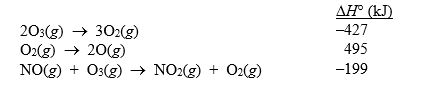 calculate H° for the reaction
NO(g) + O(g) NO2(g)
calculate H° for the reactionNO(g) + O(g) NO2(g)
Question
Question
Question
Question
Question

Unlock Deck
Sign up to unlock the cards in this deck!
Unlock Deck
Unlock Deck
1/85

Play

Full screen (f)
Deck 6: Thermochemistry: Energy Flow and Chemical Change
1
In a phase change of water between the liquid and the gas phases, 770.1 kJ of energy was released by the system. What was the product, and how much of it was formed in the phase change? (Data: H2O(l) H2O(g) H = 44.01 kJ/mol.)
A) 315 g water vapor was produced.
B) 17.5 g of water vapor was produced.
C) 17.5 mol of water vapor was produced.
D) 17.5 mol of liquid water was produced.
E) 17.5 g of liquid water was produced.
A) 315 g water vapor was produced.
B) 17.5 g of water vapor was produced.
C) 17.5 mol of water vapor was produced.
D) 17.5 mol of liquid water was produced.
E) 17.5 g of liquid water was produced.
17.5 mol of liquid water was produced.
2
Cold packs, whose temperatures are lowered when ammonium nitrate dissolves in water, are carried by athletic trainers when transporting ice is not possible. Which of the following is true of this reaction?
A) . H < 0, process is exothermic
B) . H > 0, process is exothermic
C) . H < 0, process is endothermic
D) . H > 0, process is endothermic
E) . H = 0, since cold packs are sealed
A) . H < 0, process is exothermic
B) . H > 0, process is exothermic
C) . H < 0, process is endothermic
D) . H > 0, process is endothermic
E) . H = 0, since cold packs are sealed
. H > 0, process is endothermic
3
A system which undergoes an adiabatic change and does work on the surroundings has
A) w < 0, E = 0.
B) w > 0, E > 0.
C) w > 0, E < 0.
D) w < 0, E > 0.
E) w < 0, E < 0.
A) w < 0, E = 0.
B) w > 0, E > 0.
C) w > 0, E < 0.
D) w < 0, E > 0.
E) w < 0, E < 0.
w < 0, E < 0.
4
A system that does no work but which receives heat from the surroundings has
A) q < 0, E > 0.
B) q > 0, E < 0.
C) q = E.
D) q = - E.
E) w = E.
A) q < 0, E > 0.
B) q > 0, E < 0.
C) q = E.
D) q = - E.
E) w = E.
Unlock Deck
Unlock for access to all 85 flashcards in this deck.
Unlock Deck
k this deck
5
A system delivers 1275 J of heat while the surroundings perform 855 J of work on it. Calculate E in J.
A) -2130 J
B) -420 J
C) 420 J
D) 2130 J
E) -1275 J
A) -2130 J
B) -420 J
C) 420 J
D) 2130 J
E) -1275 J
Unlock Deck
Unlock for access to all 85 flashcards in this deck.
Unlock Deck
k this deck
6
A system which undergoes an adiabatic change and has work done on it by the surroundings has
A) w = E.
B) w = - E.
C) w > 0, E < 0.
D) w < 0, E > 0.
E) w > E.
A) w = E.
B) w = - E.
C) w > 0, E < 0.
D) w < 0, E > 0.
E) w > E.
Unlock Deck
Unlock for access to all 85 flashcards in this deck.
Unlock Deck
k this deck
7
In which of the following processes is H = E ?
A) Two moles of ammonia gas are cooled from 325°C to 300°C at 1.2 atm.
B) One gram of water is vaporized at 100°C and 1 atm.
C) Two moles of hydrogen iodide gas react to form hydrogen gas and iodine gas in a 40-L container.
D) Calcium carbonate is heated to form calcium oxide and carbon dioxide in a container with variable volume.
E) One mole of solid carbon dioxide sublimes to the gas phase.
A) Two moles of ammonia gas are cooled from 325°C to 300°C at 1.2 atm.
B) One gram of water is vaporized at 100°C and 1 atm.
C) Two moles of hydrogen iodide gas react to form hydrogen gas and iodine gas in a 40-L container.
D) Calcium carbonate is heated to form calcium oxide and carbon dioxide in a container with variable volume.
E) One mole of solid carbon dioxide sublimes to the gas phase.
Unlock Deck
Unlock for access to all 85 flashcards in this deck.
Unlock Deck
k this deck
8
A system initially has an internal energy E of 501 J. It undergoes a process during which it releases 111 J of heat energy to the surroundings, and does work of 222 J. What is the final energy of the system, in J?
A) 168 J
B) 390 J
C) 612 J
D) 834 J
E) cannot be calculated without more information
A) 168 J
B) 390 J
C) 612 J
D) 834 J
E) cannot be calculated without more information
Unlock Deck
Unlock for access to all 85 flashcards in this deck.
Unlock Deck
k this deck
9
A system delivers 225 J of heat to the surroundings while delivering 645 J of work. Calculate the change in the internal energy, E, of the system.
A) -420 J
B) 420 J
C) -870 J
D) 870 J
E) -225 J
A) -420 J
B) 420 J
C) -870 J
D) 870 J
E) -225 J
Unlock Deck
Unlock for access to all 85 flashcards in this deck.
Unlock Deck
k this deck
10
Two solutions (the system), each of 25.0 mL volume and at 25.0°C, are mixed in a beaker. A reaction occurs between them, and the temperature rises to 35.0°C. After the products have equilibrated with the surroundings, the temperature is again 25.0°C and the total volume is 50.0 mL. No gases are involved in the reaction. Which one of the following relationships concerning the change from initial to final states (both at 25.0°C) is correct?
A) . E = 0
B) . H = 0
C) . E > 0
D) q = 0
E) w = 0
A) . E = 0
B) . H = 0
C) . E > 0
D) q = 0
E) w = 0
Unlock Deck
Unlock for access to all 85 flashcards in this deck.
Unlock Deck
k this deck
11
An ideal gas (the system) is contained in a flexible balloon at a pressure of 1 atm and is initially at a temperature of 20.°C. The surrounding air is at the same pressure, but its temperature is 25°C. When the system has equilibrated with its surroundings, both systems and surroundings are at 25°C and 1 atm. In changing from the initial to the final state, which one of the following relationships regarding the system is correct?
A) . E < 0
B) . E = 0
C) . H = 0
D) w > 0
E) q > 0
A) . E < 0
B) . E = 0
C) . H = 0
D) w > 0
E) q > 0
Unlock Deck
Unlock for access to all 85 flashcards in this deck.
Unlock Deck
k this deck
12
A system absorbs 21.6 kJ of heat while performing 6.9 kJ of work on the surroundings. If the initial internal energy, E, is 61.2 kJ, what is the final value of E?
A) 32.7 kJ
B) 46.5 kJ
C) 75.9 kJ
D) 82.8 kJ
E) 89.7 kJ
A) 32.7 kJ
B) 46.5 kJ
C) 75.9 kJ
D) 82.8 kJ
E) 89.7 kJ
Unlock Deck
Unlock for access to all 85 flashcards in this deck.
Unlock Deck
k this deck
13
The dissolution of barium hydroxide in water is an exothermic process. Which of the following statements is correct?
A) The enthalpy of solid barium hydroxide plus pure water is less than that of the solution, at the same temperature.
B) The enthalpy of solid barium hydroxide plus pure water is greater than that of the solution, at the same temperature.
C) The enthalpy of solid barium hydroxide plus pure water is the same as that of the solution, at the same temperature.
D) The temperature of the solution is lower than of the barium hydroxide and water before mixing.
E) When barium hydroxide dissolves in water, the system does work on the surroundings.
A) The enthalpy of solid barium hydroxide plus pure water is less than that of the solution, at the same temperature.
B) The enthalpy of solid barium hydroxide plus pure water is greater than that of the solution, at the same temperature.
C) The enthalpy of solid barium hydroxide plus pure water is the same as that of the solution, at the same temperature.
D) The temperature of the solution is lower than of the barium hydroxide and water before mixing.
E) When barium hydroxide dissolves in water, the system does work on the surroundings.
Unlock Deck
Unlock for access to all 85 flashcards in this deck.
Unlock Deck
k this deck
14
Which one of the following relationships is always correct?
A) potential energy + kinetic energy = constant
B) E = q + w
C) . E = H - P V
D) H = E + PV
E) . H = qv
A) potential energy + kinetic energy = constant
B) E = q + w
C) . E = H - P V
D) H = E + PV
E) . H = qv
Unlock Deck
Unlock for access to all 85 flashcards in this deck.
Unlock Deck
k this deck
15
A system expands from a volume of 1.00 L to 2.00 L against a constant external pressure of 1.00 atm. The work (w) done by the system, in J, is
A) 1.00 J.
B) 2.00 J.
C) 1.01 × 10² J.
D) 1.01 × 10⁵ J.
E) none of the above.
A) 1.00 J.
B) 2.00 J.
C) 1.01 × 10² J.
D) 1.01 × 10⁵ J.
E) none of the above.
Unlock Deck
Unlock for access to all 85 flashcards in this deck.
Unlock Deck
k this deck
16
A system that does no work but which transfers heat to the surroundings has
A) q < 0, E > 0.
B) q < 0, E < 0.
C) q > 0, E > 0.
D) q > 0, E < 0.
E) q < 0, E = 0.
A) q < 0, E > 0.
B) q < 0, E < 0.
C) q > 0, E > 0.
D) q > 0, E < 0.
E) q < 0, E = 0.
Unlock Deck
Unlock for access to all 85 flashcards in this deck.
Unlock Deck
k this deck
17
For which one of the following reactions will H be approximately (or exactly) equal to E?
A) H2(g) + Br2(g) 2HBr(g)
B) H2O(l) H2O(g)
C) CaCO3(s) CaO(s) + CO2(g)
D) 2H(g) + O(g) H2O(l)
E) CH4(g) + 2O2(g) CO2(g) + 2H2O(l)
A) H2(g) + Br2(g) 2HBr(g)
B) H2O(l) H2O(g)
C) CaCO3(s) CaO(s) + CO2(g)
D) 2H(g) + O(g) H2O(l)
E) CH4(g) + 2O2(g) CO2(g) + 2H2O(l)
Unlock Deck
Unlock for access to all 85 flashcards in this deck.
Unlock Deck
k this deck
18
A system contracts from an initial volume of 15.0 L to a final volume of 10.0 L under a constant external pressure of 0.800 atm. The value of w, in J, is
A) -4.0 J.
B) 4.0 J.
C) -405 J.
D) 405 J.
E) 4.05 × 10³ J.
A) -4.0 J.
B) 4.0 J.
C) -405 J.
D) 405 J.
E) 4.05 × 10³ J.
Unlock Deck
Unlock for access to all 85 flashcards in this deck.
Unlock Deck
k this deck
19
A system receives 575 J of heat and delivers 425 J of work. Calculate the change in the internal energy, E, of the system.
A) -150 J
B) 150 J
C) -1000 J
D) 1000 J
E) 575 J
A) -150 J
B) 150 J
C) -1000 J
D) 1000 J
E) 575 J
Unlock Deck
Unlock for access to all 85 flashcards in this deck.
Unlock Deck
k this deck
20
In which one of the following reactions would you expect H to be substantially greater than E (i.e., H > E)?
A) H2(g) + Br2(g) 2HBr(g)
B) CO2(s) CO2(g)
C) C2H2(g) + H2(g) C2H4(g)
D) H2O(s) H2O(l)
E) HCl(aq) + NaOH(aq) NaCl(aq) + H2O(l)
A) H2(g) + Br2(g) 2HBr(g)
B) CO2(s) CO2(g)
C) C2H2(g) + H2(g) C2H4(g)
D) H2O(s) H2O(l)
E) HCl(aq) + NaOH(aq) NaCl(aq) + H2O(l)
Unlock Deck
Unlock for access to all 85 flashcards in this deck.
Unlock Deck
k this deck
21
The specific heat capacity c of a metal is approximately related to its molar mass as follows: c × = 3R, where R is the universal gas constant, 8.314 J/mol.K. Use this relationship to identify the metal which has a specific heat capacity of 0.900 J/g.K.
A) Li
B) Sn
C) Ca
D) Al
E) U
as follows: c × = 3R, where R is the universal gas constant, 8.314 J/mol.K. Use this relationship to identify the metal which has a specific heat capacity of 0.900 J/g.K.A) Li
B) Sn
C) Ca
D) Al
E) U
Unlock Deck
Unlock for access to all 85 flashcards in this deck.
Unlock Deck
k this deck
22
A Snickers® candy bar contains 280 Calories, of which the fat content accounts for 120 Calories. What is the energy of the fat content, in kJ?
A) 5.0 × 10⁻¹ kJ
B) 29 kJ
C) 5.0 × 10² kJ
D) 1.2 × 10³ kJ
E) 5.0 × 10⁵ kJ
A) 5.0 × 10⁻¹ kJ
B) 29 kJ
C) 5.0 × 10² kJ
D) 1.2 × 10³ kJ
E) 5.0 × 10⁵ kJ
Unlock Deck
Unlock for access to all 85 flashcards in this deck.
Unlock Deck
k this deck
23
Galena is the ore from which elemental lead is extracted. In the first step of the extraction process, galena is heated in air to form lead(II) oxide.
2PbS(s) + 3O2(g) 2SO2(g) H = -827.4 kJ
What mass of galena is converted to lead oxide if 975 kJ of heat are liberated?
A) 203 g
B) 282 g
C) 406 g
D) 478 g
E) 564 g
2PbS(s) + 3O2(g) 2SO2(g) H = -827.4 kJ
What mass of galena is converted to lead oxide if 975 kJ of heat are liberated?
A) 203 g
B) 282 g
C) 406 g
D) 478 g
E) 564 g
Unlock Deck
Unlock for access to all 85 flashcards in this deck.
Unlock Deck
k this deck
24
A common laboratory reaction is the neutralization of an acid with a base. When 50.0 mL of 0.500 M HCl at 25.0°C is added to 50.0 mL of 0.500 M NaOH at 25.0°C in a coffee cup calorimeter, the temperature of the mixture rises to 28.2°C. What is the heat of reaction per mole of acid? Assume the mixture has a specific heat capacity of 4.18 J/(g·K) and that the densities of the reactant solutions are both 1.00 g/mL.
A) 670 J
B) 1300 J
C) 27 kJ
D) 54 kJ
E) > 100 kJ
A) 670 J
B) 1300 J
C) 27 kJ
D) 54 kJ
E) > 100 kJ
Unlock Deck
Unlock for access to all 85 flashcards in this deck.
Unlock Deck
k this deck
25
If, as a pioneer, you wished to warm your room by taking an object heated on top of a pot-bellied stove to it, which of the following 15-pound objects, each heated to 100°C, would be the best choice? The specific heat capacity (in J/(g·K)) for each substance is given in parentheses. Iron (0.450), copper (0.387), granite (0.79), gold (0.129), water (4.18).
A) iron
B) copper
C) granite
D) gold
E) water
A) iron
B) copper
C) granite
D) gold
E) water
Unlock Deck
Unlock for access to all 85 flashcards in this deck.
Unlock Deck
k this deck
26
A 275-g sample of nickel at 100.0°C is placed in 100.0 mL of water at 22.0°C. What is the final temperature of the water? Assume that no heat is lost to or gained from the surroundings. Specific heat capacity of nickel = 0.444 J/(g·K)
A) 39.6°C
B) 40.8°C
C) 61.0°C
D) 79.2°C
E) 82.4°C
A) 39.6°C
B) 40.8°C
C) 61.0°C
D) 79.2°C
E) 82.4°C
Unlock Deck
Unlock for access to all 85 flashcards in this deck.
Unlock Deck
k this deck
27
When Karl Kaveman adds chilled grog to his new granite mug, he removes 10.9 kJ of energy from the mug. If it has a mass of 625 g and was at 25°C, what is its new temperature? Specific heat capacity of granite = 0.79 J/(g·K)
A) 3°C
B) 14°C
C) 22°C
D) 47°C
E) none of the above
A) 3°C
B) 14°C
C) 22°C
D) 47°C
E) none of the above
Unlock Deck
Unlock for access to all 85 flashcards in this deck.
Unlock Deck
k this deck
28
Your favorite candy bar, Gummy Beakers, contains 1.2 × 10⁶ J of energy while your favorite soft drink, Bolt, contains 6.7 × 10⁵ J. If you eat two packs of Gummy Beakers a day and drink 3 cans of Bolt, what percent of your 2000 Calorie daily food intake is left for broccoli, beans, beef, etc.?
A) 53%
B) 47%
C) 27%
D) 11%
E) 0%
A) 53%
B) 47%
C) 27%
D) 11%
E) 0%
Unlock Deck
Unlock for access to all 85 flashcards in this deck.
Unlock Deck
k this deck
29
A backpacker collects snow at 0°C, and places it in a cooking pot on a camp stove. It takes 643 kJ of heat energy to melt the snow and bring the water to boiling. Assuming no heat loss, and neglecting the specific heat capacity of the pot, calculate the mass of snow that the backpacker collected. (Data: specific heat capacity of liquid water, c = 4.18 J/g.K; and: H2O(s) H2O(l) H = Hfusion = 6.02 kJ/mol)
A) 1.92 kg
B) 1.90 kg
C) 1.52 kg
D) 855 g
E) < 800 g
A) 1.92 kg
B) 1.90 kg
C) 1.52 kg
D) 855 g
E) < 800 g
Unlock Deck
Unlock for access to all 85 flashcards in this deck.
Unlock Deck
k this deck
30
The Starship Enterprise is caught in a time warp and Spock is forced to use the primitive techniques of the 20th century to determine the specific heat capacity of an unknown mineral. The 307-g sample was heated to 98.7°C and placed into a calorimeter containing 72.4 g of water at 23.6°C. The heat capacity of the calorimeter was 15.7 J/K. The final temperature in the calorimeter was 32.4°C. What is the specific heat capacity of the mineral?
A) 0.124 J/(g·K)
B) 0.131 J/(g·K)
C) 0.138 J/(g·K)
D) 0.145 J/(g·K)
E) none of the above
A) 0.124 J/(g·K)
B) 0.131 J/(g·K)
C) 0.138 J/(g·K)
D) 0.145 J/(g·K)
E) none of the above
Unlock Deck
Unlock for access to all 85 flashcards in this deck.
Unlock Deck
k this deck
31
Calcium hydroxide, which reacts with carbon dioxide to form calcium carbonate, was used by the ancient Romans as mortar in stone structures. The reaction for this process is Ca(OH)2(s) + CO2(g) CaCO3(s) + H2O(g) H = -69.1 kJ
What is the enthalpy change if 3.8 mol of calcium carbonate is formed?
A) -18 kJ
B) -69 kJ
C) -73 kJ
D) -260 kJ
E) none of the above
What is the enthalpy change if 3.8 mol of calcium carbonate is formed?
A) -18 kJ
B) -69 kJ
C) -73 kJ
D) -260 kJ
E) none of the above
Unlock Deck
Unlock for access to all 85 flashcards in this deck.
Unlock Deck
k this deck
32
Benzene is a starting material in the synthesis of nylon fibers and polystyrene (styrofoam). Its specific heat capacity is 1.74 J/(g·K). If 16.7 kJ of energy is absorbed by a 225-g sample of benzene at 20.0°C, what is its final temperature?
A) -22.7°C
B) 36.7°C
C) 42.7°C
D) 62.7°C
E) none of the above
A) -22.7°C
B) 36.7°C
C) 42.7°C
D) 62.7°C
E) none of the above
Unlock Deck
Unlock for access to all 85 flashcards in this deck.
Unlock Deck
k this deck
33
Calculate q when 28.6 g of water is heated from 22.0°C to 78.3°C.
A) 0.385 kJ
B) 1.61 kJ
C) 6.74 kJ
D) 9.37 kJ
E) 1.61 × 10³ kJ
A) 0.385 kJ
B) 1.61 kJ
C) 6.74 kJ
D) 9.37 kJ
E) 1.61 × 10³ kJ
Unlock Deck
Unlock for access to all 85 flashcards in this deck.
Unlock Deck
k this deck
34
The combustion of glucose (C6H12O6) with oxygen gas produces carbon dioxide and water. This process releases 2803 kJ per mole of glucose. When 3.00 mol of oxygen react in this way with glucose, what is the energy release in kcal? (Hint: Write a balanced equation for the combustion process.)
A) 223.5 kcal
B) 335.3 kcal
C) 1402 kcal
D) 2012 kcal
E) 5858 kcal
A) 223.5 kcal
B) 335.3 kcal
C) 1402 kcal
D) 2012 kcal
E) 5858 kcal
Unlock Deck
Unlock for access to all 85 flashcards in this deck.
Unlock Deck
k this deck
35
Natural gas, or methane, is an important fuel. Combustion of one mole of methane releases 802.3 kilojoules of energy. How much energy does that represent in kilocalories?
A) 1.92 × 10⁻¹ kcal
B) 1.92 × 10² kcal
C) 3.36 × 10³ kcal
D) 1.92 × 10⁵ kcal
E) 3.36 × 10⁶ kcal
A) 1.92 × 10⁻¹ kcal
B) 1.92 × 10² kcal
C) 3.36 × 10³ kcal
D) 1.92 × 10⁵ kcal
E) 3.36 × 10⁶ kcal
Unlock Deck
Unlock for access to all 85 flashcards in this deck.
Unlock Deck
k this deck
36
Ethylene glycol, used as a coolant in automotive engines, has a specific heat capacity of 2.42 J/(g·K). Calculate q when 3.65 kg of ethylene glycol is cooled from 132°C to 85°C.
A) -1900 kJ
B) -420 kJ
C) -99 kJ
D) -0.42 kJ
E) -4.2 × 10⁻⁶ kJ
A) -1900 kJ
B) -420 kJ
C) -99 kJ
D) -0.42 kJ
E) -4.2 × 10⁻⁶ kJ
Unlock Deck
Unlock for access to all 85 flashcards in this deck.
Unlock Deck
k this deck
37
A piece of copper metal is initially at 100.0°C. It is dropped into a coffee cup calorimeter containing 50.0 g of water at a temperature of 20.0°C. After stirring, the final temperature of both copper and water is 25.0°C. Assuming no heat losses, and that the specific heat (capacity) of water is 4.18 J/(g·K), what is the heat capacity of the copper in J/K?
A) 2.79 J/K
B) 3.33 J/K
C) 13.9 J/K
D) 209 J/K
E) none of the above
A) 2.79 J/K
B) 3.33 J/K
C) 13.9 J/K
D) 209 J/K
E) none of the above
Unlock Deck
Unlock for access to all 85 flashcards in this deck.
Unlock Deck
k this deck
38
What is the final temperature when 20.0 g of water at 25°C is mixed with 30.0 g of water at 80°C?
A) 35°C
B) 42°C
C) 53°C
D) 58°C
E) 70°C
A) 35°C
B) 42°C
C) 53°C
D) 58°C
E) 70°C
Unlock Deck
Unlock for access to all 85 flashcards in this deck.
Unlock Deck
k this deck
39
Which of the following is not a state function?
A) internal energy
B) volume
C) work
D) pressure
E) enthalpy
A) internal energy
B) volume
C) work
D) pressure
E) enthalpy
Unlock Deck
Unlock for access to all 85 flashcards in this deck.
Unlock Deck
k this deck
40
Sand is converted to pure silicon in a three step process. The third step is
SiCl4(g) + 2Mg(s) 2MgCl2(s) + Si(s) H = -625.6 kJ
What is the enthalpy change when 25.0 mol of silicon tetrachloride is converted to elemental silicon?
A) -25.0 kJ
B) -7820 kJ
C) -1.56 × 10⁴ kJ
D) -3.13 × 10⁴ kJ
E) none of the above
SiCl4(g) + 2Mg(s) 2MgCl2(s) + Si(s) H = -625.6 kJ
What is the enthalpy change when 25.0 mol of silicon tetrachloride is converted to elemental silicon?
A) -25.0 kJ
B) -7820 kJ
C) -1.56 × 10⁴ kJ
D) -3.13 × 10⁴ kJ
E) none of the above
Unlock Deck
Unlock for access to all 85 flashcards in this deck.
Unlock Deck
k this deck
41
The compound carbon suboxide, C3O2, is a gas at room temperature. Use the data supplied to calculate the heat of formation of carbon suboxide.
(Data: 2CO(g) + C(s) C3O2(g) H° = 127.3 kJ/mol
And: Hf° of CO(g) = -110.5 kJ/mol)
A) 116.8
B) -93.7
C) 227.8
D) -348.3
E) 93.7
(Data: 2CO(g) + C(s) C3O2(g) H° = 127.3 kJ/mol
And: Hf° of CO(g) = -110.5 kJ/mol)
A) 116.8
B) -93.7
C) 227.8
D) -348.3
E) 93.7
Unlock Deck
Unlock for access to all 85 flashcards in this deck.
Unlock Deck
k this deck
42
Consider the equation E = q + w
Explain fully the meaning of all three terms in the equation, and also the implied sign convention for q and w.
Explain fully the meaning of all three terms in the equation, and also the implied sign convention for q and w.
Unlock Deck
Unlock for access to all 85 flashcards in this deck.
Unlock Deck
k this deck
43
Starting from equations relating pressure to force and force to work, derive the relationship w = - P V, explaining the steps in your argument.
Unlock Deck
Unlock for access to all 85 flashcards in this deck.
Unlock Deck
k this deck
44
Calculate the H°rxn for the following reaction. ( H°f [AsH3(g)] = 66.4 kJ/mol; H°f [H3AsO4(aq)] = -904.6 kJ/mol; H°f [H2O(l)] = -285.8 kJ/mol)
H3AsO4(aq) + 4H2(g) AsH3(g) + 4H2O(l)
A) -1981.4 kJ
B) -685.2 kJ
C) -172.2 kJ
D) 172.2 kJ
E) 685.2 kJ
H3AsO4(aq) + 4H2(g) AsH3(g) + 4H2O(l)
A) -1981.4 kJ
B) -685.2 kJ
C) -172.2 kJ
D) 172.2 kJ
E) 685.2 kJ
Unlock Deck
Unlock for access to all 85 flashcards in this deck.
Unlock Deck
k this deck
45
Which one of the following statements about standard states is incorrect?
A) The standard state of a solid compound is the pure solid.
B) The standard state of a liquid compound is the pure liquid.
C) The standard state of a gaseous compound is the gas at a pressure of 1 atmosphere.
D) The standard state of an aqueous solute is a saturated solution in water.
E) The standard state of an element is the form in which it is stable at 1 atm and a specified temperature, usually 25°C.
A) The standard state of a solid compound is the pure solid.
B) The standard state of a liquid compound is the pure liquid.
C) The standard state of a gaseous compound is the gas at a pressure of 1 atmosphere.
D) The standard state of an aqueous solute is a saturated solution in water.
E) The standard state of an element is the form in which it is stable at 1 atm and a specified temperature, usually 25°C.
Unlock Deck
Unlock for access to all 85 flashcards in this deck.
Unlock Deck
k this deck
46
Which one of the following equations represents the formation reaction of CH3OH(l)?
A) C(g) + 2H2(g) + O2 (g) CH3OH(l)
B) C(g) + 4H(g) + O(g) CH3OH(l)
C) C(graphite) + 4H(g) + O(g) CH3OH(l)
D) C(diamond) + 4H(g) + O(g) CH3OH(l)
E) C(graphite) + 2H2(g) + O2(g) CH3OH(l)
A) C(g) + 2H2(g) +
O2 (g) CH3OH(l)B) C(g) + 4H(g) + O(g) CH3OH(l)
C) C(graphite) + 4H(g) + O(g) CH3OH(l)
D) C(diamond) + 4H(g) + O(g) CH3OH(l)
E) C(graphite) + 2H2(g) +
O2(g) CH3OH(l) Unlock Deck
Unlock for access to all 85 flashcards in this deck.
Unlock Deck
k this deck
47
Ethanol, C2H5OH, is being promoted as a clean fuel and is used as an additive in many gasoline mixtures. Calculate the H°rxn for the combustion of ethanol.
( H°f [C2H5OH(l)] = -277.7 kJ/mol; H°f [CO2(g)] = -393.5 kJ/mol; H°f [H2O(g)] = -241.8 kJ/mol)
A) -1234.7 kJ
B) -751.1 kJ
C) -357.6 kJ
D) 357.6 kJ
E) 1234.7 kJ
( H°f [C2H5OH(l)] = -277.7 kJ/mol; H°f [CO2(g)] = -393.5 kJ/mol; H°f [H2O(g)] = -241.8 kJ/mol)
A) -1234.7 kJ
B) -751.1 kJ
C) -357.6 kJ
D) 357.6 kJ
E) 1234.7 kJ
Unlock Deck
Unlock for access to all 85 flashcards in this deck.
Unlock Deck
k this deck
48
a. A gas sample absorbs 53 kJ of heat and does 18 kJ of work. Calculate the change in its internal energy.
b. A system expands against a constant pressure of 1.50 atm, from an initial volume of 1.00 L to a final volume of 10.0 L. Calculate the work (w) involved in this process, in kJ.
b. A system expands against a constant pressure of 1.50 atm, from an initial volume of 1.00 L to a final volume of 10.0 L. Calculate the work (w) involved in this process, in kJ.
Unlock Deck
Unlock for access to all 85 flashcards in this deck.
Unlock Deck
k this deck
49
Use the following data to calculate the standard heat (enthalpy) of formation, H°f , of manganese(IV) oxide, MnO2 (s).
2MnO2(s) 2MnO(s) + O2(g) H = 264 kJ
MnO2(s) + Mn(s) 2MnO(s) H = -240 kJ
A) -504 kJ
B) -372 kJ
C) -24 kJ
D) 24 kJ
E) 504 kJ
2MnO2(s) 2MnO(s) + O2(g) H = 264 kJ
MnO2(s) + Mn(s) 2MnO(s) H = -240 kJ
A) -504 kJ
B) -372 kJ
C) -24 kJ
D) 24 kJ
E) 504 kJ
Unlock Deck
Unlock for access to all 85 flashcards in this deck.
Unlock Deck
k this deck
50
An important step in the synthesis of nitric acid is the conversion of ammonia to nitric oxide. 4NH3(g) + 5O2(g) 4NO(g) + 6H2O(g)
Calculate H°rxn for this reaction.
H°f [NH3(g)] = -45.9 kJ/mol; H°f [NO(g)] = 90.3 kJ/mol; H°f [H2O(g)] = -241.8 kJ/mol
A) -906.0 kJ
B) -197.4 kJ
C) -105.6 kJ
D) 197.4 kJ
E) 906.0 kJ
Calculate H°rxn for this reaction.
H°f [NH3(g)] = -45.9 kJ/mol; H°f [NO(g)] = 90.3 kJ/mol; H°f [H2O(g)] = -241.8 kJ/mol
A) -906.0 kJ
B) -197.4 kJ
C) -105.6 kJ
D) 197.4 kJ
E) 906.0 kJ
Unlock Deck
Unlock for access to all 85 flashcards in this deck.
Unlock Deck
k this deck
51
Calculate the H°rxn for the following reaction. ( H°f [SiO2(s)] = -910.9 kJ/mol; H°f [SiCl4(g)] = -657.0 kJ/mol; H°f [HCl(g)] = -92.3 kJ/mol; H°f [H2O (g)] = -241.8 kJ/mol) SiO2(s) + 4HCl(g) SiCl4(g) + 2H2O(g)
A) -139.5 kJ
B) -137.4 kJ
C) -104.4 kJ
D) 104.4 kJ
E) 139.5 kJ
A) -139.5 kJ
B) -137.4 kJ
C) -104.4 kJ
D) 104.4 kJ
E) 139.5 kJ
Unlock Deck
Unlock for access to all 85 flashcards in this deck.
Unlock Deck
k this deck
52
Use Hess's Law to calculate the enthalpy change for the reaction
WO3(s) + 3H2(g) W(s) + 3H2O(g)
From the following data:
2W(s) + 3O2(g) 2WO3(s) H = -1685.4 kJ
2H2(g) + O2(g) 2H2O(g) H = -477.84 kJ
A) 125.9 kJ
B) 252.9 kJ
C) 364.9 kJ
D) 1207.6 kJ
E) none of the above
WO3(s) + 3H2(g) W(s) + 3H2O(g)
From the following data:
2W(s) + 3O2(g) 2WO3(s) H = -1685.4 kJ
2H2(g) + O2(g) 2H2O(g) H = -477.84 kJ
A) 125.9 kJ
B) 252.9 kJ
C) 364.9 kJ
D) 1207.6 kJ
E) none of the above
Unlock Deck
Unlock for access to all 85 flashcards in this deck.
Unlock Deck
k this deck
53
Calculate, in J, the work done by 10.0 g of CO2 when it sublimes against a pressure of 1.00 atm to form gaseous CO2 at 0.0°C. The volume of CO2(s) can be neglected; CO2(g) can be assumed to behave ideally. The process occurring is
CO2(s) CO2(g)
CO2(s) CO2(g)
Unlock Deck
Unlock for access to all 85 flashcards in this deck.
Unlock Deck
k this deck
54
Calculate the enthalpy change for the reaction NO(g) + O(g) NO2(g)
From the following data:
NO(g) + O3(g) NO2(g) + O2(g) H = -198.9 kJ
O3(g) 1.5O2(g) H = -142.3 kJ
O2(g) 2O(g) H = 495.0 kJ
A) -551.6 kJ
B) -304.1 kJ
C) 190.9 kJ
D) 153.8 kJ
E) 438.4 kJ
From the following data:
NO(g) + O3(g) NO2(g) + O2(g) H = -198.9 kJ
O3(g) 1.5O2(g) H = -142.3 kJ
O2(g) 2O(g) H = 495.0 kJ
A) -551.6 kJ
B) -304.1 kJ
C) 190.9 kJ
D) 153.8 kJ
E) 438.4 kJ
Unlock Deck
Unlock for access to all 85 flashcards in this deck.
Unlock Deck
k this deck
55
Which one of the following is a correct formation reaction?
A) C(diamond) C(graphite)
B) H2(g) + O(g) H2O(l)
C) C(graphite) + 4H(g) CH4(g)
D) 6C(graphite) + 6H2O(s) C6H12O6(s)
E) 2C(graphite) + 3H2(g) + O2(g) C2H5OH(l)
A) C(diamond) C(graphite)
B) H2(g) + O(g) H2O(l)
C) C(graphite) + 4H(g) CH4(g)
D) 6C(graphite) + 6H2O(s) C6H12O6(s)
E) 2C(graphite) + 3H2(g) +
O2(g) C2H5OH(l) Unlock Deck
Unlock for access to all 85 flashcards in this deck.
Unlock Deck
k this deck
56
Stoichiometric amounts of nitrogen gas and hydrogen gas react in a calorimeter to produce 5.00 g of ammonia gas. The calorimeter temperature rises 0.42°C. The calorimeter and water have a combined heat capacity of 32.16 kJ/K. Calculate the heat of formation of ammonia, Hf°, in kJ/mol. The formation reaction for ammonia is: 0.5N2(g) + 1.5H2(g) NH3(g).
A) -46 kJ/mol
B) -13.5 kJ/mol
C) -3.97 kJ/mol
D) 3.97 kJ/mol
E) 13.5 kJ/mol
A) -46 kJ/mol
B) -13.5 kJ/mol
C) -3.97 kJ/mol
D) 3.97 kJ/mol
E) 13.5 kJ/mol
Unlock Deck
Unlock for access to all 85 flashcards in this deck.
Unlock Deck
k this deck
57
The highly exothermic thermite reaction, in which aluminum reduces iron(III) oxide to elemental iron, has been used by railroad repair crews to weld rails together.
2Al(s) + Fe2O3(s) 2Fe(s) + Al2O3(s) H = -850 kJ
What mass of iron is formed when 725 kJ of heat are released?
A) 47 g
B) 65 g
C) 95 g
D) 112 g
E) 130 g
2Al(s) + Fe2O3(s) 2Fe(s) + Al2O3(s) H = -850 kJ
What mass of iron is formed when 725 kJ of heat are released?
A) 47 g
B) 65 g
C) 95 g
D) 112 g
E) 130 g
Unlock Deck
Unlock for access to all 85 flashcards in this deck.
Unlock Deck
k this deck
58
Nitric acid, which is among the top 15 chemicals produced in the United States, was first prepared over 1200 years ago by heating naturally occurring sodium nitrate (called saltpeter) with sulfuric acid and collecting the vapors produced. Calculate H°rxn for this reaction. H°f [NaNO3(s)] = -467.8 kJ/mol; H°f [NaHSO4(s)] = -1125.5 kJ/mol; H°f [H2SO4(l) = -814.0 kJ/mol; H°f [HNO3(g)] = -135.1 kJ/mol
NaNO3(s) + H2SO4(l) NaHSO4(s) + HNO3(g)
A) -644.2 kJ
B) -291.4 kJ
C) -21.2 kJ
D) 21.2 kJ
E) 644.2 kJ
NaNO3(s) + H2SO4(l) NaHSO4(s) + HNO3(g)
A) -644.2 kJ
B) -291.4 kJ
C) -21.2 kJ
D) 21.2 kJ
E) 644.2 kJ
Unlock Deck
Unlock for access to all 85 flashcards in this deck.
Unlock Deck
k this deck
59
Calculate the H°rxn for the decomposition of calcium carbonate to calcium oxide and carbon dioxide. H°f [CaCO3(s)] = -1206.9 kJ/mol; H°f [CaO(s)] = -635.1 kJ/mol; H°f [CO2(g)] = -393.5 kJ/mol
CaCO3(s) CaO(s) + CO2(g)
A) -2235.5 kJ
B) -1448.5 kJ
C) -178.3 kJ
D) 178.3 kJ
E) 2235.5 kJ
CaCO3(s) CaO(s) + CO2(g)
A) -2235.5 kJ
B) -1448.5 kJ
C) -178.3 kJ
D) 178.3 kJ
E) 2235.5 kJ
Unlock Deck
Unlock for access to all 85 flashcards in this deck.
Unlock Deck
k this deck
60
Which one of the following is not a correct formation reaction? (products are correct)
A) H2(g) + O(g) H2O(l)
B) H2(g) + Cl2(g) HCl(g)
C) 6C(graphite) + 3H2(g) C6H6(l)
D) C(graphite) C(diamond)
E) 6C(graphite) + 6H2(g) + 3O2(g) C6H12O6(s)
A) H2(g) + O(g) H2O(l)
B)
H2(g) + Cl2(g) HCl(g)C) 6C(graphite) + 3H2(g) C6H6(l)
D) C(graphite) C(diamond)
E) 6C(graphite) + 6H2(g) + 3O2(g) C6H12O6(s)
Unlock Deck
Unlock for access to all 85 flashcards in this deck.
Unlock Deck
k this deck
61
For a reaction in a sealed, rigid container, H is always greater than E.
Unlock Deck
Unlock for access to all 85 flashcards in this deck.
Unlock Deck
k this deck
62
For all processes, both q and w will have the same sign.
Unlock Deck
Unlock for access to all 85 flashcards in this deck.
Unlock Deck
k this deck
63
The only way in which a system can do work on the surroundings is by expansion against the external pressure.
Unlock Deck
Unlock for access to all 85 flashcards in this deck.
Unlock Deck
k this deck
64
Clearly state the thermodynamic standard state of
a. an element or compound.
b. a solute.
a. an element or compound.
b. a solute.
Unlock Deck
Unlock for access to all 85 flashcards in this deck.
Unlock Deck
k this deck
65
Although internal energy (E) is more fundamental and conceptually easier than enthalpy (H), in most chemical applications H is more relevant and useful than E. Why?
Unlock Deck
Unlock for access to all 85 flashcards in this deck.
Unlock Deck
k this deck
66
Diborane (B2H6) has been considered as a possible rocket fuel. Calculate H° for the reaction
B2H6(g) 2B(s) + 3H2(g)
using the following data: O2(g) H2O(g)
-242
B2H6(g) 2B(s) + 3H2(g)
using the following data:
O2(g) H2O(g)-242
Unlock Deck
Unlock for access to all 85 flashcards in this deck.
Unlock Deck
k this deck
67
The enthalpy (H) of liquid water is greater than that of the same quantity of ice at the same temperature.
Unlock Deck
Unlock for access to all 85 flashcards in this deck.
Unlock Deck
k this deck
68
The reaction
2NaOH(aq) + H2SO4(aq) Na2SO4(aq) + 2H2O(l)
was studied in a coffee cup calorimeter. 100. mL portions of 1.00 M aqueous NaOH and H2SO4, each at 24.0°C, were mixed. The maximum temperature achieved was 30.6°C. Neglect the heat capacity of the cup and the thermometer, and assume that the solution of products has a density of exactly 1 g/mL and a specific heat capacity of 4.18 J/(g·K).
a. Calculate the heat of reaction, q, in J.
b. Calculate H, the heat (enthalpy) of reaction, in kJ/mol of Na2SO4 produced.
2NaOH(aq) + H2SO4(aq) Na2SO4(aq) + 2H2O(l)
was studied in a coffee cup calorimeter. 100. mL portions of 1.00 M aqueous NaOH and H2SO4, each at 24.0°C, were mixed. The maximum temperature achieved was 30.6°C. Neglect the heat capacity of the cup and the thermometer, and assume that the solution of products has a density of exactly 1 g/mL and a specific heat capacity of 4.18 J/(g·K).
a. Calculate the heat of reaction, q, in J.
b. Calculate H, the heat (enthalpy) of reaction, in kJ/mol of Na2SO4 produced.
Unlock Deck
Unlock for access to all 85 flashcards in this deck.
Unlock Deck
k this deck
69
A mass of 1.250 g of benzoic acid (C7H6O2) was completely combusted in a bomb calorimeter. If the heat capacity of the calorimeter was 10.134 kJ/K and the heat of combustion of benzoic acid is -3226 kJ/mol, calculate (to three decimal places) the temperature increase that should have occurred in the apparatus.
Unlock Deck
Unlock for access to all 85 flashcards in this deck.
Unlock Deck
k this deck
70
a. Starting from the equation H = E + PV, show how the relationship H = qp is derived. Clearly indicate any necessary assumptions or conditions.
b. In one sentence, state in full what is meant by the equation: H = qp.
b. In one sentence, state in full what is meant by the equation: H = qp.
Unlock Deck
Unlock for access to all 85 flashcards in this deck.
Unlock Deck
k this deck
71
a. State Hess's Law.
b. Use the H° data given below to calculate H° for the reaction:
b. Use the H° data given below to calculate H° for the reaction:
Unlock Deck
Unlock for access to all 85 flashcards in this deck.
Unlock Deck
k this deck
72
H does not depend on the path of a reaction, but E does.
Unlock Deck
Unlock for access to all 85 flashcards in this deck.
Unlock Deck
k this deck
73
In a reaction with high energy reactants and low energy products, q is negative.
Unlock Deck
Unlock for access to all 85 flashcards in this deck.
Unlock Deck
k this deck
74
Different chemical bonds have different potential energies.
Unlock Deck
Unlock for access to all 85 flashcards in this deck.
Unlock Deck
k this deck
75
Given the following data: calculate H° for the reaction
NO(g) + O(g) NO2(g)
calculate H° for the reactionNO(g) + O(g) NO2(g)
Unlock Deck
Unlock for access to all 85 flashcards in this deck.
Unlock Deck
k this deck
76
a. Explain fully what is meant by the term "state function."
b. (i) Give two examples of thermodynamic quantities which state functions.
(ii) Give two examples of thermodynamic quantities which are not state functions.
b. (i) Give two examples of thermodynamic quantities which state functions.
(ii) Give two examples of thermodynamic quantities which are not state functions.
Unlock Deck
Unlock for access to all 85 flashcards in this deck.
Unlock Deck
k this deck
77
For all processes, both q and E will have the same sign.
Unlock Deck
Unlock for access to all 85 flashcards in this deck.
Unlock Deck
k this deck
78
a. Write a balanced equation for the combustion of benzene, C6H6(l) in oxygen.
b. The standard heat of combustion of benzene is -3271 kJ/mol. Calculate its standard heat of formation, H°f , given the data:
H°f [CO2(g)] = -394 kJ; H°f [H2O(l)] = -286 kJ
b. The standard heat of combustion of benzene is -3271 kJ/mol. Calculate its standard heat of formation, H°f , given the data:
H°f [CO2(g)] = -394 kJ; H°f [H2O(l)] = -286 kJ
Unlock Deck
Unlock for access to all 85 flashcards in this deck.
Unlock Deck
k this deck
79
When 1.00 g of solid NH4Cl is dissolved in 25.00 g of water contained in a coffee cup calorimeter, both reagents initially being at 25.0°C, the temperature falls to 22.4°C. Assuming that the heat capacity of the ammonium chloride solution is 4.18 J/(g·K), calculate the heat (enthalpy) of solution of NH4Cl, (a) in J/g and (b) in kJ/mol.
Unlock Deck
Unlock for access to all 85 flashcards in this deck.
Unlock Deck
k this deck
80
a. Define, or explain fully what is meant by the standard enthalpy of formation of a substance, H°f..
b. What is the standard state of the element oxygen?
c. Write down in full the formation reaction for liquid ethanol, C2H5OH(l). The equation should be balanced and should indicate the physical state of each substance.
b. What is the standard state of the element oxygen?
c. Write down in full the formation reaction for liquid ethanol, C2H5OH(l). The equation should be balanced and should indicate the physical state of each substance.
Unlock Deck
Unlock for access to all 85 flashcards in this deck.
Unlock Deck
k this deck
Unlock Deck
Unlock for access to all 85 flashcards in this deck.






